

ASTM F1925-22
(Specification)Standard Specification for Semi-Crystalline Poly(lactide) Polymer and Copolymer Resins for Surgical Implants
General Information
- Abstract
ABSTRACT
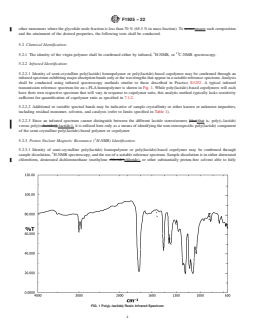
This specification covers virgin poly(L-lactic acid) resin (PLLA resin) intended for use in surgical implants. This specification does not cover stereoisomeric compositions based on various D, L, or DL copolymer ratios. This specification addresses material characteristics of virgin poly(L-lactic acid) resin and does not apply to packaged and sterilized finished implants fabricated from this material. The virgin polymer shall be a homopolymer of L-lactide with the prescribed density. The molecular mass of the virgin polymer shall be indicated by relative solution viscosity (in chloroform). In addition, the weight average molecular mass and molecular mass distributions may be determined by gel permeation chromatography The virgin polymer shall be identified as a polylactide by infrared or 1H-NMR spectroscopy. Typical infrared transmission and 1H-NMR spectra are shown. The virgin polymer shall have a specific optical rotation (in dichloromethane) and residual monomer content within the prescribe values, and shall conform to the chemical and physical property requirements specified for: residual solvent, residual water, residual tin, heavy metals, and sulfated ash. The following test methods shall be used: (1) Karl-Fischer titration and (2) atomic absorption-emission (AA) spectroscopy or inductively coupled plasma (ICP) spectroscopy. Considerations for biocompatibility of the material from a human implant perspective is also given.
SCOPE
1.1 This specification covers virgin semi-crystalline poly(l-lactide) or poly(d-lactide) homopolymer resins intended for use in surgical implants. This specification also covers semi-crystalline resins of l-lactide copolymerized with other bioabsorbable monomers including, but not limited to, glycolide, d-lactide, and dl-lactide. The poly(l-lactide) or poly(d-lactide) based homopolymers and copolymers covered by this specification possess lactide segments of sufficient length to allow potential for their crystallization upon annealing.
1.2 Since poly(glycolide) is commonly abbreviated as PGA for poly(glycolic acid) and poly(lactide) is commonly abbreviated as PLA for poly(lactic acid), these polymers are commonly referred to as PGA, PLA, and PLA:PGA resins for the hydrolytic byproducts to which they respectively degrade. PLA is a term that carries no stereoisomeric specificity and therefore encompasses both the amorphous atactic/syndiotactic dl-lactide based polymers and copolymers as well as the isotactic d-PLA and l-PLA moieties, each of which carries potential for crystallization. Inclusion of stereoisomeric specificity within the lactic acid based acronyms results in the following: poly(l-lactide) as PlLA for poly(l-lactic acid), poly(d-lactide) as PdLA for poly(d-lactic acid), and poly(dl-lactide) as PdlLA for poly(dl-lactic acid).
1.3 This specification is applicable to lactide-based polymers or copolymers that possess isotactic polymeric segments sufficient in size to carry potential for lactide-based crystallization. Such polymers typically possess nominal mole fractions that equal or exceed 50 % l-lactide. This specification is particularly applicable to isotactic-lactide based block copolymers or to polymers or copolymers synthesized from combinations of d-lactide and l-lactide that differ by more than 1.5 total mole percent (1.5 % of total moles). This specification is not applicable to lactide-co-glycolide copolymers with glycolide mole fractions greater than or equal to 70 % (65.3 % in mass fraction), which are covered by Specification F2313. This specification is not applicable to amorphous polymers or copolymers synthesized from combinations of d-lactide and l-lactide that differ by less than 1.5 total mole percent (1.5 % of total moles) as covered by Specification F2579.
1.4 This specification covers virgin semi-crystalline poly(lactide)-based resins able to be fully solvated at 30 °C by either methylene chloride (dichloromethane) or chloroform (tr...
- Status
- Published
- Publication Date
- 31-Jan-2022
- Technical Committee
- F04 - Medical and Surgical Materials and Devices
- Drafting Committee
- F04.11 - Polymeric Materials
Buy Documents
ASTM F1925-22 - Standard Specification for Semi-Crystalline Poly(lactide) Polymer and Copolymer Resins for Surgical Implants
REDLINE ASTM F1925-22 - Standard Specification for Semi-Crystalline Poly(lactide) Polymer and Copolymer Resins for Surgical Implants
Overview
ASTM F1925-22 is a comprehensive industry standard that specifies requirements for virgin semi-crystalline poly(lactide) (PLA) polymer and copolymer resins intended for use in surgical implants. Developed and maintained by ASTM International, this standard ensures consistent quality and performance for raw materials used in medical device manufacturing-particularly in absorbable, bioresorbable, or degradable implantable medical devices. ASTM F1925-22 describes the properties, identification protocols, and quality assurance measures for semi-crystalline resins based on poly(L-lactide), poly(D-lactide), and specific lactide-containing copolymers, helping manufacturers and suppliers meet regulatory and clinical demands for patient safety and device efficacy.
Key Topics
- Material Scope: Applies to virgin, semi-crystalline homopolymers and copolymers intended for processing into surgical implants. Specifically, it covers poly(L-lactide), poly(D-lactide), and copolymers with other bioabsorbable monomers (such as glycolide, D-lactide, and DL-lactide), provided they retain sufficient isotactic segments for crystallization.
- Material Exclusions: Does not apply to final fabricated, packaged, or sterilized implants. Excludes copolymers with high glycolide content (≥70%) and amorphous forms with minor differences in stereochemistry (covered by other standards such as ASTM F2313 and F2579).
- Chemical and Physical Properties: Outlines property requirements for density, molecular mass/weight, solution viscosity, copolymer composition, specific optical rotation, and impurities (residual monomer, solvents, water, metals, catalyst).
- Analytical Methods: Specifies use of validated techniques-such as infrared (IR) spectroscopy, 1H-NMR spectroscopy, gel permeation chromatography, gas chromatography, and Karl-Fischer titration-for material identification and purity assessment.
- Biocompatibility Considerations: Addresses the need for clinical evaluation in finished implants rather than raw resin, pointing users to ISO 10993 and related guidelines for biological response testing.
- Documentation and Packaging: Requires detailed supplier certification and compliance declarations with each shipment, including lot tracking, test data, and safe packaging to prevent moisture ingress.
Applications
- Surgical Implants: Poly(lactide) and copolymer resins specified by ASTM F1925-22 are used as base materials for resorbable medical devices, such as sutures, fixation devices, bone screws, plates, and scaffolds for tissue engineering.
- Medical Device Manufacturing: The standard guides raw resin selection and material qualification in processes such as injection molding, extrusion, and machining of implantable products.
- Quality Assurance and Regulatory Compliance: Adherence to ASTM F1925-22 supports medical device manufacturers in meeting global regulatory requirements for material traceability, documentation, and consistent performance.
- Research and Development: Provides a foundation for the R&D of new biodegradable polymers and composite materials within the medical device sector.
Related Standards
Organizations and professionals working with bioabsorbable polymers for surgical implants should also consult these key standards:
- ASTM F2313: Specification for poly(glycolide) and poly(glycolide-co-lactide) resins with high glycolide content.
- ASTM F2579: Specification for amorphous poly(lactide) and poly(lactide-co-glycolide) resins.
- ISO 10993: Biological evaluation of medical devices (for biocompatibility testing).
- USP <232>, <233>: Guidelines for elemental impurities in pharmaceuticals and polymers.
- ANSI/ISO/ASQ 13485: Quality management systems specific to medical devices.
- 21 CFR 820: U.S. FDA Quality System Regulation for medical device manufacturing.
By following ASTM F1925-22 and its related standards, manufacturers of absorbable medical implants can ensure material quality, product safety, and compliance with regulatory expectations-driving innovation and reliability in the field of medical polymers and devices.
Relations
- Effective Date
- 01-Oct-2023
- Effective Date
- 01-Oct-2023
- Effective Date
- 01-Nov-2019
- Effective Date
- 15-Dec-2018
- Effective Date
- 15-Dec-2018
- Effective Date
- 01-May-2018
- Effective Date
- 01-Dec-2016
- Effective Date
- 01-Dec-2016
- Effective Date
- 01-Apr-2016
- Effective Date
- 01-May-2015
- Effective Date
- 15-Aug-2014
- Effective Date
- 15-Aug-2014
- Effective Date
- 01-Aug-2014
- Effective Date
- 01-Apr-2014
- Effective Date
- 15-Feb-2014
Buy Documents
ASTM F1925-22 - Standard Specification for Semi-Crystalline Poly(lactide) Polymer and Copolymer Resins for Surgical Implants
REDLINE ASTM F1925-22 - Standard Specification for Semi-Crystalline Poly(lactide) Polymer and Copolymer Resins for Surgical Implants
Get Certified
Connect with accredited certification bodies for this standard

BSI Group
BSI (British Standards Institution) is the business standards company that helps organizations make excellence a habit.

TÜV Rheinland
TÜV Rheinland is a leading international provider of technical services.

TÜV SÜD
TÜV SÜD is a trusted partner of choice for safety, security and sustainability solutions.
Sponsored listings
Frequently Asked Questions
ASTM F1925-22 is a technical specification published by ASTM International. Its full title is "Standard Specification for Semi-Crystalline Poly(lactide) Polymer and Copolymer Resins for Surgical Implants". This standard covers: ABSTRACT This specification covers virgin poly(L-lactic acid) resin (PLLA resin) intended for use in surgical implants. This specification does not cover stereoisomeric compositions based on various D, L, or DL copolymer ratios. This specification addresses material characteristics of virgin poly(L-lactic acid) resin and does not apply to packaged and sterilized finished implants fabricated from this material. The virgin polymer shall be a homopolymer of L-lactide with the prescribed density. The molecular mass of the virgin polymer shall be indicated by relative solution viscosity (in chloroform). In addition, the weight average molecular mass and molecular mass distributions may be determined by gel permeation chromatography The virgin polymer shall be identified as a polylactide by infrared or 1H-NMR spectroscopy. Typical infrared transmission and 1H-NMR spectra are shown. The virgin polymer shall have a specific optical rotation (in dichloromethane) and residual monomer content within the prescribe values, and shall conform to the chemical and physical property requirements specified for: residual solvent, residual water, residual tin, heavy metals, and sulfated ash. The following test methods shall be used: (1) Karl-Fischer titration and (2) atomic absorption-emission (AA) spectroscopy or inductively coupled plasma (ICP) spectroscopy. Considerations for biocompatibility of the material from a human implant perspective is also given. SCOPE 1.1 This specification covers virgin semi-crystalline poly(l-lactide) or poly(d-lactide) homopolymer resins intended for use in surgical implants. This specification also covers semi-crystalline resins of l-lactide copolymerized with other bioabsorbable monomers including, but not limited to, glycolide, d-lactide, and dl-lactide. The poly(l-lactide) or poly(d-lactide) based homopolymers and copolymers covered by this specification possess lactide segments of sufficient length to allow potential for their crystallization upon annealing. 1.2 Since poly(glycolide) is commonly abbreviated as PGA for poly(glycolic acid) and poly(lactide) is commonly abbreviated as PLA for poly(lactic acid), these polymers are commonly referred to as PGA, PLA, and PLA:PGA resins for the hydrolytic byproducts to which they respectively degrade. PLA is a term that carries no stereoisomeric specificity and therefore encompasses both the amorphous atactic/syndiotactic dl-lactide based polymers and copolymers as well as the isotactic d-PLA and l-PLA moieties, each of which carries potential for crystallization. Inclusion of stereoisomeric specificity within the lactic acid based acronyms results in the following: poly(l-lactide) as PlLA for poly(l-lactic acid), poly(d-lactide) as PdLA for poly(d-lactic acid), and poly(dl-lactide) as PdlLA for poly(dl-lactic acid). 1.3 This specification is applicable to lactide-based polymers or copolymers that possess isotactic polymeric segments sufficient in size to carry potential for lactide-based crystallization. Such polymers typically possess nominal mole fractions that equal or exceed 50 % l-lactide. This specification is particularly applicable to isotactic-lactide based block copolymers or to polymers or copolymers synthesized from combinations of d-lactide and l-lactide that differ by more than 1.5 total mole percent (1.5 % of total moles). This specification is not applicable to lactide-co-glycolide copolymers with glycolide mole fractions greater than or equal to 70 % (65.3 % in mass fraction), which are covered by Specification F2313. This specification is not applicable to amorphous polymers or copolymers synthesized from combinations of d-lactide and l-lactide that differ by less than 1.5 total mole percent (1.5 % of total moles) as covered by Specification F2579. 1.4 This specification covers virgin semi-crystalline poly(lactide)-based resins able to be fully solvated at 30 °C by either methylene chloride (dichloromethane) or chloroform (tr...
ABSTRACT This specification covers virgin poly(L-lactic acid) resin (PLLA resin) intended for use in surgical implants. This specification does not cover stereoisomeric compositions based on various D, L, or DL copolymer ratios. This specification addresses material characteristics of virgin poly(L-lactic acid) resin and does not apply to packaged and sterilized finished implants fabricated from this material. The virgin polymer shall be a homopolymer of L-lactide with the prescribed density. The molecular mass of the virgin polymer shall be indicated by relative solution viscosity (in chloroform). In addition, the weight average molecular mass and molecular mass distributions may be determined by gel permeation chromatography The virgin polymer shall be identified as a polylactide by infrared or 1H-NMR spectroscopy. Typical infrared transmission and 1H-NMR spectra are shown. The virgin polymer shall have a specific optical rotation (in dichloromethane) and residual monomer content within the prescribe values, and shall conform to the chemical and physical property requirements specified for: residual solvent, residual water, residual tin, heavy metals, and sulfated ash. The following test methods shall be used: (1) Karl-Fischer titration and (2) atomic absorption-emission (AA) spectroscopy or inductively coupled plasma (ICP) spectroscopy. Considerations for biocompatibility of the material from a human implant perspective is also given. SCOPE 1.1 This specification covers virgin semi-crystalline poly(l-lactide) or poly(d-lactide) homopolymer resins intended for use in surgical implants. This specification also covers semi-crystalline resins of l-lactide copolymerized with other bioabsorbable monomers including, but not limited to, glycolide, d-lactide, and dl-lactide. The poly(l-lactide) or poly(d-lactide) based homopolymers and copolymers covered by this specification possess lactide segments of sufficient length to allow potential for their crystallization upon annealing. 1.2 Since poly(glycolide) is commonly abbreviated as PGA for poly(glycolic acid) and poly(lactide) is commonly abbreviated as PLA for poly(lactic acid), these polymers are commonly referred to as PGA, PLA, and PLA:PGA resins for the hydrolytic byproducts to which they respectively degrade. PLA is a term that carries no stereoisomeric specificity and therefore encompasses both the amorphous atactic/syndiotactic dl-lactide based polymers and copolymers as well as the isotactic d-PLA and l-PLA moieties, each of which carries potential for crystallization. Inclusion of stereoisomeric specificity within the lactic acid based acronyms results in the following: poly(l-lactide) as PlLA for poly(l-lactic acid), poly(d-lactide) as PdLA for poly(d-lactic acid), and poly(dl-lactide) as PdlLA for poly(dl-lactic acid). 1.3 This specification is applicable to lactide-based polymers or copolymers that possess isotactic polymeric segments sufficient in size to carry potential for lactide-based crystallization. Such polymers typically possess nominal mole fractions that equal or exceed 50 % l-lactide. This specification is particularly applicable to isotactic-lactide based block copolymers or to polymers or copolymers synthesized from combinations of d-lactide and l-lactide that differ by more than 1.5 total mole percent (1.5 % of total moles). This specification is not applicable to lactide-co-glycolide copolymers with glycolide mole fractions greater than or equal to 70 % (65.3 % in mass fraction), which are covered by Specification F2313. This specification is not applicable to amorphous polymers or copolymers synthesized from combinations of d-lactide and l-lactide that differ by less than 1.5 total mole percent (1.5 % of total moles) as covered by Specification F2579. 1.4 This specification covers virgin semi-crystalline poly(lactide)-based resins able to be fully solvated at 30 °C by either methylene chloride (dichloromethane) or chloroform (tr...
ASTM F1925-22 is classified under the following ICS (International Classification for Standards) categories: 11.040.40 - Implants for surgery, prosthetics and orthotics; 83.080.20 - Thermoplastic materials. The ICS classification helps identify the subject area and facilitates finding related standards.
ASTM F1925-22 has the following relationships with other standards: It is inter standard links to ASTM E473-23b, ASTM E1142-23b, ASTM D5296-19, ASTM F2579-18, ASTM F2313-18, ASTM D4603-18, ASTM F2902-16, ASTM F2902-16e1, ASTM F748-16, ASTM E1142-15, ASTM E473-14, ASTM E1142-14b, ASTM E2977-14, ASTM E1142-14a, ASTM E1142-14. Understanding these relationships helps ensure you are using the most current and applicable version of the standard.
ASTM F1925-22 is available in PDF format for immediate download after purchase. The document can be added to your cart and obtained through the secure checkout process. Digital delivery ensures instant access to the complete standard document.
Standards Content (Sample)
This international standard was developed in accordance with internationally recognized principles on standardization established in the Decision on Principles for the
Development of International Standards, Guides and Recommendations issued by the World Trade Organization Technical Barriers to Trade (TBT) Committee.
Designation: F1925 −22
Standard Specification for
Semi-Crystalline Poly(lactide) Polymer and Copolymer
Resins for Surgical Implants
This standard is issued under the fixed designation F1925; the number immediately following the designation indicates the year of
original adoption or, in the case of revision, the year of last revision. A number in parentheses indicates the year of last reapproval. A
superscript epsilon (´) indicates an editorial change since the last revision or reapproval.
1. Scope massfraction),whicharecoveredbySpecificationF2313.This
specification is not applicable to amorphous polymers or
1.1 This specification covers virgin semi-crystalline poly(L-
copolymers synthesized from combinations of D-lactide and
lactide)orpoly(D-lactide)homopolymerresinsintendedforuse
L-lactide that differ by less than 1.5 total mole percent (1.5 %
in surgical implants. This specification also covers semi-
of total moles) as covered by Specification F2579.
crystalline resins of L-lactide copolymerized with other bioab-
sorbable monomers including, but not limited to, glycolide,
1.4 This specification covers virgin semi-crystalline
D-lactide, and DL-lactide. The poly(L-lactide) or poly(D-lactide)
poly(lactide)-based resins able to be fully solvated at 30 °C by
based homopolymers and copolymers covered by this specifi-
either methylene chloride (dichloromethane) or chloroform
cation possess lactide segments of sufficient length to allow
(trichloromethane). This specification is not applicable to
potential for their crystallization upon annealing.
lactide:glycolide copolymers that possess glycolide segments
sufficient in size to deliver potential for glycolide-based
1.2 Since poly(glycolide) is commonly abbreviated as PGA
crystallization, thereby requiring fluorinated solvents for com-
for poly(glycolic acid) and poly(lactide) is commonly abbre-
plete dissolution under room temperature conditions (see
viated as PLA for poly(lactic acid), these polymers are com-
Specification F2313).
monly referred to as PGA, PLA, and PLA:PGA resins for the
hydrolyticbyproductstowhichtheyrespectivelydegrade.PLA
1.5 Within this specification, semi-crystallinity within the
isatermthatcarriesnostereoisomericspecificityandtherefore
resin is defined by the presence of a DSC (differential scanning
encompasses both the amorphous atactic/syndiotactic DL-
calorimetry) crystalline endotherm after annealing above the
lactide based polymers and copolymers as well as the isotactic
glass transition temperature. While other copolymeric seg-
D-PLAand L-PLAmoieties, each of which carries potential for
ments may also crystallize upon annealing (for example,
crystallization. Inclusion of stereoisomeric specificity within
glycolide), specific characterization of crystalline structures
the lactic acid based acronyms results in the following:
other than those formed by lactide are outside the scope of this
poly(L-lactide) as PLLA for poly(L-lactic acid), poly(D-lactide)
specification.
as PDLAfor poly(D-lactic acid), and poly(DL-lactide) as PDLLA
1.6 This specification addresses material characteristics of
for poly(DL-lactic acid).
the virgin semi-crystalline poly(lactide)-based resins intended
1.3 This specification is applicable to lactide-based poly-
foruseinsurgicalimplantsanddoesnotapplytopackagedand
mers or copolymers that possess isotactic polymeric segments
sterilized finished implants fabricated from these materials.
sufficient in size to carry potential for lactide-based crystalli-
1.7 As with any material, some characteristics may be
zation. Such polymers typically possess nominal mole frac-
altered by processing techniques (such as molding, extrusion,
tions that equal or exceed 50 % L-lactide. This specification is
machining, assembly, sterilization, and so forth) required for
particularly applicable to isotactic-lactide based block copoly-
the production of a specific part or device. Therefore, proper-
mers or to polymers or copolymers synthesized from combi-
ties of fabricated forms of this resin should be evaluated
nations of D-lactide and L-lactide that differ by more than 1.5
independently using appropriate test methods to ensure safety
total mole percent (1.5 % of total moles). This specification is
and efficacy.
not applicable to lactide-co-glycolide copolymers with gly-
colide mole fractions greater than or equal to 70 % (65.3 % in
1.8 Biocompatibility testing is not a requirement since this
specification is not intended to cover fabricated devices.
1.9 The values stated in SI units are to be regarded as
This specification is under the jurisdiction of ASTM Committee F04 on
standard. No other units of measurement are included in this
Medical and Surgical Materials and Devices and is the direct responsibility of
Subcommittee F04.11 on Polymeric Materials. standard.
Current edition approved Feb. 1, 2022. Published February 2022. Originally
1.10 This standard does not purport to address all of the
approved in 1998. Last previous edition approved in 2017 as F1925 – 17. DOI:
10.1520/F1925-22. safety concerns, if any, associated with its use. It is the
Copyright © ASTM International, 100 Barr Harbor Drive, PO Box C700, West Conshohocken, PA 19428-2959. United States
F1925 − 22
responsibility of the user of this standard to establish appro- tions Greater Than or Equal to 70 % Glycolide
priate safety, health, and environmental practices and deter- F2579 Specification for Amorphous Poly(lactide) and
mine the applicability of regulatory limitations prior to use. Poly(lactide-co-glycolide) Resins for Surgical Implants
1.11 This international standard was developed in accor- F2902 Guide for Assessment of Absorbable Polymeric Im-
dance with internationally recognized principles on standard- plants
ization established in the Decision on Principles for the
2.2 ANSI Standards:
Development of International Standards, Guides and Recom-
ANSI/ISO/ASQ Q9000-2000 Quality Management
mendations issued by the World Trade Organization Technical
Systems—Fundamentals and Vocabulary
Barriers to Trade (TBT) Committee.
ANSI/ISO/ASQ Q9001-2000 Quality Management
Systems—Requirements
2. Referenced Documents
ANSI/ISO/ASQ 13485 Medical Devices—Quality Manage-
ment Systems—Requirements for Regulatory Purposes
2.1 ASTM Standards:
D1505 Test Method for Density of Plastics by the Density-
2.3 ISO Standards:
Gradient Technique
ISO 80000-9 Quantities and Units—Part 9: Physical chem-
D2857 Practice for Dilute Solution Viscosity of Polymers
istry and molecular physics
D3417 Test Method for Enthalpies of Fusion and Crystalli-
ISO 10993 Biological Evaluation of Medical Devices
zation of Polymers by Differential Scanning Calorimetry
ISO 11357 Plastics—Differential Scanning Calorimetry
(DSC) (Withdrawn 2004)
(DSC)
D3418 Test Method for Transition Temperatures and En-
2.4 Code of Federal Regulations:
thalpies of Fusion and Crystallization of Polymers by
21 CFR 820 United States Code of Federal Regulations,
Differential Scanning Calorimetry
Title 21—Food and Drugs Services, Part 820—Quality
D4603 Test Method for Determining Inherent Viscosity of
System Regulation
Poly(Ethylene Terephthalate) (PET) by Glass Capillary
2.5 United States Pharmacopeia:
Viscometer
USP, 26th Edition United States Pharmacopeia
D5296 Test Method for Molecular Weight Averages and
USP <232> Elemental Impurities—Limits
Molecular Weight Distribution of Polystyrene by High
USP <233> Elemental Impurities—Procedure
Performance Size-Exclusion Chromatography
USP <781> Physical Tests—Optical Rotation
E473 Terminology Relating to Thermal Analysis and Rhe-
USP <788> Particulate Matter in Injections
ology 8
2.6 NIST Publication:
E793 Test Method for Enthalpies of Fusion and Crystalliza-
NIST Special Publication SP811 Guide for the Use of the
tion by Differential Scanning Calorimetry
International System of Units (SI)
E794 TestMethodforMeltingAndCrystallizationTempera-
2.7 Other Documents:
tures By Thermal Analysis
ICH Q3C(R5) International Conference on Harmonisation
E967 Test Method for Temperature Calibration of Differen-
ofTechnicalRequirementsforRegistrationofPharmaceu-
tial Scanning Calorimeters and Differential Thermal Ana-
ticals for Human Use, Quality Guideline: Impurities:
lyzers
Residual Solvents
E968 Practice for Heat Flow Calibration of Differential
ICH Q3D(R4) International Conference on Harmonisation
Scanning Calorimeters
ofTechnicalRequirementsforRegistrationofPharmaceu-
E1142 Terminology Relating to Thermophysical Properties
ticals for Human Use: Guideline for Elemental Impurities
E1252 Practice for General Techniques for Obtaining Infra-
red Spectra for Qualitative Analysis
3. Terminology
E1356 Test Method for Assignment of the Glass Transition
3.1 Definitions:
Temperatures by Differential Scanning Calorimetry
E1994 Practice for Use of Process Oriented AOQL and
LTPD Sampling Plans
Available fromAmerican National Standards Institute (ANSI), 25 W. 43rd St.,
E2977 PracticeforMeasuringandReportingPerformanceof
4th Floor, New York, NY 10036, http://www.ansi.org.
Available from International Organization for Standardization (ISO), ISO
Fourier-Transform Nuclear Magnetic Resonance (FT-
Central Secretariat, BIBC II, Chemin de Blandonnet 8, CP 401, 1214 Vernier,
NMR) Spectrometers for Liquid Samples
Geneva, Switzerland, http://www.iso.org.
F748 PracticeforSelectingGenericBiologicalTestMethods
AvailablefromU.S.GovernmentPrintingOfficeSuperintendentofDocuments,
for Materials and Devices 732 N. Capitol St., NW, Mail Stop: SDE, Washington, DC 20401, http://
www.access.gpo.gov.
F2313 Specification for Poly(glycolide) and Poly(glycolide-
Available from U.S. Pharmacopeia, 12601 Twinbrook Pkwy., Rockville, MD
co-lactide) Resins for Surgical Implants with Mole Frac-
20852orthroughhttp://www.usp.org/products/USPNF/.Thestandardswillbelisted
by appropriate USP citation number. Succeeding USP editions alternately may be
referenced.
2 8
For referenced ASTM standards, visit the ASTM website, www.astm.org, or Available from National Institute of Standards and Technology (NIST), 100
contact ASTM Customer Service at service@astm.org. For Annual Book of ASTM Bureau Dr., Stop 1070, Gaithersburg, MD 20899-1070, at http://physics.nist.gov/
Standards volume information, refer to the standard’s Document Summary page on cuu/Units/bibliography.html.
the ASTM website. Available from ICH Secretariat, c/o IFPMA, 30 rue de St-Jean, P.O. Box 758,
The last approved version of this historical standard is referenced on 1211 Geneva 13, Switzerland. Available online at http://www.ich.org/LOB/media/
www.astm.org. MEDIA423.pdf.
F1925 − 22
3.1.1 virgin polymer, n—the initially delivered form of a tion with glycolide or other monomers where the glycolide
polymer as synthesized from its monomers and prior to any mole fraction is less than 70 % (65.3 % in mass fraction). To
processing or fabrication into a medical device.
ensure such composition and the attainment of the desired
properties, the following tests shall be conducted.
4. Materials and Manufacture
5.2 Chemical Identification:
4.1 All raw monomer components and other materials
5.2.1 The identity of the virgin polymer shall be confirmed
contacting either the raw monomer(s) or resin product shall be
1 13
either by infrared, H-NMR, or C-NMR spectroscopy.
of a quality suitable to allow use of such resin in the
5.2.2 Infrared Identification:
manufacture of an implantable medical product. Such quality
includes adequate control of particles and other potential
5.2.2.1 Identity of semi-crystalline poly(lactide) homopoly-
contaminants that may affect either the toxicity of or the cell
mer or poly(lactide)-based copolymer may be confirmed
response to the as-implanted or degrading final product.
through an infrared spectrum exhibiting major absorption
bands only at the wavelengths that appear in a suitable
4.2 All polymer manufacturing (including monomer
reference spectrum.Analysis shall be conducted using infrared
handling, synthesis, pelletization/grinding, and all subsequent
spectroscopy methods similar to those described in Practice
handling) shall be undertaken under conditions suitable to
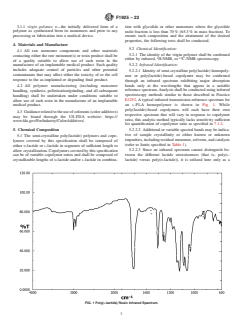
E1252. A typical infrared transmission reference spectrum for
allow use of such resin in the manufacture of an implantable
medical product. an L-PLA homopolymer is shown in Fig. 1. While
poly(lactide)-based copolymers will each have their own
4.3 Guidancerelatedtotheuseofcolorants(coloradditives)
respective spectrum that will vary in response to copolymer
may be found through the US-FDA website: https://
ratio, this analytic method typically lacks sensitivity sufficient
www.fda.gov/ForIndustry/ColorAdditives/.
for quantification of copolymer ratio as specified in 7.1.2.
5. Chemical Composition
5.2.2.2 Additional or variable spectral bands may be indica-
tive of sample crystallinity or either known or unknown
5.1 The semi-crystalline poly(lactide) polymers and copo-
impurities, including residual monomer, solvents, and catalysts
lymers covered by this specification shall be composed of
(refer to limits specified in Table 1).
either D-lactide or L-lactide in segments of sufficient length to
allow crystallization. Copolymers covered by this specification 5.2.2.3 Since an infrared spectrum cannot distinguish be-
tween the different lactide stereoisomers (that is, poly(L-
can be of variable copolymer ratios and shall be composed of
crystallizable lengths of D-lactide and/or L-lactide in combina- lactide) versus poly(D-lactide)), it is utilized here only as a
FIG. 1 Poly(L-lactide) Resin Infrared Spectrum
F1925 − 22
TABLE 1 Physical/Chemical Property Requirements for Virgin Semi-Crystalline Poly(lactide) Homopolymers and Poly(lactide)-Based
Copolymer Resins
Total Total Solvent Individual Solvent Elemental
(Optional) Residual
Residual Combination Residual(s) and Impurities Copolymer
Analyte Residual Catalyst Specific Rotation
Monomer, Residual(s) Applicable ICH (except Ratio
Water (%) (in ppm)
(%) (in ppm) Limit(s) (in ppm) catalyst)
Report 155° to 160°; (– for L-lactide; +
A
<2.0 % Report both for all #0.5 % Report per ±3 % of target
Requirement <1000 ppm conformance for D-lactide; copolymers propor-
B D
(by mass)
solvent(s) utilized (by mass) USP <233> (by mole)
C
per USP <232> tionate; see 5.3)
A
Up to 3 % if deemed acceptable by the purchaser (see 5.5.1).
B
Utilizing a moisture determination method agreed upon by the supplier and purchaser.
C
See 5.7.3.
D
See 5.7.4 and Note 4.
means of identifying the non-stereospecific poly(lactide) com- 5.2.4.1 Identity of semi-crystalline poly(lactide) homopoly-
ponent of the semi-crystalline poly(lactide)-based polymer or mer or poly(lactide)-based copolymer may be confirmed in a
copolymer. solid state through C-NMR spectroscopy and the use of a
5.2.3 Proton Nuclear Magnetic Resonance ( H-NMR) Iden- suitable reference spectrum.Analysis shall be conducted using
tification: methods similar to those described in Practice E2977.
5.2.3.1 Identity of semi-crystalline poly(lactide) homopoly- 5.2.4.2 Additional spectral bands may be indicative of
mer or poly(lactide)-based copolymer may be confirmed known or unknown impurities, including residual solvents and
through sample dissolution, H-NMR spectroscopy, and the catalysts (refer to the limits specified in Table 1).
use of a suitable reference spectrum. Sample dissolution is in
5.3 Specific Rotation:
either deuterated chloroform, deuterated dichloromethane
5.3.1 Virgin poly(L-lactide) or poly(D-lactide) homopoly-
(methylene chloride), or other substantially proton-free solvent
mersshallhaveaspecificrotationof–155°to–160°and+155°
able to fully solvate the specimen without inducing competing
to +160°, respectively, when measured in either chloroform or
spectral bands. Analysis shall be conducted using methods
methylene chloride at 20 °C using a polarimetry method equal
similar to those described in Practice E2977. A typical proton
to or equivalent to the Optical Rotation procedure described in
NMR reference spectrum for an L-PLA homopolymer (with
USP <781>. Block copolymers of poly(L-lactide:D-lactide)
residual lactide monomer peak noted) is shown in Fig. 2.
maypossessareducedlevelofspecificrotationproportionedto
5.2.3.2 Additional spectral bands may be indicative of
the copolymerization ratio. In no situation shall a resin covered
known or unknown impurities, including residual monomer,
by this specification possess a specific rotation value of less
solvents, and catalysts (refer to the limits specified in Table 1).
than 2.5 (that is, between –2.5 and +2.5), which is considered
5.2.4 Carbon-13 Nuclear Magnetic Resonance ( C-NMR)
to be indicative of an amorphous polymer covered under
Identification:
Specification F2579.
5.4 Molar Mass:
NOTE 1—The term molecular weight (abbreviated MW) is obsolete and
should be replaced by the SI (Système Internationale) equivalent of either
relative molecular mass (M ), which reflects the dimensionless ratio of the
r
mass of a single molecule to an atomic mass unit (see ISO 80000-9), or
molar mass (M), which refers to the mass of a mole of a substance and is
typically expressed as grams/mole. For polymers and other
macromolecules, use of the symbols M , M , and M continue, referring
w n z
to mass-average molar mass, number-average molar mass, and z-average
molar mass, respectively. For more information regarding proper utiliza-
tion of SI units, see NIST Special Publication SP811.
5.4.1 The molar mass of the virgin polymer shall be
indicated by inherent viscosity in dilute solution (IV). In
addition to inherent viscosity (but not in place of), mass
average molar mass and molar mass distributions may be
determined by gel permeation chromatography (GPC) accord-
ing to Test Method D5296, but using chloroform,
dichloromethane, or hexafluoroisopropanol (HFIP) and appro-
priate calibration standards.
NOTE2—Molarmasscalibrationstandards(forexample,polystyreneor
polymethylmethacrylate) provide relative values only, and are not to be
confused with an absolute determination of a lactide-based polymer’s
molar mass.
5.4.2 Determine the inherent viscosity of the polymer,
FIG. 2 Poly(L-lactide) Resin H-NMR Spectrum preferentially in chloroform at 30 °C, using procedures similar
F1925 − 22
to those described in Practice D2857 and Test Method D4603. guidelinehasbeenestablishedforautilizedsolvent,anentryof
Determination at a lower temperature of 25 °C is allowable, “noICHguidanceavailable”shallbereportedinlieuofalimit.
provided the utilized equipment delivers the required thermal
5.6.2 To minimize the potential for toxic interaction of
control and, if requested by the purchaser, an experimentally
solvent combinations, cumulative Total Solvent Combination
supported 30 °C equivalent concentration-appropriate extrapo-
Residuals shall be limited to 1000 ppm (refer to the limit
lated result is also reported within the supplied certification. If
specified in Table 1). This limit carries the effect of allowing
the required sample of the subject copolymer ratio does not
ICH Q3C quality guidelines when a single solvent system is
fully dissolve in chloroform, alternatively utilize either dichlo-
utilized and less than 1000 ppm when combinations of more
romethane (methylene chloride) or HFIP as the dissolution
than one solvent are utilized (regardless of individual solvent
solvent. Note that any incomplete sample dissolution, precipi-
toxicity).
tation from solution, or the formation of gels will produce
5.7 Elemental Impurities:
inconsistency and variation in observed drop times.
5.7.1 The significance of elemental impurities within an
NOTE 3—The IV test duration for each sample should be minimized to
absorbablepolymerisultimatelydependentonthedimensional
reduce risk of resin concentration changes due to evaporative loss of
characteristics of the final product and the rate of release of
solvent.
those initially interstitial elements into the surrounding tissue
5.4.3 Inherent viscosity is determined utilizing the follow-
and extracelluar fluid. Thus, any risk assessment of such
ing:
impurities will be dependent on the final product design and
intended application. Consequently, this raw material (not final
ln t/t v ln t/t
~ ! ~ !
o o
IV 5 or (1)
device) standard provides for appropriate reporting of elemen-
w C
tal impurity values, but does not mandate any specific perfor-
where:
mance requirements. More detailed and pharmaceutical-
IV = inherent viscosity (at 30 °C in dL/g),
oriented guidance regarding the appropriate means for both
T = efflux time in seconds for diluted solution,
monitoring and assessing relevant elemental impurities within
t = efflux time in seconds for source solvent,
o
a final product can be found in USP <232> and <233> and in
W = mass of polymer being diluted (in grams),
theICHHarmonisedGuidelineforElementalImpurities,Q3D.
V = dilution volume in deciliters (Note: 1 dL = 100 mL),
5.7.2 Determine the concentration of the respective elemen-
and
tal impurities within the absorbable polymer by utilizing
C = concentration of dilute solution (w/v).
inductively coupled plasma mass spectroscopy (ICP-MS) or
5.4.4 Resin concentration shall be 0.5 % w⁄v or less. When
inductively coupled plasma atomic or optical emission spec-
reporting results identify the solvent utilized, analyte
troscopy (ICP-AES or ICP-OES) or an equivalent alternative
concentration, and analysis temperature.
method as described in USP <233>. The specific 24 different
elementalimpuritiesofinterestareoutlinedinbothUSP<232>
5.5 Residual Monomer:
and in Table A.2.2 of the ICH Harmonised Guideline for
5.5.1 The virgin polymer shall have a combined total
Elemental Impurities, Q3D (Dec 2014). Both of these docu-
residual monomer content less than or equal to 2.0 % in mass
ments include risk-based approaches toward the assessment
fraction. Residual monomer levels up to 3 % are acceptable if
and control of elemental impurities.
deemedbythepurchasertobesuitablefortheintendedend-use
5.7.3 Except for elements intentionally added as catalysts,
application.Alternatively, a purchaser may require a monomer
assess the obtained results for compliance with the parenteral
contentsignificantlylessthan2 %toaddressprocessingand/or
concentration limits described within the Individual Compo-
intended end-use requirements (see Section S1—
nent Option of USP <232>, Table 3 (derived from ICH Q3D,
Biocompatibility).
Option 1, Table A.2.2). If all listed elements, except for those
5.5.2 Determine the mass fraction of residual monomer by
added as catalysts, can be ensured to be maintained within the
gas chromatography, HPLC, H-NMR spectroscopy (using
parenteral concentration – individual component option limits,
deuterated chloroform, deuterated dichloromethane, or other
theresinconformstoUSP<232>(exceptcatalyst).Ifanylisted
substantially proton-free solvent able to fully solvate the
element (other than added catalyst) cannot be controlled to be
specimen), or other suitably sensitive analytic method as
maintained within the described USP <232> limits, the resin
agreed upon by the supplier and purchaser.
does not conform with USP <232> (except catalyst) and the
5.6 Residual Solvents:
concentration (in ppm, per USP <233> or equivalent) of each
5.6.1 If any solvent is utilized in any resin manufacturing or
uncontrolled element is to be both monitored
...
This document is not an ASTM standard and is intended only to provide the user of an ASTM standard an indication of what changes have been made to the previous version. Because
it may not be technically possible to adequately depict all changes accurately, ASTM recommends that users consult prior editions as appropriate. In all cases only the current version
of the standard as published by ASTM is to be considered the official document.
Designation: F1925 − 17 F1925 − 22
Standard Specification for
Semi-Crystalline Poly(lactide) Polymer and Copolymer
Resins for Surgical Implants
This standard is issued under the fixed designation F1925; the number immediately following the designation indicates the year of
original adoption or, in the case of revision, the year of last revision. A number in parentheses indicates the year of last reapproval. A
superscript epsilon (´) indicates an editorial change since the last revision or reapproval.
1. Scope
1.1 This specification covers virgin semi-crystalline poly(L-lactide) or poly(D-lactide) homopolymer resins intended for use in
surgical implants. This specification also covers semi-crystalline resins of L-lactide copolymerized with other bioabsorbable
monomers including, but not limited to, glycolide, D-lactide, and DL-lactide. The poly(L-lactide) or poly(D-lactide) based
homopolymers and copolymers covered by this specification possess lactide segments of sufficient length to allow potential for
their crystallization upon annealing.
1.2 Since poly(glycolide) is commonly abbreviated as PGA for poly(glycolic acid) and poly(lactide) is commonly abbreviated as
PLA for poly(lactic acid), these polymers are commonly referred to as PGA, PLA, and PLA:PGA resins for the hydrolytic
byproducts to which they respectively degrade. PLA is a term that carries no stereoisomeric specificity and therefore encompasses
both the amorphous atactic/syndiotactic DL-lactide based polymers and copolymers as well as the isotactic D-PLA and L-PLA
moieties, each of which carries potential for crystallization. Inclusion of stereoisomeric specificity within the lactic acid based
acronyms results in the following: poly(L-lactide) as PLLA for poly(L-lactic acid), poly(D-lactide) as PDLA for poly(D-lactic acid),
and poly(DL-lactide) as PDLLA for poly(DL-lactic acid).
1.3 This specification is applicable to lactide-based polymers or copolymers that possess isotactic polymeric segments sufficient
in size to carry potential for lactide-based crystallization. Such polymers typically possess nominal mole fractions that equal or
exceed 50 % L-lactide. This specification is particularly applicable to isotactic-lactide based block copolymers or to polymers or
copolymers synthesized from combinations of D-lactide and L-lactide that differ by more than 1.5 total mole percent (1.5 % of total
moles). This specification is not applicable to lactide-co-glycolide copolymers with glycolide mole fractions greater than or equal
to 70 % (65.3 % in mass fraction), which are covered by Specification F2313. This specification is not applicable to amorphous
polymers or copolymers synthesized from combinations of D-lactide and L-lactide that differ by less than 1.5 total mole percent
(1.5 % of total moles) as covered by Specification F2579.
1.4 This specification covers virgin semi-crystalline poly(lactide)-based resins able to be fully solvated at 30°C30 °C by either
methylene chloride (dichloromethane) or chloroform (trichloromethane). This specification is not applicable to lactide:glycolide
copolymers that possess glycolide segments sufficient in size to deliver potential for glycolide-based crystallization, thereby
requiring fluorinated solvents for complete dissolution under room temperature conditions (see Specification F2313).
1.5 Within this specification, semi-crystallinity within the resin is defined by the presence of a DSC (differential scanning
calorimetry) crystalline endotherm after annealing above the glass transition temperature. While other copolymeric segments may
This specification is under the jurisdiction of ASTM Committee F04 on Medical and Surgical Materials and Devices and is the direct responsibility of Subcommittee
F04.11 on Polymeric Materials.
Current edition approved Dec. 15, 2017Feb. 1, 2022. Published January 2018February 2022. Originally approved in 1998. Last previous edition approved in 20092017
as F1925 – 09.F1925 – 17. DOI: 10.1520/F1925-17.10.1520/F1925-22.
Copyright © ASTM International, 100 Barr Harbor Drive, PO Box C700, West Conshohocken, PA 19428-2959. United States
F1925 − 22
also crystallize upon annealing (for example, glycolide), specific characterization of crystalline structures other than those formed
by lactide are outside the scope of this specification.
1.6 This specification addresses material characteristics of the virgin semi-crystalline poly(lactide) based poly(lactide)-based
resins intended for use in surgical implants and does not apply to packaged and sterilized finished implants fabricated from these
materials.
1.7 As with any material, some characteristics may be altered by processing techniques (such as molding, extrusion, machining,
assembly, sterilization, and so forth) required for the production of a specific part or device. Therefore, properties of fabricated
forms of this resin should be evaluated independently using appropriate test methods to assureensure safety and efficacy.
1.8 Biocompatibility testing is not a requirement since this specification is not intended to cover fabricated devices.
1.9 The values stated in SI units are to be regarded as standard. No other units of measurement are included in this standard.
1.10 This standard does not purport to address all of the safety concerns, if any, associated with its use. It is the responsibility
of the user of this standard to establish appropriate safety, health, and environmental practices and determine the applicability of
regulatory limitations prior to use.
1.11 This international standard was developed in accordance with internationally recognized principles on standardization
established in the Decision on Principles for the Development of International Standards, Guides and Recommendations issued
by the World Trade Organization Technical Barriers to Trade (TBT) Committee.
2. Referenced Documents
2.1 ASTM Standards:
D1505 Test Method for Density of Plastics by the Density-Gradient Technique
D2857 Practice for Dilute Solution Viscosity of Polymers
D3417 Test Method for Enthalpies of Fusion and Crystallization of Polymers by Differential Scanning Calorimetry (DSC)
(Withdrawn 2004)
D3418 Test Method for Transition Temperatures and Enthalpies of Fusion and Crystallization of Polymers by Differential
Scanning Calorimetry
D4603 Test Method for Determining Inherent Viscosity of Poly(Ethylene Terephthalate) (PET) by Glass Capillary Viscometer
D5296 Test Method for Molecular Weight Averages and Molecular Weight Distribution of Polystyrene by High Performance
Size-Exclusion Chromatography
E473 Terminology Relating to Thermal Analysis and Rheology
E793 Test Method for Enthalpies of Fusion and Crystallization by Differential Scanning Calorimetry
E794 Test Method for Melting And Crystallization Temperatures By Thermal Analysis
E967 Test Method for Temperature Calibration of Differential Scanning Calorimeters and Differential Thermal Analyzers
E968 Practice for Heat Flow Calibration of Differential Scanning Calorimeters
E1142 Terminology Relating to Thermophysical Properties
E1252 Practice for General Techniques for Obtaining Infrared Spectra for Qualitative Analysis
E1356 Test Method for Assignment of the Glass Transition Temperatures by Differential Scanning Calorimetry
E1994 Practice for Use of Process Oriented AOQL and LTPD Sampling Plans
E2977 Practice for Measuring and Reporting Performance of Fourier-Transform Nuclear Magnetic Resonance (FT-NMR)
Spectrometers for Liquid Samples
F748 Practice for Selecting Generic Biological Test Methods for Materials and Devices
F2313 Specification for Poly(glycolide) and Poly(glycolide-co-lactide) Resins for Surgical Implants with Mole Fractions Greater
Than or Equal to 70 % Glycolide
F2579 Specification for Amorphous Poly(lactide) and Poly(lactide-co-glycolide) Resins for Surgical Implants
F2902 Guide for Assessment of Absorbable Polymeric Implants
2.2 ANSI Standards:
ANSI/ISO/ASQ Q9000-2000 Quality Management Systems – Fundamentals Systems—Fundamentals and Vocabulary
ANSI/ISO/ASQ Q9001-2000 Quality Management Systems – RequirementsSystems—Requirements
For referenced ASTM standards, visit the ASTM website, www.astm.org, or contact ASTM Customer Service at service@astm.org. For Annual Book of ASTM Standards
volume information, refer to the standard’s Document Summary page on the ASTM website.
The last approved version of this historical standard is referenced on www.astm.org.
Available from American National Standards Institute (ANSI), 25 W. 43rd St., 4th Floor, New York, NY 10036, http://www.ansi.org.
F1925 − 22
ANSI/ISO/ASQ 13485 Medical Devices—Quality Management Systems—Requirements for Regulatory Purposes
2.3 ISO Standards:
ISO 80000-9 Quantities and units – Part Units—Part 9: Physical chemistry and molecular physics
ISO 10993 Biological Evaluation of Medical Devices
ISO 11357 Plastics—Differential Scanning Calorimetry (DSC)
2.4 Code of Federal Regulations:
21 CFR 820 United States Code of Federal Regulations, Title 21—Food and Drugs Services, Part 820—Quality System
Regulation
2.5 United States Pharmacopeia:
USP, 26th Edition United States Pharmacopeia:
USP <232> Elemental Impurities – LimitsImpurities—Limits
USP <233> Elemental Impurities – ProcedureImpurities—Procedure
USP <781> Physical Tests – Optical Tests—Optical Rotation
USP <788> Particulate Matter in Injections
2.6 NIST Publication:
NIST Special Publication SP811 Guide for the Use of the International System of Units (SI)
2.7 Other Document:Documents:
ICH Q3C(R5) International Conference on Harmonisation of Technical Requirements for Registration of Pharmaceuticals for
Human Use, Quality Guideline: Impurities: Residual Solvents
ICH Q3D(R4) International Conference on Harmonisation of Technical Requirements for Registration of Pharmaceuticals for
Human Use: Guideline for Elemental Impurities
3. Terminology
3.1 Definitions:
3.1.1 virgin polymer, n—the initially delivered form of a polymer as synthesized from its monomers and prior to any processing
or fabrication into a medical device.
4. Materials and Manufacture
4.1 All raw monomer components and other materials contacting either the raw monomer(s) or resin product shall be of a quality
suitable to allow use of such resin in the manufacture of an implantable medical product. Such quality includes adequate control
of particles and other potential contaminants that may affect either the toxicity of or the cell response to the as-implanted or
degrading final product.
4.2 All polymer manufacturing (including monomer handling, synthesis, pelletization/grindingpelletization/grinding, and all
subsequent handling) shall be undertaken under conditions suitable to allow use of such resin in the manufacture of an implantable
medical product.
4.3 Guidance related to the use of colorants (color additives) may be found through the US -FDA US-FDA website:
https://www.fda.gov/ForIndustry/ColorAdditives/.
5. Chemical Composition
5.1 The semi-crystalline poly(lactide) polymers and copolymers covered by this specification shall be composed of either D-lactide
or L-lactide in segments of sufficient length to allow crystallization. Copolymers covered by this specification can be of variable
copolymer ratios and shall be composed of crystallizable lengths of D-lactide and/or L-lactide in combination with glycolide or
Available from International Organization for Standardization (ISO), ISO Central Secretariat, BIBC II, Chemin de Blandonnet 8, CP 401, 1214 Vernier, Geneva,
Switzerland, http://www.iso.org.
Available from U.S. Government Printing Office Superintendent of Documents, 732 N. Capitol St., NW, Mail Stop: SDE, Washington, DC 20401, http://
www.access.gpo.gov.
Available from U.S. Pharmacopeia, 12601 Twinbrook Pkwy., Rockville, MD 20852 or through http://www.usp.org/products/USPNF/. The standards will be listed by
appropriate USP citation number. Succeeding USP editions alternately may be referenced.
Available from National Institute of Standards and Technology (NIST), 100 Bureau Dr., Stop 1070, Gaithersburg, MD 20899-1070, at http://physics.nist.gov/cuu/Units/
bibliography.html.
Available from ICH Secretariat, c/o IFPMA, 30 rue de St-Jean, P.O. Box 758, 1211 Geneva 13, Switzerland. Available online at http://www.ich.org/LOB/media/
MEDIA423.pdf.
F1925 − 22
other monomers where the glycolide mole fraction is less than 70 % (65.3 % in mass fraction). To assureensure such composition
and the attainment of the desired properties, the following tests shall be conducted.
5.2 Chemical Identification:
1 13
5.2.1 The identity of the virgin polymer shall be confirmed either by infrared, H-NMR, or C-NMR spectroscopy.
5.2.2 Infrared Identification:
5.2.2.1 Identity of semi-crystalline poly(lactide) homopolymer or poly(lactide)-based copolymer may be confirmed through an
infrared spectrum exhibiting major absorption bands only at the wavelengths that appear in a suitable reference spectrum. Analysis
shall be conducted using infrared spectroscopy methods similar to those described in Practice E1252. A typical infrared
transmission reference spectrum for an L-PLA homopolymer is shown in Fig. 1. While poly(lactide)-based copolymers will each
have their own respective spectrum that will vary in response to copolymer ratio, this analytic method typically lacks sensitivity
sufficient for quantification of copolymer ratio as specified in 7.1.2.
5.2.2.2 Additional or variable spectral bands may be indicative of sample crystallinity or either known or unknown impurities,
including residual monomer, solvents, and catalysts (refer to limits specified in Table 1).
5.2.2.3 Since an infrared spectrum cannot distinguish between the different lactide stereoisomers [that(that is, poly(L-lactide)
versus poly(D-lactide)],-lactide)), it is utilized here only as a means of identifying the non-stereospecific poly(lactide) component
of the semi-crystalline poly(lactide)-based polymer or copolymer.
5.2.3 Proton Nuclear Magnetic Resonance ( H-NMR) Identification:
5.2.3.1 Identity of semi-crystalline poly(lactide) homopolymer or poly(lactide)-based copolymer may be confirmed through
sample dissolution, H-NMR spectroscopy, and the use of a suitable reference spectrum. Sample dissolution is in either deuterated
chloroform, deuterated dichloromethane (methylene chloride)chloride), or other substantially proton-free solvent able to fully
FIG. 1 Poly(L-lactide) Resin Infrared Spectrum
F1925 − 22
TABLE 1 Physical/Chemical Property Requirements for Virgin Semi-Crystalline Poly(lactide)
Homopolymers and Poly(lactide)-basedPoly(lactide)-Based Copolymer Resins
Total Total Solvent Individual Solvent (Optional) Elemental
Residual
Residual Combination Residual(s) and Residual Impurities Copolymer Specific
Analyte Catalyst
Monomer, Residual(s) Applicable ICH Water (except Ratio Rotation
(in ppm)
(%) (in ppm) Limit(s) (in ppm) (%) catalyst)
Report 155° to 160°;
Report
A
Report both for all #0.5 % conformance ±3 % of target (– for L-lactide; + for D-lactide;
<2.0 %
Requirement <1000 ppm per
B
(by mass) solvent(s) utilized (by mass) per (by mole) copolymers proportionate; see
D
USP <233>
C
USP <232> 5.3)
A
Up to 3 % if deemed acceptable by the purchaser (see 5.5.1).
B
Utilizing a moisture determination method agreed upon by the supplier and purchaser.
C
See 5.7.3.
D
See 5.7.4 and Note 4.
solvate the specimen without inducing competing spectral bands. Analysis shall be conducted using methods similar to those
described in Practice E2977. A typical proton NMR reference spectrum for an L-PLA homopolymer (with residual lactide monomer
peak noted) is shown in Fig. 2.
5.2.3.2 Additional spectral bands may be indicative of known or unknown impurities, including residual monomer, solvents, and
catalysts (refer to the limits specified in Table 1).
5.2.4 Carbon-13 Nuclear Magnetic Resonance ( C-NMR) Identification:
5.2.4.1 Identity of semi-crystalline poly(lactide) homopolymer or poly(lactide)-based copolymer may be confirmed in a solid state
through C-NMR spectroscopy and the use of a suitable reference spectrum. Analysis shall be conducted using methods similar
to those described in Practice E2977.
5.2.4.2 Additional spectral bands may be indicative of known or unknown impurities, including residual solvents and catalysts
(refer to the limits specified in Table 1).
5.3 Specific Rotation:
5.3.1 Virgin poly(L-lactide) or poly(D-lactide) homopolymers shall have a specific rotation of –155–155° to –160 degrees –160°
and +155 to +160 degrees respectively +155° to +160°, respectively, when measured in either chloroform or methylene chloride
FIG. 2 Poly(L-lactide) Resin H-NMR Spectrum
F1925 − 22
at 20°C20 °C using a polarimetry method equal to or equivalent to the Optical Rotation procedure described in USP <781>. Block
copolymers of poly(L-lactide:D-lactide) may possess a reduced level of specific rotation proportioned to the copolymerization ratio.
In no situation shall a resin covered by this specification possess a specific rotation value of less than 2.5 (that is, between –2.5
and +2.5), which is considered to be indicative of an amorphous polymer covered under Specification F2579.
5.4 Molar Mass:
NOTE 1—The term molecular weight (abbreviated MW) is obsolete and should be replaced by the SI (Système Internationale) equivalent of either relative
molecular mass (M ), which reflects the dimensionless ratio of the mass of a single molecule to an atomic mass unit [see(see ISO 80000-9],80000-9),
r
or molar mass (M), which refers to the mass of a mole of a substance and is typically expressed as grams/mole. For polymers and other macromolecules,
use of the symbols M ,M , and M continue, referring to mass-average molar mass, number-average molar mass, and z-average molar mass, respectively.
w n z
For more information regarding proper utilization of SI units, see NIST Special Publication SP811.
5.4.1 The molar mass of the virgin polymer shall be indicated by inherent viscosity in dilute solution (IV). In addition to inherent
viscosity (but not in place of), mass average molar mass and molar mass distributions may be determined by gel permeation
chromatography (GPC) according to Test Method D5296, but using chloroform, dichloromethane, or hexafluoroisopropanol
(HFIP) and appropriate calibration standards.
NOTE 2—Molar mass calibration standards (for example, polystyrene or polymethylmethacrylate) provide relative values only, and are not to be confused
with an absolute determination of a lactide based lactide-based polymer’s molar mass.
5.4.2 Determine the inherent viscosity of the polymer, preferentially in chloroform at 30°C30 °C, using procedures similar to those
described in Practice D2857 and Test Method D4603. Determination at a lower temperature of 25°C25 °C is allowable, provided
the utilized equipment delivers the required thermal control and, if requested by the purchaser, an experimentally supported
30°C30 °C equivalent concentration-appropriate extrapolated result is also reported within the supplied certification. If the required
sample of the subject copolymer ratio does not fully dissolve in chloroform, alternatively utilize either dichloromethane (methylene
chloride) or HFIP as the dissolution solvent. Note that any incomplete sample dissolution, precipitation from solution, or the
formation of gels will produce inconsistency and variation in observed drop times.
NOTE 3—The IV test duration for each sample should be minimized to reduce risk of resin concentration changes due to evaporative loss of solvent.
5.4.3 Inherent viscosity is determined utilizing the following:
ln~t/t !v ln~t/t !
o o
IV 5 or (1)
w C
where:
IV = inherent viscosity (at 30°C in dL/g),
IV = inherent viscosity (at 30 °C in dL/g),
T = efflux time in seconds for diluted solution,
t = efflux time in seconds for source solvent,
o
W = mass of polymer being diluted (in grams),
V = dilution volume in deciliters (Note: 1 dL = 100 mL), and
C = concentration of dilute solution (w/v).
5.4.4 Resin concentration shall be 0.5 % w ⁄v or less. When reporting results identify the solvent utilized, analyte concentration,
and analysis temperature.
5.5 Residual Monomer:
5.5.1 The virgin polymer shall have a combined total residual monomer content less than or equal to 2.0 % in mass fraction.
Residual monomer levels up to 3 % are acceptable if deemed by the purchaser to be suitable for the intended end-use application.
Alternatively, a purchaser may require a monomer content significantly less than 2 % to address processing and/or intended
end-use requirements (see Section S1—Biocompatibility).
5.5.2 Determine the mass fraction of residual monomer by gas chromatography, HPLC, H-NMR spectroscopy (using deuterated
F1925 − 22
chloroform, deuterated dichloromethane, or other substantially proton-free solvent able to fully solvate the specimen), or other
suitably sensitive analytic method as agreed upon by the supplier and purchaser.
5.6 Residual Solvents:
5.6.1 If any solvent is utilized in any resin manufacturing or purification step, determine residual levels of any utilized solvent(s)
by gas chromatography or other suitable method as agreed upon by the supplier and purchaser. Acceptable residual levels of a
particular solvent shall be reflective of toxicity, with a maximum acceptable limit consistent with ICH Q3C(R5). The detection
limit for the chosen analytic method must be adequate to assureensure compliance with the applicable ICH guideline, and the
determined residual(s) and applied concentration limit(s) shall be reported. If no ICH concentration guideline has been established
for a utilized solvent, an entry of “no ICH guidance available” shall be reported in lieu of a limit.
5.6.2 To minimize the potential for toxic interaction of solvent combinations, cumulative Total Solvent Combination Residuals
shall be limited to 1000 ppm (refer to the limit specified in Table 1). This limit carries the effect of allowing ICH Q3C quality
guidelines when a single solvent system is utilized and less than 1000 ppm when combinations of more than one solvent are
utilized (regardless of individual solvent toxicity).
5.7 Elemental Impurities:
5.7.1 The significance of elemental impurities within an absorbable polymer is ultimately dependent on the dimensional
characteristics of the final product and the rate of release of those initially interstitial elements into the surrounding tissue and
extracelluar fluid. Thus, any risk assessment of such impurities will be dependent on the final product design and intended
application. Consequently, this raw material (not final device) standard provides for appropriate reporting of elemental impurity
values, but does not mandate any specific performance requirements. More detailed and pharmaceutical oriented pharmaceutical-
oriented guidance regarding the appropriate means for both monitoring and assessing relevant elemental impurities within a final
product can be found in USP <232> and <233> and in the ICH Harmonised Guideline for Elemental Impurities – Impurities, Q3D.
5.7.2 Determine the concentration of the respective elemental impurities within the absorbable polymer by utilizing inductively
coupled plasma mass spectroscopy (ICP-MS) or inductively coupled plasma atomic or optical emission spectroscopy (ICP-AES
or ICP-OES) or an equivalent alternative method as described in USP <233>. The specific 24 different elemental impurities of
interest are outlined in both USP <232> and in Table A.2.2 of the ICH Harmonised Guideline for Elemental Impurities - Impurities,
Q3D (Dec 2014). Both of these documents include risk-based approaches toward the assessment and control of elemental
impurities.
5.7.3 Except for elements intentionally added as catalysts, assess the obtained results for compliance with the parenteral
concentration limits described within the Individual Component Option of USP <232>, Table 3 (derived from ICH -Q3DQ3D,
Option 1, Table A
...