

ASTM F1136/F1136M-11(2019)
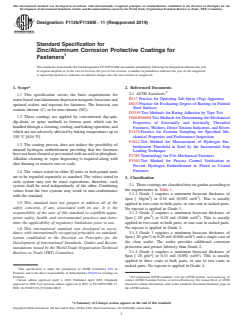
(Specification)Standard Specification for Zinc/Aluminum Corrosion Protective Coatings for Fasteners
General Information
- Abstract
ABSTRACT
This specification covers the basic requirements and associated test methods for water-based corrosion protective zinc/aluminum dispersion inorganic basecoats, and optional sealers and topcoats for fasteners. The basecoat can contain chrome (C) or be non-chrome (NC). These coatings are applied to ferrous parts by conventional dip-spin, dip-drain, or spray methods, which can be handled through a cleaning, coating, and baking operation, and which are not adversely affected by baking temperatures up to 330 °C. The coatings are classified into six grades (Grades 1 to 6) according to the required minimum basecoat thickness, and when tested, shall conform accordingly to appearance, adhesion, corrosion resistance, blister, thread fit, and hydrogen embrittlement requirements. The coating process does not induce the possibility of internal hydrogen embrittlement provided that the fasteners have not been cleaned or pre-treated with an acid or phosphate. Alkaline cleaning or vapor degreasing is required along with shot blasting to remove rust or scale. In this specification, units are presented in the metric scale.
SCOPE
1.1 This specification covers the basic requirements for water-based zinc/aluminum dispersion inorganic basecoats and optional sealers and topcoats for fasteners. The basecoat can contain chrome (C) or be non-chrome (NC).
1.2 These coatings are applied by conventional dip-spin, dip-drain, or spray methods to ferrous parts which can be handled through a cleaning, coating, and baking operation, and which are not adversely affected by baking temperatures up to 330 °C [626 °F].
1.3 The coating process does not induce the possibility of internal hydrogen embrittlement providing that the fasteners have not been cleaned or pre-treated with an acid or phosphate. Alkaline cleaning or vapor degreasing is required along with shot blasting to remove rust or scale.
1.4 The values stated in either SI units or inch-pound units are to be regarded separately as standard. The values stated in each system may not be exact equivalents; therefore, each system shall be used independently of the other. Combining values from the two systems may result in non-conformance with the standard.
1.5 This standard does not purport to address all of the safety concerns, if any, associated with its use. It is the responsibility of the user of this standard to establish appropriate safety, health, and environmental practices and determine the applicability of regulatory limitations prior to use.
1.6 This international standard was developed in accordance with internationally recognized principles on standardization established in the Decision on Principles for the Development of International Standards, Guides and Recommendations issued by the World Trade Organization Technical Barriers to Trade (TBT) Committee.
- Status
- Published
- Publication Date
- 31-Mar-2019
- Technical Committee
- F16 - Fasteners
- Drafting Committee
- F16.03 - Coatings on Fasteners


Overview
ASTM F1136/F1136M-11(2019) is an international standard that specifies the requirements and test methods for water-based zinc/aluminum corrosion protective coatings for fasteners. Developed by ASTM International, this specification applies to inorganic basecoats and optional sealers and topcoats designed to protect ferrous fastener components from corrosion. The coatings can be chrome-containing (C) or non-chrome (NC), applied by dip-spin, dip-drain, or spray methods, and are not adversely affected by baking temperatures up to 330 °C (626 °F). The standard sets forth requirements regarding appearance, adhesion, corrosion resistance, blistering, thread fit, and hydrogen embrittlement prevention.
Key Topics
- Coating Grades and Types: Six grades are defined, determined by minimum basecoat thickness and coating system (e.g., presence of sealers, topcoats, or lubricant).
- Grades 1, 2, and 4 involve no topcoats, with increasing basecoat thickness.
- Grade 3 includes a clear sealer for added corrosion resistance and lubricity.
- Grade 5 specifies use of a lubricated sealer, enhancing both corrosion protection and lubricity.
- Grade 6 incorporates pigmented topcoats, available in black or various other colors.
- Hydrogen Embrittlement Mitigation: The coating process precludes internal hydrogen embrittlement, provided no acid or phosphate pretreatment is used; alkaline cleaning, vapor degreasing, and shot blasting are required for surface preparation.
- Application Methods: Coatings are applied using conventional dip-spin, dip-drain, or spray techniques, followed by baking.
- Performance Requirements:
- Appearance: Uniform coatings without tears or discontinuities.
- Adhesion: Less than 5% removal in tape tests; no exposed substrate.
- Corrosion Resistance: Validated through salt spray testing (per ASTM B117), meeting grade-specific requirements for salt spray hours.
- Thread Fit: Coatings must not compromise thread engagement or uninstallation.
- Blistering: No visible blisters after testing.
Applications
ASTM F1136/F1136M zinc/aluminum coatings are widely used in diverse industries to extend the service life of fasteners by providing robust corrosion resistance. Typical applications include:
- Automotive: Protecting screws, bolts, and nuts used in chassis, suspension, and engine assembly.
- Construction: Enhancing the durability of structural fasteners exposed to harsh environmental conditions.
- Energy: Coating fasteners in wind turbines, transmission towers, and power generation equipment.
- Industrial Equipment: Ensuring reliable fastener performance in heavy machinery and assemblies exposed to moisture or chemicals.
- General Manufacturing: Providing protective finishes for fasteners used in appliances, electronics, and other equipment.
The use of water-based, chrome or non-chrome coatings aligns with increasing demands for sustainable and environmentally friendly surface treatments, without compromising critical mechanical properties or corrosion protection.
Related Standards
Several ASTM standards and practices complement or are referenced by ASTM F1136/F1136M for comprehensive evaluation of coated fasteners:
- ASTM B117: Practice for Operating Salt Spray (Fog) Apparatus, for corrosion testing.
- ASTM D610: Evaluating degree of rusting on painted steel surfaces.
- ASTM D3359: Adhesion by tape test methods.
- ASTM F606/F606M: Mechanical properties testing of fasteners.
- ASTM F1470: Practice for fastener sampling for specified properties and inspection.
- ASTM F1624: Measurement of hydrogen embrittlement threshold.
- ASTM F1789: Terminology related to mechanical fasteners.
- ASTM F1940: Process control verification to prevent hydrogen embrittlement.
This internationally recognized standard supports quality assurance and performance specification for corrosion protection of fasteners, ensuring consistency in global trade and manufacturing practices.
Keywords: zinc aluminum coating, corrosion resistance, fasteners, ASTM F1136, water-based coating, chrome-free coating, dip-spin application, hydrogen embrittlement prevention, industrial fasteners, protective coatings, adhesion testing, salt spray test.
Relations
- Effective Date
- 01-Apr-2019
- Effective Date
- 01-Jan-2024
- Effective Date
- 01-Nov-2023
- Effective Date
- 01-Aug-2019
- Refers
ASTM D610-08(2019) - Standard Practice for Evaluating Degree of Rusting on Painted Steel Surfaces - Effective Date
- 01-Jan-2019
- Effective Date
- 01-Nov-2018
- Effective Date
- 01-Feb-2018
- Effective Date
- 01-Jun-2017
- Effective Date
- 01-Sep-2016
- Effective Date
- 01-Aug-2016
- Effective Date
- 01-Mar-2015
- Effective Date
- 01-Feb-2015
- Effective Date
- 01-Nov-2014
- Effective Date
- 01-Sep-2014
- Effective Date
- 01-Aug-2014
Get Certified
Connect with accredited certification bodies for this standard

DVS-ZERT GmbH
German welding certification society.
CARES (UK Certification Authority for Reinforcing Steels)
UK certification for reinforcing steels and construction.
EWF/IIW (European/International Welding Federation)
International welding personnel certification.
Sponsored listings
Frequently Asked Questions
ASTM F1136/F1136M-11(2019) is a technical specification published by ASTM International. Its full title is "Standard Specification for Zinc/Aluminum Corrosion Protective Coatings for Fasteners". This standard covers: ABSTRACT This specification covers the basic requirements and associated test methods for water-based corrosion protective zinc/aluminum dispersion inorganic basecoats, and optional sealers and topcoats for fasteners. The basecoat can contain chrome (C) or be non-chrome (NC). These coatings are applied to ferrous parts by conventional dip-spin, dip-drain, or spray methods, which can be handled through a cleaning, coating, and baking operation, and which are not adversely affected by baking temperatures up to 330 °C. The coatings are classified into six grades (Grades 1 to 6) according to the required minimum basecoat thickness, and when tested, shall conform accordingly to appearance, adhesion, corrosion resistance, blister, thread fit, and hydrogen embrittlement requirements. The coating process does not induce the possibility of internal hydrogen embrittlement provided that the fasteners have not been cleaned or pre-treated with an acid or phosphate. Alkaline cleaning or vapor degreasing is required along with shot blasting to remove rust or scale. In this specification, units are presented in the metric scale. SCOPE 1.1 This specification covers the basic requirements for water-based zinc/aluminum dispersion inorganic basecoats and optional sealers and topcoats for fasteners. The basecoat can contain chrome (C) or be non-chrome (NC). 1.2 These coatings are applied by conventional dip-spin, dip-drain, or spray methods to ferrous parts which can be handled through a cleaning, coating, and baking operation, and which are not adversely affected by baking temperatures up to 330 °C [626 °F]. 1.3 The coating process does not induce the possibility of internal hydrogen embrittlement providing that the fasteners have not been cleaned or pre-treated with an acid or phosphate. Alkaline cleaning or vapor degreasing is required along with shot blasting to remove rust or scale. 1.4 The values stated in either SI units or inch-pound units are to be regarded separately as standard. The values stated in each system may not be exact equivalents; therefore, each system shall be used independently of the other. Combining values from the two systems may result in non-conformance with the standard. 1.5 This standard does not purport to address all of the safety concerns, if any, associated with its use. It is the responsibility of the user of this standard to establish appropriate safety, health, and environmental practices and determine the applicability of regulatory limitations prior to use. 1.6 This international standard was developed in accordance with internationally recognized principles on standardization established in the Decision on Principles for the Development of International Standards, Guides and Recommendations issued by the World Trade Organization Technical Barriers to Trade (TBT) Committee.
ABSTRACT This specification covers the basic requirements and associated test methods for water-based corrosion protective zinc/aluminum dispersion inorganic basecoats, and optional sealers and topcoats for fasteners. The basecoat can contain chrome (C) or be non-chrome (NC). These coatings are applied to ferrous parts by conventional dip-spin, dip-drain, or spray methods, which can be handled through a cleaning, coating, and baking operation, and which are not adversely affected by baking temperatures up to 330 °C. The coatings are classified into six grades (Grades 1 to 6) according to the required minimum basecoat thickness, and when tested, shall conform accordingly to appearance, adhesion, corrosion resistance, blister, thread fit, and hydrogen embrittlement requirements. The coating process does not induce the possibility of internal hydrogen embrittlement provided that the fasteners have not been cleaned or pre-treated with an acid or phosphate. Alkaline cleaning or vapor degreasing is required along with shot blasting to remove rust or scale. In this specification, units are presented in the metric scale. SCOPE 1.1 This specification covers the basic requirements for water-based zinc/aluminum dispersion inorganic basecoats and optional sealers and topcoats for fasteners. The basecoat can contain chrome (C) or be non-chrome (NC). 1.2 These coatings are applied by conventional dip-spin, dip-drain, or spray methods to ferrous parts which can be handled through a cleaning, coating, and baking operation, and which are not adversely affected by baking temperatures up to 330 °C [626 °F]. 1.3 The coating process does not induce the possibility of internal hydrogen embrittlement providing that the fasteners have not been cleaned or pre-treated with an acid or phosphate. Alkaline cleaning or vapor degreasing is required along with shot blasting to remove rust or scale. 1.4 The values stated in either SI units or inch-pound units are to be regarded separately as standard. The values stated in each system may not be exact equivalents; therefore, each system shall be used independently of the other. Combining values from the two systems may result in non-conformance with the standard. 1.5 This standard does not purport to address all of the safety concerns, if any, associated with its use. It is the responsibility of the user of this standard to establish appropriate safety, health, and environmental practices and determine the applicability of regulatory limitations prior to use. 1.6 This international standard was developed in accordance with internationally recognized principles on standardization established in the Decision on Principles for the Development of International Standards, Guides and Recommendations issued by the World Trade Organization Technical Barriers to Trade (TBT) Committee.
ASTM F1136/F1136M-11(2019) is classified under the following ICS (International Classification for Standards) categories: 21.060.01 - Fasteners in general; 25.220.40 - Metallic coatings. The ICS classification helps identify the subject area and facilitates finding related standards.
ASTM F1136/F1136M-11(2019) has the following relationships with other standards: It is inter standard links to ASTM F1136/F1136M-11, ASTM F1470-24, ASTM F1789-23, ASTM F1940-07a(2019), ASTM D610-08(2019), ASTM F1624-12(2018), ASTM F1470-18, ASTM F1789-17, ASTM F606/F606M-16, ASTM F1789-16, ASTM F1789-15a, ASTM F1789-15, ASTM F606/F606M-14a, ASTM F1789-14a, ASTM F1940-07a(2014). Understanding these relationships helps ensure you are using the most current and applicable version of the standard.
ASTM F1136/F1136M-11(2019) is available in PDF format for immediate download after purchase. The document can be added to your cart and obtained through the secure checkout process. Digital delivery ensures instant access to the complete standard document.
Standards Content (Sample)
This international standard was developed in accordance with internationally recognized principles on standardization established in the Decision on Principles for the
Development of International Standards, Guides and Recommendations issued by the World Trade Organization Technical Barriers to Trade (TBT) Committee.
Designation:F1136/F1136M −11 (Reapproved 2019)
Standard Specification for
Zinc/Aluminum Corrosion Protective Coatings for
Fasteners
ThisstandardisissuedunderthefixeddesignationF1136/F1136M;thenumberimmediatelyfollowingthedesignationindicatestheyear
of original adoption or, in the case of revision, the year of last revision. A number in parentheses indicates the year of last reapproval.
A superscript epsilon (´) indicates an editorial change since the last revision or reapproval.
1. Scope* 2. Referenced Documents
2.1 ASTM Standards:
1.1 This specification covers the basic requirements for
B117 Practice for Operating Salt Spray (Fog) Apparatus
water-based zinc/aluminum dispersion inorganic basecoats and
D610 Practice for Evaluating Degree of Rusting on Painted
optional sealers and topcoats for fasteners. The basecoat can
Steel Surfaces
contain chrome (C) or be non-chrome (NC).
D3359 Test Methods for Rating Adhesion by Tape Test
1.2 These coatings are applied by conventional dip-spin,
F606/F606M Test Methods for Determining the Mechanical
dip-drain, or spray methods to ferrous parts which can be
Properties of Externally and Internally Threaded
handled through a cleaning, coating, and baking operation, and
Fasteners, Washers, Direct Tension Indicators, and Rivets
which are not adversely affected by baking temperatures up to F1470 Practice for Fastener Sampling for Specified Me-
330 °C [626 °F]. chanical Properties and Performance Inspection
F1624 Test Method for Measurement of Hydrogen Em-
1.3 The coating process does not induce the possibility of
brittlement Threshold in Steel by the Incremental Step
internal hydrogen embrittlement providing that the fasteners
Loading Technique
have not been cleaned or pre-treated with an acid or phosphate.
F1789 Terminology for F16 Mechanical Fasteners
Alkaline cleaning or vapor degreasing is required along with
F1940 Test Method for Process Control Verification to
shot blasting to remove rust or scale.
Prevent Hydrogen Embrittlement in Plated or Coated
Fasteners
1.4 The values stated in either SI units or inch-pound units
are to be regarded separately as standard. The values stated in
3. Classification
each system may not be exact equivalents; therefore, each
3.1 Thesecoatingsareclassifiedintosixgradesaccordingto
system shall be used independently of the other. Combining
the requirements in Table 1.
values from the two systems may result in non-conformance
3.1.1 Grade 1 requires a minimum basecoat thickness of
with the standard.
2 2
4µm [ 16g/m ] or 0.16 mil (0.052 oz/ft ). This is usually
1.5 This standard does not purport to address all of the
applied in two coats to bulk parts, or one coat to racked parts.
safety concerns, if any, associated with its use. It is the
No topcoat is applied in Grade 1.
responsibility of the user of this standard to establish appro-
3.1.2 Grade 2 requires a minimum basecoat thickness of
2 2
priate safety, health, and environmental practices and deter-
5µm [ 20 g/m ] or 0.20 mil (0.066 oz/ft ). This is usually
mine the applicability of regulatory limitations prior to use. applied in two coats to bulk parts, or one coat to racked parts.
No topcoat is applied in Grade 2.
1.6 This international standard was developed in accor-
3.1.3 Grade 3 requires a minimum basecoat thickness of
dance with internationally recognized principles on standard-
2 2
5µm [ 20 g/m ] or 0.20 mil (0.066 oz/ft ) and a single coat of
ization established in the Decision on Principles for the
the clear sealer. The sealer provides additional corrosion
Development of International Standards, Guides and Recom-
protection and greater lubricity than Grade 2.
mendations issued by the World Trade Organization Technical
3.1.4 Grade 4 requires a minimum basecoat thickness of
Barriers to Trade (TBT) Committee.
2 2
8µm [ 28 g/m ] or 0.31 mil (0.092 oz/ft ). This is usually
applied in three coats to bulk parts, or one to two coats to
racked parts. No topcoat is applied in Grade 4.
This specification is under the jurisdiction of ASTM Committee F16 on
Fasteners and is the direct responsibility of Subcommittee F16.03 on Coatings on
Fasteners. For referenced ASTM standards, visit the ASTM website, www.astm.org, or
Current edition approved April 1, 2019. Published April 2019. Originally contact ASTM Customer Service at service@astm.org. For Annual Book of ASTM
approved in 1988. Last previous edition approved in 2011 as F1136/F1136M–11. Standards volume information, refer to the standard’s Document Summary page on
DOI: 10.1520/F1136_F1136M-11R19. the ASTM website.
*A Summary of Changes section appears at the end of this standard
Copyright © ASTM International, 100 Barr Harbor Drive, PO Box C700, West Conshohocken, PA 19428-2959. United States
F1136/F1136M−11 (2019)
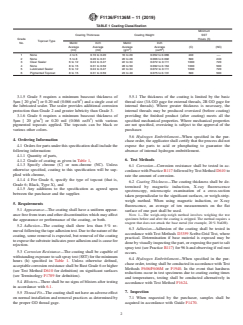
TABLE 1 Coating Classification
Minimum
Coating Thickness Coating Weight SST
Hours (h)
Grade
Topcoat Type
No.
Metric Inch Metric Inch
Average Average Average Average (C) (NC)
2 2
(mil) (mil) (g/m ) (oz/ft )
1 None 4 to 5 0.16 to 0.20 16 to 20 0.052 to 0.066 240 ----
2 None 5 to 8 0.20 to 0.31 20 to 28 0.066 to 0.092 500 240
3 Clear Sealer 6 to 12 0.24 to 0.47 22 to 34 0.072 to 0.111 1000 720
4 None 8 to 15 0.31 to 0.59 28 to 50 0.092 to 0.164 1000 500
5 Lubricated Sealer 6 to 12 0.24 to 0.47 22 to 34 0.072 to 0.111 1000 720
6 Pigmented Topcoat 8 to 15 0.31 to 0.59 23 to 40 0.075 to 0.131 500 500
3.1.5 Grade 5 requires a minimum basecoat thickness of 5.5.1 The thickness of the coating is limited by the basic
2 2
5µm [ 20 g/m ] or 0.20 mil (0.066 oz/ft ) and a single coat of thread size (3AGO gage for external threads, 2B GO gage for
the lubricated sealer. The sealer provides additional corrosion internal threads). Wher
...