

ASTM D996-23
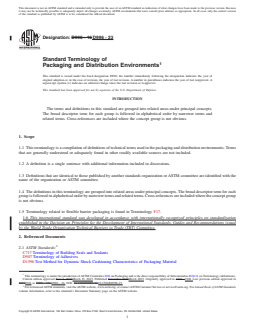
(Terminology)Standard Terminology of Packaging and Distribution Environments
General Information
- Abstract
SCOPE
1.1 This terminology is a compilation of definitions of technical terms used in the packaging and distribution environments. Terms that are generally understood or adequately found in other readily available sources are not included.
1.2 A definition is a single sentence with additional information included in discussions.
1.3 Definitions that are identical to those published by another standards organization or ASTM committee are identified with the name of the organization or ASTM committee.
1.4 The definitions in this terminology are grouped into related areas under principal concepts. The broad descriptor term for each group is followed in alphabetical order by narrower terms and related terms. Cross-references are included where the concept group is not obvious.
1.5 Terminology related to flexible barrier packaging is found in Terminology F17.
1.6 This international standard was developed in accordance with internationally recognized principles on standardization established in the Decision on Principles for the Development of International Standards, Guides and Recommendations issued by the World Trade Organization Technical Barriers to Trade (TBT) Committee.
- Status
- Published
- Publication Date
- 14-Mar-2023
- Technical Committee
- D10 - Packaging
- Drafting Committee
- D10.11 - Terminology (definitions)
Overview
ASTM D996-23, titled Standard Terminology of Packaging and Distribution Environments, is a comprehensive reference developed by ASTM International. This standard compiles essential definitions and technical terminology widely used within packaging and distribution environments. Its main objective is to provide a unified vocabulary that supports clarity, consistency, and effective communication among professionals and stakeholders in packaging, transportation, logistics, supply chain management, and distribution sectors.
ASTM D996-23 ensures that technical and specialized terms are clearly defined, helping eliminate confusion and supporting the correct application of other related packaging and distribution standards. This standard is developed following internationally recognized principles for standardization and is approved for use by agencies such as the U.S. Department of Defense.
Key Topics
ASTM D996-23 addresses and defines terms grouped by principal concepts and provides cross-references to facilitate understanding. Key terminology areas include:
Containers and Packaging Materials
- Definitions for boxes, bags, barrels, crates, cartons, cans, and other common containers
- Terms for material types: fiberboard, boxboard, containerboard, barrier materials, cushioning materials
Handling and Distribution
- Descriptions for unit loads, bundling, palletized loads, crates, and modular containers
- Terminology for loading, bracing, blocking, dunnage, and unitization
Packaging Testing and Performance
- Definitions related to package testing such as bursting strength, drop tests, compression, and environmental indicators
- Terms relevant to packaging performance: load types, sealing methods, shock absorption, and protection features
Environmental and Regulatory Considerations
- Key definitions for recyclable, reusable, returnable, compostable, and biodegradable packaging
- Clarification of terms under regulatory frameworks and international trade requirements
Cross-Referenced and Related Concepts
- Guidance to terminology in other ASTM standards (such as flexible barrier packaging in ASTM F17)
- Integration and identification of terms adopted from other standards organizations
Applications
ASTM D996-23 serves multiple practical purposes in the packaging and logistics industries:
- Standardizing Communication: Provides a reliable reference to ensure that manufacturers, suppliers, distributors, and regulatory bodies use consistent language across documentation, contracts, and technical specifications.
- Training and Education: Acts as an authoritative glossary for onboarding new staff and for ongoing professional development in packaging technology and logistics.
- Quality Assurance and Compliance: Supports understanding and correct implementation of packaging and handling procedures, especially where specific terminology is referenced in quality systems or regulatory compliance checks.
- Document Creation and Interpretation: Facilitates the preparation and interpretation of technical proposals, packaging design specifications, test reports, and safety data sheets.
- International Trade and Transport: Helps address requirements related to the packaging of goods for export, import, and distribution across different regulatory regimes.
Related Standards
ASTM D996-23 references and complements several other important industry standards, including:
- C717: Terminology of Building Seals and Sealants
- D907: Terminology of Adhesives
- D1596: Test Method for Dynamic Shock Cushioning Characteristics of Packaging Materials
- D3288: Test Methods for Magnet-Wire Enamels
- E176: Terminology of Fire Standards
- F17: Terminology Relating to Primary Barrier Packaging
Other referenced documents include federal standards (e.g., PPP-F-320 for fiberboard materials) and widely-used freight classification rules. By utilizing ASTM D996-23 as a terminology baseline, organizations can improve communication, compliance, and efficiency throughout the packaging and distribution value chain.
For the most current definitions and updates, always consult the latest version of ASTM D996 as published by ASTM International.
Relations
- Effective Date
- 01-Jan-2024
- Effective Date
- 01-Oct-2023
- Effective Date
- 01-May-2020
- Effective Date
- 01-Mar-2019
- Effective Date
- 15-Dec-2018
- Effective Date
- 01-Oct-2018
- Effective Date
- 15-Aug-2018
- Effective Date
- 01-Mar-2018
- Effective Date
- 01-Mar-2018
- Effective Date
- 01-Nov-2017
- Effective Date
- 01-Jun-2017
- Effective Date
- 01-Jan-2017
- Effective Date
- 15-Nov-2016
- Effective Date
- 01-Sep-2016
- Effective Date
- 01-Aug-2015
Get Certified
Connect with accredited certification bodies for this standard

BRCGS (Brand Reputation Compliance Global Standards)
Global food safety and quality standards owner.
Sponsored listings
Frequently Asked Questions
ASTM D996-23 is a standard published by ASTM International. Its full title is "Standard Terminology of Packaging and Distribution Environments". This standard covers: SCOPE 1.1 This terminology is a compilation of definitions of technical terms used in the packaging and distribution environments. Terms that are generally understood or adequately found in other readily available sources are not included. 1.2 A definition is a single sentence with additional information included in discussions. 1.3 Definitions that are identical to those published by another standards organization or ASTM committee are identified with the name of the organization or ASTM committee. 1.4 The definitions in this terminology are grouped into related areas under principal concepts. The broad descriptor term for each group is followed in alphabetical order by narrower terms and related terms. Cross-references are included where the concept group is not obvious. 1.5 Terminology related to flexible barrier packaging is found in Terminology F17. 1.6 This international standard was developed in accordance with internationally recognized principles on standardization established in the Decision on Principles for the Development of International Standards, Guides and Recommendations issued by the World Trade Organization Technical Barriers to Trade (TBT) Committee.
SCOPE 1.1 This terminology is a compilation of definitions of technical terms used in the packaging and distribution environments. Terms that are generally understood or adequately found in other readily available sources are not included. 1.2 A definition is a single sentence with additional information included in discussions. 1.3 Definitions that are identical to those published by another standards organization or ASTM committee are identified with the name of the organization or ASTM committee. 1.4 The definitions in this terminology are grouped into related areas under principal concepts. The broad descriptor term for each group is followed in alphabetical order by narrower terms and related terms. Cross-references are included where the concept group is not obvious. 1.5 Terminology related to flexible barrier packaging is found in Terminology F17. 1.6 This international standard was developed in accordance with internationally recognized principles on standardization established in the Decision on Principles for the Development of International Standards, Guides and Recommendations issued by the World Trade Organization Technical Barriers to Trade (TBT) Committee.
ASTM D996-23 is classified under the following ICS (International Classification for Standards) categories: 01.040.55 - Packaging and distribution of goods (Vocabularies); 55.020 - Packaging and distribution of goods in general. The ICS classification helps identify the subject area and facilitates finding related standards.
ASTM D996-23 has the following relationships with other standards: It is inter standard links to ASTM E176-24, ASTM D1596-14(2023), ASTM F17-20, ASTM C717-19, ASTM E176-18a, ASTM F17-18a, ASTM F17-18, ASTM E176-18, ASTM C717-18, ASTM C717-17a, ASTM F17-17, ASTM C717-17, ASTM C717-16a, ASTM C717-16, ASTM E176-15ae1. Understanding these relationships helps ensure you are using the most current and applicable version of the standard.
ASTM D996-23 is available in PDF format for immediate download after purchase. The document can be added to your cart and obtained through the secure checkout process. Digital delivery ensures instant access to the complete standard document.
Standards Content (Sample)
This international standard was developed in accordance with internationally recognized principles on standardization established in the Decision on Principles for the
Development of International Standards, Guides and Recommendations issued by the World Trade Organization Technical Barriers to Trade (TBT) Committee.
Designation: D996 − 23
Standard Terminology of
Packaging and Distribution Environments
This standard is issued under the fixed designation D996; the number immediately following the designation indicates the year of
original adoption or, in the case of revision, the year of last revision. A number in parentheses indicates the year of last reapproval. A
superscript epsilon (´) indicates an editorial change since the last revision or reapproval.
This standard has been approved for use by agencies of the U.S. Department of Defense.
INTRODUCTION
The terms and definitions in this standard are grouped into related areas under principal concepts.
The broad descriptor term for each group is followed in alphabetical order by narrower terms and
related terms. Cross-references are included where the concept group is not obvious.
1. Scope 2. Referenced Documents
2.1 ASTM Standards:
1.1 This terminology is a compilation of definitions of
C717 Terminology of Building Seals and Sealants
technical terms used in the packaging and distribution envi-
D907 Terminology of Adhesives
ronments. Terms that are generally understood or adequately
D1596 Test Method for Dynamic Shock Cushioning Char-
found in other readily available sources are not included.
acteristics of Packaging Material
1.2 A definition is a single sentence with additional infor-
D3288 Test Methods for Magnet-Wire Enamels
mation included in discussions.
E176 Terminology of Fire Standards
F17 Terminology Relating to Primary Barrier Packaging
1.3 Definitions that are identical to those published by
G15 Terminology Relating to Corrosion and Corrosion Test-
another standards organization or ASTM committee are iden-
ing (Withdrawn 2010)
tified with the name of the organization or ASTM committee.
2.2 Federal Standard:
1.4 The definitions in this terminology are grouped into
PPP-F-320 Fiberboard, Corrugated and Solid, Sheet Stock
related areas under principal concepts. The broad descriptor
(Container Grade), and Cut Shapes
term for each group is followed in alphabetical order by
2.3 Other Standards:
narrower terms and related terms. Cross-references are in-
Uniform Freight Classification Rule 30
cluded where the concept group is not obvious.
National Motor Freight Classification
1.5 Terminology related to flexible barrier packaging is
3. Terminology
found in Terminology F17.
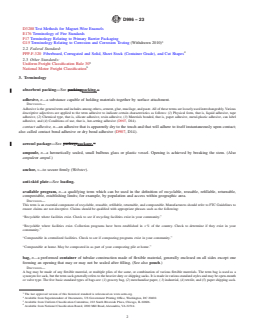
absorbent packing—See packing.
1.6 This international standard was developed in accor-
adhesive, n—a substance capable of holding materials together
dance with internationally recognized principles on standard-
by surface attachment.
ization established in the Decision on Principles for the
Development of International Standards, Guides and Recom-
For referenced ASTM standards, visit the ASTM website, www.astm.org, or
mendations issued by the World Trade Organization Technical
contact ASTM Customer Service at service@astm.org. For Annual Book of ASTM
Barriers to Trade (TBT) Committee.
Standards volume information, refer to the standard’s Document Summary page on
the ASTM website.
The last approved version of this historical standard is referenced on
www.astm.org.
1 4
This terminology is under the jurisdiction of ASTM Committee D10 on Available from Superintendent of Documents, US Government Printing Office,
Packaging and is the direct responsibility of Subcommittee D10.11 on Terminology Washington, DC 20402.
(definitions). Available from Uniform Classification Committee, 222 South Riverside Plaza,
Current edition approved March 15, 2023. Published March 2023. Originally Chicago, IL 60606.
approved in 1948. Last previous edition approved in 2016 as D996 – 16. DOI: Available from National Classification Board, 2200 Mill Road, Alexandria, VA
10.1520/D0996-23. 22314.
Copyright © ASTM International, 100 Barr Harbor Drive, PO Box C700, West Conshohocken, PA 19428-2959. United States
D996 − 23
DISCUSSION—Adhesive is the general term and includes among
barrel, n—a bulged cylindrical container of greater length
others, cement, glue, mucilage, and paste. All of these terms are loosely
than breadth, made of wooden staves bound together with
used interchangeably. Various descriptive adjectives are applied to the
hoops and having two flat ends of equal diameter. (Compare
term adhesive to indicate certain characteristics as follows: (1) Physical
drum.)
form, that is, liquid adhesive, tape adhesive, (2) Chemical type, that is,
silicate adhesive, resin adhesive, (3) Materials bonded, that is, paper
cask, n—a term used synonymously with barrel but usually
adhesive, metal-plastic adhesive, can label adhesive, and (4) Conditions
of large size or capacity.
of use, that is, hot-setting adhesive (D907, D14).
keg, n—a small slack or tight barrel of 30-gal capacity or
contact adhesive, n—an adhesive that is apparently dry to the
less.
touch and that will adhere to itself instantaneously upon
contact; also called contact bond adhesive or dry bond adhesive
barrier material:
(D907, D14).
grease-resistant barrier—a material that prevents or retards
the transmission of grease or oils.
aerosol package—See package.
ampoule, n—a hermetically sealed, small bulbous glass or water-resistant barrier—a material that retards the transmis-
plastic vessel. Opening is achieved by breaking the stem. sion of liquid water.
(Also ampuleor ampul.)
water-vapor-resistant barrier—a material that retards the
transmission of water vapor.
anchor, v—to secure firmly (Webster).
basket, n—a semirigid container usually open at the top and
anti-skid plate—See loading.
provided with one or two handles for carrying. (Compare
available program, n—a qualifying term which can be used in
hamper.)
the definition of recyclable, reusable, refillable, returnable,
DISCUSSION—A basket is sometimes made of thin strips of wood,
compostable, establishing limits; for example, by population
woven or stapled, or otherwise bound together, or it may be made of
and access within geographic area.
fiberboard or combinations of wood and fiber, or plastic. (See stave.(2))
DISCUSSION—This term is an essential component of recyclable,
reusable, refillable, returnable, and compostable. Manufacturers should
batten—See box.
refer to FTC Guidelines to ensure claims are not deceptive. Claims
biodegradable, adj—capable of undergoing decomposition
should be qualified with appropriate phrases such as the following:
into carbon dioxide, methane, water, inorganic compounds,
“Recyclable where facilities exist. Check to see if recycling facilities
exist in your community.” or biomass in which the predominant mechanism is the
“Recyclable where facilities exist. Collection programs have been
enzymatic action of micro-organisms, that can be measured
established in x % of the country. Check to determine if they exist in
by standardized tests, in a specified period of time, reflecting
your community.”
available disposal conditions.
“Compostable in centralized facilities. Check to see if composting
programs exist in your community.”
blister pack—See pack.
“Compostable at home. May be composted in as part of your
blocking—See loading.
composting pile at home.”
body—See container.
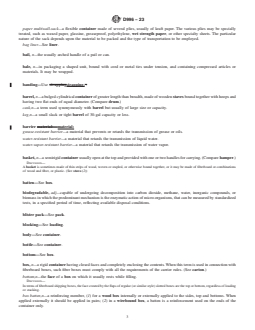
bag, n—a preformed container of tubular construction made
bottle—See container.
of flexible material, generally enclosed on all sides except
bottom—See box.
one forming an opening that may or may not be sealed after
box, n—a rigid container having closed faces and completely
filling. (See also pouch.)
enclosing the contents. When this term is used in connection
DISCUSSION—A bag may be made of any flexible material, or multiple
with fiberboard boxes, such fiber boxes must comply with all
plies of the same, or combination of various flexible materials. The
term bag is used as a synonym for sack, but the term sack generally the requirements of the carrier rules. (See carton.)
refers to the heavier duty or shipping sacks. It is made in various
bottom, n—the face of a box on which it usually rests while
standard styles and may be open-mouth or valve type. The five basic
filling.
standard types of bags are: (1) grocery bag, (2) merchandise paper, ( 3)
DISCUSSION—In terms of fiberboard shipping boxes, the face created
industrial, (4) textile, and (5) paper shipping sack.
by the flaps of regular (or similar style) slotted boxes are the top or
paper multiwall-sack—a flexible container made of several
bottom, regardless of loading or stacking.
plies, usually of kraft paper. The various plies may be specially
box batten, n—a reinforcing member, (1) for a wood box
treated, such as waxed paper, glassine, greaseproof,
internally or externally applied to the sides, top and bottoms.
polyethylene, wet strength paper, or other specialty sheets.
When applied externally it should be applied in pairs; (2) in a
The particular nature of the sack depends upon the material to
wirebound box, a batten is a reinforcement used on the ends
be packed and the type of transportation to be employed.
of the container only.
bag liner—See liner.
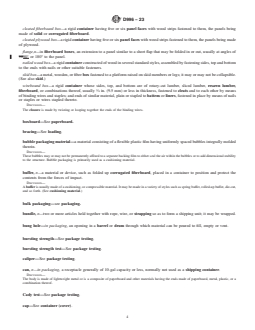
cleated fiberboard box—a rigid container having five or six
bail, n—the usually arched handle of a pail or can.
panel faces with wood strips fastened to them, the panels being
bale, n—in packaging a shaped unit, bound with cord or metal
made of solid or corrugated fiberboard.
ties under tension, and containing compressed articles or
cleated plywood box—a rigid container having five or six
materials. It may be wrapped.
panel faces with wood strips fastened to them, the panels being
banding—Use strapping. made of plywood.
D996 − 23
flange, n—in fiberboard boxes, an extension to a panel carton, n—a folding box, generally made from boxboard for
similar to a short flap that may be folded in or out, usually at merchandising consumer quantities of products (for
angles of 90° or 180° to the panel. example, shelf packages or prime packages).
nailed wood box—a rigid container constructed of wood in
case—See container.
several standard styles, assembled by fastening sides, top and
case liner—See liner.
bottom to the ends with nails or other suitable fasteners.
cask—See barrel.
skid box—a metal, wooden, or fiber box fastened to a child-resistant packaging—See packaging.
platform raised on skid members or legs; it may or may not be
chime (chine), n—in packaging, the rim of a container, such
collapsible. (See also skid.) as a drum, barrel, or can.
wirebound box—a rigid container whose sides, top, and
chipboard—See paperboard.
bottom are of rotary-cut lumber, sliced lumber, resawn
cleat, n—a wood or metal strip attached along the edge of a
lumber, fiberboard, or combinations thereof, usually ⁄8 in.
panel of a container for the attaching of an adjacent panel,
(9.5 mm) or less in thickness, fastened to cleats and to each
or fastened to the panel between the edges, or to barrel
other by means of binding wires and staples; and ends of
heads, for reinforcement and stiffening.
similar material, plain or stapled to battens or liners, fastened
cleated fiberboard box—See box.
in place by means of nails or staples or wires stapled thereto.
cleated plywood box—See box.
DISCUSSION—The closure is made by twisting or looping together the
ends of the binding wires.
closure, n—in packaging, a means of closing a container to
retain the contents.
boxboard—See paperboard.
plug, n—in packaging, a type of closure that is designed to
bracing—See loading.
be inserted into a container opening. It may be held by friction
bubble packaging material—a material consisting of a flex-
or by screw threads. (See cap.)
ible plastic film having uniformly spaced bubbles integrally
molded therein.
cocoon, v—in packaging, to employ strippable, usually plastic,
DISCUSSION—These bubbles may or may not be permanently affixed
sometimes multi-layered films to encapsulate an item.
to a separate backing film to either seal the air within the bubbles or to
code, v—to assign numbers, letters, words, or symbols as
add dimensional stability to the structure. Bubble packaging is primar-
ily used as a cushioning material. identifying marks to containers, packaged materials, or
articles to convey information concerning the qualities of the
buffer, n—a material or device, such as folded up corrugated
container or its contents, date, place of manufacture, or other
fiberboard, placed in a container to position and protect the
significant identification. (Compare marking.)
contents from the forces of impact.
DISCUSSION—A buffer is usually made of a cushioning, or compress- collapsible tube—See tube.
ible material. It may be made in a variety of styles such as spring buffer,
compaction ratio, n—the measurement of the relationship of
rolled-up buffer, die-cut, and so forth. (See cushioning material.)
volume displacement of a package before and after simu-
lated landfill conditions as determined in standardized tests.
bulk packaging—see packaging.
bundle, n—two or more articles held together with rope, wire,
composite tube—See tube.
or strapping so as to form a shipping unit; it may be
compostable, adj—capable of undergoing biological decom-
wrapped.
position in a compost site as part of an available program,
such that the material (that is, feedstock) is not visually
bung hole—in packaging, an opening in a barrel or drum
distinquishable and breaks down to carbon dioxide, water,
through which material can be poured to fill, empty or vent.
inorganic compounds, and biomass, at a rate consistent with
known compostable materials.
bursting strength—See package testing.
DISCUSSION—See available program for further clarification. Also,
bursting strength test—See package testing.
manufacturers should indicate if composting at home or centralized
caliper—See package testing.
facility is appropriate.
can, n—in packaging, a receptacle generally of 10-gal capacity
Conbur test—See package testing.
or less, normally not used as a shipping container.
constant load—See load.
DISCUSSION—The body is made of lightweight metal or is a compos-
contact adhesive—see adhesive.
ite of paperboard and other materials having the ends made of
paperboard, metal, plastic, or a combination thereof.
container—a nonspecific term for a receptacle capable of
closure (See also: bag, barrel, basket, box, can, carton,
Cady test—See package testing.
crate, cylinder, drum, envelope, hamper, pail, tube.)
cap—See container (cover).
body, n—in packaging, the principal part of a container,
carboy, n—a container made of glass, ceramic, plastic, or
usually the largest part in one piece containing the sides.
metal, having a capacity of 5 gal to 15 gal (19 L to 57 L)
bottle, n—a rigid or semirigid container typically of glass or
with the pouring and filling opening at the top.
plastic, having a comparatively narrow neck or mouth, and
DISCUSSION—For shipment, carboys are generally encased in a
protective rigid outer container. usually no handle (Webster).
D996 − 23
case, n—a nonspecific term for a shipping container. In shipping container—a container that is sufficiently strong to
domestic commerce, case usually refers to a box made from be used in commerce for packing, storing, and shipping
corrugated or solid fiberboard wood, or metal. commodities. (See also barrel, crate, drum.)
cover, n—in packaging, the top or bottom, or both of a
containerboard—any paperboard made specifically for the
container, usually the part that closes the filling and dispensing
manufacture of corrugated and solid fiberboard shipping
opening. It is often called a cap when used with fiberboard
containers. Basis weight is expressed in pounds per 1000 ft
containers. (See also shroud.)
(or grams per square metre). It is customarily shipped in
cylinder, n—a rigid cylindrical metal container designed as
rolls.
a portable vessel for the storage and transportation of com-
cylinder kraft—containerboard made from kraft pulp on a
pressed gases. Generally equipped with protected valve closure
cylinder machine.
and suitable pressure-relief safety device.
Fourdrinier kraft—containerboard made from kraft pulp on
die-cut, adj—(1) a method of preparation in which a part or
a Fourdrinier machine, basically of single-ply formation,
container has been cut, slotted, and scored or any combination
although possibly with supplementary second-ply, with less
of these by custom-made dies; (2) n, a part so made.
prominent grain direction. The sheet is formed on a traveling
expendable container—a container for shipping or storage,
endless-wire screen which may also be vibrated to obtain more
or both, intended primarily for a single trip.
random orientation of fibers.
face, n—in packaging, any one of the plane surfaces of a
solid fiberboard—a solid board made by laminating two or
container.
more plies of containerboard.
fast pack container—a standard size, reusable container
with foam cushion inserts.
containerization, n—(1) a shipping method in which material
DISCUSSION—Some designs permit shipment of a large variety of
(such as merchandise) is packaged together in one con-
items within certain limits of size, weight, configuration, and fragility.
tainer.(2) the use of transport containers to unitize cargo for
fiberboard container—a box, package, or drum made of
transportation, supply, and storage.
fiberboard. When the term box is used for classification
purposes, the structure must comply with all requirements of core, n—in packaging, a cylindrical structure used as a carrier
of flexible material that is wound around it.
the carrier rules.
flap, n—one of the closing members of a fiberboard
corrosion, n—the chemical or electrochemical reaction be-
container.
tween a material, usually a metal, and its environment that
glass container—any glass receptacle capable of holding a
produces a deterioration of the material and its properties
seal or closure for retention of contents.
(G15, G01).
intermodal container—a reusable shipping container
corrosion, inhibitor, n—a chemical substance or combina-
manufactured to standard dimensions intended to unitize cargo
tion of substances that, when present in the proper concentra-
or freight for shipping by one or more modes of transportation
tion and form in the environment, prevents or reduces corro-
without the need for intermediate handling of the contents.
sion.
jar, n—a widemouthed container made typically of glass,
volatile corrosion inhibitor (VCI)—a material that slowly
plastic, or earthenware.
releases vapor to inhibit corrosion within a package by
jug, n—a large, deep, usually glass, plastic, or earthenware
neutralizing the effects of moisture-laden air.
container with a narrow mouth and a handle.
corrugated box—See box.
manufacturer’s joint—that part of a fiberboard container
corrugated fiberboard:
where the ends of the box blank are joined together in the
(1) single face—the structure formed by one corrugated
manufacturing process by taping, stitching, or gluing.
member glued to the flat facing;
modular container—a family of containers designed to be
(2) single wall—the structure formed by one corrugated
assembled into a unit load.
inner member glued between two flat facings; also known as
returnable container—a shipping container of any material
double face;
designed to be used for more than one shipment.
(3) double wall—the structure formed by three flat facings
and two intermediate corrugated members;
reusable container—a shipping and storage container de-
signed for reuse without impairment of its protective function. (4) triple wall—the structure formed by four flat facings
DISCUSSION—It may be repaired or refitted to prolong its life, or to and three intermediate corrugated members. (See also contain-
adapt it for items other than originally intended.
erboard.)
seam, n (when referring to a fiberboard container)—the
corrugating medium—paperboard used in forming the
lines of junction created by any free edge of a container flap or
fluted portion of the corrugated board.
wall where it abuts or overlaps another portion of the con-
corrugation flute—one of the wave shapes formed in the
tainer (except the manufacturer’s joint).
inner member, that is, the corrugating medium, of corrugated
DISCUSSION—A seam may be fastened by tape, stitches, or adhesive
in the process of closing a fiberboard container. fiberboard. Flutes most commonly used are:
D996 − 23
foam-in-place cushioning material, n—one formed by
Number, per Span Between
Linear Adjacent Flutes,
dispensing, usually into a box or mold, reactive chemical
A,B
ft mm Height, in. (mm)
components that expand to envelop items packaged or occupy
A-flute 36 ± 3 7.9 to 9.1 ⁄16 (4.7)
B-flute 50 ± 3 4.7 to 6.6 ⁄32 (2.4) void areas.
C-flute 42 ± 3 6.8 to 7.8 ⁄64 (3.6)
macerated paper—generally, waste paper torn up mechani-
E-flute 94 ± 4 3.0 to 3.5 ⁄64 (1.2)
cally for use as a cushioning material.
A
The values are approximate.
B
cylinder—See container.
Height does not include thickness of facing.
cylinder kraft—See containerboard.
V-board—a term adopted from the grade symbol of corru-
dead load—See load.
gated or solid fiberboard made to comply with the weather-
density, n—mass per unit volume (D3288, D09).
resistant class as defined in Federal Specification PPP-F-320,
made of wet strength paperboard. Components are especially
desiccant, n—a hygroscopic substance used to absorb water
made to exhibit high strength (against bursting, tearing, or
vapor from the air to maintain a low relative humidity in a
rupturing) when wet.
container.
W-board—same as V-board except the “W” grades are of
diagonal bracing—See loading.
lower test requirements and primarily for use as interior or
die cut—See container.
intermediate containers.
dimensions, n—in packaging, the measurement of length,
cover—See container.
width (or diameter), and depth of containers, expressed in
crate, n—a rigid shipping container of framed construction
that order; it should be stated as “inside” or “outside.”
joined together with nails, bolts or any equivalent method of
DISCUSSION—For fiberboard and most other types of boxes, length is
fastening. The framework may or may not be enclosed with
the larger of the two dimensions of the open face, width is the lesser of
sheathing. It may be demountable (reusable) or nondemount-
the two dimensions of the open face, depth is the distance between the
able. (See also rubbing strip, strut.)
innermost surfaces of the box measured perpendicular to the length and
width, and are given as inside dimensions.
open crate—a crate with exposed frame members and not
enclosed by sheathing.
direct line of sight, n—an unobstructed visible path from one
object to another.
sheathed crate—a crate that is enclosed by having the frame
members completely covered with sheathing boards or mate-
displacement, n—in packaging,the volume occupied by a
rial.
container, calculated from its outside dimensions. (Compare
cube.)
creped duplex paper—See paper.
creped paper—See paper.
divider, n—a device, made of various materials, that separates
critical transponder distance, n—the distance between the
the space within a container into two or more spaces, cells,
transponder and the interrogator antenna at which a tran-
compartments, or layers.
sponder becomes undetectable by an RFID system, when
DISCUSSION—A divider may be plain, interlocking, scored,
moving the RFID transponder out of the read field. horizontal, vertical, or diagonal. The primary purpose of a divider is to
separate the articles, or to furnish cushioning, or both. Also, it
cube, n—in packaging, the volume of space occupied by the
frequently adds stacking strength (Compare buffer, fiberboard
unit under consideration, computed by multiplying overall partition, liner, pad, separator, spacer.)
exterior length, width, and height. For shipping purposes
dolly, n—a low platform or structure mounted on wheels or
3 3
cube is expressed to the nearest 0.1 ft (2830 cm ). (Compare
casters, designed primarily for moving bulky loads for short
displacement.)
distances. (Compare pallet.)
cushion, v—to use cushioning material to reduce shock and
drop test—See package testing.
vibration transmitted to a packaged product from an exter-
drum, n—(1) a cylindrical shipping container having straight
nally applied force.
sides, and flat, convex or embossed ends, designed for
storage and shipment as an unsupported outer package that
cushioning material—a material used to isolate or reduce the
may be shipped without boxing or crating. It may be made of
effect of externally applied shock or vibration forces, or
metal, or of plywood, or of fiber with wooden, metal or fiber
both. (See also buffer, divider, molded shape.)
ends. Drums are also made of rubber or plastics (Compare
creped cellulose wadding—a material consisting of cellulose
barrel.); (2) in set-up paper boxes, a shell or tube with paper
fibers produced by the sulfite process, loosely matted into sheet
or cellophane head, used for powder box. (See divider.)
form and then creped. It is available in single or multiple sheet
form, either plain or embossed, and may be backed with
dunnage—See loading.
various papers. It is also available impregnated with asphalt for
dynamic load—See load.
water resistance.
edge protector—See loading.
Elmendorf test—See package testing.
filler pad—in packaging, a pad used to fill space; sometimes
applied to a soft flexible pad made with various loose filling end-grain nailing—nailing in such a way that the point of the
materials to provide cushioning effects. (Compare buffer.) nail follows the grain of the wood so that the shank is
D996 − 23
parallel, or nearly parallel to the grain in that member static coeffıcient of friction—the ratio of the force required to
holding the nail point. It is weaker than side-grain nailing in move one surface over another, to the total force applied
direct withdrawal. normal to those surfaces, at the instant motion starts.
G—symbol for the dimensionless ratio between an accelera-
envelope, n—in packaging, a container of flexible material
tion in length per time-squared units, and the acceleration of
having only two faces and joined at three edges to form a
gravity in the same units (D1596).
partial enclosure. The nonjoined edge provides a filling
opening which later may be closed or sealed.
g—symbol for the acceleration of gravity at the earth’s surface.
DISCUSSION—Its value differs slightly at different points on the earth,
equivalent product, n—provides the same amount of product
2 2
but the standardized value of 32.2 ft/s or 9.806 m/s is usually used.
or number of recommended uses as contained in the package
being replaced (as related to Subcommittee D10.46 package
glass container—See container.
source reduction).
grease-resistant barrier—See barrier material.
gummed paper tape—See tape.
expendable container—See container.
hamper, n—a container (commonly used for shipping fruits
expendable pallet—See pallet.
and vegetables) circular, elliptical, or polygonal in horizontal
exterior pack—See pack.
cross section, the tube dimensions being usually greater than
face—See container.
the bottom. It has slotted sides and a bottom that may be
facing, n—a form of linerboard used as a flat member of
loose, stapled, or nailed in place. The top may or may not be
corrugated fiberboard (sometimes erroneously called a
open. (Compare basket.)
liner).
heat seal—See seal.
fastener, n—in packaging, a device that serves to secure one
hermetic seal—See seal.
part to another; for example, nail, screw, staple, strapping,
humidity indicator—an instrument or device that displays the
stitch, or adhesive.
approximate humidity condition within a package.
fast pack container—See container.
ID—inside dimensions or inside diameter.
fiberboard—See containerboard.
incline impact (Conbur) test—See package testing.
fiberboard container—See container.
inner packing—See packing.
fiberboard partitions—a set of corrugated or solid fiber-
insert, n—usually a thin filler or frame of wood, fiberboard,
board or paperboard pieces slotted so they will interlock
plastic, or other suitable material used to take up space, or
when assembled to form a number of cells into which
separate articles within a package. (Compare buffer,
articles may be placed for shipment. (See also divider.)
divider, separator.)
fiberboard tube—See tube.
interior packing—See packing.
filler pad—See cushioning material.
intermediate bulk container (IBC), n—a rigid or flexible
finish, n—See paperboard.
portable packaging, other than a cylinder or portable tank,
fire-retardant, adj—having or providing comparatively low
which is designed for mechanical handling. Additional
flammability or flame spread properties (E176, E05). details can be found in 49 CFR (§ 171.8) and the UN
Recommendations on the Transport of Dangerous Goods.
firmware, n—a series of programmable instructions, stored in
read only memory (ROM), which controls the capabilities of intermediate pack—See pack.
an interrogator.
intermediate package—See package.
intermodal container—See container.
flange, n—See box.
keg—See barrel.
flat—See container.
kraft, n—See paperboard.
floating controlled load—See load.
label, n—a piece of paper or other material to be affixed to a
flute—See corrugated fiberboard.
container or article, on which is printed a legend, informa-
foam-in place cushioning material—See cushioning mate-
tion concerning the product, or addresses. It may also be
rial.
printed directly on the container. (Compare tag.)
Fourdrinier kraft—See containerboard.
liner, n—in packaging, (1) generally, any linear material that
friction, n—resistance to relative motion between two bodies
separates a product within a container from the basic walls
in contact (Websters ).
of the container, (2) in fiberboard containers, a creased
coeffıcient of friction—the ratio of the force required to move
fiberboard sheet inserted in a container and usually fitting
one surface over another, to the total force applied normal to
against the side and end panels (liner is sometimes errone-
those surfaces.
ously used for linerboard or facing). (Compare divider.)
kinetic coeffıcient of friction—the ratio of the force required case liner (bag liner)—a lining, usually paper, or treated
to move one surface over another, to the total force applied materials placed inside a shipping container for the purpose of
normal to those surfaces, once that motion is in progress. preventing sifting, or entrance of moisture, dust, or dirt.
D996 − 23
linerboard—See paperboard. carrying vehicle, used to protect and make freight secure in, or
live load—See load. on a carrying vehicle (Classification, Rule 30); (2) in a
container, materials not constituting a part of the container,
load, n—(1) the force in weight units applied to a body; (2) the
weight of the contents of a container or transportation frequently by-product or scrap, used for filling space, for
blocking or bracing, or otherwise to protect and secure the
device; (3) a qualitative term denoting the contents of a
container. contents.
constant load, n—a load that is invariable or unchanging.
dynamic compression loading—in packaging, the applica-
tion of a force in motion that usually occurs in 10 s or less.
dead load, n—a constant load that, in structures (as a bridge,
DISCUSSION—These forces result most often from random impacts,
building, or machines) is due to the weight of the members, the
vibration, or shocks in handling and transit.
supporting structure, and permanent attachments or accessories
(Webster ). edge protector—a right-angle piece placed over the edge of
boxes, crates, bundles and gates, or bracing to distribute the
dynamic load, n—an imposed force in motion; that is, one
pressure from metal bands or ties in order to prevent cutting.
that may vary in magnitude, sense, and direction.
spreader, n—(1) a horizontal wooden member placed be-
floating load—(1) a shipment, usually a unitized load (or
tween two gates in a car to hold the gates in position against the
loads), or a large individual article, so prepared that it may
load; (2) a rigid device placed between sling legs, lifting
move in the carrying vehicle, the movement being restricted or
cables, or ropes to prevent them from damaging cargo being
retarded by friction between the load and the vehicle; (2) a
loaded or unloaded.
method of packing in which the contents of the container are
supported within the container by cushioning devices or
static compression loading—in packaging, the application of
materials; (3) floating controlled load—a floating load within
a force for an extended period, often days, weeks, or months.
a vehicle in which the movement is retarded, snubbed, or
DISCUSSION—These forces usually are associated with stacked loads.
restrained by suitable devices.
Many factors, such as material fatigue, environmental conditions, and
handling affect the rate and duration of loading.
live load, n—a moving load on a structure.
palletized load—a load made up of articles, loose or in
load limit—(1) the maximum force, in weight units, a body
containers placed on pallets or skids.
can withstand without damage; (2) the greatest allowable
weight that may be placed in a container or vehicle. For
palletized unit load—a unitized load fixed to a pallet.
containers, load limit is often expressed in terms of the gross
static load, n—an imposed stationary force, constant in
weight of the container and its contents.
magnitude, sense and direction.
load type, n—a qualitative description of the contents of a
unitized load—in packaging, a type of unit load consisting of
container with respect to density, fragility, and degree of
articles or containers secured together so as to be handled as an
blocking, bracing, and cushioning necessary. Load types
entity.
are further divided into the following categories:
unit load—in distribution, an item or assembly of items
assembled or restrained for handling and transportation as a Type I load (easy)—a qualitative term denoting contents
single entity. of low or moderate density conforming to the shape of the
container and lending support to all faces of the container.
loading, n—the act of placing a load on or in; to load a car, a
Type II load (average)—a qualitative term denoting
vessel, or a test specimen. (See also unitization.)
contents of low or moderate density providing, when packed
anti-skid plate—a device, generally metal, about 4 in. by 6
directly into a shipping container, nonshifting support at
in. (100 mm by 150 mm), with sharp projections on each face,
several points on the face of the container.
placed under, against, or between containers and car floor, to
Type III load (diffıcult)—a qualitative term denoting
retard shifting of load in transit.
contents characterized by irregular shape not lending support to
blocking, n—material used to prevent or control movement
the container, or by great density or extreme fragility.
of the unit or load or to facilitate handling (A700, A-1).
bracing, n—material or devices used to hold articles or lumber, n—the product of the saw and planing wood mill, not
sections of loads in position and prevent shifting within a further manufactured than by sawing, resawing, planing,
transportation vehicle or within a container. (See molded crosscutting to length, and matching.
shape, strapping.)
matched lumber—lumber that is shaped to make a close-
diagonal bracing—(1) a member reaching at an angle from
tongued and grooved joint at its edges or ends
a gate or other structure to the wall or floor of a freight car or
plank, n—a broad board usually more than 1 in. thick, laid
truck to strengthen and reinforce the gate or structure; (2) a
with its wide dimension horizontal, and used as a bearing
member, single or multiple, of a crate or box attached
surface.
diagonally or at an angle to add reinforcement to the container.
resawn lumber—rough or surfaced lumber that has been
dunnage, n—(1) in a carrying vehicle, the temporary
divided into two or more thicknesses by sawing.
blocking, flooring or lining, racks, standards, strips, stakes, or
similar bracing, or supports not constituting a part of the rough lumber—undressed lumber as it comes from the saw.
D996 − 23
shiplapped lumber—lumber that is shaped at its edges to and protect from the point of manufacture to the point of use,
make a close-rabbeted, or lapped joint. a product intended for household or individual use. (See unit
package under package.)
surfaced lumber—lumber that is dressed on one or more
DISCUSSION—The primary or secondary container may also be used
faces.
as the shipping container and it may be used to communicate
macerated paper—See cushioning material. information relative to the product or its use.
mailing tube—See tube.
industrial package, n—a package used for the transportation
manufacturer’s joint—See container.
or storage of commodities, the contents of which are not meant
marking, n—in packaging, the application of numbers, letters,
for retail sale without being repackaged.
labels, tags, symbols or colors to provide identification and
intermediate package—a wrap, box, or bundle (that is, a
to expedite handling during shipment and storage. (Compare
container) that contains two or more unit packages of identical
code.)
items (also called a secondary package).
matched lumber—See lumber.
primary package—a container in direct contact with and
modular container—See container.
enclosing the product along with any required protective
molded pulp—See packaging.
material(s).
molded shape—in packaging, a material formed to specific
DISCUSSION—A primary package may be used as a shipping container
contours for cushioning, or blocking or bracing purposes.
and may convey information about the contents. (See unit package and
consumer package.
Mullen test—See package testing.
nest, n—a group of articles, cans, baskets, or boxes of various secondary package, n—a container enclosing one or more
primary packages along with any required protective materi-
sizes, that fit one within the other.
al(s).
OD—the outside dimension of a package or part, or outside
DISCUSSION—A secondary package my be used as a shipping con-
diameter of a cylindrical container or wire or rod.
tainer and may convey information about the contents. (See interme-
diate package.
open crate—See crate.
unit package—the first tie, wrap, or container applied to a
overpacking, n—(1) packaging that exceeds minimum
single item, a quantity of the same item, a set, or an item with
requirements, (2) additional packaging used to increase
all its component parts, that constitutes a complete and
protection.
identifiable package containing the unit of issue of a product
pack, n—the final configuration of material with necessary
for ultimate use (also called a primary package).
protection afforded for the distribution system.
package material, n—each separate and distinct material
blister pack, n—encapsulation of an item inside a preformed
which by itself or in combination with other materials, forms
semi-rigid transparent, or opaque plastic bubble that is affixed
a package component.
to a semi-rigid backing.
DISCUSSION—Some examples of package material are polyethylene
exterior pack—a container, bundle, or assembly that is
film, polythylene foam, kraft paper, aluminum film, and paper/poly/foil
sufficient by reason of material, design, and construction to
laminate.
protect its contents during shipment or storage.
package source reduction, n—the reduction of the weight or
intermediate pack—in packaging, a wrap, box, or bundle
volume of the packaging materials used in a package
that contains two or more unit packs of identical items, and that
containing an equivalent product.
is in turn enclosed by an outer shipping container.
package testing:
pack, v—to place material into a container for handling,
bursting strength—the strength of a material in pounds-force
storage, and transportation.
per square inch (or kilopascals), measured by the Cady or
package—(1) n, a container providing means of protection and
Mullen tester. (See Cady test, and Mullen test.)
handling to a product; (2) v, to design, manufacture, or
bursting strength test—a test for measuring the resistance of
provide protection to a product; (3) when referring to a fiber
a material to bursting measured in pounds per square inch (or
container, a container not necessarily complying with all the
kilopascals). (See Mullen tester.)
requirements for a “box” in accordance with the Uniform
Cady test—a test for bursting strength made on a specific
Freight Classification and National Motor Freight Classifi-
type of machine.
cation; (4) when referring to a fiber container, one of the
special authorized containers described in detail in the
caliper—(1) n, thickness (as related to paperboard) of a
Classifications in the section titled “Authorized Packages or
sheet measured under specified procedures expressed in thou-
Shipping Containers,” of the above Freight Classifications.
sandths of an inch (or millimetres). Thousandths of an inch are
sometimes termed “points”; (2) n, the precision instrument
aerosol package— a package that contains in addition to its
used in the paperboard industry to measure thickness; (3) v, to
contents, a gas under pressure. It is fitted with a valve which
measure with a caliper.
enables the contents to be dispensed.
consumer package—a primary container (which may be compression test—a test for measuring resistance to external
enclosed in a secondary container) designed to contain, store, compressive forces. (See loading.)
D996 − 23
drop test—a test for measuring the durability of an article, or skin packaging—a process whereby a product placed on a
the protection, or the retention properties of a container, or all backing material is covered by a closely fitting thermoplastic
three by subjecting the packaged product to a free fall from film bonded to the backing material.
DISCUSSION—The article usually is placed on a porous, rigid backing
predetermined heights onto a surface with prescribed charac-
sheet, heated film is draped over it, and vacuum is applied to draw the
teristics.
film tightly over the article.
Elmendorf test—a test for measuring the tearing resistance of
vacuum packaging—the technique of packaging in contain-
tape, paperboard, or other materials.
ers from which substantially all air has been removed prior to
incline impact (Conbur) test—a test for determining princi-
sealing.
pally the resistance of a packaged product to damage from
packaging sustainability, n—in packaging, a package design
impacts.
feature resulting from an assessment of the short-term and
Mullen test—a test for bursting strength made on a specific
long-term environmental, social and economic impacts of
type of machine.
design considerations, and of the entire package life, from
puncture test—(1) a test for measuring the resistance of
manufacturing and production, storage, distribution, use and
board to puncture; (2) the strength of a material, primarily
through end-of-life actions: it does not include the product
involving tear and stiffness, expressed in units as measured by
itself.
the puncture tester.
DISCUSSION—Sustainability of a package, packaging material or
DISCUSSION—1 unit = 0.265 in.·lbf (0.0298 J) of energy.
packaging system is the result of deliberate consideration, analysis and
trade-offs between the following factors, evaluated over the entire life
revolving drum test—a test for measuring the protection to
of the package, from manufacturing and production, storage and
contents, or the retention properties of a container, or both, by
distribution, use/reuse, and through end-of-life actions:
subjecting the packaged products to rough handling in a
Performance requirements;
standard revolving drum.
Cost or economic considerations;
Reduced weight and volume;
testing machine compression—in package testing, an im-
Reduced waste;
posed force in motion applied at a predetermined rate and
Reduced use of resources, including materials and energy sources;
Minimized or eliminated greenhouse gases;
condition until a predetermined end point is achieved.
Minimized or eliminated substances of concern;
Minimized adverse impact on individuals, communities, the
packaging, v—(1) the technique of preparing goods for
environment, and on future generations;
distribution;
Use of recycled content, or other environmentally low-impact
(2) the design criteria, processes, and procedures used to
materials, production methods, and energy sources;
Op
...
This document is not an ASTM standard and is intended only to provide the user of an ASTM standard an indication of what changes have been made to the previous version. Because
it may not be technically possible to adequately depict all changes accurately, ASTM recommends that users consult prior editions as appropriate. In all cases only the current version
of the standard as published by ASTM is to be considered the official document.
Designation: D996 − 16 D996 − 23
Standard Terminology of
Packaging and Distribution Environments
This standard is issued under the fixed designation D996; the number immediately following the designation indicates the year of
original adoption or, in the case of revision, the year of last revision. A number in parentheses indicates the year of last reapproval. A
superscript epsilon (´) indicates an editorial change since the last revision or reapproval.
This standard has been approved for use by agencies of the U.S. Department of Defense.
INTRODUCTION
The terms and definitions in this standard are grouped into related areas under principal concepts.
The broad descriptor term for each group is followed in alphabetical order by narrower terms and
related terms. Cross-references are included where the concept group is not obvious.
1. Scope
1.1 This terminology is a compilation of definitions of technical terms used in the packaging and distribution environments. Terms
that are generally understood or adequately found in other readily available sources are not included.
1.2 A definition is a single sentence with additional information included in discussions.
1.3 Definitions that are identical to those published by another standards organization or ASTM committee are identified with the
name of the organization or ASTM committee.
1.4 The definitions in this terminology are grouped into related areas under principal concepts. The broad descriptor term for each
group is followed in alphabetical order by narrower terms and related terms. Cross-references are included where the concept group
is not obvious.
1.5 Terminology related to flexible barrier packaging is found in Terminology F17.
1.6 This international standard was developed in accordance with internationally recognized principles on standardization
established in the Decision on Principles for the Development of International Standards, Guides and Recommendations issued
by the World Trade Organization Technical Barriers to Trade (TBT) Committee.
2. Referenced Documents
2.1 ASTM Standards:
C717 Terminology of Building Seals and Sealants
D907 Terminology of Adhesives
D1596 Test Method for Dynamic Shock Cushioning Characteristics of Packaging Material
This terminology is under the jurisdiction of ASTM Committee D10 on Packaging and is the direct responsibility of Subcommittee D10.11 on Terminology (definitions).
Current edition approved Nov. 1, 2016March 15, 2023. Published November 2016March 2023. Originally approved in 1948 . 1948. Last previous edition approved in
20102016 as D996 – 10a.D996 – 16. DOI: 10.1520/D0996-16.10.1520/D0996-23.
For referenced ASTM standards, visit the ASTM website, www.astm.org, or contact ASTM Customer Service at service@astm.org. For Annual Book of ASTM Standards
volume information, refer to the standard’s Document Summary page on the ASTM website.
Copyright © ASTM International, 100 Barr Harbor Drive, PO Box C700, West Conshohocken, PA 19428-2959. United States
D996 − 23
D3288 Test Methods for Magnet-Wire Enamels
E176 Terminology of Fire Standards
F17 Terminology Relating to Primary Barrier Packaging
G15 Terminology Relating to Corrosion and Corrosion Testing (Withdrawn 2010)
2.2 Federal Standard:
PPP-F-320 Fiberboard, Corrugated and Solid, Sheet Stock (Container Grade), and Cut Shapes
2.3 Other Standards:
Uniform Freight Classification Rule 30
National Motor Freight Classification
3. Terminology
absorbent packing—See packingpacking. .
adhesive, n—a substance capable of holding materials together by surface attachment.
DISCUSSION—
Adhesive is the general term and includes among others, cement, glue, mucilage, and paste. All of these terms are loosely used interchangeably. Various
descriptive adjectives are applied to the term adhesive to indicate certain characteristics as follows: (1) Physical form, that is, liquid adhesive, tape
adhesive, (2) Chemical type, that is, silicate adhesive, resin adhesive, (3) Materials bonded, that is, paper adhesive, metal-plastic adhesive, can label
adhesive, and (4) Conditions of use, that is, hot-setting adhesive (D907, D14).
contact adhesive, n—an adhesive that is apparently dry to the touch and that will adhere to itself instantaneously upon contact;
also called contact bond adhesive or dry bond adhesive (D907, D14).
aerosol package—See packagepackage. .
ampoule, n—a hermetically sealed, small bulbous glass or plastic vessel. Opening is achieved by breaking the stem. (Also
ampuleor ampul.)
anchor, v—to secure firmly (Webster).
anti-skid plate—See loading.
available program, n—a qualifying term which can be used in the definition of recyclable, reusable, refillable, returnable,
compostable, establishing limits; for example, by population and access within geographic area.
DISCUSSION—
This term is an essential component of recyclable, reusable, refillable, returnable, and compostable. Manufacturers should refer to FTC Guidelines to
ensure claims are not deceptive. Claims should be qualified with appropriate phrases such as the following:
“Recyclable where facilities exist. Check to see if recycling facilities exist in your community.”
“Recyclable where facilities exist. Collection programs have been established in x % of the country. Check to determine if they exist in your
community.”
“Compostable in centralized facilities. Check to see if composting programs exist in your community.”
“Compostable at home. May be composted in as part of your composting pile at home.”
bag, n—a preformed container of tubular construction made of flexible material, generally enclosed on all sides except one
forming an opening that may or may not be sealed after filling. (See also pouch.)
DISCUSSION—
A bag may be made of any flexible material, or multiple plies of the same, or combination of various flexible materials. The term bag is used as a
synonym for sack, but the term sack generally refers to the heavier duty or shipping sacks. It is made in various standard styles and may be open-mouth
or valve type. The five basic standard types of bags are: (1) grocery bag, (2) merchandise paper, ( 3) industrial, (4) textile, and (5) paper shipping sack.
The last approved version of this historical standard is referenced on www.astm.org.
Available from Superintendent of Documents, US Government Printing Office, Washington, DC 20402.
Available from Uniform Classification Committee, 222 South Riverside Plaza, Chicago, IL 60606.
Available from National Classification Board, 2200 Mill Road, Alexandria, VA 22314.
D996 − 23
paper multiwall-sack—a flexible container made of several plies, usually of kraft paper. The various plies may be specially
treated, such as waxed paper, glassine, greaseproof, polyethylene, wet strength paper, or other specialty sheets. The particular
nature of the sack depends upon the material to be packed and the type of transportation to be employed.
bag liner—See liner.
bail, n—the usually arched handle of a pail or can.
bale, n—in packaging a shaped unit, bound with cord or metal ties under tension, and containing compressed articles or
materials. It may be wrapped.
banding—Use strappingstrapping. .
barrel, n—a bulged cylindrical container of greater length than breadth, made of wooden staves bound together with hoops and
having two flat ends of equal diameter. (Compare drum.)
cask,n—a term used synonymously with barrel but usually of large size or capacity.
keg,n—a small slack or tight barrel of 30-gal capacity or less.
barrier material:—material:
grease-resistant barrier—a material that prevents or retards the transmission of grease or oils.
water-resistant barrier—a material that retards the transmission of liquid water.
water-vapor-resistant barrier—a material that retards the transmission of water vapor.
basket, n—a semirigid container usually open at the top and provided with one or two handles for carrying. (Compare hamper.)
DISCUSSION—
A basket is sometimes made of thin strips of wood, woven or stapled, or otherwise bound together, or it may be made of fiberboard or combinations
of wood and fiber, or plastic. (See stave.(2))
batten—See box.
biodegradable, adj—capable of undergoing decomposition into carbon dioxide, methane, water, inorganic compounds, or
biomass in which the predominant mechanism is the enzymatic action of micro-organisms, that can be measured by standardized
tests, in a specified period of time, reflecting available disposal conditions.
blister pack—See pack.
blocking—See loading.
body—See container.
bottle—See container.
bottom—See box.
box, n—a rigid container having closed faces and completely enclosing the contents. When this term is used in connection with
fiberboard boxes, such fiber boxes must comply with all the requirements of the carrier rules. (See carton.)
bottom,n—the face of a box on which it usually rests while filling.
DISCUSSION—
In terms of fiberboard shipping boxes, the face created by the flaps of regular (or similar style) slotted boxes are the top or bottom, regardless of loading
or stacking.
box batten,n—a reinforcing member, (1) for a wood box internally or externally applied to the sides, top and bottoms. When
applied externally it should be applied in pairs; (2) in a wirebound box, a batten is a reinforcement used on the ends of the
container only.
D996 − 23
cleated fiberboard box—a rigid container having five or six panel faces with wood strips fastened to them, the panels being
made of solid or corrugated fiberboard.
cleated plywood box—a rigid container having five or six panel faces with wood strips fastened to them, the panels being made
of plywood.
flange,n—in fiberboard boxes, an extension to a panel similar to a short flap that may be folded in or out, usually at angles of
9090° or 180° to the panel.
nailed wood box—a rigid container constructed of wood in several standard styles, assembled by fastening sides, top and bottom
to the ends with nails or other suitable fasteners.
skid box—a metal, wooden, or fiber box fastened to a platform raised on skid members or legs; it may or may not be collapsible.
(See also skid.)
wirebound box—a rigid container whose sides, top, and bottom are of rotary-cut lumber, sliced lumber, resawn lumber,
fiberboard, or combinations thereof, usually ⁄8 in. (9.5 mm) or less in thickness, fastened to cleats and to each other by means
of binding wires and staples; and ends of similar material, plain or stapled to battens or liners, fastened in place by means of nails
or staples or wires stapled thereto.
DISCUSSION—
The closure is made by twisting or looping together the ends of the binding wires.
boxboard—See paperboard.
bracing—See loading.
bubble packaging material—a material consisting of a flexible plastic film having uniformly spaced bubbles integrally molded
therein.
DISCUSSION—
These bubbles may or may not be permanently affixed to a separate backing film to either seal the air within the bubbles or to add dimensional stability
to the structure. Bubble packaging is primarily used as a cushioning material.
buffer, n—a material or device, such as folded up corrugated fiberboard, placed in a container to position and protect the
contents from the forces of impact.
DISCUSSION—
A buffer is usually made of a cushioning, or compressible material. It may be made in a variety of styles such as spring buffer, rolled-up buffer, die-cut,
and so forth. (See cushioning material.)
bulk packaging—see packaging.
bundle, n—two or more articles held together with rope, wire, or strapping so as to form a shipping unit; it may be wrapped.
bung hole—in packaging, an opening in a barrel or drum through which material can be poured to fill, empty or vent.
bursting strength—See package testing.
bursting strength test—See package testing.
caliper—See package testing.
can, n—in packaging, a receptacle generally of 10-gal capacity or less, normally not used as a shipping container.
DISCUSSION—
The body is made of lightweight metal or is a composite of paperboard and other materials having the ends made of paperboard, metal, plastic, or a
combination thereof.
Cady test—See package testing.
cap—See container (cover).
D996 − 23
carboy, n—a container made of glass, ceramic, plastic, or metal, having a capacity of 55 gal to 15 gal (19(19 L to 57 L) with
the pouring and filling opening at the top.
DISCUSSION—
For shipment, carboys are generally encased in a protective rigid outer container.
carton, n—a folding box, generally made from boxboard for merchandising consumer quantities of products (for example, shelf
packages or prime packages).
case—See container.
case liner—See liner.
cask—See barrel.
child-resistant packaging—See packaging.
chime (chine), n—in packaging, the rim of a container, such as a drum, barrel, or can.
chipboard—See paperboard.
cleat, n—a wood or metal strip attached along the edge of a panel of a container for the attaching of an adjacent panel, or
fastened to the panel between the edges, or to barrel heads, for reinforcement and stiffening.
cleated fiberboard box—See box.
cleated plywood box—See box.
closure, n—in packaging, a means of closing a container to retain the contents.
plug,n—in packaging, a type of closure that is designed to be inserted into a container opening. It may be held by friction or
by screw threads. (See cap.)
cocoon, v—in packaging, to employ strippable, usually plastic, sometimes multi-layered films to encapsulate an item.
code, v—to assign numbers, letters, words, or symbols as identifying marks to containers, packaged materials, or articles to
convey information concerning the qualities of the container or its contents, date, place of manufacture, or other significant
identification. (Compare marking.)
collapsible tube—See tube.
compaction ratio, n—the measurement of the relationship of volume displacement of a package before and after simulated
landfill conditions as determined in standardized tests.
composite tube—See tube.
compostable, adj—capable of undergoing biological decomposition in a compost site as part of an available program, such that
the material (that is, feedstock) is not visually distinquishable and breaks down to carbon dioxide, water, inorganic compounds,
and biomass, at a rate consistent with known compostable materials.
DISCUSSION—
See available program for further clarification. Also, manufacturers should indicate if composting at home or centralized facility is appropriate.
Conbur test—See package testing.
constant load—See load.
D996 − 23
contact adhesive—see adhesiveadhesive. .
container—a nonspecific term for a receptacle capable of closure (See also: bag, barrel, basket, box, can, carton, crate,
cylinder, drum, envelope, hamper, pail, tube.)
body,n—in packaging, the principal part of a container, usually the largest part in one piece containing the sides.
bottle,n—a rigid or semirigid container typically of glass or plastic, having a comparatively narrow neck or mouth, and usually
no handle (Webster).
case,n—a nonspecific term for a shipping container. In domestic commerce, case usually refers to a box made from corrugated
or solid fiberboard wood, or metal.
cover,n—in packaging, the top or bottom, or both of a container, usually the part that closes the filling and dispensing opening.
It is often called a cap when used with fiberboard containers. (See also shroud.)
cylinder,n—a rigid cylindrical metal container designed as a portable vessel for the storage and transportation of compressed
gases. Generally equipped with protected valve closure and suitable pressure-relief safety device.
die-cut,adj—(1) a method of preparation in which a part or container has been cut, slotted, and scored or any combination of
these by custom-made dies; (2) n, a part so made.
expendable container—a container for shipping or storage, or both, intended primarily for a single trip.
face,n—in packaging, any one of the plane surfaces of a container.
fast pack container—a standard size, reusable container with foam cushion inserts.
DISCUSSION—
Some designs permit shipment of a large variety of items within certain limits of size, weight, configuration, and fragility.
fiberboard container—a box, package, or drum made of fiberboard. When the term box is used for classification purposes, the
structure must comply with all requirements of the carrier rules.
flap,n—one of the closing members of a fiberboard container.
glass container—any glass receptacle capable of holding a seal or closure for retention of contents.
intermodal container—a reusable shipping container manufactured to standard dimensions intended to unitize cargo or freight
for shipping by one or more modes of transportation without the need for intermediate handling of the contents.
jar,n—a widemouthed container made typically of glass, plastic, or earthenware.
jug,n—a large, deep, usually glass, plastic, or earthenware container with a narrow mouth and a handle.
manufacturer’s joint—that part of a fiberboard container where the ends of the box blank are joined together in the
manufacturing process by taping, stitching, or gluing.
modular container—a family of containers designed to be assembled into a unit load.
returnable container—a shipping container of any material designed to be used for more than one shipment.
reusable container—a shipping and storage container designed for reuse without impairment of its protective function.
DISCUSSION—
It may be repaired or refitted to prolong its life, or to adapt it for items other than originally intended.
seam, n (when referring to a fiberboard container)—the lines of junction created by any free edge of a container flap or wall
where it abuts or overlaps another portion of the container (except the manufacturer’s joint).
DISCUSSION—
A seam may be fastened by tape, stitches, or adhesive in the process of closing a fiberboard container.
shipping container—a container that is sufficiently strong to be used in commerce for packing, storing, and shipping
commodities. (See also barrel, crate, drum.)
containerboard—any paperboard made specifically for the manufacture of corrugated and solid fiberboard shipping
containers. Basis weight is expressed in pounds per 1000 ft (or grams per square metre). It is customarily shipped in rolls.
cylinder kraft—containerboard made from kraft pulp on a cylinder machine.
Fourdrinier kraft—containerboard made from kraft pulp on a Fourdrinier machine, basically of single-ply formation, although
possibly with supplementary second-ply, with less prominent grain direction. The sheet is formed on a traveling endless-wire
screen which may also be vibrated to obtain more random orientation of fibers.
solid fiberboard—a solid board made by laminating two or more plies of containerboard.
D996 − 23
containerization, n—(1) a shipping method in which material (such as merchandise) is packaged together in one container.(2)
the use of transport containers to unitize cargo for transportation, supply, and storage.
core, n—in packaging, a cylindrical structure used as a carrier of flexible material that is wound around it.
corrosion, n—the chemical or electrochemical reaction between a material, usually a metal, and its environment that produces
a deterioration of the material and its properties (G15, G01).
corrosion, inhibitor,n—a chemical substance or combination of substances that, when present in the proper concentration and
form in the environment, prevents or reduces corrosion.
volatile corrosion inhibitor (VCI)—a material that slowly releases vapor to inhibit corrosion within a package by neutralizing
the effects of moisture-laden air.
corrugated box—See box.
corrugated fiberboard:
(1) single face—the structure formed by one corrugated member glued to the flat facing;
(2) single wall—the structure formed by one corrugated inner member glued between two flat facings; also known as double
face;
(3) double wall—the structure formed by three flat facings and two intermediate corrugated members;
(4) triple wall—the structure formed by four flat facings and three intermediate corrugated members. (See also container-
board.)
corrugating medium—paperboard used in forming the fluted portion of the corrugated board.
corrugation flute—one of the wave shapes formed in the inner member, that is, the corrugating medium, of corrugated
fiberboard. Flutes most commonly used are:
Number, per Span Between
Linear Adjacent Flutes,
A,B
ft mm Height, in. (mm)
A-flute 36 ± 3 7.9 to 9.1 ⁄16 (4.7)
B-flute 50 ± 3 4.7 to 6.6 ⁄32 (2.4)
C-flute 42 ± 3 6.8 to 7.8 ⁄64 (3.6)
E-flute 94 ± 4 3.0 to 3.5 ⁄64 (1.2)
A
The values are approximate.
B
Height does not include thickness of facing.
V-board—a term adopted from the grade symbol of corrugated or solid fiberboard made to comply with the weather-resistant
class as defined in Federal Specification PPP-F-320, made of wet strength paperboard. Components are especially made to exhibit
high strength (against bursting, tearing, or rupturing) when wet.
W-board—same as V-board except the “W” grades are of lower test requirements and primarily for use as interior or intermediate
containers.
cover—See container.
crate, n—a rigid shipping container of framed construction joined together with nails, bolts or any equivalent method of
fastening. The framework may or may not be enclosed with sheathing. It may be demountable (reusable) or nondemountable.
(See also rubbing strip, strut.)
open crate—a crate with exposed frame members and not enclosed by sheathing.
sheathed crate—a crate that is enclosed by having the frame members completely covered with sheathing boards or material.
creped duplex paper—See paperpaper. .
creped paper—See paper.
critical transponder distance, n—the distance between the transponder and the interrogator antenna at which a transponder
becomes undetectable by an RFID system, when moving the RFID transponder out of the read field.
D996 − 23
cube, n—in packaging, the volume of space occupied by the unit under consideration, computed by multiplying overall exterior
3 3
length, width, and height. For shipping purposes cube is expressed to the nearest 0.1 ft (2830 cm ). (Compare displacement.)
cushion, v—to use cushioning material to reduce shock and vibration transmitted to a packaged product from an externally
applied force.
cushioning material—a material used to isolate or reduce the effect of externally applied shock or vibration forces, or both. (See
also buffer, divider, molded shape.)
creped cellulose wadding—a material consisting of cellulose fibers produced by the sulfite process, loosely matted into sheet
form and then creped. It is available in single or multiple sheet form, either plain or embossed, and may be backed with various
papers. It is also available impregnated with asphalt for water resistance.
filler pad—in packaging, a pad used to fill space; sometimes applied to a soft flexible pad made with various loose filling
materials to provide cushioning effects. (Compare buffer.)
foam-in-place cushioning material,n—one formed by dispensing, usually into a box or mold, reactive chemical components that
expand to envelop items packaged or occupy void areas.
macerated paper—generally, waste paper torn up mechanically for use as a cushioning material.
cylinder—See container.
cylinder kraft—See containerboardcontainerboard. .
dead load—See load.
density, n—mass per unit volume (D3288, D09).
desiccant, n—a hygroscopic substance used to absorb water vapor from the air to maintain a low relative humidity in a container.
diagonal bracing—See loading.
die cut—See container.
dimensions, n—in packaging, the measurement of length, width (or diameter), and depth of containers, expressed in that order;
it should be stated as “inside” or “outside.”
DISCUSSION—
For fiberboard and most other types of boxes, length is the larger of the two dimensions of the open face, width is the lesser of the two dimensions
of the open face, depth is the distance between the innermost surfaces of the box measured perpendicular to the length and width, and are given as
inside dimensions.
direct line of sight, n—an unobstructed visible path from one object to another.
displacement, n—in packaging,the volume occupied by a container, calculated from its outside dimensions. (Compare cube.)
divider, n—a device, made of various materials, that separates the space within a container into two or more spaces, cells,
compartments, or layers.
DISCUSSION—
A divider may be plain, interlocking, scored, horizontal, vertical, or diagonal. The primary purpose of a divider is to separate the articles, or to furnish
cushioning, or both. Also, it frequently adds stacking strength (Compare buffer, fiberboard partition, liner, pad, separator, spacer.)
dolly, n—a low platform or structure mounted on wheels or casters, designed primarily for moving bulky loads for short
distances. (Compare pallet.)
D996 − 23
drop test—See package testing.
drum, n—(1) a cylindrical shipping container having straight sides, and flat, convex or embossed ends, designed for storage
and shipment as an unsupported outer package that may be shipped without boxing or crating. It may be made of metal, or of
plywood, or of fiber with wooden, metal or fiber ends. Drums are also made of rubber or plastics (Compare barrel.); (2) in set-up
paper boxes, a shell or tube with paper or cellophane head, used for powder box. (See divider.)
dunnage—See loading.
dynamic load—See load.
edge protector—See loading.
Elmendorf test—See package testing.
end-grain nailing—nailing in such a way that the point of the nail follows the grain of the wood so that the shank is parallel,
or nearly parallel to the grain in that member holding the nail point. It is weaker than side-grain nailing in direct withdrawal.
envelope, n—in packaging, a container of flexible material having only two faces and joined at three edges to form a partial
enclosure. The nonjoined edge provides a filling opening which later may be closed or sealed.
equivalent product, n—provides the same amount of product or number of recommended uses as contained in the package
being replaced (as related to Subcommittee D10.46 package source reduction).
expendable container—See container.
expendable pallet—See palletpallet. .
exterior pack—See pack.
face—See container.
facing, n—a form of linerboard used as a flat member of corrugated fiberboard (sometimes erroneously called a liner).
fastener, n—in packaging, a device that serves to secure one part to another; for example, nail, screw, staple, strapping, stitch,
or adhesive.
fast pack container—See containercontainer. .
fiberboard—See containerboard .containerboard.
fiberboard container—See container.
fiberboard partitions—a set of corrugated or solid fiberboard or paperboard pieces slotted so they will interlock when
assembled to form a number of cells into which articles may be placed for shipment. (See also divider.)
fiberboard tube—See tube.
filler pad—See cushioning material.
finish, n—See paperboardpaperboard. .
fire-retardant, adj—having or providing comparatively low flammability or flame spread properties (E176, E05).
D996 − 23
firmware, n—a series of programmable instructions, stored in read only memory (ROM), which controls the capabilities of an
interrogator.
flange, n—See box.
flat—See container.
floating controlled load—See load.
flute—See corrugated fiberboard.
foam-in place cushioning material—See cushioning material.
Fourdrinier kraft—See containerboard.
friction, n—resistance to relative motion between two bodies in contact (Websters ).
coeffıcient of friction—the ratio of the force required to move one surface over another, to the total force applied normal to those
surfaces.
kinetic coeffıcient of friction—the ratio of the force required to move one surface over another, to the total force applied normal
to those surfaces, once that motion is in progress.
static coeffıcient of friction—the ratio of the force required to move one surface over another, to the total force applied normal
to those surfaces, at the instant motion starts.
G—symbol for the dimensionless ratio between an acceleration in length per time-squared units, and the acceleration of gravity
in the same units (D1596).
g—symbol for the acceleration of gravity at the earth’s surface.
DISCUSSION—
2 2
Its value differs slightly at different points on the earth, but the standardized value of 32.2 ft/s or 9.806 m/s is usually used.
glass container—See container.
grease-resistant barrier—See barrier material.
gummed paper tape—See tape.
hamper, n—a container (commonly used for shipping fruits and vegetables) circular, elliptical, or polygonal in horizontal cross
section, the tube dimensions being usually greater than the bottom. It has slotted sides and a bottom that may be loose, stapled,
or nailed in place. The top may or may not be open. (Compare basket.)
heat seal—See seal.
hermetic seal—See seal.
humidity indicator—an instrument or device that displays the approximate humidity condition within a package.
ID—inside dimensions or inside diameter.
incline impact (Conbur) test—See package testing.
inner packing—See packing.
D996 − 23
insert, n—usually a thin filler or frame of wood, fiberboard, plastic, or other suitable material used to take up space, or separate
articles within a package. (Compare buffer, divider, separator.)
interior packing—See packing.
intermediate bulk container (IBC), n—a rigid or flexible portable packaging, other than a cylinder or portable tank, which is
designed for mechanical handling. Additional details can be found in 49 CFR (§ 171.8) and the UN Recommendations on the
Transport of Dangerous Goods.
intermediate pack—See pack.
intermediate package—See package.
intermodal container—See container.
keg—See barrel.
kraft, n—See paperboard.
label, n—a piece of paper or other material to be affixed to a container or article, on which is printed a legend, information
concerning the product, or addresses. It may also be printed directly on the container. (Compare tag.)
liner, n—in packaging, (1) generally, any linear material that separates a product within a container from the basic walls of the
container, (2) in fiberboard containers, a creased fiberboard sheet inserted in a container and usually fitting against the side
and end panels (liner is sometimes erroneously used for linerboard or facing). (Compare divider.)
case liner (bag liner)—a lining, usually paper, or treated materials placed inside a shipping container for the purpose of
preventing sifting, or entrance of moisture, dust, or dirt.
linerboard—See paperboard.
live load—See load.
load, n—(1) the force in weight units applied to a body; (2) the weight of the contents of a container or transportation device;
(3) a qualitative term denoting the contents of a container.
constant load,n—a load that is invariable or unchanging.
dead load,n—a constant load that, in structures (as a bridge, building, or machines) is due to the weight of the members, the
supporting structure, and permanent attachments or accessories (Webster ).
dynamic load,n—an imposed force in motion; that is, one that may vary in magnitude, sense, and direction.
floating load—(1) a shipment, usually a unitized load (or loads), or a large individual article, so prepared that it may move in
the carrying vehicle, the movement being restricted or retarded by friction between the load and the vehicle; (2) a method of
packing in which the contents of the container are supported within the container by cushioning devices or materials; (3) floating
controlled load—a floating load within a vehicle in which the movement is retarded, snubbed, or restrained by suitable devices.
live load,n—a moving load on a structure.
palletized load—a load made up of articles, loose or in containers placed on pallets or skids.
palletized unit load—a unitized load fixed to a pallet.
static load,n—an imposed stationary force, constant in magnitude, sense and direction.
unitized load—in packaging, a type of unit load consisting of articles or containers secured together so as to be handled as an
entity.
unit load—in distribution, an item or assembly of items assembled or restrained for handling and transportation as a single entity.
loading, n—the act of placing a load on or in; to load a car, a vessel, or a test specimen. (See also unitization.)
D996 − 23
anti-skid plate—a device, generally metal, about 44 in. by 6 in. (100(100 mm by 150 mm), with sharp projections on each face,
placed under, against, or between containers and car floor, to retard shifting of load in transit.
blocking,n—material used to prevent or control movement of the unit or load or to facilitate handling (A700, A-1).
bracing,n—material or devices used to hold articles or sections of loads in position and prevent shifting within a transportation
vehicle or within a container. (See molded shape, strapping.)
diagonal bracing—(1) a member reaching at an angle from a gate or other structure to the wall or floor of a freight car or truck
to strengthen and reinforce the gate or structure; (2) a member, single or multiple, of a crate or box attached diagonally or at an
angle to add reinforcement to the container.
dunnage,n—(1) in a carrying vehicle, the temporary blocking, flooring or lining, racks, standards, strips, stakes, or similar
bracing, or supports not constituting a part of the carrying vehicle, used to protect and make freight secure in, or on a carrying
vehicle (Classification, Rule 30); (2) in a container, materials not constituting a part of the container, frequently by-product or
scrap, used for filling space, for blocking or bracing, or otherwise to protect and secure the contents.
dynamic compression loading—in packaging, the application of a force in motion that usually occurs in 10 s or less.
DISCUSSION—
These forces result most often from random impacts, vibration, or shocks in handling and transit.
edge protector—a right-angle piece placed over the edge of boxes, crates, bundles and gates, or bracing to distribute the
pressure from metal bands or ties in order to prevent cutting.
spreader,n—(1) a horizontal wooden member placed between two gates in a car to hold the gates in position against the load;
(2) a rigid device placed between sling legs, lifting cables, or ropes to prevent them from damaging cargo being loaded or unloaded.
static compression loading—in packaging, the application of a force for an extended period, often days, weeks, or months.
DISCUSSION—
These forces usually are associated with stacked loads. Many factors, such as material fatigue, environmental conditions, and handling affect the rate
and duration of loading.
load limit—(1) the maximum force, in weight units, a body can withstand without damage; (2) the greatest allowable weight
that may be placed in a container or vehicle. For containers, load limit is often expressed in terms of the gross weight of the
container and its contents.
load type, n—a qualitative description of the contents of a container with respect to density, fragility, and degree of blocking,
bracing, and cushioning necessary. Load types are further divided into the following categories:
Type I load (easy)—a qualitative term denoting contents of low or moderate density conforming to the shape of the
container and lending support to all faces of the container.
Type II load (average)—a qualitative term denoting contents of low or moderate density providing, when packed directly into
a shipping container, nonshifting support at several points on the face of the container.
Type III load (diffıcult)—a qualitative term denoting contents characterized by irregular shape not lending support to the
container, or by great density or extreme fragility.
lumber, n—the product of the saw and planing wood mill, not further manufactured than by sawing, resawing, planing,
crosscutting to length, and matching.
matched lumber—lumber that is shaped to make a close-tongued and grooved joint at its edges or ends
plank,n—a broad board usually more than 1 in. thick, laid with its wide dimension horizontal, and used as a bearing surface.
resawn lumber—rough or surfaced lumber that has been divided into two or more thicknesses by sawing.
rough lumber—undressed lumber as it comes from the saw.
shiplapped lumber—lumber that is shaped at its edges to make a close-rabbeted, or lapped joint.
surfaced lumber—lumber that is dressed on one or more faces.
macerated paper—See cushioning material.
mailing tube—See tube.
manufacturer’s joint—See container.
D996 − 23
marking, n—in packaging, the application of numbers, letters, labels, tags, symbols or colors to provide identification and to
expedite handling during shipment and storage. (Compare code.)
matched lumber—See lumber.
modular container—See container.
molded pulp—See packaging.
molded shape—in packaging, a material formed to specific contours for cushioning, or blocking or bracing purposes.
Mullen test—See package testing.
nest, n—a group of articles, cans, baskets, or boxes of various sizes, that fit one within the other.
OD—the outside dimension of a package or part, or outside diameter of a cylindrical container or wire or rod.
open crate—See crate.
overpacking, n—(1) packaging that exceeds minimum requirements, (2) additional packaging used to increase protection.
pack, n—the final configuration of material with necessary protection afforded for the distribution system.
blister pack,n—encapsulation of an item inside a preformed semi-rigid transparent, or opaque plastic bubble that is affixed to
a semi-rigid backing.
exterior pack—a container, bundle, or assembly that is sufficient by reason of material, design, and construction to protect its
contents during shipment or storage.
intermediate pack—in packaging, a wrap,box, or bundle that contains two or more unit packs of identical items, and that is in
turn enclosed by an outer shipping container.
pack, v—to place material into a container for handling, storage, and transportation.
package—(1) n, a container providing means of protection and handling to a product; (2) v, to design, manufacture, or provide
protection to a product; (3) when referring to a fiber container, a container not necessarily complying with all the requirements
for a “box” in accordance with the Uniform Freight Classification and National Motor Freight Classification; (4) when referring
to a fiber container, one of the special authorized containers described in detail in the Classifications in the section titled
“Authorized Packages or Shipping Containers,” of the above Freight Classifications.
aerosol package— a package that contains in addition to its contents, a gas under pressure. It is fitted with a valve which enables
the contents to be dispensed.
consumer package—a primary container (which may be enclosed in a secondary container) designed to contain, store, and
protect from the point of manufacture to the point of use, a product intended for household or individual use. (See unit package
under packagepackage. .) )
DISCUSSION—
The primary or secondary container may also be used as the shipping container and it may be used to communicate information relative to the product
or its use.
industrial package, n—a package used for the transportation or storage of commodities, the contents of which are not meant for
retail sale without being repackaged.
intermediate package—a wrap, box, or bundle (that is, a container) that contains two or more unit packages of identical items
(also called a secondary package).
primary package—a container in direct contact with and enclosing the product along with any required protective material(s).
DISCUSSION—
A primary package may be used as a shipping container and may convey information about the contents. (See unit package and consumer package.
secondary package, n—a container enclosing one or more primary packages along with any required protective material(s).
D996 − 23
DISCUSSION—
A secondary package my be used as a shipping container and may convey information about the contents. (See intermediate package.
unit package—the first tie, wrap, or container applied to a single item, a quantity of the same item, a set, or an item with all its
component parts, that constitutes a complete and identifiable package containing the unit of issue of a product for ultimate use (also
called a primary package).
package material, n—each separate and distinct material which by itself or in combination with other materials, forms a
package component.
DISCUSSION—
Some examples of package material are polyethylene film, polythylene foam, kraft paper, aluminum film, and paper/poly/foil laminate.
package source reduction, n—the reduction of the weight or volume of the packaging materials used in a package containing
an equivalent product.
package testing:—testing:
bursting strength—the strength of a material in pounds-force per square inch (or kilopascals), measured by the Cady or Mullen
tester. (See Cady test, and Mullen test.)
bursting strength test—a test for measuring the resistance of a material to bursting measured in pounds per square inch (or
kilopascals). (See Mullen tester.)
Cady test—a test for bursting strength made on a specific type of machine.
caliper—(1) n, thickness (as related to paperboard) of a sheet measured under specified procedures expressed in thousandths
of an inch (or millimetres). Thousandths of an inch are sometimes termed “points”; (2) n, the precision instrument used in the
paperboard industry to measure thickness; (3) v, to measure with a caliper.
compression test—a test for measuring resistance to external compressive forces. (See loading.)
drop test—a test for measuring the durability of an article, or the protection, or the retention properties of a container, or all three
by subjecting the packaged product to a free fall from predetermined heights onto a surface with prescribed characteristics.
Elmendorf test—a test for measuring the tearing resistance of tape, paperboard, or other materials.
incline impact (Conbur) test—a test for determining principally the resistance of a packaged product to damage from impacts.
Mullen test—a test for bursting strength made on a specific type of machine.
puncture test—(1) a test for measuring the resistance of board to puncture; (2) the strength of a material, primarily involving
tear and stiffness, expressed in units as measured by the puncture tester.
DISCUSSION—
1 unit = 0.265 in.·lbf (0.0298 J) of energy.
revolving drum test—a test for measuring the protection to contents, or the retention properties of a container, or both, by
subjecting the packaged products to rough handling in a standard revolving drum.
testing machine compression—in package testing, an imposed force in motion applied at a predetermined rate and condition until
a predetermined end point is achieved.
packaging, n—v—(1 ) the technique of preparing goods for distribution;
(1) the technique of preparing goods for distribution;
(2) the design criteria, processes, and procedures used to protect material from deterioration and damage from the time
manufacturing is completed until ultimate use or disposal;
DISCUSSION—
It includes cleaning, drying, preserving, packing, unitization, and marking.
(3) the processes and procedures used to protect an item in a unit package.
bulk packaging—(1) a method of containing loose or granular materials for shipping or storage, (2) a method of assembling
many items into a container for shipment or storage.
child-resistant packaging—packaging designed or constructed to be significantly difficult for most children under 5 years of age
to open, or to obtain a toxic or harmful amount of the contents within a reasonable time; and not difficult for normal adults to use
properly.
commercial packaging—the methods and materials used by a supplier to satisfy the requirements of the distribution system.
DISCUSSION—
Commercial packaging includes industrial packaging, and consumer packaging; and ma
...