

ASTM F17-20
(Terminology)Standard Terminology Relating to Primary Barrier Packaging
General Information
- Abstract
SCOPE
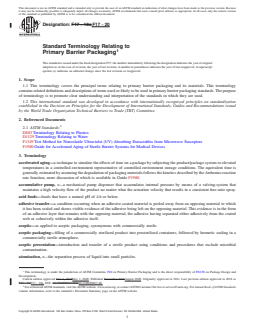
1.1 This terminology covers the principal terms relating to primary barrier packaging and its materials. This terminology contains related definitions and descriptions of terms used or likely to be used in primary barrier packaging standards. The purpose of terminology is to promote clear understanding and interpretation of the standards in which they are used.
1.2 This international standard was developed in accordance with internationally recognized principles on standardization established in the Decision on Principles for the Development of International Standards, Guides and Recommendations issued by the World Trade Organization Technical Barriers to Trade (TBT) Committee.
- Status
- Published
- Publication Date
- 30-Apr-2020
- Technical Committee
- F02 - Primary Barrier Packaging
- Drafting Committee
- F02.50 - Package Design and Development
Overview
ASTM F17-20 Standard Terminology Relating to Primary Barrier Packaging provides comprehensive definitions and descriptions of key terms used in the field of primary barrier packaging and its associated materials. Developed and maintained by ASTM International, this standard supports clear communication and consistency across packaging standards by establishing a common language. This terminology is vital for professionals involved in packaging design, manufacturing, quality assurance, and regulatory compliance, ensuring the protection and integrity of products throughout their lifecycle. The standard adheres to internationally recognized principles as established by the World Trade Organization’s Technical Barriers to Trade Committee.
Key Topics
ASTM F17-20 encompasses terminology that is central to understanding primary barrier packaging, including:
- Primary Barrier Packaging: The initial layer providing essential environmental and microbial protection to contents.
- Barrier Materials: Specialized porous or nonporous materials that limit passage of gases, vapors, liquids, or microorganisms, thereby protecting the product and the environment.
- Seal and Seal Integrity: Definitions regarding package bonding methods, the importance of maintaining continuous bonds, and factors that affect seal strength and performance.
- Flexible vs. Rigid Packaging: Distinction based on material properties and application, with flexibility characterized by hand-bending and low thickness.
- Sterile Barrier Systems: Packages designed to prevent microbial ingress and enable aseptic presentation.
- Accelerated Aging and Environmental Testing: Methods to simulate long-term effects or challenging conditions on package materials.
- Defects and Integrity: Clarification of terms such as major/minor package defects, leaks, pinholes, and delamination, essential for quality control.
- Packaging Components: Detailed classification of parts such as mechanical pump dispensers, closures, dip tubes, and more.
These definitions set the foundation for interpreting related test methods, performance standards, and regulatory guidance.
Applications
The standard terminology outlined in ASTM F17-20 is widely applicable in industries and activities such as:
- Healthcare and Medical Devices: Ensuring sterile barrier systems and package integrity for safe patient outcomes.
- Food Packaging: Supporting commercial sterility, barrier function, and compliance for packaged foods, particularly those requiring aseptic or retortable packaging.
- Pharmaceutical Products: Defining package attributes that protect product efficacy by preventing contamination.
- Consumer Goods: Guiding selection and testing of packaging materials for products such as sprays, lotions, and other liquids dispensed via mechanical pumps.
- Quality Control and Compliance: Aiding manufacturers and inspectors in detecting and categorizing defects, assessing seal strength, and maintaining high packaging standards.
- R&D and Materials Engineering: Facilitating the design, testing, and validation of innovative packaging systems to meet emerging market and regulatory needs.
By standardizing terminology, ASTM F17-20 helps ensure effective communication between manufacturers, suppliers, regulatory bodies, and end-users throughout the product supply chain.
Related Standards
ASTM F17-20 references and is used alongside several related ASTM standards, which include:
- ASTM D883: Terminology Relating to Plastics - offers key definitions for plastics in packaging.
- ASTM D1129: Terminology Relating to Water - pertinent for understanding water-related properties in packaging.
- ASTM F1349: Test Method for Nonvolatile UV Absorbing Extractables from Microwave Susceptors - relevant for evaluating microwave packaging performance.
- ASTM F1980: Guide for Accelerated Aging of Sterile Barrier Systems for Medical Devices - aids in shelf-life and durability testing.
By integrating ASTM F17-20 with these and other international standards, organizations can reinforce best practices in primary barrier packaging, reduce risk, and facilitate global trade through shared technical language.
Keywords: primary barrier packaging, ASTM F17-20, barrier materials, sterile barrier system, packaging integrity, packaging terminology, packaging defects, ASTM standards, packaging materials, package testing
Relations
- Effective Date
- 01-May-2020
- Effective Date
- 01-Feb-2024
- Effective Date
- 01-Nov-2023
- Effective Date
- 01-May-2020
- Effective Date
- 01-Jan-2020
- Effective Date
- 01-Aug-2019
- Effective Date
- 15-Apr-2019
- Effective Date
- 01-Mar-2019
- Effective Date
- 01-Feb-2019
- Effective Date
- 01-Dec-2018
- Effective Date
- 01-Nov-2018
- Effective Date
- 15-Aug-2017
- Effective Date
- 01-Apr-2014
- Effective Date
- 15-Nov-2012
- Effective Date
- 01-Aug-2011
Get Certified
Connect with accredited certification bodies for this standard

BRCGS (Brand Reputation Compliance Global Standards)
Global food safety and quality standards owner.
Sponsored listings
Frequently Asked Questions
ASTM F17-20 is a standard published by ASTM International. Its full title is "Standard Terminology Relating to Primary Barrier Packaging". This standard covers: SCOPE 1.1 This terminology covers the principal terms relating to primary barrier packaging and its materials. This terminology contains related definitions and descriptions of terms used or likely to be used in primary barrier packaging standards. The purpose of terminology is to promote clear understanding and interpretation of the standards in which they are used. 1.2 This international standard was developed in accordance with internationally recognized principles on standardization established in the Decision on Principles for the Development of International Standards, Guides and Recommendations issued by the World Trade Organization Technical Barriers to Trade (TBT) Committee.
SCOPE 1.1 This terminology covers the principal terms relating to primary barrier packaging and its materials. This terminology contains related definitions and descriptions of terms used or likely to be used in primary barrier packaging standards. The purpose of terminology is to promote clear understanding and interpretation of the standards in which they are used. 1.2 This international standard was developed in accordance with internationally recognized principles on standardization established in the Decision on Principles for the Development of International Standards, Guides and Recommendations issued by the World Trade Organization Technical Barriers to Trade (TBT) Committee.
ASTM F17-20 is classified under the following ICS (International Classification for Standards) categories: 01.040.55 - Packaging and distribution of goods (Vocabularies); 55.040 - Packaging materials and accessories. The ICS classification helps identify the subject area and facilitates finding related standards.
ASTM F17-20 has the following relationships with other standards: It is inter standard links to ASTM F17-18a, ASTM D883-24, ASTM D883-23, ASTM D1129-13(2020)e2, ASTM D883-20, ASTM D883-19c, ASTM D883-19a, ASTM F1349-08(2019), ASTM D883-19, ASTM D883-18a, ASTM D883-18, ASTM D883-17, ASTM F1349-08(2014), ASTM D883-12e1, ASTM F1980-07(2011). Understanding these relationships helps ensure you are using the most current and applicable version of the standard.
ASTM F17-20 is available in PDF format for immediate download after purchase. The document can be added to your cart and obtained through the secure checkout process. Digital delivery ensures instant access to the complete standard document.
Standards Content (Sample)
This international standard was developed in accordance with internationally recognized principles on standardization established in the Decision on Principles for the
Development of International Standards, Guides and Recommendations issued by the World Trade Organization Technical Barriers to Trade (TBT) Committee.
Designation: F17 − 20
Standard Terminology Relating to
Primary Barrier Packaging
This standard is issued under the fixed designation F17; the number immediately following the designation indicates the year of original
adoption or, in the case of revision, the year of last revision.Anumber in parentheses indicates the year of last reapproval.Asuperscript
epsilon (´) indicates an editorial change since the last revision or reapproval.
1. Scope accumulative pump, n—a mechanical pump dispenser that
accumulates internal pressure by means of a valving-system
1.1 This terminology covers the principal terms relating to
that maintains a high velocity flow of the product no matter
primary barrier packaging and its materials. This terminology
what the actuation velocity that results in a consistent fine
contains related definitions and descriptions of terms used or
mist spray.
likely to be used in primary barrier packaging standards. The
purpose of terminology is to promote clear understanding and
acid foods—foods that have a natural pH of 4.6 or below.
interpretation of the standards in which they are used.
adhesive transfer—a condition occurring when an adhesive-
1.2 This international standard was developed in accor-
coated material is peeled away from an opposing material to
dance with internationally recognized principles on standard-
which it has been sealed and shows visible evidence of the
ization established in the Decision on Principles for the
adhesive being left on the opposing material. This evidence
Development of International Standards, Guides and Recom-
is in the form of an adhesive layer that remains with the
mendations issued by the World Trade Organization Technical
opposing material, the adhesive having separated either
Barriers to Trade (TBT) Committee.
adhesively from the coated web or cohesively within the
adhesive itself.
2. Referenced Documents
aseptic—as applied to aseptic packaging, synonymous with
2.1 ASTM Standards:
commercially sterile.
D883 Terminology Relating to Plastics
aseptic packaging—filling of a commercially sterilized prod-
D1129 Terminology Relating to Water
uct into presterilized containers, followed by hermetic seal-
F1349 Test Method for Nonvolatile Ultraviolet (UV) Ab-
ing in a commercially sterile atmosphere.
sorbing Extractables from Microwave Susceptors
F1980 Guide for Accelerated Aging of Sterile Barrier Sys-
aseptic presentation—introduction and transfer of a sterile
tems for Medical Devices
product using conditions and procedures that exclude micro-
bial contamination.
3. Terminology
atomization, n—the separation process of liquid into small
accelerated aging—a technique to simulate the effects of time particles.
on a package by subjecting the product/package system to
barrier—anymateriallimitingpassagethroughitselfofsolids,
elevated temperatures in a controlled environment represen-
liquids,semisolids,gases,vapors,orformsofenergysuchas
tative of controlled environment storage conditions. The
ultraviolet light.
equivalent time is generally estimated by assuming the
barrier materials—specialized porous or nonporous packag-
degradation of packaging materials follows the kinetics
described by the Arrhenius reaction rate function, more ing materials that provide environmental protection to the
discussion of which is available in Guide F1980. package contents as well as protection to the environment
from the package contents: (1) gas, vapor, humidity, liquid,
microbial, or light resistant materials that control or elimi-
nate the amount of those environmental constituents that
ThisterminologyisunderthejurisdictionofASTMCommitteeF02onPrimary
pass into or out of a package; (2) a porous material
Barrier Packaging and is the direct responsibility of F02.50 on Package Design and
Development. preventing the passage of microorganisms that might con-
Current edition approved May 1, 2020. Published August 2020. Originally
taminate the contents of the package.
approved in 1961. Last previous edition approved in 2018 as F17 – 18a. DOI:
10.1520/F0017-20.
biological evaluation test (biotest)—a test which involves
For referenced ASTM standards, visit the ASTM website, www.astm.org, or
exposure of sealed packages to biological indicators and is
contact ASTM Customer Service at service@astm.org. For Annual Book of ASTM
designed to determine the microbiological integrity of a
Standards volume information, refer to the standard’s Document Summary page on
the ASTM website. package under the specific conditions of the test.
Copyright © ASTM International, 100 Barr Harbor Drive, PO Box C700, West Conshohocken, PA 19428-2959. United States
F17−20
burst strength—a measure of the internal pressure necessary surface of another (solid) material, forming a continuous
to rupture a package or seal. layer upon cooling. (2)Also, the product resulting from such
a process.
channel—any unimpaired pathway across the entire width of
the intended seal.
fine mist pump, n—a mechanical pump dispenser that atom-
izes liquid into a fine mist. An accumulative pump is the
clogging, v—the restriction of normal product flow. Most
most common type of fine mist pump.
commonly due to product drying in a product flow passage
area of the mechanical break-up system.
flexible—easily hand-folded, flexed, twisted, and bent.
DISCUSSION—“Flexible” may be a characteristic of thin barrier
coextrusion—in flexible barrier materials,(1) a process
materials, especially when thinner than 125 to 255 µm (5 to 10 mils),
whereby two or more plastic streams are forced simultane-
that are composed of materials that are otherwise classified as “rigid”
ously through one or more shaping orifices to become one
or “semi-rigid” under the definitions concerning rigidity based on
continuously-formed multilayered structure. (2) Also, the modulus of elasticity (see Terminology D883). Modulus of elasticity is
an inherent property of a material which in conjunction with thickness
product resulting from such a process.
determines flexibility.
commercial sterility— of thermally processed food, the con-
flexible package—any package with at least one flexible
dition achieved by application of heat, alone or in combina-
component that can be bent back or folded back upon itself.
tion with other appropriate treatments, to render the food
free of microorganisms capable of growing in the food at
fluoroptic temperature measurement—temperature mea-
normal nonrefrigerated conditions at which the food is likely
surement based on the variation in total luminescence of a
to be held during distribution and storage.
fluoroptic phosphor which has been previously calibrated
versus a known temperature standard.
conditioning—the exposure of a material to the influence of a
prescribed atmosphere for a stipulated period of time or until
food simulant—a well-characterized substance used in place
a stipulated relation is reached between material and atmo-
of food for investigative studies.
sphere.
force to actuate (FTA), n—the peak force that corresponds to
cross direction (CD)—the direction perpendicular to a mate-
the pressure on the finger that a consumer feels upon fully
rial’s flow through the machine on which the material is
actuating the mechanical pump dispenser.
being produced or processed. Material orientation perpen-
dicular to the flow direction through a machine may have functional barrier—in food packaging, a material that effec-
different properties than machine direction. Also known as tivelyrestrictspassageofsolids,liquids,semi-solids,vapors,
transverse direction (TD). or forms of energy such as ultraviolet light through itself,
across its borders, or interface with another material or
delamination—the separation of layers in a multilayered
substance.
structure.
functional compatibility, n—effect of physical or chemical
dispersion coating—in flexible barrier materials,(1) a pro-
interaction between a consumer product and a specific pump
cess of applying a material, suspended or dispersed in a
mechanism where problems typically include deformation
vehicle, to a surface in such a way that a continuous,
and degradation of components that result in a lower
coalesced, adherent layer results when the vehicle liquid
performance of the mechanical pump dispenser.
(usually water) is evaporated. (2)Also, the product resulting
from such a process.
fusion seal—a bond formed by combining two or more
materials through melting or other means so that the joining
dual ovenable—terms describing a food packaging container
layers become indistinguishable at the interface.
used to prepare food in either a conventional oven or a
microwave oven.
heat seal—the result of bonding surfaces by controlled appli-
cation of heat, pressure, and dwell time.
environmentally challenging—the process of subjecting a
package to extremes of temperature and/or humidity and/or
hermetically sealed aseptic container—a container that is
otherenvironmentalconditions,withthegoalofdetermining
designed and intended to be secure against the entry of
sensitivities of the package to environmental stresses. In
microorganisms and thereby to maintain the commercial
contrast to accelerated aging, environmental challenging
sterility of its contents.
often includes conditions, or transitions, or both, of tempera-
hot spot, n—the area of a spray where the product concentra-
ture and humidity that equal or exceed those that can be
tion is high which can be visibly seen on a spray pattern as
encountered in a package life cycle.
a concentrated stain on the alcohol-sensitive paper.
exit orifice, n—the final passage found in the insert that the
hot tack—the property of a heat seal to hold together when
liquid flows through before exiting the dispensing system
stressed while it is still hot from the sealing operation.
where the size of the orifice diameter can determine the size
of the spray particles and spray pattern.
laminate—a product made by bonding together two or more
extrusion coating—in flexible barrier materials,(1) a process layers of material or materials. (See also multilayered
of extrusion whereby a molten extrudate adheres to the structure)
F17−20
lamination—in flexible barrier materials, the process of microbiological package integrity—the physical condition of
preparing a laminate which consists of two or more flexible a finished package, including, but not limited to, the security
barriers bonded together (see also laminate). of package seals, which ensures the maintenance of the
package contents in a commercially sterile condition.
leak—a hole, void, or defect in the package material or mated
components of a package capable of passing particulate, microwave extraction cell—a polytetrafluoroethylene cell
aerosols, liquid, or gas from one side (inside or outside) of
used for evaluating microwave active materials. Refer to
the package to the other side contrary to intention. Test Method F1349 for schematics of cell construction.
load (water load)—an amount of water used to moderate the
microwave only food package—a container used to heat
microwave radiation absorbed by a susceptor during simu-
foods only in a microwave oven.
lated microwave heating tests.
microwave susceptor—packaging material that, when placed
low-acid food—any food, other than alcoholic beverages, with
in a microwave field, is designed to interact with the field
a finished equilibrium pH greater than 4.6 and a water
and provide substantial heat to the package contents.
activity (a ) greater than 0.85. Tomatoes and tomato prod-
w
minor package defect—a defect that does not significantly
ucts having a finished equilibrium pH less than 4.7 are not
reduce the usability of the package for its intended purpose,
classed as low-acid foods.
or that is a departure from established standards having little
machine direction (MD)—the direction parallel to a materi-
or no bearing on the effective use of the package.
al’s flow through the machine on which the material is being
multilayered structure—in flexible barrier materials, a struc-
produced or processed. Flow direction through a machine
ture that consists of two or more continuous layers or plies
may impart directional properties to a material. Also called
of material.
longitudinal direction (LD).
DISCUSSION—Processes such as lamination, coextrusion, extrusion
major package defect—a defect that is likely to result in
coating, and solution or dispersion coating can be used to make
multilayered structures. (
...
This document is not an ASTM standard and is intended only to provide the user of an ASTM standard an indication of what changes have been made to the previous version. Because
it may not be technically possible to adequately depict all changes accurately, ASTM recommends that users consult prior editions as appropriate. In all cases only the current version
of the standard as published by ASTM is to be considered the official document.
Designation: F17 − 18a F17 − 20
Standard Terminology Relating to
Primary Barrier Packaging
This standard is issued under the fixed designation F17; the number immediately following the designation indicates the year of original
adoption or, in the case of revision, the year of last revision. A number in parentheses indicates the year of last reapproval. A superscript
epsilon (´) indicates an editorial change since the last revision or reapproval.
1. Scope
1.1 This terminology covers the principal terms relating to primary barrier packaging and its materials. This terminology
contains related definitions and descriptions of terms used or likely to be used in primary barrier packaging standards. The purpose
of terminology is to promote clear understanding and interpretation of the standards in which they are used.
1.2 This international standard was developed in accordance with internationally recognized principles on standardization
established in the Decision on Principles for the Development of International Standards, Guides and Recommendations issued
by the World Trade Organization Technical Barriers to Trade (TBT) Committee.
2. Referenced Documents
2.1 ASTM Standards:
D883 Terminology Relating to Plastics
D1129 Terminology Relating to Water
F1349 Test Method for Nonvolatile Ultraviolet (UV) Absorbing Extractables from Microwave Susceptors
F1980 Guide for Accelerated Aging of Sterile Barrier Systems for Medical Devices
3. Terminology
accelerated aging—a technique to simulate the effects of time on a package by subjecting the product/package system to elevated
temperatures in a controlled environment representative of controlled environment storage conditions. The equivalent time is
generally estimated by assuming the degradation of packaging materials follows the kinetics described by the Arrhenius reaction
rate function, more discussion of which is available in Guide F1980.
accumulative pump, n—a mechanical pump dispenser that accumulates internal pressure by means of a valving-system that
maintains a high velocity flow of the product no matter what the actuation velocity that results in a consistent fine mist spray.
acid foods—foods that have a natural pH of 4.6 or below.
adhesive transfer—a condition occurring when an adhesive-coated material is peeled away from an opposing material to which
it has been sealed and shows visible evidence of the adhesive being left on the opposing material. This evidence is in the form
of an adhesive layer that remains with the opposing material, the adhesive having separated either adhesively from the coated
web or cohesively within the adhesive itself.
aseptic—as applied to aseptic packaging, synonymous with commercially sterile.
aseptic packaging—filling of a commercially sterilized product into presterilized containers, followed by hermetic sealing in a
commercially sterile atmosphere.
aseptic presentation—introduction and transfer of a sterile product using conditions and procedures that exclude microbial
contamination.
atomization, n—the separation process of liquid into small particles.
This terminology is under the jurisdiction of ASTM Committee F02 on Primary Barrier Packaging and is the direct responsibility of F02.50 on Package Design and
Development.
Current edition approved Oct. 1, 2018May 1, 2020. Published November 2018August 2020. Originally approved in 1961. Last previous edition approved in 2018 as
F17 – 18.F17 – 18a. DOI: 10.1520/F0017-18A.10.1520/F0017-20.
For referenced ASTM standards, visit the ASTM website, www.astm.org, or contact ASTM Customer Service at service@astm.org. For Annual Book of ASTM Standards
volume information, refer to the standard’s Document Summary page on the ASTM website.
Copyright © ASTM International, 100 Barr Harbor Drive, PO Box C700, West Conshohocken, PA 19428-2959. United States
F17 − 20
barrier—any material limiting passage through itself of solids, liquids, semisolids, gases, vapors, or forms of energy such as
ultraviolet light.
barrier materials—specialized porous or nonporous packaging materials that provide environmental protection to the package
contents as well as protection to the environment from the package contents: (1) gas, vapor, humidity, liquid, microbial, or light
resistant materials that control or eliminate the amount of those environmental constituents that pass into or out of a package;
(2) a porous material preventing the passage of microorganisms that might contaminate the contents of the package.
biological evaluation test (biotest)—a test which involves exposure of sealed packages to biological indicators and is designed
to determine the microbiological integrity of a package under the specific conditions of the test.
burst strength—a measure of the internal pressure necessary to rupture a package or seal.
channel—any unimpaired pathway across the entire width of the intended seal.
clogging, v—the restriction of normal product flow. Most commonly due to product drying in a product flow passage area of the
mechanical break-up system.
coextrusion—in flexible barrier materials, (1) a process whereby two or more plastic streams are forced simultaneously through
one or more shaping orifices to become one continuously-formed multilayered structure. (2) Also, the product resulting from
such a process.
commercial sterility— of thermally processed food, the condition achieved by application of heat, alone or in combination with
other appropriate treatments, to render the food free of microorganisms capable of growing in the food at normal nonrefrigerated
conditions at which the food is likely to be held during distribution and storage.
conditioning—the exposure of a material to the influence of a prescribed atmosphere for a stipulated period of time or until a
stipulated relation is reached between material and atmosphere.
cross direction (CD)—the direction perpendicular to a material’s flow through the machine on which the material is being
produced or processed. Material orientation perpendicular to the flow direction through a machine may have different properties
than machine direction. Also known as transverse direction (TD).
delamination—the separation of layers in a multilayered structure.
dispersion coating—in flexible barrier materials, (1) a process of applying a material, suspended or dispersed in a vehicle, to a
surface in such a way that a continuous, coalesced, adherent layer results when the vehicle liquid (usually water) is evaporated.
(2) Also, the product resulting from such a process.
dual ovenable—terms describing a food packaging container used to prepare food in either a conventional oven or a microwave
oven.
environmentally challenging—the process of subjecting a package to extremes of temperature and/or humidity and/or other
environmental conditions, with the goal of determining sensitivities of the package to environmental stresses. In contrast to
accelerated aging, environmental challenging often includes conditions, or transitions, or both, of temperature and humidity that
equal or exceed those that can be encountered in a package life cycle.
exit orifice, n—the final passage found in the insert that the liquid flows through before exiting the dispensing system where the
size of the orifice diameter can determine the size of the spray particles and spray pattern.
extrusion coating—in flexible barrier materials, (1) a process of extrusion whereby a molten extrudate adheres to the surface of
another (solid) material, forming a continuous layer upon cooling. (2) Also, the product resulting from such a process.
fine mist pump, n—a mechanical pump dispenser that atomizes liquid into a fine mist. An accumulative pump is the most common
type of fine mist pump.
flexible—easily hand-folded, flexed, twisted, and bent.
DISCUSSION—
“Flexible” may be a characteristic of thin barrier materials, especially when thinner than 125 to 255 μm (5 to 10 mils), that are composed of materials
that are otherwise classified as “rigid” or “semi-rigid” under the definitions concerning rigidity based on modulus of elasticity (see Terminology D883).
Modulus of elasticity is an inherent property of a material which in conjunction with thickness determines flexibility.
flexible package—any package with at least one flexible component that can be bent back or folded back upon itself.
fluoroptic temperature measurement—temperature measurement based on the variation in total luminescence of a fluoroptic
phosphor which has been previously calibrated versus a known temperature standard.
F17 − 20
food simulant—a well-characterized substance used in place of food for investigative studies.
force to actuate (FTA), n—the peak force that corresponds to the pressure on the finger that a consumer feels upon fully actuating
the mechanical pump dispenser.
functional barrier—in food packaging, a material that effectively restricts passage of solids, liquids, semi-solids, vapors, or forms
of energy such as ultraviolet light through itself, across its borders, or interface with another material or substance.
functional compatibility, n—effect of physical or chemical interaction between a consumer product and a specific pump
mechanism where problems typically include deformation and degradation of components that result in a lower performance of
the mechanical pump dispenser.
fusion seal—a bond formed by combining two or more materials through melting or other means so that the joining layers become
indistinguishable at the interface.
heat seal—the result of bonding surfaces by controlled application of heat, pressure, and dwell time.
hermetically sealed aseptic container—a container that is designed and intended to be secure against the entry of microorganisms
and thereby to maintain the commercial sterility of its contents.
hot spot, n—the area of a spray where the product concentration is high which can be visibly seen on a spray pattern as a
concentrated stain on the alcohol-sensitive paper.
hot tack—the property of a heat seal to hold together when stressed while it is still hot from the sealing operation.
laminate—a product made by bonding together two or more layers of material or materials. (See also multilayered structure)
lamination—in flexible barrier materials, the process of preparing a laminate which consists of two or more flexible barriers
bonded together (see also laminate).
leak—a hole, void, or defect in the package material or mated components of a package capable of passing particulate, aerosols,
liquid, or gas from one side (inside or outside) of the package to the other side contrary to intention.
load (water load)—an amount of water used to moderate the microwave radiation absorbed by a susceptor during simulated
microwave heating tests.
low-acid food—any food, other than alcoholic beverages, with a finished equilibrium pH greater than 4.6 and a water activity (a )
w
greater than 0.85. Tomatoes and tomato products having a finished equilibrium pH less than 4.7 are not classed as low-acid
foods.
machine direction (MD)—the direction parallel to a material’s flow through the machine on which the material is being produced
or processed. Flow direction through a machine may impart directional properties to a material. Also called longitudinal
direction (LD).
major package defect—a defect that is likely to result in failure or reduce significantly the usability of the package for its intended
use.
mechanical break-up unit (MBU), n— a design structure found in the insert that forces product to flow in a swirling method for
producing specific spray characteristics.
mechanical pump dispenser, n—a small, finger- or hand-actuated, mechanical device used to dispense (spray, stream, or flow)
product from a container that may be, generally, held in one’s hand.
medical device—any instrument, apparatus, implement, machine, appliance, implant, in vitro reagent or calibrator, software,
material, or other related article, intended by the manufacturer to be used, alone or in combination, for one of more of the specific
purpose(s) of (1) diagnosis, prevention, monitoring, treatment, or alleviation of a disease; (2) diagnosis, monitoring, treatment,
alleviation of or compensation for an injury; (3) investigation, replacement, modification or support of the anatomy or of a
physiological process—supporting or sustaining life; (4) control of conception; (5) disinfection of medical devices; and (6)
providing information for medical purposes by means of in vitro examination of specimens derived from the human body, and
w
...