

ASTM E2544-24
(Terminology)Standard Terminology for Three-Dimensional (3D) Imaging Systems
General Information
- Abstract
SCOPE
1.1 This terminology contains common terms, definitions of terms, descriptions of terms, nomenclature, and acronyms associated with three-dimensional (3D) imaging systems in an effort to standardize terminology used for 3D imaging systems.
1.2 The definitions of the terms presented in 3.1 are obtained from various standard documents developed by various standards development organizations. The intent is not to change these universally accepted definitions but to gather, in a single document, terms and their definitions that may be used in current or future standards for 3D imaging systems.
1.2.1 In some cases, definitions of the same term from two standards have been presented to provide additional reference. The text in parentheses to the right of each defined term is the name (and, in some cases, the specific section) of the source of the definition associated with that term.
1.3 The definitions in 3.2 are specific terms developed by this committee for 3D imaging systems. Some terms may have generally accepted definitions in a particular community or are defined in existing standards. If there are conflicting definitions, our preference is to adapt (modify) the ISO standard (if available) for this standard.
1.4 A definition in this terminology is a statement of the meaning of a word or word group expressed in a single sentence with additional information included in notes or discussions.
1.5 This standard does not purport to address all of the safety concerns, if any, associated with its use. It is the responsibility of the user of this standard to establish appropriate safety, health, and environmental practices and determine the applicability of regulatory limitations prior to use.
Note 1: The subcommittee responsible for this standard will review definitions on a five-year basis to determine if the definition is still appropriate as stated. Revisions will be made when determined necessary.
1.6 This international standard was developed in accordance with internationally recognized principles on standardization established in the Decision on Principles for the Development of International Standards, Guides and Recommendations issued by the World Trade Organization Technical Barriers to Trade (TBT) Committee.
- Status
- Published
- Publication Date
- 31-Dec-2023
- Technical Committee
- E57 - 3D Imaging Systems
- Drafting Committee
- E57.10 - Terminology
Overview
ASTM E2544-24: Standard Terminology for Three-Dimensional (3D) Imaging Systems provides a comprehensive and harmonized set of terms, definitions, and nomenclature related to 3D imaging systems. Developed by ASTM Committee E57, this terminology standard is designed to promote consistent language and understanding in the fields of 3D scanning, measurement, and imaging. By compiling terminology from a variety of sources, including international standards and technical documents, ASTM E2544-24 serves as an essential reference for manufacturers, users, developers, and stakeholders in industrial, research, and commercial applications involving 3D imaging systems.
Key Topics
- Standardized Terminology: The document defines common terms, acronyms, and concepts used across 3D imaging applications, including critical metrology and measurement vocabulary.
- Source Referencing: Where possible, definitions are drawn directly from recognized standards (ISO, ASME, NIST), ensuring international alignment and reducing ambiguity.
- 3D Imaging System Concepts: Terms related specifically to 3D imaging devices, such as point clouds, laser scanners (LiDAR, LADAR), structured light, and optical cameras, are included.
- Measurement Parameters: Definitions for accuracy, precision, bias, calibration, error (random, systematic, relative), and uncertainty support clear communication when discussing 3D measurement results.
- Operational Terms: The standard clarifies operating modes, system settings, measurement rates, field of view (FOV), resolution, and data representation (e.g., point clouds, pixels, control points).
- Specialized Applications: Describes concepts such as registration, pose, derived points, and measurements for diverse applications from small object scanning to large-scale site mapping.
Applications
The terminology standardized in ASTM E2544-24 has broad and practical value for various 3D imaging system applications:
- Industrial Measurement and Inspection: Provides a universal language for describing the setup, results, and performance of non-contact metrology tools, such as laser scanners and structured light systems used in manufacturing and quality control.
- Geospatial Surveying and Mapping: Facilitates collaboration and interoperability for applications like terrain mapping, site scanning, and infrastructure monitoring, where clarity in data interpretation is essential.
- Construction and BIM (Building Information Modeling): Ensures precise communication about 3D digital twins, site conditions, and as-built documentation using point clouds and mesh models.
- Robotics and Autonomous Systems: Standardizes terminology for describing sensor outputs, object detection, localization, and navigation, which often rely on 3D imaging.
- Medical and Scientific Research: Supports consistent reporting of 3D imaging in biomedical imaging, archaeological documentation, and scientific visualization.
- Data Exchange and Interoperability: By referencing data exchange standards and coordinate systems, the standard helps support seamless integration among different 3D imaging devices and software.
Related Standards
ASTM E2544-24 references and aligns with several important standards to provide consistency and cross-compatibility:
- ASTM E2919: Test methods for evaluating the performance of systems measuring six degrees of freedom (6DOF) pose.
- ASTM E2938, E3125: Test methods for assessing range measurement and point-to-point accuracy in 3D imaging systems.
- ASTM E2807: Specification for 3D imaging data exchange, supporting data interoperability.
- ASME B89.4.19: Performance evaluation of laser-based measurement systems.
- ISO 11146-1: Test methods for characterizing laser beam profiles.
- VIM (International Vocabulary of Metrology): Foundational definitions for metrology-related terms.
- NIST/SEMATECH e-Handbook: Statistical methods and measurement science terminology.
Adhering to ASTM E2544-24 helps ensure clear, consistent, and internationally recognized communication in all professional activities involving three-dimensional imaging systems. For technical teams, quality professionals, and decision makers, using standardized terminology streamlines project development, reporting, product development, and regulatory compliance across the rapidly growing 3D imaging industry.
Relations
- Effective Date
- 01-Jan-2024
- Effective Date
- 01-Apr-2022
- Effective Date
- 01-Apr-2022
- Effective Date
- 01-Jan-2024
- Effective Date
- 01-Jan-2024
- Effective Date
- 01-Jan-2024
- Effective Date
- 01-Jan-2024
Get Certified
Connect with accredited certification bodies for this standard

BSI Group
BSI (British Standards Institution) is the business standards company that helps organizations make excellence a habit.

NYCE
Mexican standards and certification body.
Sponsored listings
Frequently Asked Questions
ASTM E2544-24 is a standard published by ASTM International. Its full title is "Standard Terminology for Three-Dimensional (3D) Imaging Systems". This standard covers: SCOPE 1.1 This terminology contains common terms, definitions of terms, descriptions of terms, nomenclature, and acronyms associated with three-dimensional (3D) imaging systems in an effort to standardize terminology used for 3D imaging systems. 1.2 The definitions of the terms presented in 3.1 are obtained from various standard documents developed by various standards development organizations. The intent is not to change these universally accepted definitions but to gather, in a single document, terms and their definitions that may be used in current or future standards for 3D imaging systems. 1.2.1 In some cases, definitions of the same term from two standards have been presented to provide additional reference. The text in parentheses to the right of each defined term is the name (and, in some cases, the specific section) of the source of the definition associated with that term. 1.3 The definitions in 3.2 are specific terms developed by this committee for 3D imaging systems. Some terms may have generally accepted definitions in a particular community or are defined in existing standards. If there are conflicting definitions, our preference is to adapt (modify) the ISO standard (if available) for this standard. 1.4 A definition in this terminology is a statement of the meaning of a word or word group expressed in a single sentence with additional information included in notes or discussions. 1.5 This standard does not purport to address all of the safety concerns, if any, associated with its use. It is the responsibility of the user of this standard to establish appropriate safety, health, and environmental practices and determine the applicability of regulatory limitations prior to use. Note 1: The subcommittee responsible for this standard will review definitions on a five-year basis to determine if the definition is still appropriate as stated. Revisions will be made when determined necessary. 1.6 This international standard was developed in accordance with internationally recognized principles on standardization established in the Decision on Principles for the Development of International Standards, Guides and Recommendations issued by the World Trade Organization Technical Barriers to Trade (TBT) Committee.
SCOPE 1.1 This terminology contains common terms, definitions of terms, descriptions of terms, nomenclature, and acronyms associated with three-dimensional (3D) imaging systems in an effort to standardize terminology used for 3D imaging systems. 1.2 The definitions of the terms presented in 3.1 are obtained from various standard documents developed by various standards development organizations. The intent is not to change these universally accepted definitions but to gather, in a single document, terms and their definitions that may be used in current or future standards for 3D imaging systems. 1.2.1 In some cases, definitions of the same term from two standards have been presented to provide additional reference. The text in parentheses to the right of each defined term is the name (and, in some cases, the specific section) of the source of the definition associated with that term. 1.3 The definitions in 3.2 are specific terms developed by this committee for 3D imaging systems. Some terms may have generally accepted definitions in a particular community or are defined in existing standards. If there are conflicting definitions, our preference is to adapt (modify) the ISO standard (if available) for this standard. 1.4 A definition in this terminology is a statement of the meaning of a word or word group expressed in a single sentence with additional information included in notes or discussions. 1.5 This standard does not purport to address all of the safety concerns, if any, associated with its use. It is the responsibility of the user of this standard to establish appropriate safety, health, and environmental practices and determine the applicability of regulatory limitations prior to use. Note 1: The subcommittee responsible for this standard will review definitions on a five-year basis to determine if the definition is still appropriate as stated. Revisions will be made when determined necessary. 1.6 This international standard was developed in accordance with internationally recognized principles on standardization established in the Decision on Principles for the Development of International Standards, Guides and Recommendations issued by the World Trade Organization Technical Barriers to Trade (TBT) Committee.
ASTM E2544-24 is classified under the following ICS (International Classification for Standards) categories: 01.040.35 - Information technology (Vocabularies); 35.140 - Computer graphics. The ICS classification helps identify the subject area and facilitates finding related standards.
ASTM E2544-24 has the following relationships with other standards: It is inter standard links to ASTM E2544-11A(2019)e1, ASTM E456-13a(2022), ASTM E456-13a(2022)e1, ASTM E3125-17, ASTM E2938-15(2023), ASTM E2919-22, ASTM E2807-11(2019)e1. Understanding these relationships helps ensure you are using the most current and applicable version of the standard.
ASTM E2544-24 is available in PDF format for immediate download after purchase. The document can be added to your cart and obtained through the secure checkout process. Digital delivery ensures instant access to the complete standard document.
Standards Content (Sample)
This international standard was developed in accordance with internationally recognized principles on standardization established in the Decision on Principles for the
Development of International Standards, Guides and Recommendations issued by the World Trade Organization Technical Barriers to Trade (TBT) Committee.
Designation: E2544 − 24
Standard Terminology for
Three-Dimensional (3D) Imaging Systems
This standard is issued under the fixed designation E2544; the number immediately following the designation indicates the year of
original adoption or, in the case of revision, the year of last revision. A number in parentheses indicates the year of last reapproval. A
superscript epsilon (´) indicates an editorial change since the last revision or reapproval.
1. Scope 1.6 This international standard was developed in accor-
dance with internationally recognized principles on standard-
1.1 This terminology contains common terms, definitions of
ization established in the Decision on Principles for the
terms, descriptions of terms, nomenclature, and acronyms
Development of International Standards, Guides and Recom-
associated with three-dimensional (3D) imaging systems in an
mendations issued by the World Trade Organization Technical
effort to standardize terminology used for 3D imaging systems.
Barriers to Trade (TBT) Committee.
1.2 The definitions of the terms presented in 3.1 are ob-
tained from various standard documents developed by various
2. Referenced Documents
standards development organizations. The intent is not to
2.1 ASTM Standards:
change these universally accepted definitions but to gather, in
E456 Terminology Relating to Quality and Statistics
a single document, terms and their definitions that may be used
E2919 Test Method for Evaluating the Performance of
in current or future standards for 3D imaging systems.
Systems that Measure Static, Six Degrees of Freedom
1.2.1 In some cases, definitions of the same term from two
(6DOF), Pose
standards have been presented to provide additional reference.
E2938 Test Method for Evaluating the Relative-Range Mea-
The text in parentheses to the right of each defined term is the
surement Performance of 3D Imaging Systems in the
name (and, in some cases, the specific section) of the source of
Medium Range
the definition associated with that term.
E3124 Test Method for Measuring System Latency Perfor-
1.3 The definitions in 3.2 are specific terms developed by
mance of Optical Tracking Systems that Measure Six
this committee for 3D imaging systems. Some terms may have
Degrees of Freedom (6DOF) Pose
generally accepted definitions in a particular community or are
E3125 Test Method for Evaluating the Point-to-Point Dis-
defined in existing standards. If there are conflicting
tance Measurement Performance of Spherical Coordinate
definitions, our preference is to adapt (modify) the ISO
3D Imaging Systems in the Medium Range
standard (if available) for this standard.
E2807 Specification for 3D Imaging Data Exchange, Version
1.0
1.4 A definition in this terminology is a statement of the
meaning of a word or word group expressed in a single
2.2 ASME Standard:
sentence with additional information included in notes or
B89.4.19 Performance Evaluation of Laser Based Spherical
discussions.
Coordinate Measurement Systems
1.5 This standard does not purport to address all of the 2.3 ISO Standard:
safety concerns, if any, associated with its use. It is the VIM International vocabulary of metrology -- Basic and
responsibility of the user of this standard to establish appro- general concepts and associated terms
priate safety, health, and environmental practices and deter- ISO 11146–1 Lasers and laser-related equipment — Test
mine the applicability of regulatory limitations prior to use. methods for laser beam widths, divergence angles and
NOTE 1—The subcommittee responsible for this standard will review
definitions on a five-year basis to determine if the definition is still
For referenced ASTM standards, visit the ASTM website, www.astm.org, or
appropriate as stated. Revisions will be made when determined necessary.
contact ASTM Customer Service at service@astm.org. For Annual Book of ASTM
Standards volume information, refer to the standard’s Document Summary page on
the ASTM website.
1 3
This terminology is under the jurisdiction of Committee E57 on 3D Imaging Available from American Society of Mechanical Engineers (ASME), ASME
Systems and is the direct responsibility of Subcommittee E57.10 on Terminology. International Headquarters, Three Park Ave., New York, NY 10016-5990, http://
Current edition approved Jan. 1, 2024. Published February 2024. Originally www.asme.org.
ε1
approved in 2007. Last previous edition approved in 2019 as E2544 – 11a (2019) . Available from American National Standards Institute (ANSI), 25 W. 43rd St.,
DOI: 10.1520/E2544-24. 4th Floor, New York, NY 10036, http://www.ansi.org.
Copyright © ASTM International, 100 Barr Harbor Drive, PO Box C700, West Conshohocken, PA 19428-2959. United States
E2544 − 24
beam propagation ratios — Part 1: Stigmatic and simple a conventional true value and (2) the CODATA (1986) recom-
astigmatic beams mended value for the Avogadro constant, N : 6 022 136 7 ×
A
23 -1
10 mol .
2.4 NIST/SEMATECH Standard:
(2) Conventional true value is sometimes called assigned
NIST/SEMATECH e-Handbook of Statistical Methods
value, best estimate of the value, conventional value, or
3. Terminology reference value.
(3) Frequently, a number of results of measurements of a
3.1 Definitions:
quantity is used to establish a conventional true value.
accuracy of measurement, n—closeness of the agreement
between the result of a measurement and a true value of the
error (of measurement), n—result of a measurement minus a
measurand. (VIM 3.5)
true value of the measurand. (VIM 3.10)
DISCUSSION—
DISCUSSION—
(1) Accuracy is a qualitative concept.
(1) Since a true value cannot be determined, in practice, a
(2) The term “precision” should not be used for “accuracy.”
conventional true value is used (see true value and conven-
tional true value).
bias (of a measuring instrument), n—systematic error of the
(2) When it is necessary to distinguish “error” from “
indication of a measuring instrument. (VIM 3.25)
relative error,” the former is sometimes called “absolute error
DISCUSSION—
of measurement.” This should not be confused with the “
(1) The bias of a measuring instrument is normally esti-
absolute value of error,” which is the modulus of error.
mated by averaging the error of indication over an appropriate
number of repeated measurements.
indicating (measuring) instrument, n—measuring instrument
that displays an indication. (VIM 4.6)
bias, n—difference between the average or expected value of a
DISCUSSION—
distribution and the true value.
(1) Examples include analog indicating voltmeter, digital
(NIST/SEMATECH e-Handbook)
frequency meter, and micrometer.
DISCUSSION—
(2) The display may be analog (continuous or discontinu-
(1) In metrology, the difference between precision and
ous) or digital.
accuracy is that measures of precision are not affected by bias,
(3) Values of more than one quantity may be displayed
whereas accuracy measures degrade as bias increases.
simultaneously.
calibration, n—set of operations that establish, under specified
(4) A displaying measuring instrument may also provide a
conditions, the relationship between values of quantities
record.
indicated by a measuring instrument or measuring system, or
limiting conditions, n—the manufacturer’s specified limits on
values represented by a material measure or a reference
the environmental, utility, and other conditions within which
material, and the corresponding values realized by standards.
an instrument may be operated safely and without damage.
(VIM 6.11)
(ASME B89.4.19)
DISCUSSION—
DISCUSSION—
(1) The result of a calibration permits either the assignment
(1) The manufacturer’s performance specifications are not
of values of measurands to the indications or the determination
assured over the limiting conditions.
of corrections with respect to indications.
(2) A calibration may also determine other metrological
maximum permissible error (MPE), n—extreme values of an
properties such as the effect of influence quantities.
error permitted by specification, regulations, and so forth for
(3) The result of a calibration may be recorded in a
a given measuring instrument. (VIM 5.21)
document, sometimes called a calibration certificate or a
calibration report. measurand, n—particular quantity subject to measurement.
(VIM 2.6)
compensation, n—the process of determining systematic er-
DISCUSSION—
rors in an instrument and then applying these values in an
(1) Example includes vapor pressure of a given sample of
error model that seeks to eliminate or minimize measure-
water at 20°C.
ment errors. (ASME B89.4.19)
(2) The specification of a measurand may require state-
ments about quantities such as time, temperature, and pressure.
conventional true value (of a quantity), n—value attributed
to a particular quantity and accepted, sometimes by
precision, n—closeness of agreement between independent
convention, as having an uncertainty appropriate for a given
test results obtained under stipulated conditions.
purpose. (VIM 1.20)
(ASTM E456)
DISCUSSION—
DISCUSSION—
(1) Examples: (1) at a given location, the value assigned to
(1) Precision depends on random errors and does not relate
the quantity realized by a reference standard may be taken as
to the true value or the specified value.
(2) The measure of precision is usually expressed in terms
of imprecision and computed as a standard deviation of the test
Available from National Institute of Standards and Technology (NIST), 100
results. Less precision is reflected by a larger standard devia-
Bureau Dr., Stop 1070, Gaithersburg, MD 20899-1070, http://www.nist.gov.
e-Handbook available at http://www.itl.nist.gov/div898/handbook/. tion.
E2544 − 24
(3) “Independent test results” means results obtained in a (3) Reproducibility may be expressed quantitatively in
manner not influenced by any previous result on the same or terms of the dispersion characteristics of the results.
similar test object. Quantitative measures of precision depend
(4) Results are usually understood to be corrected results.
critically on the stipulated conditions. Repeatability and repro-
systematic error, n—mean that would result from an infinite
ducibility conditions are particular sets of extreme stipulated
number of measurements of the same measurand carried out
conditions.
under repeatability conditions minus a true value of the
precision, n—in metrology, the variability of a measurement
measurand. (VIM 3.14)
process around its average value.
DISCUSSION—
(NIST/SEMATECH e-Handbook)
(1) Systematic error is equal to error minus random error.
DISCUSSION—
(2) Like true value, systematic error and its causes cannot
(1) Precision is usually distinguished from accuracy, the
be completely known.
variability of a measurement process around the true value.
(3) For a measuring instrument, see “bias.”
Precision, in turn, can be decomposed further into short-term
variation or repeatability and long-term variation or reproduc-
true value (of a quantity), n—value consistent with the
ibility.
definition of a given particular quantity. (VIM 1.19)
random error, n—result of a measurement minus the mean
DISCUSSION—
that would result from an infinite number of measurements
(1) This is a value that would be obtained by a perfect
of the same measurand carried out under repeatability
measurement.
conditions. (VIM 3.13)
(2) True values are by nature indeterminate.
DISCUSSION—
(3) The indefinite article “a,” rather than the definite article
(1) Random error is equal to error minus systematic error.
“the,” is used in conjunction with “true value” because there
(2) Because only a finite number of measurements can be
may be many values consistent with the definition of a given
made, it is possible to determine only an estimate of random
particular quantity.
error.
uncertainty of measurement, n—parameter, associated with
rated conditions, n—manufacturer-specified limits on
the result of a measurement, that characterizes the dispersion
environmental, utility, and other conditions within which the
of the values that could reasonably be attributed to the
manufacturer’s performance specifications are guaranteed at
measurand. (VIM 3.9)
the time of installation of the instrument.
DISCUSSION—
(ASME B89.4.19)
(1) The parameter may be, for example, a standard devia-
relative error, n—error of measurement divided by a true
tion (or a given multiple of it) or the half width of an interval
value of the measurand. (VIM 3.12)
having a stated level of confidence.
DISCUSSION—
(2) Uncertainty of measurement comprises, in general,
(1) Since a true value cannot be determined, in practice a
many components. Some of these components may be evalu-
conventional true value is used.
ated from the statistical distribution of the results of series of
repeatability (of results of measurements), n—closeness of
measurements and can be characterized by experimental stan-
the agreement between the results of successive measure-
dard deviations. The other components, which can also be
ments of the same measurand carried out under the same
characterized by standard deviations, are evaluated from as-
conditions of measurement. (VIM 3.6)
sumed probability distributions based on experience or other
DISCUSSION—
information.
(1) These conditions are called repeatability conditions.
(3) It is understood that the result of the measurement is the
(2) Repeatability conditions include: the same measure-
best estimate of the value of the measurand, and that all
ment procedure; the same observer; the same measuring
components of uncertainty, including those arising from sys-
instrument used under the same conditions; the same location;
tematic effects, such as components associated with corrections
and repetition over a short period of time.
and reference standards, contribute to the dispersion.
(3) Repeatability may be expressed quantitatively in terms
3.2 Definitions of Terms Specific to This Standard:
of the dispersion characteristics of the results.
3D imaging system, n—a non-contact measurement system
reproducibility (of results of measurements), n—closeness
used to produce a 3D representation (for example, a point
of the agreement between the results of measurements of the
cloud or a mesh/polygonal model) of an object or a scene.
same measurand carried out under changed conditions of
DISCUSSION—
measurement. (VIM 3.7)
(1) Some examples of a 3D imaging system are terrestrial
DISCUSSION—
laser scanners, optical range cameras (such as 3D range
(1) A value statement of reproducibility requires specifica-
cameras), and structured light systems.
tion of the conditions changed.
(2) 3D imaging systems are used to measure from rela-
(2) The changed conditions may include: principle of
measurement; method of measurement; observer; measuring tively small-scale objects (such as a circuit board, a coin, a
statue, or a manufactured part) to larger scale objects or scenes
instrument; reference standard; location; conditions of use; and
time. (such as buildings, bridges, and archeological sites).
E2544 − 24
directs the laser beam. For example, the face of the instrument from
(3) The principles of measurement used in these systems
which the laser beam emerges that corresponds to a zenith angle
include, but are not limited to, time-of-flight, triangulation, and
between 180° and 360° may be defined as the back-face.
interferometry.
(4) A large number of 3D imaging system applications are
DISCUSSION—See also frontsight. E3125
concerned with measuring the external (or visible) surfaces of
backward compatibility, n—ability of a file reader to under-
objects or scenes. However, some applications may require that
sub-surface measurements also be considered (e.g., measuring stand a file created by a writer of an older version of a file
terrain under snow and ice or measuring through glass). format standard. E2807
(5) Examples of commonly-used names for certain types of
beam diameter (d ), n—for a laser beam with a circular
σ
3D imaging systems include LiDAR, RGB-D camera, flash
irradiance pattern, the beam diameter is the extent of the
LiDAR, LADAR, laser line scanner, stereo camera, 3D sonar,
irradiance distribution in a cross section of the laser beam (in
and area scanner.
a plane orthogonal to its propagation path) at a distance z and
absolute pose, n—pose of an object in the coordinate frame of
is given by:
the system under test. E2919
d ~z! 5 4σ~z!
σ
angular increment, n—the angle, Δα, between reported
where:
points, where Δα = α – α , in either the azimuth or
i i-1
σ(z) = σ (z) = σ (z)
elevation directions (or a combination of both) with respect
x y
σ (z),σ (z) = the square roots of the second order moments
to the instrument’s internal frame of reference. x y
DISCUSSION—
DISCUSSION—
(1) For scanning instruments, the angular increment may
(1) Reference ISO 11146–1.
also be known as the angle step size.
(2) For a laser beam with a Gaussian distribution of
azimuth angle, n—the angle between the orthogonal projec-
irradiance, the beam diameter is often defined as the distance
tion of the laser beam on a plane perpendicular to the vertical
across the center of the beam for which the irradiance, I, equals
(standing) axis of the instrument and a fixed (reference) axis
1/e of the maximum irradiance (where e is the base of the
in that plane. E3125
natural logarithm). See Fig. 1. The area inside a circle with this
diameter and centered at the beam center will contain 86.5 %
backsight, n—measurement mode, where the target is mea-
of the total irradiance of the beam.
sured with the laser beam emerging from the back-face of
(3) The beam diameter may be expressed as X mm mea-
the instrument.
sured at Y m. To determine the beam diameter for any other
DISCUSSION—The back-face may be arbitrarily chosen or may be
defined in terms of the zenith angle of the spinning prism mirror that distance, additional parameters are necessary.
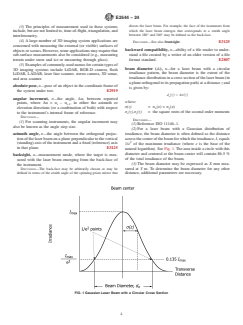
FIG. 1 Gaussian Laser Beam with a Circular Cross Section
E2544 − 24
(4) The term spot size has been used to mean the radius or
d , d = beam widths at the beam waist locations, z and
σx0 σy0 0x
the diameter of the laser beam. To avoid confusion, we
z
0y
recommend that spot size not be used.
= d (z ) and d (z ), respectively,
σx 0x σy 0y
θ = beam width of a Gaussian beam at the beam
Gσ0
beam divergence angles (θ , θ ), n—measure for the asymp-
σx σy
waist location, z ,
totic increase of the beam widths, d (z) and d (z), with
σx σy
θ = beam divergence angle for a Gaussian beam.
Gσ
increasing distance, z, from the beam waist locations, z and
0x
z , given by:
DISCUSSION—
0y
(1) For simple astigmatic beams, the beam propagation
d z
~ !
σx
θ 5 lim
ratio may also be given by (ISO 11146–1)
σx
z 2 z
~z2z !→` 0x
0x
θ d
π
σ x σx0
d z
~ ! 2
σy
M 5
x
θ 5 lim
σy λ 4
z 2 z
~z2z !→` 0y
0y
DISCUSSION—
π θ d
σy σy0
M 5
y
(1) Reference ISO 11146–1.
λ 4
(2) The beam divergence is expressed as a full angle.
(2) For a perfect Gaussian beam, M = 1. Most laser beams
(3) For circular laser beams, the beam divergence angle is
have a beam propagation ratio M >1, however, some high
given by:
quality laser beams can have values very close to 1.
(3) The beam propagation ratios are propagation invariants
d z
~ !
σ
θ 5 lim
σ for simple astigmatic beams as long as the optics involved do
z 2 z
~z2z !→` 0
not change their properties.
(4) For a perfect Gaussian laser beam of wavelength λ, the
beam divergence angle is given by:
beam width (d , d ), n—the extent of the irradiance distri-
σx σy
λ
bution in a cross section of a laser beam (in a direction
θ 5 4
σ
πd orthogonal to its propagation path) at a distance z and is
σ0
given by:
where:
d z 5 4 σ z
~ ! ~ !
σx x
d = d (z ) and is the beam width at the beam waist, z .
σ0 σ 0 0
See Fig. 2. d ~z! 5 4 σ ~z!
σy y
where σ and σ are the square roots of the second order
x y
2 2
beam propagation ratios (M , M ), n—ratios of the product
x y moments along the principal axes, x and y, respectively. See
of the divergence angle, θ, and the beam width, d, at the
Fig. 3.
beam waist location z , for a given laser beam to the same
DISCUSSION—
product for a perfect Gaussian beam at the same wavelength, (1) If the ellipticity, ε (the ratio between the minimum and
and is given by:
maximum beam widths) of the laser beam is larger than 0.87,
the beam profile may be considered to be of circular symmetry
θ d
σx σx0
M 5
x and the beam width at a distance z is defined as (ISO 11146–1):
θ d
Gσ Gσ0
2 2
θ d d z 5 2=2 σ 1σ 2
~ ! ~ !
σy σ y0 σ x y
M 5
y
(2) For a simple astigmatic laser beam with wavelength λ,
θ d
Gσ Gσ0
where: the beam widths may be expressed as:
FIG. 2 Perfect Gaussian Beam Profile for a 532 nm beam focused at 25 m
E2544 − 24
FIG. 3 Schematic Showing Beam Width, Beam Waist, Beam Divergence Angles (Ref ISO 11146)
2 2 control network, n—a collection of identifiable points (visible
4M λ
x
d ~z! 5 d Œ11 ~z 2 z !
S D
σx σx0 2 0x or inferable), with stated coordinate uncertainties, in a single
πd
σx0
coordinate system.
2 2
4M λ
y DISCUSSION—
d ~z! 5 d Œ11 ~z 2 z !
S 2 D
σy σy0 0y
πd
(1) An identifiable point is a point that can be uniquely
σy0
where:
identified throughout the useful life of the control network.
2 2 (2) An example of an inferable point is the center of a
M , M = beam propagation ratios,
x y
sphere, while not visible, can be obtained by processing
d , d = beam widths at the beam waist locations z and
σx0 σy0 0x
suitable data.
z ,
0y
(3) The purpose of a control network may include:
= d z ) and d (z ), respectively.
σx( 0x σy 0y
a. monitoring/controlling data quality (for example,
These equations, d (z) and d (z), are sometimes referred to as
σx σy
controlling scale error, identifying systematic error),
the beam propagation equations and are particularly useful for
b. registration,
short range, laser-based 3D imaging systems where the laser
c. defining the extent of a measuring environment, and
beam is focused at z and z . Using these equations, any
0x 0y
d. verifying the position of an instrument (drift).
missing parameter which defines the laser beam can be
(4) A control network should be established by an accepted
derived.
best practice.
(3) For line scanners or sheet of light profilers, the beam
width term is equivalent to the line width orthogonal to the
control point, n—an identifiable point which is a member of a
longitudinal axis of the line and to the propagation path.
control network.
byte, n—grouping of 8 bits, also known as an octet. E2807 DISCUSSION—
(1) An identifiable point is a point that can be uniquely
camel case, n—naming convention in which compound words
identified throughout the useful life of the control network.
are joined without spaces with each word’s initial letter
(2) A control point may be derived from an object that is
capitalized within the component and the first letter is either
permanent (for example, benchmark) or temporary (for
upper or lowercase. E2807
example, target such as a sphere specifically placed in a scene).
camera image, n—regular, rectangular grid of values that
degree of freedom, DOF, n—any of the minimum number of
stores data from a 2D imaging system, such as a camera.
translation or rotation components required to specify com-
E2807
pletely the pose of a rigid body.
camera projection model, n—mathematical formula used to
DISCUSSION—
convert between 3D coordinates and pixels in a camera (1) In a 3D space, a rigid object can have at most 6DOFs,
image. E2807 three translation and three rotation.
E2544 − 24
(2) The term “degree of freedom” is also used with regard frontsight, n—measurement mode, where the target is mea-
to statistical testing. It will be clear from the context in which sured with the laser beam emerging from the front-face of
it is used whether the term relates to a statistical test or the the instrument.
DISCUSSION—The front-face may be arbitrarily chosen or may be
rotation/translation aspect of the object. E2919
defined in terms of the zenith angle of the spinning prism mirror that
derived-point, n—a point (such as the center of a sphere) that
directs the laser beam. For example, the face of the instrument from
which the laser beam emerges that corresponds to a zenith angle
is not measured directly but computed using multiple mea-
between 0° and 180° may be defined as the front-face.
sured points on a target surface. E3125
DISCUSSION—See also backsight. E3125
derived-point to derived-point distance, n—the distance
between two derived-points.
instrument origin, n—point from which all instrument mea-
DISCUSSION—The derived-point to derived-point distance is also
surements are referenced, that is, origin of the instrument
referred to as point-to-point distance in this standard. E3125
coordinate reference frame (0, 0, 0).
elevation angle, n—the angle between the laser beam and the
instrument settings, n—parameters that a user
...
This document is not an ASTM standard and is intended only to provide the user of an ASTM standard an indication of what changes have been made to the previous version. Because
it may not be technically possible to adequately depict all changes accurately, ASTM recommends that users consult prior editions as appropriate. In all cases only the current version
of the standard as published by ASTM is to be considered the official document.
´1
Designation: E2544 − 11a (Reapproved 2019) E2544 − 24
Standard Terminology for
Three-Dimensional (3D) Imaging Systems
This standard is issued under the fixed designation E2544; the number immediately following the designation indicates the year of
original adoption or, in the case of revision, the year of last revision. A number in parentheses indicates the year of last reapproval. A
superscript epsilon (´) indicates an editorial change since the last revision or reapproval.
ε NOTE—Sections 3.2 and 3.3 were updated editorially in March 2022 to include all current terms developed by Commit-
tee E57.
1. Scope
1.1 This terminology contains common terms, definitions of terms, descriptions of terms, nomenclature, and acronyms associated
with three-dimensional (3D) imaging systems in an effort to standardize terminology used for 3D imaging systems.
1.2 The definitions of the terms presented in 3.1 are obtained from various standard documents developed by various standards
development organizations. The intent is not to change these universally accepted definitions but to gather, in a single document,
terms and their definitions that may be used in current or future standards for 3D imaging systems.
1.2.1 In some cases, definitions of the same term from two standards have been presented to provide additional reference. The text
in parentheses to the right of each defined term is the name (and, in some cases, the specific section) of the source of the definition
associated with that term.
1.3 The definitions in 3.2 are specific terms developed by this committee for 3D imaging systems. Some terms may have generally
accepted definitions in a particular community or are defined in existing standards. If there are conflicting definitions, our
preference is to adapt (modify) the ISO standard (if available) for this standard.
1.4 A definition in this terminology is a statement of the meaning of a word or word group expressed in a single sentence with
additional information included in notes or discussions.
1.5 This standard does not purport to address all of the safety concerns, if any, associated with its use. It is the responsibility
of the user of this standard to establish appropriate safety, health, and environmental practices and determine the applicability of
regulatory limitations prior to use.
NOTE 1—The subcommittee responsible for this standard will review definitions on a five-year basis to determine if the definition is still appropriate as
stated. Revisions will be made when determined necessary.
1.6 This international standard was developed in accordance with internationally recognized principles on standardization
established in the Decision on Principles for the Development of International Standards, Guides and Recommendations issued
by the World Trade Organization Technical Barriers to Trade (TBT) Committee.
This terminology is under the jurisdiction of Committee E57 on 3D Imaging Systems and is the direct responsibility of Subcommittee E57.10 on Terminology.
Current edition approved March 1, 2019Jan. 1, 2024. Published March 2019February 2024. Originally approved in 2007. Last previous edition approved in 20112019 as
ε1
E2544 – 11a. 11a (2019) . DOI: 10.1520/E2544-11AR19E01.10.1520/E2544-24.
Copyright © ASTM International, 100 Barr Harbor Drive, PO Box C700, West Conshohocken, PA 19428-2959. United States
E2544 − 24
2. Referenced Documents
2.1 ASTM Standards:
E456 Terminology Relating to Quality and Statistics
E2919 Test Method for Evaluating the Performance of Systems that Measure Static, Six Degrees of Freedom (6DOF), Pose
E2938 Test Method for Evaluating the Relative-Range Measurement Performance of 3D Imaging Systems in the Medium Range
E3124 Test Method for Measuring System Latency Performance of Optical Tracking Systems that Measure Six Degrees of
Freedom (6DOF) Pose
E3125 Test Method for Evaluating the Point-to-Point Distance Measurement Performance of Spherical Coordinate 3D Imaging
Systems in the Medium Range
E2807 Specification for 3D Imaging Data Exchange, Version 1.0
2.2 ASME Standard:
B89.4.19 Performance Evaluation of Laser Based Spherical Coordinate Measurement Systems
2.3 ISO Standard:
VIM International vocabulary of metrology -- Basic and general concepts and associated terms
ISO 11146–1 Lasers and laser-related equipment — Test methods for laser beam widths, divergence angles and beam
propagation ratios — Part 1: Stigmatic and simple astigmatic beams
2.4 NIST/SEMATECH Standard:
NIST/SEMATECH e-Handbook of Statistical Methods
3. Terminology
3.1 Definitions:
accuracy of measurement, n—closeness of the agreement between the result of a measurement and a true value of the
measurand. (VIM 3.5)
DISCUSSION—
(1) Accuracy is a qualitative concept.
(2) The term “precision” should not be used for “accuracy.”
bias (of a measuring instrument), n—systematic error of the indication of a measuring instrument. (VIM 3.25)
DISCUSSION—
(1) The bias of a measuring instrument is normally estimated by averaging the error of indication over an appropriate number
of repeated measurements.
bias, n—difference between the average or expected value of a distribution and the true value.
(NIST/SEMATECH e-Handbook)
DISCUSSION—
(1) In metrology, the difference between precision and accuracy is that measures of precision are not affected by bias, whereas
accuracy measures degrade as bias increases.
calibration, n—set of operations that establish, under specified conditions, the relationship between values of quantities
indicated by a measuring instrument or measuring system, or values represented by a material measure or a reference material,
and the corresponding values realized by standards. (VIM 6.11)
DISCUSSION—
(1) The result of a calibration permits either the assignment of values of measurands to the indications or the determination
of corrections with respect to indications.
(2) A calibration may also determine other metrological properties such as the effect of influence quantities.
(3) The result of a calibration may be recorded in a document, sometimes called a calibration certificate or a calibration report.
For referenced ASTM standards, visit the ASTM website, www.astm.org, or contact ASTM Customer Service at service@astm.org. For Annual Book of ASTM Standards
volume information, refer to the standard’s Document Summary page on the ASTM website.
Available from American Society of Mechanical Engineers (ASME), ASME International Headquarters, Three Park Ave., New York, NY 10016-5990, http://
www.asme.org.
Available from American National Standards Institute (ANSI), 25 W. 43rd St., 4th Floor, New York, NY 10036, http://www.ansi.org.
Available from National Institute of Standards and Technology (NIST), 100 Bureau Dr., Stop 1070, Gaithersburg, MD 20899-1070, http://www.nist.gov. e-Handbook
available at http://www.itl.nist.gov/div898/handbook/.
E2544 − 24
compensation, n—the process of determining systematic errors in an instrument and then applying these values in an error
model that seeks to eliminate or minimize measurement errors. (ASME B89.4.19)
conventional true value (of a quantity), n—value attributed to a particular quantity and accepted, sometimes by convention,
as having an uncertainty appropriate for a given purpose. (VIM 1.20)
DISCUSSION—
(1) Examples: (1) at a given location, the value assigned to the quantity realized by a reference standard may be taken as a
23 -1
conventional true value and (2) the CODATA (1986) recommended value for the Avogadro constant, N : 6 022 136 7 × 10 mol .
A
(2) Conventional true value is sometimes called assigned value, best estimate of the value, conventional value, or reference
value.
(3) Frequently, a number of results of measurements of a quantity is used to establish a conventional true value.
error (of measurement), n—result of a measurement minus a true value of the measurand. (VIM 3.10)
DISCUSSION—
(1) Since a true value cannot be determined, in practice, a conventional true value is used (see true value and conventional true
value).
(2) When it is necessary to distinguish “error” from “ relative error,” the former is sometimes called “absolute error of
measurement.” This should not be confused with the “ absolute value of error,” which is the modulus of error.
indicating (measuring) instrument, n—measuring instrument that displays an indication. (VIM 4.6)
DISCUSSION—
(1) Examples include analog indicating voltmeter, digital frequency meter, and micrometer.
(2) The display may be analog (continuous or discontinuous) or digital.
(3) Values of more than one quantity may be displayed simultaneously.
(4) A displaying measuring instrument may also provide a record.
limiting conditions, n—the manufacturer’s specified limits on the environmental, utility, and other conditions within which an
instrument may be operated safely and without damage. (ASME B89.4.19)
DISCUSSION—
(1) The manufacturer’s performance specifications are not assured over the limiting conditions.
maximum permissible error (MPE), n—extreme values of an error permitted by specification, regulations, and so forth for a
given measuring instrument. (VIM 5.21)
measurand, n—particular quantity subject to measurement. (VIM 2.6)
DISCUSSION—
(1) Example includes vapor pressure of a given sample of water at 20°C.
(2) The specification of a measurand may require statements about quantities such as time, temperature, and pressure.
precision, n—closeness of agreement between independent test results obtained under stipulated conditions.
(ASTM E456)
DISCUSSION—
(1) Precision depends on random errors and does not relate to the true value or the specified value.
(2) The measure of precision is usually expressed in terms of imprecision and computed as a standard deviation of the test
results. Less precision is reflected by a larger standard deviation.
(3) “Independent test results” means results obtained in a manner not influenced by any previous result on the same or similar
test object. Quantitative measures of precision depend critically on the stipulated conditions. Repeatability and reproducibility
conditions are particular sets of extreme stipulated conditions.
precision, n—in metrology, the variability of a measurement process around its average value.
(NIST/SEMATECH e-Handbook)
DISCUSSION—
(1) Precision is usually distinguished from accuracy, the variability of a measurement process around the true value. Precision,
in turn, can be decomposed further into short-term variation or repeatability and long-term variation or reproducibility.
E2544 − 24
random error, n—result of a measurement minus the mean that would result from an infinite number of measurements of the
same measurand carried out under repeatability conditions. (VIM 3.13)
DISCUSSION—
(1) Random error is equal to error minus systematic error.
(2) Because only a finite number of measurements can be made, it is possible to determine only an estimate of random error.
rated conditions, n—manufacturer-specified limits on environmental, utility, and other conditions within which the
manufacturer’s performance specifications are guaranteed at the time of installation of the instrument.
(ASME B89.4.19)
relative error, n—error of measurement divided by a true value of the measurand. (VIM 3.12)
DISCUSSION—
(1) Since a true value cannot be determined, in practice a conventional true value is used.
repeatability (of results of measurements), n—closeness of the agreement between the results of successive measurements of
the same measurand carried out under the same conditions of measurement. (VIM 3.6)
DISCUSSION—
(1) These conditions are called repeatability conditions.
(2) Repeatability conditions include: the same measurement procedure; the same observer; the same measuring instrument used
under the same conditions; the same location; and repetition over a short period of time.
(3) Repeatability may be expressed quantitatively in terms of the dispersion characteristics of the results.
reproducibility (of results of measurements), n—closeness of the agreement between the results of measurements of the same
measurand carried out under changed conditions of measurement. (VIM 3.7)
DISCUSSION—
(1) A value statement of reproducibility requires specification of the conditions changed.
(2) The changed conditions may include: principle of measurement; method of measurement; observer; measuring instrument;
reference standard; location; conditions of use; and time.
(3) Reproducibility may be expressed quantitatively in terms of the dispersion characteristics of the results.
(4) Results are usually understood to be corrected results.
systematic error, n—mean that would result from an infinite number of measurements of the same measurand carried out under
repeatability conditions minus a true value of the measurand. (VIM 3.14)
DISCUSSION—
(1) Systematic error is equal to error minus random error.
(2) Like true value, systematic error and its causes cannot be completely known.
(3) For a measuring instrument, see “bias.”
true value (of a quantity), n—value consistent with the definition of a given particular quantity. (VIM 1.19)
DISCUSSION—
(1) This is a value that would be obtained by a perfect measurement.
(2) True values are by nature indeterminate.
(3) The indefinite article “a,” rather than the definite article “the,” is used in conjunction with “true value” because there may
be many values consistent with the definition of a given particular quantity.
uncertainty of measurement, n—parameter, associated with the result of a measurement, that characterizes the dispersion of
the values that could reasonably be attributed to the measurand. (VIM 3.9)
DISCUSSION—
(1) The parameter may be, for example, a standard deviation (or a given multiple of it) or the half width of an interval having
a stated level of confidence.
(2) Uncertainty of measurement comprises, in general, many components. Some of these components may be evaluated from
the statistical distribution of the results of series of measurements and can be characterized by experimental standard deviations.
The other components, which can also be characterized by standard deviations, are evaluated from assumed probability
distributions based on experience or other information.
E2544 − 24
(3) It is understood that the result of the measurement is the best estimate of the value of the measurand, and that all
components of uncertainty, including those arising from systematic effects, such as components associated with corrections and
reference standards, contribute to the dispersion.
3.2 Definitions of Terms Specific to This Standard:
3D imaging system, n—a non-contact measurement instrumentsystem used to produce a 3D representation (for example, a point
cloud) cloud or a mesh/polygonal model) of an object or a site.scene.
DISCUSSION—
(1) Some examples of a 3D imaging system are laser scanners (also known as LADARs or LIDARs or laser radars), terrestrial
laser scanners, optical range cameras (also known as flash LIDARs or (such as 3D range cameras), triangulation-based systems
such as those using pattern projectors or lasers, and other systems based on interferometry.and structured light systems.
(2) In general, the information gathered by a 3D imaging system is a collection of n-tuples, where each n-tuple can include
but is not limited to spherical or Cartesian coordinates, return signal strength, color, time stamp, identifier, polarization, and
multiple range returns.
(2) 3D imaging systems are used to measure from relatively small scale objects (for example, coin, statue, manufactured part,
human body)small-scale objects (such as a circuit board, a coin, a statue, or a manufactured part) to larger scale objects or sites
(for example, terrain features, buildings, bridges, dams, towns, scenes (such as buildings, bridges, and archeological sites).
(3) The principles of measurement used in these systems include, but are not limited to, time-of-flight, triangulation, and
interferometry.
(4) A large number of 3D imaging system applications are concerned with measuring the external (or visible) surfaces of
objects or scenes. However, some applications may require that sub-surface measurements also be considered (e.g., measuring
terrain under snow and ice or measuring through glass).
(5) Examples of commonly-used names for certain types of 3D imaging systems include LiDAR, RGB-D camera, flash
LiDAR, LADAR, laser line scanner, stereo camera, 3D sonar, and area scanner.
absolute pose, n—pose of an object in the coordinate frame of the system under test. E2919
angular increment, n—the angle, Δα, between reported points, where Δα = α – α , in either the azimuth or elevation directions
i i-1
(or a combination of both) with respect to the instrument’s internal frame of reference.
DISCUSSION—
(1) For scanning instruments, the angular increment may also be known as the angle step size.
azimuth angle, n—the angle between the orthogonal projection of the laser beam on a plane perpendicular to the vertical
(standing) axis of the instrument and a fixed (reference) axis in that plane. E3125
backsight, n—measurement mode, where the target is measured with the laser beam emerging from the back-face of the
instrument.
DISCUSSION—
The back-face may be arbitrarily chosen or may be defined in terms of the zenith angle of the spinning prism mirror that directs the laser beam. For
example, the face of the instrument from which the laser beam emerges that corresponds to a zenith angle between 180° and 360° may be defined as
the back-face.
DISCUSSION—
See also frontsight. E3125
backward compatibility, n—ability of a file reader to understand a file created by a writer of an older version of a file format
standard. E2807
beam diameter (d ), n—for a laser beam with a circular irradiance pattern, the beam diameter is the extent of the irradiance
σ
distribution in a cross section of the laser beam (in a plane orthogonal to its propagation path) at a distance z and is given by:
d ~z! 5 4σ~z!
σ
where:
σ(z) = σ (z) = σ (z)
x y
σ (z),σ (z) = the square roots of the second order moments
x y
E2544 − 24
DISCUSSION—
(1) Reference ISO 11146–1.
(2) For a laser beam with a Gaussian distribution of irradiance, the beam diameter is often defined as the distance across the
center of the beam for which the irradiance, I, equals 1/e of the maximum irradiance (where e is the base of the natural logarithm).
See Fig. 1. The area inside a circle with this diameter and centered at the beam center will contain 86.5 % of the total irradiance
of the beam.
(3) The beam diameter may be expressed as X mm measured at Y m. To determine the beam diameter for any other distance,
additional parameters are necessary.
(4) The term spot size has been used to mean the radius or the diameter of the laser beam. To avoid confusion, we recommend
that spot size not be used.
beam divergence angles (θ , θ ), n—measure for the asymptotic increase of the beam widths, d (z) and d (z), with increasing
σx σy σx σy
distance, z, from the beam waist locations, z and z , given by:
0x 0y
d ~z!
σx
θ 5 lim
σx
z 2 z
z2z →`
~ ! 0x
0x
d ~z!
σy
θ 5 lim
σy
z 2 z
z2z →`
~ ! 0y
0y
DISCUSSION—
(1) Reference ISO 11146–1.
(2) The beam divergence is expressed as a full angle.
(3) For circular laser beams, the beam divergence angle is given by:
d z
~ !
σ
θ 5 lim
σ
z 2 z
~z2z !→` 0
(4) For a perfect Gaussian laser beam of wavelength λ, the beam divergence angle is given by:
λ
θ 5 4
σ
πd
σ0
where:
d = d (z ) and is the beam width at the beam waist, z .
σ0 σ 0 0
See Fig. 2.
FIG. 1 Gaussian Laser Beam with a Circular Cross Section
E2544 − 24
FIG. 2 Perfect Gaussian Beam Profile for a 532 nm beam focused at 25 m
2 2
beam propagation ratios (M , M ), n—ratios of the product of the divergence angle, θ, and the beam width, d, at the beam
x y
waist location z , for a given laser beam to the same product for a perfect Gaussian beam at the same wavelength, and is given
by:
θ d
σx σx0
M 5
x
θ d
Gσ Gσ0
θ d
σy σ y0
M 5
y
θ d
Gσ Gσ0
where:
d , d = beam widths at the beam waist locations, z and z
σx0 σy0 0x 0y
= d (z ) and d (z ), respectively,
σx 0x σy 0y
θ = beam width of a Gaussian beam at the beam waist location, z ,
Gσ0 0
θ = beam divergence angle for a Gaussian beam.
Gσ
DISCUSSION—
(1) For simple astigmatic beams, the beam propagation ratio may also be given by (ISO 11146–1)
θ d
π
σ x σx0
M 5
x
λ 4
π θ d
σy σy0
M 5
y
λ 4
2 2
(2) For a perfect Gaussian beam, M = 1. Most laser beams have a beam propagation ratio M >1, however, some high quality
laser beams can have values very close to 1.
(3) The beam propagation ratios are propagation invariants for simple astigmatic beams as long as the optics involved do not
change their properties.
beam width (d , d ), n—the extent of the irradiance distribution in a cross section of a laser beam (in a direction orthogonal
σx σy
to its propagation path) at a distance z and is given by:
d z 5 4 σ z
~ ! ~ !
σx x
d z 5 4 σ z
~ ! ~ !
σy y
where σ and σ are the square roots of the second order moments along the principal axes, x and y, respectively. See Fig. 3.
x y
DISCUSSION—
(1) If the ellipticity, ε (the ratio between the minimum and maximum beam widths) of the laser beam is larger than 0.87, the
beam profile may be considered to be of circular symmetry and the beam width at a distance z is defined as (ISO 11146–1):
2 2
d z 5 2=2 σ 1σ 2
~ ! ~ !
σ x y
(2) For a simple astigmatic laser beam with wavelength λ, the beam widths may be expressed as:
E2544 − 24
FIG. 3 Schematic Showing Beam Width, Beam Waist, Beam Divergence Angles (Ref ISO 11146)
2 2
4M λ
x
d z 5 d 11 z 2 z
~ ! ΠS D ~ !
σx σx0 2 0x
πd
σx0
2 2
4M λ
y
d ~z! 5 d Œ11 ~z 2 z !
S D
σy σy0 2 0y
πd
σy0
where:
2 2
M , M = beam propagation ratios,
x y
d , d = beam widths at the beam waist locations z and z ,
σx0 σy0 0x 0y
= d z ) and d (z ), respectively.
σx( 0x σy 0y
These equations, d (z) and d (z), are sometimes referred to as the beam propagation equations and are particularly useful for short
σx σy
range, laser-based 3D imaging systems where the laser beam is focused at z and z . Using these equations, any missing parameter
0x 0y
which defines the laser beam can be derived.
(3) For line scanners or sheet of light profilers, the beam width term is equivalent to the line width orthogonal to the
longitudinal axis of the line and to the propagation path.
byte, n—grouping of 8 bits, also known as an octet. E2807
camel case, n—naming convention in which compound words are joined without spaces with each word’s initial letter
capitalized within the component and the first letter is either upper or lowercase. E2807
camera image, n—regular, rectangular grid of values that stores data from a 2D imaging system, such as a camera. E2807
camera projection model, n—mathematical formula used to convert between 3D coordinates and pixels in a camera image.
E2807
control network, n—a collection of identifiable points (visible or inferable), with stated coordinate uncertainties, in a single
coordinate system.
DISCUSSION—
(1) An identifiable point is a point that can be uniquely identified throughout the useful life of the control network.
(2) An example of an inferable point is the center of a sphere, while not visible, can be obtained by processing suitable data.
E2544 − 24
(3) The purpose of a control network may include:
a. monitoring/controlling data quality (for example, controlling scale error, identifying systematic error),
b. registration,
c. defining the extent of a measuring environment, and
d. verifying the position of an instrument (drift).
(4) A control network should be established by an accepted best practice.
control point, n—an identifiable point which is a member of a control network.
DISCUSSION—
(1) An identifiable point is a point that can be uniquely identified throughout the useful life of the control network.
(2) A control point may be derived from an object that is permanent (for example, benchmark) or temporary (for example,
target such as a sphere specifically placed in a scene).
degree of freedom, DOF, n—any of the minimum number of translation or rotation components required to specify completely
the pose of a rigid body.
DISCUSSION—
(1) In a 3D space, a rigid object can have at most 6DOFs, three translation and three rotation.
(2) The term “degree of freedom” is also used with regard to statistical testing. It will be clear from the context in which it
is used whether the term relates to a statistical test or the rotation/translation aspect of the object. E2919
derived-point, n—a point (such as the center of a sphere) that is not measured directly but computed using multiple measured
points on a target surface. E3125
derived-point to derived-point distance, n—the distance between two derived-points.
DISCUSSION—
The derived-point to derived-point distance is also referred to as point-to-point distance in this standard. E3125
elevation angle, n—the angle between the laser beam and the orthogonal projection of the laser beam on a plane perpendicular
to the vertical (standing) axis of the instrument, measured from that plane.
DISCUSSION—
Some systems report the zenith angle instead of the elevation angle. The sum of the eleva
...