


ASTM D8152-18
(Practice)Standard Practice for Measuring Field Infiltration Rate and Calculating Field Hydraulic Conductivity Using the Modified Philip Dunne Infiltrometer Test
Standard Practice for Measuring Field Infiltration Rate and Calculating Field Hydraulic Conductivity Using the Modified Philip Dunne Infiltrometer Test
SIGNIFICANCE AND USE
5.1 This practice shall only be used on soils having infiltration rates ranging from 2.5 mm/h (field hydraulic conductivity of 6.9 × 10⁻⁷ m/s) to 15000 mm/h (field hydraulic conductivity of 4.0 × 10⁻³ m/s).
5.2 This practice is useful for field measurement of the infiltration rate and calculation of field hydraulic conductivity of soils. It was initially developed for stormwater treatment applications, and has been used to design, verify the construction of, and perform annual testing on surface drainage applications such as rain gardens or storm water collection systems (1). Other suitable applications include evaluation of potential septic-tank disposal fields (ASTM D5879 and D5921), leaching and drainage efficiencies, irrigation requirements, erosion potential, forestry, agriculture, and water spreading and recharge, among other applications. This test is not intended for use in hydraulic barriers/seals such as landfill liners, nuclear waste repositories, or the core of a dam. This test is also not intended for use in soils that experience changes in volume during infiltration, such as collapsible or expansive soils.
5.3 Field hydraulic conductivity can only be calculated when the hydraulic boundary conditions are known, such as hydraulic gradient and the extent of lateral flow of water, or these can be reliably estimated.
Note 1: The quality of the result produced by this standard is dependent on the competence of the personnel performing it, and the suitability of the equipment and facilities used. Agencies that meet the criteria of Practice D3740 are generally considered capable of competent and objective testing/sampling/inspection/etc. Users of this standard are cautioned that compliance with Practice D3740 does not in itself assure reliable results. Reliable results depend on many factors; Practice D3740 provides a means of evaluating some of those factors.
5.4 A mathematical analysis has been developed for this test that follows the Green-Ampt a...
SCOPE
1.1 This practice describes a procedure for field measurement of the infiltration rate of liquid (typically water) into soils using the modified Philip Dunne (MPD) infiltrometer. The data from the field measurement is then used to calculate the field hydraulic conductivity. Soils should be regarded as natural occurring fine or coarse-grained soils or processed materials or mixtures of natural soils and processed materials, or other porous materials, and which are basically insoluble and are in accordance with requirements of 5.1.
1.2 This practice may be conducted at the ground surface or at given depths in pits, on bare soil or with vegetation in place, depending on the conditions for which infiltration rates are desired. However, this practice cannot be conducted where the test surface is at or below the groundwater table, a perched water table, or the capillary fringe.
1.3 This practice is for soils within a range of infiltration rate range defined in 5.1, as long as an adequate seal can be made between the MPD Infiltrometer base and the soil being tested. In highly permeable soils, readings can be taken at shorter intervals, to ensure that enough data are collected to determine the infiltration rate.
1.4 The field measurement is a falling head test that can be performed relatively quickly (30 to 60 minutes) in silty sand or clayey sand soils suitable for stormwater infiltration practices. It is suitable for testing several locations across a site, to characterize the spatial variability of the infiltration rate throughout the site.
1.5 The field measurement can be used to measure the infiltration rate, which can be used to calculate the field hydraulic conductivity. The field hydraulic conductivity can be used as an index to compare the suitability of soils for use in the development of surface drainage applications (for example, rain gardens or stormwater fills).
1.6 Units—The values stated in SI unit...
General Information
- Status
- Published
- Publication Date
- 30-Jun-2018
- Technical Committee
- D18 - Soil and Rock
- Drafting Committee
- D18.04 - Hydrologic Properties and Hydraulic Barriers
Relations
- Effective Date
- 01-Nov-2023
- Effective Date
- 01-Oct-2019
- Effective Date
- 01-Mar-2019
- Effective Date
- 01-Mar-2017
- Refers
ASTM D2937-17e2 - Standard Test Method for Density of Soil in Place by the Drive-Cylinder Method - Effective Date
- 01-Feb-2017
- Refers
ASTM D2937-17e1 - Standard Test Method for Density of Soil in Place by the Drive-Cylinder Method - Effective Date
- 01-Feb-2017
- Refers
ASTM D2937-17 - Standard Test Method for Density of Soil in Place by the Drive-Cylinder Method - Effective Date
- 01-Feb-2017
- Effective Date
- 01-Aug-2015
- Effective Date
- 01-Aug-2014
- Effective Date
- 01-May-2012
- Effective Date
- 01-Mar-2012
- Effective Date
- 01-Sep-2011
- Effective Date
- 01-Sep-2011
- Effective Date
- 01-Jul-2010
- Effective Date
- 01-May-2010
Overview
ASTM D8152-18 is the Standard Practice developed by ASTM International for measuring the field infiltration rate and calculating field hydraulic conductivity using the Modified Philip Dunne (MPD) Infiltrometer Test. This standard provides a recognized procedure for obtaining accurate field-scale measurements of how quickly water enters into soils, which is then used to determine the hydraulic conductivity-an essential property for stormwater management, construction, and environmental projects.
This standard is intended for use with soils exhibiting infiltration rates between 2.5 mm/h and 15,000 mm/h, making it broadly suitable for various natural and engineered soils except those behaving as hydraulic barriers or that significantly change volume during infiltration (e.g., collapsible or expansive soils).
Key Topics
- Field Infiltration Rate Measurement: The MPD Infiltrometer Test enables quick (30-60 minute) field measurement of infiltration rates, offering a direct evaluation tool for soil permeability under site-specific conditions.
- Hydraulic Conductivity Calculation: Data collected in the field is used to calculate field hydraulic conductivity, a key parameter in assessing soil drainage capability.
- Soil and Site Suitability: The test is designed for fine to coarse-grained soils and mixtures, with procedures adaptable to bare soil or vegetated land, at the surface or at depth within pits.
- Boundary Conditions: Accurate calculation of hydraulic conductivity requires awareness of hydraulic gradients and lateral flow extent or reliable estimation of these variables.
- Limits of Applicability: The method excludes use in areas below the groundwater table, within the capillary fringe, perched water tables, or soils intended for use as hydraulic barriers or seals.
Applications
ASTM D8152-18 is widely applicable in both environmental and engineering contexts where understanding infiltration and soil hydraulic properties is critical:
- Stormwater Management: Fundamental for designing, verifying, and monitoring green infrastructure such as rain gardens and stormwater infiltration systems, helping to reduce runoff and improve onsite rainwater absorption.
- Septic System Evaluation: Used to assess suitability of soils for septic tank disposal fields, supporting compliance with related standards and regulations.
- Land and Water Management: Assists in determining leaching efficiencies, irrigation needs, erosion risks, and groundwater recharge potential in agricultural, forestry, and urban planning projects.
- Site Characterization and Construction: Offers reliable data for comparing multiple locations across a project site, revealing spatial variability critical to foundation and surface drainage design.
- Annual Testing and Compliance: Provides a basis for ongoing verification of infiltration-based installations, supporting maintenance and regulatory reporting.
Related Standards
The following ASTM standards are frequently referenced together with ASTM D8152-18 for comprehensive soil and site assessment:
- ASTM D653 - Terminology Relating to Soil, Rock, and Contained Fluids
- ASTM D2216 - Test Methods for Laboratory Determination of Water (Moisture) Content of Soil and Rock by Mass
- ASTM D2937 - Test Method for Density of Soil in Place by the Drive-Cylinder Method
- ASTM D3740 - Practice for Minimum Requirements for Agencies Engaged in Testing and/or Inspection of Soil and Rock as Used in Engineering Design and Construction
- ASTM D5879 - Practice for Surface Site Characterization for On-Site Septic Systems
- ASTM D5921 - Practice for Subsurface Site Characterization of Test Pits for On-Site Septic Systems
- ASTM D6026 - Practice for Using Significant Digits and Data Records in Geotechnical Data
- ASTM D6938 - Test Methods for In-Place Density and Water Content of Soil and Soil-Aggregate by Nuclear Methods
Summary
ASTM D8152-18 delivers a practical, standardized approach to in-situ measurement of soil infiltration and hydraulic conductivity, vital for sustainable water management, environmental protection, and infrastructure design. By following this standard, professionals can ensure data reliability, comparability, and compliance with industry best practices, directly enhancing project outcomes in stormwater, waste management, agriculture, and civil engineering.
Keywords: ASTM D8152-18, field infiltration rate, hydraulic conductivity, MPD infiltrometer test, soil permeability, stormwater management, field measurement, green infrastructure, geotechnical testing, soil evaluation.
Get Certified
Connect with accredited certification bodies for this standard

Control Union Certifications
Global certification for agriculture and sustainability.

ECOCERT
Organic and sustainability certification.

NSF International
Global independent organization facilitating standards development and certification.
Sponsored listings
Frequently Asked Questions
ASTM D8152-18 is a standard published by ASTM International. Its full title is "Standard Practice for Measuring Field Infiltration Rate and Calculating Field Hydraulic Conductivity Using the Modified Philip Dunne Infiltrometer Test". This standard covers: SIGNIFICANCE AND USE 5.1 This practice shall only be used on soils having infiltration rates ranging from 2.5 mm/h (field hydraulic conductivity of 6.9 × 10⁻⁷ m/s) to 15000 mm/h (field hydraulic conductivity of 4.0 × 10⁻³ m/s). 5.2 This practice is useful for field measurement of the infiltration rate and calculation of field hydraulic conductivity of soils. It was initially developed for stormwater treatment applications, and has been used to design, verify the construction of, and perform annual testing on surface drainage applications such as rain gardens or storm water collection systems (1). Other suitable applications include evaluation of potential septic-tank disposal fields (ASTM D5879 and D5921), leaching and drainage efficiencies, irrigation requirements, erosion potential, forestry, agriculture, and water spreading and recharge, among other applications. This test is not intended for use in hydraulic barriers/seals such as landfill liners, nuclear waste repositories, or the core of a dam. This test is also not intended for use in soils that experience changes in volume during infiltration, such as collapsible or expansive soils. 5.3 Field hydraulic conductivity can only be calculated when the hydraulic boundary conditions are known, such as hydraulic gradient and the extent of lateral flow of water, or these can be reliably estimated. Note 1: The quality of the result produced by this standard is dependent on the competence of the personnel performing it, and the suitability of the equipment and facilities used. Agencies that meet the criteria of Practice D3740 are generally considered capable of competent and objective testing/sampling/inspection/etc. Users of this standard are cautioned that compliance with Practice D3740 does not in itself assure reliable results. Reliable results depend on many factors; Practice D3740 provides a means of evaluating some of those factors. 5.4 A mathematical analysis has been developed for this test that follows the Green-Ampt a... SCOPE 1.1 This practice describes a procedure for field measurement of the infiltration rate of liquid (typically water) into soils using the modified Philip Dunne (MPD) infiltrometer. The data from the field measurement is then used to calculate the field hydraulic conductivity. Soils should be regarded as natural occurring fine or coarse-grained soils or processed materials or mixtures of natural soils and processed materials, or other porous materials, and which are basically insoluble and are in accordance with requirements of 5.1. 1.2 This practice may be conducted at the ground surface or at given depths in pits, on bare soil or with vegetation in place, depending on the conditions for which infiltration rates are desired. However, this practice cannot be conducted where the test surface is at or below the groundwater table, a perched water table, or the capillary fringe. 1.3 This practice is for soils within a range of infiltration rate range defined in 5.1, as long as an adequate seal can be made between the MPD Infiltrometer base and the soil being tested. In highly permeable soils, readings can be taken at shorter intervals, to ensure that enough data are collected to determine the infiltration rate. 1.4 The field measurement is a falling head test that can be performed relatively quickly (30 to 60 minutes) in silty sand or clayey sand soils suitable for stormwater infiltration practices. It is suitable for testing several locations across a site, to characterize the spatial variability of the infiltration rate throughout the site. 1.5 The field measurement can be used to measure the infiltration rate, which can be used to calculate the field hydraulic conductivity. The field hydraulic conductivity can be used as an index to compare the suitability of soils for use in the development of surface drainage applications (for example, rain gardens or stormwater fills). 1.6 Units—The values stated in SI unit...
SIGNIFICANCE AND USE 5.1 This practice shall only be used on soils having infiltration rates ranging from 2.5 mm/h (field hydraulic conductivity of 6.9 × 10⁻⁷ m/s) to 15000 mm/h (field hydraulic conductivity of 4.0 × 10⁻³ m/s). 5.2 This practice is useful for field measurement of the infiltration rate and calculation of field hydraulic conductivity of soils. It was initially developed for stormwater treatment applications, and has been used to design, verify the construction of, and perform annual testing on surface drainage applications such as rain gardens or storm water collection systems (1). Other suitable applications include evaluation of potential septic-tank disposal fields (ASTM D5879 and D5921), leaching and drainage efficiencies, irrigation requirements, erosion potential, forestry, agriculture, and water spreading and recharge, among other applications. This test is not intended for use in hydraulic barriers/seals such as landfill liners, nuclear waste repositories, or the core of a dam. This test is also not intended for use in soils that experience changes in volume during infiltration, such as collapsible or expansive soils. 5.3 Field hydraulic conductivity can only be calculated when the hydraulic boundary conditions are known, such as hydraulic gradient and the extent of lateral flow of water, or these can be reliably estimated. Note 1: The quality of the result produced by this standard is dependent on the competence of the personnel performing it, and the suitability of the equipment and facilities used. Agencies that meet the criteria of Practice D3740 are generally considered capable of competent and objective testing/sampling/inspection/etc. Users of this standard are cautioned that compliance with Practice D3740 does not in itself assure reliable results. Reliable results depend on many factors; Practice D3740 provides a means of evaluating some of those factors. 5.4 A mathematical analysis has been developed for this test that follows the Green-Ampt a... SCOPE 1.1 This practice describes a procedure for field measurement of the infiltration rate of liquid (typically water) into soils using the modified Philip Dunne (MPD) infiltrometer. The data from the field measurement is then used to calculate the field hydraulic conductivity. Soils should be regarded as natural occurring fine or coarse-grained soils or processed materials or mixtures of natural soils and processed materials, or other porous materials, and which are basically insoluble and are in accordance with requirements of 5.1. 1.2 This practice may be conducted at the ground surface or at given depths in pits, on bare soil or with vegetation in place, depending on the conditions for which infiltration rates are desired. However, this practice cannot be conducted where the test surface is at or below the groundwater table, a perched water table, or the capillary fringe. 1.3 This practice is for soils within a range of infiltration rate range defined in 5.1, as long as an adequate seal can be made between the MPD Infiltrometer base and the soil being tested. In highly permeable soils, readings can be taken at shorter intervals, to ensure that enough data are collected to determine the infiltration rate. 1.4 The field measurement is a falling head test that can be performed relatively quickly (30 to 60 minutes) in silty sand or clayey sand soils suitable for stormwater infiltration practices. It is suitable for testing several locations across a site, to characterize the spatial variability of the infiltration rate throughout the site. 1.5 The field measurement can be used to measure the infiltration rate, which can be used to calculate the field hydraulic conductivity. The field hydraulic conductivity can be used as an index to compare the suitability of soils for use in the development of surface drainage applications (for example, rain gardens or stormwater fills). 1.6 Units—The values stated in SI unit...
ASTM D8152-18 is classified under the following ICS (International Classification for Standards) categories: 13.080.99 - Other standards related to soil quality; 65.060.35 - Irrigation and drainage equipment. The ICS classification helps identify the subject area and facilitates finding related standards.
ASTM D8152-18 has the following relationships with other standards: It is inter standard links to ASTM D3740-23, ASTM D3740-19, ASTM D2216-19, ASTM D6938-17, ASTM D2937-17e2, ASTM D2937-17e1, ASTM D2937-17, ASTM D6938-15, ASTM D653-14, ASTM D3740-12a, ASTM D3740-12, ASTM D3740-11, ASTM D653-11, ASTM D2216-10, ASTM D5921-96(2010). Understanding these relationships helps ensure you are using the most current and applicable version of the standard.
ASTM D8152-18 is available in PDF format for immediate download after purchase. The document can be added to your cart and obtained through the secure checkout process. Digital delivery ensures instant access to the complete standard document.
Standards Content (Sample)
This international standard was developed in accordance with internationally recognized principles on standardization established in the Decision on Principles for the
Development of International Standards, Guides and Recommendations issued by the World Trade Organization Technical Barriers to Trade (TBT) Committee.
Designation:D8152 −18
Standard Practice for
Measuring Field Infiltration Rate and Calculating Field
Hydraulic Conductivity Using the Modified Philip Dunne
Infiltrometer Test
This standard is issued under the fixed designation D8152; the number immediately following the designation indicates the year of
original adoption or, in the case of revision, the year of last revision.Anumber in parentheses indicates the year of last reapproval.A
superscript epsilon (´) indicates an editorial change since the last revision or reapproval.
1. Scope 1.6 Units—The values stated in SI units are to be regarded
as the standard. No other units of measurement are to be
1.1 This practice describes a procedure for field measure-
included in this standard.
mentoftheinfiltrationrateofliquid(typicallywater)intosoils
usingthemodifiedPhilipDunne(MPD)infiltrometer.Thedata 1.7 All observed and calculated values shall conform to the
from the field measurement is then used to calculate the field guidelines for significant digits and rounding established in
hydraulic conductivity. Soils should be regarded as natural Practice D6026.
occurringfineorcoarse-grainedsoilsorprocessedmaterialsor
1.8 The procedures used to specify how data are collected/
mixtures of natural soils and processed materials, or other
recorded or calculated in this standard are regarded as the
porous materials, and which are basically insoluble and are in
industry standard. In addition, they are representative of the
accordance with requirements of 5.1.
significant digits that generally should be retained. The proce-
1.2 Thispracticemaybeconductedatthegroundsurfaceor dures used do not consider material variation, purpose for
atgivendepthsinpits,onbaresoilorwithvegetationinplace, obtaining the data, special purpose studies, or any consider-
depending on the conditions for which infiltration rates are ations for the user’s objectives; and it is common practice to
desired. However, this practice cannot be conducted where the increase or reduce significant digits of reported data to be
test surface is at or below the groundwater table, a perched commensuratewiththeseconsiderations.Itisbeyondthescope
water table, or the capillary fringe. of this standard to consider significant digits used in analytical
methods for engineering design.
1.3 This practice is for soils within a range of infiltration
1.9 This standard does not purport to address all of the
rate range defined in 5.1, as long as an adequate seal can be
safety concerns, if any, associated with its use. It is the
made between the MPD Infiltrometer base and the soil being
responsibility of the user of this standard to establish appro-
tested. In highly permeable soils, readings can be taken at
priate safety, health, and environmental practices and deter-
shorter intervals, to ensure that enough data are collected to
mine the applicability of regulatory limitations prior to use.
determine the infiltration rate.
1.10 This international standard was developed in accor-
1.4 The field measurement is a falling head test that can be
dance with internationally recognized principles on standard-
performedrelativelyquickly(30to60minutes)insiltysandor
ization established in the Decision on Principles for the
clayey sand soils suitable for stormwater infiltration practices.
Development of International Standards, Guides and Recom-
It is suitable for testing several locations across a site, to
mendations issued by the World Trade Organization Technical
characterize the spatial variability of the infiltration rate
Barriers to Trade (TBT) Committee.
throughout the site.
1.5 The field measurement can be used to measure the
2. Referenced Documents
infiltration rate, which can be used to calculate the field
2.1 ASTM Standards:
hydraulicconductivity.Thefieldhydraulicconductivitycanbe
D653Terminology Relating to Soil, Rock, and Contained
used as an index to compare the suitability of soils for use in
Fluids
thedevelopmentofsurfacedrainageapplications(forexample,
D2216TestMethodsforLaboratoryDeterminationofWater
rain gardens or stormwater fills).
(Moisture) Content of Soil and Rock by Mass
ThistestmethodisunderthejurisdictionofASTMCommitteeD18onSoiland
Rock and is the direct responsibility of Subcommittee D18.04 on Hydrologic For referenced ASTM standards, visit the ASTM website, www.astm.org, or
Properties and Hydraulic Barriers. contact ASTM Customer Service at service@astm.org. For Annual Book of ASTM
Current edition approved July 1, 2018. Published August 2018. DOI: 10.1520/ Standards volume information, refer to the standard’s Document Summary page on
D8152-18. the ASTM website.
Copyright © ASTM International, 100 Barr Harbor Drive, PO Box C700, West Conshohocken, PA 19428-2959. United States
D8152−18
D2937Test Method for Density of Soil in Place by the of soils. It was initially developed for stormwater treatment
Drive-Cylinder Method applications, and has been used to design, verify the construc-
D3740Practice for Minimum Requirements for Agencies tion of, and perform annual testing on surface drainage
Engaged in Testing and/or Inspection of Soil and Rock as applications such as rain gardens or storm water collection
Used in Engineering Design and Construction systems (1). Other suitable applications include evaluation of
D5879PracticeforSurfaceSiteCharacterizationforOn-Site potential septic-tank disposal fields (ASTM D5879 and
Septic Systems D5921), leaching and drainage efficiencies, irrigation
D5921Practice for Subsurface Site Characterization of Test requirements,erosionpotential,forestry,agriculture,andwater
Pits for On-Site Septic Systems (Withdrawn 2019) spreading and recharge, among other applications. This test is
D6026Practice for Using Significant Digits and Data Re- not intended for use in hydraulic barriers/seals such as landfill
cords in Geotechnical Data liners,nuclearwasterepositories,orthecoreofadam.Thistest
D6938TestMethodsforIn-PlaceDensityandWaterContent is also not intended for use in soils that experience changes in
of Soil and Soil-Aggregate by Nuclear Methods (Shallow volume during infiltration, such as collapsible or expansive
Depth) soils.
5.3 Field hydraulic conductivity can only be calculated
3. Terminology
when the hydraulic boundary conditions are known, such as
3.1 Definitions:
hydraulic gradient and the extent of lateral flow of water, or
3.1.1 Fordefinitionsofcommontechnicaltermsusedinthis
these can be reliably estimated.
standard, refer to Terminology D653.
NOTE 1—The quality of the result produced by this standard is
3.1.2 gravimetric water content, n—the ratio of mass of dependent on the competence of the personnel performing it, and the
suitability of the equipment and facilities used. Agencies that meet the
water to mass of solid particles in a soil matrix.
criteria of Practice D3740 are generally considered capable of competent
3.1.3 volumetric water content, n—the ratio of the volume
and objective testing/sampling/inspection/etc. Users of this standard are
of water to volume of solid particles in a soil matrix.
cautioned that compliance with Practice D3740 does not in itself assure
reliable results. Reliable results depend on many factors; Practice D3740
3.1.4 infiltration, n—the downward entry of liquid into a
provides a means of evaluating some of those factors.
soil layer.
5.4 Amathematicalanalysishasbeendevelopedforthistest
3.1.5 infiltration rate, n—aselectedrate,basedonmeasured
that follows the Green-Ampt analysis that assumes a relation-
incrementalinfiltrationvelocities,atwhichliquidcanenterthe
shipbetweenthevolumetricwatercontentandthedepthofthe
soil under specified initial and boundary conditions; it has the
wetting front, in that volumetric water content profile at the
dimensions of velocity.
wetting front is represented by a sharp transition between the
3.1.6 incremental infiltration rate, n—the quantity of flow
initial value in the ground and that of saturated soil, that is, the
per unit area over an increment of time; it has the same units
porosity (1), (2).
as the infiltration rate.
5.5 Many factors affect the infiltration rate, for example the
3.2 Definitions of Terms Specific to This Standard:
soil structure, soil layering, condition of the soil surface,
3.2.1 field hydraulic conductivity K,n—the rate of dis-
f
degreeofsaturationofthesoil,chemicalandphysicalnatureof
charge of water under laminar flow conditions through a unit
the soil and of the applied liquid, head of the applied liquid,
cross-sectionalareaofaporousmediumunderaunithydraulic
temperature of the liquid, and diameter and depth of embed-
gradient.
ment of rings. Thus, tests made at the same site are not likely
to give identical results and the rate measured by the practice
4. Summary of Practice
described in this standard is primarily for comparative use.
4.1 The infiltration rate of the soil is measured using the
MPDinfiltrometerbymeasuringthechangeinwaterlevelover 6. Test Method
time in a reservoir initially filled with 3.5 L of water. An
6.1 Scope
iterative solution to the Green-Ampt equation is used to
6.1.1 This test method describes a procedure for field
calculatethefieldhydraulicconductivityandthematricsuction
measurement of the infiltration rate of liquid (typically water)
at the wetted front by matching the solution to the measured
intosoilsusingthemodifiedPhilipDunne(MPD)infiltrometer.
water level data.
6.1.2 This test method may be conducted at the ground
surface or at given depths in pits, on bare soil or with
5. Significance and Use
vegetation in place, depending on the conditions for which
5.1 This practice shall only be used on soils having infiltra-
infiltration rates are desired. However, this practice cannot be
tion rates ranging from 2.5 mm/h (field hydraulic conductivity
conductedwherethetestsurfaceisatorbelowthegroundwater
-7
of 6.9×10 m/s) to 15000 mm/h (field hydraulic conductivity
table, a perched water table, or the capillary fringe.
-3
of 4.0×10 m/s).
6.1.3 This test method is for soils within a range of
5.2 This practice is useful for field measurement of the infiltrationraterangedefinedin5.1,aslongasanadequateseal
infiltration rate and calculation of field hydraulic conductivity
can be made between the MPD Infiltrometer base and the soil
being tested. In highly permeable soils, readings can be taken
at shorter intervals, to ensure that enough data are collected to
The last approved version of this historical standard is referenced on
www.astm.org. determine the infiltration rate.
D8152−18
6.1.4 The test method is a falling head test that can be 6.5.2 Thistestmethodisusefulforfieldmeasurementofthe
performedrelativelyquickly(30to60)minutesinsiltysandor infiltration rate. It was initially developed for stormwater
clayey sand soils suitable for stormwater infiltration practices. treatment applications, and has been used to design, verify the
It is suitable for testing several locations across a site, to constructionof,andperformannualtestingonsurfacedrainage
characterize the spatial variability of the infiltration rate applications such as rain gardens or storm water collection
throughout the site. systems (1). Other suitable applications include evaluation of
6.1.5 Units—ThevaluesstatedinSIunitsaretoberegarded potential septic-tank disposal fields (ASTM D5879 and
as the standard. No other units of measurement are to be D5921), leaching and drainage efficiencies, irrigation
included in this standard. requirements,erosionpotential,forestry,agriculture,andwater
6.1.6 All observed and calculated values shall conform to spreading and recharge, among other applications. This test is
not intended for use in hydraulic barriers/seals such as landfill
theguidelinesforsignificantdigitsandroundingestablishedin
Practice D6026. liners,nuclearwasterepositories,orthecoreofadam.Thistest
is also not intended for use in soils that experience changes in
6.1.7 This standard does not purport to address all the
safety concerns, if any, associated with its use. It is the volume during infiltration, such as collapsible or expansive
soils.
responsibility of the user of this standard to establish appro-
priate safety, health, and environmental practices and deter- 6.5.3 Many factors affect the infiltration rate, for example
the soil structure, soil layering, condition of the soil surface,
mine the applicability of regulatory limitations prior to use.
degreeofsaturationofthesoil,chemicalandphysicalnatureof
6.1.8 This international standard was developed in accor-
the soil and of the applied liquid, head of the applied liquid,
dance with internationally recognized principles on standard-
temperature of the liquid, and diameter and depth of embed-
ization established in the Decision on Principles for the
ment of rings. Thus, tests made at the same site are not likely
Development of International Standards, Guides, and Recom-
mendations issued by the World Trade Organization Technical to give identical results and the rate measured by the practice
described in this standard is primarily for comparative use.
Barriers to Trade (TBT) Committee.
6.6 Apparatus
6.2 Referenced Documents
6.6.1 Infiltrometer Graduated Cylinder—A cylinder made
6.2.1 ASTM Standards:
of clear acrylic or PVC, 357 6 1 mm long, 101.5 61mm
D653 Terminology Relating to Soil, Rock, and Contained Fluids
D2216 Test Methods for Laboratory Determination of Water (Moisture) inside diameter, with a wall thickness of 6 mm. The cylinder
Content of Soil and Rock by Mass
shallhaveameasuringgaugepermanentlyattachedtotheinner
D2937 Test Method for Density in Place by the Drive-Cylinder Method
wall and oriented vertically, with zero reading at the bottom of
D3740 Practice for Minimum Requirements for Agencies Engaged in Test-
ing and/or Inspection of Soil and Rock as Used in Engineering De- the cylinder. The gauge shall have millimeter and centimeter
sign and Construction
markingsextendingthefullheightofthecylinder.Thecylinder
D6026 Practice for Using Significant Digits in Geotechnical Engineering
is attached to the infiltrometer base (described below), with a
D6938 Test Method for Density in Place by Nuclear Method
watertight O-ring seal between the infiltrometer tube and
6.3 Terminology
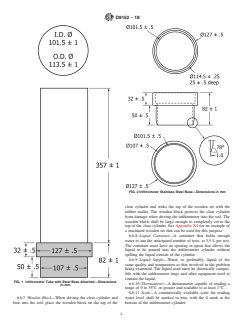
infiltrometer base. See Fig. 1.
6.3.1 Definitions—For definitions of common technical
terms used in this standard, refer to Terminology D653.
NOTE 2—The apparatus in Figs. 1 and 2 was developed in the United
Statesandisbasedona4in.insidediameter,4.5in.outsidediameterclear
6.3.1.1 gravimetric water content, n—the ratio of mass of
acrylic tube. The stainless steel base is machined from a 5 in. outside
water to mass of solid particles in a soil matrix.
diameter, 4 in. inside diameter hollow stainless steel tube.
6.3.1.2 volumetric water content, n—theratioofthevolume
6.6.2 Infiltrometer Base—A stainless steel collar, 82 6 1
of water to volume of solid particles in a soil matrix.
mm long and machined to fit around the bottom of the
6.3.1.3 infiltration, n—the downward entry of liquid into a
infiltrometer tube. The bottom edge of the base is beveled to
soil layer.
provide a cutting edge where it is pushed into the soil. Critical
6.3.1.4 infiltration rate, n—a selected rate, based on mea-
dimensionsoftheinfiltrometerbaseareshownbelowinFig.2.
sured incremental infiltration velocities, at which liquid can
6.6.3 Stopwatch—A dedicated time piece capable of mea-
enterthesoilunderspecifiedinitialandboundaryconditions;it
suring to 0.1 second or greater sensitivity. Do not use a
has the dimensions of velocity.
nondedicated device that could be interrupted by some other
6.3.1.5 incremental infiltration rate, n—the quantity of flow
function (that is, a smart phone app).
per unit area over an increment of time; it has the same units
6.6.4 Rubber Mallet—Rubbermalletwithamassofabout9
as the infiltration rate.
kg.
6.4 Summary of Test Method
6.6.5 Soil Dielectric Probe—A probe capable of inferring
6.4.1 The infiltration rate of the soil is measured using the
the volumetric water content through correlation with the
MPDinfiltrometerbymeasuringthechangeinwaterlevelover
dielectric permittivity of the soil.
time in a reservoir initially filled with 3.5 L of water.
6.6.6 Soil Core with Drive Cylinder—To obtain the volu-
6.5 Significance and Use metric water content from the gravimetric water content, use
6.5.1 This test method shall only be used on soils having the soil core with drive cylinder (ASTM D2937) to obtain an
infiltration rates ranging from 2.5 mm/h (field hydraulic undisturbed sample of the soil from the test location and
-7
conductivity of 6.9 × 10 m/s) to 15000 mm/h (field hydraulic measurethesoil’sdrydensity.Thisisnotneededifthemethod
-3
conductivity of 4.0 × 10 m/s). provides a direct measurement of volumetric water content.
D8152−18
FIG. 2Infiltrometer Stainless Steel Base—Dimensions in mm
clear cylinder and strike the top of the wooden set with the
rubber mallet. The wooden block protects the clear cylinder
from damage when driving the infiltrometer into the soil. The
wooden block shall be large enough to completely cover the
top of the clear cylinder. See Appendix X4 for an example of
a machined wooden set that can be used for this purpose.
6.6.8 Liquid Container—A container that holds enough
water to run the anticipated number of tests, at 3.5 L per test.
The container must have an opening or spout that allows the
liquid to be poured into the infiltrometer cylinder without
spilling the liquid outside of the cylinder.
6.6.9 Liquid Supply—Water, or preferably, liquid of the
same quality and temperature as that involved in the problem
being examined. The liquid used must be chemically compat-
ible with the infiltrometer rings and other equipment used to
contain the liquid.
FIG. 1 Infiltrometer Tube with Steel Base Attached—Dimensions
6.6.10 Thermometer—A thermometer capable of reading a
in mm
range of 0 to 55°C or greater and readable to at least 1°C.
6.6.11 Scale—A commercially available scale for reading
6.6.7 Wooden Block—When driving the clear cylinder and water level shall be marked in mm, with the 0 mark at the
base into the soil, place the wooden block on the top of the bottom of the infiltrometer cylinder.
D8152−18
6.7 Test Site 6.7.7 Read the water level at the bottom of the meniscus.
6.7.1 For testing an existing infiltration practice, the test is The water must be clear when taking readings.
typicallyperformedatthegroundsurfacewithintheinfiltration
6.7.8 Typically, at least 16 readings for a location are
practice. For new construction, or for septic drainfields, it is
desiredforanaccuratecalculationofhydraulicconductivity.A
necessary to determine the soil strata to be tested. This is
largewaterleveldropwillincorporatemoresoildepthintothe
determined beforehand and is based on a geotechnical explo-
hydraulic conductivity calculation and is recommended. If the
ration (soil borings or test pits). If the strata to be tested is
waterleveldropisslow,headversustimedatashouldbetaken
below the existing ground surface, it will be necessary to
until the water level is at least 100 mm from H .
excavate a pit. Perform tests at the proposed elevation where
6.7.9 When enough readings have been taken, end the test
water will infiltrate into the soil.
and measure the final (after-test) volumetric water content.
6.7.2 At the test loca
...
Questions, Comments and Discussion
Ask us and Technical Secretary will try to provide an answer. You can facilitate discussion about the standard in here.
Loading comments...