

ASTM D4189-23
(Test Method)Standard Test Method for Silt Density Index (SDI) of Water
General Information
- Abstract
SIGNIFICANCE AND USE
5.1 The SDI can serve as a useful indication of the quantity of particulate matter in water.
5.2 The SDI can be used to determine effectiveness of various processes such as filtration or clarification used to remove particulate matter.
5.3 The SDI has been empirically correlated with the fouling tendency of some water treatment equipment such as reverse osmosis devices.
5.4 The SDI may vary as a function of water temperature, and values obtained at different temperatures may not necessarily be comparable.
5.5 The SDI can vary with the membrane filter manufacturer. Thus, SDI values obtained with filters from different membrane manufacturers might not be comparable.
SCOPE
1.1 This test method covers the determination of the silt density index (SDI) of water. This test method can be used to indicate the quantity of particulate matter in water and is applicable to relatively low (
1.2 This test method is not applicable for reagent grade water Types I, II, and III of Specification D1193, or effluents from most reverse osmosis and ultrafiltration systems.
1.3 This standard does not purport to address all of the safety concerns, if any, associated with its use. It is the responsibility of the user of this standard to establish appropriate safety, health, and environmental practices and determine the applicability of regulatory limitations prior to use.
1.4 This international standard was developed in accordance with internationally recognized principles on standardization established in the Decision on Principles for the Development of International Standards, Guides and Recommendations issued by the World Trade Organization Technical Barriers to Trade (TBT) Committee.
- Status
- Published
- Publication Date
- 31-Oct-2023
- Technical Committee
- D19 - Water
- Drafting Committee
- D19.08 - Membranes and Ion Exchange Materials


Overview
ASTM D4189-23, titled Standard Test Method for Silt Density Index (SDI) of Water, is a widely recognized international standard developed by ASTM International. This standard specifies the test method for determining the Silt Density Index (SDI) of water, which serves as a practical indicator of the quantity of particulate matter present in water samples with relatively low turbidity. The SDI is especially important for assessing the fouling potential in water treatment processes and is frequently used to evaluate the performance of filtration and clarification systems, including those protecting sensitive membrane-based systems like reverse osmosis (RO).
Key Topics
- Silt Density Index (SDI): SDI is a calculated value based on the rate at which a 0.45 μm membrane filter becomes plugged when water is passed through it under controlled conditions. It is a useful, empirical measure of the particulate loading in water.
- Particulate Matter Assessment: The SDI provides a quantitative measure of suspended solids that can impact membrane filtration systems.
- Water Treatment Performance: The test is valuable in determining the effectiveness of filtration or clarification processes in removing particulates from water.
- Fouling Tendencies: There is a recognized empirical correlation between SDI values and the likelihood of fouling in water treatment equipment, especially reverse osmosis membranes.
- Temperature and Filter Variability: SDI values may be influenced by water temperature and the specific membrane filter used, so results from different temperatures or filter manufacturers may not be directly comparable.
Applications
The ASTM D4189-23 SDI test method is widely used in a variety of water treatment and quality monitoring scenarios, including:
- Reverse Osmosis Pretreatment: Assessing the particulate level to predict membrane fouling and optimize pretreatment processes in industrial and municipal water systems.
- Water Quality Monitoring: Regular monitoring of wells, filtered water, or clarified effluent to safeguard downstream equipment and processes.
- Filtration System Performance: Verifying the efficiency of filtration and clarification operations by comparing SDI measurements before and after treatment.
- Process Water Control: Maintaining consistent water quality in manufacturing, power generation, and other industries requiring high-purity water.
- Selection and Maintenance of Membrane Devices: Using SDI results to inform operational strategies and maintenance schedules for RO and other membrane systems.
Note: This test method is not recommended for reagent grade water (Types I, II, and III as specified in ASTM D1193) or for effluents from most reverse osmosis or ultrafiltration systems, where SDI values are typically too low to measure reliably.
Related Standards
- ASTM D1129: Terminology Relating to Water - foundational definitions for water quality standards.
- ASTM D1193: Specification for Reagent Water - classifies water by purity levels.
- ASTM D3370: Practices for Sampling Water from Flowing Process Streams - guidance on obtaining representative water samples.
- ASTM E1: Specification for ASTM Liquid-in-Glass Thermometers - used for accurate temperature measurement during SDI testing.
By adhering to ASTM D4189-23, water treatment professionals can ensure consistent, reliable measurement of particulate matter, supporting effective operation and maintenance of filtration and reverse osmosis systems. The standard enhances process control and equipment protection in various industries reliant on high-quality water.
Relations
- Effective Date
- 01-Nov-2023
- Effective Date
- 01-May-2020
- Effective Date
- 01-May-2020
- Effective Date
- 01-Nov-2023
- Effective Date
- 01-Nov-2023
- Referred By
ASTM D4195-23 - Standard Guide for Water Analysis for Reverse Osmosis and Nanofiltration Application - Effective Date
- 01-Nov-2023
- Effective Date
- 01-Nov-2023
- Effective Date
- 01-Nov-2023
- Effective Date
- 01-Nov-2023
Frequently Asked Questions
ASTM D4189-23 is a standard published by ASTM International. Its full title is "Standard Test Method for Silt Density Index (SDI) of Water". This standard covers: SIGNIFICANCE AND USE 5.1 The SDI can serve as a useful indication of the quantity of particulate matter in water. 5.2 The SDI can be used to determine effectiveness of various processes such as filtration or clarification used to remove particulate matter. 5.3 The SDI has been empirically correlated with the fouling tendency of some water treatment equipment such as reverse osmosis devices. 5.4 The SDI may vary as a function of water temperature, and values obtained at different temperatures may not necessarily be comparable. 5.5 The SDI can vary with the membrane filter manufacturer. Thus, SDI values obtained with filters from different membrane manufacturers might not be comparable. SCOPE 1.1 This test method covers the determination of the silt density index (SDI) of water. This test method can be used to indicate the quantity of particulate matter in water and is applicable to relatively low ( 1.2 This test method is not applicable for reagent grade water Types I, II, and III of Specification D1193, or effluents from most reverse osmosis and ultrafiltration systems. 1.3 This standard does not purport to address all of the safety concerns, if any, associated with its use. It is the responsibility of the user of this standard to establish appropriate safety, health, and environmental practices and determine the applicability of regulatory limitations prior to use. 1.4 This international standard was developed in accordance with internationally recognized principles on standardization established in the Decision on Principles for the Development of International Standards, Guides and Recommendations issued by the World Trade Organization Technical Barriers to Trade (TBT) Committee.
SIGNIFICANCE AND USE 5.1 The SDI can serve as a useful indication of the quantity of particulate matter in water. 5.2 The SDI can be used to determine effectiveness of various processes such as filtration or clarification used to remove particulate matter. 5.3 The SDI has been empirically correlated with the fouling tendency of some water treatment equipment such as reverse osmosis devices. 5.4 The SDI may vary as a function of water temperature, and values obtained at different temperatures may not necessarily be comparable. 5.5 The SDI can vary with the membrane filter manufacturer. Thus, SDI values obtained with filters from different membrane manufacturers might not be comparable. SCOPE 1.1 This test method covers the determination of the silt density index (SDI) of water. This test method can be used to indicate the quantity of particulate matter in water and is applicable to relatively low ( 1.2 This test method is not applicable for reagent grade water Types I, II, and III of Specification D1193, or effluents from most reverse osmosis and ultrafiltration systems. 1.3 This standard does not purport to address all of the safety concerns, if any, associated with its use. It is the responsibility of the user of this standard to establish appropriate safety, health, and environmental practices and determine the applicability of regulatory limitations prior to use. 1.4 This international standard was developed in accordance with internationally recognized principles on standardization established in the Decision on Principles for the Development of International Standards, Guides and Recommendations issued by the World Trade Organization Technical Barriers to Trade (TBT) Committee.
ASTM D4189-23 has the following relationships with other standards: It is inter standard links to ASTM D4189-07(2014), ASTM D1129-13(2020)e1, ASTM D1129-13(2020)e2, ASTM D8002-15e1, ASTM D4188-17, ASTM D4195-23, ASTM D6529-22, ASTM D5091-23, ASTM D5131-23. Understanding these relationships helps ensure you are using the most current and applicable version of the standard.
ASTM D4189-23 is available in PDF format for immediate download after purchase. The document can be added to your cart and obtained through the secure checkout process. Digital delivery ensures instant access to the complete standard document.
Standards Content (Sample)
This international standard was developed in accordance with internationally recognized principles on standardization established in the Decision on Principles for the
Development of International Standards, Guides and Recommendations issued by the World Trade Organization Technical Barriers to Trade (TBT) Committee.
Designation: D4189 − 23
Standard Test Method for
Silt Density Index (SDI) of Water
This standard is issued under the fixed designation D4189; the number immediately following the designation indicates the year of
original adoption or, in the case of revision, the year of last revision. A number in parentheses indicates the year of last reapproval. A
superscript epsilon (´) indicates an editorial change since the last revision or reapproval.
1. Scope 3. Terminology
3.1 Definitions—For definitions of terms used in this test
1.1 This test method covers the determination of the silt
method, refer to Terminology D1129.
density index (SDI) of water. This test method can be used to
indicate the quantity of particulate matter in water and is
3.2 Definitions:
applicable to relatively low (<1.0 NTU) turbidity waters such
3.2.1 silt density index (SDI), n—an index calculated from
as well water, filtered water, or clarified effluent samples. Since
the rate of plugging of a 0.45 μm membrane filter.
the size, shape, and nature of particulate matter in water may
vary, this test method is not an absolute measurement of the 4. Summary of Test Method
quantity of particulate matter.
4.1 Water is passed through a 0.45 μm membrane filter at a
constant applied gauge pressure of 207 kPa (30 psi), and the
1.2 This test method is not applicable for reagent grade
rate of plugging of the filter is measured.
water Types I, II, and III of Specification D1193, or effluents
from most reverse osmosis and ultrafiltration systems.
4.2 The SDI is calculated from the rate of plugging.
1.3 This standard does not purport to address all of the
5. Significance and Use
safety concerns, if any, associated with its use. It is the
responsibility of the user of this standard to establish appro- 5.1 The SDI can serve as a useful indication of the quantity
priate safety, health, and environmental practices and deter- of particulate matter in water.
mine the applicability of regulatory limitations prior to use.
5.2 The SDI can be used to determine effectiveness of
1.4 This international standard was developed in accor-
various processes such as filtration or clarification used to
dance with internationally recognized principles on standard-
remove particulate matter.
ization established in the Decision on Principles for the
5.3 The SDI has been empirically correlated with the
Development of International Standards, Guides and Recom-
fouling tendency of some water treatment equipment such as
mendations issued by the World Trade Organization Technical
reverse osmosis devices.
Barriers to Trade (TBT) Committee.
5.4 The SDI may vary as a function of water temperature,
and values obtained at different temperatures may not neces-
2. Referenced Documents
sarily be comparable.
2.1 ASTM Standards:
5.5 The SDI can vary with the membrane filter manufac-
D1129 Terminology Relating to Water
turer. Thus, SDI values obtained with filters from different
D1193 Specification for Reagent Water
membrane manufacturers might not be comparable.
D3370 Practices for Sampling Water from Flowing Process
Streams
6. Apparatus
E1 Specification for ASTM Liquid-in-Glass Thermometers
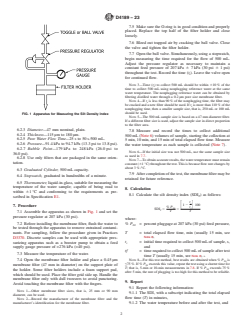
6.1 SDI Assembly, as schematically described in Fig. 1. All
wetted parts should be made of high-quality stainless steel or
plastic to prevent contamination by corrosion products. Do not
This test method is under the jurisdiction of ASTM Committee D19 on Water
use reactive materials such as carbon steel or cast iron. Suitable
and is the direct responsibility of Subcommittee D19.08 on Membranes and Ion
filter holders, designed to withstand an operating gauge pres-
Exchange Materials.
Current edition approved Nov. 1, 2023. Published November 2023. Originally
sure of 350 kPa (50 psi) can be obtained from suppliers of
approved in 1982. Last previous edition approved in 2014 as D4189 – 07 (2014)
membrane filters.
which was withdrawn July 2023 and reinstated in November 2023. DOI: 10.1520/
D4189-23.
6.2 Membrane Filter:
For referenced ASTM standards, visit the ASTM website, www.astm.org, or
6.2.1 Membrane—White hydrophilic, mixed cellulose ni-
contact ASTM Customer Service at service@astm.org. For Annual Book of ASTM
trate (50 % to 75 %) and cellulose acetate (MCE).
Standards volume information, refer to the standard’s Document Summary page on
the ASTM website. 6.2.2 Mean Pore Size—0.45 μm.
Copyright © ASTM International, 100 Barr Harbor Drive, PO Box C700, West Conshohocken, PA 19428-2959. United States
D4189 − 23
7.5 Make sure the O-ring is in good condition and properly
placed. Replace the top half of the filter holder and close
loosely.
7.6 Bleed out trapped air by cracking the ball valve. Close
the valve and tighten the filter holder.
7.7 Open the ball valve. Simultaneously, using a stopwatch,
begin measuring the time required for the flow of 500 mL.
Adjust the pressure regulator as necessary to maintain a
constant feed pressure of 207 kPa 6 7 kPa (30 psi 6 1 psi)
throughout the test. Record the time (t ). Leave the valve open
i
for continued flow.
NOTE 3—Time (t ) to collect 500 mL should be within 610 % of the
i
time to collect 500 mL using nonplugging reference water at the same
water temperature. The nonplugging reference water can be obtained by
filtering distilled water through a 0.2 μm pore size membrane filter.
NOTE 4—If t is less than 90 % of the nonplugging time, the filter may
i
be cracked and a new filter should be used. If t is more than 110 % of the
i
nonplugging time, then a smaller sample size, that is, 250 mL or 100 mL
should be used.
FIG. 1 Apparatus for Measuring the Silt Density Index
NOTE 5—The 500 mL sample size is based on a 47 mm diameter filter.
If a different filter size is used, adjust the sample size in direct proportion
to the filter area.
6.2.3 Diameter—47 mm nominal, plain.
7.8 Measure and record the times to collect additional
6.2.4 Thickness—115 μm to 180 μm.
500 mL (Note 6) volumes of sample, s
...