

ASTM D6529-22
(Test Method)Standard Test Method for Operating Performance of Continuous Electrodeionization Systems on Feeds from 50 μS/cm to 1000 μS/cm
General Information
- Abstract
SIGNIFICANCE AND USE
5.1 The CEDI devices can be used to produce deionized water from feeds of pretreated water. This test method permits the relatively rapid measurement of key performance capabilities of CEDI devices using standard sets of conditions. The data obtained can be analyzed to provide information on whether changes may have occurred in operating characteristics of the device independently of any variability in feed water characteristics or operating conditions. Under specific circumstances, this test method may also provide sufficient information for plant design.
SCOPE
1.1 This test method covers the determination of the operating characteristics of continuous electrodeionization (CEDI) devices using synthetic feed solutions and is not necessarily applicable to natural waters. This test method is a procedure applicable to solutions with a conductivity range from approximately 50 μS/cm to 1000 μS/cm.
1.2 This test method covers the determination of operating characteristics under standard test conditions of CEDI devices where the electrically active transfer media therein is predominantly unregenerated. This results in more rapid achievement of steady state and shorter test time than when performing a test which requires the active media be predominantly regenerated.
1.3 This test method is not necessarily indicative of the following:
1.3.1 Long-term performance on feed waters containing foulants or sparingly soluble solutes, or both,
1.3.2 Performance on feeds of brackish water, sea water, or other high-salinity feeds,
1.3.3 Performance on synthetic industrial feed solutions, pharmaceuticals, or process solutions of foods and beverages, or,
1.3.4 Performance on feed waters less than 50 μS/cm, particularly performance relating to organic solutes, colloidal or particulate matter, or biological or microbial matter.
1.4 This test method, subject to the limitations previously described, can be applied as either an aid to predict expected deionization performance for a given feed water quality, or as a test method to determine whether performance of a given device has changed over some period of time. It is ultimately, however, the user's responsibility to ensure the validity of this test method for their specific applications.
1.5 The values stated in SI units are to be regarded as standard. No other units of measurement are included in this standard.
1.6 This standard does not purport to address all of the safety concerns, if any, associated with its use. It is the responsibility of the user of this standard to establish appropriate safety, health, and environmental practices and determine the applicability of regulatory limitations prior to use.
1.7 This international standard was developed in accordance with internationally recognized principles on standardization established in the Decision on Principles for the Development of International Standards, Guides and Recommendations issued by the World Trade Organization Technical Barriers to Trade (TBT) Committee.
- Status
- Published
- Publication Date
- 30-Sep-2022
- Technical Committee
- D19 - Water
- Drafting Committee
- D19.08 - Membranes and Ion Exchange Materials
Overview
ASTM D6529-22: Standard Test Method for Operating Performance of Continuous Electrodeionization (CEDI) Systems on Feeds from 50 μS/cm to 1000 μS/cm is an internationally recognized test method, developed by ASTM International, for evaluating continuous electrodeionization (CEDI) devices. This standard provides guidance for measuring key operational characteristics of CEDI systems using synthetic feed solutions within a specified conductivity range. The method supports rapid performance assessments under standardized sets of conditions, enabling users to evaluate deionization efficiency and identify potential changes in device operation independent of feed water variability.
CEDI technology is vital for producing deionized water from pretreated feed water, particularly in high-purity applications such as power generation, microelectronics manufacturing, and laboratory water systems.
Key Topics
Performance Testing of CEDI Devices
- Determines operating characteristics using synthetic solutions with conductivities between 50 μS/cm and 1000 μS/cm.
- Measures extent of ion removal, pressure and flow characteristics, electrical power consumption, and current efficiency.
Applicability and Limitations
- Designed for synthetic feed solutions; not necessarily indicative of performance with natural waters or high-salinity sources.
- Not suitable for long-term assessments with feeds containing foulants, brackish water, synthetic industrial solutions, or for waters < 50 μS/cm.
Data Collection
- Assesses steady-state operation, deionization performance, and changes in resistance or pressure indicative of system fouling or degradation.
- Useful for both new and used devices under standard operating conditions.
Predictive and Diagnostic Use
- Helps predict expected deionization results for specified water qualities.
- Assists in diagnosing operational changes or deterioration in CEDI systems over time.
Applications
ASTM D6529-22 is applicable in several scenarios where high-purity water is critical and reliable deionization performance must be validated or benchmarked:
Quality Assurance for CEDI Installations
- Ensures CEDI units operate within performance parameters immediately after installation or servicing.
- Assists in validating manufacturer claims and in qualifying devices for specific plant requirements.
Routine Monitoring and Maintenance
- Provides a structured basis for routine performance checks, supporting preventative maintenance.
- Identifies when recalibration, cleaning, or replacement may be necessary due to changes in resistance, flow, or efficiency.
System Design and Optimization
- Supplies critical data for engineers designing water treatment systems where CEDI is integral.
- Aids in optimizing electrical, hydraulic, and operational parameters for various feed water conditions.
Research and Product Development
- Facilitates laboratory evaluation of new CEDI technologies or materials under controlled, reproducible conditions.
- Supports comparative performance studies across different devices or manufacturers.
Related Standards
Several ASTM standards are referenced within ASTM D6529-22 and are often used in conjunction with this test method for comprehensive water quality and device assessment:
- ASTM D1125 - Test Methods for Electrical Conductivity and Resistivity of Water
- ASTM D1193 - Specification for Reagent Water
- ASTM D1293 - Test Methods for pH of Water
- ASTM D4189 - Test Method for Silt Density Index (SDI) of Water
- ASTM D1129 - Terminology Relating to Water
- ASTM D2777 - Practice for Determination of Precision and Bias of Applicable Test Methods of Committee D19 on Water
Conclusion
ASTM D6529-22 is a key international standard for testing continuous electrodeionization systems, enabling objective measurement of operational performance on pretreated water feeds. By following this method, facilities can ensure their CEDI equipment meets high-purity water demands, supports regulatory compliance, and maintains consistent output in critical applications. This standard is a foundational tool for quality assurance, system design, and ongoing device reliability in water treatment operations.
Keywords: electrodeionization, CEDI, deionized water, ASTM standards, water treatment, conductivity, current efficiency, operational performance, high-purity water, water quality testing
Relations
- Effective Date
- 01-Nov-2023
- Effective Date
- 01-May-2020
- Effective Date
- 15-Jun-2012
- Effective Date
- 01-Jan-2012
- Effective Date
- 01-Mar-2010
- Effective Date
- 15-Jan-2008
- Effective Date
- 15-Jun-2007
- Effective Date
- 01-Sep-2006
- Effective Date
- 01-Sep-2006
- Effective Date
- 15-Aug-2006
- Effective Date
- 01-Mar-2006
- Effective Date
- 15-Feb-2006
- Refers
ASTM D1125-95(2005) - Standard Test Methods for Electrical Conductivity and Resistivity of Water - Effective Date
- 01-Apr-2005
- Effective Date
- 01-Jan-2005
- Effective Date
- 01-Mar-2004
Get Certified
Connect with accredited certification bodies for this standard

DVS-ZERT GmbH
German welding certification society.
CARES (UK Certification Authority for Reinforcing Steels)
UK certification for reinforcing steels and construction.
EWF/IIW (European/International Welding Federation)
International welding personnel certification.
Sponsored listings
Frequently Asked Questions
ASTM D6529-22 is a standard published by ASTM International. Its full title is "Standard Test Method for Operating Performance of Continuous Electrodeionization Systems on Feeds from 50 μS/cm to 1000 μS/cm". This standard covers: SIGNIFICANCE AND USE 5.1 The CEDI devices can be used to produce deionized water from feeds of pretreated water. This test method permits the relatively rapid measurement of key performance capabilities of CEDI devices using standard sets of conditions. The data obtained can be analyzed to provide information on whether changes may have occurred in operating characteristics of the device independently of any variability in feed water characteristics or operating conditions. Under specific circumstances, this test method may also provide sufficient information for plant design. SCOPE 1.1 This test method covers the determination of the operating characteristics of continuous electrodeionization (CEDI) devices using synthetic feed solutions and is not necessarily applicable to natural waters. This test method is a procedure applicable to solutions with a conductivity range from approximately 50 μS/cm to 1000 μS/cm. 1.2 This test method covers the determination of operating characteristics under standard test conditions of CEDI devices where the electrically active transfer media therein is predominantly unregenerated. This results in more rapid achievement of steady state and shorter test time than when performing a test which requires the active media be predominantly regenerated. 1.3 This test method is not necessarily indicative of the following: 1.3.1 Long-term performance on feed waters containing foulants or sparingly soluble solutes, or both, 1.3.2 Performance on feeds of brackish water, sea water, or other high-salinity feeds, 1.3.3 Performance on synthetic industrial feed solutions, pharmaceuticals, or process solutions of foods and beverages, or, 1.3.4 Performance on feed waters less than 50 μS/cm, particularly performance relating to organic solutes, colloidal or particulate matter, or biological or microbial matter. 1.4 This test method, subject to the limitations previously described, can be applied as either an aid to predict expected deionization performance for a given feed water quality, or as a test method to determine whether performance of a given device has changed over some period of time. It is ultimately, however, the user's responsibility to ensure the validity of this test method for their specific applications. 1.5 The values stated in SI units are to be regarded as standard. No other units of measurement are included in this standard. 1.6 This standard does not purport to address all of the safety concerns, if any, associated with its use. It is the responsibility of the user of this standard to establish appropriate safety, health, and environmental practices and determine the applicability of regulatory limitations prior to use. 1.7 This international standard was developed in accordance with internationally recognized principles on standardization established in the Decision on Principles for the Development of International Standards, Guides and Recommendations issued by the World Trade Organization Technical Barriers to Trade (TBT) Committee.
SIGNIFICANCE AND USE 5.1 The CEDI devices can be used to produce deionized water from feeds of pretreated water. This test method permits the relatively rapid measurement of key performance capabilities of CEDI devices using standard sets of conditions. The data obtained can be analyzed to provide information on whether changes may have occurred in operating characteristics of the device independently of any variability in feed water characteristics or operating conditions. Under specific circumstances, this test method may also provide sufficient information for plant design. SCOPE 1.1 This test method covers the determination of the operating characteristics of continuous electrodeionization (CEDI) devices using synthetic feed solutions and is not necessarily applicable to natural waters. This test method is a procedure applicable to solutions with a conductivity range from approximately 50 μS/cm to 1000 μS/cm. 1.2 This test method covers the determination of operating characteristics under standard test conditions of CEDI devices where the electrically active transfer media therein is predominantly unregenerated. This results in more rapid achievement of steady state and shorter test time than when performing a test which requires the active media be predominantly regenerated. 1.3 This test method is not necessarily indicative of the following: 1.3.1 Long-term performance on feed waters containing foulants or sparingly soluble solutes, or both, 1.3.2 Performance on feeds of brackish water, sea water, or other high-salinity feeds, 1.3.3 Performance on synthetic industrial feed solutions, pharmaceuticals, or process solutions of foods and beverages, or, 1.3.4 Performance on feed waters less than 50 μS/cm, particularly performance relating to organic solutes, colloidal or particulate matter, or biological or microbial matter. 1.4 This test method, subject to the limitations previously described, can be applied as either an aid to predict expected deionization performance for a given feed water quality, or as a test method to determine whether performance of a given device has changed over some period of time. It is ultimately, however, the user's responsibility to ensure the validity of this test method for their specific applications. 1.5 The values stated in SI units are to be regarded as standard. No other units of measurement are included in this standard. 1.6 This standard does not purport to address all of the safety concerns, if any, associated with its use. It is the responsibility of the user of this standard to establish appropriate safety, health, and environmental practices and determine the applicability of regulatory limitations prior to use. 1.7 This international standard was developed in accordance with internationally recognized principles on standardization established in the Decision on Principles for the Development of International Standards, Guides and Recommendations issued by the World Trade Organization Technical Barriers to Trade (TBT) Committee.
ASTM D6529-22 is classified under the following ICS (International Classification for Standards) categories: 25.220.20 - Surface treatment. The ICS classification helps identify the subject area and facilitates finding related standards.
ASTM D6529-22 has the following relationships with other standards: It is inter standard links to ASTM D4189-23, ASTM D1129-13(2020)e2, ASTM D2777-12, ASTM D1293-12, ASTM D1129-10, ASTM D2777-08, ASTM D4189-07, ASTM D1129-06ae1, ASTM D1129-06a, ASTM D2777-06, ASTM D1193-06, ASTM D1129-06, ASTM D1125-95(2005), ASTM D1293-99(2005), ASTM D1129-04e1. Understanding these relationships helps ensure you are using the most current and applicable version of the standard.
ASTM D6529-22 is available in PDF format for immediate download after purchase. The document can be added to your cart and obtained through the secure checkout process. Digital delivery ensures instant access to the complete standard document.
Standards Content (Sample)
This international standard was developed in accordance with internationally recognized principles on standardization established in the Decision on Principles for the
Development of International Standards, Guides and Recommendations issued by the World Trade Organization Technical Barriers to Trade (TBT) Committee.
Designation: D6529 −22
Standard Test Method for
Operating Performance of Continuous Electrodeionization
Systems on Feeds from 50 µS⁄cm to 1000 µS/cm
This standard is issued under the fixed designation D6529; the number immediately following the designation indicates the year of
original adoption or, in the case of revision, the year of last revision. A number in parentheses indicates the year of last reapproval. A
superscript epsilon (´) indicates an editorial change since the last revision or reapproval.
1. Scope 1.5 The values stated in SI units are to be regarded as
standard. No other units of measurement are included in this
1.1 This test method covers the determination of the oper-
standard.
ating characteristics of continuous electrodeionization (CEDI)
1.6 This standard does not purport to address all of the
devices using synthetic feed solutions and is not necessarily
safety concerns, if any, associated with its use. It is the
applicable to natural waters. This test method is a procedure
responsibility of the user of this standard to establish appro-
applicable to solutions with a conductivity range from approxi-
priate safety, health, and environmental practices and deter-
mately 50 µS⁄cm to 1000 µS⁄cm.
mine the applicability of regulatory limitations prior to use.
1.2 This test method covers the determination of operating
1.7 This international standard was developed in accor-
characteristics under standard test conditions of CEDI devices
dance with internationally recognized principles on standard-
where the electrically active transfer media therein is predomi-
ization established in the Decision on Principles for the
nantly unregenerated. This results in more rapid achievement
Development of International Standards, Guides and Recom-
of steady state and shorter test time than when performing a
mendations issued by the World Trade Organization Technical
test which requires the active media be predominantly regen-
Barriers to Trade (TBT) Committee.
erated.
2. Referenced Documents
1.3 This test method is not necessarily indicative of the
2.1 ASTM Standards:
following:
D1125 Test Methods for Electrical Conductivity and Resis-
1.3.1 Long-term performance on feed waters containing
tivity of Water
foulants or sparingly soluble solutes, or both,
D1129 Terminology Relating to Water
1.3.2 Performance on feeds of brackish water, sea water, or
D1193 Specification for Reagent Water
other high-salinity feeds,
D1293 Test Methods for pH of Water
1.3.3 Performance on synthetic industrial feed solutions,
D2777 Practice for Determination of Precision and Bias of
pharmaceuticals, or process solutions of foods and beverages,
Applicable Test Methods of Committee D19 on Water
or,
D4189 Test Method for Silt Density Index (SDI) of Water
1.3.4 Performance on feed waters less than 50 µS⁄cm,
particularly performance relating to organic solutes, colloidal 3. Terminology
or particulate matter, or biological or microbial matter.
3.1 Definitions—For definitions of other terms used in this
test method, refer to Terminology D1129.
1.4 This test method, subject to the limitations previously
described, can be applied as either an aid to predict expected
3.2 Definitions of Terms Specific to This Standard:
deionization performance for a given feed water quality, or as
3.2.1 cell, n—an independently fed ion-depleting chamber
a test method to determine whether performance of a given
formed by two adjacent ion-exchange membranes, or by a
device has changed over some period of time. It is ultimately,
membrane and an adjacent electrode.
however, the user’s responsibility to ensure the validity of this
3.2.2 continuous electrodeionization (CEDI) device, n—a
test method for their specific applications.
device that removes ionized and ionizable species from liquids
using electrically active media and using an electrical potential
to influence ion transport, where the ionic transport properties
This test method is under the jurisdiction of ASTM Committee D19 on Water
and is the direct responsibilities of Subcommittee D19.08 on Membranes and Ion
Exchange Materials. For referenced ASTM standards, visit the ASTM website, www.astm.org, or
Current edition approved Oct. 1, 2022. Published November 2022. Originally contact ASTM Customer Service at service@astm.org. For Annual Book of ASTM
approvedin2000.Lastpreviouseditionapprovedin2011asD6529–11,whichwas Standards volume information, refer to the standard’s Document Summary page on
withdrawn in July 2020 and reinstated in October 2022. DOI: 10.1520/D6529-22. the ASTM website.
Copyright © ASTM International, 100 Barr Harbor Drive, PO Box C700, West Conshohocken, PA 19428-2959. United States
D6529 − 22
of the active media are a primary sizing parameter. The CEDI unpressurized, ported to be capable of occasional cleanings or
devices typically comprise semipermeable ion-exchange mem- sanitizations, and incorporates needed safety features such as
branes and permanently charged ion-exchange media. Ex-
temperature and overflow protection. The tank also incorpo-
amples include continuous deionization, electrodiaresis, and rates a drain valve. During operation of the apparatus, the drain
packed-bed or filled-cell electrodialysis.
valve may be used in combination with a valve controlling the
rate of feed water to the apparatus to aid in control of solute
3.2.3 current effıciency, n—the ratio, expressed in percent,
concentrations, water level, and temperature within the tank.
of the net transfer of ionized and ionizable solutes per unit cell
The tank supplies water to a recirculation pump designed to
within a CEDI device, expressed in chemical equivalents
feed water to the CEDI device at a flow rate and pressure
transferred per unit time, to the number of coulombs trans-
consistent with the ratings of the CEDI device.Arecirculation
ferred from an external dc power source to each electrode pair,
line with a shut off valve from the pump discharge to the tank
expressed in faradays per unit time. Calculation of current
may be incorporated as required for proper pump operation.
efficiency is described in 9.2.
6.1.3 The concentration and pH of the feed water to the
4. Summary of Test Method
CEDI device is controlled by metering pumps that meter a
4.1 This test method is used to determine performance
controlled flow of concentrated aqueous sodium chloride, and
capabilities of CEDI devices with regard to extent of ion
either sodium hydroxide or hydrochloric acid as needed into
removal, pressure/flow relationships and electrical power con-
the feed water to maintain the desired feed water solute
sumption at standard or nominal operating conditions, electri-
concentration and pH.
cal current characteristics, and the relative ability of the device
6.1.3.1 The concentrated reagents may be metered into the
to remove ionized species when fed pretreated tap water. On
discharge line of the pump or alternately may be metered into
this type of feed there is little water splitting or resin
the tank. In either case, mixing means are required to ensure
regeneration, thus only ionized species are removed. This test
that the feed water concentrations do not fluctuate. Metering
method is applicable to both new and used devices.
pump assemblies and controllers should be designed with
4.2 Pressurelossdataisobtained.Thisinformationprovides
proper safety interlocks and controls configured so as to be
information relating to possible particulate plugging, fouling,
“fail safe.” Suitable instrumentation must be provided to
or internal damage of the device. Deionization performance,
monitor solute concentration (by means of electrical conduc-
concentrating stream pH, and electrical current transfer is
tivity or resistivity, see Test Methods D1125), pH (Test
monitored as a function of applied voltage. The initial ohmic
Methods D1293), and temperature of the feed water to the
(electrical) resistance, rate of change of ohmic resistance, and
CEDI device. Instrumentation may be in-line or alternately,
maximal ohmic resistance is determined. Also the electrical
appropriate sample taps may be incorporated to allow for
current efficiency as a function of deionization performance
determination off-line.
and voltage is determined. This information in combination
6.1.4 Feed water provided to the CEDI device should be
with concentrating stream pH as a function of applied voltage
plumbed as specified by the supplier, with appropriate flow and
provides basic design and performance information.
pressure controls, internal recirculations, drains, interlocks,
safety controls, and other features as required. Pressure at the
5. Significance and Use
inlet and outlet and flow rates of each of the streams of interest
5.1 The CEDI devices can be used to produce deionized
must be monitored (for example, deionized water stream,
water from feeds of pretreated water. This test method permits
concentrate stream, and electrode feed stream).
the relatively rapid measurement of key performance capabili-
6.1.5 The CEDI device should be powered as specified by
ties of CEDI devices using standard sets of conditions. The
the supplier, with equipment and wiring to provide appropriate
data obtained can be analyzed to provide information on
supply dc voltage and amperage, controls, interlocks,
whether changes may have occurred in operating characteris-
grounding, and safety features. Supply voltage and supply
tics of the device independently of any variability in feed water
amperage to the CEDI device should be monitored at positions
characteristics or operating conditions. Under specific
within the device or device assembly as specified by the
circumstances, this test method may also provide sufficient
supplier.
information for plant design.
6.1.6 Streams leaving the CEDI device may be returned to
6. Apparatus
the tank by means of return lines. Alternately, one or more of
the streams may be sent either completely or partially to drain
6.1 Description:
by means of appropriate valving if such operation provides
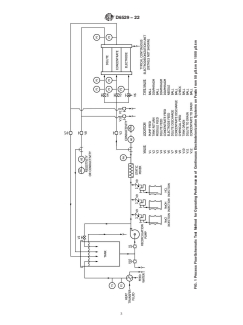
6.1.1 The test apparatus is schematically represented in Fig.
easier control of desired feed water conditions. The outlet
1. Feed water to the apparatus may be passed through a heat
deionization stream is monitored for electrical conductivity or
exchanger or other accessories, or both, to modify or control
resistivity and optionally pH, and the outlet concentrating
feed water temperature, or both, as desired. Alternatively, data
obtained from the operation of the apparatus may be normal- stream is monitored for pH and optionally electrical conduc-
ized for temperature if normalization factors are known. tivity or resistivity. For CEDI devices with internal recircula-
6.1.2 Feed water to the apparatus enters a holding tank tion and “feed and bleed” features, solute concentrations must
(open or vented) of volume sufficient to maintain good control be measured at locations that are indicative of conditions
of water level and solute concentrations. The tank is within the CEDI module prior to mixing of recirculation flows.
D6529 − 22
FIG. 1 Process Flow Schematic Test Method for Operating Performance of Continuous Electrodeionization Systems on Feeds from 50 µS⁄cm to 1000 µS⁄cm
...