

ASTM E161-17(2021)
(Specification)Standard Specification for Electroformed Material and Test Sieves
General Information
- Abstract
ABSTRACT
This specification covers the requirements for design and construction of electroformed sieves. These sieves are used to perform particle-size distribution analysis and in preparing narrowly designated particle-size fractions. They may also be used as reference standards when suitably calibrated. The material used in the manufacture of the sieve sheet shall be nickel or a metal suitable for electrodeposition in a firm crystalline structure. The sheet shall have square or round openings with straight uniform sides and smooth, flat surfaces except for a slight bevel along the edges of the openings. Frames for precision electroformed sieves shall be made from non-corrosive material such as brass or stainless steel, and constructed in such a manner as to be rigid.
SCOPE
1.1 This specification covers the technical requirements for design and construction of electroformed sieves and sieve material. These sieves are used to perform particle-size analysis and in preparing narrowly designated particle -size fractions. They may also be used as reference standards when suitably certified. The method of certifying these sieves is included in Annex A1.
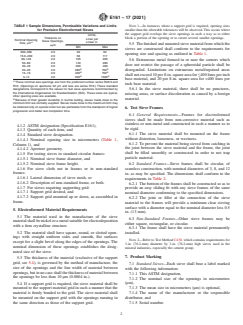
1.2 The values stated in SI units shall be considered standard for the dimensions of the electroformed mesh openings and the size of the line width in the electroformed mesh. The values stated in inch-pound units shall be considered standard with regard to the sieve frames and to lines per unit length, as in Table 1. The values given in parentheses are mathematical conversions that are provided for informational purposes only, and are not considered standard.
1.3 This standard does not purport to address all of the safety concerns, if any, associated with its use. It is the responsibility of the user of this standard to establish appropriate safety, health, and environmental practices and determine the applicability of regulatory limitations prior to use.
1.4 This international standard was developed in accordance with internationally recognized principles on standardization established in the Decision on Principles for the Development of International Standards, Guides and Recommendations issued by the World Trade Organization Technical Barriers to Trade (TBT) Committee.
- Status
- Published
- Publication Date
- 31-Aug-2021
- Technical Committee
- E29 - Particle and Spray Characterization
- Drafting Committee
- E29.01 - Sieves, Sieving Methods, and Screening Media

Overview
ASTM E161-17(2021): Standard Specification for Electroformed Material and Test Sieves provides comprehensive requirements for the design, construction, and certification of electroformed sieves and sieve materials. These sieves are essential for particle-size distribution analysis and preparation of narrowly defined particle-size fractions in laboratory and industrial settings. Electroformed sieves, typically made from nickel or suitable electrodeposited metals, are prized for their precision and reliability. This standard ensures that such sieves meet consistent quality criteria, making them suitable not only for testing but also as reference standards when properly certified.
Key Topics
- Material Requirements: Electroformed sieves must be constructed from nickel or metals that facilitate electrodeposition in a firm crystalline structure. The openings in these materials are required to be square or round, with straight, uniform sides and smooth, flat surfaces.
- Design and Construction: Sieve frames are specified to be made of non-corrosive materials such as brass or stainless steel, ensuring rigidity and longevity. Both standard circular frames and non-standard frames (which may be square, rectangular, or circular) are covered.
- Precision and Tolerances: The standard defines rigorous dimensional tolerances for mesh openings and line widths. Table 1 in the standard details permissible variations for precision sieves, ensuring consistent mesh sizes for accurate particle-size analysis.
- Product Marking and Certification: Every sieve is required to bear a permanent label indicating the ASTM designation, nominal opening size, manufacturer or distributor, and a unique serial number. Certification procedures, including microscopic inspection and measurement, are detailed in Annex A1.
- Cleaning and Maintenance: Proper cleaning methods are specified to prevent damage to the sieve sheet and preserve its precision, including the use of ultrasonic cleaning and recommended repair procedures for damaged sieves.
Applications
Electroformed test sieves manufactured under ASTM E161-17(2021) are used in:
- Particle-Size Distribution Analysis: Essential for laboratory testing in industries such as pharmaceuticals, food processing, minerals, and cement, where precise particle sizing is critical for quality control and process efficiency.
- Preparation of Particle-Size Fractions: Used to obtain specific fractions of material for further testing or manufacturing processes, ensuring uniformity in sample preparation.
- Reference Standards: When suitably certified, electroformed sieves can serve as reference standards in laboratories and testing facilities for calibration and verification of particle-size analysis equipment.
- Research and Development: Enables high-resolution separation of fine powders and particles for scientific studies and industrial innovation.
Related Standards
The following ASTM standards are closely associated with ASTM E161-17(2021):
- ASTM E11: Specification for Woven Wire Test Sieve Cloth and Test Sieves. Compliments E161 for applications requiring woven test sieves.
- ASTM C430: Test Method for Fineness of Hydraulic Cement by the 45-µm (No. 325) Sieve.
- ASTM E323: Specification for Perforated-Plate Sieves for Testing Purposes.
- ASTM E1638: Terminology Relating to Sieves, Sieving Methods, and Screening Media. Provides definitions and terminology applicable to this standard.
Practical Value
Compliance with ASTM E161-17(2021) guarantees the quality and consistency of electroformed test sieves, vital for reliable particle-size analysis. These sieves support stringent quality control, facilitate compliance with international testing standards, and help laboratories and manufacturers achieve repeatable, traceable results across a range of applications.
Keywords: ASTM E161, electroformed sieve, test sieve, particle size analysis, laboratory testing, particle-size distribution, reference standards, sieve calibration.
Relations
- Effective Date
- 01-Dec-2017
- Effective Date
- 01-Oct-2015
- Effective Date
- 01-Oct-2013
- Effective Date
- 01-Jun-2013
- Effective Date
- 15-May-2012
- Effective Date
- 15-Nov-2011
- Refers
ASTM E1638-11a - Standard Terminology Relating to Sieves, Sieving Methods, and Screening Media - Effective Date
- 15-Nov-2011
- Effective Date
- 01-May-2011
- Effective Date
- 01-Dec-2010
- Effective Date
- 01-Nov-2009
- Effective Date
- 01-May-2009
- Effective Date
- 01-Mar-2009
- Effective Date
- 01-Dec-2008
- Effective Date
- 01-Oct-2007
- Effective Date
- 01-Oct-2004
Get Certified
Connect with accredited certification bodies for this standard

DVS-ZERT GmbH
German welding certification society.
CARES (UK Certification Authority for Reinforcing Steels)
UK certification for reinforcing steels and construction.
EWF/IIW (European/International Welding Federation)
International welding personnel certification.
Sponsored listings
Frequently Asked Questions
ASTM E161-17(2021) is a technical specification published by ASTM International. Its full title is "Standard Specification for Electroformed Material and Test Sieves". This standard covers: ABSTRACT This specification covers the requirements for design and construction of electroformed sieves. These sieves are used to perform particle-size distribution analysis and in preparing narrowly designated particle-size fractions. They may also be used as reference standards when suitably calibrated. The material used in the manufacture of the sieve sheet shall be nickel or a metal suitable for electrodeposition in a firm crystalline structure. The sheet shall have square or round openings with straight uniform sides and smooth, flat surfaces except for a slight bevel along the edges of the openings. Frames for precision electroformed sieves shall be made from non-corrosive material such as brass or stainless steel, and constructed in such a manner as to be rigid. SCOPE 1.1 This specification covers the technical requirements for design and construction of electroformed sieves and sieve material. These sieves are used to perform particle-size analysis and in preparing narrowly designated particle -size fractions. They may also be used as reference standards when suitably certified. The method of certifying these sieves is included in Annex A1. 1.2 The values stated in SI units shall be considered standard for the dimensions of the electroformed mesh openings and the size of the line width in the electroformed mesh. The values stated in inch-pound units shall be considered standard with regard to the sieve frames and to lines per unit length, as in Table 1. The values given in parentheses are mathematical conversions that are provided for informational purposes only, and are not considered standard. 1.3 This standard does not purport to address all of the safety concerns, if any, associated with its use. It is the responsibility of the user of this standard to establish appropriate safety, health, and environmental practices and determine the applicability of regulatory limitations prior to use. 1.4 This international standard was developed in accordance with internationally recognized principles on standardization established in the Decision on Principles for the Development of International Standards, Guides and Recommendations issued by the World Trade Organization Technical Barriers to Trade (TBT) Committee.
ABSTRACT This specification covers the requirements for design and construction of electroformed sieves. These sieves are used to perform particle-size distribution analysis and in preparing narrowly designated particle-size fractions. They may also be used as reference standards when suitably calibrated. The material used in the manufacture of the sieve sheet shall be nickel or a metal suitable for electrodeposition in a firm crystalline structure. The sheet shall have square or round openings with straight uniform sides and smooth, flat surfaces except for a slight bevel along the edges of the openings. Frames for precision electroformed sieves shall be made from non-corrosive material such as brass or stainless steel, and constructed in such a manner as to be rigid. SCOPE 1.1 This specification covers the technical requirements for design and construction of electroformed sieves and sieve material. These sieves are used to perform particle-size analysis and in preparing narrowly designated particle -size fractions. They may also be used as reference standards when suitably certified. The method of certifying these sieves is included in Annex A1. 1.2 The values stated in SI units shall be considered standard for the dimensions of the electroformed mesh openings and the size of the line width in the electroformed mesh. The values stated in inch-pound units shall be considered standard with regard to the sieve frames and to lines per unit length, as in Table 1. The values given in parentheses are mathematical conversions that are provided for informational purposes only, and are not considered standard. 1.3 This standard does not purport to address all of the safety concerns, if any, associated with its use. It is the responsibility of the user of this standard to establish appropriate safety, health, and environmental practices and determine the applicability of regulatory limitations prior to use. 1.4 This international standard was developed in accordance with internationally recognized principles on standardization established in the Decision on Principles for the Development of International Standards, Guides and Recommendations issued by the World Trade Organization Technical Barriers to Trade (TBT) Committee.
ASTM E161-17(2021) is classified under the following ICS (International Classification for Standards) categories: 25.220.20 - Surface treatment. The ICS classification helps identify the subject area and facilitates finding related standards.
ASTM E161-17(2021) has the following relationships with other standards: It is inter standard links to ASTM C430-17, ASTM C430-08(2015), ASTM E11-13, ASTM E1638-13, ASTM E1638-12, ASTM E323-11, ASTM E1638-11a, ASTM E1638-11, ASTM E1638-10, ASTM E323-09, ASTM E11-09e1, ASTM E1638-09, ASTM C430-08, ASTM E1638-07a, ASTM E1638-94(2004). Understanding these relationships helps ensure you are using the most current and applicable version of the standard.
ASTM E161-17(2021) is available in PDF format for immediate download after purchase. The document can be added to your cart and obtained through the secure checkout process. Digital delivery ensures instant access to the complete standard document.
Standards Content (Sample)
This international standard was developed in accordance with internationally recognized principles on standardization established in the Decision on Principles for the
Development of International Standards, Guides and Recommendations issued by the World Trade Organization Technical Barriers to Trade (TBT) Committee.
Designation:E161 −17 (Reapproved 2021)
Standard Specification for
Electroformed Material and Test Sieves
This standard is issued under the fixed designation E161; the number immediately following the designation indicates the year of
original adoption or, in the case of revision, the year of last revision.Anumber in parentheses indicates the year of last reapproval.A
superscript epsilon (´) indicates an editorial change since the last revision or reapproval.
This standard has been approved for use by agencies of the U.S. Department of Defense.
1. Scope 2. Referenced Documents
1.1 This specification covers the technical requirements for 2.1 ASTM Standards:
design and construction of electroformed sieves and sieve C430Test Method for Fineness of Hydraulic Cement by the
material. These sieves are used to perform particle-size analy- 45-µm (No. 325) Sieve
sis and in preparing narrowly designated particle -size frac- E11Specification forWovenWireTest Sieve Cloth andTest
tions. They may also be used as reference standards when Sieves
suitably certified. The method of certifying these sieves is E323Specification for Perforated-Plate Sieves for Testing
included in Annex A1. Purposes
E1638Terminology Relating to Sieves, Sieving Methods,
1.2 The values stated in SI units shall be considered
and Screening Media
standard for the dimensions of the electroformed mesh open-
ings and the size of the line width in the electroformed mesh.
3. Terminology
The values stated in inch-pound units shall be considered
3.1 Definitions—For definitions of related terms, refer to
standard with regard to the sieve frames and to lines per unit
Terminology E1638.
length, as in Table 1. The values given in parentheses are
3.2 Definitions of Terms Specific to This Standard:
mathematical conversions that are provided for informational
3.2.1 electroformed material, n—electrodeposited grid ma-
purposes only, and are not considered standard.
terial consisting of precision openings used as the separation
1.3 This standard does not purport to address all of the
media for electroformed sieves.
safety concerns, if any, associated with its use. It is the
3.2.2 electroformed sieves, n—see test sieve (electro-
responsibility of the user of this standard to establish appro-
formed).
priate safety, health, and environmental practices and deter-
mine the applicability of regulatory limitations prior to use.
3.2.3 non-standard frames (electroformed), n—sieveframes
1.4 This international standard was developed in accor-
other than as specified in accordance with Table 2 that may be
dance with internationally recognized principles on standard-
circular, square, rectangular, or non-metal.
ization established in the Decision on Principles for the
3.2.3.1 Discussion—Theframeshallhavetheelectroformed
Development of International Standards, Guides and Recom-
material permanently attached.
mendations issued by the World Trade Organization Technical
3.2.4 support grid, n—conductive metal screen fused to the
Barriers to Trade (TBT) Committee.
sieve material.
3.2.5 test sieve (electroformed), n—asievemanufacturedby
mounting electroformed material in a frame, designed for use
in particle size analysis by sieving.
4. Ordering Information
4.1 Orders for items under this specification include the
following information as necessary:
4.1.1 Name of material (electroformed sieve or electro-
formed sieve material),
ThisspecificationisunderthejurisdictionofASTMCommitteeE29onParticle
and Spray Characterization and is the direct responsibility of Subcommittee E29.01
onSieves,SievingMethods,andScreeningMediaonSieves,SievingMethods,and
Screening Media. For referenced ASTM standards, visit the ASTM website, www.astm.org, or
Current edition approved Sept. 1, 2021. Published October 2021. Originally contact ASTM Customer Service at service@astm.org. For Annual Book of ASTM
approved in 1960. Last previous edition approved in 2017 as E161–17. DOI: Standards volume information, refer to the standard’s Document Summary page on
10.1520/E0161-17R21. the ASTM website.
Copyright © ASTM International, 100 Barr Harbor Drive, PO Box C700, West Conshohocken, PA 19428-2959. United States
E161−17 (2021)
TABLE 1 Sample Dimensions, Permissible Variations and Limits NOTE 1—In instances where a support grid is required, opening sizes
for Precision Electroformed Sieves
smaller than the allowable tolerances will be observed.This occurs where
the support grid overlaps the sieve openings in such a way as to either
Limits,
Tolerance on
block a portion of the opening or to create several smaller openings.
Lines per
Nominal Opening
Sieve Openings,
A
Linear in.
Size, µm
5.5 Thefinishedandmountedsievematerialfromwhichthe
±µm
Min Max
sieves are constructed shall conform to the requirements for
300–500 2.0 39 62
opening size and spacing as outlined in Table 1.
15.0–299 2.0 58 117
90–149 2.0 105 200
5.6 Extraneous metal formed in or near the corners which
50–89 2.0 140 280
does not restrict the passage of a spheroidal particle shall be
30–49 2.0 200 400
B B
20–29 2.0 280 750 disregarded. Limitations on extraneous metal/repaired areas
B B
15–19 2.0 400 750
shallnotexceed10per8-in.squareareafor≤400linesperinch
B B
3–14 2.0 500 1500
base material, and 20 per 8-in. square area for >400 lines per
A
These nominal size openings are from the preferred number series R40/3 and
inch base material.
R10. (Openings on apertures 32 µm and less are series R10.) These standard
5.6.1 In the sieve material, there shall be no punctures,
designations correspond to the values for test sieve apertures recommended by
the International Organization for Standardization (ISO). These sizes are typical,
missing areas, or surface discoloration as caused by a foreign
other opening sizes are available.
material.
B
Because of their greater durability in routine testing, sieves made close to the
minimum limit are normally supplied. Sieves made close to the maximum limit may
be obtained only on special order but are preferable from the standpoint of logical
6. Test Sieve Frames
progression and better test completion time.
6.1 General Requirements—Frames for electroformed
sieves shall be made from non-corrosive material such as
stainless or non-metal and constructed in such a manner as to
4.1.2 ASTM designation (Specification E161),
be rigid.
4.1.3 Quantity of each item, and
6.1.1 The sieve material shall be mounted on the frame
4.1.4 Standard sieve designation.
without distortion, looseness, or waviness.
4.1.4.1 Nominal opening size in micrometres (Table 1,
6.1.2 To prevent the material being sieved from catching in
Column 1), and
the joint between the sieve material and the frame, the joint
4.1.4.2 Aperture geometry.
shall be filled smoothly or constructed in order to not trap
4.1.5 For testing sieves in standard circular frames:
particle material.
4.1.5.1 Nominal sieve frame diameter, and
4.1.5.2 Nominal sieve frame height.
6.2 Standard Frames—Sieve frames shall be circular, of
4.1.6 For sieve cloth not in frames or in non-standard
seamless construction, with nominal diameters of 3, 8, and 12
frames:
in. as may be specified. The dimensions shall conform to the
4.1.6.1 Lateral dimension of sieve mesh, or
requirements in Table 2.
4.1.6.2 Description of non-standard frame, or both.
6.2.1 The bottom of the frames shall be constructed so as to
4.1.7 For sieves requiring supporting grid:
provide an easy sliding fit with any sieve frames of the same
4.1.7.1 Support grid desired, and
nominal diameter conforming to the specified dimensions.
4.1.7.2 Support grid mounted up or down, as assembled in
6.2.2 The joint or fillet at the connection of the sieve
frame.
material to the frames will provide a minimum clear sieving
surface with a diameter equal to the nominal diameter less 0.5
5. Electroformed Material Requirements
in. (13 mm).
5.1 The material used in the manufacture
...