

ASTM E2109-01(2021)
(Test Method)Standard Test Methods for Determining Area Percentage Porosity in Thermal Sprayed Coatings
General Information
- Abstract
SIGNIFICANCE AND USE
4.1 TSCs are susceptible to the formation of porosity due to a lack of fusion between sprayed particles or the expansion of gases generated during the spraying process. The determination of area percent porosity is important in order to monitor the effect of variable spray parameters and the suitability of a coating for its intended purpose. Depending on application, some or none of this porosity may be tolerable.
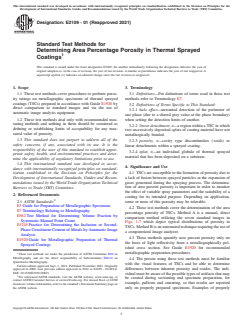
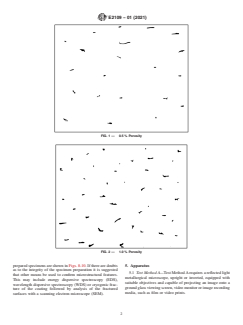
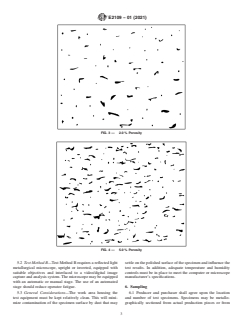
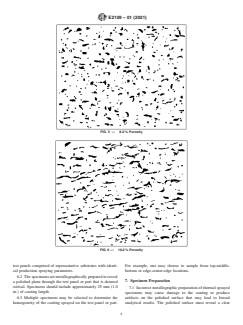
4.2 These test methods cover the determination of the area percentage porosity of TSCs. Method A is a manual, direct comparison method utilizing the seven standard images in Figs. 1-7 which depict typical distributions of porosity in TSCs. Method B is an automated technique requiring the use of a computerized image analyzer.
FIG. 1 — 0.5 % Porosity
FIG. 2 — 1.0 % Porosity
FIG. 3 — 2.0 % Porosity
FIG. 4 — 5.0 % Porosity
FIG. 5 — 8.0 % Porosity
FIG. 6 — 10.0 % Porosity
FIG. 7 — 15.0 % Porosity
4.3 These methods quantify area percent porosity only on the basis of light reflectivity from a metallographically polished cross section. See Guide E1920 for recommended metallographic preparation procedures.
4.4 The person using these test methods must be familiar with the visual features of TSCs and be able to determine differences between inherent porosity and oxides. The individual must be aware of the possible types of artifacts that may be created during sectioning and specimen preparation, for example, pullouts and smearing, so that results are reported only on properly prepared specimens. Examples of properly prepared specimens are shown in Figs. 8-10. If there are doubts as to the integrity of the specimen preparation it is suggested that other means be used to confirm microstructural features. This may include energy dispersive spectroscopy (EDS), wavelength dispersive spectroscopy (WDS) or cryogenic fracture of the coating followed by analysis of the fractured surfaces with a scanning electron microscope (SEM).
FIG. 8 Ni/Al T...
SCOPE
1.1 These test methods cover procedures to perform porosity ratings on metallographic specimens of thermal sprayed coatings (TSCs) prepared in accordance with Guide E1920 by direct comparison to standard images and via the use of automatic image analysis equipment.
1.2 These test methods deal only with recommended measuring methods and nothing in them should be construed as defining or establishing limits of acceptability for any measured value of porosity.
1.3 This standard does not purport to address all of the safety concerns, if any, associated with its use. It is the responsibility of the user of this standard to establish appropriate safety, health, and environmental practices and determine the applicability of regulatory limitations prior to use.
1.4 This international standard was developed in accordance with internationally recognized principles on standardization established in the Decision on Principles for the Development of International Standards, Guides and Recommendations issued by the World Trade Organization Technical Barriers to Trade (TBT) Committee.
- Status
- Published
- Publication Date
- 31-Aug-2021
- Technical Committee
- E04 - Metallography
- Drafting Committee
- E04.14 - Quantitative Metallography
Overview
ASTM E2109-01(2021) - Standard Test Methods for Determining Area Percentage Porosity in Thermal Sprayed Coatings outlines reliable procedures for measuring the area percent porosity in thermal sprayed coatings (TSCs). Porosity in TSCs is a key property influencing coating performance, durability, and suitability for specific applications. The standard provides quantitative methods to monitor variations in spray parameters and assess if coatings meet end-use requirements. Proper determination of porosity is important for quality control and for verifying that coatings meet industry or project specifications.
Key Topics
- Thermal Sprayed Coating Porosity: TSCs can develop porosity due to incomplete fusion of sprayed particles or from gas expansion during the application process. Porosity levels affect mechanical and chemical properties of the coating.
- Measurement Methods:
- Method A (Manual/Digital Direct Comparison): Visual assessment using seven reference images representing different porosity levels (from 0.5% to 15%) on metallographically prepared cross sections.
- Method B (Automated Image Analysis): Computerized image analysis of light microscopy images to calculate area percentage of porosity with increased objectivity and statistical precision.
- Preparation and Analysis:
- Accurate, artifact-free specimen preparation is essential. Use of automated polishing/grinding, vacuum impregnation with epoxy, and correct imaging techniques is recommended as outlined in ASTM Guide E1920.
- Distinguishing true porosity from oxides and preparation-induced artifacts is critical. Supplemental techniques (such as SEM or EDS) may be used for verification.
- Statistical Evaluation:
- Test results using Method B require calculation of mean, standard deviation, and confidence intervals. At least 20 fields should be measured for robust statistical analysis.
- For Method A, results consist primarily of minimum, maximum, and mean recorded porosities based on visual comparison.
Applications
- Quality Control in Production: Monitoring porosity in production coatings ensures adherence to process parameters and product performance requirements.
- Material Qualification: Helps qualify new or existing thermal sprayed coatings by verifying that porosity does not exceed allowable limits for specific environments.
- Research and Development: Used for optimization of thermal spraying processes, studying the influence of variables on coating microstructure.
- Failure Analysis: Supports root-cause investigation in cases where coating failure may be porosity-related, by providing quantitative evidence of coating integrity.
Industries Using ASTM E2109-01(2021)
- Aerospace and aviation engineering
- Power generation (including gas turbines)
- Automotive industry
- Industrial equipment manufacturing
- Oil and gas sector
Related Standards
- ASTM E3 - Guide for Preparation of Metallographic Specimens
- ASTM E7 - Terminology Relating to Metallography
- ASTM E562 - Test Method for Determining Volume Fraction by Systematic Manual Point Count
- ASTM E1245 - Practice for Determining Inclusion Content of Metals by Automatic Image Analysis
- ASTM E1920 - Guide for Metallographic Preparation of Thermal Sprayed Coatings
These related ASTM standards provide guidance on specimen preparation, terminology, and complementary measurement techniques, supporting consistent and accurate porosity assessment.
Keywords: thermal sprayed coating, area percent porosity, image analysis, metallography, ASTM E2109, TSC porosity measurement, quality control in coatings, microstructure analysis, production coatings, specimen preparation, statistical analysis of coatings.
Relations
- Effective Date
- 15-Aug-2019
- Effective Date
- 01-Jun-2015
- Effective Date
- 01-Nov-2014
- Effective Date
- 01-Oct-2011
- Refers
ASTM E562-11 - Standard Test Method for Determining Volume Fraction by Systematic Manual Point Count - Effective Date
- 01-Oct-2011
- Effective Date
- 01-Oct-2009
- Effective Date
- 01-Oct-2008
- Refers
ASTM E1920-03(2008) - Standard Guide for Metallographic Preparation of Thermal Sprayed Coatings - Effective Date
- 01-Oct-2008
- Refers
ASTM E562-08 - Standard Test Method for Determining Volume Fraction by Systematic Manual Point Count - Effective Date
- 01-Oct-2008
- Effective Date
- 01-Jul-2007
- Effective Date
- 01-Jul-2007
- Refers
ASTM E562-05 - Standard Test Method for Determining Volume Fraction by Systematic Manual Point Count - Effective Date
- 01-Nov-2005
- Effective Date
- 01-Nov-2005
- Effective Date
- 10-May-2003
- Effective Date
- 01-May-2003
Get Certified
Connect with accredited certification bodies for this standard

DVS-ZERT GmbH
German welding certification society.
CARES (UK Certification Authority for Reinforcing Steels)
UK certification for reinforcing steels and construction.
EWF/IIW (European/International Welding Federation)
International welding personnel certification.
Sponsored listings
Frequently Asked Questions
ASTM E2109-01(2021) is a standard published by ASTM International. Its full title is "Standard Test Methods for Determining Area Percentage Porosity in Thermal Sprayed Coatings". This standard covers: SIGNIFICANCE AND USE 4.1 TSCs are susceptible to the formation of porosity due to a lack of fusion between sprayed particles or the expansion of gases generated during the spraying process. The determination of area percent porosity is important in order to monitor the effect of variable spray parameters and the suitability of a coating for its intended purpose. Depending on application, some or none of this porosity may be tolerable. 4.2 These test methods cover the determination of the area percentage porosity of TSCs. Method A is a manual, direct comparison method utilizing the seven standard images in Figs. 1-7 which depict typical distributions of porosity in TSCs. Method B is an automated technique requiring the use of a computerized image analyzer. FIG. 1 — 0.5 % Porosity FIG. 2 — 1.0 % Porosity FIG. 3 — 2.0 % Porosity FIG. 4 — 5.0 % Porosity FIG. 5 — 8.0 % Porosity FIG. 6 — 10.0 % Porosity FIG. 7 — 15.0 % Porosity 4.3 These methods quantify area percent porosity only on the basis of light reflectivity from a metallographically polished cross section. See Guide E1920 for recommended metallographic preparation procedures. 4.4 The person using these test methods must be familiar with the visual features of TSCs and be able to determine differences between inherent porosity and oxides. The individual must be aware of the possible types of artifacts that may be created during sectioning and specimen preparation, for example, pullouts and smearing, so that results are reported only on properly prepared specimens. Examples of properly prepared specimens are shown in Figs. 8-10. If there are doubts as to the integrity of the specimen preparation it is suggested that other means be used to confirm microstructural features. This may include energy dispersive spectroscopy (EDS), wavelength dispersive spectroscopy (WDS) or cryogenic fracture of the coating followed by analysis of the fractured surfaces with a scanning electron microscope (SEM). FIG. 8 Ni/Al T... SCOPE 1.1 These test methods cover procedures to perform porosity ratings on metallographic specimens of thermal sprayed coatings (TSCs) prepared in accordance with Guide E1920 by direct comparison to standard images and via the use of automatic image analysis equipment. 1.2 These test methods deal only with recommended measuring methods and nothing in them should be construed as defining or establishing limits of acceptability for any measured value of porosity. 1.3 This standard does not purport to address all of the safety concerns, if any, associated with its use. It is the responsibility of the user of this standard to establish appropriate safety, health, and environmental practices and determine the applicability of regulatory limitations prior to use. 1.4 This international standard was developed in accordance with internationally recognized principles on standardization established in the Decision on Principles for the Development of International Standards, Guides and Recommendations issued by the World Trade Organization Technical Barriers to Trade (TBT) Committee.
SIGNIFICANCE AND USE 4.1 TSCs are susceptible to the formation of porosity due to a lack of fusion between sprayed particles or the expansion of gases generated during the spraying process. The determination of area percent porosity is important in order to monitor the effect of variable spray parameters and the suitability of a coating for its intended purpose. Depending on application, some or none of this porosity may be tolerable. 4.2 These test methods cover the determination of the area percentage porosity of TSCs. Method A is a manual, direct comparison method utilizing the seven standard images in Figs. 1-7 which depict typical distributions of porosity in TSCs. Method B is an automated technique requiring the use of a computerized image analyzer. FIG. 1 — 0.5 % Porosity FIG. 2 — 1.0 % Porosity FIG. 3 — 2.0 % Porosity FIG. 4 — 5.0 % Porosity FIG. 5 — 8.0 % Porosity FIG. 6 — 10.0 % Porosity FIG. 7 — 15.0 % Porosity 4.3 These methods quantify area percent porosity only on the basis of light reflectivity from a metallographically polished cross section. See Guide E1920 for recommended metallographic preparation procedures. 4.4 The person using these test methods must be familiar with the visual features of TSCs and be able to determine differences between inherent porosity and oxides. The individual must be aware of the possible types of artifacts that may be created during sectioning and specimen preparation, for example, pullouts and smearing, so that results are reported only on properly prepared specimens. Examples of properly prepared specimens are shown in Figs. 8-10. If there are doubts as to the integrity of the specimen preparation it is suggested that other means be used to confirm microstructural features. This may include energy dispersive spectroscopy (EDS), wavelength dispersive spectroscopy (WDS) or cryogenic fracture of the coating followed by analysis of the fractured surfaces with a scanning electron microscope (SEM). FIG. 8 Ni/Al T... SCOPE 1.1 These test methods cover procedures to perform porosity ratings on metallographic specimens of thermal sprayed coatings (TSCs) prepared in accordance with Guide E1920 by direct comparison to standard images and via the use of automatic image analysis equipment. 1.2 These test methods deal only with recommended measuring methods and nothing in them should be construed as defining or establishing limits of acceptability for any measured value of porosity. 1.3 This standard does not purport to address all of the safety concerns, if any, associated with its use. It is the responsibility of the user of this standard to establish appropriate safety, health, and environmental practices and determine the applicability of regulatory limitations prior to use. 1.4 This international standard was developed in accordance with internationally recognized principles on standardization established in the Decision on Principles for the Development of International Standards, Guides and Recommendations issued by the World Trade Organization Technical Barriers to Trade (TBT) Committee.
ASTM E2109-01(2021) is classified under the following ICS (International Classification for Standards) categories: 25.220.20 - Surface treatment. The ICS classification helps identify the subject area and facilitates finding related standards.
ASTM E2109-01(2021) has the following relationships with other standards: It is inter standard links to ASTM E562-19e1, ASTM E7-15, ASTM E7-14, ASTM E562-08e1, ASTM E562-11, ASTM E7-03(2009), ASTM E1245-03(2008), ASTM E1920-03(2008), ASTM E562-08, ASTM E3-01(2007)e1, ASTM E3-01(2007), ASTM E562-05, ASTM E562-05e1, ASTM E7-03, ASTM E1920-03. Understanding these relationships helps ensure you are using the most current and applicable version of the standard.
ASTM E2109-01(2021) is available in PDF format for immediate download after purchase. The document can be added to your cart and obtained through the secure checkout process. Digital delivery ensures instant access to the complete standard document.
Standards Content (Sample)
This international standard was developed in accordance with internationally recognized principles on standardization established in the Decision on Principles for the
Development of International Standards, Guides and Recommendations issued by the World Trade Organization Technical Barriers to Trade (TBT) Committee.
Designation: E2109 − 01 (Reapproved 2021)
Standard Test Methods for
Determining Area Percentage Porosity in Thermal Sprayed
Coatings
This standard is issued under the fixed designation E2109; the number immediately following the designation indicates the year of
original adoption or, in the case of revision, the year of last revision. A number in parentheses indicates the year of last reapproval. A
superscript epsilon (´) indicates an editorial change since the last revision or reapproval.
1. Scope 3. Terminology
1.1 These test methods cover procedures to perform poros- 3.1 Definitions—For definitions of terms used in these test
ity ratings on metallographic specimens of thermal sprayed methods refer to Terminology E7.
coatings (TSCs) prepared in accordance with Guide E1920 by
3.2 Definitions of Terms Specific to This Standard:
direct comparison to standard images and via the use of
3.2.1 halo effect—unwanted detection of the perimeter of
automatic image analysis equipment.
one phase (due to a shared gray value at the phase boundary)
1.2 These test methods deal only with recommended mea- when setting the detection limits of another.
suring methods and nothing in them should be construed as
3.2.2 linear detachment, n—a region within a TSC in which
defining or establishing limits of acceptability for any mea-
two successively deposited splats of coating material have not
sured value of porosity.
metallurgically bonded.
1.3 This standard does not purport to address all of the
3.2.3 porosity, n—cavity type discontinuities (voids) or
safety concerns, if any, associated with its use. It is the
linear detachments within a sprayed coating.
responsibility of the user of this standard to establish appro-
3.2.4 splat, n—an individual globule of thermal sprayed
priate safety, health, and environmental practices and deter-
material that has been deposited on a substrate.
mine the applicability of regulatory limitations prior to use.
1.4 This international standard was developed in accor-
4. Significance and Use
dance with internationally recognized principles on standard-
4.1 TSCs are susceptible to the formation of porosity due to
ization established in the Decision on Principles for the
a lack of fusion between sprayed particles or the expansion of
Development of International Standards, Guides and Recom-
gases generated during the spraying process. The determina-
mendations issued by the World Trade Organization Technical
tion of area percent porosity is important in order to monitor
Barriers to Trade (TBT) Committee.
the effect of variable spray parameters and the suitability of a
2. Referenced Documents
coating for its intended purpose. Depending on application,
2.1 ASTM Standards: some or none of this porosity may be tolerable.
E3 Guide for Preparation of Metallographic Specimens
4.2 These test methods cover the determination of the area
E7 Terminology Relating to Metallography
percentage porosity of TSCs. Method A is a manual, direct
E562 Test Method for Determining Volume Fraction by
comparison method utilizing the seven standard images in
Systematic Manual Point Count
Figs. 1-7 which depict typical distributions of porosity in
E1245 Practice for Determining the Inclusion or Second-
TSCs.MethodBisanautomatedtechniquerequiringtheuseof
Phase Constituent Content of Metals byAutomatic Image
a computerized image analyzer.
Analysis
4.3 These methods quantify area percent porosity only on
E1920 Guide for Metallographic Preparation of Thermal
the basis of light reflectivity from a metallographically pol-
Sprayed Coatings
ished cross section. See Guide E1920 for recommended
metallographic preparation procedures.
These test methods are under the jurisdiction of ASTM Committee E04 on
Metallography and are the direct responsibility of Subcommittee E04.14 on
4.4 The person using these test methods must be familiar
Quantitative Metallography.
with the visual features of TSCs and be able to determine
Current edition approved Sept. 1, 2021. Published November 2021. Originally
differences between inherent porosity and oxides. The indi-
approved in 2000. Last previous edition approved in 2014 as E2109 – 01(2014).
DOI: 10.1520/E2109-01R21.
vidual must be aware of the possible types of artifacts that may
For referenced ASTM standards, visit the ASTM website, www.astm.org, or
be created during sectioning and specimen preparation, for
contact ASTM Customer Service at service@astm.org. For Annual Book of ASTM
example, pullouts and smearing, so that results are reported
Standards volume information, refer to the standard’s Document Summary page on
the ASTM website. only on properly prepared specimens. Examples of properly
Copyright © ASTM International, 100 Barr Harbor Drive, PO Box C700, West Conshohocken, PA 19428-2959. United States
E2109 − 01 (2021)
FIG. 1 — 0.5 % Porosity
FIG. 2 — 1.0 % Porosity
preparedspecimensareshowninFigs.8-10.Iftherearedoubts 5. Apparatus
as to the integrity of the specimen preparation it is suggested
5.1 Test Method A—Test MethodArequires a reflected light
that other means be used to confirm microstructural features.
metallurgical microscope, upright or inverted, equipped with
This may include energy dispersive spectroscopy (EDS),
suitable objectives and capable of projecting an image onto a
wavelength dispersive spectroscopy (WDS) or cryogenic frac-
groundglassviewingscreen,videomonitororimagerecording
ture of the coating followed by analysis of the fractured
media, such as film or video prints.
surfaces with a scanning electron microscope (SEM).
E2109 − 01 (2021)
FIG. 3 — 2.0 % Porosity
FIG. 4 — 5.0 % Porosity
5.2 Test Method B—Test Method B requires a reflected light settle on the polished surface of the specimen and influence the
metallurgical microscope, upright or inverted, equipped with test results. In addition, adequate temperature and humidity
suitable objectives and interfaced to a video/digital image controls must be in place to meet the computer or microscope
capture and analysis system. The microscope may be equipped manufacturer’s specifications.
with an automatic or manual stage. The use of an automated
stage should reduce operator fatigue. 6. Sampling
5.3 General Considerations—The work area housing the 6.1 Producer and purchaser shall agree upon the location
test equipment must be kept relatively clean. This will mini- and number of test specimens. Specimens may be metallo-
mize contamination of the specimen surface by dust that may graphically sectioned from actual production pieces or from
E2109 − 01 (2021)
FIG. 5 — 8.0 % Porosity
FIG. 6 — 10.0 % Porosity
test panels comprised of representative substrates with identi- For example, one may choose to sample from top-middle-
cal production spraying parameters.
bottom or edge-center-edge locations.
6.2 Thespecimensaremetallographicallypreparedtoreveal
7. Specimen Preparation
a polished plane through the test panel or part that is deemed
critical. Specimens should include approximately 25 mm (1.0
7.1 Incorrect metallographic preparation of thermal sprayed
in.) of coating length.
specimens may cause damage to the coating or produce
artifacts on the polished surface that may lead to biased
6.3 Multiple specimens may be selected to determine the
homogeneity of the coating sprayed on the test panel or part. analytical results. The polished surface must reveal a clear
E2109 − 01 (2021)
FIG. 7 — 15.0 % Porosity
NOTE 1—V = void, O = oxide, L = linear detachment
FIG. 8 Ni/Al TSC—500X
distinction between inherent porosity, foreign matter, scratches compoundfillsthesurfaceconnectedporosityandaddssupport
and oxides. Polishing must not alter the true appearance of the to the coating during preparation.
inherent porosity by excessive relief, pitting pullout, or smear-
7.5 Use of a dyed epoxy or fluorescent additive may be
ing.
3,4
helpful in microstructural interpretation . Depending on the
7.2 Generalmetallographicspecimenpreparationguidelines
additive, a treated epoxy will fluoresce or appear as a distinct
and recommendations are given in Practice E3; however,
color when viewed with the appropriate light microscopy
manual metallographic preparation methods are not recom-
technique. This can eliminate any ambiguities concerning
mended for TSCs.
oxide content or pull-outs. Excitation and emission filters,
darkfield illumination or polarized light may be required to
7.3 Use of automatic grinding and polishing equipment is
recommended. Specific information regarding the preparation
of TSCs using automated techniques is addressed in Guide
E1920.
Street, K.W. and Leonhardt, T.A., “Fluorescence Microscopy for the Charac-
terization of Structural Integrity,” NASA Technical Memorandum 105253, 1991.
7.4 Damage to a brittle, porous TSC during specimen
Geary, A.R., “Metallographic Evaluation of Thermal Spray Coatings,” Micro-
preparation is minimized when the specimen is vacuum im-
structural Science,Vol19,D.A.Wheeler,et.al.,eds.,IMSandASMIntl.,Materials
pregnated with a low viscosity epoxy. The epoxy mounting Park, OH, 1992, pp. 637–650.
E2109 − 01 (2021)
NOTE 1—V = void, G = embedded grit, L = linear detachment
FIG. 9 Monel TSC—200X
NOTE 1—V = void, O = oxide, G = embedded grit
FIG. 10 Alloy 625 TSC—200X
reveal the color created by the dye or pigment. Consult the to resolve all voids that contribute significantly to the total
manufacturer’s directions for the proper use of these materials. porosity area percentage. During this analysis the operator
must be able to distinguish the difference between oxides and
8. Test Procedure
epoxy infiltrated into voids.
8.1.4 Compare the image on the screen with Figs. 1-7. The
8.1 Test Method A (Direct Comparison):
8.1.1 This test method utilizes the images in Figs. 1-7 for image of interest and the figures should be approximately the
same size.Aminimum image area of 9 cm by 11 cm (3.5 in. by
comparison to microscopic fields of view on a polished
specimen. Each figure has been assigned a value representing 4.5 in.) is required. This is the image size of a typical 4 in. by
5 in. instant print. One may either mask the viewing screen or
varying degrees of porosity.
8.1.2 Place the properly prepared specimen o
...