

ASTM E1920-03(2021)
(Guide)Standard Guide for Metallographic Preparation of Thermal Sprayed Coatings
General Information
- Abstract
SIGNIFICANCE AND USE
4.1 TSCs are used in a number of critical industrial components. TSCs can be expected to contain measurable levels of porosity and linear detachment. Accurate and consistent evaluation of specimens is essential to ensure the integrity of the coating and proper adherence to the substrate.
4.1.1 Example 1: By use of inappropriate metallographic methods, the apparent amount of porosity and linear detachment displayed by a given specimen can be increased, by excessive edge rounding, or decreased by smearing of material into voids. Therefore inaccurate levels of porosity and linear detachment will be reported even when the accuracy of the measurement technique is acceptable.
4.1.2 Example 2: Inconsistent metallographic preparation methods can cause the apparent amount of voids to vary excessively indicating a poorly controlled thermal spray process, while the use of consistent practice will regularly display the true microstructure and verify the consistency of the thermal spray process.
4.2 During the development of TSC procedures, metallographic information is necessary to validate the efficacy of a specific application.
4.3 Cross sections are usually taken perpendicular to the long axis of the specimen and prepared to reveal information concerning the following:
4.3.1 Variations in structure from surface to substrate,
4.3.2 The distribution of unmelted particles throughout the coating,
4.3.3 The distribution of linear detachment throughout the coating,
4.3.4 The distribution of porosity throughout the coating,
4.3.5 The presence of contamination within the coating,
4.3.6 The thickness of the coating (top coat and bond coat, where applicable),
4.3.7 The presence of interfacial contamination,
4.3.8 The integrity of the interface between the coating and substrate, and,
4.3.9 The integrity of the coating microstructure with respect to chemistry.
SCOPE
1.1 This guide covers recommendations for sectioning, cleaning, mounting, grinding, and polishing to reveal the microstructural features of thermal sprayed coatings (TSCs) and the substrates to which they are applied when examined microscopically. Because of the diversity of available equipment, the wide variety of coating and substrate combinations, and the sensitivity of these specimens to preparation technique, the existence of a series of recommended methods for metallographic preparation of thermal sprayed coating specimens is helpful. Adherence to this guide will provide practitioners with consistent and reproducible results. Additional information concerning standard practices for metallographic preparation can be found in Guide E3.
1.2 This standard does not purport to address all of the safety concerns, if any, associated with its use. It is the responsibility of the user of this standard to establish appropriate safety, health, and environmental practices and determine the applicability of regulatory limitations prior to use.
1.3 This international standard was developed in accordance with internationally recognized principles on standardization established in the Decision on Principles for the Development of International Standards, Guides and Recommendations issued by the World Trade Organization Technical Barriers to Trade (TBT) Committee.
- Status
- Published
- Publication Date
- 31-Aug-2021
- Technical Committee
- E04 - Metallography
- Drafting Committee
- E04.01 - Specimen Preparation
Overview
ASTM E1920-03(2021) - Standard Guide for Metallographic Preparation of Thermal Sprayed Coatings provides comprehensive guidance for preparing metallographic specimens of thermal sprayed coatings (TSCs) and their substrates for microscopic examination. As thermal spray coatings are vital components in numerous critical industries, accurate and reproducible metallographic preparation is essential for evaluating the integrity, microstructure, and adherence of these coatings. The standard covers recommendations for sectioning, cleaning, mounting, grinding, and polishing, addressing the unique challenges posed by varied coating and substrate combinations and the sensitivity of TSCs to preparation techniques.
Metallographic analysis of thermal sprayed coatings often informs quality control, process validation, and material development by enabling consistent assessment of critical features such as porosity, linear detachment, unmelted particles, and coating thickness. Adhering to this guide ensures best practices, minimization of preparation-induced artifacts, and reliable interpretation of results.
Key Topics
- Metallographic Preparation Sequence: Recommendations for sectioning, cleaning, mounting, grinding, and polishing TSC specimens to expose representative microstructures.
- Quality and Reproducibility: Emphasis on consistent preparation techniques to avoid misleading data caused by preparation artifacts such as excessive edge rounding or smeared material.
- Specimen Representation: Guidance on the selection and orientation of specimens to ensure cross-sections reveal relevant features, such as structural variations and interface integrity, from surface to substrate.
- Porosity and Linear Detachment: Definitions, significance, and accurate evaluation practices for identifying and measuring these critical characteristics in thermal sprayed coatings.
- Mounting and Impregnation: Recommendations for selecting appropriate mounting compounds and employing vacuum impregnation to preserve fragile, porous, or brittle coatings.
- Grinding and Polishing Techniques: Outlines of suitable equipment and procedures to minimize specimen damage and ensure true microstructure exposure.
Applications
Metallographic preparation of thermal sprayed coatings is integral to various sectors that rely on advanced materials performance, such as:
- Aerospace and Automotive: Assessing TSCs for wear resistance, thermal protection, and longevity in high-stress components.
- Power Generation: Evaluating coating integrity in turbines, boilers, and heat exchangers where reliability is paramount.
- Industrial Manufacturing: Quality assurance of parts requiring corrosion resistance, insulation, or enhanced mechanical properties.
- R&D and Failure Analysis: Supporting the development of new thermal spray processes and analyzing root causes of coating failures or performance inconsistencies.
Key practical objectives of this standard include:
- Validating the thermal spray process by revealing actual microstructure
- Detecting process or preparation variations that could mask or exaggerate porosity and detachment
- Confirming coating-substrate adhesion and identifying interfacial contamination
- Enabling accurate measurement and comparison of coating features, such as thickness and particle distribution
Related Standards
Practitioners often use ASTM E1920-03(2021) in conjunction with other relevant standards and guides for metallography and thermal sprayed materials, including:
- ASTM E3 - Guide for Preparation of Metallographic Specimens, covering general metallographic practices.
- ASTM E7 - Terminology Relating to Metallography, for reference to technical definitions.
- Thermal Spray Industry Standards - Such as those for plasma-sprayed and high velocity oxy-fuel (HVOF) coatings.
- ISO and International Standards - Developed under WTO guidelines for global harmonization in materials characterization.
By following ASTM E1920-03(2021), laboratories and quality teams can ensure reliable, internationally recognized methods for the metallographic preparation and analysis of thermal sprayed coatings, leading to higher confidence in coating performance and compliance across industries.
Relations
- Effective Date
- 01-Jun-2015
- Effective Date
- 01-Nov-2014
- Effective Date
- 01-Oct-2009
- Effective Date
- 01-Jul-2007
- Effective Date
- 01-Jul-2007
- Effective Date
- 10-May-2003
- Effective Date
- 10-Dec-2001
- Effective Date
- 10-Dec-2001
- Effective Date
- 10-Apr-2001
- Effective Date
- 10-Apr-2001
Get Certified
Connect with accredited certification bodies for this standard

DVS-ZERT GmbH
German welding certification society.
CARES (UK Certification Authority for Reinforcing Steels)
UK certification for reinforcing steels and construction.
EWF/IIW (European/International Welding Federation)
International welding personnel certification.
Sponsored listings
Frequently Asked Questions
ASTM E1920-03(2021) is a guide published by ASTM International. Its full title is "Standard Guide for Metallographic Preparation of Thermal Sprayed Coatings". This standard covers: SIGNIFICANCE AND USE 4.1 TSCs are used in a number of critical industrial components. TSCs can be expected to contain measurable levels of porosity and linear detachment. Accurate and consistent evaluation of specimens is essential to ensure the integrity of the coating and proper adherence to the substrate. 4.1.1 Example 1: By use of inappropriate metallographic methods, the apparent amount of porosity and linear detachment displayed by a given specimen can be increased, by excessive edge rounding, or decreased by smearing of material into voids. Therefore inaccurate levels of porosity and linear detachment will be reported even when the accuracy of the measurement technique is acceptable. 4.1.2 Example 2: Inconsistent metallographic preparation methods can cause the apparent amount of voids to vary excessively indicating a poorly controlled thermal spray process, while the use of consistent practice will regularly display the true microstructure and verify the consistency of the thermal spray process. 4.2 During the development of TSC procedures, metallographic information is necessary to validate the efficacy of a specific application. 4.3 Cross sections are usually taken perpendicular to the long axis of the specimen and prepared to reveal information concerning the following: 4.3.1 Variations in structure from surface to substrate, 4.3.2 The distribution of unmelted particles throughout the coating, 4.3.3 The distribution of linear detachment throughout the coating, 4.3.4 The distribution of porosity throughout the coating, 4.3.5 The presence of contamination within the coating, 4.3.6 The thickness of the coating (top coat and bond coat, where applicable), 4.3.7 The presence of interfacial contamination, 4.3.8 The integrity of the interface between the coating and substrate, and, 4.3.9 The integrity of the coating microstructure with respect to chemistry. SCOPE 1.1 This guide covers recommendations for sectioning, cleaning, mounting, grinding, and polishing to reveal the microstructural features of thermal sprayed coatings (TSCs) and the substrates to which they are applied when examined microscopically. Because of the diversity of available equipment, the wide variety of coating and substrate combinations, and the sensitivity of these specimens to preparation technique, the existence of a series of recommended methods for metallographic preparation of thermal sprayed coating specimens is helpful. Adherence to this guide will provide practitioners with consistent and reproducible results. Additional information concerning standard practices for metallographic preparation can be found in Guide E3. 1.2 This standard does not purport to address all of the safety concerns, if any, associated with its use. It is the responsibility of the user of this standard to establish appropriate safety, health, and environmental practices and determine the applicability of regulatory limitations prior to use. 1.3 This international standard was developed in accordance with internationally recognized principles on standardization established in the Decision on Principles for the Development of International Standards, Guides and Recommendations issued by the World Trade Organization Technical Barriers to Trade (TBT) Committee.
SIGNIFICANCE AND USE 4.1 TSCs are used in a number of critical industrial components. TSCs can be expected to contain measurable levels of porosity and linear detachment. Accurate and consistent evaluation of specimens is essential to ensure the integrity of the coating and proper adherence to the substrate. 4.1.1 Example 1: By use of inappropriate metallographic methods, the apparent amount of porosity and linear detachment displayed by a given specimen can be increased, by excessive edge rounding, or decreased by smearing of material into voids. Therefore inaccurate levels of porosity and linear detachment will be reported even when the accuracy of the measurement technique is acceptable. 4.1.2 Example 2: Inconsistent metallographic preparation methods can cause the apparent amount of voids to vary excessively indicating a poorly controlled thermal spray process, while the use of consistent practice will regularly display the true microstructure and verify the consistency of the thermal spray process. 4.2 During the development of TSC procedures, metallographic information is necessary to validate the efficacy of a specific application. 4.3 Cross sections are usually taken perpendicular to the long axis of the specimen and prepared to reveal information concerning the following: 4.3.1 Variations in structure from surface to substrate, 4.3.2 The distribution of unmelted particles throughout the coating, 4.3.3 The distribution of linear detachment throughout the coating, 4.3.4 The distribution of porosity throughout the coating, 4.3.5 The presence of contamination within the coating, 4.3.6 The thickness of the coating (top coat and bond coat, where applicable), 4.3.7 The presence of interfacial contamination, 4.3.8 The integrity of the interface between the coating and substrate, and, 4.3.9 The integrity of the coating microstructure with respect to chemistry. SCOPE 1.1 This guide covers recommendations for sectioning, cleaning, mounting, grinding, and polishing to reveal the microstructural features of thermal sprayed coatings (TSCs) and the substrates to which they are applied when examined microscopically. Because of the diversity of available equipment, the wide variety of coating and substrate combinations, and the sensitivity of these specimens to preparation technique, the existence of a series of recommended methods for metallographic preparation of thermal sprayed coating specimens is helpful. Adherence to this guide will provide practitioners with consistent and reproducible results. Additional information concerning standard practices for metallographic preparation can be found in Guide E3. 1.2 This standard does not purport to address all of the safety concerns, if any, associated with its use. It is the responsibility of the user of this standard to establish appropriate safety, health, and environmental practices and determine the applicability of regulatory limitations prior to use. 1.3 This international standard was developed in accordance with internationally recognized principles on standardization established in the Decision on Principles for the Development of International Standards, Guides and Recommendations issued by the World Trade Organization Technical Barriers to Trade (TBT) Committee.
ASTM E1920-03(2021) is classified under the following ICS (International Classification for Standards) categories: 25.220.20 - Surface treatment. The ICS classification helps identify the subject area and facilitates finding related standards.
ASTM E1920-03(2021) has the following relationships with other standards: It is inter standard links to ASTM E7-15, ASTM E7-14, ASTM E7-03(2009), ASTM E3-01(2007)e1, ASTM E3-01(2007), ASTM E7-03, ASTM E7-01, ASTM E7-00, ASTM E3-95, ASTM E3-01. Understanding these relationships helps ensure you are using the most current and applicable version of the standard.
ASTM E1920-03(2021) is available in PDF format for immediate download after purchase. The document can be added to your cart and obtained through the secure checkout process. Digital delivery ensures instant access to the complete standard document.
Standards Content (Sample)
This international standard was developed in accordance with internationally recognized principles on standardization established in the Decision on Principles for the
Development of International Standards, Guides and Recommendations issued by the World Trade Organization Technical Barriers to Trade (TBT) Committee.
Designation: E1920 − 03 (Reapproved 2021)
Standard Guide for
Metallographic Preparation of Thermal Sprayed Coatings
This standard is issued under the fixed designation E1920; the number immediately following the designation indicates the year of
original adoption or, in the case of revision, the year of last revision. A number in parentheses indicates the year of last reapproval. A
superscript epsilon (´) indicates an editorial change since the last revision or reapproval.
1. Scope 3.2 Definitions of Terms Specific to This Standard:
3.2.1 linear detachment, n—a region within a TSC in which
1.1 This guide covers recommendations for sectioning,
two successively deposited splats of coating material have not
cleaning, mounting, grinding, and polishing to reveal the
metallurgically bonded.
microstructural features of thermal sprayed coatings (TSCs)
and the substrates to which they are applied when examined 3.2.2 splat, n—an individual globule of thermal sprayed
microscopically. Because of the diversity of available material that has been deposited on a substrate.
equipment, the wide variety of coating and substrate
3.2.3 taper mount, n—ametallographicspecimencreatedby
combinations, and the sensitivity of these specimens to prepa-
mounting a feature, typically an interface or thin coating, at a
ration technique, the existence of a series of recommended
small angle to the polishing plane, such that the visible width
methods for metallographic preparation of thermal sprayed
exhibited by the feature is expanded.
coating specimens is helpful. Adherence to this guide will
3.2.4 TSC, n—thermal sprayed coating, including, but not
provide practitioners with consistent and reproducible results.
limited to, those formed by plasma, flame, and high velocity
Additional information concerning standard practices for met-
oxyfuel.
allographic preparation can be found in Guide E3.
1.2 This standard does not purport to address all of the
4. Significance and Use
safety concerns, if any, associated with its use. It is the
4.1 TSCs are used in a number of critical industrial compo-
responsibility of the user of this standard to establish appro-
nents. TSCs can be expected to contain measurable levels of
priate safety, health, and environmental practices and deter-
porosity and linear detachment.Accurate and consistent evalu-
mine the applicability of regulatory limitations prior to use.
ation of specimens is essential to ensure the integrity of the
1.3 This international standard was developed in accor-
coating and proper adherence to the substrate.
dance with internationally recognized principles on standard-
4.1.1 Example 1: By use of inappropriate metallographic
ization established in the Decision on Principles for the
methods, the apparent amount of porosity and linear detach-
Development of International Standards, Guides and Recom-
ment displayed by a given specimen can be increased, by
mendations issued by the World Trade Organization Technical
excessive edge rounding, or decreased by smearing of material
Barriers to Trade (TBT) Committee.
into voids. Therefore inaccurate levels of porosity and linear
detachment will be reported even when the accuracy of the
2. Referenced Documents
2 measurement technique is acceptable.
2.1 ASTM Standards:
4.1.2 Example 2: Inconsistent metallographic preparation
E3 Guide for Preparation of Metallographic Specimens
methods can cause the apparent amount of voids to vary
E7 Terminology Relating to Metallography
excessively indicating a poorly controlled thermal spray
process, while the use of consistent practice will regularly
3. Terminology
display the true microstructure and verify the consistency of
3.1 Definitions—For definitions of terms used in this guide,
the thermal spray process.
see Terminology E7.
4.2 During the development of TSC procedures, metallo-
graphic information is necessary to validate the efficacy of a
1 specific application.
ThisguideisunderthejurisdictionofASTMCommitteeE04onMetallography
and is the direct responsibility of Subcommittee E04.01 on Specimen Preparation.
4.3 Cross sections are usually taken perpendicular to the
Current edition approved Sept. 1, 2021. Published November 2021. Originally
long axis of the specimen and prepared to reveal information
approvedin1997.Lastpreviouseditionapprovedin2014asE1920–03(2014).DOI:
10.1520/E1920-03R21.
concerning the following:
For referenced ASTM standards, visit the ASTM website, www.astm.org, or
4.3.1 Variations in structure from surface to substrate,
contact ASTM Customer Service at service@astm.org. For Annual Book of ASTM
4.3.2 The distribution of unmelted particles throughout the
Standards volume information, refer to the standard’s Document Summary page on
the ASTM website. coating,
Copyright © ASTM International, 100 Barr Harbor Drive, PO Box C700, West Conshohocken, PA 19428-2959. United States
E1920 − 03 (2021)
4.3.3 The distribution of linear detachment throughout the 6.2.5.1 Use a diamond wafering blade with a maximum
coating, thickness of 0.63 mm (0.025 in.).
4.3.4 The distribution of porosity throughout the coating,
6.2.5.2 Use an ultra–thin aluminum oxide abrasive blade
4.3.5 The presence of contamination within the coating,
approximately 0.76 mm (0.030 in.) thick, which will break
4.3.6 The thickness of the coating (top coat and bond coat,
down during cutting to help reduce sectioning damage.
where applicable),
6.2.6 Faster blade speeds, 1675 m/min. (5500 surface ft/
4.3.7 The presence of interfacial contamination,
min.) or greater, produce less coating damage. Slower blade
4.3.8 The integrity of the interface between the coating and
speedswillresultinmoredamagetothecutsurfaceandarenot
substrate, and,
recommended.
4.3.9 The integrity of the coating microstructure with re-
6.2.7 Generally, an abrasive cutoff blade selected to cut the
spect to chemistry.
substrate effectively will be the best blade for the combination
of TSC and substrate.
5. Selection of Metallographic Specimens
5.1 Selection of specimens for metallographic examination 7. Cleaning
is critical if their interpretation is to be of value. Specimens
7.1 Cleaning of specimens prior to mounting is essential.
must be representative of the coating. Generally, the plane of
All sectioning coolant shall be removed from the surface and
polish should be normal to the coating surface so as to display
from any porosity connected to the surface. Use of an organic
the entire coating thickness, the substrate, and all interfaces.
solvent to aid in fluid removal and thorough drying is neces-
sary. Drying in an oven at low temperature (60 °C to 80 °C or
6. Sectioning
140 °F to 176 °F) can accelerate this process. Any liquid
6.1 Specimens to be mounted for metallographic prepara-
residualmayimpedeimpregnationofporosity,aswellasretard
tion are generally not larger than 12 mm by 25 mm (0.5 by 1.0
the curing of mounting compounds causing difficulty during
in.). The height of the mounted specimen should be no greater
grinding and polishing.
than necessary for convenient handling during polishing.
7.2 Ultrasonic cleaning of TSC specimens is generally not
6.2 In sectioning TSC specimens, care must be exercised to
recommended,especiallyforfragileorbrittlecoatings,because
avoid affecting the soundness of the coating and the interface
coating particles may be lost during this energetic cleaning
between the coating and the substrate. Sectioning damage of
process. If ultrasonic cleaning is found to be necessary,
thecoatingandinterfacethatcannotberemovedbysubsequent
cleaning time should be kept to a minimum.
grinding and polishing must be avoided.
6.2.1 Friable, porous, or brittle coatings to be sectioned may
8. Mounting
be vacuum impregnated with epoxy mounting compound
8.1 General Information:
before sectioning to protect the specimen.
8.1.1 It is always necessary to mount TSC specimens to
6.2.2 Specimens should always be sectioned such that the
maintain the original structure of the specimen during grinding
coating is compressed into the substrate. Sectioning techniques
and polishing. Both compression mounting and castable
which place the coating and interface in tension are strictly to
mountingcompoundsarecommonlyusedwhenmountingTSC
be avoided. Sectioning in tension may cause the coating to be
specimens. However, only castable epoxy mounting com-
pulled away from the substrate or result in delamination of the
pounds should be used in the initial determination of the true
coating. During examination of the polished specimens, it is
characteristics of a coating before considering the use of any
likely that this type of damage will be mistakenly interpreted.
other mounting compound. For some TSC specimens castable
When sectioning some specimens, it may not be possible to
epoxy may provide the only acceptable mount. Refer to Table
avoid placing some areas of the TSC in tension. These areas
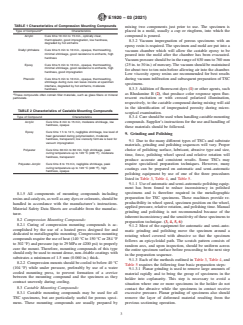
1 and Table 2 and Practice E3 for characteristics of various
should be noted and not included in the evaluation of the
mounting compounds.
specimen.
8.1.2 Byplacingpairsofspecimensinthesamemount,time
6.2.3 Sectioning with a hack saw will produce significant
and expense can be saved. When using this mounting method,
damage to the coating and interface and is not considered
the two coated surfaces should face each other. It may be
acceptable.
possible to place more than one pair of specimens in a single
6.2.4 Using an abrasive cutoff blade with a large particle
mount.
size abrasive produces a smoother surface than a hack saw, but
8.1.3 Mounting expenses may be reduced by employing the
still produces coating damage that may require considerable
sandwich mount technique. A sandwich mount is made by
grinding in subsequent preparation to remove. The choice of
using a small amount of a better, more expensive, mounting
cutoff wheel, coolant, cutting conditions, and the type and
compoundasthecriticallayerincontactwiththespecimenand
hardness of the coating and substrate will influence the quality
then topping off the mount with a less expensive compound.
of the cut surface. A poor choice of cutting conditions can
Care must be taken to use only mounting materials that are
easily overheat some TSC specimens rendering the specimens
compatible.
unusable for proper evaluation.
6.2.5 Sectioning can be completed with minimal damage to 8.1.4 Taper mounting may be useful for examination of the
the cut surface by selection of one of the two following interfaces between bond coating and top coating, as well as
abrasive cutoff blades: between coating and substrate.
E1920 − 03 (2021)
TABLE 1 Characteristics of Compression Mounting Compounds
mixing two components just prior to use. The specimen is
A
Type of Compound Characteristics placed in a mold, usually a cup or ringform, into which the
Acrylic Cure time 10 min to 15 min., optically clear, compound is poured.
thermoplastic, good impregnation, low hardness,
8.3.2 Vacuum impregnation of porous specimens with an
degraded by hot etchants
epoxy resin is required. The specimen and mold are put into a
Diallyl phthalate Cure time 5 min to 10 min., opaque, thermosetting,
vacuum chamber which will allow the castable epoxy to be
minimal shrinkage, good resistance to etchants, high
poured into the mold after the chamber has been evacuated.
hardness
Vacuum pressure should be in the range of 630 mm to 760 mm
Epoxy Cure time 5 min to 10 min., opaque, thermosetting, (25 in. to 30 in.) of mercury.The vacuum should be maintained
minimal shrinkage, good resistance to etchants, high
for about two to ten min before allowing air into
...