

ASTM E562-19e1
(Test Method)Standard Test Method for Determining Volume Fraction by Systematic Manual Point Count
General Information
- Abstract
SIGNIFICANCE AND USE
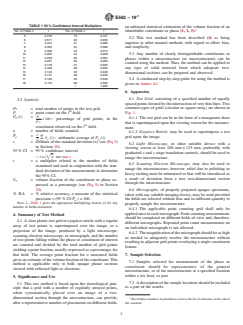
5.1 This test method is based upon the stereological principle that a grid with a number of regularly arrayed points, when systematically placed over an image of a two-dimensional section through the microstructure, can provide, after a representative number of placements on different fields, an unbiased statistical estimation of the volume fraction of an identifiable constituent or phase (1, 2, 3).3
5.2 This test method has been described (4) as being superior to other manual methods with regard to effort, bias, and simplicity.
5.3 Any number of clearly distinguishable constituents or phases within a microstructure (or macrostructure) can be counted using the method. Thus, the method can be applied to any type of solid material from which adequate two-dimensional sections can be prepared and observed.
5.4 A condensed step-by-step guide for using the method is given in Annex A1.
SCOPE
1.1 This test method describes a systematic manual point counting procedure for statistically estimating the volume fraction of an identifiable constituent or phase from sections through the microstructure by means of a point grid.
1.2 The use of automatic image analysis to determine the volume fraction of constituents is described in Practice E1245.
1.3 The values stated in SI units are to be regarded as standard. No other units of measurement are included in this standard.
1.4 This standard does not purport to address all of the safety concerns, if any, associated with its use. It is the responsibility of the user of this standard to establish appropriate safety, health, and environmental practices and determine the applicability of regulatory limitations prior to use.
1.5 This international standard was developed in accordance with internationally recognized principles on standardization established in the Decision on Principles for the Development of International Standards, Guides and Recommendations issued by the World Trade Organization Technical Barriers to Trade (TBT) Committee.
- Status
- Published
- Publication Date
- 14-Aug-2019
- Technical Committee
- E04 - Metallography
- Drafting Committee
- E04.14 - Quantitative Metallography
Overview
ASTM E562-19e1 is the internationally recognized standard test method for determining the volume fraction of identifiable constituents or phases in the microstructure of solid materials by systematic manual point count. This method, established by ASTM International, utilizes a statistical stereological approach to estimate volume fraction through the use of a regularly arrayed grid of points applied to two-dimensional sections of a specimen image. The procedure is acclaimed for its simplicity, reduced operator bias, and efficiency compared to other manual techniques, and is suitable for a wide variety of solid materials with clearly distinguishable structural features.
Key Topics
- Systematic Manual Point Counting: The core methodology involves superimposing a transparent grid, with equally spaced points, over a magnified microscope image or micrograph of the specimen. Points falling within the targeted constituent are counted across several fields, providing an unbiased statistical estimate of the volume fraction.
- Stereological Principles: The method is grounded in stereology, deriving three-dimensional volumetric information from two-dimensional section analysis.
- Applicability: Suitable for any bulk opaque material where adequate two-dimensional preparation is possible. The method accommodates any number of clearly distinguishable phases or constituents.
- Precision and Accuracy: The standard details recommended practices for grid selection, magnification, number and spacing of fields, and sample preparation to optimize measurement accuracy and minimize bias.
- Reporting: The standard outlines comprehensive reporting requirements, including sample description, grid and field detail, calculated values (volume fraction, standard deviation, confidence intervals, and relative accuracy), and sample preparation documentation.
Applications
ASTM E562-19e1 is widely applied across materials characterization and quality control processes in industries such as metallurgy, ceramics, and materials science research. Typical uses include:
- Metallography: Estimating the volume percentages of different phases or constituents in metals and alloys (e.g., ferrite, pearlite, inclusions).
- Ceramics and Composites: Quantifying volume fractions of phases or filler materials for performance assessment.
- Quality Assurance: Supporting materials specification compliance and batch consistency in manufacturing.
- Failure Analysis: Investigating the distribution and proportion of phases or inclusions that may contribute to material defects.
- Research and Development: Providing statistically robust microstructural quantification for process optimization and new material development.
The manual point count technique is favored in scenarios where automated image analysis is impractical due to sample complexity, cost, or required precision.
Related Standards
For broader or automated volume fraction analysis, these standards may also be relevant:
- ASTM E1245: Practice for Determining Inclusion or Second-Phase Constituent Content of Metals by Automatic Image Analysis.
- ASTM E3: Guide for Preparation of Metallographic Specimens, covering best practices in specimen sectioning and preparation.
- ASTM E407: Practice for Microetching Metals and Alloys, providing guidance on etching techniques for microstructure revelation.
- ASTM E691: Practice for Conducting an Interlaboratory Study to Determine the Precision of a Test Method, offering protocols for precision validation.
- ASTM E7: Terminology Relating to Metallography, for standardized definitions and terminology within the field.
Practical Value
Adopting ASTM E562-19e1 ensures reliable, internationally recognized volume fraction measurements for materials characterization. Its systematic approach minimizes operator bias and increases confidence in results, while detailed procedural guidelines help users achieve maximum accuracy and reproducibility. The method is essential for professionals in metallurgy, failure analysis, materials research, and industrial quality assurance seeking standardized, repeatable microstructural quantification.
Relations
- Replaces
ASTM E562-19 - Standard Test Method for Determining Volume Fraction by Systematic Manual Point Count - Effective Date
- 15-Aug-2019
- Effective Date
- 01-Nov-2023
- Effective Date
- 01-Jun-2015
- Effective Date
- 01-Jun-2015
- Effective Date
- 01-Nov-2014
- Effective Date
- 01-May-2013
- Effective Date
- 01-Nov-2011
- Effective Date
- 01-Oct-2009
- Effective Date
- 01-Oct-2008
- Effective Date
- 01-Oct-2008
- Effective Date
- 01-Jul-2007
- Effective Date
- 01-Jul-2007
- Effective Date
- 01-May-2007
- Effective Date
- 01-Nov-2005
- Effective Date
- 10-May-2003
Get Certified
Connect with accredited certification bodies for this standard

Element Materials Technology
Materials testing and product certification.

Inštitut za kovinske materiale in tehnologije
Institute of Metals and Technology. Materials testing, metallurgical analysis, NDT.
Sponsored listings
Frequently Asked Questions
ASTM E562-19e1 is a standard published by ASTM International. Its full title is "Standard Test Method for Determining Volume Fraction by Systematic Manual Point Count". This standard covers: SIGNIFICANCE AND USE 5.1 This test method is based upon the stereological principle that a grid with a number of regularly arrayed points, when systematically placed over an image of a two-dimensional section through the microstructure, can provide, after a representative number of placements on different fields, an unbiased statistical estimation of the volume fraction of an identifiable constituent or phase (1, 2, 3).3 5.2 This test method has been described (4) as being superior to other manual methods with regard to effort, bias, and simplicity. 5.3 Any number of clearly distinguishable constituents or phases within a microstructure (or macrostructure) can be counted using the method. Thus, the method can be applied to any type of solid material from which adequate two-dimensional sections can be prepared and observed. 5.4 A condensed step-by-step guide for using the method is given in Annex A1. SCOPE 1.1 This test method describes a systematic manual point counting procedure for statistically estimating the volume fraction of an identifiable constituent or phase from sections through the microstructure by means of a point grid. 1.2 The use of automatic image analysis to determine the volume fraction of constituents is described in Practice E1245. 1.3 The values stated in SI units are to be regarded as standard. No other units of measurement are included in this standard. 1.4 This standard does not purport to address all of the safety concerns, if any, associated with its use. It is the responsibility of the user of this standard to establish appropriate safety, health, and environmental practices and determine the applicability of regulatory limitations prior to use. 1.5 This international standard was developed in accordance with internationally recognized principles on standardization established in the Decision on Principles for the Development of International Standards, Guides and Recommendations issued by the World Trade Organization Technical Barriers to Trade (TBT) Committee.
SIGNIFICANCE AND USE 5.1 This test method is based upon the stereological principle that a grid with a number of regularly arrayed points, when systematically placed over an image of a two-dimensional section through the microstructure, can provide, after a representative number of placements on different fields, an unbiased statistical estimation of the volume fraction of an identifiable constituent or phase (1, 2, 3).3 5.2 This test method has been described (4) as being superior to other manual methods with regard to effort, bias, and simplicity. 5.3 Any number of clearly distinguishable constituents or phases within a microstructure (or macrostructure) can be counted using the method. Thus, the method can be applied to any type of solid material from which adequate two-dimensional sections can be prepared and observed. 5.4 A condensed step-by-step guide for using the method is given in Annex A1. SCOPE 1.1 This test method describes a systematic manual point counting procedure for statistically estimating the volume fraction of an identifiable constituent or phase from sections through the microstructure by means of a point grid. 1.2 The use of automatic image analysis to determine the volume fraction of constituents is described in Practice E1245. 1.3 The values stated in SI units are to be regarded as standard. No other units of measurement are included in this standard. 1.4 This standard does not purport to address all of the safety concerns, if any, associated with its use. It is the responsibility of the user of this standard to establish appropriate safety, health, and environmental practices and determine the applicability of regulatory limitations prior to use. 1.5 This international standard was developed in accordance with internationally recognized principles on standardization established in the Decision on Principles for the Development of International Standards, Guides and Recommendations issued by the World Trade Organization Technical Barriers to Trade (TBT) Committee.
ASTM E562-19e1 is classified under the following ICS (International Classification for Standards) categories: 77.040.99 - Other methods of testing of metals. The ICS classification helps identify the subject area and facilitates finding related standards.
ASTM E562-19e1 has the following relationships with other standards: It is inter standard links to ASTM E562-19, ASTM E407-23, ASTM E7-15, ASTM E407-07(2015)e1, ASTM E7-14, ASTM E691-13, ASTM E691-11, ASTM E7-03(2009), ASTM E691-08, ASTM E1245-03(2008), ASTM E3-01(2007), ASTM E3-01(2007)e1, ASTM E407-07, ASTM E691-05, ASTM E7-03. Understanding these relationships helps ensure you are using the most current and applicable version of the standard.
ASTM E562-19e1 is available in PDF format for immediate download after purchase. The document can be added to your cart and obtained through the secure checkout process. Digital delivery ensures instant access to the complete standard document.
Standards Content (Sample)
This international standard was developed in accordance with internationally recognized principles on standardization established in the Decision on Principles for the
Development of International Standards, Guides and Recommendations issued by the World Trade Organization Technical Barriers to Trade (TBT) Committee.
ϵ1
Designation:E562 −19
Standard Test Method for
Determining Volume Fraction by Systematic Manual Point
Count
This standard is issued under the fixed designation E562; the number immediately following the designation indicates the year of
original adoption or, in the case of revision, the year of last revision.Anumber in parentheses indicates the year of last reapproval.A
superscript epsilon (´) indicates an editorial change since the last revision or reapproval.
ε NOTE—Section A1.2 was editorially corrected in August 2020.
INTRODUCTION
This test method may be used to determine the volume fraction of constituents in an opaque
specimen using a polished, planar cross section by the manual point count procedure. The same
measurements can be achieved using image analysis per Practice E1245.
1. Scope E7Terminology Relating to Metallography
E407Practice for Microetching Metals and Alloys
1.1 This test method describes a systematic manual point
E691Practice for Conducting an Interlaboratory Study to
counting procedure for statistically estimating the volume
Determine the Precision of a Test Method
fraction of an identifiable constituent or phase from sections
E1245Practice for Determining the Inclusion or Second-
through the microstructure by means of a point grid.
Phase Constituent Content of Metals byAutomatic Image
1.2 The use of automatic image analysis to determine the
Analysis
volume fraction of constituents is described in Practice E1245.
3. Terminology
1.3 The values stated in SI units are to be regarded as
standard. No other units of measurement are included in this
3.1 Definitions—For definitions of terms used in this
standard.
practice, see Terminology E7.
1.4 This standard does not purport to address all of the
3.2 Definitions of Terms Specific to This Standard:
safety concerns, if any, associated with its use. It is the
3.2.1 point count—the total number of points in a test grid
responsibility of the user of this standard to establish appro-
that fall within the microstructural feature of interest, or on the
priate safety, health, and environmental practices and deter-
featureboundary;forthelatter,eachtestpointontheboundary
mine the applicability of regulatory limitations prior to use.
is one half a point.
1.5 This international standard was developed in accor-
3.2.2 point fraction—the ratio, usually expressed as a
dance with internationally recognized principles on standard-
percentage, of the point count of the phase or constituent of
ization established in the Decision on Principles for the
interest on the two-dimensional image of an opaque specimen
Development of International Standards, Guides and Recom-
tothenumberofgridpoints,whichisaveragedover nfieldsto
mendations issued by the World Trade Organization Technical
produce an unbiased estimate of the volume fraction of the
Barriers to Trade (TBT) Committee.
phase or constituent.
2. Referenced Documents
3.2.3 stereology—themethodsdevelopedtoobtaininforma-
tion about the three-dimensional characteristics of microstruc-
2.1 ASTM Standards:
tures based upon measurements made on two-dimensional
E3Guide for Preparation of Metallographic Specimens
sections through a solid material or their projection on a
surface.
This test method is under the jurisdiction of ASTM Committee E04 on
Metallography and is the direct responsibility of Subcommittee E04.14 on Quanti- 3.2.4 test grid—a transparent sheet or eyepiece reticle with
tative Metallography.
a regular pattern of lines or crosses that is superimposed over
Current edition approved Aug. 15, 2019. Published September 2019. Originally
themicrostructuralimageforcountingmicrostructuralfeatures
approved in 1976. Last previous edition approved in 2011 as E562–11. DOI:
of interest.
10.1520/E0562-19E01.
For referenced ASTM standards, visit the ASTM website, www.astm.org, or
3.2.5 volume fraction—the total volume of a phase or
contact ASTM Customer Service at service@astm.org. For Annual Book of ASTM
constituent per unit volume of specimen, generally expressed
Standards volume information, refer to the standard’s Document Summary page on
the ASTM website. as a percentage.
Copyright © ASTM International, 100 Barr Harbor Drive, PO Box C700, West Conshohocken, PA 19428-2959. United States
ϵ1
E562−19
TABLE 1 95% Confidence Interval Multipliers
an unbiased statistical estimation of the volume fraction of an
No. of Fields n t No. of Fields n t identifiable constituent or phase (1, 2, 3).
5 2.776 19 2.101
5.2 This test method has been described (4) as being
6 2.571 20 2.093
superior to other manual methods with regard to effort, bias,
7 2.447 21 2.086
8 2.365 22 2.080
and simplicity.
9 2.306 23 2.074
10 2.262 24 2.069 5.3 Any number of clearly distinguishable constituents or
11 2.228 25 2.064
phases within a microstructure (or macrostructure) can be
12 2.201 26 2.060
counted using the method. Thus, the method can be applied to
13 2.179 27 2.056
14 2.160 28 2.052 any type of solid material from which adequate two-
15 2.145 29 2.048
dimensional sections can be prepared and observed.
16 2.131 30 2.045
17 2.120 40 2.020
5.4 Acondensed step-by-step guide for using the method is
18 2.110 60 2.000
given in Annex A1.
` 1.960
6. Apparatus
6.1 Test Grid, consisting of a specified number of equally
3.3 Symbols:
spacedpointsformedbytheintersectionofverythinlines.Two
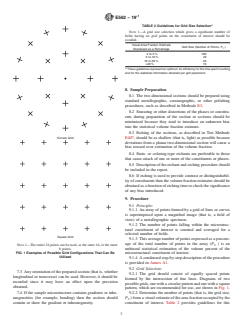
P = total number of points in the test grid. common types of grids (circular or square array) are shown in
T
th
P = point count on the i field. Fig. 1.
i
P
P (i) =
i
6.1.1 The test grid can be in the form of a transparent sheet
P
31005 percentage of grid points, in the
P
T
that is superimposed upon the viewing screen for the measure-
th
constituent observed on the i field.
ment.
n = number of fields counted.
6.1.2 Eyepiece Reticle, may be used to superimpose a test
n
¯
P =
p
grid upon the image.
P i 5 arithmetic average of P (i).
~ !
( p p
n
i51
s = estimate of the standard deviation (σ) (see (Eq 3)
6.2 Light Microscope, or other suitable device with a
in Section 10).
viewing screen at least 100 mm×125 mm, preferably with
95 % CI = 95% confidence interval
graduated x and y stage translation controls, should be used to
56ts/= n; see Note 1.
image the microstructure.
t = a multiplier related to the number of fields
6.3 Scanning Electron Microscope, may also be used to
examined and used in conjunction with the stan-
image the microstructure; however, relief due to polishing or
dard deviation of the measurements to determine
heavy etching must be minimized or bias will be introduced as
the 95% CI.
a result of deviation from a true two-dimensional section
V = volume fraction of the constituent or phase ex-
V
through the microstructure.
pressed as a percentage (see (Eq 5) in Section
10). 6.4 Micrographs, of properly prepared opaque specimens,
% RA = % relative accuracy, a measure of the statistical
taken with any suitable imaging device, may be used provided
¯
precision=(95% CI⁄P )×100.
the fields are selected without bias and in sufficient quantity to
p
NOTE 1—Table 1 gives the appropriate multiplying factors (t) for any
properly sample the microstructure.
number of fields measured.
6.4.1 The applicable point counting grid shall only be
appliedoncetoeachmicrograph.Pointcountingmeasurements
4. Summary of Test Method
should be completed on different fields of view and, therefore,
4.1 Aclearplastictestgridoreyepiecereticlewitharegular
different micrographs. Repeated point count measurements on
array of test points is superimposed over the image, or a
an individual micrograph is not allowed.
projection of the image, produced by a light microscope,
6.4.2 Themagnificationofthemicrographshouldbeashigh
scanning electron microscope, or micrograph, and the number
as needed to adequately resolve the microstructure without
of test points falling within the phase or constituent of interest
resultinginadjacentgridpointsoverlayingasingleconstituent
are counted and divided by the total number of grid points
feature.
yieldingapointfraction,usuallyexpressedasapercentage,for
that field. The average point fraction for n measured fields
7. Sample Selection
givesanestimateofthevolumefractionoftheconstituent.This
7.1 Samples selected for measurement of the phase or
method is applicable only to bulk opaque planar sections
constituent should be representative of the general
viewed with reflected light or electrons.
microstructure, or of the microstructure at a specified location
within a lot, heat, or part.
5. Significance and Use
7.2 Adescriptionofthesamplelocationsshouldbeincluded
5.1 This test method is based upon the stereological prin-
as a part of the results.
ciple that a grid with a number of regularly arrayed points,
when systematically placed over an image of a two-
dimensional section through the microstructure, can provide,
Theboldfacenumbersinparenthesesrefertothelistofreferencesattheendof
after a representative number of placements on different fields, this standard.
ϵ1
E562−19
A
TABLE 2 Guidelines for Grid Size Selection
NOTE 1—A grid size selection which gives a significant number of
fields having no grid points on the constituent of interest should be
avoided.
Visual Area Fraction Estimate
Grid Size (Number of Points, P )
T
Expressed as a Percentage
2to5% 100
5to10% 49
10 to 20 % 25
>20 % 16
A
These guidelines represent an optimum for efficiency for the time spent counting
and for the statistical information obtained per grid placement.
8. Sample Preparation
8.1 The two-dimensional sections should be prepared using
standard metallographic, ceramographic, or other polishing
procedures, such as described in Methods E3.
8.2 Smearing or other distortions of the phases or constitu-
ents during preparation of the section or sections should be
minimized because they tend to introduce an unknown bias
into the statistical volume fraction estimate.
8.3 Etching of the sections, as described in Test Methods
Circular Grid E407, should be as shallow (that is, light) as possible because
deviations from a planar two-dimensional section will cause a
bias toward over estimation of the volume fraction.
8.4 Stain- or coloring-type etchants are preferable to those
that cause attack of one or more of the constituents or phases.
8.5 Description of the etchant and etching procedure should
be included in the report.
8.6 If etching is used to provide contrast or distinguishabil-
ityofconstituentsthenthevolumefractionestimatesshouldbe
obtainedasafunctionofetchingtimetocheckthesignificance
of any bias introduced.
9. Procedure
9.1 Principle:
9.1.1 An array of points formed by a grid of lines or curves
is superimposed upon a magnified image (that is, a field of
view) of a metallographic specimen.
9.1.2 The number of points falling within the microstruc-
tural constituent of interest is counted and averaged for a
selected number of fields.
Square Grid
9.1.3 Thisaveragenumberofpointsexpressedasapercent-
age of the total number of points in the array (P )isan
T
NOTE 1—The entire 24 points can be used, or the outer 16, or the inner
unbiased statistical estimation of the volume percent of the
8 points.
FIG. 1Examples of Possible Grid Configurations That Can Be microstructural constituent of interest.
Utilized
9.1.4 Acondensedstep-by-stepdescriptionoftheprocedure
is provided in Annex A1.
9.2 Grid Selection:
7.3 Any orientation of the prepared section (that is, whether
9.2.1 The grid should consist of equally spaced points
longitudinal or transverse) can be used. However, it should be
formed by the intersection of fine lines. Diagrams of two
recorded since it may have an effect upon the precision
possiblegrids,onewithacircularpatternandonewithasquare
obtained.
pattern, which are recommended for use, are shown in Fig. 1.
7.4 If the sample microstructure contains gradients or inho- 9.2.2 Determine the number of points (that is, the grid size,
mogeneities (for example, banding) then the section should P )fromavisualestimateoftheareafractionoccupiedbythe
T
contain or show the gradient or inhomogeneity. constituent of interest. Table 2 provides guidelines for this
ϵ1
E562−19
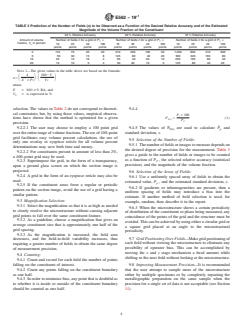
TABLE 3 Prediction of the Number of Fields (n) to be Observed as a Function of the Desired Relative Accuracy and of the Estimated
Magnitude of the Volume Fraction of the Constituent
33 % Relative Accuracy 20 % Relative Accuracy 10 % Relative Accuracy
Amount of volume
Number of fields n for a grid of P = Number of fields n for a grid of P = Number of fields n for a grid of P =
T T T
fraction, V in percent
v 16 25 49 100 16 25 49 100 16 25 49 100
points points points points points points points points points points points points
2 110 75 35 20 310 200 105 50 1,250 800 410 200
5 50 30 15 8 125 80 40 20 500 320 165 80
10 25 15 10 4 65 40 20 10 250 160 85 40
20 15 10 5 4 30 20 10 5 125 80 40 20
NOTE 1—The given values in the table above are based on the formula:
4 1002V
v
n. ·
S 2 D S D
E 3P V
T V
where:
E = 0.01×% RA, and
V = is expressed in %.
V
selection. The values in Table 2 do not correspond to theoreti- 9.4.4
cal constraints; but, by using these values, empirical observa-
P 3100
i
P 5 (1)
tions have shown that the method is optimized for a given
P~i!
P
T
precision.
¯
9.2.2.1 The user may choose to employ a 100 point grid 9.4.5 The values of P are used to calculate P and
P(i) p
overtheentirerangeofvolumefractions.Theuseof100–point standard deviation, s.
grid facilitates easy volume percent calculations. the use of
9.5 Selection of the Number of Fields:
only one overlay or eyepiece reticle for all volume percent
9.5.1 Thenumberoffieldsorimagestomeasuredependson
determinations may save both time and money.
the desired degree of precision for the measurement. Table 3
9.2.2.2 For constituents present in amount of less than 2%,
gives a guide to the number of fields or images to be counted
a 400–point grid may be used.
as a function of P , the selected relative accuracy (statistical
T
9.2.3 Superimpose the grid, in the form of a transparency,
precision), and the magnitude of the volume fraction.
upon a ground
...