

ASTM B316/B316M-20
(Specification)Standard Specification for Aluminum and Aluminum-Alloy Rivet and Cold-Heading Wire and Rods
General Information
- Abstract
ABSTRACT
This specification covers wire and rod in the alloys and the tempers suitable for manufacturing rivets and other similar items by cold-heading operations. The products covered by this specification shall be produced by extruding, rolling, or drawing, or a combination thereof, at the option of the producer. For heat-treated tempers, an inspection lot shall consist of an identifiable quantity of material of the same mill form, alloy, temper, and nominal diameter traceable to a heat-treat lot or lots, and subjected to inspection at one time. On the other hand, an inspection lot shall consist of an identifiable quantity of material of the same mill form, alloy, temper, and nominal diameter subjected to inspection for non heat-treated tempers. Samples for chemical analysis shall be taken from the material by drilling, sawing, milling, turning, or clipping a representative piece or pieces to obtain a prepared sample. One tension test per specimen shall be taken. Resistance to stress corrosion cracking for each lot of specimen shall be established by testing the previously selected tension-test samples for lot acceptance purposes. Variations from the specified diameter, length, and straightness shall not exceed the permissible variations prescribed. The material shall be supplied in the mill finish and shall conform by the requirements of this specification and shall be commercially sound.
SCOPE
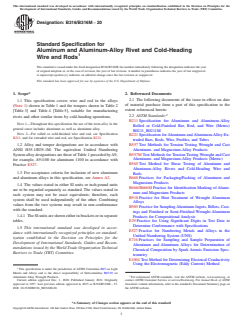
1.1 This specification covers wire and rod in the alloys (Note 1) shown in Table 1 and the tempers shown in Table 2 [Table 3] and Table 4 [Table 5], suitable for manufacturing rivets and other similar items by cold-heading operations.
Note 1: Throughout this specification the use of the term alloy in the general sense includes aluminum as well as aluminum alloy.
Note 2: For rolled or cold-finished wire and rod, see Specification B211, and for extruded wire and rod, see Specification B221.
1.2 Alloy and temper designations are in accordance with ANSI H35.1/H35.1M. The equivalent Unified Numbering System alloy designations are those of Table 1 preceded by A9, for example, A91100 for aluminum 1100 in accordance with Practice E527.
1.3 For acceptance criteria for inclusion of new aluminum and aluminum alloys in this specification, see Annex A2.
1.4 The values stated in either SI units or inch-pound units are to be regarded separately as standard. The values stated in each system may not be exact equivalents; therefore, each system shall be used independently of the other. Combining values from the two systems may result in non-conformance with the standard.
1.4.1 The SI units are shown either in brackets or in separate tables.
1.5 This international standard was developed in accordance with internationally recognized principles on standardization established in the Decision on Principles for the Development of International Standards, Guides and Recommendations issued by the World Trade Organization Technical Barriers to Trade (TBT) Committee.
- Status
- Published
- Publication Date
- 30-Nov-2020
- Technical Committee
- B07 - Light Metals and Alloys
- Drafting Committee
- B07.03 - Aluminum Alloy Wrought Products
Buy Documents
ASTM B316/B316M-20 - Standard Specification for Aluminum and Aluminum-Alloy Rivet and Cold-Heading Wire and Rods
REDLINE ASTM B316/B316M-20 - Standard Specification for Aluminum and Aluminum-Alloy Rivet and Cold-Heading Wire and Rods
Overview
ASTM B316/B316M-20 is the internationally recognized standard specification for aluminum and aluminum-alloy rivet and cold-heading wire and rods. Developed by ASTM International, this standard outlines the requirements for wire and rod products in various aluminum alloys and tempers, specifically intended for manufacturing rivets and similar items using cold-heading operations. The specification covers details related to production processes, chemical composition, mechanical properties, material quality, dimensional tolerances, and testing methodology. ASTM B316/B316M-20 ensures that aluminum wire and rod used in cold-heading applications meet precise and reliable quality standards essential for critical industrial, automotive, aerospace, and construction uses.
Key Topics
- Product Scope: Applies to solid aluminum and aluminum-alloy wire and rods suitable for cold-heading, particularly for producing rivets, bolts, and comparable fasteners.
- Manufacturing Methods: Products must be produced by one or a combination of extrusion, rolling, or drawing at the manufacturer's discretion.
- Alloy and Temper Designations: Alloy and temper identifications adhere to ANSI H35.1/H35.1M designation systems.
- Chemical Composition: Specifies the required chemical composition for various alloys, ensuring consistency and structural integrity through detailed sampling and analysis procedures.
- Mechanical Properties: Sets forth tensile, yield, and shear strength values for supplied material and after heat treatment, with requirements for both SI and inch-pound units.
- Testing Procedures: Includes mandatory tension and shear testing per ASTM methods, as well as stress-corrosion cracking resistance evaluation for certain alloy tempers.
- Dimensional Tolerances: Requires adherence to specified diameter, length, and straightness tolerances as per ANSI H35.2.
- Material Quality and Finish: Mandates that the material be supplied in mill finish, be commercially sound, and conform to specified uniformity and quality requirements.
- Certification and Inspection: The supplier must provide certification upon request, and purchasers may witness or require inspection/testing as part of the order.
Applications
ASTM B316/B316M-20 is crucial for industries relying on high-quality, reliable aluminum and aluminum-alloy fasteners. Typical application areas include:
- Aerospace and Aviation: Used for manufacturing rivets and cold-headed fasteners vital for aircraft assembly, ensuring light weight and high strength.
- Automotive: Supports production of rivets and bolts with excellent dimensional stability and mechanical properties required for vehicle structures.
- Industrial Fastener Manufacturing: Ensures the consistent production of cold-headed products like bolts, pins, and specialized fastening components.
- Construction and Structural Engineering: Provides materials for strong, corrosion-resistant fasteners essential in building and infrastructure projects.
- General Manufacturing: Facilitates the use of aluminum wire and rod in creating custom fastening solutions across various sectors.
Users of ASTM B316/B316M-20 benefit from clearly defined requirements for chemical and mechanical properties, ensuring the performance and safety of finished fastener products.
Related Standards
For comprehensive quality control and consistency, ASTM B316/B316M-20 references and works in conjunction with several related standards:
- ASTM B211 - Standard Specification for Aluminum and Aluminum-Alloy Rolled or Cold-Finished Bar, Rod, and Wire
- ASTM B221 - Standard Specification for Aluminum and Aluminum-Alloy Extruded Bars, Rods, Wire, Profiles, and Tubes
- ASTM B557/B557M - Test Methods for Tension Testing Wrought and Cast Aluminum- and Magnesium-Alloy Products
- ASTM B565 - Test Method for Shear Testing of Aluminum and Aluminum-Alloy Rivets and Cold-Heading Wire and Rods
- ANSI H35.1/H35.1M - Alloy and Temper Designation Systems for Aluminum
- ANSI H35.2/H35.2M - Dimensional Tolerances for Aluminum Mill Products
- ASTM B918 - Practice for Heat Treatment of Wrought Aluminum Alloys
These referenced documents provide a broader framework for aluminum fastener materials, ensuring that products manufactured under ASTM B316/B316M-20 align with global industry and quality standards.
Keywords: ASTM B316, aluminum alloy rivet wire, cold-heading rods, aluminum wire standards, aluminum fastener materials, mechanical properties, chemical composition, aluminum alloy specification.
Relations
- Effective Date
- 01-Dec-2023
- Effective Date
- 01-Nov-2023
- Effective Date
- 01-Oct-2017
- Effective Date
- 15-Sep-2017
- Effective Date
- 01-Jun-2017
- Effective Date
- 15-Jan-2017
- Effective Date
- 01-Nov-2016
- Effective Date
- 15-May-2014
- Effective Date
- 15-May-2014
- Effective Date
- 01-Apr-2013
- Effective Date
- 01-Dec-2012
- Effective Date
- 15-Nov-2012
- Effective Date
- 15-Jan-2012
- Effective Date
- 15-Jan-2012
- Effective Date
- 15-Jan-2012
Buy Documents
ASTM B316/B316M-20 - Standard Specification for Aluminum and Aluminum-Alloy Rivet and Cold-Heading Wire and Rods
REDLINE ASTM B316/B316M-20 - Standard Specification for Aluminum and Aluminum-Alloy Rivet and Cold-Heading Wire and Rods
Frequently Asked Questions
ASTM B316/B316M-20 is a technical specification published by ASTM International. Its full title is "Standard Specification for Aluminum and Aluminum-Alloy Rivet and Cold-Heading Wire and Rods". This standard covers: ABSTRACT This specification covers wire and rod in the alloys and the tempers suitable for manufacturing rivets and other similar items by cold-heading operations. The products covered by this specification shall be produced by extruding, rolling, or drawing, or a combination thereof, at the option of the producer. For heat-treated tempers, an inspection lot shall consist of an identifiable quantity of material of the same mill form, alloy, temper, and nominal diameter traceable to a heat-treat lot or lots, and subjected to inspection at one time. On the other hand, an inspection lot shall consist of an identifiable quantity of material of the same mill form, alloy, temper, and nominal diameter subjected to inspection for non heat-treated tempers. Samples for chemical analysis shall be taken from the material by drilling, sawing, milling, turning, or clipping a representative piece or pieces to obtain a prepared sample. One tension test per specimen shall be taken. Resistance to stress corrosion cracking for each lot of specimen shall be established by testing the previously selected tension-test samples for lot acceptance purposes. Variations from the specified diameter, length, and straightness shall not exceed the permissible variations prescribed. The material shall be supplied in the mill finish and shall conform by the requirements of this specification and shall be commercially sound. SCOPE 1.1 This specification covers wire and rod in the alloys (Note 1) shown in Table 1 and the tempers shown in Table 2 [Table 3] and Table 4 [Table 5], suitable for manufacturing rivets and other similar items by cold-heading operations. Note 1: Throughout this specification the use of the term alloy in the general sense includes aluminum as well as aluminum alloy. Note 2: For rolled or cold-finished wire and rod, see Specification B211, and for extruded wire and rod, see Specification B221. 1.2 Alloy and temper designations are in accordance with ANSI H35.1/H35.1M. The equivalent Unified Numbering System alloy designations are those of Table 1 preceded by A9, for example, A91100 for aluminum 1100 in accordance with Practice E527. 1.3 For acceptance criteria for inclusion of new aluminum and aluminum alloys in this specification, see Annex A2. 1.4 The values stated in either SI units or inch-pound units are to be regarded separately as standard. The values stated in each system may not be exact equivalents; therefore, each system shall be used independently of the other. Combining values from the two systems may result in non-conformance with the standard. 1.4.1 The SI units are shown either in brackets or in separate tables. 1.5 This international standard was developed in accordance with internationally recognized principles on standardization established in the Decision on Principles for the Development of International Standards, Guides and Recommendations issued by the World Trade Organization Technical Barriers to Trade (TBT) Committee.
ABSTRACT This specification covers wire and rod in the alloys and the tempers suitable for manufacturing rivets and other similar items by cold-heading operations. The products covered by this specification shall be produced by extruding, rolling, or drawing, or a combination thereof, at the option of the producer. For heat-treated tempers, an inspection lot shall consist of an identifiable quantity of material of the same mill form, alloy, temper, and nominal diameter traceable to a heat-treat lot or lots, and subjected to inspection at one time. On the other hand, an inspection lot shall consist of an identifiable quantity of material of the same mill form, alloy, temper, and nominal diameter subjected to inspection for non heat-treated tempers. Samples for chemical analysis shall be taken from the material by drilling, sawing, milling, turning, or clipping a representative piece or pieces to obtain a prepared sample. One tension test per specimen shall be taken. Resistance to stress corrosion cracking for each lot of specimen shall be established by testing the previously selected tension-test samples for lot acceptance purposes. Variations from the specified diameter, length, and straightness shall not exceed the permissible variations prescribed. The material shall be supplied in the mill finish and shall conform by the requirements of this specification and shall be commercially sound. SCOPE 1.1 This specification covers wire and rod in the alloys (Note 1) shown in Table 1 and the tempers shown in Table 2 [Table 3] and Table 4 [Table 5], suitable for manufacturing rivets and other similar items by cold-heading operations. Note 1: Throughout this specification the use of the term alloy in the general sense includes aluminum as well as aluminum alloy. Note 2: For rolled or cold-finished wire and rod, see Specification B211, and for extruded wire and rod, see Specification B221. 1.2 Alloy and temper designations are in accordance with ANSI H35.1/H35.1M. The equivalent Unified Numbering System alloy designations are those of Table 1 preceded by A9, for example, A91100 for aluminum 1100 in accordance with Practice E527. 1.3 For acceptance criteria for inclusion of new aluminum and aluminum alloys in this specification, see Annex A2. 1.4 The values stated in either SI units or inch-pound units are to be regarded separately as standard. The values stated in each system may not be exact equivalents; therefore, each system shall be used independently of the other. Combining values from the two systems may result in non-conformance with the standard. 1.4.1 The SI units are shown either in brackets or in separate tables. 1.5 This international standard was developed in accordance with internationally recognized principles on standardization established in the Decision on Principles for the Development of International Standards, Guides and Recommendations issued by the World Trade Organization Technical Barriers to Trade (TBT) Committee.
ASTM B316/B316M-20 is classified under the following ICS (International Classification for Standards) categories: 21.060.40 - Rivets. The ICS classification helps identify the subject area and facilitates finding related standards.
ASTM B316/B316M-20 has the following relationships with other standards: It is inter standard links to ASTM E1004-23, ASTM B660-23, ASTM E1251-17a, ASTM E1251-17, ASTM E1004-17, ASTM E3061-17, ASTM B985-12(2016), ASTM B557-14, ASTM B557M-14, ASTM B221-13, ASTM B985-12, ASTM B221-12a, ASTM B221-12, ASTM B211-12e1, ASTM B211-12. Understanding these relationships helps ensure you are using the most current and applicable version of the standard.
ASTM B316/B316M-20 is available in PDF format for immediate download after purchase. The document can be added to your cart and obtained through the secure checkout process. Digital delivery ensures instant access to the complete standard document.
Standards Content (Sample)
This international standard was developed in accordance with internationally recognized principles on standardization established in the Decision on Principles for the
Development of International Standards, Guides and Recommendations issued by the World Trade Organization Technical Barriers to Trade (TBT) Committee.
Designation: B316/B316M −20
Standard Specification for
Aluminum and Aluminum-Alloy Rivet and Cold-Heading
Wire and Rods
This standard is issued under the fixed designation B316/B316M; the number immediately following the designation indicates the year
of original adoption or, in the case of revision, the year of last revision. A number in parentheses indicates the year of last reapproval.
A superscript epsilon (´) indicates an editorial change since the last revision or reapproval.
This standard has been approved for use by agencies of the U.S. Department of Defense.
1. Scope* 2. Referenced Documents
2.1 The following documents of the issue in effect on date
1.1 This specification covers wire and rod in the alloys
of material purchase form a part of this specification to the
(Note 1) shown in Table 1 and the tempers shown in Table 2
extent referenced herein:
[Table 3] and Table 4 [Table 5], suitable for manufacturing
rivets and other similar items by cold-heading operations. 2.2 ASTM Standards:
B211 Specification for Aluminum and Aluminum-Alloy
NOTE 1—Throughout this specification the use of the term alloy in the
Rolled or Cold-Finished Bar, Rod, and Wire (Metric)
general sense includes aluminum as well as aluminum alloy.
B0211_B0211M
NOTE 2—For rolled or cold-finished wire and rod, see Specification
B221 Specification forAluminum andAluminum-Alloy Ex-
B211, and for extruded wire and rod, see Specification B221.
truded Bars, Rods, Wire, Profiles, and Tubes
1.2 Alloy and temper designations are in accordance with B557 Test Methods for Tension Testing Wrought and Cast
Aluminum- and Magnesium-Alloy Products
ANSI H35.1/H35.1M. The equivalent Unified Numbering
B557M Test Methods for Tension Testing Wrought and Cast
SystemalloydesignationsarethoseofTable 1precededbyA9,
Aluminum- and Magnesium-Alloy Products (Metric)
for example, A91100 for aluminum 1100 in accordance with
B565 Test Method for Shear Testing of Aluminum and
Practice E527.
Aluminum-Alloy Rivets and Cold-Heading Wire and
1.3 For acceptance criteria for inclusion of new aluminum
Rods
and aluminum alloys in this specification, see Annex A2.
B660 Practices for Packaging/Packing of Aluminum and
Magnesium Products
1.4 The values stated in either SI units or inch-pound units
B666/B666M Practice for Identification Marking of Alumi-
are to be regarded separately as standard. The values stated in
num and Magnesium Products
each system may not be exact equivalents; therefore, each
B918 Practice for Heat Treatment of Wrought Aluminum
system shall be used independently of the other. Combining
Alloys
values from the two systems may result in non-conformance
B985 Practice for SamplingAluminum Ingots, Billets, Cast-
with the standard.
ings and Finished or Semi-Finished Wrought Aluminum
1.4.1 TheSIunitsareshowneitherinbracketsorinseparate
Products for Compositional Analysis
tables.
E29 Practice for Using Significant Digits in Test Data to
Determine Conformance with Specifications
1.5 This international standard was developed in accor-
E527 Practice for Numbering Metals and Alloys in the
dance with internationally recognized principles on standard-
Unified Numbering System (UNS)
ization established in the Decision on Principles for the
E716 Practices for Sampling and Sample Preparation of
Development of International Standards, Guides and Recom-
Aluminum and Aluminum Alloys for Determination of
mendations issued by the World Trade Organization Technical
Chemical Composition by Spark Atomic Emission Spec-
Barriers to Trade (TBT) Committee.
trometry
E1004 Test Method for Determining Electrical Conductivity
Using the Electromagnetic (Eddy Current) Method
This specification is under the jurisdiction of ASTM Committee B07 on Light
Metals and Alloys and is the direct responsibility of Subcommittee B07.03 on
Aluminum Alloy Wrought Products. For referenced ASTM standards, visit the ASTM website, www.astm.org, or
Current edition approved Dec. 1, 2020. Published January 2021. Originally contact ASTM Customer Service at service@astm.org. For Annual Book of ASTM
approved in 1957. Last previous edition approved in 2015 as B316/B316M – 15. Standards volume information, refer to the standard’s Document Summary page on
DOI: 10.1520/B0316_B0316M-20. the ASTM website.
*A Summary of Changes section appears at the end of this standard
Copyright © ASTM International, 100 Barr Harbor Drive, PO Box C700, West Conshohocken, PA 19428-2959. United States
B316/B316M − 20
E1251 Test Method for Analysis of Aluminum and Alumi- 4.1.2 Quantity in pieces or pounds [kilograms],
num Alloys by Spark Atomic Emission Spectrometry 4.1.3 Alloy (see 7.1),
E3061 Test Method for Analysis of Aluminum and Alumi- 4.1.4 Temper (see 8.1),
numAlloys by Inductively Coupled PlasmaAtomic Emis- 4.1.5 Diameter,
sion Spectrometry (Performance Based Method) 4.1.6 Form-coiled or straight lengths,
2.3 ANSI Standards:
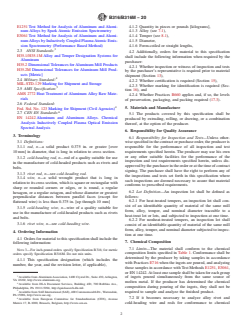
4.2 Additionally, orders for material to this specification
H35.1/H35.1M Alloy and Temper Designation Systems for
shall include the following information when required by the
Aluminum
purchaser:
H35.2 Dimensional Tolerances forAluminum Mill Products
4.2.1 Whether inspection or witness of inspection and tests
H35.2M Dimensional Tolerances for Aluminum Mill Prod-
by the purchaser’s representative is required prior to material
ucts [Metric]
shipment (Section 13),
2.4 Military Standard:
4.2.2 Whether certification is required (Section 15),
MIL-STD-129 Marking for Shipment and Storage
4.2.3 Whether marking for identification is required (Sec-
2.5 AMS Specification:
tion 16), and
AMS 2772 Heat Treatment of Aluminum Alloy Raw Mate-
4.2.4 Whether Practices B660 applies and, if so, the levels
rials
of preservation, packaging, and packing required (17.3).
2.6 Federal Standard:
5. Materials and Manufacture
Fed. Std. No. 123 Marking for Shipment (Civil Agencies)
2.7 CEN EN Standards:
5.1 The products covered by this specification shall be
EN 14242 Aluminum and Aluminum Alloys. Chemical
produced by extruding, rolling, or drawing, or a combination
Analysis Inductively Coupled Plasma Optical Emission
thereof, at the option of the producer.
Spectral Analysis
6. Responsibility for Quality Assurance
3. Terminology
6.1 Responsibility for Inspection and Tests—Unless other-
wise specified in the contract or purchase order, the producer is
3.1 Definitions:
3.1.1 rod, n—a solid product 0.375 in. or greater [over responsible for the performance of all inspection and test
requirements specified herein. The producer may use his own
10 mm] in diameter, that is long in relation to cross section.
or any other suitable facilities for the performance of the
3.1.2 cold-heading rod, n—rod of a quality suitable for use
inspection and test requirements specified herein, unless dis-
in the manufacture of cold-headed products such as rivets and
approvedbythepurchaserintheorderoratthetimeofcontract
bolts.
signing. The purchaser shall have the right to perform any of
3.1.3 rivet rod, n—see cold-heading rod.
the inspections and tests set forth in this specification where
3.1.4 wire, n—a solid wrought product that is long in
such inspections are deemed necessary to assure that material
relation to its cross section, which is square or rectangular with
conforms to prescribed requirements.
sharp or rounded corners or edges, or is round, a regular
6.2 Lot Definition—An inspection lot shall be defined as
hexagon, or a regular octagon, and whose diameter or greatest
follows:
perpendicular distances between parallel faces (except for
6.2.1 For heat-treated tempers, an inspection lot shall con-
flattened wire) is less than 0.375 in. [up through 10 mm]
sist of an identifiable quantity of material of the same mill
3.1.5 cold-heading wire, n—wire of a quality suitable for
form, alloy, temper, and nominal diameter traceable to a
use in the manufacture of cold-headed products such as rivets
heat-treat lot or lots, and subjected to inspection at one time.
and bolts.
6.2.2 For nonheat-treated tempers, an inspection lot shall
3.1.6 rivet wire, n—see cold-heading wire.
consist of an identifiable quantity of material of the same mill
form, alloy, temper, and nominal diameter subjected to inspec-
4. Ordering Information
tion at one time.
4.1 Orders for material to this specification shall include the
7. Chemical Composition
following information:
7.1 Limits—The material shall conform to the chemical
NOTE 3—For inch-pound orders specify Specification B316; for metric
composition limits specified in Table 1. Conformance shall be
orders specify Specification B316M. Do not mix units.
determined by the producer by taking samples in accordance
4.1.1 This specification designation (which includes the
with Practices E716 when the ingots are poured, and analyzing
number, the year, and the revision letter, if applicable),
those samples in accordance withTest Methods E1251, E3061,
or EN 14242.At least one sample shall be taken for each group
Available fromAluminumAssociation, 1400 Crystal Dr., Suite 430,Arlington,
of ingots poured simultaneously from the same source of
VA 22202, http://www.aluminum.org.
molten metal. If the producer has determined the chemical
Available from DLA Document Services, Building 4/D, 700 Robbins Ave.,
composition during pouring of the ingots, they shall not be
Philadelphia, PA 19111-5094, http://quicksearch.dla.mil.
Available from SAE International (SAE), 400 Commonwealth Dr.,Warrendale, required to sample and analyze the finished product.
PA 15096, http://www.sae.org.
7.2 If it becomes necessary to analyze alloy rivet and
Available from European Committee for Standardization (CEN), Avenue
Marnix 17, B-1000, Brussels, Belgium, http://www.cen.eu. cold-heading wire and rods for conformance to chemical
B316/B316M − 20
A,B,C,J
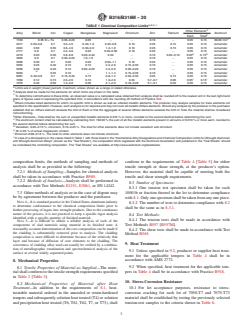
TABLE 1 Chemical Composition Limits
D
Other Elements
Alloy Silicon Iron Copper Manganese Magnesium Chromium Zinc Titanium Aluminum
E
Each Total
F
1100 0.95 Si + Fe 0.05–0.20 0.05 . . 0.10 . 0.05 0.15 99.00 min
2017 0.20–0.8 0.7 3.5–4.5 0.40–1.0 0.40–0.8 0.10 0.25 0.15 0.05 0.15 remainder
2024 0.50 0.50 3.8–4.9 0.30–0.9 1.2–1.8 0.10 0.25 0.15 0.05 0.15 remainder
2117 0.8 0.7 2.2–3.0 0.20 0.20–0.50 0.10 0.25 . 0.05 0.15 remainder
G G
2219 0.20 0.30 5.8–6.8 0.20–0.40 0.02 . 0.10 0.02–0.10 0.05 0.15 remainder
3003 0.6 0.7 0.05–0.20 1.0–1.5 . . 0.10 . 0.05 0.15 remainder
5005 0.30 0.7 0.20 0.20 0.50–1.1 0.10 0.25 . 0.05 0.15 remainder
5052 0.25 0.40 0.10 0.10 2.2–2.8 0.15–0.35 0.10 . 0.05 0.15 remainder
5056 0.30 0.40 0.10 0.05–0.20 4.5–5.6 0.05–0.20 0.10 . 0.05 0.15 remainder
H
6053 0.35 0.10 . 1.1–1.4 0.15–0.35 0.10 . 0.05 0.15 remainder
6061 0.40–0.8 0.7 0.15–0.40 0.15 0.8–1.2 0.04–0.35 0.25 0.15 0.05 0.15 remainder
I I
7050 0.12 0.15 2.0–2.6 0.10 1.9–2.6 0.04 5.7–6.7 0.06 0.05 0.15 remainder
7075 0.40 0.50 1.2–2.0 0.30 2.1–2.9 0.18–0.28 5.1–6.1 0.20 0.05 0.15 remainder
A
Limits are in weight [mass] percent, maximum, unless shown as a range or stated otherwise.
B
Analysis shall be made for the elements for which limits are shown in this table.
C
To determine conformance to these limits, an observed value or a calculated value obtained from analysis shall be rounded off to the nearest unit in the last right-hand
place of figures used in expressing the specified limit, in accordance with the rounding off method of Practice E29.
D
Others includes listed elements for which no specific limit is shown as well as unlisted metallic elements. The producer may analyze samples for trace elements not
specified in this specification. However, such analysis is not required and may not cover all metallicOthers elements. Should any analysis by the producer or the purchaser
establish that an Others element exceeds the limit of Each or that the aggregate of several Others elements exceeds the limit of Total, the material shall be considered
nonconforming.
E
Other Elements—Total shall be the sum of unspecified metallic elements 0.010 % or more, rounded to the second decimal before determining the sum.
F
The aluminum content shall be calculated by subtracting from 100.00 % the sum of all the metallic elements present in amounts of 0.010 % or more each, rounded to
the second decimal before determining the sum.
G
Vanadium, 0.05–0.15 %; zirconium, 0.10–0.25 %. The total for other elements does not include vanadium and zirconium.
H
45 to 65 % of actual magnesium content.
I
Zirconium 0.08–0.15 %. The total for other elements does not include zirconium.
J
In case of a discrepancy in the values listed in Table 1 with those listed in the “International Alloy Designations and Chemical Composition Limits for Wrought Aluminum
and Wrought Aluminum Alloys” (known as the “Teal Sheets”), the composition limits registered with the Aluminum Association and published in the “Teal Sheets” should
be considered the controlling composition. The “Teal Sheets” are available at http://www.aluminum.org/tealsheets.
composition limits, the methods of sampling and methods of conform to the requirements of Table 4 [Table 5] for either
analysis shall be as provided in the following: tensile strength or shear strength, at the producer’s option.
7.2.1 Methods of Sampling—Samples for chemical analysis However, the material shall be capable of meeting both the
shall be taken in accordance with Practice B985. tensile and shear strength requirements.
7.2.2 Methods of Analysis—Analysis shall be performed in
8.3 Number of Specimens:
accordance with Test Methods E1251, E3061, or EN 14242.
8.3.1 One tension test specimen shall be taken for each
7.3 Other methods of analysis or in the case of dispute may
1000 lb or fraction thereof in the lot to determine compliance
be by agreement between the producer and the purchaser.
with8.1.Onlyonespecimenshallbetakenfromanyonepiece.
NOTE 4—It is standard practice in the United States aluminum industry
8.3.2 The number of tests to determine compliance with 8.2
to determine conformance to the chemical composition limits prior to
shall be the same as in 8.3.1.
further processing of ingots into wrought products. Due to the continuous
nature of the process, it is not practical to keep a specific ingot analysis
8.4 Test Methods:
identified with a specific quantity of finished material.
8.4.1 The tension tests shall be made in accordance with
NOTE 5—It is difficult to obtain a reliable analysis of each of the
Test Methods B557 [B557M].
components of clad materials using material in its finished state. A
reasonably accurate determination of the core composition can be made if 8.4.2 The shear tests shall be made in accordance with Test
the cladding is substantially removed prior to analysis. The cladding
Method B565.
composition is more difficult to determine because of the relatively thin
layer and because of diffusion of core elements to the cladding. The
9. Heat Treatment
correctness of cladding alloy used can usually be verified by a combina-
tion of metallographic examination and spectrochemical analysis of the
9.1 Unless specified in 9.2, producer or supplier heat treat-
surface at several widely separated points.
ment for the applicable tempers in Table 4 shall be in
accordance with AMS 2772.
8. Mechanical Properties
9.2 When specified, heat treatment for the applicable tem-
8.1 Tensile Properties of Material as Supplied—The mate-
pers in Table 4 shall be in accordance with Practice B918.
rial shall conform to the tensile strength requirements specified
in Table 2 [Table 3].
10. Stress-Corrosion Resistance
8.2 Mechanical Properties of Material after Heat
Treatment—In addition to the requirements of 8.1, heat- 10.1 For lot acceptance purposes, resistance to stress-
treatable material ordered in the annealed or strain-hardened corrosion cracking for each lot of 7050-T7 and 7075-T73
tempers and subsequently solution heat treated (T4) or solution material shall be established by testing the previously selected
and precipitation heat treated (T6, T61, T62, T7, or T73), shall tension-test samples to the criteria shown in Table 6.
B316/B316M − 20
A,B
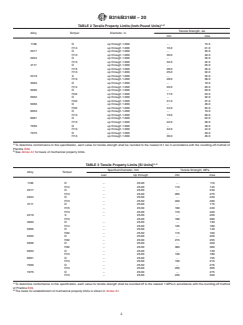
TABLE 2 Tensile Property Limits (Inch-Pound Units)
Tensile Strength, ksi
Alloy Temper Diameter, in.
min max
1100 O up through 1.000 . 15.5
H14 up through 1.000 16.0 21.0
2017 O up through 1.000 . 35.0
H13 up through 1.000 30.0 40.0
2024 O up through 1.000 . 35.0
H13 up through 1.000 32.0 42.0
2117 O up through 1.000 . 25.0
H15 up through 1.000 28.0 35.0
H13 up through 1
...
This document is not an ASTM standard and is intended only to provide the user of an ASTM standard an indication of what changes have been made to the previous version. Because
it may not be technically possible to adequately depict all changes accurately, ASTM recommends that users consult prior editions as appropriate. In all cases only the current version
of the standard as published by ASTM is to be considered the official document.
Designation: B316/B316M − 15 B316/B316M − 20
Standard Specification for
Aluminum and Aluminum-Alloy Rivet and Cold-Heading
Wire and Rods
This standard is issued under the fixed designation B316/B316M; the number immediately following the designation indicates the year
of original adoption or, in the case of revision, the year of last revision. A number in parentheses indicates the year of last reapproval.
A superscript epsilon (´) indicates an editorial change since the last revision or reapproval.
This standard has been approved for use by agencies of the U.S. Department of Defense.
1. Scope*
1.1 This specification covers wire and rod in the alloys (Note 1) shown in Table 1 and the tempers shown in Table 2 [Table 3] and
Table 4 [Table 5], suitable for manufacturing rivets and other similar items by cold-heading operations.
NOTE 1—Throughout this specification the use of the term alloy in the general sense includes aluminum as well as aluminum alloy.
NOTE 2—For rolled or cold-finished wire and rod, see Specification B211, and for extruded wire and rod, see Specification B221.
1.2 Alloy and temper designations are in accordance with ANSI H35.1/H35.1M. The equivalent Unified Numbering System alloy
designations are those of Table 1 preceded by A9, for example, A91100 for aluminum 1100 in accordance with Practice E527.
1.3 For acceptance criteria for inclusion of new aluminum and aluminum alloys in this specification, see Annex A2.
1.4 The values stated in either SI units or inch-pound units are to be regarded separately as standard. The values stated in each
system may not be exact equivalents; therefore, each system shall be used independently of the other. Combining values from the
two systems may result in non-conformance with the standard.
1.4.1 The SI units are shown either in brackets or in separate tables.
1.5 This international standard was developed in accordance with internationally recognized principles on standardization
established in the Decision on Principles for the Development of International Standards, Guides and Recommendations issued
by the World Trade Organization Technical Barriers to Trade (TBT) Committee.
2. Referenced Documents
2.1 The following documents of the issue in effect on date of material purchase form a part of this specification to the extent
referenced herein:
2.2 ASTM Standards:
This specification is under the jurisdiction of ASTM Committee B07 on Light Metals and Alloys and is the direct responsibility of Subcommittee B07.03 on Aluminum
Alloy Wrought Products.
Current edition approved Oct. 1, 2015Dec. 1, 2020. Published October 2015January 2021. Originally approved in 1957. Last previous edition approved in 20102015 as
B316/B316M – 10.B316/B316M – 15. DOI: 10.1520/B0316_B0316M-15.10.1520/B0316_B0316M-20.
For referenced ASTM standards, visit the ASTM website, www.astm.org, or contact ASTM Customer Service at service@astm.org. For Annual Book of ASTM Standards
volume information, refer to the standard’s Document Summary page on the ASTM website.
*A Summary of Changes section appears at the end of this standard
Copyright © ASTM International, 100 Barr Harbor Drive, PO Box C700, West Conshohocken, PA 19428-2959. United States
B316/B316M − 20
B211 Specification for Aluminum and Aluminum-Alloy Rolled or Cold-Finished Bar, Rod, and Wire (Metric) B0211_B0211M
B221 Specification for Aluminum and Aluminum-Alloy Extruded Bars, Rods, Wire, Profiles, and Tubes
B557 Test Methods for Tension Testing Wrought and Cast Aluminum- and Magnesium-Alloy Products
B557M Test Methods for Tension Testing Wrought and Cast Aluminum- and Magnesium-Alloy Products (Metric)
B565 Test Method for Shear Testing of Aluminum and Aluminum-Alloy Rivets and Cold-Heading Wire and Rods
B660 Practices for Packaging/Packing of Aluminum and Magnesium Products
B666/B666M Practice for Identification Marking of Aluminum and Magnesium Products
B918 Practice for Heat Treatment of Wrought Aluminum Alloys
B985 Practice for Sampling Aluminum Ingots, Billets, Castings and Finished or Semi-Finished Wrought Aluminum Products for
Compositional Analysis
E29 Practice for Using Significant Digits in Test Data to Determine Conformance with Specifications
E34 Test Methods for Chemical Analysis of Aluminum and Aluminum-Base Alloys (Withdrawn 2017)
E527 Practice for Numbering Metals and Alloys in the Unified Numbering System (UNS)
E607 Test Method for Atomic Emission Spectrometric Analysis Aluminum Alloys by the Point to Plane Technique Nitrogen
Atmosphere (Withdrawn 2011)
E716 Practices for Sampling and Sample Preparation of Aluminum and Aluminum Alloys for Determination of Chemical
Composition by Spark Atomic Emission Spectrometry
E1004 Test Method for Determining Electrical Conductivity Using the Electromagnetic (Eddy Current) Method
E1251 Test Method for Analysis of Aluminum and Aluminum Alloys by Spark Atomic Emission Spectrometry
E3061 Test Method for Analysis of Aluminum and Aluminum Alloys by Inductively Coupled Plasma Atomic Emission
Spectrometry (Performance Based Method)
2.3 ANSI Standards:
H35.1/H35.1M Alloy and Temper Designation Systems for Aluminum
H35.2 Dimensional Tolerances for Aluminum Mill Products
H35.2M Dimensional Tolerances for Aluminum Mill Products [Metric]
2.4 Military Standard:
MIL-STD-129 Marking for Shipment and Storage
2.5 AMS Specification:
AMS 2772 Heat Treatment of Aluminum Alloy Raw Materials
2.6 Federal Standard:
Fed. Std. No. 123 Marking for Shipment (Civil Agencies)
2.7 CEN EN Standards:
EN 14242 Aluminum and Aluminum Alloys. Chemical Analysis Inductively Coupled Plasma Optical Emission Spectral
Analysis
3. Terminology
3.1 Definitions:
3.1.1 rod, n—a solid product 0.375 in. or greater [over 10 mm] 10 mm] in diameter, that is long in relation to cross section.
3.1.2 cold-heading rod, n—rod of a quality suitable for use in the manufacture of cold-headed products such as rivets and bolts.
3.1.3 rivet rod, n—see cold-heading rod.
3.1.4 wire, n—a solid wrought product that is long in relation to its cross section, which is square or rectangular with sharp or
rounded corners or edges, or is round, a regular hexagon, or a regular octagon, and whose diameter or greatest perpendicular
distances between parallel faces (except for flattened wire) is less than 0.375 in. [up through 10 mm]
3.1.5 cold-heading wire, n—wire of a quality suitable for use in the manufacture of cold-headed products such as rivets and bolts.
3.1.6 rivet wire, n—see cold-heading wire.
Available from Aluminum Association, Inc., 1400 Crystal Drive,Dr., Suite 430, Arlington, VA 22202 (http://www.aluminum.org).22202, http://www.aluminum.org.
Available from Standardization Documents Order Desk, DODSSP, Bldg. 4, Section D, DLA Document Services, Building 4/D, 700 Robbins Ave., Philadelphia, PA
19111-5098, http://dodssp.daps.dla.mil.19111-5094, http://quicksearch.dla.mil.
Available from SAE International (SAE), 400 Commonwealth Dr., Warrendale, PA 15096-0001,15096, http://www.sae.org.
Available from European Committee for Standardization, Central Secretariat, (CEN), Rue de Stassart 36, B1050 Brussels, Belgium, http//www.cen.eu/esearch.
Standardization (CEN), Avenue Marnix 17, B-1000, Brussels, Belgium, http://www.cen.eu.
B316/B316M − 20
4. Ordering Information
4.1 Orders for material to this specification shall include the following information:
NOTE 3—For inch-pound orders specify Specification B316; for metric orders specify Specification B316M. Do not mix units.
4.1.1 This specification designation (which includes the number, the year, and the revision letter, if applicable),
4.1.2 Quantity in pieces or pounds [kilograms],
4.1.3 Alloy (see 7.1),
4.1.4 Temper (see 8.1),
4.1.5 Diameter,
4.1.6 Form-coiled or straight lengths,
4.2 Additionally, orders for material to this specification shall include the following information when required by the purchaser:
4.2.1 Whether inspection or witness of inspection and tests by the purchaser’s representative is required prior to material shipment
(Section 13),
4.2.2 Whether certification is required (Section 15),
4.2.3 Whether marking for identification is required (Section 16), and
4.2.4 Whether Practices B660 applies and, if so, the levels of preservation, packaging, and packing required (17.3).
5. Materials and Manufacture
5.1 The products covered by this specification shall be produced by extruding, rolling, or drawing, or a combination thereof, at
the option of the producer.
6. Responsibility for Quality Assurance
6.1 Responsibility for Inspection and Tests—Unless otherwise specified in the contract or purchase order, the producer is
responsible for the performance of all inspection and test requirements specified herein. The producer may use his own or any other
suitable facilities for the performance of the inspection and test requirements specified herein, unless disapproved by the purchaser
in the order or at the time of contract signing. The purchaser shall have the right to perform any of the inspections and tests set
forth in this specification where such inspections are deemed necessary to assure that material conforms to prescribed requirements.
6.2 Lot Definition—An inspection lot shall be defined as follows:
6.2.1 For heat-treated tempers, an inspection lot shall consist of an identifiable quantity of material of the same mill form, alloy,
temper, and nominal diameter traceable to a heat-treat lot or lots, and subjected to inspection at one time.
6.2.2 For nonheat-treated tempers, an inspection lot shall consist of an identifiable quantity of material of the same mill form,
alloy, temper, and nominal diameter subjected to inspection at one time.
7. Chemical Composition
7.1 Limits—The material shall conform to the chemical composition limits specified in Table 1. Conformance shall be determined
by the producer by taking samples in accordance with Practices E716 when the ingots are poured, and analyzing those samples
in accordance with Test Methods E34E1251, E607E3061, E1251, or EN 14242. At least one sample shall be taken for each group
of ingots poured simultaneously from the same source of molten metal. If the producer has determined the chemical composition
during pouring of the ingots, they shall not be required to sample and analyze the finished product.
B316/B316M − 20
A,B,C,J
TABLE 1 Chemical Composition Limits
D
Other Elements
Alloy Silicon Iron Copper Manganese Magnesium Chromium Zinc Titanium Aluminum
E
Each Total
F
1100 0.95 Si + Fe 0.05–0.20 0.05 . . 0.10 . 0.05 0.15 99.00 min
2017 0.20–0.8 0.7 3.5–4.5 0.40–1.0 0.40–0.8 0.10 0.25 0.15 0.05 0.15 remainder
2024 0.50 0.50 3.8–4.9 0.30–0.9 1.2–1.8 0.10 0.25 0.15 0.05 0.15 remainder
2117 0.8 0.7 2.2–3.0 0.20 0.20–0.50 0.10 0.25 . 0.05 0.15 remainder
G G
2219 0.20 0.30 5.8–6.8 0.20–0.40 0.02 . 0.10 0.02–0.10 0.05 0.15 remainder
3003 0.6 0.7 0.05–0.20 1.0–1.5 . . 0.10 . 0.05 0.15 remainder
5005 0.30 0.7 0.20 0.20 0.50–1.1 0.10 0.25 . 0.05 0.15 remainder
5052 0.25 0.40 0.10 0.10 2.2–2.8 0.15–0.35 0.10 . 0.05 0.15 remainder
5056 0.30 0.40 0.10 0.05–0.20 4.5–5.6 0.05–0.20 0.10 . 0.05 0.15 remainder
H
6053 0.35 0.10 . 1.1–1.4 0.15–0.35 0.10 . 0.05 0.15 remainder
6061 0.40–0.8 0.7 0.15–0.40 0.15 0.8–1.2 0.04–0.35 0.25 0.15 0.05 0.15 remainder
I I
7050 0.12 0.15 2.0–2.6 0.10 1.9–2.6 0.04 5.7–6.7 0.06 0.05 0.15 remainder
7075 0.40 0.50 1.2–2.0 0.30 2.1–2.9 0.18–0.28 5.1–6.1 0.20 0.05 0.15 remainder
A
Limits are in weight [mass] percent, maximum, unless shown as a range or stated otherwise.
B
Analysis shall be made for the elements for which limits are shown in this table.
C
To determine conformance to these limits, an observed value or a calculated value obtained from analysis shall be rounded off to the nearest unit in the last right-hand
place of figures used in expressing the specified limit, in accordance with the rounding off method of Practice E29.
D
Others includes listed elements for which no specific limit is shown as well as unlisted metallic elements. The producer may analyze samples for trace elements not
specified in this specification. However, such analysis is not required and may not cover all metallic Others elements. Should any analysis by the producer or the purchaser
establish that an Others element exceeds the limit of Each or that the aggregate of several Others elements exceeds the limit of Total, the material shall be considered
nonconforming.
E
Other Elements—Total shall be the sum of unspecified metallic elements 0.010 % or more, rounded to the second decimal before determining the sum.
F
The aluminum content shall be calculated by subtracting from 100.00 % the sum of all the metallic elements present in amounts of 0.010 % or more each, rounded to
the second decimal before determining the sum.
G
Vanadium, 0.05–0.15 %; zirconium, 0.10–0.25 %. The total for other elements does not include vanadium and zirconium.
H
45 to 65 % of actual magnesium content.
I
Zirconium 0.08–0.15 %. The total for other elements does not include zirconium.
J
In case of a discrepancy in the values listed in Table 1 with those listed in the “International Alloy Designations and Chemical Composition Limits for Wrought Aluminum
and Wrought Aluminum Alloys” (known as the “Teal Sheets”), the composition limits registered with the Aluminum Association and published in the “Teal Sheets” should
be considered the controlling composition. The “Teal Sheets” are available at http://www.aluminum.org/tealsheets.
7.2 If it becomes necessary to analyze Alloy Rivet and Cold-Heading Wire and Rodsalloy rivet and cold-heading wire and rods
for conformance to chemical composition limits, the methods of sampling and methods of analysis shall be as provided in the
following:
7.2.1 Methods of Sampling—Samples for chemical analysis shall be taken in accordance with Practice B985.
7.2.2 Methods of Analysis—Analysis shall be performed in accordance with Test Methods E34E1251, E607E3061, E1251, or
EN 14242.
7.3 Other methods of analysis or in the case of dispute may be by agreement between the producer and the purchaser.
NOTE 4—It is standard practice in the United States aluminum industry to determine conformance to the chemical composition limits prior to further
processing of ingots into wrought products. Due to the continuous nature of the process, it is not practical to keep a specific ingot analysis identified with
a specific quantity of finished material.
NOTE 5—It is difficult to obtain a reliable analysis of each of the components of clad materials using material in its finished state. A reasonably accurate
determination of the core composition can be made if the cladding is substantially removed prior to analysis. The cladding composition is more difficult
to determine because of the relatively thin layer and because of diffusion of core elements to the cladding. The correctness of cladding alloy used can
usually be verified by a combination of metallographic examination and spectrochemical analysis of the surface at several widely separated points.
8. Mechanical Properties
8.1 Tensile Properties of Material as Supplied—The material shall conform to the tensile strength requirements specified in Table
2 [Table 3].
8.2 Mechanical Properties of Material after Heat Treatment—In addition to the requirements of 8.1, heat-treatable material
ordered in the annealed or strain-hardened tempers and subsequently solution heat treated (T4) or solution and precipitation heat
treated (T6, T61, T62, T7, or T73), shall conform to the requirements of Table 4 [Table 5] for either tensile strength or shear
strength, at the producer’s option. However, the material shall be capable of meeting both the tensile and shear strength
requirements.
B316/B316M − 20
A,B
TABLE 2 Tensile Property Limits (Inch-Pound Units)
Tensile Strength, ksi
Alloy Temper Diameter, in.
min max
1100 O up through 1.000 . 15.5
H14 up through 1.000 16.0 21.0
2017 O up through 1.000 . 35.0
H13 up through 1.000 30.0 40.0
2024 O up through 1.000 . 35.0
H13 up through 1.000 32.0 42.0
2117 O up through 1.000 . 25.0
H15 up through 1.000 28.0 35.0
H13 up through 1.000 25.0 32.0
2219 0 up through 1.000 . 32.0
H13 up through 1.000 28.0 38.0
3003 O up through 1.000 . 19.0
H14 up through 1.000 20.0 26.0
5005 O up through 1.000 . 20.0
H32 up through 1.000 17.0 23.0
5052 O up through 1.000 . 32.0
H32 up through 1.000 31.0 37.0
5056 O up through 1.000 . 46.0
H32 up through 1.000 44.0 52.0
6053 O up through 1.000 . 19.0
H13 up through 1.000 19.0 26.0
6061 O up through 1.000 . 22.0
H13 up through 1.000 22.0 30.0
7050 O up through 1.000 . 40.0
H13 up through 1.000 34.0 44.0
7075 O up through 1.000 . 40.0
H13 up through 1.000 36.0 46.0
A
To determine conformance to this specification, each value for tensile strength shall be rounded to the nearest 0.1 ksi in accordance with the rounding-off method of
Practice E29.
B
See Annex A1 for basis of mechanical property limits.
A,B
TABLE 3 Tensile Property Limits [SI Units]
Specified Diameter, mm Tensile Strength, MPa
Alloy Temper
over Up through min max
1100 O . 25.00 . 110
H14 . 25.00 110 145
2017 O . 25.00 . 240
H13 . 25.00 205 275
2024 O . 25.00 . 240
H13 . 25.00 220 290
2117 O . 25.00 . 175
H15 . 25.00 190 240
H13 . 25.00 170 220
2219 0 . 25.00 . 220
H13 25.00 190 260
3003 O . 25.00 . 130
H14 . 25.00 135 180
5005 O . 25.00 . 140
H32 . 25.00
...