

ASTM A502-24
(Specification)Standard Specification for Rivets, Steel, Structural
General Information
- Abstract
ABSTRACT
This specification covers the chemical composition, mechanical (Brinell hardness), dimensional, and visual inspection requirements, and associated test methods for steel rivets used for structural fabricating purposes. The steel used to make the rivets shall be manufactured by the open-hearth, basic-oxygen, or electric-furnace process, and the corresponding rivets shall be made by the hot or cold heading process and are expected to be hot driven. The rivets are available in the following grades: Grade 1, carbon steel rivets for general purpose use; Grade 2, carbon manganese steel rivets for use with high strength carbon and high strength low alloy structural steels; and Grade 3, weathering steel rivets.
SCOPE
1.1 This specification covers three grades of steel rivets in diameters from 1/2 to 11/2 in. inclusive, for structural fabricating purposes. The grades are as follows:
Grade
Description
1
Carbon steel rivets for general purpose use
2
Carbon manganese steel rivets for use with high strength carbon and high strength low alloy structural steels
3
Weathering steel rivets
1.2 The values stated in inch-pound units are to be regarded as standard. The values given in parentheses are mathematical conversions to SI units that are provided for information only and are not considered standard.
- Status
- Published
- Publication Date
- 31-Jan-2024
- Technical Committee
- F16 - Fasteners
- Drafting Committee
- F16.06 - Steel Washers and Rivets

Overview
ASTM A502-24: Standard Specification for Rivets, Steel, Structural establishes comprehensive requirements for steel rivets utilized in structural fabricating applications. Developed by ASTM International, this specification addresses the chemical composition, mechanical properties (including Brinell hardness), dimensional accuracy, and visual inspection criteria, along with the associated testing methods. The standard covers three distinct grades of rivets produced using open-hearth, basic-oxygen, or electric-furnace steelmaking processes and manufactured by hot or cold heading. These steel structural rivets are typically hot driven and designed for enduring connections in steel structures.
Key Topics
Grades and Applications
ASTM A502-24 defines three grades of steel rivets:- Grade 1: Carbon steel rivets for general structural applications.
- Grade 2: Carbon manganese steel rivets, suitable for use with high-strength carbon and low alloy steels.
- Grade 3: Weathering steel rivets, offering enhanced corrosion resistance for use in certain environments.
Dimensional Ranges
- Applicable for rivet diameters from 1/2 inch to 1-1/2 inches (inclusive).
Material and Manufacture
- Specifies permissible steelmaking processes: open-hearth, basic-oxygen, or electric furnace.
- Rivets to be produced via hot or cold heading and are expected to be hot driven for optimal fit and performance.
Mechanical and Chemical Requirements
- Brinell hardness and Rockwell hardness are specified for each grade.
- Chemical composition restrictions tailored to each grade, with detailed requirements for elements such as carbon, manganese, phosphorus, sulfur, silicon, nickel, chromium, copper, and vanadium.
Inspection and Testing
- Visual inspection protocols for identifying cracks (head bursts) and duds.
- Sampling for hardness and surface discontinuities as per industry-standard practices.
- Test methods reference ASTM’s established guides for chemical analyses (ASTM A751) and mechanical testing (ASTM F606/F606M).
Marking and Packaging
- Rivets must be marked to indicate grade and manufacturer.
- Includes detailed packaging and shipping documentation requirements to ensure traceability.
Applications
ASTM A502-24 steel structural rivets are essential fasteners in various sectors, including:
- Steel construction: Used in bridges, buildings, and other infrastructure requiring durable, permanent steel-to-steel connections.
- Fabrication of high-strength assemblies: Especially for projects involving high-strength steel or weathering steel where reliability and longevity are crucial.
- Repair and maintenance operations: Ensuring compatibility and quality in replacement or retrofitting of structural connections.
The range of rivet grades ensures suitability for both general purpose construction and demanding environments subject to high loads or atmospheric corrosion.
Related Standards
- ASTM A751 - Test Methods and Practices for Chemical Analysis of Steel Products
- ASTM F606/F606M - Test Methods for Mechanical Properties of Fasteners, Washers, and Rivets
- ASTM F1470 - Practice for Fastener Sampling for Mechanical Properties and Performance Inspection
- ASME B18.1.2 - Large Rivets (1/2 Inch Nominal Diameter and Larger)
- ASTM G101 - Guide for Estimating Atmospheric Corrosion Resistance of Low-Alloy Steels
These standards ensure the rivets' mechanical reliability, consistent manufacturing quality, and proper application in structural steel assemblies.
Keywords: ASTM A502, steel structural rivets, carbon steel rivets, weathering steel rivets, rivet mechanical properties, structural fasteners, steel construction, ASTM standards
Relations
- Effective Date
- 01-Feb-2024
- Effective Date
- 01-Feb-2024
Frequently Asked Questions
ASTM A502-24 is a technical specification published by ASTM International. Its full title is "Standard Specification for Rivets, Steel, Structural". This standard covers: ABSTRACT This specification covers the chemical composition, mechanical (Brinell hardness), dimensional, and visual inspection requirements, and associated test methods for steel rivets used for structural fabricating purposes. The steel used to make the rivets shall be manufactured by the open-hearth, basic-oxygen, or electric-furnace process, and the corresponding rivets shall be made by the hot or cold heading process and are expected to be hot driven. The rivets are available in the following grades: Grade 1, carbon steel rivets for general purpose use; Grade 2, carbon manganese steel rivets for use with high strength carbon and high strength low alloy structural steels; and Grade 3, weathering steel rivets. SCOPE 1.1 This specification covers three grades of steel rivets in diameters from 1/2 to 11/2 in. inclusive, for structural fabricating purposes. The grades are as follows: Grade Description 1 Carbon steel rivets for general purpose use 2 Carbon manganese steel rivets for use with high strength carbon and high strength low alloy structural steels 3 Weathering steel rivets 1.2 The values stated in inch-pound units are to be regarded as standard. The values given in parentheses are mathematical conversions to SI units that are provided for information only and are not considered standard.
ABSTRACT This specification covers the chemical composition, mechanical (Brinell hardness), dimensional, and visual inspection requirements, and associated test methods for steel rivets used for structural fabricating purposes. The steel used to make the rivets shall be manufactured by the open-hearth, basic-oxygen, or electric-furnace process, and the corresponding rivets shall be made by the hot or cold heading process and are expected to be hot driven. The rivets are available in the following grades: Grade 1, carbon steel rivets for general purpose use; Grade 2, carbon manganese steel rivets for use with high strength carbon and high strength low alloy structural steels; and Grade 3, weathering steel rivets. SCOPE 1.1 This specification covers three grades of steel rivets in diameters from 1/2 to 11/2 in. inclusive, for structural fabricating purposes. The grades are as follows: Grade Description 1 Carbon steel rivets for general purpose use 2 Carbon manganese steel rivets for use with high strength carbon and high strength low alloy structural steels 3 Weathering steel rivets 1.2 The values stated in inch-pound units are to be regarded as standard. The values given in parentheses are mathematical conversions to SI units that are provided for information only and are not considered standard.
ASTM A502-24 is classified under the following ICS (International Classification for Standards) categories: 21.060.40 - Rivets. The ICS classification helps identify the subject area and facilitates finding related standards.
ASTM A502-24 has the following relationships with other standards: It is inter standard links to ASTM A502-03(2015), ASTM A36/A36M-19. Understanding these relationships helps ensure you are using the most current and applicable version of the standard.
ASTM A502-24 is available in PDF format for immediate download after purchase. The document can be added to your cart and obtained through the secure checkout process. Digital delivery ensures instant access to the complete standard document.
Standards Content (Sample)
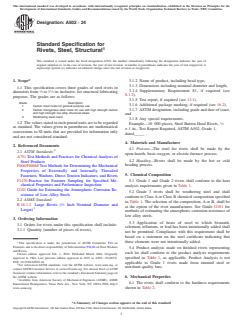
This international standard was developed in accordance with internationally recognized principles on standardization established in the Decision on Principles for the
Development of International Standards, Guides and Recommendations issued by the World Trade Organization Technical Barriers to Trade (TBT) Committee.
Designation: A502 − 24
Standard Specification for
Rivets, Steel, Structural
This standard is issued under the fixed designation A502; the number immediately following the designation indicates the year of
original adoption or, in the case of revision, the year of last revision. A number in parentheses indicates the year of last reapproval. A
superscript epsilon (´) indicates an editorial change since the last revision or reapproval.
1. Scope* 3.1.2 Name of product, including head type,
3.1.3 Dimensions including nominal diameter and length,
1.1 This specification covers three grades of steel rivets in
3.1.4 Supplementary Requirement S1, if required (see
1 1
diameters from ⁄2 to 1 ⁄2 in. inclusive, for structural fabricating
8.1.2),
purposes. The grades are as follows:
3.1.5 Test report, if required (see 13.1),
Grade Description
3.1.6 Additional package marking, if required (see 16.2),
1 Carbon steel rivets for general purpose use
2 Carbon manganese steel rivets for use with high strength carbon 3.1.7 ASTM designation, including grade and date of issue,
and high strength low alloy structural steels
and
3 Weathering steel rivets
3.1.8 Any special requirements.
1.2 The values stated in inch-pound units are to be regarded
Example—10 000 pieces, Steel Button Head Rivets, ⁄2
as standard. The values given in parentheses are mathematical
× 1 in., Test Report Required, ASTM A502, Grade 1,
conversions to SI units that are provided for information only
dated_____ .
and are not considered standard.
4. Materials and Manufacture
2. Referenced Documents
4.1 Process—The steel for rivets shall be made by the
2.1 ASTM Standards:
open-hearth, basic-oxygen, or electric-furnace process.
A751 Test Methods and Practices for Chemical Analysis of
4.2 Heading—Rivets shall be made by the hot or cold
Steel Products
heading process.
F606/F606M Test Methods for Determining the Mechanical
Properties of Externally and Internally Threaded
5. Chemical Composition
Fasteners, Washers, Direct Tension Indicators, and Rivets
F1470 Practice for Fastener Sampling for Specified Me-
5.1 Grade 1 and Grade 2 rivets shall conform to the heat
chanical Properties and Performance Inspection
analysis requirements given in Table 1.
G101 Guide for Estimating the Atmospheric Corrosion Re-
5.2 Grade 3 rivets shall be weathering steel and shall
sistance of Low-Alloy Steels
conform to Class A or Class B chemical composition specified
2.2 ASME Standard:
in Table 1. The selection of the composition, A or B, shall be
B 18.1.2 Large Rivets ( ⁄2 Inch Nominal Diameter and
at the option of the rivet manufacturer. See Guide G101 for
Larger)
methods of estimating the atmospheric corrosion resistance of
low alloy steels.
3. Ordering Information
5.3 Application of heats of steel to which bismuth,
3.1 Orders for rivets under this specification shall include:
selenium, tellurium, or lead has been intentionally added shall
3.1.1 Quantity (number of pieces of rivets),
not be permitted. Compliance with this requirement shall be
based on a statement on the steel certificate indicating that
these elements were not intentionally added.
This specification is under the jurisdiction of ASTM Committee F16 on
Fasteners and is the direct responsibility of Subcommittee F16.06 on Steel Washers
5.4 Product analysis made on finished rivets representing
and Rivets.
each lot shall conform to the product analysis requirements
Current edition approved Feb. 1, 2024. Published March 2024. Originally
approved in 1964. Last previous edition approved in 2015 as A502 – 03(2015). specified in Table 1, as applicable. Product Analysis is not
DOI: 10.1520/A0502-24.
applicable to Grade 1 rivets made from rimmed steel or
For referenced ASTM standards, visit the ASTM website, www.astm.org, or
merchant quality bars.
contact ASTM Customer Service at service@astm.org. For Annual Book of ASTM
Standards volume information, refer to the standard’s Document Summary page on
the ASTM website. 6. Mechanical Properties
Available from American Society of Mechanical Engineers (ASME), ASME
6.1 The rivets shall conform to the hardness requirements
International Headquarters, Three Park Ave., New York, NY 10016-5990, http://
www.asme.org. shown in Table 2.
*A Summary of Changes section appears at the end of this standard
Copyright © ASTM International, 100 Barr Harbor Drive, PO Box C700, West Conshohocken, PA 19428-2959. United States
A502 − 24
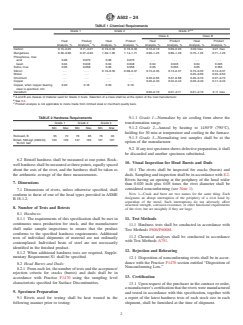
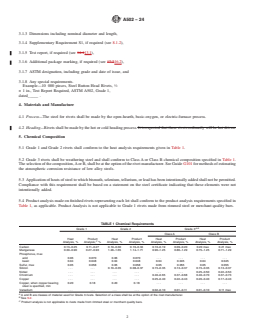
TABLE 1 Chemical Requirements
A,B
Grade 1 Grade 2 Grade 3
Class A Class B
Heat Product Heat Product Heat Product Heat Product
C
Analysis, % Analysis, % Analysis, % Analysis, % Analysis, % Analysis, % Analysis, % Analysis, %
Carbon 0.13–0.25 0.11–0.27 0.19–0.30 0.16–0.33 0.10–0.19 0.09–0.20 0.20 max 0.21 max
Manganese 0.30–0.90 0.27–0.93 1.20–1.65 1.14–1.71 0.90–1.25 0.86–1.29 0.75–1.25 0.71–1.29
Phosphorus, max
acid 0.06 0.070 0.06 0.070 . . . . . . . . . . . .
basic 0.04 0.048 0.04 0.048 0.04 0.045 0.04 0.045
Sulfur, max 0.05 0.058 0.05 0.058 0.05 0.055 0.05 0.055
Silicon . . . . . . 0.10–0.35 0.08–0.37 0.15–0.35 0.13–0.37 0.15–0.35 0.13–0.37
Nickel . . . . . . . . . . . . . . . . . . 0.25–0.50 0.22–0.53
Chromium . . . . . . . . . . . . 0.40–0.65 0.37–0.68 0.40–0.70 0.37–0.73
Copper . . . . . . . . . . . . 0.25–0.40 0.22–0.43 0.20–0.40 0.17–0.43
Copper, when copper bearing 0.20 0.18 0.20 0.18 . . . . . . . . . . . .
steel is specified, min
Vanadium . . . . . . . . . . . . 0.02–0.10 0.01–0.11 0.01–0.10 0.11 max
A
A and B are classes of material used for Grade 3 rivets. Selection of a class shall be at the option of the rivet manufacturer.
B
See 5.2.
C
Product analysis is not applicable to rivets made from rimmed steel or merchant quality bars.
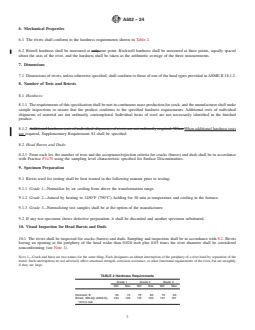
TABLE 2 Hardness Requirements
9.1.1 Grade 1—Normalize by air cooling from above the
Grade 1 Grade 2 Grade 3 transformation range.
Min Max Min Max Min Max
9.1.2 Grade 2—Anneal by heating to 1450°F (790°C),
holding for 30 min at temperature and cooling in the furnace.
Rockwell, B 55 72 76 85 76 93
9.1.3 Grade 3—Normalizing test samples shall be at the
Brinell, 500-kgf (4900-N), 103 126 137 163 137 197
option of the manufacturer.
10-mm ball
9.2 If any test specimen shows defective preparation, it shall
be discarded and another specimen substituted.
6.2 Brinell hardness shall be measured at one point. Rock-
10. Visual Inspection for Head Bursts and Duds
well hardness shall be measured at three points, equally spaced
about the axis of the rivet, and the hardness shall be taken as 10.1 The rivets shall be inspected for cracks (bursts) and
the arithmetic average of the three measurements. duds. Sampling and inspection shall be in accordance with 8.2.
Rivets having an opening at the periphery of the head wider
7. Dimensions
than 0.020 inch plus 0.05 times the rivet diameter shall be
considered nonconforming (see Note 1).
7.1 Dimensions of rivets, unless otherwise specified, shall
NOTE 1—Crack and burst ar
...
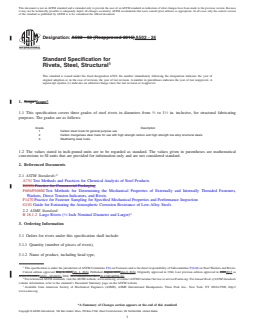
This document is not an ASTM standard and is intended only to provide the user of an ASTM standard an indication of what changes have been made to the previous version. Because
it may not be technically possible to adequately depict all changes accurately, ASTM recommends that users consult prior editions as appropriate. In all cases only the current version
of the standard as published by ASTM is to be considered the official document.
Designation: A502 − 03 (Reapproved 2015) A502 − 24
Standard Specification for
Rivets, Steel, Structural
This standard is issued under the fixed designation A502; the number immediately following the designation indicates the year of
original adoption or, in the case of revision, the year of last revision. A number in parentheses indicates the year of last reapproval. A
superscript epsilon (´) indicates an editorial change since the last revision or reapproval.
1. Scope Scope*
1 1
1.1 This specification covers three grades of steel rivets in diameters from ⁄2 to 1 ⁄2 in. inclusive, for structural fabricating
purposes. The grades are as follows:
Grade Description
1 Carbon steel rivets for general purpose use
2 Carbon manganese steel rivets for use with high strength carbon and high strength low alloy structural steels
3 Weathering steel rivets
1.2 The values stated in inch-pound units are to be regarded as standard. The values given in parentheses are mathematical
conversions to SI units that are provided for information only and are not considered standard.
2. Referenced Documents
2.1 ASTM Standards:
A751 Test Methods and Practices for Chemical Analysis of Steel Products
D3951 Practice for Commercial Packaging
F606/F606M Test Methods for Determining the Mechanical Properties of Externally and Internally Threaded Fasteners,
Washers, Direct Tension Indicators, and Rivets
F1470 Practice for Fastener Sampling for Specified Mechanical Properties and Performance Inspection
G101 Guide for Estimating the Atmospheric Corrosion Resistance of Low-Alloy Steels
2.2 ASME Standard:
B 18.1.2 Large Rivets ( ⁄2 Inch Nominal Diameter and Larger)
3. Ordering Information
3.1 Orders for rivets under this specification shall include:
3.1.1 Quantity (number of pieces of rivets),
3.1.2 Name of product, including head type,
This specification is under the jurisdiction of ASTM Committee F16 on Fasteners and is the direct responsibility of Subcommittee F16.06 on Steel Washers and Rivets.
Current edition approved May 1, 2015Feb. 1, 2024. Published August 2015March 2024. Originally approved in 1964. Last previous edition approved in 20092015 as
A502–03(2009).A502 – 03(2015). DOI: 10.1520/A0502-03R15.10.1520/A0502-24.
For referenced ASTM standards, visit the ASTM website, www.astm.org, or contact ASTM Customer Service at service@astm.org. For Annual Book of ASTM Standards
volume information, refer to the standard’s Document Summary page on the ASTM website.
Available from American Society of Mechanical Engineers (ASME), ASME International Headquarters, Three Park Ave., New York, NY 10016-5990, http://
www.asme.org.
*A Summary of Changes section appears at the end of this standard
Copyright © ASTM International, 100 Barr Harbor Drive, PO Box C700, West Conshohocken, PA 19428-2959. United States
A502 − 24
3.1.3 Dimensions including nominal diameter and length,
3.1.4 Supplementary Requirement S1, if required (see 8.1.2),
3.1.5 Test report, if required (see 14.113.1),
3.1.6 Additional package marking, if required (see 17.216.2),
3.1.7 ASTM designation, including grade and date of issue, and
3.1.8 Any special requirements.
Example—10 000 pieces, Steel Button Head Rivets, ⁄2
× 1 in., Test Report Required, ASTM A502, Grade 1,
dated_____ .
4. Materials and Manufacture
4.1 Process—The steel for rivets shall be made by the open-hearth, basic-oxygen, or electric-furnace process.
4.2 Heading—Rivets shall be made by the hot or cold heading process. It is expected that these rivets ordinarily will be hot driven.
5. Chemical Composition
5.1 Grade 1 and Grade 2 rivets shall conform to the heat analysis requirements given in Table 1.
5.2 Grade 3 rivets shall be weathering steel and shall conform to Class A or Class B chemical composition specified in Table 1.
The selection of the composition, A or B, shall be at the option of the rivet manufacturer. See Guide G101 for methods of estimating
the atmospheric corrosion resistance of low alloy steels.
5.3 Application of heats of steel to which bismuth, selenium, tellurium, or lead has been intentionally added shall not be permitted.
Compliance with this requirement shall be based on a statement on the steel certificate indicating that these elements were not
intentionally added.
5.4 Product analysis made on finished rivets representing each lot shall conform to the product analysis requirements specified in
Table 1, as applicable. Product Analysis is not applicable to Grade 1 rivets made from rimmed steel or merchant quality bars.
TABLE 1 Chemical Requirements
A,B
Grade 1 Grade 2 Grade 3
Class A Class B
Heat Product Heat Product Heat Product Heat Product
C
Analysis, % Analysis, % Analysis, % Analysis, % Analysis, % Analysis, % Analysis, % Analysis, %
Carbon 0.13–0.25 0.11–0.27 0.19–0.30 0.16–0.33 0.10–0.19 0.09–0.20 0.20 max 0.21 max
Manganese 0.30–0.90 0.27–0.93 1.20–1.65 1.14–1.71 0.90–1.25 0.86–1.29 0.75–1.25 0.71–1.29
Phosphorus, max
acid 0.06 0.070 0.06 0.070 . . . . . . . . . . . .
basic 0.04 0.048 0.04 0.048 0.04 0.045 0.04 0.045
Sulfur, max 0.05 0.058 0.05 0.058 0.05 0.055 0.05 0.055
Silicon . . . . . . 0.10–0.35 0.08–0.37 0.15–0.35 0.13–0.37 0.15–0.35 0.13–0.37
Nickel . . . . . . . . . . . . . . . . . . 0.25–0.50 0.22–0.53
Chromium . . . . . . . . . . . . 0.40–0.65 0.37–0.68 0.40–0.70 0.37–0.73
Copper . . . . . . . . . . . . 0.25–0.40 0.22–0.43 0.20–0.40 0.17–0.43
Copper, when copper bearing 0.20 0.18 0.20 0.18 . . . . . . . . . . . .
steel is specified, min
Vanadium . . . . . . . . . . . . 0.02–0.10 0.01–0.11 0.01–0.10 0.11 max
A
A and B are classes of material used for Grade 3 rivets. Selection of a class shall be at the option of the rivet manufacturer.
B
See 5.2.
C
Product analysis is not applicable to rivets made from rimmed steel or merchant quality bars.
A502 − 24
6. Mechanical Properties
6.1 The rivets shall conform to the hardness requirements shown in Table 2.
6.2 Brinell hardness shall be measured at only one point. Rockwell hardness shall be measured at three points, equally spaced
about the axis of the rivet, and the hardness shall be taken as the arithmetic average of the three measurements.
7. Dimensions
7.1 Dimensions of rivets, unless otherwise specified, shall conform to those of one of the head types provided in ASME B 18.1.2.
8. Number of Tests and Retests
8.1 Hardness:
8.1.1 The requirements of this specification shall be met in continuous mass production for stock, and the manufacturer shall make
sample inspections to ensure that the product conforms to the specified hardness requirements. Additional tests of individual
shipments of material are not ordinarily contemplated. Individual heats of steel are not necessarily identified in the finished
product.
8.1.2 Additional hardness tests of individual shipments of rivets are not ordinarily required. When When additional hardness tests
are required, Supplementary Requirement S1 shall be specified.
8.2 Head Bursts and Duds:
8.2.1 From each lot, the number of tests and the acceptance/rejection criteria for cracks (bursts) and duds shall be in accordance
with Practice F1470 using the sampling level characteristic specified for Surface Discontinuities.
9. Specimen Preparation
9.1 Rivets used for testing shall be heat treated in the following manner prior to testing:
9.1.1 Grade 1—Normalize by air cooling from above the transformation range.
9.1.2 Grade 2—Anneal by heating to 1450°F (790°C), holding for 30 min at temperature and cooling in the furnace.
9.1.3 Grade 3—Normalizing test samples shall be at the option of the manufacture
...