

ASTM D5974-20
(Test Method)Standard Test Methods for Fatty and Rosin Acids in Tall Oil Fractionation Products by Capillary Gas Chromatography
General Information
- Abstract
SIGNIFICANCE AND USE
3.1 Tall oil fractionated products derived from tall oil are important commercial materials, primarily composed of fatty acids and rosin acids, but also containing some neutral material (see Terminology D804). For many applications, it is necessary to know the level of the individual fatty acids and rosin acids present in these products. Gas chromatography has proven to be a useful tool for such determinations (see Test Methods D509), and capillary chromatography, described in these test methods, is considered to be the most effective gas chromatographic technique currently available. In particular situations, other techniques may be more suitable than gas chromatography. For example, the presence of fatty acid esters in the sample would result in transesterification during the derivatization step that may affect the results.
3.2 Due to hydrogen bonding, unmodified tall oil fatty acids and rosin acids cannot be volatilized at atmospheric pressure without undergoing decomposition. So, it is necessary to convert the free acids to the more volatile and more stable methyl esters, prior to chromatographic separation.
3.3 These test methods describe four ways to prepare methyl esters. The classic method is through the use of diazomethane, but diazomethane is a hazardous and toxic material, and so is no longer the preferred agent. The use of diazomethane is detailed in Appendix X1.
3.3.1 TMAH causes isomerization of a sample’s di- and polyunsaturated fatty acids, when it is used in even a slight excess. This leads to inaccurate results for the individual fatty acid components. TMAH should be used for materials containing only rosin acids, or when the identification or quantitation of individual fatty acid components is not important.
3.3.2 TMPAH is the recommended methylating agent when the identification or quantitation of individual di- and polyunsaturated fatty acids is required. TMPAH produces results that are very similar to those of diazomethane, but with...
SCOPE
1.1 These test methods cover the determination of the amounts of the individual fatty acids and rosin acids in fractionated tall oil products, using capillary gas chromatographic separation of the volatile methyl esters of these acids.
1.2 Four methods for forming the methyl esters, and two methods for determining the amounts of the individual fatty acids and rosin acids are described.
1.2.1 The classic method for the formation of methyl esters is through the use of diazomethane, but diazomethane is a hazardous and toxic material, and so is no longer the preferred reagent. The use of diazomethane is detailed in the Appendix. Methyl esters may be formed through the use of tetramethylammonium hydroxide (TMAH), trimethylphenylammonium hydroxide (TMPAH), or N,N-dimethylformamide dimethyl acetal (DMF-DMA).
1.2.2 The two methods for determining the amount of the individual fatty acids and rosin acids are the “internal standard” method, which yields absolute values, and the “area percent” method, which yields relative values.
1.3 This standard does not purport to address all of the safety concerns, if any, associated with its use. It is the responsibility of the user of this standard to establish appropriate safety, health, and environmental practices and determine the applicability of regulatory limitations prior to use.
1.4 This international standard was developed in accordance with internationally recognized principles on standardization established in the Decision on Principles for the Development of International Standards, Guides and Recommendations issued by the World Trade Organization Technical Barriers to Trade (TBT) Committee.
- Status
- Published
- Publication Date
- 31-Aug-2020
- Technical Committee
- D01 - Paint and Related Coatings, Materials, and Applications
- Drafting Committee
- D01.34 - Pine Chemicals and Hydrocarbon Resins
Buy Documents
ASTM D5974-20 - Standard Test Methods for Fatty and Rosin Acids in Tall Oil Fractionation Products by Capillary Gas Chromatography
REDLINE ASTM D5974-20 - Standard Test Methods for Fatty and Rosin Acids in Tall Oil Fractionation Products by Capillary Gas Chromatography
Overview
ASTM D5974-20 specifies standardized test methods for determining the amounts of individual fatty acids and rosin acids in tall oil fractionation products using capillary gas chromatography (GC). Tall oil derivatives are valuable materials widely used in industrial applications, and accurate composition analysis is critical for quality assurance and process control. The standard outlines procedures for converting the free acids into volatile and stable methyl esters, allowing precise separation and quantitation through advanced capillary GC techniques.
ASTM D5974-20 provides options for esterification and two calculation approaches-ensuring adaptability based on the analytical needs and sample types. Developed by ASTM International, this standard supports global trade, regulatory compliance, and technical consistency for producers and users of tall oil products.
Key Topics
- Scope and Applicability
- Applies to fractionated tall oil products containing fatty acids, rosin acids, and minor neutral components.
- Designed for samples where quantitative or qualitative analysis of individual fatty and rosin acids is needed.
- Sample Preparation and Derivatization
- Conversion to methyl esters is necessary due to the non-volatile nature of unmodified acids.
- Four methylation methods: diazomethane (classic, hazardous), tetramethylammonium hydroxide (TMAH), trimethylphenylammonium hydroxide (TMPAH, preferred for di- and polyunsaturated fatty acids), and N,N-dimethylformamide dimethyl acetal (DMF-DMA).
- Capillary Gas Chromatography
- Utilizes high-resolution columns and a flame ionization detector (FID).
- Separates methyl esters of fatty and rosin acids for quantitative analysis.
- Quantitative Methods
- Internal Standard Method: Provides absolute weight percentages using a reference standard.
- Area Percent Method: Offers relative amounts of each component based on chromatographic peak areas.
- Safety Considerations
- Users must follow appropriate laboratory safety, health, and environmental practices, especially when working with hazardous reagents such as diazomethane.
- Global Standardization
- Developed to align with internationally recognized principles from the World Trade Organization’s Technical Barriers to Trade (TBT) Committee.
Applications
ASTM D5974-20 is essential for laboratories and industries involved in the processing, quality control, and certification of tall oil and its derivatives. Practical applications include:
- Quality Control: Verifying the content and proportions of fatty and rosin acids in tall oil products before use in downstream manufacturing.
- Product Grading: Supporting the classification and specification of tall oil fractions based on their acid composition.
- Process Optimization: Monitoring changes in fatty acid and rosin acid profiles to adjust fractionation processes and maximize yield.
- Regulatory Compliance: Demonstrating conformity to product standards for international trade and market requirements.
- Research and Development: Enabling detailed compositional analysis critical for the development of new formulations or uses of tall oil derivatives.
Related Standards
- ASTM D509: Test methods for sampling and grading rosin - useful for complementary analysis in pine chemical products.
- ASTM D804: Terminology relating to pine chemicals, including tall oil - provides definitions and foundational understanding.
- ASTM E691: Practice for conducting interlaboratory studies to determine the precision of a test method.
Keywords
fatty acids, rosin acids, tall oil, capillary gas chromatography, methyl esters, derivatization, internal standard method, area percent method, ASTM D5974-20, quality control, pine chemicals, international standardization
Relations
- Effective Date
- 01-May-2013
- Effective Date
- 01-Jun-2012
- Effective Date
- 01-Nov-2011
- Effective Date
- 01-Oct-2008
- Effective Date
- 01-Jun-2007
- Effective Date
- 01-Nov-2005
- Effective Date
- 15-May-2005
- Effective Date
- 15-May-2005
- Effective Date
- 10-May-2003
- Effective Date
- 10-Dec-2002
- Effective Date
- 10-May-1999
- Effective Date
- 10-Dec-1997
- Effective Date
- 01-Jan-1993
Buy Documents
ASTM D5974-20 - Standard Test Methods for Fatty and Rosin Acids in Tall Oil Fractionation Products by Capillary Gas Chromatography
REDLINE ASTM D5974-20 - Standard Test Methods for Fatty and Rosin Acids in Tall Oil Fractionation Products by Capillary Gas Chromatography
Get Certified
Connect with accredited certification bodies for this standard

BSI Group
BSI (British Standards Institution) is the business standards company that helps organizations make excellence a habit.

Bureau Veritas
Bureau Veritas is a world leader in laboratory testing, inspection and certification services.

DNV
DNV is an independent assurance and risk management provider.
Sponsored listings
Frequently Asked Questions
ASTM D5974-20 is a standard published by ASTM International. Its full title is "Standard Test Methods for Fatty and Rosin Acids in Tall Oil Fractionation Products by Capillary Gas Chromatography". This standard covers: SIGNIFICANCE AND USE 3.1 Tall oil fractionated products derived from tall oil are important commercial materials, primarily composed of fatty acids and rosin acids, but also containing some neutral material (see Terminology D804). For many applications, it is necessary to know the level of the individual fatty acids and rosin acids present in these products. Gas chromatography has proven to be a useful tool for such determinations (see Test Methods D509), and capillary chromatography, described in these test methods, is considered to be the most effective gas chromatographic technique currently available. In particular situations, other techniques may be more suitable than gas chromatography. For example, the presence of fatty acid esters in the sample would result in transesterification during the derivatization step that may affect the results. 3.2 Due to hydrogen bonding, unmodified tall oil fatty acids and rosin acids cannot be volatilized at atmospheric pressure without undergoing decomposition. So, it is necessary to convert the free acids to the more volatile and more stable methyl esters, prior to chromatographic separation. 3.3 These test methods describe four ways to prepare methyl esters. The classic method is through the use of diazomethane, but diazomethane is a hazardous and toxic material, and so is no longer the preferred agent. The use of diazomethane is detailed in Appendix X1. 3.3.1 TMAH causes isomerization of a sample’s di- and polyunsaturated fatty acids, when it is used in even a slight excess. This leads to inaccurate results for the individual fatty acid components. TMAH should be used for materials containing only rosin acids, or when the identification or quantitation of individual fatty acid components is not important. 3.3.2 TMPAH is the recommended methylating agent when the identification or quantitation of individual di- and polyunsaturated fatty acids is required. TMPAH produces results that are very similar to those of diazomethane, but with... SCOPE 1.1 These test methods cover the determination of the amounts of the individual fatty acids and rosin acids in fractionated tall oil products, using capillary gas chromatographic separation of the volatile methyl esters of these acids. 1.2 Four methods for forming the methyl esters, and two methods for determining the amounts of the individual fatty acids and rosin acids are described. 1.2.1 The classic method for the formation of methyl esters is through the use of diazomethane, but diazomethane is a hazardous and toxic material, and so is no longer the preferred reagent. The use of diazomethane is detailed in the Appendix. Methyl esters may be formed through the use of tetramethylammonium hydroxide (TMAH), trimethylphenylammonium hydroxide (TMPAH), or N,N-dimethylformamide dimethyl acetal (DMF-DMA). 1.2.2 The two methods for determining the amount of the individual fatty acids and rosin acids are the “internal standard” method, which yields absolute values, and the “area percent” method, which yields relative values. 1.3 This standard does not purport to address all of the safety concerns, if any, associated with its use. It is the responsibility of the user of this standard to establish appropriate safety, health, and environmental practices and determine the applicability of regulatory limitations prior to use. 1.4 This international standard was developed in accordance with internationally recognized principles on standardization established in the Decision on Principles for the Development of International Standards, Guides and Recommendations issued by the World Trade Organization Technical Barriers to Trade (TBT) Committee.
SIGNIFICANCE AND USE 3.1 Tall oil fractionated products derived from tall oil are important commercial materials, primarily composed of fatty acids and rosin acids, but also containing some neutral material (see Terminology D804). For many applications, it is necessary to know the level of the individual fatty acids and rosin acids present in these products. Gas chromatography has proven to be a useful tool for such determinations (see Test Methods D509), and capillary chromatography, described in these test methods, is considered to be the most effective gas chromatographic technique currently available. In particular situations, other techniques may be more suitable than gas chromatography. For example, the presence of fatty acid esters in the sample would result in transesterification during the derivatization step that may affect the results. 3.2 Due to hydrogen bonding, unmodified tall oil fatty acids and rosin acids cannot be volatilized at atmospheric pressure without undergoing decomposition. So, it is necessary to convert the free acids to the more volatile and more stable methyl esters, prior to chromatographic separation. 3.3 These test methods describe four ways to prepare methyl esters. The classic method is through the use of diazomethane, but diazomethane is a hazardous and toxic material, and so is no longer the preferred agent. The use of diazomethane is detailed in Appendix X1. 3.3.1 TMAH causes isomerization of a sample’s di- and polyunsaturated fatty acids, when it is used in even a slight excess. This leads to inaccurate results for the individual fatty acid components. TMAH should be used for materials containing only rosin acids, or when the identification or quantitation of individual fatty acid components is not important. 3.3.2 TMPAH is the recommended methylating agent when the identification or quantitation of individual di- and polyunsaturated fatty acids is required. TMPAH produces results that are very similar to those of diazomethane, but with... SCOPE 1.1 These test methods cover the determination of the amounts of the individual fatty acids and rosin acids in fractionated tall oil products, using capillary gas chromatographic separation of the volatile methyl esters of these acids. 1.2 Four methods for forming the methyl esters, and two methods for determining the amounts of the individual fatty acids and rosin acids are described. 1.2.1 The classic method for the formation of methyl esters is through the use of diazomethane, but diazomethane is a hazardous and toxic material, and so is no longer the preferred reagent. The use of diazomethane is detailed in the Appendix. Methyl esters may be formed through the use of tetramethylammonium hydroxide (TMAH), trimethylphenylammonium hydroxide (TMPAH), or N,N-dimethylformamide dimethyl acetal (DMF-DMA). 1.2.2 The two methods for determining the amount of the individual fatty acids and rosin acids are the “internal standard” method, which yields absolute values, and the “area percent” method, which yields relative values. 1.3 This standard does not purport to address all of the safety concerns, if any, associated with its use. It is the responsibility of the user of this standard to establish appropriate safety, health, and environmental practices and determine the applicability of regulatory limitations prior to use. 1.4 This international standard was developed in accordance with internationally recognized principles on standardization established in the Decision on Principles for the Development of International Standards, Guides and Recommendations issued by the World Trade Organization Technical Barriers to Trade (TBT) Committee.
ASTM D5974-20 is classified under the following ICS (International Classification for Standards) categories: 67.080.10 - Fruits and derived products; 67.200.10 - Animal and vegetable fats and oils. The ICS classification helps identify the subject area and facilitates finding related standards.
ASTM D5974-20 has the following relationships with other standards: It is inter standard links to ASTM E691-13, ASTM D804-12, ASTM E691-11, ASTM E691-08, ASTM D804-07, ASTM E691-05, ASTM D509-05, ASTM D509-05(2011)e1, ASTM D509-03, ASTM D804-02, ASTM E691-99, ASTM D804-97, ASTM D509-98. Understanding these relationships helps ensure you are using the most current and applicable version of the standard.
ASTM D5974-20 is available in PDF format for immediate download after purchase. The document can be added to your cart and obtained through the secure checkout process. Digital delivery ensures instant access to the complete standard document.
Standards Content (Sample)
This international standard was developed in accordance with internationally recognized principles on standardization established in the Decision on Principles for the
Development of International Standards, Guides and Recommendations issued by the World Trade Organization Technical Barriers to Trade (TBT) Committee.
Designation: D5974 − 20
Standard Test Methods for
Fatty and Rosin Acids in Tall Oil Fractionation Products by
Capillary Gas Chromatography
This standard is issued under the fixed designation D5974; the number immediately following the designation indicates the year of
original adoption or, in the case of revision, the year of last revision.Anumber in parentheses indicates the year of last reapproval.A
superscript epsilon (´) indicates an editorial change since the last revision or reapproval.
1. Scope 2. Referenced Documents
2.1 ASTM Standards:
1.1 These test methods cover the determination of the
D509Test Methods of Sampling and Grading Rosin
amounts of the individual fatty acids and rosin acids in
D804Terminology Relating to Pine Chemicals, Including
fractionated tall oil products, using capillary gas chromato-
graphic separation of the volatile methyl esters of these acids. Tall Oil and Related Products
E691Practice for Conducting an Interlaboratory Study to
1.2 Four methods for forming the methyl esters, and two
Determine the Precision of a Test Method
methods for determining the amounts of the individual fatty
acids and rosin acids are described.
3. Significance and Use
1.2.1 The classic method for the formation of methyl esters
3.1 Tall oil fractionated products derived from tall oil are
is through the use of diazomethane, but diazomethane is a
important commercial materials, primarily composed of fatty
hazardous and toxic material, and so is no longer the preferred
acidsandrosinacids,butalsocontainingsomeneutralmaterial
reagent. The use of diazomethane is detailed in theAppendix.
(seeTerminologyD804).Formanyapplications,itisnecessary
Methyl esters may be formed through the use of tetramethyl-
to know the level of the individual fatty acids and rosin acids
ammonium hydroxide (TMAH), trimethylphenylammonium
present in these products. Gas chromatography has proven to
hydroxide (TMPAH), or N,N-dimethylformamide dimethyl
be a useful tool for such determinations (see Test Methods
acetal (DMF-DMA).
D509), and capillary chromatography, described in these test
1.2.2 The two methods for determining the amount of the
methods, is considered to be the most effective gas chromato-
individualfattyacidsandrosinacidsarethe“internalstandard”
graphic technique currently available. In particular situations,
method, which yields absolute values, and the “area percent”
other techniques may be more suitable than gas chromatogra-
method, which yields relative values.
phy. For example, the presence of fatty acid esters in the
1.3 This standard does not purport to address all of the sample would result in transesterification during the derivati-
safety concerns, if any, associated with its use. It is the zation step that may affect the results.
responsibility of the user of this standard to establish appro-
3.2 Duetohydrogenbonding,unmodifiedtalloilfattyacids
priate safety, health, and environmental practices and deter-
and rosin acids cannot be volatilized at atmospheric pressure
mine the applicability of regulatory limitations prior to use.
without undergoing decomposition. So, it is necessary to
1.4 This international standard was developed in accor-
convert the free acids to the more volatile and more stable
dance with internationally recognized principles on standard-
methyl esters, prior to chromatographic separation.
ization established in the Decision on Principles for the
3.3 These test methods describe four ways to prepare
Development of International Standards, Guides and Recom-
methyl esters. The classic method is through the use of
mendations issued by the World Trade Organization Technical
diazomethane, but diazomethane is a hazardous and toxic
Barriers to Trade (TBT) Committee.
material, and so is no longer the preferred agent. The use of
diazomethane is detailed in Appendix X1.
3.3.1 TMAH causes isomerization of a sample’s di- and
These test methods are under the jurisdiction of ASTM Committee D01 on
polyunsaturated fatty acids, when it is used in even a slight
Paint and Related Coatings, Materials, and Applications and are the direct
responsibility of Subcommittee D01.34 on Pine Chemicals and Hydrocarbon
Resins. For referenced ASTM standards, visit the ASTM website, www.astm.org, or
Current edition approved Sept. 1, 2020. Published September 2020. Originally contact ASTM Customer Service at service@astm.org. For Annual Book of ASTM
approved in 1996. Last previous edition approved in 2015 as D5974–15. DOI: Standards volume information, refer to the standard’s Document Summary page on
10.1520/D5974-20. the ASTM website.
Copyright © ASTM International, 100 Barr Harbor Drive, PO Box C700, West Conshohocken, PA 19428-2959. United States
D5974 − 20
excess. This leads to inaccurate results for the individual fatty 4.2.4 Phenolphthalein Solution, 1% (w/v) in methanol.
acidcomponents.TMAHshouldbeusedformaterialscontain- 4.2.5 Diethyl Ether, anhydrous.
ing only rosin acids, or when the identification or quantitation
4.2.6 Methanol, anhydrous.
of individual fatty acid components is not important.
4.2.7 Acetic Acid, 5% volume/volume (v/v) in methanol.
3.3.2 TMPAH is the recommended methylating agent when
4.2.8 Toluene, optional.
the identification or quantitation of individual di- and polyun-
4.3 Procedure:
saturated fatty acids is required. TMPAH produces results that
4.3.1 Dissolve the sample from 9.2.2 or 17.1 in 0.5 to 3.0
are very similar to those of diazomethane, but without the
mL of a 50:50 ether/methanol mixture, add 2 to 3 drops of
hazards that are associated with diazomethane.Aconsiderable
phenolphthalein indicator solution, and titrate to a pH of 7.8 to
excess of TMPAH may cause isomerization of conjugated
8.1 or to the very first permanent pink color, with the 6%
compounds similar to that encountered with TMAH.
solutionofTMAH.Ifthesolutionisovertitrated,itcanbeback
3.3.3 DMF-DMA gives results comparable to TMPAH and
titrated with the acetic acid in methanol solution to the end
is easy and safe to use. However, the reagent is moisture
point. When the solution is injected into the heated injection
sensitive, requiring samples to be free of any significant levels
port of the chromatograph, the tetramethylammonium salts are
of water.
pyrolyzed to methyl esters.
3.4 Two test methods for calculating the amounts of the
NOTE 2—For solid rosin, or other samples that are difficult to dissolve,
individual fatty acid and rosin acid methyl esters are included
2 to 3 drops of toluene may be added to the vial prior to the addition of
in these test methods. When the actual weight percentage of a
TMAH, to assist in dissolving the sample.
given compound is required, the “internal standard” method
mustbeused.Thismethodinvolvesaddingaknownamountof
5. Conversion By Means of Trimethylphenylammonium
an internal standard to a known amount of test material, and
Hydroxide (TMPAH)
comparing the area of the peak associated with the internal
5.1 Apparatus:
standard with the area of the peak of the individual fatty acid
5.1.1 Standard Laboratory Equipment.
or rosin acid methyl esters. The “area percent” method will
give the relative amount of each component, by comparing the
5.2 Reagents and Materials:
area of the appropriate peak to the total area of all peaks.
5.2.1 Purity of Reagents, see 4.2.1.
Non-eluting compounds will lead to erroneous (absolute)
5.2.2 Trimethylphenylammonium Hydroxide Solution,0.2M
results with this method.
or 0.1 M in methanol, CAS No. 1899-02-1.
5.2.3 Diethyl Ether, anhydrous.
PREPARATION OF METHYL ESTERS
5.2.4 Methanol, anhydrous.
NOTE1—Anyofthesethreemethodscanbeused,withthechoicebeing
5.2.5 Toluene, optional.
dependent on the factors mentioned in 3.3.
5.3 Procedure:
4. Conversion By Means of Tetramethylammonium 5.3.1 Add 0.5 to 3.0 mL of a 50:50 ether/methanol, to the
Hydroxide (TMAH) samplefrom9.2.2or17.1.Add2to3dropsofphenolphthalein
indicator solution and titrate to the very first permanent pink
4.1 Apparatus:
color with the TMPAH in methanol solution. When the
4.1.1 Standard Laboratory Equipment.
solution is injected into the heated injection port of the
4.2 Reagents and Materials:
chromatograph, the trimethylphenylammonium salts are pyro-
4.2.1 Purity of Reagents—Reagent grade chemicals shall be
lyzed to their respective methyl esters.
used in all tests. Unless otherwise indicated, it is intended that
NOTE 3—For solid rosin, or other samples that are difficult to dissolve,
all reagents shall conform to the specifications of the Commit-
3 2 to 3 drops of toluene may be added to the vial prior to the addition of
teeonAnalyticalReagentsoftheAmericanChemicalSociety ,
TMPAH, to assist in dissolving the sample.
where such specifications are available. Other grades may be
used, provided it is first ascertained that the reagent is of
6. Conversion by Means of N,N-Dimethylformamide
sufficiently high purity to permit its use without lessening the
Dimethyl Acetal (DMF-DMA)
accuracy of the determination.
6.1 Apparatus:
4.2.2 Tetramethylammonium Hydroxide Solution, 24% in
6.1.1 Standard Laboratory Equipment.
methanol, CAS No. 75-59-2.
4.2.3 Tetramethylammonium Hydroxide Solution, 6% (v/v)
6.2 Reagents and Materials:
in methanol. Dilute 25 mL of the reagent described in 4.2.2
6.2.1 Purity of Reagents, see 4.2.1.
with 75 mL of methanol.
6.2.2 N,N-Dimethylformamide dimethyl acetal (DMF-
DMA), CAS No. 4637-24-5.
6.2.3 Methanol, anhydrous.
ACS Reagent Chemicals, Specifications and Procedures for Reagents and
6.2.4 Toluene.
Standard-Grade Reference Materials, American Chemical Society, Washington,
DC. For suggestions on the testing of reagents not listed by theAmerican Chemical
6.3 Procedure:
Society, see Analar Standards for Laboratory Chemicals, BDH Ltd., Poole, Dorset,
6.3.1 Place the sample from 9.2.2 or 17.1 in an appropriate
U.K., and the United States Pharmacopeia and National Formulary, U.S. Pharma-
copeial Convention, Inc. (USPC), Rockville, MD. anhydrous vial, and dissolve with approximately 0.5 mL of
D5974 − 20
either methanol or toluene. Add approximately 1 mL of 9. Procedure
DMF-DMA,mixwell,andmaintainthesampleat30–40°Cfor
9.1 Preparation of Calibration Standard:
15 minutes.
9.1.1 Accurately weigh into a suitable vial, milligram quan-
tities of the myristic acid internal standard, plus the fatty acid
INTERNAL STANDARD METHOD
and rosin acid standards that are anticipated to be in the test
sample, and record the weights.
7. Apparatus
9.1.2 Convert the calibration standard to the methyl esters
7.1 Gas Chromatograph—An instrument equipped with a
or substituted ammonium salts as described in Sections4, 5, 6.
flame ionization detector (FID) that can be operated at condi-
9.2 Preparation of Test Sample:
tions given in 10.1.
9.2.1 Accurately weigh ;50 mg of sample and ;15 mg of
7.2 Column—A high resolution column between 15
myristicaciddirectlyintoasuitablevialandrecordtheweight.
and60m in length, up to 0.53 mm internal diameter, with a
NOTE 6—Rosin samples need to be freshly broken from a larger mass
0.20-µm film thickness of biscyanopropylsiloxane type liquid
to ensure the results are not affected by air oxidation of the rosin.
phase. The recommended referee column is 30 m in length,
0.32 mm internal diameter, with a 0.20-µm film thickness, and 9.2.2 Convert the test sample to methyl esters or substituted
provides separations equivalent or better than that display
...
This document is not an ASTM standard and is intended only to provide the user of an ASTM standard an indication of what changes have been made to the previous version. Because
it may not be technically possible to adequately depict all changes accurately, ASTM recommends that users consult prior editions as appropriate. In all cases only the current version
of the standard as published by ASTM is to be considered the official document.
Designation: D5974 − 15 D5974 − 20
Standard Test Methods for
Fatty and Rosin Acids in Tall Oil Fractionation Products by
Capillary Gas Chromatography
This standard is issued under the fixed designation D5974; the number immediately following the designation indicates the year of
original adoption or, in the case of revision, the year of last revision. A number in parentheses indicates the year of last reapproval. A
superscript epsilon (´) indicates an editorial change since the last revision or reapproval.
1. Scope
1.1 These test methods cover the determination of the amounts of the individual fatty acids and rosin acids in fractionated tall oil
products, using capillary gas chromatographic separation of the volatile methyl esters of these acids.
1.2 Four methods for forming the methyl esters, and two methods for determining the amounts of the individual fatty acids and
rosin acids are described.
1.2.1 The classic method for the formation of methyl esters is through the use of diazomethane, but diazomethane is a hazardous
and toxic material, and so is no longer the preferred reagent. The use of diazomethane is detailed in the Appendix. Methyl esters
may be formed through the use of tetramethylammonium hydroxide (TMAH), trimethylphenylammonium hydroxide (TMPAH),
or N,N-dimethylformamide dimethyl acetal (DMF-DMA).
1.2.2 The two methods for determining the amount of the individual fatty acids and rosin acids are the “internal standard” method,
which yields absolute values, and the “area percent” method, which yields relative values.
1.3 This standard does not purport to address all of the safety concerns, if any, associated with its use. It is the responsibility
of the user of this standard to establish appropriate safety safety, health, and healthenvironmental practices and determine the
applicability of regulatory limitations prior to use.
1.4 This international standard was developed in accordance with internationally recognized principles on standardization
established in the Decision on Principles for the Development of International Standards, Guides and Recommendations issued
by the World Trade Organization Technical Barriers to Trade (TBT) Committee.
2. Referenced Documents
2.1 ASTM Standards:
D509 Test Methods of Sampling and Grading Rosin
D804 Terminology Relating to Pine Chemicals, Including Tall Oil and Related Products
E691 Practice for Conducting an Interlaboratory Study to Determine the Precision of a Test Method
3. Significance and Use
3.1 Tall oil fractionated products derived from tall oil are important commercial materials, primarily composed of fatty acids and
These test methods are under the jurisdiction of ASTM Committee D01 on Paint and Related Coatings, Materials, and Applications and are the direct responsibility of
Subcommittee D01.34 on Pine Chemicals and Hydrocarbon Resins.
Current edition approved July 1, 2015Sept. 1, 2020. Published August 2015September 2020. Originally approved in 1996. Last previous edition approved in 20102015
as D5974 – 00 (2010).D5974 – 15. DOI: 10.1520/D5974-15.10.1520/D5974-20.
For referenced ASTM standards, visit the ASTM website, www.astm.org, or contact ASTM Customer Service at service@astm.org. For Annual Book of ASTM Standards
volume information, refer to the standard’s Document Summary page on the ASTM website.
Copyright © ASTM International, 100 Barr Harbor Drive, PO Box C700, West Conshohocken, PA 19428-2959. United States
D5974 − 20
rosin acids, but also containing some neutral material (see Terminology D804). For many applications, it is necessary to know the
level of the individual fatty acids and rosin acids present in these products. Gas chromatography has proven to be a useful tool
for such determinations (see Test Methods D509), and capillary chromatography, described in these test methods, is considered to
be the most effective gas chromatographic technique currently available. In particular situations, other techniques may be more
suitable than gas chromatography. For example, the presence of fatty acid esters in the sample would result in transesterification
during the derivatization step that may affect the results.
3.2 Due to hydrogen bonding, unmodified tall oil fatty acids and rosin acids cannot be volatilized at atmospheric pressure without
undergoing decomposition. So, it is necessary to convert the free acids to the more volatile and more stable methyl esters, prior
to chromatographic separation.
3.3 These test methods describe four ways to prepare methyl esters. The classic method is through the use of diazomethane, but
diazomethane is a hazardous and toxic material, and so is no longer the preferred agent. The use of diazomethane is detailed in
Appendix X1.
3.3.1 TMAH causes isomerization of a sample’s di- and polyunsaturated fatty acids, when it is used in even a slight excess. This
leads to inaccurate results for the individual fatty acid components. TMAH should be used for materials containing only rosin
acids, or when the identification or quantitation of individual fatty acid components is not important.
3.3.2 TMPAH is the recommended methylating agent when the identification or quantitation of individual di- and polyunsaturated
fatty acids is required. TMPAH produces results that are very similar to those of diazomethane, but without the hazards that are
associated with diazomethane. A considerable excess of TMPAH may cause isomerization of conjugated compounds similar to that
encountered with TMAH.
3.3.3 DMF-DMA gives results comparable to TMPAH and is easy and safe to use. However, the reagent is moisture sensitive,
requiring samples to be free of any significant levels of water.
3.4 Two test methods for calculating the amounts of the individual fatty acid and rosin acid methyl esters are included in these
test methods. When the actual weight percentage of a given compound is required, the “internal standard” method must be used.
This method involves adding a known amount of an internal standard to a known amount of test material, and comparing the area
of the peak associated with the internal standard with the area of the peak of the individual fatty acid or rosin acid methyl esters.
The “area percent” method will give the relative amount of each component, by comparing the area of the appropriate peak to the
total area of all peaks. Non-eluting compounds will lead to erroneous (absolute) results with this method.
PREPARATION OF METHYL ESTERS
NOTE 1—Any of these three methods can be used, with the choice being dependent on the factors mentioned in 3.3.
4. Conversion By Means of Tetramethylammonium Hydroxide (TMAH)
4.1 Apparatus:
4.1.1 Standard Laboratory Equipment.
4.2 Reagents and Materials:
4.2.1 Purity of Reagents—Reagent grade chemicals shall be used in all tests. Unless otherwise indicated, it is intended that all
reagents shall conform to the specifications of the Committee on Analytical Reagents of the American Chemical Society , where
such specifications are available. Other grades may be used, provided it is first ascertained that the reagent is of sufficiently high
purity to permit its use without lessening the accuracy of the determination.
4.2.2 Tetramethylammonium Hydroxide Solution, 24 % in methanol, CAS No. 75-59-2.
Reagent Chemicals, American Chemical Society Specifications,ACS Reagent Chemicals, Specifications and Procedures for Reagents and Standard-Grade Reference
Materials, American Chemical Society, Washington, DC. For suggestions on the testing of reagents not listed by the American Chemical Society, see Analar Standards for
Laboratory Chemicals, BDH Ltd., Poole, Dorset, U.K., and the United States Pharmacopeia and National Formulary, U.S. Pharmacopeial Convention, Inc. (USPC),
Rockville, MD.
D5974 − 20
4.2.3 Tetramethylammonium Hydroxide Solution, 6 % (v/v) in methanol. Dilute 25 mL of the reagent described in 4.2.2 with 75
mL of methanol.
4.2.4 Phenolphthalein Solution, 1 % (w/v) in methanol.
4.2.5 Diethyl Ether, anhydrous.
4.2.6 Methanol, anhydrous.
4.2.7 Acetic Acid, 5 % volume/volume (v/v) in methanol.
4.2.8 Toluene, optional.
4.3 Procedure:
4.3.1 Dissolve the sample from 9.2.2 or 17.1 in 0.5 to 3.0 mL of a 50:50 ether/methanol mixture, add 2 to 3 drops of
phenolphthalein indicator solution, and titrate to a pH of 7.8 to 8.1 or to the very first permanent pink color, with the 6 % solution
of TMAH. If the solution is overtitrated, it can be back titrated with the acetic acid in methanol solution to the end point. When
the solution is injected into the heated injection port of the chromatograph, the tetramethylammonium salts are pyrolyzed to methyl
esters.
NOTE 2—For solid rosin, or other samples that are difficult to dissolve, 2 to 3 drops of toluene may be added to the vial prior to the addition of TMAH,
to assist in dissolving the sample.
5. Conversion By Means of Trimethylphenylammonium Hydroxide (TMPAH)
5.1 Apparatus:
5.1.1 Standard Laboratory Equipment.
5.2 Reagents and Materials:
5.2.1 Purity of Reagents, see 4.2.1.
5.2.2 Trimethylphenylammonium Hydroxide Solution, 0.2 M or 0.1 M in methanol, CAS No. 1899-02-1.
5.2.3 Diethyl Ether, anhydrous.
5.2.4 Methanol, anhydrous.
5.2.5 Toluene, optional.
5.3 Procedure:
5.3.1 Add 0.5 to 3.0 mL of a 50:50 ether/methanol, to the sample from 9.2.2 or 17.1. Add 2 to 3 drops of phenolphthalein indicator
solution and titrate to the very first permanent pink color with the TMPAH in methanol solution. When the solution is injected into
the heated injection port of the chromatograph, the trimethylphenylammonium salts are pyrolyzed to their respective methyl esters.
NOTE 3—For solid rosin, or other samples that are difficult to dissolve, 2 to 3 drops of toluene may be added to the vial prior to the addition of TMPAH,
to assist in dissolving the sample.
6. Conversion by Means of N,N-Dimethylformamide Dimethyl Acetal (DMF-DMA)
6.1 Apparatus:
6.1.1 Standard Laboratory Equipment.
D5974 − 20
6.2 Reagents and Materials:
6.2.1 Purity of Reagents, see 4.2.1.
6.2.2 N,N-Dimethylformamide dimethyl acetal (DMF-DMA), CAS No. 4637-24-5.
6.2.3 Methanol, anhydrous.
6.2.4 Toluene.
6.3 Procedure:
6.3.1 Place the sample from 9.2.2 or 17.1 in an appropriate anhydrous vial, and dissolve with approximately 0.5 mL of either
methanol or toluene. Add approximately 1 mL of DMF-DMA, mix well, and maintain the sample at 30–40°C for 15 minutes.
INTERNAL STANDARD METHOD
7. Apparatus
7.1 Gas Chromatograph—An instrument equipped with a flame ionization detector (FID) that can be operated at conditions given
in 10.1.
7.2 Column—A high resolution column between 15 and 60 m in length, up to 0.53 mm internal diameter, with a 0.20-μm film
thickness of biscyanopropylsiloxane type liquid phase. The recommended referee column is 30 m in length, 0.32 mm internal
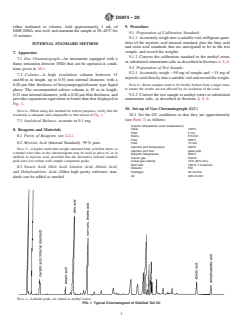
diameter, with a 0.20-μm film thickness, and provides separations equivalent or better than that displayed in Fig. 1.
NOTE 4—When using this method for referee purposes, verify that the resolution is adequate and comparable to that shown in Fig. 1.
7.3 Analytical Balance, accurate to 0.1 mg.
NOTE 1—Labeled peaks are eluted as methyl esters.
FIG. 1 Typical Chromatogram of Distilled Tall Oil
D5974 − 20
8. Reagents and Materials
8.1 Purity of Reagents, see 4.2.1.
8.2 Myristic Acid (Internal Standard),99 % pure.
NOTE 5—A higher molecular-weight saturated fatty acid that elutes as a methyl ester later in the chromatogram may be used in place of, or in addition
to myristic acid, provided that the alternative internal standard peak does not coelute with sample component peaks.
8.3 Stearic Acid, Oleic Acid, Linoleic Aci
...