

ASTM E2843-17
(Specification)Standard Specification for Demonstrating That a Building is in Walkable Proximity to Neighborhood Assets
General Information
- Abstract
ABSTRACT
This specification covers requirements for demonstrating that a building's location is in sufficient proximity to a range of establishments, services, and other amenities (referred to as "neighborhood assets" in this specification) and thus provides an opportunity for occupants to use walking as a means of transportation to conduct errands or other typical activities. It specifies a single indicator regarding the environmental performance related to a building's location, and for evaluating whether a building's location minimize the impacts associated with occupants' travel.
Included in this specification are requirements for classifying and categorizing neighborhood assets, eligibility of neighborhood assets, proximity to a diversity of neighborhood assets, demonstration of satisfaction of meeting the requirements, and documentation substantiating compliance with the requirements.
SCOPE
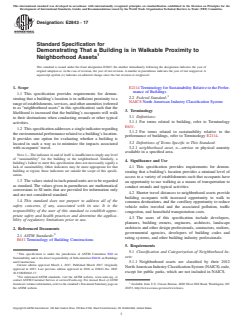
1.1 This specification provides requirements for demonstrating that a building’s location is in sufficient proximity to a range of establishments, services, and other amenities (referred to as “neighborhood assets” in this specification) such that the likelihood is increased that the building’s occupants will walk to their destinations when conducting errands or other typical activities.
1.2 This specification addresses a single indicator regarding the environmental performance related to a building’s location. It provides one option for evaluating whether a building is located in such a way as to minimize the impacts associated with occupants’ travel.
Note 1: The indicator in and of itself is insufficient to imply any level of “sustainability” for the building or the neighborhood. Similarly, a building’s failure to meet this specification does not necessarily signify a lack of sustainability. Other indicators may be more appropriate for that building or region; those indicators are outside the scope of this specification.
1.3 The values stated in inch-pound units are to be regarded as standard. The values given in parentheses are mathematical conversions to SI units that are provided for information only and are not considered standard.
1.4 This standard does not purport to address all of the safety concerns, if any, associated with its use. It is the responsibility of the user of this standard to establish appropriate safety and health practices and determine the applicability of regulatory limitations prior to use.
- Status
- Published
- Publication Date
- 28-Feb-2017
- Technical Committee
- E60 - Sustainability
- Drafting Committee
- E60.01 - Buildings and Construction
Buy Documents

ASTM E2843-17 - Standard Specification for Demonstrating That a Building is in Walkable Proximity to Neighborhood Assets

REDLINE ASTM E2843-17 - Standard Specification for Demonstrating That a Building is in Walkable Proximity to Neighborhood Assets
Overview
ASTM E2843-17: Standard Specification for Demonstrating That a Building is in Walkable Proximity to Neighborhood Assets sets out clear criteria for proving that a building’s location allows occupants easy walking access to a range of neighboring establishments, services, and amenities-collectively referred to as “neighborhood assets.” Meeting the requirements of this specification helps reduce reliance on vehicular transportation by increasing the opportunities for walking to everyday destinations, supporting both location efficiency and sustainable building planning.
This standard serves as a valuable tool for architects, urban planners, developers, and building owners seeking to document walkability and location efficiency as part of broader green building and neighborhood development strategies.
Key Topics
Definition of Neighborhood Assets: The standard classifies neighborhood assets as services or physical amenities within a specified area, using the North American Industry Classification System (NAICS) codes to designate eligible asset types. Assets include civic facilities, community-serving retail, food retail, and service establishments (such as grocery stores, schools, pharmacies, parks, and restaurants).
Proximity Requirements: It is required that a primary entrance of a building be within a ½-mile (800 meters) walking distance-measured through continuous, all-weather walkways or public rights-of-way-from at least six eligible neighborhood assets, or at least four assets provided one is a qualifying grocery store.
Diversity of Assets: Certificate of compliance requires these assets be drawn from at least three of the four neighborhood asset categories, promoting mixed-use environments and reducing vehicle trips for basic errands.
Eligibility and Documentation: For an asset to be counted, it must be operational and open to the public at the time of review. Compliance must be documented through scaled maps, marked pedestrian routes, and tables showing distances between the building and qualifying assets.
Applications
ASTM E2843-17 is widely applicable in:
- Sustainable Development: Advises green building and smart growth projects on how to evaluate and certify walkable locations, contributing to credits in sustainability and location efficiency programs.
- Urban Planning: Guides planners and city officials in assessing neighborhood connectivity and mixed-use development proposals.
- Building Certification: Forms part of certification processes for environmental performance, such as LEED, by demonstrating access to a mix of nearby services and amenities.
- Real Estate and Investment: Helps developers and investors quantify locational benefits for marketing or valuation purposes.
- Policy and Planning: Informs the development of municipal planning codes and incentives aimed at reducing traffic congestion, pollution, and household transportation expenses.
Related Standards
- ASTM E631 – Terminology of Building Constructions: Provides terminology aligned with building construction and relevant to this specification.
- ASTM E2114 – Terminology for Sustainability Relative to the Performance of Buildings: Supplies definitions used for sustainability in the building sector.
- North American Industry Classification System (NAICS): Used for the formal classification of eligible neighborhood assets.
Keywords: walkable proximity, neighborhood assets, green building, sustainability, location efficiency, diverse uses, building certification, community services, urban planning, ASTM E2843-17
By applying ASTM E2843-17, building industry professionals ensure their projects meet best practices in demonstrating access to key community assets, ultimately supporting healthier, more walkable, and environmentally efficient neighborhoods.
Relations
- Effective Date
- 01-Mar-2017
- Refers
ASTM E2114-17 - Standard Terminology for Sustainability Relative to the Performance of Buildings - Effective Date
- 01-Feb-2017
- Effective Date
- 01-Mar-2015
- Effective Date
- 01-Nov-2014
- Refers
ASTM E2114-08 - Standard Terminology for Sustainability Relative to the Performance of Buildings - Effective Date
- 01-Nov-2008
- Refers
ASTM E2114-06a - Standard Terminology for Sustainability Relative to the Performance of Buildings - Effective Date
- 01-Dec-2006
- Effective Date
- 01-Jun-2006
- Refers
ASTM E2114-06 - Standard Terminology for Sustainability Relative to the Performance of Buildings - Effective Date
- 15-Feb-2006
- Refers
ASTM E2114-05a - Standard Terminology for Sustainability Relative to the Performance of Buildings - Effective Date
- 01-Jun-2005
- Refers
ASTM E2114-05 - Standard Terminology for Sustainability Relative to the Performance of Buildings - Effective Date
- 01-Feb-2005
- Refers
ASTM E2114-04 - Standard Terminology for Sustainability Relative to the Performance of Buildings - Effective Date
- 01-Dec-2004
- Refers
ASTM E2114-00a - Standard Terminology for Sustainability Relative to the Performance of Buildings - Effective Date
- 10-Feb-2001
- Refers
ASTM E2114-01 - Standard Terminology for Sustainability Relative to the Performance of Buildings - Effective Date
- 10-Feb-2001
- Effective Date
- 28-Jul-2000
Buy Documents
ASTM E2843-17 - Standard Specification for Demonstrating That a Building is in Walkable Proximity to Neighborhood Assets
REDLINE ASTM E2843-17 - Standard Specification for Demonstrating That a Building is in Walkable Proximity to Neighborhood Assets
Get Certified
Connect with accredited certification bodies for this standard

DIBt (Deutsches Institut für Bautechnik)
German Institute for Building Technology.
DIN CERTCO
DIN Group product certification.

Aboma Certification B.V.
Specialized in construction, metal, and transport sectors.
Sponsored listings
Frequently Asked Questions
ASTM E2843-17 is a technical specification published by ASTM International. Its full title is "Standard Specification for Demonstrating That a Building is in Walkable Proximity to Neighborhood Assets". This standard covers: ABSTRACT This specification covers requirements for demonstrating that a building's location is in sufficient proximity to a range of establishments, services, and other amenities (referred to as "neighborhood assets" in this specification) and thus provides an opportunity for occupants to use walking as a means of transportation to conduct errands or other typical activities. It specifies a single indicator regarding the environmental performance related to a building's location, and for evaluating whether a building's location minimize the impacts associated with occupants' travel. Included in this specification are requirements for classifying and categorizing neighborhood assets, eligibility of neighborhood assets, proximity to a diversity of neighborhood assets, demonstration of satisfaction of meeting the requirements, and documentation substantiating compliance with the requirements. SCOPE 1.1 This specification provides requirements for demonstrating that a building’s location is in sufficient proximity to a range of establishments, services, and other amenities (referred to as “neighborhood assets” in this specification) such that the likelihood is increased that the building’s occupants will walk to their destinations when conducting errands or other typical activities. 1.2 This specification addresses a single indicator regarding the environmental performance related to a building’s location. It provides one option for evaluating whether a building is located in such a way as to minimize the impacts associated with occupants’ travel. Note 1: The indicator in and of itself is insufficient to imply any level of “sustainability” for the building or the neighborhood. Similarly, a building’s failure to meet this specification does not necessarily signify a lack of sustainability. Other indicators may be more appropriate for that building or region; those indicators are outside the scope of this specification. 1.3 The values stated in inch-pound units are to be regarded as standard. The values given in parentheses are mathematical conversions to SI units that are provided for information only and are not considered standard. 1.4 This standard does not purport to address all of the safety concerns, if any, associated with its use. It is the responsibility of the user of this standard to establish appropriate safety and health practices and determine the applicability of regulatory limitations prior to use.
ABSTRACT This specification covers requirements for demonstrating that a building's location is in sufficient proximity to a range of establishments, services, and other amenities (referred to as "neighborhood assets" in this specification) and thus provides an opportunity for occupants to use walking as a means of transportation to conduct errands or other typical activities. It specifies a single indicator regarding the environmental performance related to a building's location, and for evaluating whether a building's location minimize the impacts associated with occupants' travel. Included in this specification are requirements for classifying and categorizing neighborhood assets, eligibility of neighborhood assets, proximity to a diversity of neighborhood assets, demonstration of satisfaction of meeting the requirements, and documentation substantiating compliance with the requirements. SCOPE 1.1 This specification provides requirements for demonstrating that a building’s location is in sufficient proximity to a range of establishments, services, and other amenities (referred to as “neighborhood assets” in this specification) such that the likelihood is increased that the building’s occupants will walk to their destinations when conducting errands or other typical activities. 1.2 This specification addresses a single indicator regarding the environmental performance related to a building’s location. It provides one option for evaluating whether a building is located in such a way as to minimize the impacts associated with occupants’ travel. Note 1: The indicator in and of itself is insufficient to imply any level of “sustainability” for the building or the neighborhood. Similarly, a building’s failure to meet this specification does not necessarily signify a lack of sustainability. Other indicators may be more appropriate for that building or region; those indicators are outside the scope of this specification. 1.3 The values stated in inch-pound units are to be regarded as standard. The values given in parentheses are mathematical conversions to SI units that are provided for information only and are not considered standard. 1.4 This standard does not purport to address all of the safety concerns, if any, associated with its use. It is the responsibility of the user of this standard to establish appropriate safety and health practices and determine the applicability of regulatory limitations prior to use.
ASTM E2843-17 is classified under the following ICS (International Classification for Standards) categories: 03.080.01 - Services in general; 91.020 - Physical planning. Town planning; 91.040.01 - Buildings in general. The ICS classification helps identify the subject area and facilitates finding related standards.
ASTM E2843-17 has the following relationships with other standards: It is inter standard links to ASTM E2843-16a, ASTM E2114-17, ASTM E631-15, ASTM E631-14, ASTM E2114-08, ASTM E2114-06a, ASTM E631-06, ASTM E2114-06, ASTM E2114-05a, ASTM E2114-05, ASTM E2114-04, ASTM E2114-00a, ASTM E2114-01, ASTM E631-93a(1998)e1. Understanding these relationships helps ensure you are using the most current and applicable version of the standard.
ASTM E2843-17 is available in PDF format for immediate download after purchase. The document can be added to your cart and obtained through the secure checkout process. Digital delivery ensures instant access to the complete standard document.
Standards Content (Sample)
This international standard was developed in accordance with internationally recognized principles on standardization established in the Decision on Principles for the
Development of International Standards, Guides and Recommendations issued by the World Trade Organization Technical Barriers to Trade (TBT) Committee.
Designation:E2843 −17
Standard Specification for
Demonstrating That a Building is in Walkable Proximity to
Neighborhood Assets
This standard is issued under the fixed designation E2843; the number immediately following the designation indicates the year of
original adoption or, in the case of revision, the year of last revision.Anumber in parentheses indicates the year of last reapproval.A
superscript epsilon (´) indicates an editorial change since the last revision or reapproval.
1. Scope E2114TerminologyforSustainabilityRelativetothePerfor-
mance of Buildings
1.1 This specification provides requirements for demon-
2.2 Federal Standard:
strating that a building’s location is in sufficient proximity to a
NAICSNorth American Industry Classification System
rangeofestablishments,services,andotheramenities(referred
to as “neighborhood assets” in this specification) such that the
3. Terminology
likelihood is increased that the building’s occupants will walk
3.1 Definitions:
to their destinations when conducting errands or other typical
3.1.1 For terms related to building, refer to Terminology
activities.
E631.
1.2 This specification addresses a single indicator regarding
3.1.2 For terms related to sustainability relative to the
theenvironmentalperformancerelatedtoabuilding’slocation.
performance of buildings, refer to Terminology E2114.
It provides one option for evaluating whether a building is
3.2 Definitions of Terms Specific to This Standard:
located in such a way as to minimize the impacts associated
3.2.1 neighborhood asset, n—service or physical amenity
with occupants’ travel.
available in a specified area.
NOTE 1—The indicator in and of itself is insufficient to imply any level
of “sustainability” for the building or the neighborhood. Similarly, a
4. Significance and Use
building’s failure to meet this specification does not necessarily signify a
lack of sustainability. Other indicators may be more appropriate for that
4.1 This specification provides requirements for demon-
building or region; those indicators are outside the scope of this specifi-
strating that a building’s location provides a minimal level of
cation.
access to a variety of establishments such that occupants have
1.3 The values stated in inch-pound units are to be regarded
an opportunity to use walking as a means of transportation to
as standard. The values given in parentheses are mathematical
conduct errands and typical activities.
conversions to SI units that are provided for information only
4.2 Shorter travel distances to neighborhood assets provide
and are not considered standard.
building occupants with increased opportunity to walk to
1.4 This standard does not purport to address all of the
common destinations, and the corollary opportunity to reduce
safety concerns, if any, associated with its use. It is the
vehicle miles traveled and the associated pollution, traffic
responsibility of the user of this standard to establish appro-
congestion, and household transportation costs.
priate safety and health practices and determine the applica-
4.3 The users of this specification include developers,
bility of regulatory limitations prior to use.
planners, building owners, engineers, architects, landscape
architects and other design professionals, contractors, realtors,
2. Referenced Documents
governmental agencies, developers of building codes and
2.1 ASTM Standards:
rating systems, and other building industry professionals.
E631Terminology of Building Constructions
5. Requirements
5.1 Classification and Categorization of Neighborhood As-
This specification is under the jurisdiction of ASTM Committee E60 on
sets:
Sustainability and is the direct responsibility of Subcommittee E60.01 on Buildings
and Construction.
5.1.1 Neighborhood assets are classified by their 2012
Current edition approved March 1, 2017. Published March 2017. Originally
NorthAmericanIndustryClassificationSystem(NAICS)code,
approved in 2015. Last previous edition approved in 2016 as E2843-16a. DOI:
except for public parks, which are not included in NAICS.
10.1520/E2843-17.
For referenced ASTM standards, visit the ASTM website, www.astm.org, or
contact ASTM Customer Service at service@astm.org. For Annual Book of ASTM
Standards volume information, refer to the standard’s Document Summary page on Available from U.S. Census Bureau, 4600 Silver Hill Road, Washington, DC
the ASTM website. 20233, http://www.census.gov/eos/www/naics.
Copyright ©ASTM International, 100 Barr Harbor Drive, PO Box C700, West Conshohocken, PA19428-2959. United States
E2843−17
5.1.2 Neighborhood asset codes are grouped into four cat- 5.3.1 A minimum of six eligible neighborhood assets, or
egories: civic and community facilities, community-serving
5.3.2 A minimum of four eligible neighborhood assets,
retail, food retail, and services. Table 1 shows the category for
including at least one with NAICS Code 445110 (Grocery
each NAICS code. (See Table 2 for grouping by category.)
Stores—SupermarketandOtherGroceryexceptConvenience).
5.2 Eligibility of Neighborhood Assets—For the purposes of
5.3.3 The eligible neighborhood assets shall fall under no
this specification, a neighborhood asset shall:
fewer than three of the four neighborhood asset categories.
5.2.1 Have a NAICS code listed in Table 1 or be a public
5.3.4 Noneighborhoodassetshallbecountedtwicetowards
park, and
meeting the required criteria of 5.3, even if it falls under two
5.2.2 Be in business or otherwise open to the public at the
separate NAICS codes.
time of the site plan review.
5.3.5 No more than two neighborhood assets in any cat-
5.3 Proximity to a Diversity of Neighborhood Assets—A
egory shall be counted towards satisfying the required criteria
primary building entrance shall be within ½-mile (800-m)
of 5.3.
walking distance, as measured over a continuous network of
all-weather surfaced walkways and dedicated public rights-of-
way, of a primary entrance of either:
TABLE 1 Eligible Neighborhood Assets Codes and Categories (Organized Numerically by NAICS Code)
Title
NAICS Code (2012) Category
(All are NAICS titles with the exception of public parks)
444110 Home Centers Community-serving retail
444130 Hardware Stores Community-serving retail
445110 Grocery Stores—Supermarket and Other Grocery Food retail
except Convenience
445120 Convenience Stores Community-serving retail
44523 Specialty Food Stores—Fruit and Vegetable Markets Food retail
4453 Beer, Wine, and Liquor Stores Community-serving retail
4461 Health and Personal Care Stores—Pharmacies Community-serving retail
447110 Gasoline Stations with Convenience Stores Community-serving retail
4512 Book, Periodical, and Music Stores Community-serving retail
4529 Other General Merchandise Stores Community-serving retail
4531 Florists Community-serving retail
4532 Office Supplies, Stationery, and Gift Stores Community-serving retail
4533 Used Merchandise Stores Community-serving retail
4539 Other Miscellaneous Store Retailers Community-serving retail
4543 Direct Selling Establishments Community-serving retail
4911 Postal Service Civic and community facilities
512131 Motion Picture Theaters (except Drive-Ins) Services
51912 Other Information Services—Libraries Civic and community facilities
5221 Finance and Insurance—Banks/Savings Institutions/Credit Unions Services
523930 InvestmentAdvice Services
5412 Accounting, Tax Preparation, Bookkeeping, and Payroll Services Services
541940 Veterinary Services Services
561431 Private Mail Center
...
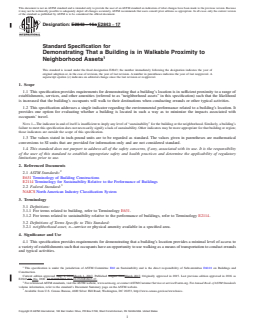
This document is not an ASTM standard and is intended only to provide the user of an ASTM standard an indication of what changes have been made to the previous version. Because
it may not be technically possible to adequately depict all changes accurately, ASTM recommends that users consult prior editions as appropriate. In all cases only the current version
of the standard as published by ASTM is to be considered the official document.
Designation: E2843 − 16a E2843 − 17
Standard Specification for
Demonstrating That a Building is in Walkable Proximity to
Neighborhood Assets
This standard is issued under the fixed designation E2843; the number immediately following the designation indicates the year of
original adoption or, in the case of revision, the year of last revision. A number in parentheses indicates the year of last reapproval. A
superscript epsilon (´) indicates an editorial change since the last revision or reapproval.
1. Scope
1.1 This specification provides requirements for demonstrating that a building’s location is in sufficient proximity to a range of
establishments, services, and other amenities (referred to as “neighborhood assets” in this specification) such that the likelihood
is increased that the building’s occupants will walk to their destinations when conducting errands or other typical activities.
1.2 This specification addresses a single indicator regarding the environmental performance related to a building’s location. It
provides one option for evaluating whether a building is located in such a way as to minimize the impacts associated with
occupants’ travel.
NOTE 1—The indicator in and of itself is insufficient to imply any level of “sustainability” for the building or the neighborhood. Similarly, a building’s
failure to meet this specification does not necessarily signify a lack of sustainability. Other indicators may be more appropriate for that building or region;
those indicators are outside the scope of this specification.
1.3 The values stated in inch-pound units are to be regarded as standard. The values given in parentheses are mathematical
conversions to SI units that are provided for information only and are not considered standard.
1.4 This standard does not purport to address all of the safety concerns, if any, associated with its use. It is the responsibility
of the user of this standard to establish appropriate safety and health practices and determine the applicability of regulatory
limitations prior to use.
2. Referenced Documents
2.1 ASTM Standards:
E631 Terminology of Building Constructions
E2114 Terminology for Sustainability Relative to the Performance of Buildings
2.2 Federal Standard:
NAICS North American Industry Classification System
3. Terminology
3.1 Definitions:
3.1.1 For terms related to building, refer to Terminology E631.
3.1.2 For terms related to sustainability relative to the performance of buildings, refer to Terminology E2114.
3.2 Definitions of Terms Specific to This Standard:
3.2.1 neighborhood asset, n—service or physical amenity available in a specified area.
4. Significance and Use
4.1 This specification provides requirements for demonstrating that a building’s location provides a minimal level of access to
a variety of establishments such that occupants have an opportunity to use walking as a means of transportation to conduct errands
and typical activities.
This specification is under the jurisdiction of ASTM Committee E60 on Sustainability and is the direct responsibility of Subcommittee E60.01 on Buildings and
Construction.
Current edition approved Aug. 1, 2016March 1, 2017. Published August 2016March 2017. Originally approved in 2015. Last previous edition approved in 2016 as
E2843-16.-16a. DOI: 10.1520/E2843-16A.10.1520/E2843-17.
For referenced ASTM standards, visit the ASTM website, www.astm.org, or contact ASTM Customer Service at service@astm.org. For Annual Book of ASTM Standards
volume information, refer to the standard’s Document Summary page on the ASTM website.
Available from U.S. Census Bureau, 4600 Silver Hill Road, Washington, DC 20233, http://www.census.gov/eos/www/naics.
Copyright © ASTM International, 100 Barr Harbor Drive, PO Box C700, West Conshohocken, PA 19428-2959. United States
E2843 − 17
4.2 Shorter travel distances to neighborhood assets provide building occupants with increased opportunity to walk to common
destinations, and the corollary opportunity to reduce vehicle miles traveled and the associated pollution, traffic congestion, and
household transportation costs.
4.3 The users of this specification include developers, planners, building owners, engineers, architects, landscape architects and
other design professionals, contractors, realtors, governmental agencies, developers of building codes and rating systems, and other
building industry professionals.
5. Requirements
5.1 Classification and Categorization of Neighborhood Assets:
5.1.1 Neighborhood assets are classified by their 2012 North American Industry Classification System (NAICS) code, except
for public parks, which are not included in NAICS.
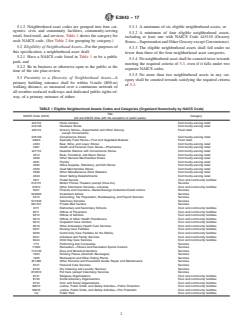
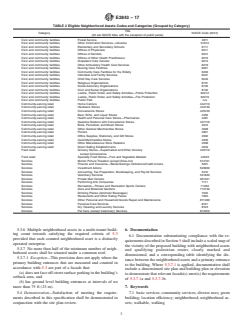
5.1.2 Neighborhood asset codes are grouped into four categories: civic and community facilities, community-serving retail, food
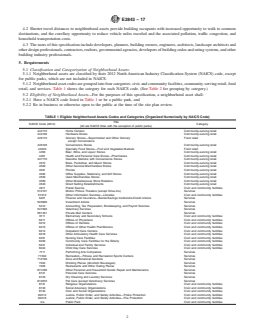
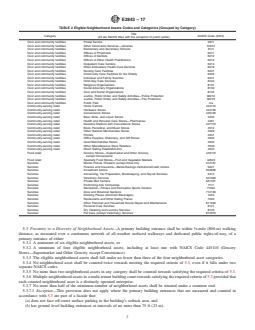
retail, and services. Table 1 shows the category for each NAICS code. (See Table 2 for grouping by category.)
5.2 Eligibility of Neighborhood Assets—For the purposes of this specification, a neighborhood asset shall:
5.2.1 Have a NAICS code listed in Table 1 or be a public park, and
5.2.2 Be in business or otherwise open to the public at the time of the site plan review.
TABLE 1 Eligible Neighborhood Assets Codes and Categories (Organized Numerically by NAICS Code)
Title
NAICS Code (2012) Category
(All are NAICS titles with the exception of public parks)
444110 Home Centers Community-serving retail
444130 Hardware Stores Community-serving retail
445110 Grocery Stores—Supermarket and Other Grocery Food retail
except Convenience
445120 Convenience Stores Community-serving retail
44523 Specialty Food Stores—Fruit and Vegetable Markets Food retail
4453 Beer, Wine, and Liquor Stores Community-serving retail
4461 Health and Personal Care Stores—Pharmacies Community-serving retail
447110 Gasoline Stations with Convenience Stores Community-serving retail
4512 Book, Periodical, and Music Stores Community-serving retail
4529 Other General Merchandise Stores Community-serving retail
4531 Florists Community-serving retail
4532 Office Supplies, Stationery, and Gift Stores Community-serving retail
4533 Used Merchandise Stores Community-serving retail
4539 Other Miscellaneous Store Retailers Community-serving retail
4543 Direct Selling Establishments Community-serving retail
4911 Postal Service Civic and community facilities
512131 Motion Picture Theaters (except Drive-Ins) Services
51912 Other Information Services—Libraries Civic and community facilities
5221 Finance and Insurance—Banks/Savings Institutions/Credit Unions Services
523930 Investment Advice Services
5412 Accounting, Tax Preparation, Bookkeeping, and Payroll Services Services
541940 Veterinary Services Services
561431 Private Mail Centers Services
6111 Elementary and Secondary Schools Civic and community facilities
6211 Offices of Physicians Civic and community facilities
6212 Offices of Dentists Civic and community facilities
6213 Offices of Other Health Practitioners Civic and community facilities
6214 Outpatient Care Centers Civic and community facilities
6219 Other Ambulatory Health Care Services Civic and community facilities
6231 Nursing Care Facilities Civic and community facilities
6233 Community Care Facilities for the Elderly Civic and community facilities
6241 Individual and Family Services Civic and community facilities
6244 Child Day Care Services Civic and community facilities
7111 Performing Arts Companies Services
71394 Recreation—Fitness and Recreation Sports Centers Services
712130 Zoos and Botanical Gar
...