

ASTM E127-20
(Practice)Standard Practice for Fabrication and Control of Flat Bottomed Hole Ultrasonic Standard Reference Blocks
General Information
- Abstract
SIGNIFICANCE AND USE
5.1 Standard reference block sets per 4.1 fabricated in accordance with this practice will exhibit specific area-amplitude and distance amplitude relationships only with an immersion test at 5 MHz using the search unit, test instrument, and test parameters described in this practice. Comparison tests at other frequencies or with uncalibrated instruments will not necessarily give the same relationships shown in this practice. See Ref (1)5 for area-amplitude limitations at other frequencies and transducer diameters. Also see Ref (2) for cautions regarding use of standard blocks for test standardizations.
5.2 Reference standards fabricated per 4.2 may utilize the fabrication and verification techniques herein. Due to the variable nature of non-standard blocks, the details should be agreed upon in the ordering documents.
SCOPE
1.1 This practice covers a procedure for fabrication and control of metal alloy reference blocks used in ultrasonic examinations that contain flat bottom holes (FBH).
1.2 These blocks may be used for checking the performance of ultrasonic examination instrumentation and search units and for standardization and control of ultrasonic examination of metal alloy products.
1.3 The reference blocks described are suitable for use with either the direct-contact method or immersion pulse-echo ultrasonic methods.
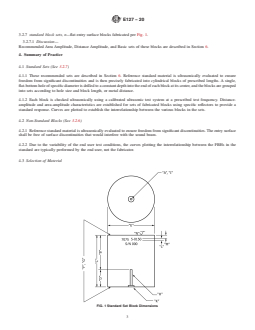
1.4 Standard sets are described for flat surface sound entry; the Basic set, Area-Amplitude set, and Distance Amplitude set.
1.5 The requirements for FBH fabrication may be applied to round bar/billet reference standards and reference standards fabricated from other product forms.
1.6 This practice does not specify reference reflector sizes or product rejection limits. It does describe fabrication practices and applied tolerances. In all cases of conflict between this practice and customer specifications, the customer specification shall prevail.
1.7 The values stated in inch-pound units are to be regarded as standard. The values given in parentheses are mathematical conversions to SI units that are provided for information only and are not considered standard.
1.8 This practice has incorporated the requirements of Practice E428 and Guide E1158. Reference standards that were manufactured under Practice E428 and Guide E1158 comply with the requirements of this practice.
1.9 This standard does not purport to address all of the safety concerns, if any, associated with its use. It is the responsibility of the user of this standard to establish appropriate safety, health, and environmental practices and determine the applicability of regulatory limitations prior to use.
1.10 This international standard was developed in accordance with internationally recognized principles on standardization established in the Decision on Principles for the Development of International Standards, Guides and Recommendations issued by the World Trade Organization Technical Barriers to Trade (TBT) Committee.
- Status
- Published
- Publication Date
- 30-Nov-2020
- Technical Committee
- E07 - Nondestructive Testing
- Drafting Committee
- E07.06 - Ultrasonic Method
Buy Documents
ASTM E127-20 - Standard Practice for Fabrication and Control of Flat Bottomed Hole Ultrasonic Standard Reference Blocks
REDLINE ASTM E127-20 - Standard Practice for Fabrication and Control of Flat Bottomed Hole Ultrasonic Standard Reference Blocks
Overview
ASTM E127-20: Standard Practice for Fabrication and Control of Flat Bottomed Hole Ultrasonic Standard Reference Blocks is a widely recognized standard developed by ASTM International. This standard sets out comprehensive guidelines for the fabrication, verification, and control of metal alloy reference blocks featuring flat bottom holes (FBH), which are critical in ultrasonic testing and nondestructive evaluation (NDE) of metal products.
ASTM E127-20 ensures consistency and reliability in ultrasonic examination by specifying the procedures and tolerances for producing reference blocks. These standard reference blocks are essential tools for calibrating ultrasonic equipment, validating inspection methods, and maintaining quality control in the ultrasonic examination of metals.
Key Topics
- Scope and Applicability: The practice covers procedures for fabricating metal alloy reference blocks with flat bottom holes, used for performance checking, instrumentation standardization, and control in ultrasonic inspection of metallic products.
- Reference Block Types: Standard blocks can be used with both direct-contact and immersion pulse-echo ultrasonic methods, and are suitable for a variety of product forms, including round bars, billets, and other shapes.
- Recommended Block Sets:
- Basic Set: Designed for general ultrasonic calibration.
- Area-Amplitude Set: Used to study the relationship between reflector area and ultrasonic response.
- Distance-Amplitude Set: Helps assess ultrasonic response over varying material thicknesses.
- Fabrication Practices: Outlines strict machining tolerances, surface finish requirements, and identification protocols to ensure block accuracy and repeatability.
- Material Selection: Provides guidance on selecting reference block materials that match the acoustic and chemical properties of the materials under test.
- Quality Control: Specifies verification techniques for physical and ultrasonic characteristics, including visual inspection and ultrasonic checks.
Applications
ASTM E127-20 flat bottomed hole ultrasonic standard reference blocks are indispensable in a variety of industrial and laboratory settings. Their key applications include:
- Instrument Calibration: Used regularly to standardize and calibrate ultrasonic testing equipment, ensuring valid and repeatable measurements.
- Performance Verification: Essential for verifying the functionality and sensitivity of ultrasonic search units and instrumentation.
- Training and Qualification: Facilitates the training of technicians and validation of procedures by providing repeatable reference reflectors.
- Quality Assurance in Manufacturing: Supports compliance and process control in industries such as aerospace, automotive, power generation, and metal fabrication, where precise inspection of metal components is critical.
- Specification Compliance: Provides a traceable, reproducible standard that underpins compliance with customer and regulatory specifications in ultrasonic evaluation.
Related Standards
ASTM E127-20 is closely associated with several other standards, which provide further detail or support on material specifications, ultrasonic testing, and terminology:
- ASTM E428: Practice for fabrication of metal reference blocks for ultrasonic testing.
- ASTM E1158: Guide for material selection and fabrication of reference blocks for ultrasonic testing.
- ASTM E1316: Standard terminology for nondestructive examinations.
- ASTM E317: Practice for evaluating performance characteristics of ultrasonic pulse-echo equipment.
- ASTM E1065: Practice for evaluating characteristics of ultrasonic search units.
- ASTM B221 and B241/B241M: Specifications for aluminum and aluminum-alloy products.
- SAE AMS 4928, 6409, 6415, 6484: Specifications for titanium and steel alloys suitable for reference block fabrication.
Summary
ASTM E127-20 provides a foundational methodology for the fabrication and control of flat bottomed hole ultrasonic reference blocks, ensuring consistency, traceability, and reliability in ultrasonic nondestructive testing of metal alloys. Its adoption is key to achieving high-quality, repeatable ultrasonic inspections and meeting stringent industry requirements for safety and performance.
These reference blocks form the backbone of calibration and quality assurance programs wherever ultrasonic NDE is utilized, making ASTM E127-20 a vital document for engineers, technicians, and quality professionals involved in the field of ultrasonic testing.
Relations
- Effective Date
- 01-Feb-2024
- Effective Date
- 01-Dec-2019
- Effective Date
- 01-Mar-2019
- Effective Date
- 01-Jan-2018
- Effective Date
- 15-Jun-2017
- Effective Date
- 01-Feb-2017
- Effective Date
- 01-Aug-2016
- Effective Date
- 01-Feb-2016
- Effective Date
- 01-Dec-2015
- Effective Date
- 01-Sep-2015
- Effective Date
- 01-Jun-2014
- Effective Date
- 01-Jun-2014
- Effective Date
- 01-Dec-2013
- Effective Date
- 15-Jun-2013
- Effective Date
- 01-Jun-2013
Buy Documents
ASTM E127-20 - Standard Practice for Fabrication and Control of Flat Bottomed Hole Ultrasonic Standard Reference Blocks
REDLINE ASTM E127-20 - Standard Practice for Fabrication and Control of Flat Bottomed Hole Ultrasonic Standard Reference Blocks
Get Certified
Connect with accredited certification bodies for this standard

Element Materials Technology
Materials testing and product certification.

Inštitut za kovinske materiale in tehnologije
Institute of Metals and Technology. Materials testing, metallurgical analysis, NDT.
Sponsored listings
Frequently Asked Questions
ASTM E127-20 is a standard published by ASTM International. Its full title is "Standard Practice for Fabrication and Control of Flat Bottomed Hole Ultrasonic Standard Reference Blocks". This standard covers: SIGNIFICANCE AND USE 5.1 Standard reference block sets per 4.1 fabricated in accordance with this practice will exhibit specific area-amplitude and distance amplitude relationships only with an immersion test at 5 MHz using the search unit, test instrument, and test parameters described in this practice. Comparison tests at other frequencies or with uncalibrated instruments will not necessarily give the same relationships shown in this practice. See Ref (1)5 for area-amplitude limitations at other frequencies and transducer diameters. Also see Ref (2) for cautions regarding use of standard blocks for test standardizations. 5.2 Reference standards fabricated per 4.2 may utilize the fabrication and verification techniques herein. Due to the variable nature of non-standard blocks, the details should be agreed upon in the ordering documents. SCOPE 1.1 This practice covers a procedure for fabrication and control of metal alloy reference blocks used in ultrasonic examinations that contain flat bottom holes (FBH). 1.2 These blocks may be used for checking the performance of ultrasonic examination instrumentation and search units and for standardization and control of ultrasonic examination of metal alloy products. 1.3 The reference blocks described are suitable for use with either the direct-contact method or immersion pulse-echo ultrasonic methods. 1.4 Standard sets are described for flat surface sound entry; the Basic set, Area-Amplitude set, and Distance Amplitude set. 1.5 The requirements for FBH fabrication may be applied to round bar/billet reference standards and reference standards fabricated from other product forms. 1.6 This practice does not specify reference reflector sizes or product rejection limits. It does describe fabrication practices and applied tolerances. In all cases of conflict between this practice and customer specifications, the customer specification shall prevail. 1.7 The values stated in inch-pound units are to be regarded as standard. The values given in parentheses are mathematical conversions to SI units that are provided for information only and are not considered standard. 1.8 This practice has incorporated the requirements of Practice E428 and Guide E1158. Reference standards that were manufactured under Practice E428 and Guide E1158 comply with the requirements of this practice. 1.9 This standard does not purport to address all of the safety concerns, if any, associated with its use. It is the responsibility of the user of this standard to establish appropriate safety, health, and environmental practices and determine the applicability of regulatory limitations prior to use. 1.10 This international standard was developed in accordance with internationally recognized principles on standardization established in the Decision on Principles for the Development of International Standards, Guides and Recommendations issued by the World Trade Organization Technical Barriers to Trade (TBT) Committee.
SIGNIFICANCE AND USE 5.1 Standard reference block sets per 4.1 fabricated in accordance with this practice will exhibit specific area-amplitude and distance amplitude relationships only with an immersion test at 5 MHz using the search unit, test instrument, and test parameters described in this practice. Comparison tests at other frequencies or with uncalibrated instruments will not necessarily give the same relationships shown in this practice. See Ref (1)5 for area-amplitude limitations at other frequencies and transducer diameters. Also see Ref (2) for cautions regarding use of standard blocks for test standardizations. 5.2 Reference standards fabricated per 4.2 may utilize the fabrication and verification techniques herein. Due to the variable nature of non-standard blocks, the details should be agreed upon in the ordering documents. SCOPE 1.1 This practice covers a procedure for fabrication and control of metal alloy reference blocks used in ultrasonic examinations that contain flat bottom holes (FBH). 1.2 These blocks may be used for checking the performance of ultrasonic examination instrumentation and search units and for standardization and control of ultrasonic examination of metal alloy products. 1.3 The reference blocks described are suitable for use with either the direct-contact method or immersion pulse-echo ultrasonic methods. 1.4 Standard sets are described for flat surface sound entry; the Basic set, Area-Amplitude set, and Distance Amplitude set. 1.5 The requirements for FBH fabrication may be applied to round bar/billet reference standards and reference standards fabricated from other product forms. 1.6 This practice does not specify reference reflector sizes or product rejection limits. It does describe fabrication practices and applied tolerances. In all cases of conflict between this practice and customer specifications, the customer specification shall prevail. 1.7 The values stated in inch-pound units are to be regarded as standard. The values given in parentheses are mathematical conversions to SI units that are provided for information only and are not considered standard. 1.8 This practice has incorporated the requirements of Practice E428 and Guide E1158. Reference standards that were manufactured under Practice E428 and Guide E1158 comply with the requirements of this practice. 1.9 This standard does not purport to address all of the safety concerns, if any, associated with its use. It is the responsibility of the user of this standard to establish appropriate safety, health, and environmental practices and determine the applicability of regulatory limitations prior to use. 1.10 This international standard was developed in accordance with internationally recognized principles on standardization established in the Decision on Principles for the Development of International Standards, Guides and Recommendations issued by the World Trade Organization Technical Barriers to Trade (TBT) Committee.
ASTM E127-20 is classified under the following ICS (International Classification for Standards) categories: 77.040.01 - Testing of metals in general; 77.120.10 - Aluminium and aluminium alloys. The ICS classification helps identify the subject area and facilitates finding related standards.
ASTM E127-20 has the following relationships with other standards: It is inter standard links to ASTM E1316-24, ASTM E1316-19b, ASTM E1316-19, ASTM E1316-18, ASTM E1316-17a, ASTM E1316-17, ASTM E1316-16a, ASTM E1316-16, ASTM E1316-15a, ASTM E1316-15, ASTM E1316-14, ASTM E1316-14e1, ASTM E1316-13d, ASTM E1316-13c, ASTM E428-08(2013). Understanding these relationships helps ensure you are using the most current and applicable version of the standard.
ASTM E127-20 is available in PDF format for immediate download after purchase. The document can be added to your cart and obtained through the secure checkout process. Digital delivery ensures instant access to the complete standard document.
Standards Content (Sample)
This international standard was developed in accordance with internationally recognized principles on standardization established in the Decision on Principles for the
Development of International Standards, Guides and Recommendations issued by the World Trade Organization Technical Barriers to Trade (TBT) Committee.
Designation: E127 − 20
Standard Practice for
Fabrication and Control of Flat Bottomed Hole Ultrasonic
Standard Reference Blocks
This standard is issued under the fixed designation E127; the number immediately following the designation indicates the year of
original adoption or, in the case of revision, the year of last revision.Anumber in parentheses indicates the year of last reapproval.A
superscript epsilon (´) indicates an editorial change since the last revision or reapproval.
This standard has been approved for use by agencies of the U.S. Department of Defense.
1. Scope* priate safety, health, and environmental practices and deter-
mine the applicability of regulatory limitations prior to use.
1.1 This practice covers a procedure for fabrication and
1.10 This international standard was developed in accor-
control of metal alloy reference blocks used in ultrasonic
dance with internationally recognized principles on standard-
examinations that contain flat bottom holes (FBH).
ization established in the Decision on Principles for the
1.2 Theseblocksmaybeusedforcheckingtheperformance
Development of International Standards, Guides and Recom-
ofultrasonicexaminationinstrumentationandsearchunitsand
mendations issued by the World Trade Organization Technical
for standardization and control of ultrasonic examination of
Barriers to Trade (TBT) Committee.
metal alloy products.
1.3 The reference blocks described are suitable for use with
2. Referenced Documents
either the direct-contact method or immersion pulse-echo
2.1 ASTM Standards:
ultrasonic methods.
B107/B107MSpecification for Magnesium-Alloy Extruded
1.4 Standard sets are described for flat surface sound entry;
Bars, Rods, Profiles, Tubes, and Wire
theBasicset,Area-Amplitudeset,andDistanceAmplitudeset.
B221Specification forAluminum andAluminum-Alloy Ex-
1.5 TherequirementsforFBHfabricationmaybeappliedto
truded Bars, Rods, Wire, Profiles, and Tubes
round bar/billet reference standards and reference standards
B241/B241MSpecification for Aluminum and Aluminum-
fabricated from other product forms.
Alloy Seamless Pipe and Seamless Extruded Tube
E317PracticeforEvaluatingPerformanceCharacteristicsof
1.6 This practice does not specify reference reflector sizes
or product rejection limits. It does describe fabrication prac- Ultrasonic Pulse-Echo Testing Instruments and Systems
tices and applied tolerances. In all cases of conflict between
without the Use of Electronic Measurement Instruments
this practice and customer specifications, the customer speci- E428Practice for Fabrication and Control of Metal, Other
fication shall prevail.
than Aluminum, Reference Blocks Used in Ultrasonic
Testing (Withdrawn 2019)
1.7 Thevaluesstatedininch-poundunitsaretoberegarded
E1065Practice for Evaluating Characteristics of Ultrasonic
as standard. The values given in parentheses are mathematical
Search Units
conversions to SI units that are provided for information only
E1158Guide for Material Selection and Fabrication of
and are not considered standard.
Reference Blocks for the Pulsed Longitudinal Wave Ul-
1.8 This practice has incorporated the requirements of
trasonic Testing of Metal and Metal Alloy Production
PracticeE428andGuideE1158.Referencestandardsthatwere
Material (Withdrawn 2019)
manufactured under Practice E428 and Guide E1158 comply
E1316Terminology for Nondestructive Examinations
with the requirements of this practice.
E1324GuideforMeasuringSomeElectronicCharacteristics
1.9 This standard does not purport to address all of the
of Ultrasonic Testing Instruments
safety concerns, if any, associated with its use. It is the
E2375Practice for Ultrasonic Testing of Wrought Products
responsibility of the user of this standard to establish appro-
1 2
This practice is under the jurisdiction of ASTM Committee E07 on Nonde- For referenced ASTM standards, visit the ASTM website, www.astm.org, or
structive Testing and is the direct responsibility of Subcommittee E07.06 on contact ASTM Customer Service at service@astm.org. For Annual Book of ASTM
Ultrasonic Method. Standards volume information, refer to the standard’s Document Summary page on
Current edition approved Dec. 1, 2020. Published January 2021. Originally the ASTM website.
ε1 3
approved in 1958. Last previous edition approved in 2019 as E127–19 . DOI: The last approved version of this historical standard is referenced on
10.1520/E0127-20. www.astm.org.
*A Summary of Changes section appears at the end of this standard
Copyright © ASTM International, 100 Barr Harbor Drive, PO Box C700, West Conshohocken, PA 19428-2959. United States
E127 − 20
2.2 SAE Standards: obtain either a maximum number of back reflections from a
AMS 4928TitaniumAlloy Bars, Wire, Forgings, and Rings reference block or a maximum indication from its entry
6Al - 4VAnnealed surface.
AMS6409Steel,Bars,Forgings,andTubing0.80Cr-1.8Ni
3.2.1.1 Discussion—Angular error results when the entry
- 0.25Mo (0.38 - 0.43C) (SAE 4340) Special Aircraft
surface, hole bottom, and back surface are not parallel to each
Quality Cleanliness, Normalized and Tempered
other.
AMS6415Steel,Bars,Forgings,andTubing0.80Cr-1.8Ni
3.2.2 entry surface, n—the end of a reference block through
- 0.25Mo (0.38 - 0.43C) (SAE 4340)
which ultrasonic energy must pass when reflections from the
AMS6484Steel,Bars,Forgings,andTubing0.80Cr-1.8Ni
hole bottom are obtained.
- 0.25Mo (0.38 - 0.43C) (SAE 4340) Normalized and
Tempered
3.2.3 hole bottom, n—the flat reflecting surface in a refer-
QQ-A225/6Aluminum Alloy, 2024, Bar, Rod, and Wire;
enceblockthatisobtainedbymakingtheentireendofadrilled
Rolled, Drawn, or Cold Finished
hole smooth and flat using best machining practices; the hole
QQ-A225/9Aluminum Alloy 7075, Bar, Rod, Wire, and
bottom is parallel to the entry surface of the block.
Special Shapes; Rolled, Drawn, or Cold Finished
3.2.4 hole size, n—the diameter of the hole in a reference
3. Terminology
block that determines the area of the hole bottom.
3.1 Definitions—For definitions of terms not specific to this
3.2.5 metal distance, n—the distance in a reference block
practice, refer to Terminology E1316.
from its entry surface to the hole bottom.
3.2 Definitions of Terms Specific to This Standard:
3.2.6 non-standard blocks, n—blocks fabricated from pro-
3.2.1 angular error, n—the condition observed in ultrasonic
duction material shapes, round and flat bar and billet, concave
tests of reference blocks when the response from the hole
surface standards, extruded, forged and additive manufactured
bottom is not maximum while the search unit is positioned to
shapes.
3.2.7 standard block sets, n—flat entry surface blocks fab-
AvailablefromSAEInternational(SAE),400CommonwealthDr.,Warrendale,
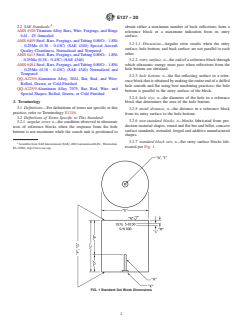
ricated per Fig. 1.
PA 15096, http://www.sae.org.
FIG. 1 Standard Set Block Dimensions
E127 − 20
3.2.7.1 Discussion—Recommended Area Amplitude, Dis- determine the effect of variations in metal distance upon the
tance Amplitude, and Basic sets of these blocks are described ultrasonic response from detected discontinuities. Test sensi-
in Section 6. tivity standardizations and corrections for metal distance are
most reliable when made under the same conditions employed
4. Summary of Practice
for the actual tests. For these purposes, reference blocks
containing various combinations of hole size and metal dis-
4.1 Standard Sets (See 3.2.7)
tance are necessary.
4.1.1 These recommended sets are described in Section 6.
Reference standard material is ultrasonically evaluated to
6.2 The following combinations or sets of blocks are rec-
ensure freedom from significant discontinuities and is then
ommended:
precisely fabricated into cylindrical blocks of prescribed
6.2.1 Basic Set—The basic set consisting of ten reference
lengths.Asingle,flat-bottomholeofspecificdiameterisdrilled
blocks is listed in Table 1. Area-amplitude relations are
to a constant depth into the end of each block at its center, and
obtained by intercomparison of blocks containing the 3in.
3 5 8
the blocks are grouped into sets according to hole size and
(76.2mm) metal distance and ⁄64in., ⁄64in., and ⁄64in. (see
block length, or metal distance.
Table 2 note) diameter holes, respectively. Distance-amplitude
4.1.2 Eachblockischeckedultrasonicallyusingacalibrated
relations are obtained by intercomparison of the blocks of
ultrasonic test system at a prescribed test frequency. Distance- 5
various lengths which contain ⁄64in. diameter holes.
amplitude and area-amplitude characteristics are established
NOTE 1—Direct conversion from inches to millimetres
forsetsoffabricatedblocksusingspecificreflectorstoprovide
(1in.=25.4mm) gives hole size dimensions for which there are no
a standard response. Curves are plotted to establish the
standard metric drills; however, Table 2 gives the nearest standard metric
interrelationship between the various blocks in the sets.
drill size.
4.2 Non-Standard Blocks (See 3.2.6)
6.2.2 Area-Amplitude Set—The area-amplitude set consist-
4.2.1 Reference standard material is ultrasonically evalu- ing of eight ultrasonic standard reference blocks is listed in
ated to ensure freedom from significant discontinuities. The
Table 3. Area-amplitude relationships are obtained by inter-
entrysurfaceshallbefreeofsurfacediscontinuitiesthatwould comparison of any three or more blocks with different flat
interfere with the sound beam.
bottom-holesizesatthesamemetaldistancefromfrontsurface
4.2.2 Due to the variability of the end user test conditions, to hole bottom.
the curves plotting the interrelationship between the FBHs in
6.2.3 Distance-Amplitude Set—A distance-amplitude set
the standard are typically performed by the end user, not the may include any convenient number of the reference blocks
fabricator.
shown in Table 4 and does not necessarily include all blocks
listed.Arecommended distance-amplitude set contains at least
4.3 Selection of Material
12blocks,andeachsetcontainsonlyoneofthethreeholesizes
4.3.1 Section 7 of this standard contains guidance on the
shown in Table 4. Blocks comprising the 19 block distance-
selection and testing of material for ultrasonic reference
amplitude sets, which are customarily supplied commercially,
standards.
are indicated in Table 4. Increments of metal distance in each
ofthethreegroupsofblocksintherecommendedsetshouldbe
5. Significance and Use
identical. Distance-amplitude relationships are obtained by
5.1 Standard reference block sets per 4.1 fabricated in
intercomparison of all blocks containing the same size hole.
accordance with this practice will exhibit specific area-
amplitude and distance amplitude relationships only with an
immersiontestat5MHzusingthesearchunit,testinstrument,
andtestparametersdescribedinthispractice.Comparisontests
TABLE 1 Dimensions and Identification of Reference Blocks in
at other frequencies or with uncalibrated instruments will not
the Basic Set (see Fig. 1)
necessarily give the same relationships shown in this practice.
5 NOTE 1—Direct conversion from inches to millimeters
SeeRef (1) forarea-amplitudelimitationsatotherfrequencies
(1in.=25.4mm) gives hole size dimensions for which there are no
and transducer diameters. Also see Ref (2) for cautions
standard metric drills; however, Table 2 gives the nearest standard metric
regarding use of standard blocks for test standardizations.
drill size.
Hole Metal Overall
5.2 Reference standards fabricated per 4.2 may utilize the
Block
Diameter Distance Length
fabrication and verification techniques herein. Due to the
Identi-
(A) (B) (C)
fication
variable nature of non-standard blocks, the details should be
⁄64 ths
Number
in. mm in. mm
agreed upon in the ordering documents.
in.
3-0300 3 3.000 76.2 3.750 95.2
6. Description of Various Recommended Sets 5-0012 5 0.125 3.2 0.875 22.2
5-0025 5 0.250 6.4 1.000 25.4
6.1 In ultrasonic testing of metals, a standard reference
5-0050 5 0.500 12.7 1.250 31.8
usually is necessary to establish a specified test sensitivity. A 5-0075 5 0.750 19.0 1.500 38.1
5-0150 5 1.500 38.1 2.250 57.2
standard ultrasonic reference also is required frequently to
5-0300 5 3.000 76.2 3.750 95.2
5-0600 5 6.000 152.4 6.750 171.4
8-0300 8 3.000 76.2 3.750 95.2
The boldface numbers in parentheses refer to a list of references at the end of 8-0600 8 6.000 152.4 6.750 171.4
this standard.
E127 − 20
TABLE 2 Diameter of Flat-Bottom Holes in Inch-Pound Units and TABLE 4 Dimensions and Identification of Reference Blocks in
the Nearest Metric Drill Hole Diameter Distance-Amplitude Sets
Block Identifica-
Metal Distance (B) Overall Length (C)
NOTE 1—Ratio of the area of the nearest metric drill size to the area of
tion Number, 3-,
the inch-pound drill size is 1.016 throughout.
A
in. mm in. mm
5-, and 8-
Hole Diameter in Inch- Nearest Metric Drill
B
−0006 0.0625 1.6 0.812 20.6
Pound Units, in. Size, mm
B
−0012 0.125 3.2 0.875 22.2
B
1/64 0.40
−0025 0.250 6.4 1.000 25.4
B
2/64 0.80 −0038 0.375 9.5 1.125 28.6
B
3/64 1.20
−0050 0.500 12.7 1.250 31.8
B
4/64 1.60
−0062 0.625 15.9 1.375 34.9
B
5/64 2.00 −0075 0.750 19.1 1.500 38.1
B
6/64 2.40
−0088 0.875 22.2 1.625 41.3
B
7/64 2.80 −0100 1.000 25.4 1.750 44.5
B
8/64 3.20
−0125 1.250 31.8 2.000 50.8
−0150 1.500 38.1 2.250 57.2
B
−0175 1.750 44.5 2.500 63.5
−0200 2.000 50.8 2.750 69.9
TABLE 3 Dimensions and Identification of Reference Blocks in B
−0225 2.250 57.2 3.000 76.2
the Area-Amplitude Set (see Fig. 1)
−0250 2.500 63.5 3.250 82.6
B
−0275 2.750 69.9 3.500 88.9
Hole Metal Overall
Block
−0300 3.000 76.2 3.750 95.3
Diameter Distance Length
B
Identi- −0325 3.250 82.6 4.000 101.6
(A) (B) (C)
fication
−0350 3.500 88.9 4.250 108.0
⁄64 ths
B
Number −0375 3.750 95.3 4.500 114.3
in. mm in. mm
in.
−0400 4.000 101.6 4.750 120.7
B
1-0300 1 3.000 76.2 3.750 95.3
−0425 4.250 108.0 5.000 127.0
2-0300 2 3.000 76.2 3.750 95.3 −0450 4.500 114.3 5.250 133.4
B
3-0300 3 3.000 76.2 3.750 95.3
−0475 4.750 120.7 5.500 139.7
4-0300 4 3.000 76.2 3.750 95.3 −0500 5.000 127.0 5.750 146.1
B
5-0300 5 3.000 76.2 3.750 95.3
−0525 5.250 133.4 6.000 152.4
6-0300 6 3.000 76.2 3.750 95.3 −0550 5.500 139.7 6.250 158.8
B
7-0300 7 3.000 76.2 3.750 95.3
−0575 5.750 146.1 6.500 165.1
8-0300 8 3.000 76.2 3.750 95.3
−0600 6.000 152.4 6.750 171.5
A
3 5 8
Hole diameters (A) ⁄64, ⁄64, and ⁄64 in.
B
Blocks customarily included in commercial 19 block distance-amplitude sets.
6.3 If the blocks are to be used for immersion testing, they
should be suitably anodized or otherwise protected to enhance
TABLE 5 Recommended Reference Block Material
resistancetocorrosion.Uncoatedblocksshallbedesignatedas
Material to be Tested Reference Material Typical Specification
Type 1; coated blocks shall be designated as Type 2.
Aluminum 7075-T6 ASTM B221, ASTM
B241/B241M, QQ-
6.4 Anumberofimportantvariablesthataffecttheresponse
A225/9
from reference blocks can be controlled during fabrication by
--- 2024 ASTM B221, ASTM
B241/B241M, QQ-
accurate machining practices. The roughness of the entry
A225/6
surface; the alignment of entry surface, hole bottom, and back
Magnesium ZK60 ASTM B107/B107M
surface; and the surface condition of the hole bottom are the
Titanium Ti-6Al-4V annealed AMS 4928
Low Alloy Steels 4340 annealed AMS 6484, AMS 6415,
more important physical variables that must be controlled
AMS 6409
during the fabrication of reference blocks. The quality of
material used for blocks also is a factor.
6.5 Non-Standard Blocks—There are many different types
reflectors, ultrasonically examine the reference block material
of reference blocks used in industry depending upon the size
at the anticipated frequency and at a sensitivity that produces
and shape of the material to be examined. Some of the more
an acoustic noise level of 20% screen height.The entire block
common flat bottom hole (FBH) types are described in
should be scanned from the surface which will be used for
Appendix X2.
standardization. Any discrete indication that exceeds 40%
screen height should be cause to remove the material from
7. Material Selection
consideration as an ultrasonic reference block.
7.1 Recommended materials for standard block sets are
7.3.1 For materials with very low noise levels, this test may
listed in Table 5 (Practice E2375).
be over-sensitive. Such materials may be ultrasonically exam-
7.2 For non-standard blocks, it is good practice to use a inedatasensitivitythatassuresnosignalswillbepresentinthe
sample removed from the production lot of material as the material that is more than half the response of the intended flat
reference block material. When this is not possible the refer- bottomedholeresponse.Suitablereferencestandardsinacous-
ence block material should be of the same general shape and tically similar material will be required for standardization of
dimensions, surface finish, chemical composition, and micro- the test.
structure as the production material to be examined.
7.4 Methods for determining acoustic compatibility of ref-
7.3 To ensure that the material chosen is suitable for use as erence standards and material under test are typically defined
reference block material and is free of potentially interfering by the governing ultrasonic test specification.
E127 − 20
8. Fabrication Procedure the blocks shown in to Figs. X2.2-X2.5.Apilot hole is used to
locateandpositiontheFBHthuseliminatingthemillingofthe
8.1 Standard sets per 4.1 shall be fabricated to the dimen-
steps. This allows the bar circumference to remain for support
sions of Fig. 1 and Table 6.
during standardization which is much more representative to
8.2 The following machining sequence is recommended:
production material. This method also results in an added
8.2.1 Machine all blocks to a uniform entry surface finish
advantage for mechanical examination of rotating material by
and to the required dimensional tolerances.
allowing signals from the reference block to be more easily
8.2.2 Drillthetestholetothenominaldepthwithastandard
evaluated dynamically as the block is moved at the maximum
drill point.
scanning rate.
8.2.3 Carefully prepare a flat-bottom drill or cutter with
8.4.1 The method is simply to use a larger pilot drill to
cuttingedgessquareandflatwithin0.0005in.(0.013mm)and
produce a hole to within a short distance of the depth of the
perpendiculartoitslongitudinalaxis(flatness,squareness,etc.,
FBH. The body and bottoming drills for the FBH are then
should be checked at a minimum of 60× magnification on an
successively mounted in a holder of the same diameter as the
optical comparator).
pilot drill for the final drilling and flattening operations. This
8.2.4 Continue to drill as needed to remove all the conical
helps to ensure that the flat bottom of the final hole will be
configuration of the bottom of the hole
parallel to a tangent of the top surface at a point immediately
8.2.5 Remove drill, check cutting edge, regrind, if neces-
abovethehole.Thisisduetotheincreasedstiffnessofthepilot
sary.
drillandtheholderbeingmuchgreaterthanthatofthesmaller
8.2.6 Remove an additional 0.005in. (0.13mm) of material
final drills. That prevents skewing of the final holes that could
from the hole bottom.
result from deep drilling of a small hole due to excess drilling
8.2.7 Recheck cutting edges of the drill on the optical
speed or pressure or to grain anomalies or small hardness
comparator, regrind, if necessary, and repeat 8.2.5 and 8.2.6.
variations in the material that might deflect smaller drills if
Careful attention must be given to the squareness of corners of
used for the total distance.
the cutter; the slightest radius reduces the reflective area of the
8.4.2 Thesizeofatypicalpilotholeusedforthispurposeis
hole bottom.
0.375in.(9.53mm).Thepilotholeistypicallydrilledtowithin
8.2.8 Typical Block Identification:
approximately 0.50in. (12.7mm) of the final desired FBH
7075 = Typical alloy designation,
depth. After the FBH is drilled, cleaned, and verified the
5 = Hole size in ⁄64in. increments, and
entrancetothepilotholemustbesealedtopreventtheentryof
0150 = 1.50 in. metal travel in 00.00 in.
couplant or other foreign material.
8.3 Non-standard Blocks, fabricated from production
8.4.3 Fig.X2.1showscrosssectionalviewsofFBHsplaced
shapes, bar/billet standards, curved surface standards, etc. will
in a round bar by this method.
usethefabricationmethodsof8.2andthetolerancesdefinedin
8.4.4 For standardization of a system for examination of
Table 6 as far as is practical. Surface finish on bar and billet
cylindrical material, the bottom of the FBH fabricated in
standards is typically the finish supplied on the bar or as
accordance with this procedure at any depth in the material
specified by the customer. For blocks such as concave stan-
may be used for “static” standardization (that is, with no
dards where the surface is fabricated, the surface finish
relative motion between standard and search unit). “Dynamic”
tolerance of Table 6 may be applicable. Metal distance is
standardization is performed with rotary and translational
typically defined by governing Ultrasonic Method Specifica-
motion between standard and search unit at the maximum
tions or as specified by the customer.
speeds to be used for the final examination. In this case, the
8.4 Counterbore Method for Deep Flat Bottomed Holes— instrument alarm gate may be set to be activated by the signal
This describes a method for fabricating deep FBHs that can be from any FBH drilled to a depth of less than a radius of the
simpler, faster, and less expensive than those used to fabricate material while not responding to signals from the sides of the
TABLE 6 Fabrication Tolerances for Standard Set Blocks
Parameter Dimension Tolerance Dimension Metric (mm) Tolerance Metric (mm)
A. FBH Diameter Per Table 1, Table 3 ±0.0005 in. Per Table 1, Table 3 ±0,0127
B. Metal Distance Per Table 1, Table 3, Table 4 ±0.015 in. Per Table 1, Table 3, Table 4 ±0,381
C. Overall Length Per Table 1, Table 3, Table 4 ±0.005 in. Per Table 1, Table 3, Table 4 ±0,127
D. Hole Depth 0.75 in. ±0.005 in. 19,05 ±0,127
E. Block Diameter 2.0 in. ±0.020 in. 50,8 ±0,508
Block Diameter >6 in. TMD 2.5 in. ±0.030 in. 63,5 ±0,762
F. End Face Flatness Within 0.0005 in. --- Within 0,0127 ---
G. Parallelism Within 0.001 in. --- Within 0,0254 ---
H. FBH Perpendicularity Within 20 minutes --- Within 20 minutes ---
I. Hole Bottom Flatness 0.001 in. Per 0.125 in. 0.0254 Per 3,175
J. Centered Within 0.010 in. --- Within 0,254 ---
K. Counterbore 0.25 in. x 0.063 in. --- 6,35 x 1,6 ---
L. Block ID Size 0.12 in. min height 3,048 min height
M. Block ID Location 0.25 in. min from top 6,35 min from top
N. Entry Surface Finish 32 µinch max 0,8 µmeter max
Other Surface Finish 63 µinch nominal 1,6 µmeter nominal
E127 − 20
pilotorFBHdrillsastheyenterthebeamfromthesearchunit. 9.1.4 Fill the hole beginning at the bottom and gradually
For C-scan standardization, all FBH depths can be gated at moving outward making certain that no air pockets or bubbles
once, the pilot holes show up separate from the FBH indica- remain in the hole.
tions. 9.1.5 Insertasmallwire,pin,needle,orothersuitableobject
that will serve as a rigid core and facilitate removal of the
8.5 Diffusion Bonding Method—Thediffusionbondingtech-
replica.
nique offers an alternative method of reference block manu-
9.1.6 After curing, the replica may be removed and exam-
facture. With this method, it is possible to fabricate reference
ined.The replica shall indicate that the hole diameter and hole
blocks containing flat disc-shaped ultrasonic reflectors instead
bottom flatness are within Table 6 tolerances and hole bottom
of FBHs. In many cases, this permits the examination of the
roughness shall not be greater than 16 µinch Ra finish. For
reference block from more than one direction, thus enhancing
record purposes, the replica may be projected on a comparator
the utility of the block.
screen and photographed as shown in Fig. 2, or other equiva-
8.5.1 Atypical example is shown in Fig. X2.6 in Appendix
lent techniques.
X2. A diffusion-bonded reference block for small diameter
rounds could be fabricated as shown. A section is removed
10. Procedure for Assessing Ultrasonic Characteristics of
from one of the round bars to be examined. The bar section is
Blocks
split lengthwise and both split surfaces are carefully ground.
10.1 For standard block sets, all measurements of area/
An end mill of the desired diameter is used to mill a shallow
amplitude and distance amplitude characteristics are to be
(typically ⁄2theholediameterindepth)FBHinoneofthesplit
made using a 5MHz, ⁄8in. (9.5mm) flat transducer at a water
sections.The sections are then bonded back together using the
path distance equal to the measured distance to the last
diffusion bonding process. (The application of heat and pres-
near-field maximum (Y0+) and a calibrated test instrument.
sure on the two sections for a period of time results in a sound
The transducer shall be characterized according to Practice
diffusion bond which is indistinguishable ultrasonically from
E1065. Reference blocks that exhibit satisfactory external
the normal structure.) (See Note 2.) The result is a reference
physical characteristics and proper configuration of the hole
standard that can be examined from either of two sides.
shall be subjected to additional examination to check their
NOTE 2—The time, temperature, and pressure requirements for a
ultrasonic response characteristics. If the ultrasonic-response
diffusion bond are both material and configuration dependent and there-
characteristics are to be established by immersion techniques,
fore are beyond the scope of this practice.TheAmericanWelding Society
can furnish information on the subject. the drilled flat-bottom holes shall be cleaned and temporarily
plugged or sealed by some other suitable technique to ensure a
8.5.2 With developed skills, all of the reference blocks
leak-tight closure. It is recommended that blocks fabricated as
shown in Figs. X2.1-X2.5 along with many more types can be
sets be compared with each other to determine their relative
successfully fabricated using the diffusion bonding technique.
ultrasonic-response characteristics. This is particularly desir-
8.5.3 Replication of the disc-shaped reflector in diffusion
able in the cases of sets containing flat-bottom holes sm
...
This document is not an ASTM standard and is intended only to provide the user of an ASTM standard an indication of what changes have been made to the previous version. Because
it may not be technically possible to adequately depict all changes accurately, ASTM recommends that users consult prior editions as appropriate. In all cases only the current version
of the standard as published by ASTM is to be considered the official document.
´1
Designation: E127 − 19 E127 − 20
Standard Practice for
Fabrication and Control of Flat Bottomed Hole Ultrasonic
Standard Reference Blocks
This standard is issued under the fixed designation E127; the number immediately following the designation indicates the year of
original adoption or, in the case of revision, the year of last revision. A number in parentheses indicates the year of last reapproval. A
superscript epsilon (´) indicates an editorial change since the last revision or reapproval.
This standard has been approved for use by agencies of the U.S. Department of Defense.
ε NOTE—Editorial corrections were made to 10.4 in February 2020.
1. Scope*
1.1 This practice covers a procedure for fabrication and control of metal alloy reference blocks used in ultrasonic examinations
that contain flat bottom holes (FBH).
1.2 These blocks may be used for checking the performance of ultrasonic examination instrumentation and search units and for
standardization and control of ultrasonic examination of metal alloy products.
1.3 The reference blocks described are suitable for use with either the direct-contact method or immersion pulse-echo ultrasonic
methods.
1.4 Standard sets are described for flat surface sound entry; the Basic set, Area-Amplitude set, and Distance Amplitude set.
1.5 The requirements for FBH fabrication may be applied to round bar/billet reference standards and reference standards
fabricated from other product forms.
1.6 This practice does not specify reference reflector sizes or product rejection limits. It does describe fabrication practices and
applied tolerances. In all cases of conflict between this practice and customer specifications, the customer specification shall
prevail.
1.7 The values stated in inch-pound units are to be regarded as standard. The values given in parentheses are mathematical
conversions to SI units that are provided for information only and are not considered standard.
1.8 This practice has incorporated the requirements of Practice E428 and Guide E1158. Reference standards that were
manufactured under Practice E428 and Guide E1158 comply with the requirements of this practice.
1.9 This standard does not purport to address all of the safety concerns, if any, associated with its use. It is the responsibility
of the user of this standard to establish appropriate safety, health, and environmental practices and determine the applicability of
regulatory limitations prior to use.
This practice is under the jurisdiction of ASTM Committee E07 on Nondestructive Testing and is the direct responsibility of Subcommittee E07.06 on Ultrasonic Method.
Current edition approved July 15, 2019Dec. 1, 2020. Published October 2019January 2021. Originally approved in 1958. Last previous edition approved in 20152019 as
ε1
E127 – 15.E127 – 19 . DOI: 10.1520/E0127-19E01.10.1520/E0127-20.
*A Summary of Changes section appears at the end of this standard
Copyright © ASTM International, 100 Barr Harbor Drive, PO Box C700, West Conshohocken, PA 19428-2959. United States
E127 − 20
1.10 This international standard was developed in accordance with internationally recognized principles on standardization
established in the Decision on Principles for the Development of International Standards, Guides and Recommendations issued
by the World Trade Organization Technical Barriers to Trade (TBT) Committee.
2. Referenced Documents
2.1 ASTM Standards:
B107/B107M Specification for Magnesium-Alloy Extruded Bars, Rods, Profiles, Tubes, and Wire
B221 Specification for Aluminum and Aluminum-Alloy Extruded Bars, Rods, Wire, Profiles, and Tubes
B241/B241M Specification for Aluminum and Aluminum-Alloy Seamless Pipe and Seamless Extruded Tube
B594 Practice for Ultrasonic Inspection of Aluminum-Alloy Wrought Products
E317 Practice for Evaluating Performance Characteristics of Ultrasonic Pulse-Echo Testing Instruments and Systems without the
Use of Electronic Measurement Instruments
E428 Practice for Fabrication and Control of Metal, Other than Aluminum, Reference Blocks Used in Ultrasonic Testing
(Withdrawn 2019)
E1065 Practice for Evaluating Characteristics of Ultrasonic Search Units
E1158 Guide for Material Selection and Fabrication of Reference Blocks for the Pulsed Longitudinal Wave Ultrasonic Testing
of Metal and Metal Alloy Production Material (Withdrawn 2019)
E1316 Terminology for Nondestructive Examinations
E1324 Guide for Measuring Some Electronic Characteristics of Ultrasonic Testing Instruments
E2375 Practice for Ultrasonic Testing of Wrought Products
2.2 SAE Standards:
AMS 4928 Titanium Alloy Bars, Wire, Forgings, and Rings 6Al - 4V Annealed
AMS 6409 Steel, Bars, Forgings, and Tubing 0.80Cr - 1.8Ni - 0.25Mo (0.38 - 0.43C) (SAE 4340) Special Aircraft Quality
Cleanliness, Normalized and Tempered
AMS 6415 Steel, Bars, Forgings, and Tubing 0.80Cr - 1.8Ni - 0.25Mo (0.38 - 0.43C) (SAE 4340)
AMS 6484 Steel, Bars, Forgings, and Tubing 0.80Cr - 1.8Ni - 0.25Mo (0.38 - 0.43C) (SAE 4340) Normalized and Tempered
QQ-A225/6 Aluminum Alloy, 2024, Bar, Rod, and Wire; Rolled, Drawn, or Cold Finished
QQ-A225/9 Aluminum Alloy 7075, Bar, Rod, Wire, and Special Shapes; Rolled, Drawn, or Cold Finished
3. Terminology
3.1 Definitions—For definitions of terms not specific to this practice, refer to Terminology E1316.
3.2 Definitions of Terms Specific to This Standard:
3.2.1 angular error, n—the condition observed in ultrasonic tests of reference blocks when the response from the hole bottom is
not maximum while the search unit is positioned to obtain either a maximum number of back reflections from a reference block
or a maximum indication from its entry surface.
3.2.1.1 Discussion—
Angular error results when the entry surface, hole bottom, and back surface are not parallel to each other.
3.2.2 entry surface, n—the end of a reference block through which ultrasonic energy must pass when reflections from the hole
bottom are obtained.
3.2.3 hole bottom, n—the flat reflecting surface in a reference block that is obtained by making the entire end of a drilled hole
smooth and flat using best machining practices; the hole bottom is parallel to the entry surface of the block.
3.2.4 hole size, n—the diameter of the hole in a reference block that determines the area of the hole bottom.
3.2.5 metal distance, n—the distance in a reference block from its entry surface to the hole bottom.
3.2.6 non-standard blocks, n—blocks fabricated from production material shapes, round and flat bar and billet, concave surface
standards, extruded, forged and additive manufactured shapes.
For referenced ASTM standards, visit the ASTM website, www.astm.org, or contact ASTM Customer Service at service@astm.org. For Annual Book of ASTM Standards
volume information, refer to the standard’s Document Summary page on the ASTM website.
The last approved version of this historical standard is referenced on www.astm.org.
Available from SAE International (SAE), 400 Commonwealth Dr., Warrendale, PA 15096, http://www.sae.org.
E127 − 20
3.2.7 standard block sets, n—flat entry surface blocks fabricated per Fig. 1.
3.2.7.1 Discussion—
Recommended Area Amplitude, Distance Amplitude, and Basic sets of these blocks are described in Section 6.
4. Summary of Practice
4.1 Standard Sets (See 3.2.7)
4.1.1 These recommended sets are described in Section 6. Reference standard material is ultrasonically evaluated to ensure
freedom from significant discontinuities and is then precisely fabricated into cylindrical blocks of prescribed lengths. A single,
flat-bottom hole of specific diameter is drilled to a constant depth into the end of each block at its center, and the blocks are grouped
into sets according to hole size and block length, or metal distance.
4.1.2 Each block is checked ultrasonically using a calibrated ultrasonic test system at a prescribed test frequency. Distance-
amplitude and area-amplitude characteristics are established for sets of fabricated blocks using specific reflectors to provide a
standard response. Curves are plotted to establish the interrelationship between the various blocks in the sets.
4.2 Non-Standard Blocks (See 3.2.6)
4.2.1 Reference standard material is ultrasonically evaluated to ensure freedom from significant discontinuities. The entry surface
shall be free of surface discontinuities that would interfere with the sound beam.
4.2.2 Due to the variability of the end user test conditions, the curves plotting the interrelationship between the FBHs in the
standard are typically performed by the end user, not the fabricator.
4.3 Selection of Material
FIG. 1 Standard Set Block Dimensions
E127 − 20
4.3.1 Section 7 of this standard contains guidance on the selection and testing of material for ultrasonic reference standards.
5. Significance and Use
5.1 Standard reference block sets per 4.1 fabricated in accordance with this practice will exhibit specific area-amplitude and
distance amplitude relationships only with an immersion test at 5 MHz using the search unit, test instrument, and test parameters
described in this practice. Comparison tests at other frequencies or with uncalibrated instruments will not necessarily give the same
relationships shown in this practice. See Ref (1) for area-amplitude limitations at other frequencies and transducer diameters. Also
see Ref (2) for cautions regarding use of standard blocks for test standardizations.
5.2 Reference standards fabricated per 4.2 may utilize the fabrication and verification techniques herein. Due to the variable nature
of non-standard blocks, the details should be agreed upon in the ordering documents.
6. Description of Various Recommended Sets
6.1 In ultrasonic testing of metals, a standard reference usually is necessary to establish a specified test sensitivity. A standard
ultrasonic reference also is required frequently to determine the effect of variations in metal distance upon the ultrasonic response
from detected discontinuities. Test sensitivity standardizations and corrections for metal distance are most reliable when made
under the same conditions employed for the actual tests. For these purposes, reference blocks containing various combinations of
hole size and metal distance are necessary.
6.2 The following combinations or sets of blocks are recommended:
6.2.1 Basic Set—The basic set consisting of ten reference blocks is listed in Table 1. Area-amplitude relations are obtained by
3 5 8
intercomparison of blocks containing the 3 in. (76.2 mm) metal distance and ⁄64 in., ⁄64 in., and ⁄64 in. (see Table 2 note) diameter
holes, respectively. Distance-amplitude relations are obtained by intercomparison of the blocks of various lengths which contain
⁄64 in. diameter holes.
NOTE 1—Direct conversion from inches to millimetres (1 in. = 25.4 mm) gives hole size dimensions for which there are no standard metric drills; however,
Table 2 gives the nearest standard metric drill size.
6.2.2 Area-Amplitude Set—The area-amplitude set consisting of eight ultrasonic standard reference blocks is listed in Table 3.
Area-amplitude relationships are obtained by intercomparison of any three or more blocks with different flat bottom-hole sizes at
the same metal distance from front surface to hole bottom.
TABLE 1 Dimensions and Identification of Reference Blocks in
the Basic Set (see Fig. 1)
NOTE 1—Direct conversion from inches to millimeters
(1 in. = 25.4 mm) gives hole size dimensions for which there are no
standard metric drills; however, Table 2 gives the nearest standard metric
drill size.
Hole Metal Overall
Block
Diameter Distance Length
Identi-
(A) (B) (C)
fication
⁄64 ths
Number
in. mm in. mm
in.
3-0300 3 3.000 76.2 3.750 95.2
5-0012 5 0.125 3.2 0.875 22.2
5-0025 5 0.250 6.4 1.000 25.4
5-0050 5 0.500 12.7 1.250 31.8
5-0075 5 0.750 19.0 1.500 38.1
5-0150 5 1.500 38.1 2.250 57.2
5-0300 5 3.000 76.2 3.750 95.2
5-0600 5 6.000 152.4 6.750 171.4
8-0300 8 3.000 76.2 3.750 95.2
8-0600 8 6.000 152.4 6.750 171.4
The boldface numbers in parentheses refer to a list of references at the end of this standard.
E127 − 20
TABLE 2 Diameter of Flat-Bottom Holes in Inch-Pound Units and
the Nearest Metric Drill Hole Diameter
NOTE 1—Ratio of the area of the nearest metric drill size to the area of
the inch-pound drill size is 1.016 throughout.
Hole Diameter in Inch- Nearest Metric Drill
Pound Units, in. Size, mm
1/64 0.40
2/64 0.80
3/64 1.20
4/64 1.60
5/64 2.00
6/64 2.40
7/64 2.80
8/64 3.20
TABLE 3 Dimensions and Identification of Reference Blocks in
the Area-Amplitude Set (see Fig. 1)
Hole Metal Overall
Block
Diameter Distance Length
Identi-
(A) (B) (C)
fication
⁄64 ths
Number
in. mm in. mm
in.
1-0300 1 3.000 76.2 3.750 95.3
2-0300 2 3.000 76.2 3.750 95.3
3-0300 3 3.000 76.2 3.750 95.3
4-0300 4 3.000 76.2 3.750 95.3
5-0300 5 3.000 76.2 3.750 95.3
6-0300 6 3.000 76.2 3.750 95.3
7-0300 7 3.000 76.2 3.750 95.3
8-0300 8 3.000 76.2 3.750 95.3
6.2.3 Distance-Amplitude Set—A distance-amplitude set may include any convenient number of the reference blocks shown in
Table 4 and does not necessarily include all blocks listed. A recommended distance-amplitude set contains at least 12 blocks, and
each set contains only one of the three hole sizes shown in Table 4. Blocks comprising the 19 block distance-amplitude sets, which
are customarily supplied commercially, are indicated in Table 4. Increments of metal distance in each of the three groups of blocks
in the recommended set should be identical. Distance-amplitude relationships are obtained by intercomparison of all blocks
containing the same size hole.
6.3 If the blocks are to be used for immersion testing, they should be suitably anodized or otherwise protected to enhance
resistance to corrosion. Uncoated blocks shall be designated as Type 1; coated blocks shall be designated as Type 2.
6.4 A number of important variables that affect the response from reference blocks can be controlled during fabrication by accurate
machining practices. The roughness of the entry surface; the alignment of entry surface, hole bottom, and back surface; and the
surface condition of the hole bottom are the more important physical variables that must be controlled during the fabrication of
reference blocks. The quality of material used for blocks also is a factor.
6.5 Non-Standard Blocks—There are many different types of reference blocks used in industry depending upon the size and shape
of the material to be examined. Some of the more common flat bottom hole (FBH) types are described in Appendix X2.
7. Material Selection
7.1 Recommended materials for standard block sets are listed in Table 5 (Practice E2375).
7.2 For non-standard blocks, it is good practice to use a sample removed from the production lot of material as the reference block
material. When this is not possible the reference block material should be of the same general shape and dimensions, surface finish,
chemical composition, and microstructure as the production material to be examined.
7.3 To ensure that the material chosen is suitable for use as reference block material and is free of potentially interfering reflectors,
E127 − 20
TABLE 4 Dimensions and Identification of Reference Blocks in
Distance-Amplitude Sets
Block Identifica-
Metal Distance (B) Overall Length (C)
tion Number, 3-,
A
in. mm in. mm
5-, and 8-
B
−0006 0.0625 1.6 0.812 20.6
B
−0012 0.125 3.2 0.875 22.2
B
−0025 0.250 6.4 1.000 25.4
B
−0038 0.375 9.5 1.125 28.6
B
−0050 0.500 12.7 1.250 31.8
B
−0062 0.625 15.9 1.375 34.9
B
−0075 0.750 19.1 1.500 38.1
B
−0088 0.875 22.2 1.625 41.3
B
−0100 1.000 25.4 1.750 44.5
B
−0125 1.250 31.8 2.000 50.8
−0150 1.500 38.1 2.250 57.2
B
−0175 1.750 44.5 2.500 63.5
−0200 2.000 50.8 2.750 69.9
B
−0225 2.250 57.2 3.000 76.2
−0250 2.500 63.5 3.250 82.6
B
−0275 2.750 69.9 3.500 88.9
−0300 3.000 76.2 3.750 95.3
B
−0325 3.250 82.6 4.000 101.6
−0350 3.500 88.9 4.250 108.0
B
−0375 3.750 95.3 4.500 114.3
−0400 4.000 101.6 4.750 120.7
B
−0425 4.250 108.0 5.000 127.0
−0450 4.500 114.3 5.250 133.4
B
−0475 4.750 120.7 5.500 139.7
−0500 5.000 127.0 5.750 146.1
B
−0525 5.250 133.4 6.000 152.4
−0550 5.500 139.7 6.250 158.8
B
−0575 5.750 146.1 6.500 165.1
−0600 6.000 152.4 6.750 171.5
A 3 5 8
Hole diameters (A) ⁄64, ⁄64, and ⁄64 in.
B
Blocks customarily included in commercial 19 block distance-amplitude sets.
TABLE 5 Recommended Reference Block Material
Material to be Tested Reference Material Typical Specification
Aluminum 7075-T6 ASTM B221, ASTM
B241/B241M, QQ-
A225/9
--- 2024 ASTM B221, ASTM
B241/B241M, QQ-
A225/6
Magnesium ZK60 ASTM B107/B107M
Titanium Ti-6Al-4V annealed AMS 4928
Low Alloy Steels 4340 annealed AMS 6484, AMS 6415,
AMS 6409
ultrasonically examine the reference block material at the anticipated frequency and at a sensitivity that produces an acoustic noise
level of 20 % screen height. The entire block should be scanned from the surface which will be used for standardization. Any
discrete indication that exceeds 40 % screen height should be cause to remove the material from consideration as an ultrasonic
reference block.
7.3.1 For materials with very low noise levels, this test may be over-sensitive. Such materials may be ultrasonically examined at
a sensitivity that assures no signals will be present in the material that is more than half the response of the intended flat bottomed
hole response. Suitable reference standards in acoustically similar material will be required for standardization of the test.
7.4 Methods for determining acoustic compatibility of reference standards and material under test are typically defined by the
governing ultrasonic test specification.
8. Fabrication Procedure
8.1 Standard sets per 4.1 shall be fabricated to the dimensions of Fig. 1 and Table 6.
E127 − 20
TABLE 6 Fabrication Tolerances for Standard Set Blocks
Parameter Dimension Tolerance Dimension Metric (mm) Tolerance Metric (mm)
A. FBH Diameter Per Table 1, Table 3 ±0.0005 in. Per Table 1, Table 3 ±0,0127
B. Metal Distance Per Table 1, Table 3, Table 4 ±0.015 in. Per Table 1, Table 3, Table 4 ±0,381
C. Overall Length Per Table 1, Table 3, Table 4 ±0.005 in. Per Table 1, Table 3, Table 4 ±0,127
D. Hole Depth 0.75 in. ±0.005 in. 19,05 ±0,127
E. Block Diameter 2.0 in. ±0.020 in. 50,8 ±0,508
Block Diameter >6 in. TMD 2.5 in. ±0.030 in. 63,5 ±0,762
F. End Face Flatness Within 0.0005 in. --- Within 0,0127 ---
G. Parallelism Within 0.001 in. --- Within 0,0254 ---
H. FBH Perpendicularity Within 20 minutes --- Within 20 minutes ---
I. Hole Bottom Flatness 0.001 in. Per 0.125 in. 0.0254 Per 3,175
J. Centered Within 0.010 in. --- Within 0,254 ---
K. Counterbore 0.25 in. x 0.063 in. --- 6,35 x 1,6 ---
L. Block ID Size 0.12 in. min height 3,048 min height
M. Block ID Location 0.25 in. min from top 6,35 min from top
N. Entry Surface Finish 32 μinch max 0,8 μmeter max
Other Surface Finish 63 μinch nominal 1,6 μmeter nominal
8.2 The following machining sequence is recommended:
8.2.1 Machine all blocks to a uniform entry surface finish and to the required dimensional tolerances.
8.2.2 Drill the test hole to the nominal depth with a standard drill point.
8.2.3 Carefully prepare a flat-bottom drill or cutter with cutting edges square and flat within 0.0005 in. (0.013 mm) and
perpendicular to its longitudinal axis (flatness, squareness, etc., should be checked at a minimum of 60× magnification on an optical
comparator).
8.2.4 Continue to drill as needed to remove all the conical configuration of the bottom of the hole
8.2.5 Remove drill, check cutting edge, regrind, if necessary.
8.2.6 Remove an additional 0.005 in. (0.13 mm) of material from the hole bottom.
8.2.7 Recheck cutting edges of the drill on the optical comparator, regrind, if necessary, and repeat 8.2.5 and 8.2.6. Careful
attention must be given to the squareness of corners of the cutter; the slightest radius reduces the reflective area of the hole bottom.
8.2.8 Typical Block Identification:
7075 = Typical alloy designation,
5 = Hole size in ⁄64 in. increments, and
0150 = 1.50 in. metal travel in 00.00 in.
8.3 Non-standard Blocks, fabricated from production shapes, bar/billet standards, curved surface standards, etc. will use the
fabrication methods of 8.2 and the tolerances defined in Table 6 as far as is practical. Surface finish on bar and billet standards
is typically the finish supplied on the bar or as specified by the customer. For blocks such as concave standards where the surface
is fabricated, the surface finish tolerance of Table 6 may be applicable. Metal distance is typically defined by governing Ultrasonic
Method Specifications or as specified by the customer.
8.4 Counterbore Method for Deep Flat Bottomed Holes—This describes a method for fabricating deep FBHs that can be simpler,
faster, and less expensive than those used to fabricate the blocks shown in to Figs. X2.2-X2.5. A pilot hole is used to locate and
position the FBH thus eliminating the milling of the steps. This allows the bar circumference to remain for support during
standardization which is much more representative to production material. This method also results in an added advantage for
mechanical examination of rotating material by allowing signals from the reference block to be more easily evaluated dynamically
as the block is moved at the maximum scanning rate.
8.4.1 The method is simply to use a larger pilot drill to produce a hole to within a short distance of the depth of the FBH. The
body and bottoming drills for the FBH are then successively mounted in a holder of the same diameter as the pilot drill for the
E127 − 20
final drilling and flattening operations. This helps to ensure that the flat bottom of the final hole will be parallel to a tangent of the
top surface at a point immediately above the hole. This is due to the increased stiffness of the pilot drill and the holder being much
greater than that of the smaller final drills. That prevents skewing of the final holes that could result from deep drilling of a small
hole due to excess drilling speed or pressure or to grain anomalies or small hardness variations in the material that might deflect
smaller drills if used for the total distance.
8.4.2 The size of a typical pilot hole used for this purpose is 0.375 in. (9.53 mm). The pilot hole is typically drilled to within
approximately 0.50 in. (12.7 mm) of the final desired FBH depth. After the FBH is drilled, cleaned, and verified the entrance to
the pilot hole must be sealed to prevent the entry of couplant or other foreign material.
8.4.3 Fig. X2.1 shows cross sectional views of FBHs placed in a round bar by this method.
8.4.4 For standardization of a system for examination of cylindrical material, the bottom of the FBH fabricated in accordance with
this procedure at any depth in the material may be used for “static” standardization (that is, with no relative motion between
standard and search unit). “Dynamic” standardization is performed with rotary and translational motion between standard and
search unit at the maximum speeds to be used for the final examination. In this case, the instrument alarm gate may be set to be
activated by the signal from any FBH drilled to a depth of less than a radius of the material while not responding to signals from
the sides of the pilot or FBH drills as they enter the beam from the search unit. For C-scan standardization, all FBH depths can
be gated at once, the pilot holes show up separate from the FBH indications.
8.5 Diffusion Bonding Method—The diffusion bonding technique offers an alternative method of reference block manufacture.
With this method, it is possible to fabricate reference blocks containing flat disc-shaped ultrasonic reflectors instead of FBHs. In
many cases, this permits the examination of the reference block from more than one direction, thus enhancing the utility of the
block.
8.5.1 A typical example is shown in Fig. X2.6 in Appendix X2. A diffusion-bonded reference block for small diameter rounds
could be fabricated as shown. A section is removed from one of the round bars to be examined. The bar section is split lengthwise
and both split surfaces are carefully ground. An end mill of the desired diameter is used to mill a shallow (typically ⁄2 the hole
diameter in depth) FBH in one of the split sections. The sections are then bonded back together using the diffusion bonding process.
(The application of heat and pressure on the two sections for a period of time results in a sound diffusion bond which is
indistinguishable ultrasonically from the normal structure.) (See Note 2.) The result is a reference standard that can be examined
from either of two sides.
NOTE 2—The time, temperature, and pressure requirements for a diffusion bond are both material and configuration dependent and therefore are beyond
the scope of this practice. The American Welding Society can furnish information on the subject.
8.5.2 With developed skills, all of the reference blocks shown in Figs. X2.1-X2.5 along with many more types can be successfully
fabricated using the diffusion bonding technique.
8.5.3 Replication of the disc-shaped reflector in diffusion bonded reference blocks is not possible. An alternative method of
determining whether the reflector has been distorted by the bonding process is to fabricate a second block under identical
conditions for destructive examination at the conclusion of the process.
9. Checking Physical Characteristics
9.1 All dimensions of the reference blocks including the diameter and perpendicularity of the examination hole may be checked
by normal quality control procedures for physical measurements. The configuration, squareness, flatness, and surface finish for
hole bottoms ⁄64 in. (1.2 mm) in diameter and larger may be checked by the following recommended technique for making and
evaluating plastic replicas:
9.1.1 Clean hole with a suitable oil-free noncorrosive solvent and dry with a stream of dried and filtered air.
9.1.2 Mix the replicating material in accordance with the manufacturer’s instructions.
9.1.3 Force the material into the hole with a disposable medical syringe and needle of adequate size.
9.1.4 Fill the hole beginning at the bottom and gradually moving outward making certain that no air pockets or bubbles remain
in the hole.
E127 − 20
9.1.5 Insert a small wire, pin, needle, or other suitable object that will serve as a rigid core and facilitate removal of the replica.
9.1.6 After curing, the replica may be removed and examined. The replica shall indicate that the hole diameter and hole bottom
flatness are within Table 6 tolerances and hole bottom roughness shall not be greater than 16 μinch Ra finish. For record purposes,
the replica may be projected on a comparator screen and photographed as shown in Fig. 2, or other equivalent techniques.
10. Procedure for Assessing Ultrasonic Characteristics of Blocks
10.1 For standard block sets, all measurements of area/amplitude and distance amplitude characteristics are to be made using a
5 MHz, ⁄8 in. (9.5 mm) flat transducer at a water path distance equal to the measured distance to the last near-field maximum (Y0+)
and a calibrated test instrument. The transducer shall be characterized according to Practice E1065. Reference blocks that exhibit
satisfactory external physical characteristics and proper configuration of the hole shall be subjected to additional examination to
check their ultrasonic response characteristics. If the ultrasonic-response characteristics are to be established by immersion
techniques, the drilled flat-bottom holes shall b
...