

ASTM D7831-20
(Practice)Standard Practice for Sampling of Tanks by Field Personnel
General Information
- Abstract
SIGNIFICANCE AND USE
5.1 This practice is intended to assist field personnel in obtaining samples from tanks for laboratory analysis. The cost associated with sampling and analysis, along with other reasons, make it essential that samples be taken correctly before submitting them for chemical analysis, physical testing, or both. Incorrect sampling can invalidate resulting data.
5.2 This practice provides guidance in choosing the sampling technique and equipment suitable for specific situations. It is recommended that this guide be used as a supplement to a written field sampling plan.
5.3 The procedures for sampling tanks using a COLIWASA, liquid profiler sampler, bacon bomb sampler, and peristaltic pump and tubing are delineated.
SCOPE
1.1 This practice covers information for field personnel to follow in order to collect samples from tanks.
1.2 The purpose of this practice is to help field personnel in planning and obtaining samples from vertical and horizontal tanks, open-topped rectangular/square tanks, railroad and truck tankers, vacuum trucks, and tanks with multiple compartments using equipment and techniques that will assist in meeting the sampling objectives.
1.3 The practice is applicable to hazardous materials, products, raw materials, by-product, or waste.
1.4 Sampling from circulating pump discharge valves and tank transfer lines is not addressed in this practice.
1.5 Units—The values stated in inch-pound units are to be regarded as the standard. The values given in parentheses are mathematical conversions to SI units that are provided for information only and are not considered standard.
1.6 This standard does not purport to address all of the safety concerns, if any, associated with its use. It is the responsibility of the user of this standard to establish appropriate safety, health, and environmental practices and determine the applicability of regulatory limitations prior to use.
1.7 This international standard was developed in accordance with internationally recognized principles on standardization established in the Decision on Principles for the Development of International Standards, Guides and Recommendations issued by the World Trade Organization Technical Barriers to Trade (TBT) Committee.
- Status
- Published
- Publication Date
- 30-Nov-2020
- Technical Committee
- D34 - Waste Management
- Drafting Committee
- D34.01.02 - Sampling Techniques
Overview
ASTM D7831-20: Standard Practice for Sampling of Tanks by Field Personnel provides essential guidance for field personnel tasked with collecting samples from various types of tanks for laboratory analysis. Developed by ASTM International, this standard aims to ensure that sampling is performed correctly and safely, thereby supporting the reliability of subsequent chemical and physical analysis. Proper sampling is critical, as errors can compromise data quality and lead to invalid results, increased costs, and safety hazards.
Key Topics
Scope of Application
- Guidance for sampling from vertical and horizontal tanks, open-topped tanks, railroad and truck tankers, vacuum trucks, and compartments within tanks.
- Suitable for hazardous materials, products, raw materials, by-products, and wastes.
- Excludes procedures for sampling from circulating pump discharge valves or tank transfer lines.
Sampling Objectives and Planning
- Establishes the importance of defining sampling objectives-such as regulatory compliance, treatment/disposal needs, or confirmatory analysis.
- Recommends supplementing fieldwork with written field sampling plans and appropriate quality assurance protocols.
Sampling Techniques & Equipment
- Outlines procedures for using devices such as COLIWASA samplers, liquid profilers (e.g., Sludge Judge), bacon bomb samplers, and peristaltic pumps and tubing.
- Provides considerations for selecting proper equipment based on tank type, material phase (single or stratified layers), and required sampling depth.
Safety and Environmental Practices
- Highlights necessary pre-sampling inspections, site-specific safety and health precautions, and proper decontamination of equipment.
- Emphasizes compliance with regulatory requirements and environmental best practices.
Documentation and Record Keeping
- Stresses recording tank characteristics, sample methods, physical properties, and chain-of-custody to ensure sample traceability.
Applications
The ASTM D7831-20 standard practice is widely applicable across industries that require accurate tank sampling, including:
- Environmental Waste Management: Collecting representative samples from storage tanks for hazardous waste characterization, treatment, and disposal planning.
- Chemical and Petrochemical Industries: Ensuring compliance with regulations by verifying tank contents and supporting inventory documentation.
- Transportation and Logistics: Sampling from tankers (railcar, truck) for manifest verification and regulatory reporting.
- Industrial Facilities: Monitoring raw materials, by-products, or end-products stored in tanks, especially where contents may be stratified or hazardous.
Using this standard enhances the reliability of test results, supports compliance with environmental and safety regulations, and increases confidence in data used for legal or operational purposes.
Related Standards
ASTM D7831-20 references and is complemented by several other important ASTM standards related to tank and waste sampling:
- ASTM D4687 - Guide for General Planning of Waste Sampling
- ASTM D4840 - Guide for Sample Chain-of-Custody Procedures
- ASTM D5088 - Practice for Decontamination of Field Equipment Used at Waste Sites
- ASTM D5283 - Practice for Environmental Data Generation: Quality Assurance and Quality Control
- ASTM D5495 - Practice for Sampling with a Composite Liquid Waste Sampler (COLIWASA)
- ASTM D5681 - Terminology for Waste and Waste Management
- ASTM D5759 / D6759 - Practice for Sampling Liquids Using Grab and Discrete Depth Samplers
- ASTM D6232 - Guide for Selection of Sampling Equipment for Waste and Contaminated Media
- ASTM D7353 - Practice for Sampling of Liquids in Waste Management with a Peristaltic Pump
Referencing these related standards can further strengthen your field sampling programs and ensure adherence to best industry practices for tank sampling and analysis.
Keywords: ASTM D7831-20, tank sampling, field sampling, hazardous waste, COLIWASA, bacon bomb sampler, liquid profiler, peristaltic pump, environmental sampling, tankers, storage tanks, waste management, compliance, laboratory analysis
Relations
- Effective Date
- 01-Nov-2023
- Effective Date
- 01-Nov-2023
- Effective Date
- 01-May-2020
- Effective Date
- 01-Nov-2018
- Effective Date
- 15-Aug-2018
- Effective Date
- 01-May-2018
- Effective Date
- 01-Sep-2017
- Effective Date
- 01-Nov-2016
- Effective Date
- 15-Oct-2016
- Effective Date
- 01-Feb-2016
- Effective Date
- 01-Sep-2015
- Effective Date
- 01-Aug-2015
- Effective Date
- 15-Jan-2015
- Effective Date
- 01-Feb-2013
- Effective Date
- 01-Jul-2011
Get Certified
Connect with accredited certification bodies for this standard

BSI Group
BSI (British Standards Institution) is the business standards company that helps organizations make excellence a habit.

Bureau Veritas
Bureau Veritas is a world leader in laboratory testing, inspection and certification services.

DNV
DNV is an independent assurance and risk management provider.
Sponsored listings
Frequently Asked Questions
ASTM D7831-20 is a standard published by ASTM International. Its full title is "Standard Practice for Sampling of Tanks by Field Personnel". This standard covers: SIGNIFICANCE AND USE 5.1 This practice is intended to assist field personnel in obtaining samples from tanks for laboratory analysis. The cost associated with sampling and analysis, along with other reasons, make it essential that samples be taken correctly before submitting them for chemical analysis, physical testing, or both. Incorrect sampling can invalidate resulting data. 5.2 This practice provides guidance in choosing the sampling technique and equipment suitable for specific situations. It is recommended that this guide be used as a supplement to a written field sampling plan. 5.3 The procedures for sampling tanks using a COLIWASA, liquid profiler sampler, bacon bomb sampler, and peristaltic pump and tubing are delineated. SCOPE 1.1 This practice covers information for field personnel to follow in order to collect samples from tanks. 1.2 The purpose of this practice is to help field personnel in planning and obtaining samples from vertical and horizontal tanks, open-topped rectangular/square tanks, railroad and truck tankers, vacuum trucks, and tanks with multiple compartments using equipment and techniques that will assist in meeting the sampling objectives. 1.3 The practice is applicable to hazardous materials, products, raw materials, by-product, or waste. 1.4 Sampling from circulating pump discharge valves and tank transfer lines is not addressed in this practice. 1.5 Units—The values stated in inch-pound units are to be regarded as the standard. The values given in parentheses are mathematical conversions to SI units that are provided for information only and are not considered standard. 1.6 This standard does not purport to address all of the safety concerns, if any, associated with its use. It is the responsibility of the user of this standard to establish appropriate safety, health, and environmental practices and determine the applicability of regulatory limitations prior to use. 1.7 This international standard was developed in accordance with internationally recognized principles on standardization established in the Decision on Principles for the Development of International Standards, Guides and Recommendations issued by the World Trade Organization Technical Barriers to Trade (TBT) Committee.
SIGNIFICANCE AND USE 5.1 This practice is intended to assist field personnel in obtaining samples from tanks for laboratory analysis. The cost associated with sampling and analysis, along with other reasons, make it essential that samples be taken correctly before submitting them for chemical analysis, physical testing, or both. Incorrect sampling can invalidate resulting data. 5.2 This practice provides guidance in choosing the sampling technique and equipment suitable for specific situations. It is recommended that this guide be used as a supplement to a written field sampling plan. 5.3 The procedures for sampling tanks using a COLIWASA, liquid profiler sampler, bacon bomb sampler, and peristaltic pump and tubing are delineated. SCOPE 1.1 This practice covers information for field personnel to follow in order to collect samples from tanks. 1.2 The purpose of this practice is to help field personnel in planning and obtaining samples from vertical and horizontal tanks, open-topped rectangular/square tanks, railroad and truck tankers, vacuum trucks, and tanks with multiple compartments using equipment and techniques that will assist in meeting the sampling objectives. 1.3 The practice is applicable to hazardous materials, products, raw materials, by-product, or waste. 1.4 Sampling from circulating pump discharge valves and tank transfer lines is not addressed in this practice. 1.5 Units—The values stated in inch-pound units are to be regarded as the standard. The values given in parentheses are mathematical conversions to SI units that are provided for information only and are not considered standard. 1.6 This standard does not purport to address all of the safety concerns, if any, associated with its use. It is the responsibility of the user of this standard to establish appropriate safety, health, and environmental practices and determine the applicability of regulatory limitations prior to use. 1.7 This international standard was developed in accordance with internationally recognized principles on standardization established in the Decision on Principles for the Development of International Standards, Guides and Recommendations issued by the World Trade Organization Technical Barriers to Trade (TBT) Committee.
ASTM D7831-20 is classified under the following ICS (International Classification for Standards) categories: 13.100 - Occupational safety. Industrial hygiene; 23.020.10 - Stationary containers and tanks. The ICS classification helps identify the subject area and facilitates finding related standards.
ASTM D7831-20 has the following relationships with other standards: It is inter standard links to ASTM D5792-10(2023), ASTM D5681-23, ASTM D5088-20, ASTM D5681-18, ASTM D4840-99(2018)e1, ASTM D5283-18, ASTM D5681-17, ASTM D5681-16a, ASTM D6759-16, ASTM D5681-16, ASTM D5792-10(2015), ASTM D5088-15a, ASTM D5088-15, ASTM D5681-13, ASTM D5495-03(2011). Understanding these relationships helps ensure you are using the most current and applicable version of the standard.
ASTM D7831-20 is available in PDF format for immediate download after purchase. The document can be added to your cart and obtained through the secure checkout process. Digital delivery ensures instant access to the complete standard document.
Standards Content (Sample)
This international standard was developed in accordance with internationally recognized principles on standardization established in the Decision on Principles for the
Development of International Standards, Guides and Recommendations issued by the World Trade Organization Technical Barriers to Trade (TBT) Committee.
Designation: D7831 − 20
Standard Practice for
Sampling of Tanks by Field Personnel
This standard is issued under the fixed designation D7831; the number immediately following the designation indicates the year of
original adoption or, in the case of revision, the year of last revision. A number in parentheses indicates the year of last reapproval. A
superscript epsilon (´) indicates an editorial change since the last revision or reapproval.
1. Scope D4840 Guide for Sample Chain-of-Custody Procedures
D5088 Practice for Decontamination of Field Equipment
1.1 This practice covers information for field personnel to
Used at Waste Sites
follow in order to collect samples from tanks.
D5283 Practice for Generation of Environmental Data Re-
1.2 The purpose of this practice is to help field personnel in
lated to Waste ManagementActivities: QualityAssurance
planning and obtaining samples from vertical and horizontal
and Quality Control Planning and Implementation
tanks, open-topped rectangular/square tanks, railroad and truck
D5495 Practice for Sampling With a Composite Liquid
tankers, vacuum trucks, and tanks with multiple compartments
Waste Sampler (COLIWASA)
using equipment and techniques that will assist in meeting the
D5681 Terminology for Waste and Waste Management
sampling objectives.
D5792 Practice for Generation of Environmental Data Re-
1.3 The practice is applicable to hazardous materials, lated to Waste Management Activities: Development of
Data Quality Objectives
products, raw materials, by-product, or waste.
D6232 Guide for Selection of Sampling Equipment for
1.4 Sampling from circulating pump discharge valves and
WasteandContaminatedMediaDataCollectionActivities
tank transfer lines is not addressed in this practice.
D6759 Practice for Sampling Liquids Using Grab and Dis-
1.5 Units—The values stated in inch-pound units are to be
crete Depth Samplers
regarded as the standard. The values given in parentheses are
D7353 Practice for Sampling of Liquids in Waste Manage-
mathematical conversions to SI units that are provided for
ment Activities Using a Peristaltic Pump
information only and are not considered standard.
1.6 This standard does not purport to address all of the
3. Terminology
safety concerns, if any, associated with its use. It is the
3.1 Definitions:
responsibility of the user of this standard to establish appro-
3.1.1 For definitions of terms used in this practice, refer to
priate safety, health, and environmental practices and deter-
Terminology D5681.
mine the applicability of regulatory limitations prior to use.
3.1.2 tank, n—stationary device designed to contain an
1.7 This international standard was developed in accor-
accumulated material that is constructed of non-earthen mate-
dance with internationally recognized principles on standard-
rials that provide structural support.
ization established in the Decision on Principles for the
3.1.2.1 Discussion—It may be appropriate to consider vari-
Development of International Standards, Guides and Recom-
ous containers (portable devices), such as roll offs, tanker
mendations issued by the World Trade Organization Technical
trucks, and rail tank cars, as tanks for sampling purposes, even
Barriers to Trade (TBT) Committee.
if they meet a regulatory definition of a container.
2. Referenced Documents
4. Summary of Practice
2.1 ASTM Standards:
4.1 This practice addresses sampling planning, including
D4687 Guide for General Planning of Waste Sampling
pre-sampling and site inspections.
4.2 This practice lists some of the factors that should be
This practice is under the jurisdiction of ASTM Committee D34 on Waste
considered when collecting tank content samples.
Management and is the direct responsibility of Subcommittee D34.01.02 on
Sampling Techniques.
4.3 Sampling procedures for the equipment needed to
Current edition approved Dec. 1, 2020. Published January 2021. Originally
sample vertical and horizontal tanks, open-topped rectangular/
approved in 2013. Last previous edition approved in 2013 as D7831 – 13. DOI:
square tanks, railroad and truck tankers, vacuum trucks, and
10.1520/D7831-20.
tanks with multiple compartments are presented.
For referenced ASTM standards, visit the ASTM website, www.astm.org, or
contact ASTM Customer Service at service@astm.org. For Annual Book of ASTM
4.4 Sampling procedures to sample single and stratified
Standards volume information, refer to the standard’s Document Summary page on
the ASTM website. materials and wastes are addressed.
Copyright © ASTM International, 100 Barr Harbor Drive, PO Box C700, West Conshohocken, PA 19428-2959. United States
D7831 − 20
4.5 It is not intended to cover all equipment that might be waterwashingbeforeleavingthesiteorstoragearea,andmany
purchasedorcustommade,nordoesthispracticeaddressevery others that would be site or storage specific.
sampling situation that is encountered in the field.
7.3 Visually inspect the tank.The type of tank and construc-
tion material, along with any markings on the tank, may
5. Significance and Use
indicate information about the contents.
5.1 This practice is intended to assist field personnel in 7.3.1 Special precautions should be taken when the tank is
obtaining samples from tanks for laboratory analysis. The cost
in poor condition, such as a material leaking from the tank
associated with sampling and analysis, along with other sides, pumps, and flanges. If the tank ladders are rusted or
reasons, make it essential that samples be taken correctly
corroded, this might indicate that the tank manway or other
before submitting them for chemical analysis, physical testing, covers may be difficult to open and the ladders unsafe to use.
or both. Incorrect sampling can invalidate resulting data.
7.3.2 Labels and records about a tank may not be accurate.
This is especially true for tanks containing multiple waste
5.2 This practice provides guidance in choosing the sam-
materials or tanks that contain stratified materials.
pling technique and equipment suitable for specific situations.
It is recommended that this guide be used as a supplement to 7.4 Examples of different tanks and tank-like containers
a written field sampling plan.
include:
7.4.1 Vertical tanks, often used for storage of petroleum and
5.3 TheproceduresforsamplingtanksusingaCOLIWASA,
petroleum waste product and various other chemicals.
liquid profiler sampler, bacon bomb sampler, and peristaltic
7.4.2 Horizontal tanks, common as railroad and truck tanker
pump and tubing are delineated.
cars, vacuum trucks, and for storage of waste materials and
products at facilities. Many of these tanks have multiple
6. Objective of Sampling
compartments and each compartment may need to be sampled
6.1 The purpose of sampling is to collect a representative
separately.
sampleofallorpartofthecontentsofthetanktodeterminethe
7.4.3 Open-toppedrectangularandsquaretanks,commonat
physical and chemical characteristics of those contents. This
electroplating facilities and batch processing plants. These can
information may then be used to:
also include concrete sumps with vertical walls.
6.1.1 Select suitable methods of treatment and disposal of
7.5 The sampling tools, sampling equipment, and sample
the contents,
containershallbeselectedbasedoninformationgatheredinthe
6.1.2 Provide evidence for use in a court of law,
initial characterization of the tank, its contents, and possible
6.1.3 Confirm that the tank contains what is written on the
sampling points.
inventory sheets,
6.1.4 Confirm that the tank car or truck contains what is
7.6 Potential sampling points should be evaluated for safety
written on the manifest or other type of documentation.
and accessibility.
7.6.1 Tools needed to remove the manway or other covers
6.2 In most cases, there is a written plan that describes the
should be non-sparking and intrinsically safe.
work to be done (Guide D4687). In other cases, there is no
written plan and the instructions are only verbal.
7.7 The following information shall be gathered and re-
corded in the field logbook as applicable:
6.3 If the objectives of sampling are unclear or unknown to
7.7.1 Tank type (that is, horizontal, vertical) dimensions,
the field personnel, they should question their supervisor or
volume, and conditions (that is, corroded, rusted, leaking
project manager about the objectives. Well-informed field
contents, and so forth). A sketch of the tank showing dimen-
personnel are then alert to unforeseen circumstances or events
sions and depths of contents should be recorded.
that might invalidate the samples.
7.7.2 Physical characteristics (that is, color, viscosity, par-
ticle size, and so forth) and quantity and depth of containerized
7. Pre-Sampling Inspection
material.
7.1 Information about the contents of the tanks may be
7.7.3 All writing, stencils, labels, or other identifying mark-
available from:
ings on the tank (that is, flammability and/or reactivity labels,
7.1.1 Previous analysis of tank contents,
product name and hazards, and so forth).
7.1.2 Records or knowledge of the plant process or other
7.7.4 Appropriate screening instrument and method read-
sources of the material in the tank,
ings of the tank head space gases or contents, or both (for
7.1.3 Shipping manifest documents.
example, organic vapor analyzer and photo ionization
7.2 Personnel doing the pre-sampling and sampling must be
detectors, combustible gas indicators (CGIs)), pH paper, or
aware of any special procedures that are to be followed at the
meter readings.
given site. Work plans shall include a worker health and safety
section because there are potential hazards associated with
8. Selection of Suitable Sampling Procedure
opening tanks as well as with potentially hazardous contents.
8.1 The physical state(s) of the material(s) being sampled is
Examples of special procedures are donning appropriate pro-
an important criterion when sampling.
tective clothing, personal protective equipment, use of safety
equipment of various kinds, evacuation procedures, fire and 8.2 Atank containing one liquid, such as water or a mixture
explosion procedures, vehicle cleaning procedures such as of liquids, such as a stable emulsion like hand cream, that does
D7831 − 20
not separate into two layers regardless of time, is said to 9. COLIWASA Sampling Device
contain one phase. A tank containing two liquids, such as oil
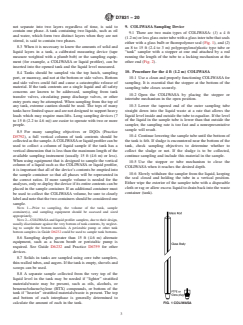
9.1 There are two main types of COLIWASA: (1)a4ft
and water, which form two distinct layers when they are not
(1.2 m) or less glass outer tube with a glass inter tube that seals
stirred, is said to contain two phases.
either with a glass bulb or fluoropolymer seal (Fig. 1), and (2)
8.3 When it is necessary to know the amounts of solid and
an 8 to 15 ft (2.4 to 3 m) polypropylene/plastic type tube or
liquid layers in a tank, a calibrated measuring device (tape “tank” sampler with a stopper at one end attached by a rod
measure weighted with a plumb bob) or the sampling equip-
running the length of the tube to a locking mechanism at the
ment (for example, a COLIWASA or liquid profiler), can be other end (Fig. 2).
inserted into the opened tank and the liquid level measured.
10. Procedure for the 4 ft (1.2 m) COLIWASA
8.4 Tanks should be sampled via the top hatch, sampling
port, or manway, and not at the bottom or side valves. Bottom
10.1 Use a clean and properly functioning COLIWASA for
and side valves could fail and cause a catastrophic release of
sampling. It is essential that the stopper at the bottom of the
material. If the tank contents are a single liquid and all safety
sampling tube closes securely.
concerns are known to be addressed, sampling from tank
10.2 Open the COLIWASA by placing the stopper or
transfer valves, circulating pump discharge valves, or other
intertube mechanism in the open position.
entry ports may be attempted. When sampling from the top of
10.3 Lower the tapered end of the outer sampling tube
any tank, extreme caution should be used. The tops
...
This document is not an ASTM standard and is intended only to provide the user of an ASTM standard an indication of what changes have been made to the previous version. Because
it may not be technically possible to adequately depict all changes accurately, ASTM recommends that users consult prior editions as appropriate. In all cases only the current version
of the standard as published by ASTM is to be considered the official document.
Designation: D7831 − 13 D7831 − 20
Standard Practice for
Sampling of Tanks by Field Personnel
This standard is issued under the fixed designation D7831; the number immediately following the designation indicates the year of
original adoption or, in the case of revision, the year of last revision. A number in parentheses indicates the year of last reapproval. A
superscript epsilon (´) indicates an editorial change since the last revision or reapproval.
1. Scope
1.1 This practice covers information for field personnel to follow in order to collect samples from tanks.
1.2 The purpose of this practice is to help field personnel in planning and obtaining samples from vertical and horizontal tanks,
open-topped rectangular/square tanks, railroad and truck tankers, vacuum trucks, and tanks with multiple compartments using
equipment and techniques that will assist in meeting the sampling objectives.
1.3 The practice is applicable to hazardous materials, products, raw materials, by-product, or waste.
1.4 Sampling from circulating pump discharge valves and tank transfer lines areis not addressed in this practice.
1.5 Units—The values stated in inch-pound units are to be regarded as the standard. The values given in parentheses are
mathematical conversions to SI units that are provided for information only and are not considered standard.
1.6 This standard does not purport to address all of the safety concerns, if any, associated with its use. It is the responsibility
of the user of this standard to establish appropriate safety safety, health, and healthenvironmental practices and determine the
applicability of regulatory limitations prior to use.
1.7 This international standard was developed in accordance with internationally recognized principles on standardization
established in the Decision on Principles for the Development of International Standards, Guides and Recommendations issued
by the World Trade Organization Technical Barriers to Trade (TBT) Committee.
2. Referenced Documents
2.1 ASTM Standards:
D4687 Guide for General Planning of Waste Sampling
D4840 Guide for Sample Chain-of-Custody Procedures
D5088 Practice for Decontamination of Field Equipment Used at Waste Sites
D5283 Practice for Generation of Environmental Data Related to Waste Management Activities: Quality Assurance and Quality
Control Planning and Implementation
D5495 Practice for Sampling With a Composite Liquid Waste Sampler (COLIWASA)
D5681 Terminology for Waste and Waste Management
This practice is under the jurisdiction of ASTM Committee D34 on Waste Management and is the direct responsibility of Subcommittee D34.01.02 on Sampling
Techniques.
Current edition approved April 1, 2013Dec. 1, 2020. Published May 2013January 2021. Originally approved in 2013. Last previous edition approved in 2013 as
D7831 – 13. DOI: 10.1520/D7831-13.10.1520/D7831-20.
For referenced ASTM standards, visit the ASTM website, www.astm.org, or contact ASTM Customer Service at service@astm.org. For Annual Book of ASTM Standards
volume information, refer to the standard’s Document Summary page on the ASTM website.
Copyright © ASTM International, 100 Barr Harbor Drive, PO Box C700, West Conshohocken, PA 19428-2959. United States
D7831 − 20
D5792 Practice for Generation of Environmental Data Related to Waste Management Activities: Development of Data Quality
Objectives
D6232 Guide for Selection of Sampling Equipment for Waste and Contaminated Media Data Collection Activities
D6759 Practice for Sampling Liquids Using Grab and Discrete Depth Samplers
D7353 Practice for Sampling of Liquids in Waste Management Activities Using a Peristaltic Pump
3. Terminology
3.1 Definitions:
3.1.1 For definitions of terms used in this guide,practice, refer to Terminology D5681.
3.1.2 tank, n—stationary device designed to contain an accumulated material that is constructed of non-earthen materials that
provide structural support.
3.1.2.1 Discussion—
It may be appropriate to consider various containers (portable devices), such as roll offs, tanker trucks, and rail tank cars, as tanks
for sampling purposes, even if they meet a regulatory definition of a container.
4. Summary of Practice
4.1 This practice addresses sampling planning, including pre-sampling and site inspections.
4.2 This practice lists some of the factors that should be considered when collecting tank content samples.
4.3 Sampling procedures for the equipment needed to sample vertical and horizontal tanks, open-topped rectangular/square tanks,
railroad and truck tankers, vacuum trucks, and tanks with multiple compartments are presented.
4.4 Sampling procedures to sample single and stratified materials and wastes are addressed.
4.5 It is not intended to cover all equipment that might be purchased or custom made, nor does the guidethis practice address every
sampling situation that is encountered in the field.
5. Significance and Use
5.1 This practice is intended to assist field personnel in obtaining samples from tanks for laboratory analysis. The cost associated
with sampling and analysis analysis, along with other reasons, make it essential that samples be taken correctly before submitting
them for chemical analysis, physical testing, or both. Incorrect sampling can invalidate resulting data.
5.2 This practice provides guidance in choosing the sampling technique and equipment suitable for specific situations. It is
recommended that this guide be used as a supplement to a written field sampling plan.
5.3 The procedures for sampling tanks using a COLIWASA, liquid profiler sampler, Bacon Bombbacon bomb sampler, and
peristaltic pump and tubing are delineated.
6. Objective of Sampling
6.1 The purpose of sampling is to collect a representative sample of all or part of the contents of the tank to determine the physical
and chemical characteristics of those contents. This information may then be used to:
6.1.1 Select suitable methods of treatment and disposal of the contents,
6.1.2 Provide evidence for use in a court of law,
6.1.3 Confirm that the tank contains what is written on the inventory sheets,
6.1.4 Confirm that the tank car or truck contains what is written on the manifest or other type of documentation.
D7831 − 20
6.2 In most cases, there is a written plan that describes the work to be done (Practice(Guide D4687). In other cases, there is no
written plan and the instructions are only verbal.
6.3 If the objectives of sampling are unclear or unknown to the field personnel, they should question their supervisor or project
manager about the objectives. Well-informed field personnel are then alert to unforeseen circumstances or events that might
invalidate the samples.
7. Pre-Sampling Inspection
7.1 Information about the contents of the tanks may be available from:
7.1.1 Previous analysis of tank contents,
7.1.2 Records or knowledge of the plant process or other sources of the material in the tank,
7.1.3 Shipping manifest documents.
7.2 Personnel doing the pre-sampling and sampling must be aware of any special procedures that are to be followed at the given
site. Work plans shall include a worker health and safety section because there are potential hazards associated with opening tanks
as well as with potentially hazardous contents. Examples of special procedures are donning appropriate protective clothing,
personal protective equipment, use of safety equipment of various kinds, evacuation procedures, fire and explosion procedures and
procedures, vehicle cleaning procedures such as water washing before leaving the site or storage area, and many others that would
be site or storage specific.
7.3 Visually inspect the tank. The type of tank and construction material, along with any markings on the tank, may indicate
information about the contents.
7.3.1 Special precautions should be taken when the tank is in poor condition, such as a material leaking from the tank sides,
pumps, and flanges. If the tank ladders are rusted or corroded, this might indicate that the tank manway or other covers may be
difficult to open and the ladders unsafe to use.
7.3.2 Labels and records about a tank may not be accurate. This is especially true for tanks containing multiple waste materials
or tanks that contain stratified materials.
7.4 Examples of different tanks,tanks and tank-like containers,containers include:
7.4.1 Vertical tanks, often used for storage of petroleum and petroleum waste product and various other chemicals.
7.4.2 Horizontal tanks, common as railroad and truck tanker cars, vacuum trucks, and for storage of waste materials and products
at facilities. Many of these tanks have multiple compartments and each compartment may need to be sampled separately.
7.4.3 Open-topped rectangular and square tanks, common at electroplating facilities and batch processing plants. These can also
include concrete sumps with vertical walls.
7.5 The sampling tools, sampling equipment, and sample container shall be selected based on information gathered in the initial
characterization of the tank, its contents, and possible sampling points.
7.6 Potential sampling points should be evaluated for safety and accessibility.
7.6.1 Tools needed to remove the manway or other covers should be non-sparking and intrinsically safe.
7.7 The following information shall be gathered and recorded in the field logbook as applicable:
7.7.1 Tank type (that is, horizontal, vertical) dimensions, volume, and conditions (that is, corroded, rusted, leaking contents, and
so forth). A sketch of the tank,tank showing dimensions and depths of contents should be recorded.
D7831 − 20
7.7.2 Physical characteristics (that is, color, viscosity, particle size, and so forth) and quantity and depth of containerized material.
7.7.3 All writing, stencils, labels, or other identifying markings on the tank (that is, flammability and or and/or reactivity labels,
product name and hazards, and so forth).
7.7.4 Appropriate screening instrument and method readings of the tank head space gases or contents, or both (for example,
organic vapor analyzer and photo ionization detectors, combustible gas indicators (CGI),(CGIs)), pH paper, or meter readings.
8. Selection of Suitable Sampling Procedure
8.1 The physical state(s) of the material(s) being sampled is an important criterion when sampling.
8.2 A tank containing one liquid, such as water or a mixture of liquids, such as a stable emulsion like hand cream, that does not
separate into two layers regardless of time, is said to contain one phase. A tank containing two liquids, such as oil and water, which
form two distinct layers when they are not stirred, is said to contain two phases.
8.3 When it is necessary to know the amounts of solid and liquid layers in a tank, a calibrated measuring device (tape measure
weighted with a plumb bob) or the sampling equipment,equipment (for example, a COLIWASA or liquid profiler)profiler), can be
inserted into the opened tank and the liquid level measured.
8.4 Tanks should be sampled via the top hatch, sampling port, or manway, and not at the bottom or side valves. Bottom and side
valves could fail and cause a catastrophic release of material. If the tank contents are a single liquid and all safety concerns are
known to be addressed, sampling from tank transfer valves, circulating pump discharge valves, or other entry ports may be
attempted. When sampling from the top of any tank, extreme caution should be used. The tops of many tanks have limited space
and are not designed to support heavy loads which may require man-lifts. Long sampling devices (7-15 ft [2.2-4.6 m]) (7 to 15
ft (2.2 to 4.6 m)) are easier to operate with two or more people.
8.5 For many sampling objectives or DQOs (Practice D5792)), a full vertical column of tank contents should be collected as the
sample. A COLIWASA or liquid profiler can be used to collect a column of liquid sample if the tank has a vertical dimension that
is less than the maximum length of the available sampling instrument (usually 15 ft [4.6 m](4.6 m) or less). When using equipment
that is designed to sample the vertical column of a liquid such as the COLIWASA or liquid profiler, it is important that all of the
device’s contents be emptied into the sample container so that all phases will be represented in the correct ratios. If more sample
volume is needed for the ana
...