

ASTM D7279-20
(Test Method)Standard Test Method for Kinematic Viscosity of Transparent and Opaque Liquids by Automated Houillon Viscometer
General Information
- Abstract
SIGNIFICANCE AND USE
5.1 Many petroleum products and some non-petroleum products are used as lubricants in the equipment, and the correct operation of the equipment depends upon the appropriate viscosity of the lubricant being used. Additionally, the viscosity of many petroleum fuels is important for the estimation of optimum storage, handling, and operational conditions. Thus, the accurate determination of viscosity is essential to many product specifications.
5.2 The viscosity of used oils is a commonly determined parameter in the oil industry to assess the effect of engine wear on the lube oils used, as well as the degradation of the engine parts during operation.
5.3 The Houillon viscometer tube method offers automated determination of kinematic viscosity. Typically a sample volume of less than 1 mL is required for the analysis.
SCOPE
1.1 This test method covers the measurement of the kinematic viscosity of transparent and opaque liquids; such as base oils, formulated oils, diesel oil, biodiesel, biodiesel blends, residual fuel oils, marine fuels, and used lubricating oils using a Houillon viscometer in automated mode.
1.2 The range of kinematic viscosity capable of being measured by this test method is from 2 mm2/s to 2500 mm2/s (see Fig. 1). The range is dependent on the tube constant utilized. The temperature range that the apparatus is capable of achieving is between 20 °C and 150 °C, inclusive. However, the precision has only been determined for the viscosity range; 2 mm2/s to 478 mm2/s at 40 °C for base oils, formulated oils, diesel oil, biodiesel, and biodiesel blends; 3 mm2/s to 106 mm2/s at 100 °C for base oils and formulated oils; 25 mm2/s to 150 mm2/s at 40 °C and 5 mm2/s to 16 mm2/s at 100 °C for used lubricating oils; 25 mm2/s to 2500 mm2/s at 50 °C and 6 mm2/s to 110 mm2/s at 100 °C for residual fuels. As indicated for the materials listed in the precision section.
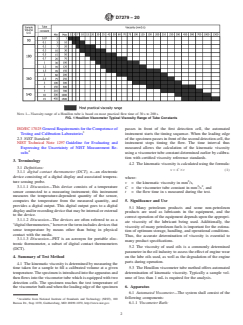
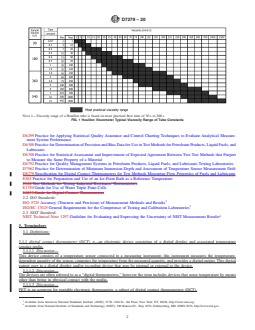
FIG. 1 Houillon Viscometer Typical Viscosity Range of Tube Constants
Note 1: Viscosity range of a Houillon tube is based on most practical flow time of 30 s to 200 s.
1.3 The values stated in SI units are to be regarded as standard. No other units of measurement are included in this standard.
1.4 This standard does not purport to address all of the safety concerns, if any, associated with its use. It is the responsibility of the user of this standard to establish appropriate safety, health, and environmental practices and determine the applicability of regulatory limitations prior to use. For specific warning statements, see Section 7.
1.5 This international standard was developed in accordance with internationally recognized principles on standardization established in the Decision on Principles for the Development of International Standards, Guides and Recommendations issued by the World Trade Organization Technical Barriers to Trade (TBT) Committee.
- Status
- Published
- Publication Date
- 31-Oct-2020
- Technical Committee
- D02 - Petroleum Products, Liquid Fuels, and Lubricants
- Drafting Committee
- D02.07 - Flow Properties
Buy Documents
ASTM D7279-20 - Standard Test Method for Kinematic Viscosity of Transparent and Opaque Liquids by Automated Houillon Viscometer
REDLINE ASTM D7279-20 - Standard Test Method for Kinematic Viscosity of Transparent and Opaque Liquids by Automated Houillon Viscometer
Overview
ASTM D7279-20 is the internationally recognized standard test method for the determination of kinematic viscosity of both transparent and opaque liquids using an automated Houillon viscometer. This method is crucial for quality control and operational efficiency in industries relying on petroleum products and lubricants, ensuring that these materials meet specific viscosity requirements essential to equipment function and fuel handling. It encompasses a broad range of sample types including base oils, formulated oils, diesel oil, biodiesel, biodiesel blends, residual fuel oils, marine fuels, and used lubricating oils.
Key Topics
- Kinematic Viscosity Measurement: This method specifies procedures for measuring the kinematic viscosity of liquid samples within a range of approximately 2 mm²/s to 2500 mm²/s, depending on the viscometer tube constant and test temperature.
- Automated Houillon Viscometer: Employs an automated system for precise viscosity measurement using a small sample volume (typically less than 1 mL), making it ideal for high-throughput laboratories.
- Sample Types and Temperature Ranges: Capable of testing a wide variety of transparent and opaque petroleum products and fuels across a temperature range from 20°C to 150°C.
- Precision and Quality Control: Provides clearly defined procedures for repeatability, reproducibility, calibration, and quality control to ensure reliable results.
- Significance and Use: Kinematic viscosity values are vital for optimizing storage, handling, operational efficiency, and for monitoring lubricant degradation and equipment wear.
Applications
The ASTM D7279-20 standard is widely used in:
- Petroleum Industry: For determining the suitability of base oils, formulated oils, diesel fuels, and residual fuels where viscosity directly impacts storage and engine performance.
- Lubricant Manufacturing and Analysis: To assess both new and used lubricating oils, aiding in predicting lubricant degradation and machinery wear, which is essential for maintenance strategies.
- Fuel Quality Control: Ensures that diesel, biodiesel, marine fuel, and blends meet required specifications for safe handling and optimal engine operation.
- Automated Laboratory Testing: Due to its automation, this method is highly effective in labs requiring reproducible and efficient analysis of a large number of samples with minimal operator intervention.
Key advantages include:
- Automated system increases testing throughput and reduces potential for human error.
- Small sample volume minimizes waste and costs.
- Ability to handle both transparent and opaque liquids efficiently.
- Well-defined calibration and quality assurance processes improve confidence in results.
Related Standards
ASTM D7279-20 references and complements several other important standards and practices including:
- ASTM D445: Test Method for Kinematic Viscosity of Transparent and Opaque Liquids (and Calculation of Dynamic Viscosity)
- ASTM D2162: Practice for Basic Calibration of Master Viscometers and Viscosity Oil Standards
- ASTM D4057 & D4177: Practices for Manual and Automatic Sampling of Petroleum and Petroleum Products
- ASTM D6299: Practice for Applying Statistical Quality Assurance and Control Charting Techniques
- ASTM D6708: Practice for Statistical Assessment and Improvement of Agreement Between Test Methods
- ISO 5725: Accuracy of Measurement Methods and Results
- ISO/IEC 17025: General Requirements for the Competence of Testing and Calibration Laboratories
By adhering to ASTM D7279-20 and its related standards, laboratories and industry professionals can ensure that their viscosity measurements are accurate, reproducible, and meet global quality benchmarks.
Keywords: ASTM D7279, kinematic viscosity, Houillon viscometer, petroleum products, lubricant analysis, fuel viscosity, quality control, automated viscosity testing.
Relations
- Effective Date
- 01-Apr-2024
- Effective Date
- 01-Mar-2024
- Effective Date
- 01-Mar-2024
- Effective Date
- 01-Dec-2023
- Effective Date
- 01-Dec-2023
- Effective Date
- 01-Nov-2023
- Effective Date
- 01-Nov-2023
- Effective Date
- 01-Nov-2023
- Effective Date
- 01-Oct-2023
- Effective Date
- 01-Dec-2019
- Effective Date
- 01-May-2019
- Effective Date
- 01-Apr-2018
- Effective Date
- 15-Dec-2017
- Effective Date
- 15-Nov-2017
- Effective Date
- 01-Jan-2017
Buy Documents
ASTM D7279-20 - Standard Test Method for Kinematic Viscosity of Transparent and Opaque Liquids by Automated Houillon Viscometer
REDLINE ASTM D7279-20 - Standard Test Method for Kinematic Viscosity of Transparent and Opaque Liquids by Automated Houillon Viscometer
Get Certified
Connect with accredited certification bodies for this standard

Element Materials Technology
Materials testing and product certification.

ABS Group Brazil
ABS Group certification services in Brazil.

ABS Quality Evaluations Inc.
American Bureau of Shipping quality certification.
Sponsored listings
Frequently Asked Questions
ASTM D7279-20 is a standard published by ASTM International. Its full title is "Standard Test Method for Kinematic Viscosity of Transparent and Opaque Liquids by Automated Houillon Viscometer". This standard covers: SIGNIFICANCE AND USE 5.1 Many petroleum products and some non-petroleum products are used as lubricants in the equipment, and the correct operation of the equipment depends upon the appropriate viscosity of the lubricant being used. Additionally, the viscosity of many petroleum fuels is important for the estimation of optimum storage, handling, and operational conditions. Thus, the accurate determination of viscosity is essential to many product specifications. 5.2 The viscosity of used oils is a commonly determined parameter in the oil industry to assess the effect of engine wear on the lube oils used, as well as the degradation of the engine parts during operation. 5.3 The Houillon viscometer tube method offers automated determination of kinematic viscosity. Typically a sample volume of less than 1 mL is required for the analysis. SCOPE 1.1 This test method covers the measurement of the kinematic viscosity of transparent and opaque liquids; such as base oils, formulated oils, diesel oil, biodiesel, biodiesel blends, residual fuel oils, marine fuels, and used lubricating oils using a Houillon viscometer in automated mode. 1.2 The range of kinematic viscosity capable of being measured by this test method is from 2 mm2/s to 2500 mm2/s (see Fig. 1). The range is dependent on the tube constant utilized. The temperature range that the apparatus is capable of achieving is between 20 °C and 150 °C, inclusive. However, the precision has only been determined for the viscosity range; 2 mm2/s to 478 mm2/s at 40 °C for base oils, formulated oils, diesel oil, biodiesel, and biodiesel blends; 3 mm2/s to 106 mm2/s at 100 °C for base oils and formulated oils; 25 mm2/s to 150 mm2/s at 40 °C and 5 mm2/s to 16 mm2/s at 100 °C for used lubricating oils; 25 mm2/s to 2500 mm2/s at 50 °C and 6 mm2/s to 110 mm2/s at 100 °C for residual fuels. As indicated for the materials listed in the precision section. FIG. 1 Houillon Viscometer Typical Viscosity Range of Tube Constants Note 1: Viscosity range of a Houillon tube is based on most practical flow time of 30 s to 200 s. 1.3 The values stated in SI units are to be regarded as standard. No other units of measurement are included in this standard. 1.4 This standard does not purport to address all of the safety concerns, if any, associated with its use. It is the responsibility of the user of this standard to establish appropriate safety, health, and environmental practices and determine the applicability of regulatory limitations prior to use. For specific warning statements, see Section 7. 1.5 This international standard was developed in accordance with internationally recognized principles on standardization established in the Decision on Principles for the Development of International Standards, Guides and Recommendations issued by the World Trade Organization Technical Barriers to Trade (TBT) Committee.
SIGNIFICANCE AND USE 5.1 Many petroleum products and some non-petroleum products are used as lubricants in the equipment, and the correct operation of the equipment depends upon the appropriate viscosity of the lubricant being used. Additionally, the viscosity of many petroleum fuels is important for the estimation of optimum storage, handling, and operational conditions. Thus, the accurate determination of viscosity is essential to many product specifications. 5.2 The viscosity of used oils is a commonly determined parameter in the oil industry to assess the effect of engine wear on the lube oils used, as well as the degradation of the engine parts during operation. 5.3 The Houillon viscometer tube method offers automated determination of kinematic viscosity. Typically a sample volume of less than 1 mL is required for the analysis. SCOPE 1.1 This test method covers the measurement of the kinematic viscosity of transparent and opaque liquids; such as base oils, formulated oils, diesel oil, biodiesel, biodiesel blends, residual fuel oils, marine fuels, and used lubricating oils using a Houillon viscometer in automated mode. 1.2 The range of kinematic viscosity capable of being measured by this test method is from 2 mm2/s to 2500 mm2/s (see Fig. 1). The range is dependent on the tube constant utilized. The temperature range that the apparatus is capable of achieving is between 20 °C and 150 °C, inclusive. However, the precision has only been determined for the viscosity range; 2 mm2/s to 478 mm2/s at 40 °C for base oils, formulated oils, diesel oil, biodiesel, and biodiesel blends; 3 mm2/s to 106 mm2/s at 100 °C for base oils and formulated oils; 25 mm2/s to 150 mm2/s at 40 °C and 5 mm2/s to 16 mm2/s at 100 °C for used lubricating oils; 25 mm2/s to 2500 mm2/s at 50 °C and 6 mm2/s to 110 mm2/s at 100 °C for residual fuels. As indicated for the materials listed in the precision section. FIG. 1 Houillon Viscometer Typical Viscosity Range of Tube Constants Note 1: Viscosity range of a Houillon tube is based on most practical flow time of 30 s to 200 s. 1.3 The values stated in SI units are to be regarded as standard. No other units of measurement are included in this standard. 1.4 This standard does not purport to address all of the safety concerns, if any, associated with its use. It is the responsibility of the user of this standard to establish appropriate safety, health, and environmental practices and determine the applicability of regulatory limitations prior to use. For specific warning statements, see Section 7. 1.5 This international standard was developed in accordance with internationally recognized principles on standardization established in the Decision on Principles for the Development of International Standards, Guides and Recommendations issued by the World Trade Organization Technical Barriers to Trade (TBT) Committee.
ASTM D7279-20 is classified under the following ICS (International Classification for Standards) categories: 17.060 - Measurement of volume, mass, density, viscosity; 75.100 - Lubricants, industrial oils and related products. The ICS classification helps identify the subject area and facilitates finding related standards.
ASTM D7279-20 has the following relationships with other standards: It is inter standard links to ASTM D445-24, ASTM D6708-24, ASTM D6300-24, ASTM D6300-23a, ASTM D6299-23a, ASTM D445-23, ASTM E1750-23, ASTM D6792-23c, ASTM D6792-23b, ASTM D6300-19a, ASTM D6708-19, ASTM D6708-18, ASTM D6299-17b, ASTM D6299-17a, ASTM D6299-17. Understanding these relationships helps ensure you are using the most current and applicable version of the standard.
ASTM D7279-20 is available in PDF format for immediate download after purchase. The document can be added to your cart and obtained through the secure checkout process. Digital delivery ensures instant access to the complete standard document.
Standards Content (Sample)
This international standard was developed in accordance with internationally recognized principles on standardization established in the Decision on Principles for the
Development of International Standards, Guides and Recommendations issued by the World Trade Organization Technical Barriers to Trade (TBT) Committee.
Designation: D7279 − 20
Standard Test Method for
Kinematic Viscosity of Transparent and Opaque Liquids by
Automated Houillon Viscometer
This standard is issued under the fixed designation D7279; the number immediately following the designation indicates the year of
original adoption or, in the case of revision, the year of last revision. A number in parentheses indicates the year of last reapproval. A
superscript epsilon (´) indicates an editorial change since the last revision or reapproval.
1. Scope* 2. Referenced Documents
2.1 ASTM Standards:
1.1 This test method covers the measurement of the kine-
D445 Test Method for Kinematic Viscosity of Transparent
matic viscosity of transparent and opaque liquids; such as base
and Opaque Liquids (and Calculation of Dynamic Viscos-
oils, formulated oils, diesel oil, biodiesel, biodiesel blends,
ity)
residual fuel oils, marine fuels, and used lubricating oils using
D2162 Practice for Basic Calibration of Master Viscometers
a Houillon viscometer in automated mode.
and Viscosity Oil Standards
1.2 The range of kinematic viscosity capable of being
D4057 Practice for Manual Sampling of Petroleum and
2 2
measured by this test method is from 2 mm /s to 2500 mm /s
Petroleum Products
(see Fig. 1). The range is dependent on the tube constant
D4177 Practice for Automatic Sampling of Petroleum and
utilized.The temperature range that the apparatus is capable of
Petroleum Products
achieving is between 20 °C and 150 °C, inclusive. However,
D6299 Practice for Applying Statistical Quality Assurance
the precision has only been determined for the viscosity range;
and Control Charting Techniques to Evaluate Analytical
2 2
2mm /s to 478 mm /s at 40 °C for base oils, formulated oils,
Measurement System Performance
diesel oil, biodiesel, and biodiesel blends; 3 mm /s to
D6300 Practice for Determination of Precision and Bias
106 mm /s at 100 °C for base oils and formulated oils;
Data for Use in Test Methods for Petroleum Products,
2 2 2 2
25 mm /s to 150 mm /s at 40 °C and 5 mm /s to 16 mm /s at
Liquid Fuels, and Lubricants
2 2
100 °C for used lubricating oils; 25 mm /s to 2500 mm /s at
D6708 Practice for StatisticalAssessment and Improvement
2 2
50 °C and 6 mm /s to 110 mm /s at 100 °C for residual fuels.
of Expected Agreement Between Two Test Methods that
As indicated for the materials listed in the precision section.
Purport to Measure the Same Property of a Material
1.3 The values stated in SI units are to be regarded as
D6792 Practice for Quality Management Systems in Petro-
standard. No other units of measurement are included in this
leum Products, Liquid Fuels, and Lubricants Testing
standard.
Laboratories
D7962 Practice for Determination of Minimum Immersion
1.4 This standard does not purport to address all of the
Depth and Assessment of Temperature Sensor Measure-
safety concerns, if any, associated with its use. It is the
ment Drift
responsibility of the user of this standard to establish appro-
D8278 Specification for Digital Contact Thermometers for
priate safety, health, and environmental practices and deter-
Test Methods Measuring Flow Properties of Fuels and
mine the applicability of regulatory limitations prior to use.
Lubricants
For specific warning statements, see Section 7.
E563 Practice for Preparation and Use of an Ice-Point Bath
1.5 This international standard was developed in accor-
as a Reference Temperature
dance with internationally recognized principles on standard-
E1750 Guide for Use of Water Triple Point Cells
ization established in the Decision on Principles for the
Development of International Standards, Guides and Recom-
2.2 ISO Standards:
mendations issued by the World Trade Organization Technical ISO 5725 Accuracy (Trueness and Precision) of Measure-
Barriers to Trade (TBT) Committee.
ment Methods and Results
1 2
This test method is under the jurisdiction of ASTM Committee D02 on For referenced ASTM standards, visit the ASTM website, www.astm.org, or
Petroleum Products, Liquid Fuels, and Lubricants and is the direct responsibility of contact ASTM Customer Service at service@astm.org. For Annual Book of ASTM
Subcommittee D02.07 on Flow Properties. Standards volume information, refer to the standard’s Document Summary page on
Current edition approved Nov. 1, 2020. Published November 2020. Originally the ASTM website.
ɛ1 3
approved in 2006. Last previous edition approved in 2018 as D7279 – 18 . DOI: Available fromAmerican National Standards Institute (ANSI), 25 W. 43rd St.,
10.1520/D7279-20. 4th Floor, New York, NY 10036, http://www.ansi.org.
*A Summary of Changes section appears at the end of this standard
Copyright © ASTM International, 100 Barr Harbor Drive, PO Box C700, West Conshohocken, PA 19428-2959. United States
D7279 − 20
NOTE 1—Viscosity range of a Houillon tube is based on most practical flow time of 30 s to 200 s.
FIG. 1 Houillon Viscometer Typical Viscosity Range of Tube Constants
ISO/EC17025 GeneralRequirementsfortheCompetenceof passes in front of the first detection cell, the automated
Testing and Calibration Laboratories instrument starts the timing sequence. When the leading edge
of the specimen passes in front of the second detection cell, the
2.3 NIST Standard:
NIST Technical Note 1297 Guideline for Evaluating and instrument stops timing the flow. The time interval thus
measured allows the calculation of the kinematic viscosity
Expressing the Uncertainty of NIST Measurement Re-
sults using a viscometer tube constant determined earlier by calibra-
tion with certified viscosity reference standards.
3. Terminology
4.2 The kinematic viscosity is calculated using the formula:
3.1 Definitions:
ν 5 C 3t (1)
3.1.1 digital contact thermometer (DCT), n—an electronic
device consisting of a digital display and associated tempera-
where:
ture sensing probe.
ν = the kinematic viscosity in mm /s,
2 2
3.1.1.1 Discussion—This device consists of a temperature
C = the viscometer tube constant in mm /s , and
sensor connected to a measuring instrument; this instrument
t = the flow time in s measured during the test.
measures the temperature-dependent quantity of the sensor,
computes the temperature from the measured quantity, and 5. Significance and Use
provides a digital output. This digital output goes to a digital
5.1 Many petroleum products and some non-petroleum
displayand/orrecordingdevicethatmaybeinternalorexternal
products are used as lubricants in the equipment, and the
to the device.
correct operation of the equipment depends upon the appropri-
3.1.1.2 Discussion—The devices are often referred to as a
ate viscosity of the lubricant being used. Additionally, the
“digitalthermometers,”howeverthetermincludesdevicesthat
viscosity of many petroleum fuels is important for the estima-
sense temperature by means other than being in physical
tion of optimum storage, handling, and operational conditions.
contact with the media.
Thus, the accurate determination of viscosity is essential to
3.1.1.3 Discussion—PET is an acronym for portable elec-
many product specifications.
tronic thermometer, a subset of digital contact thermometers
5.2 The viscosity of used oils is a commonly determined
(DCT).
parameter in the oil industry to assess the effect of engine wear
4. Summary of Test Method on the lube oils used, as well as the degradation of the engine
parts during operation.
4.1 The kinematic viscosity is determined by measuring the
time taken for a sample to fill a calibrated volume at a given 5.3 The Houillon viscometer tube method offers automated
determination of kinematic viscosity. Typically a sample vol-
temperature.Thespecimenisintroducedintotheapparatusand
thenflowsintotheviscometertubewhichisequippedwithtwo ume of less than 1 mL is required for the analysis.
detection cells. The specimen reaches the test temperature of
6. Apparatus
theviscometerbathandwhentheleadingedgeofthespecimen
6.1 Automated Viscometer—The system shall consist of the
following components:
Available from National Institute of Standards and Technology (NIST), 100
Bureau Dr., Stop 1070, Gaithersburg, MD 20899-1070, http://www.nist.gov. 6.1.1 Viscometer Bath:
D7279 − 20
6.1.1.1 Bath, to ensure optimal thermal equilibration of the 7.1.1 The uncertainty of the certified viscosity reference
system, the bath is filled with mineral or silicone oil and standard shall be stated for each certified value (k=2@95%
equipped with a stirring device. confidence). See ISO 5725 or NIST 1297.
6.1.2 Temperature Regulation System, to control the bath
7.2 Non-chromium-containing, strongly oxidizing acid
temperature to within 0.02 °C.
cleaning solution. (Warning—Non-chromium-containing,
6.1.3 Houillon Viscometer Tubes, made of glass with a
strongly oxidizing acid cleaning solutions are highly corrosive
calibratedvolumewhichvariesdependingonthetubesize(see
andpotentiallyhazardousincontactwithorganicmaterials,but
Fig. 2). This technique allows the viscosity to be measured
do not contain chromium which has special disposal prob-
over a wide range of values (see Fig. 1).
lems.)
6.1.4 Cleaning/Vacuum System, consisting of one or more
7.3 Solvent(s) for cleaning, drying, reagent grade. Refer to
solvent reservoirs to transport the solvent(s) to the viscometer
manufacturer’s recommendations. Filter before use if neces-
tubes, dry the viscometer tubes after the flushing cycle, to
sary. Typical solvent(s) include:
remove the sample, and for drainage of waste products.
7.3.1 Toluene. (Warning—Flammable. Vapor harmful.)
6.1.5 Automated Viscometer Control System—Suitable elec-
7.3.2 Petroleum spirit or naphtha. (Warning—Flammable.
tronicprocessorcapableofoperatingtheapparatus,controlling
Health hazard.)
the operation of the timers, regulating the bath temperature,
7.3.3 Acetone. (Warning—Extremely flammable. Health
cleaning the viscometer tubes, and recording and reporting the
results. hazard.)
6.1.6 PC-compatible Computer System, may be used for 7.3.4 Heptane. (Warning—Flammable. Health hazard.)
data acquisition, as per manufacturer’s instructions.
7.4 Technical grade silicone oil or white oil of appropriate
6.1.7 Timing Devices—Use any timing device that is ca- 2
viscosity (for example, about 100 mm /s @ 25 °C or equiva-
pable of taking readings with a discrimination of 0.01 s or
lent) to maintain the test temperature.
better with an accuracy within 60.07 % of the reading when
tested over the minimum and maximum intervals of expected
8. Sampling and Test Specimens
flow times.
8.1 Obtain a representative test specimen in accordance
6.1.8 Volume Delivery Device, such as a micropipette,
with Practice D4057 or Practice D4177.
capable of delivering a sufficient volume of sample to the
Houillon tube being used. (See Fig. 1 for approximate sample
8.2 Instructions for Residual Fuel Oils—(Warning—
volumes.)
Exercise care as vigorous boil-over can occur when opaque
liquids that contain high levels of water are heated to high
6.2 Temperature Measuring Devices—Use either calibrated
temperatures. Wear appropriate personal protective equipment
liquid-in-glassthermometers,ofanaccuracyaftercorrectionof
for handling hot materials.)
60.02 °C or better, or other thermometric devices such as a
8.2.1 Placethefirstbatchofresidsamplestobeanalyzedfor
digital contact thermometer as described in 6.2.1 with equal or
the day in their original containers in a sample pre-heat
better accuracy.
6.2.1 Digital Contact Thermometer—Use D02-DCT07 apparatus that is held between 60 °C and 65 °C for 1 h. Ensure
the cap on each container is tightly closed.
listed in Specification D8278.
6.2.2 Measurement Drift—The drift in calibration should be 8.2.2 Rigorously stir each sample for approximately 20 s
checked periodically and at least once per year. This can be with a glass or steel rod of sufficient length to reach the bottom
accomplished using Practice D7962. When a DCT’s calibra- of the container.
tion drifts in one direction over several checks against a
8.2.3 Remove the stirring rod and inspect for sludge or wax
reference temperature, such as the ice point, it may be an
adhering to the rod. If there is sludge or wax adhering to the
indication of deterioration of the DCT. The probe is to be
rod, continue stirring until the sample is homogeneous.
recalibratedwhenthecheckvaluediffersbymorethanthedrift
8.2.4 Recap each container tightly and shake vigorously for
listed for the DCTsince the last probe calibration. See Practice
1 min. Then loosen the cap, retighten to finger tight, then back
E563orGuideE1750formoreinformationregardingchecking
off ⁄4turntoafullturnandplacebackintothesamplepre-heat
calibrations.
apparatus.
6.2.3 Itispreferableforthecenterofthesensingelementto
8.2.5 Upon completion of 8.2.4 for all samples in the batch,
be located at the same level as the lower half of the working
increase the sample pre-heat apparatus temperature to between
capillary as long as the minimum immersion requirements are
100 °C and 105 °C and continue heating for 30 min.
met.
8.2.6 Remove each container from the sample pre-heat
apparatus, close tightly, and shake vigorously for 60 s.
7. Reagents and Materials
8.2.7 Using a volume delivery device such as a
7.1 Certified viscosity reference standards shall be certified micropipette,introducesufficientvolumeofthesampleintothe
by a laboratory that has been shown to meet the requirements selected Houillon tube. The volume to be used is a function of
the viscometer tube constant. The volume delivery device may
of ISO/EC 17025 by independent assessment. The certified
viscosity reference standards shall be traceable to master be pre-warmed to facilitate transfer of highly viscous samples.
viscometer procedures described in Test Method D2162. (See Section 11.)
D7279 − 20
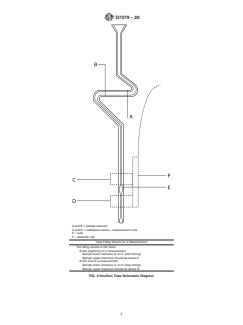
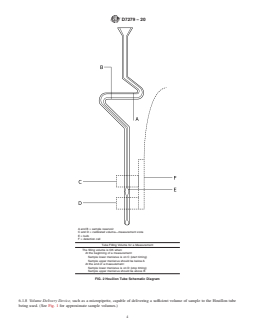
A and B = sample reservoir
C and D = calibrated volume—measurement zone
E = bulb
F = detection cell
Tube Filling Volume for a Measurement
The filling volume is OK when:
At the beginning of a measurement:
Sample lower meniscus is on C (start timing)
Sample upper meniscus should be below A
At the end of a measurement:
Sample lower meniscus is on D (stop timing)
Sample upper meniscus should be above B
FIG. 2 Houillon Tube Schematic Diagram
D7279 − 20
8.2.8 Analysisofallsamplesinthebatchmustbecompleted 11.1.1 Thermometers, if used, shall be held in an upright
within 1 h from completion of 8.2.6. position under the same conditions of immersion as when
calibrated.
9. Preparation of Apparatus
11.2 IntroduceasufficientvolumeofsampletotheHouillon
9.1 Place the automated viscometer on a stable and level
tube, using a volume delivery device (see 6.1.8) such as a
horizontal surface. Make appropriate piping, drainage, and
micro-pipette.The specimen volume to be used is a function of
vacuum connections. Refer to the manufacturer’s instructions.
the viscometer tube constant (see Fig. 1). Fig. 2 shows the
9.2 If not already mounted, install the detection cells.
correct specimen levels during a measurement.
9.3 After installing and securing all viscometer tubes in the
NOTE 3—Use a volume delivery device that is capable of introducing
bath, fill the bath with appropriate amount of bath fluid (see
the entire specimen volume in one operation.
7.4).
11.3 Introduce the specimen into the viscometer tube. Start
9.4 Add the appropriate amount of solvent(s) to the solvent
the measurement sequence.
reservoir(s).
11.4 The automated viscometer processing system will
9.5 Follow the manufacturer’s instructions for the operation
measure the flow times, calculate the viscosity according to Eq
of the instrument.
1, and record the result.
9.6 Select a clean, dry, and calibrated viscometer tube
11.5 Start the cleaning sequence (see Section 12).
having a range covering the estimated kinematic viscosity of
11.6 Allow the viscometer tube to reach the bath tempera-
the specimen to be tested, if known. The appropriate viscom-
ture (about 5 min) before performing a new measurement.
eter tube to use depends on the estimated viscosity of the
sample to be tested. The calculation in 9.6.1 may be used to
NOTE 4—In some units, the equilibration time required may be much
decide which tube to use.
less than 5 min.
9.6.1 Using Eq 1, the viscometer tube should be chosen so
that its constant C falls between ν/200 < C < ν/30 to give flow
12. Cleaning of Viscosity Tubes
times, T, between 30 s and 200 s.
12.1 The viscometer tubes are cleaned by vacuuming the
NOTE 1—In the interlaboratory study conducted for the development
specimen residue left in the viscometer tube followed by the
of this test method, the flow times were between 30 s and 200 s.
use of a solvent to remove any traces of the specimen on the
9.6.2 If a viscosity estimate is not known, a second analysis viscometertubewalls.Thesolventisthenremovedbyvacuum.
may be necessary using a different viscometer tube after a first Some units use a second solvent for drying the tube. This
trial analysis. operation is repeated several times until the viscometer tube is
clean. Periodically, the viscometer tube calibration constant
10. Calibration
should be checked.
10.1 Calibrate according to the manufacturer’s instructions.
12.2 The solvent(s) should have a boiling point appropriate
Calibrated tubes may be purchased but shall be verified as per
for the bath temperature.
10.4.
12.2.1 Thesolventflowmustbesufficienttocleantheentire
10.2 Use certified viscosity reference standards (see 7.1).
internalsectionoftheviscometertube.Thiscanbeachievedby
adjusting the solvent flow(s) and the flow rate using appropri-
10.3 Refer to Section 11 for general operation of the
ate controls.
automated viscometer and to the manufacturer’s instructions.
10.4 The determined kinematic viscosity should match the 12.3 The cleaning of one tube shall not be carried out while
certified value within 60.5 %. If it does not, then reanalyze the a test is being performed in another tube in the same bath.
standard.Ifthevalueisstilloutofrange,thencheckallcontrol
NOTE 5—Some multiple tube systems, although not included in the
system settings for the viscometer tube, and recheck each step
interlaborato
...
This document is not an ASTM standard and is intended only to provide the user of an ASTM standard an indication of what changes have been made to the previous version. Because
it may not be technically possible to adequately depict all changes accurately, ASTM recommends that users consult prior editions as appropriate. In all cases only the current version
of the standard as published by ASTM is to be considered the official document.
´1
Designation: D7279 − 18 D7279 − 20
Standard Test Method for
Kinematic Viscosity of Transparent and Opaque Liquids by
Automated Houillon Viscometer
This standard is issued under the fixed designation D7279; the number immediately following the designation indicates the year of
original adoption or, in the case of revision, the year of last revision. A number in parentheses indicates the year of last reapproval. A
superscript epsilon (´) indicates an editorial change since the last revision or reapproval.
ε NOTE—Editorially corrected Eq 1 in December 2019.
1. Scope*
1.1 This test method covers the measurement of the kinematic viscosity of transparent and opaque liquids; such as base oils,
formulated oils, diesel oil, biodiesel, biodiesel blends, residual fuel oils, marine fuels, and used lubricating oils using a Houillon
viscometer in automated mode.
2 2
1.2 The range of kinematic viscosity capable of being measured by this test method is from 2 mm /s to 2500 mm /s (see Fig. 1).
The range is dependent on the tube constant utilized. The temperature range that the apparatus is capable of achieving is between
2 2
20 °C and 150 °C, inclusive. However, the precision has only been determined for the viscosity range; 2 mm /s to 478 mm /s at
2 2
40 °C for base oils, formulated oils, diesel oil, biodiesel, and biodiesel blends; 3 mm /s to 106 mm /s at 100 °C for base oils and
2 2 2 2 2
formulated oils; 25 mm /s to 150 mm /s at 40 °C and 5 mm /s to 16 mm /s at 100 °C for used lubricating oils; 25 mm /s to
2 2 2
2500 mm /s at 50 °C and 6 mm /s to 110 mm /s at 100 °C for residual fuels. As indicated for the materials listed in the precision
section.
1.3 The values stated in SI units are to be regarded as standard. No other units of measurement are included in this standard.
1.4 This standard does not purport to address all of the safety concerns, if any, associated with its use. It is the responsibility
of the user of this standard to establish appropriate safety, health, and environmental practices and determine the applicability of
regulatory limitations prior to use. For specific warning statements, see Section 67.
1.5 This international standard was developed in accordance with internationally recognized principles on standardization
established in the Decision on Principles for the Development of International Standards, Guides and Recommendations issued
by the World Trade Organization Technical Barriers to Trade (TBT) Committee.
2. Referenced Documents
2.1 ASTM Standards:
D445 Test Method for Kinematic Viscosity of Transparent and Opaque Liquids (and Calculation of Dynamic Viscosity)
D2162 Practice for Basic Calibration of Master Viscometers and Viscosity Oil Standards
D4057 Practice for Manual Sampling of Petroleum and Petroleum Products
D4177 Practice for Automatic Sampling of Petroleum and Petroleum Products
This test method is under the jurisdiction of ASTM Committee D02 on Petroleum Products, Liquid Fuels, and Lubricants and is the direct responsibility of Subcommittee
D02.07 on Flow Properties.
Current edition approved June 1, 2018Nov. 1, 2020. Published July 2018November 2020. Originally approved in 2006. Last previous edition approved in 20162018 as
ɛ1
D7279 – 16.D7279 – 18 . DOI: 10.1520/D7279-18E01.10.1520/D7279-20.
For referenced ASTM standards, visit the ASTM website, www.astm.org, or contact ASTM Customer Service at service@astm.org. For Annual Book of ASTM Standards
volume information, refer to the standard’s Document Summary page on the ASTM website.
*A Summary of Changes section appears at the end of this standard
Copyright © ASTM International, 100 Barr Harbor Drive, PO Box C700, West Conshohocken, PA 19428-2959. United States
D7279 − 20
NOTE 1—Viscosity range of a Houillon tube is based on most practical flow time of 30 s to 200 s.
FIG. 1 Houillon Viscometer Typical Viscosity Range of Tube Constants
D6299 Practice for Applying Statistical Quality Assurance and Control Charting Techniques to Evaluate Analytical Measure-
ment System Performance
D6300 Practice for Determination of Precision and Bias Data for Use in Test Methods for Petroleum Products, Liquid Fuels, and
Lubricants
D6708 Practice for Statistical Assessment and Improvement of Expected Agreement Between Two Test Methods that Purport
to Measure the Same Property of a Material
D6792 Practice for Quality Management Systems in Petroleum Products, Liquid Fuels, and Lubricants Testing Laboratories
D7962 Practice for Determination of Minimum Immersion Depth and Assessment of Temperature Sensor Measurement Drift
D8278 Specification for Digital Contact Thermometers for Test Methods Measuring Flow Properties of Fuels and Lubricants
E563 Practice for Preparation and Use of an Ice-Point Bath as a Reference Temperature
E644 Test Methods for Testing Industrial Resistance Thermometers
E1750 Guide for Use of Water Triple Point Cells
E2877 Guide for Digital Contact Thermometers
2.2 ISO Standards:
ISO 5725 Accuracy (Trueness and Precision) of Measurement Methods and Results
ISO/EC 17025 General Requirements for the Competence of Testing and Calibration Laboratories
2.3 NIST Standard:
NIST Technical Note 1297 Guideline for Evaluating and Expressing the Uncertainty of NIST Measurement Results
3. Terminology
3.1 Definitions:
3.1.1 digital contact thermometer (DCT), n—an electronic device consisting of a digital display and associated temperature
sensing probe.
3.1.1.1 Discussion—
This device consists of a temperature sensor connected to a measuring instrument; this instrument measures the temperature-
dependent quantity of the sensor, computes the temperature from the measured quantity, and provides a digital output. This digital
output goes to a digital display and/or recording device that may be internal or external to the device.
3.1.1.2 Discussion—
The devices are often referred to as a “digital thermometers,” however the term includes devices that sense temperature by means
other than being in physical contact with the media.
3.1.1.3 Discussion—
PET is an acronym for portable electronic thermometer, a subset of digital contact thermometers (DCT).
Available from American National Standards Institute (ANSI), 25 W. 43rd St., 4th Floor, New York, NY 10036, http://www.ansi.org.
Available from National Institute of Standards and Technology (NIST), 100 Bureau Dr., Stop 1070, Gaithersburg, MD 20899-1070, http://www.nist.gov.
D7279 − 20
4. Summary of Test Method
4.1 The kinematic viscosity is determined by measuring the time taken for a sample to fill a calibrated volume at a given
temperature. The specimen is introduced into the apparatus and then flows into the viscometer tube which is equipped with two
detection cells. The specimen reaches the test temperature of the viscometer bath and when the leading edge of the specimen passes
in front of the first detection cell, the automated instrument starts the timing sequence. When the leading edge of the specimen
passes in front of the second detection cell, the instrument stops timing the flow. The time interval thus measured allows the
calculation of the kinematic viscosity using a viscometer tube constant determined earlier by calibration with certified viscosity
reference standards.
4.2 The kinematic viscosity is calculated using the formula:
ν5 C 3t (1)
where:
ν = the kinematic viscosity in mm /s,
2 2
C = the viscometer tube constant in mm /s , and
t = the flow time in s measured during the test.
5. Significance and Use
5.1 Many petroleum products and some non-petroleum products are used as lubricants in the equipment, and the correct operation
of the equipment depends upon the appropriate viscosity of the lubricant being used. Additionally, the viscosity of many petroleum
fuels is important for the estimation of optimum storage, handling, and operational conditions. Thus, the accurate determination
of viscosity is essential to many product specifications.
5.2 The viscosity of used oils is a commonly determined parameter in the oil industry to assess the effect of engine wear on the
lube oils used, as well as the degradation of the engine parts during operation.
5.3 The Houillon viscometer tube method offers automated determination of kinematic viscosity. Typically a sample volume of
less than 1 mL is required for the analysis.
6. Apparatus
6.1 Automated Viscometer—The system shall consist of the following components:
6.1.1 Viscometer Bath:
6.1.1.1 Bath, to ensure optimal thermal equilibration of the system, the bath is filled with mineral or silicone oil and equipped with
a stirring device.
6.1.2 Temperature Regulation System, to control the bath temperature to within 0.02 °C.
6.1.3 Houillon Viscometer Tubes, made of glass with a calibrated volume which varies depending on the tube size (see Fig. 2).
This technique allows the viscosity to be measured over a wide range of values (see Fig. 1).
6.1.4 Cleaning/Vacuum System, consisting of one or more solvent reservoirs to transport the solvent(s) to the viscometer tubes,
dry the viscometer tubes after the flushing cycle, to remove the sample, and for drainage of waste products.
6.1.5 Automated Viscometer Control System—Suitable electronic processor capable of operating the apparatus, controlling the
operation of the timers, regulating the bath temperature, cleaning the viscometer tubes, and recording and reporting the results.
6.1.6 PC-compatible Computer System, may be used for data acquisition, as per manufacturer’s instructions.
6.1.7 Timing Devices—Use any timing device that is capable of taking readings with a discrimination of 0.01 s or better with an
accuracy within 60.07 % of the reading when tested over the minimum and maximum intervals of expected flow times.
D7279 − 20
A and B = sample reservoir
C and D = calibrated volume—measurement zone
E = bulb
F = detection cell
Tube Filling Volume for a Measurement
The filling volume is OK when:
At the beginning of a measurement:
Sample lower meniscus is on C (start timing)
Sample upper meniscus should be below A
At the end of a measurement:
Sample lower meniscus is on D (stop timing)
Sample upper meniscus should be above B
FIG. 2 Houillon Tube Schematic Diagram
6.1.8 Volume Delivery Device, such as a micropipette, capable of delivering a sufficient volume of sample to the Houillon tube
being used. (See Fig. 1 for approximate sample volumes.)
D7279 − 20
6.2 Temperature Measuring Devices—Use either calibrated liquid-in-glass thermometers, of an accuracy after correction of 60.02
°C or better, or other thermometric devices such as a digital contact thermometer as described in 5.2.16.2.1 with equal or better
accuracy.
6.2.1 Digital Contact Thermometer Requirements: Thermometer—
Parameter Requirement
A
Nominal temperature range 20 ° C to +150 ° C
Display resolution 0.01 °C minimum
B
Accuracy ±20 mK (±0.02 °C)
Sensor type Platinum Resistance Thermometer (PRT), thermistor
C
Sensor sheath 7 mm OD maximum
D
Sensor length Less than 18 mm
E
Immersion depth Less than 40 mm per Practice D7962
E
Measurement Drift less than 10 mK (0.01 °C) per year
F
Response time less than or equal to 8 s per footnote F
Calibration error less than 10 mK (0.01 °C) over the range of intended use
Calibration range Consistent with temperature range of use
Calibration data Two data points when the “range of use” is less than 30 °C. At least three data
points when the “range of use” is 30 °C to 90 °C. At least four data points when
“range of use” is greater than 90 °C. When more than 2 data points, they shall be
evenly distributed over the calibration range. The calibration data is to be included in
calibration report.
Calibration report From a calibration laboratory with demonstrated competency in temperature calibra-
tion which is traceable to a national calibration laboratory or metrology standards
body
A
The nominal temperature range may be different from the values shown provided the calibration and accuracy criteria are met.
B
Accuracy is the combined accuracy of the DCT unit, which is the display and sensor. See Guide E2877 for more information on selecting a DCT.
C
Sensor sheath is the tube that holds the sensing element.
D
The physical length of the temperature sensing element.
E
As determined by Practice D7962 or an equivalent procedure.
F
Response Time —The time for a DCT to respond to a step change in temperature. The response time is 63.2 % of the step change time as determined per Section
9 of Test Method E644. The step change evaluation begins at 20 °C ± 5 °C air to 77 °C ± 5 °C with water circulating at 0.9 m ⁄s ± 0.09 m ⁄s past the sensor.
Use D02-DCT07 listed in Specification D8278.
6.2.2 Measurement Drift—The drift in calibration should be checked periodically and at least once per year. This can be
accomplished using Practice D7962 or Test Methods E644. When a DCT’s calibration drifts in one direction over several checks
against a reference temperature, such as the ice point, it may be an indication of deterioration of the DCT. The probe is to be
recalibrated when the check value differs by more than the drift listed infor 5.2.1the DCT since the last probe calibration. See
Practice E563, Test Methods E644, or Guide E1750 for more information regarding checking calibrations.
6.2.3 It is preferable for the center of the sensing element to be located at the same level as the lower half of the working capillary
as long as the minimum immersion requirements are met.
7. Reagents and Materials
7.1 Certified viscosity reference standards shall be certified by a laboratory that has been shown to meet the requirements of
ISO/EC 17025 by independent assessment. The certified viscosity reference standards shall be traceable to master viscometer
procedures described in Test Method D2162.
7.1.1 The uncertainty of the certified viscosity reference standard shall be stated for each certified value (k = 2 @ 95 %
confidence). See ISO 5725 or NIST 1297.
D7279 − 20
7.2 Non-chromium-containing, strongly oxidizing acid cleaning solution. (Warning—Non-chromium-containing, strongly
oxidizing acid cleaning solutions are highly corrosive and potentially hazardous in contact with organic materials, but do not
contain chromium which has special disposal problems.)
7.3 Solvent(s) for cleaning, drying, reagent grade. Refer to manufacturer’s recommendations. Filter before use if necessary.
Typical solvent(s) include:
7.3.1 Toluene. (Warning—Flammable. Vapor harmful.)
7.3.2 Petroleum spirit or naphtha. (Warning—Flammable. Health hazard.)
7.3.3 Acetone. (Warning—Extremely flammable. Health hazard.)
7.3.4 Heptane. (Warning—Flammable. Health hazard.)
7.4 Technical grade silicone oil or white oil of appropriate viscosity (for example, about 100 mm /s @ 25 °C or equivalent) to
maintain the test temperature.
8. Sampling and Test Specimens
8.1 Obtain a representative test specimen in accordance with Practice D4057 or Practice D4177.
8.2 Instructions for Residual Fuel Oils—(Warning—Exercise care as vigorous boil-over can occur when opaque liquids that
contain high levels of water are heated to high temperatures. Wear appropriate personal protective equipment for handling hot
materials.)
8.2.1 Place the first batch of resid samples to be analyzed for the day in their original containers in a sample pre-heat apparatus
that is held between 60 °C and 65 °C for 1 h. Ensure the cap on each container is tightly closed.
8.2.2 Rigorously stir each sample for approximately 20 s with a glass or steel rod of sufficient length to reach the bottom of the
container.
8.2.3 Remove the stirring rod and inspect for sludge or wax adhering to the rod. If there is sludge or wax adhering to the rod,
continue stirring until the sample is homogeneous.
8.2.4 Recap each container tightly and shake vigorously for 1 min. Then loosen the cap, retighten to finger tight, then back off ⁄4
turn to a full turn and place back into the sample pre-heat apparatus.
8.2.5 Upon completion of 7.2.48.2.4 for all samples in the batch, increase the sample pre-heat apparatus temperature to between
100 °C and 105 °C and continue heating for 30 min.
8.2.6 Remove each container from the sample pre-heat apparatus, close tightly, and shake vigorously for 60 s.
8.2.7 Using a volume delivery device such as a micropipette, introduce sufficient volume of the sample into the selected Houillon
tube. The volume to be used is a function of the viscometer tube constant. The volume delivery device may be pre-warmed to
facilitate transfer of highly viscous samples. (See Section 1011.)
8.2.8 Analysis of all samples in the batch must be completed within 1 h from completion of 7.2.68.2.6.
9. Preparation of Apparatus
9.1 Place the automated viscometer on a stable and level horizontal surface. Make appropriate piping, drainage, and vacuum
connections. Refer to the manufacturer’s instructions.
9.2 If not already mounted, install the detection cells.
D7279 − 20
9.3 After installing and securing all viscometer tubes in the bath, fill the bath with appropriate amount of bath fluid (see 6.47.4).
9.4 Add the appropriate amount of solvent(s) to the solvent reservoir(s).
9.5 Follow the manufacturer’s instructions for the operation of the instrument.
9.6 Select a clean, dry, and calibrated viscometer tube having a range covering the estimated kinematic viscosity of the specimen
to be tested, if known. The appropriate viscometer tube to use depends on the estimated viscosity of the sample to be tested. The
calculation in 8.6.19.6.1 may be used to decide which tube to use.
9.6.1 Using Eq 1, the viscometer tube should be chosen so that its constant C falls between ν/200 < C < ν/30 to give flow times,
T, between 30 s and 200 s.
NOTE 1—In the interlaboratory study conducted for the development of this test method, the flow times were between 30 s and 200 s.
9.6.2 If a viscosity estimate is not known, a second analysis may be necessary using a different viscometer tube after a first trial
analysis.
10. Calibration
10.1 Calibrate according to the manufacturer’s instructions. Calibrated tubes may be purchased but shall be verified as per 9.410.4.
10.2 Use certified viscosity reference standards (see 6.17.1).
10.3 Refer to Section 1011 for general operation of the automated viscometer and to the manufacturer’s instructions.
10.4 The determined kinematic viscosity should match the certified value within 60.5 %. If it does not, then reanalyze the
standard. If the value is still out of range, then check all control system settings for the viscometer tube, and recheck each step
in the procedure, including the temperature measuring device, and viscometer calibration to locate the source of error.
NOTE 2—The most common sources of error are caused by particles of dust lodged in the capillary bore of the viscosity tube (particularly for used oils)
and temperature measurement errors. Modification of the cleaning constants by increasing the number of cycles and increasing the aspiration time before
and after passage of the solvent (see Section 1112) may be required.
11. General Procedure for Kinematic Viscosity
11.1 Set and maintain the automated viscometer bath at the required test temperature.
11.1.1 Thermometers, if used, shall be held in an upright position under the same conditions of immersion as when calibrated.
11.2 Introduce a sufficient volume of sample to the Houillon tube, using a volume delivery device (see 5.1.86.1.8) such as a
mic
...