

ASTM D4417-21
(Test Method)Standard Test Methods for Field Measurement of Surface Profile of Blast Cleaned Steel
General Information
- Abstract
SIGNIFICANCE AND USE
5.1 The height of surface profile has been shown to be a factor in the performance of various coatings applied to steel. For this reason, surface profile should be measured prior to coating application to ensure conformance of a prepared surface to profile requirements specified by the manufacturer of a protective coating or the coating job specification.
Note 2: The peak count/peak density has been shown to be a factor in the performance of various coatings applied to steel. According to research performed by Roper, Weaver and Brandon6, an increase in peak count can improve the adhesion of some coatings to the prepared steel, as well as provide greater resistance to corrosion undercutting once the coating becomes damaged in service.
Note 3: Optical microscope methods serve as a referee method for surface profile measurement methods A and B. Profile depth designations are based on the concept of mean maximum profile (h max); this value is determined by averaging a given number (usually 20) of the highest peak to lowest valley measurements made in the field of view of a standard measuring microscope. This is done because of evidence that coating performance in any one small area is primarily influenced by the highest surface features in that area and not by the average roughness.7
SCOPE
1.1 These test methods cover the description of techniques for measuring the profile of abrasive blast cleaned surfaces in the field, shop, and laboratory. There are other techniques suitable for laboratory use not covered by these test methods.
1.2 Method B may also be appropriate to the measurement of profile produced by using power tools.
Note 1: The Method B procedure in this standard was developed for use on flat surfaces. Depending on the radius of the surface, the results could have greater variability with lower values and averages.
1.3 SSPC standard SSPC-PA 17 provides additional guidance for determining conformance with surface profile requirements.
1.4 The values stated in SI units are to be regarded as the standard. The values given in parentheses are for information only.
1.5 This standard does not purport to address all of the safety concerns, if any, associated with its use. It is the responsibility of the user of this standard to establish appropriate safety, health, and environmental practices and determine the applicability of regulatory limitations prior to use.
1.6 This international standard was developed in accordance with internationally recognized principles on standardization established in the Decision on Principles for the Development of International Standards, Guides and Recommendations issued by the World Trade Organization Technical Barriers to Trade (TBT) Committee.
- Status
- Published
- Publication Date
- 31-Dec-2020
- Technical Committee
- D01 - Paint and Related Coatings, Materials, and Applications
- Drafting Committee
- D01.46 - Industrial Protective Coatings
Buy Documents
ASTM D4417-21 - Standard Test Methods for Field Measurement of Surface Profile of Blast Cleaned Steel
REDLINE ASTM D4417-21 - Standard Test Methods for Field Measurement of Surface Profile of Blast Cleaned Steel
Overview
ASTM D4417-21 is the internationally recognized standard for field measurement of the surface profile of blast cleaned steel. Developed by ASTM, this standard provides test methods for quantifying the surface roughness created by abrasive blasting and power tool cleaning, which is crucial for ensuring proper adhesion and performance of protective coatings applied to steel surfaces. Accurate surface profile measurement helps guarantee that prepared surfaces meet the requirements set by coating manufacturers and job specifications, thereby improving coating longevity and corrosion resistance.
Key Topics
- Surface Profile Measurement: The standard outlines methods for measuring the height and characteristics of surface peaks and valleys after abrasive cleaning, an essential factor affecting coating adhesion and durability.
- Test Methods: ASTM D4417-21 describes four primary field methods:
- Method A: Visual/tactile comparison using profile comparators
- Method B: Depth micrometer readings
- Method C: Replica tape impressions
- Method D: Electronic stylus-based surface roughness measurement
- Applicability: Test methods can be used in field, shop, or laboratory settings. Method B may also be applied to profiles created by power tools.
- Significance: Emphasizes the influence of both profile height and peak count or peak density on coating performance, particularly regarding adhesion and resistance to corrosion undercutting.
- Reporting and Calibration: The standard provides guidelines for the proper calibration of instruments, systematic testing, and standardized reporting of results.
Applications
ASTM D4417-21 is widely used across the industrial coating and steel fabrication sectors, serving vital roles in:
- Quality Control: Ensuring blast or tool-cleaned surfaces conform to required profile parameters before the application of protective coatings.
- Coating System Performance: Maximizing coating adhesion and minimizing the risk of premature coating failure due to improper surface preparation.
- Field and Shop Environments: Providing flexible measurement methods for different conditions and needs, from heavy industrial sites to laboratory settings.
- Compliance and Specification: Assisting contractors, inspectors, and project owners in meeting coating manufacturer guidelines and contractual requirements.
- Maintenance and Inspection: Supporting ongoing asset integrity assessments for bridges, storage tanks, pipelines, refineries, marine structures, and more.
Related Standards
ASTM D4417-21 references and is compatible with several important related standards, enhancing its utility in surface preparation and coating applications:
- SSPC-PA 17: Procedure for determining conformance to steel profile/surface roughness/peak count requirements.
- ASTM D7127: Test method for measurement of surface roughness of abrasive blast cleaned metal surfaces using a portable stylus instrument.
- ASME B46.1: Surface texture, surface roughness, waviness, and lay.
- ISO 4287: Geometrical product specifications (GPS) for surface texture: profile method.
Practical Value
Following ASTM D4417-21 helps organizations:
- Meet contract and specification requirements for steel surface preparation
- Reduce costs from coating failure, rework, or premature maintenance
- Improve the reliability of protective coating systems on critical infrastructure
- Standardize field and lab testing protocols for surface profile measurement
- Ensure regulatory and quality compliance in industrial painting and maintenance
Keywords: ASTM D4417-21, surface profile, blast cleaned steel, field measurement, coating adhesion, surface roughness, peak count, peak density, profile comparator, replica tape, depth micrometer, protective coatings.
Relations
- Effective Date
- 01-May-2014
- Effective Date
- 01-May-2013
- Effective Date
- 01-May-2013
- Effective Date
- 01-Feb-2013
- Effective Date
- 01-Nov-2011
- Effective Date
- 01-Oct-2010
- Effective Date
- 01-Oct-2008
- Effective Date
- 01-Oct-2008
- Refers
ASTM E177-06b - Standard Practice for Use of the Terms Precision and Bias in ASTM Test Methods - Effective Date
- 15-Nov-2006
- Refers
ASTM E177-06a - Standard Practice for Use of the Terms Precision and Bias in ASTM Test Methods - Effective Date
- 01-Nov-2006
- Effective Date
- 01-Dec-2005
- Effective Date
- 01-Nov-2005
- Effective Date
- 01-Nov-2004
- Effective Date
- 01-Nov-2004
- Refers
ASTM E177-04e1 - Standard Practice for Use of the Terms Precision and Bias in ASTM Test Methods - Effective Date
- 01-Nov-2004
Buy Documents
ASTM D4417-21 - Standard Test Methods for Field Measurement of Surface Profile of Blast Cleaned Steel
REDLINE ASTM D4417-21 - Standard Test Methods for Field Measurement of Surface Profile of Blast Cleaned Steel
Get Certified
Connect with accredited certification bodies for this standard

Element Materials Technology
Materials testing and product certification.

BSMI (Bureau of Standards, Metrology and Inspection)
Taiwan's standards and inspection authority.
Inštitut za kovinske materiale in tehnologije
Institute of Metals and Technology. Materials testing, metallurgical analysis, NDT.
Sponsored listings
Frequently Asked Questions
ASTM D4417-21 is a standard published by ASTM International. Its full title is "Standard Test Methods for Field Measurement of Surface Profile of Blast Cleaned Steel". This standard covers: SIGNIFICANCE AND USE 5.1 The height of surface profile has been shown to be a factor in the performance of various coatings applied to steel. For this reason, surface profile should be measured prior to coating application to ensure conformance of a prepared surface to profile requirements specified by the manufacturer of a protective coating or the coating job specification. Note 2: The peak count/peak density has been shown to be a factor in the performance of various coatings applied to steel. According to research performed by Roper, Weaver and Brandon6, an increase in peak count can improve the adhesion of some coatings to the prepared steel, as well as provide greater resistance to corrosion undercutting once the coating becomes damaged in service. Note 3: Optical microscope methods serve as a referee method for surface profile measurement methods A and B. Profile depth designations are based on the concept of mean maximum profile (h max); this value is determined by averaging a given number (usually 20) of the highest peak to lowest valley measurements made in the field of view of a standard measuring microscope. This is done because of evidence that coating performance in any one small area is primarily influenced by the highest surface features in that area and not by the average roughness.7 SCOPE 1.1 These test methods cover the description of techniques for measuring the profile of abrasive blast cleaned surfaces in the field, shop, and laboratory. There are other techniques suitable for laboratory use not covered by these test methods. 1.2 Method B may also be appropriate to the measurement of profile produced by using power tools. Note 1: The Method B procedure in this standard was developed for use on flat surfaces. Depending on the radius of the surface, the results could have greater variability with lower values and averages. 1.3 SSPC standard SSPC-PA 17 provides additional guidance for determining conformance with surface profile requirements. 1.4 The values stated in SI units are to be regarded as the standard. The values given in parentheses are for information only. 1.5 This standard does not purport to address all of the safety concerns, if any, associated with its use. It is the responsibility of the user of this standard to establish appropriate safety, health, and environmental practices and determine the applicability of regulatory limitations prior to use. 1.6 This international standard was developed in accordance with internationally recognized principles on standardization established in the Decision on Principles for the Development of International Standards, Guides and Recommendations issued by the World Trade Organization Technical Barriers to Trade (TBT) Committee.
SIGNIFICANCE AND USE 5.1 The height of surface profile has been shown to be a factor in the performance of various coatings applied to steel. For this reason, surface profile should be measured prior to coating application to ensure conformance of a prepared surface to profile requirements specified by the manufacturer of a protective coating or the coating job specification. Note 2: The peak count/peak density has been shown to be a factor in the performance of various coatings applied to steel. According to research performed by Roper, Weaver and Brandon6, an increase in peak count can improve the adhesion of some coatings to the prepared steel, as well as provide greater resistance to corrosion undercutting once the coating becomes damaged in service. Note 3: Optical microscope methods serve as a referee method for surface profile measurement methods A and B. Profile depth designations are based on the concept of mean maximum profile (h max); this value is determined by averaging a given number (usually 20) of the highest peak to lowest valley measurements made in the field of view of a standard measuring microscope. This is done because of evidence that coating performance in any one small area is primarily influenced by the highest surface features in that area and not by the average roughness.7 SCOPE 1.1 These test methods cover the description of techniques for measuring the profile of abrasive blast cleaned surfaces in the field, shop, and laboratory. There are other techniques suitable for laboratory use not covered by these test methods. 1.2 Method B may also be appropriate to the measurement of profile produced by using power tools. Note 1: The Method B procedure in this standard was developed for use on flat surfaces. Depending on the radius of the surface, the results could have greater variability with lower values and averages. 1.3 SSPC standard SSPC-PA 17 provides additional guidance for determining conformance with surface profile requirements. 1.4 The values stated in SI units are to be regarded as the standard. The values given in parentheses are for information only. 1.5 This standard does not purport to address all of the safety concerns, if any, associated with its use. It is the responsibility of the user of this standard to establish appropriate safety, health, and environmental practices and determine the applicability of regulatory limitations prior to use. 1.6 This international standard was developed in accordance with internationally recognized principles on standardization established in the Decision on Principles for the Development of International Standards, Guides and Recommendations issued by the World Trade Organization Technical Barriers to Trade (TBT) Committee.
ASTM D4417-21 is classified under the following ICS (International Classification for Standards) categories: 17.040.20 - Properties of surfaces; 77.140.01 - Iron and steel products in general. The ICS classification helps identify the subject area and facilitates finding related standards.
ASTM D4417-21 has the following relationships with other standards: It is inter standard links to ASTM E177-14, ASTM E691-13, ASTM E177-13, ASTM D7127-13, ASTM E691-11, ASTM E177-10, ASTM E691-08, ASTM E177-08, ASTM E177-06b, ASTM E177-06a, ASTM D7127-05, ASTM E691-05, ASTM E177-06, ASTM E177-04, ASTM E177-04e1. Understanding these relationships helps ensure you are using the most current and applicable version of the standard.
ASTM D4417-21 is available in PDF format for immediate download after purchase. The document can be added to your cart and obtained through the secure checkout process. Digital delivery ensures instant access to the complete standard document.
Standards Content (Sample)
This international standard was developed in accordance with internationally recognized principles on standardization established in the Decision on Principles for the
Development of International Standards, Guides and Recommendations issued by the World Trade Organization Technical Barriers to Trade (TBT) Committee.
Designation:D4417 −21
Standard Test Methods for
Field Measurement of Surface Profile of Blast Cleaned
Steel
This standard is issued under the fixed designation D4417; the number immediately following the designation indicates the year of
original adoption or, in the case of revision, the year of last revision. A number in parentheses indicates the year of last reapproval. A
superscript epsilon (´) indicates an editorial change since the last revision or reapproval.
This standard has been approved for use by agencies of the U.S. Department of Defense.
1. Scope 2. Referenced Documents
1.1 These test methods cover the description of techniques
2.1 ASTM Standards:
for measuring the profile of abrasive blast cleaned surfaces in
D7127 Test Method for Measurement of Surface Roughness
the field, shop, and laboratory. There are other techniques
of Abrasive Blast Cleaned Metal Surfaces Using a Por-
suitable for laboratory use not covered by these test methods.
table Stylus Instrument
E177 Practice for Use of the Terms Precision and Bias in
1.2 Method B may also be appropriate to the measurement
ASTM Test Methods
of profile produced by using power tools.
E691 Practice for Conducting an Interlaboratory Study to
Determine the Precision of a Test Method
NOTE 1—The Method B procedure in this standard was developed for
use on flat surfaces. Depending on the radius of the surface, the results
2.2 SSPC Standard:
could have greater variability with lower values and averages.
SSPC-PA 17 Procedure for Determining Conformance to
1.3 SSPC standard SSPC-PA 17 provides additional guid-
Steel Profile/Surface Roughness/Peak Count Require-
ance for determining conformance with surface profile require-
ments
ments.
2.3 ASME Standard:
1.4 The values stated in SI units are to be regarded as the
ASME B46.1-2002 Surface Texture, Surface Roughness
standard. The values given in parentheses are for information
Waviness and Lay
only.
2.4 ISO Standards:
1.5 This standard does not purport to address all of the
ISO 4287: 1997 Geometrical Product Specifications
safety concerns, if any, associated with its use. It is the
(GPS)—Surface Texture: Profile Method—Terms,
responsibility of the user of this standard to establish appro-
Definitions, and Surface Parameters
priate safety, health, and environmental practices and deter-
mine the applicability of regulatory limitations prior to use.
3. Terminology
1.6 This international standard was developed in accor-
3.1 Definitions of Terms Specific to This Standard:
dance with internationally recognized principles on standard-
ization established in the Decision on Principles for the
Development of International Standards, Guides and Recom-
For referenced ASTM standards, visit the ASTM website, www.astm.org, or
mendations issued by the World Trade Organization Technical
contact ASTM Customer Service at service@astm.org. For Annual Book of ASTM
Barriers to Trade (TBT) Committee.
Standards volume information, refer to the standard’s Document Summary page on
the ASTM website.
Available from Society for Protective Coatings (SSPC), 800 Trumbull Dr.,
Pittsburgh, PA 15205, http://www.sspc.org.
1 4
These test methods are under the jurisdiction of ASTM Committee D01 on Available from American Society of Mechanical Engineers (ASME), ASME
Paint and Related Coatings, Materials, and Applications and are the direct International Headquarters, Two Park Ave., New York, NY 10016-5990, http://
responsibility of Subcommittee D01.46 on Industrial Protective Coatings. www.asme.org.
Current edition approved Jan. 1, 2021. Published January 2021. Originally Available from International Organization for Standardization (ISO), ISO
approved in 1984. Last previous edition approved in 2020 as D4417 – 20A. DOI: Central Secretariat, BIBC II, Chemin de Blandonnet 8, CP 401, 1214 Vernier,
10.1520/D4417-21. Geneva, Switzerland, http://www.iso.org.
Copyright © ASTM International, 100 Barr Harbor Drive, PO Box C700, West Conshohocken, PA 19428-2959. United States
D4417−21
3.1.1 deadband, n—that distance above and below the mean 5. Significance and Use
line that a continuous stylus trace line must cross in both
5.1 The height of surface profile has been shown to be a
directions (up and down) to count as a single peak.
factor in the performance of various coatings applied to steel.
3.1.2 evaluation length, n—a sequence of five consecutive For this reason, surface profile should be measured prior to
stylus sampling lengths. coating application to ensure conformance of a prepared
surfacetoprofilerequirementsspecifiedbythemanufacturerof
3.1.3 H, n—the average of the maximum peak-to-valley
a protective coating or the coating job specification.
height distances obtained by measuring the thickness of replica
tape.
NOTE 2—The peak count/peak density has been shown to be a factor in
the performance of various coatings applied to steel. According to
3.1.3.1 Discussion—H is the thickness measurement ad-
L
research performed by Roper, Weaver and Brandon , an increase in peak
justed for tape non-linearity.
count can improve the adhesion of some coatings to the prepared steel, as
3.1.4 Pd (peak density), n—the number of peaks per unit
well as provide greater resistance to corrosion undercutting once the
coating becomes damaged in service.
area obtained from burnished replica tape.
NOTE 3—Optical microscope methods serve as a referee method for
3.1.5 peak, n—a high point in a surface profile.
surface profile measurement methodsAand B. Profile depth designations
are based on the concept of mean maximum profile (h max); this value is
3.1.6 Rpc (peak count), n—the number of peak/valley pairs,
determined by averaging a given number (usually 20) of the highest peak
per unit of length, extending outside a “deadband” centered on
to lowest valley measurements made in the field of view of a standard
the mean line of a stylus trace.
measuring microscope. This is done because of evidence that coating
performance in any one small area is primarily influenced by the highest
3.1.6.1 Discussion—For the purpose of Rpc, a peak is
surface features in that area and not by the average roughness.
defined relative to an upper and lower height threshold. This is
asinglenumber(peakcountthreshold)andisthedistancefrom
6. Apparatus
a lower threshold to an upper threshold centered on the mean
6.1 Method A—Aprofile comparator consisting of a number
line of the profile.
of areas (each approximately one square inch in size), usually
3.1.7 Rt, n—the vertical distance between the highest peak
side by side, with a different profile or anchor pattern depth.
andthelowestvalleywithinanygivenstylusevaluationlength.
Each area is marked giving the nominal profile depth in mils or
3.1.8 sampling length, n—the nominal distance parallel to
micrometres. Typical comparator surfaces are prepared with
the surface within which surface parameters are determined.
steel shot, steel grit, or sand or other nonmetallic abrasive,
since the appearance of the profile created by these abrasives
3.1.9 surface profile, n—the height of the major peaks
may differ. The comparator areas are used with or without
relative to the major valleys.
magnification of 5 to 10 power.
3.1.10 traversing length, n—seven sampling lengths com-
6.2 Method B—A depth micrometer fitted with a pointed
prising the evaluation length and the stylus pre-travel and
probe. The probe is typically machined at a 60° included angle
post-travel segments.
with a nominal radius of 50 µm and exerting a minimum force
of 75 g. The base of the instrument rests on the tops of the
4. Summary of Test Method
peaks of the surface profile while the spring loaded tip projects
4.1 The methods are:
into the valleys.
4.1.1 Method A—The abrasive cleaned surface is compared
6.3 Method C—A replica tape containing a compressible
to commercial replicas of various surface profile depths pre-
foam attached to a flexible, incompressible plastic substrate of
pared by different blast media and the range determined. The
uniform thickness. A burnishing tool, having a spherical
geometry of the specific abrasive cleaned surface can also be
rounded end approximately 8 mm (0.3 in.) in diameter, is used
observed.
to impress the foam face of the tape into the surface to be
4.1.2 Method B—Thedepthofprofilerelativetothepeaksis
measured, to create a reverse replica. The thickness of the
measured using a fine-pointed probe at a number of locations
reverse replica is then measured using a thickness gage
and the average of the maximum peak-to-valley distances (or
specifically designed for use with this replica tape. This
alternatively, the average peak-to-valley distances) is deter-
sequence of steps is illustrated in Fig. 1.
mined.
6.3.1 Thickness gages suitable for use in this application
4.1.3 Method C—Acomposite plastic tape is impressed into
have plane parallel circular contact surfaces with the top
theblastcleanedsurfaceformingareverseimageoftheprofile.
contact surface that touches the incompressible polyester side
The average maximum peak-to-valley distance can be mea-
sured using a suitable thickness gage. The average of these
distances can be determined from a group of measurements. TheEffectofPeakCountorSurfaceRoughnessonCoatingPerformance, JPCL
Vol. 22, No. 6, pp 52-64.
Specially designed optical readers can also determine the peak
John D. Keane, Joseph A. Bruno, Jr., Raymond E. F. Weaver, “Surface Profile
density from the tape replica.
for Anti-Corrosion Paints,” Oct. 25, 1976, Steel Structures Painting Council, 4400
4.1.4 Method D—A trace measurement is taken by a por-
Fifth Ave., Pittsburgh, PA 15213.
The sole source of supply of suitable replica tape, Press-O-Film, known to the
table stylus surface roughness instrument to obtain maximum
committee at this time is Testex, 8 Fox Lane, Newark, DE 19711. If you are aware
peak-to-valley distance. The average of these distances is
of alternative suppliers, please proved this information to ASTM International
determined from a group of five traces. These devices can also
Headquarters.Your comments will receive careful consideration at a meeting of the
determine peak count information. responsible technical committee, which you may attend.
D4417−21
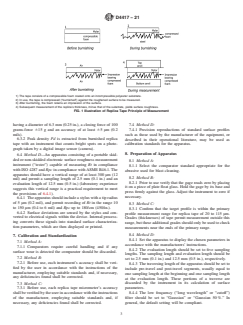
1) The tape consists of a compressible foam coated onto an incompressible polyester substrate.
2) In use, the tape is compressed (“burnished”) against the roughened surface to be measured.
3) After burnishing, the foam retains an impression of the surface.
4) Subsequent measurement of the replica’s thickness, minus that of the substrate, yields surface roughness.
FIG. 1Illustration of Replica Tape Principle of Measurement
having a diameter of 6.3 mm (0.25 in.), a closing force of 100 7.4 Method D:
grams-force 615 g and an accuracy of at least 65 µm (0.2
7.4.1 Precision reproductions of standard surface profiles
mils).
such as those used by the manufacturer of the equipment, or
6.3.2 Peak density Pd is extracted from burnished replica
described in their operational literature, may be used as
tape with an instrument that counts bright spots on a photo- calibration standards for the apparatus.
graph taken by a digital image sensor (camera).
8. Preparation of Apparatus
6.4 Method D—An apparatus consisting of a portable skid-
ded or non-skidded electronic surface roughness measurement
8.1 Method A:
instrument (“tester”) capable of measuring Rt in compliance
8.1.1 Select the comparator standard appropriate for the
with ISO 4287 and Rpc in compliance withASME B46.1. The
abrasive used for blast cleaning.
apparatus should have a vertical range of at least 300 µm (12
8.2 Method B:
mil) and permit a sampling length of 2.5 mm (0.1 in.) and an
8.2.1 Prior to use verify that the gage reads zero by placing
evaluation length of 12.5 mm (0.5 in.) (laboratory experience
it on a piece of plate float glass. Hold the gage by its base and
suggests this vertical range is a practical requirement to meet
press firmly against the glass. Adjust the instrument to zero if
the provisions of 6.4.1).
necessary.
6.4.1 The apparatus should include a stylus with a tip radius
of 5 µm (0.2 mil), and permit recording of Rt in the range 10
8.3 Method C:
to 150 µm (0.4 to 6 mil) and Rpc up to 180/cm (450/in.).
8.3.1 Confirm that the target profile is within the primary
6.4.2 Surface deviations are sensed by the stylus and con-
profile measurement range for replica tape of 20 to 115 µm.
verted to electrical signals within the device. Internal process-
Grades (thicknesses) of tape permit measurement outside this
ing converts these signals into standard surface characteriza-
range, but these additional grades should only be used to check
tion parameters, which are then displayed or printed.
measurements near the ends of the primary range.
8.4 Method D:
7. Calibration and Standardization
8.4.1 Set the apparatus to display the chosen parameters in
7.1 Method A:
accordance with the manufacturers’ instructions.
7.1.1 Comparators require careful handling and if any
8.4.2 The evaluation length should be set to five sampling
surface wear is detected the comparator should be discarded.
lengths. The sampling length and evaluation length should be
7.2 Method B:
set to 2.5 mm (0.1 in.) and 12.5 mm (0.5 in.), respectively.
7.2.1 Before use, each instrument’s accuracy shall be veri-
8.4.3 The traversing length of the apparatus should be set to
fied by the user in accordance with the instructions of the
include pre-travel and post-travel segments, usually equal to
manufacturer, employing suitable standards and, if necessary,
one sampling length at the beginning and one sampling length
any deficiencies found shall be corrected.
at the evaluation length. These portions of a traverse are
discarded by the instrument in its calculation of surface
7.3 Method C:
parameters.
7.3.1 Before use, each replica tape micrometer’s accuracy
shall be verified by the user in accordance with the instructions 8.4.4 The low frequency (“long wavelength” or “cutoff”)
of the manufacturer, employing suitable standards and, if filter should be set to “Gaussian” or “Gaussian 50 %.” In
necessary, any deficiencies found shall be corrected. general, the default setting will be compliant.
D4417−21
8.4.5 If the apparatus has a high frequency (“short wave- between the interested parties. Discard any unusually high
length” or “Ls”) filter, it should be set to “off.” instrument readings that cannot be repeated in an area.
8.4.6 The apparatus should be adjusted (if necessary) to a 10.3.2.1 At each location make ten readings and record the
deadband width (C1 = –C2) in the range 0.5 to 2.0 µm (20 to
maximum value. Then determine the average for all the
80 µin.). The choice of deadband for profiles as large as those location maximum values and report it as the profile height of
discussed in this standard will have little effect on the mea-
the surface.
surements. In general, the default setting will be compliant.
10.3.2.2 Analternatemethodistomaketenreadingsateach
8.4.7 The accuracy of the apparatus should be checked location and determine the average. Then determine the aver-
...
This document is not an ASTM standard and is intended only to provide the user of an ASTM standard an indication of what changes have been made to the previous version. Because
it may not be technically possible to adequately depict all changes accurately, ASTM recommends that users consult prior editions as appropriate. In all cases only the current version
of the standard as published by ASTM is to be considered the official document.
Designation: D4417 − 20a D4417 − 21
Standard Test Methods for
Field Measurement of Surface Profile of Blast Cleaned
Steel
This standard is issued under the fixed designation D4417; the number immediately following the designation indicates the year of
original adoption or, in the case of revision, the year of last revision. A number in parentheses indicates the year of last reapproval. A
superscript epsilon (´) indicates an editorial change since the last revision or reapproval.
This standard has been approved for use by agencies of the U.S. Department of Defense.
1. Scope
1.1 These test methods cover the description of techniques for measuring the profile of abrasive blast cleaned surfaces in the field,
shop, and laboratory. There are other techniques suitable for laboratory use not covered by these test methods.
1.2 Method B may also be appropriate to the measurement of profile produced by using power tools.
NOTE 1—The Method B procedure in this standard was developed for use on flat surfaces. Depending on the radius of the surface, the results could have
greater variability with lower values and averages.
1.3 SSPC standard SSPC-PA 17 provides additional guidance for determining conformance with surface profile requirements.
1.4 The values stated in SI units are to be regarded as the standard. The values given in parentheses are for information only.
1.5 This standard does not purport to address all of the safety concerns, if any, associated with its use. It is the responsibility
of the user of this standard to establish appropriate safety, health, and environmental practices and determine the applicability of
regulatory limitations prior to use.
1.6 This international standard was developed in accordance with internationally recognized principles on standardization
established in the Decision on Principles for the Development of International Standards, Guides and Recommendations issued
by the World Trade Organization Technical Barriers to Trade (TBT) Committee.
2. Referenced Documents
2.1 ASTM Standards:
D7127 Test Method for Measurement of Surface Roughness of Abrasive Blast Cleaned Metal Surfaces Using a Portable Stylus
Instrument
E177 Practice for Use of the Terms Precision and Bias in ASTM Test Methods
E691 Practice for Conducting an Interlaboratory Study to Determine the Precision of a Test Method
2.2 SSPC Standard:
SSPC-PA 17 Procedure for Determining Conformance to Steel Profile/Surface Roughness/Peak Count Requirements
These test methods are under the jurisdiction of ASTM Committee D01 on Paint and Related Coatings, Materials, and Applications and are the direct responsibility of
Subcommittee D01.46 on Industrial Protective Coatings.
Current edition approved Dec. 1, 2020Jan. 1, 2021. Published December 2020January 2021. Originally approved in 1984. Last previous edition approved in 2020 as
D4417 – 20.D4417 – 20A. DOI: 10.1520/D4417-20A.10.1520/D4417-21.
For referenced ASTM standards, visit the ASTM website, www.astm.org, or contact ASTM Customer Service at service@astm.org. For Annual Book of ASTM Standards
volume information, refer to the standard’s Document Summary page on the ASTM website.
Available from Society for Protective Coatings (SSPC), 800 Trumbull Dr., Pittsburgh, PA 15205, http://www.sspc.org.
Copyright © ASTM International, 100 Barr Harbor Drive, PO Box C700, West Conshohocken, PA 19428-2959. United States
D4417 − 21
2.3 ASME Standard:
ASME B46.1-2002 Surface Texture, Surface Roughness Waviness and Lay
2.4 ISO Standards:
ISO 4287: 1997 Geometrical Product Specifications (GPS)—Surface Texture: Profile Method—Terms, Definitions, and Surface
Parameters
3. Terminology
3.1 Definitions of Terms Specific to This Standard:
3.1.1 deadband, n—that distance above and below the mean line that a continuous stylus trace line must cross in both directions
(up and down) to count as a single peak.
3.1.2 evaluation length, n—a sequence of five consecutive stylus sampling lengths.
3.1.3 H, n—the average of the maximum peak-to-valley height distances obtained by measuring the thickness of replica tape.
3.1.3.1 Discussion—
H is the thickness measurement adjusted for tape non-linearity.
L
3.1.4 Pd (peak density), n—the number of peaks per unit area obtained from burnished replica tape.
3.1.5 peak, n—a high point in a surface profile.
3.1.6 Rpc (peak count), n—the number of peak/valley pairs, per unit of length, extending outside a “deadband” centered on the
mean line of a stylus trace.
3.1.6.1 Discussion—
For the purpose of Rpc, a peak is defined relative to an upper and lower height threshold. This is a single number (peak count
threshold) and is the distance from a lower threshold to an upper threshold centered on the mean line of the profile.
3.1.7 Rt, n—the vertical distance between the highest peak and the lowest valley within any given stylus evaluation length.
3.1.8 sampling length, n—the nominal distance parallel to the surface within which surface parameters are determined.
3.1.9 surface profile, n—the height of the major peaks relative to the major valleys.
3.1.10 traversing length, n—seven sampling lengths comprising the evaluation length and the stylus pre-travel and post-travel
segments.
4. Summary of Test Method
4.1 The methods are:
4.1.1 Method A—The abrasive cleaned surface is compared to commercial replicas of various surface profile depths prepared by
different blast media and the range determined. The geometry of the specific abrasive cleaned surface can also be observed.
4.1.2 Method B—The depth of profile relative to the peaks is measured using a fine-pointed probe at a number of locations and
the average of the maximum peak-to-valley distances (or alternatively, the average peak-to-valley distances) is determined.
4.1.3 Method C—A composite plastic tape is impressed into the blast cleaned surface forming a reverse image of the profile. The
average maximum peak-to-valley distance can be measured using a suitable thickness gage. The average of these distances can
be determined from a group of measurements. Specially designed optical readers can also determine the peak density from the tape
replica.
Available from American Society of Mechanical Engineers (ASME), ASME International Headquarters, Two Park Ave., New York, NY 10016-5990, http://
www.asme.org.
Available from International Organization for Standardization (ISO), ISO Central Secretariat, BIBC II, Chemin de Blandonnet 8, CP 401, 1214 Vernier, Geneva,
Switzerland, http://www.iso.org.
D4417 − 21
4.1.4 Method D—A trace measurement is taken by a portable stylus surface roughness instrument to obtain maximum
peak-to-valley distance. The average of these distances is determined from a group of five traces. These devices can also determine
peak count information.
5. Significance and Use
5.1 The height of surface profile has been shown to be a factor in the performance of various coatings applied to steel. For this
reason, surface profile should be measured prior to coating application to ensure conformance of a prepared surface to profile
requirements specified by the manufacturer of a protective coating or the coating job specification.
NOTE 2—The peak count/peak density has been shown to be a factor in the performance of various coatings applied to steel. According to research
performed by Roper, Weaver and Brandon , an increase in peak count can improve the adhesion of some coatings to the prepared steel, as well as provide
greater resistance to corrosion undercutting once the coating becomes damaged in service.
NOTE 3—Optical microscope methods serve as a referee method for surface profile measurement methods A and B. Profile depth designations are based
on the concept of mean maximum profile (h max); this value is determined by averaging a given number (usually 20) of the highest peak to lowest valley
measurements made in the field of view of a standard measuring microscope. This is done because of evidence that coating performance in any one small
area is primarily influenced by the highest surface features in that area and not by the average roughness.
6. Apparatus
6.1 Method A—A profile comparator consisting of a number of areas (each approximately one square inch in size), usually side
by side, with a different profile or anchor pattern depth. Each area is marked giving the nominal profile depth in mils or
micrometres. Typical comparator surfaces are prepared with steel shot, steel grit, or sand or other nonmetallic abrasive, since the
appearance of the profile created by these abrasives may differ. The comparator areas are used with or without magnification of
5 to 10 power.
6.2 Method B—A depth micrometer fitted with a pointed probe. The probe is typically machined at a 60° included angle with a
nominal radius of 50 μm and exerting a minimum force of 75 g. The base of the instrument rests on the tops of the peaks of the
surface profile while the spring loaded tip projects into the valleys.
1) The tape consists of a compressible foam coated onto an incompressible polyester substrate.
2) In use, the tape is compressed (“burnished”) against the roughened surface to be measured.
3) After burnishing, the foam retains an impression of the surface.
4) Subsequent measurement of the replica’s thickness, minus that of the substrate, yields surface roughness.
FIG. 1 Illustration of Replica Tape Principle of Measurement
The Effect of Peak Count or Surface Roughness on Coating Performance, JPCL Vol. 22, No. 6, pp 52-64.
John D. Keane, Joseph A. Bruno, Jr., Raymond E. F. Weaver, “Surface Profile for Anti-Corrosion Paints,” Oct. 25, 1976, Steel Structures Painting Council, 4400 Fifth
Ave., Pittsburgh, PA 15213.
D4417 − 21
6.3 Method C—A replica tape containing a compressible foam attached to a flexible, incompressible plastic substrate of uniform
thickness. A burnishing tool, having a spherical rounded end approximately 8 mm (0.3 in.) in diameter, is used to impress the foam
face of the tape into the surface to be measured, to create a reverse replica. The thickness of the reverse replica is then measured
using a thickness gage specifically designed for use with this replica tape. This sequence of steps is illustrated in Fig. 1.
6.3.1 Thickness gages suitable for use in this application have plane parallel circular contact surfaces with the top contact surface
that touches the incompressible polyester side having a diameter of 6.3 mm (0.25 in.), a closing force of 100 grams-force 615 g
and an accuracy of at least 65 μm (0.2 mils).
6.3.2 Peak density Pd is extracted from burnished replica tape with an instrument that counts bright spots on a photograph taken
by a digital image sensor (camera).
6.4 Method D—An apparatus consisting of a portable skidded or non-skidded electronic surface roughness measurement
instrument (“tester”) capable of measuring Rt in compliance with ISO 4287 and Rpc in compliance with ASME B46.1. The
apparatus should have a vertical range of at least 300 μm (12 mil) and permit a sampling length of 2.5 mm (0.1 in.) and an
evaluation length of 12.5 mm (0.5 in.) (laboratory experience suggests this vertical range is a practical requirement to meet the
provisions of 6.4.1).
6.4.1 The apparatus should include a stylus with a tip radius of 5 μm (0.2 mil), and permit recording of Rt in the range 10 to 150
μm (0.4 to 6 mil) and Rpc up to 180/cm (450/in.).
6.4.2 Surface deviations are sensed by the stylus and converted to electrical signals within the device. Internal processing converts
these signals into standard surface characterization parameters, which are then displayed or printed.
7. Calibration and Standardization
7.1 Method A:
7.1.1 Comparators require careful handling and if any surface wear is detected the comparator should be discarded.
7.2 Method B:
7.2.1 Before use, each instrument’s accuracy shall be verified by the user in accordance with the instructions of the manufacturer,
employing suitable standards and, if necessary, any deficiencies found shall be corrected.
7.3 Method C:
7.3.1 Before use, each replica tape micrometer’s accuracy shall be verified by the user in accordance with the instructions of the
manufacturer, employing suitable standards and, if necessary, any deficiencies found shall be corrected.
7.4 Method D:
7.4.1 Precision reproductions of standard surface profiles such as those used by the manufacturer of the equipment, or described
in their operational literature, may be used as calibration standards for the apparatus.
8. Preparation of Apparatus
8.1 Method A:
8.1.1 Select the comparator standard appropriate for the abrasive used for blast cleaning.
8.2 Method B:
The sole source of supply of suitable replica tape, Press-O-Film, known to the committee at this time is Testex, 8 Fox Lane, Newark, DE 19711. If you are aware of
alternative suppliers, please proved this information to ASTM International Headquarters. Your comments will receive careful consideration at a meeting of the responsible
technical committee, which you may attend.
D4417 − 21
8.2.1 Prior to use verify that the gage reads zero by placing it on a piece of plate float glass. Hold the gage by its base and press
firmly against the glass. Adjust the instrument to zero if necessary.
8.3 Method C:
8.3.1 Confirm that the target profile is within the primary profile measurement range for replica tape of 20 to 115 μm. Grades
(thicknesses) of tape permit measurement outside this range, but these additional grades should only be used to check
measurements near the ends of the primary range.
8.4 Method D:
8.4.1 Set the apparatus to display the chosen parameters in accordance with the manufacturers’ instructions.
8.4.2 The evaluation length should be set to five sampling lengths. The sampling length and evaluation length should be set to 2.5
mm (0.1 in.) and 12.5 mm (0.5 in.), respectively.
8.4.3 The traversing length of the apparatus should be set to include pre-travel and post-travel segments, usually equal to one
sampling length at the beginning and one sampling length at the evaluation length. These portions of a traverse are discarded by
the instrument in its calculation of surface parameters.
8.4.4 The low frequency (“long wavelength” or “cutoff”) filter should be set to “Gaussian” or “Gaussian 50 %.” In general, the
default setting will be compliant.
8.4.5 If the apparatus has a high frequency (“short wavelength” or “Ls”) filter, it should be set to “off.”
8.4.6 The apparatus should be adjusted (if necessary) to a deadband width (C1 = –C2) in the range 0.5 to 2.0 μm (20 to 80 μin.).
The choice of deadband for profiles as large as those discussed in this standard will have little effect on the measurements. In
general, the default setting will be compliant.
8.4.7 The accuracy of the apparatus should be checked regularly using a calibration block available from the equipment
manufacturer using their written procedure and at their recommended interval.
9. Preparation of the Sample
9.1 Use any metal surface that, after blast cleaning, is free of loose surface interference material, dirt, dust, and abrasive residue.
9.2 Select an area of the surface to be tested that is visibly free from obvious defects such as scratches, deep marks, or other
construction or corrosion defects.
9.3 Using a stiff nylon bristle brush, remove any dust or a
...