

ASTM E3197-23
(Terminology)Standard Terminology Relating to Examination of Fire Debris
General Information
- Abstract
SIGNIFICANCE AND USE
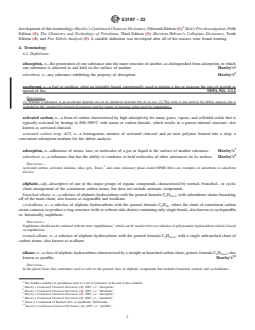
3.1 These terms have particular application to fire debris analysis. In addition, several sources of definitions were used in the development of this terminology: Hawley’s Condensed Chemical Dictionary, Fifteenth Edition (1);4 Kirk’s Fire Investigation, Fifth Edition (2); The Chemistry and Technology of Petroleum, Third Edition (3); Merriam-Webster’s Collegiate Dictionary, Tenth Edition (4); and Fire Debris Analysis (5). A suitable definition was developed after all of the sources were found wanting.
SCOPE
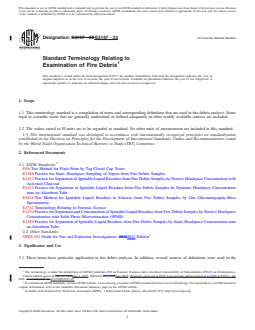
1.1 This terminology standard is a compilation of terms and corresponding definitions that are used in fire debris analysis. Some legal or scientific terms that are generally understood or defined adequately in other readily available sources are included.
1.2 The values stated in SI units are to be regarded as standard. No other units of measurement are included in this standard.
1.3 This international standard was developed in accordance with internationally recognized principles on standardization established in the Decision on Principles for the Development of International Standards, Guides and Recommendations issued by the World Trade Organization Technical Barriers to Trade (TBT) Committee.
- Status
- Published
- Publication Date
- 31-May-2023
- Technical Committee
- E30 - Forensic Sciences
- Drafting Committee
- E30.01 - Criminalistics
Overview
ASTM E3197-23 - Standard Terminology Relating to Examination of Fire Debris provides a comprehensive compilation of terms and definitions used in fire debris analysis. Published by ASTM International, this standard aims to harmonize language across the field, ensuring clarity and consistency in communication among forensic scientists, fire investigators, laboratory analysts, and legal professionals. By establishing clear definitions, ASTM E3197-23 supports the accurate interpretation and reporting of fire debris examination results and promotes best practices in the forensic analysis of ignitable liquid residues and related materials.
Key Topics
- Terminology for Fire Debris Analysis: Definitions of commonly encountered terms in the examination of fire debris, including “ignitable liquid,” “combustion product,” “pyrolysis,” and “dynamic headspace concentration.”
- Material Descriptions: Explanation of materials such as accelerants, adsorbents (e.g., activated carbon, SPME fibers), petroleum products, and residues pertinent to forensic investigation.
- Sampling and Analysis Methods: Descriptions of sampling methods (static, passive, and dynamic headspace sampling) and chromatographic analysis techniques commonly employed in fire debris examination.
- Relevant Chemical Processes: Definitions related to combustion, evaporation, desorption, oxidation, and other chemical changes significant in fire scenes and laboratory analysis.
- Forensic Context: Terminology relevant to evidence classification and comparison, such as “comparison sample,” “control sample,” “reference ignitable liquid,” and “matrix.”
Applications
ASTM E3197-23 has practical value in various settings where the interpretation and examination of fire debris are critical:
- Forensic Laboratories: Standardizes language for analysts performing fire debris exams, improving the reliability and reproducibility of analytical findings.
- Fire Investigation: Supports investigators in collecting, describing, and interpreting evidence at fire scenes, particularly when ignitable liquids or accelerants are suspected.
- Legal Proceedings: Provides the judiciary and legal professionals with clear, industry-accepted definitions, facilitating more accurate communication and interpretation of technical evidence.
- Training and Education: Offers a foundation for educational materials and training programs for new analysts and investigators entering the field of fire debris analysis.
- International Collaboration: Promotes harmonization and comparability in fire debris examination across borders by conforming to internationally recognized standards and SI units.
Related Standards
ASTM E3197-23 references and complements several related standards and guidelines:
- ASTM D56: Test Method for Flash Point by Tag Closed Cup Tester.
- ASTM E1388: Practice for Static Headspace Sampling of Vapors from Fire Debris Samples.
- ASTM E1412 / E2154: Practices for Passive Headspace Concentration (with activated charcoal or SPME).
- ASTM E1413 / E3189: Practices for Dynamic or Static Headspace Concentration.
- ASTM E1618: Test Method for Ignitable Liquid Residues by Gas Chromatography-Mass Spectrometry, critical for lab-based forensic analysis.
- ASTM E1732: Terminology Relating to Forensic Science, for broader forensic context.
- NFPA 921: Guide for Fire and Explosion Investigations, a key resource for fire investigation protocols and terminology.
Conclusion
ASTM E3197-23 is an essential resource for professionals involved in fire debris examination and forensic science. By standardizing terminology, it fosters clear communication, enhances quality assurance, and underpins reliable fire debris analysis for investigative, legal, and scientific purposes. For those working in fire scene investigation, laboratory examination, or related forensic fields, this standard is a foundational document for consistent and trusted practice.
Relations
- Refers
ASTM E1388-24 - Standard Practice for Static Headspace Sampling of Vapors from Fire Debris Samples - Effective Date
- 01-Mar-2024
- Effective Date
- 01-Feb-2024
- Effective Date
- 15-Jan-2019
- Effective Date
- 01-Nov-2018
- Effective Date
- 01-Jun-2018
- Effective Date
- 15-May-2018
- Effective Date
- 01-Sep-2017
- Effective Date
- 01-Jun-2016
- Effective Date
- 15-Jan-2016
- Effective Date
- 01-Mar-2015
- Effective Date
- 01-Jul-2014
- Effective Date
- 15-Aug-2013
- Effective Date
- 15-Jun-2012
- Effective Date
- 01-Jun-2012
- Effective Date
- 01-Feb-2012
Get Certified
Connect with accredited certification bodies for this standard

CIS Institut d.o.o.
Personal Protective Equipment (PPE) certification body. Notified Body NB-2890 for EU Regulation 2016/425 PPE.

Kiwa BDA Testing
Building and construction product certification.
Kmetijski inštitut Slovenije
Agricultural Institute of Slovenia. Soil testing, plant health, agricultural product analysis.
Sponsored listings
Frequently Asked Questions
ASTM E3197-23 is a standard published by ASTM International. Its full title is "Standard Terminology Relating to Examination of Fire Debris". This standard covers: SIGNIFICANCE AND USE 3.1 These terms have particular application to fire debris analysis. In addition, several sources of definitions were used in the development of this terminology: Hawley’s Condensed Chemical Dictionary, Fifteenth Edition (1);4 Kirk’s Fire Investigation, Fifth Edition (2); The Chemistry and Technology of Petroleum, Third Edition (3); Merriam-Webster’s Collegiate Dictionary, Tenth Edition (4); and Fire Debris Analysis (5). A suitable definition was developed after all of the sources were found wanting. SCOPE 1.1 This terminology standard is a compilation of terms and corresponding definitions that are used in fire debris analysis. Some legal or scientific terms that are generally understood or defined adequately in other readily available sources are included. 1.2 The values stated in SI units are to be regarded as standard. No other units of measurement are included in this standard. 1.3 This international standard was developed in accordance with internationally recognized principles on standardization established in the Decision on Principles for the Development of International Standards, Guides and Recommendations issued by the World Trade Organization Technical Barriers to Trade (TBT) Committee.
SIGNIFICANCE AND USE 3.1 These terms have particular application to fire debris analysis. In addition, several sources of definitions were used in the development of this terminology: Hawley’s Condensed Chemical Dictionary, Fifteenth Edition (1);4 Kirk’s Fire Investigation, Fifth Edition (2); The Chemistry and Technology of Petroleum, Third Edition (3); Merriam-Webster’s Collegiate Dictionary, Tenth Edition (4); and Fire Debris Analysis (5). A suitable definition was developed after all of the sources were found wanting. SCOPE 1.1 This terminology standard is a compilation of terms and corresponding definitions that are used in fire debris analysis. Some legal or scientific terms that are generally understood or defined adequately in other readily available sources are included. 1.2 The values stated in SI units are to be regarded as standard. No other units of measurement are included in this standard. 1.3 This international standard was developed in accordance with internationally recognized principles on standardization established in the Decision on Principles for the Development of International Standards, Guides and Recommendations issued by the World Trade Organization Technical Barriers to Trade (TBT) Committee.
ASTM E3197-23 is classified under the following ICS (International Classification for Standards) categories: 01.040.13 - Environment. Health protection. Safety (Vocabularies); 13.220.99 - Other standards related to protection against fire. The ICS classification helps identify the subject area and facilitates finding related standards.
ASTM E3197-23 has the following relationships with other standards: It is inter standard links to ASTM E1388-24, ASTM E1732-24, ASTM E1732-19, ASTM E1732-18b, ASTM E1732-18a, ASTM E1732-18, ASTM E1732-17, ASTM D56-16, ASTM E1412-16, ASTM E2154-15, ASTM E1618-14, ASTM E1413-13, ASTM E1732-12, ASTM E1412-12, ASTM E1388-12. Understanding these relationships helps ensure you are using the most current and applicable version of the standard.
ASTM E3197-23 is available in PDF format for immediate download after purchase. The document can be added to your cart and obtained through the secure checkout process. Digital delivery ensures instant access to the complete standard document.
Standards Content (Sample)
This international standard was developed in accordance with internationally recognized principles on standardization established in the Decision on Principles for the
Development of International Standards, Guides and Recommendations issued by the World Trade Organization Technical Barriers to Trade (TBT) Committee.
Designation: E3197 − 23 An American National Standard
Standard Terminology Relating to
Examination of Fire Debris
This standard is issued under the fixed designation E3197; the number immediately following the designation indicates the year of
original adoption or, in the case of revision, the year of last revision. A number in parentheses indicates the year of last reapproval. A
superscript epsilon (´) indicates an editorial change since the last revision or reapproval.
1. Scope sive Headspace Concentration with Solid Phase Microex-
traction (SPME)
1.1 This terminology standard is a compilation of terms and
E3189 Practice for Separation of Ignitable Liquid Residues
corresponding definitions that are used in fire debris analysis.
from Fire Debris Samples by Static Headspace Concen-
Some legal or scientific terms that are generally understood or
tration onto an Adsorbent Tube
defined adequately in other readily available sources are
2.2 Other Standards:
included.
NFPA 921 Guide for Fire and Explosion Investigations,
1.2 The values stated in SI units are to be regarded as
2021 Edition
standard. No other units of measurement are included in this
3. Significance and Use
standard.
1.3 This international standard was developed in accor-
3.1 These terms have particular application to fire debris
dance with internationally recognized principles on standard- analysis. In addition, several sources of definitions were used
ization established in the Decision on Principles for the
in the development of this terminology: Hawley’s Condensed
Development of International Standards, Guides and Recom- Chemical Dictionary, Fifteenth Edition (1); Kirk’s Fire
mendations issued by the World Trade Organization Technical
Investigation, Fifth Edition (2); The Chemistry and Technology
Barriers to Trade (TBT) Committee. of Petroleum, Third Edition (3); Merriam-Webster’s Collegiate
Dictionary, Tenth Edition (4); and Fire Debris Analysis (5). A
2. Referenced Documents
suitable definition was developed after all of the sources were
found wanting.
2.1 ASTM Standards:
D56 Test Method for Flash Point by Tag Closed Cup Tester
4. Terminology
E1388 Practice for Static Headspace Sampling of Vapors
4.1 Definitions:
from Fire Debris Samples
absorption, n—the penetration of one substance into the inner
E1412 Practice for Separation of Ignitable Liquid Residues
structure of another, as distinguished from adsorption, in
from Fire Debris Samples by Passive Headspace Concen-
which one substance is attracted to and held on the surface
tration with Activated Charcoal
of another. Hawley’s
E1413 Practice for Separation of Ignitable Liquid Residues
from Fire Debris Samples by Dynamic Headspace Con- absorbent, n—any substance exhibiting the property of
centration onto an Adsorbent Tube absorption. Hawley’s
E1618 Test Method for Ignitable Liquid Residues in Extracts
accelerant, n—a fuel or oxidizer, often an ignitable liquid,
from Fire Debris Samples by Gas Chromatography-Mass
intentionally used to initiate a fire or increase the rate of
Spectrometry
growth or spread of fire. NFPA 921, 3.3.2
E1732 Terminology Relating to Forensic Science
DISCUSSION—(1) Whether a substance is an accelerant depends not on
E2154 Practice for Separation and Concentration of Ignit-
its chemical structure but on its use. (2) This term is not used in fire
able Liquid Residues from Fire Debris Samples by Pas-
debris analysis but is included in this standard for historical purposes
and for clarity of meaning when used by stakeholders.
activated carbon, n—a form of carbon characterized by high
This terminology is under the jurisdiction of ASTM Committee E30 on
Forensic Sciences and is the direct responsibility of Subcommittee E30.01 on
adsorptivity for many gases, vapors, and colloidal solids that
Criminalistics.
Current edition approved June 1, 2023. Published June 2023. Originally
approved in 2020. Last previous edition approved in 2020 as E3197 – 20. DOI: Available from National Fire Protection Association (NFPA), 1 Batterymarch
10.1520/E3197-23. Park, Quincy, MA 02169-7471, http://www.nfpa.org.
2 4
For referenced ASTM standards, visit the ASTM website, www.astm.org, or The boldface numbers in parentheses refer to a list of references at the end of
contact ASTM Customer Service at service@astm.org. For Annual Book of ASTM this standard.
Standards volume information, refer to the standard’s Document Summary page on Hawley’s Condensed Chemical Dictionary (1), 2007, s.v. “absorption.”
the ASTM website. Hawley’s Condensed Chemical Dictionary (1), 2007, s.v. “absorbent.”
Copyright © ASTM International, 100 Barr Harbor Drive, PO Box C700, West Conshohocken, PA 19428-2959. United States
E3197 − 23
DISCUSSION—In fire debris, this term is typically used to refer to
is typically activated by heating to 800–900°C with steam or
alkylbenzenes, which are benzene rings with aliphatic substitutions.
carbon dioxide, which results in a porous internal structure;
also known as activated charcoal.
combustible, n—any substance that will burn, regardless of its
activated carbon strip, ACS, n—a homogenous mixture of autoignition temperature, or whether it is a solid, liquid or
activated charcoal and an inert polymer formed into a strip; a gas. Hawley’s
convenient adsorption medium for fire debris analysis.
combustible, adj—capable of undergoing combustion.
adsorption, n—adherence of atoms, ions, or molecules of a gas NFPA 921, 3.3.32
or liquid to the surface of another substance. Hawley’s
combustible liquid, n—see ignitable liquid.
adsorbent, n—a substance that has the ability to condense or
combustion, n—a usually rapid chemical process (as oxida-
hold molecules of other substances on its surface. Hawley’s
tion) that produces heat and usually light. Webster’s
DISCUSSION—Activated carbon, activated alumina, silica gels,
Tenax, and some stationary phase-coated SPME fibers are examples of combustion product, n—the heat, gases, volatilized liquids
adsorbents or adsorbent devices.
and solids, particulate matter, and ash generated by
combustion. NFPA 921, 3.3.36
aliphatic, adj—descriptive of one of the major groups of
organic compounds, characterized by normal, branched-, or
DISCUSSION—Combustion products are the result of complete or
incomplete combustion, but not thermal decomposition (see pyrolysis).
cyclic chain arrangement of the constituent carbon atoms,
but does not include aromatic compounds.
comparison sample, n—fire debris, (1) a sample of material
branched alkane, n—a subclass of aliphatic hydrocarbons
collected from a fire scene which is, to the best of the
with the general formula C H , with subordinate chains
collector’s knowledge, similar with respect to relevant char-
n 2n+2
branching off of the main chain; also known as isoparaffin and
acteristics to a sample suspected of containing ignitable
isoalkane.
substance, but which is not expected to contain an ignitable
substance; (2) a sample of suspected ignitable substance
cycloalkane, n—a subclass of aliphatic hydrocarbons with
submitted for the purpose of comparing with any ignitable
the general formula C H , where the chain of constituent
n 2n
substance separated from a debris sample.
carbon atoms connects to produce a ring structure (with or
without side chains) containing only single bonds; also known
DISCUSSION—A comparison sample should not be confused with a
as cycloparaffin or, historically, naphthene.
control sample. For example, a comparison sample might include
unburned carpet or flooring that meets the requirements in (1). E1732
DISCUSSION—Naphthenes should not be confused with the term
‘naphthalenes,’ which can be used to refer to a subclass of polyaromatic
DISCUSSION—Although, in theory, the use of comparison samples can
hydrocarbons which is based on naphthalene.
help clarify the presence of a suspected inherent ignitable liquid, the
normal alkane, n—a subclass of aliphatic hydrocarbons with presence of an ignitable liquid in a comparison sample does not
necessarily mean it is inherent to the material.
the general formula C H , with a single unbranched chain of
n 2n+2
carbon atoms; also known as n-alkane.
control sample, n—material of established origin that is used
to evaluate the performance of a test or comparison. E1732
alkane, n—a class of aliphatic hydrocarbons characterized by
a straight or branched carbon chain; generic formula
DISCUSSION—A control sample should not be confused with a
C H ; also known as paraffin. Hawley’s
comparison sample. For example, in fire debris, a control sample could
n 2n+2
include an empty can from the same lot as that used to collect samples.
DISCUSSION—In the plural form, also sometimes used to refer to the
general class of aliphatic compounds that includes branched, normal,
crude oil, n—a naturally occurring mixture of gaseous, liquid,
and cycloalkanes.
and solid hydrocarbon compounds usually found trapped
deep underground beneath impermeable cap rock and above
alkene, n—a class of unsaturated aliphatic hydrocarbons hav-
a lower dome of sedimentary rock such as shale.
ing one or more double bond(s); also known as olefin.
Chemistry and Technology of Petroleum (3), p. 901
DISCUSSION—In the plural form, also sometimes used in fire debris
analysis to refer to the general class of aliphatic compounds with one debris, n—the ruins or rubble which results from the burning
or more double bonds.
of materials. (See also fire debris.)
alkadiene, n—a class of unsaturated aliphatic hydrocarbons
desorption, n—the process of removing an adsorbed material
having two double bonds; also known as diene.
from the solid (adsorbent) on which it is adsorbed. (See also
elution.)
aromatic, n—a major group of unsaturated cyclic hydrocar-
bons containing one or more rings, typified by benzene,
DISCUSSION—Desorption may be accomplished by heating, by reduc-
which has a 6-carbon ring containing nominally three double
tion of pressure, by the presence of another more strongly adsorbed
bonds.
substance, or by a combination of these means. Hawley’s
7 11
Hawley’s Condensed Chemical Dictionary (1), 2007, s.v. “adsorption.” Hawley’s Condensed Chemical Dictionary (1), 2007, s.v. “combustible mate-
Hawley’s Condensed Chemical Dictionary (1), 2007, s.v. “adsorbent.” rial.”
9 12
Tenax is a trademark of Buchem B.V. in Apeldoorn, Netherlands. Merriam-Webster’s Collegiate Dictionary (4), 1993, s.v. “combustion.”
10 13
Hawley’s Condensed Chemical Dictionary (1), 2007, s.v. “paraffin.” Hawley’s Condensed Chemical Dictionary (1), 2007, s.v. “desorption.”
E3197 − 23
distillation, n—a physical separation based on the vaporization ignition source causes the vapors of a specimen of the
of the different components of the mixture to be separated. sample to ignite under specified conditions of the test. D56
Fire Debris Analysis (5), p. 379
DISCUSSION—There are several methods for determining the flash
point. The preferred method used by authorities in delineating between
drying oil, n—an organic liquid that, when applied as a thin
flammable and combustible liquids is a closed-cup flash point test.
film, readily absorbs oxygen from the air and polymerizes to
form a tough, elastic film. Hawley’s
fuel, n—a material that will maintain combustion under speci-
fied environmental conditions. NFPA 921, 3.3.95
DISCUSSION—Some examples of drying oils include linseed, tung, and
soybean oils. Drying oils are prone to spontaneous heating when
fuel additive, n—chemical compound or mixture of com-
exposed to air.
pounds added to a fuel for various purposes.
dynamic headspace concentration, n—an extraction tech-
headspace, n—the space above a material that includes the
nique in which a portion of the headspace vapors is
vapors produced by the liquid or solid material.
exchanged from the sample container and concentrated onto
an adsorbent medium through applied positive or negative
headspace analysis, n—practice for sampling and analyzing
pressure.
the headspace in a closed container.
elution, n—the process of removing an adsorbed substance
DISCUSSION—In fire debris analysis, there are several types of
from an adsorbent by a solvent.
headspace sampling techniques, which are list
...
This document is not an ASTM standard and is intended only to provide the user of an ASTM standard an indication of what changes have been made to the previous version. Because
it may not be technically possible to adequately depict all changes accurately, ASTM recommends that users consult prior editions as appropriate. In all cases only the current version
of the standard as published by ASTM is to be considered the official document.
Designation: E3197 − 20 E3197 − 23 An American National Standard
Standard Terminology Relating to
Examination of Fire Debris
This standard is issued under the fixed designation E3197; the number immediately following the designation indicates the year of
original adoption or, in the case of revision, the year of last revision. A number in parentheses indicates the year of last reapproval. A
superscript epsilon (´) indicates an editorial change since the last revision or reapproval.
1. Scope
1.1 This terminology standard is a compilation of terms and corresponding definitions that are used in fire debris analysis. Some
legal or scientific terms that are generally understood or defined adequately in other readily available sources are included.
1.2 The values stated in SI units are to be regarded as standard. No other units of measurement are included in this standard.
1.3 This international standard was developed in accordance with internationally recognized principles on standardization
established in the Decision on Principles for the Development of International Standards, Guides and Recommendations issued
by the World Trade Organization Technical Barriers to Trade (TBT) Committee.
2. Referenced Documents
2.1 ASTM Standards:
D56 Test Method for Flash Point by Tag Closed Cup Tester
E1388 Practice for Static Headspace Sampling of Vapors from Fire Debris Samples
E1412 Practice for Separation of Ignitable Liquid Residues from Fire Debris Samples by Passive Headspace Concentration with
Activated Charcoal
E1413 Practice for Separation of Ignitable Liquid Residues from Fire Debris Samples by Dynamic Headspace Concentration
onto an Adsorbent Tube
E1618 Test Method for Ignitable Liquid Residues in Extracts from Fire Debris Samples by Gas Chromatography-Mass
Spectrometry
E1732 Terminology Relating to Forensic Science
E2154 Practice for Separation and Concentration of Ignitable Liquid Residues from Fire Debris Samples by Passive Headspace
Concentration with Solid Phase Microextraction (SPME)
E3189 Practice for Separation of Ignitable Liquid Residues from Fire Debris Samples by Static Headspace Concentration onto
an Adsorbent Tube
2.2 Other Standards:
NFPA 921 Guide for Fire and Explosion Investigations, 20172021 Edition
3. Significance and Use
3.1 These terms have particular application to fire debris analysis. In addition, several sources of definitions were used in the
This terminology is under the jurisdiction of ASTM Committee E30 on Forensic Sciences and is the direct responsibility of Subcommittee E30.01 on Criminalistics.
Current edition approved July 15, 2020June 1, 2023. Published July 2020June 2023. Originally approved in 2020. Last previous edition approved in 2020 as E3197 – 20.
DOI: 10.1520/E3197-20.10.1520/E3197-23.
For referenced ASTM standards, visit the ASTM website, www.astm.org, or contact ASTM Customer Service at service@astm.org. For Annual Book of ASTM Standards
volume information, refer to the standard’s Document Summary page on the ASTM website.
Available from National Fire Protection Association (NFPA), 1 Batterymarch Park, Quincy, MA 02169-7471, http://www.nfpa.org.
Copyright © ASTM International, 100 Barr Harbor Drive, PO Box C700, West Conshohocken, PA 19428-2959. United States
E3197 − 23
development of this terminology: Hawley’s Condensed Chemical Dictionary, Fifteenth Edition (1); Kirk’s Fire Investigation, Fifth
Edition (2); The Chemistry and Technology of Petroleum, Third Edition (3); Merriam-Webster’s Collegiate Dictionary, Tenth
Edition (4); and Fire Debris Analysis (5). A suitable definition was developed after all of the sources were found wanting.
4. Terminology
4.1 Definitions:
absorption, n—the penetration of one substance into the inner structure of another, as distinguished from adsorption, in which
one substance is attracted to and held on the surface of another. Hawley’s
absorbent, n—any substance exhibiting the property of absorption. Hawley’s
accelerant, n—a fuel or oxidizer, often an ignitable liquid, intentionally used to initiate a fire or increase the rate of growth or
spread of fire. NFPA 921, 3.3.2
DISCUSSION—
(1) Whether a substance is an accelerant depends not on its chemical structure but on its use. (2) This term is not used in fire debris analysis but is
included in this standard for historical purposes and for clarity of meaning when used by stakeholders.
activated carbon, n—a form of carbon characterized by high adsorptivity for many gases, vapors, and colloidal solids that is
typically activated by heating to 800–900°C with steam or carbon dioxide, which results in a porous internal structure; also
known as activated charcoal.
activated carbon strip, ACS, n—a homogenous mixture of activated charcoal and an inert polymer formed into a strip; a
convenient adsorption medium for fire debris analysis.
adsorption, n—adherence of atoms, ions, or molecules of a gas or liquid to the surface of another substance. Hawley’s
adsorbent, n—a substance that has the ability to condense or hold molecules of other substances on its surface. Hawley’s
DISCUSSION—
Activated carbon, activated alumina, silica gels, Tenax, and some stationary phase-coated SPME fibers are examples of adsorbents or adsorbent
devices.
aliphatic, adj—descriptive of one of the major groups of organic compounds, characterized by normal, branched-, or cyclic
chain arrangement of the constituent carbon atoms, but does not include aromatic compounds.
branched alkane, n—a subclass of aliphatic hydrocarbons with the general formula C H , with subordinate chains branching
n 2n+2
off of the main chain; also known as isoparaffin and isoalkane.
cycloalkane, n—a subclass of aliphatic hydrocarbons with the general formula C H , where the chain of constituent carbon
n 2n
atoms connects to produce a ring structure (with or without side chains) containing only single bonds; also known as cycloparaffin
or, historically, naphthene.
DISCUSSION—
Naphthenes should not be confused with the term ‘naphthalenes,’ which can be used to refer to a subclass of polyaromatic hydrocarbons which is based
on naphthalene.
normal alkane, n—a subclass of aliphatic hydrocarbons with the general formula C H , with a single unbranched chain of
n 2n+2
carbon atoms; also known as n-alkane.
alkane, n—a class of aliphatic hydrocarbons characterized by a straight or branched carbon chain; generic formula C H ; also
n 2n+2
known as paraffin. Hawley’s
DISCUSSION—
In the plural form, also sometimes used to refer to the general class of aliphatic compounds that includes branched, normal, and cycloalkanes.
The boldface numbers in parentheses refer to a list of references at the end of this standard.
Hawley’s Condensed Chemical Dictionary (1), 2007, s.v. “absorption.”
Hawley’s Condensed Chemical Dictionary (1), 2007, s.v. “absorbent.”
Hawley’s Condensed Chemical Dictionary (1), 2007, s.v. “adsorption.”
Hawley’s Condensed Chemical Dictionary (1), 2007, s.v. “adsorbent.”
Tenax is a trademark of Buchem B.V. in Apeldoorn, Netherlands.
Hawley’s Condensed Chemical Dictionary (1), 2007, s.v. “paraffin.”
E3197 − 23
alkene, n—a class of unsaturated aliphatic hydrocarbons having one or more double bond(s); also known as olefin.
DISCUSSION—
In the plural form, also sometimes used in fire debris analysis to refer to the general class of aliphatic compounds with one or more double bonds.
alkadiene, n—a class of unsaturated aliphatic hydrocarbons having two double bonds; also known as diene.
aromatic, n—a major group of unsaturated cyclic hydrocarbons containing one or more rings, typified by benzene, which has
a 6-carbon ring containing nominally three double bonds.
DISCUSSION—
In fire debris, this term is typically used to refer to alkylbenzenes, which are benzene rings with aliphatic substitutions.
combustible, n—any substance that will burn, regardless of its autoignition temperature, or whether it is a solid, liquid or gas.
Hawley’s
combustible, adj—capable of undergoing combustion.
NFPA 921, 3.3.32
combustible liquid, n—see ignitable liquid.
combustion, n—a usually rapid chemical process (as oxidation) that produces heat and usually light. Webster’s
combustion product, n—the heat, gases, volatilized liquids and solids, particulate matter, and ash generated by combustion.
NFPA 921, 3.3.36
DISCUSSION—
Combustion products are the result of complete or incomplete combustion, but not thermal decomposition (see pyrolysis).
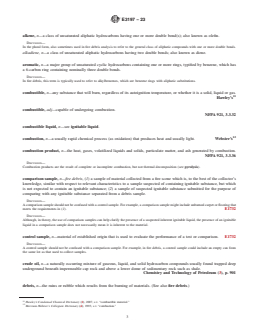
comparison sample, n—fire debris, (1) a sample of material collected from a fire scene which is, to the best of the collector’s
knowledge, similar with respect to relevant characteristics to a sample suspected of containing ignitable substance, but which
is not expected to contain an ignitable substance; (2) a sample of suspected ignitable substance submitted for the purpose of
comparing with any ignitable substance separated from a debris sample.
DISCUSSION—
A comparison sample should not be confused with a control sample. For example, a comparison sample might include unburned carpet or flooring that
meets the requirements in (1). E1732
DISCUSSION—
Although, in theory, the use of comparison samples can help clarify the presence of a suspected inherent ignitable liquid, the presence of an ignitable
liquid in a comparison sample does not necessarily mean it is inherent to the material.
control sample, n—material of established origin that is used to evaluate the performance of a test or comparison. E1732
DISCUSSION—
A control sample should not be confused with a comparison sample. For example, in fire debris, a control sample could include an empty can from
the same lot as that used to collect samples.
crude oil, n—a naturally occurring mixture of gaseous, liquid, and solid hydrocarbon compounds usually found trapped deep
underground beneath impermeable cap rock and above a lower dome of sedimentary rock such as shale.
Chemistry and Technology of Petroleum (3), p. 901
debris, n—the ruins or rubble which results from the burning of materials. (See also fire debris.)
Hawley’s Condensed Chemical Dictionary (1), 2007, s.v. “combustible material.”
Merriam-Webster’s Collegiate Dictionary (4), 1993, s.v. “combustion.”
E3197 − 23
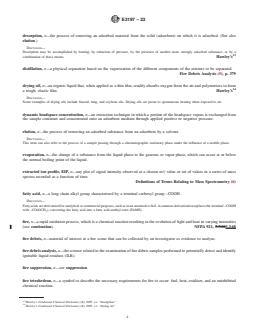
desorption, n—the process of removing an adsorbed material from the solid (adsorbent) on which it is adsorbed. (See also
elution.)
DISCUSSION—
Desorption may be accomplished by heating, by reduction of pressure, by the presence of another more strongly adsorbed substance, or by a
combination of these means. Hawley’s
distillation, n—a physical separation based on the vaporization of the different components of the mixture to be separated.
Fire Debris Analysis (5), p. 379
drying oil, n—an organic liquid that, when applied as a thin film, readily absorbs oxygen from the air and polymerizes to form
a tough, elastic film. Hawley’s
DISCUSSION—
Some examples of drying oils include linseed, tung, and soybean oils. Drying oils are prone to spontaneous heating when exposed to air.
dynamic headspace concentration, n—an extraction technique in which a portion of the headspace vapors is exchanged from
the sample container and concentrated onto an adsorbent medium through applied positive or negative pressure.
elution, n—the process of removing an adsorbed substance from an adsorbent by a solvent.
DISCUSSION—
This term can also refer to the process of a sample passing through a chromatographic stationary phase under the influence of a mobile phase.
evaporation, n—the change of a substance from the liquid phase to the gaseous or vapor phase, which can occur at or below
the normal boiling point of the liquid.
extracted ion profile, EIP, n—any plot of signal intensity observed at a chosen m/z value or set of values in a series of mass
spectra recorded as a function of time.
Definitions of Terms Relating to Mass Spectrometry (6)
fatty acid, n—a long chain alkyl group characterized by a terminal carboxyl group –COOH.
DISCUSSION—
Fatty acids are derivatized for analytical or commercial purposes, such as in an automotive fuel. A common derivatization replaces the terminal –COOH
with –CO(OCH ), converting the fatty acid into a fatty acid methyl ester (FAME).
fire, n—a rapid oxidation process, which is a chemical reaction resulting in the evolution of light and heat in varying intensities
(see combustion). NFPA
...