

ASTM E108-20a
(Test Method)Standard Test Methods for Fire Tests of Roof Coverings
General Information
- Abstract
SIGNIFICANCE AND USE
4.1 The test methods described herein are intended to provide a basis for relative comparison of roof coverings. The test methods include simulated fire exposure to the outside of the roof coverings, and, where applicable, a determination as to whether the fire performance characteristics of the roof coverings will be adversely affected by prolonged exposure to rain.
4.2 These test methods measure the surface spread of flame and the ability of the roof covering material or system to resist fire penetration from the exterior to the underside of a roof deck under the conditions of exposure.
4.3 These test methods also provide criteria to determine if the roof covering material will develop flying burning material, identified as flying brands, when subjected to a 12-mph (5.3-m/s) wind during the simulated fire exposure tests.
4.4 These test methods do not necessarily illustrate the expected performance of roof coverings under all actual fire conditions, but they do provide a basis for comparing roof covering materials when subjected to fire sources that are described herein.
4.5 These test methods do not provide any basis for determining the fire resistance characteristics when exposed to a fire originating in the building to which the roofing material is applied.
4.6 The test methods described herein involve calibrating the test equipment using a calibration deck inclined at a slope of 5 in. per horizontal ft (0.416:1). The tests described herein are performed on test decks inclined at slopes up to and including 5 in. per horizontal ft. The severity of the test exposure decreases as the slope of the test deck decreases below 5 in. per horizontal ft.
SCOPE
1.1 This fire-test-response standard covers the measurement of the relative fire characteristics of roof coverings exposed to simulated fire sources originating outside the building. It is applicable to roof coverings intended for installation on either combustible or noncombustible roof decks when applied as intended for use. The following test methods are included:
1.1.1 Intermittent flame exposure test.
1.1.2 Spread of flame test.
1.1.3 Burning brand test.
1.1.4 Flying brand test.
1.1.5 Rain test.
1.2 Three classes of fire test exposure are described:
1.2.1 Class A Tests are applicable to roof coverings that are expected to be effective against severe fire exposure, afford a high degree of fire protection to the roof deck, do not slip from position, and are not expected to present a flying brand hazard.
1.2.2 Class B Tests are applicable to roof coverings that are expected to be effective against moderate fire exposure, afford a moderate degree of fire protection to the roof deck, do not slip from position, and are not expected to present a flying brand hazard.
1.2.3 Class C Tests are applicable to roof coverings that are effective against light fire exposure, afford a light degree of fire protection to the roof deck, do not slip from position, and are not expected to present a flying brand hazard.
1.3 The values stated in inch-pound units are to be regarded as standard. The values given in parentheses are mathematical conversions to SI units that are provided for information only and are not considered standard.
1.4 This standard is used to measure and describe the response of materials, products, or assemblies to heat and flame under controlled laboratory conditions, but does not by itself incorporate all factors required for fire hazard or fire risk assessment of the materials, products or assemblies under actual fire conditions.
1.5 This standard does not purport to address all of the safety concerns, if any, associated with its use. It is the responsibility of the user of this standard to establish appropriate safety, health, and environmental practices and determine the applicability of regulatory limitations prior to use.
1.6 Fire testing is inherently hazardous. Adequate safegua...
- Status
- Published
- Publication Date
- 31-Mar-2020
- Technical Committee
- E05 - Fire Standards
- Drafting Committee
- E05.14 - External Fire Exposures
Overview
ASTM E108-20a: Standard Test Methods for Fire Tests of Roof Coverings establishes uniform procedures for evaluating the fire performance characteristics of roof covering materials. Developed by ASTM International, this key standard focuses on the fire exposure of roof coverings from external sources, simulating wildfire and other ignition risks that threaten building envelopes. By providing a consistent basis for the relative comparison of roofing materials, ASTM E108-20a helps manufacturers, code authorities, and industry professionals assess product safety and compliance.
Key Topics
- Simulated Fire Exposure: The standard specifies methods for exposing roof coverings to controlled external fire sources to measure their response.
- Test Methods Included:
- Intermittent flame exposure test
- Spread of flame test
- Burning brand test
- Flying brand test
- Rain exposure test (to determine the effect of prolonged moisture)
- Evaluation Criteria:
- Surface spread of flames
- Resistance to fire penetration from exterior to interior
- Development of flying burning materials (flying brands) under wind conditions (12 mph)
- Test Classifications:
- Class A: For roof coverings offering the highest fire resistance, suitable for severe fire exposure.
- Class B: For moderate fire resistance.
- Class C: For light fire exposure scenarios.
- Limitations: The methods focus on fire originating outside the building and do not assess resistance to fires starting inside.
Applications
ASTM E108-20a is widely referenced in building codes, product certification, and commercial specifications to ensure the fire safety of building envelopes. Its practical applications include:
- Roof Covering Evaluation: Used to classify shingles, tiles, panels, and membranes installed on either combustible or noncombustible roof decks.
- Code Compliance: A requirement for roofing materials in many jurisdictions, especially in wildfire-prone areas or for projects subject to insurance or regulatory review.
- Product Development: Manufacturers use ASTM E108-20a to design and validate roofing systems that meet desired fire protection performance classes.
- Quality Assurance: Provides a benchmark during material selection and quality control to ensure roofing systems consistently resist external fire threats.
By requiring tests such as the spread-of-flame and burning-brand, the standard helps stakeholders identify materials that minimize risk of fire spread, prevent penetration into building interiors, and reduce the creation of windborne embers.
Related Standards
ASTM E108-20a is supported by and often referenced alongside other standards in the roofing and fire safety domain, including:
- UL 790: Standard for Fire Tests of Roof Covering Materials (very closely aligned; widely accepted by code authorities)
- NFPA 256: Test Method for Fire Test of Roof Coverings (withdrawn but historically relevant)
- Referenced ASTM Standards:
- D2898: Accelerated Weathering of Fire-Retardant-Treated Wood for Fire Testing
- D4442 & D4444: Wood moisture content measurements
- Various material specifications for roofing underlayment and components
- NIST DOC PS-1 & PS-2: Standards for structural plywood and wood-based panels, referenced for test deck construction
Conclusion
ASTM E108-20a provides a critical foundation for fire safety in roofing materials by enabling objective comparisons under standardized fire test conditions. Its adoption helps ensure that roof coverings can withstand external fire exposures, thus protecting property and occupants and supporting code compliance and risk management across the construction industry. For up-to-date product certification or code reference, always consult the latest official version of ASTM E108 and applicable local requirements.
Relations
- Effective Date
- 01-Apr-2020
- Effective Date
- 01-Mar-2020
- Effective Date
- 01-Jul-2018
- Effective Date
- 01-Feb-2017
- Effective Date
- 15-Nov-2016
- Effective Date
- 01-Jun-2015
- Effective Date
- 01-May-2013
- Effective Date
- 01-Apr-2013
- Effective Date
- 01-Mar-2010
- Effective Date
- 15-Sep-2009
- Effective Date
- 01-Jan-2009
- Effective Date
- 01-Jan-2009
- Effective Date
- 01-Nov-2008
- Effective Date
- 01-Nov-2008
- Effective Date
- 01-Apr-2008
Get Certified
Connect with accredited certification bodies for this standard

DIBt (Deutsches Institut für Bautechnik)
German Institute for Building Technology.
DIN CERTCO
DIN Group product certification.

Kiwa BDA Testing
Building and construction product certification.
Sponsored listings
Frequently Asked Questions
ASTM E108-20a is a standard published by ASTM International. Its full title is "Standard Test Methods for Fire Tests of Roof Coverings". This standard covers: SIGNIFICANCE AND USE 4.1 The test methods described herein are intended to provide a basis for relative comparison of roof coverings. The test methods include simulated fire exposure to the outside of the roof coverings, and, where applicable, a determination as to whether the fire performance characteristics of the roof coverings will be adversely affected by prolonged exposure to rain. 4.2 These test methods measure the surface spread of flame and the ability of the roof covering material or system to resist fire penetration from the exterior to the underside of a roof deck under the conditions of exposure. 4.3 These test methods also provide criteria to determine if the roof covering material will develop flying burning material, identified as flying brands, when subjected to a 12-mph (5.3-m/s) wind during the simulated fire exposure tests. 4.4 These test methods do not necessarily illustrate the expected performance of roof coverings under all actual fire conditions, but they do provide a basis for comparing roof covering materials when subjected to fire sources that are described herein. 4.5 These test methods do not provide any basis for determining the fire resistance characteristics when exposed to a fire originating in the building to which the roofing material is applied. 4.6 The test methods described herein involve calibrating the test equipment using a calibration deck inclined at a slope of 5 in. per horizontal ft (0.416:1). The tests described herein are performed on test decks inclined at slopes up to and including 5 in. per horizontal ft. The severity of the test exposure decreases as the slope of the test deck decreases below 5 in. per horizontal ft. SCOPE 1.1 This fire-test-response standard covers the measurement of the relative fire characteristics of roof coverings exposed to simulated fire sources originating outside the building. It is applicable to roof coverings intended for installation on either combustible or noncombustible roof decks when applied as intended for use. The following test methods are included: 1.1.1 Intermittent flame exposure test. 1.1.2 Spread of flame test. 1.1.3 Burning brand test. 1.1.4 Flying brand test. 1.1.5 Rain test. 1.2 Three classes of fire test exposure are described: 1.2.1 Class A Tests are applicable to roof coverings that are expected to be effective against severe fire exposure, afford a high degree of fire protection to the roof deck, do not slip from position, and are not expected to present a flying brand hazard. 1.2.2 Class B Tests are applicable to roof coverings that are expected to be effective against moderate fire exposure, afford a moderate degree of fire protection to the roof deck, do not slip from position, and are not expected to present a flying brand hazard. 1.2.3 Class C Tests are applicable to roof coverings that are effective against light fire exposure, afford a light degree of fire protection to the roof deck, do not slip from position, and are not expected to present a flying brand hazard. 1.3 The values stated in inch-pound units are to be regarded as standard. The values given in parentheses are mathematical conversions to SI units that are provided for information only and are not considered standard. 1.4 This standard is used to measure and describe the response of materials, products, or assemblies to heat and flame under controlled laboratory conditions, but does not by itself incorporate all factors required for fire hazard or fire risk assessment of the materials, products or assemblies under actual fire conditions. 1.5 This standard does not purport to address all of the safety concerns, if any, associated with its use. It is the responsibility of the user of this standard to establish appropriate safety, health, and environmental practices and determine the applicability of regulatory limitations prior to use. 1.6 Fire testing is inherently hazardous. Adequate safegua...
SIGNIFICANCE AND USE 4.1 The test methods described herein are intended to provide a basis for relative comparison of roof coverings. The test methods include simulated fire exposure to the outside of the roof coverings, and, where applicable, a determination as to whether the fire performance characteristics of the roof coverings will be adversely affected by prolonged exposure to rain. 4.2 These test methods measure the surface spread of flame and the ability of the roof covering material or system to resist fire penetration from the exterior to the underside of a roof deck under the conditions of exposure. 4.3 These test methods also provide criteria to determine if the roof covering material will develop flying burning material, identified as flying brands, when subjected to a 12-mph (5.3-m/s) wind during the simulated fire exposure tests. 4.4 These test methods do not necessarily illustrate the expected performance of roof coverings under all actual fire conditions, but they do provide a basis for comparing roof covering materials when subjected to fire sources that are described herein. 4.5 These test methods do not provide any basis for determining the fire resistance characteristics when exposed to a fire originating in the building to which the roofing material is applied. 4.6 The test methods described herein involve calibrating the test equipment using a calibration deck inclined at a slope of 5 in. per horizontal ft (0.416:1). The tests described herein are performed on test decks inclined at slopes up to and including 5 in. per horizontal ft. The severity of the test exposure decreases as the slope of the test deck decreases below 5 in. per horizontal ft. SCOPE 1.1 This fire-test-response standard covers the measurement of the relative fire characteristics of roof coverings exposed to simulated fire sources originating outside the building. It is applicable to roof coverings intended for installation on either combustible or noncombustible roof decks when applied as intended for use. The following test methods are included: 1.1.1 Intermittent flame exposure test. 1.1.2 Spread of flame test. 1.1.3 Burning brand test. 1.1.4 Flying brand test. 1.1.5 Rain test. 1.2 Three classes of fire test exposure are described: 1.2.1 Class A Tests are applicable to roof coverings that are expected to be effective against severe fire exposure, afford a high degree of fire protection to the roof deck, do not slip from position, and are not expected to present a flying brand hazard. 1.2.2 Class B Tests are applicable to roof coverings that are expected to be effective against moderate fire exposure, afford a moderate degree of fire protection to the roof deck, do not slip from position, and are not expected to present a flying brand hazard. 1.2.3 Class C Tests are applicable to roof coverings that are effective against light fire exposure, afford a light degree of fire protection to the roof deck, do not slip from position, and are not expected to present a flying brand hazard. 1.3 The values stated in inch-pound units are to be regarded as standard. The values given in parentheses are mathematical conversions to SI units that are provided for information only and are not considered standard. 1.4 This standard is used to measure and describe the response of materials, products, or assemblies to heat and flame under controlled laboratory conditions, but does not by itself incorporate all factors required for fire hazard or fire risk assessment of the materials, products or assemblies under actual fire conditions. 1.5 This standard does not purport to address all of the safety concerns, if any, associated with its use. It is the responsibility of the user of this standard to establish appropriate safety, health, and environmental practices and determine the applicability of regulatory limitations prior to use. 1.6 Fire testing is inherently hazardous. Adequate safegua...
ASTM E108-20a is classified under the following ICS (International Classification for Standards) categories: 13.220.50 - Fire-resistance of building materials and elements; 91.060.20 - Roofs. The ICS classification helps identify the subject area and facilitates finding related standards.
ASTM E108-20a has the following relationships with other standards: It is inter standard links to ASTM E108-20, ASTM D4442-20, ASTM D4444-13(2018), ASTM D2898-10(2017), ASTM D4442-16, ASTM D4442-15, ASTM D1227-13, ASTM D4444-13, ASTM D2898-10, ASTM D2898-09, ASTM D3018-03(2009), ASTM D3462-09, ASTM D2898-08e1, ASTM D2898-08, ASTM D4444-08. Understanding these relationships helps ensure you are using the most current and applicable version of the standard.
ASTM E108-20a is available in PDF format for immediate download after purchase. The document can be added to your cart and obtained through the secure checkout process. Digital delivery ensures instant access to the complete standard document.
Standards Content (Sample)
This international standard was developed in accordance with internationally recognized principles on standardization established in the Decision on Principles for the
Development of International Standards, Guides and Recommendations issued by the World Trade Organization Technical Barriers to Trade (TBT) Committee.
Designation: E108 − 20a An American National Standard
Standard Test Methods for
Fire Tests of Roof Coverings
This standard is issued under the fixed designation E108; the number immediately following the designation indicates the year of
original adoption or, in the case of revision, the year of last revision.Anumber in parentheses indicates the year of last reapproval.A
superscript epsilon (´) indicates an editorial change since the last revision or reapproval.
This standard has been approved for use by agencies of the U.S. Department of Defense.
1. Scope* assessment of the materials, products or assemblies under
actual fire conditions.
1.1 Thisfire-test-responsestandardcoversthemeasurement
1.5 This standard does not purport to address all of the
of the relative fire characteristics of roof coverings exposed to
safety concerns, if any, associated with its use. It is the
simulated fire sources originating outside the building. It is
responsibility of the user of this standard to establish appro-
applicable to roof coverings intended for installation on either
priate safety, health, and environmental practices and deter-
combustible or noncombustible roof decks when applied as
mine the applicability of regulatory limitations prior to use.
intended for use. The following test methods are included:
1.6 Fire testing is inherently hazardous. Adequate safe-
1.1.1 Intermittent flame exposure test.
guards for personnel and property shall be employed in
1.1.2 Spread of flame test.
conducting these tests.
1.1.3 Burning brand test.
1.1.4 Flying brand test.
1.7 The text of this standard references notes and footnotes
1.1.5 Rain test. that provide explanatory information. These notes and
footnotes, excluding those in tables and figures, shall not be
1.2 Three classes of fire test exposure are described:
considered as requirements of this standard.
1.2.1 Class A Tests are applicable to roof coverings that are
1.8 This international standard was developed in accor-
expected to be effective against severe fire exposure, afford a
dance with internationally recognized principles on standard-
highdegreeoffireprotectiontotheroofdeck,donotslipfrom
ization established in the Decision on Principles for the
position,andarenotexpectedtopresentaflyingbrandhazard.
Development of International Standards, Guides and Recom-
1.2.2 Class B Tests are applicable to roof coverings that are
mendations issued by the World Trade Organization Technical
expected to be effective against moderate fire exposure, afford
Barriers to Trade (TBT) Committee.
a moderate degree of fire protection to the roof deck, do not
slip from position, and are not expected to present a flying
2. Referenced Documents
brand hazard.
2.1 ASTM Standards:
1.2.3 Class C Tests are applicable to roof coverings that are
D225Specification forAsphalt Shingles (Organic Felt) Sur-
effectiveagainstlightfireexposure,affordalightdegreeoffire
faced With Mineral Granules (Withdrawn 2012)
protection to the roof deck, do not slip from position, and are
D226Specification forAsphalt-Saturated Organic Felt Used
not expected to present a flying brand hazard.
in Roofing and Waterproofing
1.3 Thevaluesstatedininch-poundunitsaretoberegarded
D227Specification for Coal-Tar-Saturated Organic Felt
as standard. The values given in parentheses are mathematical
Used in Roofing and Waterproofing
conversions to SI units that are provided for information only
D312Specification for Asphalt Used in Roofing
and are not considered standard.
D450Specification for Coal-Tar Pitch Used in Roofing,
1.4 This standard is used to measure and describe the
Dampproofing, and Waterproofing
response of materials, products, or assemblies to heat and
D1227Specification for Emulsified Asphalt Used as a Pro-
flame under controlled laboratory conditions, but does not by
tective Coating for Roofing
itself incorporate all factors required for fire hazard or fire risk
D2178Specification forAsphalt Glass Felt Used in Roofing
and Waterproofing
1 2
ThesetestmethodsareunderthejurisdictionofASTMCommitteeE05onFire For referenced ASTM standards, visit the ASTM website, www.astm.org, or
StandardsandarethedirectresponsibilityofSubcommitteeE05.14onExternalFire contact ASTM Customer Service at service@astm.org. For Annual Book of ASTM
Exposures. Standards volume information, refer to the standard’s Document Summary page on
Current edition approved April 1, 2020. Published April 2020. Originally the ASTM website.
approved in 1955. Last previous edition approved in 2020 as E108–20. DOI: The last approved version of this historical standard is referenced on
10.1520/E0108-20A. www.astm.org.
*A Summary of Changes section appears at the end of this standard
Copyright © ASTM International, 100 Barr Harbor Drive, PO Box C700, West Conshohocken, PA 19428-2959. United States
E108 − 20a
D2626Specification for Asphalt-Saturated and Coated Or- 4.2 These test methods measure the surface spread of flame
ganic Felt Base Sheet Used in Roofing and the ability of the roof covering material or system to resist
D2898 Practice for Accelerated Weathering of Fire- fire penetration from the exterior to the underside of a roof
Retardant-Treated Wood for Fire Testing deck under the conditions of exposure.
D3018Specification for Class AAsphalt Shingles Surfaced
4.3 These test methods also provide criteria to determine if
with Mineral Granules
theroofcoveringmaterialwilldevelopflyingburningmaterial,
D3158Specification for Asphalt Saturated and Coated Or-
identified as flying brands, when subjected to a 12-mph
ganic Felt Used in Roofing (Withdrawn 1983)
(5.3-m/s) wind during the simulated fire exposure tests.
D3378Specification for Asphalt-Saturated and Coated As-
4.4 These test methods do not necessarily illustrate the
bestos Felt Base Sheet Used in Roofing (Withdrawn
expected performance of roof coverings under all actual fire
1985)
conditions, but they do provide a basis for comparing roof
D3462Specification for Asphalt Shingles Made from Glass
covering materials when subjected to fire sources that are
Felt and Surfaced with Mineral Granules
described herein.
D4442Test Methods for Direct Moisture Content Measure-
ment of Wood and Wood-Based Materials
4.5 These test methods do not provide any basis for deter-
D4444Test Method for Laboratory Standardization and
miningthefireresistancecharacteristicswhenexposedtoafire
Calibration of Hand-Held Moisture Meters
originating in the building to which the roofing material is
2.2 UL Standards: applied.
UL 55AMaterials for Built-Up Roof Coverings
4.6 The test methods described herein involve calibrating
UL790Tests for Fire Resistance of Roof Covering Materi-
the test equipment using a calibration deck inclined at a slope
als
of 5 in. per horizontal ft (0.416:1). The tests described herein
2.3 NFPA Standards:
are performed on test decks inclined at slopes up to and
NFPA 256Tests of Roof Coverings (Withdrawn 2008)
including 5 in. per horizontal ft. The severity of the test
2.4 NIST Standards:
exposure decreases as the slope of the test deck decreases
Department of Commerce (DOC) Voluntary Product Stan-
below 5 in. per horizontal ft.
dard PS-1 Structural Plywood
Department of Commerce (DOC) Voluntary Product Stan-
5. Apparatus and Calibration
dard PS-2 Performance Standard for Wood-based
5.1 Theessentialelementsofthefiretestapparatususedfor
Structural-use Panels
tests described in Sections 8-11 are illustrated in Fig. 1. They
consist of the following:
3. Terminology
(a)A test deck to which the roof-covering materials to be
3.1 Definitions:
testedareapplied,mountedonaframework.Theinclineofthe
3.1.1 significant lateral spread—surface flaming beyond
framework is to be adjustable with respect to incline (slope) as
1-ft. from the lead edge, extending outward to both lateral
wellastheverticalpositionforfiretestingdeckswithinsulated
edgesofthetestdeckassemblyortobothinneredgesofmetal
roof coverings.
batten strips, if used, along the side edges of the test deck
(b)A construction of noncombustible boards, mounted on
assembly.
the front of the framework to simulate eaves and cornices.
3.1.2 sustained flaming—any flaming which continues un-
(c)A gas burner (for intermittent-flame, spread-of-flame
interrupted for 5 seconds or more.
andflyingbrandtests)consistingofa44-in.(1.12m)lengthof
3.1.3 prepared roof covering—products consisting of nominal 2 in. (2.38 in./60.3 mm OD) pipe having a ⁄2-in.
shingles,tiles,panelsorrolledmaterialsthataretypicallyused (12.7mm) wide, 36-in. (0.91 m) long slot in the side toward
for steep slope roof applications which are applied directly to thetestdeck.Theburneristobesuppliedwithgasatbothends
theroofdeck(usuallywithoneormorelayersofunderlayment through nominal 1-in. (1.32 in./33.4 mm OD) pipe to provide
and with or without battens) in accordance with installation uniform gas pressure at the burner assembly.
instructions supplied with the products. (d)A blower and air duct for providing the required wind
conditions.
4. Significance and Use
(e)Adjustablefinsmountedinsidetheairducttostraighten
the air stream and reduce turbulence.
4.1 The test methods described herein are intended to
(f)A baffle mounted on the back edge of the test deck to
provide a basis for relative comparison of roof coverings. The
prevent backfiring under the deck.
test methods include simulated fire exposure to the outside of
(g)Noncombustible boards extended from the sides and
theroofcoverings,and,whereapplicable,adeterminationasto
bottom of the air duct to the simulated-eaves-and-cornices
whether the fire performance characteristics of the roof cover-
constructionmentionedin (b)(notusedduringburningbrand).
ings will be adversely affected by prolonged exposure to rain.
(h)Fire calibration exposure pattern (see 5.5.5).
5.1.1 During the test:
Available from Underwriters Laboratories Inc., 333 Pfingsten Road,
5.1.1.1 Provide free outlet to outside air beyond and above
Northbrook, IL 60062.
the test apparatus to exhaust air introduced into the test room
Available from National Fire ProtectionAssoc., 1 Batterymarch Park, Quincy,
MA 02269. by the blower, and
E108 − 20a
(See Appendix X1 for metric equivalents.)
FIG. 1 Schematic Drawing of Fire Test Apparatus
5.1.1.2 Close all openings into the test room other than
those mentioned in 5.1.1, such as doors and windows.
5.2 The temperature of the air supplied by the blower shall
be maintained between 50 and 90°F (10 and 32°C).
5.3 Fig.2illustratesanexampleoftheessentialelementsof
a rain test apparatus.
5.4 Calibrating Air Current:
5.4.1 Set up the test apparatus for the intermittent flame test
and position a bare 3-ft, 4-in. by 4-ft, 4 in. (1 m by 1.3 m)
plywood,gypsumboardorfibercementboardcalibrationdeck
on the framework at an incline of 5 in. per horizontal ft
(0.416:1).
5.4.2 Measure the air velocity midway up the slope of the
calibrationdeckatitscenterand3in.(76mm)fromeachedge.
NOTE 1—Any direct reading instrument with scale graduated in
increments of not more than 20 ft/min (6 m/min) or any timed instrument
withscalegraduated(fora1mintimedreading)inincrementsofnotmore
than 5 ft/min (1.5 m/min) will be suitable.
5.4.3 Position the center of the air measuring device at a
FIG. 2 Rain Test Apparatus
nominal 3 ⁄16 in. (94 mm) above the surface. The air flow
E108 − 20a
through and around the instrument shall be as free and 5.7.3 For the Rain Test, visually check the water flow from
undisturbed as possible. each nozzle (for obvious water obstruction in the nozzle and
uneven spray pattern) each day during the water cycle and
5.4.4 Adjusttheairsupplysystemtoproducea1mintimed
average velocity of 1056 6 44 ft/min corresponding to make adjustments when necessary.
12 60.5 mph (5.3 6 0.2 m/s) at each of the three locations 5.7.4 For the Rain Test, review the total water flow at the
detailed in 5.4.2. In order to comply with 5.5.5, it shall be
endofeachdayandattheendofeachwatercycle.Correctthe
permitted to adjust the 1-min time averaged velocity at each cause of any off-limit conditions.
location by 65 % from the initial value within the range 1012
to 1100 ft/min (5.1 to 5.5 m/s). This deviation in an individual 6. Preparation of Test Specimens
1-min timed average velocity shall only be permitted when the
6.1 Construction of Test Decks:
average of the 1-min timed average velocity of all three
6.1.1 The test deck for the intermittent flame exposure,
locations is 12 6 0.5 mph (5.3 6 0.2 m/s).
burning brand tests, flying brand test, and rain test, except as
5.5 Calibrating Flame Temperature:
specifiedinthefollowingparagraphs,shallbe3ft-4in.(1.0m)
5.5.1 Following the calibration of the air current described
wideby4ft-4in.(1.3m)longandshallbemadeofNo.1white
in5.4,positionafibercementboardcalibrationdeck,4ft,4in.
pine lumber with not less than 8% nor more than 12%
(1.3 m) long on the framework at an incline of 5 in. per
moisture content. The lumber shall be free of large or loose
horizontal ft (0.416:1).
knots,sapwood,rot,orpitchpockets,andshallcontainnoedge
5.5.2 Measure the temperature with a No. 14B&S gauge knots. Individual deck boards shall be of nominal 1 by 8-in.
(1.63 mm) Type K wire thermocouple located 1 in. (25 mm) lumber (S4S). Lay the boards across the shorter dimension of
above the surface and ⁄2 in. (13 mm) toward the source of the thetestdeckspace ⁄4in.(6mm)apartandsecurelynailtotwo
flame from the lower front edge of the calibration deck. nominal 2 by 4-in. wood battens located under and flush with
theouteredgesofthedeck(Fig.3).Deckssoconstructedshall
5.5.3 Adjust the gas flow to produce a 2 min average flame
temperature of 1400 6 50°F (760 6 28°C) for Classes A and be even and uniform.
B and 1300 6 50°F (704 6 28°C) for Class C tests.Allow the 6.1.2 Where the roof covering is intended to be installed
response of the thermocouple to the test flame to stabilize
over other than solid deck, construct the test decks of nominal
before the 2 min average flame temperature is measured. Base 1 by 4-in. lumber (S4S) spaced a minimum of 1 ⁄8in. (41 mm)
the 2 min average on temperatures recorded at 10 s intervals.
apart and securely nailed to two nominal 2 by 4-in. wood
5.5.4 Position the top surface of the leading edge of the battens.Thelumbershallbeofthesamequalityasspecifiedin
calibration deck or the test sample flush with the top edge of 6.1.1.
the simulated eave within a tolerance of−0+ ⁄2 in. (13 mm).
6.1.3 Roof coverings are permitted to be applied to other
5.5.5 When these calibration conditions are met, the flame test decks of the minimum thickness recommended by the
shallbeapproximately3ft(0.9m)wideatthebottomedgeand manufacturer. This deviation shall be noted in the report.
in the center of the width of the calibration deck and the flame Plywood, if used, shall be exterior Type A-C grade with face
shall gradually narrow to approximately a 6 in. (0.15 m) width and back veneers of Douglas fir conforming to PS1 for
inthecenterofandatthetopedgeofthecalibrationdeck.This softwoodplywoodandshallbeidentifiedasaGroup1species.
describedfireexposurepatternappliedtothedeckduringflame Oriented Strand Board (OSB), if used, shall be marked as
calibration is shown in Fig. 1, Item h. Intermittent flashes of conforming to PS2. These decks shall have ⁄8-in. (3.2-mm)
flame extending another 1 to 2 ft (0.3 to 0.6 m) beyond the top vertical and horizontal joints located as specified in 6.1.1 with
edge of the calibration deck shall be permitted. all vertical joints centered on nominal 2 by 4-in. wood battens.
If wood battens or tongue and groove joints are specified for
5.6 Rain Test Calibration:
horizontal joints, this shall be so noted in reporting the tests.
5.6.1 Measurethehorizontalprojectedareaoverwhicheach
The decks for intermittent flame tests shall have a ⁄8 in.
nozzle discharges water to the nearest square foot (square
(3.2mm) metric horizontal joint 8 in. (203 mm) from and
metre). Measure the discharge of water for each nozzle for
parallel to the 3 ⁄3 ft (1.0 m) long leading edge. In addition,
1min.
provide a ⁄8 in. (3.2mm) metric vertical joint centered on the
5.6.2 Monitorthetotalwateruseduringthetest(acommer-
deckandextendingfromtheleadingedgeofthedecktothe ⁄8
cial water meter is suitable for this purpose). For a four day
in.(3.2mm)metrichorizontaljoint.Sincethelower1 ⁄2in.(38
2 2
cyclethewaterusageshallbe42 61gal/ft (1711 641L/m ).
mm) of this joint is not protected by the 2 by 4-in. batten, due
For a seven day cycle the water usage shall be 73 61.7
to the mounting arrangement on the carriage, cover the
2 2
gal/ft (2975 6 71 L/m ).
underside of this joint from the end of the two-by-four to the
5.7 Frequency of Calibration:
leadingedgeofthedeckbyapieceofsheetsteel,2in.(51mm)
5.7.1 Calibrate the apparatus for air velocity and flame wide.
temperaturepriortoeachday’suse.Calibratetheapparatusfor
6.1.4 For Classes A and B burning brand tests on decks
flame temperature when shifting from ClassAor B to Class C
other than 1 by 8-in. metric nominal lumber, the ⁄8 in.
tests or vice versa.
(3.2mm) horizontal joint shall be 22 ⁄2 in. (572 mm) from and
5.7.2 Any indication of off-limit condition such as unusual paralleltotheleadingedgeofthedeck.ClassAtestdecksshall
flame appearance or flame contour, excess turbulence, or have a ⁄8 in. (3.2 mm) metric vertical joint centered on the
unusualnoiseshallbecauseforcalibrationpriortofurtheruse. deck that extends above the horizontal joint. For Class B test
E108 − 20a
FIG. 3 Construction of Test Decks
decks, provide two ⁄8 in. (3.2 mm) metric vertical joints, samples of roof covering materials for ClassAtests to 16 test
extending above the horizontal joint with each vertical joint
decks (two each for intermittent flame, spread of flame, and
located 10 in. (254 mm) from and parallel to the edge of the
flyingbrandtests,fourfortheburningbrandtestandsixforthe
deck. For Class C burning brand test, provide five evenly
rain test). Apply the roof covering materials under investiga-
spaced horizontal joints, with a minimum width of ⁄8 in.
tion in accordance with the manufacturer’s instructions and
(3.2mm) metric between joints in the plywood.
extend to and flush with the side and back edges of the deck.
6.1.5 For the spread of flame test, construct the test deck in
At the leading edge the material is to be positioned such that
the same manner as specified for the intermittent flame test,
there is minimum coverage or a minimum number of layers
except that (1) the vertical and horizontal joints need not be
over the horizontal deck joints. It is permitted to provide an
provided, (2) the length of the deck shall be as specified in
air-sealalongthesidesoftherepresentativesampleoftheroof
6.1.6 and (3) 15/32-in. (12-mm) thick plywood, conforming to
covering material system to restrict air flow under the system
PSI-95, is an acceptable deck for materials or systems when
duringthefiretest.Theuseofa1-in.(25-mm)maximumwidth
minimal discoloration, without char or no involvement of the
metalbattenstripfastenedontopofandalongeachlengthwise
plywood test deck occurs, during fire tests. For tests on
side edge is permitted for mechanically attached single-ply
materials intended for use only on noncombustible decks, a
membrane roof covering systems.
noncombustibledeckoftheapplicablelengthspecifiedin6.1.6
is permitted.
NOTE 2—A practice used to provide an air-seal for mechanically
6.1.6 The length of the test deck shall be 13 ft (4.0 m) for attached, fully-adhered and partially-adhered flexible single-ply mem-
brane systems is to pull the membrane taut over all four edges of the
Class C tests, 9 ft (2.7 m) minimum for Class B tests, and 8 ft
assembly to fit snugly against the deck and secure it to the wood supports
(2.4 m) minimum for Class A tests.
of the test deck.
6.2 Application of Roofing on Test Roof Deck—Apply rep-
6.3 Storage and Conditioning of Test Specimens:
resentativesamplesofroofcoveringmaterialsforClassBorC
6.3.1 Pieces of any hygroscopic materials from the same
tests to 14 test decks (two each for the intermittent flame,
stockfromwhichthetestdeckwasconstructedshallbetacked
spread of flame, and flying brand tests, four for the burning
brand test, and six for the rain test). Apply representative to the assembly during construction in such a manner that they
E108 − 20a
are easily removed.These pieces shall be conditioned with the 7.6 InallofthefiretestsdescribedinSections8–12,trowel
completed assemblies as described in 6.3.2. noncombustible mortar into the joint formed by the leading
edge of the roof covering material and the framework of the
6.3.2 The completed test assembles are to be stored indoors
carriage. This is to prevent air or the test flame from traveling
at temperatures not lower than 60°F (16°C) nor higher than
under the material being tested.
90°F (32°C) for the period of time necessary to cure the
assembly components. Test decks are to be stored so that each
7.7 In these tests subject all decks to an air current as
will be surrounded by freely circulating air.
calibrated in 5.4.
6.3.3 Justbeforethedeckistestedthepiecesofhygroscopic
7.8 Test prepared roof coverings at a slope of 5 in. per
materialspreparedin6.3.1shallbetestedformoisturecontent.
horizontal ft (416 mm per horizontal m). Test roof covering
6.3.3.1 Make the moisture determination on two samples
systems at the maximum slope specified by the manufacturer
from each piece and report the average. For lumber and other
butnottoexceed5in.perhorizontalft(416mmperhorizontal
wood-based materials, use Test Methods D4442. Use of an
m). Note the slope used in the report.
appropriately calibrated moisture meter, as described in Test
Methods D4444, to determine the moisture content of wood or
8. Intermittent Flame Exposure Test
wood products is also permitted. For other hygroscopic
materials, use test methods appropriate for those materials.
8.1 Aminimumoftwotestdecksmustbetestedandpassed
6.3.3.2 For lumber, the moisture content shall not be less
in sequence.
than 8% nor more than 12%. For plywood or OSB, the
8.2 Mount a test deck 4 ft-4 in. (1.3 m) long on the
moisture content shall not exceed 8%. For other hygroscopic
framework at the required incline and maintain the calibrated
materials, the moisture shall be within ranges specified by the
air supply to produce the specified air current. Subject the test
manufacturer before the assembly is constructed. These speci-
deck to a luminous gas flame and profile as calibrated in 5.5.
fied ranges shall be typical for exposure at 77 6 9°F (25 6
8.3 Applytheflameintermittentlyforspecifiedperiodswith
5°C) and 55 6 10% relative humidity. If there is any
indication that the lumber, plywood, or other hygroscopic specified time intervals between applications as follows:
materialshavemoisturecontentsoutsidetheseranges,measure
Flame On, Flame Off, No. of Test
Method of Test min min Cycles
moisture content and replace any out of range materials before
Class A 2 2 15
building test decks. Out of range pieces shall be dried or
Class B 2 2 8
rewetted using methods that do not damage the materials.
Class C 1 2 3
8.4 Maintaintheaircurrentthroughoutthetestandafterthe
6.4 The flying brand tests are required when there is a
last application of flame until all evidence of flame, glow, and
possibility that the roof covering will break into pieces of
smoke has disappeared from both the exposed surface of the
flying,flamingbrandsorparticleswhichcontinuetoglowafter
materialbeingtestedandtheundersideofthetestdeck,oruntil
reaching the floor of the test facility. See Appendix Appendix
X3. failure occurs, but in no case is the air current or test duration
tobemaintainedformorethan1hafterthelastflamecyclefor
a ClassAor B test or ⁄2 h after the last flame cycle for a Class
7. Tests—General
C test.
7.1 When a roof covering is restricted for use on noncom-
8.5 During the intermittent flame test, including on and off
bustible decks, only the spread of flame test is required.
periods of flame application, observe for the appearance of
Materials intended for use only on noncombustible decks are
sustained flaming on the underside of the test deck, production
permitted to be tested when applied to a noncombustible deck
of flaming or glowing brands displacement of portions of the
or any type of combustible deck of the length specified for the
test sample, and exposure or falling away of portions of the
spread of flame test.
roof deck.
7.2 When a roof covering is not restricted for use on
noncombustible decks, the spread of flame, intermittent flame,
9. Spread of Flame Test
and burning brand tests are required.
9.1 Aminimumoftwotestdecksmustbetestedandpassed
7.3 The rain tests are required whenever the fire-retardant
in sequence.
characteristics of the roof covering materials or construction
has the potential to be adversely affected by water. See 9.2 Mount a test deck long enough for the desired ClassA,
B, or C rating in 6.1.6 in the same manner and use a luminous
Appendix X2.
gas flame as described in 8.2.
7.4 The weathering tests are required for wood shakes and
shingles or when the fire-retardant characteristics of the roof 9.3 For Classes A and B tests, apply the gas flame and air
covering materials or construction has the potential to be current continuously for 10 min or until the flame (actual
adversely affected by weathering outdoors. flamingofthematerialbeingtested)permanentlyrecedesfrom
a point of maximum spread, whichever is shorter. For Class C
7.5 The flying brand tests are required when there is a
test, apply the gas flame and air current for a period of 4 min.
possibility that the roof covering will break into pieces of
flaming particles that support combustion on the floor. See 9.4 During the application of the test flame, observe the test
Appendix X3. sample for the distance to which flaming of the material has
E108 − 20a
spread,productionofflamingorglowingbrands,anddisplace- 10.3.3 Nails used in the construction of Classes A and B
ment of portions of the test sample. brands are No. 16, 1 ⁄2 in. (38 mm) long bright, flat head,
diamond point, wire nails. Sixty-eight nails weighing approxi-
10. Burning Brand Test mately 42 g are used for ClassAbrand, and 32 nails weighing
approximately 21 g are used for the Class B brand.
10.1 A minimum of four test decks for Class A fire test
10.3.4 The Class C test brand shall consist of a piece of dry
exposureandtwotest decks for Class B or C fire testexposure
nonresinouswhitepinelumber,freeofknotsandpitchpockets,
must be tested and passed in sequence.
1 1 25
1 ⁄2 by 1 ⁄2 by ⁄32 in. (38 by 38 by 19.8 mm) thick with a saw
10.2 Mount a 4 ft-4 in. (1.3 m) long test deck on the
kerf ⁄8 in. (3 mm) wide, half the thickness of the brand across
framework at the required incline and maintain the calibrated
the center of the top and bottom faces. The saw kerfs on
air supply to produce the specified air current in the same
opposite faces shall be at right angles to each other. The dry
manner as described in 8.2 for the intermittent flame test,
1 1
weightofthefinishedbrandshallbe9 ⁄4 61 ⁄4gatthetimeof
except that the framework shall be 60 in. (1524 mm) from the
the test.
air duct outlet (see Fig. 1), and the gas piping and burner are
10.4 IgnitionofBrands—Beforeapplicationtothetestdeck,
removed so as not to obstruct the air flow.
the brands shall be ignited by subjecting them, for the
10.3 SizeandConstructionofBrands—Constructthebrands
followingrequiredperiodsoftime,totheflameofagasburner
(Fig. 4), as follows, and condition in an oven at 105 to 120°F
of such size that, during the process of ignition, the brands are
(41 to 49°C) for at least 24 h.
enveloped in the burner flame. The flame temperature of the
10.3.1 The Class A test brand shall consist of a grid 12 in.
igniting flame shall be 1630 6 50°F (888 6 28°C) measured
(305 mm) square and approximately 2 ⁄4 in. (57 mm) thick
2 ⁄16in.(59mm)abovethetopoftheburner,whichisshielded
madeofdryDouglasfirlumberfreeofknotsandpitchpockets.
fromdrafts.Thebrandsshallbeappliedtothedeckwithin10s
Use 36 nominal 1 by 1 by 12 in. (25 by 25 by 305 mm) strips,
of the completion of the ignition sequence.
3 3
dressed on all four sides to ⁄4 by ⁄4 in. (19 by 19 mm), and
10.4.1 Expose Class A test brands to the flame for 5 min,
placed in three layers of twelve strips each with strips spaced
during which time they shall be rotated to present each surface
⁄4in.(6.35mm
...
This document is not an ASTM standard and is intended only to provide the user of an ASTM standard an indication of what changes have been made to the previous version. Because
it may not be technically possible to adequately depict all changes accurately, ASTM recommends that users consult prior editions as appropriate. In all cases only the current version
of the standard as published by ASTM is to be considered the official document.
Designation: E108 − 20 E108 − 20a An American National Standard
Standard Test Methods for
Fire Tests of Roof Coverings
This standard is issued under the fixed designation E108; the number immediately following the designation indicates the year of
original adoption or, in the case of revision, the year of last revision. A number in parentheses indicates the year of last reapproval. A
superscript epsilon (´) indicates an editorial change since the last revision or reapproval.
This standard has been approved for use by agencies of the U.S. Department of Defense.
1. Scope*
1.1 This fire-test-response standard covers the measurement of the relative fire characteristics of roof coverings exposed to
simulated fire sources originating outside the building. It is applicable to roof coverings intended for installation on either
combustible or noncombustible roof decks when applied as intended for use. The following test methods are included:
1.1.1 Intermittent flame exposure test.
1.1.2 Spread of flame test.
1.1.3 Burning brand test.
1.1.4 Flying brand test.
1.1.5 Rain test.
1.2 Three classes of fire test exposure are described:
1.2.1 Class A Tests are applicable to roof coverings that are expected to be effective against severe fire exposure, afford a high
degree of fire protection to the roof deck, do not slip from position, and are not expected to present a flying brand hazard.
1.2.2 Class B Tests are applicable to roof coverings that are expected to be effective against moderate fire exposure, afford a
moderate degree of fire protection to the roof deck, do not slip from position, and are not expected to present a flying brand hazard.
1.2.3 Class C Tests are applicable to roof coverings that are effective against light fire exposure, afford a light degree of fire
protection to the roof deck, do not slip from position, and are not expected to present a flying brand hazard.
1.3 The values stated in inch-pound units are to be regarded as standard. The values given in parentheses are mathematical
conversions to SI units that are provided for information only and are not considered standard.
1.4 This standard is used to measure and describe the response of materials, products, or assemblies to heat and flame under
controlled laboratory conditions, but does not by itself incorporate all factors required for fire hazard or fire risk assessment of
the materials, products or assemblies under actual fire conditions.
1.5 This standard does not purport to address all of the safety concerns, if any, associated with its use. It is the responsibility
of the user of this standard to establish appropriate safety, health, and environmental practices and determine the applicability of
regulatory limitations prior to use.
1.6 Fire testing is inherently hazardous. Adequate safeguards for personnel and property shall be employed in conducting these
tests.
1.7 The text of this standard references notes and footnotes that provide explanatory information. These notes and footnotes,
excluding those in tables and figures, shall not be considered as requirements of this standard.
1.8 This international standard was developed in accordance with internationally recognized principles on standardization
established in the Decision on Principles for the Development of International Standards, Guides and Recommendations issued
by the World Trade Organization Technical Barriers to Trade (TBT) Committee.
These test methods are under the jurisdiction of ASTM Committee E05 on Fire Standards and are the direct responsibility of Subcommittee E05.14 on External Fire
Exposures.
Current edition approved March 15, 2020April 1, 2020. Published April 2020. Originally approved in 1955. Last previous edition approved in 20172020 as
E108 – 17.E108 – 20. DOI: 10.1520/E0108-20.10.1520/E0108-20A.
*A Summary of Changes section appears at the end of this standard
Copyright © ASTM International, 100 Barr Harbor Drive, PO Box C700, West Conshohocken, PA 19428-2959. United States
E108 − 20a
2. Referenced Documents
2.1 ASTM Standards:
D225 Specification for Asphalt Shingles (Organic Felt) Surfaced With Mineral Granules (Withdrawn 2012)
D226 Specification for Asphalt-Saturated Organic Felt Used in Roofing and Waterproofing
D227 Specification for Coal-Tar-Saturated Organic Felt Used in Roofing and Waterproofing
D312 Specification for Asphalt Used in Roofing
D450 Specification for Coal-Tar Pitch Used in Roofing, Dampproofing, and Waterproofing
D1227 Specification for Emulsified Asphalt Used as a Protective Coating for Roofing
D2178 Specification for Asphalt Glass Felt Used in Roofing and Waterproofing
D2626 Specification for Asphalt-Saturated and Coated Organic Felt Base Sheet Used in Roofing
D2898 Practice for Accelerated Weathering of Fire-Retardant-Treated Wood for Fire Testing
D3018 Specification for Class A Asphalt Shingles Surfaced with Mineral Granules
D3158 Specification for Asphalt Saturated and Coated Organic Felt Used in Roofing (Withdrawn 1983)
D3378 Specification for Asphalt-Saturated and Coated Asbestos Felt Base Sheet Used in Roofing (Withdrawn 1985)
D3462 Specification for Asphalt Shingles Made from Glass Felt and Surfaced with Mineral Granules
D4442 Test Methods for Direct Moisture Content Measurement of Wood and Wood-Based Materials
D4444 Test Method for Laboratory Standardization and Calibration of Hand-Held Moisture Meters
2.2 UL Standards:
UL 55A Materials for Built-Up Roof Coverings
UL790 Tests for Fire Resistance of Roof Covering Materials
2.3 NFPA Standards:
NFPA 256 Tests of Roof Coverings (Withdrawn 2008)
2.4 NIST Standards:
Department of Commerce (DOC) Voluntary Product Standard PS-1 Structural Plywood
Department of Commerce (DOC) Voluntary Product Standard PS-2 Performance Standard for Wood-based Structural-use
Panels
3. Terminology
3.1 Definitions:
3.1.1 significant lateral spread—surface flaming beyond 1-ft. from the lead edge, extending outward to both lateral edges of the
test deck assembly or to both inner edges of metal batten strips, if used, along the side edges of the test deck assembly.
3.1.2 sustained flaming—any flaming which continues uninterrupted for 5 seconds or more.
3.1.3 prepared roof covering—products consisting of shingles, tiles, panels or rolled materials that are typically used for steep
slope roof applications which are applied directly to the roof deck (usually with one or more layers of underlayment and with or
without battens) in accordance with installation instructions supplied with the products.
4. Significance and Use
4.1 The test methods described herein are intended to provide a basis for relative comparison of roof coverings. The test
methods include simulated fire exposure to the outside of the roof coverings, and, where applicable, a determination as to whether
the fire performance characteristics of the roof coverings will be adversely affected by prolonged exposure to rain.
4.2 These test methods measure the surface spread of flame and the ability of the roof covering material or system to resist fire
penetration from the exterior to the underside of a roof deck under the conditions of exposure.
4.3 These test methods also provide criteria to determine if the roof covering material will develop flying burning material,
identified as flying brands, when subjected to a 12-mph (5.3-m/s) wind during the simulated fire exposure tests.
4.4 These test methods do not necessarily illustrate the expected performance of roof coverings under all actual fire conditions,
but they do provide a basis for comparing roof covering materials when subjected to fire sources that are described herein.
4.5 These test methods do not provide any basis for determining the fire resistance characteristics when exposed to a fire
originating in the building to which the roofing material is applied.
4.6 The test methods described herein involve calibrating the test equipment using a calibration deck inclined at a slope of 5
in. per horizontal ft (0.416:1). The tests described herein are performed on test decks inclined at slopes up to and including 5 in.
per horizontal ft. The severity of the test exposure decreases as the slope of the test deck decreases below 5 in. per horizontal ft.
For referenced ASTM standards, visit the ASTM website, www.astm.org, or contact ASTM Customer Service at service@astm.org. For Annual Book of ASTM Standards
volume information, refer to the standard’s Document Summary page on the ASTM website.
The last approved version of this historical standard is referenced on www.astm.org.
Available from Underwriters Laboratories Inc., 333 Pfingsten Road, Northbrook, IL 60062.
Available from National Fire Protection Assoc., 1 Batterymarch Park, Quincy, MA 02269.
E108 − 20a
5. Apparatus and Calibration
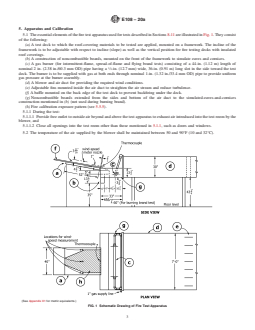
5.1 The essential elements of the fire test apparatus used for tests described in Sections 8-11 are illustrated in Fig. 1. They consist
of the following:
(a) A test deck to which the roof-covering materials to be tested are applied, mounted on a framework. The incline of the
framework is to be adjustable with respect to incline (slope) as well as the vertical position for fire testing decks with insulated
roof coverings.
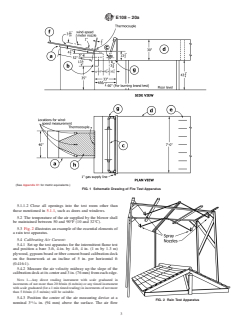
(b) A construction of noncombustible boards, mounted on the front of the framework to simulate eaves and cornices.
(c) A gas burner (for intermittent-flame, spread-of-flame and flying brand tests) consisting of a 44-in. (1.12 m) length of
nominal 2 in. (2.38 in./60.3 mm OD) pipe having a ⁄2-in. (12.7 mm) wide, 36-in. (0.91 m) long slot in the side toward the test
deck. The burner is to be supplied with gas at both ends through nominal 1-in. (1.32 in./33.4 mm OD) pipe to provide uniform
gas pressure at the burner assembly.
(d) A blower and air duct for providing the required wind conditions.
(e) Adjustable fins mounted inside the air duct to straighten the air stream and reduce turbulence.
(f) A baffle mounted on the back edge of the test deck to prevent backfiring under the deck.
(g) Noncombustible boards extended from the sides and bottom of the air duct to the simulated-eaves-and-cornices
construction mentioned in (b) (not used during burning brand).
(h) Fire calibration exposure pattern (see 5.5.5).
5.1.1 During the test:
5.1.1.1 Provide free outlet to outside air beyond and above the test apparatus to exhaust air introduced into the test room by the
blower, and
5.1.1.2 Close all openings into the test room other than those mentioned in 5.1.1, such as doors and windows.
5.2 The temperature of the air supplied by the blower shall be maintained between 50 and 90°F (10 and 32°C).
(See Appendix X1 for metric equivalents.)
FIG. 1 Schematic Drawing of Fire Test Apparatus
E108 − 20a
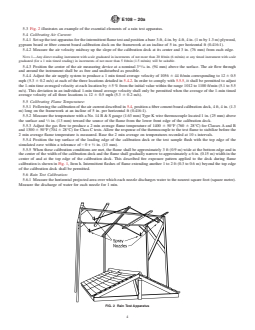
5.3 Fig. 2 illustrates an example of the essential elements of a rain test apparatus.
5.4 Calibrating Air Current:
5.4.1 Set up the test apparatus for the intermittent flame test and position a bare 3-ft, 4-in. by 4-ft, 4 in. (1 m by 1.3 m) plywood,
gypsum board or fiber cement board calibration deck on the framework at an incline of 5 in. per horizontal ft (0.416:1).
5.4.2 Measure the air velocity midway up the slope of the calibration deck at its center and 3 in. (76 mm) from each edge.
NOTE 1—Any direct reading instrument with scale graduated in increments of not more than 20 ft/min (6 m/min) or any timed instrument with scale
graduated (for a 1 min timed reading) in increments of not more than 5 ft/min (1.5 m/min) will be suitable.
5.4.3 Position the center of the air measuring device at a nominal 3 ⁄16 in. (94 mm) above the surface. The air flow through
and around the instrument shall be as free and undisturbed as possible.
5.4.4 Adjust the air supply system to produce a 1 min timed average velocity of 1056 6 44 ft/min corresponding to 12 6 0.5
mph (5.3 6 0.2 m/s) at each of the three locations detailed in 5.4.2. In order to comply with 5.5.5, it shall be permitted to adjust
the 1-min time averaged velocity at each location by 65 % from the initial value within the range 1012 to 1100 ft/min (5.1 to 5.5
m/s). This deviation in an individual 1-min timed average velocity shall only be permitted when the average of the 1-min timed
average velocity of all three locations is 12 6 0.5 mph (5.3 6 0.2 m/s).
5.5 Calibrating Flame Temperature:
5.5.1 Following the calibration of the air current described in 5.4, position a fiber cement board calibration deck, 4 ft, 4 in. (1.3
m) long on the framework at an incline of 5 in. per horizontal ft (0.416:1).
5.5.2 Measure the temperature with a No. 14 B & S gauge (1.63 mm) Type K wire thermocouple located 1 in. (25 mm) above
the surface and ⁄2 in. (13 mm) toward the source of the flame from the lower front edge of the calibration deck.
5.5.3 Adjust the gas flow to produce a 2 min average flame temperature of 1400 6 50°F (760 6 28°C) for Classes A and B
and 1300 6 50°F (704 6 28°C) for Class C tests. Allow the response of the thermocouple to the test flame to stabilize before the
2 min average flame temperature is measured. Base the 2 min average on temperatures recorded at 10 s intervals.
5.5.4 Position the top surface of the leading edge of the calibration deck or the test sample flush with the top edge of the
simulated eave within a tolerance of − 0 + ⁄2 in. (13 mm).
5.5.5 When these calibration conditions are met, the flame shall be approximately 3 ft (0.9 m) wide at the bottom edge and in
the center of the width of the calibration deck and the flame shall gradually narrow to approximately a 6 in. (0.15 m) width in the
center of and at the top edge of the calibration deck. This described fire exposure pattern applied to the deck during flame
calibration is shown in Fig. 1, Item h. Intermittent flashes of flame extending another 1 to 2 ft (0.3 to 0.6 m) beyond the top edge
of the calibration deck shall be permitted.
5.6 Rain Test Calibration:
5.6.1 Measure the horizontal projected area over which each nozzle discharges water to the nearest square foot (square metre).
Measure the discharge of water for each nozzle for 1 min.
FIG. 2 Rain Test Apparatus
E108 − 20a
5.6.2 Monitor the total water use during the test (a commercial water meter is suitable for this purpose). For a four day cycle
2 2 2
the water usage shall be 42 6 1 gal/ft (1711 6 41 L/m ). For a seven day cycle the water usage shall be 73 6 1.7 gal/ft (2975
6 71 L/m ).
5.7 Frequency of Calibration:
5.7.1 Calibrate the apparatus for air velocity and flame temperature prior to each day’s use. Calibrate the apparatus for flame
temperature when shifting from Class A or B to Class C tests or vice versa.
5.7.2 Any indication of off-limit condition such as unusual flame appearance or flame contour, excess turbulence, or unusual
noise shall be cause for calibration prior to further use.
5.7.3 For the Rain Test, visually check the water flow from each nozzle (for obvious water obstruction in the nozzle and uneven
spray pattern) each day during the water cycle and make adjustments when necessary.
5.7.4 For the Rain Test, review the total water flow at the end of each day and at the end of each water cycle. Correct the cause
of any off-limit conditions.
6. Preparation of Test Specimens
6.1 Construction of Test Decks:
6.1.1 The test deck for the intermittent flame exposure, burning brand tests, flying brand test, and rain test, except as specified
in the following paragraphs, shall be 3 ft-4 in. (1.0 m) wide by 4 ft-4 in. (1.3 m) long and shall be made of No. 1 white pine lumber
with not less than 8 % nor more than 12 % moisture content. The lumber shall be free of large or loose knots, sapwood, rot, or
pitch pockets, and shall contain no edge knots. Individual deck boards shall be of nominal 1 by 8-in. lumber (S4S). Lay the boards
across the shorter dimension of the test deck space ⁄4 in. (6 mm) apart and securely nail to two nominal 2 by 4-in. wood battens
located under and flush with the outer edges of the deck (Fig. 3). Decks so constructed shall be even and uniform.
6.1.2 Where the roof covering is intended to be installed over other than solid deck, construct the test decks of nominal 1 by
4-in. lumber (S4S) spaced a minimum of 1 ⁄8 in. (41 mm) apart and securely nailed to two nominal 2 by 4-in. wood battens. The
lumber shall be of the same quality as specified in 6.1.1.
FIG. 3 Construction of Test Decks
E108 − 20a
6.1.3 Roof coverings are permitted to be applied to other test decks of the minimum thickness recommended by the
manufacturer. This deviation shall be noted in the report. Plywood, if used, shall be exterior Type A-C grade with face and back
veneers of Douglas fir conforming to PS1 for softwood plywood and shall be identified as a Group 1 species. Oriented Strand
Board (OSB), if used, shall be marked as conforming to PS2. These decks shall have ⁄8-in. (3.2-mm) vertical and horizontal joints
located as specified in 6.1.1 with all vertical joints centered on nominal 2 by 4-in. wood battens. If wood battens or tongue and
groove joints are specified for horizontal joints, this shall be so noted in reporting the tests. The decks for intermittent flame tests
1 1
shall have a ⁄8 in. (3.2 mm) metric horizontal joint 8 in. (203 mm) from and parallel to the 3 ⁄3 ft (1.0 m) long leading edge. In
addition, provide a ⁄8 in. (3.2 mm) metric vertical joint centered on the deck and extending from the leading edge of the deck to
1 1
the ⁄8 in. (3.2 mm) metric horizontal joint. Since the lower 1 ⁄2 in. (38 mm) of this joint is not protected by the 2 by 4-in. batten,
due to the mounting arrangement on the carriage, cover the underside of this joint from the end of the two-by-four to the leading
edge of the deck by a piece of sheet steel, 2 in. (51 mm) wide.
6.1.4 For Classes A and B burning brand tests on decks other than 1 by 8-in. metric nominal lumber, the ⁄8 in. (3.2 mm)
1 1
horizontal joint shall be 22 ⁄2 in. (572 mm) from and parallel to the leading edge of the deck. Class A test decks shall have a ⁄8
in. (3.2 mm) metric vertical joint centered on the deck that extends above the horizontal joint. For Class B test decks, provide two
⁄8 in. (3.2 mm) metric vertical joints, extending above the horizontal joint with each vertical joint located 10 in. (254 mm) from
and parallel to the edge of the deck. For Class C burning brand test, provide five evenly spaced horizontal joints, with a minimum
width of ⁄8 in. (3.2 mm) metric between joints in the plywood.
6.1.5 For the spread of flame test, construct the test deck in the same manner as specified for the intermittent flame test, except
that (1) the vertical and horizontal joints need not be provided, (2) the length of the deck shall be as specified in 6.1.6 and (3)
15/32-in. (12-mm) thick plywood, conforming to PSI-95, is an acceptable deck for materials or systems when minimal
discoloration, without char or no involvement of the plywood test deck occurs, during fire tests. For tests on materials intended
for use only on noncombustible decks, a noncombustible deck of the applicable length specified in 6.1.6 is permitted.
6.1.6 The length of the test deck shall be 13 ft (4.0 m) for Class C tests, 9 ft (2.7 m) minimum for Class B tests, and 8 ft (2.4
m) minimum for Class A tests.
6.2 Application of Roofing on Test Roof Deck—Apply representative samples of roof covering materials for Class B or C tests
to 14 test decks (two each for the intermittent flame, spread of flame, and flying brand tests, four for the burning brand test, and
six for the rain test). Apply representative samples of roof covering materials for Class A tests to 16 test decks (two each for
intermittent flame, spread of flame, and flying brand tests, four for the burning brand test and six for the rain test). Apply the roof
covering materials under investigation in accordance with the manufacturer’s instructions and extend to and flush with the side and
back edges of the deck. At the leading edge the material is to be positioned such that there is minimum coverage or a minimum
number of layers over the horizontal deck joints. It is permitted to provide an air-seal along the sides of the representative sample
of the roof covering material system to restrict air flow under the system during the fire test. The use of a 1-in. (25-mm) maximum
width metal batten strip fastened on top of and along each lengthwise side edge is permitted for mechanically attached single-ply
membrane roof covering systems.
NOTE 2—A practice used to provide an air-seal for mechanically attached, fully-adhered and partially-adhered flexible single-ply membrane systems
is to pull the membrane taut over all four edges of the assembly to fit snugly against the deck and secure it to the wood supports of the test deck.
6.3 Storage and Conditioning of Test Specimens:
6.3.1 Pieces of any hygroscopic materials from the same stock from which the test deck was constructed shall be tacked to the
assembly during construction in such a manner that they are easily removed. These pieces shall be conditioned with the completed
assemblies as described in 6.3.2.
6.3.2 The completed test assembles are to be stored indoors at temperatures not lower than 60°F (16°C) nor higher than 90°F
(32°C) for the period of time necessary to cure the assembly components. Test decks are to be stored so that each will be
surrounded by freely circulating air.
6.3.3 Just before the deck is tested the pieces of hygroscopic materials prepared in 6.3.1 shall be tested for moisture content.
6.3.3.1 Make the moisture determination on two samples from each piece and report the average. For lumber and other
wood-based materials, use Test Methods D4442. Use of an appropriately calibrated moisture meter, as described in Test Methods
D4444, to determine the moisture content of wood or wood products is also permitted. For other hygroscopic materials, use test
methods appropriate for those materials.
6.3.3.2 For lumber, the moisture content shall not be less than 8 % nor more than 12 %. For plywood or OSB, the moisture
content shall not exceed 8 %. For other hygroscopic materials, the moisture shall be within ranges specified by the manufacturer
before the assembly is constructed. These specified ranges shall be typical for exposure at 77 6 9°F (25 6 5°C) and 55 6 10 %
relative humidity. If there is any indication that the lumber, plywood, or other hygroscopic materials have moisture contents outside
these ranges, measure moisture content and replace any out of range materials before building test decks. Out of range pieces shall
be dried or rewetted using methods that do not damage the materials.
6.4 The flying brand tests are required when there is a possibility that the roof covering will break into pieces of flying, flaming
brands or particles which continue to glow after reaching the floor of the test facility. See Appendix Appendix X3.
E108 − 20a
7. Tests—General
7.1 When a roof covering is restricted for use on noncombustible decks, only the spread of flame test is required. Materials
intended for use only on noncombustible decks are permitted to be tested when applied to a noncombustible deck or any type of
combustible deck of the length specified for the spread of flame test.
7.2 When a roof covering is not restricted for use on noncombustible decks, the spread of flame, intermittent flame, and burning
brand tests are required.
7.3 The rain tests are required whenever the fire-retardant characteristics of the roof covering materials or construction has the
potential to be adversely affected by water. See Appendix X2.
7.4 The weathering tests are required for wood shakes and shingles or when the fire-retardant characteristics of the roof covering
materials or construction has the potential to be adversely affected by weathering outdoors.
7.5 The flying brand tests are required when there is a possibility that the roof covering will break into pieces of flaming
particles that support combustion on the floor. See Appendix X3.
7.6 In all of the fire tests described in Sections 8 – 12, trowel noncombustible mortar into the joint formed by the leading edge
of the roof covering material and the framework of the carriage. This is to prevent air or the test flame from traveling under the
material being tested.
7.7 In these tests subject all decks to an air current as calibrated in 5.4.
7.8 Test prepared roof coverings at a slope of 5 in. per horizontal ft (416 mm per horizontal m). Test roof covering systems at
the maximum slope specified by the manufacturer but not to exceed 5 in. per horizontal ft (416 mm per horizontal m). Note the
slope used in the report.
8. Intermittent Flame Exposure Test
8.1 A minimum of two test decks must be tested and passed in sequence.
8.2 Mount a test deck 4 ft-4 in. (1.3 m) long on the framework at the required incline and maintain the calibrated air supply
to produce the specified air current. Subject the test deck to a luminous gas flame and profile as calibrated in 5.5.
8.3 Apply the flame intermittently for specified periods with specified time intervals between applications as follows:
Flame On, Flame Off, No. of Test
Method of Test min min Cycles
Class A 2 2 15
Class B 2 2 8
Class C 1 2 3
8.4 Maintain the air current throughout the test and after the last application of flame until all evidence of flame, glow, and
smoke has disappeared from both the exposed surface of the material being tested and the underside of the test deck, or until failure
occurs, but in no case is the air current or test duration to be maintained for more than 1 h after the last flame cycle for a Class
A or B test or ⁄2 h after the last flame cycle for a Class C test.
8.5 During the intermittent flame test, including on and off periods of flame application, observe for the appearance of sustained
flaming on the underside of the test deck, production of flaming or glowing brands displacement of portions of the test sample,
and exposure or falling away of portions of the roof deck.
9. Spread of Flame Test
9.1 A minimum of two test decks must be tested and passed in sequence.
9.2 Mount a test deck long enough for the desired Class A, B, or C rating in 6.1.6 in the same manner and use a luminous gas
flame as described in 8.2.
9.3 For Classes A and B tests, apply the gas flame and air current continuously for 10 min or until the flame (actual flaming
of the material being tested) permanently recedes from a point of maximum spread, whichever is shorter. For Class C test, apply
the gas flame and air current for a period of 4 min.
9.4 During the application of the test flame, observe the test sample for the distance to which flaming of the material has spread,
production of flaming or glowing brands, and displacement of portions of the test sample.
10. Burning Brand Test
10.1 A minimum of four test decks for Class A fire test exposure and two test decks for Class B or C fire test exposure must
be tested and passed in sequence.
E108 − 20a
10.2 Mount a 4 ft-4 in. (1.3 m) long test deck on the framework at the required incline and maintain the calibrated air supply
to produce the specified air current in the same manner as described in 8.2 for the intermittent flame test, except that the framework
shall be 60 in. (1524 mm) from the air duct outlet (see Fig. 1), and the gas piping and burner are removed so as not to obstruct
the air flow.
10.3 Size and Construction of Brands—Construct the brands (Fig. 4), as follows, and condition in an oven at 105 to 120°F (41
to 49°C) for at least 24 h.
10.3.1 The Class A test brand shall consist of a grid 12 in. (305 mm) square and approximately 2 ⁄4 in. (57 mm) thick made of
dry Douglas fir lumber free of knots and pitch pockets. Use 36 nominal 1 by 1 by 12 in. (25 by 25 by 305 mm) strips, dressed
3 3 1
on all four sides to ⁄4 by ⁄4 in. (19 by 19 mm), and placed in three layers of twelve strips each with strips spaced ⁄4 in. (6.35 mm)
apart. Place these strips at right angles to those in adjoining layers and nail at each end of each strip on one face and in a diagonal
pattern (Fig. 4) on the other face. The dry weight of the finished brand shall be 2000 6 150 g at the time of test.
10.3.2 The Class B test brand shall consist of a grid 6 in. (152 mm) square and approximately 2 ⁄4 in. (57 mm) thick made of
dry Douglas fir lumber free of knots and pitch pockets. Use 18 nominal 1 by 1 by 6 in. (25 by 25 by 152 mm) strips, dressed on
3 3 1
all four faces to ⁄4 by ⁄4 in. (19 by 19 mm), and placed in three layers of six strips each with strips spaced ⁄4 in. (6.35 mm) apart.
Place the strips at right angles to those in adjoining layers and nail at each end of each strip on one face and in a diagonal pattern
(Fig. 4) on the other face. The dry weight of the finished brand shall be 500 6 50 g at the time of test.
10.3.3 Nails used in the construction of Classes A and B brands are No. 16, 1 ⁄2 in. (38 mm) long bright, flat head, diamond
point, wire nails. Sixty-eight nails weighing approximately 42 g are used for Class A brand, and 32 nails weighing approximately
21 g are used for the Class B brand.
10.3.4 The Class C test brand shall consist of a piece of dry nonresinous whit
...