

ASTM E2957-17
(Test Method)Standard Test Method for Resistance to Wildfire Penetration of Eaves, Soffits and Other Projections
General Information
- Abstract
SIGNIFICANCE AND USE
5.1 The test method described herein monitors the fire characteristics and the ability of eave overhangs and other projections to resist exterior fire penetration from underneath under the specified fire exposure conditions.
5.2 Representative joints and other characteristics of the eave overhang or projection shall be included in the test specimen when these details are representative of the end-use construction.
5.3 The test method does not apply to vents or perforated materials used to enclose or cap eaves, soffits, and other projections.
Note 1: Test Methods E2912 and E2886/E2886M are methods used to test vents or perforated materials to resist direct flame impingement and flame penetration into the building.
5.4 The test method is devised for eave overhangs and other projections independent of the materials covering the building envelope.
Note 2: Heat contribution from burning materials covering the building envelope beyond the prescribed fire exposure is not considered in this test method.
5.5 The test method does not necessarily represent the expected performance of eave overhang and projections under all actual fire conditions, but it does provide a basis for comparing eave overhang and projections materials when subjected to the test procedure described herein.
5.6 In this procedure, the test specimen is subjected to specific laboratory fire test conditions. If different test conditions are substituted or the anticipated end-use conditions are changed, it is not known whether it is possible by use of this test to predict changes in the performance characteristics measured. Therefore, the results are strictly valid only for the fire test conditions and construction tested.
5.7 The test method does not provide any basis for determining the fire resistance characteristics of eave overhangs or projections when exposed to a fire originating in the building.
5.8 The test method does not address interior or exterior flame spread.
SCOPE
1.1 This fire-test-response standard prescribes a method for qualitatively assessing the resistance to fire penetration of eave overhangs and other projections, such as the soffits of roof eaves and cantilevered floor projections, when exposed to direct flame impingement from a simulated external wildfire exposure, such as encountered in a “Wildland Urban Interface” scenario. This test method provides data suitable for comparing the relative performance of materials, which are used as the exposed underside surfaces of eave overhangs and other projections.
1.2 This test method measures the ability of eave overhangs and other projections to resist fire penetration from the exterior into the wall cavity or unexposed side of the test specimen under the conditions of exposure.
1.3 This test method is applicable to eave overhangs and other projections such as the soffits of roof eaves and cantilevered floor projections intended for use with either combustible or noncombustible building envelopes.
1.4 Limitations of the test method are listed in Section 5.
1.5 The values stated in metric units are to be regarded as the standard. Values in parentheses are for information only.
1.6 This standard does not purport to address all of the safety concerns, if any, associated with its use. It is the responsibility of the user of this standard to establish appropriate safety and health practices and determine the applicability of regulatory limitations prior to use.
1.7 This standard is used to measure and describe the response of materials, products, or assemblies to heat and flame under controlled laboratory conditions, but does not by itself incorporate all factors required for fire hazard or fire risk assessment of the materials, products or assemblies under actual fire conditions.
1.8 Fire testing is inherently hazardous. Adequate safeguards for personnel and property shall be employed in conducting these tests.
1.9 The t...
- Status
- Published
- Publication Date
- 30-Apr-2017
- Technical Committee
- E05 - Fire Standards
- Drafting Committee
- E05.14 - External Fire Exposures
Buy Documents
ASTM E2957-17 - Standard Test Method for Resistance to Wildfire Penetration of Eaves, Soffits and Other Projections
REDLINE ASTM E2957-17 - Standard Test Method for Resistance to Wildfire Penetration of Eaves, Soffits and Other Projections
Overview
ASTM E2957-17: Standard Test Method for Resistance to Wildfire Penetration of Eaves, Soffits and Other Projections provides a standardized approach for evaluating how well eave overhangs, soffits, and similar building projections resist exterior fire penetration from wildfires. This method is especially relevant for structures in Wildland Urban Interface (WUI) zones, where wildfire exposure poses significant risks to building integrity and occupant safety.
The standard focuses on direct flame impingement from simulated external wildfire conditions, assessing the ability of materials and designs used in eaves, soffits, or cantilevered projections to prevent fire from penetrating into the structure. By following this method, architects, builders, and regulatory agencies can compare the relative performance of different construction materials and assemblies intended for wildfire-prone environments.
Key Topics
- Fire Penetration Resistance: The primary focus is on how eave overhangs and projections withstand direct flames without allowing fire to penetrate to the structure's interior or wall cavity.
- Testing Conditions: Test specimens, representing typical design and materials, are subjected to controlled laboratory fire exposure. The test simulates realistic exterior wildfire exposure for a prescribed period, after which performance is monitored.
- Scope of Application:
- Applies to both combustible and noncombustible building envelope systems.
- Encompasses soffits, cantilevered floor projections, and similar construction features.
- Limitations: The method does not apply to vents or perforated materials used in eaves or soffits (see ASTM E2912 and E2886/E2886M for such components).
- Performance Comparison: Results are strictly comparable under the standardized conditions described; they do not predict performance in all possible real-world fire scenarios.
- Safety and Reporting: The standard highlights necessary safety precautions for laboratory fire tests and detailed reporting requirements, including methods, specimen descriptions, and observed fire behavior.
Applications
- Wildfire-Resistant Construction: Enables designers and builders to select and specify materials for eaves, soffits, and projections that have been tested for resistance to wildfire penetration, bolstering the resilience of buildings in high-risk areas.
- Regulatory Compliance: Supports building codes and local regulations, especially in WUI zones where enhanced exterior fire protection is mandated.
- Material and Product Development: Assists manufacturers in developing and certifying materials with documented wildfire resistance, enhancing product marketing to fire-sensitive markets.
- Comparative Assessment: Offers a practical basis for comparing different assemblies or configurations, informing retrofit strategies and upgrades for existing structures.
Related Standards
- ASTM E2912: Test Method for Fire Test of Non-Mechanical Fire Dampers Used in Vented Construction.
- ASTM E2886/E2886M: Evaluates the ability of exterior vents to resist ember entry and direct flame impingement.
- ASTM E2707: Fire penetration testing of exterior wall assemblies.
- NFPA 286: Evaluates fire growth contribution of wall and ceiling interior finishes.
- ISO 13943: Provides fire safety vocabulary used for clarity within the standard.
Keywords: wildfire penetration resistance, eaves, soffits, projections, Wildland Urban Interface, fire-test response, building envelope, ASTM E2957-17, fire protection, WUI construction standards.
Practical Value
By using ASTM E2957-17, construction professionals, regulatory bodies, and product manufacturers can ensure that exposed building elements such as eaves and projections meet rigorous standards for wildfire defense, reducing the risk of fire-induced structural loss and enhancing safety in regions vulnerable to wildfires.
Relations
- Effective Date
- 01-May-2017
- Effective Date
- 01-Jan-2024
- Effective Date
- 01-Mar-2020
- Effective Date
- 15-Dec-2018
- Effective Date
- 01-Jul-2018
- Effective Date
- 01-Mar-2018
- Effective Date
- 01-Feb-2017
- Effective Date
- 15-Nov-2016
- Effective Date
- 01-Dec-2015
- Effective Date
- 01-Aug-2015
- Effective Date
- 01-Aug-2015
- Effective Date
- 01-Jun-2015
- Effective Date
- 01-Mar-2015
- Effective Date
- 01-Feb-2015
- Effective Date
- 01-Dec-2014
Buy Documents
ASTM E2957-17 - Standard Test Method for Resistance to Wildfire Penetration of Eaves, Soffits and Other Projections
REDLINE ASTM E2957-17 - Standard Test Method for Resistance to Wildfire Penetration of Eaves, Soffits and Other Projections
Get Certified
Connect with accredited certification bodies for this standard

DIBt (Deutsches Institut für Bautechnik)
German Institute for Building Technology.
DIN CERTCO
DIN Group product certification.

Kiwa BDA Testing
Building and construction product certification.
Sponsored listings
Frequently Asked Questions
ASTM E2957-17 is a standard published by ASTM International. Its full title is "Standard Test Method for Resistance to Wildfire Penetration of Eaves, Soffits and Other Projections". This standard covers: SIGNIFICANCE AND USE 5.1 The test method described herein monitors the fire characteristics and the ability of eave overhangs and other projections to resist exterior fire penetration from underneath under the specified fire exposure conditions. 5.2 Representative joints and other characteristics of the eave overhang or projection shall be included in the test specimen when these details are representative of the end-use construction. 5.3 The test method does not apply to vents or perforated materials used to enclose or cap eaves, soffits, and other projections. Note 1: Test Methods E2912 and E2886/E2886M are methods used to test vents or perforated materials to resist direct flame impingement and flame penetration into the building. 5.4 The test method is devised for eave overhangs and other projections independent of the materials covering the building envelope. Note 2: Heat contribution from burning materials covering the building envelope beyond the prescribed fire exposure is not considered in this test method. 5.5 The test method does not necessarily represent the expected performance of eave overhang and projections under all actual fire conditions, but it does provide a basis for comparing eave overhang and projections materials when subjected to the test procedure described herein. 5.6 In this procedure, the test specimen is subjected to specific laboratory fire test conditions. If different test conditions are substituted or the anticipated end-use conditions are changed, it is not known whether it is possible by use of this test to predict changes in the performance characteristics measured. Therefore, the results are strictly valid only for the fire test conditions and construction tested. 5.7 The test method does not provide any basis for determining the fire resistance characteristics of eave overhangs or projections when exposed to a fire originating in the building. 5.8 The test method does not address interior or exterior flame spread. SCOPE 1.1 This fire-test-response standard prescribes a method for qualitatively assessing the resistance to fire penetration of eave overhangs and other projections, such as the soffits of roof eaves and cantilevered floor projections, when exposed to direct flame impingement from a simulated external wildfire exposure, such as encountered in a “Wildland Urban Interface” scenario. This test method provides data suitable for comparing the relative performance of materials, which are used as the exposed underside surfaces of eave overhangs and other projections. 1.2 This test method measures the ability of eave overhangs and other projections to resist fire penetration from the exterior into the wall cavity or unexposed side of the test specimen under the conditions of exposure. 1.3 This test method is applicable to eave overhangs and other projections such as the soffits of roof eaves and cantilevered floor projections intended for use with either combustible or noncombustible building envelopes. 1.4 Limitations of the test method are listed in Section 5. 1.5 The values stated in metric units are to be regarded as the standard. Values in parentheses are for information only. 1.6 This standard does not purport to address all of the safety concerns, if any, associated with its use. It is the responsibility of the user of this standard to establish appropriate safety and health practices and determine the applicability of regulatory limitations prior to use. 1.7 This standard is used to measure and describe the response of materials, products, or assemblies to heat and flame under controlled laboratory conditions, but does not by itself incorporate all factors required for fire hazard or fire risk assessment of the materials, products or assemblies under actual fire conditions. 1.8 Fire testing is inherently hazardous. Adequate safeguards for personnel and property shall be employed in conducting these tests. 1.9 The t...
SIGNIFICANCE AND USE 5.1 The test method described herein monitors the fire characteristics and the ability of eave overhangs and other projections to resist exterior fire penetration from underneath under the specified fire exposure conditions. 5.2 Representative joints and other characteristics of the eave overhang or projection shall be included in the test specimen when these details are representative of the end-use construction. 5.3 The test method does not apply to vents or perforated materials used to enclose or cap eaves, soffits, and other projections. Note 1: Test Methods E2912 and E2886/E2886M are methods used to test vents or perforated materials to resist direct flame impingement and flame penetration into the building. 5.4 The test method is devised for eave overhangs and other projections independent of the materials covering the building envelope. Note 2: Heat contribution from burning materials covering the building envelope beyond the prescribed fire exposure is not considered in this test method. 5.5 The test method does not necessarily represent the expected performance of eave overhang and projections under all actual fire conditions, but it does provide a basis for comparing eave overhang and projections materials when subjected to the test procedure described herein. 5.6 In this procedure, the test specimen is subjected to specific laboratory fire test conditions. If different test conditions are substituted or the anticipated end-use conditions are changed, it is not known whether it is possible by use of this test to predict changes in the performance characteristics measured. Therefore, the results are strictly valid only for the fire test conditions and construction tested. 5.7 The test method does not provide any basis for determining the fire resistance characteristics of eave overhangs or projections when exposed to a fire originating in the building. 5.8 The test method does not address interior or exterior flame spread. SCOPE 1.1 This fire-test-response standard prescribes a method for qualitatively assessing the resistance to fire penetration of eave overhangs and other projections, such as the soffits of roof eaves and cantilevered floor projections, when exposed to direct flame impingement from a simulated external wildfire exposure, such as encountered in a “Wildland Urban Interface” scenario. This test method provides data suitable for comparing the relative performance of materials, which are used as the exposed underside surfaces of eave overhangs and other projections. 1.2 This test method measures the ability of eave overhangs and other projections to resist fire penetration from the exterior into the wall cavity or unexposed side of the test specimen under the conditions of exposure. 1.3 This test method is applicable to eave overhangs and other projections such as the soffits of roof eaves and cantilevered floor projections intended for use with either combustible or noncombustible building envelopes. 1.4 Limitations of the test method are listed in Section 5. 1.5 The values stated in metric units are to be regarded as the standard. Values in parentheses are for information only. 1.6 This standard does not purport to address all of the safety concerns, if any, associated with its use. It is the responsibility of the user of this standard to establish appropriate safety and health practices and determine the applicability of regulatory limitations prior to use. 1.7 This standard is used to measure and describe the response of materials, products, or assemblies to heat and flame under controlled laboratory conditions, but does not by itself incorporate all factors required for fire hazard or fire risk assessment of the materials, products or assemblies under actual fire conditions. 1.8 Fire testing is inherently hazardous. Adequate safeguards for personnel and property shall be employed in conducting these tests. 1.9 The t...
ASTM E2957-17 is classified under the following ICS (International Classification for Standards) categories: 13.220.50 - Fire-resistance of building materials and elements; 91.060.20 - Roofs. The ICS classification helps identify the subject area and facilitates finding related standards.
ASTM E2957-17 has the following relationships with other standards: It is inter standard links to ASTM E2957-15, ASTM E176-24, ASTM D4442-20, ASTM E176-18a, ASTM D4444-13(2018), ASTM E176-18, ASTM D2898-10(2017), ASTM D4442-16, ASTM D7032-15, ASTM E176-15a, ASTM E176-15ae1, ASTM D4442-15, ASTM E631-15, ASTM E176-15, ASTM D7032-14. Understanding these relationships helps ensure you are using the most current and applicable version of the standard.
ASTM E2957-17 is available in PDF format for immediate download after purchase. The document can be added to your cart and obtained through the secure checkout process. Digital delivery ensures instant access to the complete standard document.
Standards Content (Sample)
This international standard was developed in accordance with internationally recognized principles on standardization established in the Decision on Principles for the
Development of International Standards, Guides and Recommendations issued by the World Trade Organization Technical Barriers to Trade (TBT) Committee.
Designation:E2957 −17 An American National Standard
Standard Test Method for
Resistance to Wildfire Penetration of Eaves, Soffits and
Other Projections
This standard is issued under the fixed designation E2957; the number immediately following the designation indicates the year of
original adoption or, in the case of revision, the year of last revision. A number in parentheses indicates the year of last reapproval. A
superscript epsilon (´) indicates an editorial change since the last revision or reapproval.
1. Scope 1.8 Fire testing is inherently hazardous. Adequate safe-
guards for personnel and property shall be employed in
1.1 This fire-test-response standard prescribes a method for
conducting these tests.
qualitatively assessing the resistance to fire penetration of eave
1.9 The text of this standard references notes and footnotes
overhangs and other projections, such as the soffits of roof
which provide explanatory material. These notes and footnotes
eaves and cantilevered floor projections, when exposed to
(including those in tables and figures) shall not be considered
direct flame impingement from a simulated external wildfire
as requirements of the standard.
exposure, such as encountered in a “Wildland Urban Interface”
1.10 This international standard was developed in accor-
scenario.Thistestmethodprovidesdatasuitableforcomparing
dance with internationally recognized principles on standard-
the relative performance of materials, which are used as the
ization established in the Decision on Principles for the
exposed underside surfaces of eave overhangs and other
Development of International Standards, Guides and Recom-
projections.
mendations issued by the World Trade Organization Technical
1.2 This test method measures the ability of eave overhangs
Barriers to Trade (TBT) Committee.
and other projections to resist fire penetration from the exterior
2. Referenced Documents
into the wall cavity or unexposed side of the test specimen
under the conditions of exposure.
2.1 ASTM Standards:
C1396 Specification for Gypsum Board
1.3 This test method is applicable to eave overhangs and
D2898 Practice for Accelerated Weathering of Fire-
other projections such as the soffits of roof eaves and cantile-
Retardant-Treated Wood for Fire Testing
veredfloorprojectionsintendedforusewitheithercombustible
D4442 Test Methods for Direct Moisture Content Measure-
or noncombustible building envelopes.
ment of Wood and Wood-Based Materials
1.4 Limitations of the test method are listed in Section 5.
D4444 Test Method for Laboratory Standardization and
Calibration of Hand-Held Moisture Meters
1.5 The values stated in metric units are to be regarded as
D6662 Specification for Polyolefin-Based Plastic Lumber
the standard. Values in parentheses are for information only.
Decking Boards
1.6 This standard does not purport to address all of the
D7032 Specification for Establishing Performance Ratings
safety concerns, if any, associated with its use. It is the
for Wood-Plastic Composite and Plastic Lumber Deck
responsibility of the user of this standard to establish appro-
Boards, Stair Treads, Guards, and Handrails
priate safety and health practices and determine the applica-
E176 Terminology of Fire Standards
bility of regulatory limitations prior to use.
E631 Terminology of Building Constructions
1.7 This standard is used to measure and describe the
E2707 Test Method for Determining Fire Penetration of
response of materials, products, or assemblies to heat and
Exterior Wall Assemblies Using a Direct Flame Impinge-
flame under controlled laboratory conditions, but does not by
ment Exposure
itself incorporate all factors required for fire hazard or fire risk
E2912 Test Method for Fire Test of Non-Mechanical Fire
assessment of the materials, products or assemblies under
Dampers Used in Vented Construction
actual fire conditions.
E2886/E2886M Test Method for Evaluating the Ability of
Exterior Vents to Resist the Entry of Embers and Direct
Flame Impingement
This test method is under the jurisdiction of ASTM Committee E05 on Fire
Standards and is the direct responsibility of Subcommittee E05.14 on External Fire
Exposures. For referenced ASTM standards, visit the ASTM website, www.astm.org, or
Current edition approved May 1, 2017. Published May 2017. Originally contact ASTM Customer Service at service@astm.org. For Annual Book of ASTM
approved in 2015. Last previous edition approved in 2015 as E2957-15. DOI: Standards volume information, refer to the standard’s Document Summary page on
10.1520/E2957-17. the ASTM website.
Copyright © ASTM International, 100 Barr Harbor Drive, PO Box C700, West Conshohocken, PA 19428-2959. United States
E2957−17
2.2 Other Standards: 4.5 The test method monitors the fire characteristics and the
ISO 13943 Fire Safety—Vocabulary ability of the test specimen to resist fire penetration during the
NFPA 286 Standard Methods of Fire Tests for Evaluating flame exposure period and a subsequent observation period.
Contribution of Wall and Ceiling Interior Finish to Room
4.6 Observations are made for the appearance of sustained
Fire Growth
flaming and glow on the unexposed side during the 10-min
flame exposure period and a subsequent 30-min observation
3. Terminology
period.
3.1 Definitions—For definitions of terms used in this
5. Significance and Use
standard, see Terminology E176, E631 and ISO 13943. In case
of conflict between E176 and E631 or ISO 13943, the 5.1 The test method described herein monitors the fire
definitions given in Terminology E176 shall prevail. In case of characteristics and the ability of eave overhangs and other
conflict between E631 and ISO 13943, the definitions given in projections to resist exterior fire penetration from underneath
Terminology E631 shall prevail. under the specified fire exposure conditions.
3.2 Definitions of Terms Specific to This Standard: 5.2 Representative joints and other characteristics of the
3.2.1 building envelope, n—the boundary or barrier separat- eave overhang or projection shall be included in the test
ing different environmental conditions within a building and specimen when these details are representative of the end-use
from the outside environment. construction.
3.2.2 eave, n—a projecting edge of a roof that extends
5.3 The test method does not apply to vents or perforated
beyond the building envelope.
materials used to enclose or cap eaves, soffits, and other
projections.
3.2.3 glow, n—visible light emitted by a solid undergoing
NOTE 1—Test Methods E2912 and E2886/E2886M are methods used to
combustion.
test vents or perforated materials to resist direct flame impingement and
3.2.4 holding fixture, n—apparatus designed to hold the test
flame penetration into the building.
specimen and a wall assembly, described in 7.3.
5.4 The test method is devised for eave overhangs and other
3.2.5 projection, n—an exterior outcrop of the building,
projections independent of the materials covering the building
such as a cantilevered room, that protrudes from or overhangs
envelope.
the building envelope. NOTE 2—Heat contribution from burning materials covering the build-
ing envelope beyond the prescribed fire exposure is not considered in this
3.2.5.1 Discussion—Examples include, but are not limited
test method.
to, eaves, soffits, enclosed cantilevered balconies, and enclosed
5.5 The test method does not necessarily represent the
cantilevered room bump-outs.
expected performance of eave overhang and projections under
3.2.6 soffıt, n—the enclosed underside of any exterior over-
all actual fire conditions, but it does provide a basis for
hanging section of a roof eave.
comparing eave overhang and projections materials when
3.2.7 sustained flaming, n—flame on or over the surface of
subjected to the test procedure described herein.
a test specimen that lasts longer than a period of 4 s.
5.6 In this procedure, the test specimen is subjected to
3.2.8 wall assembly, n—framed vertical section simulating
specific laboratory fire test conditions. If different test condi-
an exterior wall below an eave overhang or projection used in
tions are substituted or the anticipated end-use conditions are
the evaluation of test specimen.
changed, it is not known whether it is possible by use of this
3.2.8.1 Discussion—Paragraph 7.2 describes the wall as-
test to predict changes in the performance characteristics
sembly used in this test method.
measured. Therefore, the results are strictly valid only for the
fire test conditions and construction tested.
4. Summary of Test Method
5.7 The test method does not provide any basis for deter-
4.1 This test method provides for the direct flame exposure
mining the fire resistance characteristics of eave overhangs or
of eave overhang and other projections.
projections when exposed to a fire originating in the building.
4.2 This test method employs a gas burner to produce a
5.8 The test method does not address interior or exterior
diffusion flame in contact with the test specimen.
flame spread.
4.3 The flame source is centered left to right and below the
6. Safety Precautions
test specimen.
6.1 The test procedure involves high temperatures and
4.4 The gas burner produces a prescribed net rate of heat
combustionprocesses.Therefore,thepotentialexistsforburns,
output during the flame exposure period, after which the flame
ignition of extraneous objects or clothing, and for inhalation of
exposure is terminated.
combustion products.
7. Apparatus
Available from International Organization for Standardization (ISO), 1, ch. de
7.1 Unless otherwise noted, dimensions in the following
la Voie-Creuse, CP 56, CH-1211 Geneva 20, Switzerland, http://www.iso.org.
descriptionsshallbefollowedwithatoleranceof 613mm(0.5
Available from National Fire Protection Association (NFPA), 1 Batterymarch
Park, Quincy, MA 02169-7471, http://www.nfpa.org. in.).
E2957−17
7.2 Wall Assembly—Framed assembly made up of standard tion of fire at the margins of the wall assembly. The holding
38 by 89 by 2440 mm (2 by 4 in. by 8 ft) standard wood wall fixture includes a sturdy frame assembly to mount the test
studs (metal studs optional) at 406 mm (16 in.) o.c. overlaid
specimen and the wall assembly. The holding fixture permits a
with 16 mm ( ⁄8 in.) Type “X” gypsum board complying with
prefabricated wall assembly with an attached test specimen to
Specification C1396, or a noncombustible board material of
be inserted from the rear and to seal in such a way that protects
nominal thickness of 12 mm ( ⁄2 in.) or greater.
the wall assembly edges from fire. Side shields are situated
7.2.1 Thewallassemblydimensionsshallbe1220mm(4ft)
near the vertical edges of the holding fixture and extend from
wide and 2440 mm (8 ft) high.
the holding fixture’s base to within 305 mm (12 in.) of the top
of the wall assembly as shown in Figs. 1 and 2 to aid in
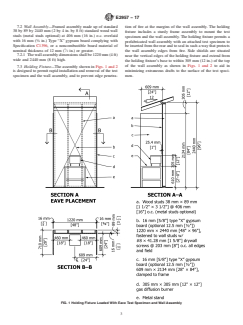
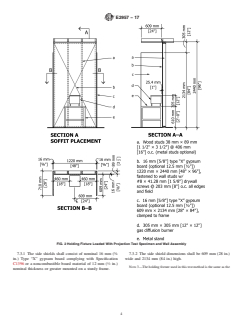
7.3 Holding Fixture—The assembly shown in Figs. 1 and 2
minimizing extraneous drafts to the surface of the test speci-
is designed to permit rapid installation and removal of the test
specimen and the wall assembly, and to prevent edge penetra- men.
FIG. 1Holding Fixture Loaded With Eave Test Specimen and Wall Assembly
E2957−17
FIG. 2Holding Fixture Loaded With Projection Test Specimen and Wall Assembly
7.3.1 The side shields shall consist of nominal 16 mm ( ⁄8 7.3.2 The side shield dimensions shall be 609 mm (28 in.)
in.) Type “X” gypsum board complying with Specification
wide and 2134 mm (84 in.) high.
C1396 or a noncombustible board material of 12 mm ( ⁄2 in.)
NOTE 3—The holding fixture used in this test method is the same as the
nominal thickness or greater mounted on a sturdy frame.
E2957−17
Wall Assembly Holding Fixture described in Paragraph 7.2, Test Method
9.1.1.2 The gas diffusion burner shall be supported for a
E2707 except the simulated noncombustible soffit has been replaced with
nominal height of 152 mm (6 in.) making the total height 305
the test specimen under investigation.
66mm(12 6 0.25 in.).
8. Test Room NOTE 4—The burner used for testing in this standard is the same as
described in Section 4.1, NFPA 286.
8.1 The ambient temperature in the test room shall be above
9.1.2 The refractory material specified in 9.1.1 shall be a
15 °C (60 °F) and the relative humidity shall be less than 75 %.
minimum 102 mm (4 in.) layer of white Ottawa sand used to
The test room shall be draft-protected and equipped with an
provide the horizontal surface through which the gas is
exhaust hood system for removal of products of combustion
supplied.
during testing.
9.2 Burner Position:
8.2 Air velocities in the vicinity of the ignition source
9.2.1 The gas diffusion burner enclosure shall be positioned
burner shall not exceed 0.5 m/s (1.64 ft/s) measured at a
so that it is centered relative to the width of the wall assembly.
horizontal distance of 0.5 m (20 in.) from the edge of the wall
9.2.2 The gas diffusion burner shall be located 25 66mm
assembly.
(1 6 0.25 in.) from the wall assembly.
8.3 Air supply shall not be limited during the test.
9.2.3 The distance from the base of the holding fixture in
Figs. 1 and 2 to the top surface of the gas diffusion burner shall
9. Ignition Source and Calibration
be915 66mm(36 60.25in.).Toobtaintherequireddistance
9.1 Ignition Source Burner: from the base of the holding fixture in Figs. 1 and 2 to the top
9.1.1 The ignition source shall be a gas diffusion burner surface of the gas diffusion burner, the nominal 305 mm (12
with a porous top surface of a refractory material. in.) tall burner shall be placed on top of a nominal 610 mm (24
9.1.1.1 The gas diffusion burner shall have a nominal in.) tall metal stand with a nominal top surface area of 610 by
surface area 305 by 305 mm (12 by 12 in.), as shown in Fig. 3. 610 mm (24 by 24 in). The metal stand is shown in Fig. 4.
FIG. 3Gas Diffusion Burner for Test
E2957−17
FIG. 4Metal Stand for Gas Diffusion Burner
9.3 The gas diffusion burner shall be supplied with mini- 9.8 Gas Diffusion Burner Calibration:
mum 99 % pure propane (often described by suppliers as CPor
9.8.1 The gas supply to the gas diffusion burner shall be the
“chemically pure” grade) having a nominal heating value of same as used for testing. The gas shall be metered and kept
93.0 MJ/m [22.2 kilocalories (thermochemical) per cubic constant throughout the calibration test.
meter or 2500 Btu (thermochemical) per cubic foot]. 9.8.2 Place the gas diffusion burner in the configuration to
be used for testing and obtain the heat release rate value
9.4 Thepropaneshallbesuppliedtothegasdiffusionburner
prescribed in 9.5.
through a metered control system.
9.8.3 Take measurements at least once every 6 s and start 1
9.5 The propane supply to the gas diffusion burner shall
min prior to ignition of the gas diffusion burner. Determine the
produce a net heat output of 300 615 kW (17,060 6 853
average heat output over a period of at least 1 min by the
BTU/min).
oxygen consumption method, or calculate the heat output from
the gas mass flow and the net heat of combustion.
9.6 The gas diffusion burner shall be ignited by a pilot
burner or a remotely controlled spark igniter.
9.9 Frequency of Calibration:
9.7 Gas diffusion burner controls shall be provided for 9.9.1 Calibrate the gas diffusion burner for heat output prior
automatic gas supply shut-off if flameout occurs. to each day’s use.
E2957−17
9.9.2 Any indication of off-limit condition such as unusual 10.3.4 Just prior to testing the test specimen, but not more
flame appearance or flame contour, excess turbulence, or than 30 min before testing, the pieces of cellulosic materials
unusual noise shall be cause for calibration prior to further use. prepared in 10.3.2 and 10.3.3 shall be tested for moisture
content.
10. Preparation of Test Specimens 10.3.4.1 Make the moisture determination on two samples
from each piece and report the average. For lumber and other
10.1 Unless otherwise noted, dimensions in the following
wood-based materials, use Test Methods D4442.Alternatively,
descriptions, shall be followed with a tolerance of 613 mm
the moisture content for lumber and other wood-based mate-
(0.5 in.).
rials is permitted to be measured using a moisture meter
10.2 Construction of Test Specimen:
calibrated in accordance with Test Methods D4444.
10.2.1 The test specimen shall be 1220 mm (4 ft) wide.
10.3.4.2 For lumber used in the construction of the wall
Whenapplicable,normalroofframing,joints,andothertypical
assembly and holding fixture, the moisture content shall not be
features present in the end-use construction shall be present in
more than 12 %. For plywood decks, the moisture content is to
the test specimen.
be not greater than 8 %. For other cellulosic materials, the
10.2.2 The test specimen shall extend out from the wall
moisture shall be within ranges specified by the test sponsor
assembly a distance of 610 mm (24 in.) and be finished in a
before the assembly is constructed. These specified ranges
manner appropriate for exterior exposure as per accepted
shall be typical for exposure at 25 6 5°C (77 6 9°F) and 55 6
construction practices.
10 % relative humidity.
10.2.2.1 Testing of test specimens with an extension from
the wall other than 610 mm (24 in.) is permitted. However,
11. Procedure
applicability of the results is limited to the extension tested or
11.1 Prior to testing, and without the test specimen or wall
less, and shall be noted in the report.
assembly in place, position the holding fixture at the desired
10.2.3 The solid left and right vertical sides of the test
test location under the collection hood and set the gas diffusion
specimen shall be finished with a noncombustible material to
burner for the prescribed level of output.
prevent unintended direct flame impingement of internal com-
ponents.
11.2 Once the gas diffusion burner output is verified, mount
thewallassemblyandthetestspecimenintotheholdingfixture
10.3 Accelerated Aging/Weathering and Conditioning of
such that the test specimen connects to the wall assembly 1524
Test Specimens:
mm (5 ft) from the top of the gas diffusion burner, without
10.3.1 When it is anticipated that a regulatory or other
affecting the distance between the wall assembly and th
...
This document is not an ASTM standard and is intended only to provide the user of an ASTM standard an indication of what changes have been made to the previous version. Because
it may not be technically possible to adequately depict all changes accurately, ASTM recommends that users consult prior editions as appropriate. In all cases only the current version
of the standard as published by ASTM is to be considered the official document.
Designation: E2957 − 15 E2957 − 17 An American National Standard
Standard Test Method for
Resistance to Wildfire Penetration of Eaves, Soffits and
Other Projections
This standard is issued under the fixed designation E2957; the number immediately following the designation indicates the year of
original adoption or, in the case of revision, the year of last revision. A number in parentheses indicates the year of last reapproval. A
superscript epsilon (´) indicates an editorial change since the last revision or reapproval.
1. Scope
1.1 This fire-test-response standard prescribes a method for qualitatively assessing the resistance to fire penetration of eave
overhangs and other projections, such as the soffits of roof eaves and cantilevered floor projections, when exposed to direct flame
impingement from a simulated external wildfire exposure, such as encountered in a “Wildland Urban Interface” scenario. This test
method provides data suitable for comparing the relative performance of materials, which are used as the exposed underside
surfaces of eave overhangs and other projections.
1.2 This test method measures the ability of eave overhangs and other projections to resist fire penetration from the exterior into
the wall cavity or unexposed side of the test specimen under the conditions of exposure.
1.3 This test method is applicable to eave overhangs and other projections such as the soffits of roof eaves and cantilevered floor
projections intended for use with either combustible or noncombustible building envelopes.
1.4 Limitations of the test method are listed in Section 5.
1.5 The values stated in metric units are to be regarded as the standard. Values in parentheses are for information only.
1.6 This standard does not purport to address all of the safety concerns, if any, associated with its use. It is the responsibility
of the user of this standard to establish appropriate safety and health practices and determine the applicability of regulatory
limitations prior to use.
1.7 This standard is used to measure and describe the response of materials, products, or assemblies to heat and flame under
controlled laboratory conditions, but does not by itself incorporate all factors required for fire hazard or fire risk assessment of
the materials, products or assemblies under actual fire conditions.
1.8 Fire testing is inherently hazardous. Adequate safeguards for personnel and property shall be employed in conducting these
tests.
1.9 The text of this standard references notes and footnotes which provide explanatory material. These notes and footnotes
(including those in tables and figures) shall not be considered as requirements of the standard.
1.10 This international standard was developed in accordance with internationally recognized principles on standardization
established in the Decision on Principles for the Development of International Standards, Guides and Recommendations issued
by the World Trade Organization Technical Barriers to Trade (TBT) Committee.
2. Referenced Documents
2.1 ASTM Standards:
C1396 Specification for Gypsum Board
D2898 Practice for Accelerated Weathering of Fire-Retardant-Treated Wood for Fire Testing
D4442 Test Methods for Direct Moisture Content Measurement of Wood and Wood-Based Materials
D4444 Test Method for Laboratory Standardization and Calibration of Hand-Held Moisture Meters
D6662 Specification for Polyolefin-Based Plastic Lumber Decking Boards
D7032 Specification for Establishing Performance Ratings for Wood-Plastic Composite and Plastic Lumber Deck Boards, Stair
Treads, Guards, and Handrails
E176 Terminology of Fire Standards
This test method is under the jurisdiction of ASTM Committee E05 on Fire Standards and is the direct responsibility of Subcommittee E05.14 on External Fire Exposures.
Current edition approved July 1, 2015May 1, 2017. Published August 2015May 2017. Originally approved in 2015. Last previous edition approved in 2015 as E2957-15.
DOI: 10.1520/E2957-1510.1520/E2957-17.
For referenced ASTM standards, visit the ASTM website, www.astm.org, or contact ASTM Customer Service at service@astm.org. For Annual Book of ASTM Standards
volume information, refer to the standard’s Document Summary page on the ASTM website.
Copyright © ASTM International, 100 Barr Harbor Drive, PO Box C700, West Conshohocken, PA 19428-2959. United States
E2957 − 17
E631 Terminology of Building Constructions
E2707 Test Method for Determining Fire Penetration of Exterior Wall Assemblies Using a Direct Flame Impingement Exposure
E2912 Test Method for Fire Test of Non-Mechanical Fire Dampers Used in Vented Construction
E2886/E2886M Test Method for Evaluating the Ability of Exterior Vents to Resist the Entry of Embers and Direct Flame
Impingement
2.2 Other Standards:
ISO 13943 Fire Safety—Vocabulary
NFPA 286 Standard Methods of Fire Tests for Evaluating Contribution of Wall and Ceiling Interior Finish to Room Fire Growth
3. Terminology
3.1 Definitions—For definitions of terms used in this standard, see Terminology E176, E631 and ISO 13943. In case of conflict
between E176 and E631 or ISO 13943, the definitions given in Terminology E176 shall prevail. In case of conflict between E631
and ISO 13943, the definitions given in Terminology E631 shall prevail.
3.2 Definitions of Terms Specific to This Standard:
3.2.1 building envelope, n—the boundary or barrier separating different environmental conditions within a building and from
the outside environment.
3.2.2 eave, n—a projecting edge of a roof that extends beyond the building envelope.
3.2.3 glow, n—visible light emitted by a solid undergoing combustion.
3.2.4 holding fixture, n—apparatus designed to hold the test specimen and a wall assembly, described in 7.3.
3.2.5 projection, n—an exterior outcrop of the building, such as a cantilevered room, that protrudes from or overhangs the
building envelope.
Available from International Organization for Standardization (ISO), 1, ch. de la Voie-Creuse, CP 56, CH-1211 Geneva 20, Switzerland, http://www.iso.org.
Available from National Fire Protection Association (NFPA), 1 Batterymarch Park, Quincy, MA 02169-7471, http://www.nfpa.org.
3.2.5.1 Discussion—
Examples include, but are not limited to, eaves, soffits, enclosed cantilevered balconies, and enclosed cantilevered room
bump-outs.
3.2.6 soffıt, n—the enclosed underside of any exterior overhanging section of a roof eave.
3.2.7 sustained flaming, n—flame on or over the surface of a test specimen that lasts longer than a period of 4 s.
3.2.8 wall assembly, n—framed vertical section simulating an exterior wall below an eave overhang or projection used in the
evaluation of test specimen.
3.2.8.1 Discussion—
Paragraph 7.2 describes the wall assembly used in this test method.
4. Summary of Test Method
4.1 This test method provides for the direct flame exposure of eave overhang and other projections.
4.2 This test method employs a gas burner to produce a diffusion flame in contact with the test specimen.
4.3 The flame source is centered left to right and below the test specimen.
4.4 The gas burner produces a prescribed net rate of heat output during the flame exposure period, after which the flame
exposure is terminated.
4.5 The test method monitors the fire characteristics and the ability of the test specimen to resist fire penetration during the flame
exposure period and a subsequent observation period.
4.6 Observations are made for the appearance of sustained flaming and glow on the unexposed side during the 10-min flame
exposure period and a subsequent 30-min observation period.
5. Significance and Use
5.1 The test method described herein monitors the fire characteristics and the ability of eave overhangs and other projections
to resist exterior fire penetration from underneath under the specified fire exposure conditions.
5.2 Representative joints and other characteristics of the eave overhang or projection shall be included in the test specimen when
these details are representative of the end-use construction.
E2957 − 17
5.3 The test method does not apply to vents or perforated materials used to enclose or cap eaves, soffits, and other projections.
NOTE 1—Test Methods E2912 and E2886/E2886M are methods used to test vents or perforated materials to resist direct flame impingement and flame
penetration into the building.
5.4 The test method is devised for eave overhangs and other projections independent of the materials covering the building
envelope.
NOTE 2—Heat contribution from burning materials covering the building envelope beyond the prescribed fire exposure is not considered in this test
method.
5.5 The test method does not necessarily represent the expected performance of eave overhang and projections under all actual
fire conditions, but it does provide a basis for comparing eave overhang and projections materials when subjected to the test
procedure described herein.
5.6 In this procedure, the test specimen is subjected to specific laboratory fire test conditions. If different test conditions are
substituted or the anticipated end-use conditions are changed, it is not known whether it is possible by use of this test to predict
changes in the performance characteristics measured. Therefore, the results are strictly valid only for the fire test conditions and
construction tested.
5.7 The test method does not provide any basis for determining the fire resistance characteristics of eave overhangs or
projections when exposed to a fire originating in the building.
5.8 The test method does not address interior or exterior flame spread.
6. Safety Precautions
6.1 The test procedure involves high temperatures and combustion processes. Therefore, the potential exists for burns, ignition
of extraneous objects or clothing, and for inhalation of combustion products.
7. Apparatus
7.1 Unless otherwise noted, dimensions in the following descriptions shall be followed with a tolerance of 613 mm (0.5 in.).
7.2 Wall Assembly—Framed assembly made up of standard 38 by 89 by 2440 mm (2 by 4 in. by 8 ft) standard wood wall studs
(metal studs optional) at 406 mm (16 in.) o.c. overlaid with 16 mm ( ⁄8 in.) Type “X” gypsum board complying with Specification
C1396, or a noncombustible board material of nominal thickness of 12 mm ( ⁄2 in.) or greater.
7.2.1 The wall assembly dimensions shall be 1220 mm (4 ft) wide and 2440 mm (8 ft) high.
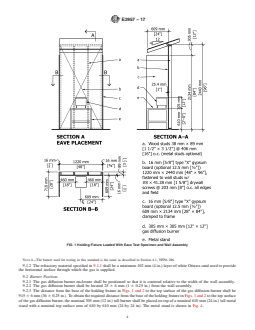
7.3 Holding Fixture—The assembly shown in Figs. 1 and 2 is designed to permit rapid installation and removal of the test
specimen and the wall assembly, and to prevent edge penetration of fire at the margins of the wall assembly. The holding fixture
includes a sturdy frame assembly to mount the test specimen and the wall assembly. The holding fixture permits a prefabricated
wall assembly with an attached test specimen to be inserted from the rear and to seal in such a way that protects the wall assembly
edges from fire. Side shields are situated near the vertical edges of the holding fixture and extend from the holding fixture’s base
to within 305 mm (12 in.) of the top of the wall assembly as shown in Figs. 1 and 2 to aid in minimizing extraneous drafts to the
surface of the test specimen.
7.3.1 The side shields shall consist of nominal 16 mm ( ⁄8 in.) Type “X” gypsum board complying with Specification C1396
or a noncombustible board material of 12 mm ( ⁄2 in.) nominal thickness or greater mounted on a sturdy frame.
7.3.2 The side shield dimensions shall be 609 mm (28 in.) wide and 2134 mm (84 in.) high.
NOTE 3—The holding fixture used in this test method is the same as the Wall Assembly Holding Fixture described in Paragraph 7.2, Test Method E2707
except the simulated noncombustible soffit has been replaced with the test specimen under investigation.
8. Test Room
8.1 The ambient temperature in the test room shall be above 15 °C (60 °F) and the relative humidity shall be less than 75 %.
The test room shall be draft-protected and equipped with an exhaust hood system for removal of products of combustion during
testing.
8.2 Air velocities in the vicinity of the ignition source burner shall not exceed 0.5 m/s (1.64 ft/s) measured at a horizontal
distance of 0.5 m (20 in.) from the edge of the wall assembly.
8.3 Air supply shall not be limited during the test.
9. Ignition Source and Calibration
9.1 Ignition Source Burner:
9.1.1 The ignition source shall be a gas diffusion burner with a porous top surface of a refractory material.
9.1.1.1 The gas diffusion burner shall have a nominal surface area 305 by 305 mm (12 by 12 in.), as shown in Fig. 3.
9.1.1.2 The gas diffusion burner shall be supported for a nominal height of 152 mm (6 in.) making the total height 305 6 6 mm
(12 6 0.25 in.).
E2957 − 17
FIG. 1 Holding Fixture Loaded With Eave Test Specimen and Wall Assembly
NOTE 4—The burner used for testing in this standard is the same as described in Section 4.1, NFPA 286.
9.1.2 The refractory material specified in 9.1.1 shall be a minimum 102 mm (4 in.) layer of white Ottawa sand used to provide
the horizontal surface through which the gas is supplied.
9.2 Burner Position:
9.2.1 The gas diffusion burner enclosure shall be positioned so that it is centered relative to the width of the wall assembly.
9.2.2 The gas diffusion burner shall be located 25 6 6 mm (1 6 0.25 in.) from the wall assembly.
9.2.3 The distance from the base of the holding fixture in Figs. 1 and 2 to the top surface of the gas diffusion burner shall be
915 6 6 mm (36 6 0.25 in.). To obtain the required distance from the base of the holding fixture in Figs. 1 and 2 to the top surface
of the gas diffusion burner, the nominal 305 mm (12 in.) tall burner shall be placed on top of a nominal 610 mm (24 in.) tall metal
stand with a nominal top surface area of 610 by 610 mm (24 by 24 in). The metal stand is shown in Fig. 4.
E2957 − 17
FIG. 2 Holding Fixture Loaded With Projection Test Specimen and Wall Assembly
9.3 The gas diffusion burner shall be supplied with minimum 99 % pure propane (often described by suppliers as CP or
“chemically pure” grade) having a nominal heating value of 93.0 MJ/m [22.2 kilocalories (thermochemical) per cubic meter or
2500 Btu (thermochemical) per cubic foot].
9.4 The propane shall be supplied to the gas diffusion burner through a metered control system.
9.5 The propane supply to the gas diffusion burner shall produce a net heat output of 300 615 kW (17,060 6 853 BTU/min).
9.6 The gas diffusion burner shall be ignited by a pilot burner or a remotely controlled spark igniter.
9.7 Gas diffusion burner controls shall be provided for automatic gas supply shut-off if flameout occurs.
9.8 Gas Diffusion Burner Calibration:
E2957 − 17
FIG. 3 Gas Diffusion Burner for Test
9.8.1 The gas supply to the gas diffusion burner shall be the same as used for testing. The gas shall be metered and kept constant
throughout the calibration test.
9.8.2 Place the gas diffusion burner in the configuration to be used for testing and obtain the heat release rate value prescribed
in 9.5.
9.8.3 Take measurements at least once every 6 s and start 1 min prior to ignition of the gas diffusion burner. Determine the
average heat output over a period of at least 1 min by the oxygen consumption method, or calculate the heat output from the gas
mass flow and the net heat of combustion.
9.9 Frequency of Calibration:
9.9.1 Calibrate the gas diffusion burner for heat output prior to each day’s use.
9.9.2 Any indication of off-limit condition such as unusual flame appearance or flame contour, excess turbulence, or unusual
noise shall be cause for calibration prior to further use.
10. Preparation of Test Specimens
10.1 Unless otherwise noted, dimensions in the following descriptions, shall be followed with a tolerance of 613 mm (0.5 in.).
10.2 Construction of Test Specimen:
10.2.1 The test specimen shall be 1220 mm (4 ft) wide. When applicable, normal roof framing, joints, and other typical features
present in the end-use construction shall be present in the test specimen.
10.2.2 The test specimen shall extend out from the wall assembly a distance of 610 mm (24 in.) and be finished in a manner
appropriate for exterior exposure as per accepted construction practices.
10.2.2.1 Testing of test specimens with an extension from the wall other than 610 mm (24 in.) is permitted. However,
applicability of the results is limited to the extension tested or less, and shall be noted in the report.
10.2.3 The solid left and right vertical sides of the test specimen shall be finished with a noncombustible material to prevent
unintended direct flame impingement of internal components.
E2957 − 17
FIG. 4 Metal Stand for Gas Diffusion Burner
10.3 Accelerated Aging/Weathering and Conditioning of Test Specimens:
10.3.1 When it is anticipated that a regulatory or other agency will require pre-test accelerated aging/weathering of the samples,
the test sponsor shall have the option to conduct such weathering. Weathering shall be conducted as specified by the regulatory
agency or applicable methods as specified for the test specimen.
10.3.1.1 Both weathered and unweathered test specimens shall be evaluated to assess the potential for the fire test response
characteristics as measured in this test method to deteriorate due to accelerated aging/weathering of the eave overhang/projection
materials.
10.3.1.2 Details of the weathering method used, or reference to a standard test method, shall be included in the report (see
Appendix X2).
10.3.2 Five pieces of any cellulosic materials from the same stock from which the test specimen was constructed shall be tacked
to the test specimen during construction in such a manner that they are easily removed and shall provide an overall moisture
content average. These pieces shall be conditioned with the completed test specimen.
10.3.3 The completed test specimens are to be stored indoors at temperatures not lower than 16°C (60°F) nor higher than 32°C
(90°F) for the period of time necessary to cure the test specimen components. This period is achieved when subsequent moisture
content measurements obtained during a 24-h period show no change for the assembly components to come into equilibrium with
a surrounding environment. Test specimens are to be stored so that each will be surrounded by freely circulating air. Relative
humidity range is to be listed a
...