

ASTM G39-99(2021)
(Practice)Standard Practice for Preparation and Use of Bent-Beam Stress-Corrosion Test Specimens
General Information
- Abstract
SIGNIFICANCE AND USE
5.1 The bent-beam specimen is designed for determining the stress-corrosion behavior of alloy sheets and plates in a variety of environments. The bent-beam specimens are designed for testing at stress levels below the elastic limit of the alloy. For testing in the plastic range, U-bend specimens should be employed (see Practice G30). Although it is possible to stress bent-beam specimens into the plastic range, the stress level cannot be calculated for plastically-stressed three- and four-point loaded specimens as well as the double-beam specimens. Therefore, the use of bent-beam specimens in the plastic range is not recommended for general use.
SCOPE
1.1 This practice covers procedures for designing, preparing, and using bent-beam stress-corrosion specimens.
1.2 Different specimen configurations are given for use with different product forms, such as sheet or plate. This practice is applicable to specimens of any metal that are stressed to levels less than the elastic limit of the material, and therefore, the applied stress can be accurately calculated or measured (see Note 1). Stress calculations by this practice are not applicable to plastically stressed specimens.
Note 1: It is the nature of these practices that only the applied stress can be calculated. Since stress-corrosion cracking is a function of the total stress, for critical applications and proper interpretation of results, the residual stress (before applying external stress) or the total elastic stress (after applying external stress) should be determined by appropriate nondestructive methods, such as X-ray diffraction (1).2
1.3 Test procedures are given for stress-corrosion testing by exposure to gaseous and liquid environments.
1.4 The bent-beam test is best suited for flat product forms, such as sheet, strip, and plate. For plate material the bent-beam specimen is more difficult to use because more rugged specimen holders must be built to accommodate the specimens. A double-beam modification of a four-point loaded specimen to utilize heavier materials is described in 10.5.
1.5 The exposure of specimens in a corrosive environment is treated only briefly since other practices deal with this aspect, for example, Practices D1141, G30, G36, G44, G50, and G85. The experimenter is referred to ASTM Special Technical Publication 425 (2).
1.6 The bent-beam practice generally constitutes a constant strain (deflection) test. Once cracking has initiated, the state of stress at the tip of the crack as well as in uncracked areas has changed, and therefore, the known or calculated stress or strain values discussed in this practice apply only to the state of stress existing before initiation of cracks.
1.7 The values stated in SI units are to be regarded as standard. The values given in parentheses after SI units are provided for information only and are not considered standard.
1.8 This standard does not purport to address all of the safety concerns, if any, associated with its use. It is the responsibility of the user of this standard to establish appropriate safety, health, and environmental practices and determine the applicability of regulatory limitations prior to use. (For more specific safety hazard information see Section 7 and 12.1.)
1.9 This international standard was developed in accordance with internationally recognized principles on standardization established in the Decision on Principles for the Development of International Standards, Guides and Recommendations issued by the World Trade Organization Technical Barriers to Trade (TBT) Committee.
- Status
- Published
- Publication Date
- 30-Apr-2021
- Technical Committee
- G01 - Corrosion of Metals
- Drafting Committee
- G01.06 - Environmentally Assisted Cracking
Overview
ASTM G39-99(2021): Standard Practice for Preparation and Use of Bent-Beam Stress-Corrosion Test Specimens provides detailed guidance on designing, preparing, and using bent-beam specimens to evaluate the stress-corrosion behavior of alloy sheets and plates. Developed by ASTM International, this standard is widely recognized in corrosion engineering and quality assurance applications for metals and alloys. The bent-beam method is particularly useful for controlled laboratory testing under stress conditions below the elastic limit, supporting the accurate assessment of materials’ resistance to stress-corrosion cracking in a range of environments.
Key Topics
- Specimen Preparation: The standard details procedures for preparing test specimens from sheet, strip, or plate forms, ensuring uniformity in size, shape, and surface finish. Proper cleaning and handling are emphasized to avoid contamination or alteration of surface properties.
- Stress Calculation: Guidance is provided for calculating and applying stresses below the elastic limit of the material. The use of proper specimen holders and stressing jigs is outlined to ensure precise load application.
- Testing Environments: The practice covers procedures for exposing specimens to both gaseous and liquid corrosive environments. Recommendations are made for laboratory and atmospheric exposures.
- Applicability: Designed for metals and alloys, the bent-beam technique is best suited for flat product forms and stress levels where calculation and measurement are reliable. Use in the plastic deformation range is not recommended.
- Hazards and Safety: The document highlights safety considerations related to high-strength materials and proper handling to mitigate risks during specimen installation, testing, and removal.
- Inspection and Reporting: Procedures for visual examination, detection of cracks, and interpretative reporting are outlined, ensuring reproducible and comparable results across laboratories.
Applications
ASTM G39 is essential in various sectors for:
- Material Selection: Supports engineers and materials scientists when choosing metals or alloys for environments where stress-corrosion cracking resistance is critical.
- Quality Assurance: Used by manufacturers to ensure product reliability before deployment in structurally demanding or corrosive applications.
- Failure Analysis: Assists forensic and reliability engineers in simulating conditions leading to stress-corrosion failures, guiding preventative strategies in design and maintenance.
- Research and Development: Valuable in the testing of new alloys, treatments, or environmental protections to enhance material durability.
- Standards Compliance: Provides a repeatable method for regulatory, certification, and industrial compliance testing for corrosion resistance.
Related Standards
To ensure comprehensive stress-corrosion testing and specimen preparation, refer to these associated ASTM and technical standards:
- ASTM G30 - Practice for Making and Using U-Bend Stress-Corrosion Test Specimens (for plastic range testing)
- ASTM D1141 - Practice for Preparation of Substitute Ocean Water
- ASTM G36 - Practice for Evaluating Stress-Corrosion-Cracking Resistance in Boiling Magnesium Chloride
- ASTM G44 - Practice for Alternate Immersion in Neutral Sodium Chloride Solution
- ASTM G50 - Practice for Atmospheric Corrosion Tests on Metals
- ASTM G85 - Practice for Modified Salt Spray (Fog) Testing
- NACE TM0177 - Laboratory Testing for Cracking in H2S Environments
Practical Value
Implementing ASTM G39 promotes consistent, high-quality results in stress-corrosion testing and ensures the reliability of metals used in critical infrastructure such as transportation, construction, energy, and marine industries. By following this standard, organizations benefit from:
- Repeatable test methods
- Accurate assessment of alloy performance
- Enhanced material selection confidence
- Reduced failure risks due to stress-corrosion
Keywords: ASTM G39, bent-beam, stress-corrosion cracking, metal testing, alloy sheets, alloy plates, laboratory corrosion test, corrosion standards, specimen preparation, stress calculation, corrosion resistance.
Relations
- Effective Date
- 01-Nov-2019
- Effective Date
- 01-Oct-2018
- Refers
ASTM G30-97(2015) - Standard Practice for Making and Using U-Bend Stress-Corrosion Test Specimens - Effective Date
- 01-Nov-2015
- Effective Date
- 01-May-2013
- Effective Date
- 01-May-2011
- Effective Date
- 01-Sep-2010
- Effective Date
- 01-Jul-2009
- Refers
ASTM G30-97(2009) - Standard Practice for Making and Using U-Bend Stress-Corrosion Test Specimens - Effective Date
- 01-May-2009
- Effective Date
- 15-Jul-2008
- Effective Date
- 01-Nov-2006
- Effective Date
- 01-May-2005
- Effective Date
- 10-Aug-2003
- Effective Date
- 10-Oct-2002
- Effective Date
- 10-Oct-2002
- Effective Date
- 10-May-2000
Get Certified
Connect with accredited certification bodies for this standard

Element Materials Technology
Materials testing and product certification.

Inštitut za kovinske materiale in tehnologije
Institute of Metals and Technology. Materials testing, metallurgical analysis, NDT.
Sponsored listings
Frequently Asked Questions
ASTM G39-99(2021) is a standard published by ASTM International. Its full title is "Standard Practice for Preparation and Use of Bent-Beam Stress-Corrosion Test Specimens". This standard covers: SIGNIFICANCE AND USE 5.1 The bent-beam specimen is designed for determining the stress-corrosion behavior of alloy sheets and plates in a variety of environments. The bent-beam specimens are designed for testing at stress levels below the elastic limit of the alloy. For testing in the plastic range, U-bend specimens should be employed (see Practice G30). Although it is possible to stress bent-beam specimens into the plastic range, the stress level cannot be calculated for plastically-stressed three- and four-point loaded specimens as well as the double-beam specimens. Therefore, the use of bent-beam specimens in the plastic range is not recommended for general use. SCOPE 1.1 This practice covers procedures for designing, preparing, and using bent-beam stress-corrosion specimens. 1.2 Different specimen configurations are given for use with different product forms, such as sheet or plate. This practice is applicable to specimens of any metal that are stressed to levels less than the elastic limit of the material, and therefore, the applied stress can be accurately calculated or measured (see Note 1). Stress calculations by this practice are not applicable to plastically stressed specimens. Note 1: It is the nature of these practices that only the applied stress can be calculated. Since stress-corrosion cracking is a function of the total stress, for critical applications and proper interpretation of results, the residual stress (before applying external stress) or the total elastic stress (after applying external stress) should be determined by appropriate nondestructive methods, such as X-ray diffraction (1).2 1.3 Test procedures are given for stress-corrosion testing by exposure to gaseous and liquid environments. 1.4 The bent-beam test is best suited for flat product forms, such as sheet, strip, and plate. For plate material the bent-beam specimen is more difficult to use because more rugged specimen holders must be built to accommodate the specimens. A double-beam modification of a four-point loaded specimen to utilize heavier materials is described in 10.5. 1.5 The exposure of specimens in a corrosive environment is treated only briefly since other practices deal with this aspect, for example, Practices D1141, G30, G36, G44, G50, and G85. The experimenter is referred to ASTM Special Technical Publication 425 (2). 1.6 The bent-beam practice generally constitutes a constant strain (deflection) test. Once cracking has initiated, the state of stress at the tip of the crack as well as in uncracked areas has changed, and therefore, the known or calculated stress or strain values discussed in this practice apply only to the state of stress existing before initiation of cracks. 1.7 The values stated in SI units are to be regarded as standard. The values given in parentheses after SI units are provided for information only and are not considered standard. 1.8 This standard does not purport to address all of the safety concerns, if any, associated with its use. It is the responsibility of the user of this standard to establish appropriate safety, health, and environmental practices and determine the applicability of regulatory limitations prior to use. (For more specific safety hazard information see Section 7 and 12.1.) 1.9 This international standard was developed in accordance with internationally recognized principles on standardization established in the Decision on Principles for the Development of International Standards, Guides and Recommendations issued by the World Trade Organization Technical Barriers to Trade (TBT) Committee.
SIGNIFICANCE AND USE 5.1 The bent-beam specimen is designed for determining the stress-corrosion behavior of alloy sheets and plates in a variety of environments. The bent-beam specimens are designed for testing at stress levels below the elastic limit of the alloy. For testing in the plastic range, U-bend specimens should be employed (see Practice G30). Although it is possible to stress bent-beam specimens into the plastic range, the stress level cannot be calculated for plastically-stressed three- and four-point loaded specimens as well as the double-beam specimens. Therefore, the use of bent-beam specimens in the plastic range is not recommended for general use. SCOPE 1.1 This practice covers procedures for designing, preparing, and using bent-beam stress-corrosion specimens. 1.2 Different specimen configurations are given for use with different product forms, such as sheet or plate. This practice is applicable to specimens of any metal that are stressed to levels less than the elastic limit of the material, and therefore, the applied stress can be accurately calculated or measured (see Note 1). Stress calculations by this practice are not applicable to plastically stressed specimens. Note 1: It is the nature of these practices that only the applied stress can be calculated. Since stress-corrosion cracking is a function of the total stress, for critical applications and proper interpretation of results, the residual stress (before applying external stress) or the total elastic stress (after applying external stress) should be determined by appropriate nondestructive methods, such as X-ray diffraction (1).2 1.3 Test procedures are given for stress-corrosion testing by exposure to gaseous and liquid environments. 1.4 The bent-beam test is best suited for flat product forms, such as sheet, strip, and plate. For plate material the bent-beam specimen is more difficult to use because more rugged specimen holders must be built to accommodate the specimens. A double-beam modification of a four-point loaded specimen to utilize heavier materials is described in 10.5. 1.5 The exposure of specimens in a corrosive environment is treated only briefly since other practices deal with this aspect, for example, Practices D1141, G30, G36, G44, G50, and G85. The experimenter is referred to ASTM Special Technical Publication 425 (2). 1.6 The bent-beam practice generally constitutes a constant strain (deflection) test. Once cracking has initiated, the state of stress at the tip of the crack as well as in uncracked areas has changed, and therefore, the known or calculated stress or strain values discussed in this practice apply only to the state of stress existing before initiation of cracks. 1.7 The values stated in SI units are to be regarded as standard. The values given in parentheses after SI units are provided for information only and are not considered standard. 1.8 This standard does not purport to address all of the safety concerns, if any, associated with its use. It is the responsibility of the user of this standard to establish appropriate safety, health, and environmental practices and determine the applicability of regulatory limitations prior to use. (For more specific safety hazard information see Section 7 and 12.1.) 1.9 This international standard was developed in accordance with internationally recognized principles on standardization established in the Decision on Principles for the Development of International Standards, Guides and Recommendations issued by the World Trade Organization Technical Barriers to Trade (TBT) Committee.
ASTM G39-99(2021) is classified under the following ICS (International Classification for Standards) categories: 77.040.10 - Mechanical testing of metals; 77.060 - Corrosion of metals. The ICS classification helps identify the subject area and facilitates finding related standards.
ASTM G39-99(2021) has the following relationships with other standards: It is inter standard links to ASTM G85-19, ASTM G36-94(2018), ASTM G30-97(2015), ASTM G36-94(2013), ASTM G85-11, ASTM G50-10, ASTM G85-09, ASTM G30-97(2009), ASTM D1141-98(2008), ASTM G36-94(2006), ASTM G44-99(2005), ASTM D1141-98(2003), ASTM G85-02, ASTM G85-02e1, ASTM G36-94(2000). Understanding these relationships helps ensure you are using the most current and applicable version of the standard.
ASTM G39-99(2021) is available in PDF format for immediate download after purchase. The document can be added to your cart and obtained through the secure checkout process. Digital delivery ensures instant access to the complete standard document.
Standards Content (Sample)
This international standard was developed in accordance with internationally recognized principles on standardization established in the Decision on Principles for the
Development of International Standards, Guides and Recommendations issued by the World Trade Organization Technical Barriers to Trade (TBT) Committee.
Designation: G39 −99 (Reapproved 2021)
Standard Practice for
Preparation and Use of Bent-Beam Stress-Corrosion Test
Specimens
ThisstandardisissuedunderthefixeddesignationG39;thenumberimmediatelyfollowingthedesignationindicatestheyearoforiginal
adoptionor,inthecaseofrevision,theyearoflastrevision.Anumberinparenthesesindicatestheyearoflastreapproval.Asuperscript
epsilon (´) indicates an editorial change since the last revision or reapproval.
1. Scope stress at the tip of the crack as well as in uncracked areas has
changed,andtherefore,theknownorcalculatedstressorstrain
1.1 This practice covers procedures for designing,
valuesdiscussedinthispracticeapplyonlytothestateofstress
preparing, and using bent-beam stress-corrosion specimens.
existing before initiation of cracks.
1.2 Differentspecimenconfigurationsaregivenforusewith
1.7 The values stated in SI units are to be regarded as
different product forms, such as sheet or plate. This practice is
standard. The values given in parentheses after SI units are
applicable to specimens of any metal that are stressed to levels
providedforinformationonlyandarenotconsideredstandard.
less than the elastic limit of the material, and therefore, the
1.8 This standard does not purport to address all of the
applied stress can be accurately calculated or measured (see
safety concerns, if any, associated with its use. It is the
Note 1). Stress calculations by this practice are not applicable
responsibility of the user of this standard to establish appro-
to plastically stressed specimens.
priate safety, health, and environmental practices and deter-
NOTE 1—It is the nature of these practices that only the applied stress
mine the applicability of regulatory limitations prior to use.
canbecalculated.Sincestress-corrosioncrackingisafunctionofthetotal
(For more specific safety hazard information see Section 7 and
stress, for critical applications and proper interpretation of results, the
residual stress (before applying external stress) or the total elastic stress 12.1.)
(after applying external stress) should be determined by appropriate
1.9 This international standard was developed in accor-
nondestructive methods, such as X-ray diffraction (1).
dance with internationally recognized principles on standard-
1.3 Test procedures are given for stress-corrosion testing by
ization established in the Decision on Principles for the
exposure to gaseous and liquid environments.
Development of International Standards, Guides and Recom-
mendations issued by the World Trade Organization Technical
1.4 The bent-beam test is best suited for flat product forms,
Barriers to Trade (TBT) Committee.
suchassheet,strip,andplate.Forplatematerialthebent-beam
specimen is more difficult to use because more rugged speci-
2. Referenced Documents
men holders must be built to accommodate the specimens. A
double-beam modification of a four-point loaded specimen to 2.1 ASTM Standards:
utilize heavier materials is described in 10.5. D1141Practice for the Preparation of Substitute Ocean
Water
1.5 The exposure of specimens in a corrosive environment
G30 Practice for Making and Using U-Bend Stress-
is treated only briefly since other practices deal with this
Corrosion Test Specimens
aspect, for example, Practices D1141, G30, G36, G44, G50,
G36Practice for Evaluating Stress-Corrosion-Cracking Re-
and G85. The experimenter is referred to ASTM Special
sistance of Metals and Alloys in a Boiling Magnesium
Technical Publication 425 (2).
Chloride Solution
1.6 The bent-beam practice generally constitutes a constant
G44PracticeforExposureofMetalsandAlloysbyAlternate
strain (deflection) test. Once cracking has initiated, the state of
Immersion in Neutral 3.5 % Sodium Chloride Solution
G50Practice for Conducting Atmospheric Corrosion Tests
This practice is under the jurisdiction ofASTM Committee G01 on Corrosion
on Metals
of Metals and is the direct responsibility of Subcommittee G01.06 on Environmen-
tally Assisted Cracking.
Current edition approved May 1, 2021. Published May 2021. Originally
approvedin1973.Lastpreviouseditionapprovedin2016asG39–99(2016).DOI: For referenced ASTM standards, visit the ASTM website, www.astm.org, or
10.1520/G0039-99R21. contact ASTM Customer Service at service@astm.org. For Annual Book of ASTM
The boldface numbers in parentheses refer to a list of references at the end of Standards volume information, refer to the standard’s Document Summary page on
this standard. the ASTM website.
Copyright © ASTM International, 100 Barr Harbor Drive, PO Box C700, West Conshohocken, PA 19428-2959. United States
G39 − 99 (2021)
G85Practice for Modified Salt Spray (Fog) Testing
2.2 NACE Document:
NACE TM0177-96Laboratory Testing of Metals for Resis-
tancetoSpecificFormsofEnvironmentalCrackinginH S
Environments
3. Terminology
3.1 Definitions of Terms Specific to This Standard:
3.1.1 cracking time—the time elapsed from the inception of
test until the appearance of cracking.
3.1.1.1 Discussion—The test begins when the stress is
applied and the stressed specimen is exposed to the corrosive
environment, whichever occurs later.
3.1.1.2 Discussion—The specimen is considered to have
failed when cracks are detected. Presence of cracks can be
determined with or without optical, mechanical, or electronic
aids. However, for meaningful interpretation, comparisons
should be made only among tests employing crack detection
methods of equivalent sensitivity.
3.1.2 stress-corrosion cracking—a cracking process requir-
ingthesimultaneousactionofacorrodentandsustainedtensile
stress. This excludes corrosion-reduced sections that fail by
fastfracture.Italsoexcludesintercrystallineortranscrystalline
corrosion which can disintegrate an alloy without either
applied or residual stress.
4. Summary of Practice
4.1 This practice involves the quantitative stressing of a
beamspecimenbyapplication of a bending stress.Theapplied
stress is determined from the size of the specimen and the
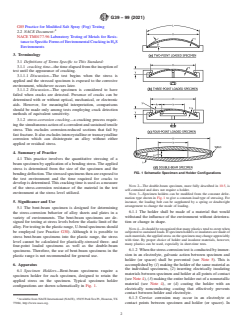
FIG. 1 Schematic Specimen and Holder Configurations
bendingdeflection.Thestressedspecimensthenareexposedto
the test environment and the time required for cracks to
developisdetermined.Thiscrackingtimeisusedasameasure
NOTE 2—The double-beam specimen, more fully described in 10.5,is
of the stress-corrosion resistance of the material in the test
self-contained and does not require a holder.
environment at the stress level utilized.
NOTE 3—Specimen holders can be modified from the constant defor-
mation type shown in Fig. 1 to give a constant-load type of stressing. For
5. Significance and Use
instance, the loading bolt can be supplanted by a spring or deadweight
arrangement to change the mode of loading.
5.1 The bent-beam specimen is designed for determining
6.1.1 The holder shall be made of a material that would
the stress-corrosion behavior of alloy sheets and plates in a
withstand the influence of the environment without deteriora-
variety of environments. The bent-beam specimens are de-
tion or change in shape.
signed for testing at stress levels below the elastic limit of the
alloy.Fortestingintheplasticrange,U-bendspecimensshould
NOTE4—Itshouldberecognizedthatmanyplasticstendtocreepwhen
be employed (see Practice G30). Although it is possible to
subjectedtosustainedloads.Ifspecimenholdersorinsulatorsaremadeof
suchmaterials,theappliedstressonthespecimenmaychangeappreciably
stress bent-beam specimens into the plastic range, the stress
with time. By proper choice of holder and insulator materials, however,
level cannot be calculated for plastically-stressed three- and
many plastics can be used, especially in short-time tests.
four-point loaded specimens as well as the double-beam
6.1.2 Whenthestress-corrosiontestisconductedbyimmer-
specimens. Therefore, the use of bent-beam specimens in the
sion in an electrolyte, galvanic action between specimen and
plastic range is not recommended for general use.
holder (or spacer) shall be prevented (see Note 5). This is
accomplishedby(1)makingtheholderofthesamematerialas
6. Apparatus
the individual specimens, (2) inserting electrically insulating
6.1 Specimen Holders—Bent-beam specimens require a
materials between specimen and holder at all points of contact
specimen holder for each specimen, designed to retain the
(see Note 4), (3) making the entire holder out of a nonmetallic
applied stress on the specimen. Typical specimen holder
material (see Note 4), or (4) coating the holder with an
configurations are shown schematically in Fig. 1.
electrically nonconducting coating that effectively prevents
contact between holder and electrolyte.
6.1.3 Crevice corrosion may occur in an electrolyte at
AvailablefromNACEInternational(NACE),15835ParkTenPl.,Houston,TX
77084, http://www.nace.org. contact points between specimen and holder (or spacer). In
G39 − 99 (2021)
these instances the critical areas should be packed with a
hydrophobic filler (such as grease or wax).
NOTE 5—In atmospheres (gas) galvanic action between specimen and
holder either does not exist or is confined to a very small area as
experienced in outdoor exposure tests.
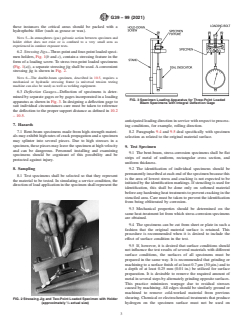
6.2 StressingJigs—Three-pointandfour-pointloadedspeci-
men holders, Fig. 1(b and c), contain a stressing feature in the
form of a loading screw.To stress two-point loaded specimens
(Fig. 1(a)), a separate stressing jig shall be used.Aconvenient
stressing jig is shown in Fig. 2.
NOTE 6—The double-beam specimen, described in 10.5, requires a
mechanical or hydraulic stressing frame (a universal tension testing
machine can also be used) as well as welding equipment.
6.3 Deflection Gauges—Deflection of specimens is deter-
mined by separate gages or by gages incorporated in a loading
FIG. 3 Specimen Loading Apparatus for Three-Point Loaded
apparatus as shown in Fig. 3. In designing a deflection gage to
Beam Specimens with Integral Deflection Gage
suit individual circumstances care must be taken to reference
the deflection to the proper support distance as defined in 10.2
– 10.5.
anticipatedloadingdirectioninservicewithrespecttoprocess-
7. Hazards
ing conditions, for example, rolling direction.
7.1 Bent-beam specimens made from high-strength materi-
8.2 Paragraphs 9.4 and 9.5 deal specifically with specimen
alsmayexhibithighratesofcrackpropagationandaspecimen
selection as related to the original material surface.
may splinter into several pieces. Due to high stresses in a
specimen,thesepiecesmayleavethespecimenathighvelocity
9. Test Specimen
and can be dangerous. Personnel installing and examining
9.1 The bent-beam, stress-corrosion specimens shall be flat
specimens should be cognizant of this possibility and be
strips of metal of uniform, rectangular cross section, and
protected against injury.
uniform thickness.
9.2 The identification of individual specimens should be
8. Sampling
permanentlyinscribedateachendofthespecimenbecausethis
8.1 Test specimens shall be selected so that they represent
is the area of lowest stress and cracking is not expected to be
the material to be tested. In simulating a service condition, the
initiatedbytheidentificationmarkings.Ifstencilingisusedfor
directionofloadapplicationinthespecimenshallrepresentthe
identification, this shall be done only on softened material
beforeanyhardeningheattreatmentstopreventcrackinginthe
stenciled area. Care must be taken to prevent the identification
from being obliterated by corrosion.
9.3 Mechanical properties should be determined on the
sameheat-treatmentlotfromwhichstress-corrosionspecimens
are obtained.
9.4 The specimens can be cut from sheet or plate in such a
fashion that the original material surface is retained. This
procedure is recommended when it is desired to include the
effect of surface condition in the test.
9.5 If, however, it is desired that surface conditions should
not influence the test results of several materials with different
surface conditions, the surfaces of all specimens must be
prepared in the same way. It is recommended that grinding or
machiningtoasurfacefinishofatleast0.7µm(30µin.)andto
a depth of at least 0.25 mm (0.01 in.) be utilized for surface
preparation. It is desirable to remove the required amount of
metalinseveralstepsbyalternatelygrindingoppositesurfaces.
This practice minimizes warpage due to residual stresses
caused by machining.All edges should be similarly ground or
machined to remove cold-worked material from previous
shearing. Chemical or electrochemical treatments that produce
FIG. 2 Stressing Jig and Two-Point Loaded Specimen with Holder
(approximately ⁄4 actual size) hydrogen on the specimen surface must not be used on
G39 − 99 (2021)
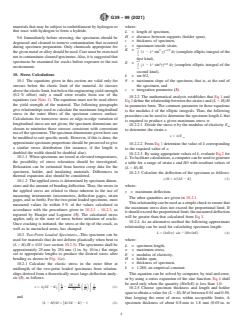
materials that may be subject to embrittlement by hydrogen or where:
that react with hydrogen to form a hydride.
L = length of specimen,
H = distance between supports (holder span),
9.6 Immediately before stressing, the specimens should be
t = thickness of specimen,
degreased and cleaned to remove contamination that occurred
ε = maximum tensile strain,
during specimen preparation. Only chemicals appropriate for
π/2
K = 2 −1/2
*
thegivenmetaloralloyshouldbeused.Caremustbeexercised ~1 2 k sin z) dz(completeellipticintegralofthe
nottocontaminatecleanedspecimens.Also,itissuggestedthat
first kind),
π/2
specimens be examined for cracks before exposure to the test
E =
2 1/2
* 1 2 k sin z) dz (complete elliptic integral of the
~
environment.
second kind),
10. Stress Calculations
k = sin θ/2,
10.1 The equations given in this section are valid only for θ = maximum slope of the specimen, that is, at the end of
stresses below the elastic limit of the material. At stresses the specimen, and
z = integration parameter (3).
abovetheelasticlimit,butbelowtheengineeringyieldstrength
(0.2% offset) only a small error results from use of the
10.2.2 The mathematical analysis establishes that Eq 1 and
equations (see Note 1). The equations must not be used above
Eq2definetherelationshipbetweenthestrainεand(L−H)⁄H
the yield strength of the material. The following paragraphs
in parameter form. The common parameter in these equations
give relationships used to calculate the maximum longitudinal
is the modulus k of the elliptic integrals. Thus, the following
stress in the outer fibers of the specimen convex surface.
procedure can be used to determine the specimen length L that
Calculations for transverse stress or edge-to-edge variation of
is required to produce a given maximum stress σ:
longitudinal stress are not given; the specimen dimensions are
10.2.2.1 Divide the stress σ by the modulus of elasticity E
m
chosen to minimize these stresses consistent with convenient
to determine the strain ε.
useofthespecimens.Thespecimendimensionsgivenherecan
ε 5 σ/E
m
bemodifiedtosuitspecificneeds.However,ifthisisdone,the
approximatespecimenproportionsshouldbepreservedtogive
10.2.2.2 From Eq 1 determine the value of k corresponding
a similar stress distribution (for instance, if the length is
to the required value of ε.
doubled the width should be doubled also).
10.2.2.3 By using appropriate values of k, evaluate Eq 2 for
10.1.1 When specimens are tested at elevated temperatures,
L.Tofacilitatecalculations,acomputercanbeusedtogenerate
the possibility of stress relaxation should be investigated.
a table for a range of strain ε and H/t with resultant values of
Relaxation can be estimated from known creep data for the
(L−H)⁄H.
specimen, holder, and insulating materials. Differences in
10.2.3 Calculate the deflection of the specimen as follows:
thermal expansion also should be considered.
y/H 5 k/~2E 2 K! (3)
10.1.2 Theappliedstressisdeterminedbyspecimendimen-
sions and the amount of bending deflection.Thus, the errors in
where:
the applied stress are related to those inherent in the use of
y = maximum deflection.
measuring instruments (micrometers, deflection gages, strain
The other quantities are given in 10.2.1.
gages,andsoforth).Forthetwo-pointloadedspecimens,most
Thisrelationshipcanbeusedasasimplechecktoensurethat
measured values lie within 5% of the values calculated in
the maximum stress does not exceed the proportional limit. If
accordance with the procedures given in 10.2.1 – 10.2.3,as
itshouldexceedtheproportionallimit,themeasureddeflection
reported by Haaijer and Loginow (3). The calculated stress
will be greater than that calculated from Eq 3.
applies only to the state of stress before initiation of cracks.
10.2.4 As an alternative method the following approximate
Once cracking is initiated, the stress at the tip of the crack, as
relationship can be used for calculating specimen length:
well as in uncracked areas, has changed.
L 5 ktE/σ sin Hσ/ktE (4)
~ ! ~ !
10.2 Two-Point Loaded Specimens—This specimen can be
used for materials that do not deform plastically when bent to where:
(L−H)⁄H=0.01 (see section 10.2.5). The specimens shall be
L = specimen length,
approximately 25mm by 254mm (1in. by 10in.) flat strips
σ = maximum stress,
cut to appropriate lengths to produce the desired stress after E = modulus of elasticity,
bending as shown in Fig. 1(a). H = holder span,
t = thickness of specimen,
10.2.1 Calculate the elastic stress in the outer fiber at
k = 1.280, an empirical constant.
midlength of the two-point loaded specimens from relation-
...