

ASTM C847-18
(Specification)Standard Specification for Metal Lath
General Information
- Abstract
ABSTRACT
This specification covers sheet lath, expanded metal lath, diamond mesh, flat and self-furring, and rib metal lath, all with or without backing and designed to be used as a base for gypsum or Portland cement plaster. Metal lath shall be fabricated from cold-rolled carbon steel sheet of commercial quality as specified and galvanized metal lath shall have a G60 coating. Physical properties such as thickness, width, length, and weight shall be specified. Metal lath shall be fabricated from hot-dipped galvanized steel.
SCOPE
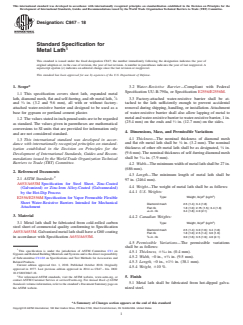
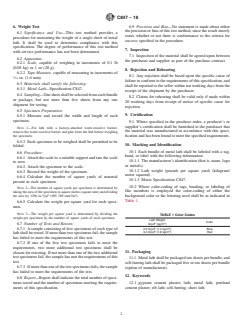
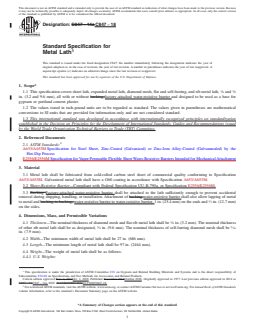
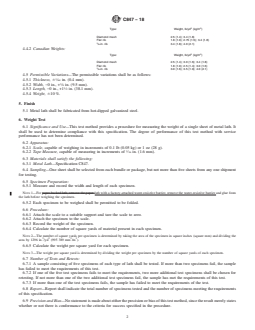
1.1 This specification covers sheet lath, expanded metal lath, diamond mesh, flat and self-furring, and rib metal lath, 1/8 and 3/8 in. (3.2 and 9.6 mm), all with or without factory-attached water-resistive barrier and designed to be used as a base for gypsum or portland cement plaster.
1.2 The values stated in inch-pound units are to be regarded as standard. The values given in parentheses are mathematical conversions to SI units that are provided for information only and are not considered standard.
1.3 This international standard was developed in accordance with internationally recognized principles on standardization established in the Decision on Principles for the Development of International Standards, Guides and Recommendations issued by the World Trade Organization Technical Barriers to Trade (TBT) Committee.
- Status
- Published
- Publication Date
- 30-Sep-2018
- Technical Committee
- C11 - Gypsum and Related Building Materials and Systems



Overview
ASTM C847-18: Standard Specification for Metal Lath provides essential guidelines for manufacturers, specifiers, and contractors involved in building construction and plastering. This international standard, developed by ASTM, covers requirements for various types of metal lath-including sheet lath, expanded metal lath, diamond mesh, flat and self-furring, and rib metal lath-with or without a factory-attached water-resistive barrier. The metal lath is specifically designed as a durable base for gypsum plaster or Portland cement plaster applications.
Given its comprehensive scope, ASTM C847-18 underscores the importance of material quality, physical properties (such as thickness, width, length, and weight), and the use of galvanized steel for long-term performance. This specification ensures reliable support for plaster finishes in a wide range of construction environments.
Key Topics
Types of Metal Lath: The standard covers multiple configurations, including diamond mesh, flat, self-furring, and various rib styles, to suit different plastering needs.
Material Requirements: All metal lath must be fabricated from cold-rolled carbon steel of commercial quality. For galvanized lath, a G60 zinc coating is mandatory, conforming to ASTM A653/A653M specifications.
Physical Properties:
- Thickness: Specified according to lath type.
- Width: Minimum width of 27 inches.
- Length: Minimum length of 97 inches.
- Weight: Clearly established per type, with variations allowed for both U.S. and Canadian usage.
Water-Resistive Barriers: Factory-attached barriers must comply with relevant ASTM and federal specifications to prevent moisture intrusion and ensure ease of installation.
Identification and Marking: Bundles must be clearly tagged or labeled with manufacturer details, lath weight, compliance statement, and, if used, a color code to denote weight class.
Quality Assurance: The standard specifies testing, inspection, rejection, rehearing, and certification procedures to maintain consistent product quality across the industry.
Applications
ASTM C847-18 is widely referenced in the construction, renovation, and repair of both residential and commercial buildings. Its primary applications include:
Base for Plastering: Metal lath as specified serves as a sturdy, stable substrate for both gypsum and Portland cement plaster, ensuring proper adhesion and long-term durability of wall and ceiling finishes.
Exterior and Interior Walls: Used behind stucco and plaster in multi-layer systems, contributing to structural integrity and improved resistance to cracking.
Water-Managed Systems: Metal lath with a factory-attached water-resistive barrier is crucial in wall assemblies exposed to moisture, enhancing weather resistance and preventing mold growth.
Restoration Projects: Meets stringent requirements for matching existing lath types in building rehabilitation while maintaining compliance with modern standards.
Related Standards
To ensure best practices and compatibility in building envelope systems and materials, refer to these associated standards:
- ASTM A653/A653M: Specification for Steel Sheet, Zinc-Coated (Galvanized) or Zinc-Iron Alloy-Coated (Galvannealed) by the Hot-Dip Process
- ASTM E2556/E2556M: Specification for Vapor Permeable Flexible Sheet Water-Resistive Barriers Intended for Mechanical Attachment
- Federal Specification UU-B-790a: Standard for water-resistive barriers used in construction assemblies
Keywords: ASTM C847, metal lath, galvanized lath, diamond mesh, rib lath, self-furring lath, gypsum plaster, Portland cement plaster, water-resistive barrier, construction standards, plaster base systems.
By adhering to ASTM C847-18, professionals can ensure code compliance, product consistency, and enhanced durability for plastering projects in diverse building environments.
Relations
- Effective Date
- 01-Oct-2018
- Effective Date
- 15-Oct-2010
- Effective Date
- 01-Nov-2009
- Effective Date
- 01-Oct-2018
- Effective Date
- 01-Oct-2018
- Effective Date
- 01-Oct-2018
- Referred By
ASTM C1780-23a - Standard Practice for Installation Methods for Cement-based Adhered Masonry Veneer - Effective Date
- 01-Oct-2018
- Effective Date
- 01-Oct-2018
Get Certified
Connect with accredited certification bodies for this standard

Element Materials Technology
Materials testing and product certification.

Inštitut za kovinske materiale in tehnologije
Institute of Metals and Technology. Materials testing, metallurgical analysis, NDT.
Sponsored listings
Frequently Asked Questions
ASTM C847-18 is a technical specification published by ASTM International. Its full title is "Standard Specification for Metal Lath". This standard covers: ABSTRACT This specification covers sheet lath, expanded metal lath, diamond mesh, flat and self-furring, and rib metal lath, all with or without backing and designed to be used as a base for gypsum or Portland cement plaster. Metal lath shall be fabricated from cold-rolled carbon steel sheet of commercial quality as specified and galvanized metal lath shall have a G60 coating. Physical properties such as thickness, width, length, and weight shall be specified. Metal lath shall be fabricated from hot-dipped galvanized steel. SCOPE 1.1 This specification covers sheet lath, expanded metal lath, diamond mesh, flat and self-furring, and rib metal lath, 1/8 and 3/8 in. (3.2 and 9.6 mm), all with or without factory-attached water-resistive barrier and designed to be used as a base for gypsum or portland cement plaster. 1.2 The values stated in inch-pound units are to be regarded as standard. The values given in parentheses are mathematical conversions to SI units that are provided for information only and are not considered standard. 1.3 This international standard was developed in accordance with internationally recognized principles on standardization established in the Decision on Principles for the Development of International Standards, Guides and Recommendations issued by the World Trade Organization Technical Barriers to Trade (TBT) Committee.
ABSTRACT This specification covers sheet lath, expanded metal lath, diamond mesh, flat and self-furring, and rib metal lath, all with or without backing and designed to be used as a base for gypsum or Portland cement plaster. Metal lath shall be fabricated from cold-rolled carbon steel sheet of commercial quality as specified and galvanized metal lath shall have a G60 coating. Physical properties such as thickness, width, length, and weight shall be specified. Metal lath shall be fabricated from hot-dipped galvanized steel. SCOPE 1.1 This specification covers sheet lath, expanded metal lath, diamond mesh, flat and self-furring, and rib metal lath, 1/8 and 3/8 in. (3.2 and 9.6 mm), all with or without factory-attached water-resistive barrier and designed to be used as a base for gypsum or portland cement plaster. 1.2 The values stated in inch-pound units are to be regarded as standard. The values given in parentheses are mathematical conversions to SI units that are provided for information only and are not considered standard. 1.3 This international standard was developed in accordance with internationally recognized principles on standardization established in the Decision on Principles for the Development of International Standards, Guides and Recommendations issued by the World Trade Organization Technical Barriers to Trade (TBT) Committee.
ASTM C847-18 is classified under the following ICS (International Classification for Standards) categories: 77.140.80 - Iron and steel castings. The ICS classification helps identify the subject area and facilitates finding related standards.
ASTM C847-18 has the following relationships with other standards: It is inter standard links to ASTM C847-14a, ASTM E2556/E2556M-10, ASTM E2556/E2556M-09, ASTM C1002-22, ASTM C1063-23, ASTM C954-22, ASTM C1780-23a, ASTM C841-23. Understanding these relationships helps ensure you are using the most current and applicable version of the standard.
ASTM C847-18 is available in PDF format for immediate download after purchase. The document can be added to your cart and obtained through the secure checkout process. Digital delivery ensures instant access to the complete standard document.
Standards Content (Sample)
This international standard was developed in accordance with internationally recognized principles on standardization established in the Decision on Principles for the
Development of International Standards, Guides and Recommendations issued by the World Trade Organization Technical Barriers to Trade (TBT) Committee.
Designation:C847 −18
Standard Specification for
Metal Lath
This standard is issued under the fixed designation C847; the number immediately following the designation indicates the year of
original adoption or, in the case of revision, the year of last revision.Anumber in parentheses indicates the year of last reapproval.A
superscript epsilon (´) indicates an editorial change since the last revision or reapproval.
This standard has been approved for use by agencies of the U.S. Department of Defense.
1. Scope* 3.2 Water-Resistive Barrier—Compliant with Federal
Specification UU-B-790a, or Specification E2556/E2556M.
1.1 This specification covers sheet lath, expanded metal
lath, diamond mesh, flat and self-furring, and rib metal lath, ⁄8 3.3 Factory-attached water-resistive barrier shall be at-
and ⁄8 in. (3.2 and 9.6 mm), all with or without factory-
tached to the lath sufficiently enough to prevent accidental
attached water-resistive barrier and designed to be used as a removal during shipping, handling, or installation.Attachment
base for gypsum or portland cement plaster. of water-resistive barrier shall also allow lapping of metal to
metalandwater-resistivebarriertowater-resistivebarrier,1in.
1.2 The values stated in inch-pound units are to be regarded
(25.4 mm) on the ends and ⁄2 in. (12.7 mm) on the sides.
as standard. The values given in parentheses are mathematical
conversions to SI units that are provided for information only
4. Dimensions, Mass, and Permissible Variations
and are not considered standard.
4.1 Thickness—The nominal thickness of diamond mesh
1.3 This international standard was developed in accor-
and flat rib metal lath shall be ⁄8 in. (3.2 mm). The nominal
dance with internationally recognized principles on standard-
thickness of other rib metal lath shall be as designated, ⁄8 in.
ization established in the Decision on Principles for the
(9.6mm).Thenominalthicknessofself-furringdiamondmesh
Development of International Standards, Guides and Recom-
shall be ⁄16 in. (7.9 mm).
mendations issued by the World Trade Organization Technical
Barriers to Trade (TBT) Committee.
4.2 Width—Theminimumwidthofmetallathshallbe27in.
(686mm).
2. Referenced Documents
4.3 Length—The minimum length of metal lath shall be
2.1 ASTM Standards:
97in. (2464 mm).
A653/A653MSpecification for Steel Sheet, Zinc-Coated
4.4 Weight—The weight of metal lath shall be as follows:
(Galvanized) or Zinc-Iron Alloy-Coated (Galvannealed)
4.4.1 U.S. Weights:
by the Hot-Dip Process
2 2
Type: Weight, lb/yd (kg/m )
E2556/E2556MSpecification for Vapor Permeable Flexible
Sheet Water-Resistive Barriers Intended for Mechanical
Diamond mesh 2.5 (1.4); 3.4 (1.8)
Attachment
Flat rib 1.8 (1.0); 2.75 (1.5); 3.4 (1.8)
⁄8-in. rib 3.4 (1.8); 4.0 (2.1)
3. Material
4.4.2 Canadian Weights:
2 2
3.1 Metal lath shall be fabricated from cold-rolled carbon
Type: Weight, lb/yd (kg/m )
steel sheet of commercial quality conforming to Specification
Diamond mesh 2.5 (1.4); 3.0 (1.6); 3.4 (1.8)
A653/A653M. Galvanized metal lath shall have a G60 coating
Flat rib 1.8 (1.0); 2.5 (1.4); 3.0 (1.6)
in accordance with Specification A653/A653M. ⁄8-in. rib 3.0 (1.6); 3.5 (1.9); 4.0 (2.1)
4.5 Permissible Variations—The permissible variations
shall be as follows:
This specification is under the jurisdiction of ASTM Committee C11 on
4.5.1 Thickness, 6 ⁄64 in. (0.4 mm).
GypsumandRelatedBuildingMaterialsandSystemsandisthedirectresponsibility
4.5.2 Width, −0 in., + ⁄8 in. (9.5 mm).
of Subcommittee C11.02 on Specifications and Test Methods for Accessories and
Related Products.
4.5.3 Length, −0 in.,+1 ⁄2 in. (38.1 mm).
Current edition approved Oct. 1, 2018. Published October 2018. Originally
4.5.4 Weight, 610%.
approved in 1977. Last previous edition approved in 2014 as C847–14a. DOI:
10.1520/C0847-18.
For referenced ASTM standards, visit the ASTM website, www.astm.org, or 5. Finish
contact ASTM Customer Service at service@astm.org. For Annual Book of ASTM
5.1 Metal lath shall be fabricated from hot-dipped galva-
Standards volume information, refer to the standard’s Document Summary page on
the ASTM website. nized steel.
*A Summary of Changes section appears at the end of this standard
Copyright © ASTM International, 100 Barr Harbor Drive, PO Box C700, West Conshohocken, PA 19428-2959. United States
C847−18
6. Weight Test 6.9 Precision and Bias—No statement is made about either
theprecisionorbiasofthistestmethod,sincetheresultmerely
6.1 Significance and Use—This test method provides a
states whether or not there is conformance to the criteria for
procedure for measuring the weight of a single sheet of metal
success specified in the procedure.
lath. It shall be used to determine compliance with this
specification. The degree of performance of this test method
7. Inspection
with service performance has not been determined.
7.1 Inspection of the material shall be agreed upon between
6.2 Apparatus:
the purchaser and supplier as part of the purchase contract.
6.2.1 Scale, capable of weighing in increme
...
This document is not an ASTM standard and is intended only to provide the user of an ASTM standard an indication of what changes have been made to the previous version. Because
it may not be technically possible to adequately depict all changes accurately, ASTM recommends that users consult prior editions as appropriate. In all cases only the current version
of the standard as published by ASTM is to be considered the official document.
Designation: C847 − 14a C847 − 18
Standard Specification for
Metal Lath
This standard is issued under the fixed designation C847; the number immediately following the designation indicates the year of
original adoption or, in the case of revision, the year of last revision. A number in parentheses indicates the year of last reapproval. A
superscript epsilon (´) indicates an editorial change since the last revision or reapproval.
This standard has been approved for use by agencies of the U.S. Department of Defense.
1. Scope*
1 3
1.1 This specification covers sheet lath, expanded metal lath, diamond mesh, flat and self-furring, and rib metal lath, ⁄8 and ⁄8
in. (3.2 and 9.6 mm), all with or without backing factory-attached water-resistive barrier and designed to be used as a base for
gypsum or portland cement plaster.
1.2 The values stated in inch-pound units are to be regarded as standard. The values given in parentheses are mathematical
conversions to SI units that are provided for information only and are not considered standard.
1.3 This international standard was developed in accordance with internationally recognized principles on standardization
established in the Decision on Principles for the Development of International Standards, Guides and Recommendations issued
by the World Trade Organization Technical Barriers to Trade (TBT) Committee.
2. Referenced Documents
2.1 ASTM Standards:
A653/A653M Specification for Steel Sheet, Zinc-Coated (Galvanized) or Zinc-Iron Alloy-Coated (Galvannealed) by the
Hot-Dip Process
E2556/E2556M Specification for Vapor Permeable Flexible Sheet Water-Resistive Barriers Intended for Mechanical Attachment
3. Material
3.1 Metal lath shall be fabricated from cold-rolled carbon steel sheet of commercial quality conforming to Specification
A653/A653M. Galvanized metal lath shall have a G60 coating in accordance with Specification A653/A653M.
3.2 Water-Resistive Barrier—Compliant with Federal Specification UU-B-790a, or Specification E2556/E2556M.
3.3 Backing Factory-attached water-resistive barrier shall be attached to the lath sufficiently enough to prevent accidental
removal during shipping, handling, or installation. Attachment of backing water-resistive barrier shall also allow lapping of metal
to metal and backing to backing, water-resistive barrier to water-resistive barrier, 1 in. (25.4 mm) on the ends and ⁄2 in. (12.7 mm)
on the sides.
4. Dimensions, Mass, and Permissible Variations
4.1 Thickness—The nominal thickness of diamond mesh and flat rib metal lath shall be ⁄8 in. (3.2 mm). The nominal thickness
3 5
of other rib metal lath shall be as designated, ⁄8 in. (9.6 mm). The nominal thickness of self-furring diamond mesh shall be ⁄16
in. (7.9 mm).
4.2 Width—The minimum width of metal lath shall be 27 in. (686 mm).
4.3 Length—The minimum length of metal lath shall be 97 in. (2464 mm).
4.4 Weight—The weight of metal lath shall be as follows:
4.4.1 U.S. Weights:
This specification is under the jurisdiction of ASTM Committee C11 on Gypsum and Related Building Materials and Systems and is the direct responsibility of
Subcommittee C11.02 on Specifications and Test Methods for Accessories and Related Products.
Current edition approved Nov. 1, 2014Oct. 1, 2018. Published November 2014October 2018. Originally approved in 1977. Last previous edition approved in 2014 as
C847 – 14.C847 – 14a. DOI: 10.1520/C0847-14A.10.1520/C0847-18.
For referenced ASTM standards, visit the ASTM website, www.astm.org, or contact ASTM Customer Service at service@astm.org. For Annual Book of ASTM Standards
volume information, refer to the standard’s Document Summary page on the ASTM website.
*A Summary of Changes section appears at the end of this standard
Copyright © ASTM International, 100 Barr Harbor Drive, PO Box C700, West Conshohocken, PA 19428-2959. United States
C847 − 18
2 2
Type: Weight, lb/yd (kg/m )
Diamond mesh 2.5 (1.4); 3.4 (1.8)
Flat rib 1.8 (1.0); 2.75 (1.5); 3.4 (1.8)
⁄8-in. rib 3.4 (1.8); 4.0 (2.1)
4.4.2 Canadian Weights:
2 2
Type: Weight, lb/yd (kg/m )
Diamond mesh 2.5 (1.4); 3.0 (1.6); 3.4 (1.8)
Flat rib 1.8 (1.0); 2.5 (1.4); 3.0 (1.6)
⁄8-in. rib 3.0 (1.6); 3.5 (1.9); 4.0 (2.1)
4.5 Permissible Variations—The permissible variations shall be as follows:
4.5.1 Thickness, 6 ⁄64 in. (0.4 mm).
4.5.2 Width, −0 in., + ⁄8 in. (9.5 mm).
4.5.3 Length, −0 in., +1 ⁄2 in. (38.1 mm).
4.5.4 Weight, 610 %.
5. Finish
5.1 Metal lath shall be fabricated from hot-dipped galvanized steel.
6. Weight Test
6.1 Significance and Use—This test method provides a procedure for measuring the weight of a single sheet of metal lath. It
shall be used to determine compliance with this specification. The degree of performance of this test method with service
performance has not been determined.
6.2 Apparatus:
6.2.1 Scale, capable of weighing in increments of 0.1 lb (0.05 kg) or 1 oz (28 g).
6.2.2 Tape Measure, capable of measuring in increments of ⁄16 in. (1.6 mm).
6.3 Materials shall satisfy the following:
6.3.1 Metal Lath—Specification C847.
6.4 Sampling—One sheet shall be selected from each bundle or package, but not more than five sheets from any one shipment
for testing.
6.5 Specimen Preparation:
6.5.1 Measure and record the width and length of each specimen.
NOTE 1—For paper-backed lath, remove the paper lath with a factory-attached water-resisti
...