

ASTM B883-24
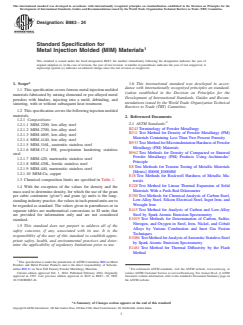
(Specification)Standard Specification for Metal Injection Molded (MIM) Materials
General Information
- Abstract
ABSTRACT
This specification covers ferrous metal injection molded (MIM) materials fabricated by mixing elemental or pre-alloyed metal powders with binders, injecting into a mold, debinding, and sintering with or without subsequent heat treatment. These materials are: low-alloy steel produced from admixtures of iron powder and other alloying elements such as nickel and molybdenum (MIM-2200 and MIM-2700); low-alloy steel produced from admixtures of iron powder and other alloying elements such as nickel, molybdenum, and carbon (MIM-4605); austenitic stainless steel produced from pre-alloyed powder or an admixture of powders (MIM-316L); precipitation hardening stainless steel produced from pre-alloyed powder or an admixture of powders (MIM-17-4 PH); and ferritic stainless steel produced from pre-alloyed powder or an admixture of powders (MIM-430L). Chemical analysis shall be performed for the elements copper, chromium, molybdenum, and nickel. The materials shall be subjected to tensile test and unnotched Charpy impact energy test.
SCOPE
1.1 This specification covers ferrous metal injection molded materials fabricated by mixing elemental or pre-alloyed metal powders with binders, injecting into a mold, debinding, and sintering, with or without subsequent heat treatment.
1.2 This specification covers the following injection molded materials.
1.2.1 Compositions:
1.2.1.1 MIM-2200, low-alloy steel
1.2.1.2 MIM-2700, low-alloy steel
1.2.1.3 MIM-4605, low-alloy steel
1.2.1.4 MIM-4140, low-alloy steel
1.2.1.5 MIM-316L, austenitic stainless steel
1.2.1.6 MIM-17-4 PH, precipitation hardening stainless steel
1.2.1.7 MIM-420, martensitic stainless steel
1.2.1.8 MIM-430L, ferritic stainless steel
1.2.1.9 MIM-440, martensitic stainless steel
1.2.1.10 MIM-Cu, copper
1.3 Chemical composition limits are specified in Table 1.
1.4 With the exception of the values for density and the mass used to determine density, for which the use of the gram per cubic centimetre (g/cm3) and gram (g) units is the longstanding industry practice, the values in inch-pound units are to be regarded as standard. The values given in parentheses or in separate tables are mathematical conversions to SI units that are provided for information only and are not considered standard.
1.5 This standard does not purport to address all of the safety concerns, if any, associated with its use. It is the responsibility of the user of this standard to establish appropriate safety, health, and environmental practices and determine the applicability of regulatory limitations prior to use.
1.6 This international standard was developed in accordance with internationally recognized principles on standardization established in the Decision on Principles for the Development of International Standards, Guides and Recommendations issued by the World Trade Organization Technical Barriers to Trade (TBT) Committee.
- Status
- Published
- Publication Date
- 31-Jan-2024
- Technical Committee
- B09 - Metal Powders and Metal Powder Products
- Drafting Committee
- B09.11 - Near Full Density Powder Metallurgy Materials
Buy Documents
ASTM B883-24 - Standard Specification for Metal Injection Molded (MIM) Materials
REDLINE ASTM B883-24 - Standard Specification for Metal Injection Molded (MIM) Materials
Overview
ASTM B883-24 – Standard Specification for Metal Injection Molded (MIM) Materials – establishes the requirements for a range of ferrous and copper-based MIM materials. Developed by ASTM International, this standard defines the production, chemical composition, and mechanical property requirements for materials made using metal injection molding: blending elemental or pre-alloyed metal powders with binders, injecting into a mold, debinding, sintering, and, if applicable, heat treatment.
This specification ensures quality, uniformity, and reliability in MIM parts by outlining essential testing and inspection criteria, making it essential for manufacturers, purchasers, and users of MIM components across diverse industries.
Key Topics
Material Coverage:
- Low-alloy steels (MIM-2200, MIM-2700, MIM-4605, MIM-4140)
- Austenitic stainless steel (MIM-316L)
- Precipitation hardening stainless steel (MIM-17-4 PH)
- Martensitic stainless steel (MIM-420, MIM-440)
- Ferritic stainless steel (MIM-430L)
- Copper (MIM-Cu)
Manufacturing Process:
- Mixing metal powders with a binder system
- Injection molding the mixture into detailed molds
- Debinding to remove binder constituents
- Sintering for densification and strength
- Optional post-processing such as heat treatment
Chemical Composition:
- Specifies limits for key elements (iron, nickel, chromium, molybdenum, carbon, copper, etc.) to guarantee material properties
Mechanical and Physical Properties:
- Requirements for properties such as tensile strength, yield strength, elongation, impact energy, density, and hardness
- Specified methods for testing and measurement (using referenced ASTM and MPIF standards)
Testing and Inspection:
- Chemical analysis of key elements
- Mechanical testing (tensile, hardness, impact testing)
- Corrosion resistance testing (for stainless steels)
- Thermal conductivity and thermal expansion testing (especially for MIM-Cu)
- Sampling, inspection, and certification procedures to ensure compliance
Units:
- Inch-pound units are standard except for density measurements, which use grams and grams per cubic centimeter per industry practice
Applications
- Automotive Components: Gears, levers, and precision assemblies requiring high strength and detailed features
- Medical Devices: Surgical instruments and orthopedic implants where biocompatibility and corrosion resistance are critical
- Consumer Electronics: Compact, intricate, and durable parts such as connectors, housings, and heat sinks
- Industrial Equipment: Robust, wear-resistant machine components, fasteners, and specialized hardware
- Aerospace: Lightweight, complex structures with strict mechanical and thermal requirements
Manufacturers and purchasers rely on ASTM B883-24 to specify and qualify MIM materials, ensuring parts perform reliably in safety-critical or high-precision environments.
Related Standards
- ASTM B243: Terminology of Powder Metallurgy
- ASTM B311/B962: Test Methods for Density of Powder Metallurgy Materials and Products
- ASTM E8/E8M, E18: Test Methods for Tension Testing and Rockwell Hardness of Metallic Materials
- ASTM E350, E415, E1019, E1086, E1621: Methods for Chemical Analysis of Metals and Alloys
- ASTM F1089: Corrosion of Surgical Instruments
- MPIF Standards 35, 50, 51, 59, 62, 63: Materials, specimen preparation, hardness, impact, corrosion, and density testing methods for MIM parts
Practical Value
Adhering to ASTM B883-24 provides manufacturers and end-users with:
- Confidence in MIM part performance, consistency, and mechanical properties
- Clear material specifications for procurement, manufacturing, and quality assurance
- Compatibility with international procurement standards and technical regulations
- Reliable benchmarks for R&D, process validation, and commercialization of metal injection molded products
Keywords: ASTM B883, Metal Injection Molding, MIM materials, low-alloy steel, stainless steel, metal powder, powder metallurgy, mechanical properties, corrosion resistance, standard specification, MIM part testing, quality assurance.
Relations
- Effective Date
- 01-Feb-2024
Buy Documents
ASTM B883-24 - Standard Specification for Metal Injection Molded (MIM) Materials
REDLINE ASTM B883-24 - Standard Specification for Metal Injection Molded (MIM) Materials
Get Certified
Connect with accredited certification bodies for this standard

Element Materials Technology
Materials testing and product certification.

Inštitut za kovinske materiale in tehnologije
Institute of Metals and Technology. Materials testing, metallurgical analysis, NDT.
Sponsored listings
Frequently Asked Questions
ASTM B883-24 is a technical specification published by ASTM International. Its full title is "Standard Specification for Metal Injection Molded (MIM) Materials". This standard covers: ABSTRACT This specification covers ferrous metal injection molded (MIM) materials fabricated by mixing elemental or pre-alloyed metal powders with binders, injecting into a mold, debinding, and sintering with or without subsequent heat treatment. These materials are: low-alloy steel produced from admixtures of iron powder and other alloying elements such as nickel and molybdenum (MIM-2200 and MIM-2700); low-alloy steel produced from admixtures of iron powder and other alloying elements such as nickel, molybdenum, and carbon (MIM-4605); austenitic stainless steel produced from pre-alloyed powder or an admixture of powders (MIM-316L); precipitation hardening stainless steel produced from pre-alloyed powder or an admixture of powders (MIM-17-4 PH); and ferritic stainless steel produced from pre-alloyed powder or an admixture of powders (MIM-430L). Chemical analysis shall be performed for the elements copper, chromium, molybdenum, and nickel. The materials shall be subjected to tensile test and unnotched Charpy impact energy test. SCOPE 1.1 This specification covers ferrous metal injection molded materials fabricated by mixing elemental or pre-alloyed metal powders with binders, injecting into a mold, debinding, and sintering, with or without subsequent heat treatment. 1.2 This specification covers the following injection molded materials. 1.2.1 Compositions: 1.2.1.1 MIM-2200, low-alloy steel 1.2.1.2 MIM-2700, low-alloy steel 1.2.1.3 MIM-4605, low-alloy steel 1.2.1.4 MIM-4140, low-alloy steel 1.2.1.5 MIM-316L, austenitic stainless steel 1.2.1.6 MIM-17-4 PH, precipitation hardening stainless steel 1.2.1.7 MIM-420, martensitic stainless steel 1.2.1.8 MIM-430L, ferritic stainless steel 1.2.1.9 MIM-440, martensitic stainless steel 1.2.1.10 MIM-Cu, copper 1.3 Chemical composition limits are specified in Table 1. 1.4 With the exception of the values for density and the mass used to determine density, for which the use of the gram per cubic centimetre (g/cm3) and gram (g) units is the longstanding industry practice, the values in inch-pound units are to be regarded as standard. The values given in parentheses or in separate tables are mathematical conversions to SI units that are provided for information only and are not considered standard. 1.5 This standard does not purport to address all of the safety concerns, if any, associated with its use. It is the responsibility of the user of this standard to establish appropriate safety, health, and environmental practices and determine the applicability of regulatory limitations prior to use. 1.6 This international standard was developed in accordance with internationally recognized principles on standardization established in the Decision on Principles for the Development of International Standards, Guides and Recommendations issued by the World Trade Organization Technical Barriers to Trade (TBT) Committee.
ABSTRACT This specification covers ferrous metal injection molded (MIM) materials fabricated by mixing elemental or pre-alloyed metal powders with binders, injecting into a mold, debinding, and sintering with or without subsequent heat treatment. These materials are: low-alloy steel produced from admixtures of iron powder and other alloying elements such as nickel and molybdenum (MIM-2200 and MIM-2700); low-alloy steel produced from admixtures of iron powder and other alloying elements such as nickel, molybdenum, and carbon (MIM-4605); austenitic stainless steel produced from pre-alloyed powder or an admixture of powders (MIM-316L); precipitation hardening stainless steel produced from pre-alloyed powder or an admixture of powders (MIM-17-4 PH); and ferritic stainless steel produced from pre-alloyed powder or an admixture of powders (MIM-430L). Chemical analysis shall be performed for the elements copper, chromium, molybdenum, and nickel. The materials shall be subjected to tensile test and unnotched Charpy impact energy test. SCOPE 1.1 This specification covers ferrous metal injection molded materials fabricated by mixing elemental or pre-alloyed metal powders with binders, injecting into a mold, debinding, and sintering, with or without subsequent heat treatment. 1.2 This specification covers the following injection molded materials. 1.2.1 Compositions: 1.2.1.1 MIM-2200, low-alloy steel 1.2.1.2 MIM-2700, low-alloy steel 1.2.1.3 MIM-4605, low-alloy steel 1.2.1.4 MIM-4140, low-alloy steel 1.2.1.5 MIM-316L, austenitic stainless steel 1.2.1.6 MIM-17-4 PH, precipitation hardening stainless steel 1.2.1.7 MIM-420, martensitic stainless steel 1.2.1.8 MIM-430L, ferritic stainless steel 1.2.1.9 MIM-440, martensitic stainless steel 1.2.1.10 MIM-Cu, copper 1.3 Chemical composition limits are specified in Table 1. 1.4 With the exception of the values for density and the mass used to determine density, for which the use of the gram per cubic centimetre (g/cm3) and gram (g) units is the longstanding industry practice, the values in inch-pound units are to be regarded as standard. The values given in parentheses or in separate tables are mathematical conversions to SI units that are provided for information only and are not considered standard. 1.5 This standard does not purport to address all of the safety concerns, if any, associated with its use. It is the responsibility of the user of this standard to establish appropriate safety, health, and environmental practices and determine the applicability of regulatory limitations prior to use. 1.6 This international standard was developed in accordance with internationally recognized principles on standardization established in the Decision on Principles for the Development of International Standards, Guides and Recommendations issued by the World Trade Organization Technical Barriers to Trade (TBT) Committee.
ASTM B883-24 is classified under the following ICS (International Classification for Standards) categories: 77.140.80 - Iron and steel castings; 77.160 - Powder metallurgy. The ICS classification helps identify the subject area and facilitates finding related standards.
ASTM B883-24 has the following relationships with other standards: It is inter standard links to ASTM B883-19. Understanding these relationships helps ensure you are using the most current and applicable version of the standard.
ASTM B883-24 is available in PDF format for immediate download after purchase. The document can be added to your cart and obtained through the secure checkout process. Digital delivery ensures instant access to the complete standard document.
Standards Content (Sample)
This international standard was developed in accordance with internationally recognized principles on standardization established in the Decision on Principles for the
Development of International Standards, Guides and Recommendations issued by the World Trade Organization Technical Barriers to Trade (TBT) Committee.
Designation: B883 − 24
Standard Specification for
Metal Injection Molded (MIM) Materials
This standard is issued under the fixed designation B883; the number immediately following the designation indicates the year of
original adoption or, in the case of revision, the year of last revision. A number in parentheses indicates the year of last reapproval. A
superscript epsilon (´) indicates an editorial change since the last revision or reapproval.
1. Scope* 1.6 This international standard was developed in accor-
dance with internationally recognized principles on standard-
1.1 This specification covers ferrous metal injection molded
ization established in the Decision on Principles for the
materials fabricated by mixing elemental or pre-alloyed metal
Development of International Standards, Guides and Recom-
powders with binders, injecting into a mold, debinding, and
mendations issued by the World Trade Organization Technical
sintering, with or without subsequent heat treatment.
Barriers to Trade (TBT) Committee.
1.2 This specification covers the following injection molded
materials.
2. Referenced Documents
1.2.1 Compositions:
2.1 ASTM Standards:
1.2.1.1 MIM-2200, low-alloy steel
B243 Terminology of Powder Metallurgy
1.2.1.2 MIM-2700, low-alloy steel
B311 Test Method for Density of Powder Metallurgy (PM)
1.2.1.3 MIM-4605, low-alloy steel
Materials Containing Less Than Two Percent Porosity
1.2.1.4 MIM-4140, low-alloy steel
B933 Test Method for Microindentation Hardness of Powder
1.2.1.5 MIM-316L, austenitic stainless steel
Metallurgy (PM) Materials
1.2.1.6 MIM-17-4 PH, precipitation hardening stainless
B962 Test Methods for Density of Compacted or Sintered
steel
Powder Metallurgy (PM) Products Using Archimedes’
1.2.1.7 MIM-420, martensitic stainless steel
Principle
1.2.1.8 MIM-430L, ferritic stainless steel
E8 Test Methods for Tension Testing of Metallic Materials
1.2.1.9 MIM-440, martensitic stainless steel
[Metric] E0008_E0008M
1.2.1.10 MIM-Cu, copper
E18 Test Methods for Rockwell Hardness of Metallic Ma-
1.3 Chemical composition limits are specified in Table 1.
terials
E228 Test Method for Linear Thermal Expansion of Solid
1.4 With the exception of the values for density and the
Materials With a Push-Rod Dilatometer
mass used to determine density, for which the use of the gram
E350 Test Methods for Chemical Analysis of Carbon Steel,
per cubic centimetre (g/cm ) and gram (g) units is the long-
Low-Alloy Steel, Silicon Electrical Steel, Ingot Iron, and
standing industry practice, the values in inch-pound units are to
Wrought Iron
be regarded as standard. The values given in parentheses or in
E415 Test Method for Analysis of Carbon and Low-Alloy
separate tables are mathematical conversions to SI units that
Steel by Spark Atomic Emission Spectrometry
are provided for information only and are not considered
E1019 Test Methods for Determination of Carbon, Sulfur,
standard.
Nitrogen, and Oxygen in Steel, Iron, Nickel, and Cobalt
1.5 This standard does not purport to address all of the
Alloys by Various Combustion and Inert Gas Fusion
safety concerns, if any, associated with its use. It is the
Techniques
responsibility of the user of this standard to establish appro-
E1086 Test Method for Analysis of Austenitic Stainless Steel
priate safety, health, and environmental practices and deter-
by Spark Atomic Emission Spectrometry
mine the applicability of regulatory limitations prior to use.
E1461 Test Method for Thermal Diffusivity by the Flash
Method
This specification is under the jurisdiction of ASTM Committee B09 on Metal
Powders and Metal Powder Products and is the direct responsibility of Subcom-
mittee B09.11 on Near Full Density Powder Metallurgy Materials. For referenced ASTM standards, visit the ASTM website, www.astm.org, or
Current edition approved Feb. 1, 2024. Published February 2024. Originally contact ASTM Customer Service at service@astm.org. For Annual Book of ASTM
approved in 1997. Last previous edition approved in 2019 as B883 – 19. DOI: Standards volume information, refer to the standard’s Document Summary page on
10.1520/B0883-24. the ASTM website.
*A Summary of Changes section appears at the end of this standard
Copyright © ASTM International, 100 Barr Harbor Drive, PO Box C700, West Conshohocken, PA 19428-2959. United States
B883 − 24
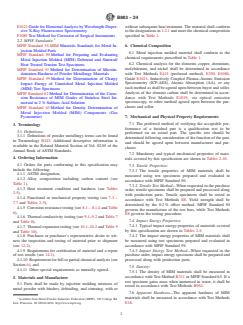
E1621 Guide for Elemental Analysis by Wavelength Disper- without subsequent heat treatment. The material shall conform
sive X-Ray Fluorescence Spectrometry to the designations in 1.2.1 and meet the chemical composition
F1089 Test Method for Corrosion of Surgical Instruments specified in Table 1.
2.2 MPIF Standards:
MPIF Standard 35-MIM Materials Standards for Metal In-
6. Chemical Composition
jection Molded Parts
6.1 Metal injection molded material shall conform to the
MPIF Standard 50 Method for Preparing and Evaluating
chemical requirements prescribed in Table 1.
Metal Injection Molded (MIM) Debound and Sintered/
6.2 Chemical analysis for the elements copper, chromium,
Heat Treated Tension Test Specimens
molybdenum, and nickel shall be determined in accordance
MPIF Standard 51 Method for Determination of Microin-
with Test Methods E415 (preferred method), E350, E1086,
dentation Hardness of Powder Metallurgy Materials
Guide E1621, Inductively Coupled Plasma–Atomic Emission
MPIF Standard 59 Method for Determination of Charpy
Spectrometry (ICP-AES), Atomic Absorption (AA), or any
Impact Energy of Unnotched Metal Injection Molded
such method as shall be agreed upon between buyer and seller.
(MIM) Test Specimens
Analysis of the element carbon shall be determined in accor-
MPIF Standard 62 Method for Determination of the Corro-
dance with Test Methods E1019, via optical emission
sion Resistance of MIM Grades of Stainless Steel Im-
spectroscopy, or other method agreed upon between the pur-
mersed in 2 % Sulfuric Acid Solution
chaser and seller.
MPIF Standard 63 Method for Density Determination of
Metal Injection Molded (MIM) Components (Gas
7. Mechanical and Physical Property Requirements
Pycnometer)
7.1 The preferred method of verifying the acceptable per-
3. Terminology
formance of a finished part is a qualification test to be
3.1 Definitions:
performed on an actual part. The specific test should be
3.1.1 Definitions of powder metallurgy terms can be found
determined following consideration of the function of the part,
in Terminology B243. Additional descriptive information is
and should be agreed upon between manufacturer and pur-
available in the Related Material Section of Vol. 02.05 of the
chaser.
Annual Book of ASTM Standards.
7.2 Mandatory and typical mechanical properties of mate-
4. Ordering Information
rials covered by this specification are shown in Tables 2-10.
4.1 Orders for parts conforming to this specification may
7.3 Tensile Properties:
include the following:
7.3.1 The tensile properties of MIM materials shall be
4.1.1 ASTM designation,
measured using test specimens prepared and evaluated in
4.1.2 Alloy composition including carbon content (see
accordance with MPIF Standard 50.
Table 1),
7.3.2 Tensile Test Method—When requested in the purchase
4.1.3 Heat treatment condition and hardness (see Tables
order, tensile specimens shall be prepared and processed along
2-5),
with production parts. Tensile specimens shall be tested in
4.1.4 Functional or mechanical property testing (see 7.3 –
accordance with Test Methods E8. Yield strength shall be
7.7 and Tables 2-5),
determined by the 0.2 % offset method. MPIF Standard 50
4.1.5 Corrosion resistance testing (see 8.1 – 8.1.4 and Table
governs the manufacture of the test bars, while Test Methods
6),
E8 governs the testing procedure.
4.1.6 Thermal conductivity testing (see 9.1–9.2 and Table 7
7.4 Impact Energy Properties:
and Table 8),
7.4.1 Typical impact energy properties of materials covered
4.1.7 Thermal expansion testing (see 10.1–10.2 and Table 9
by this specification are shown in Tables 2-5.
and Table 10),
4.1.8 Purchaser or purchaser’s representative desire to wit- 7.4.2 The impact energy properties of MIM materials shall
be measured using test specimens prepared and evaluated in
ness the inspection and testing of material prior to shipment
(see 12.2), accordance with MPIF Standard 59.
4.1.9 Requirement for certification of material and a report 7.4.3 Impact Energy Test Method—When requested in the
of test results (see 14.1), purchase order, impact energy specimens shall be prepared and
4.1.10 Requirement for full or partial chemical analysis (see processed along with production parts.
Section 6), and
7.5 Density:
4.1.11 Other special requirements as mutually agreed.
7.5.1 The density of MIM materials shall be measured in
accordance with Test Method B311 or MPIF Standard 63. If a
5. Materials and Manufacture
test specimen gains mass when immersed in water, it shall be
5.1 Parts shall be made by injection molding mixtures of
tested in accordance with Test Methods B962.
metal powder with binders, debinding, and sintering, with or
7.6 Apparent Hardness—The apparent hardness of MIM
materials shall be measured in accordance with Test Methods
Available from Metal Powder Industries Federation (MPIF), 105 College Rd.
East, Princeton, NJ 08540-6692, http://www.mpif.org. E18.
B883 − 24
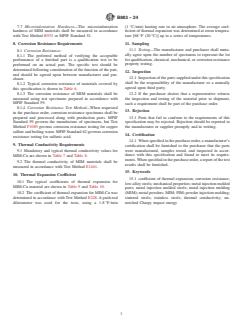
7.7 Microindentation Hardness—The microindentation (1 °C ⁄min) heating rate in air atmosphere. The average coef-
hardness of MIM materials shall be measured in accordance ficient of thermal expansion was determined at room tempera-
with Test Method B933 or MPIF Standard 51. ture [68 °F (20 °C)] up to a series of temperatures.
11. Sampling
8. Corrosion Resistance Requirements
11.1 Testing—The manufacturer and purchaser shall mutu-
8.1 Corrosion Resistance:
ally agree upon the number of specimens to represent the lot
8.1.1 The preferred method of verifying the acceptable
for qualification, chemical, mechanical, or corrosion resistance
performance of a finished part is a qualification test to be
property testing.
performed on an actual part. The specific test should be
determined following consideration of the function of the part,
12. Inspection
and should be agreed upon between manufacturer and pur-
12.1 Inspection of the parts supplied under this specification
chaser.
shall be the responsibility of the manufacturer or a mutually
8.1.2 Typical corrosion resistance of materials covered by
agreed upon third party.
this specification is shown in Table 6.
8.1.3 The corrosion resistance of MIM materials shall be
12.2 If the purchaser desires that a representative witness
measured using test specimens prepared in accordance with
the inspection and testing of the material prior to shipment,
MPIF Standard 59.
such a requirement shall be part of the purchase order.
8.1.4 Corrosion Resistance Test Method—When requested
13. Rejection
in the purchase order, corrosion resistance specimens shall be
prepared and processed along with production parts. MPIF 13.1 Parts that fail to conform to the requirements of this
Standard 59 governs the manufacture of specimens, but Test
specification may be rejected. Rejection should be reported to
Method F1089 governs corrosion resistance testing for copper the manufacturer or supplier promptly and in writing.
sulfate and boiling water. MPIF Standard 62 governs corrosion
14. Certification
resistance testing for sulfuric acid.
14.1 When specified in the purchase order, a manufacturer’s
9. Thermal Conductivity Requirements
certification shall be furnished to the purchaser that the parts
were manufactured, samples tested, and inspected in accor-
9.1 Mandatory and typical thermal conductivity values for
dance with this specification and found to meet its require-
MIM-Cu are shown in Table 7 and Table 8.
ments. When specified in the purchase order, a report of the test
9.2 The thermal conductivity of MIM materials shall be
results shall be furnished.
measured in accordance with Test Method E1461.
15. Keywords
10. Thermal Expansion Coefficient
15.1 coefficient of thermal expansion; corrosion resistance;
10.1 The typical coefficients of thermal expansion for
low-alloy steels; mechanical properties; metal injection molded
MIM-Cu material are shown in Table 9 and Table 10.
parts; metal injection molded steels; metal injection molding
10.2 The coefficient of thermal expansion for MIM-Cu was (MIM); metal powders; MIM; PIM; powder injection molding;
determined in accordance with Test Method E228. A push-rod sintered steels; stainless steels; thermal conductivity; un-
dilatometer was used for the tests, using a 1.8 °F ⁄min notched Charpy impact energy
B883 − 24
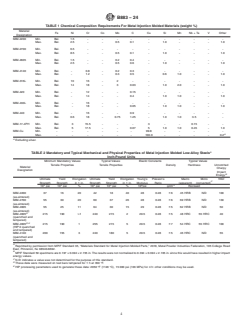
TABLE 1 Chemical Composition Requirements For Metal Injection Molded Materials (weight %)
Material
Fe Ni Cr Co Mo C Cu Si Mn Nb + Ta V Other
Designation
MIM-2200 Min. Bal. 1.5 - - - - - - - - - -
Max. Bal. 2.5 - - 0.5 0.1 - 1.0 - - - 1.0
MIM-2700 Min. Bal. 6.5 - - - - - - - - - -
Max. Bal. 8.5 - - 0.5 0.1 - 1.0 - - - 1.0
MIM-4605 Min. Bal. 1.5 - - 0.2 0.4 - - - - - -
Max. Bal. 2.5 - - 0.5 0.6 - 1.0 - - - 1.0
MIM-4140 Min. Bal. - 0.8 - 0.2 0.3 - - - - - -
Max. Bal. - 1.2 - 0.3 0.5 - 0.6 1.0 - - 1.0
MIM-316L Min. Bal. 10 16 - 2 - - - - - - -
Max. Bal. 14 18 - 3 0.03 - 1.0 2.0 - - 1.0
MIM-420 Min. Bal. - 12 - - 0.15 - - - - - -
Max. Bal. - 14 - - 0.4 - 1.0 1.0 - - 1.0
MIM-430L Min. Bal. - 16 - - - - - - - - -
Max. Bal. - 18 - - 0.05 - 1.0 1.0 - - 1.0
M
...
This document is not an ASTM standard and is intended only to provide the user of an ASTM standard an indication of what changes have been made to the previous version. Because
it may not be technically possible to adequately depict all changes accurately, ASTM recommends that users consult prior editions as appropriate. In all cases only the current version
of the standard as published by ASTM is to be considered the official document.
Designation: B883 − 19 B883 − 24
Standard Specification for
Metal Injection Molded (MIM) Materials
This standard is issued under the fixed designation B883; the number immediately following the designation indicates the year of
original adoption or, in the case of revision, the year of last revision. A number in parentheses indicates the year of last reapproval. A
superscript epsilon (´) indicates an editorial change since the last revision or reapproval.
1. Scope*
1.1 This specification covers ferrous metal injection molded materials fabricated by mixing elemental or pre-alloyed metal
powders with binders, injecting into a mold, debinding, and sintering, with or without subsequent heat treatment.
1.2 This specification covers the following injection molded materials.
1.2.1 Compositions:
1.2.1.1 MIM-2200, low-alloy steel
1.2.1.2 MIM-2700, low-alloy steel
1.2.1.3 MIM-4605, low-alloy steel
1.2.1.4 MIM-4140, low-alloy steel
1.2.1.5 MIM-316L, austenitic stainless steel
1.2.1.6 MIM-17-4 PH, precipitation hardening stainless steel
1.2.1.7 MIM-420, martensitic stainless steel
1.2.1.8 MIM-430L, ferritic stainless steel
1.2.1.9 MIM-440, martensitic stainless steel
1.2.1.10 MIM-Cu, copper
1.3 Chemical composition limits are specified in Table 1.
1.4 With the exception of the values for density and the mass used to determine density, for which the use of the gram per cubic
centimetre (g/cm ) and gram (g) units is the longstanding industry practice, the values in inch-pound units are to be regarded as
This specification is under the jurisdiction of ASTM Committee B09 on Metal Powders and Metal Powder Products and is the direct responsibility of Subcommittee
B09.11 on Near Full Density Powder Metallurgy Materials.
Current edition approved April 1, 2019Feb. 1, 2024. Published May 2019February 2024. Originally approved in 1997. Last previous edition approved in 20172019 as
B883 – 17.B883 – 19. DOI: 10.1520/B0883-19.10.1520/B0883-24.
*A Summary of Changes section appears at the end of this standard
Copyright © ASTM International, 100 Barr Harbor Drive, PO Box C700, West Conshohocken, PA 19428-2959. United States
B883 − 24
standard. The values given in parentheses or in separate tables are mathematical conversions to SI units that are provided for
information only and are not considered standard.
1.5 This standard does not purport to address all of the safety concerns, if any, associated with its use. It is the responsibility
of the user of this standard to establish appropriate safety, health, and environmental practices and determine the applicability of
regulatory limitations prior to use.
1.6 This international standard was developed in accordance with internationally recognized principles on standardization
established in the Decision on Principles for the Development of International Standards, Guides and Recommendations issued
by the World Trade Organization Technical Barriers to Trade (TBT) Committee.
2. Referenced Documents
2.1 ASTM Standards:
B243 Terminology of Powder Metallurgy
B311 Test Method for Density of Powder Metallurgy (PM) Materials Containing Less Than Two Percent Porosity
B933 Test Method for Microindentation Hardness of Powder Metallurgy (PM) Materials
B962 Test Methods for Density of Compacted or Sintered Powder Metallurgy (PM) Products Using Archimedes’ Principle
E8 Test Methods for Tension Testing of Metallic Materials [Metric] E0008_E0008M
E18 Test Methods for Rockwell Hardness of Metallic Materials
E228 Test Method for Linear Thermal Expansion of Solid Materials With a Push-Rod Dilatometer
E350 Test Methods for Chemical Analysis of Carbon Steel, Low-Alloy Steel, Silicon Electrical Steel, Ingot Iron, and Wrought
Iron
E415 Test Method for Analysis of Carbon and Low-Alloy Steel by Spark Atomic Emission Spectrometry
E1019 Test Methods for Determination of Carbon, Sulfur, Nitrogen, and Oxygen in Steel, Iron, Nickel, and Cobalt Alloys by
Various Combustion and Inert Gas Fusion Techniques
E1086 Test Method for Analysis of Austenitic Stainless Steel by Spark Atomic Emission Spectrometry
E1461 Test Method for Thermal Diffusivity by the Flash Method
E1621 Guide for Elemental Analysis by Wavelength Dispersive X-Ray Fluorescence Spectrometry
F1089 Test Method for Corrosion of Surgical Instruments
2.2 MPIF Standards:
MPIF Standard 35-MIM Materials Standards for Metal Injection Molded Parts
MPIF Standard 50 Method for Preparing and Evaluating Metal Injection Molded (MIM) Debound and Sintered/Heat Treated
Tension Test Specimens
MPIF Standard 51 Method for Determination of Microindentation Hardness of Powder Metallurgy Materials
MPIF Standard 59 Method for Determination of Charpy Impact Energy of Unnotched Metal Injection Molded (MIM) Test
Specimens
MPIF Standard 62 Method for Determination of the Corrosion Resistance of MIM Grades of Stainless Steel Immersed in 2 %
Sulfuric Acid Solution
MPIF Standard 63 Method for Density Determination of Metal Injection Molded (MIM) Components (Gas Pycnometer)
3. Terminology
3.1 Definitions:
3.1.1 Definitions of powder metallurgy terms can be found in Terminology B243. Additional descriptive information is available
in the Related Material Section of Vol. 02.05 of the Annual Book of ASTM Standards.
4. Ordering Information
4.1 Orders for parts conforming to this specification may include the following:
4.1.1 ASTM designation,
4.1.2 Alloy composition including carbon content (see Table 1),
For referenced ASTM standards, visit the ASTM website, www.astm.org, or contact ASTM Customer Service at service@astm.org. For Annual Book of ASTM Standards
volume information, refer to the standard’s Document Summary page on the ASTM website.
Available from Metal Powder Industries Federation (MPIF), 105 College Rd. East, Princeton, NJ 08540-6692, http://www.mpif.org.
B883 − 24
4.1.3 Heat treatment condition and hardness (see Tables 2-5),
4.1.4 Functional or mechanical property testing (see 7.3 – 7.7 and Tables 2-5),
4.1.5 Corrosion resistance testing (see 8.1 – 8.1.4 and Table 6),
4.1.6 Thermal conductivity testing (see 9.1–9.2 and Table 7 and Table 8),
4.1.7 Thermal expansion testing (see 10.1–10.2 and Table 9 and Table 10),
4.1.8 Purchaser or purchaser’s representative desire to witness the inspection and testing of material prior to shipment (see 12.2),
4.1.9 Requirement for certification of material and a report of test results (see 14.1),
4.1.10 Requirement for full or partial chemical analysis (see Section 6), and
4.1.11 Other special requirements as mutually agreed.
5. Materials and Manufacture
5.1 Parts shall be made by injection molding mixtures of metal powder with binders, debinding, and sintering, with or without
subsequent heat treatment. The material shall conform to the designations in 1.2.1 and meet the chemical composition specified
in Table 1.
6. Chemical Composition
6.1 Metal injection molded material shall conform to the chemical requirements prescribed in Table 1.
6.2 Chemical analysis for the elements copper, chromium, molybdenum, and nickel shall be determined in accordance with Test
Methods E415 (preferred method), E350, E1086, Guide E1621, Inductively Coupled Plasma–Atomic Emission Spectrometry
(ICP-AES), Atomic Absorption (AA), or any such method as shall be agreed upon between buyer and seller. Analysis of the
element carbon shall be determined in accordance with Test Methods E1019, via optical emission spectroscopy, or other method
agreed upon between the purchaser and seller.
7. Mechanical and Physical Property Requirements
7.1 The preferred method of verifying the acceptable performance of a finished part is a qualification test to be performed on an
actual part. The specific test should be determined following consideration of the function of the part, and should be agreed upon
between manufacturer and purchaser.
7.2 Mandatory and typical mechanical properties of materials covered by this specification are shown in Tables 2-10.
7.3 Tensile Properties:
7.3.1 The tensile properties of MIM materials shall be measured using test specimens prepared and evaluated in accordance with
MPIF Standard 50.
7.3.2 Tensile Test Method—When requested in the purchase order, tensile specimens shall be prepared and processed along with
production parts. Tensile specimens shall be tested in accordance with Test Methods E8. Yield strength shall be determined by the
0.2 % offset method. MPIF Standard 50 governs the manufacture of the test bars, while Test Methods E8 governs the testing
procedure.
7.4 Impact Energy Properties:
7.4.1 Typical impact energy properties of materials covered by this specification are shown in Tables 2-5.
B883 − 24
7.4.2 The impact energy properties of MIM materials shall be measured using test specimens prepared and evaluated in
accordance with MPIF Standard 59.
7.4.3 Impact Energy Test Method—When requested in the purchase order, impact energy specimens shall be prepared and
processed along with production parts.
7.5 Density:
7.5.1 The density of MIM materials shall be measured in accordance with Test Method B311 or MPIF Standard 63. If a test
specimen gains mass when immersed in water, it shall be tested in accordance with Test Methods B962.
7.6 Apparent Hardness—The apparent hardness of MIM materials shall be measured in accordance with Test Methods E18.
7.7 Microindentation Hardness—The microindentation hardness of MIM materials shall be measured in accordance with Test
Method B933 or MPIF Standard 51.
8. Corrosion Resistance Requirements
8.1 Corrosion Resistance:
8.1.1 The preferred method of verifying the acceptable performance of a finished part is a qualification test to be performed on
an actual part. The specific test should be determined following consideration of the function of the part, and should be agreed upon
between manufacturer and purchaser.
8.1.2 Typical corrosion resistance of materials covered by this specification is shown in Table 6.
8.1.3 The corrosion resistance of MIM materials shall be measured using test specimens prepared in accordance with MPIF
Standard 59.
8.1.4 Corrosion Resistance Test Method—When requested in the purchase order, corrosion resistance specimens shall be prepared
and processed along with production parts. MPIF Standard 59 governs the manufacture of specimens, but Test Method F1089
governs corrosion resistance testing for copper sulfate and boiling water. MPIF Standard 62 governs corrosion resistance testing
for sulfuric acid.
9. Thermal Conductivity Requirements
9.1 Mandatory and typical thermal conductivity values for MIM-Cu are shown in Table 7 and Table 8.
9.2 The thermal conductivity of MIM materials shall be measured in accordance with Test Method E1461.
10. Thermal Expansion Coefficient
10.1 The typical coefficients of thermal expansion for MIM-Cu material are shown in Table 9 and Table 10.
10.2 The coefficient of thermal expansion for MIM-Cu was determined in accordance with Test Method E228. A push-rod
dilatometer was used for the tests, using a 1.8 °F ⁄min (1 °C ⁄min) heating rate in air atmosphere. The average coefficient of thermal
expansion was determined at room temperature [68 °F (20 °C)] up to a series of temperatures.
11. Sampling
11.1 Testing—The manufacturer and purchaser shall mutually agree upon the number of specimens to represent the lot for
qualification, chemical, mechanical, or corrosion resistance property testing.
B883 − 24
12. Inspection
12.1 Inspection of the parts supplied under this specification shall be the responsibility of the manufacturer or a mutually agreed
upon third party.
12.2 If the purchaser desires that a representative witness the inspection and testing of the material prior to shipment, such a
requirement shall be part of the purchase order.
13. Rejection
13.1 Parts that fail to conform to the requirements of this specification may be rejected. Rejection should be reported to the
manufacturer or supplier promptly and in writing.
14. Certification
14.1 When specified in the purchase order, a manufacturer’s certification shall be furnished to the purchaser that the parts were
manufactured, samples tested, and inspected in accordance with this specification and found to meet its requirements. When
specified in the purchase order, a report of the test results shall be furnished.
15. Keywords
15.1 coefficient of thermal expansion; corrosion resistance; low-alloy steels; mechanical properties; metal injection molded parts;
metal injection molded steels; metal injection molding (MIM); metal powders; MIM; PIM; powder injection molding; sintered
steels; stainless steels; thermal conductivity; unnotched Charpy impact energy
TABLE 1 Chemical Composition Requirements For Metal Injection Molded Materials (weight %)
Material
Fe Ni Cr Co Mo C Cu Si Mn Nb + Ta V Other
Designation
MIM-2200 Min. Bal. 1.5 - - - - - - - - - -
Max. Bal. 2.5 - - 0.5 0.1 - 1.0 - - - 1.0
MIM-2700 Min. Bal. 6.5 - - - - - - - - - -
Max. Bal. 8.5 - - 0.5 0.1 - 1.0 - - - 1.0
MIM-4605 Min. Bal. 1.5 - - 0.2 0.4 - - - - - -
Max. Bal. 2.5 - - 0.5 0.6 - 1.0 - - - 1.0
MIM-4140 Min. Bal. - 0.8 - 0.2 0.3 - - - - - -
Max. Bal. - 1.2 - 0.3 0.5 - 0.6 1.0 - - 1.0
MIM-316L Min. Bal. 10 16 - 2 - - - - - - -
Max. Bal. 14 18 - 3 0.03 - 1.0 2.0 - - 1.0
MIM-420 Min. Bal. - 12 - - 0.15 - - - - - -
Max. Bal. - 14 - - 0.4 - 1.0 1.0 - - 1.0
MIM-430L Min. Bal. - 16 - - - - - - - - -
Max. Bal. - 18 - - 0.05 - 1.0 1.0 - - 1.0
MIM-440 Min. Bal. - 16 - - 0.9 - - - - - -
Max. Bal. 0.6 18 - 0.75 1.25 - 1.0 1.0 3.5 - -
MIM-
...