

ASTM C841-23
(Specification)Standard Specification for Installation of Interior Lathing and Furring
General Information
- Abstract
ABSTRACT
This specification covers the minimum requirements for, and the methods of application of, interior lathing and furring to receive gypsum plaster applied. Other materials are not prohibited from being used provided that their physical characteristics and durability under conditions of usage are at least equal in performance to those described. All materials shall be kept dry, preferably by being stored inside. Where necessary to be stored outside, materials shall be stacked off the ground, supported on a level platform, and protected from the weather and surface contamination. Materials shall be neatly stacked flat with care taken to avoid damage to edges, ends, or surfaces. The materials to be used are the following: tie wire and hanger wire, gypsum lath, expanded metal lath, welded wire lath, woven wire lath, nails, screws, staples, paper, and accessories such as control joints, cornerite, channels, rod and flat hangers, clips, and striplath. In general, during installation, the following shall be required: application of gypsum lath to supports, application of gypsum lath to wood supports, application of gypsum lath to metal supports, studless solid partitions (gypsum lath and plaster), application of metal plaster bases to framing members, studless solid partitions (metal lath and plaster), suspended and furred ceilings (metal lath and gypsum lath construction), main runners, cross furring, and metal furring for walls.
SCOPE
1.1 This specification covers the minimum requirements for, and the methods of application of, interior lathing and furring to receive gypsum plaster applied in accordance with Specification C842. Other materials are not prohibited from being used provided that their physical characteristics and durability under conditions of usage are at least equal in performance to those described.
1.2 The values stated in inch-pound units are to be regarded as standard. The values given in parentheses are mathematical conversions to SI units that are provided for information only and are not considered standard.
1.3 Details of construction for a specific assembly to achieve the required fire resistance shall be obtained from reports of fire-resistance tests, engineering evaluations, or listings from recognized fire testing laboratories.
1.4 Where a specific degree of sound control is required for plastered assemblies and constructions, details of construction shall be obtained from reports of acoustical tests of assemblies that have met the required or specified acoustical performance.
1.5 This standard does not purport to address all of the safety concerns, if any, associated with its use. It is the responsibility of the user of this standard to establish appropriate safety, health, and environmental practices and determine the applicability of regulatory limitations prior to use.
1.6 This international standard was developed in accordance with internationally recognized principles on standardization established in the Decision on Principles for the Development of International Standards, Guides and Recommendations issued by the World Trade Organization Technical Barriers to Trade (TBT) Committee.
- Status
- Published
- Publication Date
- 28-Feb-2023
- Technical Committee
- C11 - Gypsum and Related Building Materials and Systems
Buy Documents
ASTM C841-23 - Standard Specification for Installation of Interior Lathing and Furring
REDLINE ASTM C841-23 - Standard Specification for Installation of Interior Lathing and Furring
Overview
ASTM C841-23 is the recognized standard specification for the installation of interior lathing and furring to receive gypsum plaster. Issued by ASTM International, this standard outlines the minimum requirements and acceptable methods for installing a range of lathing and furring materials in preparation for interior plastering, particularly gypsum plaster in accordance with ASTM C842. This document ensures that proper techniques and materials are used to promote the integrity, durability, and performance of interior wall and ceiling assemblies.
Key Topics
Scope of Application
- Specifies the procedures and materials for interior lathing and furring.
- Allows for the use of alternative materials provided they meet equivalent physical characteristics and durability standards.
Material Guidelines
- Describes acceptable types of lath (gypsum lath, expanded metal lath, welded and woven wire lath) and furring accessories.
- Covers requirements for fasteners (nails, screws, staples) and accessories such as control joints, cornerite, channels, hangers, clips, and striplath.
- Emphasizes proper storage and protection of materials to maintain quality.
Installation Requirements
- Outlines methods for applying lath to wood, metal, and other supports.
- Covers studless solid partitions, both for gypsum lath and metal lath systems.
- Details suspended and furred ceiling constructions, as well as wall furring for even surfaces.
- Provides installation guidance for control joints, corner reinforcement, and edge treatments.
Performance Requirements
- Addresses fire resistance and sound control, referencing the need for appropriate test data and evaluations.
- Notes the importance of workmanship in achieving level, plumb, and true surfaces ready for plaster.
Safety and Regulatory Considerations
- Highlights the need for users to address safety, health, and environmental practices and to recognize any regulatory limitations.
Applications
The ASTM C841-23 standard is widely used in both residential and commercial construction projects where interior plastering over lath is required. It provides:
- Quality Assurance for drywall contractors, builders, and architects, ensuring a consistent and durable substrate for gypsum plaster finishes.
- Compliance Documentation for projects subject to code requirements, building inspections, or third-party certification programs.
- Design Reference for engineers and architects specifying wall and ceiling assemblies requiring fire resistance, improved sound control, or specific structural performance.
- Guidance for Repairs and Renovation, ensuring that patchwork or updates to older plaster assemblies align with contemporary best practices.
- Support for LEED or Green Building Initiatives by promoting proper installation methods that minimize waste, maximize material efficiency, and enhance overall building performance.
Related Standards
To achieve reliable results, ASTM C841-23 should be used in conjunction with several associated ASTM standards, including:
- ASTM C842: Specification for Application of Interior Gypsum Plaster
- ASTM C847: Specification for Metal Lath
- ASTM C933/C1032: Specifications for Welded and Woven Wire Lath
- ASTM C1002, C954, C514: Specifications for fasteners and screws used in lathing systems
- ASTM C11: Terminology Relating to Gypsum and Related Building Materials
- ASTM C754 & C1007: Installation of steel framing members and related accessories for gypsum products
By following ASTM C841-23 and its referenced documents, professionals in construction and building maintenance can ensure the robust installation of lathing and furring systems that perform reliably in both standard and high-performance applications.
Keywords: ASTM C841-23, interior lathing, furring, gypsum plaster, metal lath, wire lath, installation standard, wall construction, ceiling construction, building materials, construction compliance, fire resistance, sound control, plaster base.
Relations
- Effective Date
- 01-Oct-2023
- Effective Date
- 01-May-2020
- Effective Date
- 01-May-2020
- Effective Date
- 01-Apr-2020
- Effective Date
- 15-Jan-2020
- Effective Date
- 01-Nov-2019
- Effective Date
- 01-Oct-2018
- Refers
ASTM C11-18a - Standard Terminology Relating to Gypsum and Related Building Materials and Systems - Effective Date
- 01-Oct-2018
- Effective Date
- 01-Oct-2018
- Effective Date
- 01-Oct-2018
- Refers
ASTM C11-18 - Standard Terminology Relating to Gypsum and Related Building Materials and Systems - Effective Date
- 01-Jun-2018
- Effective Date
- 01-Apr-2018
- Refers
ASTM C11-17a - Standard Terminology Relating to Gypsum and Related Building Materials and Systems - Effective Date
- 01-Oct-2017
- Refers
ASTM C11-17 - Standard Terminology Relating to Gypsum and Related Building Materials and Systems - Effective Date
- 15-May-2017
- Effective Date
- 01-Jan-2017
Buy Documents
ASTM C841-23 - Standard Specification for Installation of Interior Lathing and Furring
REDLINE ASTM C841-23 - Standard Specification for Installation of Interior Lathing and Furring
Get Certified
Connect with accredited certification bodies for this standard

DIBt (Deutsches Institut für Bautechnik)
German Institute for Building Technology.
DIN CERTCO
DIN Group product certification.

Aboma Certification B.V.
Specialized in construction, metal, and transport sectors.
Sponsored listings
Frequently Asked Questions
ASTM C841-23 is a technical specification published by ASTM International. Its full title is "Standard Specification for Installation of Interior Lathing and Furring". This standard covers: ABSTRACT This specification covers the minimum requirements for, and the methods of application of, interior lathing and furring to receive gypsum plaster applied. Other materials are not prohibited from being used provided that their physical characteristics and durability under conditions of usage are at least equal in performance to those described. All materials shall be kept dry, preferably by being stored inside. Where necessary to be stored outside, materials shall be stacked off the ground, supported on a level platform, and protected from the weather and surface contamination. Materials shall be neatly stacked flat with care taken to avoid damage to edges, ends, or surfaces. The materials to be used are the following: tie wire and hanger wire, gypsum lath, expanded metal lath, welded wire lath, woven wire lath, nails, screws, staples, paper, and accessories such as control joints, cornerite, channels, rod and flat hangers, clips, and striplath. In general, during installation, the following shall be required: application of gypsum lath to supports, application of gypsum lath to wood supports, application of gypsum lath to metal supports, studless solid partitions (gypsum lath and plaster), application of metal plaster bases to framing members, studless solid partitions (metal lath and plaster), suspended and furred ceilings (metal lath and gypsum lath construction), main runners, cross furring, and metal furring for walls. SCOPE 1.1 This specification covers the minimum requirements for, and the methods of application of, interior lathing and furring to receive gypsum plaster applied in accordance with Specification C842. Other materials are not prohibited from being used provided that their physical characteristics and durability under conditions of usage are at least equal in performance to those described. 1.2 The values stated in inch-pound units are to be regarded as standard. The values given in parentheses are mathematical conversions to SI units that are provided for information only and are not considered standard. 1.3 Details of construction for a specific assembly to achieve the required fire resistance shall be obtained from reports of fire-resistance tests, engineering evaluations, or listings from recognized fire testing laboratories. 1.4 Where a specific degree of sound control is required for plastered assemblies and constructions, details of construction shall be obtained from reports of acoustical tests of assemblies that have met the required or specified acoustical performance. 1.5 This standard does not purport to address all of the safety concerns, if any, associated with its use. It is the responsibility of the user of this standard to establish appropriate safety, health, and environmental practices and determine the applicability of regulatory limitations prior to use. 1.6 This international standard was developed in accordance with internationally recognized principles on standardization established in the Decision on Principles for the Development of International Standards, Guides and Recommendations issued by the World Trade Organization Technical Barriers to Trade (TBT) Committee.
ABSTRACT This specification covers the minimum requirements for, and the methods of application of, interior lathing and furring to receive gypsum plaster applied. Other materials are not prohibited from being used provided that their physical characteristics and durability under conditions of usage are at least equal in performance to those described. All materials shall be kept dry, preferably by being stored inside. Where necessary to be stored outside, materials shall be stacked off the ground, supported on a level platform, and protected from the weather and surface contamination. Materials shall be neatly stacked flat with care taken to avoid damage to edges, ends, or surfaces. The materials to be used are the following: tie wire and hanger wire, gypsum lath, expanded metal lath, welded wire lath, woven wire lath, nails, screws, staples, paper, and accessories such as control joints, cornerite, channels, rod and flat hangers, clips, and striplath. In general, during installation, the following shall be required: application of gypsum lath to supports, application of gypsum lath to wood supports, application of gypsum lath to metal supports, studless solid partitions (gypsum lath and plaster), application of metal plaster bases to framing members, studless solid partitions (metal lath and plaster), suspended and furred ceilings (metal lath and gypsum lath construction), main runners, cross furring, and metal furring for walls. SCOPE 1.1 This specification covers the minimum requirements for, and the methods of application of, interior lathing and furring to receive gypsum plaster applied in accordance with Specification C842. Other materials are not prohibited from being used provided that their physical characteristics and durability under conditions of usage are at least equal in performance to those described. 1.2 The values stated in inch-pound units are to be regarded as standard. The values given in parentheses are mathematical conversions to SI units that are provided for information only and are not considered standard. 1.3 Details of construction for a specific assembly to achieve the required fire resistance shall be obtained from reports of fire-resistance tests, engineering evaluations, or listings from recognized fire testing laboratories. 1.4 Where a specific degree of sound control is required for plastered assemblies and constructions, details of construction shall be obtained from reports of acoustical tests of assemblies that have met the required or specified acoustical performance. 1.5 This standard does not purport to address all of the safety concerns, if any, associated with its use. It is the responsibility of the user of this standard to establish appropriate safety, health, and environmental practices and determine the applicability of regulatory limitations prior to use. 1.6 This international standard was developed in accordance with internationally recognized principles on standardization established in the Decision on Principles for the Development of International Standards, Guides and Recommendations issued by the World Trade Organization Technical Barriers to Trade (TBT) Committee.
ASTM C841-23 is classified under the following ICS (International Classification for Standards) categories: 91.100.10 - Cement. Gypsum. Lime. Mortar. The ICS classification helps identify the subject area and facilitates finding related standards.
ASTM C841-23 has the following relationships with other standards: It is inter standard links to ASTM C933-23, ASTM C1007-20, ASTM C754-20, ASTM C514-04(2020), ASTM D1784-20, ASTM D3678-19, ASTM C933-18, ASTM C11-18a, ASTM C847-18, ASTM C1032-18, ASTM C11-18, ASTM C754-18, ASTM C11-17a, ASTM C11-17, ASTM C754-17. Understanding these relationships helps ensure you are using the most current and applicable version of the standard.
ASTM C841-23 is available in PDF format for immediate download after purchase. The document can be added to your cart and obtained through the secure checkout process. Digital delivery ensures instant access to the complete standard document.
Standards Content (Sample)
This international standard was developed in accordance with internationally recognized principles on standardization established in the Decision on Principles for the
Development of International Standards, Guides and Recommendations issued by the World Trade Organization Technical Barriers to Trade (TBT) Committee.
Designation: C841 − 23
Standard Specification for
Installation of Interior Lathing and Furring
This standard is issued under the fixed designation C841; the number immediately following the designation indicates the year of
original adoption or, in the case of revision, the year of last revision. A number in parentheses indicates the year of last reapproval. A
superscript epsilon (´) indicates an editorial change since the last revision or reapproval.
This standard has been approved for use by agencies of the U.S. Department of Defense.
1. Scope mendations issued by the World Trade Organization Technical
Barriers to Trade (TBT) Committee.
1.1 This specification covers the minimum requirements for,
and the methods of application of, interior lathing and furring
2. Referenced Documents
to receive gypsum plaster applied in accordance with Specifi-
cation C842. Other materials are not prohibited from being 2.1 ASTM Standards:
A641/A641M Specification for Zinc–Coated (Galvanized)
used provided that their physical characteristics and durability
under conditions of usage are at least equal in performance to Carbon Steel Wire
C11 Terminology Relating to Gypsum and Related Building
those described.
Materials and Systems
1.2 The values stated in inch-pound units are to be regarded
C514 Specification for Nails for the Application of Gypsum
as standard. The values given in parentheses are mathematical
Board
conversions to SI units that are provided for information only
C754 Specification for Installation of Steel Framing Mem-
and are not considered standard.
bers to Receive Screw-Attached Gypsum Panel Products
1.3 Details of construction for a specific assembly to
C842 Specification for Application of Interior Gypsum Plas-
achieve the required fire resistance shall be obtained from
ter
reports of fire-resistance tests, engineering evaluations, or
C847 Specification for Metal Lath
listings from recognized fire testing laboratories.
C933 Specification for Welded Wire Lath
C954 Specification for Steel Drill Screws for the Application
1.4 Where a specific degree of sound control is required for
of Gypsum Panel Products or Metal Plaster Bases to Steel
plastered assemblies and constructions, details of construction
Studs from 0.033 in. (0.84 mm) to 0.112 in. (2.84 mm) in
shall be obtained from reports of acoustical tests of assemblies
Thickness
that have met the required or specified acoustical performance.
C1002 Specification for Steel Self-Piercing Tapping Screws
1.5 This standard does not purport to address all of the
for Application of Gypsum Panel Products or Metal
safety concerns, if any, associated with its use. It is the
Plaster Bases to Wood Studs or Steel Studs
responsibility of the user of this standard to establish appro-
C1007 Specification for Installation of Load Bearing (Trans-
priate safety, health, and environmental practices and deter-
verse and Axial) Steel Studs and Related Accessories
mine the applicability of regulatory limitations prior to use.
C1032 Specification for Woven Wire Plaster Base
1.6 This international standard was developed in accor-
C1396 Specification for Gypsum Board
dance with internationally recognized principles on standard-
D1784 Classification System and Basis for Specification for
ization established in the Decision on Principles for the
Rigid Poly(Vinyl Chloride) (PVC) Compounds and Chlo-
Development of International Standards, Guides and Recom-
rinated Poly(Vinyl Chloride) (CPVC) Compounds
D3678 Specification for Rigid Poly(Vinyl Chloride) (PVC)
Interior-Profile Extrusions
This specification is under the jurisdiction of ASTM Committee C11 on
Gypsum and Related Building Materials and Systems and is the direct responsibility
of Subcommittee C11.03 on Specifications for the Application of Gypsum and Other
Products in Assemblies. For referenced ASTM standards, visit the ASTM website, www.astm.org, or
Current edition approved March 1, 2023. Published April 2023. Originally contact ASTM Customer Service at service@astm.org. For Annual Book of ASTM
approved in 1976. Last previous edition approved in 2018 as C841 – 03 (2018). Standards volume information, refer to the standard’s Document Summary page on
DOI: 10.1520/C0841-23. the ASTM website.
Copyright © ASTM International, 100 Barr Harbor Drive, PO Box C700, West Conshohocken, PA 19428-2959. United States
C841 − 23
E492 Test Method for Laboratory Measurement of Impact 5.2 Materials shall be neatly stacked flat with care taken to
Sound Transmission Through Floor-Ceiling Assemblies avoid damage to edges, ends, or surfaces.
Using the Tapping Machine
6. Materials
2.2 National Association of Architectural Metal Manufac-
turers Standard
6.1 Wire Specification A641/A641M, Class 1 coating (gal-
HMMA 840 Installation and Storage of Hollow Metal Doors
vanized) soft temper.
and Frames
6.1.1 Tie Wire and Hanger Wire—Zinc-coated (galvanized)
soft-annealed steel, or a material having equivalent size,
3. Terminology
corrosion resistance and strength. Wire diameters (uncoated)
3.1 Definitions—For definitions relating to ceilings and specified herein correspond with United States steel wire gauge
walls see Terminology C11.
numbers as follows:
3.2 Definitions of Terms Specific to This Standard:
Wire Gauge (U.S. Steel
A
Diameter, in. (Diameter, mm)
3.2.1 base coat, n—the sum of the scratch and brown coats Wire Gauge)
0.0348 (0.88) No. 20
or the total coats in place prior to application of finish coats.
0.0410 (1.04) No. 19
0.0475 (1.21) No. 18
3.2.2 contact ceiling, n—a ceiling in which the lath is
0.0540 (1.37) No. 17
attached in direct contact with the construction above, without
0.0625 (1.59) No. 16
the use of main runners or cross furring.
0.0800 (2.03) No. 14
0.0915 (2.32) No. 13
3.2.3 furred ceiling, n—a ceiling in which the furring used
0.1055 (2.68) No. 12
for the support of the lath is attached directly to the structural
0.1205 (3.06) No. 11
0.1350 (3.43) No. 10
members of the building.
0.1483 (3.77) No. 9
3.2.4 suspended ceiling, n—a ceiling in which the main
0.1620 (4.11) No. 8
runners and cross furring are suspended below the structural A
Allowable variations in diameter shall be in accordance with tolerances as
established in A641/A641M.
members of the building.
3.2.5 main runners, n—the members that are attached to or 6.2 Gypsum Board—Specification C1396.
suspended from the construction above for the support of cross
6.3 Expanded Metal Lath—Specification C847.
furring.
6.4 Wire Lath:
3.2.6 cross furring, n—furring members that are attached at
6.4.1 Welded Wire Lath, Specification C933.
right angles to the underside of the main runners or construc-
6.4.2 Woven Wire Lath, Specification C1032.
tion above for support of the lath.
6.5 Fasteners:
3.2.7 furring, n—spacer strips fastened to a wall, ceiling, or
6.5.1 Nails for Attaching Gypsum Lath—Specification
planar element that create an even surface for the application of
C514. Nail size shall be in accordance with Table 1.
metal plaster bases or gypsum lath.
6.5.2 Nails for Attaching Metal Plaster Base—Galvanized
3.2.8 primary members, n—the members (main runners or
roofing nails or common nails. length shall be as specified in
structural supports) to which the cross furring is attached.
Section 7.
6.5.3 Screws—Specifications C954 or C1002.
3.2.9 metal plaster bases, n—expanded metal lath, sheet
metal lath, welded or woven wire lath. 6.5.3.1 Screws for attaching gypsum lath shall be sized in
accordance with Table 1.
3.2.10 face side (gypsum lath), n—the side opposite the
6.5.3.2 Screws for attaching metal plaster base shall have a
paper cover seam laps.
⁄16 in. (11.1 mm) diameter pan washer head and a 0.120 in.
3.2.11 surface transition, n—the change in width of a
(3.0 mm) diameter shank. The length shall be sufficient enough
surface, usually as a result of penetrations (doors, windows) or
to allow for the threaded portion of the screw to project not less
architectural demands.
than ⁄8 in. (9.5 mm) through steel framing when the lath is
installed.
4. Delivery of Materials
6.5.4 Staples—Staples for attaching gypsum lath shall con-
4.1 All materials shall be delivered in the original packages,
form to the requirements of Table 1.
containers, or bundles bearing the brand name and manufac-
6.5.4.1 Staples for attaching metal plaster base shall be
turer’s (or supplier’s) identification.
0.062 in. (1.6 mm) diameter, round or flattened steel wire with
⁄4 in. (19.0 mm) crown. Lengths shall be as specified for
5. Storage of Materials
individual systems.
5.1 All materials shall be kept dry, preferably by being
6.6 Paper or Other Backing—When used on metal plaster
stored inside. Where necessary to be stored outside, materials
bases, over solid backing, backing shall be securely held in
shall be stacked off the ground, supported on a level platform,
place by, or attached to the metal plaster base. Metal plaster
and protected from the weather and surface contamination.
base shall allow for ⁄4 in. (6.4 mm) self furring. The backing
shall permit embedment of plaster.
Available from National Association of Architectural Metal Manufacturers
6.7 Accessories—Shall be steel, coated, with a protective
(NAAMM), 800 Roosevelt Road, Bldg. C, Suite 312, Glen Ellyn, IL 60137,
http://www.naamm.org. rust inhibitive coating after fabrication, or fabricated from
C841 − 23
A,B
TABLE 1 Screws, Nails and Staples for Attaching Gypsum Lath to Horizontal and Vertical Wood Supports
Maximum Spacing, in. (mm) Minimum Gauge Requirements, in. (mm)
Diameter of
Distance Number of Approximate Depth of Flat Head or Gauge of
Thickness of
Width of Lath Between Attachments Spacing c to c Length of Leg Support Blued Nails or Shank of Nails
Lath
A
Supports per Bearing of Attachments Penetration Crown Width or Staples
A
of Staples
3 1 3 19
16 (406) ⁄8 (9.5) 16 (406) 4 5 (127) 1 ⁄8 (28.6) ⁄4 (19) ⁄64 (7.5) 13
A A A A
5 7
1 (25.4) ⁄8 (15.9) ⁄16 (11) 16
3 1 1 3 19
24 (610) ⁄8 (9.5) 16 (406) 6 4 ⁄2 (114) 1 ⁄8 (28.6) ⁄4 (19) ⁄64 (7.5) 13
A A A A
5 7
1 (25.4) ⁄8 (15.9) ⁄16 (11) 16
1 1 3 19
16 (406) ⁄2 (12.7) 24 (610) 4 5 (127) 1 ⁄4 (32) ⁄4 (19) ⁄64 (7.5) 13
1 A 5 A 7 A A
1 ⁄8 (28.6) ⁄8 (15.9) ⁄16 (11) 16
1 1 1 3 19
24 (610) ⁄2 (12.7) 24 (610) 6 4 ⁄2 (114) 1 ⁄4 (32) ⁄4 (19) ⁄64 (7.5) 13 (330)
A A A A
1 5 7
1 ⁄8 (28.6) ⁄8 (15.9) ⁄16 (11) 16
3 1 1 3
48 (1219) ⁄8 (9.5) 16 (406) 8 4 ⁄2 (114) 1 ⁄8 (28.6) ⁄4 (19)
A A
1 5
⁄2 (12.7) 24 (610) 1 (25.4) ⁄8 (15.9)
1 3
1 ⁄4 (32) ⁄4 (19)
A A
1 5
1 ⁄8 (28.6) ⁄8 (15.9)
A
Galvanized staples.
B
Screws for attaching gypsum lath to wood supports shall be Type W as described in Specification C1002.
zinc-coated (galvanized) steel, aluminum, zinc alloy, or high
⁄4 (19) 277 (0.412)
1 ⁄2 (38) 414 (0.616)
impact plastic. Plastic accessories shall be manufactured in
2 (50) 506 (0.753)
accordance with Specification D1784 or D3678. Aluminum
2 ⁄2 (64) 597 (0.888)
accessories shall be clear plastic coated. All accessories shall
6.7.5 Rod and flat (strap) hangers shall be mild steel, zinc
have perforated or expanded flanges or clips shaped so as to
coated or protected with a rust-inhibiting paint.
permit complete imbedment in the plaster, to provide means for
6.7.6 Clips—Devices for attaching framing members to
secure alignment, and to secure attachment of the accessory to
supports or to each other; for attaching lath to framing
the underlying surface. Accessories shall be designed for the
members; or for securing lath to lath, shall be formed of
intended use and to receive or to permit application of the
zinc-coated (galvanized) steel wire or sheet, and of sufficient
specified plaster thickness.
size and strength to support the intended load
6.7.1 Thickness of base material for accessories shall be not
6.7.7 Striplath—Shall be not less than 1.75 lb/yd
less than as shown in the following:
(0.85 kg ⁄m ) expanded metal lath, or woven or welded fabric
Base Material (mm) Thickness of Base Material, in.
of not less than 0.041 in. (1.04 mm) thick weighing not less
Uncoated steel/zinc 0.014 (0.36)
2 2
PVC 0.030 (0.76)
than 1.75 lb ⁄yd (0.85 kg/m ) fabricated from galvanized steel.
Aluminum 0.050 (1.27)
6.7.2 Control Joints—Shall be formed by using a single 7. Installation
prefabricated member or fabricated by installing casing beads
7.1 General Requirements for Application of Lath and
back to back with a flexible barrier membrane behind casing
Accessories:
beads. The separation spacing shall be not less than ⁄8 in.
7.1.1 Lath shall be installed with the long dimension at right
(3.2 mm) or as required by the anticipated thermal exposure
angles to supports, unless otherwise specified.
range.
7.1.2 Corner beads shall be installed to protect all external
6.7.3 Cornerite—shall be not less than 1.75 lb/yd
corners and to establish grounds. Corner beads shall be
(0.85 kg ⁄m ) expanded metal lath, galvanized, or given a
attached to the substrate in such a manner as to ensure proper
protective coating of rust inhibitive paint after fabrication, or
alignment during application of plaster.
woven or welded fabric not less than 0.041 in. (1.04 mm) thick
7.1.3 Metal accessories shall be installed so that flanges and
2 2
an weighing not less than 1.75 lb/yd (0.85 kg/m ), fabricated
clips provided for their attachment are covered by the base coat
from galvanized wire. When shaped for angle reinforcing,
plaster.
cornerite shall have outstanding legs of not less than 2 in.
7.1.4 Control Joints—Shall be installed in ceilings greater
2 2
(50.8 mm).
than 2500 ft (232 m ) in area and in partition, wall, and wall
6.7.4 Channels—Shall be cold-rolled steel, free of rust with
furring runs greater than 30 ft (9 m) in length. The distance
a coating of rust inhibitive paint or galvanized. Channels used
between ceiling control joints shall not be more than 50 ft
in areas subject to corrosive action of salt air or other corrosive
(15 m) in either direction. A control joint shall be installed
environments, shall be hot-dip galvanized. Weight of the
where the ceiling framing or furring changes direction. The
channel shall be not less than as shown in the following:
distance between control joints in walls or wall furring shall be
Size Weight
not more than 30 ft (9 m). A control joint shall be installed
in. (mm) lb/1000 lf (kg/m)
where an expansion joint occurs in the base exterior wall or
C841 − 23
ceiling. A ceiling height door frame, installed in accordance 7.3.1 Except where required otherwise, for certain fire-
with the spacing requirements set forth in this section, is not resistant construction, gypsum lath shall be securely attached
prohibited from being used as a control joint. to wood supports using nails, screws, or staples conforming to
Table 1.
7.1.5 Where partition assemblies require the installation of
7.3.2 Nails and screws shall be driven so that the face of the
control joints over the head of door frames to relieve stresses
head is flush with the face of the gypsum lath, and not less than
within the assemblies, such control joints shall be installed in
⁄8 in. (9.5 mm) from the edges of the lath. Staples shall be
the following manner:
driven with the crown parallel to the nailing members. The
7.1.5.1 Where control joints are located at the vertical center
crown shall bear lightly against, but not cut into, the face of the
of the door opening two metal studs shall be installed not more
1 lath.
than ⁄2 in. (12.7 mm) apart over the center of the span at the
head of the frame, with the lath installed so that a vertical joint
7.4 Application of Gypsum Lath to Metal Supports:
occurs between the studs. A prefabricated control joint or
7.4.1 Gypsum lath shall be attached to horizontal or vertical
casing beads shall be installed at the joint location.
metal supports with staples, screws, or nails, or a combination
7.1.5.2 Where control joints are located in line with the door thereof.
jambs the procedure in 7.1.5.1 shall be followed with the
7.4.2 Screws shall be driven so that the face of the head is
exception that supporting members shall consist of two studs
flush with the face of the gypsum lath and not less than ⁄8 in.
placed side-by-side.
(9.5 mm) from the edges of the lath.
7.1.6 Casing beads or other suitable accessories, shall be
7.5 Studless Solid Partitions (Gypsum Lath and Plaster):
used to isolate non-load bearing partitions from load bearing
7.5.1 Gypsum lath shall be plain, ⁄2 in. (12.7 mm) thick,
members.
24 in. (610 mm) wide, and, when applied vertically, shall be
7.1.7 Workmanship—Metal construction furring and lathing
not more than 12 ft (3.7 m) in length.
shall be erected so that finished plaster surfaces will be true to
7.5.2 Wood floor runners shall be secured to the floor using
line, level, plumb, square, curved, or as required to receive
anchors spaced not more than 24 in. (610 mm) on center.
specified plaster thickness.
Anchors shall penetrate floor surface to a depth of not less than
7.1.8 Except where frames are required to be fully grouted
⁄8 in. (15.9 mm). The width of such runners shall correspond
with plaster, lath shall be inserted into jambs as far as possible
to the overall partition thickness and their upper surface shall
and notched to pass anchors.
be grooved parallel to the length of the runner in the center to
a depth of not less than ⁄2 in. (12.7 mm) and to a width to
7.2 Application of Gypsum Lath to Supports:
accommodate snugly the thickness of the lath.
7.2.1 General—Gypsum lath shall be installed so that ver-
7.5.3 Metal floor runners shall be anchored to bases and
tical joints occur not less than one full stud space from edges
clips at not more than 24 in. (610 mm) on center. Runners shall
of openings in walls or partitions.
be designed to hold the lower edge of the lath securely in
7.2.2 Gypsum lath shall be installed with the face side out
position.
and the edges and ends butted together. End joints shall fall on
7.5.4 Metal ceiling runners shall be aligned with floor
different supports in alternate courses, or the lath shall be
runners to ensure plumb installation of the lath. Metal ceiling
installed so that end joints are continuous on one support. In
runners shall be firmly secured to the ceiling construction.
the latter case, the continuous end joints shall be covered with
7.5.5 Gypsum lath shall be of such length as to allow not
3-in. (76 mm) wide strips of metal lath or welded or woven
less than ⁄4 in. (6.4 mm) nor more than 1-in. (25.4 mm) top
wire fabric, and the long edge joints of lath in alternate courses
clearance in the ceiling runner. Erect gypsum lath vertically so
shall be offset or staggered.
as to engage the ends in or to the floor and ceiling runners.
7.2.3 Cornerite shall be installed on gypsum lath at all
7.5.6 the vertical edges of the lath shall be aligned with the
internal angles, and lightly nailed or stapled to the gypsum lath
vertical joints interlocked or mechanically fastened with type G
and not to the framing members. Cornerite shall not be used in
screws spaced not more than 12 in. (305 mm) on centers.
unrestrained construction, or where other provisions are made
7.6 Application of Metal Plaster Bases to Framing Mem-
for the treatment of internal angles.
bers:
7.2.4 Where gypsum lath sheets intersect or where joint
7.6.1 General—The spacing of supports for the type and
surfaces are to be plastered without lathing (such as masonry),
weight of metal lath used shall be in accordance with the
a casing bead shall be installed at the intersection or joining.
requirements of Table 2.
7.2.5 Gypsum lath shall be reinforced at the corners of
7.6.2 Attachments for Metal Plaster Bases to Wood Framing
doors, windows, or other openings with diagonally installed
Members:
strips of striplath or wire lath, not less than 6 in. (152 mm) wide
7.6.2.1 Diamond mesh expanded metal lath, flat rib ex-
by 12 in. (305 mm) long.
panded metal lath, and welded wire lath shall be attached to
7.2.6 Metal lath stripping shall be used to cover chases and
horizontal wood supports with 1 ⁄2 in. (38 mm), 0.1205 in.
similar breaks in continuity or horizontal or vertical surfaces
(3.06 mm) shank, ⁄16 in. (11 mm) diameter head, barbed,
that are to receive plaster. Stripping shall be extended not less
galvanized, or blued roofing nails driven flush with the lath.
than 3 in. (76 mm) on all sides of the openings.
The metal lath shall be attached to vertical wood supports with
7.3 Application of Gypsum Lath to Wood Supports: 6d common nails, or 1-in. (25 mm) long roofing nails driven
C841 − 23
TABLE 2 Types and Weights of Expanded Metal Lath, Sheet Lath, or Welded Wire Lath and Corresponding Maximum Permissible
A
Spacing of Supports
Maximum Permissible Spacing of Supports Center for Center, in. (mm)
Minimum
Type of Metal Weight of Walls (Partitions) Ceilings
Plastering Base Metal Base, lb/yd
Steel Studs,
Wood Studs Solid Partitions Wood or Concrete Metal
(kg/m )
Wall Furring, etc.
Expanded metal lath:
Diamond mesh 2.5 (0.08) 16 (406) 16 (406) 16 (406) 12 (305) 12 (305)
3.4 (0.12) 16 (406) 16 (406) 16 (406) 10 (254) 16 (406)
Flat rib 2.5 (0.08) 16 (406) 12 (305) 12 (305) 12 (305) 12 (305)
2.75 (0.09) 16 (406) 16 (406) 16 (406) 16 (406) 16 (406)
3.4 (0.12) 19 (483) 24 (610) 19 (483) 19 (483) 19 (483)
Flat rib 1.8 (0.06) 24 (610) 24 (610) 24 (610) 16 (406) 16 (406)
(large opening)
⁄8-in. (9.5 mm) rib
3.4 (0.12) 24 (610) N/A 19 (482) 19 (482) 19 (482)
4.0 (0.14) 24 (610) N/A 24 (610) 24 (610) 24 (610)
B
Wire lath welded 1.4 (0.05) 16 (406) 16 (406) 16 (406) 16 (406) 16 (406)
C
1.95 (0.07) 24 (610) 24 (610) 24 (610) 24 (610) 24 (610)
A
Paper-backed lath shall be limited to lath having an absorbent and a perforated slotted paper separator only.
B
Welded wire paper-backed lath, 16-gauge, 0.0598 in., (1.52 mm).
C
Welded wire, paper-backed lath, 16-gauge face wire, 0.0598 in. (1.52 mm) face wire.
driven in accordance with Table 1 or 1-in. No. 14 gauge wire (1.9 mm) in diameter, with the ends of each loop twisted
staples driven flush with the lath. together not less than 1 ⁄2 times
...
This document is not an ASTM standard and is intended only to provide the user of an ASTM standard an indication of what changes have been made to the previous version. Because
it may not be technically possible to adequately depict all changes accurately, ASTM recommends that users consult prior editions as appropriate. In all cases only the current version
of the standard as published by ASTM is to be considered the official document.
Designation: C841 − 03 (Reapproved 2018) C841 − 23
Standard Specification for
Installation of Interior Lathing and Furring
This standard is issued under the fixed designation C841; the number immediately following the designation indicates the year of
original adoption or, in the case of revision, the year of last revision. A number in parentheses indicates the year of last reapproval. A
superscript epsilon (´) indicates an editorial change since the last revision or reapproval.
This standard has been approved for use by agencies of the U.S. Department of Defense.
1. Scope
1.1 This specification covers the minimum requirements for, and the methods of application of, interior lathing and furring to
receive gypsum plaster applied in accordance with Specification C842. Other materials are not prohibited from being used provided
that their physical characteristics and durability under conditions of usage are at least equal in performance to those described.
1.2 The values stated in inch-pound units are to be regarded as standard. The values given in parentheses are mathematical
conversions to SI units that are provided for information only and are not considered standard.
1.3 Details of construction for a specific assembly to achieve the required fire resistance shall be obtained from reports of
fire-resistance tests, engineering evaluations, or listings from recognized fire testing laboratories.
1.4 Where a specific degree of sound control is required for plastered assemblies and constructions, details of construction shall
be obtained from reports of soundacoustical tests of assemblies that have met the requirements of Test Methodrequired or specified
acoustical E492.performance.
1.5 This standard does not purport to address all of the safety concerns, if any, associated with its use. It is the responsibility
of the user of this standard to establish appropriate safety, health, and environmental practices and determine the applicability of
regulatory limitations prior to use.
1.6 This international standard was developed in accordance with internationally recognized principles on standardization
established in the Decision on Principles for the Development of International Standards, Guides and Recommendations issued
by the World Trade Organization Technical Barriers to Trade (TBT) Committee.
2. Referenced Documents
2.1 ASTM Standards:
A641/A641M Specification for Zinc–Coated (Galvanized) Carbon Steel Wire
C11 Terminology Relating to Gypsum and Related Building Materials and Systems
C37/C37M Specification for Gypsum Lath (Withdrawn 2004)
C514 Specification for Nails for the Application of Gypsum Board
C754 Specification for Installation of Steel Framing Members to Receive Screw-Attached Gypsum Panel Products
C842 Specification for Application of Interior Gypsum Plaster
This specification is under the jurisdiction of ASTM Committee C11 on Gypsum and Related Building Materials and Systems and is the direct responsibility of
Subcommittee C11.03 on Specifications for the Application of Gypsum and Other Products in Assemblies.
Current edition approved Oct. 1, 2018March 1, 2023. Published October 2018April 2023. Originally approved in 1976. Last previous edition approved in 20132018 as
C841 – 03 (2013).(2018). DOI: 10.1520/C0841-03R18.10.1520/C0841-23.
For referenced ASTM standards, visit the ASTM website, www.astm.org, or contact ASTM Customer Service at service@astm.org. For Annual Book of ASTM Standards
volume information, refer to the standard’s Document Summary page on the ASTM website.
*A Summary of Changes section appears at the end of this standard
Copyright © ASTM International, 100 Barr Harbor Drive, PO Box C700, West Conshohocken, PA 19428-2959. United States
C841 − 23
C847 Specification for Metal Lath
C933 Specification for Welded Wire Lath
C954 Specification for Steel Drill Screws for the Application of Gypsum Panel Products or Metal Plaster Bases to Steel Studs
from 0.033 in. (0.84 mm) to 0.112 in. (2.84 mm) in Thickness
C1002 Specification for Steel Self-Piercing Tapping Screws for Application of Gypsum Panel Products or Metal Plaster Bases
to Wood Studs or Steel Studs
C1007 Specification for Installation of Load Bearing (Transverse and Axial) Steel Studs and Related Accessories
C1032 Specification for Woven Wire Plaster Base
C1396 Specification for Gypsum Board
D1784 Classification System and Basis for Specification for Rigid Poly(Vinyl Chloride) (PVC) Compounds and Chlorinated
Poly(Vinyl Chloride) (CPVC) Compounds
D3678 Specification for Rigid Poly(Vinyl Chloride) (PVC) Interior-Profile Extrusions
E492 Test Method for Laboratory Measurement of Impact Sound Transmission Through Floor-Ceiling Assemblies Using the
Tapping Machine
2.2 National Association of Architectural Metal Manufacturers Standard
HMMA 840 Installation and Storage of Hollow Metal Doors and Frames
3. Terminology
3.1 Definitions—For definitions relating to ceilings and walls see Terminology C11.
3.2 Definitions of Terms Specific to This Standard:
3.2.1 base coat, n—the sum of the scratch and brown coats or the total coats in place prior to application of finish coats.
3.2.2 contact ceiling, n—a ceiling in which the lath is attached in direct contact with the construction above, without the use of
main runners or cross furring.
3.2.3 furred ceiling, n—a ceiling in which the furring used for the support of the lath is attached directly to the structural members
of the building.
3.2.4 suspended ceiling, n—a ceiling in which the main runners and cross furring are suspended below the structural members of
the building.
3.2.5 main runners, n—the members that are attached to or suspended from the construction above for the support of cross furring.
3.2.6 cross furring, n—furring members that are attached at right angles to the underside of the main runners or construction above
for support of the lath.
3.2.7 furring, n—spacer strips fastened to a wall, ceiling, or planar element that create an even surface for the application of metal
plaster bases or gypsum lath.
3.2.8 primary members, n—the members (main runners or structural supports) to which the cross furring is attached.
3.2.9 metal plaster bases, n—expanded metal lath, sheet metal lath, welded or woven wire lath.
3.2.10 face side (gypsum lath), n—the side opposite the paper cover seam laps.
3.2.11 surface transition, n—the change in width of a surface, usually as a result of penetrations (doors, windows) or architectural
demands.
4. Delivery of Materials
4.1 All materials shall be delivered in the original packages, containers, or bundles bearing the brand name and manufacturer’s
(or supplier’s) identification.
Available from National Association of Architectural Metal Manufacturers (NAAMM), 800 Roosevelt Road, Bldg. C, Suite 312, Glen Ellyn, IL 60137,
http://www.naamm.org.
C841 − 23
5. Storage of Materials
5.1 All materials shall be kept dry, preferably by being stored inside. Where necessary to be stored outside, materials shall be
stacked off the ground, supported on a level platform, and protected from the weather and surface contamination.
5.2 Materials shall be neatly stacked flat with care taken to avoid damage to edges, ends, or surfaces.
6. Materials
6.1 Wire Specification A641/A641M, Class 1 coating (galvanized) soft temper.
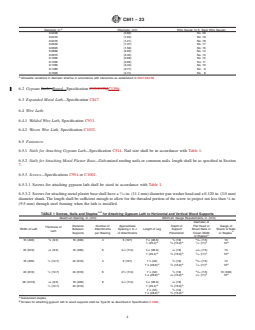
6.1.1 Tie Wire and Hanger Wire—Zinc-coated (galvanized) soft-annealed steel, or a material having equivalent size, corrosion
resistance and strength. Wire diameters (uncoated) specified herein correspond with United States steel wire gauge numbers as
follows:
C841 − 23
A
Diameter, in. (Diameter, mm) Wire Gauge (U.S. Steel Wire Gauge)
0.0348 (0.88) No. 20
0.0410 (1.04) No. 19
0.0475 (1.21) No. 18
0.0540 (1.37) No. 17
0.0625 (1.59) No. 16
0.0800 (2.03) No. 14
0.0915 (2.32) No. 13
0.1055 (2.68) No. 12
0.1205 (3.06) No. 11
0.1350 (3.43) No. 10
0.1483 (3.77) No. 9
0.1620 (4.11) No. 8
A
Allowable variations in diameter shall be in accordance with tolerances as established in A641/A641M.
6.2 Gypsum Lath—Board—Specification C37/C37MC1396.
6.3 Expanded Metal Lath—Specification C847.
6.4 Wire Lath:
6.4.1 Welded Wire Lath, Specification C933.
6.4.2 Woven Wire Lath, Specification C1032.
6.5 Fasteners:
6.5.1 Nails for Attaching Gypsum Lath—Specification C514. Nail size shall be in accordance with Table 1.
6.5.2 Nails for Attaching Metal Plaster Base—Galvanized roofing nails or common nails. length shall be as specified in Section
7.
6.5.3 Screws—Specifications C954 or C1002.
6.5.3.1 Screws for attaching gypsum lath shall be sized in accordance with Table 1.
6.5.3.2 Screws for attaching metal plaster base shall have a ⁄16 in. (11.1 mm) diameter pan washer head and a 0.120 in. (3.0 mm)
diameter shank. The length shall be sufficient enough to allow for the threaded portion of the screw to project not less than ⁄8 in.
(9.5 mm) through steel framing when the lath is installed.
A,B
TABLE 1 Screws, Nails and Staples for Attaching Gypsum Lath to Horizontal and Vertical Wood Supports
Maximum Spacing, in. (mm) Minimum Gauge Requirements, in. (mm)
Diameter of
Distance Number of Approximate Depth of Flat Head or Gauge of
Thickness of
Width of Lath Between Attachments Spacing c to c Length of Leg Support Blued Nails or Shank of Nails
Lath
A
Supports per Bearing of Attachments Penetration Crown Width or Staples
A
of Staples
3 1 3 19
16 (406) ⁄8 (9.5) 16 (406) 4 5 (127) 1 ⁄8 (28.6) ⁄4 (19) ⁄64 (7.5) 13
A A A A
5 7
1 (25.4) ⁄8 (15.9) ⁄16 (11) 16
3 1 1 3 19
24 (610) ⁄8 (9.5) 16 (406) 6 4 ⁄2 (114) 1 ⁄8 (28.6) ⁄4 (19) ⁄64 (7.5) 13
A A A A
5 7
1 (25.4) ⁄8 (15.9) ⁄16 (11) 16
1 1 3 19
16 (406) ⁄2 (12.7) 24 (610) 4 5 (127) 1 ⁄4 (32) ⁄4 (19) ⁄64 (7.5) 13
A A A A
1 5 7
1 ⁄8 (28.6) ⁄8 (15.9) ⁄16 (11) 16
1 1 1 3 19
24 (610) ⁄2 (12.7) 24 (610) 6 4 ⁄2 (114) 1 ⁄4 (32) ⁄4 (19) ⁄64 (7.5) 13 (330)
A A A A
1 5 7
1 ⁄8 (28.6) ⁄8 (15.9) ⁄16 (11) 16
3 1 1 3
48 (1219) ⁄8 (9.5) 16 (406) 8 4 ⁄2 (114) 1 ⁄8 (28.6) ⁄4 (19)
A A
1 5
⁄2 (12.7) 24 (610) 1 (25.4) ⁄8 (15.9)
1 3
1 ⁄4 (32) ⁄4 (19)
A A
1 5
1 ⁄8 (28.6) ⁄8 (15.9)
A
Galvanized staples.
B
Screws for attaching gypsum lath to wood supports shall be Type W as described in Specification C1002.
C841 − 23
6.5.4 Staples—Staples for attaching gypsum lath shall conform to the requirements of Table 1.
6.5.4.1 Staples for attaching metal plaster base shall be 0.062 in. (1.6 mm) diameter, round or flattened steel wire with ⁄4 in. (19.0
mm) crown. Lengths shall be as specified for individual systems.
6.6 Paper or Other Backing—When used on metal plaster bases, over solid backing, backing shall be securely held in place by,
or attached to the metal plaster base. Metal plaster base shall allow for ⁄4 in. (6.4 mm) self furring. The backing shall permit
embedment of plaster.
6.7 Accessories—Shall be steel, coated, with a protective rust inhibitive coating after fabrication, or fabricated from zinc-coated
(galvanized) steel, aluminum, zinc alloy, or high impact plastic. Plastic accessories shall be manufactured in accordance with
Specification D1784 or D3678. Aluminum accessories shall be clear plastic coated. All accessories shall have perforated or
expanded flanges or clips shaped so as to permit complete imbedment in the plaster, to provide means for secure alignment, and
to secure attachment of the accessory to the underlying surface. Accessories shall be designed for the intended use and to receive
or to permit application of the specified plaster thickness.
6.7.1 Thickness of base material for accessories shall be not less than as shown in the following:
Base Material (mm) Thickness of Base Material, in.
Uncoated steel/zinc 0.014 (0.36)
PVC 0.030 (0.76)
Aluminum 0.050 (1.27)
6.7.2 Control Joints—Shall be formed by using a single prefabricated member or fabricated by installing casing beads back to back
with a flexible barrier membrane behind casing beads. The separation spacing shall be not less than ⁄8 in. (3.2 mm) or as required
by the anticipated thermal exposure range.
2 2
6.7.3 Cornerite—shall be not less than 1.75 lb/yd (0.85 kg ⁄m ) expanded metal lath, galvanized, or given a protective coating of
rust inhibitive paint after fabrication, or woven or welded fabric not less than 0.041 in. (1.04 mm) thick an weighing not less than
2 2
1.75 lb/yd (0.85 kg/m ), fabricated from galvanized wire. When shaped for angle reinforcing, cornerite shall have outstanding legs
of not less than 2 in. (50.8 mm).
6.7.4 Channels—Shall be cold-rolled steel, free of rust with a coating of rust inhibitive paint or galvanized. Channels used in areas
subject to corrosive action of salt air or other corrosive environments, shall be hot-dip galvanized. Weight of the channel shall be
not less than as shown in the following:
Size Weight
in. (mm) lb/1000 lf (kg/m)
⁄4 (19) 277 (0.412)
1 ⁄2 (38) 414 (0.616)
2 (50) 506 (0.753)
2 ⁄2 (64) 597 (0.888)
6.7.5 Rod and flat (strap) hangers shall be mild steel, zinc coated or protected with a rust-inhibiting paint.
6.7.6 Clips—Devices for attaching framing members to supports or to each other; for attaching lath to framing members; or for
securing lath to lath, shall be formed of zinc-coated (galvanized) steel wire or sheet, and of sufficient size and strength to support
the intended load
2 2
6.7.7 Striplath—Shall be not less than 1.75 lb/yd (0.85 kg ⁄m ) expanded metal lath, or woven or welded fabric of not less than
2 2
0.041 in. (1.04 mm) thick weighing not less than 1.75 lb ⁄yd (0.85 kg/m ) fabricated from galvanized steel.
7. Installation
7.1 General Requirements for Application of Lath and Accessories:
7.1.1 Lath shall be installed with the long dimension at right angles to supports, unless otherwise specified.
7.1.2 Corner beads shall be installed to protect all external corners and to establish grounds. Corner beads shall be attached to the
substrate in such a manner as to ensure proper alignment during application of plaster.
C841 − 23
7.1.3 Metal accessories shall be installed so that flanges and clips provided for their attachment are covered by the base coat
plaster.
2 2
7.1.4 Control Joints—Shall be installed in ceilings greater than 2500 ft (232 m ) in area and in partition, wall, and wall furring
runs greater than 30 ft (9 m) in length. The distance between ceiling control joints shall not be more than 50 ft (15 m) in either
direction. A control joint shall be installed where the ceiling framing or furring changes direction. The distance between control
joints in walls or wall furring shall be not more than 30 ft (9 m). A control joint shall be installed where an expansion joint occurs
in the base exterior wall or ceiling. A ceiling height door frame, installed in accordance with the spacing requirements set forth
in this section, is not prohibited from being used as a control joint.
7.1.5 Where partition assemblies require the installation of control joints over the head of door frames to relieve stresses within
the assemblies, such control joints shall be installed in the following manner:
7.1.5.1 Where control joints are located at the vertical center of the door opening two metal studs shall be installed not more than
⁄2 in. (12.7 mm) apart over the center of the span at the head of the frame, with the lath installed so that a vertical joint occurs
between the studs. A prefabricated control joint or casing beads shall be installed at the joint location.
7.1.5.2 Where control joints are located in line with the door jambs the procedure in 7.1.5.1 shall be followed with the exception
that supporting members shall consist of two studs placed side-by-side.
7.1.6 Casing beads or other suitable accessories, shall be used to isolate non-load bearing partitions from load bearing members.
7.1.7 Workmanship—Metal construction furring and lathing shall be erected so that finished plaster surfaces will be true to line,
level, plumb, square, curved, or as required to receive specified plaster thickness.
7.1.8 Except where frames are required to be fully grouted with plaster, lath shall be inserted into jambs as far as possible and
notched to pass anchors.
7.2 Application of Gypsum Lath to Supports:
7.2.1 General—Gypsum lath shall be installed so that vertical joints occur not less than one full stud space from edges of openings
in walls or partitions.
7.2.2 Gypsum lath shall be installed with the face side out and the edges and ends butted together. End joints shall fall on different
supports in alternate courses, or the lath shall be installed so that end joints are continuous on one support. In the latter case, the
continuous end joints shall be covered with 3-in. (76-mm)(76 mm) wide strips of metal lath or welded or woven wire fabric, and
the long edge joints of lath in alternate courses shall be offset or staggered.
7.2.3 Cornerite shall be installed on gypsum lath at all internal angles, and lightly nailed or stapled to the gypsum lath and not
to the framing members. Cornerite shall not be used in unrestrained construction, or where other provisions are made for the
treatment of internal angles.
7.2.4 Where gypsum lath sheets intersect or where joint surfaces are to be plastered without lathing (such as masonry), a casing
bead shall be installed at the intersection or joining.
7.2.5 Gypsum lath shall be reinforced at the corners of doors, windows, or other openings with diagonally installed strips of
striplath or wire lath, not less than 6 in. (152 mm) wide by 12 in. (305 mm) long.
7.2.6 Metal lath stripping shall be used to cover chases and similar breaks in continuity or horizontal or vertical surfaces that are
to receive plaster. Stripping shall be extended not less than 3 in. (76 mm) on all sides of the openings.
7.3 Application of Gypsum Lath to Wood Supports:
7.3.1 Except where required otherwise, for certain fire-resistant construction, gypsum lath shall be securely attached to wood
supports using nails, screws, or staples conforming to Table 1.
7.3.2 Nails and screws shall be driven so that the face of the head is flush with the face of the gypsum lath, and not less than ⁄8
C841 − 23
in. (9.5 mm) from the edges of the lath. Staples shall be driven with the crown parallel to the nailing members. The crown shall
bear lightly against, but not cut into, the face of the lath.
7.4 Application of Gypsum Lath to Metal Supports:
7.4.1 Gypsum lath shall be attached to horizontal or vertical metal supports with staples, screws, or nails, or a combination thereof.
7.4.2 Screws shall be driven so that the face of the head is flush with the face of the gypsum lath and not less than ⁄8 in. (9.5 mm)
from the edges of the lath.
7.5 Studless Solid Partitions (Gypsum Lath and Plaster):
7.5.1 Gypsum lath shall be plain, ⁄2 in. (12.7 mm) thick, 24 in. (610 mm) wide, and, when applied vertically, shall be not more
than 12 ft (3.7 m) in length.
7.5.2 Wood floor runners shall be secured to the floor using anchors spaced not more than 24 in. (610 mm) on center. Anchors
shall penetrate floor surface to a depth of not less than ⁄8 in. (15.9 mm). The width of such runners shall correspond to the overall
partition thickness and their upper surface shall be grooved parallel to the length of the runner in the center to a depth of not less
than ⁄2 in. (12.7 mm) and to a width to accommodate snugly the thickness of the lath.
7.5.3 Metal floor runnersshall runners shall be anchored to bases and clips at not more than 24 in. (610 mm) on center. Runners
shall be designed to hold the lower edge of the lath securely in position.
7.5.4 Metal ceiling runners shall be aligned with floor runners to ensure plumb installation of the lath. Metal ceiling runners shall
be firmly secured to the ceiling construction.
7.5.5 Gypsum lath shall be of such length as to allow not less than ⁄4 in. (6.4 mm) nor more than 1-in. (25.4-mm)(25.4 mm) top
clearance in the ceiling runner. Erect gypsum lath vertically so as to engage the ends in or to the floor and ceiling runners.
7.5.6 the vertical edges of the lath shall be aligned with the vertical joints interlocked or mechanically fastened with type G screws
spaced not more than 12 in. (305 mm) on centers.
7.6 Application of Metal Plaster Bases to Framing Members:
7.6.1 General—The spacing of supports for the type and weight of metal lath used shall be in accordance with the requirements
of Table 2.
7.6.2 Attachments for Metal Plaster Bases to Wood Framing Members:
7.6.2.1 Diamond mesh expanded metal lath, flat rib expanded metal lath, and welded wire lath shall be attached to horizontal wood
1 7
supports with 1 ⁄2 in. (38 mm), 0.1205 in. (3.06 mm) shank, ⁄16 in. (11 mm) diameter head, barbed, galvanized, or blued roofing
nails driven flush with the lath. The metal lath shall be attached to vertical wood supports with 6d common nails, or 1-in.
(25-mm)(25 mm) long roofing nails driven driven in accordance with Table 1 or 1-in. No. 14 gauge wire staples driven flush with
the lath.
7.6.2.2 ⁄8-in. (9.5-mm)(9.5 mm) rib expanded metal lath shall be attached to horizontal and vertical wood supports with nails or
3 3
staples not less than ⁄8 in. (9.5 mm) longer than required (7.6.2.1) to provide not less than ⁄8-in. (9.5-mm)(9.5 mm) longer than
required (see 7.6.2.1) to provide penetration in accordance with Table 1.
7.6.2.3 When used on vertical wood supports, common nails shall be bent over to engage not less than three strands of lath. When
used for the application of rib lath, common nails shall be bent over to engage not less than one rib of the lath.
7.6.2.4 Other methods of attachment shalll be used when it can be shown they provide a carrying strength not less than that
described in 7.6.2.1 through 7.6.2.3 may be used.
7.6.3 Attachments for Metal Plaster Bases to Metal Framing Members:
C841 − 23
TABLE 2 Types and Weights of Expanded Metal Lath, Sheet Lath, or Welded Wire Lath and Corresponding Maximum Permissible
A
Spacing of Supports
Maximum Permissible Spacing of Supports Center for Center, in. (mm)
Minimum
Type of Metal Weight of Walls (Partitions) Ceilings
Plastering Base Metal Base, lb/yd
Steel Studs,
Wood Studs Solid Partitions Wood or Concrete Metal
(kg/m )
Wall Furring, etc.
Expanded metal lath:
Diamond mesh 2.5 (0.08) 16 (406) 16 (406) 16 (406) 12 (305) 12 (305)
3.4 (0.12) 16 (406) 16 (406) 16 (4
...