

ASTM C754-20
(Specification)Standard Specification for Installation of Steel Framing Members to Receive Screw-Attached Gypsum Panel Products
General Information
- Abstract
ABSTRACT
This specification covers the minimum requirements for the installation of interior nonstructural steel framing and furring members designed to receive screw-attached gypsum panel products. Details of construction for a specific assembly to achieve the required fire resistance shall be obtained from reports of fire-resistance tests, engineering evaluations, or listings from recognized fire testing laboratories. Each element of the assembly, that is, the studs, runners, rigid furring channels, tie wires, hanger wires, grid suspension systems (consisting of the main beam, cross furring members, and rod and flat hangers) shall be manufactured in the specified dimensions. Specified installation procedures for the metal framing, which includes the runners, studs, chase wall partitions, rigid furring channels, wall furring-bracket systems, and soffits, are detailed thoroughly. Installation requirements for the suspended and furred ceilings, including the main runners, flat hangers and inserts, wood constructions, furring members, rigid furring channels, and grid suspension systems, are discussed methodically as well.
SCOPE
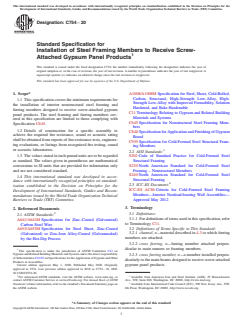
1.1 This specification covers the minimum requirements for the installation of interior nonstructural steel framing and furring members designed to receive screw-attached gypsum panel products. The steel framing and furring members covered in this specification are limited to those complying with Specification C645.
1.2 Details of construction for a specific assembly to achieve the required fire resistance, sound or acoustic rating shall be obtained from reports of fire-resistance tests, engineering evaluations, or listings from recognized fire testing, sound or acoustic laboratories.
1.3 The values stated in inch-pound units are to be regarded as standard. The values given in parentheses are mathematical conversions to SI units that are provided for information only and are not considered standard.
1.4 This international standard was developed in accordance with internationally recognized principles on standardization established in the Decision on Principles for the Development of International Standards, Guides and Recommendations issued by the World Trade Organization Technical Barriers to Trade (TBT) Committee.
- Status
- Published
- Publication Date
- 30-Apr-2020
- Technical Committee
- C11 - Gypsum and Related Building Materials and Systems
Buy Documents
ASTM C754-20 - Standard Specification for Installation of Steel Framing Members to Receive Screw-Attached Gypsum Panel Products
REDLINE ASTM C754-20 - Standard Specification for Installation of Steel Framing Members to Receive Screw-Attached Gypsum Panel Products
Overview
ASTM C754-20: Standard Specification for Installation of Steel Framing Members to Receive Screw-Attached Gypsum Panel Products establishes the minimum requirements for installing interior nonstructural steel framing and furring members. These components are specifically designed to support screw-attached gypsum panel products in a range of building interiors. Developed by ASTM International, this standard supports practices aligned with internationally recognized principles and is widely referenced in the construction industry for projects requiring nonstructural metal framing solutions.
This standard applies only to the installation of steel framing members compliant with ASTM C645 and provides comprehensive guidelines to ensure structural integrity, alignment, and the appropriate support for various gypsum panel products. It also references necessary standards for material characteristics and fire resistance requirements, supporting effective and safe construction practices.
Key Topics
- Scope of Application
- Covers nonstructural steel studs, runners, furring channels, tie wires, hanger wires, and suspension systems intended for gypsum board installation.
- Limits coverage to steel members that comply with ASTM C645.
- Installation Requirements
- Specifies proper alignment, anchoring, fastener types, and spacing for runners, studs, and furring members.
- Details requirements for suspended and furred ceilings, soffits, and chase wall partitions.
- Fire Resistance and Acoustic Performance
- Notes that fire resistance and sound/acoustic ratings must be confirmed using test reports, engineering evaluations, or listings from recognized laboratories.
- Dimensional and Material Specifications
- Outlines minimum dimensions, yield strengths, coatings for corrosion protection, and other requirements for steel members, channels, and wire accessories.
- Referenced Documents
- Includes related ASTM, AISI, and ICC standards for steel materials, installation practices, and construction terminology.
Applications
ASTM C754-20 is essential for construction professionals working on interior partition systems, particularly where durability, dimensional consistency, and code compliance for non-load-bearing walls and ceilings are required. Primary uses include:
- Commercial and Institutional Interiors
- Ensuring correct installation of framing for gypsum wallboard in office buildings, schools, healthcare facilities, and retail spaces.
- Residential Developments
- Application in multi-family housing and residential complexes requiring fire-rated and acoustically controlled interior partitions.
- Renovation Projects
- Providing specifications for retrofitting existing structures with steel-framed gypsum panel assemblies.
- Code Compliance
- Meeting requirements for fire resistance, sound rating, and installation as mandated by building codes or project specifications.
By adhering to ASTM C754-20, contractors and installers can achieve uniformity and reliability in metal stud and track framing installations, supporting the longevity and safety of wall and ceiling systems.
Related Standards
The implementation of ASTM C754-20 is often accompanied by compliance with multiple related standards, ensuring holistic quality and compatibility:
- ASTM C645 - Specification for Nonstructural Steel Framing Members
- ASTM C840 - Specification for Application and Finishing of Gypsum Board
- ASTM C11 - Terminology Relating to Gypsum and Related Building Materials and Systems
- AISI S220 - North American Standard for Cold-Formed Steel Framing - Nonstructural Members
- ICC-ES AC86 - Criteria for Cold-Formed Steel Framing Members-Interior Nonload-bearing Wall Assemblies
Together, these standards provide a comprehensive framework for the design, selection, installation, and performance validation of steel framing systems supporting screw-attached gypsum panel products.
Keywords: ASTM C754-20, steel framing installation, nonstructural steel framing, gypsum panel products, metal stud wall specification, suspended ceiling standards, fire resistance, acoustic rated partitions, drywall framing, ASTM standards for construction.
Relations
- Effective Date
- 01-May-2020
- Effective Date
- 01-Nov-2023
- Effective Date
- 01-Nov-2023
- Effective Date
- 01-Oct-2023
- Effective Date
- 01-Nov-2019
- Effective Date
- 01-Oct-2019
- Effective Date
- 01-Jun-2019
- Effective Date
- 15-Nov-2018
- Refers
ASTM C11-18a - Standard Terminology Relating to Gypsum and Related Building Materials and Systems - Effective Date
- 01-Oct-2018
- Effective Date
- 01-Oct-2018
- Effective Date
- 01-Sep-2018
- Effective Date
- 01-Jul-2018
- Effective Date
- 01-Jun-2018
- Effective Date
- 01-Jun-2018
- Effective Date
- 01-Jun-2018
Buy Documents
ASTM C754-20 - Standard Specification for Installation of Steel Framing Members to Receive Screw-Attached Gypsum Panel Products
REDLINE ASTM C754-20 - Standard Specification for Installation of Steel Framing Members to Receive Screw-Attached Gypsum Panel Products
Get Certified
Connect with accredited certification bodies for this standard

DIBt (Deutsches Institut für Bautechnik)
German Institute for Building Technology.
DIN CERTCO
DIN Group product certification.

Aboma Certification B.V.
Specialized in construction, metal, and transport sectors.
Sponsored listings
Frequently Asked Questions
ASTM C754-20 is a technical specification published by ASTM International. Its full title is "Standard Specification for Installation of Steel Framing Members to Receive Screw-Attached Gypsum Panel Products". This standard covers: ABSTRACT This specification covers the minimum requirements for the installation of interior nonstructural steel framing and furring members designed to receive screw-attached gypsum panel products. Details of construction for a specific assembly to achieve the required fire resistance shall be obtained from reports of fire-resistance tests, engineering evaluations, or listings from recognized fire testing laboratories. Each element of the assembly, that is, the studs, runners, rigid furring channels, tie wires, hanger wires, grid suspension systems (consisting of the main beam, cross furring members, and rod and flat hangers) shall be manufactured in the specified dimensions. Specified installation procedures for the metal framing, which includes the runners, studs, chase wall partitions, rigid furring channels, wall furring-bracket systems, and soffits, are detailed thoroughly. Installation requirements for the suspended and furred ceilings, including the main runners, flat hangers and inserts, wood constructions, furring members, rigid furring channels, and grid suspension systems, are discussed methodically as well. SCOPE 1.1 This specification covers the minimum requirements for the installation of interior nonstructural steel framing and furring members designed to receive screw-attached gypsum panel products. The steel framing and furring members covered in this specification are limited to those complying with Specification C645. 1.2 Details of construction for a specific assembly to achieve the required fire resistance, sound or acoustic rating shall be obtained from reports of fire-resistance tests, engineering evaluations, or listings from recognized fire testing, sound or acoustic laboratories. 1.3 The values stated in inch-pound units are to be regarded as standard. The values given in parentheses are mathematical conversions to SI units that are provided for information only and are not considered standard. 1.4 This international standard was developed in accordance with internationally recognized principles on standardization established in the Decision on Principles for the Development of International Standards, Guides and Recommendations issued by the World Trade Organization Technical Barriers to Trade (TBT) Committee.
ABSTRACT This specification covers the minimum requirements for the installation of interior nonstructural steel framing and furring members designed to receive screw-attached gypsum panel products. Details of construction for a specific assembly to achieve the required fire resistance shall be obtained from reports of fire-resistance tests, engineering evaluations, or listings from recognized fire testing laboratories. Each element of the assembly, that is, the studs, runners, rigid furring channels, tie wires, hanger wires, grid suspension systems (consisting of the main beam, cross furring members, and rod and flat hangers) shall be manufactured in the specified dimensions. Specified installation procedures for the metal framing, which includes the runners, studs, chase wall partitions, rigid furring channels, wall furring-bracket systems, and soffits, are detailed thoroughly. Installation requirements for the suspended and furred ceilings, including the main runners, flat hangers and inserts, wood constructions, furring members, rigid furring channels, and grid suspension systems, are discussed methodically as well. SCOPE 1.1 This specification covers the minimum requirements for the installation of interior nonstructural steel framing and furring members designed to receive screw-attached gypsum panel products. The steel framing and furring members covered in this specification are limited to those complying with Specification C645. 1.2 Details of construction for a specific assembly to achieve the required fire resistance, sound or acoustic rating shall be obtained from reports of fire-resistance tests, engineering evaluations, or listings from recognized fire testing, sound or acoustic laboratories. 1.3 The values stated in inch-pound units are to be regarded as standard. The values given in parentheses are mathematical conversions to SI units that are provided for information only and are not considered standard. 1.4 This international standard was developed in accordance with internationally recognized principles on standardization established in the Decision on Principles for the Development of International Standards, Guides and Recommendations issued by the World Trade Organization Technical Barriers to Trade (TBT) Committee.
ASTM C754-20 is classified under the following ICS (International Classification for Standards) categories: 91.060.10 - Walls. Partitions. Facades; 91.100.10 - Cement. Gypsum. Lime. Mortar. The ICS classification helps identify the subject area and facilitates finding related standards.
ASTM C754-20 has the following relationships with other standards: It is inter standard links to ASTM C754-18, ASTM A1008/A1008M-23, ASTM A1008/A1008M-23e1, ASTM C840-23, ASTM C840-19b, ASTM C840-19a, ASTM C840-19, ASTM C840-18b, ASTM C11-18a, ASTM C840-18a, ASTM A1008/A1008M-18, ASTM C840-18, ASTM C955-18, ASTM C645-18, ASTM C955-18e1. Understanding these relationships helps ensure you are using the most current and applicable version of the standard.
ASTM C754-20 is available in PDF format for immediate download after purchase. The document can be added to your cart and obtained through the secure checkout process. Digital delivery ensures instant access to the complete standard document.
Standards Content (Sample)
This international standard was developed in accordance with internationally recognized principles on standardization established in the Decision on Principles for the
Development of International Standards, Guides and Recommendations issued by the World Trade Organization Technical Barriers to Trade (TBT) Committee.
Designation:C754 −20
Standard Specification for
Installation of Steel Framing Members to Receive Screw-
Attached Gypsum Panel Products
This standard is issued under the fixed designation C754; the number immediately following the designation indicates the year of
original adoption or, in the case of revision, the year of last revision.Anumber in parentheses indicates the year of last reapproval.A
superscript epsilon (´) indicates an editorial change since the last revision or reapproval.
This standard has been approved for use by agencies of the U.S. Department of Defense.
1. Scope* A1008/A1008MSpecification for Steel, Sheet, Cold-Rolled,
Carbon, Structural, High-Strength Low-Alloy, High-
1.1 This specification covers the minimum requirements for
Strength Low-Alloy with Improved Formability, Solution
the installation of interior nonstructural steel framing and
Hardened, and Bake Hardenable
furring members designed to receive screw-attached gypsum
C11Terminology Relating to Gypsum and Related Building
panel products. The steel framing and furring members cov-
Materials and Systems
ered in this specification are limited to those complying with
C645Specification for Nonstructural Steel Framing Mem-
Specification C645.
bers
1.2 Details of construction for a specific assembly to
C840SpecificationforApplicationandFinishingofGypsum
achieve the required fire resistance, sound or acoustic rating
Board
shallbeobtainedfromreportsoffire-resistancetests,engineer-
C955Specification for Cold-Formed Steel Structural Fram-
ing evaluations, or listings from recognized fire testing, sound
ing Members
or acoustic laboratories. 3
2.2 AISI Standards:
1.3 The values stated in inch-pound units are to be regarded S202Code of Standard Practice for Cold-Formed Steel
as standard. The values given in parentheses are mathematical Structural Framing
conversions to SI units that are provided for information only S220 North American Standard for Cold-Formed Steel
and are not considered standard. Framing – Nonstructural Members
S240 North American Standard for Cold-Formed Steel
1.4 This international standard was developed in accor-
Structural Framing
dance with internationally recognized principles on standard-
2.3 ICC-ES Document:
ization established in the Decision on Principles for the
ICC-ES AC86Criteria for Cold-Formed Steel Framing
Development of International Standards, Guides and Recom-
Members—Interior Nonload-bearing Wall Assemblies—
mendations issued by the World Trade Organization Technical
Approved May 2012
Barriers to Trade (TBT) Committee.
3. Terminology
2. Referenced Documents
3.1 Definitions:
2.1 ASTM Standards:
3.1.1 Fordefinitionsoftermsusedinthisspecification,refer
A641/A641MSpecification for Zinc–Coated (Galvanized)
to Terminology C11.
Carbon Steel Wire
3.2 Definitions of Terms Specific to This Standard:
A653/A653MSpecification for Steel Sheet, Zinc-Coated
3.2.1 channel, n—material described in 4.3 to which furring
(Galvanized) or Zinc-Iron Alloy-Coated (Galvannealed)
members are attached.
by the Hot-Dip Process
3.2.2 cross furring, n—furring member attached perpen-
dicular to main runners or framing members.
This specification is under the jurisdiction of ASTM Committee C11 on
GypsumandRelatedBuildingMaterialsandSystemsandisthedirectresponsibility
3.2.3 cross furring member, n—a member installed perpen-
ofSubcommitteeC11.03onSpecificationsfortheApplicationofGypsumandOther
dicularlytothemainbeamsdesignedtoreceivescrew-attached
Products in Assemblies.
gypsum panel products.
Current edition approved May 1, 2020. Published May 2020. Originally
approved in 1974. Last previous edition approved in 2018 as C754–18. DOI:
10.1520/C0754-20.
2 3
For referenced ASTM standards, visit the ASTM website, www.astm.org, or Available from American Iron and Steel Institute (AISI), 25 Massachusetts
contact ASTM Customer Service at service@astm.org. For Annual Book of ASTM Ave., NW, Suite 800, Washington, DC 20001, http://www.steel.org.
Standards volume information, refer to the standard’s Document Summary page on Available from International Code Council (ICC), 500 New Jersey Ave., NW,
the ASTM website. 6th Floor, Washington, DC 20001, http://www.iccsafe.org.
*A Summary of Changes section appears at the end of this standard
Copyright © ASTM International, 100 Barr Harbor Drive, PO Box C700, West Conshohocken, PA 19428-2959. United States
C754−20
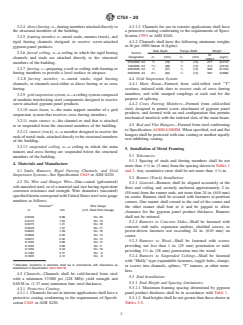
3.2.4 direct furring, n—furringmembersattacheddirectlyto 4.3.1.2 Channels for use in exterior applications shall have
the structural members of the building. a protective coating conforming to the requirements of Speci-
fication C955 or AISI S240.
3.2.5 framing member, n—metal studs, runners (track), and
4.3.2 Channels shall have the following minimum weights
rigid furring channels designed to receive screw-attached
in lb per 1000 linear ft (kg/m):
gypsum panel products.
Web Depth Flange Width Weight
3.2.6 furred ceiling, n—a ceiling in which the rigid furring Section
lb/
Designation in. (mm) in. (mm) (kg/m)
channels and studs are attached directly to the structural
1000 ft
3 1
075U050 -54 ⁄4 (19) ⁄2 (13) 277 (0.412)
members of the building.
1 1
150U050 -54 1 ⁄2 (38) ⁄2 (13) 414 (0.616)
3.2.7 furring, v—preparingawallorceilingwithframingor 1
200U050 -54 2 (51) ⁄2 (13) 506 (0.753)
1 1
250U050 -54 2 ⁄2 (64) ⁄2 (13) 597 (0.888)
furring members to provide a level surface or airspace.
4.4 Grid Suspension System:
3.2.8 furring member, n—metal studs, rigid furring
channels, or channels used either as direct furring or as cross
4.4.1 Main Beam—Formed from cold-rolled steel “T”
furring. sections, indexed with slots to receive ends of cross furring
members, and with stamped couplings at each end for the
3.2.9 grid suspension system, n—aceilingsystemcomposed
purpose of splicing.
of modular interlocking steel components designed to receive
4.4.2 Cross Furring Members—Formed from cold-rolled
screw-attached gypsum panel products.
steel, designed to permit screw attachment of gypsum panel
3.2.10 main beam, n—the main support member of a grid
products, and formed with an end configuration that permits
suspension system that receives cross furring members.
mechanical interlock with the indexed slots of the main beam.
3.2.11 main runner, n—the channel or stud that is attached
4.5 Rod and Flat Hangers—Formed from steel conforming
to or suspended from the structural members of the building.
to Specification A1008/A1008M. When specified, rod and flat
3.2.12 runner (track), n—a member designed to receive the
hangers shall be protected with zinc coating or another equally
endsofmetalstuds,attacheddirectlytothestructuralmembers
rust-inhibiting coating.
of the building.
3.2.13 suspended ceiling, n—a ceiling in which the main
5. Installation of Metal Framing
runners and cross furring are suspended below the structural
5.1 Tolerances:
members of the building.
5.1.1 Spacing of studs and furring members shall be not
4. Materials and Manufacture
more than 6 ⁄8 in. (3 mm) from the spacing shown in Tables 1
4.1 Studs, Runners, Rigid Furring Channels, and Grid
and 2. Any cumulative error shall be not more than 6 ⁄8 in.
Suspension Systems—See Specification C645 or AISI S220.
5.2 Runner (Track) Installation:
4.2 Tie Wire and Hanger Wire—Zinc-coated (galvanized)
5.2.1 General—Runners shall be aligned accurately at the
soft-annealed steel, or of a material and size having equivalent
floor and ceiling and securely anchored approximately 2 in.
corrosion resistance and strength. Wire diameters (uncoated)
(50mm) from the runner ends, not more than 24 in. (610 mm)
specifiedhereincorrespondwithUnitedStatessteelwiregauge
on center. Runners shall be secured with fasteners at partition
numbers as follows:
corners. One runner shall extend to the end of the corner and
A
Diameter Wire Gauge
the other runner shall butt to it and be gapped to allow
in. mm (U.S. Steel Wire Gauge)
clearance for the gypsum panel product thickness. Runners
shall not be mitered.
0.0348 0.88 No. 20
0.0410 1.04 No. 19
5.2.2 Runners to Concrete Slabs—Shall be fastened with
0.0475 1.21 No. 18
concrete stub nails, expansion anchors, shielded screws, or
0.0540 1.37 No. 17
0.0625 1.59 No. 16 power-driven fasteners not exceeding 24 in. (610 mm) on
0.0800 2.03 No. 14
center.
0.0915 2.32 No. 13
5.2.3 Runners to Wood—Shall be fastened with screws
0.1055 2.68 No. 12
0.1205 3.06 No. 11
providing not less than 1 in. (25 mm) penetration or nails
0.1350 3.43 No. 10
providing 1 ⁄2 in. (38 mm) penetration into the wood.
0.1483 3.77 No. 9
0.1620 4.12 No. 8 5.2.4 Runners to Suspended Ceilings—Shall be fastened
with “Molly”-type expandable fasteners, toggle bolts, clamps,
A
Allowable variations in diameter shall be in accordance with tolerances as
or screws into channels, splines, “T” runners, or other mem-
established in Specification A641/A641M.
bers.
4.3 Channels—Channels shall be cold-formed from steel
5.3 Stud Installation:
with a minimum 33000 psi (228 MPa) yield strength and
5.3.1 Stud Height and Spacing Limitations:
0.0538 in. (1.37 mm) minimum bare steel thickness.
5.3.1.1 Maximum framing spacing determined by gypsum
4.3.1 Protective Coating:
panel product thickness shall be in accordance with Table 1.
4.3.1.1 Channelsforuseininteriorapplicationsshallhavea
protective coating conforming to the requirements of Specifi- 5.3.1.2 Studheightsshallbenotgreaterthanthoseshownin
cation C645 or AISI S220. Tables 3-5.
C754−20
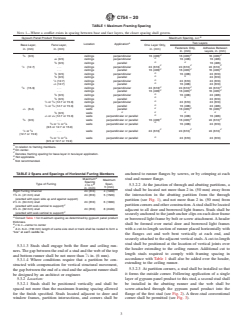
TABLE 1 Maximum Framing Spacing
NOTE 1—Where a conflict exists in spacing between base and face layers, the closer spacing shall govern.
B
Gypsum Panel Product Thickness Maximum Spacing, o.c.
Two Layers
A
Location Application
Base Layer, Face Layer, One Layer Only,
Fasteners Only, Adhesive Between
in. (mm) in. (mm) in. (mm)
in. (mm) Layers, in. (mm)
C C C
⁄8 (9.5) . . . ceilings perpendicular 16 (406) 16 (406) 16 (406)
D
⁄8 (9.5) ceilings perpendicular 16 (406) 16 (406)
DE
⁄8 (9.5) ceilings parallel 16 (406)
C C C
⁄2 (12.7) . . . ceilings perpendicular 24 (610) 24 (610) 24 (610)
C C C
. . . ceilings parallel 16 (406) 16 (406) 16 (406)
D
⁄8 (9.5) ceilings perpendicular 16 (406) 24 (610)
DE
⁄8 (9.5) ceilings parallel 24 (610)
1 D
⁄2 (12.7) ceilings perpendicular 24 (610) 24 (610)
D
⁄2 (12.7) ceilings parallel 16 (406) 24 (610)
C C C
⁄8 (15.9) . . . ceilings perpendicular 24 (610) 24 (610) 24 (610)
C C C
. . . ceilings parallel 16 (406) 16 (406) 16 (406)
D
⁄8 (9.5) ceilings perpendicular 16 (406) 24 (406)
DE
⁄8 (9.5) ceilings parallel 24 (610)
D
1 5
⁄2 or ⁄8 (12.7 or 15.9) ceilings perpendicular 24 (610) 24 (610)
1 5 D
⁄2 or ⁄8 (12.7 or 15.9) ceilings parallel 16 (406) 24 (406)
E C C
⁄4 (6.4) . . . walls parallel 16 (406) 16 (406)
EE E E
⁄8 (9.5) walls
D
1 5
⁄2 or ⁄8 (12.7 or 15.9) walls perpendicular or parallel 16 (406) 16 (406)
C C C
⁄8 (9.5) . . . walls perpendicular or parallel 16 (406) 16 (406) 24 (610)
D
3 1 5
⁄8 or ⁄2 or ⁄8 walls perpendicular or parallel 16 (406) 24 (610)
(9.5 or 12.7 or 15.9)
C C C
1 5
⁄2 or ⁄8 . . . walls perpendicular or parallel 24 (610) 24 (610) 24 (610)
(12.7 or 15.9)
D
3 1 5
⁄8 or ⁄2 or ⁄8 walls perpendicular or parallel 24 (610) 24 (610)
(9.5 or 12.7 or 15.9)
A
In relation to framing members.
B
On center.
C
Denotes framing spacing for base layer in two-layer application.
D
Not applicable.
E
Not recommended.
TABLE 2 Spans and Spacings of Horizontal Furring Members
anchored to runner flanges by screws, or by crimping at each
A
Maximum stud and runner flange.
Maximum
Spacing
Type of Furring Span,
B
ctoc, 5.3.2.2 At the junction of through and abutting partitions, a
ft (mm)
in. (mm)
stud shall be located not more than 2 in. (50 mm) away from
Rigid Furring Channel 24 (610) 4 (1220)
1 ⁄8 in. (41 mm) stud 24 (610) 5 (1520) the intersection in the abutting partition from the through
(erected with open side up and against support)
partition (see Fig. 1), and not more than 2 in. (50 mm) from
2 ⁄2 in. (64 mm) stud 24 (610) 6 (1830)
C partitioncornersandotherconstruction.Astudshallbelocated
(erected with web vertical to support)
3 ⁄8 in. (92 mm) stud 24 (610) 8 (2440)
adjacent to all door and borrowed light frames. Studs shall be
C
(erected with web vertical to support)
securely anchored to the jamb anchor clips on each door frame
A
Consult Table 1 for maximum spacing as determined by gypsum panel product
or borrowed light frame by bolt or screw attachment.Aheader
thickness.
B shall be formed over metal door and borrowed light frames
c to c—center to center
C
A in. 6-in. (150 mm) length of same size stud or track shall be nested to form a
with a cut-to-length section of runner placed horizontally with
“box” at each saddle tie.
the flanges cut and web bent vertically at each end, and
securely attached to the adjacent vertical studs.Acut-to-length
stud shall be positioned at the location of vertical joints over
5.3.1.3 Studs shall engage both the floor and ceiling run-
the header extending to the ceiling runner. Additional cut to
ners.The gap between the end of a stud and the web of the top
length studs required to comply with framing spacing in
and bottom runner shall be not more than ⁄4 in. (6 mm).
accordance with Table 1 shall also be added over the header,
5.3.1.4 Where conditions require that a partition be con-
extending to the ceiling runner.
structed with compensation for vertical structural movement,
5.3.2.3 At partition corners, a stud shall be installed so that
the gap between the end of a stud and the adjacent runner shall
it forms the outside corner. Following application of a single
be designed by an architect or engineer.
layer of gypsum panel product to this stud, a second stud shall
5.3.2 Location:
be installed in the abutting runner and the web shall be
5.3.2.1 Studs shall be positioned vertically and shall be
screw-attached through the gypsum panel product into the
spaced not more than the maximum framing spacing allowed
for the finish specified. Studs located adjacent to door and flange of the first stud (see Fig. 2). A three-stud conventional
window frames, partition intersections, and corners shall be corner shall be permitted (see Fig. 3).
C754−20
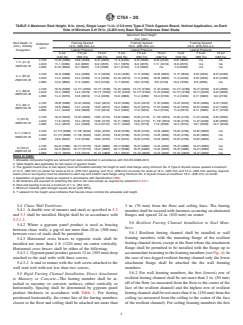
TABLE 3 Maximum Stud Height, ft-in. (mm), Single Layer ⁄8-in. (15.9mm) Type-X Thick Gypsum Board, Vertical Application, on Each
Side of Minimum 0.0179-in. (0.455mm) Base Steel Thickness Steel Studs
Maximum Stud Height
ft-in. (mm)
Stud Depth, in. Framing Spaced Framing Spaced Framing Spaced
Deflection
(mm), Industry 12 in. (305 mm) o.c. 16 in. (406 mm) o.c. 24 in. (610 mm) o.c.
Limit
Designator Lateral Pressure Lateral Pressure Lateral Pressure
5 psf 7.5 psf 10 psf 5 psf 7.5 psf 10 psf 5 psf 7.5 psf 10 psf
(240 Pa) (360 Pa) (480 Pa) (240 Pa) (360 Pa) (480 Pa) (240 Pa) (360 Pa) (480 Pa)
L/120 13-0f (3960) 10-8 (3250) 9-3f (2820) 11-3 (3430) 9-3f (2820) 8-0f (2440) 9-3f (2820) n/a n/a
1- ⁄8 (41.3)
L/240 11-1 (3380) 9-8 (2950) 8-9 (2670) 10-1 (3070) 8-9 (2670) 7-11 (2410) 8-9 (2670) n/a n/a
162S125-18
L/360 9-10 (3000) 8-7 (2620) 7-9 (2360) 8-11 (2720) 7-9 (2360) n/a 7-9 (2360) n/a n/a
L/120 16-4f (4980) 13-4 (4060) 11-7f (3530) 14-2f (4320) 11-7f (3530) 10-0f (3050) 11-7f (3530) 9-5f (2870) 8-2f (2490)
2- ⁄2 (63.5)
L/240 14-2 (4320) 12-4 (3760) 11-3 (3430) 12-10 (3910) 11-3 (2430) 10-0f (3050) 11-3 (3430) 9-5f (2870) 8-2f (2490)
250S125-18
L/360 12-9 (3890) 11-2 (3400) 10-2 (3100) 11-7 (3530) 10-2 (3100) 9-0 (2740) 10-2 (3100) 8-6 (2590) n/a
L/120 18-3f (5560) 14-11f (4550) 12-11f (3180) 15-10 (4820) 12-11f (3180) 11-2f (3400) 12-11f (3180) 10-7f (3230) 9-2f (2800)
3- ⁄2 (88.9)
L/240 16-4 (4980) 14-4 (4370) 12-11f (3180) 14-10 (4520) 12-11f (3180) 11-2f (3400) 12-11f (3180) 10-7f (3230) 9-2f (2800)
350S125-18
L/360 14-4 (4370) 12-6 (3810) 11-4 (3450) 13-0 (3960) 11-4 (3450) 10-3 (3120) 11-4 (3450) 9-11 (3020) 9-0 (2740)
L/120 18-8f (5690) 15-3f (4650) 13-2f (4010) 16-2f (4930) 13-2f (4010) 11-5f (3480) 13-2f (4010) 10-9f (3280) 9-4f (1930)
3- ⁄8 (92.1)
L/240 16-8 (5080) 14-7 (4440) 13-2f (4010) 15-2 (3960) 13-2f (4010) 11-5f (3480) 13-2f (4010) 10-9f (3280) 9-4f (1930)
362S125-18
L/360 14-7 (4440) 12-9 (3890) 11-6 (3510) 13-3 (4040) 11-6 (3510) 10-4 (3150) 11-6 (3510) 9-11 (3020) 8-11 (2720)
L/120 19-3f (5870) 15-9f (4800) 13-8f (4170) 16-8f (5080) 13-8f (4170) 11-10f (3610) 13-8f (4170) 11-2f (3400) 9-8f (2950)
4 (101.6)
L/240 17-6 (4370) 15-4 (4670) 13-8f (4170) 15-11 (4850) 13-8f (4170) 11-10f (3610) 13-8f (4170) 11-2f (3400) 9-8f (2950)
400S125-18
L/360 15-4 (4670) 13-4 (4060) 12-2 (3710) 13-11 (4240) 12-2 (3710) 11-0 (3350) 12-2 (3710) 10-7 (3230) 10-7 (3230)
L/120 21-11f (6680) 17-10f (5430) 15-6f (4720) 19-0f (5790) 15-6f (4720) 13-5f (4090) 15-6f (4720) 12-8f (3860) n/a
5- ⁄2 (139.7)
L/240 21-11f (6680) 17-10f (5430) 15-6f (4720) 19-0f (5790) 15-6f (4720) 13-5f (4090) 15-6f (4720) 12-8f (3860) n/a
550S125-18
L/360 19-6 (5940) 17-0 (5180) 15-6f (4720) 17-9 (5410) 15-6f (4720) 13-5f (4090) 15-6f (4720) 12-8f (3860) n/a
L/120 23-2f (7060) 18-11f (5770) 16-4f (4980) 20-1f (6380) 16-4f (4980) 14-2f (4320) 16-4f (4980) 13-4f (4060) n/a
6 (152.4)
L/240 22-9 (6930) 18-11f (5770) 16-4f (4980) 20-1f (6380) 16-4f (4980) 14-2f (4320) 16-4f (4980) 13-4f (4060) n/a
600S125-18
L/360 19-11 (6070) 17-5 (5310) 15-10 (4820) 18-1 (5510) 15-10 (4820) 14-2f (4320) 15-10 (4820) 13-4f (4060) n/a
Notes to Table:
1. Allowable composite heights are derived from tests conducted in accordance with ICC-ES AC86-2012.
2. Table heights also applicable for two layers of gypsum board.
3. The gypsum board (one or two layers) must be installed vertically full height to each stud flange using minimum No. 6 Type-S drywall screws spaced a maximum
of 12 in. (305 mm) on-center for studs at 24 in. (610 mm) spacing, and 16 in. (406 mm) on-center for studs at 16 in. (406 mm) and 12 in. (305 mm) spacing. Gypsum
board (one or two layers) must be attached to each top and bottom track flange using minimum No. 6 drywall screws at maximum 16 in. (406 mm) on-center
4. Application of gypsum board as required in accordance with Specification C840.
5. No fasteners are required for attaching the stud to the track except as required by subsection 5.3.2.1.
6. Stud end bearing must be a minimum of 1 in. (254 mm).
7. Minimum material yield strength equals 33 ksi (230 MPa).
8. ‘f’ adjacent to the height value indicates that flexural stress controls the allowable wall height.
5.4 Chase Wall Partitions: 3 in. (76 mm) from the floor and ceiling lines. The furring
5.4.1 Adouble row of runners and studs as specified in 5.2 membershallbesecuredwithfastenersoccurringonalternated
and 5.3 shall be installed. Height shall be in accordance with flanges and spaced 24 in. (610 mm) on center.
5.3.1.2.
5.6 Resilient Furring Channel Installation to Steel Mem-
5.4.2 Where a gypsum panel product is used as bracing
bers:
between chase walls, a gap of not more than 20 in. (508 mm)
5.6.1 Resilient furring channel shall be installed to wall
between rows of studs shall be permitted.
framing members with the mounting flange of the resilient
5.4.3 Horizontal cross braces to opposite studs shall be
furring channel down, except at the floor where the attachment
installed not more than 4 ft (1220 mm) on center vertically.
flange shall be permitted to be installed with the flange up to
Horizontal cross braces shall be either of the following:
accommodatefasteningtotheframingmembers(seeFig.4).In
5.4.3.1 Gypsumpanelproductgussets12in.(305mm)deep
the case of two-legged resilient furring channel only the lower
attached to the stud webs with three screws.
5.4.3.2 Astud or runner with the web screw-attached to the attachment flange shall be attached the the wall framing
wall stud web with not less than two screws. members.
5.6.2 For wall framing members, the first (lowest) row of
5.5 Rigid Furring Channel Installation, Direct Attachment
resilient furring channel shall be not more than 2 in. (50 mm)
to Masonry or Concrete—The furring member shall be at-
off of the floor (as measured from the floor to the center of the
tached to masonry or concrete surfaces, either vertically or
face of the resilient channel) and the highest row of resilient
horizontally. Spacing shall be determined by gypsum panel
product thickness in accordance with Table 1. For furring furringchannelshallbenotmorethan6in.(150mm)fromthe
ceiling (as measured from the ceiling to the center of the face
positioned horizontally, the center line of the furring members
closest to the floor and ceiling shall be attached not more than of the resilient channel). For ceiling framing members the first
C754−20
TABLE 4 Maximum Stud Height, ft-in. (mm), Single Layer ⁄8-in. (15.9mm) Type-X Thick Gypsum Board, Vertical Application, on Each
Side of Minimum 0.0296-in. (0.750mm) Base Steel Thickness Steel Studs
Maximum Stud Height
ft-in. (mm)
Stud Depth, in. Framing Spaced Framing Spaced Framing Spaced
Deflection
(mm), Industry 12 in. (305 mm) o.c. 16 in. (406 mm) o.c. 24 in. (610 mm) o.c.
Limit
Designator Lateral Pressure Lateral Pressure Lateral Pressure
5 psf 7.5 psf 10 psf 5 psf 7.5 psf 10 psf 5 psf 7.5 psf 10 psf
(240 Pa) (360 Pa) (480 Pa) (240 Pa) (360 Pa) (480 Pa) (240 Pa) (360 Pa) (480 Pa)
L/120 14-11 (4550) 13-1 (3990) 11-10 (3610) 13-7 (4140) 11-10 (3610) 10-9 (3280) 11-10 (3610) 10-4 (3150) 9-4 (2840)
1- ⁄8 (41.3)
L/240 11-10 (3610) 10-4 (3150) 9-4 (2840) 10-9 (3280) 9-4 (1930) 8-3 (2510) 9-4 (2840) 7-11 (2410) n/a
162S125-30
L/360 10-4 (3150) 8-11 (2720) 7-11 (2410) 9-4 (1930) 7-11 (2410) n/a 7-11 (2410) n/a n/a
L/120 18-5 (5610) 16-1 (4900) 14-7 (4440) 16-9 (5100) 14-7 (4440) 13-3 (4040) 14-7 (4440) 12-9 (3890) 11-7 (3530)
2- ⁄2 (63.5)
L/240 15-10 (4820) 13-10 (4220) 12-7 (3840) 14-5 (4180) 12-7 (3840) 11-5 (3480) 12-7 (3840) 11-0 (3350) 10-0 (3050)
250S125-30
L/360 14-1 (4290) 12-4 (3760) 11-2 (3400) 12-10 (3910) 11-2 (3400) 10-2 (3100) 11-2 (3400) 9-9 (2970) 8-8 (2640)
L/120 22-6 (6860) 19-8 (6000) 17-11 (5460) 20-6 (6250) 17-11 (5460) 16-3 (4950) 17-11 (5460) 15-8 (4780) 13-9f (4190)
3- ⁄2 (88.9)
L/240 17-11 (5460) 15-8 (4780) 14-2 (4320) 16-3 (4950) 14-2 (4320) 12-11 (3940) 14-2 (4320) 12-4 (3760) 11-1 (3380)
350S125-30
L/360 15-8 (4780) 13-8 (4170) 12-4 (3760) 14-2 (4320) 12-4 (3760) 11-1 (3380) 12-4 (3760) 10-7 (3230) n/a
L/120 22-10 (6960) 19-11 (6070) 18-1 (5510) 20-8 (6300) 18-1 (5510) 16-5 (5000) 18-1 (5510) 15-9f (4800) 13-8f (4170)
3- ⁄8 (92.1)
L/240 18-3 (5560) 16-0 (4880) 14-6 (4420) 16-7 (5050) 14-6 (4420) 13-2 (4010) 14-6 (4420) 12-8 (3860) 11-4 (3450)
362S125-30
L/360 16-4 (4980) 14-3 (4340) 12-11 (3940) 14-10 (4520) 12-11 (3940) 11-6 (3510) 12-11 (3940) 10-11 (3330) n/a
L/120 24-6 (7470) 21-5 (6530) 19-5 (5920) 22-3 (6780) 19-5 (5920) 17-5f (5310) 19-5 (5920) 16-5f (5000) 14-2f (4320)
4 (101.6)
L/240 19-5 (5920) 17-0 (5180) 15-5 (4700) 17-8 (5390) 15-5 (4700) 14-0 (4270) 15-5 (4700) 13-6 (4110) 12-2 (3710)
400S125-30
L/360 17-0 (5180) 14-10 (4520) 13-6 (4110) 15-5 (4700) 13-6 (4110) 12-2 (3710) 13-6 (4110) 11-7 (3530) 10-4 (3150)
L/120 30-5 (9270) 27-0 (8230) 24-10 (7570) 28-0 (8530) 24-10f (7570) 21-7f (6580) 24-10 (7570) 20-4f (6200) 17-7f (5360)
5- ⁄2 (139.7)
L/240 24-10 (7570) 22-0 (6700) 20-2 (6150) 22-9 (6930) 20-2 (6150) 18-6 (5640) 20-2 (6150) 17-10 (5430) 16-2 (4930)
550S125-30
L/360 22-0 (6700) 19-5 (5920) 17-10 (5430) 20-2 (6150) 17-10 (5430) 16-2 (4930) 17-10 (5430) 15-7 (4750) n/a
L/120 34-2 (10420) 28-11f (8810) 25-0f (7620) 30-8f (9350) 25-0f (7620) 21-8f (6610) 25-0f (7620) 20-5f (6240) 17-8f (5390)
6 (152.4)
L/240 27-1 (8250) 23-8 (7210) 21-6 (6550) 24-7 (7490) 21-6 (6550) 19-6 (5940) 21-6 (6550) 18-9 (5720) 17-1 (5210)
600S125-30
L/360 23-8 (7210) 20-8 (6300) 18-9 (5720) 21-6 (6550) 18-9 (5720) 17-1 (5210) 18-9 (5720) 16-5 (5020) n/a
Notes to Table:
1. Allowable composite heights are derived from tests conducted in accordance with ICC-ES AC86-2012.
2. Table heights also applicable for two layers of gypsum board.
3. The gypsum board (one or two layers) must be installed vertically full height to each stud flange using minimum No. 6 Type-S drywall screws spaced a maximum
of 12 in. (305 mm) on-center for studs at 24 in. (610 mm) spacing, and 16 in. (406 mm) on-center for studs at 16 in. (406 mm) and 12 in. (305 mm) spacing. Gypsum
board (one or two layers) must be attached to each top and bottom track flange using minimum No. 6 drywall screws at maximum 16 in. (406 mm) on-center
4. Application of gypsum board as required in accordance with Specification C840.
5. No fasteners are required for attaching the stud to the track except as required by subsection 5.3.2.1.
6. Stud end bearing must be a minimum of 1 in. (254 mm).
7. Minimum material yield strength equals 33 ksi (230 MPa).
8. ‘f’ adjacent to the height value indicates that flexural stress controls the allowable wall height.
row and the last row of resilient furring channel shall be resilient furring channels to each other at the ends of each of
located not more than 6 in. (150 mm) from the adjacent wall. the nested resilient furring channels shall be installed.
5.6.3 The resilient furring channel shall be positioned with 5.6.5 Gypsum panel products shall be attached to the
the slotted hole(s) directly over the framing member (see Fig. resilient furring channel using screws and ensuring that the
4). The resilient furring channel shall be attached to the screw does not make contact with the framing member.
framing member with Type-S × ⁄8 in. (10 mm) pan head
5.7 Resilient Furring Channel Installation to Wood Mem-
framing screws using the screw hole provided in the mounting
bers:
flange.
5.7.1 Resilient furring channel shall be installed to wall
framing members with the mounting flange of the resilient
NOTE1—Ifnoscrewholeisprovidedorlocatedattheframingmember,
drill through the mounting flange to attach the resilient furring channel to
furring channel down, except at the floor where the mounting
the member.
flange shall be permitted to be installed with the flange up to
5.6.4 Resilient furring channel members shall be spliced accommodatefasteningtotheframingmembers(seeFig.4).In
either by “nesting” the ends of the resilient furring channel the case of two-legged resilient furring channel only the lower
members directly over the framing member and screwing mounting flange shall be attached to the wall framing mem-
through the mounting flange into the framing members or by bers.
butting the resilient furring channel members over the framing 5.7.2 For wall framing members, the first (lowest) row of
member and screwing through the mounting flange into the resilient furring channel shall be not more than 2 in. (50 mm)
studmembers.Agapofnotlessthan ⁄16in.(2mm)shallbeleft off of the floor (as measured from the floor to the center of the
between the members.When nesting the ends of the members, face of the resilient channel) and the last (highest) row of
an additional screw attaching the mounting flanges of the resilient furring channel shall be not more than 6 in (150 mm)
C754−20
TABLE 5 Maximum Stud Height, ft-in. (mm), Single Layer ⁄8-in. (15.9mm) Type-X Thick Gypsum Board, Vertical Application, on Each
Side of Minimum 0.0329-in. (0.836mm) Base Steel Thickness Steel Studs
Maximum Stud Height
ft-in. (mm)
Stud Depth, in. Framing Spaced Framing Spaced Framing Spaced
Deflection
(mm), Industry 12 in. (305 mm) o.c. 16 in. (406 mm) o.c. 24 in. (610 mm) o.c.
Limit
Designator Lateral Pressure Lateral Pressure Lateral Pressure
5 psf 7.5 psf 10 psf 5 psf 7.5 psf 10 psf 5 psf 7.5 psf 10 psf
(240 Pa) (360 Pa) (480 Pa) (240 Pa) (360 Pa) (480 Pa) (240 Pa) (360 Pa) (480 Pa)
L/120 19-8 (6000) 17-3 (5260) 15-8 (4780) 17-11 (5460) 15-8 (4780) 14-3 (4340) 15-8 (4780) 13-8 (4170) 12-4F (3760)
2- ⁄2 (63.5)
L/240 15-8 (4780) 13-8 (4170) 12-5 (3800) 14-3 (4340) 12-5 (3800) 11-3 (3430) 12-5 (3800) 10-10 (3300) 9-10 (3000)
250S125-33
L/360 13-8 (4170) 11-11 (3630) 10-10 (3300) 12-5 (3790) 10-10 (3300) 9-10 (3000) 10-10 (3300) 9-5 (2870) 8-4 (2540)
L/120 23-0 (7010) 20-1 (6120) 18-3 (5560) 20-11 (6380) 18-3 (5560) 16-7 (5050) 18-3 (5560) 15-11 (4850) 14-4f (4370)
3- ⁄2 (88.9)
L/240 18-3 (5560) 15-11 (4850) 14-6 (4420) 16-7 (5050) 14-6 (4420) 13-2 (4010) 14-6 (4420) 12-8 (3860) 11-4 (3450)
350S125-33
L/360 15-11 (4850) 13-11 (4240) 12-8 (3860) 14-6 (4420) 12-8 (3860) 11-4 (3450) 12-8 (3860) 10-10 (3300) 9-8 (2950)
L/120 24-2 (7370) 21-1 (6430) 19-2 (5840) 21-1 (6430) 19-2 (5840) 17-5 (5310) 19-2 (5840) 16-8f (5080) 14-5f (4180)
3- ⁄8 (92.1)
L/240 19-2 (5840) 16-9 (5100) 15-3 (4650) 17-5 (5310) 15-3 (4650) 13-10 (4220) 15-3 (4650) 13-4 (4060) 11-11 (3630)
362S125-33
L/360 16-9 (5100) 14-8 (4470) 13-4 (4060) 15-3 (4650) 13-4 (4060) 11-11 (3630) 13-4 (4060) 11-4 (3450) 10-1 (3070)
L/120 25-3 (7700) 22-1 (6730) 20-1 (6120) 22-11 (6990) 20-1 (6120) 18-3 (5560) 20-1 (6120) 17-3f (5260) 15-0f (4570)
4 (101.6)
L/240 20-1 (6120) 17-6 (5330) 15-11 (4850) 18-3 (5560) 15-11 (4850) 14-5 (4400) 15-11 (4850) 13-11 (4240) 12-7 (3840)
400S125-33
L/360 17-6 (5330) 15-4 (4670) 13-11 (4240) 15-11 (4850) 13-11 (4240) 12-7 (3840) 13-11 (4240) 12-0 (3660) 10-9 (3280)
L/120 35-4 (10770) 30-10 (9400) 27-10f (8480) 32-1f (9780) 27-10f (8480) 24-1f (7340) 27-10f (8480) 22-9f (6930) 19-8f (6000)
6 (152.4)
L/240 28-1 (8560) 24-6 (7470) 22-3 (6780) 25-6 (7770) 22-3 (6780) 20-3 (6170) 22-3 (6780) 19-5 (5920) 17-8 (5390)
600S125-33
L/360 24-6 (7470) 21-5 (6530) 19-5 (5920) 22-3 (6780) 19-5 (5920) 17-8 (5390) 19-5 (5920) 16-11 (5160) n/a
Notes to Table:
1. Allowable composite heights are derived from tests conducted in accordance with ICC-ES AC86-2012.
2. Table heights also applicable for two layers of gypsum board.
3. The gypsum board (one or two layers) must be installed vertically full height to each stud flange using minimum No. 6 Type-S drywall screws spa
...
This document is not an ASTM standard and is intended only to provide the user of an ASTM standard an indication of what changes have been made to the previous version. Because
it may not be technically possible to adequately depict all changes accurately, ASTM recommends that users consult prior editions as appropriate. In all cases only the current version
of the standard as published by ASTM is to be considered the official document.
Designation: C754 − 18 C754 − 20
Standard Specification for
Installation of Steel Framing Members to Receive Screw-
Attached Gypsum Panel Products
This standard is issued under the fixed designation C754; the number immediately following the designation indicates the year of
original adoption or, in the case of revision, the year of last revision. A number in parentheses indicates the year of last reapproval. A
superscript epsilon (´) indicates an editorial change since the last revision or reapproval.
This standard has been approved for use by agencies of the U.S. Department of Defense.
1. Scope*
1.1 This specification covers the minimum requirements for the installation of interior nonstructural steel framing and furring
members designed to receive screw-attached gypsum panel products. The steel framing and furring members covered in this
specification are limited to those complying with Specification C645.
1.2 Details of construction for a specific assembly to achieve the required fire resistance, sound or acoustic rating shall be
obtained from reports of fire-resistance tests, engineering evaluations, or listings from recognized fire testing, sound or acoustic
laboratories.
1.3 The values stated in inch-pound units are to be regarded as standard. The values given in parentheses are mathematical
conversions to SI units that are provided for information only and are not considered standard.
1.4 This international standard was developed in accordance with internationally recognized principles on standardization
established in the Decision on Principles for the Development of International Standards, Guides and Recommendations issued
by the World Trade Organization Technical Barriers to Trade (TBT) Committee.
2. Referenced Documents
2.1 ASTM Standards:
A641/A641M Specification for Zinc–Coated (Galvanized) Carbon Steel Wire
A653/A653M Specification for Steel Sheet, Zinc-Coated (Galvanized) or Zinc-Iron Alloy-Coated (Galvannealed) by the
Hot-Dip Process
A1008/A1008M Specification for Steel, Sheet, Cold-Rolled, Carbon, Structural, High-Strength Low-Alloy, High-Strength
Low-Alloy with Improved Formability, Solution Hardened, and Bake Hardenable
C11 Terminology Relating to Gypsum and Related Building Materials and Systems
C645 Specification for Nonstructural Steel Framing Members
C840 Specification for Application and Finishing of Gypsum Board
C955 Specification for Cold-Formed Steel Structural Framing Members
2.2 AISI Standard:Standards:
AISI COSPS202 Code of Standard Practice for Cold-Formed Steel Structural Framing - 2006 Edition
S220 North American Standard for Cold-Formed Steel Framing – Nonstructural Members
S240 North American Standard for Cold-Formed Steel Structural Framing
2.3 ICC-ES DocumentDocument:
ICC-ES AC86 Criteria for Cold-Formed Steel Framing Members—Interior Nonload-bearing Wall Assemblies—Approved May
This specification is under the jurisdiction of ASTM Committee C11 on Gypsum and Related Building Materials and Systems and is the direct responsibility of
Subcommittee C11.03 on Specifications for the Application of Gypsum and Other Products in Assemblies.
Current edition approved April 1, 2018May 1, 2020. Published April 2018May 2020. Originally approved in 1974. Last previous edition approved in 20172018 as
C754 – 17.C754 – 18. DOI: 10.1520/C0754-18.10.1520/C0754-20.
For referenced ASTM standards, visit the ASTM website, www.astm.org, or contact ASTM Customer Service at service@astm.org. For Annual Book of ASTM Standards
volume information, refer to the standard’s Document Summary page on the ASTM website.
Available from American Iron and Steel Institute (AISI), 1140 Connecticut25 Massachusetts Ave., NW, Suite 705,800, Washington, DC 20036,20001, http://
www.steel.org.
Available from ICC Evaluation Services, Inc., 5360 Workman Mill Road, Whittier, CA 90601, www.icc-es.org.International Code Council (ICC), 500 New Jersey Ave.,
NW, 6th Floor, Washington, DC 20001, http://www.iccsafe.org.
*A Summary of Changes section appears at the end of this standard
Copyright © ASTM International, 100 Barr Harbor Drive, PO Box C700, West Conshohocken, PA 19428-2959. United States
C754 − 20
3. Terminology
3.1 Definitions—Terms shall be as defined in Terminology C11.
3.1 Definitions:
3.1.1 For definitions of terms used in this specification, refer to Terminology C11.
3.2 Definitions of Terms Specific to This Standard:
3.2.1 channel, n—the material described in 4.3 to which furring members are attached.
3.2.2 cross furring, n—furring member attached perpendicular to main runners or framing members.
3.2.3 cross furring member, n—a member installed perpendicularly to the main beams designed to receive screw-attached
gypsum panel products.
3.2.4 direct furring, n—furring members attached directly to the structural members of the building.
3.2.5 framing member, n—metal studs, runners (track), and rigid furring channels designed to receive screw-attached gypsum
panel products.
3.2.6 furred ceiling, n—a ceiling in which the rigid furring channels and studs are attached directly to the structural members
of the building.
3.2.7 furring, v—preparing a wall or ceiling with framing or furring members to provide a level surface or airspace.
3.2.8 furring member, n—metal studs, rigid furring channels, or channels used either as direct furring or as cross furring.
3.2.9 grid suspension system, n—a ceiling system composed of modular interlocking steel components designed to receive
screw-attached gypsum panel products.
3.2.10 main beam, n—the main support member of a grid suspension system that receives cross furring members.
3.2.11 main runner, n—the channel or stud that is attached to or suspended from the structural members of the building.
3.2.12 runner (track), n—a member designed to receive the ends of metal studs, attached directly to the structural members of
the building.
3.2.13 suspended ceiling, n—a ceiling in which the main runners and cross furring are suspended below the structural members
of the building.
4. Materials and Manufacture
4.1 Studs, Runners, Rigid Furring Channels, and Grid Suspension Systems—See Specification C645. or AISI S220.
4.2 Tie Wire and Hanger Wire—Zinc-coated (galvanized) soft-annealed steel, or of a material and size having equivalent
corrosion resistance and strength. Wire diameters (uncoated) specified herein correspond with United States steel wire gauge
numbers as follows:
A
Diameter Wire Gauge
in. mm (U.S. Steel Wire Gauge)
0.0348 0.88 No. 20
0.0410 1.04 No. 19
0.0475 1.21 No. 18
0.0540 1.37 No. 17
0.0625 1.59 No. 16
0.0800 2.03 No. 14
0.0915 2.32 No. 13
0.1055 2.68 No. 12
0.1205 3.06 No. 11
0.1350 3.43 No. 10
0.1483 3.77 No. 9
0.1620 4.12 No. 8
A
Allowable variations in diameter shall be in accordance with tolerances as established in Specification A641/A641M.
4.3 Channels—Channels shall be cold-formed from steel with a minimum 33 000 psi (228 MPa) yield strength and 0.0538 in.
(1.37 mm) minimum bare steel thickness.
4.3.1 Protective Coating:
4.3.1.1 Channels for use in interior applications shall have a protective coating conforming to the requirements of Specification
C645. or AISI S220.
4.3.1.2 Channels for use in exterior applications shall have a protective coating conforming to the requirements of Specification
C955. or AISI S240.
4.3.2 Channels shall have the following minimum weights in lb per 1000 linear ft (kg/m):
Section Web Depth Flange Width Weight
Designation in. (mm) in. (mm) lb/1000 ft (kg/m)
3 1
075U050 -54 ⁄4 (19) ⁄2 (13) 277 (0.412)
C754 − 20
1 1
150U050 -54 1 ⁄2 (38) ⁄2 (13) 414 (0.616)
200U050 -54 2 (51) ⁄2 (13) 506 (0.753)
1 1
250U050 -54 2 ⁄2 (64) ⁄2 (13) 597 (0.888)
4.4 Grid Suspension System:
4.4.1 Main Beam—Formed from cold-rolled steel “T” sections, indexed with slots to receive ends of cross furring members, and
with stamped couplings at each end for the purpose of splicing.
4.4.2 Cross Furring Members—Formed from cold-rolled steel, designed to permit screw attachment of gypsum panel products,
and formed with an end configuration that permits mechanical interlock with the indexed slots of the main beam.
4.5 Rod and Flat Hangers—Formed from steel conforming to Specification A1008/A1008M. When specified, rod and flat
hangers shall be protected with zinc coating or another equally rust-inhibiting coating.
5. Installation of Metal Framing
5.1 Tolerances:
5.1.1 Spacing of studs and furring members shall be not more than 6 ⁄8 in. (3 mm) from the spacing shown in Tables 1 and
2. Any cumulative error shall be not more than 6 ⁄8 in.
5.2 Runner (Track) Installation:
5.2.1 General—Runners shall be aligned accurately at the floor and ceiling and securely anchored approximately 2 in. (50 mm)
from the runner ends, not more than 24 in. (610 mm) on center. Runners shall be secured with fasteners at partition corners. One
runner shall extend to the end of the corner and the other runner shall butt to it and be gapped to allow clearance for the gypsum
panel product thickness. Runners shall not be mitered.
5.2.2 Runners to Concrete Slabs—Shall be fastened with concrete stub nails, expansion anchors, shielded screws, or
power-driven fasteners not exceeding 24 in. (610 mm) on center.
5.2.3 Runners to Wood—Shall be fastened with screws providing not less than 1 in. (25 mm) penetration or nails providing 1 ⁄2
in. (38 mm) penetration into the wood.
5.2.4 Runners to Suspended Ceilings—Shall be fastened with “Molly”-type expandable fasteners, toggle bolts, clamps, or
screws into channels, splines, “T” runners, or other members.
5.3 Stud Installation:
5.3.1 Stud Height and Spacing Limitations:
5.3.1.1 Maximum framing spacing determined by gypsum panel product thickness shall be in accordance with Table 1.
5.3.1.2 Stud heights shall be not greater than those shown in Tables 3-5.
5.3.1.3 Studs shall engage both the floor and ceiling runners. The gap between the end of a stud and the web of the top and
bottom runner shall be not more than ⁄4 in. (6 mm).
5.3.1.4 Where conditions require that a partition be constructed with compensation for vertical structural movement, the gap
between the end of a stud and the adjacent runner shall be designed by an architect or engineer.
5.3.2 Location:
5.3.2.1 Studs shall be positioned vertically and shall be spaced not more than the maximum framing spacing allowed for the
finish specified. Studs located adjacent to door and window frames, partition intersections, and corners shall be anchored to runner
flanges by screws, or by crimping at each stud and runner flange.
5.3.2.2 At the junction of through and abutting partitions, a stud shall be located not more than 2 in. (50 mm) away from the
intersection in the abutting partition from the through partition (see Fig. 1), and not more than 2 in. (50 mm) from partition corners
and other construction. A stud shall be located adjacent to all door and borrowed light frames. Studs shall be securely anchored
to the jamb anchor clips on each door frame or borrowed light frame by bolt or screw attachment. A header shall be formed over
metal door and borrowed light frames with a cut-to-length section of runner placed horizontally with the flanges cut and web bent
vertically at each end, and securely attached to the adjacent vertical studs. A cut-to-length stud shall be positioned at the location
of vertical joints over the header extending to the ceiling runner. Additional cut to length studs required to comply with framing
spacing in accordance with Table 1 shall also be added over the header, extending to the ceiling runner.
5.3.2.3 At partition corners, a stud shall be installed so that it forms the outside corner. Following application of a single layer
of gypsum panel product to this stud, a second stud shall be installed in the abutting runner and the web shall be screw-attached
through the gypsum panel product into the flange of the first stud (see Fig. 2). A three-stud conventional corner shall be permitted
(see Fig. 3).
C754 − 20
TABLE 1 Maximum Framing Spacing
NOTE 1—Where a conflict exists in spacing between base and face layers, the closer spacing shall govern.
Gypsum Panel Product Thickness Maximum Spacing, oc
Two Layers
Location Application
Base Layer, Face Layer, One Layer Only,
Fasteners Only, Adhesive Between
in. (mm) in. (mm) in. (mm)
in. (mm) Layers, in. (mm)
A A A
⁄8 (9.5) . . . ceilings perpendicular 16 (406) 16 (406) 16 (406)
⁄8 (9.5) ceilings perpendicular NA 16 (406) 16 (406)
⁄8 (9.5) ceilings parallel NA NR 16 (406)
A A A
⁄2 (12.7) . . . ceilings perpendicular 24 (610) 24 (610) 24 (610)
A A A
. . . ceilings parallel 16 (406) 16 (406) 16 (406)
⁄8 (9.5) ceilings perpendicular NA 16 (406) 24 (610)
⁄8 (9.5) ceilings parallel NA NR 24 (610)
⁄2 (12.7) ceilings perpendicular NA 24 (610) 24 (610)
⁄2 (12.7) ceilings parallel NA 16 (406) 24 (610)
A A A
⁄8 (15.9) . . . ceilings perpendicular 24 (610) 24 (610) 24 (610)
A A A
. . . ceilings parallel 16 (406) 16 (406) 16 (406)
⁄8 (9.5) ceilings perpendicular NA 16 (406) 24 (406)
⁄8 (9.5) ceilings parallel NA NR 24 (610)
1 5
⁄2 or ⁄8 (12.7 or 15.9) ceilings perpendicular NA 24 (610) 24 (610)
1 5
⁄2 or ⁄8 (12.7 or 15.9) ceilings parallel NA 16 (406) 24 (406)
A A
⁄4 (6.4) . . . walls parallel NR 16 (406) 16 (406)
⁄8 (9.5) walls NR NR NR NR
1 5
⁄2 or ⁄8 (12.7 or 15.9) walls perpendicular or parallel NA 16 (406) 16 (406)
A A A
⁄8 (9.5) . . . walls perpendicular or parallel 16 (406) 16 (406) 24 (610)
3 1 5
⁄8 or ⁄2 or ⁄8 walls perpendicular or parallel NA 16 (406) 24 (610)
(9.5 or 12.7 or 15.9)
A A A
1 5
⁄2 or ⁄8 . . . walls perpendicular or parallel 24 (610) 24 (610) 24 (610)
(12.7 or 15.9)
3 1 5
⁄8 or ⁄2 or ⁄8 walls perpendicular or parallel NA 24 (610) 24 (610)
(9.5 or 12.7 or 15.9)
Perpendicular—perpendicular to framing members
Parallel—parallel to framing members
NA—not applicable
NR—not recommended
oc—on center
TABLE 1 Maximum Framing Spacing
NOTE 1—Where a conflict exists in spacing between base and face layers, the closer spacing shall govern.
B
Gypsum Panel Product Thickness Maximum Spacing, o.c.
Two Layers
A
Location Application
Base Layer, Face Layer, One Layer Only,
Fasteners Only, Adhesive Between
in. (mm) in. (mm) in. (mm)
in. (mm) Layers, in. (mm)
C C C
⁄8 (9.5) . . . ceilings perpendicular 16 (406) 16 (406) 16 (406)
D
⁄8 (9.5) ceilings perpendicular 16 (406) 16 (406)
D E
⁄8 (9.5) ceilings parallel 16 (406)
C C C
⁄2 (12.7) . . . ceilings perpendicular 24 (610) 24 (610) 24 (610)
C C C
. . . ceilings parallel 16 (406) 16 (406) 16 (406)
D
⁄8 (9.5) ceilings perpendicular 16 (406) 24 (610)
D E
⁄8 (9.5) ceilings parallel 24 (610)
1 D
⁄2 (12.7) ceilings perpendicular 24 (610) 24 (610)
D
⁄2 (12.7) ceilings parallel 16 (406) 24 (610)
C C C
⁄8 (15.9) . . . ceilings perpendicular 24 (610) 24 (610) 24 (610)
C C C
. . . ceilings parallel 16 (406) 16 (406) 16 (406)
D
⁄8 (9.5) ceilings perpendicular 16 (406) 24 (406)
D E
⁄8 (9.5) ceilings parallel 24 (610)
D
1 5
⁄2 or ⁄8 (12.7 or 15.9) ceilings perpendicular 24 (610) 24 (610)
D
1 5
⁄2 or ⁄8 (12.7 or 15.9) ceilings parallel 16 (406) 24 (406)
E C C
⁄4 (6.4) . . . walls parallel 16 (406) 16 (406)
3 E E E E
⁄8 (9.5) walls
D
1 5
⁄2 or ⁄8 (12.7 or 15.9) walls perpendicular or parallel 16 (406) 16 (406)
C C C
⁄8 (9.5) . . . walls perpendicular or parallel 16 (406) 16 (406) 24 (610)
D
3 1 5
⁄8 or ⁄2 or ⁄8 walls perpendicular or parallel 16 (406) 24 (610)
(9.5 or 12.7 or 15.9)
C C C
1 5
⁄2 or ⁄8 . . . walls perpendicular or parallel 24 (610) 24 (610) 24 (610)
(12.7 or 15.9)
D
3 1 5
⁄8 or ⁄2 or ⁄8 walls perpendicular or parallel 24 (610) 24 (610)
(9.5 or 12.7 or 15.9)
A
In relation to framing members.
B
On center.
C
Denotes framing spacing for base layer in two-layer application.
D
Not applicable.
C754 − 20
E
Not recommended.
TABLE 2 Spans and Spacings of Horizontal Furring Members
A
Maximum
Maximum
Spacing
Type of Furring B Span,
c to c,
ft (mm)
in. (mm)
Rigid Furring Channel 24 (610) 4 (1220)
1 ⁄8 in. (41 mm) stud 24 (610) 5 (1520)
(erected with open side up and against support)
2 ⁄2 in. (64 mm) stud 24 (610) 6 (1830)
C
(erected with web vertical to support)
3 ⁄8 in. (92 mm) stud 24 (610) 8 (2440)
C
(erected with web vertical to support)
A
Consult Table 1 for maximum spacing as determined by gypsum panel product
thickness.
B
c to c—center to center
C
A in. 6-in. (150-mm)(150 mm) length of same size stud or track shall be nested
to form a “box” at each saddle tie.
5.4 Chase Wall Partitions:
5.4.1 A double row of runners and studs as specified in 5.2 and 5.3 shall be installed. Height shall be in accordance with 5.3.1.2.
5.4.2 Where a gypsum panel product is used as bracing between chase walls, a gap of not more than 20 in. (508 mm) between
rows of studs shall be permitted.
5.4.3 Horizontal cross braces to opposite studs shall be installed not more than 4 ft (1220 mm) on center vertically. Horizontal
cross braces shall be either of the following:
5.4.3.1 Gypsum panel product gussets 12 in. (305 mm) deep attached to the stud webs with three screws.
5.4.3.2 A stud or runner with the web screw-attached to the wall stud web with not less than two screws.
5.5 Rigid Furring Channel Installation, Direct Attachment to Masonry or Concrete—The furring member shall be attached to
masonry or concrete surfaces, either vertically or horizontally. Spacing shall be determined by gypsum panel product thickness in
accordance with Table 1. For furring positioned horizontally, the center line of the furring members closest to the floor and ceiling
shall be attached not more than 3 in. (76 mm) from the floor and ceiling lines. The furring member shall be secured with fasteners
occurring on alternated flanges and spaced 24 in. (610 mm) on center.
5.6 Resilient Furring Channel Installation to Steel Members:
5.6.1 Resilient furring channel shall be installed to wall framing members with the mounting flange of the resilient furring
channel down, except at the floor where the attachment flange shall be permitted to be installed with the flange up to accommodate
fastening to the framing members (see Fig. 4). In the case of two-legged resilient furring channel only the lower attachment flange
shall be attached the the wall framing members.
5.6.2 For wall framing members, the first (lowest) row of resilient furring channel shall be not more than 2 in. (50 mm) off of
the floor (as measured from the floor to the center of the face of the resilient channel) and the highest row of resilient furring
channel shall be not more than 6 in. (150 mm) from the ceiling (as measured from the ceiling to the center of the face of the resilient
channel). For ceiling framing members the first row and the last row of resilient furring channel shall be located not more than
6 in. (150 mm) from the adjacent wall.
5.6.3 The resilient furring channel shall be positioned with the slotted hole(s) directly over the framing member (see Fig. 4).
The resilient furring channel shall be attached to the framing member with Type-S × ⁄8 in. (10 mm) pan head framing screws using
the screw hole provided in the mounting flange.
NOTE 1—If no screw hole is provided or located at the framing member, drill through the mounting flange to attach the resilient furring channel to
the member.
5.6.4 Resilient furring channel members shall be spliced either by “nesting” the ends of the resilient furring channel members
directly over the framing member and screwing through the mounting flange into the framing members or by butting the resilient
furring channel members over the framing member and screwing through the mounting flange into the stud members. A gap of
not less than ⁄16 in. (2 mm) shall be left between the members. When nesting the ends of the members, an additional screw
attaching the mounting flanges of the resilient furring channels to each other at the ends of each of the nested resilient furring
channels shall be installed.
5.6.5 Gypsum panel products shall be attached to the resilient furring channel using screws and ensuring that the screw does
not make contact with the framing member.
5.7 Resilient Furring Channel Installation to Wood Members:
5.7.1 Resilient furring channel shall be installed to wall framing members with the mounting flange of the resilient furring
channel down, except at the floor where the mounting flange shall be permitted to be installed with the flange up to accommodate
C754 − 20
TABLE 3 Maximum Stud Height, ft-in. (mm), Single Layer ⁄8-in. (15.9-mm) Type X (15.9 mm) Type-X Thick Gypsum Board, Vertical
Application, on Each Side of Minimum 0.0179-in. (0.455-mm)(0.455 mm) Base Steel Thickness Steel Studs
Maximum Stud Height
ft-in. (mm)
Framing Spaced Framing Spaced Framing Spaced
Stud Depth, in.
Deflection
(mm), Industry 12 in. (305 mm) o.c. 16 in. (406 mm) o.c. 24 in. (610 mm) o.c.
Limit
Designator
Lateral Pressure Lateral Pressure Lateral Pressure
5 psf 7.5 psf 10 psf 5 psf 7.5 psf 10 psf 5 psf 7.5 psf 10 psf
(240 Pa) (360 Pa) (480 Pa) (240 Pa) (360 Pa) (480 Pa) (240 Pa) (360 Pa) (480 Pa)
L/120 13-0f (3960) 10-8 (3250) 9-3f (2820) 11-3 (3430) 9-3f (2820) 8-0f (2440) 9-3f (2820) n/a n/a
1- ⁄8 (41.3)
L/240 11-1 (3380) 9-8 (2950) 8-9 (2670) 10-1 (3070) 8-9 (2670) 7-11 (2410) 8-9 (2670) n/a n/a
162S125-18
L/360 9-10 (3000) 8-7 (2620) 7-9 (2360) 8-11 (2720) 7-9 (2360) n/a 7-9 (2360) n/a n/a
L/120 16-4f (4980) 13-4 (4060) 11-7f (3530) 14-2f (4320) 11-7f (3530) 10-0f (3050) 11-7f (3530) 9-5f (2870) 8-2f (2490)
2- ⁄2 (63.5)
L/240 14-2 (4320) 12-4 (3760) 11-3 (3430) 12-10 (3910) 11-3 (2430) 10-0f (3050) 11-3 (3430) 9-5f (2870) 8-2f (2490)
250S125-18
L/360 12-9 (3890) 11-2 (3400) 10-2 (3100) 11-7 (3530) 10-2 (3100) 9-0 (2740) 10-2 (3100) 8-6 (2590) n/a
L/120 18-3f (5560) 14-11f (4550) 12-11f (3180) 15-10 (4820) 12-11f (3180) 11-2f (3400) 12-11f (3180) 10-7f (3230) 9-2f (2800)
3- ⁄2 (88.9)
L/240 16-4 (4980) 14-4 (4370) 12-11f (3180) 14-10 (4520) 12-11f (3180) 11-2f (3400) 12-11f (3180) 10-7f (3230) 9-2f (2800)
350S125-18
L/360 14-4 (4370) 12-6 (3810) 11-4 (3450) 13-0 (3960) 11-4 (3450) 10-3 (3120) 11-4 (3450) 9-11 (3020) 9-0 (2740)
L/120 18-8f (5690) 15-3f (4650) 13-2f (4010) 16-2f (4930) 13-2f (4010) 11-5f (3480) 13-2f (4010) 10-9f (3280) 9-4f (1930)
3- ⁄8 (92.1)
L/240 16-8 (5080) 14-7 (4440) 13-2f (4010) 15-2 (3960) 13-2f (4010) 11-5f (3480) 13-2f (4010) 10-9f (3280) 9-4f (1930)
362S125-18
L/360 14-7 (4440) 12-9 (3890) 11-6 (3510) 13-3 (4040) 11-6 (3510) 10-4 (3150) 11-6 (3510) 9-11 (3020) 8-11 (2720)
L/120 19-3f (5870) 15-9f (4800) 13-8f (4170) 16-8f (5080) 13-8f (4170) 11-10f (3610) 13-8f (4170) 11-2f (3400) 9-8f (2950)
4 (101.6)
L/240 17-6 (4370) 15-4 (4670) 13-8f (4170) 15-11 (4850) 13-8f (4170) 11-10f (3610) 13-8f (4170) 11-2f (3400) 9-8f (2950)
400S125-18
L/360 15-4 (4670) 13-4 (4060) 12-2 (3710) 13-11 (4240) 12-2 (3710) 11-0 (3350) 12-2 (3710) 10-7 (3230) 10-7 (3230)
L/120 21-11f (6680) 17-10f (5430) 15-6f (4720) 19-0f (5790) 15-6f (4720) 13-5f (4090) 15-6f (4720) 12-8f (3860) n/a
5- ⁄2 (139.7)
L/240 21-11f (6680) 17-10f (5430) 15-6f (4720) 19-0f (5790) 15-6f (4720) 13-5f (4090) 15-6f (4720) 12-8f (3860) n/a
550S125-18
L/360 19-6 (5940) 17-0 (5180) 15-6f (4720) 17-9 (5410) 15-6f (4720) 13-5f (4090) 15-6f (4720) 12-8f (3860) n/a
L/120 23-2f (7060) 18-11f (5770) 16-4f (4980) 20-1f (6380) 16-4f (4980) 14-2f (4320) 16-4f (4980) 13-4f (4060) n/a
6 (152.4)
L/240 22-9 (6930) 18-11f (5770) 16-4f (4980) 20-1f (6380) 16-4f (4980) 14-2f (4320) 16-4f (4980) 13-4f (4060) n/a
600S125-18
L/360 19-11 (6070) 17-5 (5310) 15-10 (4820) 18-1 (5510) 15-10 (4820) 14-2f (4320) 15-10 (4820) 13-4f (4060) n/a
Notes to Table:
1. Allowable composite heights are derived from tests conducted in accordance with ICC-ES AC86-2012.
2. Table heights also applicable for two layers of gypsum board.
3. The gypsum board (one or two layers) must be installed vertically full height to each stud flange using minimum No. 6 Type S drywall screws spaced a maximum
of 12 in. (305 mm) on-center for studs at 24 in. (610 mm) spacing, and 16 in. (406 mm) on-center for studs at 16 in. (406 mm) and 12 in. (305 mm) spacing. Gypsum
board (one or two layers) must be attached to each top and bottom track flange using minimum No. 6 drywall screws at maximum 16 in. (406 mm) on-center
3. The gypsum board (one or two layers) must be installed vertically full height to each stud flange using minimum No. 6 Type-S drywall screws spaced a maximum
of 12 in. (305 mm) on-center for studs at 24 in. (610 mm) spacing, and 16 in. (406 mm) on-center for studs at 16 in. (406 mm) and 12 in. (305 mm) spacing. Gypsum
board (one or two layers) must be attached to each top and bottom track flange using minimum No. 6 drywall screws at maximum 16 in. (406 mm) on-center
4. Application of gypsum board as required in accordance with Specification C840.
5. No fasteners are required for attaching the stud to the track except as required by subsection 5.3.2.1.
6. Stud end bearing must be a minimum of 1 in. (254 mm).
7. Minimum material yield strength equals 33 ksi (230 MPa).
8. ‘f’ adjacent to the height value indicates that flexural stress controls the allowable wall height.
fastening to the framing members (see Fig. 4). In the case of two-legged resilient furring channel only the lower mounting flange
shall be attached to the wall framing members.
5.7.2 For wall framing members, the first (lowest) row of resilient furring channel shall be not more than 2 in. (50 mm) off of
the floor (as measured from the floor to the center of the face of the resilient channel) and the last (highest) row of resilient furring
channel shall be not more than 6 in (150 mm) from the ceiling (as measured from the ceiling to the center of the face of the resilient
channel). For ceiling framing members the first row and the last row of resilient furring channel shall be located not more than
6 in. (150 mm) from the adjacent wall.
5.7.3 The resilient furring channel shall be positioned with the slotted hole(s) directly over the framing member (see Fig. 4).
The resilient furring channel shall be attached to the framing member with Type-W or Type-S screws (minimum 1 ⁄4 (32 mm) long)
using the screw hole provided in the mounting flange.
NOTE 2—If no screw hole is provided or located at the framing member, drill through the mounting flange to attach the resilient furring channel to
the member.
5.7.4 Resilient furring channel members shall be spliced either by “nesting” the ends of the resilient furring channel members
directly over the framing member and screwing through the mounting flange into the framing members or by butting the resilient
furring channel members over the framing member and screwing through the mounting flange into the stud members. A gap of
not less than ⁄16 in. (2 mm) shall be left between the members. When nesting the ends of the members, an additional screw
attaching the mounting flanges of the resilient furring channels to each other at the ends of the nested resilient furring channels
shall be installed.
C754 − 20
TABLE 4 Maximum Stud Height, ft-in. (mm), Single Layer ⁄8-in. (15.9-mm) Type X (15.9 mm) Type-X Thick Gypsum Board, Vertical
Application, on Each Side of Minimum 0.0296-in. (0.750-mm)(0.750 mm) Base Steel Thickness Steel Studs
Maximum Stud Height
ft-in. (mm)
Framing Spaced Framing Spaced Framing Spaced
Stud Depth, in.
Deflection
(mm), Industry 12 in. (305 mm) o.c. 16 in. (406 mm) o.c. 24 in. (610 mm) o.c.
Limit
Designator
Lateral Pressure Lateral Pressure Lateral Pressure
5 psf 7.5 psf 10 psf 5 psf 7.5 psf 10 psf 5 psf 7.5 psf 10 psf
(240 Pa) (360 Pa) (480 Pa) (240 Pa) (360 Pa) (480 Pa) (240 Pa) (360 Pa) (480 Pa)
L/120 14-11 (4550) 13-1 (3990) 11-10 (3610) 13-7 (4140) 11-10 (3610) 10-9 (3280) 11-10 (3610) 10-4 (3150) 9-4 (2840)
1- ⁄8 (41.3)
L/240 11-10 (3610) 10-4 (3150) 9-4 (2840) 10-9 (3280) 9-4 (1930) 8-3 (2510) 9-4 (2840) 7-11 (2410) n/a
162S125-30
L/360 10-4 (3150) 8-11 (2720) 7-11 (2410) 9-4 (1930) 7-11 (2410) n/a 7-11 (2410) n/a n/a
L/120 18-5 (5610) 16-1 (4900) 14-7 (4440) 16-9 (5100) 14-7 (4440) 13-3 (4040) 14-7 (4440) 12-9 (3890) 11-7 (3530)
2- ⁄2 (63.5)
L/240 15-10 (4820) 13-10 (4220) 12-7 (3840) 14-5 (4180) 12-7 (3840) 11-5 (3480) 12-7 (3840) 11-0 (3350) 10-0 (3050)
250S125-30
L/360 14-1 (4290) 12-4 (3760) 11-2 (3400) 12-10 (3910) 11-2 (3400) 10-2 (3100) 11-2 (3400) 9-9 (2970) 8-8 (2640)
L/120 22-6 (6860) 19-8 (6000) 17-11 (5460) 20-6 (6250) 17-11 (5460) 16-3 (4950) 17-11 (5460) 15-8 (4780) 13-9f (4190)
3- ⁄2 (88.9)
L/240 17-11 (5460) 15-8 (4780) 14-2 (4320) 16-3 (4950) 14-2 (4320) 12-11 (3940) 14-2 (4320) 12-4 (3760) 11-1 (3380)
350S125-30
L/360 15-8 (4780) 13-8 (4170) 12-4 (3760) 14-2 (4320) 12-4 (3760) 11-1 (3380) 12-4 (3760) 10-7 (3230) n/a
L/120 22-10 (6960) 19-11 (6070) 18-1 (5510) 20-8 (6300) 18-1 (5510) 16-5 (5000) 18-1 (5510) 15-9f (4800) 13-8f (4170)
3- ⁄8 (92.1)
L/240 18-3 (5560) 16-0 (4880) 14-6 (4420) 16-7 (5050) 14-6 (4420) 13-2 (4010) 14-6 (4420) 12-8 (3860) 11-4 (3450)
362S125-30
L/360 16-4 (4980) 14-3 (4340) 12-11 (3940) 14-10 (4520) 12-11 (3940) 11-6 (3510) 12-11 (3940) 10-11 (3330) n/a
L/120 24-6 (7470) 21-5 (6530) 19-5 (5920) 22-3 (6780) 19-5 (5920) 17-5f (5310) 19-5 (5920) 16-5f (5000) 14-2f (4320)
4 (101.6)
L/240 19-5 (5920) 17-0 (5180) 15-5 (4700) 17-8 (5390) 15-5 (4700) 14-0 (4270) 15-5 (4700) 13-6 (4110) 12-2 (3710)
400S125-30
L/360 17-0 (5180) 14-10 (4520) 13-6 (4110) 15-5 (4700) 13-6 (4110) 12-2 (3710) 13-6 (4110) 11-7 (3530) 10-4 (3150)
L/120 30-5 (9270) 27-0 (8230) 24-10 (7570) 28-0 (8530) 24-10f (7570) 21-7f (6580) 24-10 (7570) 20-4f (6200) 17-7f (5360)
5- ⁄2 (139.7)
L/240 24-10 (7570) 22-0 (6700) 20-2 (6150) 22-9 (6930) 20-2 (6150) 18-6 (5640) 20-2 (6150) 17-10 (5430) 16-2 (4930)
550S125-30
L/360 22-0 (6700) 19-5 (5920) 17-10 (5430) 20-2 (6150) 17-10 (5430) 16-2 (4930) 17-10 (5430) 15-7 (4750) n/a
L/120 34-2 (10420) 28-11f (8810) 25-0f (7620) 30-8f (9350) 25-0f (7620) 21-8f (6610) 25-0f (7620) 20-5f (6240) 17-8f (5390)
6 (152.4)
L/240 27-1 (8250) 23-8 (7210) 21-6 (6550) 24-7 (7490) 21-6 (6550) 19-6 (5940) 21-6 (6550) 18-9 (5720) 17-1 (5210)
600S125-30
L/360 23-8 (7210) 20-8 (6300) 18-9 (5720) 21-6 (6550) 18-9 (5720) 17-1 (5210) 18-9 (5720) 16-5 (5020) n/a
Notes to Table:
1. Allowable composite heights are derived from tests conducted in accordance with ICC-ES AC86-2012.
2. Table heights also applicable for two layers of gypsum board.
3. The gypsum board (one or two layers) must be installed vertically full height to each stud flange using minimum No. 6 Type S drywall screws spaced a maximum
of 12 in. (305 mm) on-center for studs at 24 in. (610 mm) spacing, and 16 in. (406 mm) on-center for studs at 16 in. (406 mm) and 12 in. (305 mm) spacing. Gypsum
board (one or two layers) must be attached to each top and bottom track flange using minimum No. 6 drywall screws at maximum 16 in. (406 mm) on-center
3. The gypsum board (one or two layers) must be installed vertically full height to each stud flange using minimum No. 6 Type-S drywall screws spaced a maximum
of 12 in. (305 mm) on-center for studs at 24 in. (610 mm) spacing, and 16 in. (406 mm) on-center for studs at 16 in. (406 mm) and 12 in. (305 mm) spacing. Gypsum
board (one or two layers) must be attached to each top and bottom track flange using minimum No. 6 drywall screws at maximum 16 in. (406 mm) on-center
4. Application of gypsum board as required in accordance with Specification C840.
5. No fasteners are required for attaching the stud to the track except as required by subsection 5.3.2.1.
6. Stud end bearing must be a minimum of 1 in. (254 mm).
7. Minimum material yield strength equals 33 ksi (230 MPa).
8. ‘f’ adjacent to the height value indicates that flexural stress controls the allowable wall height.
5.7.5 Gypsum panel products shall be attached to the resilient furring channel using screws and ensuring that the screw does
not make contact with the framing member.
5.8 Wall Furring-BracketFurring-bracket System:
5.8.1 Adjustable wall furring brackets with serrated edges facing upward shall be attached to masonry or concrete walls in the
following spacing pattern: 48 in. (1220 mm) on center vertically, 6 in. (152 mm) maximum from floor and ceiling, 36 in. (910 mm)
on center horizontally, 4 in. (100 mm) maximum from columns or other
...