

ASTM C645-18
(Specification)Standard Specification for Nonstructural Steel Framing Members
General Information
- Abstract
ABSTRACT
This specification covers nonstructural steel framing members in interior construction assemblies. Members shall be manufactured from steel and shall have a protective coating. Studs and rigid furring channels shall have a configuration and steel thickness such that the system in which they are used will carry the design transverse loads without exceeding either the allowable stress of the steel or the allowable design deflection. Members shall be manufactured in such a fashion as to minimize burrs and sharp edges. Penetration test shall be done for performance requirements, where members shall be capable of pulling the head of the screw below the surface of the gypsum board without spin out. Apparatus and materials shall satisfy the testing requirements of the specification.
SCOPE
1.1 This specification covers nonstructural steel framing members in interior construction assemblies.
1.2 The values stated in inch-pound units are to be regarded as standard. The values given in parentheses are mathematical conversions to SI units that are provided for information only and are not considered standard.
1.3 The following safety hazards caveat pertains only to the test methods portion, Sections 9 and 10, of this specification: This standard does not purport to address all of the safety concerns, if any, associated with its use. It is the responsibility of the user of this standard to establish appropriate safety, health, and environmental practices and determine the applicability of regulatory limitations prior to use.
1.4 This international standard was developed in accordance with internationally recognized principles on standardization established in the Decision on Principles for the Development of International Standards, Guides and Recommendations issued by the World Trade Organization Technical Barriers to Trade (TBT) Committee.
- Status
- Published
- Publication Date
- 31-May-2018
- Technical Committee
- C11 - Gypsum and Related Building Materials and Systems
Overview
ASTM C645-18, Standard Specification for Nonstructural Steel Framing Members, establishes the requirements for nonstructural steel framing components used in interior construction assemblies. Published by ASTM International, this standard specifies the material, manufacturing, testing, and performance requirements for steel studs, runners, furring channels, and grid suspension system components that are not intended to carry structural loads, but are crucial in applications such as partition walls and suspended ceilings.
Compliance with ASTM C645-18 helps ensure that nonstructural steel framing members are manufactured safely, with consistent quality, suitable corrosion resistance, and are capable of supporting finishes such as gypsum wallboard.
Key Topics
Scope and Coverage
The standard applies exclusively to nonstructural steel framing members used in interior building assemblies. It addresses product dimensions, allowable tolerances, protective coatings, and minimum steel thicknesses.Materials and Protective Coatings
Members must be produced from steel that meets specific technical standards and feature a minimum protective coating, generally matching the corrosion resistance criteria outlined in ASTM A653/A653M or equivalent.Design and Performance Requirements
- Steel framing components should support intended design transverse loads without exceeding allowable stress or deflection limits.
- Minimum thickness and dimensions ensure consistent installation and performance.
- Edges must be manufactured to minimize burrs and sharp edges for safety and finishing.
- Specialized penetration tests confirm that members can securely hold screws beneath the gypsum board surface without screw spinout.
Testing Methods & Quality Assurance
The specification includes detailed testing procedures for performance, with criteria for acceptance and retesting protocols. Documentation and certification requirements are included for quality assurance.Safety and Compliance
The standard emphasizes the user’s responsibility to adhere to relevant safety, health, and environmental practices and regulatory requirements, particularly when conducting tests.
Applications
ASTM C645-18 is widely recognized and used in the following applications:
- Non-Load-Bearing Wall Assemblies
Utilized in the construction of interior partition walls that do not carry floor or roof loads. - Suspended Ceiling Systems
Provides specifications for main beams and cross furring channels supporting ceilings in commercial and residential spaces. - Interior Furring and Framing
Guides the use of hat furring channels and track runners in supporting wallboard and finishing materials. - Renovation and Retrofit Projects
Ensures compliance and compatibility when updating or expanding existing interior spaces using nonstructural steel framing components.
Specifiers, engineers, architects, and contractors rely on ASTM C645-18 for clear requirements to enhance installation quality and building safety.
Related Standards
Several other standards are closely associated with ASTM C645-18 and are commonly referenced together for nonstructural steel framing installations:
- ASTM A1003/A1003M: Steel sheet criteria for cold-formed framing members.
- ASTM A653/A653M: Specification for galvanized or galvannealed steel coatings.
- ASTM C754: Installation of steel framing for screw-attached gypsum panel products.
- ASTM C1002: Steel self-piercing tapping screws for application of gypsum panels.
- ASTM C1396/C1396M: Specification for gypsum board.
- AISI S100 & S220: North American specifications for the design of cold-formed steel structural and nonstructural members.
- ICC-ES-AC86: Acceptance criteria for cold-formed steel framing members.
Practical Value
Specifying ASTM C645-18 ensures high performance, durability, and safety of nonstructural steel framing systems used in interior applications. This standard is an essential reference for ensuring reliable gypsum board attachment, minimizing installation issues, and achieving consistent building quality in commercial and residential projects. Proper use of ASTM C645-18 promotes compliance, mitigates risks, and supports a standard approach to the selection, fabrication, and installation of nonstructural steel framing members.
Relations
- Effective Date
- 01-Jun-2018
- Refers
ASTM C11-18a - Standard Terminology Relating to Gypsum and Related Building Materials and Systems - Effective Date
- 01-Oct-2018
- Refers
ASTM C11-18 - Standard Terminology Relating to Gypsum and Related Building Materials and Systems - Effective Date
- 01-Jun-2018
- Effective Date
- 01-Apr-2018
- Refers
ASTM C11-17a - Standard Terminology Relating to Gypsum and Related Building Materials and Systems - Effective Date
- 01-Oct-2017
- Refers
ASTM C11-17 - Standard Terminology Relating to Gypsum and Related Building Materials and Systems - Effective Date
- 15-May-2017
- Effective Date
- 01-Jan-2017
- Effective Date
- 01-Nov-2016
- Refers
ASTM C11-16 - Standard Terminology Relating to Gypsum and Related Building Materials and Systems - Effective Date
- 15-May-2016
- Refers
ASTM C11-15a - Standard Terminology Relating to Gypsum and Related Building Materials and Systems - Effective Date
- 01-Oct-2015
- Effective Date
- 01-Jun-2015
- Refers
ASTM C11-15 - Standard Terminology Relating to Gypsum and Related Building Materials and Systems - Effective Date
- 01-Apr-2015
- Effective Date
- 01-Feb-2015
- Effective Date
- 01-Oct-2014
- Effective Date
- 15-Aug-2014
Get Certified
Connect with accredited certification bodies for this standard

DIBt (Deutsches Institut für Bautechnik)
German Institute for Building Technology.
DIN CERTCO
DIN Group product certification.

Aboma Certification B.V.
Specialized in construction, metal, and transport sectors.
Sponsored listings
Frequently Asked Questions
ASTM C645-18 is a technical specification published by ASTM International. Its full title is "Standard Specification for Nonstructural Steel Framing Members". This standard covers: ABSTRACT This specification covers nonstructural steel framing members in interior construction assemblies. Members shall be manufactured from steel and shall have a protective coating. Studs and rigid furring channels shall have a configuration and steel thickness such that the system in which they are used will carry the design transverse loads without exceeding either the allowable stress of the steel or the allowable design deflection. Members shall be manufactured in such a fashion as to minimize burrs and sharp edges. Penetration test shall be done for performance requirements, where members shall be capable of pulling the head of the screw below the surface of the gypsum board without spin out. Apparatus and materials shall satisfy the testing requirements of the specification. SCOPE 1.1 This specification covers nonstructural steel framing members in interior construction assemblies. 1.2 The values stated in inch-pound units are to be regarded as standard. The values given in parentheses are mathematical conversions to SI units that are provided for information only and are not considered standard. 1.3 The following safety hazards caveat pertains only to the test methods portion, Sections 9 and 10, of this specification: This standard does not purport to address all of the safety concerns, if any, associated with its use. It is the responsibility of the user of this standard to establish appropriate safety, health, and environmental practices and determine the applicability of regulatory limitations prior to use. 1.4 This international standard was developed in accordance with internationally recognized principles on standardization established in the Decision on Principles for the Development of International Standards, Guides and Recommendations issued by the World Trade Organization Technical Barriers to Trade (TBT) Committee.
ABSTRACT This specification covers nonstructural steel framing members in interior construction assemblies. Members shall be manufactured from steel and shall have a protective coating. Studs and rigid furring channels shall have a configuration and steel thickness such that the system in which they are used will carry the design transverse loads without exceeding either the allowable stress of the steel or the allowable design deflection. Members shall be manufactured in such a fashion as to minimize burrs and sharp edges. Penetration test shall be done for performance requirements, where members shall be capable of pulling the head of the screw below the surface of the gypsum board without spin out. Apparatus and materials shall satisfy the testing requirements of the specification. SCOPE 1.1 This specification covers nonstructural steel framing members in interior construction assemblies. 1.2 The values stated in inch-pound units are to be regarded as standard. The values given in parentheses are mathematical conversions to SI units that are provided for information only and are not considered standard. 1.3 The following safety hazards caveat pertains only to the test methods portion, Sections 9 and 10, of this specification: This standard does not purport to address all of the safety concerns, if any, associated with its use. It is the responsibility of the user of this standard to establish appropriate safety, health, and environmental practices and determine the applicability of regulatory limitations prior to use. 1.4 This international standard was developed in accordance with internationally recognized principles on standardization established in the Decision on Principles for the Development of International Standards, Guides and Recommendations issued by the World Trade Organization Technical Barriers to Trade (TBT) Committee.
ASTM C645-18 is classified under the following ICS (International Classification for Standards) categories: 91.060.10 - Walls. Partitions. Facades. The ICS classification helps identify the subject area and facilitates finding related standards.
ASTM C645-18 has the following relationships with other standards: It is inter standard links to ASTM C645-14e1, ASTM C11-18a, ASTM C11-18, ASTM C754-18, ASTM C11-17a, ASTM C11-17, ASTM C754-17, ASTM C1002-16, ASTM C11-16, ASTM C11-15a, ASTM C475/C475M-15, ASTM C11-15, ASTM C754-15, ASTM C1396/C1396M-14a, ASTM C1002-14. Understanding these relationships helps ensure you are using the most current and applicable version of the standard.
ASTM C645-18 is available in PDF format for immediate download after purchase. The document can be added to your cart and obtained through the secure checkout process. Digital delivery ensures instant access to the complete standard document.
Standards Content (Sample)
This international standard was developed in accordance with internationally recognized principles on standardization established in the Decision on Principles for the
Development of International Standards, Guides and Recommendations issued by the World Trade Organization Technical Barriers to Trade (TBT) Committee.
Designation:C645 −18
Standard Specification for
Nonstructural Steel Framing Members
This standard is issued under the fixed designation C645; the number immediately following the designation indicates the year of
original adoption or, in the case of revision, the year of last revision. A number in parentheses indicates the year of last reapproval. A
superscript epsilon (´) indicates an editorial change since the last revision or reapproval.
This standard has been approved for use by agencies of the U.S. Department of Defense.
1. Scope* bers to Receive Screw-Attached Gypsum Panel Products
C1002 Specification for Steel Self-Piercing Tapping Screws
1.1 This specification covers nonstructural steel framing
for Application of Gypsum Panel Products or Metal
members in interior construction assemblies.
Plaster Bases to Wood Studs or Steel Studs
1.2 The values stated in inch-pound units are to be regarded
C1396/C1396M Specification for Gypsum Board
as standard. The values given in parentheses are mathematical
2.2 AISI Standards:
conversions to SI units that are provided for information only
S100 North American Specification for the Design of Cold-
and are not considered standard.
Formed Steel Structural Members, 2007 edition
1.3 The following safety hazards caveat pertains only to the
S220 North American Standard for Cold-Formed Steel
test methods portion, Sections 9 and 10, of this specification:
Framing—Nonstructural Members, 2015 Edition
This standard does not purport to address all of the safety
2.3 ICC-ES Document
concerns, if any, associated with its use. It is the responsibility
ICC-ES-AC86 Acceptance Criteria for Cold-formed Steel
of the user of this standard to establish appropriate safety,
Framing Members—Interior Nonload-bearing Wall
health, and environmental practices and determine the appli-
Assemblies—Approved May 2012
cability of regulatory limitations prior to use.
1.4 This international standard was developed in accor-
3. Terminology
dance with internationally recognized principles on standard-
ization established in the Decision on Principles for the
3.1 Definitions—Definitions shall be in accordance with
Development of International Standards, Guides and Recom-
Terminology C11.
mendations issued by the World Trade Organization Technical
3.2 Definitions of Terms Specific to This Standard:
Barriers to Trade (TBT) Committee.
3.2.1 members, n—in screw application of gypsum board,
studs, runners (track), hat furring channels, main beams, and
2. Referenced Documents
cross furring members of grid suspension systems or other
items manufactured in accordance with this specification.
2.1 ASTM Standards:
A1003/A1003M Specification for Steel Sheet, Carbon,
3.2.2 nonstructural wall stud, n—a member in a steel
Metallic- and Nonmetallic-Coated for Cold-Formed
framed wall system which is limited to a lateral (transverse)
Framing Members
load of not more than 10 lb/ft (480 Pa), a superimposed
C11 Terminology Relating to Gypsum and Related Building
verticalload,exclusiveofsheathingmaterials,ofnotmorethan
Materials and Systems
100 lbf/ft (1460 N/m), or a superimposed vertical load of not
C475/C475M Specification for Joint Compound and Joint
more than 200 lbs (890 N).
Tape for Finishing Gypsum Board
C754 Specification for Installation of Steel Framing Mem-
4. Materials and Manufacture
4.1 Members shall be manufactured from steel meeting the
requirements of Specification A1003/A1003M.
This specification is under the jurisdiction of ASTM Committee C11 on
Gypsum and Related Building Materials and Systems and is the direct responsibility
4.2 Members shall have a protective coating in accordance
of Subcommittee C11.02 on Specifications and Test Methods for Accessories and
with AISI S220, Section A5.
Related Products.
Current edition approved June 1, 2018. Published June 2018. Originally
ɛ1
approved in 1970. Last previous edition approved in 2014 as C645 – 14 . DOI:
10.1520/C0645-18.
2 3
For referenced ASTM standards, visit the ASTM website, www.astm.org, or Available from American Iron and Steel Institute (AISI), 1140 Connecticut
contact ASTM Customer Service at service@astm.org. For Annual Book of ASTM Ave., NW, Suite 705, Washington, DC 20036, http://www.steel.org.
Standards volume information, refer to the standard’s Document Summary page on Available from ICC Evaluation Services, Inc., 5360 Workman Mill Road,
the ASTM website. Whittier, CA 90601, www.icc-es.org.
*A Summary of Changes section appears at the end of this standard
Copyright © ASTM International, 100 Barr Harbor Drive, PO Box C700, West Conshohocken, PA 19428-2959. United States
C645−18
4.3 Members shall be manufactured from steel having a 5.2 Members shall comply with the manufacturing toler-
minimum thickness, individual measurement of 0.0179 in. ances as listed in AISI S220, Section A6.4.
(0.455 mm), before application of protective coating.
5.3 RigidFurringChannels—Minimumdepthshallbe ⁄8in.
(22 mm). Minimum width of furring attachment flanges (see
5. Dimensions and Permissible Variations
Fig. 2) shall be ⁄2 in. (12.7 mm).
5.1 Studs and rigid furring channels shall have a configu-
ration and steel thickness such that the system in which they
5.4 Grid suspension systems include main beams and cross
are used will carry the design transverse loads without exceed-
furring members which mechanically interlock to form a
ing either the allowable stress of the steel or the allowable
modular supporting network. Length tolerance for grid suspen-
design deflection. Main beams and cross furring of grid
sion members shall be 6 ⁄16 in. (1.59 mm).
suspension systems shall be limited to a deflection of L/240.
5.5 Runners (track) shall be formed in a U-shaped
The manufacturer shall supply sufficient data for calculating
configuration, having web depth compatible with those of the
design performance.
studs of the same nominal size. The runners (track) shall be
NOTE 1—Allowable deflection varies depending on the cladding used
designed such that when the studs are placed in both the top
and architectural requirements. Detailed requirements shall be specified in
application specifications. and bottom runners (track), they are held by friction. Minimum
height of flanges shall be 1 in. (25 mm).
5.1.1 Members, except main beams of grid suspension
systems, shall be sufficiently rigid to permit penetration of the
6. Edges
screw.
5.1.2 Minimum width of face to which gypsum board is
6.1 Members shall be manufactured in such a fashion as to
screw-attached shall be not less than 1 ⁄4 in. (32 mm).
minimize burrs and sharp edges.
5.1.3 Minimum lip dimension shall be ⁄16 in. (5 mm). (See
Fig. 1.)
FIG. 1 Minimum Drywall Stud Cross Section
C645−18
FIG. 2Hat Furring Channel Cross Section
7. Cutouts 9.2 Members that can show certified third party testing in
accordance with ICC-ES-AC86 (Approved May 2012), and
7.1 Cutouts shall not reduce the performance of the mem-
conform to the limiting height tables in Specification C754,
bers in the gypsum board construction assembly below the
need not meet the minimum thickness limitation set forth in
specified performance requirements.
subsection 4.3 or the minimum section properties set forth in
subsection 8.1.
8. Sectional Properties
8.1 The sectional properties of members shall be computed
10. Penetration Test
in accordance with AISI S100 (see Tables 1 and 2 and Figs. 1
10.1 Significance and Use—This test method provides a
and 2).
procedure for evaluating the member’s ability to pull the head
9. Performance Requirements of a screw below the surface of gypsum wallboard. It shall be
used to determine compliance with this specification. The
9.1 Penetration—When tested in accordance with Section
degree of performance of this test method with service perfor-
10, members shall be capable of pulling the head of the screw
mance has not been determined.
below the surface of the gypsum board in less than 2 s without
spin out. 10.2 Apparatus Shall Satisfy the Following:
TABLE 1 Minimum Section Properties for Various Studs
C C,D
Section Stud Design Minimum Base Steel Gross Area Effective Properties
A B E F
Designator Depth Thickness Thickness Ix Mn/Ω
2 2 4 4
in. (mm) in. (mm) in. (mm) in (mm)in (1000 mm ) (in-k) (N-m)
162S125-18 1.625 41 0.0188 0.478 0.0179 0.454 0.080 52 0.034 14 0.61 69
162S125-30 1.625 41 0.0312 0.792 0.0296 0.752 0.132 85 0.060 25 1.19 134
162S125-33 1.625 41 0.0346 0.879 0.0329 0.835 0.145 94 0.066 27 1.37 155
250S125-18 2.500 64 0.0188 0.478 0.0179 0.454 0.097 63 0.910 38 1.03 116
250S125-30 2.500 64 0.0312 0.792 0.0296 0.752 0.159 102 0.159 66 2.09 236
250S125-33 2.500 64 0.034
...
This document is not an ASTM standard and is intended only to provide the user of an ASTM standard an indication of what changes have been made to the previous version. Because
it may not be technically possible to adequately depict all changes accurately, ASTM recommends that users consult prior editions as appropriate. In all cases only the current version
of the standard as published by ASTM is to be considered the official document.
´1
Designation: C645 − 14 C645 − 18
Standard Specification for
Nonstructural Steel Framing Members
This standard is issued under the fixed designation C645; the number immediately following the designation indicates the year of
original adoption or, in the case of revision, the year of last revision. A number in parentheses indicates the year of last reapproval. A
superscript epsilon (´) indicates an editorial change since the last revision or reapproval.
This standard has been approved for use by agencies of the U.S. Department of Defense.
ε NOTE—Fig. 2 was revised editorially to remove an unnecessary asterisk in Dec. 2015.
1. Scope*
1.1 This specification covers nonstructural steel framing members in interior construction assemblies.
1.2 The values stated in inch-pound units are to be regarded as standard. The values given in parentheses are mathematical
conversions to SI units that are provided for information only and are not considered standard.
1.3 The following safety hazards caveat pertains only to the test methods portion, Sections 9 and 10, of this specification: This
standard does not purport to address all of the safety concerns, if any, associated with its use. It is the responsibility of the user
of this standard to establish appropriate safety safety, health, and healthenvironmental practices and determine the applicability
of regulatory limitations prior to use.
1.4 This international standard was developed in accordance with internationally recognized principles on standardization
established in the Decision on Principles for the Development of International Standards, Guides and Recommendations issued
by the World Trade Organization Technical Barriers to Trade (TBT) Committee.
2. Referenced Documents
2.1 ASTM Standards:
A653/A653M Specification for Steel Sheet, Zinc-Coated (Galvanized) or Zinc-Iron Alloy-Coated (Galvannealed) by the
Hot-Dip Process
A1003/A1003M Specification for Steel Sheet, Carbon, Metallic- and Nonmetallic-Coated for Cold-Formed Framing Members
C11 Terminology Relating to Gypsum and Related Building Materials and Systems
C475/C475M Specification for Joint Compound and Joint Tape for Finishing Gypsum Board
C754 Specification for Installation of Steel Framing Members to Receive Screw-Attached Gypsum Panel Products
C1002 Specification for Steel Self-Piercing Tapping Screws for Application of Gypsum Panel Products or Metal Plaster Bases
to Wood Studs or Steel Studs
C1396/C1396M Specification for Gypsum Board
2.2 AISI Standards:
S100 North American Specification for the Design of Cold-Formed Steel Structural Members, 2007 edition
S220 North American Standard for Cold-Formed Steel Framing—Nonstructural Members, 20112015 Edition
2.3 ICC-ES Document
ICC-ES-AC86 Acceptance Criteria for Cold-formed Steel Framing Members—Interior Nonload-bearing Wall Assemblies—
Approved May 2012
3. Terminology
3.1 Definitions—Definitions shall be in accordance with Terminology C11.
3.2 Definitions of Terms Specific to This Standard:
This specification is under the jurisdiction of ASTM Committee C11 on Gypsum and Related Building Materials and Systems and is the direct responsibility of
Subcommittee C11.02 on Specifications and Test Methods for Accessories and Related Products.
Current edition approved Nov. 1, 2014June 1, 2018. Published November 2014June 2018. Originally approved in 1970. Last previous edition approved in 20132014 as
ɛ1
C645 – 13.C645 – 14 . DOI: 10.1520/C0645-14E01.10.1520/C0645-18.
For referenced ASTM standards, visit the ASTM website, www.astm.org, or contact ASTM Customer Service at service@astm.org. For Annual Book of ASTM Standards
volume information, refer to the standard’s Document Summary page on the ASTM website.
Available from American Iron and Steel Institute (AISI), 1140 Connecticut Ave., NW, Suite 705, Washington, DC 20036, http://www.steel.org.
Available from ICC Evaluation Services, Inc., 5360 Workman Mill Road, Whittier, CA 90601, www.icc-es.org.
*A Summary of Changes section appears at the end of this standard
Copyright © ASTM International, 100 Barr Harbor Drive, PO Box C700, West Conshohocken, PA 19428-2959. United States
C645 − 18
3.2.1 members, n—in screw application of gypsum board, studs, runners (track), hat furring channels, main beams, and cross
furring members of grid suspension systems or other items manufactured in accordance with this specification.
3.2.2 nonstructural wall stud, n—a member in a steel framed wall system which is limited to a lateral (transverse) load of not
more than 10 lb/ft (480 Pa), a superimposed vertical load, exclusive of sheathing materials, of not more than 100 lbf/ft (1460
N/m), or a superimposed vertical load of not more than 200 lbs (890 N).
4. Materials and Manufacture
4.1 Members shall be manufactured from steel meeting the requirements of Specification A1003/A1003M.
4.2 Members shall have a protective coating conforming to Specification in accordance A653/A653M G40 minimum or shall
have a protective coating with an equivalent corrosion resistance.with AISI S220, Section A5.
4.3 Members shall be manufactured from steel having a minimum thickness, individual measurement of 0.0179 in. (0.455 mm),
before application of protective coating.
5. Dimensions and Permissible Variations
5.1 Studs and rigid furring channels shall have a configuration and steel thickness such that the system in which they are used
will carry the design transverse loads without exceeding either the allowable stress of the steel or the allowable design deflection.
Main beams and cross furring of grid suspension systems shall be limited to a deflection of L/240. The manufacturer shall supply
sufficient data for calculating design performance.
NOTE 1—Allowable deflection varies depending on the cladding used and architectural requirements. Detailed requirements shall be specified in
application specifications.
5.1.1 Members, except main beams of grid suspension systems, shall be sufficiently rigid to permit penetration of the screw.
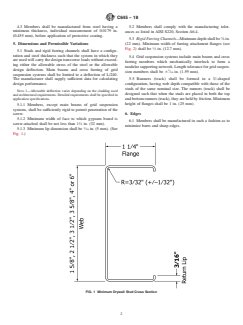
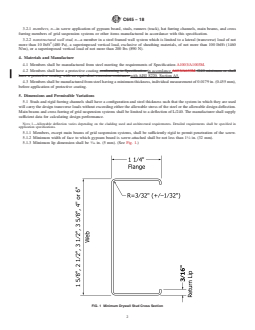
5.1.2 Minimum width of face to which gypsum board is screw-attached shall be not less than 1 ⁄4 in. (32 mm).
5.1.3 Minimum lip dimension shall be ⁄16 in. (5 mm). (See Fig. 1.)
FIG. 1 Minimum Drywall Stud Cross Section
C645 − 18
5.2 Members shall be manufactured within the limits as showncomply with the manufacturing tolerances as listed in Table 1
andAISI S220, Fig. 2.Section A6.4.
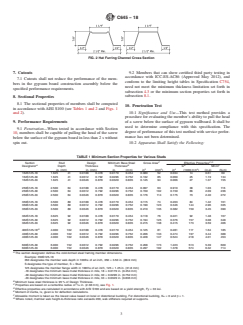
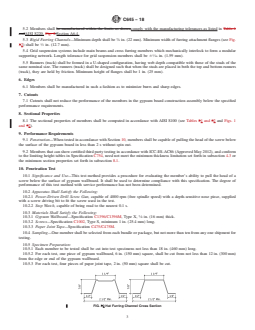
5.3 Rigid Furring Channels—Minimum depth shall be ⁄8 in. (22 mm). Minimum width of furring attachment flanges (see Fig.
32) shall be ⁄2 in. (12.7 mm).
5.4 Grid suspension systems include main beams and cross furring members which mechanically interlock to form a modular
supporting network. Length tolerance for grid suspension members shall be 6 ⁄16 in. (1.59 mm).
5.5 Runners (track) shall be formed in a U-shaped configuration, having web depth compatible with those of the studs of the
same nominal size. The runners (track) shall be designed such that when the studs are placed in both the top and bottom runners
(track), they are held by friction. Minimum height of flanges shall be 1 in. (25 mm).
6. Edges
6.1 Members shall be manufactured in such a fashion as to minimize burrs and sharp edges.
7. Cutouts
7.1 Cutouts shall not reduce the performance of the members in the gypsum board construction assembly below the specified
performance requirements.
8. Sectional Properties
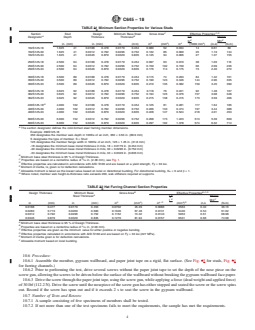
8.1 The sectional properties of members shall be computed in accordance with AISI S100 (see Tables 21 and 32 and Figs. 1
and 32).
9. Performance Requirements
9.1 Penetration—When tested in accordance with Section 10, members shall be capable of pulling the head of the screw below
the surface of the gypsum board in less than 2 s without spin out.
9.2 Members that can show certified third party testing in accordance with ICC-ES-AC86 (Approved May 2012), and conform
to the limiting height tables in Specification C754, need not meet the minimum thickness limitation set forth in subsection 4.3 or
the minimum section properties set forth in subsection 8.1.
10. Penetration Test
10.1 Significance and Use—This test method provides a procedure for evaluating the member’s ability to pull the head of a
screw below the surface of gypsum wallboard. It shall be used to determine compliance with this specification. The degree of
performance of this test method with service performance has not been determined.
10.2 Apparatus Shall Satisfy the Following:
10.2.1 Power-Driven Drill Screw Gun, capable of 4000 rpm (free spindle speed) with a depth-sensitive nose piece, supplied
with a screw driving bit to fit the screw used in the test.
10.2.2 Stop Watch, capable of being read to the nearest 0.1 s.
10.3 Materials Shall Satisfy the Following:
10.3.1 Gypsum Wallboard—Specification C1396/C1396M, Type X, ⁄8 in. (16 mm) thick.
10.3.2 Screws—Specification C1002, Type S, minimum 1 in. (25.4 mm) long.
10.3.3 Paper Joint Tape—Specification C475/C475M.
10.4 Sampling—One member shall be selected from each bundle or package, but not more than ten from any one shipment for
testing.
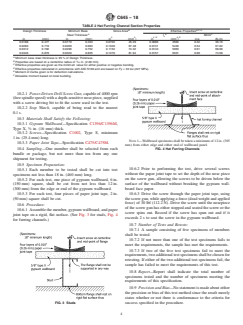
10.5 Specimen Preparation:
10.5.1 Each member to be tested shall be cut into test specimens not less than 18 in. (460 mm) long.
10.5.2 For each test, one piece of gypsum wallboard, 6 in. (150 mm) square, shall be cut from not less than 12 in. (300 mm)
from the edge or end of the gypsum wallboard.
10.5.3 For each test, four pieces of paper joint tape, 2 in. (50 mm) square shall be cut.
FIG. 32 Hat Furring Channel Cross Section
--------------
...