

ASTM C514-04(2020)
(Specification)Standard Specification for Nails for the Application of Gypsum Board
General Information
- Abstract
ABSTRACT
This specification covers the requirements for steel wire nails suitable for use in the application of gypsum board. Details of construction for a specific assembly to achieve the required fire resistance shall be obtained from reports of fire-resistance tests, engineering evaluations, or listings from recognized fire testing laboratories. Steel Wire, used in the manufacture of nails, shall be of hard-drawn low or medium-low-carbon steel. The nails shall be tested and shall conform to specified values of physical properties such as ductility, and withdrawal resistance.
SCOPE
1.1 This specification covers requirements for steel wire nails suitable for use in the application of gypsum board.
1.2 Details of construction for a specific assembly to achieve the required fire resistance shall be obtained from reports of fire-resistance tests, engineering evaluations, or listings from recognized fire testing laboratories.
1.3 The values stated in inch-pound units are to be regarded as standard. The values given in parentheses are mathematical conversions to SI units that are provided for information only and are not considered standard.
1.4 The following precautionary caveat pertains only to the test method portion, Sections 7 and 8, of this specification: This standard does not purport to address all of the safety concerns, if any, associated with its use. It is the responsibility of the user of this standard to establish appropriate safety, health, and environmental practices and determine the applicability of regulatory limitations prior to use.
1.5 This international standard was developed in accordance with internationally recognized principles on standardization established in the Decision on Principles for the Development of International Standards, Guides and Recommendations issued by the World Trade Organization Technical Barriers to Trade (TBT) Committee.
- Status
- Published
- Publication Date
- 31-Mar-2020
- Technical Committee
- C11 - Gypsum and Related Building Materials and Systems


Overview
ASTM C514-04(2020), Standard Specification for Nails for the Application of Gypsum Board, establishes the requirements for steel wire nails used in the installation of gypsum board. Developed by ASTM International, this standard outlines the key physical properties, dimensions, workmanship, and test protocols to ensure the reliability and safety of nails in gypsum board installations, particularly where fire-resistance or code compliance is required.
This specification applies internationally and follows principles set by the World Trade Organization for standardization. It is widely used by manufacturers, building professionals, code authorities, and testing laboratories to ensure consistent quality and performance of nails used with gypsum board systems.
Key Topics
- Material Requirements: Nails must be made from hard-drawn low- or medium-low-carbon steel wire, ensuring appropriate strength and durability.
- Physical Properties:
- Ductility: Nails must be sufficiently ductile to withstand cold bending over a specified radius without fracturing.
- Withdrawal Resistance: Nails must meet or exceed established resistance values when withdrawn from standard wood blocks, ensuring effective board retention.
- Dimensional Specifications:
- Head: Diameter and thickness limits, free from sharp edges or protrusions.
- Shank: Limited diameter variability for consistent performance.
- Points: Must be medium to long diamond or needle points for easy installation.
- Workmanship and Finish:
- Nails should be free of injurious defects and neatly formed.
- Finishes can be bright, chemically treated, or coated to inhibit rust, provided compatibility with joint compounds and paints.
- Packaging and Marking: Nails should be packaged in commercial-grade containers, clearly labeled with type, length, manufacturer, and net mass to assure traceability and facilitate logistics.
Applications
ASTM C514-04(2020) is primarily applied in building construction, specifically for the secure fastening of gypsum board (drywall) to wood or metal framing:
- Residential and Commercial Buildings: Ensures the structural reliability of interior partitions and ceilings where gypsum board is used.
- Fire-Resistant Assemblies: Used in assemblies where specific fire-resistance ratings are needed, as determined by recognized fire testing laboratories.
- Quality Control and Procurement: Used as a standard reference in specifying, testing, or auditing fastener quality for gypsum board installation.
- Compliance and Inspection: Assists inspectors and code officials in verifying that installed products align with safety and performance standards.
Related Standards
For comprehensive compliance in gypsum board applications and fastener use, the following related standards are commonly referenced:
- ASTM C840 - Standard Specification for Application and Finishing of Gypsum Board
- ASTM E119 - Standard Test Methods for Fire Tests of Building Construction and Materials
- ASTM C1002 - Standard Specification for Steel Self-Piercing Tapping Screws for the Application of Gypsum Panel Products or Metal Plaster Bases
- ASTM E4 - Practices for Force Verification of Testing Machines (referenced for test equipment calibration in C514)
- Building Codes (IBC, IRC) - Incorporate ASTM C514 requirements for code compliance
Summary
Compliance with ASTM C514-04(2020) ensures that steel wire nails used in gypsum board installation meet stringent material and performance standards, contributing to the safety, durability, and reliability of interior construction. Adoption of this standard supports quality assurance in the supply chain and regulatory approval for building projects using gypsum board systems, making it essential for manufacturers, contractors, quality professionals, and code officials.
Relations
- Effective Date
- 01-Apr-2020
- Effective Date
- 01-Jun-2014
- Effective Date
- 01-Jun-2010
- Effective Date
- 01-Nov-2009
- Effective Date
- 01-Apr-2009
- Effective Date
- 01-Dec-2008
- Effective Date
- 01-Jan-2007
- Effective Date
- 10-Aug-2003
- Effective Date
- 10-Nov-2002
- Effective Date
- 10-Apr-2001
- Effective Date
- 10-Apr-2001
- Effective Date
- 01-Apr-2020
- Referred By
ASTM F1667/F1667M-21a - Standard Specification for Driven Fasteners: Nails, Spikes, and Staples - Effective Date
- 01-Apr-2020
- Effective Date
- 01-Apr-2020
- Effective Date
- 01-Apr-2020
Frequently Asked Questions
ASTM C514-04(2020) is a technical specification published by ASTM International. Its full title is "Standard Specification for Nails for the Application of Gypsum Board". This standard covers: ABSTRACT This specification covers the requirements for steel wire nails suitable for use in the application of gypsum board. Details of construction for a specific assembly to achieve the required fire resistance shall be obtained from reports of fire-resistance tests, engineering evaluations, or listings from recognized fire testing laboratories. Steel Wire, used in the manufacture of nails, shall be of hard-drawn low or medium-low-carbon steel. The nails shall be tested and shall conform to specified values of physical properties such as ductility, and withdrawal resistance. SCOPE 1.1 This specification covers requirements for steel wire nails suitable for use in the application of gypsum board. 1.2 Details of construction for a specific assembly to achieve the required fire resistance shall be obtained from reports of fire-resistance tests, engineering evaluations, or listings from recognized fire testing laboratories. 1.3 The values stated in inch-pound units are to be regarded as standard. The values given in parentheses are mathematical conversions to SI units that are provided for information only and are not considered standard. 1.4 The following precautionary caveat pertains only to the test method portion, Sections 7 and 8, of this specification: This standard does not purport to address all of the safety concerns, if any, associated with its use. It is the responsibility of the user of this standard to establish appropriate safety, health, and environmental practices and determine the applicability of regulatory limitations prior to use. 1.5 This international standard was developed in accordance with internationally recognized principles on standardization established in the Decision on Principles for the Development of International Standards, Guides and Recommendations issued by the World Trade Organization Technical Barriers to Trade (TBT) Committee.
ABSTRACT This specification covers the requirements for steel wire nails suitable for use in the application of gypsum board. Details of construction for a specific assembly to achieve the required fire resistance shall be obtained from reports of fire-resistance tests, engineering evaluations, or listings from recognized fire testing laboratories. Steel Wire, used in the manufacture of nails, shall be of hard-drawn low or medium-low-carbon steel. The nails shall be tested and shall conform to specified values of physical properties such as ductility, and withdrawal resistance. SCOPE 1.1 This specification covers requirements for steel wire nails suitable for use in the application of gypsum board. 1.2 Details of construction for a specific assembly to achieve the required fire resistance shall be obtained from reports of fire-resistance tests, engineering evaluations, or listings from recognized fire testing laboratories. 1.3 The values stated in inch-pound units are to be regarded as standard. The values given in parentheses are mathematical conversions to SI units that are provided for information only and are not considered standard. 1.4 The following precautionary caveat pertains only to the test method portion, Sections 7 and 8, of this specification: This standard does not purport to address all of the safety concerns, if any, associated with its use. It is the responsibility of the user of this standard to establish appropriate safety, health, and environmental practices and determine the applicability of regulatory limitations prior to use. 1.5 This international standard was developed in accordance with internationally recognized principles on standardization established in the Decision on Principles for the Development of International Standards, Guides and Recommendations issued by the World Trade Organization Technical Barriers to Trade (TBT) Committee.
ASTM C514-04(2020) is classified under the following ICS (International Classification for Standards) categories: 21.060.50 - Pins, nails. The ICS classification helps identify the subject area and facilitates finding related standards.
ASTM C514-04(2020) has the following relationships with other standards: It is inter standard links to ASTM C514-04(2014), ASTM E4-14, ASTM E4-10, ASTM E4-09a, ASTM E4-09, ASTM E4-08, ASTM E4-07, ASTM E4-03, ASTM E4-02, ASTM E4-01, ASTM E4-99, ASTM C840-20, ASTM F1667/F1667M-21a, ASTM C844-15(2021), ASTM C841-23. Understanding these relationships helps ensure you are using the most current and applicable version of the standard.
ASTM C514-04(2020) is available in PDF format for immediate download after purchase. The document can be added to your cart and obtained through the secure checkout process. Digital delivery ensures instant access to the complete standard document.
Standards Content (Sample)
This international standard was developed in accordance with internationally recognized principles on standardization established in the Decision on Principles for the
Development of International Standards, Guides and Recommendations issued by the World Trade Organization Technical Barriers to Trade (TBT) Committee.
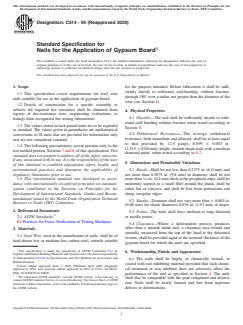
Designation:C514 −04 (Reapproved 2020)
Standard Specification for
Nails for the Application of Gypsum Board
This standard is issued under the fixed designation C514; the number immediately following the designation indicates the year of
original adoption or, in the case of revision, the year of last revision. A number in parentheses indicates the year of last reapproval. A
superscript epsilon (´) indicates an editorial change since the last revision or reapproval.
This standard has been approved for use by agencies of the U.S. Department of Defense.
1. Scope for the purpose intended. Before fabrication it shall be suffi-
ciently ductile to withstand cold-bending, without fracture,
1.1 This specification covers requirements for steel wire
through 180° over a radius not greater than the diameter of the
nails suitable for use in the application of gypsum board.
wire (see Section 8).
1.2 Details of construction for a specific assembly to
achieve the required fire resistance shall be obtained from
4. Physical Properties
reports of fire-resistance tests, engineering evaluations, or
4.1 Ductility—The nail shall be sufficiently ductile to with-
listings from recognized fire testing laboratories.
stand cold bending without fracture when tested according to
1.3 The values stated in inch-pound units are to be regarded
Section 8.
as standard. The values given in parentheses are mathematical
4.2 Withdrawal Resistance—The average withdrawal
conversions to SI units that are provided for information only
resistance, both immediate and delayed, shall be at least equal
and are not considered standard.
to that provided by 12.5 gauge, 0.099 6 0.003 in.
1.4 The following precautionary caveat pertains only to the
(2.515 6 0.08 mm), bright, smooth shank nails with a medium
testmethodportion,Sections7and8,ofthisspecification: This
diamond point, when tested according to 8.2.
standard does not purport to address all of the safety concerns,
if any, associated with its use. It is the responsibility of the user
5. Dimensions and Permissible Variations
of this standard to establish appropriate safety, health, and
environmental practices and determine the applicability of 5.1 Heads—Shall be not less than 0.2375 in. (6.0 mm) and
regulatory limitations prior to use. not more than 0.3875 in. (9.8 mm) in diameter, shall be not
1.5 This international standard was developed in accor- morethan ⁄64in.(0.4mm)thickattheperipheraledge,shallbe
dance with internationally recognized principles on standard- uniformly tapered to a small fillet around the shank, shall be
ization established in the Decision on Principles for the
either flat or concave, and shall be free from protrusions and
Development of International Standards, Guides and Recom- sharp, irregular edges.
mendations issued by the World Trade Organization Technical
5.2 Shanks—Diameter shall not vary more than 6 0.003 in.
Barriers to Trade (TBT) Committee.
(0.08 mm) for shank diameters 0.076 in. (1.93 mm) or larger.
2. Referenced Documents
5.3 Points—The nails shall have medium to long diamond
or needle points.
2.1 ASTM Standards:
E4 Practices for Force Verification of Testing Machines
5.4 Clearance—Where a deformation process produces
other than a smooth shank nail, a clearance area (round and
3. Materials
smooth), measured from the top of the head to the deformed
3.1 Steel Wire, used in the manufacture of nails, shall be of
section, shall be provided equal to the nominal thickness of the
hard-drawn low or medium-low-carbon steel, entirely suitable
gypsum board for which the nails are specified.
This specification is under the jurisdiction of ASTM Committee C11 on
6. Workmanship, Finish, and Appearance
Gypsum and Related Building Materials and Systems and is the direct responsibility
of Subcommittee C11.02 on Specifications and Test Methods for Accessories and
6.1 The nails shall be bright, or chemically treated, or
Related Products.
coated with rust inhibiting material provided that such chemi-
Current edition approved April 1, 2020. Published April 2020. Originally
cal treatment or rust inhibitor does not adversely affect the
approved in 1963. Last previous edition approved in 2014 as C514 – 04 (2014).
DOI: 10.1520/C0514-04R20.
performance of the nail as specified in Section 4. The nails
For referenced ASTM standards, visit the ASTM website, www.astm.org, or
shall also be compatible with the joint compound and decora-
contact ASTM Customer Service at service@astm.org. For Annual Book of ASTM
tion. Nails shall be neatly formed and free from injurious
Standards volume information, refer to the standard’s Document Summary page on
the ASTM website. defects or deformations.
Copyright © ASTM International, 100 Barr Harbor Drive, PO Box C700, West Conshohocken, PA 19428-2959. United States
C514−04 (2020)
7. Number of Tests 16 %, but not more than 19 %, free moisture as determined by
a suitable moisture meter. Required wood blocks for a test
7.1 At least five nails from each lot of 100 individual
seriesshallbecutfromasinglepiec
...