

ASTM A747/A747M-23
(Specification)Standard Specification for Steel Castings, Stainless, Precipitation Hardening
General Information
- Abstract
ABSTRACT
This specification covers iron-chromium-nickel-copper corrosion resistance steel castings capable of being strengthened by precipitation hardening heat treatment. The steel shall be made by electric furnace process with or without separate refining such as argon-oxygen decarburization. The steel materials shall also undergo homogenization heat treatment, solution annealing heat treatment, precipitation hardening and shall conform to the required values of temperature and time and cooling treatment. The materials shall conform to the required chemical compositions of carbon, manganese, phosphorus, sulfur, silicon, chromium, nickel, copper, columbium, and nitrogen.
SCOPE
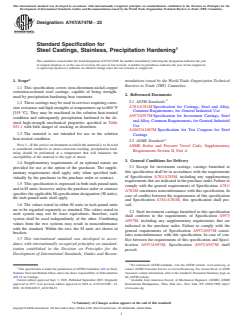
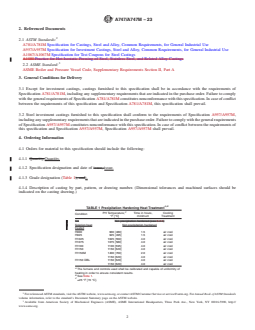
1.1 This specification covers iron-chromium-nickel-copper corrosion-resistant steel castings, capable of being strengthened by precipitation hardening heat treatment.
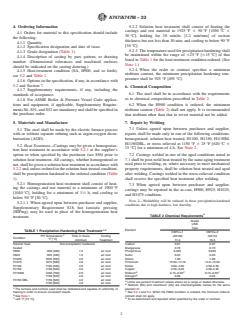
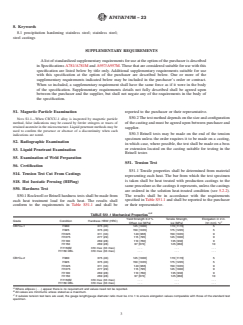
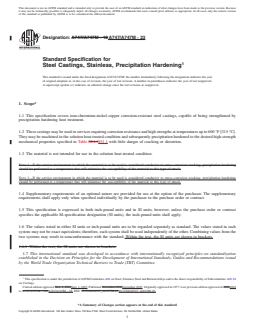
1.2 These castings may be used in services requiring corrosion resistance and high strengths at temperatures up to 600 °F [315 °C]. They may be machined in the solution heat-treated condition and subsequently precipitation hardened to the desired high-strength mechanical properties specified in Table S51.1 with little danger of cracking or distortion.
1.3 The material is not intended for use in the solution heat-treated condition.
Note 1: If the service environment in which the material is to be used is considered conducive to stress-corrosion cracking, precipitation hardening should be performed at a temperature that will minimize the susceptibility of the material to this type of attack.
1.4 Supplementary requirements of an optional nature are provided for use at the option of the purchaser. The supplementary requirements shall apply only when specified individually by the purchaser in the purchase order or contract.
1.5 This specification is expressed in both inch-pound units and in SI units; however, unless the purchase order or contract specifies the applicable M-specification designation (SI units), the inch-pound units shall apply.
1.6 The values stated in either SI units or inch-pound units are to be regarded separately as standard. The values stated in each system may not be exact equivalents; therefore, each system shall be used independently of the other. Combining values from the two systems may result in nonconformance with the standard. Within the text, the SI units are shown in brackets.
1.7 This international standard was developed in accordance with internationally recognized principles on standardization established in the Decision on Principles for the Development of International Standards, Guides and Recommendations issued by the World Trade Organization Technical Barriers to Trade (TBT) Committee.
- Status
- Published
- Publication Date
- 31-Aug-2023
- Technical Committee
- A01 - Steel, Stainless Steel and Related Alloys
- Drafting Committee
- A01.18 - Castings
Buy Documents

ASTM A747/A747M-23 - Standard Specification for Steel Castings, Stainless, Precipitation Hardening
REDLINE ASTM A747/A747M-23 - Standard Specification for Steel Castings, Stainless, Precipitation Hardening
Overview
ASTM A747/A747M-23 is an internationally recognized standard specification developed by ASTM International. It defines the requirements for iron-chromium-nickel-copper corrosion-resistant steel castings that can be strengthened by precipitation hardening heat treatment. These stainless steel castings offer high strength and corrosion resistance at elevated temperatures, making them ideal for critical applications in industries such as aerospace, power generation, chemical processing, and pressure vessel manufacturing.
The castings covered by ASTM A747/A747M-23 must be produced using an electric furnace process, with optional refining methods such as argon-oxygen decarburization. The specification details a sequence of mandatory heat treatments, including homogenization, solution heat treatment, and precipitation hardening, designed to enhance material properties according to precise temperature, time, and cooling parameters.
Key Topics
Material Coverage
- Iron-chromium-nickel-copper alloys
- Corrosion-resistant, precipitation hardening stainless steel castings
Heat Treatment Process
- Homogenization heat treatment (optional or purchaser-specified)
- Solution heat treatment as a standard requirement
- Precipitation hardening at defined temperatures and times
- Multiple heat treatment conditions (H900, H925, H1025, H1075, H1100, H1150, H1150M, H1150 DBL)
Mechanical Properties
- Minimum required yield and tensile strengths
- Elongation percentages for mechanical integrity
- Brinell or Rockwell hardness values for each condition
Chemical Composition
- Strict limits on carbon, manganese, phosphorus, sulfur, silicon, chromium, nickel, copper
- Optional reporting and control of niobium (columbium) and nitrogen content
Testing and Quality Assurance
- Requirements for mechanical property testing (tensile, hardness)
- Non-destructive examinations (magnetic particle, radiographic, liquid penetrant)
- Certification and marking requirements for traceability
Weldability and Repair
- Permitted repair procedures for casting defects
- Post-weld heat treatment protocols for maintaining mechanical properties
- Guidance on repairs in various heat-treated conditions
Applications
Steel castings manufactured to ASTM A747/A747M-23 are widely used where a combination of high strength, corrosion resistance, and reliable performance at elevated temperatures (up to 600 °F [315 °C]) is crucial. Typical applications include:
- Pressure vessel components used in power generation and chemical industries
- Aerospace structural parts that require precision machining and high mechanical integrity
- Pumps, valves, and fittings for corrosive environments such as seawater or chemical plants
- Food processing equipment where hygiene and corrosion resistance are paramount
- Oil and gas industry equipment that demands both strength and environmental durability
The specification's versatile approach to heat treatment allows these castings to be tailored for specific strength and toughness requirements, with minimal risk of cracking or distortion during subsequent machining or service.
Related Standards
ASTM A747/A747M-23 is part of a family of ASTM standards that ensure the quality and consistency of steel and stainless steel castings. Relevant standards include:
- ASTM A781/A781M - General requirements for steel and alloy castings for industrial use
- ASTM A957/A957M - Requirements for investment castings of steel and alloys
- ASTM A1067/A1067M - Practice for test coupons for steel castings
- ASTM A1080 - Practice for hot isostatic pressing of steel, stainless steel, and related alloy castings
- ASME Boiler and Pressure Vessel Code, Section II, Part A - Recognizes ASTM A747/A747M for code applications
Compliance with ASTM A747/A747M-23 helps manufacturers, purchasers, and end users achieve reliable, high-performance stainless steel castings suitable for demanding engineering applications. This standard supports both inch-pound and SI units, ensuring global alignment with industry best practices and customer requirements.
Relations
- Effective Date
- 01-Sep-2018
- Effective Date
- 01-Sep-2018
- Effective Date
- 01-Jun-2018
- Effective Date
- 15-May-2018
- Effective Date
- 15-May-2018
- Effective Date
- 01-Mar-2018
- Effective Date
- 01-Jan-2018
- Effective Date
- 01-May-2017
- Effective Date
- 01-Dec-2016
- Effective Date
- 01-Nov-2015
- Effective Date
- 01-Mar-2015
- Effective Date
- 01-Oct-2014
- Effective Date
- 01-Oct-2014
- Effective Date
- 01-May-2014
- Effective Date
- 01-Mar-2014
Buy Documents
ASTM A747/A747M-23 - Standard Specification for Steel Castings, Stainless, Precipitation Hardening
REDLINE ASTM A747/A747M-23 - Standard Specification for Steel Castings, Stainless, Precipitation Hardening
Get Certified
Connect with accredited certification bodies for this standard

Element Materials Technology
Materials testing and product certification.

Inštitut za kovinske materiale in tehnologije
Institute of Metals and Technology. Materials testing, metallurgical analysis, NDT.
Sponsored listings
Frequently Asked Questions
ASTM A747/A747M-23 is a technical specification published by ASTM International. Its full title is "Standard Specification for Steel Castings, Stainless, Precipitation Hardening". This standard covers: ABSTRACT This specification covers iron-chromium-nickel-copper corrosion resistance steel castings capable of being strengthened by precipitation hardening heat treatment. The steel shall be made by electric furnace process with or without separate refining such as argon-oxygen decarburization. The steel materials shall also undergo homogenization heat treatment, solution annealing heat treatment, precipitation hardening and shall conform to the required values of temperature and time and cooling treatment. The materials shall conform to the required chemical compositions of carbon, manganese, phosphorus, sulfur, silicon, chromium, nickel, copper, columbium, and nitrogen. SCOPE 1.1 This specification covers iron-chromium-nickel-copper corrosion-resistant steel castings, capable of being strengthened by precipitation hardening heat treatment. 1.2 These castings may be used in services requiring corrosion resistance and high strengths at temperatures up to 600 °F [315 °C]. They may be machined in the solution heat-treated condition and subsequently precipitation hardened to the desired high-strength mechanical properties specified in Table S51.1 with little danger of cracking or distortion. 1.3 The material is not intended for use in the solution heat-treated condition. Note 1: If the service environment in which the material is to be used is considered conducive to stress-corrosion cracking, precipitation hardening should be performed at a temperature that will minimize the susceptibility of the material to this type of attack. 1.4 Supplementary requirements of an optional nature are provided for use at the option of the purchaser. The supplementary requirements shall apply only when specified individually by the purchaser in the purchase order or contract. 1.5 This specification is expressed in both inch-pound units and in SI units; however, unless the purchase order or contract specifies the applicable M-specification designation (SI units), the inch-pound units shall apply. 1.6 The values stated in either SI units or inch-pound units are to be regarded separately as standard. The values stated in each system may not be exact equivalents; therefore, each system shall be used independently of the other. Combining values from the two systems may result in nonconformance with the standard. Within the text, the SI units are shown in brackets. 1.7 This international standard was developed in accordance with internationally recognized principles on standardization established in the Decision on Principles for the Development of International Standards, Guides and Recommendations issued by the World Trade Organization Technical Barriers to Trade (TBT) Committee.
ABSTRACT This specification covers iron-chromium-nickel-copper corrosion resistance steel castings capable of being strengthened by precipitation hardening heat treatment. The steel shall be made by electric furnace process with or without separate refining such as argon-oxygen decarburization. The steel materials shall also undergo homogenization heat treatment, solution annealing heat treatment, precipitation hardening and shall conform to the required values of temperature and time and cooling treatment. The materials shall conform to the required chemical compositions of carbon, manganese, phosphorus, sulfur, silicon, chromium, nickel, copper, columbium, and nitrogen. SCOPE 1.1 This specification covers iron-chromium-nickel-copper corrosion-resistant steel castings, capable of being strengthened by precipitation hardening heat treatment. 1.2 These castings may be used in services requiring corrosion resistance and high strengths at temperatures up to 600 °F [315 °C]. They may be machined in the solution heat-treated condition and subsequently precipitation hardened to the desired high-strength mechanical properties specified in Table S51.1 with little danger of cracking or distortion. 1.3 The material is not intended for use in the solution heat-treated condition. Note 1: If the service environment in which the material is to be used is considered conducive to stress-corrosion cracking, precipitation hardening should be performed at a temperature that will minimize the susceptibility of the material to this type of attack. 1.4 Supplementary requirements of an optional nature are provided for use at the option of the purchaser. The supplementary requirements shall apply only when specified individually by the purchaser in the purchase order or contract. 1.5 This specification is expressed in both inch-pound units and in SI units; however, unless the purchase order or contract specifies the applicable M-specification designation (SI units), the inch-pound units shall apply. 1.6 The values stated in either SI units or inch-pound units are to be regarded separately as standard. The values stated in each system may not be exact equivalents; therefore, each system shall be used independently of the other. Combining values from the two systems may result in nonconformance with the standard. Within the text, the SI units are shown in brackets. 1.7 This international standard was developed in accordance with internationally recognized principles on standardization established in the Decision on Principles for the Development of International Standards, Guides and Recommendations issued by the World Trade Organization Technical Barriers to Trade (TBT) Committee.
ASTM A747/A747M-23 is classified under the following ICS (International Classification for Standards) categories: 77.140.80 - Iron and steel castings. The ICS classification helps identify the subject area and facilitates finding related standards.
ASTM A747/A747M-23 has the following relationships with other standards: It is inter standard links to ASTM A957/A957M-18a, ASTM A781/A781M-18c, ASTM A781/A781M-18b, ASTM A781/A781M-18a, ASTM A957/A957M-18, ASTM A1067/A1067M-12a(2018), ASTM A781/A781M-18, ASTM A781/A781M-17, ASTM A781/A781M-16, ASTM A957/A957M-15a, ASTM A957/A957M-15, ASTM A957/A957M-14, ASTM A781/A781M-14b, ASTM A781/A781M-14a, ASTM A781/A781M-14. Understanding these relationships helps ensure you are using the most current and applicable version of the standard.
ASTM A747/A747M-23 is available in PDF format for immediate download after purchase. The document can be added to your cart and obtained through the secure checkout process. Digital delivery ensures instant access to the complete standard document.
Standards Content (Sample)
This international standard was developed in accordance with internationally recognized principles on standardization established in the Decision on Principles for the
Development of International Standards, Guides and Recommendations issued by the World Trade Organization Technical Barriers to Trade (TBT) Committee.
Designation: A747/A747M − 23
Standard Specification for
Steel Castings, Stainless, Precipitation Hardening
This standard is issued under the fixed designation A747/A747M; the number immediately following the designation indicates the year
of original adoption or, in the case of revision, the year of last revision. A number in parentheses indicates the year of last reapproval.
A superscript epsilon (´) indicates an editorial change since the last revision or reapproval.
1. Scope* mendations issued by the World Trade Organization Technical
Barriers to Trade (TBT) Committee.
1.1 This specification covers iron-chromium-nickel-copper
corrosion-resistant steel castings, capable of being strength-
2. Referenced Documents
ened by precipitation hardening heat treatment.
2.1 ASTM Standards:
1.2 These castings may be used in services requiring corro-
A781/A781M Specification for Castings, Steel and Alloy,
sion resistance and high strengths at temperatures up to 600 °F
Common Requirements, for General Industrial Use
[315 °C]. They may be machined in the solution heat-treated
A957/A957M Specification for Investment Castings, Steel
condition and subsequently precipitation hardened to the de-
and Alloy, Common Requirements, for General Industrial
sired high-strength mechanical properties specified in Table
Use
S51.1 with little danger of cracking or distortion.
A1067/A1067M Specification for Test Coupons for Steel
1.3 The material is not intended for use in the solution
Castings
heat-treated condition.
2.2 ASME Standard:
NOTE 1—If the service environment in which the material is to be used
ASME Boiler and Pressure Vessel Code, Supplementary
is considered conducive to stress-corrosion cracking, precipitation hard-
Requirements Section II, Part A
ening should be performed at a temperature that will minimize the
susceptibility of the material to this type of attack.
3. General Conditions for Delivery
1.4 Supplementary requirements of an optional nature are
3.1 Except for investment castings, castings furnished to
provided for use at the option of the purchaser. The supple-
this specification shall be in accordance with the requirements
mentary requirements shall apply only when specified indi-
of Specification A781/A781M, including any supplementary
vidually by the purchaser in the purchase order or contract.
requirements that are indicated in the purchase order. Failure to
1.5 This specification is expressed in both inch-pound units
comply with the general requirements of Specification A781/
and in SI units; however, unless the purchase order or contract
A781M constitutes nonconformance with this specification. In
specifies the applicable M-specification designation (SI units),
case of conflict between the requirements of this specification
the inch-pound units shall apply.
and Specification A781/A781M, this specification shall pre-
1.6 The values stated in either SI units or inch-pound units
vail.
are to be regarded separately as standard. The values stated in
3.2 Steel investment castings furnished to this specification
each system may not be exact equivalents; therefore, each
shall conform to the requirements of Specification A957/
system shall be used independently of the other. Combining
A957M, including any supplementary requirements that are
values from the two systems may result in nonconformance
indicated in the purchase order. Failure to comply with the
with the standard. Within the text, the SI units are shown in
general requirements of Specification A957/A957M consti-
brackets.
tutes nonconformance with this specification. In case of con-
1.7 This international standard was developed in accor-
flict between the requirements of this specification and Speci-
dance with internationally recognized principles on standard-
fication A957/A957M, Specification A957/A957M shall
ization established in the Decision on Principles for the
prevail.
Development of International Standards, Guides and Recom-
For referenced ASTM standards, visit the ASTM website, www.astm.org, or
This specification is under the jurisdiction of ASTM Committee A01 on Steel, contact ASTM Customer Service at service@astm.org. For Annual Book of ASTM
Stainless Steel and Related Alloys and is the direct responsibility of Subcommittee Standards volume information, refer to the standard’s Document Summary page on
A01.18 on Castings. the ASTM website.
Current edition approved Sept. 1, 2023. Published September 2023. Originally Available from American Society of Mechanical Engineers (ASME), ASME
approved in 1977. Last previous edition approved in 2018 as A747/A747M – 18. International Headquarters, Three Park Ave., New York, NY 10016-5990, http://
DOI: 10.1520/A0747_A0747M-23. www.asme.org.
*A Summary of Changes section appears at the end of this standard
Copyright © ASTM International, 100 Barr Harbor Drive, PO Box C700, West Conshohocken, PA 19428-2959. United States
A747/A747M − 23
4. Ordering Information 5.2.2 Solution heat treatment shall consist of heating the
castings and test material to 1925 °F 6 50 °F [1050 °C 6
4.1 Orders for material to this specification should include
30 °C], holding for 30 min/in. [1.2 min/mm] of section
the following:
thickness but not less than 30 min, and cooling to below 90 °F
4.1.1 Quantity.
[30 °C].
4.1.2 Specification designation and date of issue.
5.2.3 The temperature used for precipitation hardening shall
4.1.3 Grade designation (Table 1).
be maintained within the range of 625 °F [615 °C] of that
4.1.4 Description of casting by part, pattern, or drawing
listed in Table 1 for the heat-treatment condition ordered. (See
number. (Dimensional tolerances and machined surfaces
Note 1.)
should be indicated on the casting drawing.)
5.2.4 When the order or contract specifies a minimum
4.1.5 Heat-treatment condition (SA, H900, and so forth);
niobium content, the minimum precipitation hardening tem-
see 5.2 and Table 1.
perature shall be 925 °F [495 °C].
4.1.6 Options in the specification, if any, in accordance with
5.2 and Section 7.
6. Chemical Composition
4.1.7 Supplementary requirements, if any, including the
6.1 The steel shall be in accordance with the requirements
standards of acceptance.
as to chemical composition prescribed in Table 2.
4.1.8 For ASME Boiler & Pressure Vessel Code applica-
tions and equipment, if applicable, Supplementary Require-
6.2 When the H900 condition is ordered, the minimum
ments S6, S51, and S52 are mandatory and shall be specified in
niobium content (Table 2) shall not apply. It is recommended
the purchase order.
that niobium other than that in revert material not be added.
7. Repair by Welding
5. Materials and Manufacture
7.1 Unless agreed upon between purchaser and supplier,
5.1 The steel shall be made by the electric furnace process
repairs shall be made only in one of the following conditions:
with or without separate refining such as argon-oxygen decar-
homogenized, solution heat treated, H1100, H1150, H1150M,
burization (AOD).
H1150DBL, or stress relieved at 1150 °F 6 25 °F [620 °C 6
5.2 Heat Treatment—Castings may be given a homogeniza-
15 °C] for a minimum of 4 h. See Note 2.
tion heat treatment in accordance with 5.2.1 at the supplier’s
7.2 Castings welded in one of the aged conditions noted in
option or when specified by the purchaser (see S56) prior to
solution heat treatment. All castings, whether homogenized or 7.1 shall be post-weld heat treated by the same aging treatment
used prior to welding, or, where necessary to meet mechanical
not, shall be given a solution heat treatment in accordance with
5.2.2 and, unless ordered in the solution heat-treated condition, property requirements, shall be solution heat treated and aged
after welding. Castings welded in the stress-relieved condition
shall be precipitation hardened to the ordered condition (Table
1). shall receive the specified heat treatment after welding.
5.2.1 Homogenization heat treatment shall consist of heat-
7.3 When agreed upon between purchaser and supplier,
ing the castings and test material to a minimum of 1900 °F
castings may be repaired in the as-cast, H900, H925, H1025,
[1040 °C], holding for a minimum of 1 ⁄2 h, and cooling to
and H1075 condition.
below 90 °F [30 °C].
NOTE 2—Weldability will be reduced in these precipitation-hardened
5.2.1.1 When agreed upon between purchaser and supplier,
conditions due to high hardness, low ductility.
Supplementary Requirement S18, hot isostatic pressing
(HIPing), may be used in place of the homogenization heat
A
TABLE 2 Chemical Requirements
treatment.
Grade
UNS
Type
A,B Element
TABLE 1 Precipitation Hardening Heat Treatment
CB7Cu-1 CB7Cu-2
C
J92180 J92110
PH Temperature, Time in hours, Cooling
Condition
°F [°C]
minimum Treatment 17-4 15-5
Carbon 0.07 0.07
Solution heat Not precipitation hardened
treated Manganese 0.70 0.70
H900 900 [480] 1.5 air cool Phosphorus 0.035 0.035
H925 925 [495] 1.5 air cool Sulfur 0.03 0.03
H1025 1025 [550] 4.0 air cool Silicon 1.00 1.00
H1075 1075 [580] 4.0 air cool Chromium 15.50–17.70 14.0–15.50
H1100 1100 [595] 4.0 air cool Nickel 3.60–4.60 4.50–5.50
H1150 1150 [620] 4.0
...
This document is not an ASTM standard and is intended only to provide the user of an ASTM standard an indication of what changes have been made to the previous version. Because
it may not be technically possible to adequately depict all changes accurately, ASTM recommends that users consult prior editions as appropriate. In all cases only the current version
of the standard as published by ASTM is to be considered the official document.
Designation: A747/A747M − 18 A747/A747M − 23
Standard Specification for
Steel Castings, Stainless, Precipitation Hardening
This standard is issued under the fixed designation A747/A747M; the number immediately following the designation indicates the year
of original adoption or, in the case of revision, the year of last revision. A number in parentheses indicates the year of last reapproval.
A superscript epsilon (´) indicates an editorial change since the last revision or reapproval.
1. Scope*
1.1 This specification covers iron-chromium-nickel-copper corrosion-resistant steel castings, capable of being strengthened by
precipitation hardening heat treatment.
1.2 These castings may be used in services requiring corrosion resistance and high strengths at temperatures up to 600 °F [315 °C].
They may be machined in the solution heat-treated condition and subsequently precipitation hardened to the desired high-strength
mechanical properties specified in Table S24.1S51.1 with little danger of cracking or distortion.
1.3 The material is not intended for use in the solution heat-treated condition.
NOTE 1—If the service environment in which the material is to be used is considered conducive to stress-corrosion cracking, precipitation hardening
should be performed at a temperature that will minimize the susceptibility of the material to this type of attack.
NOTE 1—If the service environment in which the material is to be used is considered conducive to stress-corrosion cracking, precipitation hardening
should be performed at a temperature that will minimize the susceptibility of the material to this type of attack.
1.4 Supplementary requirements of an optional nature are provided for use at the option of the purchaser. The supplementary
requirements shall apply only when specified individually by the purchaser in the purchase order or contract.
1.5 This specification is expressed in both inch-pound units and in SI units; however, unless the purchase order or contract
specifies the applicable M-specification designation (SI units), the inch-pound units shall apply.
1.6 The values stated in either SI units or inch-pound units are to be regarded separately as standard. The values stated in each
system may not be exact equivalents; therefore, each system shall be used independently of the other. Combining values from the
two systems may result in nonconformance with the standard. Within the text, the SI units are shown in brackets.
1.6.1 Within the text, the SI units are shown in brackets.
1.7 This international standard was developed in accordance with internationally recognized principles on standardization
established in the Decision on Principles for the Development of International Standards, Guides and Recommendations issued
by the World Trade Organization Technical Barriers to Trade (TBT) Committee.
This specification is under the jurisdiction of ASTM Committee A01 on Steel, Stainless Steel and Related Alloys and is the direct responsibility of Subcommittee A01.18
on Castings.
Current edition approved Nov. 1, 2018Sept. 1, 2023. Published November 2018September 2023. Originally approved in 1977. Last previous edition approved in 20162018
as A747/A747M – 16a.A747/A747M – 18. DOI: 10.1520/A0747_A0747M-18.10.1520/A0747_A0747M-23.
*A Summary of Changes section appears at the end of this standard
Copyright © ASTM International, 100 Barr Harbor Drive, PO Box C700, West Conshohocken, PA 19428-2959. United States
A747/A747M − 23
2. Referenced Documents
2.1 ASTM Standards:
A781/A781M Specification for Castings, Steel and Alloy, Common Requirements, for General Industrial Use
A957/A957M Specification for Investment Castings, Steel and Alloy, Common Requirements, for General Industrial Use
A1067/A1067M Specification for Test Coupons for Steel Castings
A1080 Practice for Hot Isostatic Pressing of Steel, Stainless Steel, and Related Alloy Castings
2.2 ASME Standard:
ASME Boiler and Pressure Vessel Code, Supplementary Requirements Section II, Part A
3. General Conditions for Delivery
3.1 Except for investment castings, castings furnished to this specification shall be in accordance with the requirements of
Specification A781/A781M, including any supplementary requirements that are indicated in the purchase order. Failure to comply
with the general requirements of Specification A781/A781M constitutes nonconformance with this specification. In case of conflict
between the requirements of this specification and Specification A781/A781M, this specification shall prevail.
3.2 Steel investment castings furnished to this specification shall conform to the requirements of Specification A957/A957M,
including any supplementary requirements that are indicated in the purchase order. Failure to comply with the general requirements
of Specification A957/A957M constitutes nonconformance with this specification. In case of conflict between the requirements of
this specification and Specification A957/A957M, Specification A957/A957M shall prevail.
4. Ordering Information
4.1 Orders for material to this specification should include the following:
4.1.1 Quantity,Quantity.
4.1.2 Specification designation and date of issue, issue.
4.1.3 Grade designation (Table 1), and).
4.1.4 Description of casting by part, pattern, or drawing number. (Dimensional tolerances and machined surfaces should be
indicated on the casting drawing.)
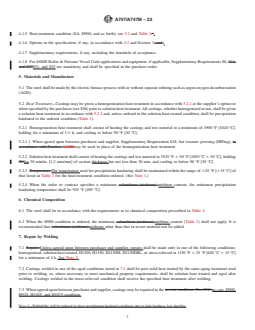
A,B
TABLE 1 Precipitation Hardening Heat Treatment
C
Time in hours, Cooling
PH Temperature,
Condition
°F [°C]
minimum Treatment
SA Not precipitation hardened (see 5.2.3)
Solution heat Not precipitation hardened
treated
H900 900 [480] 1.5 air cool
H925 925 [495] 1.5 air cool
H1025 1025 [550] 4.0 air cool
H1075 1075 [580] 4.0 air cool
H1100 1100 [595] 4.0 air cool
H1150 1150 [620] 4.0 air cool
H1150M 1400 [760] 2.0 air cool
1150 [620] 4.0 air cool
H1150 DBL 1150 [620] 4.0 air cool
1150 [620] 4.0 air cool
A
The furnace and controls used shall be calibrated and capable of uniformity of
heating in order to ensure consistent results.
B
See Note 1.
C
±25 °F [15 °C].
For referenced ASTM standards, visit the ASTM website, www.astm.org, or contact ASTM Customer Service at service@astm.org. For Annual Book of ASTM Standards
volume information, refer to the standard’s Document Summary page on the ASTM website.
Available from American Society of Mechanical Engineers (ASME), ASME International Headquarters, Three Park Ave., New York, NY 10016-5990, http://
www.asme.org.
A747/A747M − 23
4.1.5 Heat-treatment condition (SA, H900, and so forth); see 5.2 and Table 1, .
4.1.6 Options in the specification, if any, in accordance with 5.2 and Section 7, and .
4.1.7 Supplementary requirements, if any, including the standards of acceptance.
4.1.8 For ASME Boiler & Pressure Vessel Code applications and equipment, if applicable, Supplementary Requirements S6, S14,
and S27S51, and S52 are mandatory and shall be specified in the purchase order.
5. Materials and Manufacture
5.1 The steel shall be made by the electric furnace process with or without separate refining such as argon-oxygen decarburization
(AOD).
5.2 Heat Treatment—Castings may be given a homogenization heat treatment in accordance with 5.2.1 at the supplier’s option or
when specified by the purchaser (see S56) prior to solution heat treatment. All castings, whether homogenized or not, shall be given
a solution heat treatment in accordance with 5.2.2 and, unless ordered in the solution heat-treated condition, shall be precipitation
hardened to the ordered condition (Table 1).
5.2.1 Homogenization heat treatment shall consist of heating the castings and test material to a minimum of 1900 °F [1040 °C],
holding for a minimum of 1 ⁄2 h, and cooling to below 90 °F [30 °C].
5.2.1.1 When agreed upon between purchaser and supplier, Supplementary Requirement S18, hot isostatic pressing (HIPing), in
accordance with Practice A1080may be used in place of the homogenization heat treatment.
5.2.2 Solution heat treatment shall consist of heating the castings and test material to 1925 °F 6 50 °F [1050 °C 6 30 °C], holding
thefor 30 min/in. [1.2 min/mm] of section thickness but not less than 30 min, and cooling to below 90 °F [30 °C].
5.2.3 Temperature The temperature used for precipitation hardening shall be maintained within the range of 625 °F [615 °C] of
that listed in Table 1 for the heat-treatment condition ordered. (See Note 1.)
5.2.4 When the order or contract specifies a minimum columbium (niobium) niobium content, the minimum precipitation
hardening temperature shall be 925 °F [495 °C].
6. Chemical Composition
6.1 The steel shall be in accordance with the requirements as to chemical composition prescribed in Table 2.
6.2 When the H900 condition is ordered, the minimum columbium (niobium) niobium content (Table 2) shall not apply. It is
recommended that columbium (niobium) niobium other than that in revert material not be added.
7. Repair by Welding
7.1 Repairs Unless agreed upon between purchaser and supplier, repairs shall be made only in one of the following conditions:
homogenized, solution heat treated, H1100, H1150, H1150M, H1150DBL, or stress relieved at 1150 °F 6 25 °F [620 °C 6 15 °C]
for a minimum of 4 h. See Note 2.
7.2 Castings welded in one of the aged conditions noted in 7.1 shall be post-weld heat treated by the same aging treatment used
prior to welding, or, where necessary to meet mechanical property requirements, shall be solution heat treated and aged after
welding. Castings welded in the stress-relieved condition shall receive the specified heat treatment after welding.
7.3 When agreed upon between purchaser and supplier, castings may be repaired in the as-cast condition. (See S58.)as-cast, H900,
H925, H1025, and H1075 condition.
NOTE 2—Weldability will be reduced in these precipitation-hardened conditions due to high hardness, low ductility.
A747/A747M − 23
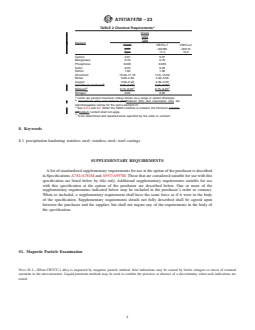
A
TABLE 2 Chemical Requirements
Grade
UNS
Type
Element
Grade CB7Cu-1 CB7Cu-2
UNS J92180 J92110
Type 17-4 15-5
Carbon 0.07 0.07
Manganese 0.70 0.70
Phosphorus 0.035 0.035
Sulfu
...