

ASTM A217/A217M-22
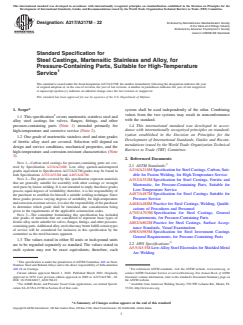
(Specification)Standard Specification for Steel Castings, Martensitic Stainless and Alloy, for Pressure-Containing Parts, Suitable for High-Temperature Service
General Information
- Abstract
ABSTRACT
This specification covers steel castings, martensitic stainless steel and alloys steel castings for valves, flanges, fittings, and other pressure-containing parts intended primarily for high-temperature and corrosive service. The grades of steels covered here are: Grade WC1, Grade WC4, Grade WC5, Grade WC6, Grade WC9, Grade WC11, Grade C5, Grade C12, Grade C12A, and Grade CA15. Heat treatment shall consist of normalizing and tempering for Grade C12A and tempering for all other grades. Heat treatments shall be performed after castings have been allowed to cool. Heat and product analyses shall be performed wherein specimens shall conform to required chemical composition of carbon, molybdenum, chromium, nickel, vanadium, manganese, phosphorus, sulfur, silicon, columbium, nitrogen, aluminum, copper, titanium, tungsten, and zirconium. The surface of the casting shall be examined visually and shall be free of adhering sand, scale, cracks and hot tears. Steels shall undergo tension test, and shall conform to the following mechanical requirements: tensile strength, yield strength, elongation, and reduction of area.
SCOPE
1.1 This specification2 covers martensitic stainless steel and alloy steel castings for valves, flanges, fittings, and other pressure-containing parts (Note 1) intended primarily for high-temperature and corrosive service (Note 2).
1.2 One grade of martensitic stainless steel and nine grades of ferritic alloy steel are covered. Selection will depend on design and service conditions, mechanical properties, and the high-temperature and corrosion-resistant characteristics (Note 3).
Note 1: Carbon steel castings for pressure-containing parts are covered by Specification A216/A216M. Low alloy quench-and-tempered grades equivalent to Specification A217/A217M grades may be found in both Specifications A352/A352M and A487/A487M.
Note 2: The grades covered by this specification represent materials that are generally suitable for assembly with other castings or wrought steel parts by fusion welding. It is not intended to imply that these grades possess equal degrees of weldability; therefore, it is the responsibility of the purchaser to establish for himself a suitable welding technique. Since these grades possess varying degrees of suitability for high-temperature and corrosion-resistant service, it is also the responsibility of the purchaser to determine which grade shall be furnished, due consideration being given to the requirements of the applicable construction codes.
Note 3: The committee formulating this specification has included nine grades of materials that are considered to represent basic types of ferritic alloy steels suitable for valves, flanges, fittings, and other pressure-containing parts. Additional alloy steels that may better fulfill certain types of service will be considered for inclusion in this specification by the committee as the need becomes apparent.
1.3 The values stated in either SI units or inch-pound units are to be regarded separately as standard. The values stated in each system may not be exact equivalents; therefore, each system shall be used independently of the other. Combining values from the two systems may result in nonconformance with the standard.
1.4 This international standard was developed in accordance with internationally recognized principles on standardization established in the Decision on Principles for the Development of International Standards, Guides and Recommendations issued by the World Trade Organization Technical Barriers to Trade (TBT) Committee.
- Status
- Published
- Publication Date
- 28-Feb-2022
- Technical Committee
- A01 - Steel, Stainless Steel and Related Alloys
- Drafting Committee
- A01.18 - Castings
Buy Documents
ASTM A217/A217M-22 - Standard Specification for Steel Castings, Martensitic Stainless and Alloy, for Pressure-Containing Parts, Suitable for High-Temperature Service
REDLINE ASTM A217/A217M-22 - Standard Specification for Steel Castings, Martensitic Stainless and Alloy, for Pressure-Containing Parts, Suitable for High-Temperature Service
Overview
ASTM A217/A217M-22 is a standard specification developed by ASTM International for steel castings made from martensitic stainless and alloy steel. These castings are intended for pressure-containing parts-such as valves, flanges, and fittings-primarily used in high-temperature and corrosive service environments. The specification addresses a range of steel grades, performance criteria, heat treatments, and quality requirements, making it a widely-referenced document in industries such as power generation, oil and gas, and petrochemicals.
This standard is endorsed by organizations like the Manufacturers Standardization Society and the American Foundrymen’s Society, and is recognized in major industry codes, including those by the U.S. Department of Defense and ASME Boiler and Pressure Vessel Code.
Key Topics
- Material Grades: Covers one grade of martensitic stainless steel (CA15) and nine grades of ferritic alloy steel (WC1, WC4, WC5, WC6, WC9, WC11, C5, C12, C12A).
- Design Criteria: Steel grade selection depends on design conditions, mechanical properties, corrosion resistance, and high-temperature performance.
- Heat Treatment: Specifies required treatments such as normalizing, tempering, and for certain grades, accelerated cooling. Heat treatment must be completed after allowed cooling.
- Chemical Composition: Mandates strict adherence to specified chemical limits on carbon, molybdenum, chromium, nickel, vanadium, manganese, phosphorus, sulfur, silicon, and other alloying elements.
- Mechanical Properties: Requires minimum standards for tensile strength, yield strength, elongation, and reduction of area, varying by grade.
- Surface Quality and Inspection: Castings must be free from defects like cracks, adhering sand, and hot tears, and are subject to visual, ultrasonic, magnetic particle, or radiographic inspections as determined by the purchaser.
- Weldability: While compatible with fusion welding, weldability varies by grade and the responsibility for determining appropriate welding techniques lies with the purchaser.
- Supplementary Requirements: Includes options for enhanced chemical limits, post-weld heat treatment, additional non-destructive testing, and specialized requirements upon agreement.
Applications
ASTM A217/A217M-22 steel castings are widely used for:
- Valves: Pressure-containing valve bodies and components for steam, gas, and chemical service.
- Flanges: Connection points in piping systems exposed to high temperature and corrosive conditions.
- Fittings: Elbows, tees, reducers, and other fittings in power plants and process industries.
- Components for High-Temperature Service: Including critical parts in refineries, petrochemical plants, and power stations, especially in steam and hot-gas lines.
These castings are chosen for their robust mechanical properties at elevated temperatures and excellent resistance to corrosion and oxidation, ensuring reliability and safety in demanding operational environments.
Related Standards
For complementary requirements, users should consult:
- ASTM A216/A216M: Standard for carbon steel castings for pressure-containing parts in high-temperature service.
- ASTM A352/A352M: Covers ferritic and martensitic steel castings for low-temperature applications.
- ASTM A487/A487M: Specification for steel castings suitable for pressure service.
- ASTM A703/A703M: General requirements for steel castings used in pressure applications.
- ASME SA-217/SA-217M: The corresponding ASME standard for boiler and pressure vessel applications.
- AWS Welding Standards: Specifications for appropriate welding electrodes and processes for alloy and stainless steel castings.
- ASTM A802/A802M & A985/A985M: Standards for visual acceptance, inspection, and general requirements for investment castings.
By adhering to ASTM A217/A217M-22, manufacturers and end-users can ensure the performance, safety, and consistency necessary for critical pressure-containing steel castings used in challenging industrial environments.
Relations
- Effective Date
- 01-Mar-2024
- Effective Date
- 01-Mar-2019
- Effective Date
- 01-Sep-2018
- Effective Date
- 01-Sep-2018
- Effective Date
- 01-Jul-2018
- Effective Date
- 01-Jul-2018
- Effective Date
- 15-Jun-2018
- Effective Date
- 15-May-2018
- Effective Date
- 01-May-2018
- Effective Date
- 01-Nov-2017
- Effective Date
- 01-Nov-2017
- Effective Date
- 01-May-2017
- Effective Date
- 01-May-2017
- Effective Date
- 01-Dec-2016
- Effective Date
- 01-Mar-2016
Buy Documents
ASTM A217/A217M-22 - Standard Specification for Steel Castings, Martensitic Stainless and Alloy, for Pressure-Containing Parts, Suitable for High-Temperature Service
REDLINE ASTM A217/A217M-22 - Standard Specification for Steel Castings, Martensitic Stainless and Alloy, for Pressure-Containing Parts, Suitable for High-Temperature Service
Get Certified
Connect with accredited certification bodies for this standard

Element Materials Technology
Materials testing and product certification.

Inštitut za kovinske materiale in tehnologije
Institute of Metals and Technology. Materials testing, metallurgical analysis, NDT.
Sponsored listings
Frequently Asked Questions
ASTM A217/A217M-22 is a technical specification published by ASTM International. Its full title is "Standard Specification for Steel Castings, Martensitic Stainless and Alloy, for Pressure-Containing Parts, Suitable for High-Temperature Service". This standard covers: ABSTRACT This specification covers steel castings, martensitic stainless steel and alloys steel castings for valves, flanges, fittings, and other pressure-containing parts intended primarily for high-temperature and corrosive service. The grades of steels covered here are: Grade WC1, Grade WC4, Grade WC5, Grade WC6, Grade WC9, Grade WC11, Grade C5, Grade C12, Grade C12A, and Grade CA15. Heat treatment shall consist of normalizing and tempering for Grade C12A and tempering for all other grades. Heat treatments shall be performed after castings have been allowed to cool. Heat and product analyses shall be performed wherein specimens shall conform to required chemical composition of carbon, molybdenum, chromium, nickel, vanadium, manganese, phosphorus, sulfur, silicon, columbium, nitrogen, aluminum, copper, titanium, tungsten, and zirconium. The surface of the casting shall be examined visually and shall be free of adhering sand, scale, cracks and hot tears. Steels shall undergo tension test, and shall conform to the following mechanical requirements: tensile strength, yield strength, elongation, and reduction of area. SCOPE 1.1 This specification2 covers martensitic stainless steel and alloy steel castings for valves, flanges, fittings, and other pressure-containing parts (Note 1) intended primarily for high-temperature and corrosive service (Note 2). 1.2 One grade of martensitic stainless steel and nine grades of ferritic alloy steel are covered. Selection will depend on design and service conditions, mechanical properties, and the high-temperature and corrosion-resistant characteristics (Note 3). Note 1: Carbon steel castings for pressure-containing parts are covered by Specification A216/A216M. Low alloy quench-and-tempered grades equivalent to Specification A217/A217M grades may be found in both Specifications A352/A352M and A487/A487M. Note 2: The grades covered by this specification represent materials that are generally suitable for assembly with other castings or wrought steel parts by fusion welding. It is not intended to imply that these grades possess equal degrees of weldability; therefore, it is the responsibility of the purchaser to establish for himself a suitable welding technique. Since these grades possess varying degrees of suitability for high-temperature and corrosion-resistant service, it is also the responsibility of the purchaser to determine which grade shall be furnished, due consideration being given to the requirements of the applicable construction codes. Note 3: The committee formulating this specification has included nine grades of materials that are considered to represent basic types of ferritic alloy steels suitable for valves, flanges, fittings, and other pressure-containing parts. Additional alloy steels that may better fulfill certain types of service will be considered for inclusion in this specification by the committee as the need becomes apparent. 1.3 The values stated in either SI units or inch-pound units are to be regarded separately as standard. The values stated in each system may not be exact equivalents; therefore, each system shall be used independently of the other. Combining values from the two systems may result in nonconformance with the standard. 1.4 This international standard was developed in accordance with internationally recognized principles on standardization established in the Decision on Principles for the Development of International Standards, Guides and Recommendations issued by the World Trade Organization Technical Barriers to Trade (TBT) Committee.
ABSTRACT This specification covers steel castings, martensitic stainless steel and alloys steel castings for valves, flanges, fittings, and other pressure-containing parts intended primarily for high-temperature and corrosive service. The grades of steels covered here are: Grade WC1, Grade WC4, Grade WC5, Grade WC6, Grade WC9, Grade WC11, Grade C5, Grade C12, Grade C12A, and Grade CA15. Heat treatment shall consist of normalizing and tempering for Grade C12A and tempering for all other grades. Heat treatments shall be performed after castings have been allowed to cool. Heat and product analyses shall be performed wherein specimens shall conform to required chemical composition of carbon, molybdenum, chromium, nickel, vanadium, manganese, phosphorus, sulfur, silicon, columbium, nitrogen, aluminum, copper, titanium, tungsten, and zirconium. The surface of the casting shall be examined visually and shall be free of adhering sand, scale, cracks and hot tears. Steels shall undergo tension test, and shall conform to the following mechanical requirements: tensile strength, yield strength, elongation, and reduction of area. SCOPE 1.1 This specification2 covers martensitic stainless steel and alloy steel castings for valves, flanges, fittings, and other pressure-containing parts (Note 1) intended primarily for high-temperature and corrosive service (Note 2). 1.2 One grade of martensitic stainless steel and nine grades of ferritic alloy steel are covered. Selection will depend on design and service conditions, mechanical properties, and the high-temperature and corrosion-resistant characteristics (Note 3). Note 1: Carbon steel castings for pressure-containing parts are covered by Specification A216/A216M. Low alloy quench-and-tempered grades equivalent to Specification A217/A217M grades may be found in both Specifications A352/A352M and A487/A487M. Note 2: The grades covered by this specification represent materials that are generally suitable for assembly with other castings or wrought steel parts by fusion welding. It is not intended to imply that these grades possess equal degrees of weldability; therefore, it is the responsibility of the purchaser to establish for himself a suitable welding technique. Since these grades possess varying degrees of suitability for high-temperature and corrosion-resistant service, it is also the responsibility of the purchaser to determine which grade shall be furnished, due consideration being given to the requirements of the applicable construction codes. Note 3: The committee formulating this specification has included nine grades of materials that are considered to represent basic types of ferritic alloy steels suitable for valves, flanges, fittings, and other pressure-containing parts. Additional alloy steels that may better fulfill certain types of service will be considered for inclusion in this specification by the committee as the need becomes apparent. 1.3 The values stated in either SI units or inch-pound units are to be regarded separately as standard. The values stated in each system may not be exact equivalents; therefore, each system shall be used independently of the other. Combining values from the two systems may result in nonconformance with the standard. 1.4 This international standard was developed in accordance with internationally recognized principles on standardization established in the Decision on Principles for the Development of International Standards, Guides and Recommendations issued by the World Trade Organization Technical Barriers to Trade (TBT) Committee.
ASTM A217/A217M-22 is classified under the following ICS (International Classification for Standards) categories: 77.140.80 - Iron and steel castings. The ICS classification helps identify the subject area and facilitates finding related standards.
ASTM A217/A217M-22 has the following relationships with other standards: It is inter standard links to ASTM A488/A488M-24, ASTM A985/A985M-19, ASTM A985/A985M-18a, ASTM A703/A703M-18a, ASTM A488/A488M-18, ASTM A488/A488M-18e1, ASTM A352/A352M-18, ASTM A985/A985M-18, ASTM A703/A703M-18, ASTM A703/A703M-17a, ASTM A352/A352M-17, ASTM A488/A488M-17, ASTM A703/A703M-17, ASTM A985/A985M-16, ASTM A488/A488M-16. Understanding these relationships helps ensure you are using the most current and applicable version of the standard.
ASTM A217/A217M-22 is available in PDF format for immediate download after purchase. The document can be added to your cart and obtained through the secure checkout process. Digital delivery ensures instant access to the complete standard document.
Standards Content (Sample)
This international standard was developed in accordance with internationally recognized principles on standardization established in the Decision on Principles for the
Development of International Standards, Guides and Recommendations issued by the World Trade Organization Technical Barriers to Trade (TBT) Committee.
Designation:A217/A217M −22 Endorsed by Manufacturers Standardization Society
of the Valve and Fittings Industry
Endorsed by American Foundrymen’s Society
Used in USDOE-NE Standards
Standard Specification for
Steel Castings, Martensitic Stainless and Alloy, for
Pressure-Containing Parts, Suitable for High-Temperature
Service
This standard is issued under the fixed designationA217/A217M; the number immediately following the designation indicates the year
of original adoption or, in the case of revision, the year of last revision. A number in parentheses indicates the year of last reapproval.
A superscript epsilon (´) indicates an editorial change since the last revision or reapproval.
This standard has been approved for use by agencies of the U.S. Department of Defense.
1. Scope* system shall be used independently of the other. Combining
2 values from the two systems may result in nonconformance
1.1 This specification covers martensitic stainless steel and
with the standard.
alloy steel castings for valves, flanges, fittings, and other
1.4 This international standard was developed in accor-
pressure-containing parts (Note 1) intended primarily for
dance with internationally recognized principles on standard-
high-temperature and corrosive service (Note 2).
ization established in the Decision on Principles for the
1.2 One grade of martensitic stainless steel and nine grades
Development of International Standards, Guides and Recom-
of ferritic alloy steel are covered. Selection will depend on
mendations issued by the World Trade Organization Technical
design and service conditions, mechanical properties, and the
Barriers to Trade (TBT) Committee.
high-temperature and corrosion-resistant characteristics (Note
3).
2. Referenced Documents
NOTE 1—Carbon steel castings for pressure-containing parts are cov-
2.1 ASTM Standards:
ered by Specification A216/A216M. Low alloy quench-and-tempered
A216/A216M SpecificationforSteelCastings,Carbon,Suit-
grades equivalent to Specification A217/A217M grades may be found in
both Specifications A352/A352M and A487/A487M. able for Fusion Welding, for High-Temperature Service
NOTE 2—The grades covered by this specification represent materials
A352/A352M Specification for Steel Castings, Ferritic and
that are generally suitable for assembly with other castings or wrought
Martensitic, for Pressure-Containing Parts, Suitable for
steel parts by fusion welding. It is not intended to imply that these grades
Low-Temperature Service
possess equal degrees of weldability; therefore, it is the responsibility of
A487/A487M Specification for Steel Castings Suitable for
the purchaser to establish for himself a suitable welding technique. Since
these grades possess varying degrees of suitability for high-temperature
Pressure Service
andcorrosion-resistantservice,itisalsotheresponsibilityofthepurchaser
A488/A488M Practice for Steel Castings, Welding, Qualifi-
to determine which grade shall be furnished, due consideration being
cations of Procedures and Personnel
given to the requirements of the applicable construction codes.
A703/A703M Specification for Steel Castings, General
NOTE 3—The committee formulating this specification has included
nine grades of materials that are considered to represent basic types of Requirements, for Pressure-Containing Parts
ferriticalloysteelssuitableforvalves,flanges,fittings,andotherpressure-
A802/A802M Practice for Steel Castings, Surface Accep-
containingparts.Additionalalloysteelsthatmaybetterfulfillcertaintypes
tance Standards, Visual Examination
of service will be considered for inclusion in this specification by the
A985/A985M Specification for Steel Investment Castings
committee as the need becomes apparent.
General Requirements, for Pressure-Containing Parts
1.3 The values stated in either SI units or inch-pound units
2.2 AWS Specifications:
are to be regarded separately as standard. The values stated in
A5.5/A5.5M Low-Alloy Steel Electrodes for Shielded Metal
each system may not be exact equivalents; therefore, each
Arc Welding
This specification is under the jurisdiction ofASTM Committee A01 on Steel,
Stainless Steel and Related Alloys and is the direct responsibility of Subcommittee
A01.18 on Castings. For referenced ASTM standards, visit the ASTM website, www.astm.org, or
Current edition approved March 1, 2022. Published March 2022. Originally contact ASTM Customer Service at service@astm.org. For Annual Book of ASTM
approved in 1939. Last previous edition approved in 2020 as A217/A217M – 20. Standards volume information, refer to the standard’s Document Summary page on
DOI: 10.1520/A0217_A0217M-22. the ASTM website.
2 4
For ASME Boiler and Pressure Vessel Code applications, see related Specifi- Available from American Welding Society, 550 NW LeJuene Rd., Miami, FL
cation SA-217/SA 217M in Section II of that code. 33126, http://www.aws.org.
*A Summary of Changes section appears at the end of this standard
Copyright © ASTM International, 100 Barr Harbor Drive, PO Box C700, West Conshohocken, PA 19428-2959. United States
A217/A217M−22
A5.23/A5.23M Low-Alloy Steel Electrodes and Fluxes for 4.1.1 A description of the casting by pattern number or
Submerged Arc Welding drawing (dimensional tolerances shall be included on the
A5.28/A5.28M Low-Alloy Steel Electrodes and Rods for casting drawing),
Gas Shielded Arc Welding 4.1.2 Grade of steel,
A5.29/A5.29M Low-Alloy Steel Electrodes for Flux Cored
4.1.3 Options in the specification,
Arc Welding 4.1.4 Whether the castings are to be produced using the
investment casting process, and
3. General Conditions for Delivery
4.1.5 The supplementary requirements desired, including
the standards of acceptance.
3.1 Except for investment castings, castings furnished to
this specification shall conform to the requirements of Speci-
5. Heat Treatment
fication A703/A703M, including any supplementary require-
ments that are indicated in the purchase order. Failure to
5.1 Allcastingsshallreceiveaheattreatmentpropertotheir
comply with the general requirements of Specification A703/
design and chemical composition.
A703M constitutes nonconformance with this specification. In
5.2 Castings shall be furnished in the normalized and
case of conflict between the requirements of this specification
tempered conditions; Grades WC1, WC4, WC5, WC6, and
and Specification A703/A703M, this specification shall pre-
CA15 shall be tempered at 1100 °F [595 °C] min; Grades
vail.
WC9, C5, C12, and WC11 shall be tempered at 1250 °F
3.2 Steel investment castings furnished to this specification
[675 °C] min; Grade C12Ashall be thermally treated, either by
shall conform to the requirements of Specification A985/
normalizing and tempering or by accelerated cooling from the
A985M, including any supplementary requirements that are
austenitizing temperature by air blasting or liquid quenching,
indicated in the purchase order. Failure to comply with the
followed by tempering. C12A castings shall be austenitized at
general requirements of Specification A985/A985M consti-
1900 to 1975 °F [1040 to 1080 °C] and tempered at 1350 to
tutes nonconformance with this specification. In case of con-
1470 °F [730 to 800 °C].
flict between the requirements of this specification and Speci-
5.3 Heat treatment shall be performed after castings have
fication A985/A985M, Specification A985/A985M shall
been allowed to cool below the transformation range.
prevail.
4. Ordering Information 6. Chemical Composition
4.1 The inquiry and order should include or indicate the 6.1 The steel shall be in accordance with the requirements
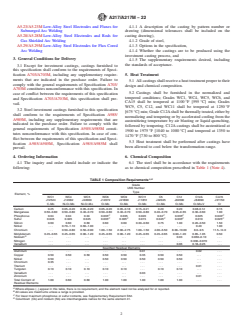
following: as to chemical composition prescribed in Table 1 (Note 4).
A,B
TABLE 1 Composition Requirements
Grade
UNS Number
Type
Element, %
WC1 WC4 WC5 WC6 WC9 WC11 C5 C12 C12A CA15
J12524 J12082 J22000 J12072 J21890 J11872 J42045 J82090 J84090 J91150
C-Mo Ni-Cr-Mo Ni-Cr-Mo Cr-Mo Cr-Mo Cr-Mo Cr-Mo Cr-Mo Cr-Mo-V Cr
Carbon 0.25 0.05–0.20 0.05–0.20 0.05–0.20 0.05–0.18 0.15–0.21 0.20 0.20 0.08-0.12 0.15
Manganese 0.50–0.80 0.50–0.80 0.40–0.70 0.50–0.80 0.40–0.70 0.50–0.80 0.40–0.70 0.35–0.65 0.30–0.60 1.00
C C C C
Phosphorus 0.04 0.04 0.04 0.035 0.035 0.020 0.04 0.035 0.025 0.040
C C C C C
Sulfur 0.045 0.045 0.045 0.035 0.035 0.015 0.045 0.035 0.010 0.025
Silicon 0.60 0.60 0.60 0.60 0.60 0.30–0.60 0.75 1.00 0.20–0.50 1.50
Nickel . . . 0.70–1.10 0.60–1.00 . . . . . . . . . . . . . . . 0.40 1.00
Chromium . . . 0.50–0.80 0.50–0.90 1.00–1.50 2.00–2.75 1.00–1.50 4.00–6.50 8.00–10.00 8.0–9.5 11.5–14.0
Molybdenum 0.45–0.65 0.45–0.65 0.90–1.20 0.45–0.65 0.90–1.20 0.45–0.65 0.45–0.65 0.90–1.20 0.85–1.05 0.50
D
Niobium . . . . . . . . . . . . . . . . . . . . . 0.03 0.060–0.10 . . .
Nitrogen . . . . . . . . . . . . . . . . . . . . . . . . 0.030–0.070 . . .
Vanadium . . . . . . . . . . . . . . . . . . . . . 0.06 0.18–0.25 . . .
Specified Residual Elements
Aluminum . . . . . 0.01 . . 0.02 .
Copper 0.50 0.50 0.50 0.50 0.50 0.35 0.50 0.50 . . . . . .
Nickel 0.50 . . . . . . 0.50 0.50 0.50 0.50 0.50 . . . . . .
Chromium 0.35 . . . . . . . . .
Titanium . . . . . . . . 0.01 .
Tungsten 0.10 0.10 0.10 0.10 0.10 . . . 0.10 0.10 . . . . . .
Vanadium . . . . . . . . . . . . . . . 0.03 . . . . . . . . . . . .
Zirconium . . . . . . . . . . . . . . . . . . . . . . . . 0.01 . . .
Total Content of 1.00 0.60 0.60 1.00 1.00 1.00 1.00 1.00 . . . . . .
Residual Elements
A
Where ellipses ({) appear in this table, there is no requirement, and the element need not be analyzed for or reported.
B
All values are maximums unless a range is provided.
C
For lower maximum phosphorus or sulfur contents, see Supplementary Requirement S52.
D
Columbium (Cb) and niobium (Nb) are interchangeable names for the same element
...
This document is not an ASTM standard and is intended only to provide the user of an ASTM standard an indication of what changes have been made to the previous version. Because
it may not be technically possible to adequately depict all changes accurately, ASTM recommends that users consult prior editions as appropriate. In all cases only the current version
of the standard as published by ASTM is to be considered the official document.
Designation: A217/A217M − 20 A217/A217M − 22 Endorsed by Manufacturers Standardization Society
of the Valve and Fittings Industry
Endorsed by American Foundrymen’s Society
Used in USDOE-NE Standards
Standard Specification for
Steel Castings, Martensitic Stainless and Alloy, for
Pressure-Containing Parts, Suitable for High-Temperature
Service
This standard is issued under the fixed designation A217/A217M; the number immediately following the designation indicates the year
of original adoption or, in the case of revision, the year of last revision. A number in parentheses indicates the year of last reapproval.
A superscript epsilon (´) indicates an editorial change since the last revision or reapproval.
This standard has been approved for use by agencies of the U.S. Department of Defense.
1. Scope*
1.1 This specification covers martensitic stainless steel and alloy steel castings for valves, flanges, fittings, and other
pressure-containing parts (Note 1) intended primarily for high-temperature and corrosive service (Note 2).
1.2 One grade of martensitic stainless steel and nine grades of ferritic alloy steel are covered. Selection will depend on design and
service conditions, mechanical properties, and the high-temperature and corrosion-resistant characteristics (Note 3).
NOTE 1—Carbon steel castings for pressure-containing parts are covered by Specification A216/A216M. Low alloy quench-and-tempered grades
equivalent to Specification A217/A217M grades may be found in both Specifications A352/A352M and A487/A487M.
NOTE 2—The grades covered by this specification represent materials that are generally suitable for assembly with other castings or wrought steel parts
by fusion welding. It is not intended to imply that these grades possess equal degrees of weldability; therefore, it is the responsibility of the purchaser
to establish for himself a suitable welding technique. Since these grades possess varying degrees of suitability for high-temperature and corrosion-resistant
service, it is also the responsibility of the purchaser to determine which grade shall be furnished, due consideration being given to the requirements of
the applicable construction codes.
NOTE 3—The committee formulating this specification has included nine grades of materials that are considered to represent basic types of ferritic alloy
steels suitable for valves, flanges, fittings, and other pressure-containing parts. Additional alloy steels that may better fulfill certain types of service will
be considered for inclusion in this specification by the committee as the need becomes apparent.
1.3 The values stated in either SI units or inch-pound units are to be regarded separately as standard. The values stated in each
system may not be exact equivalents; therefore, each system shall be used independently of the other. Combining values from the
two systems may result in nonconformance with the standard.
1.4 This international standard was developed in accordance with internationally recognized principles on standardization
established in the Decision on Principles for the Development of International Standards, Guides and Recommendations issued
by the World Trade Organization Technical Barriers to Trade (TBT) Committee.
This specification is under the jurisdiction of ASTM Committee A01 on Steel, Stainless Steel and Related Alloys and is the direct responsibility of Subcommittee A01.18
on Castings.
Current edition approved May 1, 2020March 1, 2022. Published May 2020March 2022. Originally approved in 1939. Last previous edition approved in 20142020 as
A217/A217M – 14.A217/A217M – 20. DOI: 10.1520/A0217_A0217M-20.10.1520/A0217_A0217M-22.
For ASME Boiler and Pressure Vessel Code applications, see related Specification SA-217/SA 217M in Section II of that code.
*A Summary of Changes section appears at the end of this standard
Copyright © ASTM International, 100 Barr Harbor Drive, PO Box C700, West Conshohocken, PA 19428-2959. United States
A217/A217M − 22
2. Referenced Documents
2.1 ASTM Standards:
A216/A216M Specification for Steel Castings, Carbon, Suitable for Fusion Welding, for High-Temperature Service
A352/A352M Specification for Steel Castings, Ferritic and Martensitic, for Pressure-Containing Parts, Suitable for Low-
Temperature Service
A487/A487M Specification for Steel Castings Suitable for Pressure Service
A488/A488M Practice for Steel Castings, Welding, Qualifications of Procedures and Personnel
A703/A703M Specification for Steel Castings, General Requirements, for Pressure-Containing Parts
A802/A802M Practice for Steel Castings, Surface Acceptance Standards, Visual Examination
A985/A985M Specification for Steel Investment Castings General Requirements, for Pressure-Containing Parts
2.2 AWS Specifications:
A5.5/A5.5M Low-Alloy Steel Electrodes for Shielded Metal Arc Welding
A5.23/A5.23M Low-Alloy Steel Electrodes and Fluxes for Submerged Arc Welding
A5.28/A5.28M Low Alloy Low-Alloy Steel Electrodes and Rods for Gas Shielded Arc Welding
A5.29/A5.29M Low-Alloy Steel Electrodes for Flux Cored Arc Welding
3. General Conditions for Delivery
3.1 Except for investment castings, castings furnished to this specification shall conform to the requirements of Specification
A703/A703M, including any supplementary requirements that are indicated in the purchase order. Failure to comply with the
general requirements of Specification A703/A703M constitutes nonconformance with this specification. In case of conflict between
the requirements of this specification and Specification A703/A703M, this specification shall prevail.
3.2 Steel investment castings furnished to this specification shall conform to the requirements of Specification A985/A985M,
including any supplementary requirements that are indicated in the purchase order. Failure to comply with the general requirements
of Specification A985/A985M constitutes nonconformance with this specification. In case of conflict between the requirements of
this specification and Specification A985/A985M, Specification A985/A985M shall prevail.
4. Ordering Information
4.1 The inquiry and order should include or indicate the following:
4.1.1 A description of the casting by pattern number or drawing (dimensional tolerances shall be included on the casting drawing),
4.1.2 Grade of steel,
4.1.3 Options in the specification,
4.1.4 Whether the castings are to be produced using the investment casting process, and
4.1.5 The supplementary requirements desired, including the standards of acceptance.
5. Heat Treatment
5.1 All castings shall receive a heat treatment proper to their design and chemical composition.
5.2 Castings shall be furnished in the normalized and tempered conditions; Grades WC1, WC4, WC5, WC6, and CA15 shall be
tempered at 1100 °F [595 °C] min; Grades WC9, C5, C12, and WC11 shall be tempered at 1250 °F [675 °C] min; Grade C12A
shall be thermally treated, either by normalizing and tempering or by accelerated cooling from the austenitizing temperature by
air blasting or liquid quenching, followed by tempering. C12A castings shall be austenitized at 1900 to 1975 °F [1040 to 1080 °C]
and tempered at 1350 to 1470 °F [730 to 800 °C].
For referenced ASTM standards, visit the ASTM website, www.astm.org, or contact ASTM Customer Service at service@astm.org. For Annual Book of ASTM Standards
volume information, refer to the standard’s Document Summary page on the ASTM website.
Available from American Welding Society, 550 NW LeJuene Rd., Miami, FL 33126, http://www.aws.org.
A217/A217M − 22
5.3 Heat treatment shall be performed after castings have been allowed to cool below the transformation range.
6. Chemical Composition
6.1 The steel shall be in accordance with the requirements as to chemical composition prescribed in Table 1 (Note 4).
NOTE 4—The role of alloying elements in the development of Grade C12A has been extensively investigated. V and CbNb contribute to precipitation
strengthening by forming fine and coherent precipitation of M(C,N)X carbo-nitrides in the ferrite matrix. V also precipitates as VN during tempering or
during creep. The two elements are more effective in combination. Therefore, the addition of strong nitride-forming elements, those with a stronger affinity
for nitrogen than CbNb and V, as deoxidation agents, interferes with these high-temperature strengthening mechanisms.
7. Mechanical Properties
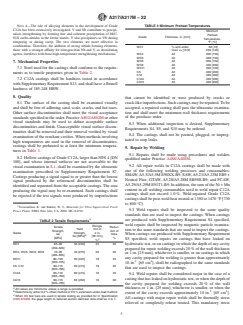
7.1 Steel used for the castings shall conform to the requirements as to tensile properties given in Table 2.
7.2 C12A castings shall be hardness tested in accordance with Supplementary Requirement S13, and shall have a Brinell hardness
of 185-248 HBW.
8. Quality
8.1 The surface of the casting shall be examined visually and shall be free of adhering sand, scale, cracks, and hot tears. Other
surface discontinuities shall meet the visual acceptance standards specified in the order. Practice A802/A802M or other visual
standards may be used to define acceptable surface discontinuities and finish. Unacceptable visual surface discontinuities shall be
removed and their removal verified by visual examination of the resultant cavities. When methods involving high temperatures are
used in the removal of discontinuities, castings shall be preheated to at least the minimum temperatures in Table 3.
A,B
TABLE 1 Composition Requirements
Grade
UNS Number
Type
Element, %
WC1 WC4 WC5 WC6 WC9 WC11 C5 C12 C12A CA15
J12524 J12082 J22000 J12072 J21890 J11872 J42045 J82090 J84090 J91150
C-Mo Ni-Cr-Mo Ni-Cr-Mo Cr-Mo Cr-Mo Cr-Mo Cr-Mo Cr-Mo Cr-Mo-V Cr
Carbon 0.25 0.05–0.20 0.05–0.20 0.05–0.20 0.05–0.18 0.15–0.21 0.20 0.20 0.08-0.12 0.15
Manganese 0.50–0.80 0.50–0.80 0.40–0.70 0.50–0.80 0.40–0.70 0.50–0.80 0.40–0.70 0.35–0.65 0.30–0.60 1.00
C C C C
Phosphorus 0.04 0.04 0.04 0.035 0.035 0.020 0.04 0.035 0.025 0.040
C C C C C
Sulfur 0.045 0.045 0.045 0.035 0.035 0.015 0.045 0.035 0.010 0.025
Silicon 0.60 0.60 0.60 0.60 0.60 0.30–0.60 0.75 1.00 0.20–0.50 1.50
N
...