

ASTM A356/A356M-21
(Specification)Standard Specification for Steel Castings, Carbon, Low Alloy, and Stainless Steel, Heavy-Walled for Steam Turbines
General Information
- Abstract
ABSTRACT
This specification covers one grade of martensitic stainless steel and several grades of ferritic steel castings for cylindrical (shells), valve chests, throttle valves, and other heavy-walled castings for steam turbine applications. The steel shall be made by the open-hearth or electric-furnace process. Deoxidation of the carbon and low-alloy steel grades shall be by manganese and silicon. The castings shall be heat treated in either the normalized, tempered, or stress-relieved conditions. Mechanical properties such as tensile strength, yield strength, and elongation shall be determined by subjecting the specimens to a tension test.
SCOPE
1.1 This specification covers one grade of martensitic stainless steel and several grades of ferritic steel castings for cylinders (shells), valve chests, throttle valves, and other heavy-walled castings for steam turbine applications.
1.2 The values stated in either SI units or inch-pound units are to be regarded separately as standard. The values stated in each system may not be exact equivalents; therefore, each system shall be used independently of the other. Combining values from the two systems may result in nonconformance with the standard.
1.2.1 Within the text, the SI units are shown in brackets.
1.3 This international standard was developed in accordance with internationally recognized principles on standardization established in the Decision on Principles for the Development of International Standards, Guides and Recommendations issued by the World Trade Organization Technical Barriers to Trade (TBT) Committee.
- Status
- Published
- Publication Date
- 30-Apr-2021
- Technical Committee
- A01 - Steel, Stainless Steel and Related Alloys
- Drafting Committee
- A01.18 - Castings
Buy Documents
ASTM A356/A356M-21 - Standard Specification for Steel Castings, Carbon, Low Alloy, and Stainless Steel, Heavy-Walled for Steam Turbines
REDLINE ASTM A356/A356M-21 - Standard Specification for Steel Castings, Carbon, Low Alloy, and Stainless Steel, Heavy-Walled for Steam Turbines
Overview
ASTM A356/A356M-21: Standard Specification for Steel Castings, Carbon, Low Alloy, and Stainless Steel, Heavy-Walled for Steam Turbines establishes the material and mechanical requirements for heavy-walled steel castings used in steam turbine components. Published by ASTM International, this standard covers one grade of martensitic stainless steel and several ferritic steel grades, focusing on castings fabricated for cylinders, valve chests, throttle valves, and similarly demanding steam turbine parts. The specification defines both SI and inch-pound units, ensuring international relevance and application.
Key Topics
- Material Grades Covered: Includes carbon steel, various low-alloy steels, and a grade of martensitic stainless steel suitable for high-performance and heavy-section turbine components.
- Steelmaking and Deoxidation: Steel must be produced by open-hearth or electric-furnace process. Deoxidation for carbon and low-alloy grades is carried out with manganese and silicon, with further options for vacuum and specific deoxidizer restrictions.
- Heat Treatment: Specifies normalizing, tempering, and stress-relieving as required heat-treatments to achieve desired mechanical properties for each grade.
- Mechanical Properties: Requires castings to be tested for tensile strength, yield strength, elongation, and reduction of area to ensure durability and safety in service.
- Inspection and Testing: Outlines requirements for tension testing, specimen selection, number of tests per lot, and potential rehearing procedures.
- Welding and Repairs: Addresses weld qualification per ASTM A488/A488M and details inspection and heat treatment requirements for welds and repairs to maintain integrity.
- Quality Assurance: Emphasizes inspection accessibility, marking and traceability, and surface finish requirements using referenced standards such as MSS SP-55.
Applications
Steel castings that comply with ASTM A356/A356M-21 are essential in the construction and maintenance of steam turbines for power generation plants and industrial processes. Its scope includes:
- Cylinders (Shells): Thick-section pressure-retaining or structural cases for turbines.
- Valve Chests and Throttle Valves: Components where material integrity ensures operational reliability under high steam pressure and temperature.
- Other Heavy-Walled Castings: Any large, stress-critical part subject to thermal cycling and high mechanical loads in turbine systems.
These high-specification steel castings are selected to withstand demanding service conditions, prevent failure, and ensure long-term turbine safety and efficiency.
Related Standards
ASTM A356/A356M-21 references several industry standards critical for material testing and inspection:
- ASTM A370 - Mechanical Testing of Steel Products
- ASTM A488/A488M - Welding Qualification for Steel Castings
- ASTM A941 - Terminology for Steel, Stainless Steel, and Related Alloys
- ASTM E709 - Guide for Magnetic Particle Testing
- ASTM E94/E94M - Radiographic Examination Guidelines
- ASTM E125 - Magnetic Particle Indication Reference Photographs for Castings
- ASTM E165/E165M - Liquid Penetrant Testing
- ASTM E186 / E280 / E446 - Reference Radiographs for Steel Castings of various thicknesses
- MSS SP-55 - Visual Inspection of Steel Castings for Piping Components
These related standards help ensure that steel castings produced under ASTM A356/A356M-21 fulfill stringent quality, inspection, and reliability requirements for critical turbine applications.
Keywords: ASTM A356/A356M-21, heavy-walled steel castings, steam turbine components, carbon steel, low-alloy steel, stainless steel castings, mechanical testing, quality assurance, power generation, valve chests, turbine cylinders, industry standards, inspection.
Relations
- Effective Date
- 01-Mar-2024
- Effective Date
- 01-Mar-2024
- Effective Date
- 01-Mar-2024
- Effective Date
- 01-Jul-2019
- Effective Date
- 01-Jul-2018
- Effective Date
- 01-Jul-2018
- Refers
ASTM A370-17a - Standard Test Methods and Definitions for Mechanical Testing of Steel Products - Effective Date
- 15-Nov-2017
- Effective Date
- 01-Sep-2017
- Effective Date
- 01-May-2017
- Effective Date
- 01-Jan-2017
- Effective Date
- 01-Mar-2016
- Effective Date
- 01-Nov-2015
- Effective Date
- 01-Nov-2015
- Effective Date
- 15-May-2014
- Effective Date
- 15-Nov-2013
Buy Documents
ASTM A356/A356M-21 - Standard Specification for Steel Castings, Carbon, Low Alloy, and Stainless Steel, Heavy-Walled for Steam Turbines
REDLINE ASTM A356/A356M-21 - Standard Specification for Steel Castings, Carbon, Low Alloy, and Stainless Steel, Heavy-Walled for Steam Turbines
Get Certified
Connect with accredited certification bodies for this standard

Element Materials Technology
Materials testing and product certification.

Inštitut za kovinske materiale in tehnologije
Institute of Metals and Technology. Materials testing, metallurgical analysis, NDT.
Sponsored listings
Frequently Asked Questions
ASTM A356/A356M-21 is a technical specification published by ASTM International. Its full title is "Standard Specification for Steel Castings, Carbon, Low Alloy, and Stainless Steel, Heavy-Walled for Steam Turbines". This standard covers: ABSTRACT This specification covers one grade of martensitic stainless steel and several grades of ferritic steel castings for cylindrical (shells), valve chests, throttle valves, and other heavy-walled castings for steam turbine applications. The steel shall be made by the open-hearth or electric-furnace process. Deoxidation of the carbon and low-alloy steel grades shall be by manganese and silicon. The castings shall be heat treated in either the normalized, tempered, or stress-relieved conditions. Mechanical properties such as tensile strength, yield strength, and elongation shall be determined by subjecting the specimens to a tension test. SCOPE 1.1 This specification covers one grade of martensitic stainless steel and several grades of ferritic steel castings for cylinders (shells), valve chests, throttle valves, and other heavy-walled castings for steam turbine applications. 1.2 The values stated in either SI units or inch-pound units are to be regarded separately as standard. The values stated in each system may not be exact equivalents; therefore, each system shall be used independently of the other. Combining values from the two systems may result in nonconformance with the standard. 1.2.1 Within the text, the SI units are shown in brackets. 1.3 This international standard was developed in accordance with internationally recognized principles on standardization established in the Decision on Principles for the Development of International Standards, Guides and Recommendations issued by the World Trade Organization Technical Barriers to Trade (TBT) Committee.
ABSTRACT This specification covers one grade of martensitic stainless steel and several grades of ferritic steel castings for cylindrical (shells), valve chests, throttle valves, and other heavy-walled castings for steam turbine applications. The steel shall be made by the open-hearth or electric-furnace process. Deoxidation of the carbon and low-alloy steel grades shall be by manganese and silicon. The castings shall be heat treated in either the normalized, tempered, or stress-relieved conditions. Mechanical properties such as tensile strength, yield strength, and elongation shall be determined by subjecting the specimens to a tension test. SCOPE 1.1 This specification covers one grade of martensitic stainless steel and several grades of ferritic steel castings for cylinders (shells), valve chests, throttle valves, and other heavy-walled castings for steam turbine applications. 1.2 The values stated in either SI units or inch-pound units are to be regarded separately as standard. The values stated in each system may not be exact equivalents; therefore, each system shall be used independently of the other. Combining values from the two systems may result in nonconformance with the standard. 1.2.1 Within the text, the SI units are shown in brackets. 1.3 This international standard was developed in accordance with internationally recognized principles on standardization established in the Decision on Principles for the Development of International Standards, Guides and Recommendations issued by the World Trade Organization Technical Barriers to Trade (TBT) Committee.
ASTM A356/A356M-21 is classified under the following ICS (International Classification for Standards) categories: 77.140.80 - Iron and steel castings. The ICS classification helps identify the subject area and facilitates finding related standards.
ASTM A356/A356M-21 has the following relationships with other standards: It is inter standard links to ASTM A370-24, ASTM A941-24, ASTM A488/A488M-24, ASTM A370-19, ASTM A488/A488M-18e1, ASTM A488/A488M-18, ASTM A370-17a, ASTM A941-17, ASTM A488/A488M-17, ASTM A370-17, ASTM A488/A488M-16, ASTM A370-15, ASTM A941-15, ASTM A370-14, ASTM A370-13. Understanding these relationships helps ensure you are using the most current and applicable version of the standard.
ASTM A356/A356M-21 is available in PDF format for immediate download after purchase. The document can be added to your cart and obtained through the secure checkout process. Digital delivery ensures instant access to the complete standard document.
Standards Content (Sample)
This international standard was developed in accordance with internationally recognized principles on standardization established in the Decision on Principles for the
Development of International Standards, Guides and Recommendations issued by the World Trade Organization Technical Barriers to Trade (TBT) Committee.
Designation:A356/A356M −21
Standard Specification for
Steel Castings, Carbon, Low Alloy, and Stainless Steel,
Heavy-Walled for Steam Turbines
This standard is issued under the fixed designationA356/A356M; the number immediately following the designation indicates the year
of original adoption or, in the case of revision, the year of last revision. A number in parentheses indicates the year of last reapproval.
A superscript epsilon (´) indicates an editorial change since the last revision or reapproval.
1. Scope* E186 Reference Radiographs for Heavy-Walled (2 to 4 ⁄2 in.
(50.8 to 114 mm)) Steel Castings
1.1 This specification covers one grade of martensitic stain-
E280 Reference Radiographs for Heavy-Walled (4 ⁄2 to 12
less steel and several grades of ferritic steel castings for
in. (114 to 305 mm)) Steel Castings
cylinders (shells), valve chests, throttle valves, and other
E446 Reference Radiographs for Steel Castings Up to 2 in.
heavy-walled castings for steam turbine applications.
(50.8 mm) in Thickness
1.2 The values stated in either SI units or inch-pound units
E709 Guide for Magnetic Particle Testing
are to be regarded separately as standard. The values stated in
2.2 Manufacturers Standardization Society of the Valve and
each system may not be exact equivalents; therefore, each 3
Fittings Industry Standard:
system shall be used independently of the other. Combining
SP-55 Quality Standard for Steel Castings for Valves,
values from the two systems may result in nonconformance
Flanges, Fittings, and Other Piping Components (Visual
with the standard.
Method)
1.2.1 Within the text, the SI units are shown in brackets.
3. Classification
1.3 This international standard was developed in accor-
dance with internationally recognized principles on standard-
3.1 The castings are furnished in the grades shown in Table
ization established in the Decision on Principles for the
1.
Development of International Standards, Guides and Recom-
mendations issued by the World Trade Organization Technical 4. Ordering Information
Barriers to Trade (TBT) Committee.
4.1 Orders for material to this specification should include
the following information:
2. Referenced Documents
4.1.1 A description of the casting by pattern number or
2.1 ASTM Standards:
drawing (dimensional tolerances shall be included on the
A370 Test Methods and Definitions for Mechanical Testing
casting drawing),
of Steel Products
4.1.2 Grade of steel,
A488/A488M Practice for Steel Castings, Welding, Qualifi-
4.1.3 Options in the specification, and
cations of Procedures and Personnel
4.1.4 The supplementary requirements desired, including
A941 TerminologyRelatingtoSteel,StainlessSteel,Related
the standards of acceptance.
Alloys, and Ferroalloys
E94/E94M Guide for Radiographic Examination Using In-
5. Melting Process
dustrial Radiographic Film
5.1 The steel shall be made by the open-hearth or electric-
E125 Reference Photographs for Magnetic Particle Indica-
furnace process.
tions on Ferrous Castings
5.2 Deoxidation Practice:
E165/E165M Practice for Liquid Penetrant Testing for Gen-
5.2.1 Deoxidation of the carbon and low-alloy steel grades
eral Industry
shall be by manganese and silicon. Furnace or ladle deoxida-
tion with other agents is permissible with the approval of the
This specification is under the jurisdiction of ASTM Committee A01 on Steel,
Stainless Steel and Related Alloys and is the direct responsibility of Subcommittee
purchaser.
A01.18 on Castings.
5.2.2 The purchaser may specify that no aluminum be
Current edition approved May 1, 2021. Published May 2021. Originally
added.
approved in 1952. Last previous edition approved in 2016 as A356/A356M – 16.
DOI: 10.1520/A0356_A0356M-21.
For referenced ASTM standards, visit the ASTM website, www.astm.org, or
contact ASTM Customer Service at service@astm.org. For Annual Book of ASTM AvailablefromManufacturersStandardizationSocietyoftheValveandFittings
Standards volume information, refer to the standard’s Document Summary page on Industry (MSS), 127 Park St., NE, Vienna, VA22180-4602, http://www.mss-hq.org.
the ASTM website.
*A Summary of Changes section appears at the end of this standard
Copyright © ASTM International, 100 Barr Harbor Drive, PO Box C700, West Conshohocken, PA 19428-2959. United States
A356/A356M−21
A,B
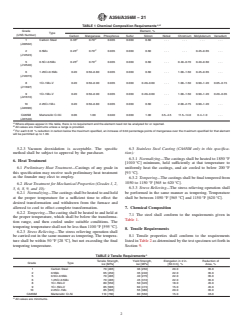
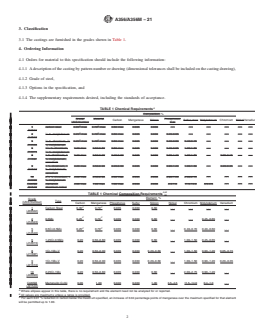
TABLE 1 Chemical Composition Requirements
Element, %
Grade
Type
(UNS Number)
Carbon Manganese Phosphorus Sulfur Silicon Nickel Chromium Molybdenum Vanadium
C C
1 Carbon Steel 0.35 0.70 0.035 0.030 0.60 . . . . . . . . . . . .
(J03502)
C C
2 0.5Mo 0.25 0.70 0.035 0.030 0.60 . . . . . . 0.45–0.65 . . .
(J12523)
C C
5 0.5Cr-0.5Mo 0.25 0.70 0.035 0.030 0.60 . . . 0.40–0.70 0.40–0.60 . . .
(J12540)
6 1.25Cr-0.5Mo 0.20 0.50–0.80 0.035 0.030 0.60 . . . 1.00–1.50 0.45–0.65 . . .
(J12073)
8 1Cr-1Mo-V 0.20 0.50–0.90 0.035 0.030 0.20–0.60 . . . 1.00–1.50 0.90–1.20 0.05–0.15
(J11697)
9 1Cr-1Mo-V 0.20 0.50–0.90 0.035 0.030 0.20–0.60 . . . 1.00–1.50 0.90–1.20 0.20–0.35
(J21610)
10 2.25Cr-1Mo 0.20 0.50–0.80 0.035 0.030 0.60 . . . 2.00–2.75 0.90–1.20 . . .
(J22090)
CA6NM Martensitic Cr-Ni 0.06 1.00 0.040 0.030 1.00 3.5–4.5 11.5–14.0 0.4–1.0 . . .
(J91540)
A
Where ellipses appear in this table, there is no requirement and the element need not be analyzed for or reported.
B
All values are maximums unless a range is provided.
C
For each 0.01 % reduction in carbon below the maximum specified, an increase of 0.04 percentage points of manganese over the maximum specified for that element
will be permitted up to 1.00.
5.2.3 Vacuum deoxidation is acceptable. The specific 6.3 Stainless Steel Casting (CA6NM only in this specifica-
method shall be subject to approval by the purchaser. tion):
6.3.1 Normalizing—The castings shall be heated to 1850 °F
6. Heat Treatment
[1010 °C] minimum, held sufficiently at that temperature to
6.1 Preliminary Heat Treatment—Castings of any grade in
uniformly heat the castings, and air cooled to below 200 °F
this specification may receive such preliminary heat treatment
[93 °C].
as the founder may elect to employ.
6.3.2 Tempering—The castings shall be final tempered from
1050 to 1150 °F [565 to 620 °C].
6.2 Heat Treatment for Mechanical Properties (Grades 1, 2,
6.3.3 Stress Relieving—The stress relieving operation shall
5, 6, 8, 9, and 10):
6.2.1 Normalizing—The castings shall be heated to and held be performed in the same manner as tempering. Temperature
shall be between 1050 °F [565 °C] and 1150 °F [620 °C].
at the proper temperature for a sufficient time to effect the
desired transformation and withdrawn from the furnace and
allowed to cool to effect complete transformation. 7. Chemical Composition
6.2.2 Tempering—The casting shall be heated to and held at
7.1 The steel shall conform to the requirements given in
the proper temperature, which shall be below the transforma-
Table 1.
tion range, and then cooled under suitable conditions. The
tempering temperature shall not be less than 1100 °F [595 °C].
8. Tensile Requirements
6.2.3 Stress Relieving—The stress relieving operation shall
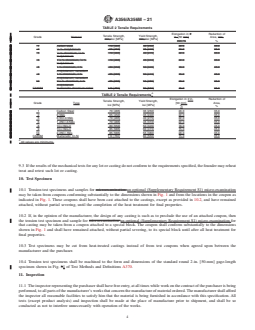
be carried out in the same manner as tempering. The tempera- 8.1 Tensile properties shall conform to the requirements
ture shall be within 50 °F [28 °C], but not exceeding the final listed in Table 2 as determined by the test specimen set forth in
tempering temperature. Section 9.
A
TABLE 2 Tensile Requirements
Tensile Strength, Yield Strength, Elongation in 2 in. Reduction of
Grade Type
ksi [MPa] ksi [MPa] [50 mm], % Area, %
1 Carbon Steel 70 [485] 36 [250] 20.0 35.0
2 0.5Mo 65 [450] 35 [240] 22.0 35.0
5 0.5Cr-0.5Mo 70 [485] 40 [275] 22.0 35.0
6 1.25Cr-0.5Mo 70 [485] 45 [310] 22.0 35.0
8 1Cr-1Mo-V 80 [550] 50 [345] 18.0 45.0
9 1Cr-1Mo-V 85 [585] 60 [415] 15.0 45.0
10 2.25Cr-1Mo 85 [585] 55 [380] 20.0 35.0
CA6NM Martensitic Cr-Ni 110 [760] 80 [550] 15.0 35.0
A
All values are minimums.
A356/A356M−21
8.2 Tension tests shall be performed in accordance withTest without partial severing, to its special block until after all heat
Methods and Definitions A370. treatment for final properties.
10.3 Test specimens may be cut from heat-treated castings
9. Number of Tests and Retests
instead of from test coupons when agreed upon between the
9.1 One tension test shall be made from each heat in each
manufacturer and the purchaser.
heat-treatment lot and from each casting on which attached
10.4 Tension test specimens shall be machined to the form
coupons are specified. The bar from which the test specimen is
and dimensions of the standard round 2-in. [50-mm] gage-
taken shall be heat treated with the casting represented.
length specimen shown in Fig. 4 of Test Methods and Defini-
9.2 If any test specimen shows defective machining or
tions A370.
develops flaws, it shall be discarded and another specimen
11. Inspection
substituted from the same heat.
11.1 The inspector representing the purchaser shall have
9.3 If the results of the mechanical tests for any lot or
free entry, at all times while work on the contract of the
casting do not conform to the requirements specified, the
purchaser is being performed, to all parts of the manufacturer’s
founder may reheat treat and retest such lot or casting.
works that concern the manufacture of material ordered. The
manufacturer shall afford the inspector all reasonable facilities
10. Test Specimen
to satisfy him that the material is being furnished in accordance
10.1 Tension test specimens and samples for an optional
with this specification. All tests (except product analysis) and
(Supplementary Requirement S1) micro-examination may be
inspection shall be made at the place of manufacture prior to
taken from coupons conforming substantially to the dimen-
shipment, and shall be so conducted as not to int
...
This document is not an ASTM standard and is intended only to provide the user of an ASTM standard an indication of what changes have been made to the previous version. Because
it may not be technically possible to adequately depict all changes accurately, ASTM recommends that users consult prior editions as appropriate. In all cases only the current version
of the standard as published by ASTM is to be considered the official document.
Designation: A356/A356M − 16 A356/A356M − 21
Standard Specification for
Steel Castings, Carbon, Low Alloy, and Stainless Steel,
Heavy-Walled for Steam Turbines
This standard is issued under the fixed designation A356/A356M; the number immediately following the designation indicates the year
of original adoption or, in the case of revision, the year of last revision. A number in parentheses indicates the year of last reapproval.
A superscript epsilon (´) indicates an editorial change since the last revision or reapproval.
1. Scope*
1.1 This specification covers one grade of martensitic stainless steel and several grades of ferritic steel castings for cylinders
(shells), valve chests, throttle valves, and other heavy-walled castings for steam turbine applications.
1.2 Optional supplementary requirements (S1 through S5) shall apply as selected by and specified by the purchaser.
1.2 The values stated in either SI units or inch-pound units are to be regarded separately as standard. The values stated in each
system may not be exact equivalents; therefore, each system shall be used independently of the other. Combining values from the
two systems may result in nonconformance with the standard.
1.2.1 Within the text, the SI units are shown in brackets.
1.3 This international standard was developed in accordance with internationally recognized principles on standardization
established in the Decision on Principles for the Development of International Standards, Guides and Recommendations issued
by the World Trade Organization Technical Barriers to Trade (TBT) Committee.
2. Referenced Documents
2.1 ASTM Standards:
A370 Test Methods and Definitions for Mechanical Testing of Steel Products
A488/A488M Practice for Steel Castings, Welding, Qualifications of Procedures and Personnel
A941 Terminology Relating to Steel, Stainless Steel, Related Alloys, and Ferroalloys
E94E94/E94M Guide for Radiographic Examination Using Industrial Radiographic Film
E125 Reference Photographs for Magnetic Particle Indications on Ferrous Castings
E165E165/E165M Practice for Liquid Penetrant Testing for General Industry
E186 Reference Radiographs for Heavy-Walled (2 to 4 ⁄2 in. (50.8 to 114 mm)) Steel Castings
E280 Reference Radiographs for Heavy-Walled (4 ⁄2 to 12 in. (114 to 305 mm)) Steel Castings
E446 Reference Radiographs for Steel Castings Up to 2 in. (50.8 mm) in Thickness
E709 Guide for Magnetic Particle Testing
2.2 Manufacturers’Manufacturers Standardization Society of the Valve and Fittings Industry Standard:
SP-55 Quality Standard for Steel Castings for Valves, Flanges, Fittings, and Other Piping Components (Visual Method)
This specification is under the jurisdiction of ASTM Committee A01 on Steel, Stainless Steel and Related Alloys and is the direct responsibility of Subcommittee A01.18
on Castings.
Current edition approved Dec. 1, 2016May 1, 2021. Published January 2017May 2021. Originally approved in 1952. Last previous edition approved in 2016 as
A356/A356M – 11 (2016).A356/A356M – 16. DOI: 10.1520/A0356_A0356M-16.10.1520/A0356_A0356M-21.
For referenced ASTM standards, visit the ASTM website, www.astm.org, or contact ASTM Customer Service at service@astm.org. For Annual Book of ASTM Standards
volume information, refer to the standard’s Document Summary page on the ASTM website.
Available from Manufacturers Standardization Society of the Valve and Fittings Industry (MSS), 127 Park St., NE, Vienna, VA 22180-4602, http://www.mss-hq.org.
*A Summary of Changes section appears at the end of this standard
Copyright © ASTM International, 100 Barr Harbor Drive, PO Box C700, West Conshohocken, PA 19428-2959. United States
A356/A356M − 21
3. Classification
3.1 The castings are furnished in the grades shown in Table 1.
4. Ordering Information
4.1 Orders for material to this specification should include the following information:
4.1.1 A description of the casting by pattern number or drawing (dimensional tolerances shall be included on the casting drawing),
4.1.2 Grade of steel,
4.1.3 Options in the specification, and
4.1.4 The supplementary requirements desired, including the standards of acceptance.
A
TABLE 1 Chemical Requirements
Composition, %
Grade/ Material Phosphorus,
Carbon Manganese Silicon Sulfur, max Molybdenum Chromium NickelVanadium
UNS Number max
B B
1 carbon steel 0.35 max 0.70 max 0.60 max 0.035 0.030 . . . . . . . . . . . . . . . . . .
J03502
B B
2 ⁄2 % molybdenum 0.25 max 0.70 max 0.60 max 0.035 0.030 0.45-0.65 . . . . . . . . . . . . . . .
J12523
B B
1 1
5 ⁄2 % chromium, ⁄2 0.25 max 0.70 max 0.60 max 0.035 0.030 0.40-0.60 0.40-0.70 . . . . . . . . . . . .
J12540 % molybdenum
6 1 ⁄4 % chromium, 0.20 max 0.50-0.80 0.60 max 0.035 0.030 0.45-0.65 1.00-1.50 . . . . . . . . . . . .
J12073 ⁄2 % molybdenum
8 1 % chromium, 1 0.20 max 0.50-0.90 0.20-0.60 0.035 0.030 0.90-1.20 1.00-1.50 . . . 0.05-0.15 . . . . . .
J11697 % molybdenum,
vanadium
9 1 % chromium, 1 0.20 max 0.50-0.90 0.20-0.60 0.035 0.030 0.90-1.20 1.00-1.50 . . . 0.20-0.35 . . . . . .
J21610 % molybdenum,
vanadium
10 2 ⁄4 % chromium, 1 0.20 max 0.50-0.80 0.60 max 0.035 0.030 0.90-1.20 2.00-2.75 . . . . . . . . . . . .
J22090 % molybdenum
CA6NM martensic 0.06 max 1.00 max 1.00 max 0.040 0.030 0.4-1.0 11.5-14.0 3.5-4.5 . . . . . . . . .
J91540 chromium nickel
A,B
TABLE 1 Chemical Composition Requirements
Element, %
Grade
Type
(UNS Number)
Carbon Manganese Phosphorus Sulfur Silicon Nickel Chromium Molybdenum Vanadium
C C
1 Carbon Steel 0.35 0.70 0.035 0.030 0.60 . . . . . . . . . . . .
(J03502)
C C
2 0.5Mo 0.25 0.70 0.035 0.030 0.60 . . . . . . 0.45–0.65 . . .
(J12523)
C C
5 0.5Cr-0.5Mo 0.25 0.70 0.035 0.030 0.60 . . . 0.40–0.70 0.40–0.60 . . .
(J12540)
6 1.25Cr-0.5Mo 0.20 0.50–0.80 0.035 0.030 0.60 . . . 1.00–1.50 0.45–0.65 . . .
(J12073)
8 1Cr-1Mo-V 0.20 0.50–0.90 0.035 0.030 0.20–0.60 . . . 1.00–1.50 0.90–1.20 0.05–0.15
(J11697)
9 1Cr-1Mo-V 0.20 0.50–0.90 0.035 0.030 0.20–0.60 . . . 1.00–1.50 0.90–1.20 0.20–0.35
(J21610)
10 2.25Cr-1Mo 0.20 0.50–0.80 0.035 0.030 0.60 . . . 2.00–2.75 0.90–1.20 . . .
(J22090)
CA6NM Martensitic Cr-Ni 0.06 1.00 0.040 0.030 1.00 3.5–4.5 11.5–14.0 0.4–1.0 . . .
(J91540)
A
Where ellipses appear in this table, there is no requirement and the element need not be analyzed for or reported.
B
All values are maximums unless a range is provided.
C
For each 0.01 % reduction in carbon below the maximum specified, an increase of 0.04 percentage points of manganese over the maximum specified for that element
will be permitted up to 1.00.
A356/A356M − 21
5. Melting Process
5.1 The steel shall be made by the open-hearth or electric-furnace process.
5.2 Deoxidation Practice:
5.2.1 Deoxidation of the carbon and low-alloy steel grades shall be by manganese and silicon. Furnace or ladle deoxidation with
other agents is permissible with the approval of the purchaser.
5.2.2 The purchaser may specify that no aluminum be added.
5.2.3 Vacuum deoxidation is acceptable. The specific method shall be subject to approval by the purchaser.
6. Heat Treatment
6.1 Preliminary Heat Treatment—The castings Castings of any grade in this specification may receive such preliminary heat
treatment as the founder may elect to employ.
6.2 Heat Treatment for Final Properties: Mechanical Properties (Grades 1, 2, 5, 6, 8, 9, and 10):
6.2.1 Normalizing—The castings shall be heated to and held at the proper temperature for a sufficient time to effect the desired
transformation and withdrawn from the furnace and allowed to cool to effect complete transformation.
6.2.2 Tempering—The casting shall be heated to and held at the proper temperature, which shall be below the transformation
range, and then cooled under suitable conditions. The tempering temperature shall not be less than 1100 °F [595 °C].
6.2.3 Stress Relieving—The stress relieving operation shall be carried out in the same manner as tempering. The temperature shall
be within 50 °F [28 °C], but not exceeding the final tempering temperature.
6.3 Stainless Steel Casting: Casting (CA6NM only in this specification):
6.3.1 Normalizing—The castings shall be heated to 1850 °F [1010 °C] minimum, held sufficiently at that temperature to uniformly
heat the castings, and air cooled to below 200 °F [93 °C].
6.3.2 Tempering—The castings shall be final tempered from 1050 to 1150 °F [565 to 620 °C].
6.3.3 Stress Relieving—The stress relieving operation shall be performed in the same manner as tempering. Temperature shall be
between 1050 °F [565 °C] and 1150 °F [620 °C].
7. Chemical Composition
7.1 The steel shall conform to the requirements given in Table 1.
8. Tensile Requirements
8.1 Tensile properties shall conform to the requirements listed in Table 2 as determined by the test specimen set forth in Section
9.
8.2 Tension tests shall be performed in accordance with Test Methods and Definitions A370.
9. Number of Tests and Retests
9.1 One tension test shall be made from each heat in each heat-treatment chargelot and from each casting on which attached
coupons are specified. The bar from which the test specimen is taken shall be heat treated with the casting represented.
9.2 If any test specimen shows defective machining or develops flaws, it shall be discarded and another specimen substituted from
the same heat.
A356/A356M − 21
TABLE 2 Tensile Requirements
Elongation in 2 Reduction of
Tensile Strength, Yield Strength,
Grade Material in. [50 mm] Area, min,
min, ksi [MPa] min, ksi [MPa]
min, % %
1 carbon steel 70 [485] 36 [250] 20.0 35.0
2 ⁄2 % molybdenum 65 [450] 35 [240] 22.0 35.0
1 1
5 ⁄2 % chromium, ⁄2 % 70 [485] 40 [275] 22.0 35.0
molybdenum
1 1
6 1 ⁄4 % chromium, ⁄2 % 70 [485] 45 [310] 22.0 35.0
molybdenum
8 1 % chromium, 1 % 80 [550] 50 [345] 18.0 45.0
molybdenum, vanadium
9 1 % chromium, 1 % 85 [585] 60 [415] 15.0 45.0
molybdenum, vanadium
10 2 ⁄4 % chromium, 1 % 85 [585] 55 [380] 20.0 35.0
molybdenum
CA6NM martensitic chromium nickel 110 [760] 80 [550] 15.0 35.0
A
TABLE 2 Tensile Requirements
Elongation in 2 in. Reduction of
Tensile Strength, Yield Strength,
Grade Type [50 mm], Area,
ksi [MPa] ksi [MPa]
% %
1 Carbon Steel 70 [485] 36 [250] 20.0 35.0
2 0.5Mo 65 [450] 35 [240] 22.0 35.0
5 0.5Cr-0.5Mo 70 [485] 40 [275] 22.0 35.0
6 1.25Cr-0.5Mo 70 [485] 45 [310] 22.0 35.0
8 1Cr-1Mo-V 80 [550] 50 [345] 18.0 45.0
9 1Cr-1Mo-V 85 [585] 60 [415] 15.0 45.0
10 2.25Cr-1Mo 85 [585] 55 [380] 20.0 35.0
CA6NM Martensitic Cr-Ni 110 [760] 80 [550] 15.0 35.0
A
All values are minimums.
9.3 If the results of the mechanical tests for any lot or casting do not conform to the requirements specified, the founder may reheat
treat and retest such lot or casting.
10. Test Specimen
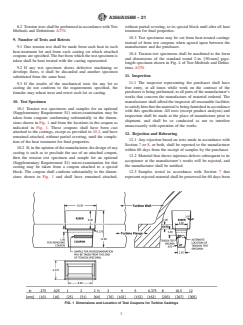
10.1 Tension test specimens and samples for microexamination an optional (Supplementary Requirement S1) micro-examination
may be taken from coupons conforming substantially to the dimensions shown in Fig. 1 and from the locations in the coupon as
indicated in Fig. 1. These coupons sh
...