

ASTM A1091/A1091M-21
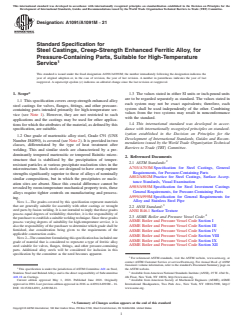
(Specification)Standard Specification for Steel Castings, Creep-Strength Enhanced Ferritic Alloy, for Pressure-Containing Parts, Suitable for High-Temperature Service
General Information
- Abstract
ABSTRACT
This specification covers general requirements for creep-strength enhanced alloy steel castings for valves, flanges, fittings, and other pressure-containing parts intended primarily for high-temperature service. However, the castings are not restricted to such applications, and may be used for other applications for which the attributes of the material, as defined by this specification, are suitable. The specification includes one grade of martensitic alloy steel, Grade C91, which is provided in two classes, differentiated by the type of heat treatment after weld repairs.
This specification also prescribes the general conditions for delivery, including those for investment castings, as well as the requirements for ordering information; materials and manufacture (heat-treatment and machining); chemical composition; testing of mechanical properties (tensile testing and hardness testing); quality of castings; rework, weld repair, and retreatment; and certification and marking of castings.
SCOPE
1.1 This specification covers creep-strength enhanced alloy steel castings for valves, flanges, fittings, and other pressure-containing parts intended primarily for high-temperature service (see Note 1). However, they are not restricted to such applications and the castings may be used for other applications for which the attributes of the material, as defined by this specification, are suitable.
1.2 One grade of martensitic alloy steel, Grade C91 (UNS Number J84090), is covered (see Note 2). It is provided in two classes, differentiated by the type of heat treatment after welding. This and similar steels are characterized by a predominantly tempered martensitic or tempered Bainitic microstructure that is stabilized by the precipitation of temper-resistant particles at various precipitate nucleation sites in the microstructure. Such steels are designed to have creep-rupture strengths significantly superior to those of alloys of nominally similar compositions, but in which the precipitates or nucleation sites are absent. Since this crucial difference cannot be revealed by room-temperature mechanical property tests, these alloys require tighter controls on manufacturing and processing.
Note 1: The grades covered by this specification represent materials that are generally suitable for assembly with other castings or wrought steel parts by fusion welding. It is not intended to imply that these grades possess equal degrees of weldability; therefore, it is the responsibility of the purchaser to establish a suitable welding technique. Since these grades possess varying degrees of suitability for high-temperature service, it is also the responsibility of the purchaser to determine which grade shall be furnished, due consideration being given to the requirements of the applicable construction codes.
Note 2: The committee formulating this specification has included one grade of material that is considered to represent a type of ferritic alloy steel suitable for valves, flanges, fittings, and other pressure-containing parts. Additional alloy steels will be considered for inclusion in this specification by the committee as the need becomes apparent.
1.3 The values stated in either SI units or inch-pound units are to be regarded separately as standard. The values stated in each system may not be exact equivalents; therefore, each system shall be used independently of the other. Combining values from the two systems may result in nonconformance with the standard.
1.4 This international standard was developed in accordance with internationally recognized principles on standardization established in the Decision on Principles for the Development of International Standards, Guides and Recommendations issued by the World Trade Organization Technical Barriers to Trade (TBT) Committee.
- Status
- Published
- Publication Date
- 30-Apr-2021
- Technical Committee
- A01 - Steel, Stainless Steel and Related Alloys
- Drafting Committee
- A01.18 - Castings
Buy Documents
ASTM A1091/A1091M-21 - Standard Specification for Steel Castings, Creep-Strength Enhanced Ferritic Alloy, for Pressure-Containing Parts, Suitable for High-Temperature Service
REDLINE ASTM A1091/A1091M-21 - Standard Specification for Steel Castings, Creep-Strength Enhanced Ferritic Alloy, for Pressure-Containing Parts, Suitable for High-Temperature Service
Overview
ASTM A1091/A1091M-21 is the standard specification for steel castings made from creep-strength enhanced ferritic alloy, primarily intended for pressure-containing parts used in high-temperature service. This specification is crucial for industries requiring reliable steel castings for valves, flanges, fittings, and other pressure-retaining components that operate under elevated temperatures. ASTM A1091/A1091M-21 covers the requirements for one grade of martensitic alloy steel, specifically Grade C91 (UNS J84090), available in two classes differentiated by the type of heat treatment after weld repairs. The standard also details general delivery conditions, testing methods, acceptance criteria, certification, and marking.
Key Topics
Scope and Applicability
- Applies to creep-strength enhanced alloy steel castings for use in high-temperature, pressure-containing equipment.
- Not limited to valves and flanges; suitable for other applications that benefit from the specified material properties.
Material Specifications
- Focuses on Grade C91, a martensitic alloy steel known for a tempered martensitic or bainitic microstructure.
- Strict controls on chemical composition ensure superior creep-rupture strength and material reliability.
- Two classes are designated based on post-weld heat treatment, impacting allowable service conditions.
Manufacturing and Quality Control
- Requires comprehensive heat treatment, austenitizing, and tempering processes to maintain material integrity.
- Castings must be free from surface defects and are subject to visual, ultrasonic, and, where applicable, other non-destructive examinations.
- Weld repairs are permitted, but must follow qualified procedures, and major welds require specific post-weld heat treatments.
Mechanical Properties and Testing
- Specifies rigorous tensile and hardness testing to confirm material strength and durability.
- Detailed requirements for test specimen preparation and acceptance criteria.
Certification and Marking
- Certification includes chemical and mechanical test results, weld repair locations, and class designation.
Applications
The ASTM A1091/A1091M-21 standard is vital for industries that design and operate equipment exposed to high-temperature and high-pressure environments, including:
- Power Generation: Steel castings manufactured under this specification are extensively used in steam turbines, boiler components, and heat exchangers.
- Petrochemical and Refining: Suited for valves, flanges, fittings, and pressure-containing vessels handling corrosive and high-temperature media.
- Oil & Gas and Process Industries: Enables reliable operation of pressure systems under thermally demanding conditions.
- Industrial Equipment Manufacturing: Ensures consistent quality for any application requiring enhanced creep strength and dimensional stability at high temperatures.
By adhering to ASTM A1091/A1091M-21, manufacturers and end users can assure compliance with both industry and regulatory requirements, minimizing risk and ensuring long-term performance.
Related Standards
ASTM A1091/A1091M-21 references and aligns with several other industry standards, ensuring comprehensive material and quality control across applications. Key related standards include:
- ASTM A703/A703M – General Requirements for Steel Castings for Pressure-Containing Parts
- ASTM A985/A985M – Steel Investment Castings for Pressure-Containing Parts
- ASTM A999/A999M – General Requirements for Alloy and Stainless Steel Pipe
- ASTM A802/A802M – Surface Acceptance Standards for Steel Castings
- ASME Boiler and Pressure Vessel Code (Sections I, III, IV, VIII, IX, XII)
- ASME B16.34 – Valves Flanged, Threaded, and Welding End
- ASME B31.1 and B31.3 – Pressure Piping Codes
- AWS Specifications for welding consumables (A5.5, A5.23, A5.28, A5.29)
- ANSI B46.1 – Surface Texture
Specifying compliance with ASTM A1091/A1091M-21 ensures robust, high-performance cast steel components recognized across international markets, supporting design, procurement, and certification processes in high-temperature applications.
Relations
- Effective Date
- 01-Mar-2019
- Effective Date
- 01-Sep-2018
- Effective Date
- 01-Sep-2018
- Effective Date
- 15-May-2018
- Effective Date
- 01-May-2018
- Effective Date
- 01-Nov-2017
- Effective Date
- 01-Sep-2017
- Effective Date
- 01-May-2017
- Effective Date
- 01-Dec-2016
- Effective Date
- 01-Sep-2016
- Effective Date
- 01-Dec-2015
- Effective Date
- 01-Jun-2015
- Effective Date
- 01-Jun-2015
- Effective Date
- 01-Oct-2014
- Effective Date
- 01-Oct-2013
Buy Documents
ASTM A1091/A1091M-21 - Standard Specification for Steel Castings, Creep-Strength Enhanced Ferritic Alloy, for Pressure-Containing Parts, Suitable for High-Temperature Service
REDLINE ASTM A1091/A1091M-21 - Standard Specification for Steel Castings, Creep-Strength Enhanced Ferritic Alloy, for Pressure-Containing Parts, Suitable for High-Temperature Service
Get Certified
Connect with accredited certification bodies for this standard

Element Materials Technology
Materials testing and product certification.

Inštitut za kovinske materiale in tehnologije
Institute of Metals and Technology. Materials testing, metallurgical analysis, NDT.
Sponsored listings
Frequently Asked Questions
ASTM A1091/A1091M-21 is a technical specification published by ASTM International. Its full title is "Standard Specification for Steel Castings, Creep-Strength Enhanced Ferritic Alloy, for Pressure-Containing Parts, Suitable for High-Temperature Service". This standard covers: ABSTRACT This specification covers general requirements for creep-strength enhanced alloy steel castings for valves, flanges, fittings, and other pressure-containing parts intended primarily for high-temperature service. However, the castings are not restricted to such applications, and may be used for other applications for which the attributes of the material, as defined by this specification, are suitable. The specification includes one grade of martensitic alloy steel, Grade C91, which is provided in two classes, differentiated by the type of heat treatment after weld repairs. This specification also prescribes the general conditions for delivery, including those for investment castings, as well as the requirements for ordering information; materials and manufacture (heat-treatment and machining); chemical composition; testing of mechanical properties (tensile testing and hardness testing); quality of castings; rework, weld repair, and retreatment; and certification and marking of castings. SCOPE 1.1 This specification covers creep-strength enhanced alloy steel castings for valves, flanges, fittings, and other pressure-containing parts intended primarily for high-temperature service (see Note 1). However, they are not restricted to such applications and the castings may be used for other applications for which the attributes of the material, as defined by this specification, are suitable. 1.2 One grade of martensitic alloy steel, Grade C91 (UNS Number J84090), is covered (see Note 2). It is provided in two classes, differentiated by the type of heat treatment after welding. This and similar steels are characterized by a predominantly tempered martensitic or tempered Bainitic microstructure that is stabilized by the precipitation of temper-resistant particles at various precipitate nucleation sites in the microstructure. Such steels are designed to have creep-rupture strengths significantly superior to those of alloys of nominally similar compositions, but in which the precipitates or nucleation sites are absent. Since this crucial difference cannot be revealed by room-temperature mechanical property tests, these alloys require tighter controls on manufacturing and processing. Note 1: The grades covered by this specification represent materials that are generally suitable for assembly with other castings or wrought steel parts by fusion welding. It is not intended to imply that these grades possess equal degrees of weldability; therefore, it is the responsibility of the purchaser to establish a suitable welding technique. Since these grades possess varying degrees of suitability for high-temperature service, it is also the responsibility of the purchaser to determine which grade shall be furnished, due consideration being given to the requirements of the applicable construction codes. Note 2: The committee formulating this specification has included one grade of material that is considered to represent a type of ferritic alloy steel suitable for valves, flanges, fittings, and other pressure-containing parts. Additional alloy steels will be considered for inclusion in this specification by the committee as the need becomes apparent. 1.3 The values stated in either SI units or inch-pound units are to be regarded separately as standard. The values stated in each system may not be exact equivalents; therefore, each system shall be used independently of the other. Combining values from the two systems may result in nonconformance with the standard. 1.4 This international standard was developed in accordance with internationally recognized principles on standardization established in the Decision on Principles for the Development of International Standards, Guides and Recommendations issued by the World Trade Organization Technical Barriers to Trade (TBT) Committee.
ABSTRACT This specification covers general requirements for creep-strength enhanced alloy steel castings for valves, flanges, fittings, and other pressure-containing parts intended primarily for high-temperature service. However, the castings are not restricted to such applications, and may be used for other applications for which the attributes of the material, as defined by this specification, are suitable. The specification includes one grade of martensitic alloy steel, Grade C91, which is provided in two classes, differentiated by the type of heat treatment after weld repairs. This specification also prescribes the general conditions for delivery, including those for investment castings, as well as the requirements for ordering information; materials and manufacture (heat-treatment and machining); chemical composition; testing of mechanical properties (tensile testing and hardness testing); quality of castings; rework, weld repair, and retreatment; and certification and marking of castings. SCOPE 1.1 This specification covers creep-strength enhanced alloy steel castings for valves, flanges, fittings, and other pressure-containing parts intended primarily for high-temperature service (see Note 1). However, they are not restricted to such applications and the castings may be used for other applications for which the attributes of the material, as defined by this specification, are suitable. 1.2 One grade of martensitic alloy steel, Grade C91 (UNS Number J84090), is covered (see Note 2). It is provided in two classes, differentiated by the type of heat treatment after welding. This and similar steels are characterized by a predominantly tempered martensitic or tempered Bainitic microstructure that is stabilized by the precipitation of temper-resistant particles at various precipitate nucleation sites in the microstructure. Such steels are designed to have creep-rupture strengths significantly superior to those of alloys of nominally similar compositions, but in which the precipitates or nucleation sites are absent. Since this crucial difference cannot be revealed by room-temperature mechanical property tests, these alloys require tighter controls on manufacturing and processing. Note 1: The grades covered by this specification represent materials that are generally suitable for assembly with other castings or wrought steel parts by fusion welding. It is not intended to imply that these grades possess equal degrees of weldability; therefore, it is the responsibility of the purchaser to establish a suitable welding technique. Since these grades possess varying degrees of suitability for high-temperature service, it is also the responsibility of the purchaser to determine which grade shall be furnished, due consideration being given to the requirements of the applicable construction codes. Note 2: The committee formulating this specification has included one grade of material that is considered to represent a type of ferritic alloy steel suitable for valves, flanges, fittings, and other pressure-containing parts. Additional alloy steels will be considered for inclusion in this specification by the committee as the need becomes apparent. 1.3 The values stated in either SI units or inch-pound units are to be regarded separately as standard. The values stated in each system may not be exact equivalents; therefore, each system shall be used independently of the other. Combining values from the two systems may result in nonconformance with the standard. 1.4 This international standard was developed in accordance with internationally recognized principles on standardization established in the Decision on Principles for the Development of International Standards, Guides and Recommendations issued by the World Trade Organization Technical Barriers to Trade (TBT) Committee.
ASTM A1091/A1091M-21 is classified under the following ICS (International Classification for Standards) categories: 77.140.80 - Iron and steel castings. The ICS classification helps identify the subject area and facilitates finding related standards.
ASTM A1091/A1091M-21 has the following relationships with other standards: It is inter standard links to ASTM A985/A985M-19, ASTM A985/A985M-18a, ASTM A703/A703M-18a, ASTM A985/A985M-18, ASTM A703/A703M-18, ASTM A703/A703M-17a, ASTM A999/A999M-17, ASTM A703/A703M-17, ASTM A985/A985M-16, ASTM A999/A999M-16, ASTM A999/A999M-15, ASTM A703/A703M-15e1, ASTM A703/A703M-15, ASTM A985/A985M-14, ASTM A703/A703M-13a. Understanding these relationships helps ensure you are using the most current and applicable version of the standard.
ASTM A1091/A1091M-21 is available in PDF format for immediate download after purchase. The document can be added to your cart and obtained through the secure checkout process. Digital delivery ensures instant access to the complete standard document.
Standards Content (Sample)
This international standard was developed in accordance with internationally recognized principles on standardization established in the Decision on Principles for the
Development of International Standards, Guides and Recommendations issued by the World Trade Organization Technical Barriers to Trade (TBT) Committee.
Designation:A1091/A1091M −21
Standard Specification for
Steel Castings, Creep-Strength Enhanced Ferritic Alloy, for
Pressure-Containing Parts, Suitable for High-Temperature
Service
This standard is issued under the fixed designation A1091/A1091M; the number immediately following the designation indicates the
year of original adoption or, in the case of revision, the year of last revision. A number in parentheses indicates the year of last
reapproval. A superscript epsilon (´) indicates an editorial change since the last revision or reapproval.
1. Scope* 1.3 The values stated in either SI units or inch-pound units
are to be regarded separately as standard. The values stated in
1.1 This specification covers creep-strength enhanced alloy
each system may not be exact equivalents; therefore, each
steel castings for valves, flanges, fittings, and other pressure-
system shall be used independently of the other. Combining
containing parts intended primarily for high-temperature ser-
values from the two systems may result in nonconformance
vice (see Note 1). However, they are not restricted to such
with the standard.
applications and the castings may be used for other applica-
1.4 This international standard was developed in accor-
tions for which the attributes of the material, as defined by this
dance with internationally recognized principles on standard-
specification, are suitable.
ization established in the Decision on Principles for the
1.2 One grade of martensitic alloy steel, Grade C91 (UNS
Development of International Standards, Guides and Recom-
Number J84090), is covered (see Note 2). It is provided in two
mendations issued by the World Trade Organization Technical
classes, differentiated by the type of heat treatment after
Barriers to Trade (TBT) Committee.
welding. This and similar steels are characterized by a pre-
dominantly tempered martensitic or tempered Bainitic micro-
2. Referenced Documents
structure that is stabilized by the precipitation of temper-
2.1 ASTM Standards:
resistant particles at various precipitate nucleation sites in the
A703/A703M Specification for Steel Castings, General
microstructure. Such steels are designed to have creep-rupture
Requirements, for Pressure-Containing Parts
strengths significantly superior to those of alloys of nominally
A802/A802M Practice for Steel Castings, Surface Accep-
similar compositions, but in which the precipitates or nucle-
tance Standards, Visual Examination
ation sites are absent. Since this crucial difference cannot be
A985/A985M Specification for Steel Investment Castings
revealed by room-temperature mechanical property tests, these
General Requirements, for Pressure-Containing Parts
alloys require tighter controls on manufacturing and process-
A999/A999M Specification for General Requirements for
ing.
Alloy and Stainless Steel Pipe
NOTE 1—The grades covered by this specification represent materials
that are generally suitable for assembly with other castings or wrought
2.2 ANSI Standard:
steel parts by fusion welding. It is not intended to imply that these grades
ANSI B46.1 Surface Texture
possess equal degrees of weldability; therefore, it is the responsibility of
2.3 ASME Boiler and Pressure Vessel Code:
the purchaser to establish a suitable welding technique. Since these grades
ASME Boiler and Pressure Vessel Code Section I
possess varying degrees of suitability for high-temperature service, it is
also the responsibility of the purchaser to determine which grade shall be
ASME Boiler and Pressure Vessel Code Section III
furnished, due consideration being given to the requirements of the
ASME Boiler and Pressure Vessel Code Section IV
applicable construction codes.
ASME Boiler and Pressure Vessel Code Section VIII
NOTE2—Thecommitteeformulatingthisspecificationhasincludedone
ASME Boiler and Pressure Vessel Code Section IX
grade of material that is considered to represent a type of ferritic alloy
ASME Boiler and Pressure Vessel Code Section XII
steel suitable for valves, flanges, fittings, and other pressure-containing
parts. Additional alloy steels will be considered for inclusion in this
specification by the committee as the need becomes apparent.
For referenced ASTM standards, visit the ASTM website, www.astm.org, or
contact ASTM Customer Service at service@astm.org. For Annual Book of ASTM
Standards volume information, refer to the standard’s Document Summary page on
This specification is under the jurisdiction ofASTM Committee A01 on Steel, the ASTM website.
Stainless Steel and Related Alloys and is the direct responsibility of Subcommittee Available fromAmerican National Standards Institute (ANSI), 25 W. 43rd St.,
A01.18 on Castings. 4th Floor, New York, NY 10036, http://www.ansi.org.
Current edition approved May 1, 2021. Published June 2021. Originally Available from American Society of Mechanical Engineers (ASME), ASME
approved in 2016. Last previous edition approved in 2016 as A1091/A1091M – 16. International Headquarters, Two Park Ave., New York, NY 10016-5990, http://
DOI: 10.1520/A1091_A1091M-21. www.asme.org.
*A Summary of Changes section appears at the end of this standard
Copyright © ASTM International, 100 Barr Harbor Drive, PO Box C700, West Conshohocken, PA 19428-2959. United States
A1091/A1091M−21
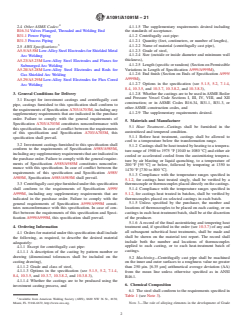
2.4 Other ASME Codes: 4.1.1.5 The supplementary requirements desired including
B16.34 Valves Flanged, Threaded and Welding End the standards of acceptance.
B31.1 Power Piping 4.1.2 Centrifugally cast pipe:
B31.3 Process Piping 4.1.2.1 Quantity (feet, centimeters, or number of lengths),
4.1.2.2 Name of material (centrifugally cast pipe),
2.5 AWS Specifications:
4.1.2.3 Grade of steel,
A5.5/A5.5M Low-Alloy Steel Electrodes for Shielded Metal
4.1.2.4 Size (outside or inside diameter and minimum wall
Arc Welding
thickness),
A5.23/A5.23M Low-Alloy Steel Electrodes and Fluxes for
4.1.2.5 Length (specific or random) (Section on Permissible
Submerged Arc Welding
Variations in Length of Specification A999/A999M),
A5.28/A5.28M Low-Alloy Steel Electrodes and Rods for
4.1.2.6 End finish (Section on Ends of Specification A999/
Gas Shielded Arc Welding
A999M),
A5.29/A5.29M Low-Alloy Steel Electrodes for Flux Cored
4.1.2.7 Options in the specification (see 5.1.5, 5.2, 7.1.4,
Arc Welding
8.4, 10.3.5, and 10.3.7, 10.3.8.2, and 10.3.8.3),
3. General Conditions for Delivery 4.1.2.8 Whether the castings are to be used inASME Boiler
and Pressure Vessel Code Sections I, III, IV, VIII, and XII
3.1 Except for investment castings and centrifugally cast
construction; or in ASME Codes B16.34, B31.1, B31.3, or
pipe, castings furnished to this specification shall conform to
other ASME construction codes, and
the requirements of Specification A703/A703M, including any
4.1.2.9 The supplementary requirements desired.
supplementary requirements that are indicated in the purchase
order. Failure to comply with the general requirements of
5. Materials and Manufacture
Specification A703/A703M constitutes nonconformance with
5.1 Heat Treatment—Castings shall be furnished in the
this specification. In case of conflict between the requirements
austenitized and tempered condition.
of this specification and Specification A703/A703M, this
5.1.1 Before heat treatment, castings shall be allowed to
specification shall prevail.
cool to a temperature below the transformation range.
3.2 Investment castings furnished to this specification shall
5.1.2 Castings shall be heat treated by heating to a tempera-
conform to the requirements of Specification A985/A985M,
ture range of 1900 to 1975 °F [1040 to 1080 °C] and either air
including any supplementary requirements that are indicated in
cooled or accelerated cooled from the austenitizing tempera-
the purchase order. Failure to comply with the general require-
ture by air blasting or liquid quenching, to a temperature of
ments of Specification A985/A985M constitutes nonconfor-
200 °F [95 °C] or below, followed by tempering at 1350 to
mance with this specification. In case of conflict between the
1470 °F [730 to 800 °C].
requirements of this specification and Specification A985/
5.1.3 Compliance with the temperature ranges specified in
A985M, Specification A985/A985M shall prevail.
5.1.2, for castings heat treated singly, shall be verified by a
thermocoupleorthermocouplesplaceddirectlyonthecastings.
3.3 Centrifugallycastpipefurnishedunderthisspecification
shall conform to the requirements of Specification A999/ 5.1.4 Compliance with the temperature ranges specified in
5.1.2, for castings heat treated in batches, shall be verified by
A999M, including any supplementary requirements that are
indicated in the purchase order. Failure to comply with the thermocouples placed on selected castings in each batch.
general requirements of Specification A999/A999M consti- 5.1.5 Unless specified by the purchaser, the number and
tutes nonconformance with this specification. In case of con- locations of thermocouples to be placed on each casting, or on
flict between the requirements of this specification and Speci- castings in each heat-treatment batch, shall be at the discretion
fication A999/A999M, this specification shall prevail. of the producer.
5.1.6 A record of the final austenitizing and tempering heat
4. Ordering Information
treatment and, if specified in the order (see 10.3.7) of any and
all subsequent subcritical heat treatments, shall be made and
4.1 Orders for material under this specification shall include
shall be shown on the material test report. The record shall
the following, as required, to describe the desired material
include both the number and locations of thermocouples
adequately:
applied to each casting, or to each heat-treatment batch of
4.1.1 Except for centrifugally cast pipe:
castings.
4.1.1.1 A description of the casting by pattern number or
drawing (dimensional tolerances shall be included on the
5.2 Machining—Centrifugally cast pipe shall be machined
casting drawing),
on the inner and outer surfaces to a roughness value no greater
4.1.1.2 Grade and class of steel,
than 250 µin. [6.35 µm] arithmetical average deviation (AA)
4.1.1.3 Options in the specification (see 5.1.5, 5.2, 7.1.4,
from the mean line unless otherwise specified as in ANSI
8.4, 10.3.5, and 10.3.7, 10.3.8.2, and 10.3.8.3),
B46.1.
4.1.1.4 Whether the castings are to be produced using the
6. Chemical Composition
investment casting process, and
6.1 The steel shall conform to the requirements specified in
Table 1 (see Note 3).
Available from American Welding Society (AWS), 8669 NW 36 St., #130,
Miami, FL 33166-6672, http://www.aws.org. NOTE 3—The role of alloying elements in the development of Grade
A1091/A1091M−21
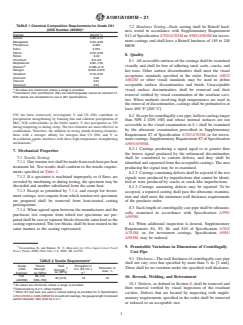
TABLE 1 Chemical Composition Requirements for Grade C91
7.2 Hardness Testing—Each casting shall be Brinell hard-
A
(UNS Number J84090)
ness tested in accordance with Supplementary Requirement
Element Weight %
S13ofSpecificationA703/A703MorA985/A985Mforinvest-
Carbon 0.08–0.12
ment castings and shall have a Brinell hardness of 185 to 248
Manganese 0.30–0.60
Phosphorus 0.025
HBW.
Sulfur 0.010
Silicon 0.20–0.50
8. Quality
Nickel 0.40
Chromium 8.0–9.5
8.1 Allaccessiblesurfacesofthecastingsshallbeexamined
Molybdenum 0.85–1.05
B
visually and shall be free of adhering sand, scale, cracks, and
Niobium 0.060–0.10
Nitrogen 0.030–0.070
hot tears. Other surface discontinuities shall meet the visual
Vanadium 0.18–0.25
acceptance standards specified in the order. Practice A802/
Aluminum 0.02
A802M or other visual standards may be used to define
Titanium 0.01
Zirconium 0.01
acceptable surface discontinuities and finish. Unacceptable
A
All values are maximums unless a range is provided. visual surface discontinuities shall be removed and their
B
Columbium (Cb) and Niobium (Nb) are interchangeable names for element 41.
removal verified by visual examination of the resultant cavi-
Both names are acceptable for use in A01 specifications.
ties. When methods involving high temperatures are used in
the removal of discontinuities, castings shall be preheated to at
least 400 °F [200 °C].
C91 has been extensively investigated. V and Cb (Nb) contribute to
8.2 Exceptforc
...
This document is not an ASTM standard and is intended only to provide the user of an ASTM standard an indication of what changes have been made to the previous version. Because
it may not be technically possible to adequately depict all changes accurately, ASTM recommends that users consult prior editions as appropriate. In all cases only the current version
of the standard as published by ASTM is to be considered the official document.
´1
Designation: A1091/A1091M − 16 A1091/A1091M − 21
Standard Specification for
Steel Castings, Creep-Strength Enhanced Ferritic Alloy, for
Pressure-Containing Parts, Suitable for High Temperature
High-Temperature Service
This standard is issued under the fixed designation A1091/A1091M; the number immediately following the designation indicates the
year of original adoption or, in the case of revision, the year of last revision. A number in parentheses indicates the year of last
reapproval. A superscript epsilon (´) indicates an editorial change since the last revision or reapproval.
ε NOTE—Table 3 was editorially corrected in April 2017.
1. Scope Scope*
1.1 This specification covers creep-strength enhanced alloy steel castings for valves, flanges, fittings, and other pressure-
containing parts intended primarily for high-temperature service (see Note 1). However, they are not restricted to such
applications,applications and the castings may be used for other applications for which the attributes of the material, as defined
by this specification, are suitable.
1.2 One grade of martensitic alloy steel, Grade C91, C91 (UNS Number J84090), is covered (see Note 2). It is provided in two
classes, differentiated by the type of heat treatment after weld repairs. welding. This and similar steels are characterized by a
predominantly tempered martensitic or tempered Bainitic microstructure that is stabilized by the precipitation of temper-resistant
particles at various precipitate nucleation sites in the microstructure. Such steels are designed to have creep-rupture strengths
significantly superior to those of alloys of nominally similar compositions, but in which the precipitates or nucleation sites are
absent. Since this crucial difference cannot be revealed by room-temperature mechanical property tests, these alloys require tighter
controls on manufacturing and processing.
NOTE 1—The grades covered by this specification represent materials that are generally suitable for assembly with other castings or wrought steel parts
by fusion welding. It is not intended to imply that these grades possess equal degrees of weldability; therefore, it is the responsibility of the purchaser
to establish a suitable welding technique. Since these grades possess varying degrees of suitability for high-temperature service, it is also the responsibility
of the purchaser to determine which grade shall be furnished, due consideration being given to the requirements of the applicable construction codes.
NOTE 2—The committee formulating this specification has included one grade of material that is considered to represent a type of ferritic alloy steel
suitable for valves, flanges, fittings, and other pressure-containing parts. Additional alloy steels will be considered for inclusion in this specification by
the committee as the need becomes apparent.
1.3 The values stated in either SI units or inch-pound units are to be regarded separately as standard. The values stated in each
system may not be exact equivalents; therefore, each system shall be used independently of the other. Combining values from the
two systems may result in non-conformancenonconformance with the standard.
1.4 This international standard was developed in accordance with internationally recognized principles on standardization
established in the Decision on Principles for the Development of International Standards, Guides and Recommendations issued
by the World Trade Organization Technical Barriers to Trade (TBT) Committee.
This specification is under the jurisdiction of ASTM Committee A01 on Steel, Stainless Steel and Related Alloys and is the direct responsibility of Subcommittee A01.18
on Castings.
Current edition approved May 1, 2016May 1, 2021. Published May 2016June 2021. Originally approved in 2016. Last previous edition approved in 2016 as
A1091/A1091M – 16. DOI: 10.1520/A1091_A1091M-16E01.10.1520/A1091_A1091M-21.
*A Summary of Changes section appears at the end of this standard
Copyright © ASTM International, 100 Barr Harbor Drive, PO Box C700, West Conshohocken, PA 19428-2959. United States
A1091/A1091M − 21
2. Referenced Documents
2.1 ASTM Standards:
A335/A335M Specification for Seamless Ferritic Alloy-Steel Pipe for High-Temperature Service
A703/A703M Specification for Steel Castings, General Requirements, for Pressure-Containing Parts
A802/A802M Practice for Steel Castings, Surface Acceptance Standards, Visual Examination
A985/A985M Specification for Steel Investment Castings General Requirements, for Pressure-Containing Parts
A999/A999M Specification for General Requirements for Alloy and Stainless Steel Pipe
2.2 ANSI StandardsStandard:
ANSI B46.1 Surface Texture
2.3 ASME Boiler and Pressure Vessel CodeCode:
ASME Boiler and Pressure Vessel Code Section I
ASME Boiler and Pressure Vessel Code Section III
ASME Boiler and Pressure Vessel Code Section IV
ASME Boiler and Pressure Vessel Code Section VIII
ASME Boiler and Pressure Vessel Code Section IX
ASME Boiler and Pressure Vessel Code Section XII
2.4 Other ASME CodesCodes:
B16.34 Valves Flanged, Threaded and Welding End
B31.1 Power Piping
B31.3 Process Piping
2.5 AWS SpecificationsSpecifications:
A5.5/A5.5M Low Alloy Low-Alloy Steel Electrodes for Shielded Metal Arc Welding
A5.23/A5.23M Low Alloy Low-Alloy Steel Electrodes and Fluxes for Submerged Arc Welding
A5.28/A5.28M Low Alloy Low-Alloy Steel Electrodes and Rods for Gas Shielded Arc Welding
A5.29/A5.29M Low Allow Low-Alloy Steel Electrodes for Flux Cored Arc Welding
3. General Conditions for Delivery
3.1 Except for investment castings and centrifugally cast pipe, castings furnished to this specification shall conform to the
requirements of Specification A703/A703M, including any supplementary requirements that are indicated in the purchase order.
Failure to comply with the general requirements of Specification A703/A703M constitutes nonconformance with this specification.
In case of conflict between the requirements of this specification and Specification A703/A703M, this specification shall prevail.
3.2 Investment castings furnished to this specification shall conform to the requirements of Specification A985/A985M, including
any supplementary requirements that are indicated in the purchase order. Failure to comply with the general requirements of
Specification A985/A985M constitutes nonconformance with this specification. In case of conflict between the requirements of this
specification and Specification A985/A985M, Specification A985/A985M shall prevail.
3.3 Centrifugally cast pipe furnished under this specification shall conform to the requirements of Specification A999/A999M,
including any supplementary requirements that are indicated in the purchase order. Failure to comply with the general requirements
of Specification A999/A999M constitutes nonconformance with this specification. In case of conflict between the requirements of
this specification and Specification A999/A999M, this specification shall prevail.
4. Ordering Information
4.1 Orders for material under this specification shall include the following, as required, to describe the desired material adequately:
4.1.1 Except for centrifugally cast pipe,pipe:
For referenced ASTM standards, visit the ASTM website, www.astm.org, or contact ASTM Customer Service at service@astm.org. For Annual Book of ASTM Standards
volume information, refer to the standard’s Document Summary page on the ASTM website.
Available from American National Standards Institute (ANSI), 25 W. 43rd St., 4th Floor, New York, NY 10036, http://www.ansi.org.
Available from American Society of Mechanical Engineers (ASME), ASME International Headquarters, Two Park Ave., New York, NY 10016-5990, http://
www.asme.org.
Available from American Welding Society (AWS), 8669 NW 36 St., #130, Miami, FL 33166-6672, http://www.aws.org.
A1091/A1091M − 21
4.1.1.1 A description of the casting by pattern number or drawing (dimensional tolerances shall be included on the casting
drawing),
4.1.1.2 Grade and Classclass of steel,
4.1.1.3 Options in the specification (see 5.1.5, 5.2, 7.1.4, 8.4, 10.3.5, and 10.3.7, 10.3.8.2, and 10.3.8.3),
4.1.1.4 Whether the castings are to be produced using the investment casting process, and
4.1.1.5 The supplementary requirements desired including the standards of acceptance.
4.1.2 Centrifugally cast pipe,pipe:
4.1.2.1 Quantity (feet, centimeters, or number of lengths),
4.1.2.2 Name of material (centrifugally cast pipe),
4.1.2.3 Grade of steel,
4.1.2.4 Size (outside or inside diameter and minimum wall thickness),
4.1.2.5 Length (specific or random) (Section on Permissible Variations in Length of Specification A999/A999M),
4.1.2.6 End finish (Section on Ends of Specification A999/A999M),
4.1.2.7 Options in the specification (see 5.1.5, 5.2, 7.1.4, 8.4, 10.3.5, and 10.3.7, 10.3.8.2, and 10.3.8.3),
4.1.2.8 Whether the castings are to be used in ASME Boiler &and Pressure Vessel Code Sections I, III, IV, VIII, and XII
construction; or in ASME Codes B16.34, B31.1, B31.3, or other ASME construction codes,and,codes, and
4.1.2.9 The supplementary requirements desired.
5. Materials and Manufacture
5.1 Heat-Treatment—Heat Treatment—Castings shall be furnished in the austenitized and tempered condition.
5.1.1 Before heat treatment, castings shall be allowed to cool to a temperature below the transformation range.
5.1.2 Castings shall be heat treated by heating to a temperature range of 1900 to 1975°F1975 °F [1040 to 1080°C]1080 °C] and
either air cooled or accelerated cooled from the austenitizing temperature by air blasting or liquid quenching, to a temperature of
200°F [95°C]200 °F [95 °C] or below, followed by tempering at 1350 to 1470°F1470 °F [730 to 800°C].800 °C].
5.1.3 Compliance with the temperature ranges specified in 5.1.2, for castings heat treated singly, shall be verified by a
thermocouple or thermocouples placed directly on the castings.
5.1.4 Compliance with the temperature ranges specified in 5.1.2, for castings heat treated in batches, shall be verified by
thermocouples placed on selected castings in each batch.
5.1.5 Unless specified by the purchaser, the number and locations of thermocouples to be placed on each casting, or on castings
in each heat-treatment batch, shall be at the discretion of the producer.
5.1.6 A record of the final austenitizing and tempering heat treatment,treatment and, if specified in the order (see 10.3.7),) of any
and all subsequent sub-criticalsubcritical heat treatments, shall be made and shall be shown on the material test report. The record
shall include both the number and locations of thermocouples applied to each casting, or to each heat-treatment batch of castings.
5.2 Machining—Centrifugally cast pipe shall be machined on the inner and outer surfaces to a roughness value no greater than
250μ in.250 μin. [6.35 μm] arithmetical average deviation (AA) from the mean line unless otherwise specified as in ANSI B46.1.
A1091/A1091M − 21
6. Chemical Composition
6.1 Heat Analysis—An analysis of each heat shall be made by the manufacturer to determine the weight percentages of elements
specified in Table 1. The analysis shall be made on a test sample taken from the ladle. The chemical composition thus determined
shall steel shall conform to the requirements specified in Table 1 (see Note 3).
NOTE 3—The role of alloying elements in the development of Grade C91has C91 has been extensively investigated. V and Cb (Nb) contribute to
precipitation strengthening by forming fine and coherent precipitation of M(C, N)X carbo-nitrides in the ferrite matrix. V also precipitates as VN during
tempering or during creep. The two elements are more effective in combination. Therefore, the addition of strong nitride-forming elements, those with
a stronger affinity for nitrogen than Cb (Nb) and V, as de-oxidation agents,agents interferes with these high-temperature strengthening mechanisms.
7. Mechanical Properties
7.1 Tensile Testing—Testing:
7.1.1 One tension test shall be made from each heat per heat treatment lot. Test results shall conform to the tensile requirements
specified in Table 2.
7.1.2 If a specimen is machined improperly or if flaws are revealed by machining or during testing, the specimen may be discarded
and another substituted from the same heat.
7.1.3 Except as permitted by 7.1.4, and except for investment castings, test coupons from which tension test specimens are
prepared shall be removed from heat-treated casting prolongations.
7.1.4 When agreed upon between the manufacturer and the purchaser, test coupons from which test specimens are prepared shall
be cast as separate blocks from the same heat as the casting represented. The test blocks shall be heat treated in the same manner
as the casting represented.
TABLE 1 Chemical RequirementsComposition Requirements for
A
Grade C91 (UNS Number J84090)
Composition, %
Element Weight %
Grade Identification Symbol C91
UNS Number J84090
Carbon 0.08-0.12
Carbon 0.08–0.12
Manganese 0.30–0.60
Phosphorus 0.025
Sulfur 0.010
Silicon 0.20–0.50
Nickel 0.40
Chromium 8.0–9.5
Molybdenium 0.85–1.05
Molybdenum 0.85–1.05
A
Columbium
A
(Niobium) 0.060–0.10
B
Niobium 0.060–0.10
Nitrogen 0.030–0.070
Vanadium 0.18–0.25
Aluminum 0.02
Titanium 0.01
Zirconium 0.01
A
All values are maximums unless a range is provided.
B
Columbium (Cb) and Niobium (Nb) refer to the same Element 41.are inter-
changeable names for element 41
...