

ASTM A757/A757M-22
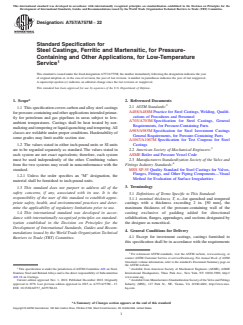
(Specification)Standard Specification for Steel Castings, Ferritic and Martensitic, for Pressure-Containing and Other Applications, for Low-Temperature Service
General Information
- Abstract
ABSTRACT
This specification covers carbon and alloy steel castings for pressure-containing and other applications intended primarily for petroleum and gas pipelines in areas subject to low-ambient temperatures. Castings shall be heat treated by normalizing and tempering or liquid quenching and tempering. The steel shall be made by the electric furnace process or other primary processes. Heat and product analyses shall be performed on the material and the chemical composition shall conform to the prescribed values for carbon, manganese, nickel, phosphorus, sulfur, silicon, nickel, chromium, molybdenum, also for residual elements like vanadium, copper, nickel, chromium, molybdenum, and tungsten. Tensile test shall be made and the mechanical properties thus determined shall conform to the required tensile strength, yield strength, elongation, and reduction of area. Charpy V-notch testing shall be done to determine the impact properties on each heat by specimen type like coupons representing the weld deposits and coupons representing the heat-affected zone. Impact properties shall also be determined on both the heat-affected zone of the base metal and the weld metal of the welding procedure qualification test. After machining, each pressure-containing casting shall undergo hydrostatic pressure testing and shall not leak.
SCOPE
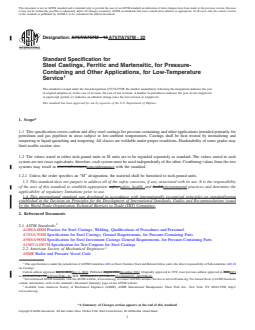
1.1 This specification covers carbon and alloy steel castings for pressure-containing and other applications intended primarily for petroleum and gas pipelines in areas subject to low-ambient temperatures. Castings shall be heat treated by normalizing and tempering or liquid quenching and tempering. All classes are weldable under proper conditions. Hardenability of some grades may limit usable section size.
1.2 The values stated in either inch-pound units or SI units are to be regarded separately as standard. The values stated in each system are not exact equivalents; therefore, each system must be used independently of the other. Combining values from the two systems may result in nonconformance with the standard.
1.2.1 Unless the order specifies an “M” designation, the material shall be furnished to inch-pound units.
1.3 This standard does not purport to address all of the safety concerns, if any, associated with its use. It is the responsibility of the user of this standard to establish appropriate safety, health, and environmental practices and determine the applicability of regulatory limitations prior to use.
1.4 This international standard was developed in accordance with internationally recognized principles on standardization established in the Decision on Principles for the Development of International Standards, Guides and Recommendations issued by the World Trade Organization Technical Barriers to Trade (TBT) Committee.
- Status
- Published
- Publication Date
- 31-Oct-2022
- Technical Committee
- A01 - Steel, Stainless Steel and Related Alloys
- Drafting Committee
- A01.18 - Castings
Buy Documents
ASTM A757/A757M-22 - Standard Specification for Steel Castings, Ferritic and Martensitic, for Pressure-Containing and Other Applications, for Low-Temperature Service
REDLINE ASTM A757/A757M-22 - Standard Specification for Steel Castings, Ferritic and Martensitic, for Pressure-Containing and Other Applications, for Low-Temperature Service
Overview
ASTM A757/A757M-22 is a globally recognized standard specification issued by ASTM International for carbon and alloy steel castings, specifically ferritic and martensitic grades, intended for pressure-containing and other critical applications. This standard is widely used in the petroleum and gas industries, particularly for infrastructure operating in low-temperature service conditions. The specification addresses essential criteria for the manufacture, heat treatment, chemical composition, mechanical properties, and testing of steel castings designed to withstand challenging environments, such as cold climates encountered in pipeline applications.
Key Topics
- Material Scope: Covers carbon and alloy steel castings for pressure vessels and pipelines exposed to low ambient temperatures.
- Heat Treatment: Requires normalizing and tempering or liquid quenching and tempering to achieve desired mechanical properties and toughness.
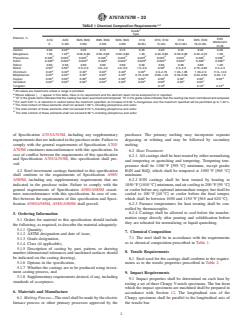
- Chemical Composition: Specifies strict limits for elements such as carbon, manganese, nickel, chromium, molybdenum, phosphorus, sulfur, silicon, and various residual elements, ensuring material integrity and performance.
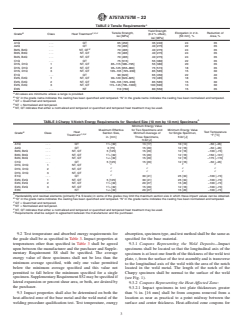
- Mechanical Properties: Mandates compliance with minimum requirements for tensile strength, yield strength, elongation, and reduction of area through rigorous tensile testing.
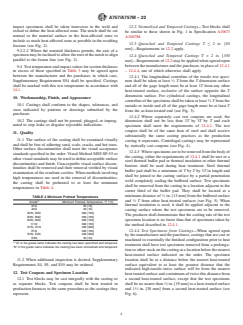
- Impact Testing: Charpy V-notch impact tests are required for each heat to verify material toughness at specified low temperatures, including both base metal and weld zones.
- Hydrostatic Testing: After machining, pressure-containing castings must pass hydrostatic tests to confirm there are no leaks.
- Weldability: All classes are weldable under appropriate conditions, though hardenability may limit section size for certain grades.
- Quality Assurance: Provides guidelines for visual inspection and handling of surface irregularities, referencing additional standards for acceptance.
- Supplementary Requirements: Allows for optional supplementary testing and examination, including radiographic and magnetic particle inspection, per purchaser request.
Applications
ASTM A757/A757M-22 is critical for designers, engineers, and manufacturers involved in the fabrication of components where safety, reliability, and performance at low temperatures are paramount. Core applications include:
- Petroleum and Gas Pipelines: Used for valves, fittings, and pressure vessels in arctic and sub-arctic conditions, where materials must resist brittle fracture.
- Pressure-Containing Equipment: Supports safe operation in refineries, chemical plants, and power generation facilities with demanding temperature requirements.
- Welded Structures: Applicable to welded assemblies requiring verified impact properties of both base and weld metal.
- General Industrial Applications: Suitable for any critical component requiring high toughness in low-temperature environments.
By adhering to ASTM A757/A757M-22, organizations ensure their steel castings meet stringent international requirements, minimizing the risk of failure in service and supporting compliance with regulatory and customer specifications.
Related Standards
To ensure comprehensive compliance and compatibility in steel castings production, the following related standards are frequently referenced alongside ASTM A757/A757M-22:
- ASTM A703/A703M: General requirements for steel castings for pressure-containing parts.
- ASTM A985/A985M: Requirements for steel investment castings used in pressure-containing parts.
- ASTM A1067/A1067M: Specifications for test coupons for steel castings.
- ASTM A488/A488M: Practice for welding and qualification of procedures and personnel in steel castings.
- MSS SP-55: Visual evaluation of surface irregularities in steel castings for valves, flanges, and fittings.
- ASME Boiler and Pressure Vessel Code: Provides rules for the construction of pressure vessels and components.
Practical Value
Adoption of ASTM A757/A757M-22 ensures that steel castings intended for low-temperature and pressure-containing applications deliver consistent quality, mechanical resilience, and safety assurance. Compliance with this standard is essential for organizations aiming for reliability, regulatory adherence, and optimal performance in demanding operating environments, especially in oil, gas, petrochemical, and power sectors.
Relations
- Effective Date
- 01-Mar-2024
- Effective Date
- 01-Mar-2019
- Effective Date
- 01-Sep-2018
- Effective Date
- 01-Sep-2018
- Effective Date
- 01-Jul-2018
- Effective Date
- 01-Jul-2018
- Effective Date
- 15-May-2018
- Effective Date
- 01-May-2018
- Effective Date
- 01-Mar-2018
- Effective Date
- 01-Nov-2017
- Effective Date
- 01-May-2017
- Effective Date
- 01-May-2017
- Effective Date
- 01-Dec-2016
- Effective Date
- 01-Mar-2016
- Effective Date
- 01-Jun-2015
Buy Documents
ASTM A757/A757M-22 - Standard Specification for Steel Castings, Ferritic and Martensitic, for Pressure-Containing and Other Applications, for Low-Temperature Service
REDLINE ASTM A757/A757M-22 - Standard Specification for Steel Castings, Ferritic and Martensitic, for Pressure-Containing and Other Applications, for Low-Temperature Service
Get Certified
Connect with accredited certification bodies for this standard

Element Materials Technology
Materials testing and product certification.

Inštitut za kovinske materiale in tehnologije
Institute of Metals and Technology. Materials testing, metallurgical analysis, NDT.
Sponsored listings
Frequently Asked Questions
ASTM A757/A757M-22 is a technical specification published by ASTM International. Its full title is "Standard Specification for Steel Castings, Ferritic and Martensitic, for Pressure-Containing and Other Applications, for Low-Temperature Service". This standard covers: ABSTRACT This specification covers carbon and alloy steel castings for pressure-containing and other applications intended primarily for petroleum and gas pipelines in areas subject to low-ambient temperatures. Castings shall be heat treated by normalizing and tempering or liquid quenching and tempering. The steel shall be made by the electric furnace process or other primary processes. Heat and product analyses shall be performed on the material and the chemical composition shall conform to the prescribed values for carbon, manganese, nickel, phosphorus, sulfur, silicon, nickel, chromium, molybdenum, also for residual elements like vanadium, copper, nickel, chromium, molybdenum, and tungsten. Tensile test shall be made and the mechanical properties thus determined shall conform to the required tensile strength, yield strength, elongation, and reduction of area. Charpy V-notch testing shall be done to determine the impact properties on each heat by specimen type like coupons representing the weld deposits and coupons representing the heat-affected zone. Impact properties shall also be determined on both the heat-affected zone of the base metal and the weld metal of the welding procedure qualification test. After machining, each pressure-containing casting shall undergo hydrostatic pressure testing and shall not leak. SCOPE 1.1 This specification covers carbon and alloy steel castings for pressure-containing and other applications intended primarily for petroleum and gas pipelines in areas subject to low-ambient temperatures. Castings shall be heat treated by normalizing and tempering or liquid quenching and tempering. All classes are weldable under proper conditions. Hardenability of some grades may limit usable section size. 1.2 The values stated in either inch-pound units or SI units are to be regarded separately as standard. The values stated in each system are not exact equivalents; therefore, each system must be used independently of the other. Combining values from the two systems may result in nonconformance with the standard. 1.2.1 Unless the order specifies an “M” designation, the material shall be furnished to inch-pound units. 1.3 This standard does not purport to address all of the safety concerns, if any, associated with its use. It is the responsibility of the user of this standard to establish appropriate safety, health, and environmental practices and determine the applicability of regulatory limitations prior to use. 1.4 This international standard was developed in accordance with internationally recognized principles on standardization established in the Decision on Principles for the Development of International Standards, Guides and Recommendations issued by the World Trade Organization Technical Barriers to Trade (TBT) Committee.
ABSTRACT This specification covers carbon and alloy steel castings for pressure-containing and other applications intended primarily for petroleum and gas pipelines in areas subject to low-ambient temperatures. Castings shall be heat treated by normalizing and tempering or liquid quenching and tempering. The steel shall be made by the electric furnace process or other primary processes. Heat and product analyses shall be performed on the material and the chemical composition shall conform to the prescribed values for carbon, manganese, nickel, phosphorus, sulfur, silicon, nickel, chromium, molybdenum, also for residual elements like vanadium, copper, nickel, chromium, molybdenum, and tungsten. Tensile test shall be made and the mechanical properties thus determined shall conform to the required tensile strength, yield strength, elongation, and reduction of area. Charpy V-notch testing shall be done to determine the impact properties on each heat by specimen type like coupons representing the weld deposits and coupons representing the heat-affected zone. Impact properties shall also be determined on both the heat-affected zone of the base metal and the weld metal of the welding procedure qualification test. After machining, each pressure-containing casting shall undergo hydrostatic pressure testing and shall not leak. SCOPE 1.1 This specification covers carbon and alloy steel castings for pressure-containing and other applications intended primarily for petroleum and gas pipelines in areas subject to low-ambient temperatures. Castings shall be heat treated by normalizing and tempering or liquid quenching and tempering. All classes are weldable under proper conditions. Hardenability of some grades may limit usable section size. 1.2 The values stated in either inch-pound units or SI units are to be regarded separately as standard. The values stated in each system are not exact equivalents; therefore, each system must be used independently of the other. Combining values from the two systems may result in nonconformance with the standard. 1.2.1 Unless the order specifies an “M” designation, the material shall be furnished to inch-pound units. 1.3 This standard does not purport to address all of the safety concerns, if any, associated with its use. It is the responsibility of the user of this standard to establish appropriate safety, health, and environmental practices and determine the applicability of regulatory limitations prior to use. 1.4 This international standard was developed in accordance with internationally recognized principles on standardization established in the Decision on Principles for the Development of International Standards, Guides and Recommendations issued by the World Trade Organization Technical Barriers to Trade (TBT) Committee.
ASTM A757/A757M-22 is classified under the following ICS (International Classification for Standards) categories: 77.140.80 - Iron and steel castings. The ICS classification helps identify the subject area and facilitates finding related standards.
ASTM A757/A757M-22 has the following relationships with other standards: It is inter standard links to ASTM A488/A488M-24, ASTM A985/A985M-19, ASTM A985/A985M-18a, ASTM A703/A703M-18a, ASTM A488/A488M-18, ASTM A488/A488M-18e1, ASTM A985/A985M-18, ASTM A703/A703M-18, ASTM A1067/A1067M-12a(2018), ASTM A703/A703M-17a, ASTM A488/A488M-17, ASTM A703/A703M-17, ASTM A985/A985M-16, ASTM A488/A488M-16, ASTM A703/A703M-15. Understanding these relationships helps ensure you are using the most current and applicable version of the standard.
ASTM A757/A757M-22 is available in PDF format for immediate download after purchase. The document can be added to your cart and obtained through the secure checkout process. Digital delivery ensures instant access to the complete standard document.
Standards Content (Sample)
This international standard was developed in accordance with internationally recognized principles on standardization established in the Decision on Principles for the
Development of International Standards, Guides and Recommendations issued by the World Trade Organization Technical Barriers to Trade (TBT) Committee.
Designation:A757/A757M −22
Standard Specification for
Steel Castings, Ferritic and Martensitic, for Pressure-
Containing and Other Applications, for Low-Temperature
Service
This standard is issued under the fixed designationA757/A757M; the number immediately following the designation indicates the year
of original adoption or, in the case of revision, the year of last revision. A number in parentheses indicates the year of last reapproval.
A superscript epsilon (´) indicates an editorial change since the last revision or reapproval.
This standard has been approved for use by agencies of the U.S. Department of Defense.
1. Scope* 2. Referenced Documents
2.1 ASTM Standards:
1.1 This specification covers carbon and alloy steel castings
A488/A488M Practice for Steel Castings, Welding, Qualifi-
forpressure-containingandotherapplicationsintendedprimar-
cations of Procedures and Personnel
ily for petroleum and gas pipelines in areas subject to low-
A703/A703M Specification for Steel Castings, General
ambient temperatures. Castings shall be heat treated by nor-
Requirements, for Pressure-Containing Parts
malizingandtemperingorliquidquenchingandtempering.All
A985/A985M Specification for Steel Investment Castings
classes are weldable under proper conditions. Hardenability of
General Requirements, for Pressure-Containing Parts
some grades may limit usable section size.
A1067/A1067M Specification for Test Coupons for Steel
Castings
1.2 The values stated in either inch-pound units or SI units
2.2 American Society of Mechanical Engineers:
are to be regarded separately as standard. The values stated in
ASME Boiler and Pressure Vessel Code
each system are not exact equivalents; therefore, each system
must be used independently of the other. Combining values 2.3 Manufacturers Standardization Society of the Valve and
Fittings Industry Standards:
from the two systems may result in nonconformance with the
MSS SP-55 Quality Standard for Steel Castings for Valves,
standard.
Flanges, Fittings, and Other Piping Components—Visual
1.2.1 Unless the order specifies an “M” designation, the
Method for Evaluation of Surface Irregularities
material shall be furnished to inch-pound units.
3. Terminology
1.3 This standard does not purport to address all of the
safety concerns, if any, associated with its use. It is the
3.1 Definitions of Terms Specific to This Standard:
responsibility of the user of this standard to establish appro-
3.1.1 nominal thickness, T, n—for quenched and tempered
priate safety, health, and environmental practices and deter-
castings with a thickness exceeding 2 in. [50 mm], the
mine the applicability of regulatory limitations prior to use.
maximum thickness of the pressure-containing wall of the
casting exclusive of padding added for directional
1.4 This international standard was developed in accor-
solidification, flanges, appendages, and sections designated by
dance with internationally recognized principles on standard-
the designer as noncritical.
ization established in the Decision on Principles for the
Development of International Standards, Guides and Recom-
4. General Conditions for Delivery
mendations issued by the World Trade Organization Technical
4.1 Except for investment castings, castings furnished to
Barriers to Trade (TBT) Committee.
this specification shall be in accordance with the requirements
For referenced ASTM standards, visit the ASTM website, www.astm.org, or
contact ASTM Customer Service at service@astm.org. For Annual Book of ASTM
Standards volume information, refer to the standard’s Document Summary page on
the ASTM website.
1 3
This specification is under the jurisdiction ofASTM Committee A01 on Steel, Available from American Society of Mechanical Engineers (ASME), ASME
Stainless Steel and Related Alloys and is the direct responsibility of Subcommittee International Headquarters, Three Park Ave., New York, NY 10016-5990, http://
A01.18 on Castings. www.asme.org.
Current edition approved Nov. 1, 2022. Published December 2022. Originally AvailablefromManufacturersStandardizationSocietyoftheValveandFittings
approved in 1978. Last previous edition approved in 2015 as A757/A757M – 15. Industry (MSS), 127 Park St., NE, Vienna, VA 22180-4602, http://www.mss-
DOI: 10.1520/A0757_A0757M-22. hq.com.
*A Summary of Changes section appears at the end of this standard
Copyright © ASTM International, 100 Barr Harbor Drive, PO Box C700, West Conshohocken, PA 19428-2959. United States
A757/A757M−22
A,B
TABLE 1 Chemical Composition Requirements
C
Grade
Type
Element, %
E3N
A1Q A2Q B2N, B2Q B3N, B3Q B4N, B4Q C1Q D1N, D1Q E1Q E2N, E2Q
Martensitic
C C-Mn 2.5Ni 3.5Ni 4.5Ni Ni-Mo Cr-Mo Ni-Cr-Mo Ni-Cr-Mo
Cr-Ni
D
Carbon 0.30 0.25 0.25 0.15 0.15 0.25 0.20 0.22 0.20 0.06
D
Manganese 1.00 1.20 0.50–0.80 0.50–0.80 0.50–0.80 1.20 0.40–0.80 0.50–0.80 0.40–0.70 1.00
E E E E E E E F F G
Phosphorus 0.025 0.025 0.025 0.025 0.025 0.025 0.025 0.025 0.020 0.030
E E E E E E E F F G
Sulfur 0.025 0.025 0.025 0.025 0.025 0.025 0.025 0.025 0.020 0.030
Silicon 0.60 0.60 0.60 0.60 0.60 0.60 0.60 0.60 0.60 1.00
E E E
Nickel 0.50 0.50 2.0–3.0 3.0–4.0 4.0–5.0 1.5–2.0 0.50 2.5–3.5 2.75–3.90 3.5–4.5
E E E E E E
Chromium 0.40 0.40 0.40 0.40 0.40 0.40 2.0–2.75 1.35–1.85 1.50–2.0 11.5–14.0
E E E E E
Molybdenum 0.25 0.25 0.25 0.25 0.25 0.15–0.30 0.90–1.20 0.35–0.60 0.40–0.60 0.40–1.0
E E E E E E E F F G
Copper 0.50 0.50 0.50 0.50 0.50 0.50 0.50 0.50 0.50 0.50
E E E E E E E F F
Vanadium 0.03 0.03 0.03 0.03 0.03 0.03 0.03 0.03 0.03 .
E F G
Tungsten . . . . . . . . . . . . . . . . . . 0.10 . . . 0.10 0.10
A
All values are maximums unless a range is provided.
B
Where ellipses (. . .) appear in this table, there is no requirement and the element need not be analyzed for or reported.
C
“Q” in the grade name indicates that the casting has been quenched and tempered. “N” in the grade name indicates that the casting has been normalized and tempered.
D
For each 0.01 % of reduction in carbon below the maximum specified, an increase of 0.04 % manganese over the maximum specified will be permitted up to 1.40 %.
E
The total content of these elements shall not exceed 1.00 % including phosphorus and sulfur.
F
The total content of these elements shall not exceed 0.70 % including phosphorus and sulfur.
G
The total content of these elements shall not exceed 0.50 % including phosphorus and sulfur.
of Specification A703/A703M, including any supplementary purchaser. The primary melting may incorporate separate
requirementsthatareindicatedinthepurchaseorder.Failureto degassing or refining and may be followed by secondary
comply with the general requirements of Specification A703/ melting.
A703M constitutes nonconformance with this specification. In
6.2 Heat Treatment:
case of conflict between the requirements of this specification
6.2.1 All castings shall be heat treated by either normalizing
and Specification A703/A703M, this specification shall pre-
and tempering or quenching and tempering. Tempering tem-
vail.
perature shall be 1100 °F [595 °C] minimum, except grades
4.2 Steel investment castings furnished to this specification B4N and B4Q, which shall be tempered at 1050 °F [565 °C]
shall conform to the requirements of Specification A985/ minimum.
A985M, including any supplementary requirements that are 6.2.2 E3N castings shall be heat treated by heating to
indicated in the purchase order. Failure to comply with the 1850 °F [1010 °C] minimum, and air cooling to 200 °F [95 °C]
general requirements of Specification A985/A985M consti- or cooler before any optional intermediate temper, but shall be
tutes nonconformance with this specification. In case of con- cooled to 100 °F [40 °C] or cooler before the final temper,
flict between the requirements of this specification and Speci- which shall be between 1050 and 1150 °F [565 and 620 °C].
fication A985/A985M, A985/A985M shall prevail. 6.2.3 Furnace temperatures for heat treating shall be con-
trolled by thermocouples.
5. Ordering Information 6.2.4 Castings shall be allowed to cool below the transfor-
mation range directly after pouring and solidification before
5.1 Orders for material to this specification should include
they are reheated for normalizing or liquid quenching.
the following, as required, to describe the material adequately:
5.1.1 Quantity,
7. Chemical Composition
5.1.2 ASTM designation and date of issue,
7.1 The steel shall be in accordance with the requirements
5.1.3 Grade designation,
as to chemical composition prescribed in Table 1.
5.1.4 Class (if applicable),
5.1.5 Description of casting by part, pattern, or drawing
8. Tensile Requirements
number (dimensional tolerances and machined surfaces should
be indicated on the casting drawing),
8.1 Steel used for the castings shall conform to the require-
5.1.6 Options in the specification,
ments as to the tensile properties prescribed in Table 2.
5.1.7 Whether the castings are to be produced using invest-
ment casting process, and 9. Impact Requirements
5.1.8 Supplementary requirements desired, if any, including
9.1 Impact properties shall be determined on each heat by
standards of acceptance.
testing a set of three Charpy V-notch specimens. The bar from
which the impact specimens are machined shall be prepared in
6. Materials and Manufacture
accordance with Section 12. The longitudinal axis of the
6.1 MeltingProcess—Thesteelshallbemadebytheelectric Charpy specimens shall be parallel to the longitudinal axis of
furnace process or other primary processes approved by the the tensile bar.
A757/A757M−22
A
TABLE 2 Tensile Requirements
Yield Strength
Tensile Strength, Elongation in 2 in. Reduction of
B C,D,E
Grade Class Heat Treatment (0.2 % offset),
ksi [MPa] [50 mm], % Area, %
ksi [MPa]
A1Q . . . QT 65 [450] 35 [240] 24 35
A2Q . . . QT 70 [485] 40 [275] 22 35
E
B2N, B2Q . . . NT, QT 70 [485] 40 [275] 24 35
B3N, B3Q . . . NT, QT 70 [485] 40 [275] 24 35
B4N, B4Q . . . NT, QT 70 [485] 40 [275] 24 35
C1Q . . . QT 75 [515] 55 [380] 22 35
D1N, D1Q 1 NT, QT 85–115 [585–795] 55 [380] 20 35
D1N, D1Q 2 NT, QT 95–125 [655–860] 75 [515] 18 35
D1N, D1Q 3 NT, QT 105–135 [725–930] 85 [585] 15 30
E1Q . . . QT 90 [620] 65 [450] 22 40
E2N, E2Q 1 NT, QT 90–120 [620–825] 70 [485] 18 35
E2N, E2Q 2 NT, QT 105–135 [725–930] 85 [585] 15 30
E2N, E2Q 3 NT, QT 115–145 [795–1000] 100 [690] 13 30
E3N . . . NT 110 [760] 80 [550] 15 35
A
All values are minimums unless a range is provided.
B
“Q” in the grade name indicates the casting has been quenched and tempered. “N” in the grade name indicates the casting has been normalized and tempered.
C
QT = Quenched and tempered.
D
NT = Normalized and tempered.
E
NT, QT indicates that either a normalized and tempered or quenched and tempered heat treatment may be used.
A
TABLE 3 Charpy V-Notch Energy Requirements for Standard Size (10 mm by 10 mm) Specimens
Minimum Energy Value
Maximum Effective for Two Specimens and Minimum Energy Value
Heat Test Temperature
B
Grade Class Section Size, Minimum Average of for Single Specimen,
C,D,E
Treatment °F [°C]
in. [mm] Three Specimens, ft·lbf [J]
ft·lbf [J]
A1Q . . . QT 1 ⁄4 [32] 13 [17] 10 [14] −50 [−46]
A2Q . . . QT 3 [75] 15 [20] 12 [16] −50 [−46]
B2N, B2Q . . . NT, QT 5 [125] 15 [20] 12 [16] −100 [−73]
B3N, B3Q . . . NT, QT 1 ⁄4 [32] 15 [20] 12 [16] −150 [−101]
B4N, B4Q . . . NT, QT 1 ⁄4 [32] 15 [20] 12 [16] −175 [−115]
C1Q . . . QT 5 [125] 15 [20] 12 [16] −50 [−46]
FFF F
D1N, D1Q 1 NT, QT
FFF F
D1N, D1Q 2 NT, QT
FFF F
D1N, D1Q 3 NT, QT
F
E1Q . . . QT 30 [41] 25 [34] −100 [−73]
E2N, E2Q 1 NT, QT 5 [125] 30 [41] 25 [34] −100 [−73]
E2N, E2Q 2 NT, QT 1 ⁄4 [32] 20 [27] 15 [20] −100 [−73]
E2N, E2Q 3 NT, QT 1 ⁄4 [32] 15 [20] 12 [16] −100 [−73]
E3N . . . NT 1 ⁄4 [32] 20 [27] 15 [20] −100 [−73]
A
Hardenability and residual elements (primarily P & S levels) in some of the grades may limit the maximum section size in which these impact values can be obtained.
B
“Q” in the grade name indicates the casting has been quenched and tempered. “N” in the grade name indicates the casting has been normalized and tempered.
C
QT = Quenched and tempered.
D
NT = Normalized and tempered.
E
NT, QT indicates that either a normalized and tempered or quenched and tempered heat treatment may be used.
F
Requirements shall be subject to agreement between the manufacturer and the purchaser.
9.2 Test temperature and absorbed energy requirements for absorption,specimentype,andtestmethodshallbethesameas
the grade shall be as specified in Table 3. Impact properties at specified for the base material.
temperatures other than specified in Table 3 shall be agreed
9.3.1 Coupons Representing the Weld Deposits—Impact
upon between the manufacturer and the purchaser and Supple-
specimens shall be located so that the longitudinal axis of the
mentary Requirement S8 shall be specified. The average
specimen is at least one fourth of the thickness of the weld test
energy value of three specimens shall not be less than the
plate, t, from the surface of the test assembly and is transverse
minimum average specified, with only one value permitted
to the longitudinal axis of the weld with the area of the notch
below the minimum average specified and this value not
located in the weld metal. The length of the notch of the
permitted to fall below the minimum specified for a single
Charpy specimen shall be normal to the surface of the weld
specimen.SupplementaryRequirementS52maybespecifiedif
(see Fig. 1).
lateral expansion or percent shear area, or both, are desired by
9.3.2 Coupons Representing the Heat-Affected Zone:
the purchaser.
9.3.2.1 Impact specimens in test plate thicknesses greater
9.3 Impact properties shall also be determined on both the than ⁄8 in. [16 mm] shall be from coupons removed from a
heat-affected zone of the base metal and the weld metal of the location as near as practical to a point midway between the
welding procedure qualification test. Test temperature, energy surface and center thickness. Heat-affected zone coupons for
A757/A757M−22
impact specimens shall be taken transverse to the weld
...
This document is not an ASTM standard and is intended only to provide the user of an ASTM standard an indication of what changes have been made to the previous version. Because
it may not be technically possible to adequately depict all changes accurately, ASTM recommends that users consult prior editions as appropriate. In all cases only the current version
of the standard as published by ASTM is to be considered the official document.
Designation: A757/A757M − 15 A757/A757M − 22
Standard Specification for
Steel Castings, Ferritic and Martensitic, for Pressure-
Containing and Other Applications, for Low-Temperature
Service
This standard is issued under the fixed designation A757/A757M; the number immediately following the designation indicates the year
of original adoption or, in the case of revision, the year of last revision. A number in parentheses indicates the year of last reapproval.
A superscript epsilon (´) indicates an editorial change since the last revision or reapproval.
This standard has been approved for use by agencies of the U.S. Department of Defense.
1. Scope*
1.1 This specification covers carbon and alloy steel castings for pressure-containing and other applications intended primarily for
petroleum and gas pipelines in areas subject to low-ambient temperatures. Castings shall be heat treated by normalizing and
tempering or liquid quenching and tempering. All classes are weldable under proper conditions. Hardenability of some grades may
limit usable section size.
1.2 The values stated in either inch-pound units or SI units are to be regarded separately as standard. The values stated in each
system are not exact equivalents; therefore, each system must be used independently of the other. Combining values from the two
systems may result in non-conformancenonconformance with the standard.
1.2.1 Unless the order specifies an “M” designation, the material shall be furnished to inch-pound units.
1.3 This standard does not purport to address all of the safety concerns, if any, associated with its use. It is the responsibility
of the user of this standard to establish appropriate safety safety, health, and healthenvironmental practices and determine the
applicability of regulatory limitations prior to use.
1.4 This international standard was developed in accordance with internationally recognized principles on standardization
established in the Decision on Principles for the Development of International Standards, Guides and Recommendations issued
by the World Trade Organization Technical Barriers to Trade (TBT) Committee.
2. Referenced Documents
2.1 ASTM Standards:
A488/A488M Practice for Steel Castings, Welding, Qualifications of Procedures and Personnel
A703/A703M Specification for Steel Castings, General Requirements, for Pressure-Containing Parts
A985/A985M Specification for Steel Investment Castings General Requirements, for Pressure-Containing Parts
A1067/A1067M Specification for Test Coupons for Steel Castings
2.2 American Society of Mechanical Engineers:
ASME Boiler and Pressure Vessel Code
This specification is under the jurisdiction of ASTM Committee A01 on Steel, Stainless Steel and Related Alloys and is the direct responsibility of Subcommittee A01.18
on Castings.
Current edition approved July 1, 2015Nov. 1, 2022. Published August 2015December 2022. Originally approved in 1978. Last previous edition approved in 20102015
as A757/A757M – 10.A757/A757M – 15. DOI: 10.1520/A757_A757M-15. 10.1520/A0757_A0757M-22.
For referenced ASTM standards, visit the ASTM website, www.astm.org, or contact ASTM Customer Service at service@astm.org. For Annual Book of ASTM Standards
volume information, refer to the standard’s Document Summary page on the ASTM website.
Available from American Society of Mechanical Engineers (ASME), ASME International Headquarters, Three Park Ave., New York, NY 10016-5990, http://
www.asme.org.
*A Summary of Changes section appears at the end of this standard
Copyright © ASTM International, 100 Barr Harbor Drive, PO Box C700, West Conshohocken, PA 19428-2959. United States
A757/A757M − 22
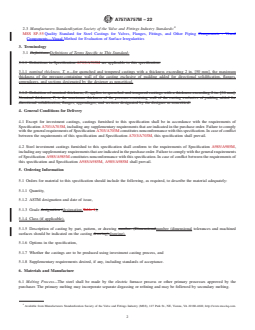
2.3 Manufacturers Standardization Society of the Valve and Fittings Industry Standards:
MSS SP-55 Quality Standard for Steel Castings for Valves, Flanges, Fittings, and Other Piping Components - Visual
Components—Visual Method for Evaluation of Surface Irregularities
3. Terminology
3.1 Definitions:Definitions of Terms Specific to This Standard:
3.1.1 Definitions in Specification A703/A703M are applicable to this specification.
3.1.1 nominal thickness, T, n—for quenched and tempered castings with a thickness exceeding 2 in. [50 mm], the maximum
thickness of the pressure-containing wall of the casting exclusive of padding added for directional solidification, flanges,
appendages, and sections designated by the designer as noncritical.
3.1.2 Definition of nominal thickness, T, applies to quenched and tempered castings with a thickness exceeding 2 in. [50 mm].
Nominal thickness, T, is the maximum thickness of the pressure-containing wall of the casting exclusive of padding added for
directional solidification, flanges, appendages, and sections designated by the designer as noncritical.
4. General Conditions for Delivery
4.1 Except for investment castings, castings furnished to this specification shall be in accordance with the requirements of
Specification A703/A703M, including any supplementary requirements that are indicated in the purchase order. Failure to comply
with the general requirements of Specification A703/A703M constitutes nonconformance with this specification. In case of conflict
between the requirements of this specification and Specification A703/A703M, this specification shall prevail.
4.2 Steel investment castings furnished to this specification shall conform to the requirements of Specification A985/A985M,
including any supplementary requirements that are indicated in the purchase order. Failure to comply with the general requirements
of Specification A985/A985M constitutes nonconformance with this specification. In case of conflict between the requirements of
this specification and Specification A985/A985M, A985/A985M shall prevail.
5. Ordering Information
5.1 Orders for material to this specification should include the following, as required, to describe the material adequately:
5.1.1 Quantity,
5.1.2 ASTM designation and date of issue,
5.1.3 Grade designation (designation,Table 1),
5.1.4 Class (if applicable),
5.1.5 Description of casting by part, pattern, or drawing number. (Dimensionalnumber (dimensional tolerances and machined
surfaces should be indicated on the casting drawing).drawing),
5.1.6 Options in the specification,
5.1.7 Whether the castings are to be produced using investment casting process, and
5.1.8 Supplementary requirements desired, if any, including standards of acceptance.
6. Materials and Manufacture
6.1 Melting Process—The steel shall be made by the electric furnace process or other primary processes approved by the
purchaser. The primary melting may incorporate separate degassing or refining and may be followed by secondary melting.
Available from Manufacturers Standardization Society of the Valve and Fittings Industry (MSS), 127 Park St., NE, Vienna, VA 22180-4602, http://www.mss-hq.com.
A757/A757M − 22
A ,B
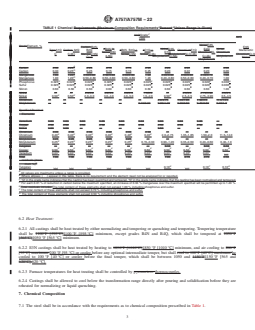
TABLE 1 Chemical Requirements (Maximum Composition Requirements Percent Unless Range is Given)
C
A1QGrade
A2Q
Type
NickelE2N,
GradeElement, %
Carbon-B2N, E3N
2B3N, ⁄2 NickelD1N, E2Q Nickel
1 1
TypeA1Q Carbon A2Q B2Q 3B4N, B4Q ⁄2 4C1Q ⁄2 ChromiumE1Q Martensitic
NickelB3Q D1Q ChromiumNi- Chromium
C C-Mn Manga-2.5Ni Nickel4.5Ni NickelNi-Mo MolybdenumNi-Cr-Mo ChromiumCr-Ni
3.5Ni MolybdenumCr-Mo Cr-Mo Molybdenum
nese Nickel
Molybdenum
A
Carbon 0.30 0.25 0.25 0.15 0.15 0.25 0.20 0.22 0.20 0.06
D
Carbon 0.30 0.25 0.25 0.15 0.15 0.25 0.20 0.22 0.20 0.06
A
Manganese 1.00 1.20 0.50/0.80 0.50/0.80 0.50/0.80 1.20 0.40/0.80 0.50/0.80 0.40/0.70 1.00
D
Manganese 1.00 1.20 0.50–0.80 0.50–0.80 0.50–0.80 1.20 0.40–0.80 0.50–0.80 0.40–0.70 1.00
E E E E E E E F F G
Phosphorus 0.025 0.025 0.025 0.025 0.025 0.025 0.025 0.025 0.020 0.030
E E E E E E E F F G
Sulfur 0.025 0.025 0.025 0.025 0.025 0.025 0.025 0.025 0.020 0.030
Silicon 0.60 0.60 0.60 0.60 0.60 0.60 0.60 0.60 0.60 1.00
Nickel — — 2.0/3.0 3.0/4.0 4.0/5.0 1.5/2.0 — 2.5/3.5 2.75/3.90 3.5/4.5
E E E
Nickel 0.50 0.50 2.0–3.0 3.0–4.0 4.0–5.0 1.5–2.0 0.50 2.5–3.5 2.75–3.90 3.5–4.5
Chromium — — — — — — 2.0/2.75 1.35/1.85 1.50/2.0 11.5/14.0
Molybdenum — — — — — 0.15/0.30 0.90/1.20 0.35/0.60 0.40/0.60 0.40/1.0
Specified Residual
Elements:
Vanadium 0.03 0.03 0.03 0.03 0.03 0.03 0.03 0.03 0.03 —
Copper 0.50 0.50 0.50 0.50 0.50 0.50 0.50 0.50 0.50 0.50
Nickel 0.50 0.50 — — — — 0.50 — — —
Chromium 0.40 0.40 0.40 0.40 0.40 0.40 — — — —
E E E E E E
Chromium 0.40 0.40 0.40 0.40 0.40 0.40 2.0–2.75 1.35–1.85 1.50–2.0 11.5–14.0
Molybdenum 0.25 0.25 0.25 0.25 0.25 — — — — —
E E E E E
Molybdenum 0.25 0.25 0.25 0.25 0.25 0.15–0.30 0.90–1.20 0.35–0.60 0.40–0.60 0.40–1.0
Tungsten — — — — — — 0.10 — 0.10 0.10
E E E E E E E F F G
Copper 0.50 0.50 0.50 0.50 0.50 0.50 0.50 0.50 0.50 0.50
E E E E E E E F F
Vanadium 0.03 0.03 0.03 0.03 0.03 0.03 0.03 0.03 0.03 . . .
Total 1.00 1.00 1.00 1.00 1.00 1.00 1.00 0.70 0.70 0.50
residuals (maxi-
B
mum %)
E F G
Tungsten . . . . . . . . . . . . . . . . . . 0.10 . . . 0.10 0.10
A
All values are maximums unless a range is provided.
B
Where ellipses (. . .) appear in this table, there is no requirement and the element need not be analyzed for or reported.
C
“Q” in the grade name indicates that the casting has been quenched and tempered. “N” in the grade name indicates that the casting has been normalized and tempered.
D
For each 0.01 % of reduction in carbon below the maximum specified, an increase of 0.04 % manganese over the maximum specified will be permitted up to 1.40 %.
E
Total residuals includes The total content of these elements shall not exceed 1.00 % including phosphorus and sulfur.
F
The total content of these elements shall not exceed 0.70 % including phosphorus and sulfur.
G
The total content of these elements shall not exceed 0.50 % including phosphorus and sulfur.
6.2 Heat Treatment:
6.2.1 All castings shall be heat treated by either normalizing and tempering or quenching and tempering. Tempering temperature
shall be 1100°F [595°C]1100 °F [595 °C] minimum, except grades B4N and B4Q, which shall be tempered at 1050°F
[565°C]1050 °F [565 °C] minimum.
6.2.2 E3N castings shall be heat treated by heating to 1850°F [1010°C]1850 °F [1010 °C] minimum, and air cooling to 200°F
[95°C] maximum 200 °F [95 °C] or cooler before any optional intermediate temper, but shall cool to 100°F [40°C] maximum be
cooled to 100 °F [40 °C] or cooler before the final temper, which shall be between 1050 and 1150°F1150 °F [565 and
620°C].620 °C].
6.2.3 Furnace temperatures for heat treating shall be controlled by pyrometers. thermocouples.
6.2.4 Castings shall be allowed to cool below the transformation range directly after pouring and solidification before they are
reheated for normalizing or liquid quenching.
7. Chemical Composition
7.1 The steel shall be in accordance with the requirements as to chemical composition prescribed in Table 1.
A757/A757M − 22
TABLE 2 Tensile Requirements
Yield Strength Reduction of Area,
C
Elongation in 2 in.
Tensile Strength,
A,B
Grade Heat Treatment (0.2 % offset), min, %
min, ksi [MPa]
[50 mm], min, %
min, ksi [MPa]
A1Q QT 65 [450] 35 [240] 24 35
A2Q QT 70 [485] 40 [275] 22 35
D
B2N, B2Q NT/QT 70 [485] 40 [275] 24 35
B3N, B3Q NT/QT 70 [485] 40 [275] 24 35
B4N, B4Q NT/QT 70 [485] 40 [275] 24 35
C1Q QT 75 [515] 55 [380] 22 35
D1N1, D1Q1 NT/QT 85 [585] 55 [380] 20 35
115 [795]
D1N2, D1Q2 NT/QT 95 [655] 75 [515] 18 35
125 [860]
D1N3, D1Q3 NT/QT 105 [725] 85 [585] 15 30
135 [930]
E1Q QT 90 [620] 65 [450] 22 40
E2N1, E2Q1 NT/QT 90 [620] 70 [485] 18 35
120 [825]
E2N2, E2Q2 NT/QT 105 [725] 85 [585] 15 30
135 [930]
E2N3, E2Q3 NT/QT 115 [795] 100 [690] 13 30
145 [1000]
E3N NT 110 [760] 80 [550] 15 35
A
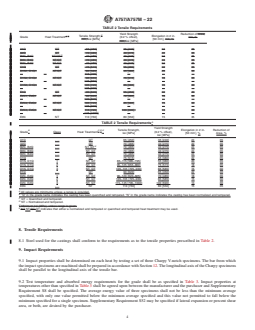
TABLE 2 Tensile Requirements
Yield Strength
Tensile Strength, Elongation in 2 in. Reduction of
B C,D,E
Grade Class Heat Treatment (0.2 % offset),
ksi [MPa] [50 mm], % Area, %
ksi [MPa]
A1Q . . . QT 65 [450] 35 [240] 24 35
A2Q . . . QT 70 [485] 40 [275] 22 35
E
B2N, B2Q . . . NT, QT 70 [485] 40 [275] 24 35
B3N, B3Q . . . NT, QT 70 [485] 40 [275] 24 35
B4N, B4Q . . . NT, QT 70 [485] 40 [275] 24 35
C1Q . . . QT 75 [515] 55 [380] 22 35
D1N, D1Q 1 NT, QT 85–115 [585–795] 55 [380] 20 35
D1N, D1Q 2 NT, QT 95–125 [655–860] 75 [515] 18 35
D1N, D1Q 3 NT, QT 105–135 [725–930] 85 [585] 15 30
E1Q . . . QT 90 [620] 65 [450] 22 40
E2N, E2Q 1 NT, QT 90–120 [620–825] 70 [485] 18 35
E2N, E2Q 2 NT, QT 105–135 [725–930] 85 [585] 15 30
E2N, E2Q 3 NT, QT 115–145 [795–1000] 100 [690] 13 30
E3N . . . NT 110 [760] 80 [550] 15 35
A
All values are minimums unless a range is provided.
B
“Q” in the grade name indicates the casting has been quenched and tempered. “N” in the grade name indicates the casting has been normalized and tempered.
C
QT = Quenched and tempered.
D
NT = Normalized and tempered.
C
Minimum ksi (MPa), unless range is given.
E
NT NT,⁄QT QT indicates that either a normalized and tempered or quenched and tempered heat treatment may be used.
8. Tensile Requirements
8.1 Steel used for the castings shall conform to the requirements as to the tensile properties prescribed in Table 2.
9. Impact Requirements
9.1 Impact properties shall be determined on each heat by testing a set of three Charpy V-notch specimens. The bar from which
the impact specimens are machined shall be prepared in accordance with Section 12. The longitudinal axis of the Charpy specimens
shall be parallel to the longitudinal axis of the tensile bar.
9.2 Test temperature and absorbed energy requirements for the grade shall be as specified in Table 3. Impact properties at
temperatures other than specified in Table 3 shall be agreed upon between the manufacturer and the purchaser and Supplementary
Requirement S8 shall be specified. The average energy value of three specimens shall not be less than the minimum average
specified, with only one value permitted below the minimum average specified and this value not permitted to fall below the
minimum specified for a single specimen. Supplementary Requirement S52 may be specified if lateral expansion or percent shear
area, or both, are desired by the purchaser.
A757/A757M − 22
A
TABLE 3 Charpy V-Notch Energy Requirements for Standard Size (10 mm by 10 mm) Specimens
Grade Heat Effective Section Size, Test Temperature Energy value, ft·lbf [J], Energy Value, ft·lbf [J],
B,C
Treatment max, in. [mm] min value for two min for single specimen
°F [°C]
specimens and min
average of three
specimens
A1Q QT 1 ⁄4 [32] −50 [−46] 13 [17] 10 [14]
A2Q QT 3 [75] −50 [−46] 15 [20] 12 [16]
D
B2N, B2Q NT/QT 5 [125] −100 [−73] 15 [20] 12 [16]
B3N, B3Q NT/QT 1 ⁄4 [32] −150 [−101] 15 [20] 12 [16]
B4N, B4Q NT/QT 1 ⁄4 [32] −175 [−115] 15 [20] 12 [16]
C1Q QT 5 [125] −50 [−46] 15 [20] 12 [16]
E E E E E
D1N1, D 1Q1 NT/QT
E E E E E
D1N2, D 1Q2 NT/QT
E E E E E
D1N3, D 1Q3 NT/QT
E
E1Q QT −100 [−73] 30 [41] 25 [34]
E2N1, E 2Q1 NT/QT 5 [125] −100 [−73] 30 [41] 25 [34]
E2N2, E 2Q2 NT/QT 1 ⁄4 [32] −100 [−73] 20 [27] 15 [20]
E2N3, E 2Q3 NT/QT 1 ⁄4 [32] −100 [−73] 15 [20] 12 [16]
E3N NT 1 ⁄4 [32] −100 [−73] 20 [27] 15 [20]
A
TABLE 3 Charpy V-Notch Energy Requirements for Standard Size (10 mm by 10 mm) Specimens
Minimum Energy Value
Maximum Effective for Two Specimens and Minimum Energy Value
Heat Test Temperature
B
Grade Class Section Size, Minimum Average of for Single Specimen,
C,D,E
Treatment °F [°C]
in. [mm] Three Specimens, ft·lbf [J]
ft·lbf [J]
A1Q . . . QT 1 ⁄4 [32] 13 [17] 10 [14] −50 [−46]
A2Q . . . QT 3 [75] 15 [20] 12 [16] −50 [−46]
B2N, B2Q . . . NT, QT 5 [125] 15 [20] 12 [16] −100 [−73]
B3N, B3Q . . . NT, QT 1 ⁄4 [32] 15 [20] 12 [16] −150 [−101]
B4N, B4Q . . . NT, QT 1 ⁄4 [32] 15 [20] 12 [16] −175 [−115]
C1Q . . . QT 5 [125] 15 [20] 12 [16] −50 [−46]
F F F F
D1N, D1Q 1 NT, QT
F F F F
D1N, D1Q 2 NT, QT
F F F F
D1N, D1Q 3 NT, QT
F
E1Q . . . QT 30 [41] 25 [34] −100 [−73]
E2N, E2Q 1 NT, QT 5 [125] 30 [41] 25 [34] −100 [−73]
E2N, E2Q 2 NT, QT 1 ⁄4 [32] 20 [27] 15 [20] −100 [−73]
E2N, E2Q 3 NT, QT 1 ⁄4 [32] 15 [20] 12 [16] −100 [−73]
E3N . . . NT 1 ⁄4 [32] 20 [27] 15 [20] −100 [−73]
A
Hardenability and residual elements (primarily P & S levels) in some of the grades may limit the maximum section size in which these impact values can be obtained.
B
“Q” in the grade name indicates the casting has been quenched and tempered. “N” in the grade name indicates the casting has been normalized and tempered.
C
QT = Quenched and tempered.
D
NT = Normalized and tempered.
E
NT NT,⁄QT QT indicates that either a normalized and tempered or quenched and tempered heat treatment may be used.
F
Requirements shall be subject to agreement between the manufacturer and the purchaser.
9.3 Impact properties shall also be determined on both the heat-affected zone of the base metal and the weld metal of the welding
procedure qualification test. Test temperature, energy absorption, specimen type, and test method shall be the same as specified
for the base material.
9.3.1 Coupons Representing the Weld Deposits—Impact specimens shall be located so that the longitudinal axis of the specimen
is at least one fourth of the thickness of the weld test plate, t, from the surface of t
...