

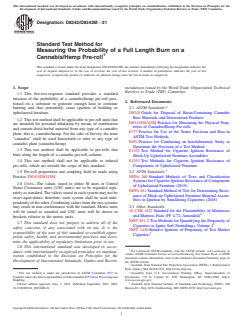
ASTM D8342/D8342M-21
(Test Method)Standard Test Method for Measuring the Probability of a Full Length Burn on a Cannabis/Hemp Pre-roll
General Information
- Abstract
SIGNIFICANCE AND USE
5.1 According to statistics provided by the NFPA, one of the most common initiating events in a fatal fire is the dropping of a smoking material, such as a pre-roll, onto a bed or a piece of upholstered furniture. Test Methods E1352 and E1353 and NFPA 261 and NFPA 260 have been developed to evaluate the susceptibility of upholstered furniture mock-ups and components to ignition by cigarettes (similarly for pre-rolls). Federal Standard 16 CFR 1632 was promulgated to reduce the likelihood that mattresses and mattress pads would ignite from a lighted smoking material. Research of test methods (NIST 851-2) has found that filter paper substrates can be used to replace the fabric/padding assembly with multiple layers of common filter paper showing a systematic progression in measuring ignition strength. Additionally, smoking materials with high percentages of full-length burns on filter paper substrates (NIST 1436) generate enough heat to keep burning and thus are more likely to ignite soft furnishings than smoking materials with lower percentages of full-length burns.
5.2 In this test method, the pre-rolls are subjected to a set of laboratory conditions. If different conditions are substituted or the end-use conditions are changed, it may not be possible to use this test method to predict quantitative changes in the fire test response. Therefore, the quantitative results are valid only for the fire test exposure conditions described in this test method. Pre-roll preparation and sampling are very important to ensure minimal impact on results. Preparation shall be made using Practice D8343/D8343M.
5.3 This test method outlines the moisture content of cannabis herbal material in the pre-roll. Determining the moisture content of cannabis herbal material used will shed more light on the effects of moisture on the probability of a pre-roll to achieve a full-length burn when ignited.
5.4 The data from this test method can help extrapolate whether a sample set of pre-ro...
SCOPE
1.1 This fire-test-response standard provides a standard measure of the probability of a cannabis/hemp pre-roll positioned on a substrate to generate enough heat to continue burning and thus potentially cause ignition of bedding or upholstered furniture.
1.2 This test method shall be applicable to pre-roll units that are intended for personal inhalation by means of combustion and contain dried herbal material from any type of a cannabis plant, that is, cannabis/hemp. For the sake of brevity, the term “cannabis” shall be used henceforth to refer to any type of cannabis plant (cannabis/hemp).
1.3 This test method shall be applicable to pre-rolls that burn along the length of a cannabis pre-roll column.
1.4 This test method shall not be applicable to infused pre-rolls, which are outside the scope of this standard.
1.5 Pre-roll preparation and sampling shall be made using Practice D8343/D8343M.
1.6 Units—The values stated in either SI units or United States Customary units (USC units) are to be regarded separately as standard. The values stated in each system may not be exact equivalents; therefore, each system shall be used independently of the other. Combining values from the two systems may result in non-conformance with the standard. Metric units will be stated as standard and USC units will be shown in brackets relative to the metric units.
1.7 This standard does not purport to address all of the safety concerns, if any, associated with its use. It is the responsibility of the user of this standard to establish appropriate safety, health, and environmental practices and determine the applicability of regulatory limitations prior to use.
1.8 This international standard was developed in accordance with internationally recognized principles on standardization established in the Decision on Principles for the Development of International Standards, Guides and Recommendations issued by the World Trade Or...
- Status
- Published
- Publication Date
- 31-May-2021
- Technical Committee
- D37 - Cannabis
- Drafting Committee
- D37.04 - Processing and Handling
Overview
ASTM D8342/D8342M-21 is a globally recognized standard developed by ASTM International for measuring the probability of a full-length burn on a cannabis/hemp pre-roll. This standard test method is vital for assessing the fire-risk potential of cannabis pre-rolls when they are placed on substrates mimicking bedding or upholstered furniture. By setting a consistent approach to evaluate if a pre-roll can generate enough heat to continue burning, ASTM D8342/D8342M-21 supports fire safety, compliance, and product reliability within the cannabis and hemp industries.
Key Topics
- Fire-Test Response: The standard outlines procedures to measure the likelihood that a cannabis/hemp pre-roll will burn its full length and potentially ignite common household materials.
- Applicability: The method applies specifically to pre-rolls intended for personal inhalation that contain dried cannabis herbal material, excluding infused pre-rolls.
- Substrate Testing: Pre-rolls are tested on surfaces of varying filter paper thicknesses to simulate the ignition resistance of real-world materials like furniture fabrics and bedding.
- Moisture Content Measurement: The standard emphasizes the importance of recording the moisture content of cannabis material, as it affects burn probability.
- Sampling and Preparation: Rigorous preparation and sampling per Practice D8343/D8343M are required to achieve accurate, reproducible results.
- Quantitative Results & Limitations: Results are valid only under the specific laboratory conditions described, and caution should be exercised when extrapolating data to other settings.
Applications
ASTM D8342/D8342M-21 has practical value for a variety of stakeholders:
- Product Safety Testing: Manufacturers of cannabis/hemp pre-rolls can use this standard to assess product safety and minimize fire risks before products reach consumers.
- Regulatory Compliance: The method supports compliance with fire safety regulations, especially as cannabis/hemp product use expands and regulatory scrutiny increases.
- Quality Assurance: By implementing this standard, businesses can ensure consistency and quality in their pre-roll products, fostering consumer trust.
- Research and Development: Product developers and researchers can use the test method to understand the influence of material properties such as moisture content on burn behavior.
- Risk Assessment: The standard provides data that aid in evaluating how likely a pre-roll is to remain lit and pose a fire risk if dropped onto household furnishings.
Related Standards
Several other standards and guides complement ASTM D8342/D8342M-21, including:
- ASTM D8343/D8343M - Practice for Measuring the Physical Properties of Cannabis/Hemp Pre-rolls (for sample preparation and handling)
- ASTM D8245 - Guide for Disposal of Resin-Containing Cannabis Raw Materials and Downstream Products
- ASTM E1352 / E1353 - Test Methods for Cigarette Ignition Resistance of Furniture Assemblies and Components
- NFPA 260 / NFPA 261 - National Fire Protection Association standards on ignition resistance of upholstered furniture materials
- 16 CFR 1632 - Federal Standard for the Flammability of Mattresses and Mattress Pads
- NIST 851-2 / NIST 1436 - NIST publications relating to ignition propensity testing
Practical Value
Utilizing ASTM D8342/D8342M-21 helps cannabis/hemp pre-roll producers, testing laboratories, and regulators to:
- Reduce consumer hazards associated with fire-ignition risks of smoking materials
- Maintain high safety benchmarks in product design and material selection
- Meet evolving legal requirements for fire safety in cannabis products
- Enhance overall industry confidence and product quality assurance
By incorporating this standard into quality management systems, stakeholders can reliably assess and mitigate the full-length burn risk of cannabis pre-rolls, contributing to safer consumer products and environments.
Relations
- Effective Date
- 15-Jan-2019
- Effective Date
- 01-May-2014
- Effective Date
- 01-May-2013
- Effective Date
- 01-May-2013
- Effective Date
- 01-Nov-2011
- Effective Date
- 01-Oct-2010
- Effective Date
- 01-Oct-2008
- Effective Date
- 01-Oct-2008
- Effective Date
- 01-Apr-2008
- Effective Date
- 15-Feb-2008
- Effective Date
- 15-Feb-2008
- Refers
ASTM E177-06b - Standard Practice for Use of the Terms Precision and Bias in ASTM Test Methods - Effective Date
- 15-Nov-2006
- Refers
ASTM E177-06a - Standard Practice for Use of the Terms Precision and Bias in ASTM Test Methods - Effective Date
- 01-Nov-2006
- Effective Date
- 01-Nov-2005
- Effective Date
- 01-Nov-2004
Get Certified
Connect with accredited certification bodies for this standard

CIS Institut d.o.o.
Personal Protective Equipment (PPE) certification body. Notified Body NB-2890 for EU Regulation 2016/425 PPE.

Kiwa BDA Testing
Building and construction product certification.
Kmetijski inštitut Slovenije
Agricultural Institute of Slovenia. Soil testing, plant health, agricultural product analysis.
Sponsored listings
Frequently Asked Questions
ASTM D8342/D8342M-21 is a standard published by ASTM International. Its full title is "Standard Test Method for Measuring the Probability of a Full Length Burn on a Cannabis/Hemp Pre-roll". This standard covers: SIGNIFICANCE AND USE 5.1 According to statistics provided by the NFPA, one of the most common initiating events in a fatal fire is the dropping of a smoking material, such as a pre-roll, onto a bed or a piece of upholstered furniture. Test Methods E1352 and E1353 and NFPA 261 and NFPA 260 have been developed to evaluate the susceptibility of upholstered furniture mock-ups and components to ignition by cigarettes (similarly for pre-rolls). Federal Standard 16 CFR 1632 was promulgated to reduce the likelihood that mattresses and mattress pads would ignite from a lighted smoking material. Research of test methods (NIST 851-2) has found that filter paper substrates can be used to replace the fabric/padding assembly with multiple layers of common filter paper showing a systematic progression in measuring ignition strength. Additionally, smoking materials with high percentages of full-length burns on filter paper substrates (NIST 1436) generate enough heat to keep burning and thus are more likely to ignite soft furnishings than smoking materials with lower percentages of full-length burns. 5.2 In this test method, the pre-rolls are subjected to a set of laboratory conditions. If different conditions are substituted or the end-use conditions are changed, it may not be possible to use this test method to predict quantitative changes in the fire test response. Therefore, the quantitative results are valid only for the fire test exposure conditions described in this test method. Pre-roll preparation and sampling are very important to ensure minimal impact on results. Preparation shall be made using Practice D8343/D8343M. 5.3 This test method outlines the moisture content of cannabis herbal material in the pre-roll. Determining the moisture content of cannabis herbal material used will shed more light on the effects of moisture on the probability of a pre-roll to achieve a full-length burn when ignited. 5.4 The data from this test method can help extrapolate whether a sample set of pre-ro... SCOPE 1.1 This fire-test-response standard provides a standard measure of the probability of a cannabis/hemp pre-roll positioned on a substrate to generate enough heat to continue burning and thus potentially cause ignition of bedding or upholstered furniture. 1.2 This test method shall be applicable to pre-roll units that are intended for personal inhalation by means of combustion and contain dried herbal material from any type of a cannabis plant, that is, cannabis/hemp. For the sake of brevity, the term “cannabis” shall be used henceforth to refer to any type of cannabis plant (cannabis/hemp). 1.3 This test method shall be applicable to pre-rolls that burn along the length of a cannabis pre-roll column. 1.4 This test method shall not be applicable to infused pre-rolls, which are outside the scope of this standard. 1.5 Pre-roll preparation and sampling shall be made using Practice D8343/D8343M. 1.6 Units—The values stated in either SI units or United States Customary units (USC units) are to be regarded separately as standard. The values stated in each system may not be exact equivalents; therefore, each system shall be used independently of the other. Combining values from the two systems may result in non-conformance with the standard. Metric units will be stated as standard and USC units will be shown in brackets relative to the metric units. 1.7 This standard does not purport to address all of the safety concerns, if any, associated with its use. It is the responsibility of the user of this standard to establish appropriate safety, health, and environmental practices and determine the applicability of regulatory limitations prior to use. 1.8 This international standard was developed in accordance with internationally recognized principles on standardization established in the Decision on Principles for the Development of International Standards, Guides and Recommendations issued by the World Trade Or...
SIGNIFICANCE AND USE 5.1 According to statistics provided by the NFPA, one of the most common initiating events in a fatal fire is the dropping of a smoking material, such as a pre-roll, onto a bed or a piece of upholstered furniture. Test Methods E1352 and E1353 and NFPA 261 and NFPA 260 have been developed to evaluate the susceptibility of upholstered furniture mock-ups and components to ignition by cigarettes (similarly for pre-rolls). Federal Standard 16 CFR 1632 was promulgated to reduce the likelihood that mattresses and mattress pads would ignite from a lighted smoking material. Research of test methods (NIST 851-2) has found that filter paper substrates can be used to replace the fabric/padding assembly with multiple layers of common filter paper showing a systematic progression in measuring ignition strength. Additionally, smoking materials with high percentages of full-length burns on filter paper substrates (NIST 1436) generate enough heat to keep burning and thus are more likely to ignite soft furnishings than smoking materials with lower percentages of full-length burns. 5.2 In this test method, the pre-rolls are subjected to a set of laboratory conditions. If different conditions are substituted or the end-use conditions are changed, it may not be possible to use this test method to predict quantitative changes in the fire test response. Therefore, the quantitative results are valid only for the fire test exposure conditions described in this test method. Pre-roll preparation and sampling are very important to ensure minimal impact on results. Preparation shall be made using Practice D8343/D8343M. 5.3 This test method outlines the moisture content of cannabis herbal material in the pre-roll. Determining the moisture content of cannabis herbal material used will shed more light on the effects of moisture on the probability of a pre-roll to achieve a full-length burn when ignited. 5.4 The data from this test method can help extrapolate whether a sample set of pre-ro... SCOPE 1.1 This fire-test-response standard provides a standard measure of the probability of a cannabis/hemp pre-roll positioned on a substrate to generate enough heat to continue burning and thus potentially cause ignition of bedding or upholstered furniture. 1.2 This test method shall be applicable to pre-roll units that are intended for personal inhalation by means of combustion and contain dried herbal material from any type of a cannabis plant, that is, cannabis/hemp. For the sake of brevity, the term “cannabis” shall be used henceforth to refer to any type of cannabis plant (cannabis/hemp). 1.3 This test method shall be applicable to pre-rolls that burn along the length of a cannabis pre-roll column. 1.4 This test method shall not be applicable to infused pre-rolls, which are outside the scope of this standard. 1.5 Pre-roll preparation and sampling shall be made using Practice D8343/D8343M. 1.6 Units—The values stated in either SI units or United States Customary units (USC units) are to be regarded separately as standard. The values stated in each system may not be exact equivalents; therefore, each system shall be used independently of the other. Combining values from the two systems may result in non-conformance with the standard. Metric units will be stated as standard and USC units will be shown in brackets relative to the metric units. 1.7 This standard does not purport to address all of the safety concerns, if any, associated with its use. It is the responsibility of the user of this standard to establish appropriate safety, health, and environmental practices and determine the applicability of regulatory limitations prior to use. 1.8 This international standard was developed in accordance with internationally recognized principles on standardization established in the Decision on Principles for the Development of International Standards, Guides and Recommendations issued by the World Trade Or...
ASTM D8342/D8342M-21 is classified under the following ICS (International Classification for Standards) categories: 13.220.40 - Ignitability and burning behaviour of materials and products; 97.140 - Furniture; 97.160 - Home textiles. Linen. The ICS classification helps identify the subject area and facilitates finding related standards.
ASTM D8342/D8342M-21 has the following relationships with other standards: It is inter standard links to ASTM D8245-19, ASTM E177-14, ASTM E691-13, ASTM E177-13, ASTM E691-11, ASTM E177-10, ASTM E691-08, ASTM E177-08, ASTM E1352-08a, ASTM E1353-08, ASTM E1352-08, ASTM E177-06b, ASTM E177-06a, ASTM E691-05, ASTM E177-04. Understanding these relationships helps ensure you are using the most current and applicable version of the standard.
ASTM D8342/D8342M-21 is available in PDF format for immediate download after purchase. The document can be added to your cart and obtained through the secure checkout process. Digital delivery ensures instant access to the complete standard document.
Standards Content (Sample)
This international standard was developed in accordance with internationally recognized principles on standardization established in the Decision on Principles for the
Development of International Standards, Guides and Recommendations issued by the World Trade Organization Technical Barriers to Trade (TBT) Committee.
Designation: D8342/D8342M − 21
Standard Test Method for
Measuring the Probability of a Full Length Burn on a
Cannabis/Hemp Pre-roll
This standard is issued under the fixed designation D8342/D8342M; the number immediately following the designation indicates the
year of original adoption or, in the case of revision, the year of last revision. A number in parentheses indicates the year of last
reapproval. A superscript epsilon (´) indicates an editorial change since the last revision or reapproval.
1. Scope mendations issued by the World Trade Organization Technical
Barriers to Trade (TBT) Committee.
1.1 This fire-test-response standard provides a standard
measure of the probability of a cannabis/hemp pre-roll posi-
2. Referenced Documents
tioned on a substrate to generate enough heat to continue
burning and thus potentially cause ignition of bedding or 2.1 ASTM Standards:
upholstered furniture. D8245 Guide for Disposal of Resin-Containing Cannabis
Raw Materials and Downstream Products
1.2 This test method shall be applicable to pre-roll units that
D8343/D8343M Practice for Measuring the Physical Prop-
are intended for personal inhalation by means of combustion
erties of Cannabis/Hemp Pre-rolls
and contain dried herbal material from any type of a cannabis
E177 Practice for Use of the Terms Precision and Bias in
plant, that is, cannabis/hemp. For the sake of brevity, the term
ASTM Test Methods
“cannabis” shall be used henceforth to refer to any type of
E691 Practice for Conducting an Interlaboratory Study to
cannabis plant (cannabis/hemp).
Determine the Precision of a Test Method
1.3 This test method shall be applicable to pre-rolls that
E1352 Test Method for Cigarette Ignition Resistance of
burn along the length of a cannabis pre-roll column.
Mock-Up Upholstered Furniture Assemblies
E1353 Test Methods for Cigarette Ignition Resistance of
1.4 This test method shall not be applicable to infused
Components of Upholstered Furniture
pre-rolls, which are outside the scope of this standard.
2.2 NFPA Standards:
1.5 Pre-roll preparation and sampling shall be made using
NFPA 260 Standard Methods of Tests and Classification
Practice D8343/D8343M.
Systems for Cigarette Ignition Resistance of Components
1.6 Units—The values stated in either SI units or United
of Upholstered Furniture (2019)
States Customary units (USC units) are to be regarded sepa-
NFPA 261 Standard Method of Test for Determining Resis-
rately as standard.The values stated in each system may not be
tance of Mock-up Upholstered Furniture MaterialAssem-
exact equivalents; therefore, each system shall be used inde-
blies to Ignition by Smoldering Cigarettes (2018)
pendentlyoftheother.Combiningvaluesfromthetwosystems
2.3 Other Standards:
may result in non-conformance with the standard. Metric units
16 CFR 1632 Standard for the Flammability of Mattresses
will be stated as standard and USC units will be shown in
and Mattress Pads (FF 4-72, Amended)
brackets relative to the metric units.
NIST 851-2 Test Methods for Quantifying the Propensity of
1.7 This standard does not purport to address all of the
Cigarettes to Ignite Soft Furnishings, Volume 2
safety concerns, if any, associated with its use. It is the
NIST 1436 Relative Ignition of Propensity of Test Market
responsibility of the user of this standard to establish appro-
Cigarettes
priate safety, health, and environmental practices and deter-
mine the applicability of regulatory limitations prior to use.
1.8 This international standard was developed in accor-
For referenced ASTM standards, visit the ASTM website, www.astm.org, or
dance with internationally recognized principles on standard-
contact ASTM Customer Service at service@astm.org. For Annual Book of ASTM
ization established in the Decision on Principles for the
Standards volume information, refer to the standard’s Document Summary page on
Development of International Standards, Guides and Recom-
the ASTM website.
Available from National Fire Protection Association (NFPA), 1 Batterymarch
Park, Quincy, MA 02169-7471, http://www.nfpa.org.
1 4
This test method is under the jurisdiction of ASTM Committee D37 on Available from U.S. Government Printing Office, Superintendent of
CannabisandisthedirectresponsibilityofSubcommitteeD37.04onProcessingand Documents, 732 N. Capitol St., NW, Washington, DC 20401-0001, http://
Handling. www.access.gpo.gov.
Current edition approved June 1, 2021. Published September 2021. DOI: Available from National Institute of Standards and Technology (NIST), 100
10.1520/D8342_D8342M-21. Bureau Dr., Stop 1070, Gaithersburg, MD 20899-1070, http://www.nist.gov.
Copyright © ASTM International, 100 Barr Harbor Drive, PO Box C700, West Conshohocken, PA 19428-2959. United States
D8342/D8342M − 21
3. Terminology 3.2.6 QMS—quality management system
3.1 Definitions of Terms Specific to This Standard:
4. Summary of Test Method
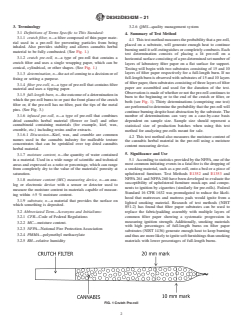
3.1.1 crutch filter, n—a filter composed of thin paper mate-
4.1 Thistestmethodmeasurestheprobabilitythatapre-roll,
rial used in a pre-roll for preventing particles from being
placed on a substrate, will generate enough heat to continue
inhaled. Also provides stability and allows cannabis herbal
burninguntilitself-extinguishesorcompletelycombusts.Each
material to be fully combusted. (See Fig. 1.)
test determination consists of placing a lit pre-roll on a
3.1.2 crutch pre-roll, n—a type of pre-roll that contains a
horizontalsurfaceconsistingofapre-determinedsetnumberof
crutch filter and uses a single wrapping paper, which can be
layers of laboratory filter paper on a flat surface for support.
conical, cylindrical, or other shapes. (See Fig. 1.)
Testing will begin with two substrates consisting of 15 and 10
layers of filter paper respectively for a full-length burn. If no
3.1.3 determination, n—theactofcomingtoadecisionorof
full-length burn is observed with substrates of 15 and 10 layers
fixing or setting a purpose.
of filter paper, then substrates consisting of three layers of filter
3.1.4 filter pre-roll, n—a type of pre-roll that contains filter
paper are assembled and used for the duration of the test.
material and uses a tipping paper.
Observation is made of whether or not the pre-roll continues to
3.1.5 full-length burn, n—the outcome of a determination in
burn to the beginning or to the end of the crutch or filter, or
which the pre-roll burns to or past the front plane of the crutch
both (see Fig. 1). Thirty determinations (comprising one test)
filter or, if the pre-roll has no filter, past the tips of the metal
are performed to determine the probability that the pre-roll will
pins. (See Fig. 3.)
continue burning despite heat abstraction by the substrate. The
3.1.6 infused pre-roll, n—a type of pre-roll that combines
number of determinations can vary on a case-by-case basis
dried cannabis herbal material (flower or leaf) and other
dependent on sample size. Sample size should represent a
cannabinoid containing materials (for example, kief, wax,
statistical size of production batches when using this test
crumble, etc.) including resins and/or extracts.
method for analyzing pre-rolls meant for sale.
3.1.6.1 Discussion—Kief, wax, and crumble are common
4.2 This test method also measures the moisture content of
names used in the cannabis industry for malleable texture
the cannabis herbal material in the pre-roll using a moisture
concentrates that can be sprinkled over top dried cannabis
content measuring device.
herbal material.
5. Significance and Use
3.1.7 moisture content, n—the quantity of water contained
5.1 AccordingtostatisticsprovidedbytheNFPA,oneofthe
in a material. Used in a wide range of scientific and technical
most common initiating events in a fatal fire is the dropping of
areas and expressed as a ratio or percentage, which can range
a smoking material, such as a pre-roll, onto a bed or a piece of
from completely dry to the value of the materials’ porosity at
upholstered furniture. Test Methods E1352 and E1353 and
saturation.
NFPA261 and NFPA260 have been developed to evaluate the
3.1.8 moisture content (MC) measuring device, n—an ana-
susceptibility of upholstered furniture mock-ups and compo-
log or electronic device with a sensor or detector used to
nents to ignition by cigarettes (similarly for pre-rolls). Federal
measure the moisture content in materials capable of measur-
Standard 16 CFR 1632 was promulgated to reduce the likeli-
ing within 65 % moisture content.
hood that mattresses and mattress pads would ignite from a
3.1.9 substrate, n—a material that provides the surface on
lighted smoking material. Research of test methods (NIST
which something is deposited.
851-2) has found that filter paper substrates can be used to
3.2 Abbreviated Term—Acronyms and Initialisms:
replace the fabric/padding assembly with multiple layers of
3.2.1 CFR—Code of Federal Regulations common filter paper showing a systematic progression in
measuring ignition strength. Additionally, smoking materials
3.2.2 MC—moisture content.
with high percentages of full-length burns on filter paper
3.2.3 NFPA—National Fire Protection Association
substrates (NIST 1436) generate enough heat to keep burning
3.2.4 PMMA—polymethyl methacrylate
andthusaremorelikelytoignitesoftfurnishingsthansmoking
3.2.5 RH—relative humidity materials with lower percentages of full-length burns.
FIG. 1 Crutch Pre-roll
D8342/D8342M − 21
5.2 In this test method, the pre-rolls are subjected to a set of 6.1.3.2 Substrate #2—10 layers of filter papers.
laboratory conditions. If different conditions are substituted or
6.1.3.3 Substrate #3—3 layers of filter papers
the end-use conditions are changed, it may not be possible to
6.2 Moisture Content Measuring Device:
use this test method to predict quantitative changes in the fire
6.2.1 Near Infrared Reflectance Spectroscopy (NIRS) Mois-
test response. Therefore, the quantitative results are valid only
ture Meter, suited for the real-time measurement of moisture
for the fire test exposure conditions described in this test
content, capable of measuring within 65 % MC.
method. Pre-roll preparation and sampling are very important
to ensure minimal impact on results. Preparation shall be made
6.3 Test Chamber:
using Practice D8343/D8343M.
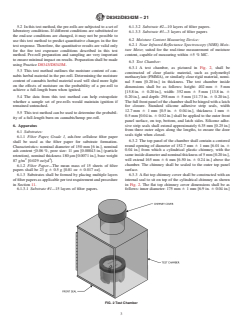
6.3.1 A test chamber, as pictured in Fig. 2, shall be
5.3 This test method outlines the moisture content of can-
constructed of clear plastic material, such as polymethyl
nabis herbal material in the pre-roll. Determining the moisture
methacrylate (PMMA), or similarly clear rigid material, nomi-
content of cannabis herbal material used will shed more light
nal 5 mm [0.20 in.] in thickness. The test chamber inside
on the effects of moisture on the probability of a pre-roll to
dimensions shall be as follows: height: 402 mm 6 5mm
achieve a full-length burn when ignited.
[15.8 in. 6 0.20 in.], width: 352 mm 6 5 mm [13.8 in. 6
5.4 The data from this test method can help extrapolate 0.20 in.], and depth: 298 mm 6 5 mm [11.73 in. 6 0.20 in.].
whether a sample set of pre-rolls would maintain ignition if The full front panel of the chamber shall be hinged with a latch
remained untouched. for closure. Standard silicone adhesive strip seals, width
12.7 mm 6 1 mm [0.5 in. 6 0.04 in.], thickness 1 mm 6
5.5 This test method can be used to determine the probabil-
0.5 mm [0.04 in. 6 0.02 in.] shall be applied to the outer front
ity of a full-length burn on cannabis/hemp pre-roll.
panel surface, on top, bottom, and latch sides. Silicone adhe-
sive strip seals shall extend approximately 6.35 mm [0.25 in.]
6. Apparatus
from three outer edges along the lengths, to ensure the door
6.1 Substrates:
seals tight when closed.
6.1.1 Filter Paper, Grade 1, ash-free cellulose filter paper
6.3.2 The top panel of the chamber shall contain a centered
shall be used as the filter paper for substrate formation.
round opening of diameter of 152.7 mm 6 1 mm [6.01 in. 6
Characteristics: nominal diameter of 150 mm [6 in.], nominal
0.04 in.] from which a cylindrical plastic chimney, with the
ash content ≤0.06 %, pore size: 11 µm [0.00043 in.] (particle
sameinsidediameterandnominalthicknessof5mm[0.20in.],
retention), nominal thickness 180 µm [0.0071 in.], base weight
2 2
will extend 165 mm 6 6 mm [6.50 in. 6 0.24 in.] above the
87 g/m [0.029 oz/yd ].
chamber. The chimney shall be sealed to the outer top panel
6.1.2 Filter Paper—The mean mass of 15 sheets of filter
surface.
papers shall be 23 g 6 0.5 g [0.81 oz 6 0.017 oz].
6.1.3 Substrates shall be formed by placing multiple layers 6.3.3 A flat top chimney cover shall be constructed with an
offilterpapersasapplicablepertestrequirementandprocedure internal seal to sit on top of the cylindrical chimney as shown
in Section 11. in Fig. 2. The flat top chimney cover dimensions shall be as
6.1.3.1 Substrate #1—15 layers of filter papers. follows: inner diameter: 175 mm 6 1 mm [6.9 in. 6 0.04 in.]
FIG. 2 Test Chamber
D8342/D8342M − 21
cylinder diameter to 150.4 mm 6 1 mm [5.92 in. 6 0.04 in.],
inner diameter: 127 mm 61mm[5in. 6 0.04 in.], and height:
15.5 mm 6 1 mm [0.61 in. 6 0.04 in.]. The top surface of the
flange of the adaptor ring shall be flat to within 60.03 mm
[0.001 in.].Aschematic of the adaptor ring is shown in Fig. 5.
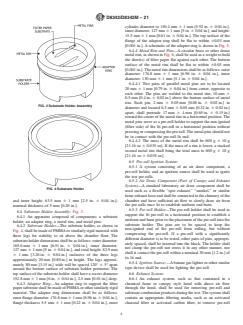
6.4.4 Metal Rim and Pins—A circular brass or other dense
metal rim, as shown in Fig. 6, shall be used as a weight to hold
the sheet(s) of filter paper flat against each other. The bottom
surface of the metal rim shall be flat to within 60.03 mm
[0.001in.].Themetalrimdimensionsshallbeasfollows:outer
diameter: 176.8 mm 6 1 mm [6.96 in. 6 0.04 in.], inner
diameter: 130 mm 6 1 mm [5.1 in. 6 0.04 in.].
6.4.4.1 Two pairs of parallel metal pins are to be located
20 mm 6 1 mm [0.79 in. 6 0.04 in.] from center, opposite to
each other. The pins are welded to the metal rim, 10 mm 6
0.5 mm [0.4 in. 6 0.02 in.] above the bottom surface of metal
rim. Each pin, 2 mm 6 0.05 mm [0.08 in. 6 0.02 in.] in
FIG. 3 Substrate Holder Assembly
diameter and located 6.3 mm 6 0.05 mm [0.32 in. 6 0.02 in.]
apart, shall protrude 17 mm 6 4 mm [0.65 in. 6 0.15 in.]
toward the center of the metal rim in a horizontal position.The
metal pins serve as a pre-roll holder to support the non-ignited
(filter side) of the lit pre-roll in a horizontal position without
pressingorcompressingthepre-roll.Themetalpinsshouldnot
be in contact with the pre-roll lit end.
6.4.4.2 The mass of the metal rim shall be 600 g 6 10 g
[21.16 oz 6 0.035 oz]. If the mass of a rim is lower, a stacked
second metal rim shall bring the total mass to 600 g 6 10 g
[21.16 oz 6 0.035 oz].
6.5 Pre-roll Ignition System:
6.5.1 A system consisting of an air draw component, a
pre-roll holder, and an ignition source shall be used to ignite
the test pre-rolls.
6.5.2 Air Draw Component (Part of Canopy and Exhaust
System)—A standard laboratory air draw component shall be
FIG. 4 Substrate Holder
used such as a flexible “spot exhaust,” “snorkel,” or similar
fumeexhausthoseandshallbeconnectedtothechimneyofthe
chamber and have sufficient air flow to slowly draw air from
and inner height: 63.5 mm 6 1 mm [2.5 in. 6 0.04 in.];
the pre-rolls once lit to establish uniform end burn.
nominal thickness of 5 mm [0.20 in.].
6.5.3 Pre-roll Holder—The pre-roll holder shall be used to
6.4 Substrate Holder Assembly: Fig. 3.
support the lit pre-roll in a horizontal position to establish a
6.4.1 An apparatus composed of components: a substrate
uniform end burn prior to the placement of the pre-roll into the
holder, an adaptor ring, a metal rim, and metal pins.
substrate holder. The pins are to be spaced to keep the
6.4.2 Substrate Holder—The substrate holder, as shown in
non-ignited end of the pre-roll from rolling, but without
Fig. 4, shall be made of PMMAor similarly rigid material with
compressing the pre-roll. If a pre-roll with a significantly
three legs for stability to sit above the chamber floor. The
different diameter is to be tested, other pairs of pins, appropri-
substrateholderdimensionsshallbeasfollows:outerdiameter:
ately spaced, shall be inserted into the block. The holder shall
165.6 mm 6 1 mm [6.51 in. 6 0.04 in.], inner diameter:
not clamp the pre-roll nor stress it in any other manner, nor
127 mm 61mm[5in. 6 0.04 in.], and total height: 82.9 mm
shall it contact the pre-roll within a nominal 30 mm [1.2 in.] of
6 1 mm [3.26 in. 6 0.04 in.] inclusive of the three legs
its lit end.
approximately 20 mm [0.80 in.] in height. The legs approxi-
6.5.4 Ignition Source:—Abutane gas lighter or other similar
mately 80 mm [3.15 in.] wide will be spaced 120° 6 5° apart
type device shall be used for lighting the pre-roll.
around the bottom surface of substrate
...