

ASTM D7800/D7800M-23
(Test Method)Standard Test Method for Determination of Elemental Sulfur in Natural Gas
General Information
- Abstract
SIGNIFICANCE AND USE
5.1 Elemental sulfur impacts the quality of pipeline natural gas and deposits on pipeline flanges, fittings and valves, thereby impacting their performance. Natural gas suppliers and distributers require a standardized test method for measuring elemental sulfur. Some government regulators are also interested in measuring elemental sulfur since it would provide a means for assessing the contribution of elemental sulfur in pipelines to the SOx emission inventory from burning of gaseous fuels. Use of this method in concert with sulfur gas laboratory test methods such as Test Methods D4084, D4468, D5504, and D6228 or on-line methods such as D7165 or D7166 can provide users with a comprehensive sulfur compound profile for natural gas or other gaseous fuels. Other applications may include elemental sulfur in particulate deposits such as diesel exhausts.
SCOPE
1.1 This test method is primarily for the determination of elemental sulfur in natural gas pipelines, but it may be applied to other gaseous fuel pipelines and applications provided the user has validated its suitability for use. The detection range for elemental sulfur, reported as sulfur, is 0.0018 mg/L to 30 mg/L. The results may also be reported in units of mg/kg or ppm.
1.2 The values stated in either SI units or inch-pound units are to be regarded separately as standard. The values stated in each system are not necessarily exact equivalents; therefore, to ensure conformance with the standard, each system shall be used independently of the other, and values from the two systems shall not be combined.
1.3 This standard does not purport to address all of the safety concerns, if any, associated with its use. It is the responsibility of the user of this standard to establish appropriate safety, health, and environmental practices and determine the applicability of regulatory limitations prior to use.
1.4 This international standard was developed in accordance with internationally recognized principles on standardization established in the Decision on Principles for the Development of International Standards, Guides and Recommendations issued by the World Trade Organization Technical Barriers to Trade (TBT) Committee.
- Status
- Published
- Publication Date
- 31-May-2023
- Technical Committee
- D03 - Gaseous Fuels
Overview
ASTM D7800/D7800M-23: Standard Test Method for Determination of Elemental Sulfur in Natural Gas is an internationally recognized standard developed by ASTM. This test method details precise procedures for quantifying elemental sulfur in natural gas streams, primarily within pipeline systems. Accurate determination of elemental sulfur is critical for maintaining natural gas quality, protecting infrastructure, and complying with environmental regulations. Elemental sulfur can adversely affect pipeline components such as flanges, fittings, and valves by forming deposits, potentially leading to equipment malfunction. Additionally, knowledge of sulfur content is vital for assessing contributions to SOx emission inventories from the combustion of natural gas and other gaseous fuels.
Key Topics
- Elemental Sulfur in Natural Gas: Describes the occurrence, risks, and reaction mechanisms associated with elemental sulfur, which is commonly found in particulate form in natural gas, diesel exhaust, and other gaseous fuels.
- Detection Range and Reporting: The method covers detection of elemental sulfur within a range of 0.0018 mg/L to 30 mg/L, with results reported in mg/L, mg/kg, or ppm.
- Sample Collection and Analysis: Utilizes a transportable elemental sulfur reactor for onsite extraction of sulfur, followed by laboratory analysis via gas chromatography equipped with sulfur or phosphorus-selective detectors (such as SCD, FPD, or PFPD).
- Interferences and Specificity: The test method discusses potential interferences from polysulfides, episulfides, and hydrogensulfide, ensuring operators are aware of analytical challenges and mitigation strategies.
- Calibration and Standardization: Emphasizes the importance of calibration using known standards, and requires rigorous preparation and validation to ensure reliable, reproducible results.
Applications
- Pipeline Operations: Supports natural gas suppliers and distributors in monitoring and managing sulfur deposition within pipelines to maintain operational efficiency and safety.
- Compliance and Regulation: Assists operators in meeting stringent regulatory requirements for sulfur content, supporting environmental reporting and permitting, and contributing data to SOx emission inventories.
- Equipment Protection: Identifying and quantifying elemental sulfur helps prevent corrosion and blockages in pipeline infrastructure, reducing maintenance costs and minimizing downtime.
- Comprehensive Sulfur Profiling: When used together with other laboratory and on-line sulfur analysis methods (such as ASTM D4084, D4468, D5504, D6228, D7165, and D7166), this standard enables the development of a detailed sulfur compound profile for natural gas and other gaseous fuels.
- Extended Use Cases: The method can be adapted for assessing elemental sulfur in other gaseous fuel pipelines and in particulate deposits, such as those found in diesel exhaust systems, provided the user validates its suitability.
Related Standards
- ASTM D4084: Test Method for Analysis of Hydrogen Sulfide in Gaseous Fuels.
- ASTM D4468: Test Method for Total Sulfur in Gaseous Fuels.
- ASTM D5504 / D6228: Methods for Determination of Sulfur Compounds by Gas Chromatography.
- ASTM D7165 / D7166: On-line analysis practices for sulfur content in gaseous fuels.
- ASTM D1945: Test Method for Analysis of Natural Gas by Gas Chromatography.
- ISO 14532: Natural Gas - Vocabulary.
Practical Value
Implementing ASTM D7800/D7800M-23 provides pipeline operators, laboratories, and regulators with a robust tool for the detection and management of elemental sulfur in natural gas. This can translate into enhanced gas quality, reduced risks to both personnel and infrastructure, and adherence to both national and international regulatory frameworks. The method’s inclusion in a network of related sulfur-sensing protocols ensures that users can achieve comprehensive analysis for pipeline integrity, environmental compliance, and process optimization.
Keywords: elemental sulfur, natural gas, pipelines, sulfur analysis, ASTM D7800, SOx emissions, pipeline integrity, environmental compliance, gas chromatography, sulfur content, sulfur detection, gaseous fuels.
Relations
- Effective Date
- 01-Oct-2023
- Effective Date
- 15-Dec-2019
- Refers
ASTM D4626-95(2019) - Standard Practice for Calculation of Gas Chromatographic Response Factors - Effective Date
- 01-Dec-2019
- Effective Date
- 01-Jul-2016
- Refers
ASTM D5287-08(2015) - Standard Practice for Automatic Sampling of Gaseous Fuels (Withdrawn 2024) - Effective Date
- 01-Jun-2015
- Effective Date
- 01-Nov-2012
- Effective Date
- 01-Nov-2011
- Effective Date
- 01-Jun-2011
- Effective Date
- 01-Dec-2010
- Effective Date
- 01-May-2010
- Effective Date
- 01-Apr-2010
- Effective Date
- 01-Jan-2010
- Effective Date
- 01-Jan-2010
- Effective Date
- 01-Jan-2010
- Effective Date
- 01-Dec-2008
Get Certified
Connect with accredited certification bodies for this standard

Element Materials Technology
Materials testing and product certification.

ABS Group Brazil
ABS Group certification services in Brazil.

ABS Quality Evaluations Inc.
American Bureau of Shipping quality certification.
Sponsored listings
Frequently Asked Questions
ASTM D7800/D7800M-23 is a standard published by ASTM International. Its full title is "Standard Test Method for Determination of Elemental Sulfur in Natural Gas". This standard covers: SIGNIFICANCE AND USE 5.1 Elemental sulfur impacts the quality of pipeline natural gas and deposits on pipeline flanges, fittings and valves, thereby impacting their performance. Natural gas suppliers and distributers require a standardized test method for measuring elemental sulfur. Some government regulators are also interested in measuring elemental sulfur since it would provide a means for assessing the contribution of elemental sulfur in pipelines to the SOx emission inventory from burning of gaseous fuels. Use of this method in concert with sulfur gas laboratory test methods such as Test Methods D4084, D4468, D5504, and D6228 or on-line methods such as D7165 or D7166 can provide users with a comprehensive sulfur compound profile for natural gas or other gaseous fuels. Other applications may include elemental sulfur in particulate deposits such as diesel exhausts. SCOPE 1.1 This test method is primarily for the determination of elemental sulfur in natural gas pipelines, but it may be applied to other gaseous fuel pipelines and applications provided the user has validated its suitability for use. The detection range for elemental sulfur, reported as sulfur, is 0.0018 mg/L to 30 mg/L. The results may also be reported in units of mg/kg or ppm. 1.2 The values stated in either SI units or inch-pound units are to be regarded separately as standard. The values stated in each system are not necessarily exact equivalents; therefore, to ensure conformance with the standard, each system shall be used independently of the other, and values from the two systems shall not be combined. 1.3 This standard does not purport to address all of the safety concerns, if any, associated with its use. It is the responsibility of the user of this standard to establish appropriate safety, health, and environmental practices and determine the applicability of regulatory limitations prior to use. 1.4 This international standard was developed in accordance with internationally recognized principles on standardization established in the Decision on Principles for the Development of International Standards, Guides and Recommendations issued by the World Trade Organization Technical Barriers to Trade (TBT) Committee.
SIGNIFICANCE AND USE 5.1 Elemental sulfur impacts the quality of pipeline natural gas and deposits on pipeline flanges, fittings and valves, thereby impacting their performance. Natural gas suppliers and distributers require a standardized test method for measuring elemental sulfur. Some government regulators are also interested in measuring elemental sulfur since it would provide a means for assessing the contribution of elemental sulfur in pipelines to the SOx emission inventory from burning of gaseous fuels. Use of this method in concert with sulfur gas laboratory test methods such as Test Methods D4084, D4468, D5504, and D6228 or on-line methods such as D7165 or D7166 can provide users with a comprehensive sulfur compound profile for natural gas or other gaseous fuels. Other applications may include elemental sulfur in particulate deposits such as diesel exhausts. SCOPE 1.1 This test method is primarily for the determination of elemental sulfur in natural gas pipelines, but it may be applied to other gaseous fuel pipelines and applications provided the user has validated its suitability for use. The detection range for elemental sulfur, reported as sulfur, is 0.0018 mg/L to 30 mg/L. The results may also be reported in units of mg/kg or ppm. 1.2 The values stated in either SI units or inch-pound units are to be regarded separately as standard. The values stated in each system are not necessarily exact equivalents; therefore, to ensure conformance with the standard, each system shall be used independently of the other, and values from the two systems shall not be combined. 1.3 This standard does not purport to address all of the safety concerns, if any, associated with its use. It is the responsibility of the user of this standard to establish appropriate safety, health, and environmental practices and determine the applicability of regulatory limitations prior to use. 1.4 This international standard was developed in accordance with internationally recognized principles on standardization established in the Decision on Principles for the Development of International Standards, Guides and Recommendations issued by the World Trade Organization Technical Barriers to Trade (TBT) Committee.
ASTM D7800/D7800M-23 is classified under the following ICS (International Classification for Standards) categories: 23.040.99 - Other pipeline components; 75.060 - Natural gas; 75.160.30 - Gaseous fuels. The ICS classification helps identify the subject area and facilitates finding related standards.
ASTM D7800/D7800M-23 has the following relationships with other standards: It is inter standard links to ASTM D4626-23, ASTM D4150-19, ASTM D4626-95(2019), ASTM D4150-08(2016), ASTM D5287-08(2015), ASTM D1072-06(2012), ASTM D4468-85(2011), ASTM D7607-11, ASTM D6228-10, ASTM D7551-10, ASTM D3609-00(2010), ASTM D1945-03(2010), ASTM D7166-10, ASTM D7165-10, ASTM D5287-08. Understanding these relationships helps ensure you are using the most current and applicable version of the standard.
ASTM D7800/D7800M-23 is available in PDF format for immediate download after purchase. The document can be added to your cart and obtained through the secure checkout process. Digital delivery ensures instant access to the complete standard document.
Standards Content (Sample)
This international standard was developed in accordance with internationally recognized principles on standardization established in the Decision on Principles for the
Development of International Standards, Guides and Recommendations issued by the World Trade Organization Technical Barriers to Trade (TBT) Committee.
Designation: D7800/D7800M − 23
Standard Test Method for
Determination of Elemental Sulfur in Natural Gas
This standard is issued under the fixed designation D7800/D7800M; the number immediately following the designation indicates the
year of original adoption or, in the case of revision, the year of last revision. A number in parentheses indicates the year of last
reapproval. A superscript epsilon (´) indicates an editorial change since the last revision or reapproval.
1. Scope D1145 Test Method for Sampling Natural Gas (Withdrawn
1986)
1.1 This test method is primarily for the determination of
D1945 Test Method for Analysis of Natural Gas by Gas
elemental sulfur in natural gas pipelines, but it may be applied
Chromatography
to other gaseous fuel pipelines and applications provided the
D3609 Practice for Calibration Techniques Using Perme-
user has validated its suitability for use. The detection range for
ation Tubes
elemental sulfur, reported as sulfur, is 0.0018 mg ⁄L to
D4084 Test Method for Analysis of Hydrogen Sulfide in
30 mg ⁄L. The results may also be reported in units of mg/kg or
Gaseous Fuels (Lead Acetate Reaction Rate Method)
ppm.
D4150 Terminology Relating to Gaseous Fuels
D4468 Test Method for Total Sulfur in Gaseous Fuels by
1.2 The values stated in either SI units or inch-pound units
Hydrogenolysis and Rateometric Colorimetry
are to be regarded separately as standard. The values stated in
D4626 Practice for Calculation of Gas Chromatographic
each system are not necessarily exact equivalents; therefore, to
Response Factors
ensure conformance with the standard, each system shall be
D5287 Practice for Automatic Sampling of Gaseous Fuels
used independently of the other, and values from the two
D5504 Test Method for Determination of Sulfur Compounds
systems shall not be combined.
in Natural Gas and Gaseous Fuels by Gas Chromatogra-
1.3 This standard does not purport to address all of the
phy and Chemiluminescence
safety concerns, if any, associated with its use. It is the D6228 Test Method for Determination of Sulfur Compounds
responsibility of the user of this standard to establish appro- in Natural Gas and Gaseous Fuels by Gas Chromatogra-
phy and Flame Photometric Detection
priate safety, health, and environmental practices and deter-
D7165 Practice for Gas Chromatograph Based On-line/At-
mine the applicability of regulatory limitations prior to use.
line Analysis for Sulfur Content of Gaseous Fuels
1.4 This international standard was developed in accor-
D7166 Practice for Total Sulfur Analyzer Based On-line/At-
dance with internationally recognized principles on standard-
line for Sulfur Content of Gaseous Fuels
ization established in the Decision on Principles for the
D7551 Test Method for Determination of Total Volatile
Development of International Standards, Guides and Recom-
Sulfur in Gaseous Hydrocarbons and Liquefied Petroleum
mendations issued by the World Trade Organization Technical
Gases and Natural Gas by Ultraviolet Fluorescence
Barriers to Trade (TBT) Committee.
D7607 Test Method for Analysis of Oxygen in Gaseous
Fuels (Electrochemical Sensor Method)
2. Referenced Documents
E840 Practice for Using Flame Photometric Detectors in Gas
Chromatography
2.1 ASTM Standards:
2.2 ISO Documents
D1072 Test Method for Total Sulfur in Fuel Gases by
Combustion and Barium Chloride Titration ISO 14532 Natural Gas—Vocabulary
3. Terminology
3.1 Definitions:
This test method is under the jurisdiction of ASTM Committee D03 on Gaseous
3.2 For definitions of general terms used in D03 Gaseous
Fuels and is the direct responsibility of Subcommittee D03.06.01 on Analysis of
Major Constituents by Gas Chromatography.
Fuels standards, refer to Terminology D4150.
Current edition approved June 1, 2023. Published June 2023. Originally
3.3 Definitions of Terms Specific to This Standard:
approved in 2014. Last previous edition approved in 2014 as D7800/D7800M – 14
which was withdrawn February 2023 and reinstated in June 2023. DOI: 10.1520/
D7800_D7800M-23.
2 3
For referenced ASTM standards, visit the ASTM website, www.astm.org, or The last approved version of this historical standard is referenced on
contact ASTM Customer Service at service@astm.org. For Annual Book of ASTM www.astm.org.
Standards volume information, refer to the standard’s Document Summary page on Available from International Organization for Standardization (ISO), 1, ch. de
the ASTM website. la Voie-Creuse, CP 56, CH-1211 Geneva 20, Switzerland, http://www.iso.org.
Copyright © ASTM International, 100 Barr Harbor Drive, PO Box C700, West Conshohocken, PA 19428-2959. United States
D7800/D7800M − 23
3.3.1 elemental sulfur, n—a pale yellow nonmetallic ele- 4.1.1 Natural gas, at a gauge pressure up to 6.8 MPa [1000
ment occurring in nature and found as a particulate in diesel psig], is introduced into a transportable elemental sulfur reactor
exhaust, natural gas, and other gaseous fuels. through a 6 mm [ ⁄4 in.] stainless steel probe located in the
3.3.1.1 Discussion—Elemental sulfur exists in several free middle to top third of a pipeline. The reactor consists of an
and combined allotropic forms. enclosure that is heated to approximately 71 °C [160 °F] and
contains a series of three high pressure bubblers, which contain
3.3.2 episulfide, n—a class of compound that contains a
the reaction solution. A fourth bubbler is located outside the
saturated heterocyclic ring consisting of two carbon atoms and
heated enclosure to act as a reaction solution vapor condenser.
one sulfur atom.
The gas flows through a coalescing filter to remove any liquid
3.3.2.1 Discussion—Episulfides are the sulfur analogue of
droplets present to keep the meter from being contaminated.
an epoxide. They are also known as thiiranes, olefin sulfides,
The gas is regulated to provide a constant pressure to a
thioalkylene oxides, and thiacyclopropanes.
metering valve that is used to control the flow rate of gas
3.3.3 natural gas pipeline, n—pipeline in which natural gas
through the system. The meter records the total volume that has
is transported.
passed through the reactor during the test period. The apparatus
3.3.4 pipeline, n—all parts of those physical facilities
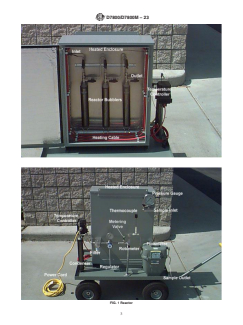
is depicted in Fig. 1.
through which gas moves in transportation, including pipe,
4.1.2 Liquid samples extracted from the transportable el-
valves, and other appurtenance attached to pipe, compressor
emental sulfur reactor are injected into a gas chromatograph
units, metering stations, regulator stations, delivery stations,
interfaced to an SCD, FPD or PFPD configured to detect
holders, and fabricated assemblies.
phosphorus. The TPPS and surrogate, TPPO , are chromato-
3.3.5 polysulfide, n—a class of chemical compounds con-
graphically resolved from other compounds in the sample,
taining chains of sulfur atoms.
integrated, and concentration of elemental sulfur in the original
3.3.5.1 Discussion—The two main classes of polysulfides
natural gas sample is calculated using the equations described
2−
are anions with the general formula Sn . These anions are the
in subsection 4.1.
conjugate bases of the hydrogen polysulfides H Sn. Organic
polysulfides are also known; the main representatives of which
5. Significance and Use
have the formulae RSnR, where R = alkyl or aryl.
5.1 Elemental sulfur impacts the quality of pipeline natural
3.4 Abbreviations and Acronyms:
gas and deposits on pipeline flanges, fittings and valves,
3.4.1 DMF—dimethylformamide
thereby impacting their performance. Natural gas suppliers and
3.4.2 FPD—flame photometric detector distributers require a standardized test method for measuring
elemental sulfur. Some government regulators are also inter-
3.4.3 GC—gas chromatograph
ested in measuring elemental sulfur since it would provide a
3.4.4 PFPD—pulsed flame photometric detector
means for assessing the contribution of elemental sulfur in
3.4.5 SCD—sulfur chemiluminescence detector
pipelines to the SOx emission inventory from burning of
gaseous fuels. Use of this method in concert with sulfur gas
3.4.6 TPP—triphenylphosphine
laboratory test methods such as Test Methods D4084, D4468,
4. Summary of Test Method
D5504, and D6228 or on-line methods such as D7165 or
D7166 can provide users with a comprehensive sulfur com-
4.1 A transportable elemental sulfur reactor is used to
pound profile for natural gas or other gaseous fuels. Other
convert elemental sulfur in the side stream of a flowing gas
applications may include elemental sulfur in particulate depos-
stream into an easily detectable species. This is accomplished
its such as diesel exhausts.
by sampling a representative portion of the natural gas stream
and bubbling it through a chemical reactor containing triph-
enylphosphine (TPP) in a solution of dimethylformamide 6. Interferences
(DMF). This solution selectively reacts with crystals of el-
6.1 Triphenylphosphine abstracts sulfur from polysulfide
emental sulfur to produce the elemental sulfur adduct triph-
and episulfides, as well as elemental sulfur. Hence, polysulfide
enylphosphine sulfide (TPPS) (Eq 1 and Eq 2).
and episulfides that react with TPPS can interfere with this
1 2
~C H ! P1~C H ! P SSSSSSSS →~C H ! PS
analysis. Simple organosulfur compounds such as thiols and
6 5 3 6 5 3 6 5 3
1 2
thioethers are unreactive.
1 C H P SSSSSSS , etc. (1)
~ !
6 5 3
1 2
C H P1 C H P SS →2 C H PS (2)
~ ! ~ ! ~ ! 6.2 Triphenylphosphine selenide (Ph3PSe) is an interferent
6 5 6 5 6 5
3 3 3
that may be encountered in some biogases.
Liquid samples extracted from the transportable elemental
sulfur reactor are injected into a gas chromatograph (GC) 6.3 Triphenylphosphine oxide (Ph3PO) is an interferent
interfaced to a SCD, FPD, or a PFPD operating in the
resulting from slow oxidation of triphenylphosphine. (Eq 3).
phosphorus mode. The concentration of TPPS is proportional
2PPh31O2→2OPPh3 (3)
to the concentration of elemental sulfur found in the gas.
6.4 During the sample collection, Hydrogen Sulfide (H S)
in the gas stream at elevated temperatures may react with TPP.
“Reactions of Elemental Sulfur: I: The Uncatalyzed Reaction of Sulfur with
Also, residual H S in the medium may react with the TPP at the
Triarylphosphines,” Bartlett, P. D. and Garbis Meguerian. Journal of the American 2
Chemical Society, vol. 78, No. 15, pp 3710. 1956. GC injector temperatures required to volatilize the sample.
D7800/D7800M − 23
FIG. 1 Reactor
D7800/D7800M − 23
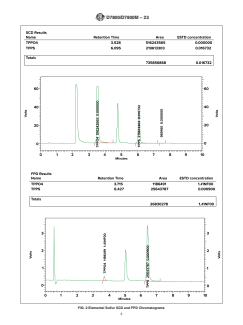
FIG. 2 Elemental Sulfur SCD and FPD Chromatograms
D7800/D7800M − 23
FIG. 3 Example of General SCD Method Parameters
6.5 There may also be inadvertent oxidation of the residual
H S to elemental sulfur. To avoid extraneous oxidation, pre- Method Description
Program for Analysis of TPPS
cautions are taken with respect to preparation of the test
Injection Temperature = 275 °C
solutions, cleaning of the apparatus and handling of the reacted
Column Temperature = 155:1 at 25 > 275:9.2
solutions. Valve On = 0
Detector Temperature = Off
7. Apparatus
GC Parameters
Temperature Setup
7.1 For each test site, the following equipment is needed:
Oven Parameters
7.1.1 Reactor cart with bubblers filled with TPP in a Oven: On
Oven Equilib Time: 0.00 min
solution of DMF and purged with nitrogen. The bubblers are
Oven Max Temperature: 320 °C
three 500 mL polytetrafluoroethylene-lined steel cylinders. The
Oven Cryo: Off
three cylinders are housed in an insulated cabinet fitted with Oven Cryo Blast: Off
Oven Ambient: 20 °C
heat trace tape to generate elevated temperatures, nominally
Oven Temperature Program
70 °C to 90 °C [160 °F to 195 °F], required for the test. A
fourth 500 mL steel cylinder is connected downstream outside
Init Level
Final Temp: 155.00 °C
of the insulated cabinet. The interior of the reactor is rated for
Final Time: 1.00 min
operation in a Class 1 Division 2 hazardous environment,
Level 1
however, the heating cable termination cap and the thermostat Rate: 25.00 °C/min
Final Temp: 275.00 °C
box may be rated NEMA 4 (weather proof), so the reactor is
Final Time: 4.70 min
typically located at least 4.6 m [15 ft.] away from the pipeline;
Zone Temperatures
7.1.2 Coalescing filter and filter element, Injector A Setpoint: 275 °C
7.1.3 A 6 mm [¼ in.] sample probe of suitable length so that
Detector Setup
the probe tip can be positioned between the middle and a
Detector B: On
Det. B Negative Polarity: Off
position one-third from the top of the pipe,
Signal 1 Parameters
7.1.4 A 4.6 m [15 ft] length of 6 mm [¼ in.] stainless tubing
Source: Det. B
(or longer depending on site),
Attenuation: 0
7.1.5 Thermocouple probe, Range: 0
Auto Zero: Off
7.1.6 Thin wire thermocouple,
7.1.7 Electronic thermometer or data logger,
Inlet A
Constant Flow: On
7.1.8 Stopwatch,
Constant Flow Pressure: 12.60 kPa
7.1.9 Oxygen analyzer, and
Constant Flow Temperature: 100.00 °C
7.1.10 Electrical connection and 15 m [nominally 50 ft]
Column Length: 50.00 m
Column ID: 0.52 mm
cord (or longer depending on site).
Column Gas: He
7.2 The following laboratory equipment is needed: Vacuum Compensation: Off
Split Flow: 0.00 mL/min
7.2.1 Chromatograph,
Split Ratio: (0.00 : 1)
7.2.1.1 Any gas chromatograph of standard manufacture,
Inlet A Pressure Program
Init Level
with hardware necessary for interfacing to an SCD, PFPD, or
Pressure: 0.00 kPa
FPD, and containing all features necessary for the intended
Final Time: 0.00 min
application(s) can be used. The detector should be configured
Pressure: 0.00 kPa
for selective detection of phosphorus and placed in service in Final Time: 0.00 min
Inlet Temperature Setup
accordance with the manufacturer’s instructions. This analysis
Inlet A
can be performed under a wide range of operating conditions.
Zone Temperature: On
Setpoint Temperature: 275 °C
Typical, minimal performance criteria for chromatographic
Oven Track: Off
conditions are:
Inlet A Temperature Program
(a) Operating conditions must be set such that TPPS
Init Level
Final Temp: 0.00 °C
separates from the matrix and other sulfur species that may be
Final Time: 0.00 min
present in a sample.
Init Level
(b) The injection system must transfer the TPPS to the GC
Final Temp: 0.00 °C
Final Time: 0.00 min
column without loss or absorption, without reaction to the
Instrument Setup
TPPS and without excessive carryover between samples.
The operating conditions presented in Fig. 3 and Fig. 4 have
Minimum Stable Baseline Time: 15.0 min
Maximum Test Time: 15.0 min
been successfully used to fulfill the above criteria. Fig. 2
illustrates a typical analysis of TPPS determined from a natural
gas sample.
7.2.1.2 SCD—Place in service in accordance with the manu- observed when changing sample size. Matrix interference is
facturer’s instructions, and configure the detector for also indicated by recoveries less than 90 % or greater than
phosphorus-selective detection or other selective sulfur mode 110 % for samples spiked with calibration gas or samples
to achieve sulfur speciation. Matrix interference is occasionally diluted with air. When matrix interference is indicated, samples
D7800/D7800M − 23
FIG. 4 Example of General FPD Method Parameters
tion procedure results in recoveries within 10 % of theoretical
Temperature Setup results. Operational features specific to the interface configu-
Oven Parameters
ration employed are described in the following. For further
Oven: On
information on SCD operation and limitations, the user is
Oven Equilib Time: 0.00 min
Oven Max Temperature: 300 °C referred to Test Method D5504.
Oven Cryo: Off
7.2.1.3 PFPD and FPD—Place into service in accordance
Oven Cryo Blast: Off
with manufacturer’s instructions, and configure the gas flow
Oven Ambient: 20 °C
Timeout Detection: Off
rates and optical filter for phosphorus-selective detection. For
Timeout Detector: 10.00 min
further information on PFPD and FPD operation see Practice
Fault Detection: Off
E840.
Oven Temperature Program
Level Rate Next Temp Hold Time
7.2.1.4 Column—A variety of columns can be used in
Initial 250.00 °C 10.00 min
performing the determination of elemental sulfur according to
Zone Temperatures
Front Inlet Setpoint: 300 °C this standard. Typically, a 60 m x 0.53 mm ID fused silica open
Back Inlet Setpoint: Off
tubular column containing a 5 μm film thickness of bonded
Front Detector Setpoint: Off
methyl silicone liquid phase is used. The selected column must
Back Detector Setpoint: 250 °C
Aux 1 Setpoint: Off provide retention and resolution characteristics such as those
Aux 2 Setpoint: 250 °C
listed in Fig. 5. The column must be inert towards TPPS. The
Inlet Temperature Setup
column must also demonstrate a sufficiently low liquid phase
Inlet: Front
Oven Track: Off
bleed at high temperature such that loss of detector response is
Zone Temperature: Off
not encountered while operating the column at 200 °C [392
Inlet Temperature Program: Off
°F].
Inlet: Back
Oven Track: Off
7.2.2 Recorder. A 0 mV to 1 mV range recording potenti-
Zone Temperature: Off
ometer or equivalent, with a full-scale response time of 2 s or
Inlet Temperature Program: Off
less can be used.
Inlet: Aux 1
Oven Track: Off
7.2.3 Integrator. An electronic integrating device or com-
Zone Temperature: Off
puter can be used. The device and software must have the
Inlet Temperature Program: Off
Inlet: Aux 2 following capabilities:
Oven Track: Off
7.2.3.1 Graphic presentation of the chromatogram,
Zone Temperature: 250 °C
Inlet Temperature Program: Off 7.2.3.2 Digital display of chromatographic peak areas,
7.2.3.3 Identification of TPPS chromatographic peak by
Inlet Pressure Setup
retention time or relative retention time, or both,
General Inlet Settings
Split Mode: Splitless
7.2.3.4 Calculation and use of the TPPS response factor, and
Purge Flow: 10.00 mL/min at 0.00 min
7.2.3.5 External standard calculation and data presentation.
Gas Saver: Off
Column Setup
8. Reagents and Materials
Column 1
Capillary Colunn
8.1 For each test site the following reagents and materials
Length: 30.00 m
are needed:
Inside Diameter: 0.53 mm
Film Thickness: 1.50 um 8.1.1 1 L ACS reagent grade dimethylformamide (DMF),
Inlet: Front
8.1.2 5 g of doubly recrystallized TPP supplied,
Gas: Helium
Carrier Flow 8.1.3 1 g of triphenylphosphate (TPPO ),
Column Mode: Constant Flow
8.1.4 1 L acetone,
Flow: 9.80 mL/min
8.1.5 Four 250 mL plastic bottles with lids and labels,
Signals Setup
Signal 1 Parameters
8.1.6 One 100 mL plastic bottles with lids and labels,
Detector: Back Det.
8.1.7 One 20 mL plastic bottle with lid and label,
Range: 0
Attenuation: 0
8.1.8 Five 8 mL glass vials with lids and labels,
Auto Zero: Off
8.1.9 Ten 2 mL Target vials,
Quantitation: Area
Calibration Flag: Replace
8.1.10 Ultra-high purity (UHP) nitrogen,
Calibration Weight: 0
8.1.11 Eight polyvinyl floride bags (optional), and
Calibration Unit: mg/mL
Group Table
8.1.12 Four stainless steel cylinders.
Acquisition: Yes
Current Frequency: 20 (Hz)
Run Time: 10 (min) 9. Hazards
Delay: 0 (min)
9.1 Improper use of an elemental sulfur reactor can result in
burns, fires, or explosions; therefore, users are advised to
familiarize themselves with the chemical and physical proper-
may be analyzed by dilution or application of other mitigation ties of each of the reagents and materials listed in Section 8 and
efforts provided a spiked sample performed using the mitiga- the safe operation of the apparatus listed in Section 7.
D7800/D7800M − 23
FIG. 5
9.2 Gloves, safety glasses, and lab coat m
...