

ASTM E787-81(2024)
(Specification)Standard Specification for Disposable Glass Micro Blood Collection Pipets
General Information
- Abstract
ABSTRACT
This specification covers two dimensionally different (short and long) disposable glass micropipets used primarily to collect whole human blood specimens for clinical analysis and testing. Short and long pipets are available as coated with heparin (Type I) or uncoated (Type II).The pipets shall be fabricated from borosilicate glass, Type I, Class B, or soda lime glass, Type II. Heparin shall be the ammonium salt isolated from the lungs or intestinal mucosa of beef or pork origin and shall meet the specified heparin potency. The physical requirements including design, dimensions, workmanship, color coding, capillarity, fluidity, lot or control number, resistance to centrifugal force, and heparin coating are specified. The following tests shall be performed: capillarity test, fluidity test, sheep plasma test, human whole blood test, resistance to centrifugal force test, and heparin content test. The physical requirements for short Caraway pipet and long Natelson pipet are illustrated as well.
SCOPE
1.1 This specification covers two dimensionally different disposable glass micropipets used primarily to collect whole human blood specimens for clinical analysis and testing. They are available as coated with heparin or uncoated.
1.2 This international standard was developed in accordance with internationally recognized principles on standardization established in the Decision on Principles for the Development of International Standards, Guides and Recommendations issued by the World Trade Organization Technical Barriers to Trade (TBT) Committee.
- Status
- Published
- Publication Date
- 31-Jan-2024
- Technical Committee
- E41 - Laboratory Apparatus
- Drafting Committee
- E41.01 - Laboratory Ware and Supplies


Overview
ASTM E787-81(2024), Standard Specification for Disposable Glass Micro Blood Collection Pipets, covers requirements for two types of dimensionally different disposable glass micropipets used in collecting whole human blood specimens. These pipets are essential for clinical analysis and laboratory testing, providing a standardized method for sample collection. The specification details manufacturing materials, physical requirements, performance tests, and quality indicators to ensure safe and effective use in laboratory environments.
Key Topics
- Pipet Types: The standard defines two main types of pipets:
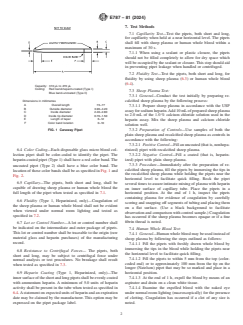
- Short Caraway pipet: Approximately 75 mm in length, typically holding 310 μL to 470 μL.
- Long Natelson pipet: Approximately 150 mm in length, with a capacity of 220 μL to 420 μL.
- Coating Options: Both pipet types are available in two variants:
- Type I (Heparin-coated): Identified with a red band. Provides anticoagulant properties using a heparin coating.
- Type II (Uncoated): Identified with a blue band. Used when anticoagulant is not required.
- Material Requirements: Pipets must be made from either borosilicate glass (Type I, Class B) or soda lime glass (Type II) to ensure strength and chemical resistance.
- Quality and Design: The specification demands:
- Straight, fire-polished pipets with tapered points
- No defects, cracks, or foreign matter
- Color coding for easy identification
- Performance Tests: Includes capillarity, fluidity, sheep plasma, human whole blood, centrifugal force resistance, and heparin content tests to guarantee reliable and safe performance.
Applications
Disposable glass micro blood collection pipets specified by ASTM E787-81(2024) are critical in a range of medical and laboratory applications where small-volume blood collection is required:
- Clinical Laboratories: Used in hospitals, clinics, and diagnostic labs for routine blood testing and specialized analyses.
- Point-of-Care Testing: Suitable for near-patient sample collection in doctor’s offices and emergency settings.
- Research Facilities: Widely used in academic and biotechnological research where accurate and standardized micro blood sampling is essential.
- Quality Control: Ensures traceability through lot numbers and standardized dimensions, improving reproducibility and patient safety.
- Compatibility and Safety: Heparin-coated models allow for immediate anticoagulation, preventing clotting during analysis and aiding in accurate test results.
Related Standards
Several ASTM standards and guidelines complement or reference ASTM E787-81(2024):
- ASTM E438: Specification for Glasses in Laboratory Apparatus provides the glass material requirements referenced for pipet manufacturing.
- United States Pharmacopeia (USP): Methods for assaying heparin content ensure compliance with pharmaceutical quality benchmarks.
- International Principles: This standard aligns with principles established by the World Trade Organization Technical Barriers to Trade (TBT) Committee, ensuring international applicability.
Practical Value
Adhering to ASTM E787-81(2024) ensures consistent quality, patient safety, and regulatory compliance in the production and use of disposable glass micro blood collection pipets. Clear specifications for design, materials, testing, and labeling help laboratories select the appropriate pipet for clinical and research applications, reducing risk of contamination, breakage, or sample compromise. The use of standardized pipets also facilitates interoperability and efficient training for laboratory personnel worldwide.
Keywords: blood collection, disposable pipets, glass micropipets, clinical laboratory, heparin-coated, Caraway pipet, Natelson pipet, ASTM E787-81, laboratory supplies, medical testing standards.
Relations
- Replaces
ASTM E787-81(2017) - Standard Specification for Disposable Glass Micro Blood Collection Pipets - Effective Date
- 01-Feb-2024
- Effective Date
- 01-Feb-2024
- Effective Date
- 01-Jan-2018
Get Certified
Connect with accredited certification bodies for this standard

BSI Group
BSI (British Standards Institution) is the business standards company that helps organizations make excellence a habit.

TÜV Rheinland
TÜV Rheinland is a leading international provider of technical services.

TÜV SÜD
TÜV SÜD is a trusted partner of choice for safety, security and sustainability solutions.
Sponsored listings
Frequently Asked Questions
ASTM E787-81(2024) is a technical specification published by ASTM International. Its full title is "Standard Specification for Disposable Glass Micro Blood Collection Pipets". This standard covers: ABSTRACT This specification covers two dimensionally different (short and long) disposable glass micropipets used primarily to collect whole human blood specimens for clinical analysis and testing. Short and long pipets are available as coated with heparin (Type I) or uncoated (Type II).The pipets shall be fabricated from borosilicate glass, Type I, Class B, or soda lime glass, Type II. Heparin shall be the ammonium salt isolated from the lungs or intestinal mucosa of beef or pork origin and shall meet the specified heparin potency. The physical requirements including design, dimensions, workmanship, color coding, capillarity, fluidity, lot or control number, resistance to centrifugal force, and heparin coating are specified. The following tests shall be performed: capillarity test, fluidity test, sheep plasma test, human whole blood test, resistance to centrifugal force test, and heparin content test. The physical requirements for short Caraway pipet and long Natelson pipet are illustrated as well. SCOPE 1.1 This specification covers two dimensionally different disposable glass micropipets used primarily to collect whole human blood specimens for clinical analysis and testing. They are available as coated with heparin or uncoated. 1.2 This international standard was developed in accordance with internationally recognized principles on standardization established in the Decision on Principles for the Development of International Standards, Guides and Recommendations issued by the World Trade Organization Technical Barriers to Trade (TBT) Committee.
ABSTRACT This specification covers two dimensionally different (short and long) disposable glass micropipets used primarily to collect whole human blood specimens for clinical analysis and testing. Short and long pipets are available as coated with heparin (Type I) or uncoated (Type II).The pipets shall be fabricated from borosilicate glass, Type I, Class B, or soda lime glass, Type II. Heparin shall be the ammonium salt isolated from the lungs or intestinal mucosa of beef or pork origin and shall meet the specified heparin potency. The physical requirements including design, dimensions, workmanship, color coding, capillarity, fluidity, lot or control number, resistance to centrifugal force, and heparin coating are specified. The following tests shall be performed: capillarity test, fluidity test, sheep plasma test, human whole blood test, resistance to centrifugal force test, and heparin content test. The physical requirements for short Caraway pipet and long Natelson pipet are illustrated as well. SCOPE 1.1 This specification covers two dimensionally different disposable glass micropipets used primarily to collect whole human blood specimens for clinical analysis and testing. They are available as coated with heparin or uncoated. 1.2 This international standard was developed in accordance with internationally recognized principles on standardization established in the Decision on Principles for the Development of International Standards, Guides and Recommendations issued by the World Trade Organization Technical Barriers to Trade (TBT) Committee.
ASTM E787-81(2024) is classified under the following ICS (International Classification for Standards) categories: 11.100 - Laboratory medicine; 11.100.30 - Analysis of blood and urine. The ICS classification helps identify the subject area and facilitates finding related standards.
ASTM E787-81(2024) has the following relationships with other standards: It is inter standard links to ASTM E787-81(2017), ASTM E438-92(2024), ASTM E438-92(2018). Understanding these relationships helps ensure you are using the most current and applicable version of the standard.
ASTM E787-81(2024) is available in PDF format for immediate download after purchase. The document can be added to your cart and obtained through the secure checkout process. Digital delivery ensures instant access to the complete standard document.
Standards Content (Sample)
This international standard was developed in accordance with internationally recognized principles on standardization established in the Decision on Principles for the
Development of International Standards, Guides and Recommendations issued by the World Trade Organization Technical Barriers to Trade (TBT) Committee.
Designation: E787 − 81 (Reapproved 2024)
Standard Specification for
Disposable Glass Micro Blood Collection Pipets
This standard is issued under the fixed designation E787; the number immediately following the designation indicates the year of
original adoption or, in the case of revision, the year of last revision. A number in parentheses indicates the year of last reapproval. A
superscript epsilon (´) indicates an editorial change since the last revision or reapproval.
This standard has been approved for use by agencies of the U.S. Department of Defense.
1. Scope 4.1.2 Long Pipet—Approximately 150 mm long and coated
with heparin (Type I) or uncoated (Type II). These are
1.1 This specification covers two dimensionally different
commercially recognized as Natelson pipets.
disposable glass micropipets used primarily to collect whole
human blood specimens for clinical analysis and testing. They
5. Materials and Manufacture
are available as coated with heparin or uncoated.
5.1 Glass—The pipets shall be fabricated from borosilicate
1.2 This international standard was developed in accor-
glass, Type I, Class B, or soda lime glass, Type II, in
dance with internationally recognized principles on standard-
accordance with Specification E438.
ization established in the Decision on Principles for the
5.2 Heparin—shall be the ammonium salt isolated from the
Development of International Standards, Guides and Recom-
lungs or intestinal mucosa of beef or pork origin. The heparin
mendations issued by the World Trade Organization Technical
potency shall be 1 mg of ammonium heparin compound which
Barriers to Trade (TBT) Committee.
is equal to at least 100 USP units.
2. Referenced Documents
6. Physical Requirements
2.1 ASTM Standards:
6.1 Design—The disposable glass micro blood collection
E438 Specification for Glasses in Laboratory Apparatus
pipets, both short and long, shall be straight and pulled to a
3. Terminology tapered point at one end. Any cross section of the pipets, taken
in a plane perpendicular to the longitudinal axis, shall be
3.1 Definitions of Terms Specific to This Standard:
circular. The pipets shall be lightly firepolished at both ends
3.1.1 disposable micropipets—in accordance with this
with no run-in and possess color bands to denote presence or
specification and the expected product performance expressed
absence of heparin content.
in this standard, those pipets which are to be used one time
only. Any institution or individual who reuses a disposable 6.2 Dimensions:
6.2.1 The short Caraway pipet shall be approximately
pipet must bear full responsibility for its safety and effective-
ness. 75 mm long and 4 mm in outside diameter. The pipet shall hold
a liquid volume of 310 μL to 470 μL. The tapered point length
4. Classification
and tip orifice opening shall be as specified in Fig. 1.
6.2.2 The long Natelson pipet shall be approximately
4.1 This specification covers two dimensionally different
150 mm long and 3 mm in outside diameter. The pipet shall
disposable glass pipets as follows:
hold a liquid volume of 220 μL to 420 μL. The tapered point
4.1.1 Short Pipet—Approximately 75 mm long and coated
length and tip orifice opening shall be as specified in Fig. 2.
with heparin (Type I) or uncoated (Type II). These are
commercially recognized as Caraway pipets.
6.3 Workmanship—The pipets, as illustrated in Fig. 1 and
Fig. 2, shall be free of defects that noticeably detract from their
appearance or impair their serviceability. They shall be free of
This specification is under the jurisdiction of ASTM Committee E41 on
Laboratory Apparatus and is the direct responsibility of Subcommittee E41.01 on lint, or significant foreign matter, loose or embedded when
Laboratory Ware and Supplies.
viewed under normal room lighting. The top and tip ends of the
Current edition approved Feb. 1, 2024. Published February 2024. Originally
pipets shall be cut at approximately 90° to the pipet axis and
approved in 1981. Last previous edition approved in 2017 as E787 – 81 (2017).
shall not be cracked or have jagged ends or chips that enter the
DOI: 10.1520/E0787-81R24.
For referenced ASTM standards, visit the ASTM website, www.astm.org, or
bore of the pipet.
contact ASTM Customer Service at service@astm.org. For Annual Book of ASTM
Standards volume information, refer to the standard’s Document Summary page on
the ASTM website. Natelson, S., Ph.D., Micro-Techniques of Clinical Chemistry, Charles C.
Caraway, W. T., and Fanger, H., “Ultramicro Procedures In Clinical Thomas, Springfield, Ill., 1961, p. 70.
Chemistry,” American Journal of Clinical Pathology , 25, 1955, pp. 316–331. The United States Pharmacopeia, 19th Revision, pp. 229–230.
Copyright © ASTM International, 100 Barr Harbor Drive, PO Box C700, West Conshohocken, PA 19428-2959. United States
E787 − 81 (2024)
7. Test Methods
7.1 Capillarity Test—Test the pipets, both short and long,
for capillarity when held at a near horizontal level. The pipets
shall fill with sheep plasma or human whole blood within a
maximum of 30 s.
7.1.1 When using a sealant or plastic closure, the pipets
should not be filled completely to allow for dry space which
will be occupied by the sealant or closure. This step should aid
in preventing pipet leakage when handled or centrifuged.
7.2 Fluidity Test—Test the pipets, both short and long, for
fluidity by using sheep plasma (6.3) or human whole blood
(6.4).
Capacity: 310 μL to 470 μL
Coding: Red band-heparin-coated (Type I)
7.3 Sheep Plasma Test:
Blue band-uncoated (Type II)
7.3.1 General—Conduct the test initially by preparing re-
calcified sheep plasma by the following process:
Dimensions in millimetres
A Overall length 73–77
7.3.1.1 Prepare sheep plasma in accordance with the USP
B Outside diameter 3.90–4.20
assay for sodium heparin. Add 10 mL of prepared sheep plasma
C Inside diameter 2.40–2.80
to 2.0 mL of the 1.0 % calcium chloride solution used in the
D Inside tip diameter 0.70–1.50
E Length of taper 6–12
heparin assay. Mix the sheep plasma and calcium chloride
F Color band location 0–10
solution well.
FIG. 1 Caraway Pipet 7.3.2 Preparation of Controls—Use samples of both the
plain sheep plasma and recalcified sheep plasma as controls in
accordance with the following:
7.3.2.1 Positive Control—Fill an uncoated (that is, nonhepa-
rinized) pipet with recalcified sheep plasm
...