

ASTM D8381/D8381M-21
(Test Method)Standard Test Methods for Measuring the Depth of Deep Foundations by Parallel Seismic Logging
General Information
- Abstract
SIGNIFICANCE AND USE
5.1 It is often necessary to determine the depth of deep foundation elements supporting existing structures, such as buildings and bridges, for which neither drawings nor as-built records are available. Such situations occur when the foundation loads have to be increased or when it is intended to excavate near, or even under, the structure. When the top of the foundation is inaccessible, as is the case with underwater bridge piers, the Parallel Seismic method can be used to determine the deep foundations’ depth. The method is also applicable in cases where the foundation top can be reached, but the foundation element is not testable by the Low Strain Impact Integrity Testing Method (ASTM D5882) due to the foundation type (such as diaphragm and secant-pile walls, H-piles and sheet piles) or excessive foundation slenderness.
5.2 Agencies that meet the criteria of Practice D3740 are generally considered capable of competent and objective testing and inspection. However, users of this standard are cautioned that compliance with Practice D3740 does not in itself assure reliable results since the proper conduct and evaluation of parallel seismic tests requires training, special knowledge and experience. A suitably qualified engineer shall plan and supervise the acquisition of field data and the interpretation of the test results.
SCOPE
1.1 The test Methods described in this standard are used to measure the depth of vertical deep foundation elements including micropiles, driven piles (prefabricated or cast in-situ), bored piles, secant or tangent pile walls, caissons, barrettes, diaphragm walls and sheet pile walls. It is applicable where the top of the said foundation element (in the following also named “pile”) cannot be exposed for testing and other testing methods such as ASTM D5882 or D6760 cannot be used.
1.2 This standard provides minimum requirements for measuring the depth of deep foundations. Plans, specifications, and/or provisions may provide additional requirements and methods as needed to satisfy the objectives of a particular test program.
1.3 This standard provides the following test methods:
1.3.1 Method “A” using a vertical access tube adjacent to the deep foundation.
1.3.2 Method “B” using a seismic cone inserted into the ground adjacent to the deep foundation.
1.4 Apparati and Methods herein designated “optional” may produce different a different kind of test results or additional information and may be used only when approved by the engineer responsible for the test.
1.5 The text of this standard references notes and footnotes that provide explanatory material. These notes and footnotes (excluding those in tables and figures) shall not be considered as requirements of the standard.
1.6 Units—The values stated in either SI units or inch-pound units are to be regarded separately as standard. The values stated in each system may not be exact equivalents; therefore, each system shall be used independently of the other. Combining values from the two systems may result in non-conformance with the standard.
1.7 All observed and calculated values shall conform to the guidelines for significant digits and rounding established in Practice D6026.
1.8 The methods used to specify how data are collected, recorded and calculated in this standard are regarded as the industry standard. In addition, they are representative of the significant digits that should generally be retained. The methods used do not consider material variation, purpose for obtaining the data, special-purpose studies or any considerations for the user’s objectives; and it is common practice to increase or reduce significant digits of reported data to be commensurate with these considerations. It is beyond the scope of this standard to consider significant digits used in analysis.
1.9 This standard offers an organized collection of information or a series of options and does not recommend a ...
- Status
- Published
- Publication Date
- 31-Oct-2021
- Technical Committee
- D18 - Soil and Rock
- Drafting Committee
- D18.11 - Deep Foundations
Overview
ASTM D8381/D8381M-21: Standard Test Methods for Measuring the Depth of Deep Foundations by Parallel Seismic Logging provides robust procedures for determining the depth of vertical deep foundation elements when structural records are unavailable or traditional testing is impractical. Developed by ASTM International, this standard is essential for civil engineering projects involving buildings, bridges, and other structures where foundation data is required, but direct access to the foundation is difficult or impossible. The parallel seismic method delivers a non-destructive means to estimate the depth of deep foundations such as piles, caissons, diaphragm walls, and sheet pile walls, particularly when the foundation top is inaccessible (e.g., underwater piers) or unsuitable for low strain integrity testing.
Key Topics
Scope of Application:
- Precise measurement of the depth of vertical foundation elements including micropiles, driven piles (prefabricated or cast-in-situ), bored piles, secant or tangent pile walls, caissons, barrettes, diaphragm walls, and sheet pile walls.
- Applicable to situations where traditional as-built records are missing or when other testing methods like ASTM D5882 or ASTM D6760 are not feasible.
Test Methods:
- Method A: Utilizes a vertical access tube installed adjacent to the foundation, filled with water, and a hydrophone or seismic sensor to detect and record seismic waves.
- Method B: Involves insertion of a seismic cone into the ground next to the foundation, recording wave data as the cone progresses in depth.
Engineering Requirements:
- Test planning and data interpretation must be supervised by a qualified engineer with relevant experience in parallel seismic logging.
- Agencies conducting these tests must meet requirements outlined in ASTM Practice D3740 concerning competence in testing and inspection.
Data Accuracy:
- The test results should adhere to guidelines on significant digits and rounding established in ASTM Practice D6026.
Equipment:
- Requires pressure-sensitive probes, data recording devices, triggering hammers, cables, and other apparatus calibrated and maintained as per manufacturer instructions.
- Depth measuring devices must be accurate and regularly calibrated.
Applications
Parallel seismic logging offers practical value in several scenarios:
Infrastructure Assessment:
Ideal for existing buildings and bridges where foundation depths are unknown, supporting load assessments, and remediation planning.Site Excavation and Redevelopment:
Useful when planning excavation activities near or under structures to avoid damaging hidden or undocumented foundation elements.Challenging Access Conditions:
Enables testing foundations beneath water, through pile caps, or where the foundation top is otherwise inaccessible or unsuitable for impact testing.Non-Destructive Evaluation:
Preferred for foundations that cannot endure the stresses of conventional testing or when minimal disturbance to the structure is essential.Foundation Types Covered:
Suits a wide range of deep foundation systems, including unusual types such as diaphragm and secant-pile walls, or foundations with high slenderness ratios.
Related Standards
For a comprehensive approach to deep foundation testing and data interpretation, users are encouraged to consult the following ASTM standards:
- ASTM D5882 – Low Strain Impact Integrity Testing of Deep Foundations
- ASTM D6760 – Integrity Testing of Concrete Deep Foundations by Ultrasonic Crosshole Testing
- ASTM D3740 – Minimum Requirements for Agencies Testing Soil and Rock
- ASTM D6026 – Guidelines for Significant Digits in Geotechnical Data
- ASTM D653 – Terminology Relating to Soil, Rock, and Contained Fluids
- ASTM D8232 – Measuring Inclination of Deep Foundations
Practical Value
Implementing ASTM D8381/D8381M-21 ensures reliable, standardized testing results that support foundation engineering, structural safety, and regulatory compliance. The standard’s clear procedures and emphasis on professional oversight make it the industry benchmark for measuring the depth of deep foundations through parallel seismic methods, enhancing the confidence of engineers, contractors, and infrastructure owners in their decision-making processes.
Keywords: deep foundation depth testing, parallel seismic logging, ASTM D8381, foundation assessment, non-destructive testing, pile depth measurement, engineering standards, geotechnical testing.
Relations
- Effective Date
- 01-Nov-2023
- Effective Date
- 01-Oct-2019
- Effective Date
- 01-Feb-2019
- Effective Date
- 01-Dec-2016
- Effective Date
- 01-Aug-2014
- Effective Date
- 01-May-2012
- Effective Date
- 01-Mar-2012
- Effective Date
- 01-Sep-2011
- Effective Date
- 01-Sep-2011
- Effective Date
- 01-Mar-2010
- Effective Date
- 01-Jan-2009
- Effective Date
- 01-Dec-2008
- Effective Date
- 01-Nov-2008
- Effective Date
- 01-Mar-2008
- Effective Date
- 01-Jan-2008
Get Certified
Connect with accredited certification bodies for this standard

DIBt (Deutsches Institut für Bautechnik)
German Institute for Building Technology.
DIN CERTCO
DIN Group product certification.
Zavod za gradbeništvo Slovenije (ZAG) - Inšpekcija
ZAG inspection body for construction products, structures, and materials.
Sponsored listings
Frequently Asked Questions
ASTM D8381/D8381M-21 is a standard published by ASTM International. Its full title is "Standard Test Methods for Measuring the Depth of Deep Foundations by Parallel Seismic Logging". This standard covers: SIGNIFICANCE AND USE 5.1 It is often necessary to determine the depth of deep foundation elements supporting existing structures, such as buildings and bridges, for which neither drawings nor as-built records are available. Such situations occur when the foundation loads have to be increased or when it is intended to excavate near, or even under, the structure. When the top of the foundation is inaccessible, as is the case with underwater bridge piers, the Parallel Seismic method can be used to determine the deep foundations’ depth. The method is also applicable in cases where the foundation top can be reached, but the foundation element is not testable by the Low Strain Impact Integrity Testing Method (ASTM D5882) due to the foundation type (such as diaphragm and secant-pile walls, H-piles and sheet piles) or excessive foundation slenderness. 5.2 Agencies that meet the criteria of Practice D3740 are generally considered capable of competent and objective testing and inspection. However, users of this standard are cautioned that compliance with Practice D3740 does not in itself assure reliable results since the proper conduct and evaluation of parallel seismic tests requires training, special knowledge and experience. A suitably qualified engineer shall plan and supervise the acquisition of field data and the interpretation of the test results. SCOPE 1.1 The test Methods described in this standard are used to measure the depth of vertical deep foundation elements including micropiles, driven piles (prefabricated or cast in-situ), bored piles, secant or tangent pile walls, caissons, barrettes, diaphragm walls and sheet pile walls. It is applicable where the top of the said foundation element (in the following also named “pile”) cannot be exposed for testing and other testing methods such as ASTM D5882 or D6760 cannot be used. 1.2 This standard provides minimum requirements for measuring the depth of deep foundations. Plans, specifications, and/or provisions may provide additional requirements and methods as needed to satisfy the objectives of a particular test program. 1.3 This standard provides the following test methods: 1.3.1 Method “A” using a vertical access tube adjacent to the deep foundation. 1.3.2 Method “B” using a seismic cone inserted into the ground adjacent to the deep foundation. 1.4 Apparati and Methods herein designated “optional” may produce different a different kind of test results or additional information and may be used only when approved by the engineer responsible for the test. 1.5 The text of this standard references notes and footnotes that provide explanatory material. These notes and footnotes (excluding those in tables and figures) shall not be considered as requirements of the standard. 1.6 Units—The values stated in either SI units or inch-pound units are to be regarded separately as standard. The values stated in each system may not be exact equivalents; therefore, each system shall be used independently of the other. Combining values from the two systems may result in non-conformance with the standard. 1.7 All observed and calculated values shall conform to the guidelines for significant digits and rounding established in Practice D6026. 1.8 The methods used to specify how data are collected, recorded and calculated in this standard are regarded as the industry standard. In addition, they are representative of the significant digits that should generally be retained. The methods used do not consider material variation, purpose for obtaining the data, special-purpose studies or any considerations for the user’s objectives; and it is common practice to increase or reduce significant digits of reported data to be commensurate with these considerations. It is beyond the scope of this standard to consider significant digits used in analysis. 1.9 This standard offers an organized collection of information or a series of options and does not recommend a ...
SIGNIFICANCE AND USE 5.1 It is often necessary to determine the depth of deep foundation elements supporting existing structures, such as buildings and bridges, for which neither drawings nor as-built records are available. Such situations occur when the foundation loads have to be increased or when it is intended to excavate near, or even under, the structure. When the top of the foundation is inaccessible, as is the case with underwater bridge piers, the Parallel Seismic method can be used to determine the deep foundations’ depth. The method is also applicable in cases where the foundation top can be reached, but the foundation element is not testable by the Low Strain Impact Integrity Testing Method (ASTM D5882) due to the foundation type (such as diaphragm and secant-pile walls, H-piles and sheet piles) or excessive foundation slenderness. 5.2 Agencies that meet the criteria of Practice D3740 are generally considered capable of competent and objective testing and inspection. However, users of this standard are cautioned that compliance with Practice D3740 does not in itself assure reliable results since the proper conduct and evaluation of parallel seismic tests requires training, special knowledge and experience. A suitably qualified engineer shall plan and supervise the acquisition of field data and the interpretation of the test results. SCOPE 1.1 The test Methods described in this standard are used to measure the depth of vertical deep foundation elements including micropiles, driven piles (prefabricated or cast in-situ), bored piles, secant or tangent pile walls, caissons, barrettes, diaphragm walls and sheet pile walls. It is applicable where the top of the said foundation element (in the following also named “pile”) cannot be exposed for testing and other testing methods such as ASTM D5882 or D6760 cannot be used. 1.2 This standard provides minimum requirements for measuring the depth of deep foundations. Plans, specifications, and/or provisions may provide additional requirements and methods as needed to satisfy the objectives of a particular test program. 1.3 This standard provides the following test methods: 1.3.1 Method “A” using a vertical access tube adjacent to the deep foundation. 1.3.2 Method “B” using a seismic cone inserted into the ground adjacent to the deep foundation. 1.4 Apparati and Methods herein designated “optional” may produce different a different kind of test results or additional information and may be used only when approved by the engineer responsible for the test. 1.5 The text of this standard references notes and footnotes that provide explanatory material. These notes and footnotes (excluding those in tables and figures) shall not be considered as requirements of the standard. 1.6 Units—The values stated in either SI units or inch-pound units are to be regarded separately as standard. The values stated in each system may not be exact equivalents; therefore, each system shall be used independently of the other. Combining values from the two systems may result in non-conformance with the standard. 1.7 All observed and calculated values shall conform to the guidelines for significant digits and rounding established in Practice D6026. 1.8 The methods used to specify how data are collected, recorded and calculated in this standard are regarded as the industry standard. In addition, they are representative of the significant digits that should generally be retained. The methods used do not consider material variation, purpose for obtaining the data, special-purpose studies or any considerations for the user’s objectives; and it is common practice to increase or reduce significant digits of reported data to be commensurate with these considerations. It is beyond the scope of this standard to consider significant digits used in analysis. 1.9 This standard offers an organized collection of information or a series of options and does not recommend a ...
ASTM D8381/D8381M-21 is classified under the following ICS (International Classification for Standards) categories: 91.120.25 - Seismic and vibration protection; 93.020 - Earthworks. Excavations. Foundation construction. Underground works. The ICS classification helps identify the subject area and facilitates finding related standards.
ASTM D8381/D8381M-21 has the following relationships with other standards: It is inter standard links to ASTM D3740-23, ASTM D3740-19, ASTM D7400/D7400M-19, ASTM D6760-16, ASTM D653-14, ASTM D3740-12a, ASTM D3740-12, ASTM D653-11, ASTM D3740-11, ASTM D3740-10, ASTM D653-09, ASTM D653-08a, ASTM D653-08, ASTM D3740-08, ASTM D6760-08. Understanding these relationships helps ensure you are using the most current and applicable version of the standard.
ASTM D8381/D8381M-21 is available in PDF format for immediate download after purchase. The document can be added to your cart and obtained through the secure checkout process. Digital delivery ensures instant access to the complete standard document.
Standards Content (Sample)
This international standard was developed in accordance with internationally recognized principles on standardization established in the Decision on Principles for the
Development of International Standards, Guides and Recommendations issued by the World Trade Organization Technical Barriers to Trade (TBT) Committee.
Designation: D8381/D8381M − 21
Standard Test Methods for
Measuring the Depth of Deep Foundations by Parallel
Seismic Logging
This standard is issued under the fixed designation D8381/D8381M; the number immediately following the designation indicates the
year of original adoption or, in the case of revision, the year of last revision. A number in parentheses indicates the year of last
reapproval. A superscript epsilon (´) indicates an editorial change since the last revision or reapproval.
1. Scope Combining values from the two systems may result in non-
conformance with the standard.
1.1 The test Methods described in this standard are used to
measure the depth of vertical deep foundation elements includ- 1.7 All observed and calculated values shall conform to the
ing micropiles, driven piles (prefabricated or cast in-situ), guidelines for significant digits and rounding established in
bored piles, secant or tangent pile walls, caissons, barrettes, Practice D6026.
diaphragm walls and sheet pile walls. It is applicable where the
1.8 The methods used to specify how data are collected,
topofthesaidfoundationelement(inthefollowingalsonamed
recorded and calculated in this standard are regarded as the
“pile”) cannot be exposed for testing and other testing methods
industry standard. In addition, they are representative of the
such as ASTM D5882 or D6760 cannot be used.
significant digits that should generally be retained. The meth-
1.2 This standard provides minimum requirements for mea- ods used do not consider material variation, purpose for
suring the depth of deep foundations. Plans, specifications, obtaining the data, special-purpose studies or any consider-
and/or provisions may provide additional requirements and ations for the user’s objectives; and it is common practice to
methods as needed to satisfy the objectives of a particular test increase or reduce significant digits of reported data to be
program. commensuratewiththeseconsiderations.Itisbeyondthescope
of this standard to consider significant digits used in analysis.
1.3 This standard provides the following test methods:
1.3.1 Method “A” using a vertical access tube adjacent to 1.9 This standard offers an organized collection of informa-
the deep foundation. tion or a series of options and does not recommend a specific
1.3.2 Method “B” using a seismic cone inserted into the course of action. This document cannot replace education or
ground adjacent to the deep foundation. experienceandshouldbeusedinconjunctionwithprofessional
judgment. Not all aspects of this standard may be applicable
1.4 ApparatiandMethodshereindesignated“optional”may
under all circumstances. This ASTM standard is not intended
produce different a different kind of test results or additional
to represent or replace the standard of care by which the
information and may be used only when approved by the
adequacy of a given professional service must be judged, nor
engineer responsible for the test.
should this document be applied without consideration of a
1.5 The text of this standard references notes and footnotes
project’smanyuniqueaspects.Theword“Standard”inthetitle
that provide explanatory material. These notes and footnotes
of this document only means that the document has been
(excluding those in tables and figures) shall not be considered
approved through the ASTM consensus process.
as requirements of the standard.
1.10 This standard does not purport to address all of the
1.6 Units—The values stated in either SI units or inch-
safety concerns, if any, associated with its use. It is the
pound units are to be regarded separately as standard. The
responsibility of the user of this standard to establish appro-
values stated in each system may not be exact equivalents;
priate safety, health, and environmental practices and deter-
therefore,eachsystemshallbeusedindependentlyoftheother.
mine the applicability of regulatory limitations prior to use.
1.11 This international standard was developed in accor-
dance with internationally recognized principles on standard-
These test methods are under the jurisdiction ofASTM Committee D18 on Soil
ization established in the Decision on Principles for the
and Rock and are the direct responsibility of Subcommittee D18.11 on Deep
Development of International Standards, Guides and Recom-
Foundations.
mendations issued by the World Trade Organization Technical
Current edition approved Nov. 1, 2021. Published November 2021. DOI:
10.1520/D8381_D8381M-21 Barriers to Trade (TBT) Committee.
Copyright © ASTM International, 100 Barr Harbor Drive, PO Box C700, West Conshohocken, PA 19428-2959. United States
D8381/D8381M − 21
2. Referenced Documents 4.1.2 The method can also be performed using a seismic
2 sensor instead of a hydrophone. In this case , water is not
2.1 ASTM Standards:
required and the sensor is clamped to its sidewall by an
D653 Terminology Relating to Soil, Rock, and Contained
appropriate device. The sensor might provide additional infor-
Fluids
mation due to registration of several wave types and
D3740 Practice for Minimum Requirements for Agencies
components, but has no advantage to a hydrophone for the
Engaged in Testing and/or Inspection of Soil and Rock as
Method described above. Chains of hydrophones or seismic
Used in Engineering Design and Construction
sensors (a set of sensors mounted in fixed intervals along a
D4428/D4428M Test Methods for Crosshole Seismic Test-
multicore cable and used for simultaneous recording at several
ing
depths) can be used to speed up the investigation. In the
D5882 Test Method for Low Strain Impact Integrity Testing
following, just the term probe is used for both devices.
of Deep Foundations
D6026 Practice for Using Significant Digits and Data Re-
NOTE 1—When striking the superstructure is undesirable because of the
potential for physical damage (such as decorative or historic finishes), or
cords in Geotechnical Data
it appears that there is no connection between the superstructure and
D6760 Test Method for Integrity Testing of Concrete Deep
supporting pile, the side of the pile may be exposed by digging an access
Foundations by Ultrasonic Crosshole Testing
pit. As the test quality may improve by applying axial blows, this can be
D7400/D7400M Test Methods for Downhole Seismic Test-
achieved by cutting a notch in the side of the pile or attaching a sturdy
ing bracket to it.
D8232 Test Procedures for Measuring the Inclination of
4.2 Method B:
Deep Foundations
4.2.1 In this method, a seismic cone, conforming to the
2.2 Other Standards:
requirements of Test Method D7400/D7400M, is inserted into
AFNOR NF P94-160-3 Auscultation d’un élément de
the ground proximate to the deep foundation, stopping after
fondation, partie 3: Méthode sismique parallèle
each depth interval. At each stop the pile or superstructure
above the deep foundation are hit at least once with a
3. Terminology
trigger-equipped hammer. A portable digital recording device
3.1 Definitions:
and a (separate or integrated) display device that are connected
3.1.1 For definitions of common technical terms used in this
to the seismic cone via a data cable or a wireless connection,
standard, refer to Terminology D653.
record the output trace for each blow and then plot the results
against the respective depth.
3.2 Definitions of Terms Specific to This Standard:
3.2.1 depth interval, n—the vertical spacing between two
NOTE 2—Method B may be inapplicable for testing the depth of
stops. foundations that penetrate into bedrock (such as rock sockets) or other
hard or very dense strata due to inability to push the seismic cone to the
3.2.2 seismic sensor, n—an instrument to measure the
required depth.
ground motion when it is shaken by a perturbation, including
geophones or accelerometers. 5. Significance and Use
3.2.3 stop, n—the level at which the hydrophone or seismic
5.1 It is often necessary to determine the depth of deep
sensor is stopped for taking a measurement.
foundation elements supporting existing structures, such as
buildings and bridges, for which neither drawings nor as-built
3.2.4 trace, n—the time history of the seismic sensor output
records are available. Such situations occur when the founda-
at any given depth.
tion loads have to be increased or when it is intended to
4. Summary of Test Method excavate near, or even under, the structure.When the top of the
foundation is inaccessible, as is the case with underwater
4.1 Method A:
bridge piers, the Parallel Seismic method can be used to
4.1.1 In this method, a vertical access tube is installed in a
determine the deep foundations’ depth. The method is also
borehole drilled proximate to the deep foundation and filled
applicable in cases where the foundation top can be reached,
with water. A hydrophone, connected to a depth measuring
but the foundation element is not testable by the Low Strain
device, is lowered into the access tube. After a brief pause at
Impact Integrity Testing Method (ASTM D5882) due to the
each stop to stabilize the hydrophone reading, the pile or
foundation type (such as diaphragm and secant-pile walls,
superstructure are hit at least once with a trigger-equipped
H-piles and sheet piles) or excessive foundation slenderness.
hammer.Aportable digital recording device and a (separate or
integrated) display device that are connected to the trigger, 5.2 Agencies that meet the criteria of Practice D3740 are
depth meter and the hydrophone via data cables or wireless
generally considered capable of competent and objective
connections, record and plot the hydrophone output trace for testing and inspection. However, users of this standard are
each blow against the respective depth below the reference
cautioned that compliance with Practice D3740 does not in
level. itself assure reliable results since the proper conduct and
evaluation of parallel seismic tests requires training, special
For referenced ASTM standards, visit the ASTM website, www.astm.org, or
contact ASTM Customer Service at service@astm.org. For Annual Book of ASTM Niederleithinger, E., “Improvement and Extension of the Parallel Seismic
Standards volume information, refer to the standard’s Document Summary page on Method for Foundation Depth Measurement,” Soils and Foundations, Vol. 52 Nr. 6,
the ASTM website. 2012, pp. 1093-1101.
D8381/D8381M − 21
knowledge and experience. A suitably qualified engineer shall 6.2.1 CPT (Cone Penetration Testing) Rig, equipped with a
plan and supervise the acquisition of field data and the seismic cone attached to the end of rigid rods. The CPT rig
design should allow positioning close enough to the tested
interpretation of the test results.
element.
6.2.2 Data Logger, equipped with an accurate clock and
6. Apparatus
abletosimultaneouslyrecordthedepthoftheseismicconeand
6.1 Method A:
the pulse reaching the seismic cone.
6.1.1 Pressure-sensitive probe (hydrophone or seismic
6.2.3 Control Box, equipped with an accurate clock and
sensor), pressure-rated to withstand penetration depths pre- recording the time of each trigger pulse.
scribed in 9.1.1 and 9.2.2, respectively. 6.2.4 Digital recording and display device.
6.2.5 Triggering Hand-Held Hammer,—equipped with a
6.1.2 Signal Transmission Cable (optional)—The cable
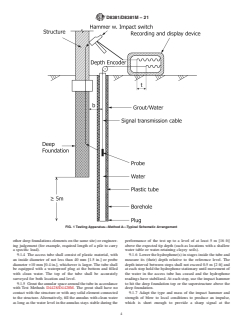
piezo shock switch. A typical schematic arrangement of the
shall be sufficiently robust to carry the probe and abrasion
testing apparatus is illustrated in Fig. 2.
resistant to allow repeated field use and maintain flexibility in
the range of expected temperatures. The cable itself, as well as
7. Hazards
all connectors, shall be waterproof to at least 150 % of the
7.1 The test is often carried out over water or on construc-
maximum testing depth. Alternatively, a wireless connection
tion sites with traffic of mechanical equipment such as tractors
between the probe and the data recording and display unit may
or drilling rigs, and used heavy, mobile equipment, potentially
be established.
overhead. This standard does not purport to address all the
6.1.3 Depth Measuring Device—The cable shall be marked
safety concerns, if any, associated with its use. It is the
at regular intervals to assess depth of probe. Alternatively, a
responsibility of the user of this standard to establish appro-
pulley over which the cable is deployed may be instrumented
priate safety, health and environmental practices and determine
with a depth-encoding device to monitor the depth to the
the applicability of regulatory limitations prior to use.
location of the probe throughout the test. The design of the
7.2 Before penetrating the ground to prepare for the test the
pulley and cable reel shall be such that cable slippage shall not
engineer in charge shall verify that no buried utilities will be
occur. Alternatively, a flexible tape measure may be affixed to
affected during the process.
the transducer/cable such that it measures the transducer
centerline depth but does not interfere with signal transmission 8. Calibration
to the transducer. Depth data may also be obtained from any
8.1 The depth encoder wheel (if used) shall be field-
source as long as it meets the requirements of 8.1.
calibrated at least once every six months to an accuracy of 1 %
6.1.4 Triggering is done with a hand-held hammer,
of the maximum testing depth or 0.1 m [4 in.], whichever is
equipped with a piezo shock switch or instrumented hammer larger, according to the manufacturer’s instructions.
head that can record the impact signal.Alternatively, a suitable
8.2 The whole system shall be regularly calibrated follow-
receiver (such as an accelerometer) may be mounted to the
ing the manufacturer’s instruction and checked for functi
...