

ASTM F708-24
(Practice)Standard Practice for Design and Installation of Rigid Pipe Hangers
General Information
- Abstract
ABSTRACT
This practice covers acceptable methods of fabricating and installing rigid pipe hangers used to support shipboard piping systems, it provides guidance for the design of hanger caps, straps and standoffs, selection of hanger and hanger liner materials, hanger bolting, and hanger spacing. The pipe hanger style includes: split cap hanger, 3strap hanger, welded hanger, U-bolt hanger, J band type hanger, Nelson hanger, clamp hanger assembled with mounting channel, poly-block twin clamp hanger, crimp-on weld stud-type hangers, banded weld stud-type hanger, and poly-block single-clamp hanger. Guidance in determining pipe hanger spacing are provided. Special consideration should be given to areas of concentrated loads, such as risers, valves, or groups of fittings, and to piping configurations that could create rotational forces. Hangers need not be lined unless the hanger and pipe are of dissimilar material. All hanger bolts within tanks or other inaccessible areas shall be secured with lock nuts, lock washers, or by some other means. Pipe hangers and standoffs located in areas subject to corrosion, such as in bilges, ballast tanks, and areas exposed to the weather, should be zinc-plated or blasted and coated with inorganic zinc or coated with the same material as that of the surrounding area. Standoffs fabricated from pipe should not be used within tanks. Consideration should be given to thermal growth of the piping when selecting or locating hangers so as not to overstress the piping or hangers.
SCOPE
1.1 This practice covers acceptable methods of fabricating and installing rigid pipe hangers used to support shipboard piping systems with temperatures of 650 °F (343 °C) or less.
1.2 This practice provides guidance for the design of hanger caps, straps and standoffs, selection of hanger and hanger liner materials, hanger bolting, and hanger spacing.
1.3 Other hanger designs may be used provided they result in an adequately supported vibration-free piping system and are compatible with the intended system service and temperature limitations.
1.4 The values stated in inch-pound units are to be regarded as standard. The values given in parentheses are mathematical conversions to SI units that are provided for information only and are not considered standard.
1.5 This standard does not purport to address all of the safety concerns, if any, associated with its use. It is the responsibility of the user of this standard to establish appropriate safety, health, and environmental practices and determine the applicability of regulatory limitations prior to use.
1.6 This international standard was developed in accordance with internationally recognized principles on standardization established in the Decision on Principles for the Development of International Standards, Guides and Recommendations issued by the World Trade Organization Technical Barriers to Trade (TBT) Committee.
- Status
- Published
- Publication Date
- 31-Dec-2023
- Technical Committee
- F25 - Ships and Marine Technology
- Drafting Committee
- F25.11 - Machinery and Piping Systems
Overview
ASTM F708-24 is an international standard practice developed by ASTM International, providing comprehensive requirements for the design and installation of rigid pipe hangers in shipboard piping systems. This standard applies to pipe systems operating at temperatures of 650 °F (343 °C) or less and offers guidance on material selection, hanger fabrication, installation methods, and the appropriate spacing of pipe hangers. The document is critical for ensuring properly supported, vibration-free, and safe piping systems on ships and marine vessels.
Key Topics
- Pipe Hanger Design and Styles: ASTM F708-24 covers a wide variety of rigid pipe hanger types, including split cap hangers, strap hangers, welded hangers, U-bolt hangers, J band type hangers, Nelson hangers, clamp hangers with mounting channels, poly-block twin and single clamp hangers, crimp-on weld stud hangers, and banded weld stud hangers. Each style is illustrated and defined with its typical application and limitations.
- Material Selection: The standard details acceptable materials for the manufacture of pipe hangers and components, prioritizing commercial quality carbon steel, stainless steel, and appropriate plastics for certain clamp systems. It further specifies coatings for corrosion resistance, such as zinc plating and inorganic zinc coatings.
- Hanger Liner Materials: Guidelines are provided for selecting liner materials including fiberglass, silicone rubber, synthetic rubber, lead, and fluorocarbon elastomers to prevent direct contact between dissimilar metals or in temperature-critical applications.
- Hanger Bolting and Fasteners: Recommendations for using electroplated zinc, hex-type bolts and nuts, and securement with lock nuts or lock washers in inaccessible locations ensure the integrity and safety of installed hangers.
- Hanger Spacing and Placement: Schedules and tables are given for minimum and maximum spacing between hangers depending on pipe size, with special attention to concentrated loads (such as near valves and fittings) and configurations that could introduce rotational stress.
- Environmental Considerations: Special instructions address corrosion prevention for hangers located in bilges, ballast tanks, and weather-exposed areas, including requirements to avoid certain materials within tanks and the use of protective coatings or stainless steel in highly corrosive environments.
- Thermal Expansion and System Movement: The standard requires consideration of thermal growth and ship flexing, with recommendations on incorporating rider bars or wear strips to prevent chafing in long piping runs.
Applications
- Marine and Shipbuilding: ASTM F708-24 is specifically designed for application on commercial, military, and industrial marine vessels where robust and reliable support of piping systems is essential. The standard guides shipyards, engineers, and contractors in ensuring pipework is securely supported, protected from vibration, and resistant to environmental conditions.
- Refit and Retrofit Projects: The standard is equally valuable for maintenance, refit, or upgrade projects on existing ships, ensuring that new or replacement rigid pipe hangers conform to best practice for safety and performance.
- Piping System Design: Naval architects and marine engineers use this standard during the design phase of piping systems to ensure hanger types, spacing, materials, and corrosion protection measures are optimized for durability and regulatory compliance.
- Quality Assurance: Inspection, commissioning, and maintenance teams reference ASTM F708-24 to verify that installations meet international norms and perform reliably in demanding marine environments.
Related Standards
- ASTM A307: Specification for Carbon Steel Bolts, Studs, and Threaded Rod 60,000 PSI Tensile Strength, referenced for bolting and fastener requirements in pipe hanger installation.
- ASTM F1121: Standard Practices for Shipboard Piping, may provide additional installation practices and system design guidelines.
- ISO/TC 8 Standards: Related international guidelines for marine piping and systems may be used in parallel for broader regulatory compliance.
- IMO MSC Standards: Complementary guidelines for safety and environmental protection of shipboard systems by the International Maritime Organization.
Organizations engaged in ship design, construction, and maintenance rely on ASTM F708-24 for effective, safe, and regulation-compliant pipe hanger design and installation, supporting long-term reliability and structural safety of marine piping systems.
Relations
- Effective Date
- 01-Jan-2024
- Effective Date
- 01-Jan-2024
- Effective Date
- 01-Jan-2024
Frequently Asked Questions
ASTM F708-24 is a standard published by ASTM International. Its full title is "Standard Practice for Design and Installation of Rigid Pipe Hangers". This standard covers: ABSTRACT This practice covers acceptable methods of fabricating and installing rigid pipe hangers used to support shipboard piping systems, it provides guidance for the design of hanger caps, straps and standoffs, selection of hanger and hanger liner materials, hanger bolting, and hanger spacing. The pipe hanger style includes: split cap hanger, 3strap hanger, welded hanger, U-bolt hanger, J band type hanger, Nelson hanger, clamp hanger assembled with mounting channel, poly-block twin clamp hanger, crimp-on weld stud-type hangers, banded weld stud-type hanger, and poly-block single-clamp hanger. Guidance in determining pipe hanger spacing are provided. Special consideration should be given to areas of concentrated loads, such as risers, valves, or groups of fittings, and to piping configurations that could create rotational forces. Hangers need not be lined unless the hanger and pipe are of dissimilar material. All hanger bolts within tanks or other inaccessible areas shall be secured with lock nuts, lock washers, or by some other means. Pipe hangers and standoffs located in areas subject to corrosion, such as in bilges, ballast tanks, and areas exposed to the weather, should be zinc-plated or blasted and coated with inorganic zinc or coated with the same material as that of the surrounding area. Standoffs fabricated from pipe should not be used within tanks. Consideration should be given to thermal growth of the piping when selecting or locating hangers so as not to overstress the piping or hangers. SCOPE 1.1 This practice covers acceptable methods of fabricating and installing rigid pipe hangers used to support shipboard piping systems with temperatures of 650 °F (343 °C) or less. 1.2 This practice provides guidance for the design of hanger caps, straps and standoffs, selection of hanger and hanger liner materials, hanger bolting, and hanger spacing. 1.3 Other hanger designs may be used provided they result in an adequately supported vibration-free piping system and are compatible with the intended system service and temperature limitations. 1.4 The values stated in inch-pound units are to be regarded as standard. The values given in parentheses are mathematical conversions to SI units that are provided for information only and are not considered standard. 1.5 This standard does not purport to address all of the safety concerns, if any, associated with its use. It is the responsibility of the user of this standard to establish appropriate safety, health, and environmental practices and determine the applicability of regulatory limitations prior to use. 1.6 This international standard was developed in accordance with internationally recognized principles on standardization established in the Decision on Principles for the Development of International Standards, Guides and Recommendations issued by the World Trade Organization Technical Barriers to Trade (TBT) Committee.
ABSTRACT This practice covers acceptable methods of fabricating and installing rigid pipe hangers used to support shipboard piping systems, it provides guidance for the design of hanger caps, straps and standoffs, selection of hanger and hanger liner materials, hanger bolting, and hanger spacing. The pipe hanger style includes: split cap hanger, 3strap hanger, welded hanger, U-bolt hanger, J band type hanger, Nelson hanger, clamp hanger assembled with mounting channel, poly-block twin clamp hanger, crimp-on weld stud-type hangers, banded weld stud-type hanger, and poly-block single-clamp hanger. Guidance in determining pipe hanger spacing are provided. Special consideration should be given to areas of concentrated loads, such as risers, valves, or groups of fittings, and to piping configurations that could create rotational forces. Hangers need not be lined unless the hanger and pipe are of dissimilar material. All hanger bolts within tanks or other inaccessible areas shall be secured with lock nuts, lock washers, or by some other means. Pipe hangers and standoffs located in areas subject to corrosion, such as in bilges, ballast tanks, and areas exposed to the weather, should be zinc-plated or blasted and coated with inorganic zinc or coated with the same material as that of the surrounding area. Standoffs fabricated from pipe should not be used within tanks. Consideration should be given to thermal growth of the piping when selecting or locating hangers so as not to overstress the piping or hangers. SCOPE 1.1 This practice covers acceptable methods of fabricating and installing rigid pipe hangers used to support shipboard piping systems with temperatures of 650 °F (343 °C) or less. 1.2 This practice provides guidance for the design of hanger caps, straps and standoffs, selection of hanger and hanger liner materials, hanger bolting, and hanger spacing. 1.3 Other hanger designs may be used provided they result in an adequately supported vibration-free piping system and are compatible with the intended system service and temperature limitations. 1.4 The values stated in inch-pound units are to be regarded as standard. The values given in parentheses are mathematical conversions to SI units that are provided for information only and are not considered standard. 1.5 This standard does not purport to address all of the safety concerns, if any, associated with its use. It is the responsibility of the user of this standard to establish appropriate safety, health, and environmental practices and determine the applicability of regulatory limitations prior to use. 1.6 This international standard was developed in accordance with internationally recognized principles on standardization established in the Decision on Principles for the Development of International Standards, Guides and Recommendations issued by the World Trade Organization Technical Barriers to Trade (TBT) Committee.
ASTM F708-24 is classified under the following ICS (International Classification for Standards) categories: 21.060.70 - Clamps and staples. The ICS classification helps identify the subject area and facilitates finding related standards.
ASTM F708-24 has the following relationships with other standards: It is inter standard links to ASTM F708-92(2022), ASTM F993-21, ASTM F986-86(2022). Understanding these relationships helps ensure you are using the most current and applicable version of the standard.
ASTM F708-24 is available in PDF format for immediate download after purchase. The document can be added to your cart and obtained through the secure checkout process. Digital delivery ensures instant access to the complete standard document.
Standards Content (Sample)
This international standard was developed in accordance with internationally recognized principles on standardization established in the Decision on Principles for the
Development of International Standards, Guides and Recommendations issued by the World Trade Organization Technical Barriers to Trade (TBT) Committee.
Designation: F708 − 24 An American National Standard
Standard Practice for
Design and Installation of Rigid Pipe Hangers
This standard is issued under the fixed designation F708; the number immediately following the designation indicates the year of original
adoption or, in the case of revision, the year of last revision. A number in parentheses indicates the year of last reapproval. A superscript
epsilon (´) indicates an editorial change since the last revision or reapproval.
This standard has been approved for use by agencies of the U.S. Department of Defense.
1. Scope 3. Terminology
1.1 This practice covers acceptable methods of fabricating 3.1 Definitions:
and installing rigid pipe hangers used to support shipboard
3.1.1 liner, n—the material used to isolate a pipe from its
piping systems with temperatures of 650 °F (343 °C) or less.
hanger.
1.2 This practice provides guidance for the design of hanger
3.1.2 rider bar, n—a protective strip of material installed
caps, straps and standoffs, selection of hanger and hanger liner
between the pipe and the hanger where frequent linear move-
materials, hanger bolting, and hanger spacing.
ment of the pipe is expected.
1.3 Other hanger designs may be used provided they result
3.1.3 rigid pipe hanger, n—a device that transfers the load
in an adequately supported vibration-free piping system and
imposed by the piping, insulation, and system medium to the
are compatible with the intended system service and tempera-
supporting structure.
ture limitations.
3.1.4 standoff, n—the rigid member that connects the hanger
1.4 The values stated in inch-pound units are to be regarded
strap, saddle, or band to the supporting structure. A standoff is
as standard. The values given in parentheses are mathematical
usually made up of one or more pieces of flat bar, pipe, angle
conversions to SI units that are provided for information only
bar, or flanged plate to suit a specific location.
and are not considered standard.
1.5 This standard does not purport to address all of the
4. List of Pipe Hanger Styles
safety concerns, if any, associated with its use. It is the
4.1 This practice incorporates 26 pipe hanger assemblies as
responsibility of the user of this standard to establish appro-
shown on Figs. 1-9 as follows:
priate safety, health, and environmental practices and deter-
Hanger Fig. No.
mine the applicability of regulatory limitations prior to use.
1.6 This international standard was developed in accor-
Split cap hanger (single leg standoff) 1(a)
Split cap hanger (dual leg standoff) 1(b)
dance with internationally recognized principles on standard-
Split cap hanger (chair type) 1(c)
ization established in the Decision on Principles for the
Strap hanger 2(a)
Development of International Standards, Guides and Recom-
Strap hanger (assembled for clearance with rider bar) 2(b)
Strap hanger (assembled for clearance with TFE-fluorocarbon 2(c)
mendations issued by the World Trade Organization Technical
strip)
Barriers to Trade (TBT) Committee.
Welded hanger (flat bar U-type) 3(a)
Welded hanger (round bar U-type) 3(b)
2. Referenced Documents Welded hanger (square bar U-type) 3(b)
U-bolt hanger 4(a)
2.1 ASTM Standards:
U-bolt hanger (assembled for clearance with rider bar) 4(b)
U-bolt hanger (assembled for clearance with TFE-fluorocarbon 4(c)
A307 Specification for Carbon Steel Bolts, Studs, and
strip)
Threaded Rod 60 000 PSI Tensile Strength
Welded hanger (single leg standoff welded direct to pipe) 5(a)
Welded hanger (dual leg standoff welded direct to pipe) 5(b)
“J” band type hanger (insulated pipe) 6(a)
“J” band type hanger (bare pipe) 6(b)
This practice is under the jurisdiction of ASTM Committee F25 on Ships and
Clamp hanger assembled with mounting channel 7
Marine Technology and is the direct responsibility of Subcommittee F25.11 on
Crimp-on weld stud-type hangers 8
Machinery and Piping Systems.
Banded weld stud-type hanger 9
Current edition approved Jan. 1, 2024. Published January 2024. Originally
approved in 1981. Last previous edition approved in 2022 as F708 – 92 (2022).
5. Hanger Designs
DOI: 10.1520/F0708-24.
For referenced ASTM standards, visit the ASTM website, www.astm.org, or
5.1 Figs. 1-5 and Fig. 6(a) hangers are designs generally
contact ASTM Customer Service at service@astm.org. For Annual Book of ASTM
manufactured by shipyards or their subcontractors. See also
Standards volume information, refer to the standard’s Document Summary page on
the ASTM website. Tables 1-6.
Copyright © ASTM International, 100 Barr Harbor Drive, PO Box C700, West Conshohocken, PA 19428-2959. United States
F708 − 24
5.2 Fig. 6, Fig. 7, Fig. 8, and Fig. 9 hangers are commer- 9.1.1 Hangers need not be lined unless the hanger and pipe
cially available from various vendors. Fig. 7, Fig. 8, and Fig. 9 are of dissimilar material, or when the system internal operat-
hangers are primarily designed for use in supporting electrical ing temperature is 300 °F (149 °C) and over, or 50 °F (10 °C)
cables, but are suitable for hanging small size pipe and tubing. and under and the heat transmitted to the other side of the
structure to which the hanger is attached may be objectionable.
6. Materials and Manufacture
For hanger liner materials, see 6.5.
6.1 Hanger materials for straps, saddles, and U-bolts for
9.1.2 All hanger bolts within tanks or other inaccessible
Figs. 1-5 hangers and standoffs should be fabricated from
areas shall be secured with lock nuts, lock washers, or by some
commercial quality carbon steel. The steel should be a weld-
other means.
able grade with a minimum tensile strength of 47 ksi
9.1.3 Pipe hangers and standoffs located in areas subject to
(324 MPa) and capable of being bent at room temperature
corrosion, such as in bilges, ballast tanks, and areas exposed to
through 90° to an inside radius equal to the material thickness
the weather, should be zinc-plated or blasted and coated with
without cracking on the outside of the bend.
inorganic zinc or coated with the same material as that of the
6.2 Hangers in Fig. 1, Fig. 6, Fig. 8, and Fig. 9 are generally surrounding area.
manufactured from carbon steel. Fig. 7 is furnished in carbon
9.1.4 Standoffs fabricated from pipe should not be used
steel and stainless steel.
within tanks.
6.3 Bands and buckles for Fig. 6 and Fig. 9 hangers should 9.1.5 Where thermal growth of piping exceeds 0.100 in.
(2.5 mm) or long runs of pipe are affected by ship flexing, such
be carbon steel electroplated zinc or stainless steel.
as long runs on the weather deck, or long runs in longitudinal
6.4 Hanger bolts and nuts should be regular series hex type
passageways, a metal rider bar attached to the pipe or a
electroplated zinc with unified national coarse threads Class 2
TFE-fluorocarbon wear strip should be used in conjunction
fit in accordance with Specification A307, Grade B.
with a clearance type hanger, or other means should be
6.5 Table 7 is a listing of hanger liner materials generally
provided to prevent chaffing of the pipe.
used to isolate the pipe from the hanger (see 9.1.1).
9.1.6 Consideration should be given to thermal growth of
the piping when selecting or locating hangers so as not to
7. Application and Limitations
overstress the piping or hangers.
7.1 Unless otherwise noted, application and limitations on
9.1.7 Nonmetallic pipe should be hung in accordance with
the use of various style hangers should be as noted with each
the manufacturer’s recommendations.
hanger detail.
8. Hanger Spacing
10. Workmanship, Finish, and Appearance
8.1 Table 8 provides general guidance in determining pipe
10.1 Finished hanger components shall have a workman-
hanger spacing. Special consideration should be given to areas
like appearance and be free of cracks or other injurious defects.
of concentrated loads, such as risers, valves, or groups of
Surface scale, rust, welding slag, or any foreign material (such
fittings, and to piping configurations that could create rota-
as oil) shall be removed before painting or coating.
tional forces.
11. Keywords
9. General Requirements
9.1 The following general requirements and conditions are 11.1 design; fabrication; installation; piping systems; rigid
applicable to all styles of hangers: pipe hangers
F708 − 24
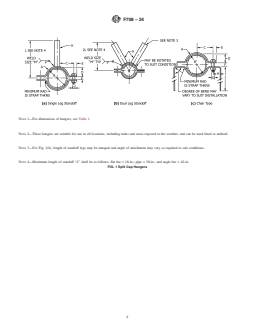
NOTE 1—For dimensions of hangers, see Table 1.
NOTE 2—These hangers are suitable for use in all locations, including tanks and areas exposed to the weather, and can be used lined or unlined.
NOTE 3—For Fig. 1(b), length of standoff legs may be unequal and angle of attachment may vary as required to suit conditions.
NOTE 4—Maximum length of standoff “L” shall be as follows: flat bar = 18-in.; pipe = 30-in.; and angle bar = 42-in.
FIG. 1 Split Cap Hangers
NOTE 1—For dimensions of hangers, see Table 2.
NOTE 2—These hangers are suitable for use in all locations, including tanks and areas exposed to the weather, and can be used lined or unlined.
1 1
NOTE 3—Install standard flat washers as necessary to unlined strap to provide ⁄32 in. to ⁄8 in. (0.8 mm to 3.2 mm) clearance for linear motion of piping
when required.
FIG. 2 Strap Hangers
F708 − 24
NOTE 1—For dimensions of hangers, see Table 3.
NOTE 2—These hangers are suitable for use in all locations, including tanks and areas exposed to the weather, and are intended to be used unlined only.
NOTE 3—Weld as indicated for size 3-in. NPS and above. For 2 ⁄2-in. NPS and below, weld hanger on outside only.
FIG. 3 Welded Hangers
NOTE 1—For dimensions of hangers, see Table 4.
NOTE 2—These hangers are suitable for use in all locations, including tanks and areas exposed to the weather, and are intended to be used unlined.
FIG. 4 U-Bolt Hangers
F708 − 24
NOTE 1—For dimensions of hangers, see Table 5.
NOTE 2—These hangers are limited to use on normally dry ferrous piping systems, such as sounding tubes. Air escapes and plumbing drains with a
wall thickness of 0.200 in. (5.1 mm) or more.
NOTE 3—These hangers should not be used where takedown is required or in the steering gear room, inner bottoms, fore peak, aft peak or deep tanks,
or other high vibration or inaccessible areas.
NOTE 4—For Fig. 5(b), length of standoff legs may be unequal and angle of attachment may vary as required to suit conditions.
FIG. 5 Welded Hangers
NOTE 1—For dimensions of hangers, see Table 6.
NOTE 2—These hangers are suitable for use in all locations, except tanks and areas exposed to the weather, and can be used lined or unlined.
FIG. 6 J-Band Type Hangers
F708 − 24
NOTE 1—These hangers are suitable for use in all locations, including tanks and areas exposed to the weather. When used in areas subject to high
corrosion, such as salt water ballast tanks or weather decks, stainless steel hanger components shall be used.
NOTE 2—These hangers are suitable for supporting single or multiple runs of piping 2 in. (50.8 mm) or smaller.
FIG. 7 Clamp Hanger Assembled with Mounting Channel
NOTE 1—These hangers are suitable for use in all locations, except tanks, and should be coated with neoprene or other similar material when used to
support nonferrous tubing.
NOTE 2—These hangers are limited to use on tubing with an outside diameter of 1 ⁄8 in. (28.6 mm) or smaller with a system operating temperature
of 180 °F (82.2 °C) or less.
NOTE 3—Size and quantity of tubes may be varied provided they are arranged so as to be securely clamped.
FIG. 8 Crimp-On Weld Stud Hangers
F708 − 24
NOTE 1—These hangers are suitable for use in all locations except tanks.
NOTE 2—These hangers are limited to use on tubing with an outside diameter of ⁄2 in. (12.7 mm) or smaller with a system operating temperature of
180 °F (82.2 °C) or less.
NOTE 3—Size and quantity of tube may be varied, provided they are arranged so as to be securely clamped.
FIG. 9 Banded Weld Stud Hanger
F708 − 24
TABLE 1 Dimensions for Split Cap Hangers (Fig. 1)
A B C D E F G H J K M
Centerline Size of Standoff
of Centerline Centerline
Copper Inside Clearance
Schedule
Nominal Size of Pipe to Height of Bolt of Size
Water Diameter at Bolts Length,
Pipe Flat Bar, Centerline of Bolt to Diameter, Bolt to of
Tube of (without max,
Flat Bar, Nominal Angle Bar,
Size, min, of Strap, End of min, Hanger Weld,
Size, Strap, liner), in. A A
A A A A
min, in. Pipe min, in.
in. in. Bolt, in. Strap, in. Leg, in.
A A
in. in. in.
A A
Size,
min, in. in.
A
A
min, in.
in.
3 1 3 3 15 3 5 1 1 1 3 3 1 3 3 1 1
. . . ⁄8 ⁄8 × ⁄4 ⁄4 ⁄16 ⁄16 ⁄16 ⁄8 ⁄4 ⁄2 6 ⁄16 × ⁄4 ⁄2 ⁄4 × ⁄4 × ⁄8 ⁄8
1 1 3 13 15 13 5 1 1 1 3 3 1 3 3 1 1
⁄4 . . . ⁄8 × ⁄4 ⁄16 ⁄16 ⁄64 ⁄16 ⁄8 ⁄4 ⁄2 6 ⁄16 × ⁄4 ⁄2 ⁄4 × ⁄4 × ⁄8 ⁄8
1 1 3 7 1 5 1 1 1 3 3 1 3 3 1 1
. . . ⁄2 ⁄8 × ⁄4 ⁄8 1 ⁄4 ⁄16 ⁄8 ⁄4 ⁄2 6 ⁄16 × ⁄4 ⁄2 ⁄4 × ⁄4 × ⁄8 ⁄8
3 1 3 15 9 5 1 1 1 3 3 1 3 3 1 1
⁄8 . . . ⁄8 × ⁄4 ⁄16 1 ⁄32 ⁄16 ⁄8 ⁄4 ⁄2 6 ⁄16 × ⁄4 ⁄
...
This document is not an ASTM standard and is intended only to provide the user of an ASTM standard an indication of what changes have been made to the previous version. Because
it may not be technically possible to adequately depict all changes accurately, ASTM recommends that users consult prior editions as appropriate. In all cases only the current version
of the standard as published by ASTM is to be considered the official document.
Designation: F708 − 92 (Reapproved 2022) F708 − 24 An American National Standard
Standard Practice for
Design and Installation of Rigid Pipe Hangers
This standard is issued under the fixed designation F708; the number immediately following the designation indicates the year of original
adoption or, in the case of revision, the year of last revision. A number in parentheses indicates the year of last reapproval. A superscript
epsilon (´) indicates an editorial change since the last revision or reapproval.
This standard has been approved for use by agencies of the U.S. Department of Defense.
1. Scope
1.1 This practice covers acceptable methods of fabricating and installing rigid pipe hangers used to support shipboard piping
systems with temperatures of 650 °F (343 °C) or less.
1.2 This practice provides guidance for the design of hanger caps, straps and standoffs, selection of hanger and hanger liner
materials, hanger bolting, and hanger spacing.
1.3 Other hanger designs may be used provided they result in an adequately supported vibration-free piping system and are
compatible with the intended system service and temperature limitations.
1.4 The values stated in inch-pound units are to be regarded as standard. The values given in parentheses are mathematical
conversions to SI units that are provided for information only and are not considered standard.
1.5 This standard does not purport to address all of the safety concerns, if any, associated with its use. It is the responsibility
of the user of this standard to establish appropriate safety, health, and environmental practices and determine the applicability of
regulatory limitations prior to use.
1.6 This international standard was developed in accordance with internationally recognized principles on standardization
established in the Decision on Principles for the Development of International Standards, Guides and Recommendations issued
by the World Trade Organization Technical Barriers to Trade (TBT) Committee.
2. Referenced Documents
2.1 ASTM Standards:
A307 Specification for Carbon Steel Bolts, Studs, and Threaded Rod 60 000 PSI Tensile Strength
3. Terminology
3.1 Definitions:
3.1.1 liner, n—the material used to isolate a pipe from its hanger.
This practice is under the jurisdiction of ASTM Committee F25 on Ships and Marine Technology and is the direct responsibility of Subcommittee F25.11 on Machinery
and Piping Systems.
Current edition approved Oct. 1, 2022Jan. 1, 2024. Published October 2022January 2024. Originally approved in 1981. Last previous edition approved in 20182022 as
ɛ1
F708 – 92 (2018)(2022). . DOI: 10.1520/F0708-92R22.10.1520/F0708-24.
For referenced ASTM standards, visit the ASTM website, www.astm.org, or contact ASTM Customer Service at service@astm.org. For Annual Book of ASTM Standards
volume information, refer to the standard’s Document Summary page on the ASTM website.
Copyright © ASTM International, 100 Barr Harbor Drive, PO Box C700, West Conshohocken, PA 19428-2959. United States
F708 − 24
3.1.2 rider bar, n—a protective strip of material installed between the pipe and the hanger where frequent linear movement of the
pipe is expected.
3.1.3 rigid pipe hanger, n—a device that transfers the load imposed by the piping, insulation, and system medium to the supporting
structure.
3.1.4 standoff, n—the rigid member that connects the hanger strap, saddle, or band to the supporting structure. A standoff is usually
made up of one or more pieces of flat bar, pipe, angle bar, or flanged plate to suit a specific location.
4. List of Pipe Hanger Styles
4.1 This practice incorporates 26 pipe hanger assemblies as shown on Figs. 1-912(c) as follows:
Hanger Fig. No.
Split cap hanger (single leg standoff) 1(a)
Split cap hanger (dual leg standoff) 1(b)
Split cap hanger (chair type) 1(c)
Strap hanger 2(a)
Strap hanger (assembled for clearance with rider bar) 2(b)
Strap hanger (assembled for clearance with TFE-fluorocarbon strip) 2(c)
Welded hanger (flat bar U-type) 3(a)
Welded hanger (round bar U-type) 3(b)
Welded hanger (square bar U-type) 3(b)
U-bolt hanger 4(a)
U-bolt hanger (assembled for clearance with rider bar) 4(b)
U-bolt hanger (assembled for clearance with TFE-fluorocarbon strip) 4(c)
Welded hanger (single leg standoff welded direct to pipe) 5(a)
Welded hanger (dual leg standoff welded direct to pipe) 5(b)
“J” band type hanger (insulated pipe) 6(a)
“J” band type hanger (bare pipe) 6(b)
Nelson hanger 7
Clamp hanger assembled with mounting channel 8
Clamp hanger assembled with mounting channel 7
4,5
Poly-block twin clamp hanger (assembled with welding plate) 9(a)
4,5
Poly-block twin clamp hanger (assembled with welding stud) 9(b)
4,5
Poly-block twin clamp hanger (assembled with mounting channel) 9(c)
Crimp-on weld stud-type hangers 10
Crimp-on weld stud-type hangers 8
Banded weld stud-type hanger 11
Banded weld stud-type hanger 9
Poly-block single-clamp hanger (assembled with welding plate) 12(a)
Poly-block single-clamp hanger (assembled with welding stud) 12(b)
Poly-block single-clamp hanger (assembled with mounting channel) 12(c)
5. Hanger Designs
5.1 Figs. 1-5 and Fig. 6(a) hangers are designs generally manufactured by shipyards or their subcontractors. See also Tables 1-6.
5.2 Fig. 6, Fig. 87, Fig. 108, and Fig. 119 hangers are commercially available from various vendors. Fig. 87, Fig. 108, and Fig.
119 hangers are primarily designed for use in supporting electrical cables, but are suitable for hanging small size pipe and tubing.
5.2.1 The Fig. 7 hanger is a specific design that has been patented by Nelson Division of TRW.
4,5
5.2.2 The Fig. 9 and Fig. 12 hangers are primarily designed for use when supporting multiple runs of pipe or tubing.
6. Materials and Manufacture
6.1 Hanger materials for straps, saddles, and U-bolts for Figs. 1-5 hangers and standoffs should be fabricated from commercial
quality carbon steel. The steel should be a weldable grade with a minimum tensile strength of 47 ksi (324 MPa) (324 MPa) and
capable of being bent at room temperature through 90° to an inside radius equal to the material thickness without cracking on the
outside of the bend.
F708 − 24
6.2 Hangers in Fig. 1, Fig. 6, Fig. 7, Fig. 108, and Fig. 119 are generally manufactured from carbon steel. Fig. 87 is furnished
in carbon steel and stainless steel. Fig. 9 and Fig. 12 hanger clamp halves are injected molded plastic furnished with carbon steel
or stainless steel hardware.
6.3 Bands and buckles for Fig. 6 and Fig. 119 hangers should be carbon steel electroplated zinc or stainless steel.
6.4 Hanger bolts and nuts should be regular series hex type electroplated zinc with unified national coarse threads Class 2 fit in
accordance with Specification A307, Grade B.
6.5 Table 7 is a listing of hanger liner materials generally used to isolate the pipe from the hanger (see 9.1.1).
7. Application and Limitations
7.1 Unless otherwise noted, application and limitations on the use of various style hangers should be as noted with each hanger
detail.
8. Hanger Spacing
8.1 Table 8 provides general guidance in determining pipe hanger spacing. Special consideration should be given to areas of
concentrated loads, such as risers, valves, or groups of fittings, and to piping configurations that could create rotational forces.
9. General Requirements
9.1 The following general requirements and conditions are applicable to all styles of hangers:
9.1.1 Hangers need not be lined unless the hanger and pipe are of dissimilar material, or when the system internal operating
temperature is 300 °F (149 °C) and over, or 50 °F (10 °C) and under and the heat transmitted to the other side of the structure to
which the hanger is attached may be objectionable. For hanger liner materials, see 6.5.
9.1.2 All hanger bolts within tanks or other inaccessible areas shall be secured with lock nuts, lock washers, or by some other
means.
9.1.3 Pipe hangers and standoffs located in areas subject to corrosion, such as in bilges, ballast tanks, and areas exposed to the
weather, should be zinc-plated or blasted and coated with inorganic zinc or coated with the same material as that of the surrounding
area.
9.1.4 Standoffs fabricated from pipe should not be used within tanks.
9.1.5 Where thermal growth of piping exceeds 0.100 in. (2.5 mm) (2.5 mm) or long runs of pipe are affected by ship flexing, such
as long runs on the weather deck, or long runs in longitudinal passageways, a metal rider bar attached to the pipe or a
TFE-fluorocarbon wear strip should be used in conjunction with a clearance type hanger, or other means should be provided to
prevent chaffing of the pipe.
9.1.6 Consideration should be given to thermal growth of the piping when selecting or locating hangers so as not to overstress
the piping or hangers.
9.1.7 Nonmetallic pipe should be hung in accordance with the manufacturer’s recommendations.
10. Workmanship, Finish, and Appearance
10.1 Finished hanger components shall have a workman-like appearance and be free of cracks or other injurious defects. Surface
scale, rust, welding slag, or any foreign material (such as oil) shall be removed before painting or coating.
11. Keywords
11.1 design; fabrication; installation; piping systems; rigid pipe hangers
F708 − 24
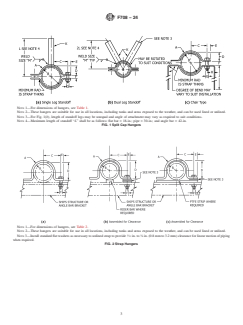
NOTE 1—For dimensions of hangers, see Table 1.
NOTE 2—These hangers are suitable for use in all locations, including tanks and areas exposed to the weather, and can be used lined or unlined.
NOTE 3—For Fig. 1(b), length of standoff legs may be unequal and angle of attachment may vary as required to suit conditions.
NOTE 4—Maximum length of standoff “L” shall be as follows: flat bar = 18-in.; pipe = 30-in.; and angle bar = 42-in.
FIG. 1 Split Cap Hangers
F708 − 24
NOTE 1—For dimensions of hangers, see Table 2.
NOTE 2—These hangers are suitable for use in all locations, including tanks and areas exposed to the weather, and can be used lined or unlined.
1 1
NOTE 3—Install standard flat washers as necessary to unlined strap to provide ⁄32 in. to ⁄8 in. (0.8 mm to 3.2 mm) clearance for linear motion of piping
when required.
FIG. 2 Strap Hangers
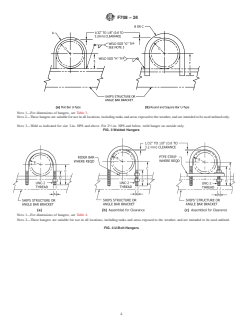
NOTE 1—For dimensions of hangers, see Table 3.
NOTE 2—These hangers are suitable for use in all locations, including tanks and areas exposed to the weather, and are intended to be used unlined only.
NOTE 3—Weld as indicated for size 3-in. NPS and above. For 2 ⁄2-in. NPS and below, weld hanger on outside only.
FIG. 3 Welded Hangers
F708 − 24
NOTE 1—For dimensions of hangers, see Table 4.
NOTE 2—These hangers are suitable for use in all locations, including tanks and areas exposed to the weather, and are intended to be used unlined.
FIG. 4 U-Bolt Hangers
NOTE 1—For dimensions of hangers, see Table 5.
NOTE 2—These hangers are limited to use on normally dry ferrous piping systems, such as sounding tubes. Air escapes and plumbing drains with a wall
thickness of 0.200 in. (5.1 mm) or more.
NOTE 3—These hangers should not be used where takedown is required or in the steering gear room, inner bottoms, fore peak, aft peak or deep tanks,
or other high vibration or inaccessible areas.
NOTE 4—For Fig. 5(b), length of standoff legs may be unequal and angle of attachment may vary as required to suit conditions.
FIG. 5 Welded Hangers
F708 − 24
NOTE 1—For dimensions of hangers, see Table 6.
NOTE 2—These hangers are suitable for use in all locations, except tanks and areas exposed to the weather, and can be used lined or unlined.
FIG. 6 J-Band Type Hangers
F708 − 24
NOTE 1—These hangers are suitable for use in all locations, including tanks and areas exposed to the weather. When used in areas subject to high
corrosion, such as salt water ballast tanks or weather decks, stainless steel hanger components shall be used.
NOTE 2—These hangers are suitable for supporting single or multiple runs of piping 2 in. (50.8 mm) or smaller.
FIG. 87 Clamp Hanger Assembled with Mounting Channel
NOTE 1—These hangers are suitable for use in all locations, except tanks, and should be coated with neoprene or other similar material when used to
support nonferrous tubing.
NOTE 2—These hangers are limited to use on tubing with an outside diameter of 1 ⁄8 in. (28.6 mm) or smaller with a system operating temperature of
180 °F (82.2 °C) or less.
NOTE 3—Size and quantity of tubes may be varied provided they are arranged so as to be securely clamped.
FIG. 108 Crimp-On Weld Stud Hangers
F708 − 24
NOTE 1—These hangers are suitable for use in all locations except tanks.
NOTE 2—These hangers are limited to use on tubing with an outside diameter of ⁄2 in. (12.7 mm) or smaller with a system operating temperature of 180 °F
(82.2 °C) or less.
NOTE 3—Size and quantity of tube may be varied, provided they are arranged so as to be securely clamped.
FIG. 119 Banded Weld Stud Hanger
F708 − 24
TABLE 1 Dimensions for Split Cap Hangers (Fig. 1)
A B C D E F G H J K M
Centerline Size of Standoff
of Centerline Centerline
Copper Inside Clearance
Schedule
Nominal Size of Pipe to Height of Bolt of Size
Water Diameter at Bolts Length,
Pipe Flat Bar, Centerline of Bolt to Diameter, Bolt to of
Tube of (without max,
Flat Bar, Nominal Angle Bar,
Size, min, of Strap, End of min, Hanger Weld,
Size, Strap, liner), in. A A
A A A A
min, in. Pipe min, in.
in. in. Bolt, in. Strap, in. Leg, in.
A A
in. in. in.
A A
Size,
min, in. in.
A
A
min, in.
in.
3 1 3 3 15 3 5 1 1 1 3 3 1 3 3 1 1
. . . ⁄8 ⁄8 × ⁄4 ⁄4 ⁄16 ⁄16 ⁄16 ⁄8 ⁄4 ⁄2 6 ⁄16 × ⁄4 ⁄2 ⁄4 × ⁄4 × ⁄8 ⁄8
1 1 3 13 15 13 5 1 1 1 3 3 1 3 3 1 1
⁄4 . . . ⁄8 × ⁄4 ⁄16 ⁄16 ⁄64 ⁄16 ⁄8 ⁄4 ⁄2 6 ⁄16 × ⁄4 ⁄2 ⁄4 × ⁄4 × ⁄8 ⁄8
1 1 3 7 1 5 1 1 1 3 3 1 3 3 1 1
. . . ⁄2 ⁄8 × ⁄4 ⁄8 1 ⁄4 ⁄16 ⁄8 ⁄4 ⁄2 6 ⁄16 × ⁄4 ⁄2 ⁄4 × ⁄4 × ⁄8 ⁄8
3 1 3 15 9 5 1 1 1 3 3 1 3 3 1 1
⁄8 . . . ⁄8 × ⁄4 ⁄16 1 ⁄32 ⁄16 ⁄8 ⁄4 ⁄2 6 ⁄16 × ⁄4 ⁄2 ⁄4 × ⁄4 × ⁄8 ⁄8
5 1 3 1 5 5 1 1 1 3 3 1 3 3 1 1
. . . ⁄8 ⁄8 × ⁄4 1 1 ⁄16 ⁄16 ⁄16 ⁄8 ⁄4 ⁄2 6 ⁄16 × ⁄4 ⁄2 ⁄4 × ⁄4 × ⁄8 ⁄8
1 1 3 1 1 23 5 1 1 1 3 3 1 3 3 1 1
⁄2 . . . ⁄8 × ⁄4 1 ⁄8 1 ⁄8 ⁄64 ⁄16 ⁄8 ⁄4 ⁄2 6 ⁄16 × ⁄4 ⁄2 ⁄4 × ⁄4 × ⁄8 ⁄8
3 1 3 1 1 3 5 1 1 1 3 3 1 3 3 1 1
. . . ⁄4 ⁄8 × ⁄4 1 ⁄8 1 ⁄8 ⁄8 ⁄16 ⁄8 ⁄4 ⁄2 6 ⁄16 × ⁄4 ⁄2 ⁄4 × ⁄4 × ⁄8 ⁄8
3 1 5 1 15 3 1 5 5 1 3 1 1
⁄4 . . . ⁄8 × 1 1 ⁄16 1 ⁄4 ⁄32 ⁄8 ⁄8 ⁄16 ⁄8 6 ⁄4 × 1 ⁄4 1 × 1 × ⁄4 ⁄8
1 3 1 1 3 1 5 5 1 3 1 1
. . . 1 ⁄8 × 1 1 ⁄8 1 ⁄4 ⁄2 ⁄8 ⁄8 ⁄16 ⁄8 6 ⁄4 × 1 ⁄4 1 × 1 × ⁄4 ⁄8
1 9 3 19 3 1 5 5 1 3 1 1
1 . . . ⁄8 × 1 1 ⁄16 1 ⁄8 ⁄32 ⁄8 ⁄8 ⁄16 ⁄8 6 ⁄4 × 1 ⁄4 1 × 1 × ⁄4 ⁄8
1 1 5 3 5 3 1 5 5 1 3 1 1
. . . 1 ⁄4 ⁄8 × 1 1 ⁄8 1 ⁄8 ⁄8 ⁄8 ⁄8 ⁄16 ⁄8 6 ⁄4 × 1 ⁄4 1 × 1 × ⁄4 ⁄8
1 1 7 9 3 3 1 5 5 1 3 1 1
. . . 1 ⁄2 ⁄8 ×
...