

ASTM E2336-20
(Test Method)Standard Test Methods for Fire Resistive Grease Duct Enclosure Systems
General Information
- Abstract
SIGNIFICANCE AND USE
5.1 These test methods are intended to evaluate the ability of the grease duct enclosure system to do the following:
5.1.1 Resist the effects of a standardized fire exposure,
5.1.2 Retain its integrity, or
5.1.3 Exhibit both properties dependent upon the type of test assembly involved during a predetermined test exposure.
5.2 These test methods provide for the following measurements and evaluations where applicable:
5.2.1 Capability of the enclosure material to resist flaming (combustion) when exposed to 1382°F (750°C).
5.2.2 Loadbearing ability of the tested support system and fastening system to carry the load of the grease duct enclosure system during a standardized fire-engulfment test.
5.2.3 Ability of a fire stop to meet the requirements of Test Method E814 when used with a grease duct enclosure system.
5.2.4 Ability of the enclosure material to resist the passage of flames and hot gases during a standardized fire resistance test and a standardized internal fire test.
5.2.5 Transmission of heat through the grease duct and the enclosure material(s) during a standardized fire resistance test and a standardized internal fire test.
5.2.6 Ability of the grease duct enclosure system to resist the passage of water during a standardized hose stream test.
5.2.7 Comparative measurement of temperature aging of the enclosure material(s) when subjected to standardized cyclic thermal transmissions.
5.3 These test methods do not provide the following:
5.3.1 Full information as to performance of the enclosure material or the grease duct enclosure system constructed with components, densities, or dimensions other than those tested.
5.3.2 Evaluation of the degree by which the enclosure material or grease duct enclosure system contributes to the fire hazard by generation of smoke, toxic gases, or other products of combustion.
5.3.3 Measurement of the degree of control or limitation of the passage of smoke or products of combustion ...
SCOPE
Note 1: The majority of this standard is based on the Model Building Code Evaluation Service2 Acceptance Criteria titled ACCEPTANCE CRITERIA FOR GREASE DUCT ENCLOSURE ASSEMBLIES, AC101, which was created in 1994. Numerous design listings and labeled materials exist based on the provisions of this standard.
1.1 These test methods evaluate the enclosure materials and the grease duct enclosure systems using the following test methods: noncombustibility, fire resistance, durability, internal fire, and fire-engulfment with a through-penetration fire stop.
1.2 These test methods prescribe a standardized fire exposure for comparing the test results of the enclosure materials and grease duct enclosure systems. The results of these tests are one factor in assessing predicted fire performance of grease duct enclosure systems. Using these test results to predict the performance of actual grease duct enclosure systems requires the evaluation of test conditions.
1.3 The values stated in inch-pound units are to be regarded as standard. The values given in parentheses are mathematical conversions to SI units that are provided for information only and are not considered standard.
1.4 The text of these test methods references notes and footnotes which provide explanatory material. These notes and footnotes (excluding those in tables and figures) shall not be considered as requirements of the fire test response standard.
1.5 These test methods are used to measure and describe the response of materials, products, or assemblies to heat and flame under controlled conditions, but does not by itself incorporate all factors required for fire hazard or fire risk assessment of the materials, products, or assemblies under actual fire conditions.
1.6 These test methods do not purport to address all of the safety concerns, if any, associated with its use. It is the responsibility of the user of these test methods to establish appr...
- Status
- Published
- Publication Date
- 31-Mar-2020
- Technical Committee
- E05 - Fire Standards
- Drafting Committee
- E05.11 - Fire Resistance
Overview
ASTM E2336-20: Standard Test Methods for Fire Resistive Grease Duct Enclosure Systems is a key international standard developed by ASTM International to evaluate fire resistance and performance of grease duct enclosure systems. These systems are essential to maintaining fire safety in commercial kitchens and other environments where grease-laden vapors are present. The standard outlines comprehensive laboratory test methods to assess the ability of enclosure materials and complete grease duct assemblies to withstand fire exposure, maintain structural integrity, and prevent the spread of fire and hot gases during a predetermined test exposure.
ASTM E2336-20 provides a consistent framework for evaluating and comparing grease duct fire protection products, supporting code compliance, certification, and building safety. It is widely referenced in model building codes and by authorities having jurisdiction.
Key Topics
- Scope of Testing: Evaluation of both the material and assembly, including noncombustibility, fire resistance, internal fire, fire engulfment, durability, and through-penetration fire stop performance.
- Fire Exposure: Standardized fire tests at temperatures up to 1382°F (750°C) assess the enclosure’s resistance to flame, heat transmission, and integrity under extreme conditions.
- Loadbearing & Fastening: Assessment of the support and fastening systems’ ability to bear the enclosure’s weight during fire exposure.
- Thermal Performance: Measurement of heat transmission through the system, including temperature aging under cyclic thermal conditions.
- Water Resistance: Testing the system’s ability to resist water penetration during a hose stream test, simulating firefighting conditions.
- Limitations: The methods do not measure smoke, toxic gas production, or surface flame spread, which are covered by other standards.
Applications
ASTM E2336-20 is primarily used by manufacturers, testing laboratories, certification bodies, builders, and regulatory agencies for:
- Product Certification: Demonstrating that grease duct enclosure systems meet recognized fire-resistance benchmarks for safe installation in commercial kitchens and other high-risk areas.
- Code Compliance: Supporting compliance with building codes, such as the International Mechanical Code (IMC) and NFPA 96, which require tested fire-resistive enclosures for commercial kitchen exhaust ducts.
- Design Comparisons: Providing standardized test results for comparing enclosure materials and design options, aiding specifiers and engineers in selecting appropriate fire protection measures.
- Field Approval: Assisting jurisdictions and code officials in approving or certifying fire-resistant grease duct installations based on accurate, reproducible laboratory testing.
- Durability Evaluation: Assessing long-term performance and thermal aging of fire resistant materials used in grease duct enclosures.
Related Standards
ASTM E2336-20 references several key standards and is often used in conjunction with the following:
- ASTM E84: Standard Test Method for Surface Burning Characteristics of Building Materials
- ASTM E119: Standard Test Methods for Fire Tests of Building Construction and Materials
- ASTM E136: Test Method for Assessing Combustibility of Materials Using a Vertical Tube Furnace at 750°C
- ASTM E814: Test Method for Fire Tests of Penetration Firestop Systems
- ASTM C518: Test Method for Steady-State Thermal Transmission Properties by Means of the Heat Flow Meter Apparatus
- NFPA 96: Standard for Ventilation Control and Fire Protection of Commercial Cooking Operations
- International Mechanical Code (IMC): Provides minimum requirements for grease duct construction and fire safety standards
By following ASTM E2336-20, stakeholders ensure reliable, repeatable test results and maintain best practices in the evaluation and implementation of fire resistive grease duct enclosure systems, ultimately enhancing building safety and fire protection strategies.
Relations
- Effective Date
- 01-Apr-2020
- Effective Date
- 01-Mar-2024
- Effective Date
- 01-Feb-2024
- Effective Date
- 01-Jan-2024
- Effective Date
- 01-Dec-2023
- Effective Date
- 01-Sep-2023
- Effective Date
- 01-Oct-2019
- Effective Date
- 01-Jul-2019
- Effective Date
- 15-Apr-2019
- Effective Date
- 01-Mar-2019
- Effective Date
- 01-Feb-2019
- Effective Date
- 15-Dec-2018
- Effective Date
- 01-Nov-2018
- Effective Date
- 01-Nov-2018
- Effective Date
- 01-Oct-2018
Get Certified
Connect with accredited certification bodies for this standard

CIS Institut d.o.o.
Personal Protective Equipment (PPE) certification body. Notified Body NB-2890 for EU Regulation 2016/425 PPE.

Kiwa BDA Testing
Building and construction product certification.
Kmetijski inštitut Slovenije
Agricultural Institute of Slovenia. Soil testing, plant health, agricultural product analysis.
Sponsored listings
Frequently Asked Questions
ASTM E2336-20 is a standard published by ASTM International. Its full title is "Standard Test Methods for Fire Resistive Grease Duct Enclosure Systems". This standard covers: SIGNIFICANCE AND USE 5.1 These test methods are intended to evaluate the ability of the grease duct enclosure system to do the following: 5.1.1 Resist the effects of a standardized fire exposure, 5.1.2 Retain its integrity, or 5.1.3 Exhibit both properties dependent upon the type of test assembly involved during a predetermined test exposure. 5.2 These test methods provide for the following measurements and evaluations where applicable: 5.2.1 Capability of the enclosure material to resist flaming (combustion) when exposed to 1382°F (750°C). 5.2.2 Loadbearing ability of the tested support system and fastening system to carry the load of the grease duct enclosure system during a standardized fire-engulfment test. 5.2.3 Ability of a fire stop to meet the requirements of Test Method E814 when used with a grease duct enclosure system. 5.2.4 Ability of the enclosure material to resist the passage of flames and hot gases during a standardized fire resistance test and a standardized internal fire test. 5.2.5 Transmission of heat through the grease duct and the enclosure material(s) during a standardized fire resistance test and a standardized internal fire test. 5.2.6 Ability of the grease duct enclosure system to resist the passage of water during a standardized hose stream test. 5.2.7 Comparative measurement of temperature aging of the enclosure material(s) when subjected to standardized cyclic thermal transmissions. 5.3 These test methods do not provide the following: 5.3.1 Full information as to performance of the enclosure material or the grease duct enclosure system constructed with components, densities, or dimensions other than those tested. 5.3.2 Evaluation of the degree by which the enclosure material or grease duct enclosure system contributes to the fire hazard by generation of smoke, toxic gases, or other products of combustion. 5.3.3 Measurement of the degree of control or limitation of the passage of smoke or products of combustion ... SCOPE Note 1: The majority of this standard is based on the Model Building Code Evaluation Service2 Acceptance Criteria titled ACCEPTANCE CRITERIA FOR GREASE DUCT ENCLOSURE ASSEMBLIES, AC101, which was created in 1994. Numerous design listings and labeled materials exist based on the provisions of this standard. 1.1 These test methods evaluate the enclosure materials and the grease duct enclosure systems using the following test methods: noncombustibility, fire resistance, durability, internal fire, and fire-engulfment with a through-penetration fire stop. 1.2 These test methods prescribe a standardized fire exposure for comparing the test results of the enclosure materials and grease duct enclosure systems. The results of these tests are one factor in assessing predicted fire performance of grease duct enclosure systems. Using these test results to predict the performance of actual grease duct enclosure systems requires the evaluation of test conditions. 1.3 The values stated in inch-pound units are to be regarded as standard. The values given in parentheses are mathematical conversions to SI units that are provided for information only and are not considered standard. 1.4 The text of these test methods references notes and footnotes which provide explanatory material. These notes and footnotes (excluding those in tables and figures) shall not be considered as requirements of the fire test response standard. 1.5 These test methods are used to measure and describe the response of materials, products, or assemblies to heat and flame under controlled conditions, but does not by itself incorporate all factors required for fire hazard or fire risk assessment of the materials, products, or assemblies under actual fire conditions. 1.6 These test methods do not purport to address all of the safety concerns, if any, associated with its use. It is the responsibility of the user of these test methods to establish appr...
SIGNIFICANCE AND USE 5.1 These test methods are intended to evaluate the ability of the grease duct enclosure system to do the following: 5.1.1 Resist the effects of a standardized fire exposure, 5.1.2 Retain its integrity, or 5.1.3 Exhibit both properties dependent upon the type of test assembly involved during a predetermined test exposure. 5.2 These test methods provide for the following measurements and evaluations where applicable: 5.2.1 Capability of the enclosure material to resist flaming (combustion) when exposed to 1382°F (750°C). 5.2.2 Loadbearing ability of the tested support system and fastening system to carry the load of the grease duct enclosure system during a standardized fire-engulfment test. 5.2.3 Ability of a fire stop to meet the requirements of Test Method E814 when used with a grease duct enclosure system. 5.2.4 Ability of the enclosure material to resist the passage of flames and hot gases during a standardized fire resistance test and a standardized internal fire test. 5.2.5 Transmission of heat through the grease duct and the enclosure material(s) during a standardized fire resistance test and a standardized internal fire test. 5.2.6 Ability of the grease duct enclosure system to resist the passage of water during a standardized hose stream test. 5.2.7 Comparative measurement of temperature aging of the enclosure material(s) when subjected to standardized cyclic thermal transmissions. 5.3 These test methods do not provide the following: 5.3.1 Full information as to performance of the enclosure material or the grease duct enclosure system constructed with components, densities, or dimensions other than those tested. 5.3.2 Evaluation of the degree by which the enclosure material or grease duct enclosure system contributes to the fire hazard by generation of smoke, toxic gases, or other products of combustion. 5.3.3 Measurement of the degree of control or limitation of the passage of smoke or products of combustion ... SCOPE Note 1: The majority of this standard is based on the Model Building Code Evaluation Service2 Acceptance Criteria titled ACCEPTANCE CRITERIA FOR GREASE DUCT ENCLOSURE ASSEMBLIES, AC101, which was created in 1994. Numerous design listings and labeled materials exist based on the provisions of this standard. 1.1 These test methods evaluate the enclosure materials and the grease duct enclosure systems using the following test methods: noncombustibility, fire resistance, durability, internal fire, and fire-engulfment with a through-penetration fire stop. 1.2 These test methods prescribe a standardized fire exposure for comparing the test results of the enclosure materials and grease duct enclosure systems. The results of these tests are one factor in assessing predicted fire performance of grease duct enclosure systems. Using these test results to predict the performance of actual grease duct enclosure systems requires the evaluation of test conditions. 1.3 The values stated in inch-pound units are to be regarded as standard. The values given in parentheses are mathematical conversions to SI units that are provided for information only and are not considered standard. 1.4 The text of these test methods references notes and footnotes which provide explanatory material. These notes and footnotes (excluding those in tables and figures) shall not be considered as requirements of the fire test response standard. 1.5 These test methods are used to measure and describe the response of materials, products, or assemblies to heat and flame under controlled conditions, but does not by itself incorporate all factors required for fire hazard or fire risk assessment of the materials, products, or assemblies under actual fire conditions. 1.6 These test methods do not purport to address all of the safety concerns, if any, associated with its use. It is the responsibility of the user of these test methods to establish appr...
ASTM E2336-20 is classified under the following ICS (International Classification for Standards) categories: 13.220.40 - Ignitability and burning behaviour of materials and products; 21.260 - Lubrication systems. The ICS classification helps identify the subject area and facilitates finding related standards.
ASTM E2336-20 has the following relationships with other standards: It is inter standard links to ASTM E2336-16, ASTM E136-24a, ASTM E136-24, ASTM E176-24, ASTM E84-23d, ASTM E84-23c, ASTM E119-19, ASTM E84-19b, ASTM E84-19a, ASTM E84-19, ASTM E136-19, ASTM E176-18a, ASTM E119-18ce1, ASTM E119-18c, ASTM E84-18b. Understanding these relationships helps ensure you are using the most current and applicable version of the standard.
ASTM E2336-20 is available in PDF format for immediate download after purchase. The document can be added to your cart and obtained through the secure checkout process. Digital delivery ensures instant access to the complete standard document.
Standards Content (Sample)
This international standard was developed in accordance with internationally recognized principles on standardization established in the Decision on Principles for the
Development of International Standards, Guides and Recommendations issued by the World Trade Organization Technical Barriers to Trade (TBT) Committee.
Designation: E2336 − 20 An American National Standard
Standard Test Methods for
Fire Resistive Grease Duct Enclosure Systems
This standard is issued under the fixed designation E2336; the number immediately following the designation indicates the year of
original adoption or, in the case of revision, the year of last revision. A number in parentheses indicates the year of last reapproval. A
superscript epsilon (´) indicates an editorial change since the last revision or reapproval.
INTRODUCTION
The protection of grease ducts under fire exposure conditions is an item of importance in securing
constructions that are safe, and that are not a menace to neighboring construction nor to the public.
Recognition of this is registered in the codes of many authorities, municipal and other agencies. Many
types of enclosure materials are used to protect grease ducts. Normally, these enclosure materials are
eitherappliedtogreaseductsinthefieldorarefabricatedaspartofthegreaseductwhenshippedfrom
the factory. Evaluating enclosure materials used to protect a grease duct from fire is an aid for
predicting their fire performance and promotes uniformity in requirements of various authorities. To
do this it is necessary that the fire-endurance properties of enclosure materials be measured and
specifiedaccordingtoacommonstandardexpressedintermsthatareapplicablealiketoawidevariety
of materials, situations, and conditions of exposure.
1. Scope* footnotes (excluding those in tables and figures) shall not be
NOTE 1—The majority of this standard is based on the Model Building
considered as requirements of the fire test response standard.
Code Evaluation Service Acceptance Criteria titled ACCEPTANCE
1.5 These test methods are used to measure and describe the
CRITERIA FOR GREASE DUCT ENCLOSURE ASSEMBLIES, AC101,
which was created in 1994. Numerous design listings and labeled response of materials, products, or assemblies to heat and
materials exist based on the provisions of this standard.
flame under controlled conditions, but does not by itself
incorporate all factors required for fire hazard or fire risk
1.1 These test methods evaluate the enclosure materials and
assessment of the materials, products, or assemblies under
the grease duct enclosure systems using the following test
actual fire conditions.
methods: noncombustibility, fire resistance, durability, internal
fire, and fire-engulfment with a through-penetration fire stop.
1.6 These test methods do not purport to address all of the
safety concerns, if any, associated with its use. It is the
1.2 These test methods prescribe a standardized fire expo-
responsibility of the user of these test methods to establish
sure for comparing the test results of the enclosure materials
appropriate safety and health practices and to determine the
andgreaseductenclosuresystems.Theresultsofthesetestsare
applicability of regulatory limitations prior to use.
one factor in assessing predicted fire performance of grease
duct enclosure systems. Using these test results to predict the
1.7 This international standard was developed in accor-
performance of actual grease duct enclosure systems requires
dance with internationally recognized principles on standard-
the evaluation of test conditions.
ization established in the Decision on Principles for the
Development of International Standards, Guides and Recom-
1.3 The values stated in inch-pound units are to be regarded
mendations issued by the World Trade Organization Technical
as standard. The values given in parentheses are mathematical
Barriers to Trade (TBT) Committee.
conversions to SI units that are provided for information only
and are not considered standard.
2. Referenced Documents
1.4 The text of these test methods references notes and
2.1 ASTM Standards:
footnotes which provide explanatory material. These notes and
C518 Test Method for Steady-State Thermal Transmission
Properties by Means of the Heat Flow Meter Apparatus
This test method is under the jurisdiction of ASTM Committee E05 on Fire
C569 Test Method for Indentation Hardness of Preformed
Standards and is the direct responsibility of Subcommittee E05.11 on Fire
Resistance.
Current edition approved April 1, 2020. Published April 2020. Originally
approved in 2004. Last previous edition approved in 2016 as E2336–16. DOI: For referenced ASTM standards, visit the ASTM website, www.astm.org, or
10.1520/E2336-20. contact ASTM Customer Service at service@astm.org. For Annual Book of ASTM
ICC Evaluation Service, Inc. (ICBO Evaluation Service, Inc.) 5360 Workman Standards volume information, refer to the standard’s Document Summary page on
Mill Road, Whittier, CA 90601-2298 the ASTM website.
*A Summary of Changes section appears at the end of this standard
Copyright © ASTM International, 100 Barr Harbor Drive, PO Box C700, West Conshohocken, PA 19428-2959. United States
E2336 − 20
Thermal Insulations (Withdrawn 1988) 3.2.11 unexposed surface thermocouple, n—temperature-
E84 Test Method for Surface Burning Characteristics of measuring device placed on the unexposed side.
Building Materials
4. Summary of Test Method
E119 Test Methods for Fire Tests of Building Construction
and Materials
4.1 Representative test specimens of the enclosure material
E136 TestMethodforAssessingCombustibilityofMaterials
or the grease duct enclosure system are subjected to the
Using a Vertical Tube Furnace at 750°C
following tests. These test methods describe the following test
E176 Terminology of Fire Standards
sequence and procedures:
E631 Terminology of Building Constructions
4.1.1 A noncombustibilty test, Test Method E136, demon-
E814 Test Method for Fire Tests of Penetration Firestop
strates the enclosure material’s ability to resist combustion at a
Systems
standardized temperature and duration.
2.2 Other Documents:
4.1.2 A durability test intended to simulate the effects of
UL 385 Standard for Play Pipes for Water Supply Testing in
long-term exposure of typical in-service conditions on the
Fire-Protection Service
thermal transmission qualities of the enclosure materials when
subjected to a modified version of Test Method C518.
3. Terminology
4.1.3 An internal fire test uses two standardized fire expo-
3.1 Definitions: For definitions of terms used in this test
sures occurring inside the grease duct. Both tests illustrate the
method associated with fire issues refer to the definitions
enclosure material’s ability to resist thermal transmission of
contained inTerminology E176 and for building issues refer to
heat to the unexposed side in a horizontal application. The first
the definitions contained in Terminology E631. When there is
standardized fire exposure is intended to simulate long term
a conflict between Terminology E176 and Terminology E631
exposure of the enclosure material to a standardized service
definitions, the definitions in Terminology E176 shall apply.
condition.The second standardized fire exposure is intended to
3.2 Definitions of Terms Specific to This Standard:
simulate a standardized grease fire.
3.2.1 enclosure material, n—the product applied to the
4.1.4 A fire-engulfment test uses a standardized fire
grease duct to provide fire resistance.
exposure, the time temperature curve ofTest Methods E119,to
3.2.2 fire-separating element, n—floors, walls, and parti- simulate a fire occurring on the outside of the grease duct, and
tions having a period of fire resistance determined in accor- demonstrates the ability of the grease duct enclosure system to
dance with fire resistance test methods such as Test Methods remain intact without a through opening. The fire-engulfment
E119. test also tests the fastening methods used to secure the
enclosure material to the grease duct and the supporting
3.2.3 fire side, adj—the face of the test assembly or test
system. The fire-engulfment test also provides a means to test
specimen exposed to the heat or flame or both of the test
a through-penetration fire stop to determine its compatibility
apparatus.
with the grease duct enclosure system.
3.2.4 grease duct (also known as kitchen exhaust grease
duct), n—a tube or conduit utilized for conveying air.
5. Significance and Use
3.2.4.1 Discussion—It is usually equipped with an access
5.1 These test methods are intended to evaluate the ability
opening for cleaning the orifice.
of the grease duct enclosure system to do the following:
3.2.5 grease duct enclosure system, n—consists of the
5.1.1 Resist the effects of a standardized fire exposure,
grease duct, an enclosure material(s), a support and fastening
5.1.2 Retain its integrity, or
system, and an access opening for cleaning the grease duct.
5.1.3 Exhibit both properties dependent upon the type of
3.2.6 orifice, n—the continuous hollow area or opening
test assembly involved during a predetermined test exposure.
within the grease duct or combustion chamber.
5.2 These test methods provide for the following measure-
3.2.7 supporting construction, n—the arrangement of build-
ments and evaluations where applicable:
ing sections forming the fire-separating elements into which
5.2.1 Capability of the enclosure material to resist flaming
the grease duct enclosure system is installed.
(combustion) when exposed to 1382°F (750°C).
3.2.8 test assembly, n—the complete assembly composed of 5.2.2 Loadbearing ability of the tested support system and
a test specimen(s) together with its supporting construction.
fastening system to carry the load of the grease duct enclosure
system during a standardized fire-engulfment test.
3.2.9 test specimen, n—a material, product, or assemblage
5.2.3 Ability of a fire stop to meet the requirements of Test
of a specific design, composition, density, and dimensions.
Method E814 when used with a grease duct enclosure system.
3.2.9.1 Discussion—the enclosure material or the grease
5.2.4 Ability of the enclosure material to resist the passage
duct enclosure system are examples of test specimens.
of flames and hot gases during a standardized fire resistance
3.2.10 unexposed side, n—the face or part not directly
test and a standardized internal fire test.
exposed to the heat or flame or both of the test apparatus.
5.2.5 Transmission of heat through the grease duct and the
enclosure material(s) during a standardized fire resistance test
The last approved version of this historical standard is referenced on
and a standardized internal fire test.
www.astm.org.
5.2.6 Ability of the grease duct enclosure system to resist
Available from Underwriters Laboratories (UL), Corporate Progress, 333
Pfingsten Rd., Northbrook, IL 60062. the passage of water during a standardized hose stream test.
E2336 − 20
5.2.7 Comparativemeasurementoftemperatureagingofthe providing the minimum temperatures to perform the internal
enclosure material(s) when subjected to standardized cyclic fire test as specified in Section 13.
NOTE 4—A burner with a minimum heat input (Btu/h) of at least 925
thermal transmissions.
2 2
times the cross-sectional area of the test assembly orifice, in. (mm ), has
5.3 These test methods do not provide the following:
been proven adequate to produce the 500°F (260°C) internal temperature
during that exposure period and a burner with a minimum heat input
5.3.1 Full information as to performance of the enclosure
(Btu/h) of at least 4025 times the cross-sectional area of the test assembly
material or the grease duct enclosure system constructed with
2 2
orifice, in. (mm ), has been proven adequate to produce the 2000°F
components, densities, or dimensions other than those tested.
(1093°C) internal temperature during that exposure period. For rectangu-
5.3.2 Evaluation of the degree by which the enclosure lar ducts, the cross-sectional area shall be modified when determining the
minimum heat input. For rectangular ducts, an equivalent diameter (DE)
material or grease duct enclosure system contributes to the fire
and the equivalent cross-sectional area shall be determined as follows:
hazard by generation of smoke, toxic gases, or other products
0.625 0.25
of combustion.
D 5 1.30~ab! ⁄~a 1 b! (1)
E
where:
5.3.3 Measurement of the degree of control or limitation of
the passage of smoke or products of combustion through the
a = length of one side of duct,
grease duct enclosure system.
b = length of adjacent side of duct, and
6 2
Equivalent Area =(D /2)
5.3.4 Measurement of flame spread over the surface of the
E
grease duct enclosure system.
6.3 Furnace—An enclosed furnace facility capable of con-
trolling a fire to the time-temperature curve in Test Methods
NOTE 2—The information in 5.3.2 – 5.3.4 is usually determined by
E119. A horizontal furnace is shown in Fig. 2.
other suitable test methods. For example, 5.3.4 is typically determined
using Test Method E84.
6.4 Furnace Thermocouples:
6.4.1 The E119 furnace thermocouples shall:
5.4 Inthesetestmethods,thetestspecimensaresubjectedto
one or more specific tests under laboratory conditions. When 6.4.1.1 Be protected by sealed porcelain tubes having a
3 1
nominal ⁄4-in. (19-mm) outside diameter and ⁄8-in. (3-mm)
different test conditions are substituted or the end-use condi-
tions are changed, it is not always possible by, or from, these wall thickness, or, as an alternative, in the case of base metal
testmethodstopredictchangestothecharacteristicsmeasured. thermocouples, protected by a standard ⁄2-in. (13-mm) diam-
Therefore,theresultsoftheselaboratorytestsarevalidonlyfor eter wrought steel or wrought iron pipe of standard weight, and
the exposure conditions described in these test methods. 6.4.1.2 Have a time constant between the range of 5.0 to 7.2
min while encased in the tubes described in 6.4.1.1.
5.5 Various test methods in these test methods require a test
6.4.2 Other types of E119 protection tubes or pyrometers
specimen to be exposed to a standard fire that is controlled to
shall be used only when they give the same indications under
achieve specified temperatures throughout a specified time
test conditions as those of 6.4.1.2 within the limit of accuracy
period.The fire-engulfment and vertical fire resistance tests are
that applies for furnace-temperature measurements.
followed by the application of a standardized hose stream test.
NOTE 5—Atypical thermocouple assembly meeting these time constant
These test methods provide a relative measure of the fire-test-
requirements is fabricated by fusion-welding the twisted ends of No. 18
response of comparable enclosure materials and grease duct
gage Chromel-Alumel wires, mounting the leads in porcelain insulators
enclosure systems under these exposure conditions. The fire
and inserting the assembly so the thermocouple bead is approximately 0.5
exposure is not representative of all fire conditions because
in. (25 mm) from the sealed end of the standard weight nominal ⁄2-in.
conditions vary with changes in the amount, nature and (25-mm) iron, steel, or Inconel pipe. The time constant for this and for
several other thermocouple assemblies was measured in 1976. Another
distribution of fire loading, ventilation, compartment size and
option is to calculate the time constant from knowledge of its physical and
configuration,andheatsinkcharacteristicsofthecompartment.
thermal properties.
Variation from the test conditions or test specimen
6.5 Pressure-sensing Probes—Where applicable, tolerances
construction, such as size, materials, method of assembly, also
are 65 % of dimensions shown in Fig. 3 or Fig. 4.
affects the fire-test-response. For these reasons, evaluation of
6.5.1 The pressure-sensing probes shall be either aT-shaped
the variation is required for application to construction in the
sensor as shown in Fig. 3, or a tube sensor as shown in Fig. 4
field.
6.6 Unexposed Surface Thermocouples:
6. Apparatus
6.6.1 The unexposed surface thermocouple wires, which
shall be covered by the thermocouple pads described in 6.7
6.1 Combustion Chamber—A tubular L-shaped assembly
during testing, shall not be heavier than No. 18 B and S gage
used with a gas-fired burner(s) capable of delivering the
(0.040 in.) (1.02 mm), and shall be electrically insulated with
minimum interior temperatures for the internal fire test as
heat-resistant and moisture-resistant coatings.
specified in Section 13.
6.7 Thermocouple Pads:
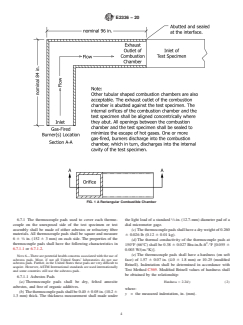
NOTE 3—An example of such a device is an L-shaped square steel tube
measuring 84 6 1 in. by 96 6 1 in. on the exterior legs with an orifice
measuring a minimum 24 by 24 in. and insulated on the interior with a
minimum2in.thick8lb/ft densityceramicfiberblanketasshowninFig.
ASHRAE Fundamentals Handbook, Chapter 32: Duct Design.
1. Inconel is a registered trade name of INCO Alloys, Inc., 3800 Riverside Dr.,
Huntingdon, WV 25720.
6.2 Gas-fired Burner—A device that produces heat and
Supporting data is available from ASTM International Headquarters. Request
flame from a gas undergoing combustion that is capable of RR:E05-1001.
E2336 − 20
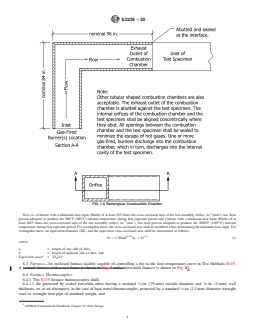
FIG. 1 A Rectangular Combustible Chamber
6.7.1 The thermocouple pads used to cover each thermo- the light load of a standard ⁄2-in. (12.7-mm) diameter pad of a
couple on the unexposed side of the test specimen or test dial micrometer gage.
assembly shall be made of either asbestos or refractory fiber
(c) Thethermocouplepadsshallhaveadryweightof0.260
materials. All thermocouple pads shall be square and measure
6 0.026 lb (0.12 6 0.01 kg).
6 6 ⁄8 in. (152 6 3 mm) on each side. The properties of the
(d) The thermal conductivity of the thermocouple pads at
thermocouple pads shall have the following characteristics in
150°F (66°C) shall be 0.38 6 0.027 Btu-in./h-ft -°F [0.055 6
6.7.1.1 or 6.7.1.2.
0.003 W/(m-°K)].
(e) The thermocouple pads shall have a hardness (on soft
NOTE 6—There are potential health concerns associated with the use of
asbestos pads. Most, if not all United States’ laboratories do not use
face) of 1.57 6 0.07 in. (4.0 6 1.8 mm) or 10-25 (modified
asbestos pads. Further, in the United States these pads are very difficult to
Brinell). Indentation shall be determined in accordance with
acquire. However, ASTM International standards are used internationally
Test Method C569. Modified Brinell values of hardness shall
and some countries still use the asbestos pads.
be obtained by the relationship:
6.7.1.1 Asbestos Pads
Hardness 5 2.24/y (2)
(a) Thermocouple pads shall be dry, felted amosite
asbestos, and free of organic additives.
where:
(b) Thethermocouplepadsshallbe0.40 60.05in.(10.2 6
y = the measured indentation, in. (mm).
1.3 mm) thick. The thickness measurement shall made under
E2336 − 20
NOTE 1—The test specimen is lowered into the furnace and held up by the supporting construction.
FIG. 2 A Horizontal Furnace
6.7.1.2 Refractory Fiber Pads 6.9 Hose Stream Delivery System:
(a) Thermocouple pads shall be dry, felted refractory fiber 6.9.1 The hose stream delivery system shall consist of:
pads. 6.9.1.1 A standard 2 ⁄2-in. (64-mm) diameter hose attached
(b) The thermocouple pads shall be 0.375 6 0.063 in. (9.5 to a national standard play pipe as described in UL 385.
6 1.6 mm) thick. The thickness measurement shall be made 6.9.1.2 The play pipe shall have a length of 30 6 ⁄4 in. (762
1 1
under the light load of a standard ⁄2-in. (12.7-mm) diameter 6 6 mm) and shall be equipped with a standard 1 ⁄8-in.
pad of a dial micrometer gage. (29-mm) discharge tip of the standard-taper-smooth-bore pat-
(c) Thethermocouplepadsshallhaveadryweightof0.147 tern without shoulder at the orifice.
6 0.053 lb (67 6 24 g). 6.9.1.3 The play pipe shall be fitted with a standard 2 ⁄2-in.
(d) The thermal conductivity of the thermocouple pads at (64-mm) inside dimension by 6-in. (153-mm) long nipple
150°F (66°C) shall be 0.37 6 0.03 Btu-in./h-ft -°F [0.053 6 mounted between the hose and the base of the play pipe.
0.004 W/(m-°K)]. 6.9.1.4 A pressure tap for measuring the water pressure at
(e) The thermocouple pads shall have a hardness (on soft the base of the nozzle shall be normal to the surface of the
face) of 0.75 6 0.025 in. (1.9 6 0.6 mm). Indentation shall be nipple, shall be centered in its length, and shall not protrude
determined in accordance with Test Method C569. Modified into the water stream.
Brinellvaluesofhardnessshallbeobtainedbytherelationship: 6.9.1.5 A suitable pressure gage capable of reading a mini-
mum of 0-50 psi (0-344.8 kPa) and graduated into no greater
Hardness 5 2.24/y (3)
than 2-psi (13.8-kPa) increments shall be used to measure the
where:
water pressure.
y = the measured indentation, in. (mm).
7. Sampling, Units, Test Specimens, and Test Assemblies
6.8 Differential Pressure Measurement Instruments:
NOTE 7—Some evaluation services require an approved inspection
6.8.1 The differential pressure measurement instrument
agency or certification body to witness the enclosure material production
shall be:
to establish traceability to the test specimens and that the enclosure
6.8.2 A manometer or equivalent transducer
material be representative of the product as applied in the field. Enclosure
materials are normally required to be classified as noncombustible, as
6.8.3 Capable of reading in graduated increments of no
defined by the International Building Code (2000).
greater than 0.01 in. H O (2.5 Pa) with a precision of not less
than 60.005 in. HO(61.25 Pa). 7.1 Noncombustibility Test Specimens:
E2336 − 20
FIG. 3 T-Shaped Pressure Sensor
FIG. 4 Tube Sensor
E2336 − 20
7.1.1 Each test specimen shall be prepared in accordance characteristics of the grease duct, including the shape,
with Test Method E136. dimensions, material, and construction techniques.
7.1.2 Properties of the materials, such as density and 7.3.5 Createanaccessopeningonthesideofthegreaseduct
dimensions, used in the test specimen shall be determined and between the internal thermocouples and the vertical leg of the
recorded. Document the description of the enclosure material grease duct. Document the access opening construction,
test specimens. Include such information as the lot number, location, and size.
trade name, and all recorded information.
NOTE 8—A successful test on the grease duct in 7.3 normally qualifies
the enclosure
...
This document is not an ASTM standard and is intended only to provide the user of an ASTM standard an indication of what changes have been made to the previous version. Because
it may not be technically possible to adequately depict all changes accurately, ASTM recommends that users consult prior editions as appropriate. In all cases only the current version
of the standard as published by ASTM is to be considered the official document.
Designation: E2336 − 16 E2336 − 20 An American National Standard
Standard Test Methods for
Fire Resistive Grease Duct Enclosure Systems
This standard is issued under the fixed designation E2336; the number immediately following the designation indicates the year of
original adoption or, in the case of revision, the year of last revision. A number in parentheses indicates the year of last reapproval. A
superscript epsilon (´) indicates an editorial change since the last revision or reapproval.
INTRODUCTION
The protection of grease ducts under fire exposure conditions is an item of importance in securing
constructions that are safe, and that are not a menace to neighboring construction nor to the public.
Recognition of this is registered in the codes of many authorities, municipal and other agencies. Many
types of enclosure materials are used to protect grease ducts. Normally, these enclosure materials are
either applied to grease ducts in the field or are fabricated as part of the grease duct when shipped from
the factory. Evaluating enclosure materials used to protect a grease duct from fire is an aid for
predicting their fire performance and promotes uniformity in requirements of various authorities. To
do this it is necessary that the fire-endurance properties of enclosure materials be measured and
specified according to a common standard expressed in terms that are applicable alike to a wide variety
of materials, situations, and conditions of exposure.
1. Scope Scope*
NOTE 1—The majority of this standard is based on the Model Building Code Evaluation Service Acceptance Criteria titled ACCEPTANCE CRITERIA
FOR GREASE DUCT ENCLOSURE ASSEMBLIES, AC101, which was created in 1994. Numerous design listings and labeled materials exist based on
the provisions of this standard.
1.1 These test methods evaluate the enclosure materials and the grease duct enclosure systems using the following test methods:
noncombustibility, fire resistance, durability, internal fire, and fire-engulfment with a through-penetration fire stop.
1.2 These test methods prescribe a standardized fire exposure for comparing the test results of the enclosure materials and grease
duct enclosure systems. The results of these tests are one factor in assessing predicted fire performance of grease duct enclosure
systems. Using these test results to predict the performance of actual grease duct enclosure systems requires the evaluation of test
conditions.
1.3 The values stated in inch-pound units are to be regarded as standard. The values given in parentheses are mathematical
conversions to SI units that are provided for information only and are not considered standard.
1.4 The text of these test methods references notes and footnotes which provide explanatory material. These notes and footnotes
(excluding those in tables and figures) shall not be considered as requirements of the fire test response standard.
1.5 These test methods are used to measure and describe the response of materials, products, or assemblies to heat and flame
under controlled conditions, but does not by itself incorporate all factors required for fire hazard or fire risk assessment of the
materials, products, or assemblies under actual fire conditions.
1.6 These test methods do not purport to address all of the safety concerns, if any, associated with its use. It is the responsibility
of the user of these test methods to establish appropriate safety and health practices and to determine the applicability of
regulatory limitations prior to use.
1.7 This international standard was developed in accordance with internationally recognized principles on standardization
established in the Decision on Principles for the Development of International Standards, Guides and Recommendations issued
by the World Trade Organization Technical Barriers to Trade (TBT) Committee.
This test method is under the jurisdiction of ASTM Committee E05 on Fire Standards and is the direct responsibility of Subcommittee E05.11 on Fire Resistance.
Current edition approved April 1, 2016April 1, 2020. Published April 2016April 2020. Originally approved in 2004. Last previous edition approved in 20142016 as
E2336–14.–16. DOI: 10.1520/E2336-16.10.1520/E2336-20.
ICC Evaluation Service, Inc. (ICBO Evaluation Service, Inc.) 5360 Workman Mill Road, Whittier, CA 90601-2298
*A Summary of Changes section appears at the end of this standard
Copyright © ASTM International, 100 Barr Harbor Drive, PO Box C700, West Conshohocken, PA 19428-2959. United States
E2336 − 20
2. Referenced Documents
2.1 ASTM Standards:
C518 Test Method for Steady-State Thermal Transmission Properties by Means of the Heat Flow Meter Apparatus
C569 Test Method for Indentation Hardness of Preformed Thermal Insulations (Withdrawn 1988)
E84 Test Method for Surface Burning Characteristics of Building Materials
E119 Test Methods for Fire Tests of Building Construction and Materials
E136 Test Method for Assessing Combustibility of Materials Using a Vertical Tube Furnace at 750°C
E176 Terminology of Fire Standards
E631 Terminology of Building Constructions
E814 Test Method for Fire Tests of Penetration Firestop Systems
2.2 Other Documents:
UL 385 Standard for Play Pipes for Water Supply Testing in Fire-Protection Service
3. Terminology
3.1 Definitions: For definitions of terms used in this test method associated with fire issues refer to the definitions contained in
Terminology E176 and for building issues refer to the definitions contained in Terminology E631. When there is a conflict between
Terminology E176 and Terminology E631 definitions, the definitions in Terminology E176 shall apply.
3.2 Definitions of Terms Specific to This Standard:
3.2.1 enclosure material, n—the product applied to the grease duct to provide fire resistance.
3.2.2 fire-separating element, n—floors, walls, and partitions having a period of fire resistance determined in accordance with
fire resistance test methods such as Test Methods E119.
3.2.3 fire side, adj—the face of the test assembly or test specimen exposed to the heat or flame or both of the test apparatus.
3.2.4 grease duct (also known as kitchen exhaust grease duct), n—a tube or conduit utilized for conveying air.
3.2.4.1 Discussion—
It is usually equipped with an access opening for cleaning the orifice.
3.2.5 grease duct enclosure system, n—consists of the grease duct, an enclosure material(s), a support and fastening system, and
an access opening for cleaning the grease duct.
3.2.6 orifice, n—the continuous hollow area or opening within the grease duct or combustion chamber.
3.2.7 supporting construction, n—the arrangement of building sections forming the fire-separating elements into which the
grease duct enclosure system is installed.
3.2.8 test assembly, n—the complete assembly composed of a test specimen(s) together with its supporting construction.
3.2.9 test specimen, n—a material, product, or assemblage of a specific design, composition, density, and dimensions.
3.2.9.1 Discussion—
the enclosure material or the grease duct enclosure system are examples of test specimens.
3.2.10 unexposed side, n—the face or part not directly exposed to the heat or flame or both of the test apparatus.
3.2.11 unexposed surface thermocouple, n—temperature-measuring device placed on the unexposed side.
4. Summary of Test Method
4.1 Representative test specimens of the enclosure material or the grease duct enclosure system are subjected to the following
tests. These test methods describe the following test sequence and procedures:
4.1.1 A noncombustibilty test, Test Method E136, demonstrates the enclosure material’s ability to resist combustion at a
standardized temperature and duration.
4.1.2 A fire resistance test, Test Methods E119, illustrates the ability of the enclosure material to resist the effects of fire when
applied in a vertical application.
4.1.2 A durability test intended to simulate the effects of long-term exposure of typical in-service conditions on the thermal
transmission qualities of the enclosure materials when subjected to a modified version of Test Method C518.
For referenced ASTM standards, visit the ASTM website, www.astm.org, or contact ASTM Customer Service at service@astm.org. For Annual Book of ASTM Standards
volume information, refer to the standard’s Document Summary page on the ASTM website.
The last approved version of this historical standard is referenced on www.astm.org.
Available from Underwriters Laboratories (UL), Corporate Progress, 333 Pfingsten Rd., Northbrook, IL 60062.
E2336 − 20
4.1.3 An internal fire test uses two standardized fire exposures occurring inside the grease duct. Both tests illustrate the
enclosure material’s ability to resist thermal transmission of heat to the unexposed side in a horizontal application. The first
standardized fire exposure is intended to simulate long term exposure of the enclosure material to a standardized service condition.
The second standardized fire exposure is intended to simulate a standardized grease fire.
4.1.4 A fire-engulfment test uses a standardized fire exposure, the time temperature curve of Test Methods E119, to simulate
a fire occurring on the outside of the grease duct, and demonstrates the ability of the grease duct enclosure system to remain intact
without a through opening. The fire-engulfment test also tests the fastening methods used to secure the enclosure material to the
grease duct and the supporting system. The fire-engulfment test also provides a means to test a through-penetration fire stop to
determine its compatibility with the grease duct enclosure system.
5. Significance and Use
5.1 These test methods are intended to evaluate the ability of the grease duct enclosure system to do the following:
5.1.1 Resist the effects of a standardized fire exposure,
5.1.2 Retain its integrity, or
5.1.3 Exhibit both properties dependent upon the type of test assembly involved during a predetermined test exposure.
5.2 These test methods provide for the following measurements and evaluations where applicable:
5.2.1 Capability of the enclosure material to resist flaming (combustion) when exposed to 1382°F (750°C).
5.2.2 Loadbearing ability of the tested support system and fastening system to carry the load of the grease duct enclosure system
during a standardized fire-engulfment test.
5.2.3 Ability of a fire stop to meet the requirements of Test Method E814 when used with a grease duct enclosure system.
5.2.4 Ability of the enclosure material to resist the passage of flames and hot gases during a standardized fire resistance test and
a standardized internal fire test.
5.2.5 Transmission of heat through the grease duct and the enclosure material(s) during a standardized fire resistance test and
a standardized internal fire test.
5.2.6 Ability of the grease duct enclosure system to resist the passage of water during a standardized hose stream test.
5.2.7 Comparative measurement of temperature aging of the enclosure material(s) when subjected to standardized cyclic
thermal transmissions.
5.3 These test methods do not provide the following:
5.3.1 Full information as to performance of the enclosure material or the grease duct enclosure system constructed with
components, densities, or dimensions other than those tested.
5.3.2 Evaluation of the degree by which the enclosure material or grease duct enclosure system contributes to the fire hazard
by generation of smoke, toxic gases, or other products of combustion.
5.3.3 Measurement of the degree of control or limitation of the passage of smoke or products of combustion through the grease
duct enclosure system.
5.3.4 Measurement of flame spread over the surface of the grease duct enclosure system.
NOTE 2—The information in 5.3.2 – 5.3.4 is usually determined by other suitable test methods. For example, 5.3.4 is typically determined using Test
Method E84.
5.4 In these test methods, the test specimens are subjected to one or more specific tests under laboratory conditions. When
different test conditions are substituted or the end-use conditions are changed, it is not always possible by, or from, these test
methods to predict changes to the characteristics measured. Therefore, the results of these laboratory tests are valid only for the
exposure conditions described in these test methods.
5.5 Various test methods in these test methods require a test specimen to be exposed to a standard fire that is controlled to
achieve specified temperatures throughout a specified time period. The fire-engulfment and vertical fire resistance tests are
followed by the application of a standardized hose stream test. These test methods provide a relative measure of the
fire-test-response of comparable enclosure materials and grease duct enclosure systems under these exposure conditions. The fire
exposure is not representative of all fire conditions because conditions vary with changes in the amount, nature and distribution
of fire loading, ventilation, compartment size and configuration, and heat sink characteristics of the compartment. Variation from
the test conditions or test specimen construction, such as size, materials, method of assembly, also affects the fire-test-response.
For these reasons, evaluation of the variation is required for application to construction in the field.
6. Apparatus
6.1 Combustion Chamber—A tubular L-shaped assembly used with a gas-fired burner(s) capable of delivering the minimum
interior temperatures for the internal fire test as specified in Section 1413.
NOTE 3—An example of such a device is an L-shaped square steel tube measuring 84 6 1 in. by 96 6 1 in. on the exterior legs with an orifice measuring
a minimum 24 by 24 in. and insulated on the interior with a minimum 2 in. thick 8 lb/ft density ceramic fiber blanket as shown in Fig. 1.
6.2 Gas-fired Burner—A device that produces heat and flame from a gas undergoing combustion that is capable of providing
the minimum temperatures to perform the internal fire test as specified in Section 1413.
E2336 − 20
FIG. 1 A Rectangular Combustible Chamber
2 2
NOTE 4—A burner with a minimum heat input (Btu/h) of at least 925 times the cross-sectional area of the test assembly orifice, in. (mm ), has been
proven adequate to produce the 500°F (260°C) internal temperature during that exposure period and a burner with a minimum heat input (Btu/h) of at
2 2
least 4025 times the cross-sectional area of the test assembly orifice, in. (mm ), has been proven adequate to produce the 2000°F (1093°C) internal
temperature during that exposure period. For rectangular ducts, the cross-sectional area shall be modified when determining the minimum heat input. For
rectangular ducts, an equivalent diameter (DE) and the equivalent cross-sectional area shall be determined as follows:
0.625 0.25
D 5 1.30 ab ⁄ a 1 b (1)
~ ! ~ !
E
where:
a = length of one side of duct,
b = length of adjacent side of duct, and
6 2
Equivalent Area = (D /2)
E
6.3 Furnace—An enclosed furnace facility capable of controlling a fire to the time-temperature curve in Test Methods E119.
A vertical furnace with a test frame is shown in Fig. 2 and a horizontal furnace is shown in Fig. 32.
6.4 Furnace Thermocouples:
6.4.1 The E119 furnace thermocouples shall:
3 1
6.4.1.1 Be protected by sealed porcelain tubes having a nominal ⁄4-in. (19-mm) outside diameter and ⁄8-in. (3-mm) wall
thickness, or, as an alternative, in the case of base metal thermocouples, protected by a standard ⁄2-in. (13-mm) diameter wrought
steel or wrought iron pipe of standard weight, and
ASHRAE Fundamentals Handbook, Chapter 32: Duct Design.
E2336 − 20
NOTE 1—The test specimen is lowered into the furnace and held up by the supporting construction.
FIG. 32 A Horizontal Furnace
6.4.1.2 Have a time constant between the range of 5.0 to 7.2 min while encased in the tubes described in 6.4.1.1.
6.4.2 Other types of E119 protection tubes or pyrometers shall be used only when they give the same indications under test
conditions as those of 6.4.1.2 within the limit of accuracy that applies for furnace-temperature measurements.
NOTE 5—A typical thermocouple assembly meeting these time constant requirements is fabricated by fusion-welding the twisted ends of No. 18 gage
Chromel-Alumel wires, mounting the leads in porcelain insulators and inserting the assembly so the thermocouple bead is approximately 0.5 in. (25 mm)
from the sealed end of the standard weight nominal ⁄2-in. (25-mm) iron, steel, or Inconel pipe. The time constant for this and for several other
thermocouple assemblies was measured in 1976. Another option is to calculate the time constant from knowledge of its physical and thermal properties.
6.5 Pressure-sensing Probes—Where applicable, tolerances are 65 % of dimensions shown in Fig. 43 or Fig. 54.
6.5.1 The pressure-sensing probes shall be either a T-shaped sensor as shown in Fig. 43, or a tube sensor as shown in Fig. 54
6.6 Unexposed Surface Thermocouples:
6.6.1 The unexposed surface thermocouple wires, which shall be covered by the thermocouple pads described in 6.7 during
testing, shall not be heavier than No. 18 B and S gage (0.040 in.) (1.02 mm), and shall be electrically insulated with heat-resistant
and moisture-resistant coatings.
6.7 Thermocouple Pads:
6.7.1 The thermocouple pads used to cover each thermocouple on the unexposed side of the test specimen or test assembly shall
be made of either asbestos or refractory fiber materials. All thermocouple pads shall be square and measure 6 6 ⁄8 in. (152 6 3
mm) on each side. The properties of the thermocouple pads shall have the following characteristics in 6.7.1.1 or 6.7.1.2.
NOTE 6—There are potential health concerns associated with the use of asbestos pads. Most, if not all United States’ laboratories do not use asbestos
pads. Further, in the United States these pads are very difficult to acquire. However, ASTM International standards are used internationally and some
countries still use the asbestos pads.
6.7.1.1 Asbestos Pads
(a) Thermocouple pads shall be dry, felted amosite asbestos, and free of organic additives.
Inconel is a registered trade name of INCO Alloys, Inc., 3800 Riverside Dr., Huntingdon, WV 25720.
Supporting data is available from ASTM International Headquarters. Request RR:E05-1001.
E2336 − 20
FIG. 43 T-Shaped Pressure Sensor
FIG. 54 Tube Sensor
E2336 − 20
(b) The thermocouple pads shall be 0.40 6 0.05 in. (10.2 6 1.3 mm) thick. The thickness measurement shall made under the
light load of a standard ⁄2-in. (12.7-mm) diameter pad of a dial micrometer gage.
(c) The thermocouple pads shall have a dry weight of 0.260 6 0.026 lb (0.12 6 0.01 kg).
(d) The thermal conductivity of the thermocouple pads at 150°F (66°C) shall be 0.38 6 0.027 Btu-in./h-ft -°F [0.055 6 0.003
W/(m-°K)].
(e) The thermocouple pads shall have a hardness (on soft face) of 1.57 6 0.07 in. (4.0 6 1.8 mm) or 10-25 (modified Brinell).
Indentation shall be determined in accordance with Test Method C569. Modified Brinell values of hardness shall be obtained by
the relationship:
Hardness 5 2.24/y (2)
where:
y = the measured indentation, in. (mm).
6.7.1.2 Refractory Fiber Pads
(a) Thermocouple pads shall be dry, felted refractory fiber pads.
(b) The thermocouple pads shall be 0.375 6 0.063 in. (9.5 6 1.6 mm) thick. The thickness measurement shall be made under
the light load of a standard ⁄2-in. (12.7-mm) diameter pad of a dial micrometer gage.
(c) The thermocouple pads shall have a dry weight of 0.147 6 0.053 lb (67 6 24 g).
(d) The thermal conductivity of the thermocouple pads at 150°F (66°C) shall be 0.37 6 0.03 Btu-in./h-ft -°F [0.053 6 0.004
W/(m-°K)].
(e) The thermocouple pads shall have a hardness (on soft face) of 0.75 6 0.025 in. (1.9 6 0.6 mm). Indentation shall be
determined in accordance with Test Method C569. Modified Brinell values of hardness shall be obtained by the relationship:
Hardness 5 2.24/y (3)
where:
y = the measured indentation, in. (mm).
6.8 Differential Pressure Measurement Instruments:
6.8.1 The differential pressure measurement instrument shall be:
6.8.2 A manometer or equivalent transducer
6.8.3 Capable of reading in graduated increments of no greater than 0.01 in. H O (2.5 Pa) with a precision of not less than
60.005 in. H O (61.25 Pa).
6.9 Hose Stream Delivery System:
6.9.1 The hose stream delivery system shall consist of:
6.9.1.1 A standard 2 ⁄2-in. (64-mm) diameter hose attached to a national standard play pipe as described in UL 385.
1 1
6.9.1.2 The play pipe shall have a length of 30 6 ⁄4 in. (762 6 6 mm) and shall be equipped with a standard 1 ⁄8-in. (29-mm)
discharge tip of the standard-taper-smooth-bore pattern without shoulder at the orifice.
6.9.1.3 The play pipe shall be fitted with a standard 2 ⁄2-in. (64-mm) inside dimension by 6-in. (153-mm) long nipple mounted
between the hose and the base of the play pipe.
6.9.1.4 A pressure tap for measuring the water pressure at the base of the nozzle shall be normal to the surface of the nipple,
shall be centered in its length, and shall not protrude into the water stream.
6.9.1.5 A suitable pressure gage capable of reading a minimum of 0-50 psi (0-344.8 kPa) and graduated into no greater than
2-psi (13.8-kPa) increments shall be used to measure the water pressure.
7. Sampling, Units, Test Specimens, and Test Assemblies
NOTE 7—Some evaluation services require an approved inspection agency or certification body to witness the enclosure material production to establish
traceability to the test specimens and that the enclosure material be representative of the product as applied in the field. Enclosure materials are normally
required to be classified as noncombustible, as defined by the International Building Code (2000).
7.1 Noncombustibility Test Specimens:
7.1.1 Each test specimen shall be prepared in accordance with Test Method E136.
7.1.2 Properties of the materials, such as density and dimensions, used in the test specimen shall be determined and recorded.
Document the description of the enclosure material test specimens. Include such information as the lot number, trade name, and
all recorded information.
7.2 Fire Resistance Test Specimens:
7.2.1 Each test specimen shall be prepared in accordance with Test Methods E119.
NOTE 8—When applying for evaluation reports, it is important that the same type, density, and dimensions of enclosure material be used in all the fire
resistance tests referenced in this standard because sometimes this standard is used to approve enclosure materials and their application. Some certification
services use this standard to publish design listings and certify enclosure materials bearing their label.
E2336 − 20
7.2.2 Properties of the materials, such as density and dimensions, used in the test specimen shall be determined and recorded.
Document the description of the enclosure material test specimens. Include such information as the lot number, trade name, and
all recorded information.
NOTE 9—Some certification and evaluation services require that the same type, density, and dimensions of enclosure material be used in all the fire
resistance tests referenced in this standard because this standard can be used to approve enclosure materials and their application. Some certification or
evaluation services use this standard to publish design listings, approve or certify enclosure materials bearing their label or designation.
7.2.3 Test Assembly—The test assembly shall be a vertical wall consisting of the following:
NOTE 10—Some certification and evaluation services require use of the same materials and construction (that is, same type and thickness of steel) in
all the fire resistance tests referenced in this standard. Some certification or evaluation services use this standard to publish evaluation reports, design
listings, approve or certify enclosure materials bearing their label or designation.
2 2
7.2.3.1 The area exposed to fire shall be not less than 100 ft (9.29 m ), with neither dimension less than 9 ft (2.7 m). The test
specimen shall not be restrained on its vertical edges. Reference Fig. 6.
5 1
7.2.3.2 Use 20 GA 3- ⁄8 by 1- ⁄4 in. (92 by 32 mm) steel studs, spaced 30 6 1 in. (762 6 25 mm) on center,
7.2.3.3 Stitch weld a single layer of sheet steel to the steel studs. Vertical joints in the sheet steel shall be centered on the steel
studs. The flat side of the sheet steel shall be the fire side of the test assembly. Document the type of sheet steel and its thickness.
7.2.3.4 The fire side of the test assembly shall be covered with the enclosure material, installed in accordance with the test
sponsor’s installation instructions. Document the installation method in detail.
7.2.3.5 Equip the test assembly with at least one access opening. Document the access opening construction, location, and size.
The test assembly shall include at least one transverse and longitudinal joint of the enclosure material installed in accordance with
the test sponsor’s instructions. Document the type of joints used and the test sponsor’s installation method.
7.2.3.6 Seal the test assembly against the furnace with an insulating gasket located between the test assembly and the vertical
furnace referenced in 6.3.
7.2 Durability Test Specimens:
7.2.1 Eight test specimens of the enclosure material shall be required.
7.2.2 The test specimens shall be prepared in accordance with Test Method C518.
7.2.3 Properties of the materials, such as density and dimensions, used in the test specimen shall be determined and recorded.
Document the description of the enclosure material test specimens. Include such information as the
...