

ASTM E2691-20
(Practice)Standard Practice for Job Productivity Measurement
General Information
- Abstract
SIGNIFICANCE AND USE
5.1 JPM produces two measurements: construction production rate and productivity.
5.1.1 JPM measures the overall production rate by comparing CPIP to the time elapsed in the construction schedule.
5.1.2 JPM measures overall job productivity through a comparison of labor usage to a reference point.
5.2 JPM issues early warning signals for construction.
5.2.1 JPM identifies productivity deviations in the form of any gains or losses in productivity, and anomalies indicating a special cause, from the productivity reference point.
5.2.2 JPM measures the productivity changes to individual building elements (according to the UNIFORMAT II format for organizing building data, in Classification E1557) with the same methodology used for overall job productivity measurement.
5.2.3 JPM measures ongoing changes in labor usage.
5.3 JPM measures productivity wherever the labor is used in construction by:
5.3.1 Any contractor or construction manager directly or indirectly responsible for the productivity of the labor and its usage.
5.3.2 Any contractor or construction manager conducting self performance on any portion of the construction job.
5.3.3 Any contractor or construction manager supervising labor performance on any portion of a construction job.
SCOPE
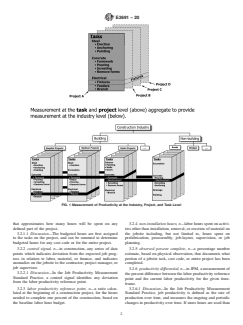
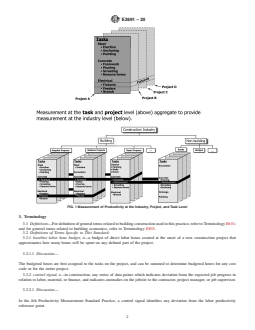
1.1 Based on the UNIFORMAT II format for organizing building data, established in Classification E1557, and depending on the level where measurement is applied (industry, total job, or building element), JPM measures construction productivity at three levels: task, project, and industry (shown in Fig. 1). By comparing labor hours used against CPIP, JPM allows for unified measurement of established building elements (according to the UNIFORMAT II format. This practice establishes a process for measuring construction job productivity by comparing labor usage to CPIP.
FIG. 1 Measurement of Productivity at the Industry, Project, and Task Level
1.2 JPM measures labor productivity of the installation processes on a construction job.2
1.3 CPIP is measured with input from the labor performing the installation, utilizing elements of statistical process control (SPC) and industrial engineering.
1.4 JPM takes into account the difficulty of installation at any given point on a job.
1.5 JPM evaluates relative productivity changes using trend monitoring.
1.6 This international standard was developed in accordance with internationally recognized principles on standardization established in the Decision on Principles for the Development of International Standards, Guides and Recommendations issued by the World Trade Organization Technical Barriers to Trade (TBT) Committee.
- Status
- Published
- Publication Date
- 31-Mar-2020
- Technical Committee
- E06 - Performance of Buildings
- Drafting Committee
- E06.81 - Building Economics



Overview
ASTM E2691-20: Standard Practice for Job Productivity Measurement (JPM) is an internationally recognized standard published by ASTM International. This standard provides a unified process for measuring and tracking productivity on construction projects. Built on the UNIFORMAT II classification for organizing building data, ASTM E2691-20 helps contractors, construction managers, and project owners assess labor productivity and production rates at multiple levels-from specific building elements to entire projects or the construction industry.
JPM is a practical tool that delivers early warning signals for deviations in productivity, enabling proactive management and continuous improvement on job sites. This standard aligns with global best practices, supporting objective, data-driven decision-making in construction job productivity management.
Key Topics
- Job Productivity Measurement (JPM): A systematic approach to measuring both production rate and labor productivity by comparing actual labor usage to planned values.
- Construction Put in Place (CPIP): A metric for tracking the amount of work completed versus time and labor expended, supporting schedule and budget adherence.
- Baseline Labor Hour Budget (BLHB): Establishes planned labor hours for each task or building element, providing a critical reference point for performance tracking.
- Trend and Anomaly Detection: JPM applies elements of statistical process control and industrial engineering concepts to monitor deviations in productivity, identify special causes, and support timely intervention.
- Application Levels: JPM is adaptable for measuring productivity at the task, project, or industry level.
- UNIFORMAT II Integration: Ensures consistency in organizing building data, facilitating clear reporting and benchmarking across projects.
Applications
The ASTM E2691-20 standard serves as a valuable productivity measurement and management resource across a range of construction project types, including building, infrastructure, and specialty trade work:
- Contractors and Construction Managers: Use JPM to establish labor benchmarks, monitor labor efficiency, and adjust resource allocation dynamically, reducing costs and risk.
- Project Owners and Developers: Implement standardized reporting to improve project transparency, support claims analysis, and ensure contractual performance.
- Subcontractors: Benefit from early identification of productivity issues within specialized work packages, allowing corrective action before issues escalate.
- Trend Monitoring: Continuous measurement highlights positive or negative trends and identifies anomalies, supporting ongoing process improvement.
- Industry Benchmarking: JPM provides a basis for performance comparison across jobs, contractors, or geographic regions, underpinning productivity research and best practice sharing.
JPM is applicable wherever labor is an essential driver of project success, supporting both routine progress measurement and forensic analysis for dispute resolution or claims.
Related Standards
ASTM E2691-20 works in conjunction with several related standards to provide a comprehensive measurement and management framework for construction job productivity:
ASTM E1557: Classification for Building Elements and Related Sitework-UNIFORMAT II
Provides the standardized structure for organizing building information and creating work breakdown structures used in JPM.ASTM E631: Terminology of Building Constructions
Defines construction terminology used throughout the JPM standard.ASTM E833: Terminology of Building Economics
Clarifies economic terms for analyzing job productivity and cost performance.ASTM E1946: Practice for Measuring Cost Risk of Buildings and Building Systems and Other Constructed Projects
Supports cost risk assessments closely related to productivity analysis.ASTM E2166: Practice for Organizing and Managing Building Data
Outlines data management processes that complement systematic productivity measurement.ASTM E2587: Practice for Use of Control Charts in Statistical Process Control
Used for identifying process variations and special causes, as integrated in JPM.
Practical Value
By applying ASTM E2691-20, construction professionals can implement a consistent, effective process for job productivity measurement, monitoring, and improvement. Utilizing this standard enhances construction project delivery by promoting transparency, early problem detection, and a culture of continuous improvement based on objective data. For organizations seeking to optimize productivity, reduce costs, and achieve predictable outcomes, JPM provides a proven and internationally accepted framework.
Relations
- Effective Date
- 01-Apr-2020
- Effective Date
- 01-Apr-2020
- Effective Date
- 01-Oct-2015
- Effective Date
- 01-Apr-2015
- Effective Date
- 01-Mar-2015
- Effective Date
- 01-Nov-2014
- Effective Date
- 01-Oct-2014
- Effective Date
- 01-Oct-2014
- Effective Date
- 01-Nov-2013
- Effective Date
- 15-Oct-2013
- Effective Date
- 01-Oct-2013
- Effective Date
- 01-Dec-2012
- Effective Date
- 01-May-2012
- Effective Date
- 01-Apr-2012
- Effective Date
- 01-Apr-2012
Get Certified
Connect with accredited certification bodies for this standard

BSI Group
BSI (British Standards Institution) is the business standards company that helps organizations make excellence a habit.

Bureau Veritas
Bureau Veritas is a world leader in laboratory testing, inspection and certification services.

DNV
DNV is an independent assurance and risk management provider.
Sponsored listings
Frequently Asked Questions
ASTM E2691-20 is a standard published by ASTM International. Its full title is "Standard Practice for Job Productivity Measurement". This standard covers: SIGNIFICANCE AND USE 5.1 JPM produces two measurements: construction production rate and productivity. 5.1.1 JPM measures the overall production rate by comparing CPIP to the time elapsed in the construction schedule. 5.1.2 JPM measures overall job productivity through a comparison of labor usage to a reference point. 5.2 JPM issues early warning signals for construction. 5.2.1 JPM identifies productivity deviations in the form of any gains or losses in productivity, and anomalies indicating a special cause, from the productivity reference point. 5.2.2 JPM measures the productivity changes to individual building elements (according to the UNIFORMAT II format for organizing building data, in Classification E1557) with the same methodology used for overall job productivity measurement. 5.2.3 JPM measures ongoing changes in labor usage. 5.3 JPM measures productivity wherever the labor is used in construction by: 5.3.1 Any contractor or construction manager directly or indirectly responsible for the productivity of the labor and its usage. 5.3.2 Any contractor or construction manager conducting self performance on any portion of the construction job. 5.3.3 Any contractor or construction manager supervising labor performance on any portion of a construction job. SCOPE 1.1 Based on the UNIFORMAT II format for organizing building data, established in Classification E1557, and depending on the level where measurement is applied (industry, total job, or building element), JPM measures construction productivity at three levels: task, project, and industry (shown in Fig. 1). By comparing labor hours used against CPIP, JPM allows for unified measurement of established building elements (according to the UNIFORMAT II format. This practice establishes a process for measuring construction job productivity by comparing labor usage to CPIP. FIG. 1 Measurement of Productivity at the Industry, Project, and Task Level 1.2 JPM measures labor productivity of the installation processes on a construction job.2 1.3 CPIP is measured with input from the labor performing the installation, utilizing elements of statistical process control (SPC) and industrial engineering. 1.4 JPM takes into account the difficulty of installation at any given point on a job. 1.5 JPM evaluates relative productivity changes using trend monitoring. 1.6 This international standard was developed in accordance with internationally recognized principles on standardization established in the Decision on Principles for the Development of International Standards, Guides and Recommendations issued by the World Trade Organization Technical Barriers to Trade (TBT) Committee.
SIGNIFICANCE AND USE 5.1 JPM produces two measurements: construction production rate and productivity. 5.1.1 JPM measures the overall production rate by comparing CPIP to the time elapsed in the construction schedule. 5.1.2 JPM measures overall job productivity through a comparison of labor usage to a reference point. 5.2 JPM issues early warning signals for construction. 5.2.1 JPM identifies productivity deviations in the form of any gains or losses in productivity, and anomalies indicating a special cause, from the productivity reference point. 5.2.2 JPM measures the productivity changes to individual building elements (according to the UNIFORMAT II format for organizing building data, in Classification E1557) with the same methodology used for overall job productivity measurement. 5.2.3 JPM measures ongoing changes in labor usage. 5.3 JPM measures productivity wherever the labor is used in construction by: 5.3.1 Any contractor or construction manager directly or indirectly responsible for the productivity of the labor and its usage. 5.3.2 Any contractor or construction manager conducting self performance on any portion of the construction job. 5.3.3 Any contractor or construction manager supervising labor performance on any portion of a construction job. SCOPE 1.1 Based on the UNIFORMAT II format for organizing building data, established in Classification E1557, and depending on the level where measurement is applied (industry, total job, or building element), JPM measures construction productivity at three levels: task, project, and industry (shown in Fig. 1). By comparing labor hours used against CPIP, JPM allows for unified measurement of established building elements (according to the UNIFORMAT II format. This practice establishes a process for measuring construction job productivity by comparing labor usage to CPIP. FIG. 1 Measurement of Productivity at the Industry, Project, and Task Level 1.2 JPM measures labor productivity of the installation processes on a construction job.2 1.3 CPIP is measured with input from the labor performing the installation, utilizing elements of statistical process control (SPC) and industrial engineering. 1.4 JPM takes into account the difficulty of installation at any given point on a job. 1.5 JPM evaluates relative productivity changes using trend monitoring. 1.6 This international standard was developed in accordance with internationally recognized principles on standardization established in the Decision on Principles for the Development of International Standards, Guides and Recommendations issued by the World Trade Organization Technical Barriers to Trade (TBT) Committee.
ASTM E2691-20 is classified under the following ICS (International Classification for Standards) categories: 03.100.30 - Management of human resources; 91.200 - Construction technology. The ICS classification helps identify the subject area and facilitates finding related standards.
ASTM E2691-20 has the following relationships with other standards: It is inter standard links to ASTM E2691-16, ASTM E1557-09(2020)e1, ASTM E1557-09(2015), ASTM E2587-15, ASTM E631-15, ASTM E631-14, ASTM E2587-14e1, ASTM E2587-14, ASTM E833-13b, ASTM E833-13a, ASTM E833-13, ASTM E2587-12, ASTM E833-12, ASTM E1946-12, ASTM E2166-12. Understanding these relationships helps ensure you are using the most current and applicable version of the standard.
ASTM E2691-20 is available in PDF format for immediate download after purchase. The document can be added to your cart and obtained through the secure checkout process. Digital delivery ensures instant access to the complete standard document.
Standards Content (Sample)
This international standard was developed in accordance with internationally recognized principles on standardization established in the Decision on Principles for the
Development of International Standards, Guides and Recommendations issued by the World Trade Organization Technical Barriers to Trade (TBT) Committee.
Designation: E2691 − 20
Standard Practice for
Job Productivity Measurement
This standard is issued under the fixed designation E2691; the number immediately following the designation indicates the year of
original adoption or, in the case of revision, the year of last revision. A number in parentheses indicates the year of last reapproval. A
superscript epsilon (´) indicates an editorial change since the last revision or reapproval.
INTRODUCTION
Job Productivity Measurement (JPM) measures both construction productivity differential on an
ongoing and periodic basis and average productivity over the life of the construction project.
JPM calculates the ratio of output per unit of input: how much work—Construction Put In Place
(CPIP)—was produced by how many labor hours. Additionally, JPM is an early warning signal for
construction performance. It measures ongoing productivity changes, trends, and anomalies resulting
from changes on a construction jobsite, which enables contractors, project managers, supervisors, and
foremen to react and improve productivity as the construction project unfolds.
1. Scope Development of International Standards, Guides and Recom-
mendations issued by the World Trade Organization Technical
1.1 Based on the UNIFORMAT II format for organizing
Barriers to Trade (TBT) Committee.
building data, established in Classification E1557, and depend-
ing on the level where measurement is applied (industry, total
2. Referenced Documents
job, or building element), JPM measures construction produc-
tivity at three levels: task, project, and industry (shown in Fig. 2.1 ASTM Standards:
1). By comparing labor hours used against CPIP, JPM allows E631 Terminology of Building Constructions
for unified measurement of established building elements E833 Terminology of Building Economics
(according to the UNIFORMAT II format. This practice E1557 Classification for Building Elements and Related
establishes a process for measuring construction job produc- Sitework—UNIFORMAT II
tivity by comparing labor usage to CPIP. E1946 Practice for Measuring Cost Risk of Buildings and
Building Systems and Other Constructed Projects
1.2 JPM measures labor productivity of the installation
E2166 Practice for Organizing and Managing Building Data
processes on a construction job.
E2587 Practice for Use of Control Charts in Statistical
1.3 CPIP is measured with input from the labor performing
Process Control
the installation, utilizing elements of statistical process control
2.2 ASTM Manual:
(SPC) and industrial engineering.
MNL 65 Application ofASTM E2691 Standard Practice for
1.4 JPM takes into account the difficulty of installation at
Job Productivity Measurement
any given point on a job.
3. Terminology
1.5 JPM evaluates relative productivity changes using trend
monitoring.
3.1 Definitions—For definition of general terms related to
1.6 This international standard was developed in accor- building construction used in this practice, refer to Terminol-
dance with internationally recognized principles on standard- ogyE631;andforgeneraltermsrelatedtobuildingeconomics,
ization established in the Decision on Principles for the refer to Terminology E833.
3.2 Definitions of Terms Specific to This Standard:
3.2.1 baseline labor hour budget, n—a budget of direct
labor hours created at the onset of a new construction project
This practice is under the jurisdiction of ASTM Committee E06 on Perfor-
mance of Buildings and is the direct responsibility of Subcommittee E06.81 on
Building Economics.
Current edition approved April 1, 2020. Published April 2020. Originally
approved in 2007. Last previous edition approved in 2016 as E2691–16. DOI: For referenced ASTM standards, visit the ASTM website, www.astm.org, or
10.1520/E2691-20. contact ASTM Customer Service at service@astm.org. For Annual Book of ASTM
JPM is based on the application of Job Productivity Assurance and Control Standards volume information, refer to the standard’s Document Summary page on
(JPAC), which has been used in industry for more than fifteen years, resulting in 20 the ASTM website.
to 30 % improvement in productivity for contractors using it. Available from ASTM International Headquarters. Order MNL65-EB.
Copyright © ASTM International, 100 Barr Harbor Drive, PO Box C700, West Conshohocken, PA 19428-2959. United States
E2691 − 20
FIG. 1 Measurement of Productivity at the Industry, Project, and Task Level
that approximates how many hours will be spent on any 3.2.4 non-installation hours, n—labor hours spent on activi-
defined part of the project. ties other than installation, removal, or erection of material on
3.2.1.1 Discussion—The budgeted hours are first assigned the jobsite including, but not limited to, hours spent on
to the tasks on the project, and can be summed to determine prefabrication, preassembly, job-layout, supervision, or job
budgeted hours for any cost code or for the entire project. planning.
3.2.2 control signal, n—in construction, any series of data 3.2.5 observed percent complete, n—a percentage number
points which indicates deviation from the expected job prog- estimate, based on physical observation, that documents what
ress in relation to labor, material, or finance, and indicates portion of a jobsite task, cost code, or entire project has been
anomalies on the jobsite to the contractor, project manager, or completed.
job supervisor.
3.2.6 productivity differential, n—in JPM, a measurement of
3.2.2.1 Discussion—In the Job Productivity Measurement
the percent difference between the labor productivity reference
Standard Practice, a control signal identifies any deviation
point and the current labor productivity for the given time-
from the labor productivity reference point.
frame.
3.2.3 labor productivity reference point, n—a ratio calcu- 3.2.6.1 Discussion—In the Job Productivity Measurement
lated at the beginning of a construction project, for the hours Standard Practice, job productivity is defined as the rate of
needed to complete one percent of the construction, based on production over time, and measures the ongoing and periodic
the baseline labor hour budget. changes in productivity over time. If more hours are used than
E2691 − 20
planned due to the difficulty of installation, errors, or rework, 5.3 JPMmeasuresproductivitywhereverthelaborisusedin
thejobproductivitydifferentialwillbenegative.Iffewerhours construction by:
are used than planned, the job productivity differential will be 5.3.1 Any contractor or construction manager directly or
positive. indirectly responsible for the productivity of the labor and its
usage.
3.2.7 system productivity, n—the ratio of the labor hours
5.3.2 Any contractor or construction manager conducting
allocated to physical construction put in place, over the total
self performance on any portion of the construction job.
labor hours used for completion of the project.
5.3.3 Any contractor or construction manager supervising
labor performance on any portion of a construction job.
4. Summary of Practice
4.1 This practice is organized as follows:
6. Procedure
4.1.1 Section 1, Scope—Identifies coverage.
6.1 Establish a baseline labor hour budget (BLHB) for the
4.1.2 Section 2, Referenced Documents—Lists ASTM stan-
scope of the construction job being measured using a Work
dards referenced in this practice.
Breakdown Structure (WBS) and reference to the UNIFOR-
4.1.3 Section 3, Terminology—Addresses definitions of
MAT II Classification E1557.
terms used in this practice.
4.1.4 Section 4, Summary of Practice—Outlines the con- 6.2 Evaluate the BLHB for appropriate level of detail.
tents of this practice.
6.3 Establish the labor productivity reference point (LPRP).
4.1.5 Section 5, Significance and Use—Explains signifi-
6.4 Once any labor hours are expended on the job (even
cance of measuring job productivity and of using the JPM
before installation commences, with activities such as
practice to do so.
planning, layout, pre-assembly), begin tracking the JPM.
4.1.6 Section 6, Procedure—Lists the steps for conducting
JPM. 6.5 Report the JPM productivity differential and review the
4.1.7 Section 7, Data Sources and Assumptions—Describes resultsforsignalsofspecialcauses impactingtheproductivity.
raw data used in calculation of JPM.
7. Data Sources and Assumptions
4.1.8 Section 8, Calculation of Labor Productivity Refer-
ence Point (LPRP)—Describes calculation of LPRP, using data
7.1 There are four data sources required for the calculation
gathered according to Section 7, and with output provided for
of JPM:
Section 9.
7.1.1 An estimate of the scope of construction to be put in
4.1.9 Section 9, Calculation of JPM—Provides algorithms
place (see 7.2).
for determining JPM.
7.1.2 The BLHB developed from a work breakdown struc-
4.1.10 Section 10, Report—Describes various types of re-
ture (WBS) (see 7.3).
porting output for JPM.
7.1.3 Expended labor hours (see 7.4).
4.1.11 Section 11, Applications—Describes where and how
7.1.4 CPIP, measured by observed percent complete (see
JPM information can be used.
7.5).
4.1.12 Section 12, Keywords—Lists related words and
7.2 The estimate of the labor required for installation is
phrases.
established prior to establishing the BLHB.
7.2.1 Profit on the project is calculated based on estimated
5. Significance and Use
labor cost with given labor hours; therefore, the BLHB must
5.1 JPM produces two measurements: construction produc-
not exceed the estimated labor hours.
tion rate and productivity.
7.3 AWBS comprised of cost codes and tasks is needed to
5.1.1 JPM measures the overall production rate by compar-
establish the BLHB as described in Section 8.
ing CPIP to the time elapsed in the construction schedule.
7.3.1 The UNIFORMAT II Classification E1557 provides a
5.1.2 JPM measures overall job productivity through a
format for creating a WBS by defining a hierarchy of building
comparison of labor usage to a reference point.
elements; Practice E2166 provides a practice for organizing
5.2 JPM issues early warning signals for construction.
building data based on UNIFORMAT II.
5.2.1 JPM identifies productivity deviations in the form of
7.3.1.1 JPM users managing several contractors or subcon-
any gains or losses in productivity, and anomalies indicating a
tractors have subcontractors reporting JPM for each of the
special cause, from the productivity reference point.
majorgroupelementsandgroupelementsdefinedinUNIFOR-
5.2.2 JPM measures the productivity changes to individual
MAT II.
building elements (according to the UNIFORMAT II format
7.3.1.2 Contractors and subcontractors directly managing
for organizing building data, in Classification E1557) with the
installation report JPM for major group elements, using cost
same methodology used for overall job productivity measure-
ment.
As defined by Practice E2587, a special cause (or unassignable cause) is a
5.2.3 JPM measures ongoing changes in labor usage.
factor that contributes to variation in a process or product output that is feasible to
detect and identify. In JPM measurement, the factor contributes to variation in
productivity or deviation from the productivity reference point.
5 7
Construction put in place is defined in the C30 series report from the U.S. UNIFORMATII is limited to building construction, whereas JPM applies to all
Census Bureau on “Value of Construction Put in Place,” http://www.census.gov/. types of construction, including roads and bridges, tunnels, dams, and railroads.
E2691 − 20
codessimilartotheindividualelementsfromUNIFORMATII. is not available, use an industry standard reference point such
For example, the cost codes for an electrical contractor include as R.S. Means Cost Estimating guide (1).
service and distribution, lighting and branch wiring, commu-
8.2.2 Determine the BLHB for each cost code by summing
nicationandsecuritysystems,andspecialelectricalsystems,as
the BLHB for each task within the cost code at the lowest level
shown in Fig. 2.
of the WBS, according to Eq 1:
7.3.2 Establish cost codes that will remain standard across
BLHB 5 BLHB (1)
CostCode ( Task
all jobs within the company. Use a maximum of 20 cost codes.
Tasks
Seven to twelve cost codes are effective for most applications.
8.2.3 Determine the BLHB for the total job by summing the
Reference the descriptions listed as individual elements in
hours budgeted in each cost code, as shown in Eq 2.
Section 3 of UNIFORMAT II for creating cost codes.
7.3.3 Depending on the application level of JPM, tasks are
BLHB 5 BLHB (2)
Job ( CostCode
CostCodes
defined by either UNIFORMAT II, or when applied at the
project level, are generated and described individually as a
8.2.4 The summed cost code hours comprise the total direct
subset of each cost code.
labor budget for the job. An illustration of a conversion from
7.3.4 A partial example of a WBS based on UNIFORMAT
the WBS into a BLHB is shown in Table 1.
II is shown in Fig. 3, where UNIFORMATII Level 2 and 3 are
8.3 Evaluate the BLHB.
shownforanelectricalcontractor,anddetailedtaskshavebeen
8.3.1 Calculate the contribution of each BLHB to its
Task
assigned to Level 3 for the Service and Distribution.
associated cost code, and to the overall job (Eq 3 and 4).
7.3.5 The WBS includes tasks for both installation and
non-installation activities. BLHB
Task
BLHB Task Weight per Cost Code 5 (3)
7.3.5.1 Non-installation activities include, but are not lim- BLHB
CostCode
ited to, planning, layout, pre-fabrication and assembly, and
BLHB
Task
BLHB Task Weight per Job 5 (4)
supervision.
BLHB
Job
7.3.5.2 Non-installation hours are included as tasks within
8.3.2 Common practice has shown that a task representing
the cost codes to which they apply.
morethan2.5 %ofthetotaljobwillbedifficulttovisualizefor
7.3.6 The baseline labor hours are assigned to the lowest
reporting observed percent complete. If any BLHB is
level tasks of the WBS, establishing BLHB for each task.
Task
Task
greater than 2.5 % of BLHB , divide the task into more
Job
7.4 On the project level application of JPM, labor hours
detailed tasks.
expended are reported in each cost code. This method of time
8.3.3 Continue to divide tasks as necessary and reallocate
reporting must be consistent with time reported for payroll
hours until each BLHB is less than 2.5 % of the BLHB .
Task Job
purposes. Hours are not reported for any level lower than the
Examples of BLHB task weightings are shown in Table 2,
cost codes in the WBS. In other words, hours are not collected
columns 4 and 5.
or reported by individual activities.
8.3.4 Calculate the LPRP for each cost code as the BLHB
7.5 CPIP is the observed completed portion of each task
required for one percent of CPIP (Eq 5).
(observed percent complete), contributing to the total comple-
BLHB
CostCode
tion of that task, based on effort expended.
LPRP 5 (5)
CostCode
NOTE 1—Observed percent complete will take into account the diffi-
culty of installation of each task. For example, the first five hundred feet
8.3.5 Calculate the LPRP for the total job by summing the
of a one thousand foot pipe installation could be a straight run, giving
LPRP of each cost code weighted by the BLHB
observed percent complete of fifty percent. The second five hundred feet
CostCode CostCode
of the installation could be more difficult, requiring more labor hours.
as a portion of the BLHB (Eq 6).
Job
Therefore, the ratio of construction put in place to labor hours spent will
BLHB
not be a linear relationship. In this example, the first five hundred feet CostCode
LPRP 5 LPRP · (6)
S D
Job CostCode
(
BLHB
coulduse250outof1000hours,wherethesecondfivehundredfeetcould
CostCodes Job
use 750 out of 1000 hours.
NOTE 2—One percent of a cost code (LPRP ) is not equal to one
CostCode
percent of the total job due to the fact that each cost code has a different
impact on the job and is therefore weighted against the total job. In other
8. Calculation of Labor Productivity Reference Point
words, one percent completion of each cost code could be higher or lower
8.1 The WBS created in 7.3 is used to create the BLHB,
than one percent completion of the job. The cost code weighting is done
toensurethatJPMtakesintoaccountthedifficultyofinstallationbasedon
which is then evaluated and used to establish the initial LPRP.
the cost code being measured. Eq 6 takes weighting of the cost code into
8.2 Create a BLHB for the job.
account and is a summation of weighted LPRP , and therefore will
CostCode
8.2.1 Data from 7.3.6 provides budgeted labor hours for
not be equal to the simple summation of all LPRP .
CostCode
each task in the WBS. Use either the budgeted labor hours
8.4 Account for change orders.
specific to a job based on company past practice or, if that data
8.4.1 The budgeted labor hours associated with change
orders are added or subtracted from the BLHB, and are
For reasons similar to those listed in 6.1.3 of Practice E1946, 20 elements
provides an appropriate level of detail for measuring job progress without
oversimplifying the JPM, or placing undue burden on the field labor for tracking The boldface numbers in parentheses refer to a list of references at the end of
required for the JPM. this standard.
E2691 − 20
FIG. 2 One Section of the UNIFORMAT II Classification of Building Elements (E1557), Shown as a Format for Creating a WBS
E2691 − 20
FIG. 3 Partial WBS for Electrical Subcontractor, Based on UNIFORMAT II
includedinthecalculationofthebaselineproductivityfromthe 9.1.5 Determine the total job productivity differential by
point at which they are recognized by the labor performing taking the weighted average of the cost code productivity
installation. differentials.
8.4.2 Note reasons for change orders as part of the JPM.
ProductivityDifferential 5 (10)
Job
9. Calculation of JPM
~ProductivityDifferential 3BLBHCostCodeWeight!
( CostCode
CostCodes
9.1 Evaluate the JPM periodically by collecting CPIP and
expended labor hours, and comparing them to the LPRP.
9.1.6 Continue evaluation of LPRP on periodic basis.
9.1.1 Report the CPIP, measured by observed percent com-
plete on each task, as shown in Table 3, column 6. 10. Report
9.1.1.1 Calculate observed percent complete per cost code,
10.1 Report the productivity differential on each cost code
by summing the weighted percent complete per task item for
and for the job on a Summary Sheet (Table 5), which includes
the cost code (Eq 7).
all of the elements from Tables 1-4, and the productivity
Observed%Complete 5 (7)
differential for one reporting period.
CostCode
10.2 Graphically represent the productivity differential
~Observed%Complete ·BLHBTaskWeightperCostCode!
( Task
TasksforCostCode trend over time, with the 0 % line representing the LPRP.
NOTE 3—For Eq 7, Observed%Complete is expressed as a percentage
10.2.1 When the productivity differential is above the line,
and can take any value between 0 and 100.
interpret that the job productivity is better than planned
9.1.2 Report the hours expended by the labor on each cost
according to the initial LPRP (Fig. 4).
code, as shown in Table 4, column 7.
10.2.2 When the productivity differential is below the line,
9.1.3 Calculate current productivity per cost code as the
interpret that the job productivity is worse than planned
labor hours expended per observed percent of CPIP for each
according to the initial LPRP (Fig. 4).
cost code, based on the labor hours expended and the observed
10.3 Plot the percent productivity differential from each
percent complete per cost code (Eq 8).
JPMupdateonalinegraph,toshowthetrendinthedifferential
LaborHoursExpended
over time, on the job, and by cost code (Fig. 5).
CostCode
CurrentProductivity 5 (8)
CostCode
Observed%Complete
CostCode
NOTE 4—Observed%Complete is expressed in whole numbers in Eq 8,
11. Applications
taking a value between 0 and 100.
11.1 Reviewproductivitytrendsforearlywarningsignalsof
9.1.4 Calculate the productivity differential as the percent
deviations in the form of any gains or losses in productivity,
difference between the LPRP and the current productivity, for
and anomalies as shown in Fig. 6, from the productivity
each cost code (Eq 9).
reference point to identify special causes. Any anomaly or
ProductivityDifferential 5 (9)
deviation from the reference point is a special cause if it has
CostCode
any the following characteristics:
LPRP 2 CurrentProductivity
~ !
CostCode CostCode
11.1.1 Trends: 6 or more points in the same direction.
LPRP
CostCode
11.1.2 Shifts in the mean: 9 or more points in a row on one
side of the mean with the rest of the points fall at the other side
Current average productivity per job can also be calculated as labor hours
of the mean.
expended per job divided by the observed percent complete for the job. Although
this calculation is not used for calculation of the productivity differential and
tracking JPM, it is a by-product of the data collected for JPM. For example, using
the numbers in Table 4, current average productivity for the job is 37.7 hours per Practice E2587 describes four signals of a shift in the process level which are
observed percent of CPIP (that is, 1508 divided by 40 = 37.7; where 1508 is listed suitable for manufacturing; the signals listed here are modifications which apply in
in line 60, column 7, and 40 is listed in line 60, column 6). construction, based on common practice of JPM.
E2691 − 20
TABLE 1 Calculation of BLHB Using UNIFORMAT II Classification and WBS
Column #→
12a 2b 3
Row #↓
(UNIFORMAT II Level 3
1 Individual Element) Tasks BLHB
Cost Code
2 Electrical Service & Distribution Main switchboard Remove Existing Switchboard 100
3 Install Switchboard - Equip. Room 1 100
4 Install Switchboard - Equip. Room 2 90
5 Test & Inspect S. Board - Equip. Room 1 60
6 Test & Inspect S. Board - Equip. Room 2 40
7 Primary transformer Remove Existing Transformers 85
8 Install Transformer - Equip. Room 1 95
9 Install Transformer - Equip. Room 2 90
10 Test & Inspect Transformer - Equip. Room 1 50
11 Test & Inspect Transformer - Equip. Room 2 40
12 Branch circuit panels Remove Existing Panels 95
13 Install Panels - Equip. Room 1 80
14 Install Panel - Equip. Room 2 75
15 Test & Inspect Panels - Equip. Room 1 70
16 Test & Inspect Pane! - Equip. Room 2 60
17 Conduit & wiring to circuit panels Small Feeders 95
18 Large Feeders 90
19 Total Budgeted Hours for Electrical Service & Distribution 1315
20 Lighting & Branch Wiring Lighting Fixtures Floor 1 - assemble 40
21 Floor 1 - install 95
22 Floor 2 - assemble 40
23 Floor 2 - install 95
24 Floor 3 - assemble 35
25 Floor 3 - install 80
26 Showroom track lighting - assemble 40
27 Showroom track lighting - install 80
28 Showroom sconces - assemble 25
29 Showroom sconces - install 70
30 Showroom lay-ins - assemble 65
31 Showroom lay-ins - install 90
32 Branch wiring and devices for lighting Floor 1 - conduit 90
33 fixtures Floor 1 - wire 100
34 Floor 2 - conduit 90
35 Floor 2 - wire 100
36 Floor 3 - conduit 90
37 Floor 3 - wire 100
38 Showroom - conduit 100
39 Showroom - wire 90
40 Devices Floor 1 - terminate 80
41 Floor 1 - trim 60
42 Floor 2 - terminate 80
43 Floor 2 - trim 80
44 Floor 3 - terminate 90
45 Floor 3 - trim 100
46 Showroom - terminate 70
47 Showroom - trim 80
48 Total Budgeted Hours for Lighting & Branch Wire 2155
49 Other Electrical Systems Emergency generator Equipment set 80
50 Equipment connection 90
51 Testing 20
52 UPS 50
53 Lightning and grounding protection system 90
54 Raceway system 100
55 Total Budgeted Hours for Other Electrical Systems 430
56 Site Lighting Set poles 80
57 Wire and conduit for fixtures 100
58 Install fixtures 90
59 Total Budgeted Hours for Site Lighting 270
60 Total Budgeted Hours for Job 4170
11.1.3 Extreme points: a point more than 3 standard devia- 11.2 Missing data is a clear indication of lack of process
tions above or below the mean.
control and requires immediate attention.
11.1.4 Alternating ups and downs (saw tooth pattern): 14
points alternating vigorously.
E2691 − 20
TABLE 2 Calculation of BLHB Task Weights per Cost Code and per Job
Column #→
12a 2b 345
Row #↓
BLHB Task &
(UNIFORMAT II Level 3 BLHB Task
Cost Code
1 Individual Element) Tasks BLHB Weight per
Weight
Cost Code Cost Code
per Job
2 Electrical Service & Distribution Main switchboard Remove Existing Switchboard 100 8 % 2.4 %
3 Install Switchboard - Equip. Room 1 100 8 % 2.4 %
4 Install Switchboard - Equip. Room 2 90 7 % 2.2 %
5 Test & Inspect S. Board - Equip. Room 60 5 % 1.4 %
6 Test & Inspect S. Board - Equip. Room 40 3 % 1.0 %
7 Primary transformer Remove Existing Transformers 85 6 % 2.0 %
8 Install Transformer - Equip. Room 1 95 7 % 2.3 %
9 Install Transformer - Equip. Room 2 90 7 % 2.2 %
10 Test & Inspect Transformer - Equip. 50 4 % 1.2 %
Room 1
11 Test & Inspect Transformer - Equip. 40 3 % 1.0 %
Room 2
12 Branch circuit panels Remove Existing Panels 95 7 % 2.3 %
13 Install Panels - Equip. Room 1 80 6 % 1.9 %
14 Install Panel - Equip. Room 2 75 6 % 1.8 %
15 Test & Inspect Panels - Equip. Room 1 70 5 % 1.7 %
16 Test & Inspect Panel - Equip. Room 2 60 5 % 1.4 %
17 Conduit & wiring to circuit panels Small Feeders 95 7 % 2.3 %
18 Large Feeders 90 7 % 2.2 %
19 Total Budgeted Hours for Electrical Service & Distribution 1315 100 % 31.5 %
20 Lighting & Branch Wiring Lighting Fixtures Floor 1 - assemble 40 2 % 1.0 %
21 Floor 1 - install 95 4 % 2.3 %
22 Floor 2 - assemble 40 2 % 1.0 %
23 Floor 2 - install 95 4 % 2.3 %
24 Floor 3 - assemble 35 2 % 0.8 %
25 Floor 3 - install 80 4 % 1.9 %
26 Showroom track lighting - assemble 40 2 % 1.0 %
27 Showroom track lighting - install 80 4 % 1.9 %
28 Showroom sconces - assemble 25 1 % 0.6 %
29 Showroom sconces - install 70 3 % 1.7 %
30 Showroom lay-ins - assemble 65 3 % 1.6 %
31 Showroom lay-ins - install 90 4 % 2.2 %
32 Branch wiring and devices Floor 1 - conduit 90 4 % 2.2 %
33 for lighting fixtures Floor 1 - wire 100 5 % 2.4 %
34 Floor 2 - conduit 90 4 % 2.2 %
35 Floor 2 - wire 100 5 % 2.4 %
36 Floor 3 - conduit 90 4 % 2.2 %
37 Floor 3 - wire 100 5 % 2.4 %
38 Showroom - conduit 100 5 % 2.4 %
39 Showroom - wire 90 4 % 2.2 %
40 Devices Floor 1 - terminate 80 4 % 1.9 %
41 Floor 1 - trim 60 3 % 1.4 %
42 Floor 2 - terminate 80 4 % 1.9 %
43 Floor 2 - trim 80 4 % 1.9 %
44 Floor 3 - terminate 90 4 % 2.2 %
45 Floor 3 - trim 100 5 % 2.4 %
46 Showroom - terminate 70 3 % 1.7 %
47 Showroom - trim 80 4 % 1.9 %
48 Total Budgeted Hours for Lighting & Branch Wire 2155 100 % 51.7 %
49 Other Electrical Systems Emergency generator Equipment set 80 19 % 1.9 %
50 Equipment connection 90 21 % 2.2 %
51 Testing 20 5 % 0.5 %
52 UPS 50 12 % 1.2 %
53 Lighting and grounding protection system 90 21 % 2.2 %
54 Raceway system 100 23 % 2.4 %
55 Total Budgeted Hours for Other Electrical Systems 430 100 % 10.3 %
56 Site Lighting Set poles 80 30 % 1.9 %
57 Wire and conduit for fixtures 100 37 % 2.4 %
58 Install fixtures 90 33 % 2.2 %
59 Total Budgeted Hours for Site Lighting 270 100 % 6.5 %
60 Total Budgeted Hours for Job 4170
E2691 − 20
TABLE 3 Reporting CPIP per Task as Measured by Physical Observation of Percent Complete on Each Task
Column #→
12a 2b 34 5 6
Row #↓
(UNIFORMAT II Level 3 BLHB Task BLHB Task & Observed
1 Individual Element) Tasks BLHB Weight per Cost Code %
Cost Code Cost Code Weight per Job Complete
2 Electrical Service Main switchboard Remove Existing Switchboard 100 8 % 2.4 % 100 %
3 & Distribution Install Switchboard - Equip. Room 1 100 8 % 2.4 % 50 %
4 Install Switchboard - Equip. Room 2 90 7 % 2.2 % 20 %
5 Test & Inspect S. Board - Equip. Room 1 60 5 % 1.4 % 0 %
6 Test & Inspect S. Board - Equip. Room 2 40 3 % 1.0 % 0 %
7 Primary transformer Remove Existing Transformers 85 6 % 2.0 % 95 %
8 Install Transformer- Equip. Room 1 95 7 % 2.3 % 5 %
9 Install Transformer - Equip. Room 2 90 7 % 2.2 % 0 %
10 Test & Inspect Transformer - Equip. Room 1 50 4 % 1.2 % 0 %
11 Test & Inspect Transformer- Equip. Room 2 40 3 % 1.0 % 0 %
12 Branch circuit panels Remove Existing Panels 95 7 % 2.3 % 100 %
13 Install Panels - Equip. Room 1 80 6 % 1.9 % 80 %
14 Install Pane! - Equip. Room 2 75 6 % 1.8 % 50 %
15 Test & Inspect Panels - Equip. Room 1 70 5 % 1.7 % 0 %
16 Test & Inspect Panel - Equip. Room 2 60 5 % 1.4 % 0 %
17 Conduit & wiring to Small Feeders 95 7 % 2.3 % 90 %
18 circuit panels Large Feeders 90 7 % 2.2 % 100 %
19 Total Budgeted Hours (col. 3); Weight per Cost Code (col. 4); Weight per job (col. 5); 1315 100 % 31.5 % 48 %
Cost Code % complete (col. 6)
20 Lighting & Branch Wiring Lighting Fixtures Floor 1 - assemble 40 2 % 1.0 % 75 %
21 Floor 1 - install 95 4 % 2.3 % 20 %
22 Floor 2 - assemble 40 2 % 1.0 % 30 %
23 Floor 2 - install 95 4 % 2.3 % 5 %
24 Floor 3 - assemble 35 2 % 0.8 % 0 %
25 Floor 3 - install 80 4 % 1.9 % 0 %
26 Showroom track lighting - assemble 40 2 % 1.0 % 15 %
27 Showroom track lighting - install 80 4 % 1.9 % 0 %
28 Showroom sconces - assemble 25 1 % 0.6 % 15 %
29 Showroom sconces - install 70 3 % 1.7 % 0 %
30 Showroom lay-ins - assemble 65 3 % 1.6 % 0 %
31 Showroom lay-ins - install 90 4 % 2.2 % 0 %
32 Branch wiring and Floor 1 - conduit 90 4 % 2.2 % 75 %
33 devices for Floor 1 - wire 100 5 % 2.4 % 25 %
34 lighting fixtures Floor 2 - conduit 90 4 % 2.2 % 45 %
35 Floor 2 - wire 100 5 % 2.4 % 5 %
36 Floor 3 - conduit 90 4 % 2.2 % 0 %
37 Floor 3 - wire 100 5 % 2.4 % 0 %
38 Showroom - conduit 100 5 % 2.4 % 100 %
39 Showroom - wire 90 4 % 2.2 % 100 %
40 Devices Floor 1 - terminate 80 4 % 1.9 % 25 %
41 Floor 1 - trim 60 3 % 1.4 % 0 %
42 Floor 2 - terminate 80 4 % 1.9 % 0 %
43 Floor 2 - trim 80 4 % 1.9 % 0 %
44 Floor 3 - terminate 90 4 % 2.2 % 0 %
45 Floor 3 - trim 100 5 % 2.4 % 0 %
46 Showroom - terminate 70 3 % 1.7 % 0 %
47 Showroom - trim 80 4 % 1.9 % 0 %
48 Total Budgeted Hours (col. 3); Weight per Cost Code (col. 4); Weight per job (col. 5); 2155 100 % 51.7 % 20 %
Cost Code % complete (col. 6)
49 Other Electrical Systems Emergency Equipment set 80 19 % 1.9 % 100 %
50 generator Equipment connection 90 21 % 2.2 % 100 %
51 Testing 20 5 % 0.5 % 50 %
52 UPS 50 12 % 1.2 % 100 %
53 Grounding 90 21 % 2.2 % 100 %
54 Special Raceway 100 23 % 2.4 % 100 %
55 Total Budgeted Hours (col. 3); Weight per Cost Code (col. 4); Weight per job (col. 5); 430 100 % 10.3 % 98 %
Cost Code % complete (col. 6)
56 Site Lighting Set poles 80 30 % 1.9 % 80 %
57 Wire and conduit for fixtures 100 37 % 2.4 % 65 %
58 Install fixtures 90 33 % 2.2 % 55 %
59 Total Budgeted Hours (col. 3); Weight per Cost Code (col. 4); Weight per job (col. 5); 270 100 % 6.5 % 66 %
Cost Code % complete (col. 6)
60 Total Budgeted Hours for Job (col. 3); Observed%Complete for Job (col. 6) 4170 40 %
11.3 If anomalies do not show any of the above-mentioned typically referred to as common variation due to daily events
behaviors, such deviations (productivity gains or losses) are on the construction jobsite.
E2691 − 20
TABLE 4 Reporting Expended Labor Hours per Cost Code
Column #→
12a 2b 34 5 67
Row #↓
BLHB Task BLHB Task
(UNIFORMAT II Level 3 Observed Expended
Weight & Cost Code
1 Individual Element) Tasks BLHB % Labor
per Weight
Cost Code Complete Hours
Cost Code per Job
2 Electrical Service Main switchboard Remove Existing Switchboard 100 8 % 2.4 % 100 %
3 & Distribution Install Switchboard - Equip. Room 1 100 8 % 2.4 % 50 %
4 Install Switchboard - Equip. Room 2 90 7 % 2.2 % 20 %
5 Test & Inspect S. Board - Equip. Room 1 60 5 % 1.4 % 0 %
6 Test & inspect S. Board - Equip. Room 2 40 3 % 1.0 % 0 %
7 Primary transformer Remove Existing Transformers 85 6 % 2.0 % 95 %
8 Install Transformer- Equip. Room 1 95 7 % 2.3 % 5 %
9 Install Transformer- Equip. Room 2 90 7 % 2.2 % 0 %
10 Test & Inspect Transformer- Equip. Room 1 50 4 % 1.2 % 0 %
11 Test & Inspect Transformer- Equip. Room 2 40 3 % 1.0 % 0 %
12 Branch circuit Remove Existing Panels 95 7 % 2.3 % 100 %
13 panels Install Panels - Equip. Room 1 80 6 % 1.9 % 80 %
14 Install Panel - Equip. Room 2 75 6 % 1.8 % 50 %
15 Test & Inspect Panels - Equip. Room 1 70 5 % 1.7 % 0 %
16 Test & inspect Panel - Equip. Room 2 60 5 % 1.4 % 0 %
17 Conduit & wiring to Small Feeders 95 7 % 2.3 % 90 %
18 circuit panels Large Feeders 90 7 % 2.2 % 100 %
19 Total Budgeted Hours (col. 3); Weight per Cost Code (col. 4); Weight per job (col. 5); 1315 100 % 31.5 % 48 % 450
Cost Code % complete (col. 6); Expended Labor Hours per Cost Code (col. 7)
20 Lighting & Branch Wiring Lighting Fixtures Floor 1 - assemble 40 2 % 1.0 % 75 %
21 Floor 1 - install 95 4 % 2.3 % 20 %
22 Floor 2 - assemble 40 2 % 1.0 % 30 %
23 Floor 2 - install 95 4 % 2.3 % 5 %
24 Floor 3 - assemble 35 2 % 0.8 % 0 %
25 Floor 3 - install 80 4 % 1.9 % 0 %
26 Showroom track lighting - assemble 40 2 % 1.0 % 15 %
27 Showroom track lighting - install 80 4 % 1.9 % 0 %
28 Showroom sconces - assemble 25 1 % 0.6 % 15 %
29 Showroom sconces - install 70 3 % 1.7 % 0 %
30 Showroom lay-ins - assemble 65 3 % 1.6 % 0 %
31 Showroom lay-ins - install 90 4 % 2.2 % 0 %
32 Branch wiring and Floor 1 - conduit 90 4 % 2.2 % 75 %
33 devices for Floor 1 - wire 100 5 % 2.4 % 25 %
34 lighting fixtures Floor 2 - conduit 90 4 % 2.2 % 45 %
35 Floor 2 - wire 100 5 % 2.4 % 5 %
36 Floor 3 - conduit 90 4 % 2.2 % 0 %
37 Floor 3 - wire 100 5 % 2.4 % 0 %
38 Showroom - conduit 100 5 % 2.4 % 100 %
39 Showroom - wire 90 4 % 2.2 % 100 %
40 Devices Floor 1 - terminate 80 4 % 1.9 % 25 %
41 Floor 1 - trim 60 3 % 1.4 % 0 %
42 Floor 2 - terminate 80 4 % 1.9 % 0 %
43 Floor 2 - trim 80 4 % 1.9 % 0 %
44 Floor 3 - terminate 90 4 % 2.2 % 0 %
45 Floor 3 - trim 100 5 % 2.4 % 0 %
46 Showroom - terminate 70 3 % 1.7 % 0 %
47 Showroom - trim 80 4 % 1.9 % 0 %
48 Total Budgeted Hours (col. 3) ; Weight per Cost Code (col. 4); Weight per job (col. 5); 2155 100 % 51.7 % 20 % 725
Cost Code % complete (col. 6); Expended Labor Hours per Cost Code (col. 7)
49 Other Electrical Systems Emergency Equipment set 80 19 % 1.9 % 100 %
50 generator Equipment connection 90 21 % 2.2 % 100 %
51 Testing 20 5 % 0.5 % 50 %
52 UPS 50 12 % 1.2 % 100 %
53 Grounding 90 21 % 2.2 % 100 %
54 Special Raceway 100 23 % 2.4 % 100 %
55 Total Budgeted Hours (col. 3) ; Weight per Cost Code (col. 4); Weight per job (col. 5); 430 100 % 10.3 % 98 % 325
Cost Code % complete (col. 6); Expended Labor Hours per Cost Code (col. 7)
56 Site Lighting Set poles 80 30 % 1.9 % 80 %
57 Wire and conduit for fixtures 100 37 % 2.4 % 65 %
58 Install fixtures 90 33 % 2.2 % 55 %
59 Total Budgeted Hours (col. 3); Weight per Cost Code (col. 4); Weight per job (col. 5); 270 100 % 6.5 % 66 % 8
Cost Code % complete (col. 6); Expended Labor Hours per Cost Code (col. 7)
60 Total Budgeted Hours for Job (col. 3); Observed%Complete for Job (col. 6); 4170 40 % 1508
Expended Labor hours for Job (col. 7)
E2691 − 20
TABLE 5 JPM Summary Sheet
(with all information about the BLHB and the productivity differential (Column 8) reported for one reporting period)
Column #
→ 12a 2b 34 5 6 7 8
Row #↓
BLHB Task BLHB Task
(UNIFORMAT II Level 3 Observed Expended %
Weight & Cost Code
1 Individual Element) Tasks BLHB % Labor Productivity
per Weight
Cost Code Complete Hours Differential
Cost Code per Job
2 Electrical Service Main Remove Existing Switchboard 100 8 % 2.4 % 100 %
3 & Distribution switchboard Install Switchboard - Equip. Room 1 100 8 % 2.4 % 50 %
4 Install Switchboard - Equip. Room 2 90 7 % 2.2 % 20 %
5 Test & Inspect S. Board - Equip. Room 1 60 5 % 1.4 % 0 %
6 Test & inspect S. Board - Equip. Room 2 40 3 % 1.0 % 0 %
7 Primary Remove Existing Transformers 85 6 % 2.0 % 95 %
8 transformer Install Transformer - Equip. Room 1 95 7 % 2.3 % 5 %
9 Install Transformer - Equip. Room 2 90 7 % 2.2 % 0 %
10 Test & Inspect Transformer- Equip. Room 1 50 4 % 1.2 % 0 %
11 Test & Inspect Transformer- Equip. Room 2 40 3 % 1.0 % 0 %
12 Branch Remove Existing Panels 95 7 % 2.3 % 100 %
13 circuit Install Panels - Equip. Room 1 80 6 %
panels
14 Install Panel - Equip. Room 2 75 6 % 1.8 % 50 %
15 Test & Inspect Panels - Equip. Room 1 70 5 % 1.7 % 0 %
16 Test & Inspect Panel - Equip. Room 2 60 5 % 1.4 % 0 %
17 Conduit & Small Feeders 95 7 % 2.3 % 90 %
18 wiring to Large Feeders 90 7 % 2.2 % 100 %
circuit panels
19 Total Budgeted Hours (col. 3); Weight per Cost Code (col. 4); Weight per job (col. 5); 1315 100 % 31.5 % 48 % 450 28 %
Cost Code % complete (col. 6): Expended Labor Hours per Cost Code (col. 7);
% Productivity Differential per Cost Code (col. 8)
20 Lighting & Lighting Floor 1 - assemble 40 2 % 1.0 % 75 %
21 Branch Wiring Fixtures Floor 1 - install 95 4 % 2.3 % 20 %
22 Floor 2 - assemble 40 2% 1.0% 30%
23 Floor 2 - install 95 4% 2.3% 5%
24 Floor 3 - assemble 35 2% 0.8% 0%
25 Floor 3 - install 80 4 % 1.9 % 0 %
26 Showroom track lighting - assemble 40 2 % 1.0 % 15 %
27 Showroom track lighting - install 80 4 % 1.9 % 0 %
28 Showroom sconces - assemble 25 1 % 0.6 % 15 %
29 Showroom sconces - install 70 3 % 1.7 % 0 %
30 Showroom lay-ins - assemble 65 3 % 1.6 % 0 %
31 Showroom lay-ins - install 90 4 % 2.2 % 0 %
32 Branch wiring Floor 1 - conduit 90 4 % 2.2 % 75 %
33 and devices Floor 1 - wire 100 5 % 2.4 % 25 %
34 for lighting Floor 2 - conduit 90 4 % 2.2 % 45 %
35 fixtures Floor 2 - wire 100 5 % 2.4 % 5 %
36 Floor 3 - conduit 90 4 % 2.2 % 0 %
37 Floor 3 - wire 100 5 % 2.4 % 0 %
38 Showroom - conduit 100 5 % 2.4 % 100 %
39 Showroom - wire 90 4 % 2.2 % 100 %
40 Devices Floor 1 - terminate 80 4 % 1.9 % 25 %
41 Floor 1 - trim 60 3 % 1.4 % 0 %
42 Floor 2 - terminate 80 4 % 1.9 % 0 %
43 Floor 2 - trim 80 4 % 1.9 % 0 %
44 Floor 3 - terminate 90 4 % 2.2 % 0 %
45 Floor 3 - trim 100 5 % 2.4 % 0 %
46 Showroom - terminate 70 3 % 1.7 % 0 %
47 Showroom - trim 80 4 % 1.9 % 0 %
48 Total Budgeted Hours (col. 3); Weight per Cost Code (col. 4); Weight per job (col. 5); 2155 100 % 51.7 % 20 % 725 -71 %
Cost Code % complete (col. 6): Expended Labor Hours per Cost Code (col. 7);
% Productivity Differential per Cost Code (col. 8)
49 Other Electrical Emergency Equipment set 80 19 % 1.9 % 100 %
50 Systems generator Equipment connection 90 21 % 2.2 % 100 %
51 Testing 20 5 % 0.5 % 50 %
52 UPS 50 12 % 1.2 % 100 %
53 Grounding 90 21 % 2.2 % 100 %
54 Special Raceway 100 23 % 2.4 % 100 %
55 Total Budgeted Hours (col. 3); Weight per Cost Code (col. 4); Weight per job (col. 5); 430 100 % 10.3 % 98 % 325 23 %
Cost Code % complete (col. 6): Expended Labor Hours per Cost Code (col. 7);
% Productivity Differential per Cost Code (col. 8)
56 Site Lighting Set poles 80 30 % 1.9 % 80 %
57 Wire and conduit for fixtures 100 37 % 2.4 % 65 %
58 Install fixtures 90 33 % 2.2 % 55 %
59 Total Budgeted Hours (col. 3); Weight per Cost Code (col. 4); Weight per job (col. 5); 270 100 % 6.5 % 66 % 8 96 %
Cost Code % complete (col. 6): Expended Labor Hours per Cost Code (col. 7);
% Productivity Differential per Cost Code (col. 8)
60 Total Budgeted Hours for Job (col. 3); Observed%Complete for Job (col. 6); 4170 40 % 1,508 -19 %
Expended Labor hours for Job (col. 7); % Productivity Differential for Job (col. 8)
E2691 − 20
FIG. 4 JPM Graphical Output Interpretation
NOTE 1—The values for Week 5 are listed in Table 5.
FIG. 5 Plot of JPM Output (Productivity Differential Trend) for Total Job and Each Cost Code
11.4 Analyze the JPM trends for individual jobs. 11.4.3 Ifanyspecialcausesignalsarepresentinthetotaljob
11.4.1 TotalJob—Observethetotaljobtrendforpresenceof or the cost codes, they must be explained. The General
anyspecialcauses.Iftherearenospecialtrendsasidentifiedin Foreman (GF) and Project Manager (PM) collaborate to
Fig.5,thenusetheproductivitydeviationtoestablishifthejob identify potential reasons of the special cause, and then
is ahead or behind the expected productivity reference point. develop an action plan for responding to them. If the special
11.4.2 Cost Code—Observe the cost code trends following cause is negative (that is, a downward trend, or a significantly
the same procedure used in 11.4.1. negativeshiftinthemean),thePMandGFneedtoidentifythe
E2691 − 20
FIG. 6 Five Signals Identifiable by Trending the JPM, Indicating a Special Cause in the Productivity Differential
cause and attempt to resolve it. If the special cause is positive other cost codes can also be identified on the trend chart, by
(that is, an upward trend or an upward shift in the mean), the comparison of the cost code’s behavior to the job total trend.
PM and GF identify what positively impacted the productivity. The total job trend in Fig. 4 resembles the trends for the
This information can be shared within the company, or with Service & Distribution and the Lighting & Branch Wire cost
other contractors on the same job for continuous improvement. codes. Referencing the Summary Sheet in Table 5 (column 5),
11.4.4 The secondary information provided by observation these two cost codes together represent 83 % of the BLHB .
Job
of the cost code trends is the impact of the cost codes on the
11.4.5 The person who analyzes the cost code trend will
total job behavior, based on the portion of the baseline labor
note the reasons for anomalies and special causes on the chart
hour budget in each cost code, attributed to the baseline labor
for the date of occurrence for record keeping purposes.
hour budget for the job. Use the following steps to analyze the
11.5 Review the JPM trends for a company or industry.
impact of individual cost codes on the total job behavior.
11.5.1 Acontractorreviewsthetotaljobtrendforalljobs,as
11.4.4.1 Reference the Summary Sheet (Table 5) to identify
shown in Fig. 7.
which cost codes have the highest impact on the total job,
based on the BLHB as a portion of the BLHB . The 11.5.2 AGeneral Contractor,Architect, Engineer, Construc-
CostCode Job
impact of cost codes with a BLHB comparatively larger than tion Manager, or other entity managing an overall construction
E2691 − 20
FIG. 7 Overall Company JPM Trend, Showing Individual Job Total Trends
project reviews the total job trend for all subcontractors. This 11.6.3 Appendix X2 provides an approach for supplement-
would be similar to Fig. 7 with each line representing a ing the JPM reports with root causes for productivity impacts.
subcontractor rather than a job.
11.5.3 All cost codes can be compared across several jobs 12. Keywords
for a company, or for the industry. For example, a cost code
12.1 accounting; agile; agile construction; construction ac-
may do consistently well on all jobs for a company, and
counting; construction production; construction productivity
another cost code may be completely unpredictable. The
measure; construction put in place; cost codes; CPIP; effec-
industry can analyze cost codes for expected productivity, and
tiveness;efficiency;individualproductivity;joblaborvariance;
identify areas for improvement and training industry-wide.
job layout; job productivity; job productivity assurance and
11.6 Use JPM for contract billing. control; job productivity measurement; job tracking; JPAC;
11.6.1 UseofJPMforcontractbillingresultsinanumberof JPM; labor productivity; labor variation; lean; lean construc-
benefits, both for contractors and owners, including but not tion; low cost provider; observed percent complete; planning;
limited to: (1) increased billing accuracy; (2) improved cash predicting profits; predictions; process of project management;
flow; (3) improved gross margin; and (4) more reliable production; productivity; productivity measurement; profit-
substantiation. ability; Six Sigma in construction; SPC; SPC in construction;
11.6.2 AppendixX1providesanin-depthdiscussionofhow statistical process control; system productivity; trends; trend
to use JPM for contract billing along with its advantages over monitoring; value engineering; variation; variation measure-
using other accounting methods. ment in construction; work breakdown structure
E2691 − 20
APPENDIXES
(Nonmandatory Information)
X1. USING THE JOB PRODUCTIVITY MEASUREMENT STANDARD PRACTICE FOR BILLING
X1.1 Overview approach. The fundamental distinction between the two meth-
ods lies in the recognition, recording, matching, and reporting
X
...
This document is not an ASTM standard and is intended only to provide the user of an ASTM standard an indication of what changes have been made to the previous version. Because
it may not be technically possible to adequately depict all changes accurately, ASTM recommends that users consult prior editions as appropriate. In all cases only the current version
of the standard as published by ASTM is to be considered the official document.
Designation: E2691 − 16 E2691 − 20
Standard Practice for
Job Productivity Measurement
This standard is issued under the fixed designation E2691; the number immediately following the designation indicates the year of
original adoption or, in the case of revision, the year of last revision. A number in parentheses indicates the year of last reapproval. A
superscript epsilon (´) indicates an editorial change since the last revision or reapproval.
INTRODUCTION
Job Productivity Measurement (JPM) measures both construction productivity differential on an
ongoing and periodic basis and average productivity over the life of the construction project.
JPM calculates the ratio of output per unit of input: how much work—Construction Put In Place
(CPIP)—was produced by how many labor hours. Additionally, JPM is an early warning signal for
construction performance. It measures ongoing productivity changes, trends, and anomalies resulting
from changes on a construction jobsite, which enables contractors, project managers, supervisors, and
foremen to react and improve productivity as the construction project unfolds.
1. Scope
1.1 Based on the UNIFORMAT II format for organizing building data, established in Classification E1557, and depending on
the level where measurement is applied (industry, total job, or building element), JPM measures construction productivity at three
levels: task, project, and industry (shown in Fig. 1). By comparing labor hours used against CPIP, JPM allows for unified
measurement of established building elements (according to the UNIFORMAT II format. This practice establishes a process for
measuring construction job productivity by comparing labor usage to CPIP.
1.2 JPM measures labor productivity of the installation processes on a construction job.
1.3 CPIP is measured with input from the labor performing the installation, utilizing elements of statistical process control
(SPC) and industrial engineering.
1.4 JPM takes into account the difficulty of installation at any given point on a job.
1.5 JPM evaluates relative productivity changes using trend monitoring.
1.6 This international standard was developed in accordance with internationally recognized principles on standardization
established in the Decision on Principles for the Development of International Standards, Guides and Recommendations issued
by the World Trade Organization Technical Barriers to Trade (TBT) Committee.
2. Referenced Documents
2.1 ASTM Standards:
E631 Terminology of Building Constructions
E833 Terminology of Building Economics
E1557 Classification for Building Elements and Related Sitework—UNIFORMAT II
E1946 Practice for Measuring Cost Risk of Buildings and Building Systems and Other Constructed Projects
E2166 Practice for Organizing and Managing Building Data
E2587 Practice for Use of Control Charts in Statistical Process Control
2.2 ASTM Manual:
MNL 65 Application of ASTM E2691 Standard Practice for Job Productivity Measurement
This practice is under the jurisdiction of ASTM Committee E06 on Performance of Buildings and is the direct responsibility of Subcommittee E06.81 on Building
Economics.
Current edition approved March 1, 2016April 1, 2020. Published April 2016April 2020. Originally approved in 2007. Last previous edition approved in 20112016 as
E2691 – 11.E2691–16. DOI: 10.1520/E2691-16.10.1520/E2691-20.
JPM is based on the application of Job Productivity Assurance and Control (JPAC), which has been used in industry for more than fifteen years, resulting in 20 to 30 %
improvement in productivity for contractors using it.
For referenced ASTM standards, visit the ASTM website, www.astm.org, or contact ASTM Customer Service at service@astm.org. For Annual Book of ASTM Standards
volume information, refer to the standard’sstandard’s Document Summary page on the ASTM website.
Available from ASTM International Headquarters. Order MNL65-EB.
Copyright © ASTM International, 100 Barr Harbor Drive, PO Box C700, West Conshohocken, PA 19428-2959. United States
E2691 − 20
FIG. 1 Measurement of Productivity at the Industry, Project, and Task Level
3. Terminology
3.1 Definitions—For definition of general terms related to building construction used in this practice, refer to Terminology E631;
and for general terms related to building economics, refer to Terminology E833.
3.2 Definitions of Terms Specific to This Standard:
3.2.1 baseline labor hour budget, n—a budget of direct labor hours created at the onset of a new construction project that
approximates how many hours will be spent on any defined part of the project.
3.2.1.1 Discussion—
The budgeted hours are first assigned to the tasks on the project, and can be summed to determine budgeted hours for any cost
code or for the entire project.
3.2.2 control signal, n—in construction, any series of data points which indicates deviation from the expected job progress in
relation to labor, material, or finance, and indicates anomalies on the jobsite to the contractor, project manager, or job supervisor.
3.2.2.1 Discussion—
In the Job Productivity Measurement Standard Practice, a control signal identifies any deviation from the labor productivity
reference point.
E2691 − 20
3.2.3 labor productivity reference point, n—a ratio calculated at the beginning of a construction project, for the hours needed
to complete one percent of the construction, based on the baseline labor hour budget.
3.2.4 non-installation hours, n—labor hours spent on activities other than installation, removal, or erection of material on the
jobsite including, but not limited to, hours spent on prefabrication, preassembly, job-layout, supervision, or job planning.
3.2.5 observed percent complete, n—a percentage number estimate, based on physical observation, that documents what portion
of a jobsite task, cost code, or entire project has been completed.
3.2.6 productivity differential, n—in JPM, a measurement of the percent difference between the labor productivity reference
point and the current labor productivity for the given timeframe.
3.2.6.1 Discussion—
In the Job Productivity Measurement Standard Practice, job productivity is defined as the rate of production over time, and
measures the ongoing and periodic changes in productivity over time. If more hours are used than planned due to the difficulty
of installation, errors, or rework, the job productivity differential will be negative. If fewer hours are used than planned, the job
productivity differential will be positive.
3.2.7 system productivity, n—the ratio of the labor hours allocated to physical construction put in place, over the total labor
hours used for completion of the project.
4. Summary of Practice
4.1 This practice is organized as follows:
4.1.1 Section 1, Scope—Identifies coverage.
4.1.2 Section 2, Referenced Documents—Lists ASTM standards referenced in this practice.
4.1.3 Section 3, Terminology—Addresses definitions of terms used in this practice.
4.1.4 Section 4, Summary of Practice—Outlines the contents of this practice.
4.1.5 Section 5, Significance and Use—Explains significance of measuring job productivity and of using the JPM practice to do
so.
4.1.6 Section 6, Procedure—Lists the steps for conducting JPM.
4.1.7 Section 7, Data Sources and Assumptions—Describes raw data used in calculation of JPM.
4.1.8 Section 8, Calculation of Labor Productivity Reference Point (LPRP)—Describes calculation of LPRP, using data gathered
according to Section 7, and with output provided for Section 9.
4.1.9 Section 9, Calculation of JPM—Provides algorithms for determining JPM.
4.1.10 Section 10, Report—Describes various types of reporting output for JPM.
4.1.11 Section 11, Applications—Describes where and how JPM information can be used.
4.1.12 Section 12, Keywords—Lists related words and phrases.
5. Significance and Use
5.1 JPM produces two measurements: construction production rate and productivity.
5.1.1 JPM measures the overall production rate by comparing CPIP to the time elapsed in the construction schedule.
5.1.2 JPM measures overall job productivity through a comparison of labor usage to a reference point.
5.2 JPM issues early warning signals for construction.
5.2.1 JPM identifies productivity deviations in the form of any gains or losses in productivity, and anomalies indicating a special
cause, from the productivity reference point.
5.2.2 JPM measures the productivity changes to individual building elements (according to the UNIFORMAT II format for
organizing building data, in Classification E1557) with the same methodology used for overall job productivity measurement.
5.2.3 JPM measures ongoing changes in labor usage.
5.3 JPM measures productivity wherever the labor is used in construction by:
5.3.1 Any contractor or construction manager directly or indirectly responsible for the productivity of the labor and its usage.
5.3.2 Any contractor or construction manager conducting self performance on any portion of the construction job.
5.3.3 Any contractor or construction manager supervising labor performance on any portion of a construction job.
6. Procedure
6.1 Establish a baseline labor hour budget (BLHB) for the scope of the construction job being measured using a Work
Breakdown Structure (WBS) and reference to the UNIFORMAT II classification (Practice Classification E1557).
Construction put in place is defined in the C30 series report from the U.S. Census Bureau on “Value of Construction Put in Place,” http://www.census.gov/.
E2691 − 20
6.2 Evaluate the BLHB for appropriate level of detail.
6.3 Establish the labor productivity reference point (LPRP).
6.4 Once any labor hours are expended on the job (even before installation commences, with activities such as planning, layout,
pre-assembly), begin tracking the JPM.
6.5 Report the JPM productivity differential and review the results for signals of special causes impacting the productivity.
7. Data Sources and Assumptions
7.1 There are four data sources required for the calculation of JPM:
7.1.1 An estimate of the scope of construction to be put in place (see 7.2).
7.1.2 The BLHB developed from a work breakdown structure (WBS) (see 7.3).
7.1.3 Expended labor hours (see 7.4).
7.1.4 CPIP, measured by observed percent complete (see 7.5).
7.2 The estimate of the labor required for installation is established prior to establishing the BLHB.
7.2.1 Profit on the project is calculated based on estimated labor cost with given labor hours; therefore, the BLHB must not
exceed the estimated labor hours.
7.3 A WBS comprised of cost codes and tasks is needed to establish the BLHB as described in Section 8.
7.3.1 The UNIFORMAT II classification (Practice Classification E1557) provides a format for creating a WBS by defining a
hierarchy of building elements; Practice E2166 provides a practice for organizing building data based on UNIFORMAT II.
7.3.1.1 JPM users managing several contractors or subcontractors have subcontractors reporting JPM for each of the major
group elements and group elements defined in UNIFORMAT II.
7.3.1.2 Contractors and subcontractors directly managing installation report JPM for major group elements, using cost codes
similar to the individual elements from UNIFORMAT II. For example, the cost codes for an electrical contractor include service
and distribution, lighting and branch wiring, communication and security systems, and special electrical systems, as shown in Fig.
2.
7.3.2 Establish cost codes that will remain standard across all jobs within the company. Use a maximum of 20 cost codes. Seven
to twelve cost codes are effective for most applications. Reference the descriptions listed as individual elements in Section 3 of
UNIFORMAT II for creating cost codes.
7.3.3 Depending on the application level of JPM, tasks are defined by either UNIFORMAT II, or when applied at the project
level, are generated and described individually as a subset of each cost code.
7.3.4 A partial example of a WBS based on UNIFORMAT II is shown in Fig. 3, where UNIFORMAT II Level 2 and 3 are shown
for an electrical contractor, and detailed tasks have been assigned to Level 3 for the Service and Distribution.
7.3.5 The WBS includes tasks for both installation and non-installation activities.
7.3.5.1 Non-installation activities include, but are not limited to, planning, layout, pre-fabrication and assembly, and
supervision.
7.3.5.2 Non-installation hours are included as tasks within the cost codes to which they apply.
7.3.6 The baseline labor hours are assigned to the lowest level tasks of the WBS, establishing BLHB for each task.
Task
7.4 On the project level application of JPM, labor hours expended are reported in each cost code. This method of time reporting
must be consistent with time reported for payroll purposes. Hours are not reported for any level lower than the cost codes in the
WBS. In other words, hours are not collected or reported by individual activities.
7.5 CPIP is the observed completed portion of each task (observed percent complete), contributing to the total completion of
that task, based on effort expended.
NOTE 1—Observed percent complete will take into account the difficulty of installation of each task. For example, the first five hundred feet of a one
thousand foot pipe installation could be a straight run, giving observed percent complete of fifty percent. The second five hundred feet of the installation
could be more difficult, requiring more labor hours. Therefore, the ratio of construction put in place to labor hours spent will not be a linear relationship.
In this example, the first five hundred feet could use 250 out of 1000 hours, where the second five hundred feet could use 750 out of 1000 hours.
8. Calculation of Labor Productivity Reference Point
8.1 The WBS created in 7.3 is used to create the BLHB, which is then evaluated and used to establish the initial LPRP.
8.2 Create a BLHB for the job.
As defined by Practice E2587, a special cause (or unassignable cause) is a factor that contributes to variation in a process or product output that is feasible to detect and
identify. In JPM measurement, the factor contributes to variation in productivity or deviation from the productivity reference point.
UNIFORMAT II is limited to building construction, whereas JPM applies to all types of construction, including roads and bridges, tunnels, dams, and railroads.
For reasons similar to those listed in 6.1.3 of Practice E1946, 20 elements provides an appropriate level of detail for measuring job progress without oversimplifying
the JPM, or placing undue burden on the field labor for tracking required for the JPM.
E2691 − 20
FIG. 2 One Section of the UNIFORMAT II Classification of Building Elements (Practice (E1557), Shown as a Format for Creating a WBS
E2691 − 20
FIG. 3 Partial WBS for Electrical Subcontractor, Based on UNIFORMAT II
8.2.1 Data from 7.3.6 provides budgeted labor hours for each task in the WBS. Use either the budgeted labor hours specific to
a job based on company past practice or, if that data is not available, use an industry standard reference point such as R.S. Means
Cost Estimating guide (1).
8.2.2 Determine the BLHB for each cost code by summing the BLHB for each task within the cost code at the lowest level of
the WBS, according to Eq 1:
BLHB 5 BLHB (1)
CostCode ( Task
Tasks
8.2.3 Determine the BLHB for the total job by summing the hours budgeted in each cost code, as shown in Eq 2.
BLHB 5 BLHB (2)
Job ( CostCode
CostCodes
8.2.4 The summed cost code hours comprise the total direct labor budget for the job. An illustration of a conversion from the
WBS into a BLHB is shown in Table 1.
8.3 Evaluate the BLHB.
8.3.1 Calculate the contribution of each BLHB to its associated cost code, and to the overall job (Eq 3 and 4).
Task
BLHB
Task
BLHB Task Weight per Cost Code 5 (3)
BLHB
CostCode
BLHB
Task
BLHB Task Weight per Job 5 (4)
BLHB
Job
8.3.2 Common practice has shown that a task representing more than 2.5 % of the total job will be difficult to visualize for
reporting observed percent complete. If any BLHB is greater than 2.5 % of BLHB , divide the task into more detailed tasks.
Task Job
8.3.3 Continue to divide tasks as necessary and reallocate hours until each BLHB is less than 2.5 % of the BLHB .
Task Job
Examples of BLHB task weightings are shown in Table 2, columns 4 and 5.
8.3.4 Calculate the LPRP for each cost code as the BLHB required for one percent of CPIP (Eq 5).
BLHB
CostCode
LPRP 5 (5)
CostCode
8.3.5 Calculate the LPRP for the total job by summing the LPRP of each cost code weighted by the BLHB as
CostCode CostCode
a portion of the BLHB (Eq 6).
Job
BLHB
CostCode
LPRP 5 LPRP · (6)
S D
Job ( CostCode
BLHB
CostCodes
Job
NOTE 2—One percent of a cost code (LPRP ) is not equal to one percent of the total job due to the fact that each cost code has a different impact
CostCode
on the job and is therefore weighted against the total job. In other words, one percent completion of each cost code could be higher or lower than one
percent completion of the job. The cost code weighting is done to ensure that JPM takes into account the difficulty of installation based on the cost code
being measured. Eq 6 takes weighting of the cost code into account and is a summation of weighted LPRP , and therefore will not be equal to
CostCode
the simple summation of all LPRP .
CostCode
8.4 Account for change orders.
8.4.1 The budgeted labor hours associated with change orders are added or subtracted from the BLHB, and are included in the
calculation of the baseline productivity from the point at which they are recognized by the labor performing installation.
The boldface numbers in parentheses refer to a list of references at the end of this standard.
E2691 − 20
TABLE 1 Calculation of BLHB Using UNIFORMAT II Classification and WBS
Column # →
1 2a 2b 3
Row # ↓
(UNIFORMAT II Level 3
1 Individual Element) Tasks BLHB
Cost Code
2 Electrical Service & Distribution Main switchboard Remove Existing Switchboard 100
3 Install Switchboard - Equip. Room 1 100
4 Install Switchboard - Equip. Room 2 90
5 Test & Inspect S. Board - Equip. Room 1 60
6 Test & Inspect S. Board - Equip. Room 2 40
7 Primary transformer Remove Existing Transformers 85
8 Install Transformer - Equip. Room 1 95
9 Install Transformer - Equip. Room 2 90
10 Test & Inspect Transformer - Equip. Room 1 50
11 Test & Inspect Transformer - Equip. Room 2 40
12 Branch circuit panels Remove Existing Panels 95
13 Install Panels - Equip. Room 1 80
14 Install Panel - Equip. Room 2 75
15 Test & Inspect Panels - Equip. Room 1 70
16 Test & Inspect Pane! - Equip. Room 2 60
17 Conduit & wiring to circuit panels Small Feeders 95
18 Large Feeders 90
19 Total Budgeted Hours for Electrical Service & Distribution 1315
20 Lighting & Branch Wiring Lighting Fixtures Floor 1 - assemble 40
21 Floor 1 - install 95
22 Floor 2 - assemble 40
23 Floor 2 - install 95
24 Floor 3 - assemble 35
25 Floor 3 - install 80
26 Showroom track lighting - assemble 40
27 Showroom track lighting - install 80
28 Showroom sconces - assemble 25
29 Showroom sconces - install 70
30 Showroom lay-ins - assemble 65
31 Showroom lay-ins - install 90
32 Branch wiring and devices for lighting Floor 1 - conduit 90
33 fixtures Floor 1 - wire 100
34 Floor 2 - conduit 90
35 Floor 2 - wire 100
36 Floor 3 - conduit 90
37 Floor 3 - wire 100
38 Showroom - conduit 100
39 Showroom - wire 90
40 Devices Floor 1 - terminate 80
41 Floor 1 - trim 60
42 Floor 2 - terminate 80
43 Floor 2 - trim 80
44 Floor 3 - terminate 90
45 Floor 3 - trim 100
46 Showroom - terminate 70
47 Showroom - trim 80
48 Total Budgeted Hours for Lighting & Branch Wire 2155
49 Other Electrical Systems Emergency generator Equipment set 80
50 Equipment connection 90
51 Testing 20
52 UPS 50
53 Lightning and grounding protection system 90
54 Raceway system 100
55 Total Budgeted Hours for Other Electrical Systems 430
56 Site Lighting Set poles 80
57 Wire and conduit for fixtures 100
58 Install fixtures 90
59 Total Budgeted Hours for Site Lighting 270
60 Total Budgeted Hours for Job 4170
8.4.2 Note reasons for change orders as part of the JPM.
9. Calculation of JPM
9.1 Evaluate the JPM periodically by collecting CPIP and expended labor hours, and comparing them to the LPRP.
9.1.1 Report the CPIP, measured by observed percent complete on each task, as shown in Table 3, column 6.
E2691 − 20
TABLE 2 Calculation of BLHB Task Weights per Cost Code and per Job
Column # →
1 2a 2b 3 4 5
Row # ↓
BLHB Task &
(UNIFORMAT II Level 3 BLHB Task
Cost Code
1 Individual Element) Tasks BLHB Weight per
Weight
Cost Code Cost Code
per Job
2 Electrical Service & Distribution Main switchboard Remove Existing Switchboard 100 8 % 2.4 %
3 Install Switchboard - Equip. Room 1 100 8 % 2.4 %
4 Install Switchboard - Equip. Room 2 90 7 % 2.2 %
5 Test & Inspect S. Board - Equip. Room 60 5 % 1.4 %
6 Test & Inspect S. Board - Equip. Room 40 3 % 1.0 %
7 Primary transformer Remove Existing Transformers 85 6 % 2.0 %
8 Install Transformer - Equip. Room 1 95 7 % 2.3 %
9 Install Transformer - Equip. Room 2 90 7 % 2.2 %
10 Test & Inspect Transformer - Equip. 50 4 % 1.2 %
Room 1
11 Test & Inspect Transformer - Equip. 40 3 % 1.0 %
Room 2
12 Branch circuit panels Remove Existing Panels 95 7 % 2.3 %
13 Install Panels - Equip. Room 1 80 6 % 1.9 %
14 Install Panel - Equip. Room 2 75 6 % 1.8 %
15 Test & Inspect Panels - Equip. Room 1 70 5 % 1.7 %
16 Test & Inspect Panel - Equip. Room 2 60 5 % 1.4 %
17 Conduit & wiring to circuit panels Small Feeders 95 7 % 2.3 %
18 Large Feeders 90 7 % 2.2 %
19 Total Budgeted Hours for Electrical Service & Distribution 1315 100 % 31.5 %
20 Lighting & Branch Wiring Lighting Fixtures Floor 1 - assemble 40 2 % 1.0 %
21 Floor 1 - install 95 4 % 2.3 %
22 Floor 2 - assemble 40 2 % 1.0 %
23 Floor 2 - install 95 4 % 2.3 %
24 Floor 3 - assemble 35 2 % 0.8 %
25 Floor 3 - install 80 4 % 1.9 %
26 Showroom track lighting - assemble 40 2 % 1.0 %
27 Showroom track lighting - install 80 4 % 1.9 %
28 Showroom sconces - assemble 25 1 % 0.6 %
29 Showroom sconces - install 70 3 % 1.7 %
30 Showroom lay-ins - assemble 65 3 % 1.6 %
31 Showroom lay-ins - install 90 4 % 2.2 %
32 Branch wiring and devices Floor 1 - conduit 90 4 % 2.2 %
33 for lighting fixtures Floor 1 - wire 100 5 % 2.4 %
34 Floor 2 - conduit 90 4 % 2.2 %
35 Floor 2 - wire 100 5 % 2.4 %
36 Floor 3 - conduit 90 4 % 2.2 %
37 Floor 3 - wire 100 5 % 2.4 %
38 Showroom - conduit 100 5 % 2.4 %
39 Showroom - wire 90 4 % 2.2 %
40 Devices Floor 1 - terminate 80 4 % 1.9 %
41 Floor 1 - trim 60 3 % 1.4 %
42 Floor 2 - terminate 80 4 % 1.9 %
43 Floor 2 - trim 80 4 % 1.9 %
44 Floor 3 - terminate 90 4 % 2.2 %
45 Floor 3 - trim 100 5 % 2.4 %
46 Showroom - terminate 70 3 % 1.7 %
47 Showroom - trim 80 4 % 1.9 %
48 Total Budgeted Hours for Lighting & Branch Wire 2155 100 % 51.7 %
49 Other Electrical Systems Emergency generator Equipment set 80 19 % 1.9 %
50 Equipment connection 90 21 % 2.2 %
51 Testing 20 5 % 0.5 %
52 UPS 50 12 % 1.2 %
53 Lighting and grounding protection system 90 21 % 2.2 %
54 Raceway system 100 23 % 2.4 %
55 Total Budgeted Hours for Other Electrical Systems 430 100 % 10.3 %
56 Site Lighting Set poles 80 30 % 1.9 %
57 Wire and conduit for fixtures 100 37 % 2.4 %
58 Install fixtures 90 33 % 2.2 %
59 Total Budgeted Hours for Site Lighting 270 100 % 6.5 %
60 Total Budgeted Hours for Job 4170
E2691 − 20
TABLE 3 Reporting CPIP per Task as Measured by Physical Observation of Percent Complete on Each Task
Column # →
1 2a 2b 3 4 5 6
Row # ↓
(UNIFORMAT II Level 3 BLHB Task BLHB Task & Observed
1 Individual Element) Tasks BLHB Weight per Cost Code %
Cost Code Cost Code Weight per Job Complete
2 Electrical Service Main switchboard Remove Existing Switchboard 100 8 % 2.4 % 100 %
3 & Distribution Install Switchboard - Equip. Room 1 100 8 % 2.4 % 50 %
4 Install Switchboard - Equip. Room 2 90 7 % 2.2 % 20 %
5 Test & Inspect S. Board - Equip. Room 1 60 5 % 1.4 % 0 %
6 Test & Inspect S. Board - Equip. Room 2 40 3 % 1.0 % 0 %
7 Primary transformer Remove Existing Transformers 85 6 % 2.0 % 95 %
8 Install Transformer- Equip. Room 1 95 7 % 2.3 % 5 %
9 Install Transformer - Equip. Room 2 90 7 % 2.2 % 0 %
10 Test & Inspect Transformer - Equip. Room 1 50 4 % 1.2 % 0 %
11 Test & Inspect Transformer- Equip. Room 2 40 3 % 1.0 % 0 %
12 Branch circuit panels Remove Existing Panels 95 7 % 2.3 % 100 %
13 Install Panels - Equip. Room 1 80 6 % 1.9 % 80 %
14 Install Pane! - Equip. Room 2 75 6 % 1.8 % 50 %
15 Test & Inspect Panels - Equip. Room 1 70 5 % 1.7 % 0 %
16 Test & Inspect Panel - Equip. Room 2 60 5 % 1.4 % 0 %
17 Conduit & wiring to Small Feeders 95 7 % 2.3 % 90 %
18 circuit panels Large Feeders 90 7 % 2.2 % 100 %
19 Total Budgeted Hours (col. 3); Weight per Cost Code (col. 4); Weight per job (col. 5); 1315 100 % 31.5 % 48 %
Cost Code % complete (col. 6)
20 Lighting & Branch Wiring Lighting Fixtures Floor 1 - assemble 40 2 % 1.0 % 75 %
21 Floor 1 - install 95 4 % 2.3 % 20 %
22 Floor 2 - assemble 40 2 % 1.0 % 30 %
23 Floor 2 - install 95 4 % 2.3 % 5 %
24 Floor 3 - assemble 35 2 % 0.8 % 0 %
25 Floor 3 - install 80 4 % 1.9 % 0 %
26 Showroom track lighting - assemble 40 2 % 1.0 % 15 %
27 Showroom track lighting - install 80 4 % 1.9 % 0 %
28 Showroom sconces - assemble 25 1 % 0.6 % 15 %
29 Showroom sconces - install 70 3 % 1.7 % 0 %
30 Showroom lay-ins - assemble 65 3 % 1.6 % 0 %
31 Showroom lay-ins - install 90 4 % 2.2 % 0 %
32 Branch wiring and Floor 1 - conduit 90 4 % 2.2 % 75 %
33 devices for Floor 1 - wire 100 5 % 2.4 % 25 %
34 lighting fixtures Floor 2 - conduit 90 4 % 2.2 % 45 %
35 Floor 2 - wire 100 5 % 2.4 % 5 %
36 Floor 3 - conduit 90 4 % 2.2 % 0 %
37 Floor 3 - wire 100 5 % 2.4 % 0 %
38 Showroom - conduit 100 5 % 2.4 % 100 %
39 Showroom - wire 90 4 % 2.2 % 100 %
40 Devices Floor 1 - terminate 80 4 % 1.9 % 25 %
41 Floor 1 - trim 60 3 % 1.4 % 0 %
42 Floor 2 - terminate 80 4 % 1.9 % 0 %
43 Floor 2 - trim 80 4 % 1.9 % 0 %
44 Floor 3 - terminate 90 4 % 2.2 % 0 %
45 Floor 3 - trim 100 5 % 2.4 % 0 %
46 Showroom - terminate 70 3 % 1.7 % 0 %
47 Showroom - trim 80 4 % 1.9 % 0 %
48 Total Budgeted Hours (col. 3); Weight per Cost Code (col. 4); Weight per job (col. 5); 2155 100 % 51.7 % 20 %
Cost Code % complete (col. 6)
49 Other Electrical Systems Emergency Equipment set 80 19 % 1.9 % 100 %
50 generator Equipment connection 90 21 % 2.2 % 100 %
51 Testing 20 5 % 0.5 % 50 %
52 UPS 50 12 % 1.2 % 100 %
53 Grounding 90 21 % 2.2 % 100 %
54 Special Raceway 100 23 % 2.4 % 100 %
55 Total Budgeted Hours (col. 3); Weight per Cost Code (col. 4); Weight per job (col. 5); 430 100 % 10.3 % 98 %
Cost Code % complete (col. 6)
56 Site Lighting Set poles 80 30 % 1.9 % 80 %
57 Wire and conduit for fixtures 100 37 % 2.4 % 65 %
58 Install fixtures 90 33 % 2.2 % 55 %
59 Total Budgeted Hours (col. 3); Weight per Cost Code (col. 4); Weight per job (col. 5); 270 100 % 6.5 % 66 %
Cost Code % complete (col. 6)
60 Total Budgeted Hours for Job (col. 3); Observed%Complete for Job (col. 6) 4170 40 %
9.1.1.1 Calculate observed percent complete per cost code, by summing the weighted percent complete per task item for the cost
code (Eq 7).
E2691 − 20
Observed%Complete 5 (7)
CostCode
~Observed%Complete ·BLHBTaskWeightperCostCode!
( Task
TasksforCostCode
NOTE 3—For Eq 7, Observed%Complete is expressed as a percentage and can take any value between 0 and 100.
9.1.2 Report the hours expended by the labor on each cost code, as shown in Table 4, column 7.
9.1.3 Calculate current productivity per cost code as the labor hours expended per observed percent of CPIP for each cost
code, based on the labor hours expended and the observed percent complete per cost code (Eq 8).
LaborHoursExpended
CostCode
CurrentProductivity 5 (8)
CostCode
Observed%Complete
CostCode
NOTE 4—Observed%Complete is expressed in whole numbers in Eq 8, taking a value between 0 and 100.
9.1.4 Calculate the productivity differential as the percent difference between the LPRP and the current productivity, for each
cost code (Eq 9).
ProductivityDifferential 5 (9)
CostCode
LPRP 2 CurrentProductivity !
~
CostCode CostCode
LPRP
CostCode
9.1.5 Determine the total job productivity differential by taking the weighted average of the cost code productivity differentials.
ProductivityDifferential 5 (10)
Job
ProductivityDifferential 3BLBHCostCodeWeight
~ !
CostCode
(
CostCodes
9.1.6 Continue evaluation of LPRP on periodic basis.
10. Report
10.1 Report the productivity differential on each cost code and for the job on a Summary Sheet (Table 5), which includes all
of the elements from Tables 1-4, and the productivity differential for one reporting period.
10.2 Graphically represent the productivity differential trend over time, with the 0 % line representing the LPRP.
10.2.1 When the productivity differential is above the line, interpret that the job productivity is better than planned according
to the initial LPRP (Fig. 4).
10.2.2 When the productivity differential is below the line, interpret that the job productivity is worse than planned according
to the initial LPRP (Fig. 4).
10.3 Plot the percent productivity differential from each JPM update on a line graph, to show the trend in the differential over
time, on the job, and by cost code (Fig. 5).
11. Applications
11.1 Review productivity trends for early warning signals of deviations in the form of any gains or losses in productivity, and
anomalies as shown in Fig. 6, from the productivity reference point to identify special causes. Any anomaly or deviation from the
reference point is a special cause if it has any the following characteristics:
11.1.1 Trends: 6 or more points in the same direction.
11.1.2 Shifts in the mean: 9 or more points in a row on one side of the mean with the rest of the points fall at the other side
of the mean.
11.1.3 Extreme points: a point more than 3 standard deviations above or below the mean.
11.1.4 Alternating ups and downs (saw tooth pattern): 14 points alternating vigorously.
11.2 Missing data is a clear indication of lack of process control and requires immediate attention.
Current average productivity per job can also be calculated as labor hours expended per job divided by the observed percent complete for the job. Although this
calculation is not used for calculation of the productivity differential and tracking JPM, it is a by-product of the data collected for JPM. For example, using the numbers in
Table 4, current average productivity for the job is 37.7 hours per observed percent of CPIP (that is, 1508 divided by 40 = 37.7; where 1508 is listed in line 60, column 7,
and 40 is listed in line 60, column 6).
Practice E2587 describes four signals of a shift in the process level which are suitable for manufacturing; the signals listed here are modifications which apply in
construction, based on common practice of JPM.
E2691 − 20
TABLE 4 Reporting Expended Labor Hours per Cost Code
Column # →
1 2a 2b 3 4 5 6 7
Row # ↓
BLHB Task BLHB Task
(UNIFORMAT II Level 3 Observed Expended
Weight & Cost Code
1 Individual Element) Tasks BLHB % Labor
per Weight
Cost Code Complete Hours
Cost Code per Job
2 Electrical Service Main switchboard Remove Existing Switchboard 100 8 % 2.4 % 100 %
& Distribution
3 Install Switchboard - Equip. Room 1 100 8 % 2.4 % 50 %
4 Install Switchboard - Equip. Room 2 90 7 % 2.2 % 20 %
5 Test & Inspect S. Board - Equip. Room 1 60 5 % 1.4 % 0 %
6 Test & inspect S. Board - Equip. Room 2 40 3 % 1.0 % 0 %
7 Primary transformer Remove Existing Transformers 85 6 % 2.0 % 95 %
8 Install Transformer- Equip. Room 1 95 7 % 2.3 % 5 %
9 Install Transformer- Equip. Room 2 90 7 % 2.2 % 0 %
10 Test & Inspect Transformer- Equip. Room 1 50 4 % 1.2 % 0 %
11 Test & Inspect Transformer- Equip. Room 2 40 3 % 1.0 % 0 %
12 Branch circuit Remove Existing Panels 95 7 % 2.3 % 100 %
13 panels Install Panels - Equip. Room 1 80 6 % 1.9 % 80 %
14 Install Panel - Equip. Room 2 75 6 % 1.8 % 50 %
15 Test & Inspect Panels - Equip. Room 1 70 5 % 1.7 % 0 %
16 Test & inspect Panel - Equip. Room 2 60 5 % 1.4 % 0 %
17 Conduit & wiring to Small Feeders 95 7 % 2.3 % 90 %
18 circuit panels Large Feeders 90 7 % 2.2 % 100 %
19 Total Budgeted Hours (col. 3); Weight per Cost Code (col. 4); Weight per job (col. 5); 1315 100 % 31.5 % 48 % 450
Cost Code % complete (col. 6); Expended Labor Hours per Cost Code (col. 7)
20 Lighting & Branch Wiring Lighting Fixtures Floor 1 - assemble 40 2 % 1.0 % 75 %
21 Floor 1 - install 95 4 % 2.3 % 20 %
22 Floor 2 - assemble 40 2 % 1.0 % 30 %
23 Floor 2 - install 95 4 % 2.3 % 5 %
24 Floor 3 - assemble 35 2 % 0.8 % 0 %
25 Floor 3 - install 80 4 % 1.9 % 0 %
26 Showroom track lighting - assemble 40 2 % 1.0 % 15 %
27 Showroom track lighting - install 80 4 % 1.9 % 0 %
28 Showroom sconces - assemble 25 1 % 0.6 % 15 %
29 Showroom sconces - install 70 3 % 1.7 % 0 %
30 Showroom lay-ins - assemble 65 3 % 1.6 % 0 %
31 Showroom lay-ins - install 90 4 % 2.2 % 0 %
32 Branch wiring and Floor 1 - conduit 90 4 % 2.2 % 75 %
33 devices for Floor 1 - wire 100 5 % 2.4 % 25 %
34 lighting fixtures Floor 2 - conduit 90 4 % 2.2 % 45 %
35 Floor 2 - wire 100 5 % 2.4 % 5 %
36 Floor 3 - conduit 90 4 % 2.2 % 0 %
37 Floor 3 - wire 100 5 % 2.4 % 0 %
38 Showroom - conduit 100 5 % 2.4 % 100 %
39 Showroom - wire 90 4 % 2.2 % 100 %
40 Devices Floor 1 - terminate 80 4 % 1.9 % 25 %
41 Floor 1 - trim 60 3 % 1.4 % 0 %
42 Floor 2 - terminate 80 4 % 1.9 % 0 %
43 Floor 2 - trim 80 4 % 1.9 % 0 %
44 Floor 3 - terminate 90 4 % 2.2 % 0 %
45 Floor 3 - trim 100 5 % 2.4 % 0 %
46 Showroom - terminate 70 3 % 1.7 % 0 %
47 Showroom - trim 80 4 % 1.9 % 0 %
48 Total Budgeted Hours (col. 3) ; Weight per Cost Code (col. 4); Weight per job (col. 5); 2155 100 % 51.7 % 20 % 725
Cost Code % complete (col. 6); Expended Labor Hours per Cost Code (col. 7)
49 Other Electrical Systems Emergency Equipment set 80 19 % 1.9 % 100 %
50 generator Equipment connection 90 21 % 2.2 % 100 %
51 Testing 20 5 % 0.5 % 50 %
52 UPS 50 12 % 1.2 % 100 %
53 Grounding 90 21 % 2.2 % 100 %
54 Special Raceway 100 23 % 2.4 % 100 %
55 Total Budgeted Hours (col. 3) ; Weight per Cost Code (col. 4); Weight per job (col. 5); 430 100 % 10.3 % 98 % 325
Cost Code % complete (col. 6); Expended Labor Hours per Cost Code (col. 7)
56 Site Lighting Set poles 80 30 % 1.9 % 80 %
57 Wire and conduit for fixtures 100 37 % 2.4 % 65 %
58 Install fixtures 90 33 % 2.2 % 55 %
59 Total Budgeted Hours (col. 3); Weight per Cost Code (col. 4); Weight per job (col. 5); 270 100 % 6.5 % 66 % 8
Cost Code % complete (col. 6); Expended Labor Hours per Cost Code (col. 7)
60 Total Budgeted Hours for Job (col. 3); Observed%Complete for Job (col. 6); 4170 40 % 1508
Expended Labor hours for Job (col. 7)
E2691 − 20
TABLE 5 JPM Summary Sheet
(with all information about the BLHB and the productivity differential (Column 8) reported for one reporting period)
Column #
→ 1 2a 2b 3 4 5 6 7 8
Row # ↓
BLHB Task BLHB Task
(UNIFORMAT II Level 3 Observed Expended %
Weight & Cost Code
1 Individual Element) Tasks BLHB % Labor Productivity
per Weight
Cost Code Complete Hours Differential
Cost Code per Job
2 Electrical Service Main Remove Existing Switchboard 100 8 % 2.4 % 100 %
& Distribution switchboard
3 Install Switchboard - Equip. Room 1 100 8 % 2.4 % 50 %
4 Install Switchboard - Equip. Room 2 90 7 % 2.2 % 20 %
5 Test & Inspect S. Board - Equip. Room 1 60 5 % 1.4 % 0 %
6 Test & inspect S. Board - Equip. Room 2 40 3 % 1.0 % 0 %
7 Primary Remove Existing Transformers 85 6 % 2.0 % 95 %
8 transformer Install Transformer - Equip. Room 1 95 7 % 2.3 % 5 %
9 Install Transformer - Equip. Room 2 90 7 % 2.2 % 0 %
10 Test & Inspect Transformer- Equip. Room 1 50 4 % 1.2 % 0 %
11 Test & Inspect Transformer- Equip. Room 2 40 3 % 1.0 % 0 %
12 Branch Remove Existing Panels 95 7 % 2.3 % 100 %
13 circuit Install Panels - Equip. Room 1 80 6 %
14 panels Install Panel - Equip. Room 2 75 6 % 1.8 % 50 %
15 Test & Inspect Panels - Equip. Room 1 70 5 % 1.7 % 0 %
16 Test & Inspect Panel - Equip. Room 2 60 5 % 1.4 % 0 %
17 Conduit & Small Feeders 95 7 % 2.3 % 90 %
18 wiring to Large Feeders 90 7 % 2.2 % 100 %
circuit panels
19 Total Budgeted Hours (col. 3); Weight per Cost Code (col. 4); Weight per job (col. 5); 1315 100 % 31.5 % 48 % 450 28 %
Cost Code % complete (col. 6): Expended Labor Hours per Cost Code (col. 7);
% Productivity Differential per Cost Code (col. 8)
20 Lighting & Lighting Floor 1 - assemble 40 2 % 1.0 % 75 %
21 Branch Wiring Fixtures Floor 1 - install 95 4 % 2.3 % 20 %
22 Floor 2 - assemble 40 2% 1.0% 30%
23 Floor 2 - install 95 4% 2.3% 5%
24 Floor 3 - assemble 35 2% 0.8% 0%
25 Floor 3 - install 80 4 % 1.9 % 0 %
26 Showroom track lighting - assemble 40 2 % 1.0 % 15 %
27 Showroom track lighting - install 80 4 % 1.9 % 0 %
28 Showroom sconces - assemble 25 1 % 0.6 % 15 %
29 Showroom sconces - install 70 3 % 1.7 % 0 %
30 Showroom lay-ins - assemble 65 3 % 1.6 % 0 %
31 Showroom lay-ins - install 90 4 % 2.2 % 0 %
32 Branch wiring Floor 1 - conduit 90 4 % 2.2 % 75 %
33 and devices Floor 1 - wire 100 5 % 2.4 % 25 %
34 for lighting Floor 2 - conduit 90 4 % 2.2 % 45 %
35 fixtures Floor 2 - wire 100 5 % 2.4 % 5 %
36 Floor 3 - conduit 90 4 % 2.2 % 0 %
37 Floor 3 - wire 100 5 % 2.4 % 0 %
38 Showroom - conduit 100 5 % 2.4 % 100 %
39 Showroom - wire 90 4 % 2.2 % 100 %
40 Devices Floor 1 - terminate 80 4 % 1.9 % 25 %
41 Floor 1 - trim 60 3 % 1.4 % 0 %
42 Floor 2 - terminate 80 4 % 1.9 % 0 %
43 Floor 2 - trim 80 4 % 1.9 % 0 %
44 Floor 3 - terminate 90 4 % 2.2 % 0 %
45 Floor 3 - trim 100 5 % 2.4 % 0 %
46 Showroom - terminate 70 3 % 1.7 % 0 %
47 Showroom - trim 80 4 % 1.9 % 0 %
48 Total Budgeted Hours (col. 3); Weight per Cost Code (col. 4); Weight per job (col. 5); 2155 100 % 51.7 % 20 % 725 -71 %
Cost Code % complete (col. 6): Expended Labor Hours per Cost Code (col. 7);
% Productivity Differential per Cost Code (col. 8)
49 Other Electrical Emergency Equipment set 80 19 % 1.9 % 100 %
50 Systems generator Equipment connection 90 21 % 2.2 % 100 %
51 Testing 20 5 % 0.5 % 50 %
52 UPS 50 12 % 1.2 % 100 %
53 Grounding 90 21 % 2.2 % 100 %
54 Special Raceway 100 23 % 2.4 % 100 %
55 Total Budgeted Hours (col. 3); Weight per Cost Code (col. 4); Weight per job (col. 5); 430 100 % 10.3 % 98 % 325 23 %
Cost Code % complete (col. 6): Expended Labor Hours per Cost Code (col. 7);
% Productivity Differential per Cost Code (col. 8)
56 Site Lighting Set poles 80 30 % 1.9 % 80 %
57 Wire and conduit for fixtures 100 37 % 2.4 % 65 %
58 Install fixtures 90 33 % 2.2 % 55 %
59 Total Budgeted Hours (col. 3); Weight per Cost Code (col. 4); Weight per job (col. 5); 270 100 % 6.5 % 66 % 8 96 %
Cost Code % complete (col. 6): Expended Labor Hours per Cost Code (col. 7);
% Productivity Differential per Cost Code (col. 8)
E2691 − 20
Column #
→ 1 2a 2b 3 4 5 6 7 8
Row # ↓
60 Total Budgeted Hours for Job (col. 3); Observed%Complete for Job (col. 6); 4170 40 % 1,508 -19 %
Expended Labor hours for Job (col. 7); % Productivity Differential for Job (col. 8)
FIG. 4 JPM Graphical Output Interpretation
11.3 If anomalies do not show any of the above-mentioned behaviors, such deviations (productivity gains or losses) are typically
referred to as common variation due to daily events on the construction jobsite.
11.4 Analyze the JPM trends for individual jobs.
11.4.1 Total Job—Observe the total job trend for presence of any special causes. If there are no special trends as identified in
Fig. 5, then use the productivity deviation to establish if the job is ahead or behind the expected productivity reference point.
11.4.2 Cost Code—Observe the cost code trends following the same procedure used in 11.4.1.
11.4.3 If any special cause signals are present in the total job or the cost codes, they must be explained. The General Foreman
(GF) and Project Manager (PM) collaborate to identify potential reasons of the special cause, and then develop an action plan for
responding to them. If the special cause is negative (that is, a downward trend, or a significantly negative shift in the mean), the
PM and GF need to identify the cause and attempt to resolve it. If the special cause is positive (that is, an upward trend or an
upward shift in the mean), the PM and GF identify what positively impacted the productivity. This information can be shared
within the company, or with other contractors on the same job for continuous improvement.
11.4.4 The secondary information provided by observation of the cost code trends is the impact of the cost codes on the total
job behavior, based on the portion of the baseline labor hour budget in each cost code, attributed to the baseline labor hour budget
for the job. Use the following steps to analyze the impact of individual cost codes on the total job behavior.
11.4.4.1 Reference the Summary Sheet (Table 5) to identify which cost codes have the highest impact on the total job, based
on the BLHB as a portion of the BLHB . The impact of cost codes with a BLHB comparatively larger than other cost
CostCode Job
codes can also be identified on the trend chart, by comparison of the cost code’s behavior to the job total trend. The total job trend
in Fig. 4 resembles the trends for the Service & Distribution and the Lighting & Branch Wire cost codes. Referencing the Summary
Sheet in Table 5 (column 5), these two cost codes together represent 83 % of the BLHB .
Job
11.4.5 The person who analyzes the cost code trend will note the reasons for anomalies and special causes on the chart for the
date of occurrence for record keeping purposes.
11.5 Review the JPM trends for a company or industry.
11.5.1 A contractor reviews the total job trend for all jobs, as shown in Fig. 7.
11.5.2 A General Contractor, Architect, Engineer, Construction Manager, or other entity managing an overall construction
project reviews the total job trend for all subcontractors. This would be similar to Fig. 7 with each line representing a subcontractor
rather than a job.
11.5.3 All cost codes can be compared across several jobs for a company, or for the industry. For example, a cost code may do
consistently well on all jobs for a company, and another cost code may be completely unpredictable. The industry can analyze cost
codes for expected productivity, and identify areas for improvement and training industry-wide.
11.6 Use JPM for contract billing.
E2691 − 20
NOTE 1—The values for Week 5 are listed in Table 5.
FIG. 5 Plot of JPM Output (Productivity Differential Trend) for Total Job and Each Cost Code
11.6.1 Use of JPM for contract billing results in a number of benefits, both for contractors and owners, including but not limited
to: (1) increased billing accuracy; (2) improved cash flow; (3) improved gross margin; and (4) more reliable substantiation.
11.6.2 Appendix X1 provides an in-depth discussion of how to use JPM for contract billing along with its advantages over using
other accounting methods.
11.6.3 Appendix X2 provides an approach for supplementing the JPM reports with root causes for productivity impacts.
12. Keywords
12.1 accounting; agile; agile construction; construction accounting; construction production; construction productivity measure;
construction put in place; cost codes; CPIP; effectiveness; efficiency; individual productivity; job labor variance; job layout; job
productivity; job productivity assurance and control; job productivity measurement; job tracking; JPAC; JPM; labor productivity;
labor variation; lean; lean construction; low cost provider; observed percent complete; planning; predicting profits; predictions;
process of project management; production; productivity; productivity measurement; profitability; Six Sigma in construction; SPC;
SPC in construction; statistical process control; system productivity; trends; trend monitoring; value engineering; variation;
variation measurement in construction; work breakdown structure
...