

ASTM F3533/F3533M-23
(Guide)Standard Guide for Inspection and Acceptance of Installed Thermoplastic Storm and Sanitary Sewer Pipe
General Information
- Abstract
SIGNIFICANCE AND USE
4.1 The inspection of installed thermoplastic storm and sewer pipe verifies proper installation of the product and establishes a baseline for comparison for further evaluation.
4.2 This guide is useful as a reference by an owner in preparing project specifications and to identify, evaluate and interpret observations during post installation inspections of pipe.
4.3 Field evaluations either remotely or with person entry should be made by an independent 3rd party engineering firm or duly appointed representative of the owner.
SCOPE
1.1 This guide identifies pipeline components, recommended protocols and evaluation criteria to consider in the inspection and acceptance of installed thermoplastic pipe by either person-entry, or remote inspection.
1.2 This guide is intended for installation related observations and assumes that pre-installation inspection has been completed and all final settlement of fill has occurred. Inspection should be a minimum of 30 days after installation. This inspection period could be increased to accommodate the installer’s warranty period, which is typically one year or greater.
Note 1: Pipe types covered under this standard are typically installed under the AASHTO LRFD Bridge Construction Specifications or Practice D2321.
1.3 It applies to the thermoplastic non-pressure gravity flow storm and sewer pipe manufactured in accordance with Specifications D3034, F679, F714, F794, F894, F949, F1803, F2306, F2435, F2562, F2648, F2763, F2764, F2881, F2947, F3123, ISO 21138, ISO 4435, ISO 8772 and ISO 8773. It may also be considered for use for any similar thermoplastic pipe products not covered by this list but with similar physical or performance characteristics if approved by the owner.
1.4 Person entry is normally used unless extenuating circumstances preclude this type inspection by the engineer. Remote inspection is recommended for use for pipe diameters of 30 in. [750 mm] and smaller unless otherwise specified by owner or engineer. Person entry ultimately depends on the safety, size, and environmental consideration assessments by the engineer.
1.5 Access of installed pipe for manual inspection should follow OSHA 29 CFR PART 1926 SUBPART AA or ISO 45001, or any other applicable regulations for confined space entry. This standard does not purport to address all of the safety concerns, if any, associated with its use. It is the responsibility of the user of this standard to establish appropriate safety and health practices and determine the applicability of regulatory limitations prior to use.
1.6 The values stated in either SI units or inch-pound units are to be regarded separately as standard. The values stated in each system are not necessarily exact equivalents; therefore, to ensure conformance with the standard, each system shall be used independently of the other, and values from the two systems shall not be combined.
1.7 This standard does not purport to address all of the safety concerns, if any, associated with its use. It is the responsibility of the user of this standard to establish appropriate safety, health, and environmental practices and determine the applicability of regulatory limitations prior to use.
1.8 This international standard was developed in accordance with internationally recognized principles on standardization established in the Decision on Principles for the Development of International Standards, Guides and Recommendations issued by the World Trade Organization Technical Barriers to Trade (TBT) Committee.
- Status
- Published
- Publication Date
- 31-Oct-2023
- Technical Committee
- F17 - Plastic Piping Systems
- Drafting Committee
- F17.62 - Sewer
Overview
ASTM F3533/F3533M-23: Standard Guide for Inspection and Acceptance of Installed Thermoplastic Storm and Sanitary Sewer Pipe provides comprehensive guidance for evaluating thermoplastic non-pressure gravity flow storm and sewer pipes after installation. Developed by ASTM, this guide establishes inspection protocols, evaluation criteria, and recommended practices to verify proper installation, identify structural concerns, and ensure long-term performance and safety of pipeline systems. This standard is widely applicable to pipes manufactured in accordance with leading ASTM and ISO specifications and is designed to assist owners, engineers, and third-party inspectors in post-installation assessments.
Key Topics
Inspection Protocols
The standard outlines both person-entry and remote inspection methods, detailing recommended equipment and safety requirements. Key elements include:- Minimum 30-day waiting period after installation before inspection
- Mandated compliance with OSHA 29 CFR PART 1926 SUBPART AA, ISO 45001, or other relevant safety protocols for confined space entry
- Use of calibrated equipment and certified inspectors
Evaluation Criteria
The guide sets forth protocols for evaluating:- Pipe deformation such as ring deflection, ovality, and buckling
- Alignment, settlement, and pipe grade for assessing structural and hydraulic performance
- Joint integrity (soil tight, silt tight, watertight) based on design and referenced standards
- Identification and classification of cracks (longitudinal, circumferential)
Acceptance and Reporting
Acceptance criteria are defined by project specifications, applicable product standards, and observed conditions such as allowable ring deflection and leak-free joints. Detailed reporting is required, including:- Location and severity of observed defects
- Recommendations for repair, remediation, or further evaluation
- Image and video documentation, with clear correlation to inspection reports
Equipment and Operator Certification
All remote inspection equipment must be calibrated, and operators certified, typically via recognized programs such as NASSCO's Pipeline Assessment Certification Program (PACP).
Applications
This standard is an essential reference for a wide range of practical applications, including:
Municipal and Private Infrastructure Projects
Ensures the quality of stormwater and sanitary sewer installations during handover, maintenance inspections, or warranty assessments.Project Specification Development
Serves as a foundation for drafting or reviewing project-specific quality control requirements and acceptance criteria.Regulatory Compliance and Risk Management
Assists owners and engineers in meeting local, national, and international regulatory requirements for installed plastic pipe systems.Third-Party and Independent Inspection
Provides a basis for objective, repeatable, and standardized pipeline inspection and acceptance by engineering firms or representatives of the pipeline owner.
Related Standards
ASTM F3533/F3533M-23 references and is compatible with a range of other standards relevant to plastic piping systems and pipeline inspection:
Installation and Material Specifications
- ASTM D3034, F679, F714, F794, F894, F949, F1803, F2306, F2435, F2562, F2648, F2763, F2764, F2881, F2947, F3123
- ISO 21138, ISO 4435, ISO 8772, ISO 8773
Inspection and Testing Practices
- ASTM D2321 (Installation), F1417 (Air Testing), F2487 (Infiltration/Exfiltration Testing)
- ASTM F3080, F3095 (Laser Technology for Inspection)
Safety Standards
- OSHA 29 CFR PART 1926 SUBPART AA (Confined Spaces)
- ISO 45001 (Occupational Health and Safety)
Assessment and Certification
- NASSCO PACP (Pipeline Assessment Certification Program)
- AASHTO LRFD Bridge Construction Specifications
Practical Value
By standardizing inspection and acceptance procedures, ASTM F3533/F3533M-23 enhances the reliability and safety of thermoplastic storm and sanitary sewer systems. Its use reduces project risks, supports regulatory compliance, and promotes best practices in infrastructure asset management and quality assurance for both new installations and maintenance activities.
Keywords: inspection, thermoplastic pipe, storm sewer, sanitary sewer, ASTM F3533, ring deflection, joint integrity, pipeline acceptance, person entry inspection, remote inspection, project specifications, sewer pipe standards.
Relations
- Effective Date
- 15-Feb-2024
- Effective Date
- 01-Feb-2024
- Effective Date
- 01-May-2022
- Effective Date
- 01-Feb-2019
- Refers
ASTM D1600-18 - Standard Terminology for Abbreviated Terms Relating to Plastics (Withdrawn 2024) - Effective Date
- 01-Jan-2018
Frequently Asked Questions
ASTM F3533/F3533M-23 is a guide published by ASTM International. Its full title is "Standard Guide for Inspection and Acceptance of Installed Thermoplastic Storm and Sanitary Sewer Pipe". This standard covers: SIGNIFICANCE AND USE 4.1 The inspection of installed thermoplastic storm and sewer pipe verifies proper installation of the product and establishes a baseline for comparison for further evaluation. 4.2 This guide is useful as a reference by an owner in preparing project specifications and to identify, evaluate and interpret observations during post installation inspections of pipe. 4.3 Field evaluations either remotely or with person entry should be made by an independent 3rd party engineering firm or duly appointed representative of the owner. SCOPE 1.1 This guide identifies pipeline components, recommended protocols and evaluation criteria to consider in the inspection and acceptance of installed thermoplastic pipe by either person-entry, or remote inspection. 1.2 This guide is intended for installation related observations and assumes that pre-installation inspection has been completed and all final settlement of fill has occurred. Inspection should be a minimum of 30 days after installation. This inspection period could be increased to accommodate the installer’s warranty period, which is typically one year or greater. Note 1: Pipe types covered under this standard are typically installed under the AASHTO LRFD Bridge Construction Specifications or Practice D2321. 1.3 It applies to the thermoplastic non-pressure gravity flow storm and sewer pipe manufactured in accordance with Specifications D3034, F679, F714, F794, F894, F949, F1803, F2306, F2435, F2562, F2648, F2763, F2764, F2881, F2947, F3123, ISO 21138, ISO 4435, ISO 8772 and ISO 8773. It may also be considered for use for any similar thermoplastic pipe products not covered by this list but with similar physical or performance characteristics if approved by the owner. 1.4 Person entry is normally used unless extenuating circumstances preclude this type inspection by the engineer. Remote inspection is recommended for use for pipe diameters of 30 in. [750 mm] and smaller unless otherwise specified by owner or engineer. Person entry ultimately depends on the safety, size, and environmental consideration assessments by the engineer. 1.5 Access of installed pipe for manual inspection should follow OSHA 29 CFR PART 1926 SUBPART AA or ISO 45001, or any other applicable regulations for confined space entry. This standard does not purport to address all of the safety concerns, if any, associated with its use. It is the responsibility of the user of this standard to establish appropriate safety and health practices and determine the applicability of regulatory limitations prior to use. 1.6 The values stated in either SI units or inch-pound units are to be regarded separately as standard. The values stated in each system are not necessarily exact equivalents; therefore, to ensure conformance with the standard, each system shall be used independently of the other, and values from the two systems shall not be combined. 1.7 This standard does not purport to address all of the safety concerns, if any, associated with its use. It is the responsibility of the user of this standard to establish appropriate safety, health, and environmental practices and determine the applicability of regulatory limitations prior to use. 1.8 This international standard was developed in accordance with internationally recognized principles on standardization established in the Decision on Principles for the Development of International Standards, Guides and Recommendations issued by the World Trade Organization Technical Barriers to Trade (TBT) Committee.
SIGNIFICANCE AND USE 4.1 The inspection of installed thermoplastic storm and sewer pipe verifies proper installation of the product and establishes a baseline for comparison for further evaluation. 4.2 This guide is useful as a reference by an owner in preparing project specifications and to identify, evaluate and interpret observations during post installation inspections of pipe. 4.3 Field evaluations either remotely or with person entry should be made by an independent 3rd party engineering firm or duly appointed representative of the owner. SCOPE 1.1 This guide identifies pipeline components, recommended protocols and evaluation criteria to consider in the inspection and acceptance of installed thermoplastic pipe by either person-entry, or remote inspection. 1.2 This guide is intended for installation related observations and assumes that pre-installation inspection has been completed and all final settlement of fill has occurred. Inspection should be a minimum of 30 days after installation. This inspection period could be increased to accommodate the installer’s warranty period, which is typically one year or greater. Note 1: Pipe types covered under this standard are typically installed under the AASHTO LRFD Bridge Construction Specifications or Practice D2321. 1.3 It applies to the thermoplastic non-pressure gravity flow storm and sewer pipe manufactured in accordance with Specifications D3034, F679, F714, F794, F894, F949, F1803, F2306, F2435, F2562, F2648, F2763, F2764, F2881, F2947, F3123, ISO 21138, ISO 4435, ISO 8772 and ISO 8773. It may also be considered for use for any similar thermoplastic pipe products not covered by this list but with similar physical or performance characteristics if approved by the owner. 1.4 Person entry is normally used unless extenuating circumstances preclude this type inspection by the engineer. Remote inspection is recommended for use for pipe diameters of 30 in. [750 mm] and smaller unless otherwise specified by owner or engineer. Person entry ultimately depends on the safety, size, and environmental consideration assessments by the engineer. 1.5 Access of installed pipe for manual inspection should follow OSHA 29 CFR PART 1926 SUBPART AA or ISO 45001, or any other applicable regulations for confined space entry. This standard does not purport to address all of the safety concerns, if any, associated with its use. It is the responsibility of the user of this standard to establish appropriate safety and health practices and determine the applicability of regulatory limitations prior to use. 1.6 The values stated in either SI units or inch-pound units are to be regarded separately as standard. The values stated in each system are not necessarily exact equivalents; therefore, to ensure conformance with the standard, each system shall be used independently of the other, and values from the two systems shall not be combined. 1.7 This standard does not purport to address all of the safety concerns, if any, associated with its use. It is the responsibility of the user of this standard to establish appropriate safety, health, and environmental practices and determine the applicability of regulatory limitations prior to use. 1.8 This international standard was developed in accordance with internationally recognized principles on standardization established in the Decision on Principles for the Development of International Standards, Guides and Recommendations issued by the World Trade Organization Technical Barriers to Trade (TBT) Committee.
ASTM F3533/F3533M-23 has the following relationships with other standards: It is inter standard links to ASTM F894-24, ASTM F714-24, ASTM F714-22, ASTM F894-19, ASTM D1600-18. Understanding these relationships helps ensure you are using the most current and applicable version of the standard.
ASTM F3533/F3533M-23 is available in PDF format for immediate download after purchase. The document can be added to your cart and obtained through the secure checkout process. Digital delivery ensures instant access to the complete standard document.
Standards Content (Sample)
This international standard was developed in accordance with internationally recognized principles on standardization established in the Decision on Principles for the
Development of International Standards, Guides and Recommendations issued by the World Trade Organization Technical Barriers to Trade (TBT) Committee.
Designation: F3533/F3533M − 23
Standard Guide for
Inspection and Acceptance of Installed Thermoplastic Storm
and Sanitary Sewer Pipe
This standard is issued under the fixed designation F3533/F3533M; the number immediately following the designation indicates the year
of original adoption or, in the case of revision, the year of last revision. A number in parentheses indicates the year of last reapproval.
A superscript epsilon (´) indicates an editorial change since the last revision or reapproval.
1. Scope health practices and determine the applicability of regulatory
limitations prior to use.
1.1 This guide identifies pipeline components, recom-
mended protocols and evaluation criteria to consider in the 1.6 The values stated in either SI units or inch-pound units
inspection and acceptance of installed thermoplastic pipe by are to be regarded separately as standard. The values stated in
either person-entry, or remote inspection. each system are not necessarily exact equivalents; therefore, to
ensure conformance with the standard, each system shall be
1.2 This guide is intended for installation related observa-
used independently of the other, and values from the two
tions and assumes that pre-installation inspection has been
systems shall not be combined.
completed and all final settlement of fill has occurred. Inspec-
1.7 This standard does not purport to address all of the
tion should be a minimum of 30 days after installation. This
safety concerns, if any, associated with its use. It is the
inspection period could be increased to accommodate the
responsibility of the user of this standard to establish appro-
installer’s warranty period, which is typically one year or
priate safety, health, and environmental practices and deter-
greater.
NOTE 1—Pipe types covered under this standard are typically installed mine the applicability of regulatory limitations prior to use.
under the AASHTO LRFD Bridge Construction Specifications or Practice
1.8 This international standard was developed in accor-
D2321.
dance with internationally recognized principles on standard-
1.3 It applies to the thermoplastic non-pressure gravity flow
ization established in the Decision on Principles for the
storm and sewer pipe manufactured in accordance with Speci-
Development of International Standards, Guides and Recom-
fications D3034, F679, F714, F794, F894, F949, F1803,
mendations issued by the World Trade Organization Technical
F2306, F2435, F2562, F2648, F2763, F2764, F2881, F2947,
Barriers to Trade (TBT) Committee.
F3123, ISO 21138, ISO 4435, ISO 8772 and ISO 8773. It may
also be considered for use for any similar thermoplastic pipe 2. Referenced Documents
products not covered by this list but with similar physical or
2.1 ASTM Standards:
performance characteristics if approved by the owner.
D1600 Terminology for Abbreviated Terms Relating to Plas-
tics
1.4 Person entry is normally used unless extenuating cir-
D2321 Practice for Underground Installation of Thermoplas-
cumstances preclude this type inspection by the engineer.
tic Pipe for Sewers and Other Gravity-Flow Applications
Remote inspection is recommended for use for pipe diameters
D3034 Specification for Type PSM Poly(Vinyl Chloride)
of 30 in. [750 mm] and smaller unless otherwise specified by
(PVC) Sewer Pipe and Fittings
owner or engineer. Person entry ultimately depends on the
F412 Terminology Relating to Plastic Piping Systems
safety, size, and environmental consideration assessments by
F679 Specification for Poly(Vinyl Chloride) (PVC) Large-
the engineer.
Diameter Plastic Gravity Sewer Pipe and Fittings
1.5 Access of installed pipe for manual inspection should
F714 Specification for Polyethylene (PE) Plastic Pipe (DR-
follow OSHA 29 CFR PART 1926 SUBPART AA or ISO
PR) Based on Outside Diameter
45001, or any other applicable regulations for confined space
F794 Specification for Poly(Vinyl Chloride) (PVC) Profile
entry. This standard does not purport to address all of the safety
Gravity Sewer Pipe and Fittings Based on Controlled
concerns, if any, associated with its use. It is the responsibility
Inside Diameter
of the user of this standard to establish appropriate safety and
F894 Specification for Polyethylene (PE) Large Diameter
1 2
This guide is under the jurisdiction of ASTM Committee F17 on Plastic Piping For referenced ASTM standards, visit the ASTM website, www.astm.org, or
Systems and is the direct responsibility of Subcommittee F17.62 on Sewer. contact ASTM Customer Service at service@astm.org. For Annual Book of ASTM
Current edition approved Nov. 1, 2023. Published November 2023. DOI: Standards volume information, refer to the standard’s Document Summary page on
10.1520/F3533–23 the ASTM website.
Copyright © ASTM International, 100 Barr Harbor Drive, PO Box C700, West Conshohocken, PA 19428-2959. United States
F3533/F3533M − 23
Profile Wall Sewer and Drain Pipe systems of unplasticized poly(vinyl chloride) (PVC-U),
F949 Specification for Poly(Vinyl Chloride) (PVC) Corru- polypropylene (PP) and polyethylene (PE)
gated Sewer Pipe With a Smooth Interior and Fittings ISO 45001 Occupational health and safety management
F1417 Practice for Installation Acceptance of Plastic Non- systems — Requirements with guidance for use
pressure Sewer Lines Using Low-Pressure Air ISO 4435 Plastics piping systems for non-pressure under-
F1803 Specification for Poly (Vinyl Chloride)(PVC) Closed ground drainage and sewerage — Unplasticized poly(vi-
Profile Gravity Pipe and Fittings Based on Controlled nyl chloride) (PVC-U)
Inside Diameter ISO 8772 Plastics piping systems for non-pressure under-
F2306 Specification for 300 mm to 1500 mm [12 in. to 60 ground drainage and sewerage — Polyethylene (PE)
in.] Annular Corrugated Profile-Wall Polyethylene (PE) ISO 8773 Plastics piping systems for non-pressure under-
Pipe and Fittings for Non-Pressure Gravity-Flow Storm ground drainage and sewerage — Polypropylene (PP)
Sewer and Subsurface Drainage Applications
2.4 AASHTO Specifications:
F2435 Specification for Steel Reinforced Polyethylene (PE)
AASHTO LRFD Bridge Design Specifications
Corrugated Pipe
AASHTO LRFD Bridge Construction Specifications
F2487 Practice for Infiltration and Exfiltration Acceptance
Culvert and Storm Drain System Inspection Guide
Testing of Installed Corrugated High Density Polyethyl-
2.5 National Association of Sewer Service Companies
ene and Polypropylene Pipelines
(NASSCO) References:
F2562 Specification for Steel Reinforced Thermoplastic
NASSCO Pipeline Assessment Certification Program
Ribbed Pipe and Fittings for Non-Pressure Drainage and
Sewerage
3. Terminology
F2648 Specification for 50 mm to 1500 mm [2 in. to 60 in.]
3.1 Definitions—Definitions are in accordance with Termi-
Annular Corrugated Profile Wall Polyethylene (PE) Pipe
nology F412 and abbreviations are in accordance with Termi-
and Fittings for Land Drainage Applications
nology D1600, unless otherwise specified.
F2763 Specification for 12 to 60 in. [300 to 1500 mm] Dual
and Triple Profile-Wall Polyethylene (PE) Pipe and Fit-
3.2 Definitions of Terms Specific to This Standard:
tings for Sanitary Sewer Applications
3.2.1 buckling, n—visible wall crushing of the pipe
F2764 Specification for 6 in. to 60 in. [150 mm to 1500 mm]
structure, essentially a thrust force that exceeds the capacity of
Polypropylene (PP) Corrugated Double and Triple Wall
the wall section. It may also appear as an offset crease in the
Pipe and Fittings for Non-Pressure Sanitary Sewer Appli-
pipe wall.
cations
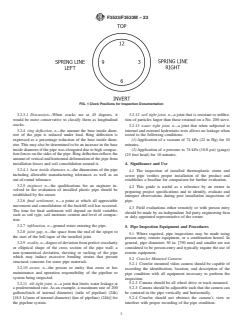
3.2.2 clock positions, n—the relative circumferential
F2881 Specification for 12 to 60 in. [300 to 1500 mm]
position, direction or location of an observation on the pipe
Polypropylene (PP) Dual Wall Pipe and Fittings for
interior is described using the analogy of a 12-hour clock. For
Non-Pressure Storm Sewer Applications
example, when looking downstream as shown in Fig. 1, 12
F2947 Specification for 150 to 1500 mm [6 to 60 in.]
o’clock is the pipe crown or top of pipe (the inside of the pipe
Annular Corrugated Profile-Wall Polyethylene (PE) Pipe
at this location is the obvert); 3 o’clock the spring line right; 6
and Fittings for Sanitary Sewer Applications
o’clock the bottom of the pipe (the inside of the pipe at this
F3080 Practice for Laser Technologies for Measurement of
location is the invert); and 9 o’clock the spring line left. The
Cross-Sectional Shape of Pipeline and Conduit by Non-
areas between the top of the pipe and spring line are referred to
Rotating Laser Projector, Infrared Measurement, and
as the shoulder with the area between the spring line and
CCTV Camera System
bottom of the pipe referred to as the haunch. The viewing
F3095 Practice for Laser Technologies for Direct Measure-
orientation (upstream or downstream) of the clock position
ment of Cross Sectional Shape of Pipeline and Conduit by
observations should be identified to establish the spring line
Rotating Laser Diodes and CCTV Camera System
positions. When two clock positions are utilized to characterize
F3123 Specification for Metric Outside Diameter Polyethyl-
the location or relative size of an anomaly within the pipe, the
ene (PE) Plastic Pipe (DR-PN)
clock positions should be entered clockwise (for example,
2.2 OSHA References:
circumferential crack begins at 10 o’clock and ends at 2
OSHA 29 CFR PART 1926 SUBPART AA
o’clock).
2.3 ISO Standards:
3.2.3 crack, n—
ISO/ISE 17025 General Requirements for the Competence
3.2.3.1 circumferential crack, n—a crack generally aligned
of Testing and Calibration Laboratories
with the circumference of the pipe and generally perpendicular
ISO 21138 Plastics piping systems for non-pressure under-
to the longitudinal axis of the pipe.
ground drainage and sewerage — Structured-wall piping
3.2.3.2 longitudinal crack, n—a crack aligned with the axis
of the pipe.
Available from Occupational Safety and Health Administration (OSHA), 200
Constitution Ave., NW, Washington, DC 20210, http://www.osha.gov.
4 5
Available from International Organization for Standardization (ISO), ISO Available from American Association of State Highway and Transportation
Central Secretariat, Chemin de Blandonnet 8, CP 401, 1214 Vernier, Geneva, Officials (AASHTO), 444 N. Capitol St., NW, Suite 249, Washington, DC 20001,
Switzerland, https://www.iso.org. http://www.transportation.org.
F3533/F3533M − 23
FIG. 1 Clock Positions for Inspection Documentation
3.2.3.1 Discussion—When cracks are at 45 degrees, it 3.2.12 soil tight joint, n—a joint that is resistant to infiltra-
would be more conservative to classify them as longitudinal tion of particles larger than those retained on a No. 200 sieve.
cracks.
3.2.13 water tight joint, n—a joint that when subjected to
3.2.4 ring deflection, n—the amount the base inside diam- internal and external hydrostatic tests allows no leakage when
eter of the pipe is reduced under load. Ring deflection is
tested to the following conditions:
expressed as a percentage reduction of the base inside diam- (1) Application of a vacuum of 74 kPa (22 in Hg) for 10
eter. This may also be determined to be an increase in the base
minutes.
inside diameter if the pipe was elongated due to high compac- (2) Application of a pressure to 74 kPa (10.8 psi) (gauge)
tion forces on the sides of the pipe. Ring deflection reflects the
(25 foot head) for 10 minutes.
amount of vertical and horizontal deformation of the pipe from
installation forces and soil consolidation around it.
4. Significance and Use
3.2.4.1 base inside diameter, n—the dimensions of the pipe
4.1 The inspection of installed thermoplastic storm and
including allowable manufacturing tolerances as well as an
sewer pipe verifies proper installation of the product and
out-of-round tolerance.
establishes a baseline for comparison for further evaluation.
3.2.5 engineer, n—the qualifications for an engineer in-
4.2 This guide is useful as a reference by an owner in
volved in the evaluation of installed plastic pipe should be
preparing project specifications and to identify, evaluate and
established by the owner.
interpret observations during post installation inspections of
3.2.6 final settlement, n—a point at which all appreciable pipe.
movement and consolidation of the backfill soil has occurred.
4.3 Field evaluations either remotely or with person entry
The time for final settlement will depend on field variables
should be made by an independent 3rd party engineering firm
such as soil type, soil moisture content and level of compac-
or duly appointed representative of the owner.
tion.
3.2.7 infiltration, n—ground water entering the pipe.
5. Pipe Inspection Equipment and Procedures
3.2.8 joint gap, n—the space from the end of the spigot to
5.1 Where required, pipe inspections may be made using
the start of the bell taper of the installed joint.
person-entry, remote equipment, or a combination hereof. In
3.2.9 ovality, n—degree of deviation from perfect circularity
general, pipe diameters 30 in. [750 mm] and smaller are not
or elliptical shape of the cross section of the pipe wall: a considered to be person-entry and typically require the use of
non-symmetrical deviation, skewing or racking of the pipe
remote equipment.
which may induce excessive bending strains that present
5.2 Crawler Mounted Camera:
structural concerns for some pipe materials.
5.2.1 Crawler mounted video camera should be capable of
3.2.10 owner, n—the person or entity that owns or has
recording the identification, location, and description of the
maintenance and operation responsibility of the pipeline or
pipe condition with all equipment necessary to perform the
system being inspected.
inspection.
5.2.2 Camera should be all wheel drive or track mounted.
3.2.11 silt tight joint, n—a joint that limits water leakage at
5.2.3 Camera should be adjustable such that the camera can
a predetermined rate. As an example, a maximum rate of 200
gallons/(inch of internal diameter) (mile of pipeline) (24h) be centered in the pipe vertically and horizontally.
[18.5 L/(mm of internal diameter) (km of pipeline) (24h)] for 5.2.4 Crawler should not obstruct the camera’s view or
the pipeline system. interfere with proper recording of the pipe condition.
F3533/F3533M − 23
5.2.5 Crawler speed is typically adjustable with an operat- estimated by taking measurements around the periphery of the
ing speed for recording to the requirements in Practice F3080 pipe. Additionally, any areas indicating localized ring deflec-
or Practice F3095.
tions should be properly documented with multiple measure-
5.2.6 The video equipment should be calibrated in accor- ments around the circumference of the pipe at, before and after
dance with the manufacturer’s recommendation within one the specific location in question.
year prior to the inspection date.
5.5.4 Cracks and joint gaps and/or vertical or horizontal
offsets may be measured with either a metal or fabric tape
5.3 Crawler Mounted Camera with Laser Profiler:
measure capable of measuring to the nearest 0.1 in. [3 mm].
5.3.1 Laser profiling to determine overall shape, deforma-
tion and ring deflection should be accomplished by Practice 5.5.5 Adequate lighting should be provided during the
person entry inspection. Headlamps and handheld flashlights
F3080 or Practice F3095.
are considered adequate, provided measurements and observa-
5.3.2 The video equipment should be calibrated in accor-
dance with the manufacturer’s recommendation within one tions can be properly recorded.
year prior to the inspection date.
6. Equipment and Operator Accuracy Verification
5.4 Mandrel:
5.4.1 Mandrels are used for post installation ring deflection
6.1 A verification process should be completed and docu-
testing to ensure the maximum allowable ring deflection is not
mented prior to the inspection to ensure the remote inspection
exceeded and are typically metal, have at least nine points
equipment is performing within specifications and all operators
evenly distributed around the circumference, and mandrel fin
are proficient in the setup, calibration process, and usage of
length long enough to prevent binding or toppling of the
equipment and are capable of making accurate and repeatable
mandrel while it is being pulled or pushed through the pipe.
measurements.
Mandrel should have enough cable, hose or rope to pul
...