

ASTM F894-24
(Specification)Standard Specification for Polyethylene (PE) Large Diameter Profile Wall Sewer and Drain Pipe
General Information
- Abstract
ABSTRACT
This specification covers requirements and test methods for materials, dimensions, workmanship, ring stiffness, flattening, joint systems, and a form of marking for polyethylene (PE) pipe of profile wall construction and with bell and spigot, heat fusion, extrusion welded or electrofusion joints for use in gravity flow applications, such as for sewers and drains. The PE profile wall pipe products cover six standard ring stiffness constant (RSC) classifications, namely 40, 63, 100, and 160, 250 and 400. These are referred to as RSC 40, RSC 63, RSC 100, RSC 160, RSC 250 and RSC 400. Referee testing, ring stiffness constant testing, flattening test, and joint tightness test shall be performed to meet the requirements prescribed.
SCOPE
1.1 This specification covers requirements and test methods for materials, dimensions, workmanship, ring stiffness, flattening, joint systems, and a form of marking for large diameter, 10 in. to 138 in. (250 mm to 3510 mm), inside diameter based polyethylene (PE) pipe of profile wall construction and with bell and spigot, heat fusion, extrusion welded or electrofusion joints for use in gravity flow applications, such as for sewers and drains.
Note 1: Pipe produced to this specification should be installed in accordance with Practice D2321 and with the manufacturer's recommendations.
1.2 The values stated in inch-pound units are to be regarded as standard. The values given in parentheses are mathematical conversions to SI units that are provided for information only and are not considered standard.
1.3 The following safety hazards caveat pertains only to the test method portion, Section 8, of this specification: This standard does not purport to address all of the safety concerns, if any, associated with its use. It is the responsibility of the user of this standard to establish appropriate safety, health, and environmental practices and determine the applicability of regulatory limitations prior to use.
1.4 This international standard was developed in accordance with internationally recognized principles on standardization established in the Decision on Principles for the Development of International Standards, Guides and Recommendations issued by the World Trade Organization Technical Barriers to Trade (TBT) Committee.
- Status
- Published
- Publication Date
- 14-Feb-2024
- Technical Committee
- F17 - Plastic Piping Systems
- Drafting Committee
- F17.26 - Olefin Based Pipe
Buy Documents
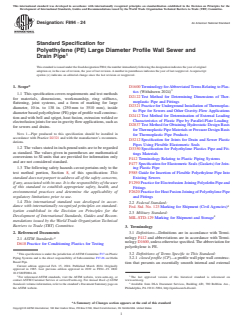
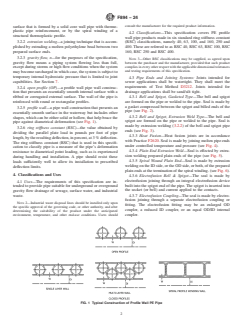
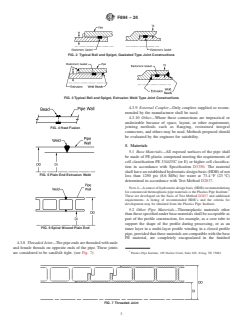
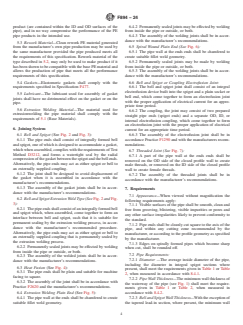
ASTM F894-24 - Standard Specification for Polyethylene (PE) Large Diameter Profile Wall Sewer and Drain Pipe
REDLINE ASTM F894-24 - Standard Specification for Polyethylene (PE) Large Diameter Profile Wall Sewer and Drain Pipe
Overview
ASTM F894-24: Standard Specification for Polyethylene (PE) Large Diameter Profile Wall Sewer and Drain Pipe is an internationally recognized standard developed by ASTM International. It sets forth comprehensive requirements for materials, dimensions, workmanship, ring stiffness, flattening, and joint systems, along with prescribed methods for pipe marking. This specification is intended for polyethylene (PE) pipe of profile wall construction with inside diameters ranging from 10 inches to 138 inches (250 mm to 3510 mm) and covers a variety of joint types including bell and spigot, heat fusion, extrusion welded, and electrofusion joints. The standard aims to ensure the suitability of PE profile wall pipes for gravity-flow applications, primarily used in sewers and drains.
Key Topics
Materials & Construction
- Polyethylene (PE) compounds must meet cell classification PE 334433C (or E) or higher.
- Use of compatible thermoplastic materials is permitted as part of the profile, provided performance is uncompromised.
- Rework material from the same manufacturer may be used under certain conditions.
Pipe Dimensions & Classifications
- Pipes are classified by six standard ring stiffness constants (RSC): RSC 40, 63, 100, 160, 250, and 400.
- Wall thickness, inside diameter, and bell dimensions must comply with prescribed tolerances.
Joint Systems
- Acceptable joints include:
- Bell and spigot (gasketed or welded)
- Heat fusion
- Electrofusion (bell & spigot or coupling)
- Threaded joints and external couplers
- Joints must meet watertight or sand/silt tight requirements depending on application.
- Acceptable joints include:
Testing & Quality Assurance
- Referee, ring stiffness, flattening, and joint tightness tests are required.
- Ring stiffness constant (RSC) is a key performance indicator for deformation resistance.
- Joint tightness is verified in accordance with referenced ASTM test methods.
Marking & Identification
- Each pipe must be clearly marked with the ASTM designation, nominal size, RSC classification, PE legend, manufacturer details, and production code.
Applications
PE large diameter profile wall pipe made to ASTM F894-24 is intended for:
- Underground and aboveground gravity flow sewer systems
- Municipal and industrial drainage applications
- Stormwater management infrastructure
- Industrial waste drainage (subject to suitability and regulatory approval)
These pipes are commonly specified for use in:
- Sanitary and storm sewer mains
- Culverts and outfalls
- Large-scale drainage networks
- Rehabilitation of existing pipelines
The standard’s requirements ensure that the pipe exhibits performance characteristics essential for long-term reliability, such as ring stiffness, joint integrity, and resistance to deformation.
Related Standards
ASTM F894-24 references several related standards that encompass installation, materials, and testing, including:
- ASTM D2321 – Installation of thermoplastic pipe for sewers and other gravity-flow applications
- ASTM D3212 – Joints for drain and sewer plastic pipes using flexible elastomeric seals
- ASTM D3350 – Polyethylene plastics pipe and fittings materials
- ASTM D2412 – External loading characteristics of plastic pipe by parallel-plate loading
- ASTM F2620 / F1290 – Joining processes such as heat fusion and electrofusion for PE pipe
- ASTM F477 – Elastomeric seals (gaskets) for plastic pipe joining
These standards work together to address the full lifecycle of PE profile wall piping, from manufacturing and testing through installation and in-service performance.
By adhering to ASTM F894-24, engineers, contractors, and municipalities can specify profile wall polyethylene sewer and drain pipes that meet stringent performance and quality requirements, ensuring dependable operation in diverse gravity flow applications.
Relations
- Effective Date
- 15-Feb-2024
- Effective Date
- 15-Feb-2024
- Effective Date
- 15-Feb-2024
Buy Documents
ASTM F894-24 - Standard Specification for Polyethylene (PE) Large Diameter Profile Wall Sewer and Drain Pipe
REDLINE ASTM F894-24 - Standard Specification for Polyethylene (PE) Large Diameter Profile Wall Sewer and Drain Pipe
Get Certified
Connect with accredited certification bodies for this standard

Institut za varilstvo d.o.o. (Welding Institute)
Slovenia's leading welding institute since 1952. ISO 3834, EN 1090, pressure equipment certification, NDT personnel, welder qualification. Only IIW Au
Sponsored listings
Frequently Asked Questions
ASTM F894-24 is a technical specification published by ASTM International. Its full title is "Standard Specification for Polyethylene (PE) Large Diameter Profile Wall Sewer and Drain Pipe". This standard covers: ABSTRACT This specification covers requirements and test methods for materials, dimensions, workmanship, ring stiffness, flattening, joint systems, and a form of marking for polyethylene (PE) pipe of profile wall construction and with bell and spigot, heat fusion, extrusion welded or electrofusion joints for use in gravity flow applications, such as for sewers and drains. The PE profile wall pipe products cover six standard ring stiffness constant (RSC) classifications, namely 40, 63, 100, and 160, 250 and 400. These are referred to as RSC 40, RSC 63, RSC 100, RSC 160, RSC 250 and RSC 400. Referee testing, ring stiffness constant testing, flattening test, and joint tightness test shall be performed to meet the requirements prescribed. SCOPE 1.1 This specification covers requirements and test methods for materials, dimensions, workmanship, ring stiffness, flattening, joint systems, and a form of marking for large diameter, 10 in. to 138 in. (250 mm to 3510 mm), inside diameter based polyethylene (PE) pipe of profile wall construction and with bell and spigot, heat fusion, extrusion welded or electrofusion joints for use in gravity flow applications, such as for sewers and drains. Note 1: Pipe produced to this specification should be installed in accordance with Practice D2321 and with the manufacturer's recommendations. 1.2 The values stated in inch-pound units are to be regarded as standard. The values given in parentheses are mathematical conversions to SI units that are provided for information only and are not considered standard. 1.3 The following safety hazards caveat pertains only to the test method portion, Section 8, of this specification: This standard does not purport to address all of the safety concerns, if any, associated with its use. It is the responsibility of the user of this standard to establish appropriate safety, health, and environmental practices and determine the applicability of regulatory limitations prior to use. 1.4 This international standard was developed in accordance with internationally recognized principles on standardization established in the Decision on Principles for the Development of International Standards, Guides and Recommendations issued by the World Trade Organization Technical Barriers to Trade (TBT) Committee.
ABSTRACT This specification covers requirements and test methods for materials, dimensions, workmanship, ring stiffness, flattening, joint systems, and a form of marking for polyethylene (PE) pipe of profile wall construction and with bell and spigot, heat fusion, extrusion welded or electrofusion joints for use in gravity flow applications, such as for sewers and drains. The PE profile wall pipe products cover six standard ring stiffness constant (RSC) classifications, namely 40, 63, 100, and 160, 250 and 400. These are referred to as RSC 40, RSC 63, RSC 100, RSC 160, RSC 250 and RSC 400. Referee testing, ring stiffness constant testing, flattening test, and joint tightness test shall be performed to meet the requirements prescribed. SCOPE 1.1 This specification covers requirements and test methods for materials, dimensions, workmanship, ring stiffness, flattening, joint systems, and a form of marking for large diameter, 10 in. to 138 in. (250 mm to 3510 mm), inside diameter based polyethylene (PE) pipe of profile wall construction and with bell and spigot, heat fusion, extrusion welded or electrofusion joints for use in gravity flow applications, such as for sewers and drains. Note 1: Pipe produced to this specification should be installed in accordance with Practice D2321 and with the manufacturer's recommendations. 1.2 The values stated in inch-pound units are to be regarded as standard. The values given in parentheses are mathematical conversions to SI units that are provided for information only and are not considered standard. 1.3 The following safety hazards caveat pertains only to the test method portion, Section 8, of this specification: This standard does not purport to address all of the safety concerns, if any, associated with its use. It is the responsibility of the user of this standard to establish appropriate safety, health, and environmental practices and determine the applicability of regulatory limitations prior to use. 1.4 This international standard was developed in accordance with internationally recognized principles on standardization established in the Decision on Principles for the Development of International Standards, Guides and Recommendations issued by the World Trade Organization Technical Barriers to Trade (TBT) Committee.
ASTM F894-24 is classified under the following ICS (International Classification for Standards) categories: 23.040.20 - Plastics pipes. The ICS classification helps identify the subject area and facilitates finding related standards.
ASTM F894-24 has the following relationships with other standards: It is inter standard links to ASTM F894-19, ASTM F3533/F3533M-23, ASTM F1759-97(2018). Understanding these relationships helps ensure you are using the most current and applicable version of the standard.
ASTM F894-24 is available in PDF format for immediate download after purchase. The document can be added to your cart and obtained through the secure checkout process. Digital delivery ensures instant access to the complete standard document.
Standards Content (Sample)
This international standard was developed in accordance with internationally recognized principles on standardization established in the Decision on Principles for the
Development of International Standards, Guides and Recommendations issued by the World Trade Organization Technical Barriers to Trade (TBT) Committee.
Designation: F894 − 24 An American National Standard
Standard Specification for
Polyethylene (PE) Large Diameter Profile Wall Sewer and
Drain Pipe
This standard is issued under the fixed designation F894; the number immediately following the designation indicates the year of original
adoption or, in the case of revision, the year of last revision. A number in parentheses indicates the year of last reapproval. A superscript
epsilon (´) indicates an editorial change since the last revision or reapproval.
1. Scope* D1600 Terminology for Abbreviated Terms Relating to Plas-
tics (Withdrawn 2024)
1.1 This specification covers requirements and test methods
D2122 Test Method for Determining Dimensions of Ther-
for materials, dimensions, workmanship, ring stiffness,
moplastic Pipe and Fittings
flattening, joint systems, and a form of marking for large
D2321 Practice for Underground Installation of Thermoplas-
diameter, 10 in. to 138 in. (250 mm to 3510 mm), inside
tic Pipe for Sewers and Other Gravity-Flow Applications
diameter based polyethylene (PE) pipe of profile wall construc-
D2412 Test Method for Determination of External Loading
tion and with bell and spigot, heat fusion, extrusion welded or
Characteristics of Plastic Pipe by Parallel-Plate Loading
electrofusion joints for use in gravity flow applications, such as
D2837 Test Method for Obtaining Hydrostatic Design Basis
for sewers and drains.
for Thermoplastic Pipe Materials or Pressure Design Basis
NOTE 1—Pipe produced to this specification should be installed in
for Thermoplastic Pipe Products
accordance with Practice D2321 and with the manufacturer’s recommen-
D3212 Specification for Joints for Drain and Sewer Plastic
dations.
Pipes Using Flexible Elastomeric Seals
1.2 The values stated in inch-pound units are to be regarded
D3350 Specification for Polyethylene Plastics Pipe and Fit-
as standard. The values given in parentheses are mathematical
tings Materials
conversions to SI units that are provided for information only
F412 Terminology Relating to Plastic Piping Systems
and are not considered standard.
F477 Specification for Elastomeric Seals (Gaskets) for Join-
1.3 The following safety hazards caveat pertains only to the ing Plastic Pipe
test method portion, Section 8, of this specification: This
F585 Guide for Insertion of Flexible Polyethylene Pipe Into
standard does not purport to address all of the safety concerns, Existing Sewers
if any, associated with its use. It is the responsibility of the user
F1290 Practice for Electrofusion Joining Polyolefin Pipe and
of this standard to establish appropriate safety, health, and
Fittings
environmental practices and determine the applicability of F2620 Practice for Heat Fusion Joining of Polyethylene Pipe
regulatory limitations prior to use.
and Fittings
1.4 This international standard was developed in accor-
2.2 Federal Standard:
dance with internationally recognized principles on standard-
Fed. Std. No. 123 Marking for Shipment (Civil Agencies)
ization established in the Decision on Principles for the
2.3 Military Standard:
Development of International Standards, Guides and Recom- 4
MIL-STD-129 Marking for Shipment and Storage
mendations issued by the World Trade Organization Technical
Barriers to Trade (TBT) Committee.
3. Terminology
2. Referenced Documents 3.1 Definitions—Definitions are in accordance with Termi-
2 nology F412 and abbreviations are in accordance with Termi-
2.1 ASTM Standards:
nology D1600, unless otherwise specified. The abbreviation for
D618 Practice for Conditioning Plastics for Testing
polyethylene is PE.
3.2 Definitions of Terms Specific to This Standard:
This specification is under the jurisdiction of ASTM Committee F17 on Plastic
Piping Systems and is the direct responsibility of Subcommittee F17.26 on Olefin
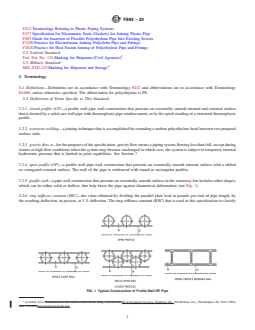
3.2.1 closed profile (CP)—a profile wall pipe wall construc-
Based Pipe.
tion that presents an essentially smooth internal and external
Current edition approved Feb. 15, 2024. Published March 2024. Originally
approved in 1985. Last previous edition approved in 2019 as F894 –19. DOI:
10.1520/F0894-24.
2 3
For referenced ASTM standards, visit the ASTM website, www.astm.org, or The last approved version of this historical standard is referenced on
contact ASTM Customer Service at service@astm.org. For Annual Book of ASTM www.astm.org.
Standards volume information, refer to the standard’s Document Summary page on Available from DLA Document Services, Building 4/D, 700 Robbins Ave.,
the ASTM website. Philadelphia, PA 19111-5094, http://quicksearch.dla.mil.
*A Summary of Changes section appears at the end of this standard
Copyright © ASTM International, 100 Barr Harbor Drive, PO Box C700, West Conshohocken, PA 19428-2959. United States
F894 − 24
consult the manufacturer for the required product information.
surface that is formed by a solid core wall pipe with thermo-
plastic pipe reinforcement, or by the spiral winding of a
4.2 Classifications—This specification covers PE profile
structural thermoplastic profile.
wall pipe products made in six standard ring stiffness constant
3.2.2 extrusion welding—a joining technique that is accom- (RSC) classifications, namely 40, 63, 100, and 160, 250 and
plished by extruding a molten polyethylene bead between two 400. These are referred to as RSC 40, RSC 63, RSC 100, RSC
prepared surface ends. 160, RSC 250 and RSC 400.
3.2.3 gravity flow, n—for the purposes of the specification,
NOTE 3—Other RSC classifications may be supplied, as agreed upon
gravity flow means a piping system flowing less than full,
between the purchaser and the manufacturer, provided that such product
complies in every other respect with the applicable dimensional tolerances
except during storms or high flow conditions when the system
and testing requirements of this specification.
may become surcharged in which case, the system is subject to
temporary internal hydrostatic pressure that is limited to joint
4.3 Pipe Ends and Joining Systems: Joints intended for
capabilities. See Section 7.
sewer applications shall be watertight. They shall meet the
requirements of Test Method D3212. Joints intended for
3.2.4 open profile (OP)—a profile wall pipe wall construc-
drainage applications shall be sand/silt tight.
tion that presents an essentially smooth internal surface with a
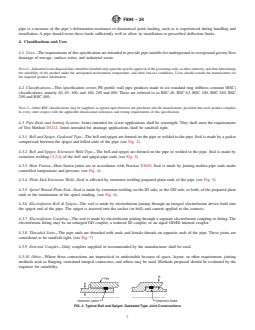
ribbed or corrugated external surface. The wall of the pipe is 4.3.1 Bell and Spigot, Gasketed Type—The bell and spigot
reinforced with round or rectangular profiles. are formed on the pipe or welded to the pipe. Seal is made by
a gasket compressed between the spigot and billed ends of the
3.2.5 profile wall—a pipe wall construction that presents an
pipe (see Fig. 2).
essentially smooth surface in the waterway but includes other
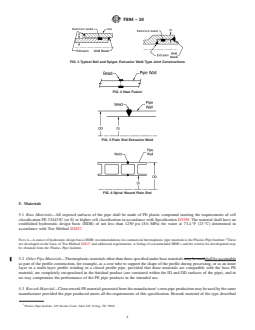
4.3.2 Bell and Spigot, Extrusion Weld Type—The bell and
shapes, which can be either solid or hollow, that help brace the
spigot are formed on the pipe or welded to the pipe. Seal is
pipe against diametrical deformation (see Fig. 1).
made by extrusion welding (3.2.2) of the bell and spigot pipe
3.2.6 ring stiffness constant (RSC)—the value obtained by
ends (see Fig. 3).
dividing the parallel plate load in pounds per foot of pipe
4.3.3 Heat Fusion—Heat fusion joints are in accordance
length, by the resulting deflection, in percent, at 3 % deflection.
with Practice F2620. Seal is made by joining molten pipe ends
The ring stiffness constant (RSC) that is used in this specifi-
under controlled temperature and pressure (see Fig. 4).
cation to classify pipe is a measure of the pipe’s deformation
4.3.4 Plain End Extrusion Weld—Seal is effected by extru-
resistance to diametrical point loading, such as is experienced
sion welding prepared plain ends of the pipe (see Fig. 5).
during handling and installation. A pipe should resist these
4.3.5 Spiral Wound Plain End—Seal is made by extrusion
loads sufficiently well to allow its installation to prescribed
welding on the ID side, or the OD side, or both, of the prepared
deflection limits.
plain ends at the termination of the spiral winding. (see Fig. 6).
4. Classifications and Uses
4.3.6 Electrofusion Bell & Spigot—The seal is made by
electrofusion joining through an integral electrofusion device
4.1 Uses—The requirements of this specification are in-
built into the spigot end of the pipe. The spigot is inserted into
tended to provide pipe suitable for underground or overground
the socket (or bell) and current applied to the contacts.
gravity flow drainage of sewage, surface water, and industrial
4.3.7 Electrofusion Coupling—The seal is made by electro-
waste.
fusion joining through a separate electrofusion coupling or
NOTE 2—Industrial waste disposal lines should be installed only upon
fitting. The electrofusion fitting may be an enlarged OD
the specific approval of the governing code, or other authority, and after
coupler, a reduced ID coupler, or an equal OD/ID internal
determining the suitability of the product under the anticipated
environment, temperature, and other end-use conditions. Users should coupler.
FIG. 1 Typical Construction of Profile Wall PE Pipe
F894 − 24
FIG. 2 Typical Bell and Spigot, Gasketed Type Joint Constructions
FIG. 3 Typical Bell and Spigot, Extrusion Weld Type Joint Constructions
4.3.9 External Coupler—Only couplers supplied or recom-
mended by the manufacturer shall be used.
4.3.10 Other—Where these connections are impractical or
undesirable because of space, layout, or other requirement,
joining methods such as flanging, restrained integral
FIG. 4 Heat Fusion
connectors, and others may be used. Methods proposed should
be evaluated by the engineer for suitability.
5. Materials
5.1 Base Materials—All exposed surfaces of the pipe shall
be made of PE plastic compound meeting the requirements of
cell classification PE 334433C (or E) or higher cell classifica-
tion in accordance with Specification D3350. The material
shall have an established hydrostatic design basis (HDB) of not
FIG. 5 Plain End Extrusion Weld
less than 1250 psi (8.6 MPa) for water at 73.4 °F (23 °C)
determined in accordance with Test Method D2837.
NOTE 4—A source of hydrostatic design basis (HDB) recommendations
for commercial thermoplastic pipe materials is the Plastics Pipe Institute.
These are developed on the basis of Test Method D2837 and additional
requirements. A listing of recommended HDB’s and the criteria for
development may be obtained from the Plastics Pipe Institute.
5.2 Other Pipe Materials—Thermoplastic materials other
than those specified under base materials shall be acceptable as
part of the profile construction, for example, as a core tube to
support the shape of the profile during processing, or as an
FIG. 6 Spiral Wound Plain End
inner layer in a multi-layer profile winding in a closed profile
pipe, provided that these materials are compatible with the base
PE material, are completely encapsulated in the finished
4.3.8 Threaded Joint—The pipe ends are threaded with male
and female threads on opposite ends of the pipe. These joints
are considered to be sand/silt tight. (see Fig. 7) Plastics Pipe Institute, 105 Decker Court, Suite 825, Irving, TX 75062
FIG. 7 Threaded Joint
F894 − 24
product (are contained within the ID and OD surfaces of the 6.4.2 Permanently sealed joints may be effected by welding
pipe), and in no way compromise the performance of the PE from inside the pipe or outside, or both.
pipe products in the intended use. 6.4.3 The assembly of the welding joints shall be in accor-
dance with the manufacturer’s recommendations.
5.3 Rework Material—Clean rework PE material generated
from the manufacturer’s own pipe production may be used by 6.5 Spiral Wound Plain End (See Fig. 6):
the same manufacturer provided the pipe produced meets all 6.5.1 The pipe wall at the ends ends shall be chamfered to
the requirements of this specification. Rework material of the create suitable fillet weld geometry.
type described in 5.2, may only be used to make product if it 6.5.2 Permanently sealed joints may be made by welding
has been shown to be compatible with the base PE material and from inside the pipe or outside, or both.
allows the production of pipe that meets all the performance 6.5.3 The assembly of the welding joints shall be in accor-
requirements of this specification. dance with the manufacturer’s recommendations.
5.4 Gaskets—Elastomeric gaskets shall comply with the 6.6 Bell and Spigot or Coupling Electrofusion Joint:
requirements specified in Specification F477. 6.6.1 The bell and spigot joint shall consist of an integral
electrofusion device built into the spigot and a plain socket or
5.5 Lubricant—The lubricant used for assembly of gasket
bell end, which come together to form an electrofusion joint
joints shall have no detrimental effect on the gasket or on the
with the proper application of electrical current for an appro-
pipe.
priate time period.
5.6 Extrusion Welding Material—The material used for
6.6.2 The coupling, the joint may consist of two prepared
extrusionwelding the pipe material shall comply with the
straight pipe ends (spigot ends) and a separate OD, ID, or
requirements of 5.1 (Base Materials).
internal electrofusion coupling, which come together to form
an electrofusion joint with the proper application of electrical
6. Joining System
current for an appropriate time period.
6.6.3 The assembly of the electrofusion joint shall be in
6.1 Bell and Spigot (See Fig. 2 and Fig. 3):
accordance Practice F1290 and with the manufacturers recom-
6.1.1 The pipe ends shall consist of integrally formed bell
mendations.
and spigot, one of which is designed to accommodate a gasket,
which when assembled, complies with the requirements of Test
6.7 Threaded Joint (See Fig. 7):
Method D3212, and forms a watertight seal by the radial
6.7.1 A part of the pipe wall at the ends ends shall be
compression of the gasket between the spigot and the bell ends.
removed on the OD side of the closed profile wall to create
Alternatively, the pipe ends may act as either spigot or bell to
male threads, or removed on the ID side of the closed profile
an externally supplied coupling.
wall to create female threads.
6.1.2 The joint shall be designed to avoid displacement of
6.7.2 The assembly of the threaded joints shall be in
the gasket when it is assembled in accordance with the
accordance with the manufacturer’s recommendations.
manufacturer’s recommendations.
6.1.3 The assembly of the gasket joints shall be in accor-
7. Requirements
dance with the manufacturer’s recommendations.
7.1 Appearance—When viewed without magnification the
6.2 Bell and Spigot Extrusion Weld Type (See Fig. 2 and Fig.
following requirements apply:
3):
7.1.1 Visible surfaces of the pipe shall be smooth, clean and
6.2.1 The pipe ends shall consist of an integrally formed bell
free from grooving, blistering, visible impurities or pores and
and spigot which, when assembled, come together to form an
any other surface irregularities likely to prevent conformity to
interface between bell and spigot, such that it is suitable for
the standard.
permanent sealing by the extrusion welding process, in accor-
7.1.2 Pipe ends shall be cleanly cut square to the axis of the
dance with the manufacturer’s recommended procedure.
pipe, and within any cutting zone recommended by the
Alternatively, the pipe ends may act as either spigot or bell to
manufacturer, or according to the profile geometry as specified
an externally supplied coupling that is permanently sealed by
by the manufacturer.
the extrusion welding process.
7.1.3 Edges on spirally formed pipes which become sharp
6.2.2 Permanently sealed joints may be effected by welding
when cut, shall be rounded off.
from inside the pipe or outside, or both.
7.2 Pipe Requirements:
6.2.3 The assembly of the welded joints shall be in accor-
7.2.1 Diameter —The average inside diameter of the pipe,
dance with the manufacturer’s recommendations.
including the diameter in integral spigot sections where
6.3 Heat Fusion (See Fig. 4):
present, shall meet the requirements given in Table 1 or Table
6.3.1 The pipe ends shall be plain and suitable for machine
2, when measured in accordance with 8.4.1.
facing to square.
7.2.2 Pipe Wall Thickness—The minimum wall thickness of
6.3.2 The assembly of the joint shall be in accordance with
the waterway of the pipe (see Fig. 1) shall meet the require-
Practice F2620 and the manufacturer’s recommendations.
ments given in Table 1 or Table 2, when measured in
6.4 Extrusion Welding Plain End (See Fig. 5): accordance with 8.4.2.
6.4.1 The pipe wall at the ends shall be chamfered to create 7.2.3 Bell and Spigot Wall Thickness—With the exception of
suitable fillet weld geometry. the tapered lead-in section, where present, the minimum wall
F894 − 24
TABLE 1 Open Profile Pipe Dimensions and Tolerances
Min Wall Thickness in Pipe Waterway, W
Tolerance on
Average Inside Min Bell
Nominal Nom., Dia. Average Inside
RSC 40, in. RSC 63, in. RSC 100, in. RSC 160
Diameter, in. Thickness, Tb,
Pipe Size Size Diameter, in.
(mm) (mm) (mm) and higher,
(mm) in. (mm)
(mm)
in. (mm)
18 460 18.00 (457.2) ±0.38 (9.7) 0.18 (4.6) 0.18 (4.6) 0.18 (4.6) 0.22 (5.6) 0.70 (17.8)
19.5 495 19.5 (495.3) ±0.38 (9.7) 0.18 (4.6) 0.18 (4.6) 0.18 (4.6) 0.24 (6.1) 0.70 (17.8)
21 530 21.00 (533.4) ±0.38 (9.7) 0.18 (4.6) 0.18 (4.6) 0.18 (4.6) 0.24 (6.1) 0.70 (17.8)
24 610 24.00 (609.6) ±0.38 (9.7) 0.18 (4.6) 0.18 (4.6) 0.22 (5.6) 0.24 (6.1) 0.70 (17.8)
27 690 27.00 (685.8) ±0.38 (9.7) 0.18 (4.6) 0.18 (4.6) 0.24 (6.1) 0.24 (6.1) 0.70 (17.8)
30 760 30.00 (762.0) ±0.38 (9.7) 0.18 (4.6) 0.22 (5.6) 0.24 (6.1) 0.26 (6.6) 0.70 (17.8)
33 840 33.00 (838.2) ±0.38 (9.7) 0.18 (4.6) 0.24 (6.1) 0.24 (6.1) 0.30 (7.6) 0.95 (24.1)
36 910 36.00 (914.4) ±0.38 (9.7) 0.18 (4.6) 0.24 (6.1) 0.26 (6.6) 0.30 (7.6) 1.05 (26.7)
42 1070 42.00 (1066.8) ±0.42 (10.7) 0.24 (6.1) 0.24 (6.10) 0.30 (7.6) 0.38 (9.7) 1.15 (29.2)
48 1220 48.00 (1219.2) ±0.48 (12.2) 0.24 (6.1) 0.26 (6.6) 0.30 (7.6) 0.38 (9.7) 1.25 (31.8)
54 1370 54.00 (1371.6) ±0.54 (13.7) 0.24 (6.1) 0.30 (7.6) 0.38 (9.7) 0.42 (10.7) 1.25 (31.8)
60 1520 60.00 (1524.0) ±0.60 (15.2) 0.26 (6.6) 0.30 (7.6) 0.38 (9.7) 0.52 (13.2) 1.30 (33.0)
66 1680 66.00 (1676.4) ±0.66 (16.8) 0.30 (7.6) 0.38 (9.7) 0.42 (10.7) 0.67 (17.0) 1.30 (33.0)
72 1830 72.00 (1828.8) ±0.72 (18.3) 0.30 (7.6) 0.38 (9.7) 0.42 (10.7) 0.90 (22.9) 1.30 (33.0)
78 1980 78.00 (1981.2) ±0.78 (19.8) 0.30 (7.6) 0.38 (9.7) 0.52 (13.2) 0.90 (22.9) 1.35 (34.3)
84 2130 84.00 (2133.6) ±0.84 (21.3) 0.38 (9.7) 0.42 (10.7) 0.67 (17.0) 0.90 (22.9) 1.35 (34.3)
90 2290 90.00 (2286.0) ±0.90 (22.9) 0.38 (9.7) 0.42 (10.7) 0.90 (22.9) 0.95 (24.1) 1.35 (34.3)
96 2440 96.00 (2438.4) ±0.96 (24.4) 0.38 (9.7) 0.52 (13.2) 0.90 (22.9) 0.95 (24.1) 1.35 (34.3)
108 2740 108.00 (2743.2) ±1.08 (27.4) 0.42 (10.7) 0.67 (17.0) 0.90 (22.9) 0.95 (24.1) 1.35 (34.3)
120 3050 120.00 (3048.0) ±1.20 (30.5) 0.52 (13.2) 0.67 (17.0) 0.90 (22.9) 0.95 (24.1) 1.35 (34.3)
132 3355 132.00 (3352.8) ±1.32 (33.5) 0.52 (13.2) 0.67 (17.0) 0.90 (22.9) 0.95 (24.1) 1.35 (34.3)
TABLE 2 Closed Profile Pipe Dimensions and Tolerances
Min Wall
Average Inside Tolerance on Min Bell
Nominal Thickness in Pipe
Nom. Dia. Size Diameter, Average Inside Diameter, Thickness, Tb,
Pipe Size Waterway, W, All RSC,
in. (mm) in. (mm) in. (mm)
in. (mm)
10 250 10.0 (254.0) ±0.38 (9.7) 0.18 (4.6) 0.5 (13)
12 300 12.0 (304.8) ±0.38 (9.7) 0.18 (4.6) 0.5 (13)
15 380 15.0 (381.0) ±0.38 (9.7) 0.18 (4.6) 0.5 (13)
18 460 18.0 (457.2) ±0.38 (9.7) 0.18 (4.6) 0.5 (13)
19.5 495 19.5 (495.3) ±0.38 (9.7) 0.18 (4.6) 0.5 (13)
21 530 21.0 (533.4) ±0.38 (9.7) 0.18 (4.6) 0.5 (13)
24 610 24.0 (609.6) ±0.38 (9.7) 0.18 (4.6) 0.5 (13)
27 690 27.0 (685.8) ±0.38 (9.7) 0.18 (4.6) 0.5 (13)
30 760 30.0 (762.0) ±0.38 (9.7) 0.18 (4.6) 0.5 (13)
33 840 33.0 (838.2) ±0.38 (9.7) 0.18 (4.6) 0.5 (13)
36 910 36.0 (914.4) ±0.38 (9.7) 0.18 (4.6) 0.5 (13)
40 1020 40.0 (1016.0) ±0.38 (9.75) 0.18 (4.6) 0.5 (13)
42 1070 42.0 (1066.8) ±0.42 (10.7) 0.18 (4.6) 0.5 (13)
48 1220 48.0 (1219.2) ±0.48 (12.2) 0.18 (4.6) 0.5 (13)
54 1370 54.0 (1371.6) ±0.54 (13.7) 0.18 (4.6) 0.5 (13)
60 1520 60.0 (1524.0) ±0.60 (15.2) 0.18 (4.6) 0.6 (15)
66 1680 66.0 (1676.4) ±0.66 (16.8) 0.18 (4.6) 0.6 (15)
72 1830 72.0 (1828.8) ±0.72 (18.3) 0.18 (4.6) 0.6 (15)
78 1980 78.0 (1981.2) ±0.78 (19.8) 0.18 (4.6) 0.6 (15)
84 2130 84.0 (2133.6) ±0.84 (21.3) 0.18 (4.6) 0.7 (18)
90 2290 90.0 (2286.0) ±0.90 (22.9) 0.18 (4.6) 0.7 (18)
96 2440 96.0 (2438.4) ±0.96 (24.9) 0.18 (4.6) 0.7 (18)
102 2590 102.0 (2590.8) ±1.02 (25.9) 0.18 (4.6) 0.7 (18)
108 2740 108.0 (2743.2) ±1.08 (27.4) 0.18 (4.6) 0.7 (18)
114 2900 114.0 (2895.6) ±1.14 (29.0) 0.18 (4.6) 0.8 (20)
120 3050 120.0 (3048.0) ±1.20 (30.5) 0.18 (4.6) 0.8 (20)
126 3200 126.0 (3200.4) ±1.26 (32.0) 0.18 (4.6) 0.8 (20)
132 3355 132.0 (3352.8) ±1.32 (33.5) 0.18 (4.6) 0.8 (20)
138 3510 138.0 (3505.2) ±1.38 (35.1) 0.18 (4.6) 0.8 (20)
thickness in the bell of the pipe (see Fig. 1) shall meet the 7.2.4 Laying Length—Standard pipe laying length, mea-
values specified in Table 1 or Table 2. The minimum wall sured from the bottom of the bell to the tip of the spigot (see
thickness of the thinnest section of the spigot shall not be less Fig. 1), shall be 20 ft (6.1 m) when measured in accordance
than that established for the pipe waterway. with Test Method D2122. Other laying lengths shall be as
F894 − 24
agreed upon between the purchaser and the manufacturer. The proper section, then spliced into circular form, and shall be
tolerance on the laying length shall be 62 in. (50 mm). For made of a properly cured high grade elastomeric compound.
pipe with an integral bell, the pipe laying length is measured 7.6.2 The basic polymer shall be natural rubber, synthetic
from the bottom of the bell to the tip of the spigot. elastomer, or a blend of both.
7.6.3 The gasket shall be designed with an adequate com-
7.3 Ring Stiffness Constant—Ring stiffness constant (RSC)
pressive force, so as to effect a positive seal under all
for the pipe between bell and spigot sections shall comply with
combinations of joint tolerances.
the minimum values given in Table 3, when tested in accor-
dance with 8.5.1 or with the corresponding values established
8. Test Methods
by statistical correlation, developed by the manufacturer and
agreed by the purchaser, when measured in accordance with 8.1 Conditioning:
8.5.2. However, in cases of disagreement the pipe shall comply
8.1.1 Referee Testing—When conditioning is required for
with the values in Table 3, when tested in accordance with referee tests, condition the specimens in accordance with
8.5.1. Where an integral bell is present, the RSC for the pipe is
Procedure A of Methods D618 at 73 °F (23 °C) without regard
determined between bell and spigot sections. to relative humidity for not less than 40 h prior to test. Conduct
tests under the same conditions of temperature and humidity,
7.4 Flattening—There shall be no evidence of splitting,
unless otherwise specified.
cracking, or breaking when pipe, including the bell or spigot
8.1.2 Quality Control Testing—Unless otherwise specified,
section, is tested in accordance with 8.6.
condition specimens for a minimum of 4 h prior to test in air
7.
...
This document is not an ASTM standard and is intended only to provide the user of an ASTM standard an indication of what changes have been made to the previous version. Because
it may not be technically possible to adequately depict all changes accurately, ASTM recommends that users consult prior editions as appropriate. In all cases only the current version
of the standard as published by ASTM is to be considered the official document.
Designation: F894 − 19 F894 − 24 An American National Standard
Standard Specification for
Polyethylene (PE) Large Diameter Profile Wall Sewer and
Drain Pipe
This standard is issued under the fixed designation F894; the number immediately following the designation indicates the year of original
adoption or, in the case of revision, the year of last revision. A number in parentheses indicates the year of last reapproval. A superscript
epsilon (´) indicates an editorial change since the last revision or reapproval.
1. Scope*
1.1 This specification covers requirements and test methods for materials, dimensions, workmanship, ring stiffness, flattening,
joint systems, and a form of marking for large diameter, 10 to 132 in. (250 to 335510 in. to 138 in. (250 mm to 3510 mm), inside
diameter based polyethylene (PE) pipe of profile wall construction and with bell and spigot, heat fusion, extrusion welded or
elctrofusionelectrofusion joints for use in gravity flow applications, such as for sewers and drains.
NOTE 1—Pipe produced to this specification should be installed in accordance with Practice D2321 and with the manufacturer’s recommendations.
1.2 The values stated in inch-pound units are to be regarded as standard. The values given in parentheses are mathematical
conversions to SI units that are provided for information only and are not considered standard.
1.3 The following safety hazards caveat pertains only to the test method portion, Section 8, of this specification: This standard
does not purport to address all of the safety concerns, if any, associated with its use. It is the responsibility of the user of this
standard to establish appropriate safety, health, and environmental practices and determine the applicability of regulatory
limitations prior to use.
1.4 This international standard was developed in accordance with internationally recognized principles on standardization
established in the Decision on Principles for the Development of International Standards, Guides and Recommendations issued
by the World Trade Organization Technical Barriers to Trade (TBT) Committee.
2. Referenced Documents
2.1 ASTM Standards:
D618 Practice for Conditioning Plastics for Testing
D1600 Terminology for Abbreviated Terms Relating to Plastics (Withdrawn 2024)
D2122 Test Method for Determining Dimensions of Thermoplastic Pipe and Fittings
D2321 Practice for Underground Installation of Thermoplastic Pipe for Sewers and Other Gravity-Flow Applications
D2412 Test Method for Determination of External Loading Characteristics of Plastic Pipe by Parallel-Plate Loading
D2837 Test Method for Obtaining Hydrostatic Design Basis for Thermoplastic Pipe Materials or Pressure Design Basis for
Thermoplastic Pipe Products
D3212 Specification for Joints for Drain and Sewer Plastic Pipes Using Flexible Elastomeric Seals
D3350 Specification for Polyethylene Plastics Pipe and Fittings Materials
This specification is under the jurisdiction of ASTM Committee F17 on Plastic Piping Systems and is the direct responsibility of Subcommittee F17.26 on Olefin Based
Pipe.
Current edition approved Feb. 1, 2019Feb. 15, 2024. Published March 2019March 2024. Originally approved in 1985. Last previous edition approved in 20132019 as
F894 –13. DOI: 10.1520/F0894-19. –19. DOI: 10.1520/F0894-24.
For referenced ASTM standards, visit the ASTM website, www.astm.org, or contact ASTM Customer Service at service@astm.org. For Annual Book of ASTM Standards
volume information, refer to the standard’s Document Summary page on the ASTM website.
The last approved version of this historical standard is referenced on www.astm.org.
*A Summary of Changes section appears at the end of this standard
Copyright © ASTM International, 100 Barr Harbor Drive, PO Box C700, West Conshohocken, PA 19428-2959. United States
F894 − 24
F412 Terminology Relating to Plastic Piping Systems
F477 Specification for Elastomeric Seals (Gaskets) for Joining Plastic Pipe
F585 Guide for Insertion of Flexible Polyethylene Pipe Into Existing Sewers
F1290 Practice for Electrofusion Joining Polyolefin Pipe and Fittings
F2620 Practice for Heat Fusion Joining of Polyethylene Pipe and Fittings
2.2 Federal Standard:
Fed. Std. No. 123 Marking for Shipment (Civil Agencies)
2.3 Military Standard:
MIL-STD-129 Marking for Shipment and Storage
3. Terminology
3.1 Definitions—Definitions are in accordance with Terminology F412 and abbreviations are in accordance with Terminology
D1600, unless otherwise specified. The abbreviation for polyethylene is PE.
3.2 Definitions of Terms Specific to This Standard:
3.2.1 closed profile (CP)—a profile wall pipe wall construction that presents an essentially smooth internal and external surface
that is formed by a solid core wall pipe with thermoplastic pipe reinforcement, or by the spiral winding of a structural thermoplastic
profile.
3.2.2 extrusion welding—a joining technique that is accomplished by extruding a molten polyethylene bead between two prepared
surface ends.
3.2.3 gravity flow, n—for the purposes of the specification, gravity flow means a piping system flowing less than full, except during
storms or high flow conditions when the system may become surcharged in which case, the system is subject to temporary internal
hydrostatic pressure that is limited to joint capabilities. See Section 7.
3.2.4 open profile (OP)—a profile wall pipe wall construction that presents an essentially smooth internal surface with a ribbed
or corrugated external surface. The wall of the pipe is reinforced with round or rectangular profiles.
3.2.5 profile wall—a pipe wall construction that presents an essentially smooth surface in the waterway but includes other shapes,
which can be either solid or hollow, that help brace the pipe against diametrical deformation (see Fig. 1).
3.2.6 ring stiffness constant (RSC)—the value obtained by dividing the parallel plate load in pounds per foot of pipe length, by
the resulting deflection, in percent, at 3 % deflection. The ring stiffness constant (RSC) that is used in this specification to classify
FIG. 1 Typical Construction of Profile Wall PE Pipe
Available from Standardization Documents Order Desk, Bldg. 4 Section D, DLA Document Services, Building 4/D, 700 Robbins Ave., Philadelphia, PA 19111-5094,
Attn: NPODS.http://quicksearch.dla.mil.
F894 − 24
pipe is a measure of the pipe’s deformation resistance to diametrical point loading, such as is experienced during handling and
installation. A pipe should resist these loads sufficiently well to allow its installation to prescribed deflection limits.
4. Classifications and Uses
4.1 Uses—The requirements of this specification are intended to provide pipe suitable for underground or overground gravity flow
drainage of sewage, surface water, and industrial waste.
NOTE 2—Industrial waste disposal lines should be installed only upon the specific approval of the governing code, or other authority, and after determining
the suitability of the product under the anticipated environment, temperature, and other end-use conditions. Users should consult the manufacturer for
the required product information.
4.2 Classifications—This specification covers PE profile wall pipe products made in six standard ring stiffness constant (RSC)
classifications, namely 40, 63, 100, and 160, 250 and 400. These are referred to as RSC 40, RSC 63, RSC 100, RSC 160, RSC
250 and RSC 400.
NOTE 3—Other RSC classifications may be supplied, as agreed upon between the purchaser and the manufacturer, provided that such product complies
in every other respect with the applicable dimensional tolerances and testing requirements of this specification.
4.3 Pipe Ends and Joining Systems: Joints intended for sewer applications shall be watertight. They shall meet the requirements
of Test Method D3212. Joints intended for drainage applications shall be sand/silt tight.
4.3.1 Bell and Spigot, Gasketed Type—The bell and spigot are formed on the pipe or welded to the pipe. Seal is made by a gasket
compressed between the spigot and billed ends of the pipe (see Fig. 2).
4.3.2 Bell and Spigot, Extrusion Weld Type—The bell and spigot are formed on the pipe or welded to the pipe. Seal is made by
extrusion welding (3.2.2) of the bell and spigot pipe ends (see Fig. 3).
4.3.3 Heat Fusion—Heat fusion joints are in accordance with Practice F2620. Seal is made by joining molten pipe ends under
controlled temperature and pressure (see Fig. 4).
4.3.4 Plain End Extrusion Weld—Seal is effected by extrusion welding prepared plain ends of the pipe (see Fig. 5).
4.3.5 Spiral Wound Plain End—Seal is made by extrusion welding on the ID side, or the OD side, or both, of the prepared plain
ends at the termination of the spiral winding. (see Fig. 6).
4.3.6 Electrofusion Bell & Spigot—The seal is made by electrofusion joining through an integral electrofusion device built into
the spigot end of the pipe. The spigot is inserted into the socket (or bell) and current applied to the contacts.
4.3.7 Electrofusion Coupling—The seal is made by electrofusion joining through a separate electrofusion coupling or fitting. The
electrofusion fitting may be an enlarged OD coupler, a reduced ID coupler, or an equal OD/ID internal coupler.
4.3.8 Threaded Joint—The pipe ends are threaded with male and female threads on opposite ends of the pipe. These joints are
considered to be sand/silt tight. (see Fig. 7)
4.3.9 External Coupler—Only couplers supplied or recommended by the manufacturer shall be used.
4.3.10 Other—Where these connections are impractical or undesirable because of space, layout, or other requirement, joining
methods such as flanging, restrained integral connectors, and others may be used. Methods proposed should be evaluated by the
engineer for suitability.
FIG. 2 Typical Bell and Spigot, Gasketed Type Joint Constructions
F894 − 24
FIG. 3 Typical Bell and Spigot, Extrusion Weld Type Joint Constructions
FIG. 4 Heat Fusion
FIG. 5 Plain End Extrusion Weld
FIG. 6 Spiral Wound Plain End
5. Materials
5.1 Base Materials—All exposed surfaces of the pipe shall be made of PE plastic compound meeting the requirements of cell
classification PE 334433C (or E) or higher cell classification in accordance with Specification D3350. The material shall have an
established hydrostatic design basis (HDB) of not less than 1250 psi (8.6 MPa) for water at 73.4 °F (23 °C) determined in
accordance with Test Method D2837.
NOTE 4—A source of hydrostatic design basis (HDB) recommendations for commercial thermoplastic pipe materials is the Plastics Pipe Institute. These
are developed on the basis of Test Method D2837 and additional requirements. A listing of recommended HDB’s and the criteria for development may
be obtained from the Plastics Pipe Institute.
5.2 Other Pipe Materials—Thermoplastic materials other than those specified under base materials may be usedshall be acceptable
as part of the profile construction, for example, as a core tube to support the shape of the profile during processing, or as an inner
layer in a multi-layer profile winding in a closed profile pipe, provided that these materials are compatible with the base PE
material, are completely encapsulated in the finished product (are contained within the ID and OD surfaces of the pipe), and in
no way compromise the performance of the PE pipe products in the intended use.
5.3 Rework Material—Clean rework PE material generated from the manufacturer’s own pipe production may be used by the same
manufacturer provided the pipe produced meets all the requirements of this specification. Rework material of the type described
Plastics Pipe Institute, 105 Decker Court, Suite 825, Irving, TX 75062
F894 − 24
FIG. 7 Threaded Joint
in 5.2, may only be used to make product if it has been shown to be compatible with the base PE material and allows the production
of pipe that meets all the performance requirements of this specification.
5.4 Gaskets—Elastomeric gaskets shall comply with the requirements specified in Specification F477.
5.5 Lubricant—The lubricant used for assembly of gasket joints shall have no detrimental effect on the gasket or on the pipe.
5.6 Extrusion Welding Material—The material used for extrusionwelding the pipe material shall meet comply with the
requirements established forof 5.1 the base material. (Base Materials).
6. Joining System
6.1 Bell and Spigot (See Fig. 2 and Fig. 3):
6.1.1 The pipe ends shall consist of integrally formed bell and spigot, one of which is designed to accommodate a gasket, which
when assembled, complies with the requirements of Test Method D3212, and forms a watertight seal by the radial compression
of the gasket between the spigot and the bell ends. Alternatively, the pipe ends may act as either spigot or bell to an externally
supplied coupling.
6.1.2 The joint shall be designed to avoid displacement of the gasket when it is assembled in accordance with the manufacturer’s
recommendations.
6.1.3 The assembly of the gasket joints shall be in accordance with the manufacturer’s recommendations.
6.2 Bell and Spigot Extrusion Weld Type (See Fig. 2 and Fig. 3):
6.2.1 The pipe ends shall consist of an integrally formed bell and spigot which, when assembled, come together to form an
interface between bell and spigot, such that it is suitable for permanent sealing by the extrusion welding process, in accordance
with the manufacturer’s recommended procedure. Alternatively, the pipe ends may act as either spigot or bell to an externally
supplied coupling that is permanently sealed by the extrusion welding process.
6.2.2 Permanently sealed joints may be effected by welding from inside the pipe or outside, or both.
6.2.3 The assembly of the welded joints shall be in accordance with the manufacturer’s recommendations.
Fig. 4):
6.3 Heat Fusion (See
6.3.1 The pipe ends shall be plain and suitable for machine facing to square.
6.3.2 The assembly of the joint shall be in accordance with Practice F2620 and the manufacturer’s recommendations.
6.4 Extrusion Welding Plain End (See Fig. 5):
6.4.1 The pipe wall at the ends shall be chamfered to create suitable fillet weld geometry.
6.4.2 Permanently sealed joints may be effected by welding from inside the pipe or outside, or both.
F894 − 24
6.4.3 The assembly of the welding joints shall be in accordance with the manufacturer’s recommendations.
6.5 Spiral Wound Plain End (See Fig. 6):
6.5.1 The pipe wall at the ends ends shall be chamfered to create suitable fillet weld geometry.
6.5.2 Permanently sealed joints may be made by welding from inside the pipe or outside, or both.
6.5.3 The assembly of the welding joints shall be in accordance with the manufacturer’s recommendations.
6.6 Bell and Spigot or Coupling Electrofusion Joint:
6.6.1 The bell and spigot joint shall consist of an integral electrofusion device built into the spigot and a plain socket or bell end,
which come together to form an electrofusion joint with the proper application of electrical current for an appropriate time period.
6.6.2 The coupling, the joint may consist of two prepared straight pipe ends (spigot ends) and a separate OD, ID, or internal
electrofusion coupling, which come together to form an electrofusion joint with the proper application of electrical current for an
appropriate time period.
6.6.3 The assembly of the electrofusion joint shall be in accordance Practice F1290 and with the manufacturers recommendations.
6.7 Threaded Joint (See Fig. 7):
6.7.1 A part of the pipe wall at the ends ends shall be removed on the OD side of the closed profile wall to create male threads,
or removed on the ID side of the closed profile wall to create female threads.
6.7.2 The assembly of the threaded joints shall be in accordance with the manufacturer’s recommendations.
7. Requirements
7.1 Appearance—When viewed without magnification the following requirements apply:
7.1.1 Visible surfaces of the pipe shall be smooth, clean and free from grooving, blistering, visible impurities or pores and any
other surface irregularities likely to prevent conformity to the standard.
7.1.2 Pipe ends shall be cleanly cut square to the axis of the pipe, and within any cutting zone recommended by the manufacturer,
or according to the profile geometry as specified by the manufacturer.
7.1.3 Edges on spirally formed pipes which become sharp when cut, shall be rounded off.
7.2 Pipe Requirements:
7.2.1 Diameter —The average inside diameter of the pipe, including the diameter in integral spigot sections where present, shall
meet the requirements given in Table 1 or Table 2, when measured in accordance with 8.4.1.
7.2.2 Pipe Wall Thickness—The minimum wall thickness of the waterway of the pipe (see Fig. 1) shall meet the requirements
given in Table 1 or Table 2, when measured in accordance with 8.4.2.
7.2.3 Bell and Spigot Wall Thickness—With the exception of the tapered lead-in section, where present, the minimum wall
thickness in the bell of the pipe (see Fig. 1) shall meet the values specified in Table 1 or Table 2. The minimum wall thickness
of the thinnest section of the spigot shall not be less than that established for the pipe waterway.
7.2.4 Laying Length—Standard pipe laying length, measured from the bottom of the bell to the tip of the spigot (see Fig. 1), shall
be 20 ft (6.1 m) when measured in accordance with Test Method D2122. Other laying lengths shall be as agreed upon between
the purchaser and the manufacturer. The tolerance on the laying length shall be 62 in. (50 mm). For pipe with an integral bell,
the pipe laying length is measured from the bottom of the bell to the tip of the spigot.
F894 − 24
TABLE 1 Open Profile Pipe Dimensions and Tolerances
Min Wall Thickness in Pipe Waterway, W
Average Tolerance on
Nominal Min Bell
Inside Average Inside
RSC 40, in. RSC 63, in. RSC 100, in. RSC 160
Pipe Size, Thickness, Tb,
Diameter, in. Diameter, in.
(mm) (mm) (mm) and higher,
in. (mm) in. (mm)
(mm) (mm)
in. (mm)
18 (460) 18.00 (457.2) ±0.38 (9.7) 0.18 (4.6) 0.18 (4.6) 0.18 (4.6) 0.22 (5.6) 0.70 (17.8)
19.5 (495) 19.5 (495.3) ±0.38 (9.7) 0.18 (4.6) 0.18 (4.6) 0.18 (4.6) 0.24 (6.1) 0.70 (17.8)
21 (530) 21.00 (533.4) ±0.38 (9.7) 0.18 (4.6) 0.18 (4.6) 0.18 (4.6) 0.24 (6.1) 0.70 (17.8)
24 (610) 24.00 (609.6) ±0.38 (9.7) 0.18 (4.6) 0.18 (4.6) 0.22 (5.6) 0.24 (6.1) 0.70 (17.8)
27 (690) 27.00 (685.8) ±0.38 (9.7) 0.18 (4.6) 0.18 (4.6) 0.24 (6.1) 0.24 (6.1) 0.70 (17.8)
30 (760) 30.00 (762.0) ±0.38 (9.7) 0.18 (4.6) 0.22 (5.6) 0.24 (6.1) 0.26 (6.6) 0.70 (17.8)
33 (840) 33.00 (838.2) ±0.38 (9.7) 0.18 (4.6) 0.24 (6.1) 0.24 (6.1) 0.30 (7.6) 0.95 (24.1)
36 (910) 36.00 (914.4) ±0.38 (9.7) 0.18 (4.6) 0.24 (6.1) 0.26 (6.6) 0.30 (7.6) 1.05 (26.7)
42 (1070) 42.00 ±0.42 (10.7) 0.24 (6.1) 0.24 (6.10) 0.30 (7.6) 0.38 (9.7) 1.15 (29.2)
(1066.8)
48 (1220) 48.00 ±0.48 (12.2) 0.24 (6.1) 0.26 (6.6) 0.30 (7.6) 0.38 (9.7) 1.25 (31.8)
(1219.2)
54 (1370) 54.00 ±0.54 (13.7) 0.24 (6.1) 0.30 (7.6) 0.38 (9.7) 0.42 (10.7) 1.25 (31.8)
(1371.6)
60 (1520) 60.00 ±0.60 (15.2) 0.26 (6.6) 0.30 (7.6) 0.38 (9.7) 0.52 (13.2) 1.30 (33.0)
(1524.0)
66 (1680) 66.00 ±0.66 (16.8) 0.30 (7.6) 0.38 (9.7) 0.42 (10.7) 0.67 (17.0) 1.30 (33.0)
(1676.4)
72 (1830) 72.00 ±0.72 (18.3) 0.30 (7.6) 0.38 (9.7) 0.42 (10.7) 0.90 (22.9) 1.30 (33.0)
(1828.8)
78 (1980) 78.00 ±0.78 (19.8) 0.30 (7.6) 0.38 (9.7) 0.52 (13.2) 0.90 (22.9) 1.35 (34.3)
(1981.2)
84 (2130) 84.00 ±0.84 (21.3) 0.38 (9.7) 0.42 (10.7) 0.67 (17.0) 0.90 (22.9) 1.35 (34.3)
(2133.6)
90 (2290) 90.00 ±0.90 (22.9) 0.38 (9.7) 0.42 (10.7) 0.90 (22.9) 0.95 (24.1) 1.35 (34.3)
(2286.0)
96 (2440) 96.00 ±0.96 (24.4) 0.38 (9.7) 0.52 (13.2) 0.90 (22.9) 0.95 (24.1) 1.35 (34.3)
(2438.4)
108 (2740) 108.00 ±1.08 (27.4) 0.42 (10.7) 0.67 (17.0) 0.90 (22.9) 0.95 (24.1) 1.35 (34.3)
(2743.2)
120 (3050) 120.00 ±1.20 (30.5) 0.52 (13.2) 0.67 (17.0) 0.90 (22.9) 0.95 (24.1) 1.35 (34.3)
(3048.0)
132 (3355) 132.00 ±1.32 (33.5) 0.52 (13.2) 0.67 (17.0) 0.90 (22.9) 0.95 (24.1) 1.35 (34.3)
(3352.8)
TABLE 1 Open Profile Pipe Dimensions and Tolerances
Min Wall Thickness in Pipe Waterway, W
Tolerance on
Average Inside Min Bell
Nominal Nom., Dia. Average Inside
RSC 40, in. RSC 63, in. RSC 100, in. RSC 160
Diameter, in. Thickness, Tb,
Pipe Size Size Diameter, in.
(mm) (mm) (mm) and higher,
(mm) in. (mm)
(mm)
in. (mm)
18 460 18.00 (457.2) ±0.38 (9.7) 0.18 (4.6) 0.18 (4.6) 0.18 (4.6) 0.22 (5.6) 0.70 (17.8)
19.5 495 19.5 (495.3) ±0.38 (9.7) 0.18 (4.6) 0.18 (4.6) 0.18 (4.6) 0.24 (6.1) 0.70 (17.8)
21 530 21.00 (533.4) ±0.38 (9.7) 0.18 (4.6) 0.18 (4.6) 0.18 (4.6) 0.24 (6.1) 0.70 (17.8)
24 610 24.00 (609.6) ±0.38 (9.7) 0.18 (4.6) 0.18 (4.6) 0.22 (5.6) 0.24 (6.1) 0.70 (17.8)
27 690 27.00 (685.8) ±0.38 (9.7) 0.18 (4.6) 0.18 (4.6) 0.24 (6.1) 0.24 (6.1) 0.70 (17.8)
30 760 30.00 (762.0) ±0.38 (9.7) 0.18 (4.6) 0.22 (5.6) 0.24 (6.1) 0.26 (6.6) 0.70 (17.8)
33 840 33.00 (838.2) ±0.38 (9.7) 0.18 (4.6) 0.24 (6.1) 0.24 (6.1) 0.30 (7.6) 0.95 (24.1)
36 910 36.00 (914.4) ±0.38 (9.7) 0.18 (4.6) 0.24 (6.1) 0.26 (6.6) 0.30 (7.6) 1.05 (26.7)
42 1070 42.00 (1066.8) ±0.42 (10.7) 0.24 (6.1) 0.24 (6.10) 0.30 (7.6) 0.38 (9.7) 1.15 (29.2)
48 1220 48.00 (1219.2) ±0.48 (12.2) 0.24 (6.1) 0.26 (6.6) 0.30 (7.6) 0.38 (9.7) 1.25 (31.8)
54 1370 54.00 (1371.6) ±0.54 (13.7) 0.24 (6.1) 0.30 (7.6) 0.38 (9.7) 0.42 (10.7) 1.25 (31.8)
60 1520 60.00 (1524.0) ±0.60 (15.2) 0.26 (6.6) 0.30 (7.6) 0.38 (9.7) 0.52 (13.2) 1.30 (33.0)
66 1680 66.00 (1676.4) ±0.66 (16.8) 0.30 (7.6) 0.38 (9.7) 0.42 (10.7) 0.67 (17.0) 1.30 (33.0)
72 1830 72.00 (1828.8) ±0.72 (18.3) 0.30 (7.6) 0.38 (9.7) 0.42 (10.7) 0.90 (22.9) 1.30 (33.0)
78 1980 78.00 (1981.2) ±0.78 (19.8) 0.30 (7.6) 0.38 (9.7) 0.52 (13.2) 0.90 (22.9) 1.35 (34.3)
84 2130 84.00 (2133.6) ±0.84 (21.3) 0.38 (9.7) 0.42 (10.7) 0.67 (17.0) 0.90 (22.9) 1.35 (34.3)
90 2290 90.00 (2286.0) ±0.90 (22.9) 0.38 (9.7) 0.42 (10.7) 0.90 (22.9) 0.95 (24.1) 1.35 (34.3)
96 2440 96.00 (2438.4) ±0.96 (24.4) 0.38 (9.7) 0.52 (13.2) 0.90 (22.9) 0.95 (24.1) 1.35 (34.3)
108 2740 108.00 (2743.2) ±1.08 (27.4) 0.42 (10.7) 0.67 (17.0) 0.90 (22.9) 0.95 (24.1) 1.35 (34.3)
120 3050 120.00 (3048.0) ±1.20 (30.5) 0.52 (13.2) 0.67 (17.0) 0.90 (22.9) 0.95 (24.1) 1.35 (34.3)
132 3355 132.00 (3352.8) ±1.32 (33.5) 0.52 (13.2) 0.67 (17.0) 0.90 (22.9) 0.95 (24.1) 1.35 (34.3)
7.3 Ring Stiffness Constant—Ring stiffness constant (RSC) for the pipe between bell and spigot sections shall comply with the
minimum values given in Table 3, when tested in accordance with 8.5.1 or with the corresponding values established by statistical
correlation, developed by the manufacturer and agreed by the purchaser, when measured in accordance with 8.5.2. However, in
F894 − 24
TABLE 2 Closed Profile Pipe Dimensions and Tolerances
Min Wall
Nominal Average Inside Tolerance on Min Bell
Thickness in Pipe
Pipe Size, Diameter, Average Inside Diameter, Thickness, Tb,
Waterway, W, All RSC,
in. (mm) in. (mm) in. (mm) in. (mm)
in. (mm)
10 (250) 10.0 (254.0) ±0.38 (9.7) 0.18 (4.6) 0.5 (13)
12 (300) 12.0 (304.8) ±0.38 (9.7) 0.18 (4.6) 0.5 (13)
15 (380) 15.0 (381.0) ±0.38 (9.7) 0.18 (4.6) 0.5 (13)
18 (460) 18.0 (457.2) ±0.38 (9.7) 0.18 (4.6) 0.5 (13)
19.5 (495) 19.5 (495.3) ±0.38 (9.7) 0.18 (4.6) 0.5 (13)
21 (530) 21.0 (533.4) ±0.38 (9.7) 0.18 (4.6) 0.5 (13)
24 (610) 24.0 (609.6) ±0.38 (9.7) 0.18 (4.6) 0.5 (13)
27 (690) 27.0 (685.8) ±0.38 (9.7) 0.18 (4.6) 0.5 (13)
30 (760) 30.0 (762.0) ±0.38 (9.7) 0.18 (4.6) 0.5 (13)
33 (840) 33.0 (838.2) ±0.38 (9.7) 0.18 (4.6) 0.5 (13)
36 (910) 36.0 (914.4) ±0.38 (9.7) 0.18 (4.6) 0.5 (13)
40 (1020) 40.0 (1016.0) ±0.38 (9.75) 0.18 (4.6) 0.5 (13)
42 (1070) 42.0 (1066.8) ±0.42 (10.7) 0.18 (4.6) 0.5 (13)
48 (1220) 48.0 (1219.2) ±0.48 (12.2) 0.18 (4.6) 0.5 (13)
54 (1370) 54.0 (1371.6) ±0.54 (13.7) 0.18 (4.6) 0.5 (13)
60 (1520) 60.0 (1524.0) ±0.60 (15.2) 0.18 (4.6) 0.6 (15)
66 (1680) 66.0 (1676.4) ±0.66 (16.8) 0.18 (4.6) 0.6 (15)
72 (1830) 72.0 (1828.8) ±0.72 (18.3) 0.18 (4.6) 0.6 (15)
78 (1980) 78.0 (1981.2) ±0.78 (19.8) 0.18 (4.6) 0.6 (15)
84 (2130) 84.0 (2133.6) ±0.84 (21.3) 0.18 (4.6) 0.7 (18)
90 (2290) 90.0 (2286.0) ±0.90 (22.9) 0.18 (4.6) 0.7 (18)
96 (2440) 96.0 (2438.4) ±0.96 (24.9) 0.18 (4.6) 0.7 (18)
102 (2590) 102.0 (2590.8) ±1.02 (25.9) 0.18 (4.6) 0.7 (18)
108 (2740) 108.0 (2743.2) ±1.08 (27.4) 0.18 (4.6) 0.7 (18)
114 (2900) 114.0 (2895.6) ±1.14 (29.0) 0.18 (4.6) 0.8 (20)
120 (3050) 120.0 (3048.0) ±1.20 (30.5) 0.18 (4.6) 0.8 (20)
126 (3200) 126.0 (3200.4) ±1.26 (32.0) 0.18 (4.6) 0.8 (20)
132 (3355) 132.0 (3352.8) ±1.32 (33.5) 0.18 (4.6) 0.8 (20)
138 (3510) 138.0 (3505.2) ±1.38 (35.1) 0.18 (4.6) 0.8 (20)
TABLE 2 Closed Profile Pipe Dimensions and Tolerances
Min Wall
Average Inside Tolerance on Min Bell
Nominal Thickness in Pipe
Nom. Dia. Size Diameter, Average Inside Diameter, Thickness, Tb,
Pipe Size Waterway, W, All RSC,
in. (mm) in. (mm) in. (mm)
in. (mm)
10 250 10.0 (254.0) ±0.38 (9.7) 0.18 (4.6) 0.5 (13)
12 300 12.0 (304.8) ±0.38 (9.7) 0.18 (4.6) 0.5 (13)
15 380 15.0 (381.0) ±0.38 (9.7) 0.18 (4.6) 0.5 (13)
18 460 18.0 (457.2) ±0.38 (9.7) 0.18 (4.6) 0.5 (13)
19.5 495 19.5 (495.3) ±0.38 (9.7) 0.18 (4.6) 0.5 (13)
21 530 21.0 (533.4) ±0.38 (9.7) 0.18 (4.6) 0.5 (13)
24 610 24.0 (609.6) ±0.38 (9.7) 0.18 (4.6) 0.5 (13)
27 690 27.0 (685.8) ±0.38 (9.7) 0.18 (4.6) 0.5 (13)
30 760 30.0 (762.0) ±0.38 (9.7) 0.18 (4.6) 0.5 (13)
33 840 33.0 (838.2) ±0.38 (9.7) 0.18 (4.6) 0.5 (13)
36 910 36.0 (914.4) ±0.38 (9.7) 0.18 (4.6) 0.5 (13)
40 1020 40.0 (1016.0) ±0.38 (9.75) 0.18 (4.6) 0.5 (13)
42 1070 42.0 (1066.8) ±0.42 (10.7) 0.18 (4.6) 0.5 (13)
48 1220 48.0 (1219.2) ±0.48 (12.2) 0.18 (4.6) 0.5 (13)
54 1370 54.0 (1371.6) ±0.54 (13.7) 0.18 (4.6) 0.5 (13)
60 1520 60.0 (1524.0) ±0.60 (15.2) 0.18 (4.6) 0.6 (15)
66 1680 66.0 (1676.4) ±0.66 (16.8) 0.18 (4.6) 0.6 (15)
72 1830 72.0 (1828.8) ±0.72 (18.3) 0.18 (4.6) 0.6 (15)
78 1980 78.0 (1981.2) ±0.78 (19.8) 0.18 (4.6) 0.6 (15)
84 2130 84.0 (2133.6) ±0.84 (21.3) 0.18 (4.6) 0.7 (18)
90 2290 90.0 (2286.0) ±0.90 (22.9) 0.18 (4.6) 0.7 (18)
96 2440 96.0 (2438.4) ±0.96 (24.9) 0.18 (4.6) 0.7 (18)
102 2590 102.0 (2590.8) ±1.02 (25.9) 0.18 (4.6) 0.7 (18)
108 2740 108.0 (2743.2) ±1.08 (27.4) 0.18 (4.6) 0.7 (18)
114 2900 114.0 (2895.6) ±1.14 (29.0) 0.18 (4.6) 0.8 (20)
120 3050 120.0 (3048.0) ±1.20 (30.5) 0.18 (4.6) 0.8 (20)
126 3200 126.0 (3200.4) ±1.26 (32.0) 0.18 (4.6) 0.8 (20)
132 3355 132.0 (3352.8) ±1.32 (33.5) 0.18 (4.6) 0.8 (20)
138 3510 138.0 (3505.2) ±1.38 (35.1) 0.18 (4.6) 0.8 (20)
cases of disagreement the pipe shall comply with the values in Table 3, when tested in accordance with 8.5.1. Where an integral
bell is present, the RSC for the pipe is determined between bell and spigot sections.
F894 − 24
TABLE 3 Minimum Ring Stiffness Constant (RSC) Values
Nominal Pipe Classificat
...