

ASTM F1759-97(2018)
(Practice)Standard Practice for Design of High-Density Polyethylene (HDPE) Manholes for Subsurface Applications
General Information
- Abstract
SIGNIFICANCE AND USE
4.1 Uses—The requirements of this practice are intended to provide manholes suitable for installation in pipeline or conduit trenches, landfill perimeters, and landfills with limited settlement characteristics. Direct installation in sanitary landfills or other fills subject to large (in excess of 10 %) soil settlements may require special designs outside the scope of this practice.
4.1.1 Manholes are assumed to be subject to gravity flow only.
4.2 Design Assumption—The design methodology in this practice applies only to manholes that are installed in backfill consisting of Class I, Class II, or Class III material as defined in Practice D2321, which has been compacted to a minimum of 90 % standard proctor density. The designs are based on the backfill extending at least 3.5 ft (1 m) from the perimeter of the manhole for the full height of the manhole and extending laterally to undisturbed in situ soil. Manholes are assumed placed on a stable base consisting of at least 12 in. (30.5 cm) of Class I material compacted to at least 95 % standard proctor density or a concrete slab. The foundation soils under the base must provide adequate bearing strength to carry downdrag loads.
4.2.1 Manholes installed in sanitary landfills or other fills experiencing large settlements may require special designs beyond the scope of this practice. The designer should evaluate each specific site to determine the suitability for use of HDPE manholes and the designer should prepare a written specification for installation, which is beyond the scope of this practice.
SCOPE
1.1 This practice covers general and basic procedures related to the design of manholes and components manufactured from high-density polyethylene (HDPE) for use in subsurface applications and applies to personnel access structures. The practice covers the material, the structural design requirements of the manhole barrel (also called vertical riser or shaft), floor (bottom), and top, and joints between shaft sections.
1.2 This practice offers the minimum requirements for the proper design of an HDPE manhole. Due to the variability in manhole height, diameter, and the soil, each manhole must be designed and detailed individually. When properly used and implemented, this practice can help ensure a safe and reliable structure for the industry.
1.3 Disclaimer—The reader is cautioned that independent professional judgment must be exercised when data or recommendations set forth in this practice are applied. The publication of the material contained herein is not intended as a representation or warranty on the part of ASTM that this information is suitable for general or particular use, or freedom from infringement of any patent or patents. Anyone making use of this information assumes all liability arising from such use. The design of structures is within the scope of expertise of a licensed architect, structural engineer, or other licensed professional for the application of principles to a particular structure.
1.4 The values stated in inch-pound units are to be regarded as the standard. The SI units given in parentheses are provided for information only.
1.5 This standard does not purport to address all of the safety concerns, if any, associated with its use. It is the responsibility of the user of this standard to establish appropriate safety, health, and environmental practices and determine the applicability of regulatory limitations prior to use.
1.6 This international standard was developed in accordance with internationally recognized principles on standardization established in the Decision on Principles for the Development of International Standards, Guides and Recommendations issued by the World Trade Organization Technical Barriers to Trade (TBT) Committee.
- Status
- Published
- Publication Date
- 31-Jan-2018
- Technical Committee
- F17 - Plastic Piping Systems
- Drafting Committee
- F17.26 - Olefin Based Pipe
Overview
ASTM F1759-97(2018) is the internationally recognized standard practice for the design of high-density polyethylene (HDPE) manholes for subsurface applications. Developed by ASTM International, this practice outlines essential requirements and methodologies for designing HDPE manholes intended for underground installations such as pipelines, conduit trenches, landfill perimeters, and locations with controlled soil settlement. The standard ensures that HDPE manholes serve as reliable personnel access structures, providing practical guidance on material selection and structural design to meet long-term performance needs in diverse civil engineering projects.
Key Topics
- Scope and Applicability: Covers the general and basic procedures for the design of HDPE manholes, including specifications for the barrel (vertical riser or shaft), floor (bottom), top, and connector joints.
- Material Requirements: Specifies that HDPE manhole components must meet certain material classifications in accordance with ASTM standards (e.g., Specification D3350).
- Design Assumptions: Outlines the conditions assumed in the design, such as gravity-flow systems, suitable site conditions with controlled subsidence, and installation in compacted backfill with verified density.
- Performance Limits: Addresses how to manage radial and axial loads, resistance to ground movement (downdrag), groundwater effects, and buckling prevention.
- Installation Considerations: Notes the importance of proper site evaluation, suitable backfill material, and the need for professional engineering judgment for specific scenarios.
- Safety and Compliance: Emphasizes that designers and installers must consider site-specific safety, health, and environmental requirements beyond the minimum standards provided.
Applications
ASTM F1759-97(2018) is a critical resource for engineers, designers, and contractors involved in:
- Municipal Infrastructure: Used in sewerage and stormwater management systems where durable, corrosion-resistant manholes are necessary for long-term maintenance access.
- Landfill Construction: Applied in landfill perimeters or other areas with limited soil settlement, offering a lightweight yet strong alternative to traditional concrete manholes.
- Pipeline Trench Projects: Suitable for installation in pipeline or conduit trenches, providing accessible points for inspection, cleaning, and system upgrades.
- Areas with Controlled Settlement: Ideal for subsurface installations where soil settlements do not exceed the standard’s limitations, promoting integrity and longevity of the access structure.
- Environments Requiring Chemical Resistance: HDPE’s resistance to chemicals and groundwater promotes reliable usage in harsh environments.
Note: Installations in areas subject to significant soil settlement (over 10%) or dynamic loading conditions may require alternative designs or site-specific engineering solutions outside this standard's scope.
Related Standards
To ensure comprehensive adherence to best practices, ASTM F1759-97(2018) references and should be used in conjunction with several key ASTM standards:
- ASTM D2321: Practice for Underground Installation of Thermoplastic Pipe for Sewers and Other Gravity-Flow Applications
- ASTM D3350: Specification for Polyethylene Plastics Pipe and Fittings Materials
- ASTM D3212: Specification for Joints for Drain and Sewer Plastic Pipes Using Flexible Elastomeric Seals
- ASTM D1600: Terminology for Abbreviated Terms Relating to Plastics
- ASTM F477: Specification for Elastomeric Seals for Joining Plastic Pipe
- ASTM F894: Specification for Polyethylene (PE) Large Diameter Profile Wall Sewer and Drain Pipe
These referenced documents provide further guidance on terminology, material properties, joining techniques, and installation practices that support the safe, efficient, and sustainable use of HDPE manholes in modern infrastructure.
Keywords: ASTM F1759, HDPE manholes, subsurface applications, manhole design, pipeline trench, landfill perimeter, gravity flow, plastic piping systems, structural requirements, civil infrastructure standards
Relations
- Effective Date
- 01-Feb-2018
- Effective Date
- 15-Feb-2024
- Effective Date
- 01-Feb-2024
- Effective Date
- 01-Apr-2020
- Effective Date
- 15-Mar-2020
- Effective Date
- 01-Feb-2019
- Effective Date
- 01-Jan-2019
- Effective Date
- 01-Mar-2018
- Refers
ASTM D1600-18 - Standard Terminology for Abbreviated Terms Relating to Plastics (Withdrawn 2024) - Effective Date
- 01-Jan-2018
- Effective Date
- 01-Aug-2017
- Effective Date
- 01-Feb-2017
- Effective Date
- 15-Nov-2016
- Effective Date
- 01-Aug-2016
- Effective Date
- 01-Jun-2015
- Effective Date
- 01-Aug-2014
Get Certified
Connect with accredited certification bodies for this standard

DIN CERTCO
DIN Group product certification.

Smithers Quality Assessments
US management systems and product certification.
Sponsored listings
Frequently Asked Questions
ASTM F1759-97(2018) is a standard published by ASTM International. Its full title is "Standard Practice for Design of High-Density Polyethylene (HDPE) Manholes for Subsurface Applications". This standard covers: SIGNIFICANCE AND USE 4.1 Uses—The requirements of this practice are intended to provide manholes suitable for installation in pipeline or conduit trenches, landfill perimeters, and landfills with limited settlement characteristics. Direct installation in sanitary landfills or other fills subject to large (in excess of 10 %) soil settlements may require special designs outside the scope of this practice. 4.1.1 Manholes are assumed to be subject to gravity flow only. 4.2 Design Assumption—The design methodology in this practice applies only to manholes that are installed in backfill consisting of Class I, Class II, or Class III material as defined in Practice D2321, which has been compacted to a minimum of 90 % standard proctor density. The designs are based on the backfill extending at least 3.5 ft (1 m) from the perimeter of the manhole for the full height of the manhole and extending laterally to undisturbed in situ soil. Manholes are assumed placed on a stable base consisting of at least 12 in. (30.5 cm) of Class I material compacted to at least 95 % standard proctor density or a concrete slab. The foundation soils under the base must provide adequate bearing strength to carry downdrag loads. 4.2.1 Manholes installed in sanitary landfills or other fills experiencing large settlements may require special designs beyond the scope of this practice. The designer should evaluate each specific site to determine the suitability for use of HDPE manholes and the designer should prepare a written specification for installation, which is beyond the scope of this practice. SCOPE 1.1 This practice covers general and basic procedures related to the design of manholes and components manufactured from high-density polyethylene (HDPE) for use in subsurface applications and applies to personnel access structures. The practice covers the material, the structural design requirements of the manhole barrel (also called vertical riser or shaft), floor (bottom), and top, and joints between shaft sections. 1.2 This practice offers the minimum requirements for the proper design of an HDPE manhole. Due to the variability in manhole height, diameter, and the soil, each manhole must be designed and detailed individually. When properly used and implemented, this practice can help ensure a safe and reliable structure for the industry. 1.3 Disclaimer—The reader is cautioned that independent professional judgment must be exercised when data or recommendations set forth in this practice are applied. The publication of the material contained herein is not intended as a representation or warranty on the part of ASTM that this information is suitable for general or particular use, or freedom from infringement of any patent or patents. Anyone making use of this information assumes all liability arising from such use. The design of structures is within the scope of expertise of a licensed architect, structural engineer, or other licensed professional for the application of principles to a particular structure. 1.4 The values stated in inch-pound units are to be regarded as the standard. The SI units given in parentheses are provided for information only. 1.5 This standard does not purport to address all of the safety concerns, if any, associated with its use. It is the responsibility of the user of this standard to establish appropriate safety, health, and environmental practices and determine the applicability of regulatory limitations prior to use. 1.6 This international standard was developed in accordance with internationally recognized principles on standardization established in the Decision on Principles for the Development of International Standards, Guides and Recommendations issued by the World Trade Organization Technical Barriers to Trade (TBT) Committee.
SIGNIFICANCE AND USE 4.1 Uses—The requirements of this practice are intended to provide manholes suitable for installation in pipeline or conduit trenches, landfill perimeters, and landfills with limited settlement characteristics. Direct installation in sanitary landfills or other fills subject to large (in excess of 10 %) soil settlements may require special designs outside the scope of this practice. 4.1.1 Manholes are assumed to be subject to gravity flow only. 4.2 Design Assumption—The design methodology in this practice applies only to manholes that are installed in backfill consisting of Class I, Class II, or Class III material as defined in Practice D2321, which has been compacted to a minimum of 90 % standard proctor density. The designs are based on the backfill extending at least 3.5 ft (1 m) from the perimeter of the manhole for the full height of the manhole and extending laterally to undisturbed in situ soil. Manholes are assumed placed on a stable base consisting of at least 12 in. (30.5 cm) of Class I material compacted to at least 95 % standard proctor density or a concrete slab. The foundation soils under the base must provide adequate bearing strength to carry downdrag loads. 4.2.1 Manholes installed in sanitary landfills or other fills experiencing large settlements may require special designs beyond the scope of this practice. The designer should evaluate each specific site to determine the suitability for use of HDPE manholes and the designer should prepare a written specification for installation, which is beyond the scope of this practice. SCOPE 1.1 This practice covers general and basic procedures related to the design of manholes and components manufactured from high-density polyethylene (HDPE) for use in subsurface applications and applies to personnel access structures. The practice covers the material, the structural design requirements of the manhole barrel (also called vertical riser or shaft), floor (bottom), and top, and joints between shaft sections. 1.2 This practice offers the minimum requirements for the proper design of an HDPE manhole. Due to the variability in manhole height, diameter, and the soil, each manhole must be designed and detailed individually. When properly used and implemented, this practice can help ensure a safe and reliable structure for the industry. 1.3 Disclaimer—The reader is cautioned that independent professional judgment must be exercised when data or recommendations set forth in this practice are applied. The publication of the material contained herein is not intended as a representation or warranty on the part of ASTM that this information is suitable for general or particular use, or freedom from infringement of any patent or patents. Anyone making use of this information assumes all liability arising from such use. The design of structures is within the scope of expertise of a licensed architect, structural engineer, or other licensed professional for the application of principles to a particular structure. 1.4 The values stated in inch-pound units are to be regarded as the standard. The SI units given in parentheses are provided for information only. 1.5 This standard does not purport to address all of the safety concerns, if any, associated with its use. It is the responsibility of the user of this standard to establish appropriate safety, health, and environmental practices and determine the applicability of regulatory limitations prior to use. 1.6 This international standard was developed in accordance with internationally recognized principles on standardization established in the Decision on Principles for the Development of International Standards, Guides and Recommendations issued by the World Trade Organization Technical Barriers to Trade (TBT) Committee.
ASTM F1759-97(2018) is classified under the following ICS (International Classification for Standards) categories: 83.080.20 - Thermoplastic materials. The ICS classification helps identify the subject area and facilitates finding related standards.
ASTM F1759-97(2018) has the following relationships with other standards: It is inter standard links to ASTM F1759-97(2010), ASTM F894-24, ASTM F714-24, ASTM F412-20, ASTM D2321-20, ASTM F894-19, ASTM F412-19, ASTM D2321-18, ASTM D1600-18, ASTM F412-17a, ASTM F412-17, ASTM F412-16a, ASTM F412-16, ASTM F412-15, ASTM D3035-14a. Understanding these relationships helps ensure you are using the most current and applicable version of the standard.
ASTM F1759-97(2018) is available in PDF format for immediate download after purchase. The document can be added to your cart and obtained through the secure checkout process. Digital delivery ensures instant access to the complete standard document.
Standards Content (Sample)
This international standard was developed in accordance with internationally recognized principles on standardization established in the Decision on Principles for the
Development of International Standards, Guides and Recommendations issued by the World Trade Organization Technical Barriers to Trade (TBT) Committee.
Designation: F1759 − 97 (Reapproved 2018) An American National Standard
Standard Practice for
Design of High-Density Polyethylene (HDPE) Manholes for
Subsurface Applications
This standard is issued under the fixed designation F1759; the number immediately following the designation indicates the year of
original adoption or, in the case of revision, the year of last revision. A number in parentheses indicates the year of last reapproval. A
superscript epsilon (´) indicates an editorial change since the last revision or reapproval.
1. Scope ization established in the Decision on Principles for the
Development of International Standards, Guides and Recom-
1.1 This practice covers general and basic procedures re-
mendations issued by the World Trade Organization Technical
lated to the design of manholes and components manufactured
Barriers to Trade (TBT) Committee.
from high-density polyethylene (HDPE) for use in subsurface
applications and applies to personnel access structures. The
2. Referenced Documents
practice covers the material, the structural design requirements
2.1 ASTM Standards:
of the manhole barrel (also called vertical riser or shaft), floor
D653 Terminology Relating to Soil, Rock, and Contained
(bottom), and top, and joints between shaft sections.
Fluids
1.2 This practice offers the minimum requirements for the
D1600 Terminology forAbbreviatedTerms Relating to Plas-
proper design of an HDPE manhole. Due to the variability in
tics
manhole height, diameter, and the soil, each manhole must be
D2321 PracticeforUndergroundInstallationofThermoplas-
designed and detailed individually. When properly used and
tic Pipe for Sewers and Other Gravity-Flow Applications
implemented, this practice can help ensure a safe and reliable
D2657 Practice for Heat Fusion Joining of Polyolefin Pipe
structure for the industry.
and Fittings
1.3 Disclaimer—The reader is cautioned that independent D2837 Test Method for Obtaining Hydrostatic Design Basis
professional judgment must be exercised when data or recom-
forThermoplasticPipeMaterialsorPressureDesignBasis
mendations set forth in this practice are applied. The publica- for Thermoplastic Pipe Products
tion of the material contained herein is not intended as a
D3035 SpecificationforPolyethylene(PE)PlasticPipe(DR-
representation or warranty on the part of ASTM that this PR) Based on Controlled Outside Diameter
information is suitable for general or particular use, or freedom
D3212 Specification for Joints for Drain and Sewer Plastic
frominfringementofanypatentorpatents.Anyonemakinguse
Pipes Using Flexible Elastomeric Seals
of this information assumes all liability arising from such use. D3350 Specification for Polyethylene Plastics Pipe and Fit-
The design of structures is within the scope of expertise of a
tings Materials
licensed architect, structural engineer, or other licensed profes- F412 Terminology Relating to Plastic Piping Systems
sional for the application of principles to a particular structure.
F477 Specification for Elastomeric Seals (Gaskets) for Join-
ing Plastic Pipe
1.4 The values stated in inch-pound units are to be regarded
F714 Specification for Polyethylene (PE) Plastic Pipe (DR-
as the standard. The SI units given in parentheses are provided
PR) Based on Outside Diameter
for information only.
F894 Specification for Polyethylene (PE) Large Diameter
1.5 This standard does not purport to address all of the
Profile Wall Sewer and Drain Pipe
safety concerns, if any, associated with its use. It is the
responsibility of the user of this standard to establish appro-
3. Terminology
priate safety, health, and environmental practices and deter-
3.1 Definitions:
mine the applicability of regulatory limitations prior to use.
3.1.1 Definitionsusedinthispracticeareinaccordancewith
1.6 This international standard was developed in accor-
Terminology F412 and Terminology D1600 unless otherwise
dance with internationally recognized principles on standard-
indicated.
3.2 Definitions of Terms Specific to This Standard:
This practice is under the jurisdiction of ASTM Committee F17 on Plastic
Piping Systems and is the direct responsibility of Subcommittee F17.26 on Olefin
Based Pipe. For referenced ASTM standards, visit the ASTM website, www.astm.org, or
Current edition approved Feb. 1, 2018. Published March 2018. Originally contact ASTM Customer Service at service@astm.org. For Annual Book of ASTM
approved in 1997. Last previous edition approved in 2010 as F1759 – 97 (2010). Standards volume information, refer to the standard’s Document Summary page on
DOI: 10.1520/F1759-97R18. the ASTM website.
Copyright © ASTM International, 100 Barr Harbor Drive, PO Box C700, West Conshohocken, PA 19428-2959. United States
F1759 − 97 (2018)
3.2.1 anchor connection ring—an HDPE ring attached to
the manhole riser on which to place an antiflotation device,
such as a concrete anchor ring.
3.2.2 arching—mobilization of internal shear resistance
within a soil mass that results in a change in soil pressure
acting on an underground structure.
3.2.3 benching—the internal floor of a manhole when it is
elevated above the manhole invert, usually provided as a place
for personnel to stand.
3.2.4 closed profile—a manhole barrel construction that
presents an essentially smooth internal surface braced with
projections or ribs, which are joined by an essentially smooth
outer wall. Solid wall construction is considered a special case
of the closed profile.
3.2.5 downdrag—downward shear force acting on the
shaft’s external surface and resulting from settlement of the
manhole backfill.
3.2.6 extrusion welding—a joining technique that is accom-
plished by extruding a molten polyethylene bead between two
prepared surface ends.
3.2.7 floor—the lowest internal surface of the manhole. The
floor and bottom are often the same.
3.2.8 inlet/outlet—pipe (conduit) passing through the wall
of the manhole.
FIG. 1 Manhole Terminology
3.2.9 invert—the flow channel in the floor of a manhole.
This may consist of the lower half of a pipe, thus the name
“invert”.
4.2 Design Assumption—The design methodology in this
3.2.10 manhole—an underground service access structure,
practice applies only to manholes that are installed in backfill
which can access pipelines, conduits, or subsurface equipment.
consisting of Class I, Class II, or Class III material as defined
3.2.11 manhole bottom—the lowest external surface of the inPracticeD2321,whichhasbeencompactedtoaminimumof
manhole. 90 % standard proctor density. The designs are based on the
backfillextendingatleast3.5ft(1m)fromtheperimeterofthe
3.2.12 manhole cone—the top portion of the manhole
manhole for the full height of the manhole and extending
through which entrance to the manhole is made and where the
laterally to undisturbed in situ soil. Manholes are assumed
diameter may increase from the entrance way to the larger
placed on a stable base consisting of at least 12 in. (30.5 cm)
manhole barrel. Sometimes referred to as the manway reducer.
of Class I material compacted to at least 95 % standard proctor
3.2.13 open profile—a manhole barrel construction that
density or a concrete slab. The foundation soils under the base
presents an essentially smooth internal surface with a ribbed or
must provide adequate bearing strength to carry downdrag
corrugated external surface. Open profile barrel constructions
loads.
are normally not used for manholes.
4.2.1 Manholes installed in sanitary landfills or other fills
3.2.14 performance limits—mechanisms by which the func-
experiencing large settlements may require special designs
tion of a structure may become impaired.
beyondthescopeofthispractice.Thedesignershouldevaluate
each specific site to determine the suitability for use of HDPE
3.2.15 riser—the vertical barrel or “shaft” section of a
manholes and the designer should prepare a written specifica-
manhole.
tion for installation, which is beyond the scope of this practice.
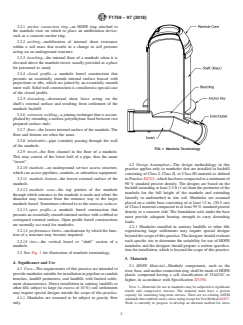
3.3 See Fig. 1 for illustration of manhole terminology.
5. Materials
4. Significance and Use
5.1 HDPE Material—Manhole components, such as the
4.1 Uses—The requirements of this practice are intended to
riser,base,andanchorconnectionring,shallbemadeofHDPE
providemanholessuitableforinstallationinpipelineorconduit
plastic compound having a cell classification of 334433C or
trenches, landfill perimeters, and landfills with limited settle-
higher, in accordance with Specification D3350.
ment characteristics. Direct installation in sanitary landfills or
NOTE 1—Materials for use in manholes may be subjected to significant
other fills subject to large (in excess of 10 %) soil settlements
tensile and compressive stresses. The material must have a proven
may require special designs outside the scope of this practice.
capacity for sustaining long-term stresses. There are no existing ASTM
4.1.1 Manholes are assumed to be subject to gravity flow
standardsthatestablishsuchastressratingexceptforTestMethodD2837.
only. Work is currently in progress to develop an alternate method for stress
F1759 − 97 (2018)
rating materials and when completed, this standard will be altered
accordingly.
5.2 Other Material—Manholecomponents,suchastopsand
lids,maybefabricatedfrommaterialsotherthanHDPEaslong
as agreed to by the user and manufacturer.
6. Subsurface Loading on Manhole Riser
6.1 Performance Limits—The manhole riser’s performance
limits include ring deflection, ring (hoop) and axial stress (or
strain), and ring and axial buckling. Radially directed loads
acting on a manhole cause ring deformation and ring bending
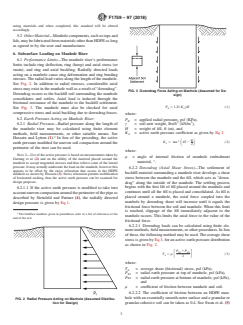
stresses.Theradialloadvariesalongthelengthofthemanhole.
See Fig. 2. In addition to radial stresses, considerable axial
stress may exist in the manhole wall as a result of “downdrag”.
FIG. 3 Downdrag Force Acting on Manhole (Assumed for De-
Downdrag occurs as the backfill soil surrounding the manhole
sign)
consolidates and settles. Axial load is induced through the
frictional resistance of the manhole to the backfill settlement.
P 5 1.21 K γH (1)
See Fig. 3. The manhole must also be checked for axial R A
compressive stress and axial buckling due to downdrag forces.
where:
6.2 Earth Pressure Acting on Manhole Riser:
P = applied radial pressure, psf (KPa),
R
3 3
6.2.1 Radial Pressure—Radial pressure along the length of
γ = soil unit weight, lbs/ft (kN/m ),
H = weight of fill, ft (m), and
the manhole riser may be calculated using finite element
K = active earth pressure coefficient as given by Eq 2.
methods, field measurements, or other suitable means. See
A
Hossain and Lytton (1). In lieu of the preceding, the active
φ
K 5 tan 45 2 (2)
S D
earth pressure modified for uneven soil compaction around the A
perimeter of the riser can be used.
where:
NOTE 2—Use of the active pressure is based on measurements taken by
φ = angle of internal friction of manhole embedment
Gartung et al. (2) and on the ability of the material placed around the
material, °.
manhole to accept tangential stresses and thus relieve some of the lateral
pressure. It may actually understate the load on the manhole, however this
6.2.2 Downdrag (Axial Shear Stress)—The settlement of
appears to be offset by the stress relaxation that occurs in the HDPE
backfill material surrounding a manhole riser develops a shear
manhole as shown by Hossain (3). Stress relaxation permits mobilization
stress between the manhole and the fill, which acts as “down-
of horizontal arching, thus the active earth pressure can be assumed for
design purposes. drag” along the outside of the manhole. The settling process
begins with the first lift of fill placed around the manhole and
6.2.1.1 If the active earth pressure is modified to take into
continues until all the fill is placed and consolidated. As fill is
accountunevencompactionaroundtheperimeterofthepipeas
placed around a manhole, the axial force coupled into the
described by Steinfeld and Partner (4), the radially directed
manhole by downdrag shear will increase until it equals the
design pressure is given by Eq 1.
frictional force between the soil and manhole. When this limit
is reached, slippage of the fill immediately adjacent to the
The boldface numbers given in parentheses refer to a list of references at the
manhole occurs. This limits the axial force to the value of the
end of the text.
frictional force.
6.2.2.1 Downdrag loads can be calculated using finite ele-
ment methods, field measurements, or other procedures. In lieu
of these, the following method may be used.The average shear
stress is given by Eq 3, for an active earth pressure distribution
as shown in Fig. 2.
P 1P
R1 R2
T 5 µ (3)
F G
A
where:
T = average shear (frictional) stress, psf (kPa),
A
P = radial earth pressure at top of manhole, psf (kPa),
R1
P = radial earth pressure at bottom of manhole, psf (kPa),
R2
and
µ = coefficient of friction between manhole and soil.
6.2.2.2 The coefficient of friction between an HDPE man-
hole with an essentially smooth outer surface and a granular or
FIG. 2 Radial Pressure Acting on Manhole (Assumed Distribu-
tion for Design) granular-cohesive soil can be taken as 0.4. See Swan et al. (5)
F1759 − 97 (2018)
and Martin et al. (6). In some applications the coefficient of where:
friction may be reduced by coating the exterior of the manhole
P ' = applied radial pressure, psf (kPa),
R
with bentonite or some other lubricant.
K = active earth pressure coefficient,
A
H = height of fill, ft (m),
NOTE 3—The use of external stiffeners or open profiles to stiffen the
γ = unit weight of water, pcf (kN/m ), and
W
riser greatly increases the downdrag load due to their impeding the
γ = unit weight of saturated soil, pcf (kN/m ).
S
settlement of soil beside the manhole. This has the effect of increasing the
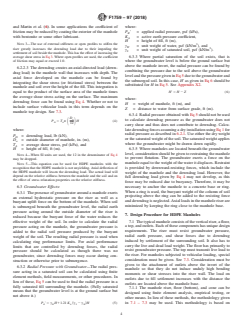
6.3.3 Where partial saturation of the soil exists, that is
average shear stress in Eq 3. Where open profiles are used, the coefficient
of friction may equal or exceed 1.0.
where the groundwater level is below the ground surface but
above the manhole invert, the radial pressure can be found by
6.2.2.3 The downdrag creates an axial-directed load (down-
combining the pressure due to the soil above the groundwater
drag load) in the manhole wall that increases with depth. The
levelandthepressuregiveninEq5duetothegroundwaterand
axial force developed on the manhole can be found by
the submerged soil. In this case, H' as given in Eq 6 should be
integrating the shear stress (or frictional stress) between the
substituted for H in Eq 5. See Appendix X2.
manhole and soil over the height of the fill. This integration is
H' 5 H 2 Z (6)
equal to the product of the surface area of the manhole times
the average shear stress acting on the surface. The maximum
where:
downdrag force can be found using Eq 4. Whether or not to
H = weight of manhole, ft (m), and
include surface vehicular loads in this term depends on the
Z = distance to water from surface grade, ft (m).
manhole top design. See 7.3.
6.3.4 Radial pressure obtained with Eq 5 should not be used
D
o
to calculate downdrag pressure as the groundwater does not
P 5 T π H (4)
S D
D A
carry shear and thus does not contribute to downdrag. Calcu-
latedowndragforcesassumingadryinstallationusingEq1for
where:
radial pressure as described in 6.2.1. Use either the dry weight
P = downdrag load, lb (kN),
D
orthesaturatedweightofthesoil.Thesaturatedweightapplies
D = outside diameter of manhole, in. (m),
o
where the groundwater might be drawn down rapidly.
T = average shear stress, psf (kPa), and
A
6.3.5 Where manholes are located beneath the groundwater
H = height of fill, ft (m).
level, consideration should be given to restraining the manhole
NOTE 4—When SI units are used, the 12 in the denominator of Eq 4
to prevent flotation. The groundwater exerts a force on the
may be dropped.
manhole equal to the weight of the water it displaces. Restraint
NOTE 5—This equation can be used for HDPE manholes with the
recognition that the HDPE manhole is not unyielding.Axial deflection of is provided by downward-resisting forces, which include the
the HDPE manhole will lessen the downdrag load. The actual load will
weight of the manhole and the downdrag load. However, the
depend on the relative stiffness between the manhole and the soil and on
full downdrag load given by Eq 4 may not develop, as this
the effect of stress relaxation properties on the relative stiffness.
force may be reduced due to buoyancy. Therefore, it may be
6.3 Groundwater Effects: necessary to anchor the manhole to a concrete base or ring.
When a ring is used, the buoyant weight of the column of soil
6.3.1 The presence of groundwater around a manhole exerts
projecting above the ring can be added to the resisting force
an external hydrostatic pressure on the riser as well as a
anddowndragisneglected.Axialloadsinthemanholeriserare
buoyant uplift force on the bottom of the manhole. When soil
minimized by keeping the ring close to the manhole base.
is submerged beneath the groundwater level, the radial earth
pressure acting around the outside diameter of the riser is
7. Design Procedure for HDPE Manholes
reduced because the buoyant force of the water reduces the
7.1 Thetypicalmanholeconsistsoftheverticalriser,afloor,
effective weight of the soil. In order to calculate the radial
a top, and outlets. Each of these components has unique design
pressure acting on the manhole, the groundwater pressure is
requirements. The riser must resist groundwater pressure,
added to the radial soil pressure produced by the buoyant
radial earth pressure, and shear forces due to downdrag
weight of the soil. The resulting radial pressure is used when
induced by settlement of the surrounding soil. It also has to
calculating ring performance limits. For axial performance
carry the live and dead load weight. The floor has primarily to
limits that are controlled by downdrag forces, the radial
resist groundwater pressure. The top must transmit live load to
pressure should be calculated as though there was no
the riser. For manholes subjected to vehicular loading, special
groundwater, since downdrag forces may occur during con-
consideration must be given. See 7.3. Consideration must be
struction or otherwise prior to submergence.
given to the attachment of outlets above the invert of the
6.3.2 Radial Pressure with Groundwater—The radial pres-
manhole so that they do not induce unduly high bending
sure acting in a saturated soil can be calculated using finite
moments or shear stresses into the riser wall. The load on
element methods, field measurements, or other procedures. In
outlets due to fill settlement increases with the distance the
lieu of these, Eq 5 can be used to find the radial pressure in a
outlets are located above the manhole base.
fully saturated fill surrounding the manhole. (Fully saturated
7.1.1 The manhole riser, floor (bottom), and cone can be
means that the groundwater level is at the ground surface but
designed using finite element analysis, empirical testing, or
not above it.)
other means. In lieu of these methods, the methodology given
P ' 5 γ H11.21 K γ 2 γ H (5) in 7.1 – 7.3 may be used. This methodology is based on
~ !
R W A S W
F1759 − 97 (2018)
practical experience and field observations and it accounts for The bending strain can be found either by using an equation
arching and viscoelastic effects empirically. Further refine- that relates the deflection in the riser to the strain (such as
ments of this methodology could be made by the following: Molin’s Equation) or by the following method, which consid-
accounting in a direct way for the earth load reductions due to ers the bending moment induced by the eccentricity of the
radial and axial deformations in the manhole structure as a thrust load. The eccentricity factor, e, can be calculated from
result of the viscoelasticity of the HDPE and the surrounding Eq 9. It can be assumed that the ring bending deflections will
soil, accounting directly for the benefits of stress relaxation in be low and generally on the order of one or two percent of the
the HDPE, considering the interaction between axial and ring manhole diameter.
buckling, and directly determining the soil’s enhancement of
e 5 C ~D /2! (9)
o M
the riser’s axial buckling resistance.
where:
7.1.1.1 Manhole Riser Design—Design of the manhole riser
e = eccentricity, in. (cm),
consistsprimarilyofassumingatrialwallsectionandchecking
C = 0.02 ovality correction factor for 2 % deflection, and
its performance limits for the radial and downdrag loads.
o
D = mean diameter of manhole, in. (cm).
Usually, the maximum loads occur near the deepest buried M
portion of the manhole. Because loads are lower near the
7.1.1.7 The resulting bending moment due to the ring thrust
surface, the riser wall thickness can be tapered from bottom to
acting over the eccentricity can be found from Eq 10.
top.
M 5 e ~N !~0.5! (10)
E T
7.1.1.2 Radial Loads—The performance limits under radial
loads consist of ring compressive thrust, ring bending, and ring where:
buckling. Ring compression and ring bending create a com-
M = bending load, in.-lb/in. (N-cm/cm),
E
bined strain in the manhole wall that must be within a limiting
e = eccentricity in. (cm), and
strain value.
N = ring thrust, lb/in.
T
7.1.1.3 Ring Compressive Thrust—Radial loads acting on
7.1.1.8 Thebendingstrain, ε ,foragivensectionisgivenin
B
the manhole create a compressive hoop thrust. For a vertical
Eq 11.
riser,themaximumthrustoccursatthedeepestsection.(Dueto
M
E
the presence of the manhole floor, the maximum thrust actually
ε 5 (11)
B
ES
X
occurs slightly above the floor.) Eq 7 gives the ring thrust.
where:
P
R
N 5 ~R ! (7)
T M
144 ε = bending strain, in./in. (cm/cm),
B
3 3
S = section modulus, in. /in. = I/c (cm /cm),
X
where:
4 4
I = moment of inertia of manhole wall, in. /in. (cm /cm),
N = ring thrust, lb/in. (N/cm),
T c = distance from riser centroid to surface, in. (cm), and
2 2
P = applied radial pressure, psf (N/cm ) (1N/cm =10
E = stress relaxation modulus of HDPE, psi (N/cm ).
R
kPa), and
NOTE 7—If the stress relaxation modulus for bending is different than
R = mean radius of manhole, in. (cm). the stress relaxation modulus for compression, the respective values
M
should be used in Eq 8 and Eq 11. (Stress relaxation values may be
For applied radial pressure use Eq 1, if dry, and Eq 5 if
obtained from the manhole manufacturer or HDPE resin supplier.)
groundwater is present.
7.1.1.9 Combined Ring Compression and Ring Bending
NOTE 6—When SI units are used, the 144 in the denominator of Eq 7
Strain—The total ring strain occurring in the manhole riser
may be dropped.
wall is given by Eq 12.
7.1.1.4 The ring compressive strain due to the ring thrust is
ε 5 ε 1ε (12)
C T B
givenbyEq8.Inordertocalculatetheringcompressivestrain,
where:
a wall section must be assumed.
ε = combined ring strain, in./in. (cm/cm),
C
N
T
ε 5 (8)
ε = compressive thrust strain, in./in. (cm/cm), and
T
T
EA
S
ε = bending strain, in./in. (cm/cm).
B
where:
7.1.1.10 The wall thickness should be designed so that the
ε = ring compressive strain, in./in. (cm/cm),
T combined ring strain in Eq 12 is less than the material’s
N = ring load, lb/in. (N/cm),
T permissible strain limit (capacity). Strain capacity of HDPE
E = stress relaxation modulus, psi (N/cm ), and
can vary depending on the particular resin, its molecular
2 2
A = manhole cross-sectional area, in. /in. (cm /cm). (For
S
weight, and its molecular weight distribution. Because of the
solid wall risers, A equals the wall thickness.)
S
variationsinHDPEresinsandblends,thestrainlimitshouldbe
7.1.1.5 Ring Bending—The ring strain calculated by Eq 8 establishedforeachparticularmaterial.Thestrainlimitmaybe
will be combined with the bending strain to determine the determined by accelerated laboratory testing. Test data for the
design adequacy of a proposed wall section. end-user should be available from the manufacturer.
7.1.1.6 The radial pressures applied to a manhole varies 7.1.1.11 An alternate design approach is to design for stress
around the circumference due to variability in the fill material rather than strain and use an allowable compressive stress
and its placement as demonstrated by the 1.21 factor in Eq 1. value. This method can be used by converting the strain in Eq
This eccentricity introduces bending strain in the riser wall. 12 to a combined stress value.
F1759 − 97 (2018)
NOTE 8—The limiting stress approach is usually applied to pressure
D = mean diameter, in. (cm),
M
pipewherethepipeissubjectedtolong-termhoopstressthatmustbekept
R = 1-.33 H'/H, buoyancy reduction factor,
below the threshold for developing slow crack growth within the design
H' = height of groundwater above invert, ft (m),
life. For several years, it was customary to design non-pressure rated
H = height of fill, ft (m),
HDPEpipesusinganallowablecompressivestressapproximatelyequalto
E' = modulus of soil reaction, psi (N/cm ),
the hydrostatic design stress. However, it has recently been shown that the
long-term, compressive design stress is higher than the hydrostatic design E = stress relaxation modulus, psi (N/cm ), and
4 4
stress, primarily due to a difference in failure mechanisms.
I = moment of inertia of manhole wall, in. /in. (cm /
cm).
7.1.1.12 Ring Buckling—If the ring compressive thrust
stress exceeds a critical value, the manhole can lose its ability and:
to resist flexural deformation and undergo ring buckling.
1 1
B' 5 B' 5 ~SI units! (16)
Moore and Selig have used continuum theory to develop S D
~20.065H! ~20.213H!
114e 114e
design equations for buckling (7). The continuum theory
7.1.1.16 For design purposes, the ring thrust as given by Eq
addresses buckling of cylindrical structures surrounded by soil.
7 should not exceed one-half the critical ring thrust, N .
CRW
The presence of groundwater tends to lower the critical
7.1.1.17 When radial stiffeners are provided in the manhole
buckling value as fluid pressure is not relieved by small
wall, the average moment of inertia of the wall can be used in
deformationsthatwouldpromotearchinginsoil.Asolutionfor
the above equations. But, a check should be made to ensure
hydrostatic pressure effects has not yet been published using
that the spacing between stiffeners does not permit local
the continuum theory. At present the most commonly used
buckling.
solution for groundwater effects is Luscher’s equation as given
7.1.2 Axial Load Performance Limits—In the above section
in AWWA C-950 (8).
on earth loading, the axial load due to downdrag was given. In
7.1.1.13 Manhole Section Above Groundwater Level—The
addition to the downdrag, other axial loads include the weight
critical ring thrust at which buckling occurs is given by Eq 13.
ofthemanholeanditsappurtenancesandtheweightofanylive
See Moore et al. (9) .
loads, such as equipment or vehicles. These loads create an
1/3 2/3
N 5 0.7 R ~EI! ~E ! (13)
CR H S
axial, compressive strain in the manhole wall. The strain is
limited by the compressive strain capacity of the material and
where:
by the strain limit at axial buckling. Both limits are calculated
N = critical ring thrust (no groundwater), lb/in. (N/cm),
CR
and the smallest allowable strain controls design.
R = geometry factor,
H
7.1.2.1 Axial Strain—The maximum axial strain induced by
E = stress relaxation modulus, psi (N/cm ),
4 4
the downdrag shear occurs at the riser’s lowest point. Assum-
I = moment of inertia of manhole wall, in. /in. (cm /cm),
inguniformdowndragthestraininasolidwallriserisconstant
and
around the perimeter of the riser. For profile walls, the axial
E = Young’s modulus of the soil, psi (N/cm ).
S
strain will vary along the length of the profile and possibly
The geometry factor is dependent on the depth of burial and
...