

ASTM E833-14(2021)
(Terminology)Standard Terminology of Building Economics
General Information
- Abstract
SCOPE
1.1 This terminology relates to the economic evaluation of building construction as used in other standards under the jurisdiction of ASTM Committee E06 on Performance of Buildings, and it does not necessarily correspond to the terminology used in other areas of accounting and economics.
1.2 This international standard was developed in accordance with internationally recognized principles on standardization established in the Decision on Principles for the Development of International Standards, Guides and Recommendations issued by the World Trade Organization Technical Barriers to Trade (TBT) Committee.
- Status
- Published
- Publication Date
- 31-Jan-2021
- Technical Committee
- E06 - Performance of Buildings
- Drafting Committee
- E06.81 - Building Economics
Overview
ASTM E833-14(2021), Standard Terminology of Building Economics, provides a comprehensive set of definitions and terminology specifically for the economic evaluation of building construction projects. Developed under the jurisdiction of ASTM Committee E06 on Performance of Buildings, this international standard supports clear communication and consistent understanding when analyzing the financial aspects of buildings throughout their lifecycle. This standard serves as a foundational reference for other ASTM standards related to building economics, value engineering, life-cycle cost analysis, and project management.
Key Topics
- Building Economics: Focuses on applying economic analysis methods to the design, financing, engineering, construction, ownership, management, operation, and disposition of buildings.
- Cost Terms: Definitions include capital cost, operating cost, maintenance and repair cost, first cost, and incremental cost, ensuring standardized financial discussions.
- Evaluation Methods: Provides terminology for techniques like life-cycle cost analysis, benefit-to-cost ratio, savings-to-investment ratio, and internal rate of return.
- Risk and Decision Analysis: Defines approaches for assessing uncertainty, risk exposure, risk attitude (risk averse, risk taking, risk neutral), and decision-making under uncertainty.
- Project and Cost Control: Outlines terminology for cost models, cost overruns, budgeting (allowances, contingencies, reserves), codes of accounts, and work breakdown structures.
- Productivity and Performance Metrics: Includes terms for labor productivity, productivity differentials, and performance measurement within construction projects.
- Environmental and Regulatory Context: Introduces terminology relevant to environmental regulations and remediation, such as hazardous waste, decontamination, remediation, and related legal frameworks.
Applications
ASTM E833-14(2021) is valuable for a variety of stakeholders in the building industry:
- Design and Construction Professionals: Ensures consistent economic evaluation during planning, design, and construction phases.
- Cost Engineers and Estimators: Supports precise cost breakdowns, budgeting, and forecasting for building projects.
- Project Managers: Facilitates clear communication regarding project costs, budget control, and risk management.
- Facility Owners and Operators: Assists with investment decisions, maintenance planning, retrofits, and total cost of ownership calculations.
- Value Engineering and Analysis Teams: Provides a common vocabulary for value management processes, supporting methodologies such as value engineering and function analysis.
- Environmental Consultants: Supplies key terms for evaluating and managing costs associated with hazardous materials, remediation, and regulatory compliance.
- Standards Development: Forms the basis for terminology used in related ASTM standards, harmonizing industry practices and improving international collaboration.
By establishing a common language, the standard improves the accuracy of economic comparison, value analysis, cost control, and reporting across project teams and phases. It also supports compliance with recognized international standardization principles, contributing to transparent and equitable trade practices globally.
Related Standards
- ASTM E1699 - Practice for Performing Value Engineering (VE)/Value Analysis (VA) of Projects, Products and Processes: Provides procedural guidance for value engineering and analysis.
- ASTM E2691 - Practice for Job Productivity Measurement: Defines methods for evaluating jobsite labor productivity in building construction.
- CSI MasterFormat and Uniformat II: Industry classification systems referenced for cost and project breakdown structures in the construction sector.
These documents, alongside ASTM E833, facilitate best practices in building economics, cost planning, productivity measurement, and project lifecycle management.
Relations
- Effective Date
- 01-Apr-2020
- Effective Date
- 01-Mar-2016
- Effective Date
- 01-Nov-2013
- Effective Date
- 01-Nov-2011
- Effective Date
- 01-Apr-2010
- Effective Date
- 01-Nov-2009
- Effective Date
- 01-Oct-2005
- Effective Date
- 10-Oct-2000
Get Certified
Connect with accredited certification bodies for this standard

DIBt (Deutsches Institut für Bautechnik)
German Institute for Building Technology.
DIN CERTCO
DIN Group product certification.

Aboma Certification B.V.
Specialized in construction, metal, and transport sectors.
Sponsored listings
Frequently Asked Questions
ASTM E833-14(2021) is a standard published by ASTM International. Its full title is "Standard Terminology of Building Economics". This standard covers: SCOPE 1.1 This terminology relates to the economic evaluation of building construction as used in other standards under the jurisdiction of ASTM Committee E06 on Performance of Buildings, and it does not necessarily correspond to the terminology used in other areas of accounting and economics. 1.2 This international standard was developed in accordance with internationally recognized principles on standardization established in the Decision on Principles for the Development of International Standards, Guides and Recommendations issued by the World Trade Organization Technical Barriers to Trade (TBT) Committee.
SCOPE 1.1 This terminology relates to the economic evaluation of building construction as used in other standards under the jurisdiction of ASTM Committee E06 on Performance of Buildings, and it does not necessarily correspond to the terminology used in other areas of accounting and economics. 1.2 This international standard was developed in accordance with internationally recognized principles on standardization established in the Decision on Principles for the Development of International Standards, Guides and Recommendations issued by the World Trade Organization Technical Barriers to Trade (TBT) Committee.
ASTM E833-14(2021) is classified under the following ICS (International Classification for Standards) categories: 01.040.91 - Construction materials and building (Vocabularies); 91.010.01 - Construction industry in general. The ICS classification helps identify the subject area and facilitates finding related standards.
ASTM E833-14(2021) has the following relationships with other standards: It is inter standard links to ASTM E2691-20, ASTM E2691-16, ASTM E1699-13, ASTM E2691-11, ASTM E1699-10, ASTM E2691-09, ASTM E1699-00(2005), ASTM E1699-00. Understanding these relationships helps ensure you are using the most current and applicable version of the standard.
ASTM E833-14(2021) is available in PDF format for immediate download after purchase. The document can be added to your cart and obtained through the secure checkout process. Digital delivery ensures instant access to the complete standard document.
Standards Content (Sample)
This international standard was developed in accordance with internationally recognized principles on standardization established in the Decision on Principles for the
Development of International Standards, Guides and Recommendations issued by the World Trade Organization Technical Barriers to Trade (TBT) Committee.
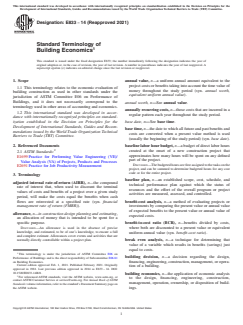
Designation: E833 − 14 (Reapproved 2021)
Standard Terminology of
Building Economics
This standard is issued under the fixed designation E833; the number immediately following the designation indicates the year of
original adoption or, in the case of revision, the year of last revision. A number in parentheses indicates the year of last reapproval. A
superscript epsilon (´) indicates an editorial change since the last revision or reapproval.
1. Scope annual value, n—a uniform annual amount equivalent to the
project costs or benefits taking into account the time value of
1.1 This terminology relates to the economic evaluation of
money throughout the study period (syn. annual worth,
building construction as used in other standards under the
equivalent uniform annual value).
jurisdiction of ASTM Committee E06 on Performance of
Buildings, and it does not necessarily correspond to the
annual worth, n—See annual value.
terminology used in other areas of accounting and economics.
annually recurring costs, n—those costs that are incurred in a
1.2 This international standard was developed in accor-
regular pattern each year throughout the study period.
dance with internationally recognized principles on standard-
base date, n—See base time.
ization established in the Decision on Principles for the
Development of International Standards, Guides and Recom-
base time, n—the date to which all future and past benefits and
mendations issued by the World Trade Organization Technical
costs are converted when a present value method is used
Barriers to Trade (TBT) Committee.
(usually the beginning of the study period) (syn. base date).
2. Referenced Documents
baseline labor hour budget, n—a budget of direct labor hours
created at the onset of a new construction project that
2.1 ASTM Standards:
approximates how many hours will be spent on any defined
E1699 Practice for Performing Value Engineering (VE)/
part of the project.
Value Analysis (VA) of Projects, Products and Processes
DISCUSSION—Thebudgetedhoursarefirstassignedtothetasksonthe
E2691 Practice for Job Productivity Measurement
project, and can be summed to determine budgeted hours for any cost
code or for the entire project.
3. Terminology
baseline plan, n—an established scope, cost, schedule, and
adjusted internal rate-of-return (AIRR), n—the compound
technical performance plan against which the status of
rate of interest that, when used to discount the terminal
resources and the effort of the overall program or project
values of costs and benefits of a project over a given study
activities are measured, assessed, and controlled.
period, will make the costs equal the benefits when cash
flows are reinvested at a specified rate (syn. financial benefit-cost analysis, n—a method of evaluating projects or
management rate of return (FMRR)). investments by comparing the present value or annual value
of expected benefits to the present value or annual value of
allowance, n—in construction design planning and estimating,
expected costs.
an allocation of money that is intended to be spent for a
specific purpose. benefit-to-cost ratio (BCR), n—benefits divided by costs,
DISCUSSION—An allowance is used in the absence of precise
where both are discounted to a present value or equivalent
knowledge, and estimated, to be of one’s knowledge, to ensure a full
uniform annual value (syn. benefit-cost ratio).
and complete estimate. Allowances cover events and activities that are
normally directly controllable within a project plan. break even analysis, n—a technique for determining that
value of a variable which results in benefits (savings) just
equal to costs.
This terminology is under the jurisdiction of ASTM Committee E06 on
building decision, n—a decision regarding the design,
Performance of Buildings and is the direct responsibility of Subcommittee E06.81
on Building Economics. financing, engineering, construction, management, or opera-
Current edition approved Feb. 1, 2021. Published February 2021. Originally
tion of a building.
approved in 1981. Last previous edition approved in 2014 as E833 – 14. DOI:
10.1520/E0833-14R21.
building economics, n—the application of economic analysis
For referenced ASTM standards, visit the ASTM website, www.astm.org, or
to the design, financing, engineering, construction,
contact ASTM Customer Service at service@astm.org. For Annual Book of ASTM
management, operation, ownership, or disposition of build-
Standards volume information, refer to the standard’s Document Summary page on
the ASTM website. ings.
Copyright © ASTM International, 100 Barr Harbor Drive, PO Box C700, West Conshohocken, PA 19428-2959. United States
E833 − 14 (2021)
DISCUSSION—In Practice E2691, a control signal identifies any
building system, n—an aggregation or assemblage of items
deviation from the labor productivity reference point.
joined in regular interaction or interdependence in buildings
or building construction.
cost analysis, n—subdividing the project estimate into compo-
nent parts to find and compare their relationship to previ-
capital cost, n—the costs of acquiring, substantially
ously established historical costs.
improving, expanding, changing the functional use of, or
replacing a building or building system.
cost effective, adj—the condition whereby the present value
benefits (savings) of an investment exceeds its present value
cash flow, n—the stream of monetary (dollar) values—costs
costs.
and benefits—resulting from a project investment.
cost limitations, n—the budget boundaries for project ele-
certainty equivalent technique, n—a technique used to adjust
ments.
economic measures of project worth to reflect risk exposure
cost model, n—the description of the project divided into
and risk attitude.
discrete elements showing quantities and unit price for each
DISCUSSION—Estimated project returns are multiplied by a certainty
equivalent factor (CEF) to determine the certainty equivalent amount a element.
decision maker finds equally acceptable to the estimated project
cost overruns, n—in project design or construction, or both,
returns.
the unanticipated increase in cost due to factors such as
code of accounts, n—a hierarchical, company-specific system
unanticipated site conditions, changes in the cost of building
for cost accounting, control, and management.
materials, labor, weather, and labor disputes.
Comprehensive Environmental Response, Compensation, cost professional, n—in project design or construction, or
and Liability Act (CERCLA), n—also known as
both, a person engaged in the occupation of understanding,
“Superfund,” CERCLA prescribes actions and regulatory
managing or estimating project costs, or a combination
requirements for reducing risks to human health and the
thereof.
environmentresultingfromreleasesorthreatenedreleasesof
current dollars, n—dollars of purchasing power in which
hazardous substances into the environment.
actual prices are stated, including inflation or deflation.
DISCUSSION—In the absence of inflation or deflation, current dollars
condition index—descriptive or numeric rating used to repre-
equal constant dollars.
sent the “condition” of the rated asset as of a stated point in
time.
current replacement value—engineering estimate of costs (in
DISCUSSION—Examples of condition indices include quantitative
today’s dollars) required to replace a facility at existing size
scores (scale of 0-100; 0-10; 0-5) based upon statistically sampled data
and functional capability using current construction stan-
and associated deficiency curves or defined descriptors (good – fair –
dards.
poor).
DISCUSSION—Includes costs for overhead, planning, design,
construction, and construction management for the asset being re-
constant dollars, n—dollars of uniform purchasing power
viewed; does not typically include land value or initial site clearing or
exclusive of general inflation or deflation.
earthwork costs. The current replacement value for a given building
DISCUSSION—Constant dollars are tied to a reference year.
may include costs applicable to such site improvements as park
benches, walkways, parking, service roads, and site utilities and such
construction contingency, n—the funds added to estimated
should be delineated based upon intended use of the term. Typical
and known costs in case of cost overruns during construc-
engineering estimates include costs for materials, equipment, supplies,
tion.
and labor.
construction documents, n—materials that convey the
deactivation, n—the process of placing a facility in a safe and
physical, aesthetic, technical, performance, and administra-
stable condition to minimize the long-term cost of a surveil-
tive requirements necessary to initiate a contract for con-
lance and maintenance program and to protect the workers,
struction of the proposed project.
the public, and the environment.
contingency, n—in construction design planning and
decision analysis, n—a technique for making economic deci-
estimating, a sum of money that is provided to cover the
sions in an uncertain environment that allows a decision
occurrence of unintended departures from the planned scope
maker to include alternative outcomes, risk attitudes, or
of work.
subjective impressions about uncertain events in an evalua-
DISCUSSION—A contingency is used in the absence of precise
tion of investments.
knowledge, and estimated, to be of one’s knowledge, to ensure that a
decommissioning, n—takes place after deactivation, and in-
financial buffer is available within a budget. Contingencies assist in
mitigating the effects of unplanned events and other risks that are cludes surveillance and maintenance, decontamination,
normally not directly controllable within a project plan.
dismantlement, surveillance and long-term monitoring, or
any combination thereof.
control signal, n—in construction, any series of data points
which indicates deviation from the expected job progress in decontamination, n—the removal of hazardous or radioactive
relation to labor, material, or finance, and indicates anoma- material, or both, from facilities, soils, or equipment to
lies on the jobsite to the contractor, project manager, or job preclude the occurrence of foreseeable adverse health ef-
supervisor. fects.
E833 − 14 (2021)
design contingency, n—in project design/construction, the eter quantity, or parameter quantities, has, or have, been
amount of funds added to the estimated construction costs to applied to derive benchmark figures (rates, ratios,
cover unanticipated construction costs due to the incom- percentages, and so forth).
DISCUSSION—Elemental cost analyses are valuable tools in planning,
pleteness of the design, where the contingency is inversely
estimating, and controlling construction cost through all stages of
proportional to the level of completeness of the design
planning and design.The benchmark figures are primarily derived from
documentation.
underlying estimate detail but can, in some circumstances, be used
directly to approximate estimates for other projects.
design development, n—the phase of a project consisting of
drawings and document preparation to fix and describe the
elemental cost summary, n—in construction planning, design,
size and character of the building systems, material, and
specification, estimating, and cost analysis, a tabulation of
elements.
cost categorized by major group element, group element,
or element.
design program, n—the information detailing project
function, purpose, and characteristics inclusive of floor area,
engineering economics, n—the application of economic tech-
functional spaces, equipment, and building systems.
niques to the evaluation of design and engineering alterna-
tives.
desires, n—the functions that the value analysis team deter-
mines to be fulfilled if cost is not a factor, or functions which
equivalent uniform annual value, n—See annual value.
do not otherwise violate a constraint.
ex situ treatment, n—treatment, remediation, or cleanup of
differential price escalation rate, n—the expected percent
contaminated material in a treatment facility at a different
difference between the rate of increase assumed for a given
location from the contaminated site.
item of cost (such as energy), and the general rate of
field requirements, n—in construction design planning and
inflation.
estimating, the nonpermanent portion of construction cost
discount factor, n—a multiplicative number (calculated from a
that is essential to permit implementation of the construction
discount formula for a given discount rate and interest
work in the field.
period) that is used to convert costs and benefits occurring at
DISCUSSION—Usually relating to permits, insurances, supervision,
different times to a common time. site set-up, and other requirements that permit the construction process,
but excluding such temporary construction work as formwork, bracing,
discounting, n—a technique for converting cash flows that
shoring, and other work required to install the permanent construction
occur over time to equivalent amounts at a common time.
work.
discount rate, n—the rate of interest reflecting the investor’s
financial management rate-of-return (FMRR), n—See ad-
time value of money, used to determine discount factors for justed internal rate-of-return (AIRR).
converting benefits and costs occurring at different times to
first cost, n—costs incurred in placing a building or building
a base time.
subsystem into service, including, but not limited to, costs of
DISCUSSION—The discount rate may be expressed as nominal or real.
planning, design, engineering, site acquisition and
economic evaluation methods, n—a set of economic analysis
preparation, construction, purchase, installation, property
techniques that consider all relevant costs associated with a
taxes and interest during the construction period, and con-
project investment during its study period, comprising such
struction related fees (syn. initial investment cost, initial
techniques as life-cycle cost, benefit-to-cost ratio, savings-
cost).
to-investment ratio, internal rate of return, and net savings.
function, n—a purpose of the entire project or some portion
economic life, n—thatperiodoftimeoverwhichaninvestment
thereof determined by the needs or desires of the user/owner
is considered to be the least-cost alternative for meeting a
and expressed in two words, an active verb and a measurable
particular objective.
noun.
element, n—in construction planning, design, specification,
function analysis, n—an examination of the project consisting
estimating, and cost analysis, a significant component part
of (1) the determination of the project functions; (2) the
of the whole that performs a specific function, or functions,
examination and sorting of these functions into categories;
regardless of design, specification, or construction method.
(3) the selection of the critical functions and arrangement
DISCUSSION—While through analysis, or by direct application, con-
into a logical order; and (4) the determination of the project
struction estimates categorized into elements (functional elements)
cost allocated to performing each critical function.
with allocated costs, may be summarized in an elemental cost
summary or elemental cost analysis; elements (functional elements)
function, basic, n—a function that is necessary to achieve the
also provide a framework for consistent preliminary project
primary purpose of a building system or element.
description, outline, and performance specification, through all stages
of planning, design, construction, and maintenance. functional element, n—in construction planning, design,
specification, estimating, and cost analysis; see element.
elemental cost analysis, n—in construction planning, design,
specification, estimating, and cost analysis, a tabulation of future value, n—the value of a benefit or a cost at some point
cost categorized by major group element, group element, in the future, considering the time value of money (syn.
or element, or any combination thereof, to which a param- future worth).
E833 − 14 (2021)
DISCUSSION—Maintenance includes preventive maintenance, normal
future worth, n—See future value.
repairs, replacement of parts and structural components, and other
general overhead, n—the fixed cost associated with operation activities needed to preserve the asset so that it continues to provide
acceptableserviceandachievesitsexpectedlife.Maintenanceexcludes
ofthecorporateormainoffice,plant,equipment,andstaffing
activities aimed at expanding the capacity of an asset or otherwise
maintained by a contractor for general business operations.
upgrading it to serve needs different from, or significantly greater than,
DISCUSSION—General overhead costs may not be specifically appli-
those originally intended.
cable to a particular job or project.
maintenance and repair cost, n—the total of labor, material,
group element, n—in construction planning, design,
and other related costs incurred in conducting corrective and
specification, estimating, and cost analysis, a significant
preventative maintenance and repair on a building, or on its
component part of the whole that includes relevant elements
systems and components, or on both.
which, as a group, perform specific function, or functions,
regardless of design, specification, or construction method.
major group element, n—in construction planning, design,
specification, estimating, and cost analysis, a very signifi-
hazardous waste, n—waste that is listed as hazardous by the
cant component part of the whole that includes relevant
Environmental Protection Agency (EPA) or exhibits one or
group elements which, as a group perform major specific
more of the following characteristics: ignitability, reactivity,
function, or functions, regardless of design, specification or
corrosivity, or toxicity, as specified in the Code of Federal
construction method.
Reg
...