

ASTM F1654-95(2020)
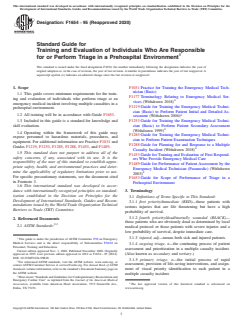
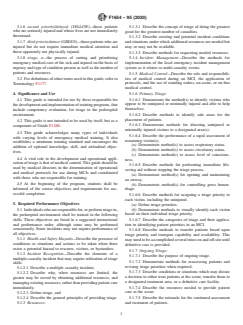
(Guide)Standard Guide for Training and Evaluation of Individuals Who Are Responsible for or Perform Triage in a Prehospital Environment
General Information
- Abstract
SIGNIFICANCE AND USE
4.1 This guide is intended for use by those responsible for the development and implementation of training programs, that include competency evaluation, for triage in the prehospital environment.
4.2 This guide is not intended to be used by itself, but as a component of Guide F1288.
4.3 This guide acknowledges many types of individuals with varying levels of emergency medical training. It also establishes a minimum training standard and encourages the addition of optional knowledge, skill, and attitudinal objectives.
4.4 A vital role in the development and operational application of triage is that of medical control. This guide should be used by medical directors in the determination of operational and medical protocols for use during MCIs and coordinated with those who are responsible for training.
4.5 At the beginning of the program, students shall be informed of the course objectives and requirements for successful completion.
SCOPE
1.1 This guide covers minimum requirements for the training and evaluation of individuals who perform triage at an emergency medical incident involving multiple casualties in a prehospital environment.
1.2 All training will be in accordance with Guide F1653.
1.3 Included in this guide is a standard for knowledge and skill evaluation.
1.4 Operating within the framework of this guide may expose personnel to hazardous materials, procedures, and equipment. For additional information see Practice F1031 and Guides F1219, F1253, F1285, F1288, F1453, and F1489.
1.5 This standard does not purport to address all of the safety concerns, if any, associated with its use. It is the responsibility of the user of this standard to establish appropriate safety, health, and environmental practices and determine the applicability of regulatory limitations prior to use. For specific precautionary statements, see the document cited in Footnote 3.
1.6 This international standard was developed in accordance with internationally recognized principles on standardization established in the Decision on Principles for the Development of International Standards, Guides and Recommendations issued by the World Trade Organization Technical Barriers to Trade (TBT) Committee.
- Status
- Published
- Publication Date
- 31-Oct-2020
- Technical Committee
- F30 - Emergency Medical Services
- Drafting Committee
- F30.02 - Personnel, Training and Education


Overview
ASTM F1654-95(2020) - Standard Guide for Training and Evaluation of Individuals Who Are Responsible for or Perform Triage in a Prehospital Environment provides minimum requirements for the training and evaluation of personnel performing triage during emergency medical incidents involving multiple casualties. Developed by ASTM International, this guide supports the creation and implementation of competency-based training programs for prehospital triage, ensuring a high standard of emergency medical response in mass casualty situations (MCIs).
This guide is intended as a component of ASTM Guide F1288 and should be used in conjunction with other referenced ASTM standards. It is applicable to various levels of emergency medical training and is intended for use by those designing, supervising, or evaluating triage training programs, as well as medical directors and emergency services coordinators.
Key Topics
- Competency-Based Training: Outlines minimum training requirements for individuals performing triage in the prehospital environment.
- Triage Principles: Covers the process of assessing and prioritizing patients based on severity and urgency.
- Priority Classification: Defines primary triage categories such as immediate (red), delayed (yellow), minor (green), and deceased (black).
- Incident Management: Describes methods for implementing incident command and medical protocols during MCIs.
- Hazard and Safety Awareness: Emphasizes recognizing hazards to rescuers, victims, and bystanders, and actions to mitigate these risks.
- Primary and Ongoing Triage: Addresses the continuing process of patient reassessment, transport prioritization, and documentation during an incident.
- Evaluation Standards: Specifies methods for evaluating knowledge and skill in prehospital triage, as well as requirements for remediation if needed.
Applications
The practical value of ASTM F1654-95(2020) is found in its comprehensive approach to standardizing the training and competency evaluation of prehospital care providers. Applications include:
- Emergency Medical Services (EMS) Training: Used by EMS training coordinators and educators to structure triage curriculum, ensuring responders are equipped to handle MCIs efficiently.
- Medical Control Guidance: Assists medical directors in formulating operational and medical protocols for triage, harmonizing field operations with medical command guidelines.
- Multi-Agency Response Planning: Supports coordinated training across fire services, police, and public safety agencies involved in disaster response.
- Drills and Evaluation: Provides benchmarks for hands-on training exercises and competency assessments.
- Policy Development: Aids government agencies and hospitals in establishing standard operating procedures for triage and mass casualty management.
- Continuous Quality Improvement: Forms the basis for ongoing review and improvement of triage practices within EMS systems.
Related Standards
ASTM F1654-95(2020) references and complements several related standards critical to comprehensive prehospital emergency care training:
- ASTM F1653: Guide for Scope of Performance of Triage in a Prehospital Environment.
- ASTM F1031: Practice for Training Emergency Medical Technicians (Basic).
- ASTM F1219, F1253, F1285: Guides for various assessment and training techniques (some withdrawn but referenced for historical completeness).
- ASTM F1288: Guide for Planning for and Response to a Multiple Casualty Incident.
- ASTM F1453: Guide for Training and Evaluation of First Responders Who Provide Emergency Medical Care.
- ASTM F1489: Guide for Performance of Patient Assessment by the Emergency Medical Technician (Paramedic).
Conclusion
ASTM F1654-95(2020) delivers essential guidance for the training and evaluation of triage personnel in the prehospital environment, promoting effective, efficient, and safe response to MCIs. By establishing standardized competencies and evaluation methods, this guide enhances preparedness and supports the ongoing professional development of emergency responders worldwide.
Keywords: prehospital triage training, emergency medical incident, mass casualty incident (MCI), EMS training standards, triage evaluation, ASTM F1654.
Relations
- Effective Date
- 01-Jul-2012
- Effective Date
- 01-Mar-2009
- Refers
ASTM F1177-02(2009) - Standard Terminology Relating to Emergency Medical Services (Withdrawn 2018) - Effective Date
- 01-Mar-2009
- Effective Date
- 01-Feb-2008
- Effective Date
- 01-Mar-2006
- Effective Date
- 10-Sep-2003
- Refers
ASTM F1288-90(2003) - Standard Guide for Planning for and Response to a Multiple Casualty Incident - Effective Date
- 10-Sep-2003
- Effective Date
- 10-Sep-2002
- Effective Date
- 10-Oct-2000
- Effective Date
- 10-Oct-2000
- Refers
ASTM F1288-90(1998) - Standard Guide for Planning for and Response to a Multiple Casualty Incident - Effective Date
- 10-Nov-1998
- Effective Date
- 10-Jun-1998
- Effective Date
- 01-Jan-1996
Get Certified
Connect with accredited certification bodies for this standard

BSI Group
BSI (British Standards Institution) is the business standards company that helps organizations make excellence a habit.

TÜV SÜD
TÜV SÜD is a trusted partner of choice for safety, security and sustainability solutions.

Bureau Veritas
Bureau Veritas is a world leader in laboratory testing, inspection and certification services.
Sponsored listings
Frequently Asked Questions
ASTM F1654-95(2020) is a guide published by ASTM International. Its full title is "Standard Guide for Training and Evaluation of Individuals Who Are Responsible for or Perform Triage in a Prehospital Environment". This standard covers: SIGNIFICANCE AND USE 4.1 This guide is intended for use by those responsible for the development and implementation of training programs, that include competency evaluation, for triage in the prehospital environment. 4.2 This guide is not intended to be used by itself, but as a component of Guide F1288. 4.3 This guide acknowledges many types of individuals with varying levels of emergency medical training. It also establishes a minimum training standard and encourages the addition of optional knowledge, skill, and attitudinal objectives. 4.4 A vital role in the development and operational application of triage is that of medical control. This guide should be used by medical directors in the determination of operational and medical protocols for use during MCIs and coordinated with those who are responsible for training. 4.5 At the beginning of the program, students shall be informed of the course objectives and requirements for successful completion. SCOPE 1.1 This guide covers minimum requirements for the training and evaluation of individuals who perform triage at an emergency medical incident involving multiple casualties in a prehospital environment. 1.2 All training will be in accordance with Guide F1653. 1.3 Included in this guide is a standard for knowledge and skill evaluation. 1.4 Operating within the framework of this guide may expose personnel to hazardous materials, procedures, and equipment. For additional information see Practice F1031 and Guides F1219, F1253, F1285, F1288, F1453, and F1489. 1.5 This standard does not purport to address all of the safety concerns, if any, associated with its use. It is the responsibility of the user of this standard to establish appropriate safety, health, and environmental practices and determine the applicability of regulatory limitations prior to use. For specific precautionary statements, see the document cited in Footnote 3. 1.6 This international standard was developed in accordance with internationally recognized principles on standardization established in the Decision on Principles for the Development of International Standards, Guides and Recommendations issued by the World Trade Organization Technical Barriers to Trade (TBT) Committee.
SIGNIFICANCE AND USE 4.1 This guide is intended for use by those responsible for the development and implementation of training programs, that include competency evaluation, for triage in the prehospital environment. 4.2 This guide is not intended to be used by itself, but as a component of Guide F1288. 4.3 This guide acknowledges many types of individuals with varying levels of emergency medical training. It also establishes a minimum training standard and encourages the addition of optional knowledge, skill, and attitudinal objectives. 4.4 A vital role in the development and operational application of triage is that of medical control. This guide should be used by medical directors in the determination of operational and medical protocols for use during MCIs and coordinated with those who are responsible for training. 4.5 At the beginning of the program, students shall be informed of the course objectives and requirements for successful completion. SCOPE 1.1 This guide covers minimum requirements for the training and evaluation of individuals who perform triage at an emergency medical incident involving multiple casualties in a prehospital environment. 1.2 All training will be in accordance with Guide F1653. 1.3 Included in this guide is a standard for knowledge and skill evaluation. 1.4 Operating within the framework of this guide may expose personnel to hazardous materials, procedures, and equipment. For additional information see Practice F1031 and Guides F1219, F1253, F1285, F1288, F1453, and F1489. 1.5 This standard does not purport to address all of the safety concerns, if any, associated with its use. It is the responsibility of the user of this standard to establish appropriate safety, health, and environmental practices and determine the applicability of regulatory limitations prior to use. For specific precautionary statements, see the document cited in Footnote 3. 1.6 This international standard was developed in accordance with internationally recognized principles on standardization established in the Decision on Principles for the Development of International Standards, Guides and Recommendations issued by the World Trade Organization Technical Barriers to Trade (TBT) Committee.
ASTM F1654-95(2020) is classified under the following ICS (International Classification for Standards) categories: 03.100.30 - Management of human resources; 11.160 - First aid. The ICS classification helps identify the subject area and facilitates finding related standards.
ASTM F1654-95(2020) has the following relationships with other standards: It is inter standard links to ASTM F1031-00(2012), ASTM F1288-90(2009), ASTM F1177-02(2009), ASTM F1285-90(2008), ASTM F1031-00(2006), ASTM F1285-90(2003), ASTM F1288-90(2003), ASTM F1177-02, ASTM F1219-00, ASTM F1031-00, ASTM F1288-90(1998), ASTM F1285-90(1998), ASTM F1177-96a. Understanding these relationships helps ensure you are using the most current and applicable version of the standard.
ASTM F1654-95(2020) is available in PDF format for immediate download after purchase. The document can be added to your cart and obtained through the secure checkout process. Digital delivery ensures instant access to the complete standard document.
Standards Content (Sample)
This international standard was developed in accordance with internationally recognized principles on standardization established in the Decision on Principles for the
Development of International Standards, Guides and Recommendations issued by the World Trade Organization Technical Barriers to Trade (TBT) Committee.
Designation: F1654 − 95 (Reapproved 2020)
Standard Guide for
Training and Evaluation of Individuals Who Are Responsible
for or Perform Triage in a Prehospital Environment
This standard is issued under the fixed designation F1654; the number immediately following the designation indicates the year of
original adoption or, in the case of revision, the year of last revision. A number in parentheses indicates the year of last reapproval. A
superscript epsilon (´) indicates an editorial change since the last revision or reapproval.
1. Scope F1031 Practice for Training the Emergency Medical Tech-
nician (Basic)
1.1 This guide covers minimum requirements for the train-
F1177 Terminology Relating to Emergency Medical Ser-
ing and evaluation of individuals who perform triage at an
vices (Withdrawn 2018)
emergency medical incident involving multiple casualties in a
F1219 Guide for Training the Emergency Medical Techni-
prehospital environment.
cian (Basic) to Perform Patient Initial and Detailed As-
1.2 All training will be in accordance with Guide F1653. 4
sessment (Withdrawn 2006)
F1253 Guide for Training the Emergency Medical Techni-
1.3 Included in this guide is a standard for knowledge and
skill evaluation. cian (Basic) to Perform Patient Secondary Assessment
(Withdrawn 1999)
1.4 Operating within the framework of this guide may
F1285 Guide for Training the Emergency Medical Techni-
expose personnel to hazardous materials, procedures, and
cian to Perform Patient Examination Techniques
equipment. For additional information see Practice F1031 and
F1288 Guide for Planning for and Response to a Multiple
Guides F1219, F1253, F1285, F1288, F1453, and F1489.
Casualty Incident (Withdrawn 2018)
1.5 This standard does not purport to address all of the
F1453 Guide for Training and Evaluation of First Respond-
safety concerns, if any, associated with its use. It is the
ers Who Provide Emergency Medical Care
responsibility of the user of this standard to establish appro-
F1489 Guide for Performance of Patient Assessment by the
priate safety, health, and environmental practices and deter-
Emergency Medical Technician (Paramedic) (Withdrawn
mine the applicability of regulatory limitations prior to use.
2003)
For specific precautionary statements, see the document cited
F1653 Guide for Scope of Performance of Triage in a
in Footnote 3.
Prehospital Environment
1.6 This international standard was developed in accor-
dance with internationally recognized principles on standard- 3. Terminology
ization established in the Decision on Principles for the
3.1 Definitions of Terms Specific to This Standard:
Development of International Standards, Guides and Recom-
3.1.1 first priority/immediate (RED)—those patients with
mendations issued by the World Trade Organization Technical
serious injuries that are life threatening but have a high
Barriers to Trade (TBT) Committee.
probability of survival.
3.1.2 fourth priority/dead/mortally wounded (BLACK)—
2. Referenced Documents
those patients who are obviously dead as determined by local
2,3
2.1 ASTM Standards:
medical protocol or those patients with severe injuries and a
low probability of survival, despite immediate care.
3.1.3 injured, adj—means both sick and injured patients.
This guide is under the jurisdiction of ASTM Committee F30 on Emergency
Medical Services and is the direct responsibility of Subcommittee F30.02 on
3.1.4 ongoing triage, n—the continuing process of patient
Personnel, Training and Education.
assessment and prioritization in a multiple casualty incident.
Current edition approved Nov. 1, 2020. Published November 2020. Originally
(Also known as secondary and tertiary.)
approved in 1995. Last previous edition approved in 2012 as F1654 – 95 (2012).
DOI: 10.1520/F1654-95R20.
3.1.5 primary triage, n—the initial process of rapid
For referenced ASTM standards, visit the ASTM website, www.astm.org, or
assessment, provision of life-saving interventions, and assign-
contact ASTM Customer Service at service@astm.org. For Annual Book of ASTM
Standards volume information, refer to the standard’s Document Summary page on ment of visual priority identification to each patient in a
the ASTM website.
multiple casualty incident.
Most recent “Standards and Guidelines for Cardiopulmonary Resuscitation and
Emergency Cardiac Care” as reprinted from the Journal of the American Medical
Association, available from American Heart Association, 7272 Greenville Ave., The last approved version of this historical standard is referenced on
Dallas, TX 75231. www.astm.org.
Copyright © ASTM International, 100 Barr Harbor Drive, PO Box C700, West Conshohocken, PA 19428-2959. United States
F1654 − 95 (2020)
3.1.6 second priority/delayed (YELLOW)—those patients 5.1.3.1 Describe the concept of triage of doing the greatest
who are seriously injured and whose lives are not immediately good for the greatest number of casualties.
threatened.
5.1.3.2 Describe existing and potential incident conditions
and situations under which additional resources are needed but
3.1.7 third priority/minor (GREEN)—those patients who are
may or may not be available.
injured but do not require immediate medical attention and
those apparently not physically injured.
5.1.3.3 Describe methods for requesting needed resources.
3.1.8 triage, n—the process of sorting and prioritizing 5.1.4 Incident Management—Describe the methods for
emergency medical care of the sick and injured on the basis of implementation of the local emergency incident management
urgency and type of condition present as well as the number of
system as it relates to multi-casualty events.
patients and resources.
5.1.5 Medical Control—Describe the role and responsibili-
ties of medical control during an MCI, the application of
3.2 For definitions of other terms used in this guide, refer to
protocols, and the use of st
...