

ASTM B243-23
(Terminology)Standard Terminology of Powder Metallurgy
General Information
- Abstract
SCOPE
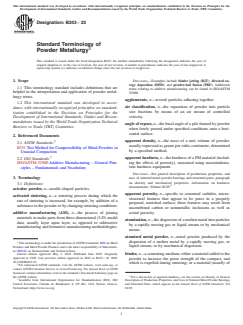
1.1 This terminology standard includes definitions that are helpful in the interpretation and application of powder metallurgy terms.
1.2 This international standard was developed in accordance with internationally recognized principles on standardization established in the Decision on Principles for the Development of International Standards, Guides and Recommendations issued by the World Trade Organization Technical Barriers to Trade (TBT) Committee.
- Status
- Published
- Publication Date
- 30-Apr-2023
- Technical Committee
- B09 - Metal Powders and Metal Powder Products
- Drafting Committee
- B09.01 - Nomenclature and Technical Data
Overview
ASTM B243-23: Standard Terminology of Powder Metallurgy is an international standard developed by ASTM International that provides essential definitions for the powder metallurgy (PM) industry. This terminology standard is designed to assist professionals, manufacturers, and researchers in accurately interpreting and applying terms related to powder metallurgy processes, materials, and products. Developed following the World Trade Organization’s internationally recognized principles on standardization, ASTM B243-23 ensures consistency and clarity in global communication within the PM field.
Key Topics
The standard covers a comprehensive range of relevant terminology for powder metallurgy, including:
- Powder Types and Morphologies: Definitions for various forms of powders such as acicular (needle-shaped), dendritic, granular, flake, and nanopowder.
- Powder Properties: Terms related to apparent density, flow rate, particle size distribution, green strength, and porosity, which are crucial for quality control.
- Processing Methods:
- Additive Manufacturing: Concepts such as additive manufacturing (AM), powder-bed fusion (PBF), binder jetting (BJT), and directed energy deposition (DED), cross-referenced to ISO/ASTM 52900.
- Traditional Processes: Sintering, isostatic pressing, compaction, roll compacting, and powder forging.
- Defects and Quality Terms: Blister cracks, lamination, segregation, warpage, and density ratio.
- Injection Molding & Compounding: Terms specific to metal injection molding (MIM), including binder, debinding, feedstock, cavity, and runner.
- Shapes and Components: Definitions for compact, preform, briquet, bar, and die sets used in PM part production.
Applications
ASTM B243-23 is used across multiple aspects of powder metallurgy, benefitting professionals who require a consistent vocabulary, including:
- Manufacturers: Ensures clear communication of requirements and specifications for PM products, improving quality control across global supply chains.
- Quality Assurance: Supports testing and inspection teams by providing agreed definitions for measurements such as apparent hardness, sintered density, and compressibility.
- Research and Development: Enables R&D teams to align on process terms and innovate new powders, composites, and AM processes.
- Standardization and Compliance: Helps organizations comply with international trade requirements and technical regulations by aligning with WTO TBT principles.
- Training and Education: Serves as a foundational reference for training new employees, technical staff, and students in the language and practices of powder metallurgy.
Related Standards
ASTM B243-23 makes direct references to several important related standards and documents, including:
- ASTM B331: Test Method for Compressibility of Metal Powders in Uniaxial Compaction, supporting terms related to powder consolidation.
- ISO/ASTM 52900: General Principles for Additive Manufacturing - Fundamentals and Vocabulary, referenced for additional AM terminology.
- Annual Book of ASTM Standards, Volume 02.05: Contains broader informational context for PM materials, testing, and properties.
Conclusion
ASTM B243-23: Standard Terminology of Powder Metallurgy provides a critical framework for the consistent use of terminology across the powder metallurgy sector. By ensuring clear definitions for industry processes, materials, and quality metrics, this standard supports technical accuracy and effective international collaboration in PM applications, additive manufacturing, and related fields.
Relations
- Refers
ASTM B331-10 - Standard Test Method for Compressibility of Metal Powders in Uniaxial Compaction - Effective Date
- 01-Oct-2010
- Effective Date
- 15-Feb-1995
- Refers
ASTM B331-95 - Standard Test Method for Compressibility of Metal Powders in Uniaxial Compaction - Effective Date
- 15-Feb-1995
Get Certified
Connect with accredited certification bodies for this standard

Element Materials Technology
Materials testing and product certification.

Inštitut za kovinske materiale in tehnologije
Institute of Metals and Technology. Materials testing, metallurgical analysis, NDT.
Sponsored listings
Frequently Asked Questions
ASTM B243-23 is a standard published by ASTM International. Its full title is "Standard Terminology of Powder Metallurgy". This standard covers: SCOPE 1.1 This terminology standard includes definitions that are helpful in the interpretation and application of powder metallurgy terms. 1.2 This international standard was developed in accordance with internationally recognized principles on standardization established in the Decision on Principles for the Development of International Standards, Guides and Recommendations issued by the World Trade Organization Technical Barriers to Trade (TBT) Committee.
SCOPE 1.1 This terminology standard includes definitions that are helpful in the interpretation and application of powder metallurgy terms. 1.2 This international standard was developed in accordance with internationally recognized principles on standardization established in the Decision on Principles for the Development of International Standards, Guides and Recommendations issued by the World Trade Organization Technical Barriers to Trade (TBT) Committee.
ASTM B243-23 is classified under the following ICS (International Classification for Standards) categories: 01.040.77 - Metallurgy (Vocabularies); 77.160 - Powder metallurgy. The ICS classification helps identify the subject area and facilitates finding related standards.
ASTM B243-23 has the following relationships with other standards: It is inter standard links to ASTM B331-10, ASTM B331-95(2002), ASTM B331-95. Understanding these relationships helps ensure you are using the most current and applicable version of the standard.
ASTM B243-23 is available in PDF format for immediate download after purchase. The document can be added to your cart and obtained through the secure checkout process. Digital delivery ensures instant access to the complete standard document.
Standards Content (Sample)
This international standard was developed in accordance with internationally recognized principles on standardization established in the Decision on Principles for the
Development of International Standards, Guides and Recommendations issued by the World Trade Organization Technical Barriers to Trade (TBT) Committee.
Designation: B243 − 23
Standard Terminology of
Powder Metallurgy
This standard is issued under the fixed designation B243; the number immediately following the designation indicates the year of
original adoption or, in the case of revision, the year of last revision. A number in parentheses indicates the year of last reapproval. A
superscript epsilon (´) indicates an editorial change since the last revision or reapproval.
DISCUSSION—Examples include binder jetting (BJT), directed en-
1. Scope
ergy deposition (DED), and powder-bed fusion (PBF). Additional
1.1 This terminology standard includes definitions that are
terms relating to additive manufacturing can be found in ISO/ASTM
helpful in the interpretation and application of powder metal-
52900.
lurgy terms.
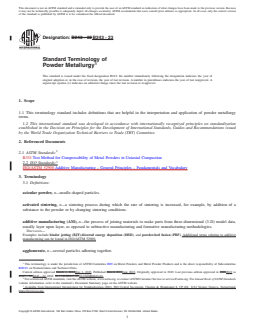
agglomerate, n—several particles adhering together.
1.2 This international standard was developed in accor-
air classification, n—the separation of powder into particle
dance with internationally recognized principles on standard-
size fractions by means of an air stream of controlled
ization established in the Decision on Principles for the
velocity.
Development of International Standards, Guides and Recom-
mendations issued by the World Trade Organization Technical
angle of repose, n—the basal angle of a pile formed by powder
Barriers to Trade (TBT) Committee.
when freely poured under specified conditions onto a hori-
zontal surface.
2. Referenced Documents
2 apparent density, n—the mass of a unit volume of powder,
2.1 ASTM Standards:
usually expressed as grams per cubic centimetre, determined
B331 Test Method for Compressibility of Metal Powders in
by a specified method.
Uniaxial Compaction
apparent hardness, n—the hardness of a PM material (includ-
2.2 ISO Standards:
ing the effects of porosity), measured using macroindenta-
ISO/ASTM 52900 Additive Manufacturing – General Prin-
tion hardness equipment.
ciples – Fundamentals and Vocabulary
DISCUSSION—See general description of production, properties, and
3. Terminology
uses of sintered metal powder bearings and structural parts, paragraph
on density and mechanical properties, information on hardness
3.1 Definitions:
measurement, Volume 02.05.
acicular powder, n—needle-shaped particles.
apparent porosity, n—specific to cemented carbides, micro-
activated sintering, n—a sintering process during which the
structural features that appear to be pores in a properly
rate of sintering is increased, for example, by addition of a
prepared, unetched surface; these features may result from
substance to the powder or by changing sintering conditions.
uncombined carbon or nonmetallic inclusions as well as
additive manufacturing (AM), n—the process of joining actual porosity.
materials to make parts from three-dimensional (3-D) model
atomization, n—the dispersion of a molten metal into particles
data, usually layer upon layer, as opposed to subtractive
by a rapidly moving gas or liquid stream or by mechanical
manufacturing and formative manufacturing methodologies.
means.
atomized metal powder, n—metal powder produced by the
dispersion of a molten metal by a rapidly moving gas, or
This terminology is under the jurisdiction of ASTM Committee B09 on Metal
Powders and Metal Powder Products and is the direct responsibility of Subcommit- liquid stream, or by mechanical dispersion.
tee B09.01 on Nomenclature and Technical Data.
binder, n—a cementing medium; either a material added to the
Current edition approved May 1, 2023. Published June 2023. Originally
approved in 1949. Last previous edition approved in 2022 as B243 – 22. DOI:
powder to increase the green strength of the compact, and
10.1520/B0243-23.
which is expelled during sintering; or a material (usually of
For referenced ASTM standards, visit the ASTM website, www.astm.org, or
contact ASTM Customer Service at service@astm.org. For Annual Book of ASTM
Standards volume information, refer to the standard’s Document Summary page on
the ASTM website. For a discussion of apparent hardness, see the section on Density in General
Available from International Organization for Standardization (ISO), ISO Description of Production, Properties, and Uses of Sintered Metal Powder Bearings
Central Secretariat, Chemin de Blandonnet 8, CP 401, 1214 Vernier, Geneva, and Structural Parts, which appears in the Annual Book of ASTM Standards, Vol
Switzerland, https://www.iso.org. 02.05.
Copyright © ASTM International, 100 Barr Harbor Drive, PO Box C700, West Conshohocken, PA 19428-2959. United States
B243 − 23
relatively lower melting point) added to a powder mixture carbonyl powder, n—a metal powder prepared by the thermal
for the specific purpose of cementing together powder decomposition of a metal carbonyl
particles which alone would not sinter into a strong body.
cavity (MIM), n—the hollow space of a mold that forms one
part.
binder (MIM), n—a mixture of polymers or other materials, or
both, that when combined with metal powders enables the
cemented carbide, n—sintered material characterized by high
mixture to flow during the injection molding process. The
strength and wear resistance and comprising one or more
binder imparts green strength to the MIM part and allows it
carbides of refractory metals as the main component bonded
to retain its molded shape.
by metallic binder phase.
binder jetting (BJT), n—additive manufacturing process in
cermet, n—sintered material containing at least one metallic
which a liquid bonding agent is selectively deposited to join
phase and at least one nonmetallic phase that is generally of
powder materials.
a ceramic nature.
binder removal, n—the chemical or thermal extraction of
chemical deposition, n—the precipitation of one metal from a
binder from a compact. Synonymous with debinding.
solution of its salts by the addition of another metal or
reagent to the solution.
blank, n—a pressed, presintered, or fully sintered compact,
usually in the unfinished condition, requiring cutting,
chemically precipitated metal powder, n—powder produced
machining, or some other operation to give it its final shape. by the reduction of a metal from a solution of its salts either
by the addition of another metal higher in the electromotive
blending, n—the thorough intermingling of powders of the
series or by other reducing agent.
same nominal composition and made by the same produc-
classification, n—separation of a powder into fractions accord-
tion method.
ing to particle size.
DISCUSSION—Not to be confused with mixing.
closed pore, n—a pore not communicating or connected with
blister crack, n—typically small defects (star burst) over or
an exterior surface.
around a bump or blister.
coin, v—to repress a sintered compact to obtain a definite
DISCUSSION—These may occur during sintering as a result of rapid
surface configuration. Synonymous with emboss (not to be
outgassing of the lubricant. The rapid outgassing may be caused by the
specified amount of lubricant being subjected to an excessive heating confused with restrike or size).
rate. The defects may also be caused by “concentrated balls” of
cold isostatic pressing (CIP), n—isostatic pressing at ambient
lubricant, or moisture. During the sintering of the copper base PM
temperature.
parts, hydrogen gas from the furnace atmosphere can diffuse into the
compact and react with residual oxygen, producing steam that can form
cold pressing, n—the forming of a compact at room tempera-
blisters and cracks. In that industry, this is also called embrittlement,
ture.
and is not to be confused with the hydrogen embrittlement of high
strength steel.
cold welding, n—cohesion between two surfaces of metal,
blistered compact, n—a sintered object characterized by generally under the influence of externally applied pressure,
at room temperature.
having blisters or eruptions on the surface.
DISCUSSION—Often used to describe the mechanism by which powder
DISCUSSION—In ferrous materials, this effect is often caused by in situ
particles develop initial bonds and a pressed compact develops green
gas decomposition and soot formation that forces particles apart and
strength.
causes the compact to blister.
comminuted powder, n—a powder produced by mechanical
bridging, n—the formation of arched cavities in a powder
attrition of solid metal or powder
mass.
communicating pores, n—see interconnected porosity.
briquet, n—see compact.
compact, n—an object produced by the compression of metal
brown part, n—an MIM part that has had a majority of the
powder, generally while confined in a die, with or without
binder (first stage) removed. Synonymous with debound
the inclusion of nonmetallic constituents. Synonymous with
part.
briquet.
bulk density, n—the mass per unit volume of a powder under
compactibility, n—a conceptual term, encompassing the pow-
nonstandard conditions, for example, in a shipping container
der characteristics of compressibility, green strength, edge
(not to be confused with apparent density).
retention, and lamination tendency, that relates to the ability
of a powder to be consolidated into a usable green compact.
burn-off, n—removal of organic additives (binder or lubricant)
from a compact by heating.
compacting, n—a process in which a powder held in a die or
other container is subjected to an external force in order to
cake, n—a bonded mass of unpressed metal powder.
densify the powder and produce a compact of prescribed
DISCUSSION—Often refers to the form of powder as it exits a furnace. shape and dimensions.
B243 − 23
compacting pressure (uniaxial), n—applied force divided by (RD) as opposed to those cracks produced by other systems,
the projected area of contact with the punch(es). that is, metal injection molding, vacuum hot pressing, and so
forth.
compacting tool set, n—an assembly of tooling items in which
cross-product contamination, n—the unintentional mixing of
powder is pressed.
powders with distinct differences in either physical charac-
DISCUSSION—May include a die, punches, and core rods.
teristics or chemical composition or both.
completely alloyed powder, n—see pre-alloyed powder.
cut, n—see fraction.
composite compact, n—a metal powder compact consisting of
debinding, n—see binder removal.
two or more adhering layers, rings, or other shapes of
debound part, n—see brown part.
different metals or alloys with each material retaining its
original identity.
dendritic powder, n—particles, usually of electrolytic origin,
having the typical pine tree structure.
composite powder, n—a powder in which each particle
consists of two or more distinct constituents.
densification crack, n—a defect caused by differential stresses
in a region of a part that has experienced large differences in
compound compact, n—a metal powder compact consisting
shrinkage during sintering.
of mixed metals, the particles of which are joined by
density (dry), n—see sintered density.
pressing or sintering, or both, with each metal particle
retaining substantially its original composition.
density (wet), n—see impregnated density.
compounding (MIM), n—process whereby the metal powders
density ratio, n—the ratio, often expressed as a percentage, of
and molten binder constituents are combined to produce a
the density of a porous material to the density of the same
feedstock.
material completely free of porosity. Synonymous with
relative density.
compressibility, n—the capacity of a metal powder to be
densified under a uniaxially applied pressure in a closed die.
die, n—a member of the compacting tool set forming the cavity
DISCUSSION—Compressibility is measured in accordance with Test
in which the powder is compacted or a PM compact is
Method B331 and may be expressed numerically as the pressure to
repressed.
reach a specified density, or alternatively the density at a given
pressure.
die body, n—the stationary or fixed part of a die.
compression ratio, n—the ratio of the volume of the loose die insert, n—a removable liner or part of a die body.
powder to the volume of the compact made from it.
die set, n—the parts of a press that hold and locate the die in
Synonymous with fill ratio.
proper relation to the punches.
continuous sintering, n—presintering, or sintering, in such
diffusion-alloyed powder, n—a partially alloyed powder pro-
manner that the objects are advanced through the furnace at
duced by means of a diffusion anneal.
a fixed rate by manual or mechanical means. Synonymous
with stoking. dimensional change of a compact, n—the difference, at room
temperature, between the size of the sintered specimen and
cooling rate, n—the average temperature change per second
the die size.
between prescribed temperatures during the cooling phase of
DISCUSSION—The difference in dimensions is usually reported as a
a thermal process.
percentage of the die size. It should include a (+) when the sintered part
is larger than the die size and a (−) when the sintered part is smaller
core rod, n—a member of the compacting tool set that forms
than the die size.
internal features such as splines, diameters, keyways, or
other profiles in a PM compact.
directed energy deposition (DED), n—additive manufactur-
ing process in which focused thermal energy is used to fuse
cored bar, n—a compact of bar shape heated by its own
materials by melting as they are being deposited.
electrical resistance to a temperature high enough to melt its
DISCUSSION—“Focused thermal energy” means that an energy source
interior.
(for example, laser, electron beam, or plasma arc) is focused to melt the
materials being deposited.
crack (RD), n—generally a planar defect.
disintegration, n—the reduction of massive material to pow-
cracked ammonia, n—see dissociated ammonia.
der.
cracks (rigid die system (RD)), n—the following names and
definitions apply only to items produced in a rigid die system
There is detailed information on numerous cracks, their location, cause, and
prevention in a handbook published by Metal Powder Industries Federation,
Princeton, New Jersey, “The Common Cracks in PM Compacts” by D. Zenger and
See Test Method B331. H. Cai.
B243 − 23
dispersion-strengthened material, n—a material consisting fluid permeability, n—see permeability.
of a metal and finely dispersed, substantially insoluble,
fraction, n—the portion of a powder sample that lies between
metallic or nonmetallic phase.
two stated particle sizes. Synonymous with cut.
dissociated ammonia, n—a reducing gas produced by the
fully dense material, n—a material completely free of porosity
thermal decomposition of anhydrous ammonia over a
and voids.
catalyst, resulting in a gas of 75 % hydrogen and 25 %
DISCUSSION—This is a conceptual term. In practice, complete densi-
nitrogen. Synonymous with cracked ammonia.
fication is difficult to achieve and some microporosity will generally be
double-action pressing, n—a method by which a powder is
present. The measured density of a material depends on its specific
pressed in a die between opposing moving punches. chemistry, thermomechanical condition, and microstructure.
gas classification, n—the separation of powder into particle
double press-double sinter, n—to repress and sinter a previ-
size fractions by means of a gas stream of controlled
ously presintered or sintered compact.
velocity.
DISCUSSION—Used to describe a four-step manufacturing process.
gate, n—the interface in the flow channel between the runner
ejection crack, n—a defect that occurs during the removal of
and the mold cavity.
the compact from the tooling (usually occurs in multilevel
granular powder, n—particles having approximately equidi-
parts that are not supported uniformly on all lower surfaces).
mensional nonspherical shapes.
electrolytic powder, n—powder produced by electrolytic de-
granulation, n—the production of coarse metal particles by
position or by the pulverization of an electrodeposit.
pouring the molten metal through a screen into water
endothermic gas, n—a reducing gas atmosphere used in
(shotting) or by violent agitation of the molten metal while
sintering, produced by the reaction of a hydrocarbon vapor
solidifying.
and air over a catalyst with the use of an external heat
green, n—unsintered (not sintered); for example, green
source. It is low in carbon dioxide and water vapor while
compact, green density, green strength.
containing combustibles of about 60 atomic percent hydro-
gen and carbon monoxide combined.
green crack, n—a defect that occurs prior to sintering.
equalizing, n—see blending.
green density, n—the mass per unit volume of an unsintered
compact.
exothermic atmosphere (gas), n—a reducing gas atmosphere
used in sintering, produced by partial or complete combus-
green expansion, n—the increase in dimensions of an ejected
tion of hydrocarbon fuel gas and air with the associated
compact relative to the die dimensions, measured at right
generation of heat. The maximum combustible content is
angles to the direction of pressing. Synonymous with
approximately 25 atomic percent.
springback.
explosive compaction, n—high-energy consolidation of pow-
green strength, n—stress required to break an unsintered
ders by means of a detonation shock wave.
compact.
exudation, n—the action by which all or a portion of the low
growth, n—an increase in dimensions of a compact which may
melting constituent of a compact is forced to the surface
occur during sintering. (Converse of shrinkage.)
during sintering. Sometimes referred to as “bleed out.”
hardmetal, n—see cemented carbide.
Synonymous with sweating.
heating rate, n—the average temperature change per unit time
feedshoe, n—a part of the compacting press that delivers
between prescribed temperatures during the heating phase of
powder to the die cavity, usually by sliding an open-
a thermal process.
bottomed powder container over the open top of the die.
hold pressure, n—the melt pressure, or the pressure applied by
feedstock, n—in metal injection molding (MIM), a moldable
the molding machine during the hold time interval.
mixture of metal powder and binder.
hot densification, n—the consolidation, at an elevated pressure
fill ratio, n—see compression ratio.
and at a temperature that often results in recrystallization, of
fines, n— the portion of a powder composed of particles which
an unsintered, presintered, or sintered powder preform, or of
are smaller than a specified size, currently less than 44 μm.
encapsulated or loose powder, to reduce porosity.
See also superfines.
hot isostatic pressing (HIP), n—isostatic pressing at an
flake powder, n—flat or scale-like particles whose thickness is
elevated temperature.
small compared with the other dimensions.
hot pressing, n—pressure-assisted, low strain rate uniaxial
flow rate, n—the time required for a powder sample of densification of a powder preform, compact, or encapsulated
standard weight to flow through an orifice in a standard or loose powder at a temperature sufficient to induce
instrument according to a specified procedure. diffusion or creep.
B243 − 23
hot repress powder forging, n—hot densification of a PM jetting, n—a condition that arises during the rapid filling of an
preform by forging where the material flow is mainly in the injection mold where the feedstock shoots across the mold
direction of forging. and fills back toward the gate.
hot upset powder forging, n—hot densification of a PM knit-line, n—a mark on, or location in, a molded part formed
preform by forging where there is a significant amount of by the union of two or more streams of feedstock flowing
together.
lateral material flow.
DISCUSSION—Synonymous with “weldline.”
hybrid-alloy powder, n—a pre-alloyed or diffusion-alloyed
lamination crack, n—a defect(s) roughly parallel to the punch
powder to which either elemental or master-alloy metal
faces of the part (these defects usually occur when powder is
powders have been admixed.
compressed to high density and the relaxation forces during
hydrogen loss, n—the loss in weight of metal powder or of a
pressure release exceed the binding force between the
compact caused by heating a representative sample for a
particles).
specified time and temperature in a purified hydrogen
liquid phase sintering, n—sintering of a compact, or loose
atmosphere—broadly, a measure of the oxygen content of
powder aggregate, under conditions in which a liquid phase
the sample when applied to materials containing only such
is present during part of the sintering cycle.
oxides as are reducible with hydrogen and no hydride-
forming element.
lot, n—a specified quantity of product manufactured under
traceable, controlled conditions as agreed between producer
hydrogen-reduced powder, n—powder produced by the re-
and user.
duction of a metal oxide in an atmosphere containing
hydrogen.
lubricant, n—material used to reduce inter-particle friction
and the friction between the powder mass and the tooling.
impregnated density, n—the mass per unit volume of a
sintered PM part or test specimen, impregnated with oil or
lubricant (admixed), n—a lubricant incorporated into a po
...
This document is not an ASTM standard and is intended only to provide the user of an ASTM standard an indication of what changes have been made to the previous version. Because
it may not be technically possible to adequately depict all changes accurately, ASTM recommends that users consult prior editions as appropriate. In all cases only the current version
of the standard as published by ASTM is to be considered the official document.
Designation: B243 − 22 B243 − 23
Standard Terminology of
Powder Metallurgy
This standard is issued under the fixed designation B243; the number immediately following the designation indicates the year of
original adoption or, in the case of revision, the year of last revision. A number in parentheses indicates the year of last reapproval. A
superscript epsilon (´) indicates an editorial change since the last revision or reapproval.
1. Scope
1.1 This terminology standard includes definitions that are helpful in the interpretation and application of powder metallurgy
terms.
1.2 This international standard was developed in accordance with internationally recognized principles on standardization
established in the Decision on Principles for the Development of International Standards, Guides and Recommendations issued
by the World Trade Organization Technical Barriers to Trade (TBT) Committee.
2. Referenced Documents
2.1 ASTM Standards:
B331 Test Method for Compressibility of Metal Powders in Uniaxial Compaction
2.2 ISO Standards:
ISO/ASTM 52900 Additive Manufacturing – General Principles – Fundamentals and Vocabulary
3. Terminology
3.1 Definitions:
acicular powder, n—needle-shaped particles.
activated sintering, n—a sintering process during which the rate of sintering is increased, for example, by addition of a
substance to the powder or by changing sintering conditions.
additive manufacturing (AM), n—the process of joining materials to make parts from three-dimensional (3-D) model data,
usually layer upon layer, as opposed to subtractive manufacturing and formative manufacturing methodologies.
DISCUSSION—
Examples include binder jetting (BJT),directed energy deposition (DED), and powder-bed fusion (PBF). Additional terms relating to additive
manufacturing can be found in ISO/ASTM 52900.
agglomerate, n—several particles adhering together.
This terminology is under the jurisdiction of ASTM Committee B09 on Metal Powders and Metal Powder Products and is the direct responsibility of Subcommittee
B09.01 on Nomenclature and Technical Data.
Current edition approved March 1, 2022May 1, 2023. Published March 2022June 2023. Originally approved in 1949. Last previous edition approved in 20202022 as
B243 – 20.B243 – 22. DOI: 10.1520/B0243-22.10.1520/B0243-23.
For referenced ASTM standards, visit the ASTM website, www.astm.org, or contact ASTM Customer Service at service@astm.org. For Annual Book of ASTM Standards
volume information, refer to the standard’s Document Summary page on the ASTM website.
Available from International Organization for Standardization (ISO), ISO Central Secretariat, Chemin de Blandonnet 8, CP 401, 1214 Vernier, Geneva, Switzerland,
https://www.iso.org.
Copyright © ASTM International, 100 Barr Harbor Drive, PO Box C700, West Conshohocken, PA 19428-2959. United States
B243 − 23
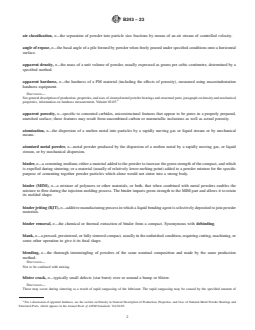
air classification, n—the separation of powder into particle size fractions by means of an air stream of controlled velocity.
angle of repose, n—the basal angle of a pile formed by powder when freely poured under specified conditions onto a horizontal
surface.
apparent density, n—the mass of a unit volume of powder, usually expressed as grams per cubic centimetre, determined by a
specified method.
apparent hardness, n—the hardness of a PM material (including the effects of porosity), measured using macroindentation
hardness equipment.
DISCUSSION—
See general description of production, properties, and uses of sintered metal powder bearings and structural parts, paragraph on density and mechanical
properties, information on hardness measurement, Volume 02.05.
apparent porosity, n—specific to cemented carbides, microstructural features that appear to be pores in a properly prepared,
unetched surface; these features may result from uncombined carbon or nonmetallic inclusions as well as actual porosity.
atomization, n—the dispersion of a molten metal into particles by a rapidly moving gas or liquid stream or by mechanical
means.
atomized metal powder, n—metal powder produced by the dispersion of a molten metal by a rapidly moving gas, or liquid
stream, or by mechanical dispersion.
binder, n—a cementing medium; either a material added to the powder to increase the green strength of the compact, and which
is expelled during sintering; or a material (usually of relatively lower melting point) added to a powder mixture for the specific
purpose of cementing together powder particles which alone would not sinter into a strong body.
binder (MIM), n—a mixture of polymers or other materials, or both, that when combined with metal powders enables the
mixture to flow during the injection molding process. The binder imparts green strength to the MIM part and allows it to retain
its molded shape.
binder jetting (BJT), n—additive manufacturing process in which a liquid bonding agent is selectively deposited to join powder
materials.
binder removal, n—the chemical or thermal extraction of binder from a compact. Synonymous with debinding.
blank, n—a pressed, presintered, or fully sintered compact, usually in the unfinished condition, requiring cutting, machining, or
some other operation to give it its final shape.
blending, n—the thorough intermingling of powders of the same nominal composition and made by the same production
method.
DISCUSSION—
Not to be confused with mixing.
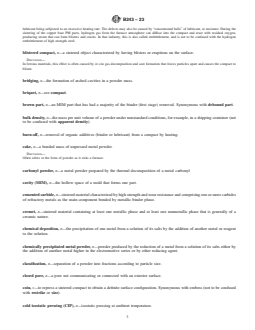
blister crack, n—typically small defects (star burst) over or around a bump or blister.
DISCUSSION—
These may occur during sintering as a result of rapid outgassing of the lubricant. The rapid outgassing may be caused by the specified amount of
For a discussion of apparent hardness, see the section on Density in General Description of Production, Properties, and Uses of Sintered Metal Powder Bearings and
Structural Parts, which appears in the Annual Book of ASTM Standards, Vol 02.05.
B243 − 23
lubricant being subjected to an excessive heating rate. The defects may also be caused by “concentrated balls” of lubricant, or moisture. During the
sintering of the copper base PM parts, hydrogen gas from the furnace atmosphere can diffuse into the compact and react with residual oxygen,
producing steam that can form blisters and cracks. In that industry, this is also called embrittlement, and is not to be confused with the hydrogen
embrittlement of high strength steel.
blistered compact, n—a sintered object characterized by having blisters or eruptions on the surface.
DISCUSSION—
In ferrous materials, this effect is often caused by in situ gas decomposition and soot formation that forces particles apart and causes the compact to
blister.
bridging, n—the formation of arched cavities in a powder mass.
briquet, n—see compact.
brown part, n—an MIM part that has had a majority of the binder (first stage) removed. Synonymous with debound part.
bulk density, n—the mass per unit volume of a powder under nonstandard conditions, for example, in a shipping container (not
to be confused with apparent density).
burn-off, n—removal of organic additives (binder or lubricant) from a compact by heating.
cake, n—a bonded mass of unpressed metal powder.
DISCUSSION—
Often refers to the form of powder as it exits a furnace.
carbonyl powder, n—a metal powder prepared by the thermal decomposition of a metal carbonyl
cavity (MIM), n—the hollow space of a mold that forms one part.
cemented carbide, n—sintered material characterized by high strength and wear resistance and comprising one or more carbides
of refractory metals as the main component bonded by metallic binder phase.
cermet, n—sintered material containing at least one metallic phase and at least one nonmetallic phase that is generally of a
ceramic nature.
chemical deposition, n—the precipitation of one metal from a solution of its salts by the addition of another metal or reagent
to the solution.
chemically precipitated metal powder, n—powder produced by the reduction of a metal from a solution of its salts either by
the addition of another metal higher in the electromotive series or by other reducing agent.
classification, n—separation of a powder into fractions according to particle size.
closed pore, n—a pore not communicating or connected with an exterior surface.
coin, v—to repress a sintered compact to obtain a definite surface configuration. Synonymous with emboss (not to be confused
with restrike or size).
cold isostatic pressing (CIP), n—isostatic pressing at ambient temperature.
B243 − 23
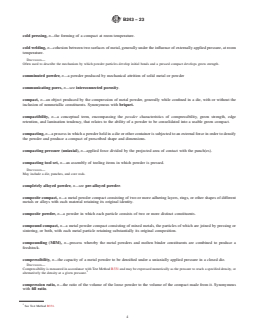
cold pressing, n—the forming of a compact at room temperature.
cold welding, n—cohesion between two surfaces of metal, generally under the influence of externally applied pressure, at room
temperature.
DISCUSSION—
Often used to describe the mechanism by which powder particles develop initial bonds and a pressed compact develops green strength.
comminuted powder, n—a powder produced by mechanical attrition of solid metal or powder
communicating pores, n—see interconnected porosity.
compact, n—an object produced by the compression of metal powder, generally while confined in a die, with or without the
inclusion of nonmetallic constituents. Synonymous with briquet.
compactibility, n—a conceptual term, encompassing the powder characteristics of compressibility, green strength, edge
retention, and lamination tendency, that relates to the ability of a powder to be consolidated into a usable green compact.
compacting, n—a process in which a powder held in a die or other container is subjected to an external force in order to densify
the powder and produce a compact of prescribed shape and dimensions.
compacting pressure (uniaxial), n—applied force divided by the projected area of contact with the punch(es).
compacting tool set, n—an assembly of tooling items in which powder is pressed.
DISCUSSION—
May include a die, punches, and core rods.
completely alloyed powder, n—see pre-alloyed powder.
composite compact, n—a metal powder compact consisting of two or more adhering layers, rings, or other shapes of different
metals or alloys with each material retaining its original identity.
composite powder, n—a powder in which each particle consists of two or more distinct constituents.
compound compact, n—a metal powder compact consisting of mixed metals, the particles of which are joined by pressing or
sintering, or both, with each metal particle retaining substantially its original composition.
compounding (MIM), n—process whereby the metal powders and molten binder constituents are combined to produce a
feedstock.
compressibility, n—the capacity of a metal powder to be densified under a uniaxially applied pressure in a closed die.
DISCUSSION—
Compressibility is measured in accordance with Test Method B331 and may be expressed numerically as the pressure to reach a specified density, or
alternatively the density at a given pressure.
compression ratio, n—the ratio of the volume of the loose powder to the volume of the compact made from it. Synonymous
with fill ratio.
See Test Method B331.
B243 − 23
continuous sintering, n—presintering, or sintering, in such manner that the objects are advanced through the furnace at a fixed
rate by manual or mechanical means. Synonymous with stoking.
cooling rate, n—the average temperature change per second between prescribed temperatures during the cooling phase of a
thermal process.
core rod, n—a member of the compacting tool set that forms internal features such as splines, diameters, keyways, or other
profiles in a PM compact.
cored bar, n—a compact of bar shape heated by its own electrical resistance to a temperature high enough to melt its interior.
crack (RD), n—generally a planar defect.
cracked ammonia, n—see dissociated ammonia.
cracks (rigid die system (RD)), n—the following names and definitions apply only to items produced in a rigid die system (RD)
as opposed to those cracks produced by other systems, that is, metal injection molding, vacuum hot pressing, and so forth.
cross-product contamination, n—the unintentional mixing of powders with distinct differences in either physical character-
istics or chemical composition or both.
cut, n—see fraction.
debinding, n—see binder removal.
debound part, n—see brown part.
dendritic powder, n—particles, usually of electrolytic origin, having the typical pine tree structure.
densification crack, n—a defect caused by differential stresses in a region of a part that has experienced large differences in
shrinkage during sintering.
density (dry), n—see sintered density.
density (wet), n—see impregnated density.
density ratio, n—the ratio, often expressed as a percentage, of the density of a porous material to the density of the same material
completely free of porosity. Synonymous with relative density.
die, n—a member of the compacting tool set forming the cavity in which the powder is compacted or a PM compact is repressed.
die body, n—the stationary or fixed part of a die.
die insert, n—a removable liner or part of a die body.
There is detailed information on numerous cracks, their location, cause, and prevention in a handbook published by Metal Powder Industries Federation, Princeton, New
Jersey, “The Common Cracks in PM Compacts” by D. Zenger and H. Cai.
B243 − 23
die set, n—the parts of a press that hold and locate the die in proper relation to the punches.
diffusion-alloyed powder, n—a partially alloyed powder produced by means of a diffusion anneal.
dimensional change of a compact, n—the difference, at room temperature, between the size of the sintered specimen and the
die size.
DISCUSSION—
The difference in dimensions is usually reported as a percentage of the die size. It should include a (+) when the sintered part is larger than the die
size and a (−) when the sintered part is smaller than the die size.
directed energy deposition (DED), n—additive manufacturing process in which focused thermal energy is used to fuse
materials by melting as they are being deposited.
DISCUSSION—
“Focused thermal energy” means that an energy source (for example, laser, electron beam, or plasma arc) is focused to melt the materials being
deposited.
disintegration, n—the reduction of massive material to powder.
dispersion-strengthened material, n—a material consisting of a metal and finely dispersed, substantially insoluble, metallic or
nonmetallic phase.
dissociated ammonia, n—a reducing gas produced by the thermal decomposition of anhydrous ammonia over a catalyst,
resulting in a gas of 75 % hydrogen and 25 % nitrogen. Synonymous with cracked ammonia.
double-action pressing, n—a method by which a powder is pressed in a die between opposing moving punches.
double press-double sinter, n—to repress and sinter a previously presintered or sintered compact.
DISCUSSION—
Used to describe a four-step manufacturing process.
ejection crack, n—a defect that occurs during the removal of the compact from the tooling (usually occurs in multilevel parts
that are not supported uniformly on all lower surfaces).
electrolytic powder, n—powder produced by electrolytic deposition or by the pulverization of an electrodeposit.
endothermic gas, n—a reducing gas atmosphere used in sintering, produced by the reaction of a hydrocarbon vapor and air over
a catalyst with the use of an external heat source. It is low in carbon dioxide and water vapor while containing combustibles
of about 60 atomic percent hydrogen and carbon monoxide combined.
equalizing, n—see blending.
exothermic atmosphere (gas), n—a reducing gas atmosphere used in sintering, produced by partial or complete combustion of
hydrocarbon fuel gas and air with the associated generation of heat. The maximum combustible content is approximately 25
atomic percent.
explosive compaction, n—high-energy consolidation of powders by means of a detonation shock wave.
exudation, n—the action by which all or a portion of the low melting constituent of a compact is forced to the surface during
sintering. Sometimes referred to as “bleed out.” Synonymous with sweating.
B243 − 23
feedshoe, n—a part of the compacting press that delivers powder to the die cavity, usually by sliding an open-bottomed powder
container over the open top of the die.
feedstock, n—in metal injection molding (MIM), a moldable mixture of metal powder and binder.
fill ratio, n—see compression ratio.
fines, n— the portion of a powder composed of particles which are smaller than a specified size, currently less than 44 μm. See
also superfines.
flake powder, n—flat or scale-like particles whose thickness is small compared with the other dimensions.
flow rate, n—the time required for a powder sample of standard weight to flow through an orifice in a standard instrument
according to a specified procedure.
fluid permeability, n—see permeability.
fraction, n—the portion of a powder sample that lies between two stated particle sizes. Synonymous with cut.
fully dense material, n—a material completely free of porosity and voids.
DISCUSSION—
This is a conceptual term. In practice, complete densification is difficult to achieve and some microporosity will generally be present. The measured
density of a material depends on its specific chemistry, thermomechanical condition, and microstructure.
gas classification, n—the separation of powder into particle size fractions by means of a gas stream of controlled velocity.
gate, n—the interface in the flow channel between the runner and the mold cavity.
granular powder, n—particles having approximately equidimensional nonspherical shapes.
granulation, n—the production of coarse metal particles by pouring the molten metal through a screen into water (shotting) or
by violent agitation of the molten metal while solidifying.
green, n—unsintered (not sintered); for example, green compact, green density, green strength.
green crack, n—a defect that occurs prior to sintering.
green density, n—the mass per unit volume of an unsintered compact.
green expansion, n—the increase in dimensions of an ejected compact relative to the die dimensions, measured at right angles
to the direction of pressing. Synonymous with springback.
green strength, n—stress required to break an unsintered compact.
growth, n—an increase in dimensions of a compact which may occur during sintering. (Converse of shrinkage.)
hardmetal, n—see cemented carbide.
B243 − 23
heating rate, n—the average temperature change per unit time between prescribed temperatures during the heating phase of a
thermal process.
hold pressure, n—the melt pressure, or the pressure applied by the molding machine during the hold time interval.
hot densification, n—the consolidation, at an elevated pressure and at a temperature that often results in recrystallization, of an
unsintered, presintered, or sintered powder preform, or of encapsulated or loose powder, to reduce porosity.
hot isostatic pressing (HIP), n—isostatic pressing at an elevated temperature.
hot pressing, n—pressure-assisted, low strain rate uniaxial densification of a powder preform, compact, or encapsulated or loose
powder at a temperature sufficient to induce diffusion or creep.
hot repress powder forging, n—hot densification of a PM preform by forging where the material flow is mainly in the direction
of forging.
hot upset powder forging, n—hot densification of a PM preform by forging where there is a significant amount of lateral
material flow.
hybrid-alloy powder, n—a pre-alloyed or diffusion-alloyed powder to which either elemental or master-alloy metal powders
have been admixed.
hydrogen loss, n—the loss in weight of metal powder or of a compact caused by heating a representative sample for a specified
time and temperature in a purified hydrogen atmosphere—broadly, a measure of the oxygen content of the sample when applied
to materials containing only such oxides as are reducible with hydrogen and no hydride-forming element.
hydrogen-reduced powder, n—powder produced by the reduction of a metal oxide in an atmosphere containing hydrogen.
impregnated density, n—the mass per unit volume of a sintered PM part or test specimen, impregnated with oil or other
lubricants. Synonymous with density (wet).
impregnation, n—a process of filling the pores of a sintered compact, with a nonmetallic material such as oil, wax, or resin.
infiltrant efficiency, n—the ratio of the mass of infiltrant absorbed by the part to the mass of infiltrant originally used, expressed
as a percentage.
infiltration, n—a process of filling the pores of a sintered, or unsintered, compact with a metal or alloy of lower melting point.
infiltration erosion, n—the pitting, channeling, and coarsening of the surface porosity that results from the dissolution of the
base metal by the liquid infiltrant, as the infiltrant flows into the matrix.
infiltration loading density, n—infiltrant weight per unit area of contact between infiltrant and part.
infiltration residue, n—material that remains on the surface of the part after infiltration.
interconnected porosity, n—a network of mutually connected pores that may or may not extend to an exterior surface.
Synonymous with communi
...