

ASTM A20/A20M-20
(Specification)Standard Specification for General Requirements for Steel Plates for Pressure Vessels
General Information
- Abstract
ABSTRACT
This specification covers a group of common requirements that apply to rolled steel plates for pressure vessels. The steel shall be made in an open-hearth, basic-oxygen, or electric-arc furnace process. Sampling and methods for chemical analysis are discussed. Yield strength tests, tension tests, and notch-toughness tests shall be made in accordance to the product specification to conform to the specified requirements.
SCOPE
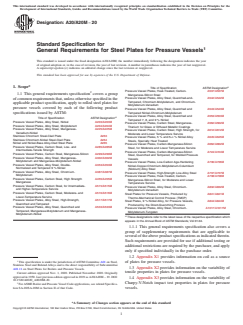
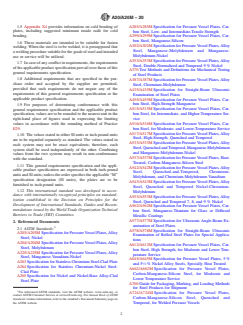
1.1 This general requirements specification2 covers a group of common requirements that, unless otherwise specified in the applicable product specification, apply to rolled steel plates for pressure vessels covered by each of the following product specifications issued by ASTM:
Title of Specification
ASTM DesignationA
Pressure Vessel Plates, Alloy Steel, Nickel
A203/A203M
Pressure Vessel Plates, Alloy Steel, Molybdenum
A204/A204M
Pressure Vessel Plates, Alloy Steel, Manganese-
Vanadium-Nickel
A225/A225M
Stainless Chromium Steel-Clad Plate
A263
Stainless Chromium-Nickel Steel-Clad Plate
A264
Nickel and Nickel-Base Alloy-Clad Steel Plate
A265
Pressure Vessel Plates, Carbon Steel, Low- and
Intermediate-Tensile Strength
A285/A285M
Pressure Vessel Plates, Carbon Steel, Manganese-Silicon
A299/A299M
Pressure Vessel Plates, Alloy Steel, Manganese-
Molybdenum and Manganese-Molybdenum-Nickel
A302/A302M
Pressure Vessel Plates, Alloy Steel, Double-
Normalized and Tempered 9 % Nickel
A353/A353M
Pressure Vessel Plates, Alloy Steel, Chromium-
Molybdenum
A387/A387M
Pressure Vessel Plates, Carbon Steel, High Strength
Manganese
A455/A455M
Pressure Vessel Plates, Carbon Steel, for Intermediate-
and Higher-Temperature Service
A515/A515M
Pressure Vessel Plates, Carbon Steel, Moderate- and
Lower-Temperature Service
A516/A516M
Pressure Vessel Plates, Alloy Steel, High-Strength,
Quenched and Tempered
A517/A517M
Pressure Vessel Plates, Alloy Steel, Quenched and
Tempered, Manganese-Molybdenum and Manganese-
Molybdenum-Nickel
A533/A533M
Title of Specification
ASTM DesignationA
Pressure Vessel Plates, Heat-Treated, Carbon-
Manganese-Silicon Steel
A537/A537M
Pressure Vessel Plates, Alloy Steel, Quenched-and-
Tempered, Chromium-Molybdenum, and Chromium-
Molybdenum-Vanadium
A542/A542M
Pressure Vessel Plates, Alloy Steel, Quenched and
Tempered Nickel-Chromium-Molybdenum
A543/A543M
Pressure Vessel Plates, Alloy Steel, Quenched and
Tempered 7, 8, and 9 % Nickel
A553/A553M
Pressure Vessel Plates, Carbon Steel, Manganese-
Titanium for Glass or Diffused Metallic Coatings
A562/A562M
Pressure Vessel Plates, Carbon Steel, High Strength, for
Moderate and Lower Temperature Service
A612/A612M
Pressure Vessel Plates, 5 % and 51/2 % Nickel Alloy
Steels, Specially Heat Treated
A645/A645M
Pressure Vessel Plates, Carbon-Manganese-Silicon
Steel, for Moderate and Lower Temperature Service
A662/A662M
Pressure Vessel Plates, Carbon-Manganese-Silicon
Steel, Quenched and Tempered, for Welded Pressure
Vessels
A724/A724M
Pressure Vessel Plates, Low-Carbon Age-Hardening
Nickel-Copper-Chromium-Molybdenum-Columbium
(Niobium) Alloy Steel
A736/A736M
Pressure Vessel Plates, High-Strength Low-Alloy Steel
A737/A737M
Pressure Vessel Plates, Heat-Treated, Carbon-
Manganese-Silicon Steel, for Moderate and Lower
Temperature Service
A738/A738M
Pressure Vessel Plates, Alloy Steel, Chromium-
Molybdenum-Vanadium
A832/A832M
Steel Plates for Pressure Vessels, Produced by
Thermo-Mechanical Control Process (TMCP)
A841/A841M
Steel Plates, 9 % Nickel Alloy, for Pressure Vessels,
Produced by the Direct-Quenching Process
A844/A844M
Pressure Vessel Plates, Alloy Steel, Chromium-
Molybdenum-Tungsten
A1017/A1017M
1.1.1...
- Status
- Published
- Publication Date
- 31-Oct-2020
- Technical Committee
- A01 - Steel, Stainless Steel and Related Alloys
- Drafting Committee
- A01.11 - Steel Plates for Boilers and Pressure Vessels
Buy Documents
ASTM A20/A20M-20 - Standard Specification for General Requirements for Steel Plates for Pressure Vessels
REDLINE ASTM A20/A20M-20 - Standard Specification for General Requirements for Steel Plates for Pressure Vessels
Overview
ASTM A20/A20M-20 is the Standard Specification for General Requirements for Steel Plates for Pressure Vessels, published by ASTM International. This standard provides a set of unified requirements that apply to a broad range of steel plates manufactured for use in pressure vessels. It covers general mechanical, chemical, and testing criteria that ensure consistency, quality, and safety in the production and use of steel plates for pressure-containing equipment. The specification is intended to be used in conjunction with various product-specific ASTM standards for pressure vessel plates, ensuring that the foundational requirements are met across multiple grades and applications.
Key Topics
- Scope: Applies to rolled steel plates intended for pressure vessel applications, produced via open-hearth, basic-oxygen, or electric-arc furnace processes.
- Uniform Requirements: Establishes overarching criteria related to materials, heat treatment, sampling, chemical analysis, and mechanical property testing (yield strength, tensile strength, and notch-toughness).
- Supplementary Provisions: Includes additional testing or restrictions when specified in the purchase order, such as supplementary impact or through-thickness testing.
- Ordering Information: Details the necessary data to include when ordering, including plate quantity, size, steel grade, test requirements, and specific processing conditions.
- Chemical and Mechanical Testing: Specifies test methods for chemical composition and mechanical performance, referencing required ASTM testing standards.
- Quality and Defect Management: Addresses surface and edge imperfections, conditions for repair by welding, and acceptance criteria for finished plates.
- Heat Treatment Guidance: Defines roles and responsibilities around heat treatment, including instructions for plates supplied as-rolled, normalized, or quenched and tempered.
- Measurement Units: Recognizes both SI and inch-pound units, requiring consistency and prohibiting the mixing of unit systems within orders or test reports.
- Fusion Welding Suitability: Indicates that materials compliant with this standard are suitable for fusion welding, provided appropriate procedures are followed.
Applications
ASTM A20/A20M-20 is widely used in industries requiring high-performance steel plates for pressure containment, such as:
- Boiler Manufacturing: Ensures steel plates used in boilers meet standardized requirements for toughness and strength.
- Petrochemical and Chemical Processing: Guarantees reliability of steel plates in reactors, separators, and pressure vessels handling hazardous materials.
- Power Generation: Used in the fabrication of pressure vessels and heat exchangers for fossil, nuclear, and renewable energy plants.
- Oil & Gas Industry: Applies to steel plates used in piping, storage tanks, and vessel construction for upstream and downstream energy facilities.
- Industrial Equipment: Used in autoclaves, storage tanks, and other equipment where internal pressure is a safety concern.
By applying the unified requirements of ASTM A20/A20M-20, manufacturers and end-users can ensure consistent mechanical performance, reliable weldability, and regulatory compliance across various pressure vessel applications.
Related Standards
ASTM A20/A20M-20 serves as the foundational standard for numerous pressure vessel plate product specifications, including but not limited to:
- A203/A203M - Pressure Vessel Plates, Alloy Steel, Nickel
- A204/A204M - Pressure Vessel Plates, Alloy Steel, Molybdenum
- A285/A285M - Pressure Vessel Plates, Carbon Steel, Low- and Intermediate-Tensile Strength
- A515/A515M - Pressure Vessel Plates, Carbon Steel, for Intermediate- and Higher-Temperature Service
- A516/A516M - Pressure Vessel Plates, Carbon Steel, for Moderate- and Lower-Temperature Service
- A537/A537M - Pressure Vessel Plates, Heat-Treated, Carbon-Manganese-Silicon Steel
- A387/A387M - Pressure Vessel Plates, Alloy Steel, Chromium-Molybdenum
Referenced Test Methods and Practices:
- ASTM A370 (Mechanical Testing)
- ASTM A751 (Chemical Analysis)
- ASTM E112 (Grain Size)
- ASME Boiler and Pressure Vessel Code references
Summary
ASTM A20/A20M-20 is essential for the quality assurance of steel plates used in pressure vessel applications. By providing unified requirements applicable across multiple grades and specifications, it facilitates safety, reliability, and efficiency in critical industries such as energy, petrochemical, and manufacturing. Utilizing this standard helps ensure compliance with industry best practices and regulatory frameworks for pressure-containing steel products.
Relations
- Effective Date
- 01-Mar-2024
- Effective Date
- 01-Mar-2024
- Effective Date
- 01-Mar-2024
- Effective Date
- 01-Nov-2023
- Effective Date
- 01-Nov-2023
- Effective Date
- 01-Nov-2023
- Effective Date
- 01-Nov-2023
- Effective Date
- 01-Nov-2023
- Effective Date
- 01-Nov-2023
- Effective Date
- 01-Sep-2023
- Effective Date
- 01-May-2020
- Effective Date
- 01-May-2020
- Effective Date
- 01-Nov-2019
- Effective Date
- 01-Jul-2019
- Effective Date
- 01-May-2019
Buy Documents
ASTM A20/A20M-20 - Standard Specification for General Requirements for Steel Plates for Pressure Vessels
REDLINE ASTM A20/A20M-20 - Standard Specification for General Requirements for Steel Plates for Pressure Vessels
Get Certified
Connect with accredited certification bodies for this standard

Element Materials Technology
Materials testing and product certification.

Inštitut za kovinske materiale in tehnologije
Institute of Metals and Technology. Materials testing, metallurgical analysis, NDT.
Institut za varilstvo d.o.o. (Welding Institute)
Slovenia's leading welding institute since 1952. ISO 3834, EN 1090, pressure equipment certification, NDT personnel, welder qualification. Only IIW Au
Sponsored listings
Frequently Asked Questions
ASTM A20/A20M-20 is a technical specification published by ASTM International. Its full title is "Standard Specification for General Requirements for Steel Plates for Pressure Vessels". This standard covers: ABSTRACT This specification covers a group of common requirements that apply to rolled steel plates for pressure vessels. The steel shall be made in an open-hearth, basic-oxygen, or electric-arc furnace process. Sampling and methods for chemical analysis are discussed. Yield strength tests, tension tests, and notch-toughness tests shall be made in accordance to the product specification to conform to the specified requirements. SCOPE 1.1 This general requirements specification2 covers a group of common requirements that, unless otherwise specified in the applicable product specification, apply to rolled steel plates for pressure vessels covered by each of the following product specifications issued by ASTM: Title of Specification ASTM DesignationA Pressure Vessel Plates, Alloy Steel, Nickel A203/A203M Pressure Vessel Plates, Alloy Steel, Molybdenum A204/A204M Pressure Vessel Plates, Alloy Steel, Manganese- Vanadium-Nickel A225/A225M Stainless Chromium Steel-Clad Plate A263 Stainless Chromium-Nickel Steel-Clad Plate A264 Nickel and Nickel-Base Alloy-Clad Steel Plate A265 Pressure Vessel Plates, Carbon Steel, Low- and Intermediate-Tensile Strength A285/A285M Pressure Vessel Plates, Carbon Steel, Manganese-Silicon A299/A299M Pressure Vessel Plates, Alloy Steel, Manganese- Molybdenum and Manganese-Molybdenum-Nickel A302/A302M Pressure Vessel Plates, Alloy Steel, Double- Normalized and Tempered 9 % Nickel A353/A353M Pressure Vessel Plates, Alloy Steel, Chromium- Molybdenum A387/A387M Pressure Vessel Plates, Carbon Steel, High Strength Manganese A455/A455M Pressure Vessel Plates, Carbon Steel, for Intermediate- and Higher-Temperature Service A515/A515M Pressure Vessel Plates, Carbon Steel, Moderate- and Lower-Temperature Service A516/A516M Pressure Vessel Plates, Alloy Steel, High-Strength, Quenched and Tempered A517/A517M Pressure Vessel Plates, Alloy Steel, Quenched and Tempered, Manganese-Molybdenum and Manganese- Molybdenum-Nickel A533/A533M Title of Specification ASTM DesignationA Pressure Vessel Plates, Heat-Treated, Carbon- Manganese-Silicon Steel A537/A537M Pressure Vessel Plates, Alloy Steel, Quenched-and- Tempered, Chromium-Molybdenum, and Chromium- Molybdenum-Vanadium A542/A542M Pressure Vessel Plates, Alloy Steel, Quenched and Tempered Nickel-Chromium-Molybdenum A543/A543M Pressure Vessel Plates, Alloy Steel, Quenched and Tempered 7, 8, and 9 % Nickel A553/A553M Pressure Vessel Plates, Carbon Steel, Manganese- Titanium for Glass or Diffused Metallic Coatings A562/A562M Pressure Vessel Plates, Carbon Steel, High Strength, for Moderate and Lower Temperature Service A612/A612M Pressure Vessel Plates, 5 % and 51/2 % Nickel Alloy Steels, Specially Heat Treated A645/A645M Pressure Vessel Plates, Carbon-Manganese-Silicon Steel, for Moderate and Lower Temperature Service A662/A662M Pressure Vessel Plates, Carbon-Manganese-Silicon Steel, Quenched and Tempered, for Welded Pressure Vessels A724/A724M Pressure Vessel Plates, Low-Carbon Age-Hardening Nickel-Copper-Chromium-Molybdenum-Columbium (Niobium) Alloy Steel A736/A736M Pressure Vessel Plates, High-Strength Low-Alloy Steel A737/A737M Pressure Vessel Plates, Heat-Treated, Carbon- Manganese-Silicon Steel, for Moderate and Lower Temperature Service A738/A738M Pressure Vessel Plates, Alloy Steel, Chromium- Molybdenum-Vanadium A832/A832M Steel Plates for Pressure Vessels, Produced by Thermo-Mechanical Control Process (TMCP) A841/A841M Steel Plates, 9 % Nickel Alloy, for Pressure Vessels, Produced by the Direct-Quenching Process A844/A844M Pressure Vessel Plates, Alloy Steel, Chromium- Molybdenum-Tungsten A1017/A1017M 1.1.1...
ABSTRACT This specification covers a group of common requirements that apply to rolled steel plates for pressure vessels. The steel shall be made in an open-hearth, basic-oxygen, or electric-arc furnace process. Sampling and methods for chemical analysis are discussed. Yield strength tests, tension tests, and notch-toughness tests shall be made in accordance to the product specification to conform to the specified requirements. SCOPE 1.1 This general requirements specification2 covers a group of common requirements that, unless otherwise specified in the applicable product specification, apply to rolled steel plates for pressure vessels covered by each of the following product specifications issued by ASTM: Title of Specification ASTM DesignationA Pressure Vessel Plates, Alloy Steel, Nickel A203/A203M Pressure Vessel Plates, Alloy Steel, Molybdenum A204/A204M Pressure Vessel Plates, Alloy Steel, Manganese- Vanadium-Nickel A225/A225M Stainless Chromium Steel-Clad Plate A263 Stainless Chromium-Nickel Steel-Clad Plate A264 Nickel and Nickel-Base Alloy-Clad Steel Plate A265 Pressure Vessel Plates, Carbon Steel, Low- and Intermediate-Tensile Strength A285/A285M Pressure Vessel Plates, Carbon Steel, Manganese-Silicon A299/A299M Pressure Vessel Plates, Alloy Steel, Manganese- Molybdenum and Manganese-Molybdenum-Nickel A302/A302M Pressure Vessel Plates, Alloy Steel, Double- Normalized and Tempered 9 % Nickel A353/A353M Pressure Vessel Plates, Alloy Steel, Chromium- Molybdenum A387/A387M Pressure Vessel Plates, Carbon Steel, High Strength Manganese A455/A455M Pressure Vessel Plates, Carbon Steel, for Intermediate- and Higher-Temperature Service A515/A515M Pressure Vessel Plates, Carbon Steel, Moderate- and Lower-Temperature Service A516/A516M Pressure Vessel Plates, Alloy Steel, High-Strength, Quenched and Tempered A517/A517M Pressure Vessel Plates, Alloy Steel, Quenched and Tempered, Manganese-Molybdenum and Manganese- Molybdenum-Nickel A533/A533M Title of Specification ASTM DesignationA Pressure Vessel Plates, Heat-Treated, Carbon- Manganese-Silicon Steel A537/A537M Pressure Vessel Plates, Alloy Steel, Quenched-and- Tempered, Chromium-Molybdenum, and Chromium- Molybdenum-Vanadium A542/A542M Pressure Vessel Plates, Alloy Steel, Quenched and Tempered Nickel-Chromium-Molybdenum A543/A543M Pressure Vessel Plates, Alloy Steel, Quenched and Tempered 7, 8, and 9 % Nickel A553/A553M Pressure Vessel Plates, Carbon Steel, Manganese- Titanium for Glass or Diffused Metallic Coatings A562/A562M Pressure Vessel Plates, Carbon Steel, High Strength, for Moderate and Lower Temperature Service A612/A612M Pressure Vessel Plates, 5 % and 51/2 % Nickel Alloy Steels, Specially Heat Treated A645/A645M Pressure Vessel Plates, Carbon-Manganese-Silicon Steel, for Moderate and Lower Temperature Service A662/A662M Pressure Vessel Plates, Carbon-Manganese-Silicon Steel, Quenched and Tempered, for Welded Pressure Vessels A724/A724M Pressure Vessel Plates, Low-Carbon Age-Hardening Nickel-Copper-Chromium-Molybdenum-Columbium (Niobium) Alloy Steel A736/A736M Pressure Vessel Plates, High-Strength Low-Alloy Steel A737/A737M Pressure Vessel Plates, Heat-Treated, Carbon- Manganese-Silicon Steel, for Moderate and Lower Temperature Service A738/A738M Pressure Vessel Plates, Alloy Steel, Chromium- Molybdenum-Vanadium A832/A832M Steel Plates for Pressure Vessels, Produced by Thermo-Mechanical Control Process (TMCP) A841/A841M Steel Plates, 9 % Nickel Alloy, for Pressure Vessels, Produced by the Direct-Quenching Process A844/A844M Pressure Vessel Plates, Alloy Steel, Chromium- Molybdenum-Tungsten A1017/A1017M 1.1.1...
ASTM A20/A20M-20 is classified under the following ICS (International Classification for Standards) categories: 23.020.30 - Pressure vessels, gas cylinders; 77.140.50 - Flat steel products and semi-products. The ICS classification helps identify the subject area and facilitates finding related standards.
ASTM A20/A20M-20 has the following relationships with other standards: It is inter standard links to ASTM A941-24, ASTM A533/A533M-24, ASTM A370-24, ASTM A578/A578M-17(2023), ASTM A517/A517M-17(2023), ASTM A577/A577M-17(2023), ASTM A724/A724M-09(2023), ASTM A435/A435M-17(2023), ASTM A455/A455M-12a(2023), ASTM A387/A387M-17a(2023), ASTM A537/A537M-20, ASTM A612/A612M-20, ASTM A700-14(2019), ASTM A370-19, ASTM A542/A542M-19. Understanding these relationships helps ensure you are using the most current and applicable version of the standard.
ASTM A20/A20M-20 is available in PDF format for immediate download after purchase. The document can be added to your cart and obtained through the secure checkout process. Digital delivery ensures instant access to the complete standard document.
Standards Content (Sample)
This international standard was developed in accordance with internationally recognized principles on standardization established in the Decision on Principles for the
Development of International Standards, Guides and Recommendations issued by the World Trade Organization Technical Barriers to Trade (TBT) Committee.
Designation:A20/A20M −20
Standard Specification for
General Requirements for Steel Plates for Pressure Vessels
This standard is issued under the fixed designation A20/A20M; the number immediately following the designation indicates the year
of original adoption or, in the case of revision, the year of last revision. A number in parentheses indicates the year of last reapproval.
A superscript epsilon (´) indicates an editorial change since the last revision or reapproval.
This standard has been approved for use by agencies of the U.S. Department of Defense.
A
1. Scope*
Title of Specification ASTM Designation
Pressure Vessel Plates, Heat-Treated, Carbon- A537/A537M
1.1 This general requirements specification covers a group
Manganese-Silicon Steel
of common requirements that, unless otherwise specified in the Pressure Vessel Plates, Alloy Steel, Quenched-and- A542/A542M
Tempered, Chromium-Molybdenum, and Chromium-
applicable product specification, apply to rolled steel plates for
Molybdenum-Vanadium
pressure vessels covered by each of the following product
Pressure Vessel Plates, Alloy Steel, Quenched and A543/A543M
specifications issued by ASTM: Tempered Nickel-Chromium-Molybdenum
Pressure Vessel Plates, Alloy Steel, Quenched and A553/A553M
A
Title of Specification ASTM Designation
Tempered 7, 8, and9%Nickel
Pressure Vessel Plates, Alloy Steel, Nickel A203/A203M
Pressure Vessel Plates, Carbon Steel, Manganese- A562/A562M
Pressure Vessel Plates, Alloy Steel, Molybdenum A204/A204M
Titanium for Glass or Diffused Metallic Coatings
Pressure Vessel Plates, Alloy Steel, Manganese- A225/A225M
Pressure Vessel Plates, Carbon Steel, High Strength, for A612/A612M
Vanadium-Nickel
Moderate and Lower Temperature Service
Stainless Chromium Steel-Clad Plate A263 1
Pressure Vessel Plates, 5 % and 5 ⁄2 % Nickel Alloy A645/A645M
Stainless Chromium-Nickel Steel-Clad Plate A264
Steels, Specially Heat Treated
Nickel and Nickel-Base Alloy-Clad Steel Plate A265
Pressure Vessel Plates, Carbon-Manganese-Silicon A662/A662M
Pressure Vessel Plates, Carbon Steel, Low- and A285/A285M
Steel, for Moderate and Lower Temperature Service
Intermediate-Tensile Strength
Pressure Vessel Plates, Carbon-Manganese-Silicon A724/A724M
Pressure Vessel Plates, Carbon Steel, Manganese-Silicon A299/A299M
Steel, Quenched and Tempered, for Welded Pressure
Pressure Vessel Plates, Alloy Steel, Manganese- A302/A302M
Vessels
Molybdenum and Manganese-Molybdenum-Nickel
Pressure Vessel Plates, Low-Carbon Age-Hardening A736/A736M
Pressure Vessel Plates, Alloy Steel, Double- A353/A353M
Nickel-Copper-Chromium-Molybdenum-Columbium
Normalized and Tempered9%Nickel
(Niobium) Alloy Steel
Pressure Vessel Plates, Alloy Steel, Chromium- A387/A387M
Pressure Vessel Plates, High-Strength Low-Alloy Steel A737/A737M
Molybdenum
Pressure Vessel Plates, Heat-Treated, Carbon- A738/A738M
Pressure Vessel Plates, Carbon Steel, High Strength A455/A455M
Manganese-Silicon Steel, for Moderate and Lower
Manganese
Temperature Service
Pressure Vessel Plates, Carbon Steel, for Intermediate- A515/A515M
Pressure Vessel Plates, Alloy Steel, Chromium- A832/A832M
and Higher-Temperature Service
Molybdenum-Vanadium
Pressure Vessel Plates, Carbon Steel, Moderate- and A516/A516M
Steel Plates for Pressure Vessels, Produced by A841/A841M
Lower-Temperature Service
Thermo-Mechanical Control Process (TMCP)
Pressure Vessel Plates, Alloy Steel, High-Strength, A517/A517M
Steel Plates, 9 % Nickel Alloy, for Pressure Vessels, A844/A844M
Quenched and Tempered
Produced by the Direct-Quenching Process
Pressure Vessel Plates, Alloy Steel, Quenched and A533/A533M
Pressure Vessel Plates, Alloy Steel, Chromium- A1017/A1017M
Tempered, Manganese-Molybdenum and Manganese-
Molybdenum-Tungsten
Molybdenum-Nickel
A
These designations refer to the latest issue of the respective specification which
appears in the Annual Book of ASTM Standards, Vol 01.04.
1.1.1 This general requirements specification also covers a
group of supplementary requirements that are applicable to
severaloftheaboveproductspecificationsasindicatedtherein.
Such requirements are provided for use if additional testing or
additional restrictions are required by the purchaser, and apply
only if specified individually in the purchase order.
1.2 Appendix X1 provides information on coil as a source
This specification is under the jurisdiction ofASTM Committee A01 on Steel, of plates for pressure vessels.
Stainless Steel and Related Alloys and is the direct responsibility of Subcommittee
1.3 Appendix X2 provides information on the variability of
A01.11 on Steel Plates for Boilers and Pressure Vessels.
tensile properties in plates for pressure vessels.
Current edition approved Nov. 1, 2020. Published November 2020. Originally
approved in 1950. Last previous edition approved in 2019 as A20/A20M – 19. DOI:
1.4 Appendix X3 provides information on the variability of
10.1520/A0020_A0020M-20.
Charpy-V-Notch impact test properties in plates for pressure
ForASME Boiler and Pressure Vessel Code applications, see related Specifica-
tion SA-20/SA-20M in Section II of that Code. vessels.
*A Summary of Changes section appears at the end of this standard
Copyright © ASTM International, 100 Barr Harbor Drive, PO Box C700, West Conshohocken, PA 19428-2959. United States
A20/A20M−20
1.5 Appendix X4 provides information on cold bending of A285/A285M Specification for Pressure Vessel Plates, Car-
plates, including suggested minimum inside radii for cold bon Steel, Low- and Intermediate-Tensile Strength
bending.
A299/A299M Specification for Pressure Vessel Plates, Car-
bon Steel, Manganese-Silicon
1.6 These materials are intended to be suitable for fusion
A302/A302M Specification for PressureVessel Plates,Alloy
welding. When the steel is to be welded, it is presupposed that
Steel, Manganese-Molybdenum and Manganese-
aweldingproceduresuitableforthegradeofsteelandintended
Molybdenum-Nickel
use or service will be utilized.
A353/A353M Specification for PressureVessel Plates,Alloy
1.7 In case of any conflict in requirements, the requirements
Steel, Double-Normalized and Tempered 9 % Nickel
oftheapplicableproductspecificationprevailoverthoseofthis
A370 Test Methods and Definitions for Mechanical Testing
general requirements specification.
of Steel Products
1.8 Additional requirements that are specified in the pur-
A387/A387M Specification for PressureVessel Plates,Alloy
chase order and accepted by the supplier are permitted,
Steel, Chromium-Molybdenum
provided that such requirements do not negate any of the
A435/A435M Specification for Straight-Beam Ultrasonic
requirements of this general requirements specification or the
Examination of Steel Plates
applicable product specification.
A455/A455M Specification for Pressure Vessel Plates, Car-
bon Steel, High-Strength Manganese
1.9 For purposes of determining conformance with this
A515/A515M Specification for Pressure Vessel Plates, Car-
general requirements specification and the applicable product
bon Steel, for Intermediate- and Higher-Temperature Ser-
specification, values are to be rounded to the nearest unit in the
vice
right-hand place of figures used in expressing the limiting
values in accordance with the rounding method of Practice A516/A516M Specification for Pressure Vessel Plates, Car-
bon Steel, for Moderate- and Lower-Temperature Service
E29.
A517/A517M Specification for PressureVessel Plates,Alloy
1.10 The values stated in either SI units or inch-pound units
Steel, High-Strength, Quenched and Tempered
are to be regarded separately as standard. The values stated in
A533/A533M Specification for PressureVessel Plates,Alloy
each system may not be exact equivalents; therefore, each
Steel, Quenched and Tempered, Manganese-Molybdenum
system shall be used independently of the other. Combining
and Manganese-Molybdenum-Nickel
values from the two systems may result in non-conformance
A537/A537M Specification for PressureVessel Plates, Heat-
with the standard.
Treated, Carbon-Manganese-Silicon Steel
1.11 This general requirements specification and the appli-
A542/A542M Specification for PressureVessel Plates,Alloy
cable product specification are expressed in both inch-pound
Steel, Quenched-and-Tempered, Chromium-
unitsandSIunits;unlesstheorderspecifiestheapplicable“M”
Molybdenum, and Chromium-Molybdenum-Vanadium
specification designation (SI units), the plates are to be
A543/A543M Specification for PressureVessel Plates,Alloy
furnished to inch-pound units.
Steel, Quenched and Tempered Nickel-Chromium-
1.12 This international standard was developed in accor-
Molybdenum
dance with internationally recognized principles on standard-
A553/A553M Specification for PressureVessel Plates,Alloy
ization established in the Decision on Principles for the
Steel, Quenched and Tempered 7, 8, and 9 % Nickel
Development of International Standards, Guides and Recom-
A562/A562M Specification for Pressure Vessel Plates, Car-
mendations issued by the World Trade Organization Technical
bon Steel, Manganese-Titanium for Glass or Diffused
Barriers to Trade (TBT) Committee.
Metallic Coatings
A577/A577M Specification for Ultrasonic Angle-Beam Ex-
2. Referenced Documents
amination of Steel Plates
2.1 ASTM Standards:
A578/A578M Specification for Straight-Beam Ultrasonic
A203/A203M Specification for PressureVessel Plates,Alloy
Examination of Rolled Steel Plates for Special Applica-
Steel, Nickel
tions
A204/A204M Specification for PressureVessel Plates,Alloy
A612/A612M Specification for Pressure Vessel Plates, Car-
Steel, Molybdenum
bon Steel, High Strength, for Moderate and Lower Tem-
A225/A225M Specification for PressureVessel Plates,Alloy
perature Service
Steel, Manganese-Vanadium-Nickel
A645/A645M Specification for Pressure Vessel Plates, 5 %
A263 Specification for Stainless Chromium Steel-Clad Plate
and 5 ⁄2 % Nickel Alloy Steels, Specially Heat Treated
A264 Specification for Stainless Chromium-Nickel Steel-
A662/A662M Specification for Pressure Vessel Plates,
Clad Plate
Carbon-Manganese-Silicon Steel, for Moderate and
A265 Specification for Nickel and Nickel-Base Alloy-Clad
Lower Temperature Service
Steel Plate
A700 Guide for Packaging, Marking, and Loading Methods
for Steel Products for Shipment
For referenced ASTM standards, visit the ASTM website, www.astm.org, or
A724/A724M Specification for Pressure Vessel Plates,
contact ASTM Customer Service at service@astm.org. For Annual Book of ASTM
Carbon-Manganese-Silicon Steel, Quenched and
Standards volume information, refer to the standard’s Document Summary page on
the ASTM website. Tempered, for Welded Pressure Vessels
A20/A20M−20
A736/A736M Specification for PressureVessel Plates, Low- plate-as-rolled that does not define the actual condition of a
Carbon Age-Hardening Nickel-Copper-Chromium- plate,butdefinesthesingularproductofaslaboringotthathas
Molybdenum-Columbium (Niobium) Alloy Steel been hot-rolled
A737/A737M SpecificationforPressureVesselPlates,High-
3.1.2 coil—hot-rolled steel in coil form for processing into
Strength, Low-Alloy Steel
finished plates.
A738/A738M Specification for PressureVessel Plates, Heat-
3.1.3 exclusive—when used in relation to ranges, as for
Treated, Carbon-Manganese-Silicon Steel, for Moderate
ranges of thicknesses in the tables of permissible variations in
and Lower Temperature Service
dimensions, the term is intended to exclude only the greater
A751 Test Methods, Practices, and Terminology for Chemi-
value of the range. Thus, a range from 60 to 72 in. [1500 to
cal Analysis of Steel Products
1800 mm] exclusive includes 60 in. [1500 mm], but does not
A770/A770M Specification for Through-Thickness Tension
include 72 in. [1800 mm].
Testing of Steel Plates for Special Applications
3.1.4 heat treatment terms—see 3.1.11, and Terminology
A832/A832M Specification for PressureVessel Plates,Alloy
A941.
Steel, Chromium-Molybdenum-Vanadium
A841/A841M Specification for Steel Plates for Pressure
3.1.5 hot forming—a forming operation producing perma-
Vessels, Produced by Thermo-Mechanical Control Pro-
nent deformation, performed after the plate has been heated to
cess (TMCP)
the temperature required to produce grain refinement.
A844/A844M Specification for Steel Plates, 9 % Nickel
3.1.6 hot-rolled (hot rolling)—for plates, the process de-
Alloy, for Pressure Vessels, Produced by the Direct-
scribed for a plate that has been rolled from a slab or ingot
Quenching Process
whose starting temperature is suitably above the recrystalliza-
A941 TerminologyRelatingtoSteel,StainlessSteel,Related
tion temperature of the metal to be rolled.
Alloys, and Ferroalloys
3.1.6.1 Discussion—Hot-rolled may be used in conjunction
A1017/A1017M Specification for Pressure Vessel Plates,
with any rolling process to more effectively describe a specific
Alloy Steel, Chromium-Molybdenum-Tungsten
condition, for example; hot-rolled as-rolled; hot-rolled control-
E21 TestMethodsforElevatedTemperatureTensionTestsof
rolled, etc.
Metallic Materials
3.1.7 manufacturer—the organization that directly controls
E29 Practice for Using Significant Digits in Test Data to
the conversion of steel ingots or slabs, by hot rolling, into
Determine Conformance with Specifications
plate-as-rolled or into coil; and for plates produced from
E112 Test Methods for Determining Average Grain Size
plate-as-rolled, the organization that directly controls, or is
E208 Test Method for Conducting Drop-Weight Test to
responsible for, one or more of the operations involved in
Determine Nil-Ductility Transition Temperature of Fer-
finishing the plates. Such finishing operations include leveling,
ritic Steels
cutting to length, testing, inspection, conditioning, heat treat-
E709 Guide for Magnetic Particle Testing
ment(ifapplicable),packaging,marking,loadingforshipment,
2.2 American Society of Mechanical Engineers Code:
and certification.
ASME Boiler and Pressure Vessel Code, Section IX
3.1.7.1 Discussion—The finishing operations need not be
2.3 U.S. Federal Standard:
done by the organization that did the hot rolling of the plate.
Fed. Std. No. 123 Marking for Shipment (Civil Agencies)
For plates produced from coil, see also 3.1.2.
2.4 Automotive Industry Action Group Standard:
3.1.8 mill edge—the normal edge produced by rolling be-
B1 Bar Code Symbology Standard
tween horizontal finishing rolls.Amill edge does not conform
to any definite contour. Mill edge plates have two mill edges
3. Terminology
and two trimmed edges.
3.1 Definitions of Terms Specific to This Standard:
3.1.1 as-rolled—for plates, the condition of a plate that has 3.1.8.1 Discussion—Mill edge plates may at times be side-
been hot-rolled and will not be or has not yet been heat treated. trimmed on one or both sides at the discretion of the manu-
3.1.1.1 Discussion—The term as-rolled by itself is not facturer.
meant to refer to plates that have been hot-rolled using control-
3.1.9 plate identifier—the alpha, numeric, or alphanumeric
rolling (CR), direct quench (DQT), thermo-mechanical control designation used to identify the plate.
rolling (TMCP), recrystalization control rolling (RCR), or any
3.1.10 plates—flat hot-rolled steel, ordered to thickness or
similar methods that are intended to produce a set of properties
weight and typically to width and length, commonly available
that are not normally achievable were they not employed. The
by size as follows:
term as-rolled is to be distinguished from the established term
Width, in. [mm] Thickness, in. [mm]
Over 8 [200] over 0.229 [6.0 mm and over]
Over 48 [1200] over 0.179 [4.6 mm and over]
Available from American Society of Mechanical Engineers (ASME), ASME
3.1.10.1 Discussion—Steel plates are available in various
International Headquarters, Two Park Ave., New York, NY 10016-5990, http://
www.asme.org.
thickness, width, and length combinations dependent upon
Available from DLA Document Services, Building 4/D, 700 Robbins Ave.,
equipment and processing capabilities of various manufactur-
Philadelphia, PA 19111-5094, http://quicksearch.dla.mil.
ers and processors. Historic limitations of a plate based upon
Available fromAutomotive IndustryAction Group (AIAG), 26200 Lahser Rd.,
Suite 200, Southfield, MI 48033, http://www.aiag.org. dimensions (thickness, width, and length) do not take into
A20/A20M−20
account current production and processing capabilities. To 4.1.10 Supplementary requirements, if any (test specimen
qualify any plate to a particular product specification requires heat treatment, special impact test requirements, etc.),
that all appropriate and necessary tests be performed and that
4.1.11 Provisions for delivery with mill edges and any
the results meet the limits prescribed in that product specifi- special permissible variations (see 14.4), and
cation.Ifthenecessarytestsrequiredbyaproductspecification
4.1.12 Additional requirements, if any.
can not be conducted, the plate can not be qualified to that
specification. This general requirements specification contains
5. Materials and Manufacture
permitted variations for the commonly available sizes. Permit-
5.1 Thesteelshallbemadeinanopen-hearth,basic-oxygen,
ted variations for other sizes are subject to agreement between
orelectric-arcfurnace,possiblyfollowedbyadditionalrefining
the purchaser and the manufacturer or processor, whichever is
in a ladle metallurgy furnace (LMF), or by another method; or
applicable.
secondary melting by vacuum-arc remelting (VAR), electro-
3.1.11 precipitation heat treatment—a subcritical tempera-
slag remelting (ESR), or another method.
ture thermal treatment performed to cause precipitation of
5.2 The steel may be strand cast or cast in stationary molds.
submicroscopic constituents, and so forth, to result in enhance-
5.2.1 Strand Cast Slabs:
ment of some desirable property.
5.2.1.1 If heats of the same nominal chemical composition
3.1.12 processor—the organization that directly controls, or
are consecutively strand cast at one time, the heat number
is responsible for, operations involved in the processing of coil
assigned to the cast product (slab) may remain unchanged until
into finished plates. Such processing operations include
all of the steel in the slab is from the following heat.
decoiling, leveling, cutting to length, testing, inspection,
5.2.1.2 When two consecutively strand cast heats have
conditioning, heat treatment (if applicable), packaging,
different nominal chemical composition ranges, the manufac-
marking, loading for shipment, and certification.
turer shall remove the transition material by any established
3.1.12.1 Discussion—Theprocessingoperationsneednotbe
procedure that positively separates the grades.
done by the organization that did the hot rolling of the coil. If
5.3 The ratio of reduction of thickness from a strand-cast
only one organization is involved in the hot rolling and
slab to plate shall be at least 3.0:1, except that reduction ratios
processing operations, that organization is termed the manu-
as low as 2.0:1 are permitted if all of the following limitations
facturer for the hot rolling operation and the processor for the
are met:
processing operations. If more than one organization is in-
volved in the hot rolling and processing operations, the 5.3.1 The purchaser agrees to the use of such reduction
organization that did the hot rolling is termed the manufacturer ratios.
and the organization that does one or more processing opera-
5.3.2 The applicable product specification is A299/A299M,
tions is termed a processor. A515/A515M,A516/A516M,A537/A537M,A662/A662M,or
A737/A737M.
3.2 Refer to Terminology A941 for additional terms used in
5.3.3 The specified plate thickness is 3.0 in. [75 mm] or
this standard.
more.
5.3.4 One or more of the following low hydrogen practices
4. Ordering Information
are used: vacuum degassing during steelmaking; controlled
4.1 Orders should include the following information, as
soaking of the slabs or plates; or controlled slow cooling of the
necessary, to adequately describe the desired product.
slabs or plates.
4.1.1 Quantity (weight [mass] or number of plates),
5.3.5 The sulfur content is 0.004 % or less, based upon heat
4.1.2 Dimensions,
analysis.
4.1.3 Name of product (for example, plates, carbon steel;
5.3.6 One or more of the following practices are used:
plates, alloy steel),
electromagnetic stirring during strand casting; soft reduction
4.1.4 Specification designation (including type, class, and
during strand casting; heavy pass reductions or other special
grade as applicable) and year-date,
practices during plate rolling; or combined forging and rolling
4.1.5 Condition (as-rolled, normalized, quenched and
during plate rolling.
tempered, etc. If heat treatment of plate is to be performed by
5.3.7 The plates are ultrasonically examined in accordance
the fabricator, this is to be stated.Also, if purchaser specifies a
with Specification A578/A578M, Level C based on continuous
heat-treatment cycle, this is to be stated),
scanning over 100 % of the plate surface.
4.1.6 Impact test requirements, if any (see Section 12). (For
5.3.8 The plates are through-thickness tension tested in
Charpy V-notch test, include test specimen orientation, testing
accordance with Specification A770/A770M.
temperature,andacceptancecriteria.Fordrop-weighttest,give
5.4 Unless otherwise specified in the purchase order, plates
testing temperature),
shall be produced from plate-as-rolled or from coil.
4.1.7 Exclusion of either plates produced from coil or plates
produced from plate-as-rolled, if applicable. (See 5.4 and
5.5 Coils are excluded from qualification to the applicable
Appendix X1.)
product specification until they are decoiled, leveled, cut to
4.1.8 Limits for grain refining elements other than length, and tested by the processor in accordance with the
aluminum, if applicable (see 8.3.2),
specified requirements (see Sections 9, 10, 11, 12, 13, 14, 15,
4.1.9 Paint marking (see 13.2.1), 16, and 20.)
A20/A20M−20
5.5.1 Plates produced from coil shall not contain splice applicable grade, class, and type. In addition, for elements that
welds, unless approved by the purchaser. are listed in Table 1 but are not specified or restricted in the
applicable product specification for the applicable grade, class,
6. Heat Treatment
and type, heat analyses shall conform to the applicable heat
analysis limits given in Table 1.
6.1 If plates are required to be heat treated, the heat
treatment shall be performed by the manufacturer, the
7.2 Product Analysis:
processor, or the fabricator, unless otherwise specified in the
7.2.1 Sampling for chemical analysis and methods of analy-
applicable product specification.
sis shall be in accordance with Test Methods, Practices, and
Terminology A751.
6.2 If the heat treatment required by the applicable product
specification is to be performed by the purchaser or the 7.2.2 For each plate-as-rolled, the purchaser shall have the
option of chemically analyzing a broken tension test specimen
purchaser’s agent, and the plates are to be supplied by the
manufacturer or processor in a condition other than that or a sample taken from the same relative location as that from
which the tension test specimen was obtained.
required by the applicable product specification, the order shall
so state. 7.2.3 For elements that are specified or restricted by the
applicable product specification for the applicable grade, class,
6.2.1 If plates are ordered without the heat treatment re-
and type, product analyses shall conform to the product
quired by the applicable product specification, heat treatment
analysis requirements of the applicable product specification
of the plates to conform to the requirements of the applicable
for the applicable grade, class, and type.
product specification shall be the responsibility of the pur-
chaser. 7.2.4 For elements that are listed in Table 1 but are not
specified or restricted by the applicable product specification
6.3 If heat treatment is to be performed, the plates shall be
heat treated as specified in the applicable product specification.
The purchaser may specify the heat treatment to be used,
provided it is not in conflict with the requirements of the
TABLE 1 Limits on Elements (see 7.1.3 and 7.2.4)
applicable product specification.
A
Copper, max % Heat analysis 0.40
Product analysis 0.43
6.4 If normalizing is to be performed by the fabricator, the
plates shall be either normalized or heated uniformly for hot A
Nickel, max % Heat analysis 0.40
forming, provided that the temperature to which the plates are Product analysis 0.43
heated for hot forming does not significantly exceed the
A,B
Chromium, max % Heat analysis 0.30
normalizing temperature.
Product analysis 0.34
6.5 If no heat treatment is required, the manufacturer or
A,B
Molybdenum, max % Heat analysis 0.12
processor shall have the option of heat treating the plates by
Product analysis 0.13
normalizing, stress relieving, or normalizing and then stress
C
Vanadium, max % Heat analysis 0.03
relieving to meet the requirements of the applicable product
Product analysis 0.04
specification.
D E
Columbium (Niobium), max % Heat analysis 0.02
6.6 If approved by the purchaser, cooling rates faster than
Product analysis 0.03
those obtained by cooling in air are permissible to achieve
F
Titanium, max % Heat analysis 0.03
specified mechanical properties, provided that the plates are
Product analysis 0.04
subsequently tempered in the temperature range from 1100 to
Boron, max % Heat analysis 0.0010
1300°F [595 to 705°C].
Product analysis 0.0015
A
7. Chemical Composition
In addition for each heat, based upon the heat analysis, the sum of copper,
nickel, chromium, and molybdenum shall not exceed 1.00 %, unless one or more
7.1 Heat Analysis:
ofthoseelementsarespecifiedorrestrictedbytheapplicableproductspecification
7.1.1 Sampling for chemical analysis and methods of analy- for the applicable grade, class, and type.
B
In addition for each heat, based upon the heat analysis, the sum of chromium
sis shall be in accordance with Test Methods, Practices, and
and molybdenum shall not exceed 0.32 %, unless one or both of those elements
Terminology A751.
arespecifiedorrestrictedbytheapplicableproductspecificationfortheapplicable
grade, class, and type.
7.1.2 For each heat, the heat analysis shall include determi-
C
Byagreementbetweenthepurchaserandthesupplier,theheatanalysislimitfor
nationofthecontentofcarbon,manganese,phosphorus,sulfur,
vanadium is permitted to be increased to a value not higher than 0.10 %, and the
silicon, nickel, chromium, molybdenum, copper, vanadium,
product analysis limit for vanadium is permitted to be increased to a value not
higher than 0.11 %.
columbium (niobium); any other element that is specified or
D
Columbium and niobium are interchangeable names for the same element and
restricted by the applicable product specification for the
both names are acceptable for use in A01 specifications.
E
applicable grade, class, and type; aluminum, if the aluminum
Byagreementbetweenthepurchaserandthesupplier,theheatanalysislimitfor
columbium (niobium) is permitted to be increased to a value not higher that
content is to be used in place of austenitic grain size testing of
0.05 %, and the product analysis limit for columbium (niobium) is permitted to be
the heat (see 8.3.2.1); and any other austenitic grain refining
increased to a value not higher than 0.06 %.
F
element for which limits are specified in the purchase order Byagreementbetweenthepurchaserandthesupplier,theheatanalysislimitfor
titanium is permitted to be increased to a value not higher than 0.04 %, and the
(see 8.3.2).
productanalysislimitfortitaniumispermittedtobeincreasedtoavaluenothigher
7.1.3 Heat analyses shall conform to the heat analysis
than 0.05 %.
requirements of the applicable product specification for the
A20/A20M−20
for the applicable grade, class, and type, product analyses shall by agreement with the purchaser, the metal so removed may be
conform to the applicable product analysis limits given in replaced with weld metal (see 9.4).
Table 1.
9.3 Edge Imperfections:
7.3 Referee Analysis—For referee purposes, Test Methods, 9.3.1 Laminar-type discontinuities 1 in. [25 mm] and less in
Practices, and Terminology A751 shall be used. length visible to the unaided eye on an edge of a plate as
prepared for shipment by the manufacturer or processor are
8. Metallurgical Structure
acceptable and do not require exploration.
8.1 Where austenitic grain size testing is required, such 9.3.2 All larger discontinuities shall be explored to deter-
minetheirdepthandextent.Discontinuitiesshallbeconsidered
testing shall be a McQuaid Ehn test in accordance with Test
Methods E112 and at least 70 % of the grains in the area continuous when located in the same plane within 5 % of the
plate thickness and separated by a distance less than the length
examined shall meet the specified grain size requirement.
of the smaller of two adjacent discontinuities.
8.2 Coarse Austenitic Grain Size—Where coarse austenitic
9.3.3 Indications visible to the unaided eye on the cut edges
grain size is specified one austenitic grain size test per heat
of a plate as prepared for shipment by the manufacturer or
shall be made and the grain size number so determined shall be
processor shall not exceed the limits given in Columns 1 and 2
in the range of 1 to 5 inclusive.
of Table A1.14 [A2.14].
8.3 Fine Austenitic Grain Size:
9.3.4 Larger indications shall be removed by the manufac-
8.3.1 Except as allowed in 8.3.2, and when fine austenitic
turer or processor by grinding, provided that the resultant
grainsizeisspecified,orwhentheproducerelectstodetermine
cavity does not exceed the limits given in Columns 3 and 4 of
the grain size, one McQuaid Ehn test per heat shall be made
Table A1.14 [A2.14].
and the austenitic grain size number so determined shall be 5
9.3.5 Indications of greater magnitude shall be cause for
or higher, and the chemical requirements of 8.3.2 do not apply.
rejection of the plate, except that, by agreement with the
purchaser, the defects may be removed and replaced with weld
NOTE 1—Such austenitic grain size numbers may be achieved with
lower contents of austenitic grain refining elements than 8.3.2 requires for
metal (see 9.4).
austenitic grain size testing to be waived.
9.3.6 Indications on the edges of a plate cut during the
8.3.2 Unless testing for fine austenitic grain size is specified fabrication shall be cause for rejection of the plate at the
discretion of the purchaser if the magnitude exceeds the limits
in the purchase order or the producer elects to test for fine
austenitic grain size, the austenitic grain size test need not be given in Columns 5 and 6 of TableA1.14 [A2.14]. The defects
may be removed and replaced with weld metal (see 9.4).
made for any heat that has, by heat analysis, one or more of the
following: 9.3.7 Fabricators should be aware that edge cracks may
initiate upon bending a sheared or burned edge during the
8.3.2.1 A total aluminum content of 0.020 % or more.
8.3.2.2 An acid soluble aluminum content of 0.015 % or fabrication process. This is not considered to be a fault of the
steel, but is rather a function of the induced cold work or heat
more.
8.3.2.3 A content for an austenitic grain refining element affected zone.
that exceeds the minimum value agreed to by the purchaser as
9.4 Repair by Welding:
being sufficient for austenitic grain size testing to be waived.
9.4.1 Repair welding shall be permitted only with the
8.3.2.4 Contents for the combination of two or more auste-
approval of the purchaser.
nitic grain refining elements that exceed the applicable mini-
9.4.2 Preparation for repair welding shall include inspection
mum values agreed to by the purchaser as being sufficient for
to confirm complete removal of the defect.
austenitic grain size testing to be waived.
9.4.3 Repairs shall be made utilizing welding procedures
8.3.2.5 The analysis for the elements mentioned in 8.3.2.1,
qualified in accordance with Section IX of the
8.3.2.2, 8.3.2.3,or 8.3.2.4 shall be included in the test report.
ASME Boiler and Pressure Vessel Code and repair welding
shall be done by welders or welding operators meeting the
9. Quality
qualification requirements of Section IX.
9.1 General—Plates shall be free of injurious defects and
9.4.4 The weld metal shall have the A-number analysis
shall have a workmanlike finish.
corresponding to the equivalent ASME P-number of the plate,
except that A-1 or A-2 analysis weld metal may be employed
9.2 Surface Imperfections:
9.2.1 For plates produced from plate-as-rolled, all injurious for P-1 plates. Other weld metals may be employed that are
compatible with the plate being repaired, if so approved by the
surface imperfections shall be removed by the manufacturer.
For plates produced from coil, all injurious surface imperfec- purchaser. Such weld metals shall be qualified in accordance
with the requirements of Section IX of the
tions shall be removed by the processor.
9.2.1.1 Shallow imperfections shall be ground to sound ASME Boiler and Pressure Vessel Code.
9.4.5 If Charpy impact tests of the plate are required, the
metal; the ground area shall be well faired and the thickness of
the ground plate shall not be reduced below the minimum welding procedure qualification tests shall also include Charpy
impact tests of the weld, the heat-affected zone, and the plate,
thickness permitted.
9.2.1.2 All surface imperfections, the removal of which will and the test results shall be reported to the purchaser.
reduce the plate thickness below the minimum thickness 9.4.6 If the plate is subjected to normalizing, quenching and
permitted, shall be cause for rejection of the plate, except that, tempering, hot forming, or post-weld heat treating, the welding
A20/A20M−20
procedure qualification test plates and the weld repaired plate quenchedandtemperedplates,onetensiontestcouponshallbe
shall be subjected to the thermal heat treatment as specified by taken from each coil. Two tension test coupons shall be taken
the purchaser. from each quenched and tempered plate, as heat treated.
9.4.7 In addition, repair welds shall meet the requirements
11.1.4 Plates Produced from Coil and Qualified Using Test
of the construction code specified by the purchaser.
Specimens Taken from Test Coupons Heat Treated by Other
than Stress Relieving—One tension test coupon shall be taken
10. Test Methods
from each coil.
10.1 All tests shall be conducted in accordance with Test
11.2 Orientation of Test Specimens—The longitudinal axis
Methods and Definitions A370.
of the tension test specimens shall be transverse to the final
10.2 Yield strength shall be determined by either the 0.2 %
rolling direction of the plate.
offsetmethodorthe0.5 %extensionunderloadmethod,unless
11.3 Location of Test Coupons—Tension test coupons shall
otherwise stated in the applicable product specification.
betakenfromacorneroftheplate.Forquenchedandtempered
10.3 Rounding Procedures—For purposes of determining
plates, the two tension test coupons shall be taken from
conformance with the applicable product specification, a cal-
opposite ends of the plate.
culated value shall be rounded to the nearest 1 ksi [5 MPa] for
11.4 Tests from Heat-Treated Plates:
tensile and yield strengths, and to the nearest unit in the
right-hand place of figures used in expressing the limiting 11.4.1 If heat treatment is performed by the manufacturer or
valueforothervalues,inaccordancewiththeroundingmethod processor, the test specimens shall be taken from the plate in
given in Practice E29. the heat-treated condition or from full-thickness coupons
simultaneously heat treated with the plate.
11. Tension Tests
11.4.2 If heat treatment is to be performed by the fabricator,
11.1 Number of Test Coupons:
the plates shall be accepted on the basis of tests made on test
11.1.1 Plates Produced from As-Rolled Plates—For other
specimens taken from full-thickness coupons heat treated in
than quenched and tempered plates, one tension test coupon
accordance with the requirements specified in the applicable
shall be taken from each plate-as-rolled. Two tension test
product specification or the purchase order. If the heat-
coupons shall be taken from each quenched and tempered
treatment temperatures are not specified, the manufacturer or
plate, as heat treated. If plates are furnished by the manufac-
processor shall heat treat the coupons under conditions it
turer or processor in accordance with 11.4.2 and qualified by
considers appropriate. The purchaser shall be informed of the
using test specimens taken from heat-treated test coupons
procedure followed in heat treating the specimens.
(including normalized, normalized and tempered, and
11.4.3 If approved by the purchaser, the procedures of
quenched and tempered), one tension test coupon shall be
11.4.2 may be implemented on plates heat treated by the
taken from each plate-as-rolled (see Terminology A941 for the
manufacturer or processor, except that for plates that are
definition of plate-as-rolled).
quenchedandtempered,alltestingrequiredthespecificationor
11.1.2 Plates Produced from Coil and Furnished without
the purchase order must be performed after plate heat
Heat Treatment or with Stress Relieving Only—Except as
treatment, in accordance with 11.1.1 and 11.4.4, and the results
allowed by 11.1.2.1 and 11.1.4, a minimum of three tension
reported.
coupons shall be taken from each coil as follows:
11.4.4 For plates that are heat treated with a cooling rate
11.1.2.1 The first test coupon shall be taken immediately
faster than still-air cooling from the austenitizing temperature,
prior to the first plate to be qualified to the applicable product
one of the following shall apply in addition to other require-
specification, the second test coupon shall be taken from the
ments specified herein:
approximate center lap, and the third test coupon shall be taken
11.4.4.1 The gage length of the tension test specimen shall
immediately after the last plate to be qualified to the applicable
be taken at least 1T from any as-heat treated edge, where T is
product specification. If, during decoiling, the amount of
the thickness of the plate, and shall be at least ⁄2 in. [12.5 mm]
material decoiled is less than that required to reach the next
from flame-cut or heat-affected-zone surfaces.
standard test location, a test for qualification of that particular
11.4.4.2 Asteel thermal buffer pad, 1 T by 1T by at least 3T,
portion of the coil shall be made from a test coupon taken from
shall be joined to the plate edge by a partial penetration weld
a location adjacent to the innermost portion decoiled.
completely sealing the buffered edge prior to heat treatment.
11.1.2.2 All plates between any two test locations that meet
11.4.4.3 Thermal insulation or other thermal barriers shall
the requirements of the applicable product specification are
be used during the heat treatment adjacent to the plate edge
acceptable.
where the test specimens are to be removed. It shall be
11.1.2.3 All plates between a test location that fails to meet
demonstrated that the cooling rate of the tension test specimen
the requirements of the applicable product specification and an
isnofasterthan,andnotsubstantiallyslowerthan,thatattained
adjacent test location that meets the requirements of the
by the method described in 11.4.4.2.
applicable product specification are rejectable, except that the
processor has the option to make other tests after cutting back 11.4.4.4 When test coupons cut from the plate but heat
the coil in either direction. treated separately are used, the coupon dimensions shall be not
11.1.3 Plates Produced from Coil and Furnished Heat less than 3T by 3T by T and each tension test specimen cut
Treated by Other than Stress Relieving—For other than from it shall meet the requirements of 11.4.4.1.
A20/A20M−20
11.4.4.5 If cooling rate data for the plate and cooling rate gage length is increased. The effect is not so pronounced in
control devices for the test coupons are available, the test thicker plates. For such material, if so stated in the applicable
coupons may be heat treated separately in the device, provided product specification for plates up to ⁄4 in. [20 mm], inclusive,
that this method is approved by the purchaser. in thickness, if the percentage of elongation of an 8-in.
[200-mm] gage length test specimen falls not more than 3
11.5 Test Specimen Preparation:
percentage points below the amount prescribed, the elongation
11.5.1 Tension test specimens for plates ⁄4 in. [20 mm] and
shall be considered satisfactory if the percentage of elongation
under in thickness shall be the full thickness of the plates. The
in 2 in. [50 mm] across the break is not less than 25 %.
test specimens shall conform to the requirements for either the
1 1 11.6.4 The tensile requirements tables in many of the
1 ⁄2-in. [40-mm] wide or the ⁄2-in. [12.5-mm] wide rectangular
product specifications covered by this general requirements
tension test specimen of Test Methods and Definitions A370.
1 specification specify elongation requirements in both 8-in.
The 1 ⁄2-in. [40-mm] wide test specimen may have both edges
1 [200-mm] and 2-in. [50-mm] gage lengths. Unless otherwise
parallel. The ⁄2-in. [12.5-mm] wide specimen may have a
3 provided in the applicable product specification, both require-
maximum nominal thickness of ⁄4 in. [20 mm].
ments are not required to be applied simultaneously, and the
11.5.2 For plates up to 4 in. [100 mm], inclusive, in
elongation need only be determined in the gage length appro-
thickness, tension test specimens may be the full thickness of
1 priate for the test specimen used. After selection of the
the plate and conform to the requirements for the 1 ⁄2-in.
appropriate gage length, the elongation requirement for the
[40-mm] wide rectangular tension test specimen of Test Meth-
alternative gage length shall be deemed not applicable.
ods and Definitions A370 if adequate testing machine capacity
is available.
11.7 This specification does not provide requirements for
11.5.3 For plates over ⁄4 in. [20 mm] in thickness, except as
product tension testing subsequent to shipment (see 15.1).
permitted in 11.5.2, tension test specimens shall conform to the
Therefore, the requirements of 11.1 through 11.6 and Section
requirements for the 0.500-in. [12.5-mm] diameter test speci-
16 apply only for tests conducted at the place of manufacture
menofTestMethodsandDefinitionsA370.Theaxisofthetest
prior to shipment. Compliance to Specification A20/20M and
specimen shall be located midway between the center of
the applicable product specification does not preclude the
thickness and the top or bottom surface of the plate.
possibility that product tension test results may vary outside
specified ranges. The tensile properties will vary within the
11.6 Elongation Requirement Adjustments:
same plate-as-rolled or piece, be it as-rolled, control-rolled, or
11.6.1 Due to the specimen geometry effect encountered
heat-treated. The purchaser should, therefore, be aware that
when using the rectangular tension test specimen for testing
tension testing in accordance with the requirements of Speci-
thin plate, adjustments in elongation requirements must be
fication A20/A20M does not provide assurance that all prod-
provided for thicknesses under 0.312 in. [8 mm].Accordingly,
ucts of a plate-as-rolled will be identical in tensile properties
the following deductions shall be made from the base elonga-
with the products tested. If the purchaser wishes to have more
tion requirements in the applicable product specification:
confidence than that provided by Specification A20/A20M
Elongation
Plate Nominal Thickness Range, in. [mm]
testing procedures, additional testing or requirements, such as
Deduction, %
0.299–0.311 [7.60–7.89] 0.5
Supplementary Requirement S4, should be imposed.
0.286–0.298 [7.30–7.59] 1.0
0.273–0.285 [7.00–7.29] 1.5
11.8 Appendix X2 provides additional information on the
0.259–0.272 [6.60–6.99] 2.0
variability of tensile properties in plates for pressure vessels.
0.246–0.258 [6.20–6.59] 2.5
0.233–0.245 [5.90–6.19] 3.0
0.219–0.232 [5.50–5.89] 3.5
12. Notch-Toughness Tests
0.206–0.218 [5.20–5.49] 4.0
0.193–0.205 [4.90–5.19] 4.5
12.1 Charpy V-Notch Tests:
less than 0.193 [4.90] 5.0
12.1.1 Number of Tests—If Charpy V-Notch tests are
11.6.2 Due to the inherently lower elongation that is o
...
This document is not an ASTM standard and is intended only to provide the user of an ASTM standard an indication of what changes have been made to the previous version. Because
it may not be technically possible to adequately depict all changes accurately, ASTM recommends that users consult prior editions as appropriate. In all cases only the current version
of the standard as published by ASTM is to be considered the official document.
Designation: A20/A20M − 19 A20/A20M − 20
Standard Specification for
General Requirements for Steel Plates for Pressure Vessels
This standard is issued under the fixed designation A20/A20M; the number immediately following the designation indicates the year
of original adoption or, in the case of revision, the year of last revision. A number in parentheses indicates the year of last reapproval.
A superscript epsilon (´) indicates an editorial change since the last revision or reapproval.
This standard has been approved for use by agencies of the U.S. Department of Defense.
1. Scope*
1.1 This general requirements specification covers a group of common requirements that, unless otherwise specified in the
applicable product specification, apply to rolled steel plates for pressure vessels covered by each of the following product
specifications issued by ASTM:
A
Title of Specification ASTM Designation
Pressure Vessel Plates, Alloy Steel, Nickel A203/A203M
Pressure Vessel Plates, Alloy Steel, Molybdenum A204/A204M
Pressure Vessel Plates, Alloy Steel, Manganese- A225/A225M
Vanadium-Nickel
Stainless Chromium Steel-Clad Plate A263
Stainless Chromium-Nickel Steel-Clad Plate A264
Nickel and Nickel-Base Alloy-Clad Steel Plate A265
Pressure Vessel Plates, Carbon Steel, Low- and A285/A285M
Intermediate-Tensile Strength
Pressure Vessel Plates, Carbon Steel, Manganese-Silicon A299/A299M
Pressure Vessel Plates, Alloy Steel, Manganese- A302/A302M
Molybdenum and Manganese-Molybdenum-Nickel
Pressure Vessel Plates, Alloy Steel, Double- A353/A353M
Normalized and Tempered 9 % Nickel
Pressure Vessel Plates, Alloy Steel, Chromium- A387/A387M
Molybdenum
Pressure Vessel Plates, Carbon Steel, High Strength A455/A455M
Manganese
Pressure Vessel Plates, Carbon Steel, for Intermediate- A515/A515M
and Higher-Temperature Service
Pressure Vessel Plates, Carbon Steel, Moderate- and A516/A516M
Lower-Temperature Service
Pressure Vessel Plates, Alloy Steel, High-Strength, A517/A517M
Quenched and Tempered
Pressure Vessel Plates, Alloy Steel, Quenched and A533/A533M
Tempered, Manganese-Molybdenum and Manganese-
Molybdenum-Nickel
This specification is under the jurisdiction of ASTM Committee A01 on Steel, Stainless Steel and Related Alloys and is the direct responsibility of Subcommittee A01.11
on Steel Plates for Boilers and Pressure Vessels.
Current edition approved May 1, 2019Nov. 1, 2020. Published May 2019November 2020. Originally approved in 1950. Last previous edition approved in 20182019 as
A20/A20M – 18.A20/A20M – 19. DOI: 10.1520/A0020_A0020M-19.10.1520/A0020_A0020M-20.
For ASME Boiler and Pressure Vessel Code applications, see related Specification SA-20/SA-20M in Section II of that Code.
*A Summary of Changes section appears at the end of this standard
Copyright © ASTM International, 100 Barr Harbor Drive, PO Box C700, West Conshohocken, PA 19428-2959. United States
A20/A20M − 20
A
Title of Specification ASTM Designation
Pressure Vessel Plates, Heat-Treated, Carbon- A537/A537M
Manganese-Silicon Steel
Pressure Vessel Plates, Alloy Steel, Quenched-and- A542/A542M
Tempered, Chromium-Molybdenum, and Chromium-
Molybdenum-Vanadium
Pressure Vessel Plates, Alloy Steel, Quenched and A543/A543M
Tempered Nickel-Chromium-Molybdenum
Pressure Vessel Plates, Alloy Steel, Quenched and A553/A553M
Tempered 7, 8, and 9 % Nickel
Pressure Vessel Plates, Carbon Steel, Manganese- A562/A562M
Titanium for Glass or Diffused Metallic Coatings
Pressure Vessel Plates, Carbon Steel, High Strength, for A612/A612M
Moderate and Lower Temperature Service
Pressure Vessel Plates, 5 % and 5 ⁄2 % Nickel Alloy A645/A645M
Steels, Specially Heat Treated
Pressure Vessel Plates, Carbon-Manganese-Silicon A662/A662M
Steel, for Moderate and Lower Temperature Service
Pressure Vessel Plates, Carbon-Manganese-Silicon A724/A724M
Steel, Quenched and Tempered, for Welded Pressure
Vessels
Pressure Vessel Plates, Low-Carbon Age-Hardening A736/A736M
Nickel-Copper-Chromium-Molybdenum-Columbium
(Niobium) Alloy Steel
Pressure Vessel Plates, High-Strength Low-Alloy Steel A737/A737M
Pressure Vessel Plates, Heat-Treated, Carbon- A738/A738M
Manganese-Silicon Steel, for Moderate and Lower
Temperature Service
Pressure Vessel Plates, Alloy Steel, Chromium- A832/A832M
Molybdenum-Vanadium
Steel Plates for Pressure Vessels, Produced by A841/A841M
Thermo-Mechanical Control Process (TMCP)
Steel Plates, 9 % Nickel Alloy, for Pressure Vessels, A844/A844M
Produced by the Direct-Quenching Process
Pressure Vessel Plates, Alloy Steel, Chromium- A1017/A1017M
Molybdenum-Tungsten
A
These designations refer to the latest issue of the respective specification which appears in the Annual Book of ASTM Standards, Vol 01.04.
1.1.1 This general requirements specification also covers a group of supplementary requirements that are applicable to several of
the above product specifications as indicated therein. Such requirements are provided for use if additional testing or additional
restrictions are required by the purchaser, and apply only if specified individually in the purchase order.
1.2 Appendix X1 provides information on coil as a source of plates for pressure vessels.
1.3 Appendix X2 provides information on the variability of tensile properties in plates for pressure vessels.
1.4 Appendix X3 provides information on the variability of Charpy-V-Notch impact test properties in plates for pressure vessels.
1.5 Appendix X4 provides information on cold bending of plates, including suggested minimum inside radii for cold bending.
1.6 These materials are intended to be suitable for fusion welding. When the steel is to be welded, it is presupposed that a welding
procedure suitable for the grade of steel and intended use or service will be utilized.
1.7 In case of any conflict in requirements, the requirements of the applicable product specification prevail over those of this
general requirements specification.
1.8 Additional requirements that are specified in the purchase order and accepted by the supplier are permitted, provided that such
requirements do not negate any of the requirements of this general requirements specification or the applicable product
specification.
1.9 For purposes of determining conformance with this general requirements specification and the applicable product
specification, values are to be rounded to the nearest unit in the right-hand place of figures used in expressing the limiting values
in accordance with the rounding method of Practice E29.
A20/A20M − 20
1.10 The values stated in either SI units or inch-pound units are to be regarded separately as standard. The values stated in each
system may not be exact equivalents; therefore, each system shall be used independently of the other. Combining values from the
two systems may result in non-conformance with the standard.
1.11 This general requirements specification and the applicable product specification are expressed in both inch-pound units and
SI units; unless the order specifies the applicable “M” specification designation (SI units), the plates are to be furnished to
inch-pound units.
1.12 This international standard was developed in accordance with internationally recognized principles on standardization
established in the Decision on Principles for the Development of International Standards, Guides and Recommendations issued
by the World Trade Organization Technical Barriers to Trade (TBT) Committee.
2. Referenced Documents
2.1 ASTM Standards:
A203/A203M Specification for Pressure Vessel Plates, Alloy Steel, Nickel
A204/A204M Specification for Pressure Vessel Plates, Alloy Steel, Molybdenum
A225/A225M Specification for Pressure Vessel Plates, Alloy Steel, Manganese-Vanadium-Nickel
A263 Specification for Stainless Chromium Steel-Clad Plate
A264 Specification for Stainless Chromium-Nickel Steel-Clad Plate
A265 Specification for Nickel and Nickel-Base Alloy-Clad Steel Plate
A285/A285M Specification for Pressure Vessel Plates, Carbon Steel, Low- and Intermediate-Tensile Strength
A299/A299M Specification for Pressure Vessel Plates, Carbon Steel, Manganese-Silicon
A302/A302M Specification for Pressure Vessel Plates, Alloy Steel, Manganese-Molybdenum and Manganese-Molybdenum-
Nickel
A353/A353M Specification for Pressure Vessel Plates, Alloy Steel, Double-Normalized and Tempered 9 % Nickel
A370 Test Methods and Definitions for Mechanical Testing of Steel Products
A387/A387M Specification for Pressure Vessel Plates, Alloy Steel, Chromium-Molybdenum
A435/A435M Specification for Straight-Beam Ultrasonic Examination of Steel Plates
A455/A455M Specification for Pressure Vessel Plates, Carbon Steel, High-Strength Manganese
A515/A515M Specification for Pressure Vessel Plates, Carbon Steel, for Intermediate- and Higher-Temperature Service
A516/A516M Specification for Pressure Vessel Plates, Carbon Steel, for Moderate- and Lower-Temperature Service
A517/A517M Specification for Pressure Vessel Plates, Alloy Steel, High-Strength, Quenched and Tempered
A533/A533M Specification for Pressure Vessel Plates, Alloy Steel, Quenched and Tempered, Manganese-Molybdenum and
Manganese-Molybdenum-Nickel
A537/A537M Specification for Pressure Vessel Plates, Heat-Treated, Carbon-Manganese-Silicon Steel
A542/A542M Specification for Pressure Vessel Plates, Alloy Steel, Quenched-and-Tempered, Chromium-Molybdenum, and
Chromium-Molybdenum-Vanadium
A543/A543M Specification for Pressure Vessel Plates, Alloy Steel, Quenched and Tempered Nickel-Chromium-Molybdenum
A553/A553M Specification for Pressure Vessel Plates, Alloy Steel, Quenched and Tempered 7, 8, and 9 % Nickel
A562/A562M Specification for Pressure Vessel Plates, Carbon Steel, Manganese-Titanium for Glass or Diffused Metallic
Coatings
A577/A577M Specification for Ultrasonic Angle-Beam Examination of Steel Plates
A578/A578M Specification for Straight-Beam Ultrasonic Examination of Rolled Steel Plates for Special Applications
A612/A612M Specification for Pressure Vessel Plates, Carbon Steel, High Strength, for Moderate and Lower Temperature
Service
A645/A645M Specification for Pressure Vessel Plates, 5 % and 5 ⁄2 % Nickel Alloy Steels, Specially Heat Treated
A662/A662M Specification for Pressure Vessel Plates, Carbon-Manganese-Silicon Steel, for Moderate and Lower Temperature
Service
A700 Guide for Packaging, Marking, and Loading Methods for Steel Products for Shipment
A724/A724M Specification for Pressure Vessel Plates, Carbon-Manganese-Silicon Steel, Quenched and Tempered, for Welded
Pressure Vessels
A736/A736M Specification for Pressure Vessel Plates, Low-Carbon Age-Hardening Nickel-Copper-Chromium-Molybdenum-
Columbium (Niobium) Alloy Steel
For referenced ASTM standards, visit the ASTM website, www.astm.org, or contact ASTM Customer Service at service@astm.org. For Annual Book of ASTM Standards
volume information, refer to the standard’s Document Summary page on the ASTM website.
A20/A20M − 20
A737/A737M Specification for Pressure Vessel Plates, High-Strength, Low-Alloy Steel
A738/A738M Specification for Pressure Vessel Plates, Heat-Treated, Carbon-Manganese-Silicon Steel, for Moderate and Lower
Temperature Service
A751 Test Methods, Practices, and Terminology for Chemical Analysis of Steel Products
A770/A770M Specification for Through-Thickness Tension Testing of Steel Plates for Special Applications
A832/A832M Specification for Pressure Vessel Plates, Alloy Steel, Chromium-Molybdenum-Vanadium
A841/A841M Specification for Steel Plates for Pressure Vessels, Produced by Thermo-Mechanical Control Process (TMCP)
A844/A844M Specification for Steel Plates, 9 % Nickel Alloy, for Pressure Vessels, Produced by the Direct-Quenching Process
A941 Terminology Relating to Steel, Stainless Steel, Related Alloys, and Ferroalloys
A1017/A1017M Specification for Pressure Vessel Plates, Alloy Steel, Chromium-Molybdenum-Tungsten
E21 Test Methods for Elevated Temperature Tension Tests of Metallic Materials
E29 Practice for Using Significant Digits in Test Data to Determine Conformance with Specifications
E112 Test Methods for Determining Average Grain Size
E208 Test Method for Conducting Drop-Weight Test to Determine Nil-Ductility Transition Temperature of Ferritic Steels
E709 Guide for Magnetic Particle Testing
2.2 American Society of Mechanical Engineers Code:
ASME Boiler and Pressure Vessel Code, Section IX
2.3 U.S. Federal Standard:
Fed. Std. No. 123 Marking for Shipment (Civil Agencies)
2.4 Automotive Industry Action Group Standard:
B 1 Bar Code Symbology Standard
3. Terminology
3.1 Definitions of Terms Specific to This Standard:
3.1.1 as-rolled—for plates, the condition of a plate that has been hot-rolled and will not be or has not yet been heat treated.
3.1.1.1 Discussion—
The term as-rolled by itself is not meant to refer to plates that have been hot-rolled using control- rolling (CR), direct quench
(DQT), thermo-mechanical control rolling (TMCP), recrystalization control rolling (RCR), or any similar methods that are
intended to produce a set of properties that are not normally achievable were they not employed. The term as-rolled is to be
distinguished from the established term plate-as-rolled that does not define the actual condition of a plate, but defines the singular
product of a slab or ingot that has been hot-rolled
3.1.2 coil—hot-rolled steel in coil form for processing into finished plates.
3.1.3 exclusive—when used in relation to ranges, as for ranges of thicknesses in the tables of permissible variations in dimensions,
the term is intended to exclude only the greater value of the range. Thus, a range from 60 to 72 in. [1500 to 1800 mm] exclusive
includes 60 in. [1500 mm], but does not include 72 in. [1800 mm].
3.1.4 heat treatment terms—see 3.1.103.1.11, and Terminology A941.
3.1.5 hot forming—a forming operation producing permanent deformation, performed after the plate has been heated to the
temperature required to produce grain refinement.
3.1.6 hot-rolled (hot rolling)—for plates, the process described for a plate that has been rolled from a slab or ingot whose starting
temperature is suitably above the recrystallization temperature of the metal to be rolled.
3.1.6.1 Discussion—
Hot-rolled may be used in conjunction with any rolling process to more effectively describe a specific condition, for example;
hot-rolled as-rolled; hot-rolled control-rolled, etc.
3.1.7 manufacturer—the organization that directly controls the conversion of steel ingots or slabs, by hot rolling, into
plate-as-rolled or into coil; and for plates produced from plate-as-rolled, the organization that directly controls, or is responsible
Available from American Society of Mechanical Engineers (ASME), ASME International Headquarters, Two Park Ave., New York, NY 10016-5990, http://
www.asme.org.
Available from DLA Document Services, Building 4/D, 700 Robbins Ave., Philadelphia, PA 19111-5094, http://quicksearch.dla.mil.
Available from Automotive Industry Action Group (AIAG), 26200 Lahser Rd., Suite 200, Southfield, MI 48033, http://www.aiag.org.
A20/A20M − 20
for, one or more of the operations involved in finishing the plates. Such finishing operations include leveling, cutting to length,
testing, inspection, conditioning, heat treatment (if applicable), packaging, marking, loading for shipment, and certification.
3.1.7.1 Discussion—
The finishing operations need not be done by the organization that did the hot rolling of the plate. For plates produced from coil,
see also 3.1.2.
3.1.8 mill edge—the normal edge produced by rolling between horizontal finishing rolls. A mill edge does not conform to any
definite contour. Mill edge plates have two mill edges and two trimmed edges.
3.1.8.1 Discussion—
Mill edge plates may at times be side-trimmed on one or both sides at the discretion of the manufacturer.
3.1.9 plate identifier—the alpha, numeric, or alphanumeric designation used to identify the plate.
3.1.10 plates—flat hot-rolled steel, ordered to thickness or weight and typically to width and length, commonly available by size
as follows:
Width, in. [mm] Thickness, in. [mm]
Over 8 [200] over 0.229 [6.0 mm and over]
Over 48 [1200] over 0.179 [4.6 mm and over]
3.1.10.1 Discussion—
Steel plates are available in various thickness, width, and length combinations dependent upon equipment and processing
capabilities of various manufacturers and processors. Historic limitations of a plate based upon dimensions (thickness, width, and
length) do not take into account current production and processing capabilities. To qualify any plate to a particular product
specification requires that all appropriate and necessary tests be performed and that the results meet the limits prescribed in that
product specification. If the necessary tests required by a product specification can not be conducted, the plate can not be qualified
to that specification. This general requirements specification contains permitted variations for the commonly available sizes.
Permitted variations for other sizes are subject to agreement between the purchaser and the manufacturer or processor, whichever
is applicable.
3.1.11 precipitation heat treatment—a subcritical temperature thermal treatment performed to cause precipitation of submicro-
scopic constituents, and so forth, to result in enhancement of some desirable property.
3.1.12 processor—the organization that directly controls, or is responsible for, operations involved in the processing of coil into
finished plates. Such processing operations include decoiling, leveling, cutting to length, testing, inspection, conditioning, heat
treatment (if applicable), packaging, marking, loading for shipment, and certification.
3.1.12.1 Discussion—
The processing operations need not be done by the organization that did the hot rolling of the coil. If only one organization is
involved in the hot rolling and processing operations, that organization is termed the manufacturer for the hot rolling operation
and the processor for the processing operations. If more than one organization is involved in the hot rolling and processing
operations, the organization that did the hot rolling is termed the manufacturer and the organization that does one or more
processing operations is termed a processor.
3.2 Refer to Terminology A941 for additional terms used in this standard.
4. Ordering Information
4.1 Orders should include the following information, as necessary, to adequately describe the desired product.
4.1.1 Quantity (weight [mass] or number of plates),
4.1.2 Dimensions,
4.1.3 Name of product (for example, plates, carbon steel; plates, alloy steel),
4.1.4 Specification designation (including type, class, and grade as applicable) and year-date,
A20/A20M − 20
4.1.5 Condition (as-rolled, normalized, quenched and tempered, etc. If heat treatment of plate is to be performed by the fabricator,
this is to be stated. Also, if purchaser specifies a heat-treatment cycle, this is to be stated),
4.1.6 Impact test requirements, if any (see Section 12). (For Charpy V-notch test, include test specimen orientation, testing
temperature, and acceptance criteria. For drop-weight test, give testing temperature),
4.1.7 Exclusion of either plates produced from coil or plates produced from plate-as-rolled, if applicable. (See 5.4 and Appendix
X1.)
4.1.8 Limits for grain refining elements other than aluminum, if applicable (see 8.3.2),
4.1.9 Paint marking (see 13.2.1),
4.1.10 Supplementary requirements, if any (test specimen heat treatment, special impact test requirements, etc.), and
4.1.11 Provisions for delivery with mill edges and any special permissible variations (see 14.4), and
4.1.12 Additional requirements, if any.
5. Materials and Manufacture
5.1 The steel shall be made in an open-hearth, basic-oxygen, or electric-arc furnace, possibly followed by additional refining in
a ladle metallurgy furnace (LMF), or by another method; or secondary melting by vacuum-arc remelting (VAR), electroslag
remelting (ESR), or another method.
5.2 The steel may be strand cast or cast in stationary molds.
5.2.1 Strand Cast Slabs:
5.2.1.1 If heats of the same nominal chemical composition are consecutively strand cast at one time, the heat number assigned
to the cast product (slab) may remain unchanged until all of the steel in the slab is from the following heat.
5.2.1.2 When two consecutively strand cast heats have different nominal chemical composition ranges, the manufacturer shall
remove the transition material by any established procedure that positively separates the grades.
5.3 The ratio of reduction of thickness from a strand-cast slab to plate shall be at least 3.0:1, except that reduction ratios as low
as 2.0:1 are permitted if all of the following limitations are met:
5.3.1 The purchaser agrees to the use of such reduction ratios.
5.3.2 The applicable product specification is A299/A299M, A515/A515M, A516/A516M, A537/A537M, A662/A662M, or
A737/A737M.
5.3.3 The specified plate thickness is 3.0 in. [75 mm] or more.
5.3.4 One or more of the following low hydrogen practices are used: vacuum degassing during steelmaking; controlled soaking
of the slabs or plates; or controlled slow cooling of the slabs or plates.
5.3.5 The sulfur content is 0.004 % or less, based upon heat analysis.
5.3.6 One or more of the following practices are used: electromagnetic stirring during strand casting; soft reduction during strand
casting; heavy pass reductions or other special practices during plate rolling; or combined forging and rolling during plate rolling.
5.3.7 The plates are ultrasonically examined in accordance with Specification A578/A578M, Level C based on continuous
scanning over 100 % of the plate surface.
5.3.8 The plates are through-thickness tension tested in accordance with Specification A770/A770M.
A20/A20M − 20
5.4 Unless otherwise specified in the purchase order, plates shall be produced from plate-as-rolled or from coil.
5.5 Coils are excluded from qualification to the applicable product specification until they are decoiled, leveled, cut to length, and
tested by the processor in accordance with the specified requirements (see Sections 9, 10, 11, 12, 13, 14, 15, 16, and 20.)
5.5.1 Plates produced from coil shall not contain splice welds, unless approved by the purchaser.
6. Heat Treatment
6.1 If plates are required to be heat treated, the heat treatment shall be performed by the manufacturer, the processor, or the
fabricator, unless otherwise specified in the applicable product specification.
6.2 If the heat treatment required by the applicable product specification is to be performed by the purchaser or the purchaser’s
agent, and the plates are to be supplied by the manufacturer or processor in a condition other than that required by the applicable
product specification, the order shall so state.
6.2.1 If plates are ordered without the heat treatment required by the applicable product specification, heat treatment of the plates
to conform to the requirements of the applicable product specification shall be the responsibility of the purchaser.
6.3 If heat treatment is to be performed, the plates shall be heat treated as specified in the applicable product specification. The
purchaser may specify the heat treatment to be used, provided it is not in conflict with the requirements of the applicable product
specification.
6.4 If normalizing is to be performed by the fabricator, the plates shall be either normalized or heated uniformly for hot forming,
provided that the temperature to which the plates are heated for hot forming does not significantly exceed the normalizing
temperature.
6.5 If no heat treatment is required, the manufacturer or processor shall have the option of heat treating the plates by normalizing,
stress relieving, or normalizing and then stress relieving to meet the requirements of the applicable product specification.
6.6 If approved by the purchaser, cooling rates faster than those obtained by cooling in air are permissible to achieve specified
mechanical properties, provided that the plates are subsequently tempered in the temperature range from 1100 to 1300°F [595 to
705°C].
7. Chemical Composition
7.1 Heat Analysis:
7.1.1 Sampling for chemical analysis and methods of analysis shall be in accordance with Test Methods, Practices, and
Terminology A751.
7.1.2 For each heat, the heat analysis shall include determination of the content of carbon, manganese, phosphorus, sulfur, silicon,
nickel, chromium, molybdenum, copper, vanadium, columbium (niobium); any other element that is specified or restricted by the
applicable product specification for the applicable grade, class, and type; aluminum, if the aluminum content is to be used in place
of austenitic grain size testing of the heat (see 8.3.2.1); and any other austenitic grain refining element for which limits are specified
in the purchase order (see 8.3.2).
7.1.3 Heat analyses shall conform to the heat analysis requirements of the applicable product specification for the applicable grade,
class, and type. In addition, for elements that are listed in Table 1 but are not specified or restricted in the applicable product
specification for the applicable grade, class, and type, heat analyses shall conform to the applicable heat analysis limits given in
Table 1.
7.2 Product Analysis:
A20/A20M − 20
TABLE 1 Limits on Elements (see 7.1.3 and 7.2.4)
A
Copper, max % Heat analysis 0.40
Product analysis 0.43
A
Nickel, max % Heat analysis 0.40
Product analysis 0.43
A,B
Chromium, max % Heat analysis 0.30
Product analysis 0.34
A,B
Molybdenum, max % Heat analysis 0.12
Product analysis 0.13
C
Vanadium, max % Heat analysis 0.03
Product analysis 0.04
D E
Columbium (Niobium), max % Heat analysis 0.02
Product analysis 0.03
F
Titanium, max % Heat analysis 0.03
Product analysis 0.04
Boron, max % Heat analysis 0.0010
Product analysis 0.0015
A
In addition for each heat, based upon the heat analysis, the sum of copper,
nickel, chromium, and molybdenum shall not exceed 1.00 %, unless one or more
of those elements are specified or restricted by the applicable product specification
for the applicable grade, class, and type.
B
In addition for each heat, based upon the heat analysis, the sum of chromium
and molybdenum shall not exceed 0.32 %, unless one or both of those elements
are specified or restricted by the applicable product specification for the applicable
grade, class, and type.
C
By agreement between the purchaser and the supplier, the heat analysis limit for
vanadium is permitted to be increased to a value not higher than 0.10 %, and the
product analysis limit for vanadium is permitted to be increased to a value not
higher than 0.11 %.
D
Columbium and niobium are interchangeable names for the same element and
both names are acceptable for use in A01 specifications.
E
By agreement between the purchaser and the supplier, the heat analysis limit for
columbium (niobium) is permitted to be increased to a value not higher that
0.05 %, and the product analysis limit for columbium (niobium) is permitted to be
increased to a value not higher than 0.06 %.
F
By agreement between the purchaser and the supplier, the heat analysis limit for
titanium is permitted to be increased to a value not higher than 0.04 %, and the
product analysis limit for titanium is permitted to be increased to a value not higher
than 0.05 %.
7.2.1 Sampling for chemical analysis and methods of analysis shall be in accordance with Test Methods, Practices, and
Terminology A751.
7.2.2 For each plate-as-rolled, the purchaser shall have the option of chemically analyzing a broken tension test specimen or a
sample taken from the same relative location as that from which the tension test specimen was obtained.
7.2.3 For elements that are specified or restricted by the applicable product specification for the applicable grade, class, and type,
product analyses shall conform to the product analysis requirements of the applicable product specification for the applicable grade,
class, and type.
7.2.4 For elements that are listed in Table 1 but are not specified or restricted by the applicable product specification for the
applicable grade, class, and type, product analyses shall conform to the applicable product analysis limits given in Table 1.
7.3 Referee Analysis—For referee purposes, Test Methods, Practices, and Terminology A751 shall be used.
8. Metallurgical Structure
8.1 Where austenitic grain size testing is required, such testing shall be a McQuaid Ehn test in accordance with Test Methods E112
and at least 70 % of the grains in the area examined shall meet the specified grain size requirement.
A20/A20M − 20
8.2 Coarse Austenitic Grain Size—Where coarse austenitic grain size is specified one austenitic grain size test per heat shall be
made and the grain size number so determined shall be in the range of 1 to 5 inclusive.
8.3 Fine Austenitic Grain Size:
8.3.1 Except as allowed in 8.3.2, and when fine austenitic grain size is specified, or when the producer elects to determine the grain
size, one McQuaid Ehn test per heat shall be made and the austenitic grain size number so determined shall be 5 or higher, and
the chemical requirements of 8.3.2 do not apply.
NOTE 1—Such austenitic grain size numbers may be achieved with lower contents of austenitic grain refining elements than 8.3.2 requires for austenitic
grain size testing to be waived.
8.3.2 Unless testing for fine austenitic grain size is specified in the purchase order or the producer elects to test for fine austenitic
grain size, the austenitic grain size test need not be made for any heat that has, by heat analysis, one or more of the following:
8.3.2.1 A total aluminum content of 0.020 % or more.
8.3.2.2 An acid soluble aluminum content of 0.015 % or more.
8.3.2.3 A content for an austenitic grain refining element that exceeds the minimum value agreed to by the purchaser as being
sufficient for austenitic grain size testing to be waived.
8.3.2.4 Contents for the combination of two or more austenitic grain refining elements that exceed the applicable minimum values
agreed to by the purchaser as being sufficient for austenitic grain size testing to be waived.
8.3.2.5 The analysis for the elements mentioned in 8.3.2.1, 8.3.2.2, 8.3.2.3, or 8.3.2.4 shall be included in the test report.
9. Quality
9.1 General—Plates shall be free of injurious defects and shall have a workmanlike finish.
9.2 Surface Imperfections:
9.2.1 For plates produced from plate-as-rolled, all injurious surface imperfections shall be removed by the manufacturer. For plates
produced from coil, all injurious surface imperfections shall be removed by the processor.
9.2.1.1 Shallow imperfections shall be ground to sound metal; the ground area shall be well faired and the thickness of the ground
plate shall not be reduced below the minimum thickness permitted.
9.2.1.2 All surface imperfections, the removal of which will reduce the plate thickness below the minimum thickness permitted,
shall be cause for rejection of the plate, except that, by agreement with the purchaser, the metal so removed may be replaced with
weld metal (see 9.4).
9.3 Edge Imperfections:
9.3.1 Laminar-type discontinuities 1 in. [25 mm] and less in length visible to the unaided eye on an edge of a plate as prepared
for shipment by the manufacturer or processor are acceptable and do not require exploration.
9.3.2 All larger discontinuities shall be explored to determine their depth and extent. Discontinuities shall be considered
continuous when located in the same plane within 5 % of the plate thickness and separated by a distance less than the length of
the smaller of two adjacent discontinuities.
9.3.3 Indications visible to the unaided eye on the cut edges of a plate as prepared for shipment by the manufacturer or processor
shall not exceed the limits given in Columns 1 and 2 of Table A1.14 [A2.14].
A20/A20M − 20
9.3.4 Larger indications shall be removed by the manufacturer or processor by grinding, provided that the resultant cavity does
not exceed the limits given in Columns 3 and 4 of Table A1.14 [A2.14].
9.3.5 Indications of greater magnitude shall be cause for rejection of the plate, except that, by agreement with the purchaser, the
defects may be removed and replaced with weld metal (see 9.4).
9.3.6 Indications on the edges of a plate cut during the fabrication shall be cause for rejection of the plate at the discretion of the
purchaser if the magnitude exceeds the limits given in Columns 5 and 6 of Table A1.14 [A2.14]. The defects may be removed and
replaced with weld metal (see 9.4).
9.3.7 Fabricators should be aware that edge cracks may initiate upon bending a sheared or burned edge during the fabrication
process. This is not considered to be a fault of the steel, but is rather a function of the induced cold work or heat affected zone.
9.4 Repair by Welding:
9.4.1 Repair welding shall be permitted only with the approval of the purchaser.
9.4.2 Preparation for repair welding shall include inspection to confirm complete removal of the defect.
9.4.3 Repairs shall be made utilizing welding procedures qualified in accordance with Section IX of the ASME Boiler and Pres-
sure Vessel Code and repair welding shall be done by welders or welding operators meeting the qualification requirements of
Section IX.
9.4.4 The weld metal shall have the A-number analysis corresponding to the equivalent ASME P-number of the plate, except that
A-1 or A-2 analysis weld metal may be employed for P-1 plates. Other weld metals may be employed that are compatible with
the plate being repaired, if so approved by the purchaser. Such weld metals shall be qualified in accordance with the requirements
of Section IX of the ASME Boiler and Pressure Vessel Code.
9.4.5 If Charpy impact tests of the plate are required, the welding procedure qualification tests shall also include Charpy impact
tests of the weld, the heat-affected zone, and the plate, and the test results shall be reported to the purchaser.
9.4.6 If the plate is subjected to normalizing, quenching and tempering, hot forming, or post-weld heat treating, the welding
procedure qualification test plates and the weld repaired plate shall be subjected to the thermal heat treatment as specified by the
purchaser.
9.4.7 In addition, repair welds shall meet the requirements of the construction code specified by the purchaser.
10. Test Methods
10.1 All tests shall be conducted in accordance with Test Methods and Definitions A370.
10.2 Yield strength shall be determined by either the 0.2 % offset method or the 0.5 % extension under load method, unless
otherwise stated in the applicable product specification.
10.3 Rounding Procedures—For purposes of determining conformance with the applicable product specification, a calculated
value shall be rounded to the nearest 1 ksi [5 MPa] for tensile and yield strengths, and to the nearest unit in the right-hand place
of figures used in expressing the limiting value for other values, in accordance with the rounding method given in Practice E29.
11. Tension Tests
11.1 Number of Test Coupons:
11.1.1 Plates Produced from As-Rolled Plates—For other than quenched and tempered plates, one tension test coupon shall be
taken from each plate-as-rolled. Two tension test coupons shall be taken from each quenched and tempered plate, as heat treated.
If plates are furnished by the manufacturer or processor in accordance with 11.4.2 and qualified by using test specimens taken from
heat-treated test coupons (including normalized, normalized and tempered, and quenched and tempered), one tension test coupon
shall be taken from each plate-as-rolled (see Terminology A941 for the definition of plate-as-rolled).
A20/A20M − 20
11.1.2 Plates Produced from Coil and Furnished without Heat Treatment or with Stress Relieving Only—Except as allowed by
11.1.2.1 and 11.1.4, a minimum of three tension coupons shall be taken from each coil as follows:
11.1.2.1 The first test coupon shall be taken immediately prior to the first plate to be qualified to the applicable product
specification, the second test coupon shall be taken from the approximate center lap, and the third test coupon shall be taken
immediately after the last plate to be qualified to the applicable product specification. If, during decoiling, the amount of material
decoiled is less than that required to reach the next standard test location, a test for qualification of that particular portion of the
coil shall be made from a test coupon taken from a location adjacent to the innermost portion decoiled.
11.1.2.2 All plates between any two test locations that meet the requirements of the applicable product specification are acceptable.
11.1.2.3 All plates between a test location that fails to meet the requirements of the applicable product specification and an
adjacent test location that meets the requirements of the applicable product specification are rejectable, except that the processor
has the option to make other tests after cutting back the coil in either direction.
11.1.3 Plates Produced from Coil and Furnished Heat Treated by Other than Stress Relieving—For other than quenched and
tempered plates, one tension test coupon shall be taken from each coil. Two tension test coupons shall be taken from each quenched
and tempered plate, as heat treated.
11.1.4 Plates Produced from Coil and Qualified Using Test Specimens Taken from Test Coupons Heat Treated by Other than Stress
Relieving—One tension test coupon shall be taken from each coil.
11.2 Orientation of Test Specimens—The longitudinal axis of the tension test specimens shall be transverse to the final rolling
direction of the plate.
11.3 Location of Test Coupons—Tension test coupons shall be taken from a corner of the plate. For quenched and tempered plates,
the two tension test coupons shall be taken from opposite ends of the plate.
11.4 Tests from Heat-Treated Plates:
11.4.1 If heat treatment is performed by the manufacturer or processor, the test specimens shall be taken from the plate in the
heat-treated condition or from full-thickness coupons simultaneously heat treated with the plate.
11.4.2 If heat treatment is to be performed by the fabricator, the plates shall be accepted on the basis of tests made on test
specimens taken from full-thickness coupons heat treated in accordance with the requirements specified in the applicable product
specification or the purchase order. If the heat-treatment temperatures are not specified, the manufacturer or processor shall heat
treat the coupons under conditions it considers appropriate. The purchaser shall be informed of the procedure followed in heat
treating the specimens.
11.4.3 If approved by the purchaser, the procedures of 11.4.2 may be implemented on plates heat treated by the manufacturer or
processor, except that for plates that are quenched and tempered, all testing required the specification or the purchase order must
be performed after plate heat treatment, in accordance with 11.1.1 and 11.4.4, and the results reported.
11.4.4 For plates that are heat treated with a cooling rate faster than still-air cooling from the austenitizing temperature, one of
the following shall apply in addition to other requirements specified herein:
11.4.4.1 The gage length of the tension test specimen shall be taken at least 1T from any as-heat treated edge, where T is the
thickness of the plate, and shall be at least ⁄2 in. [12.5 mm] from flame-cut or heat-affected-zone surfaces.
11.4.4.2 A steel thermal buffer pad, 1 T by 1T by at least 3T, shall be joined to the plate edge by a partial penetration weld
completely sealing the buffered edge prior to heat treatment.
11.4.4.3 Thermal insulation or other thermal barriers shall be used during the heat treatment adjacent to the plate edge where the
test specimens are to be removed. It shall be demonstrated that the cooling rate of the tension test specimen is no faster than, and
not substantially slower than, that attained by the method described in 11.4.4.2.
A20/A20M − 20
11.4.4.4 When test coupons cut from the plate but heat treated separately are used, the coupon dimensions shall be not less than
3T by 3T by T and each tension test specimen cut from it shall meet the requirements of 11.4.4.1.
11.4.4.5 If cooling rate data for the plate and cooling rate control devices for the test coupons are available, the test coupons may
be heat treated separately in the device, provided that this method is approved by the purchaser.
11.5 Test Specimen Preparation:
11.5.1 Tension test specimens for plates ⁄4 in. [20 mm] and under in thickness shall be the full thickness of the plates. The test
1 1
specimens shall conform to the requirements for either the 1 ⁄2-in. [40-mm] wide or the ⁄2-in. [12.5-mm] wide rectangular tension
test specimen of Test Methods and Definitions A370. The 1 ⁄2-in. [40-mm] wide test specimen may have both edges parallel. The
1 3
⁄2-in. [12.5-mm] wide specimen may have a maximum nominal thickness of ⁄4 in. [20 mm].
11.5.2 For plates up to 4 in. [100 mm], inclusive, in thickness, tension test specimens may be the full thickness of the plate and
conform to the requirements for the 1 ⁄2-in. [40-mm] wide rectangular tension test specimen of Test Methods and Definitions A370
if adequate testing machine capacity is available.
11.5.3 For plates over ⁄4 in. [20 mm] in thickness, except as permitted in 11.5.2, tension test specimens shall conform to the
requirements for the 0.500-in. [12.5-mm] diameter test specimen of Test Methods and Definitions A370. The axis of the test
specimen shall be located midway between the center of thickness and the top or bottom surface of the plate.
11.6 Elongation Requirement Adjustments:
11.6.1 Due to the specimen geometry effect encountered when using the rectangular tension test specimen for testing thin plate,
adjustments in elongation requirements must be provided for thicknesses under 0.312 in. [8 mm]. Accordingly, the following
deductions shall be made from the base elongation requirements in the applicable product specification:
Elongation
Plate Nominal Thickness Range, in. [mm]
Deduction, %
0.299–0.311 [7.60–7.89] 0.5
0.286–0.298 [7.30–7.59] 1.0
0.273–0.285 [7.00–7.29] 1.5
0.259–0.272 [6.60–6.99] 2.0
0.246–0.258 [6.20–6.59] 2.5
0.233–0.245 [5.90–6.19] 3.0
0.219–0.232 [5.50–5.89] 3.5
0.206–0.218 [5.20–5.49] 4.0
0.193–0.205 [4.90–5.19] 4.5
less than 0.193 [4.90] 5.0
11.6.2 Due to the inherently lower elongation that is obtainable in thicker plate, adjustments in elongation requirements in 2-in.
[50-mm] gage length shall be provided for thicknesses over 3.5 in. [90 mm]. Accordingly, the following deductions shall be made
from the base elongation requirements in 2 in. [50 mm] prescribed in the applicable product specification:
Elongation
Plate Nominal Thickness Range, in. [mm]
Deduction, %
3.501–3.999 [90.00–102.49] 0.5
4.000–4.499 [102.50–114.99] 1.0
4.500–4.999 [115.00–127.49] 1.5
5.000–5.499 [127.50–139.99] 2.0
5.500–5.999 [140.0–152.49] 2.5
6.000 and thicker [152.50 and thicker] 3.0
11.6.3 A characteristic of certain types of alloy steels is a local disproportionate increase in the degree of necking down or
contraction of the test specimens during the tension test, resulting in a decrease in the percentage of elongation as the gage length
is increased. The effect is not so pronounced in thicker plates. For such material, if so stated in the applicable product specification
for plates up to ⁄4 in. [20 mm], inclusive, in thickness, if the percentage of elongation of an 8-in. [200-mm] gage length test
specimen falls not more than 3 percentage points below the amount prescribed, the elongation shall be considered satisfactory if
the percentage of elongation in 2 in. [50 mm] across the break is not less than 25 %.
A20/A20M − 20
11.6.4 The tensile requirements tables in many of the product specifications covered by this general requirements specification
specify elongation requirements in both 8-in. [200-mm] and 2-in. [50-mm
...