

ASTM D156-23
(Test Method)Standard Test Method for Saybolt Color of Petroleum Products (Saybolt Chromometer Method)
General Information
- Abstract
SIGNIFICANCE AND USE
5.1 Determination of the color of petroleum products is used mainly for manufacturing control purposes and is an important quality characteristic since color is readily observed by the user of the product. In some cases the color may serve as an indication of the degree of refinement of the material. When the color range of a particular product is known, a variation outside the established range can indicate possible contamination with another product. However, color is not always a reliable guide to product quality and should not be used indiscriminately in product specifications.
SCOPE
1.1 This test method covers the determination of the color of refined oils such as undyed motor and aviation gasoline, jet propulsion fuels, naphthas and kerosine, and, in addition, petroleum waxes and pharmaceutical white oils.
Note 1: For determining the color of petroleum products darker than Saybolt Color − 16, see Test Method D1500.
1.2 This test method reports results specific to this test method and recorded as, “Saybolt Color units.”
1.3 The values stated in inch-pound units or in SI units and which are not in parentheses are to be regarded as the standard. The values given in parentheses are for information only.
Note 2: Oil tubes and apparatus used in this test method have traditionally been marked in inches, (the tube is required to be etched with 1/8 in. divisions.) The Saybolt Color Numbers are aligned with inch, 1/2 in., 1/4 in., and 1/8 in. changes in the depth of oil. These fractional inch changes do not readily correspond to SI equivalents and in view of the preponderance of apparatus already in use and marked in inches, the inch/pound unit is regarded as the standard. However the test method does use SI units of length when the length is not directly related to divisions on the oil tube and Saybolt Color Numbers. The test method uses SI units for temperature.
1.4 This standard does not purport to address all of the safety concerns, if any, associated with its use. It is the responsibility of the user of this standard to establish appropriate safety, health, and environmental practices and determine the applicability of regulatory limitations prior to use.
1.5 This international standard was developed in accordance with internationally recognized principles on standardization established in the Decision on Principles for the Development of International Standards, Guides and Recommendations issued by the World Trade Organization Technical Barriers to Trade (TBT) Committee.
- Status
- Published
- Publication Date
- 30-Sep-2023
- Technical Committee
- D02 - Petroleum Products, Liquid Fuels, and Lubricants
- Drafting Committee
- D02.05 - Properties of Fuels, Petroleum Coke and Carbon Material
Buy Documents
ASTM D156-23 - Standard Test Method for Saybolt Color of Petroleum Products (Saybolt Chromometer Method)
REDLINE ASTM D156-23 - Standard Test Method for Saybolt Color of Petroleum Products (Saybolt Chromometer Method)
Overview
ASTM D156-23 is the Standard Test Method for Saybolt Color of Petroleum Products (Saybolt Chromometer Method), developed by ASTM International. This test method provides a systematic procedure for determining the color of refined oils, including undyed motor and aviation gasoline, jet propulsion fuels, naphthas, kerosene, petroleum waxes, and pharmaceutical white oils. The Saybolt color test helps users and manufacturers monitor product quality and detect potential contamination, serving as a key quality control metric in the petroleum industry.
The Saybolt Chromometer Method evaluates color on a scale from -16 (darkest) to +30 (lightest), producing results specific to this test and reported as “Saybolt Color units.” The method is designed around inch-pound units due to industry practice and equipment standards, though SI units are used for temperature and as otherwise applicable.
Key Topics
Significance of Color Determination:
- Color serves as a major quality characteristic in petroleum products, immediately visible to users.
- Unusual color variations outside a known product range can indicate contamination or changes in processing.
- Although color may suggest the degree of refinement, it should not be the sole criterion for product quality.
Saybolt Color Scale:
- Uses a numerical scale from -16 (dark) to +30 (light).
- Results are measured using specific sample tube depths, matched visually against glass color standards.
Sample Types Covered:
- Undyed gasoline (motor and aviation)
- Jet propulsion fuels
- Naphthas
- Kerosene
- Petroleum waxes
- Pharmaceutical white oils
Test Method Highlights:
- The Saybolt chromometer visually compares the sample against reference standards using controlled lighting.
- Precision identified: repeatability is ±1 color unit, reproducibility is ±2 color units.
Units and Apparatus:
- Inch-pound units are standard due to apparatus design and industry adoption.
- The chromometer consists of glass sample and standard tubes, optical system, and a designated light source.
Applications
Manufacturing Control:
During petroleum refining, regular color testing with ASTM D156-23 helps monitor the consistency and purity of products, minimizing off-spec material and providing early detection of process disruptions.Quality Assurance:
Saybolt color values are routinely used in quality assurance protocols to ensure that products meet specification requirements before shipment or further processing.Contaminant Detection:
Changes outside established color ranges can quickly indicate cross-contamination with other products, triggering further testing or corrective action.Regulatory Compliance:
Many regulations and buyer requirements specify color standards for various petroleum products, making adherence to ASTM D156-23 essential for market access.
Related Standards
- ASTM D1500 - Test Method for ASTM Color of Petroleum Products (ASTM Color Scale), used for products darker than Saybolt Color -16.
- ASTM D4057 - Practice for Manual Sampling of Petroleum and Petroleum Products, referenced for correct sampling methods.
- ASTM D938 - Test Method for Congealing Point of Petroleum Waxes, relevant for sample preparation of waxes.
- ASTM D4175 - Terminology Relating to Petroleum Products, Liquid Fuels, and Lubricants.
- ASTM E308 - Practice for Computing the Colors of Objects by Using the CIE System, referenced for colorimetric calculations.
Keywords: ASTM D156, Saybolt Color, petroleum products color test, chromometer method, motor gasoline, jet fuel, naphtha, kerosine, petroleum wax, quality control, refinery product specification, ASTM standards.
Relations
- Effective Date
- 01-Oct-2023
- Effective Date
- 01-Mar-2024
- Refers
ASTM D4175-23a - Standard Terminology Relating to Petroleum Products, Liquid Fuels, and Lubricants - Effective Date
- 15-Dec-2023
- Refers
ASTM D4175-23e1 - Standard Terminology Relating to Petroleum Products, Liquid Fuels, and Lubricants - Effective Date
- 01-Jul-2023
- Refers
ASTM D4175-23 - Standard Terminology Relating to Petroleum Products, Liquid Fuels, and Lubricants - Effective Date
- 01-Jul-2023
- Effective Date
- 01-Oct-2023
- Referred By
ASTM D1500-12(2017) - Standard Test Method for ASTM Color of Petroleum Products (ASTM Color Scale) - Effective Date
- 01-Oct-2023
- Effective Date
- 01-Oct-2023
- Effective Date
- 01-Oct-2023
- Referred By
ASTM D4871-11(2022) - Standard Guide for Universal Oxidation/Thermal Stability Test Apparatus - Effective Date
- 01-Oct-2023
- Referred By
ASTM D7847-22 - Standard Guide for Interlaboratory Studies for Microbiological Test Methods - Effective Date
- 01-Oct-2023
- Effective Date
- 01-Oct-2023
- Effective Date
- 01-Oct-2023
- Effective Date
- 01-Oct-2023
- Effective Date
- 01-Oct-2023
Buy Documents
ASTM D156-23 - Standard Test Method for Saybolt Color of Petroleum Products (Saybolt Chromometer Method)
REDLINE ASTM D156-23 - Standard Test Method for Saybolt Color of Petroleum Products (Saybolt Chromometer Method)
Get Certified
Connect with accredited certification bodies for this standard

Element Materials Technology
Materials testing and product certification.

ABS Group Brazil
ABS Group certification services in Brazil.

ABS Quality Evaluations Inc.
American Bureau of Shipping quality certification.
Sponsored listings
Frequently Asked Questions
ASTM D156-23 is a standard published by ASTM International. Its full title is "Standard Test Method for Saybolt Color of Petroleum Products (Saybolt Chromometer Method)". This standard covers: SIGNIFICANCE AND USE 5.1 Determination of the color of petroleum products is used mainly for manufacturing control purposes and is an important quality characteristic since color is readily observed by the user of the product. In some cases the color may serve as an indication of the degree of refinement of the material. When the color range of a particular product is known, a variation outside the established range can indicate possible contamination with another product. However, color is not always a reliable guide to product quality and should not be used indiscriminately in product specifications. SCOPE 1.1 This test method covers the determination of the color of refined oils such as undyed motor and aviation gasoline, jet propulsion fuels, naphthas and kerosine, and, in addition, petroleum waxes and pharmaceutical white oils. Note 1: For determining the color of petroleum products darker than Saybolt Color − 16, see Test Method D1500. 1.2 This test method reports results specific to this test method and recorded as, “Saybolt Color units.” 1.3 The values stated in inch-pound units or in SI units and which are not in parentheses are to be regarded as the standard. The values given in parentheses are for information only. Note 2: Oil tubes and apparatus used in this test method have traditionally been marked in inches, (the tube is required to be etched with 1/8 in. divisions.) The Saybolt Color Numbers are aligned with inch, 1/2 in., 1/4 in., and 1/8 in. changes in the depth of oil. These fractional inch changes do not readily correspond to SI equivalents and in view of the preponderance of apparatus already in use and marked in inches, the inch/pound unit is regarded as the standard. However the test method does use SI units of length when the length is not directly related to divisions on the oil tube and Saybolt Color Numbers. The test method uses SI units for temperature. 1.4 This standard does not purport to address all of the safety concerns, if any, associated with its use. It is the responsibility of the user of this standard to establish appropriate safety, health, and environmental practices and determine the applicability of regulatory limitations prior to use. 1.5 This international standard was developed in accordance with internationally recognized principles on standardization established in the Decision on Principles for the Development of International Standards, Guides and Recommendations issued by the World Trade Organization Technical Barriers to Trade (TBT) Committee.
SIGNIFICANCE AND USE 5.1 Determination of the color of petroleum products is used mainly for manufacturing control purposes and is an important quality characteristic since color is readily observed by the user of the product. In some cases the color may serve as an indication of the degree of refinement of the material. When the color range of a particular product is known, a variation outside the established range can indicate possible contamination with another product. However, color is not always a reliable guide to product quality and should not be used indiscriminately in product specifications. SCOPE 1.1 This test method covers the determination of the color of refined oils such as undyed motor and aviation gasoline, jet propulsion fuels, naphthas and kerosine, and, in addition, petroleum waxes and pharmaceutical white oils. Note 1: For determining the color of petroleum products darker than Saybolt Color − 16, see Test Method D1500. 1.2 This test method reports results specific to this test method and recorded as, “Saybolt Color units.” 1.3 The values stated in inch-pound units or in SI units and which are not in parentheses are to be regarded as the standard. The values given in parentheses are for information only. Note 2: Oil tubes and apparatus used in this test method have traditionally been marked in inches, (the tube is required to be etched with 1/8 in. divisions.) The Saybolt Color Numbers are aligned with inch, 1/2 in., 1/4 in., and 1/8 in. changes in the depth of oil. These fractional inch changes do not readily correspond to SI equivalents and in view of the preponderance of apparatus already in use and marked in inches, the inch/pound unit is regarded as the standard. However the test method does use SI units of length when the length is not directly related to divisions on the oil tube and Saybolt Color Numbers. The test method uses SI units for temperature. 1.4 This standard does not purport to address all of the safety concerns, if any, associated with its use. It is the responsibility of the user of this standard to establish appropriate safety, health, and environmental practices and determine the applicability of regulatory limitations prior to use. 1.5 This international standard was developed in accordance with internationally recognized principles on standardization established in the Decision on Principles for the Development of International Standards, Guides and Recommendations issued by the World Trade Organization Technical Barriers to Trade (TBT) Committee.
ASTM D156-23 is classified under the following ICS (International Classification for Standards) categories: 75.080 - Petroleum products in general. The ICS classification helps identify the subject area and facilitates finding related standards.
ASTM D156-23 has the following relationships with other standards: It is inter standard links to ASTM D156-15, ASTM D1500-24, ASTM D4175-23a, ASTM D4175-23e1, ASTM D4175-23, ASTM D235-22, ASTM D1500-12(2017), ASTM D7826-23a, ASTM D1123-22a, ASTM D4871-11(2022), ASTM D7847-22, ASTM D3699-19, ASTM D6045-20, ASTM D3735-22, ASTM D128-98(2019). Understanding these relationships helps ensure you are using the most current and applicable version of the standard.
ASTM D156-23 is available in PDF format for immediate download after purchase. The document can be added to your cart and obtained through the secure checkout process. Digital delivery ensures instant access to the complete standard document.
Standards Content (Sample)
This international standard was developed in accordance with internationally recognized principles on standardization established in the Decision on Principles for the
Development of International Standards, Guides and Recommendations issued by the World Trade Organization Technical Barriers to Trade (TBT) Committee.
Designation: D156 − 23
Standard Test Method for
Saybolt Color of Petroleum Products (Saybolt Chromometer
Method)
This standard is issued under the fixed designation D156; the number immediately following the designation indicates the year of
original adoption or, in the case of revision, the year of last revision. A number in parentheses indicates the year of last reapproval. A
superscript epsilon (´) indicates an editorial change since the last revision or reapproval.
This standard has been approved for use by agencies of the U.S. Department of Defense.
1. Scope* 2. Referenced Documents
1.1 This test method covers the determination of the color of 2.1 ASTM Standards:
D938 Test Method for Congealing Point of Petroleum
refined oils such as undyed motor and aviation gasoline, jet
propulsion fuels, naphthas and kerosine, and, in addition, Waxes, Including Petrolatum
D1500 Test Method for ASTM Color of Petroleum Products
petroleum waxes and pharmaceutical white oils.
(ASTM Color Scale)
NOTE 1—For determining the color of petroleum products darker than
D4057 Practice for Manual Sampling of Petroleum and
Saybolt Color − 16, see Test Method D1500.
Petroleum Products
1.2 This test method reports results specific to this test
D4175 Terminology Relating to Petroleum Products, Liquid
method and recorded as, “Saybolt Color units.”
Fuels, and Lubricants
E308 Practice for Computing the Colors of Objects by Using
1.3 The values stated in inch-pound units or in SI units and
the CIE System
which are not in parentheses are to be regarded as the standard.
The values given in parentheses are for information only.
3. Terminology
NOTE 2—Oil tubes and apparatus used in this test method have
3.1 Definitions:
traditionally been marked in inches, (the tube is required to be etched with
1 1
3.1.1 For definitions of terms used in this test method, refer
⁄8 in. divisions.) The Saybolt Color Numbers are aligned with inch, ⁄2 in.,
1 1
⁄4 in., and ⁄8 in. changes in the depth of oil. These fractional inch changes
to Terminology D4175.
do not readily correspond to SI equivalents and in view of the prepon-
3.1.2 clear-and-bright, n—condition in which the sample is
derance of apparatus already in use and marked in inches, the inch/pound
free of haze or cloudiness. (Also termed clean-and-bright .)
unit is regarded as the standard. However the test method does use SI units
of length when the length is not directly related to divisions on the oil tube
3.1.3 free water, n—water in excess of that soluble in the
and Saybolt Color Numbers. The test method uses SI units for tempera-
sample and appearing in the sample as a haze or cloudiness, as
ture.
droplets, or as a separated phase or layer.
1.4 This standard does not purport to address all of the
3.1.4 particulates, n—small solid or semisolid particles,
safety concerns, if any, associated with its use. It is the
sometimes referred to as silt or sediment, that can be suspended
responsibility of the user of this standard to establish appro-
in the sample or can settle to the bottom.
priate safety, health, and environmental practices and deter-
mine the applicability of regulatory limitations prior to use.
3.1.5 turbidity, n—reduction of transparency of a sample
1.5 This international standard was developed in accor- due to the presence of particulate matter or water haze, or both.
dance with internationally recognized principles on standard-
3.2 Definitions of Terms Specific to This Standard:
ization established in the Decision on Principles for the
3.2.1 Saybolt color, n—an empirical definition of the color
Development of International Standards, Guides and Recom-
of a clear petroleum liquid based on a scale of −16 (darkest)
mendations issued by the World Trade Organization Technical
to +30 (lightest).
Barriers to Trade (TBT) Committee.
3.2.1.1 Discussion—The number is derived by finding the
height of a column of the sample that, when viewed through
This test method is under the jurisdiction of ASTM Committee D02 on
Petroleum Products, Liquid Fuels, and Lubricants and is the direct responsibility of
Subcommittee D02.05 on Properties of Fuels, Petroleum Coke and Carbon Material. For referenced ASTM standards, visit the ASTM website, www.astm.org, or
Current edition approved Oct. 1, 2023. Published October 2023. Originally contact ASTM Customer Service at service@astm.org. For Annual Book of ASTM
approved in 1923. Last previous edition approved in 2015 as D156 – 15. DOI: Standards volume information, refer to the standard’s Document Summary page on
10.1520/D0156-23. the ASTM website.
*A Summary of Changes section appears at the end of this standard
Copyright © ASTM International, 100 Barr Harbor Drive, PO Box C700, West Conshohocken, PA 19428-2959. United States
D156 − 23
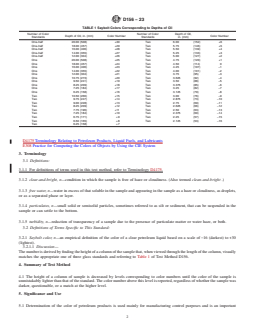
TABLE 1 Saybolt Colors Corresponding to Depths of Oil
Number of Color Number of Color Depth of Oil,
Depth of Oil, in. (mm) Color Number Color Number
Standards Standards in. (mm)
One-half 20.00 (508) +30 Two 6.00 (152) +6
One-half 18.00 (457) +29 Two 5.75 (146) +5
One-half 16.00 (406) +28 Two 5.50 (139) +4
One-half 14.00 (355) +27 Two 5.25 (133) +3
One-half 12.00 (304) +26 Two 5.00 (127) +2
One 20.00 (508) +25 Two 4.75 (120) +1
One 18.00 (457) +24 Two 4.50 (114) 0
One 16.00 (406) +23 Two 4.25 (107) −1
One 14.00 (355) +22 Two 4.00 (101) −2
One 12.00 (304) +21 Two 3.75 (95) −3
One 10.75 (273) +20 Two 3.625 (92) −4
One 9.50 (241) +19 Two 3.50 (88) −5
One 8.25 (209) +18 Two 3.375 (85) −6
One 7.25 (184) +17 Two 3.25 (82) −7
One 6.25 (158) +16 Two 3.125 (79) −8
Two 10.50 (266) +15 Two 3.00 (76) −9
Two 9.75 (247) +14 Two 2.875 (73) −10
Two 9.00 (228) +13 Two 2.75 (69) −11
Two 8.25 (209) +12 Two 2.625 (66) −12
Two 7.75 (196) +11 Two 2.50 (63) −13
Two 7.25 (184) +10 Two 2.375 (60) −14
Two 6.75 (171) +9 Two 2.25 (57) −15
Two 6.50 (165) +8 Two 2.125 (53) −16
Two 6.25 (158) +7
the length of the column, visually matches the appropriate one and with acetone or some other suitable solvent, and dry.
of three glass standards and referring to Table 1 of Test Method Assemble the oil tube, and position the tubes in the instrument.
D156.
7.2 Using the specified light source and illumination, ob-
serve the comparative light intensity of the two halves of the
4. Summary of Test Method
optical field, with both tubes empty, and with the 12 mm
4.1 The height of a column of sample is decreased by levels
diaphragm removed from under the plain tube. The intensity of
corresponding to color numbers until the color of the sample is
light observed in each half of the optical field must be the
unmistakably lighter than that of the standard. The color
same. Adjustment in the position of the light source may be
number above this level is reported, regardless of whether the
necessary to achieve this match.
sample was darker, questionable, or a match at the higher level.
NOTE 3—On some instruments, removal of the 12 mm diaphragm can
prevent the assembly from seating against the base (about a ⁄4 in. gap),
5. Significance and Use
which can let a lot of stray light in that may affect the light intensity when
trying to compare the two halves of the optical field in 7.2. If this occurs,
5.1 Determination of the color of petroleum products is used
follow the procedure in 7.3 (where the 12 mm diaphragm has been
mainly for manufacturing control purposes and is an important
reattached) as the basis to ensure the light source has been properly set to
quality characteristic since color is readily observed by the user
provide the same light intensity in both halves of the optical field.
of the product. In some cases the color may serve as an
7.3 Replace the 12 mm diaphragm under the plain tube, and
indication of the degree of refinement of the material. When the
fill the oil tube to the 20 in. (508 mm) mark with distilled or
color range of a particular product is known, a variation outside
deionized water. The intensity of the light observed in each half
the established range can indicate possible contamination with
of the optical field must be the same, for the instrument to be
another product. However, color is not always a reliable guide
judged satisfactory for use. The optical properties of glass,
to product quality and should not be used indiscriminately in
from different batches, can vary significantly and it is recom-
product specifications.
mended that only matched tubes, such as described in the
Appendix, be used in this test. When a tube is broken, replace
6. Apparatus
both tubes with a matched pair of tubes.
6.1 The Saybolt chromometer consisting of sample and
8. Sampling
standard tubes, optical system, light source, and color
standards, is described in detail in Annex A1 and illustrated in
8.1 Samples shall be taken in accordance with the instruc-
Fig. A1.1.
tions in Practice D4057.
7. Standardization of Apparatus 9. Preparation of Test Specimen
7.1 Remove the glass disk from the bottom of the oil tube. 9.1 Samples (Excluding Waxes)—If the sample is contained
Clean the disk, oil tube, and plain tube. When deposits are not in a clear, transparent container, such as glass bottle, visually
removable by wiping or solvent rinsing, wash with soap and inspect the sample for evidence of free water, particulate
water. After cleaning, rinse with distilled or deionized water contamination, and haze by holding the container up to the
D156 − 23
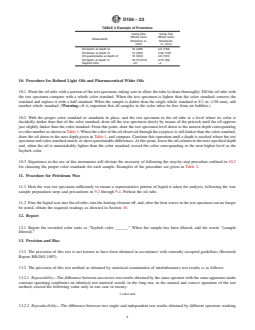
TABLE 2 Example of Procedure
light. If the sample is contained in a nontransparent container,
shake or agitate the sample container vigorously to uniformly Using One Using Two
Whole Color Whole Color
suspend any free water that may be present in the sample
Observation
Standard, in. Standards,
before transferring a portion to a clear, transparent container to
(mm) in. (mm)
conduct the visual inspection before proceeding.
Oil darker at depth of 16 (406) 4.5 (102)
Oil darker at depth of 14 (355) 4.25 (107)
9.2 Wax Samples—Carry out the same procedure in 9.1,
Oil questionable at depth of 12 (304) 4.0 (101)
except that the sample is to be heated to a temperature just
Oil lighter at depth of 10.75 (273) 3.75 (95)
Saybolt color +21 −2
enough to ensure the sample is liquid (see 9.4). (Warning—
Take appropriate safety precautions in handling the sample at
elevated temperatures.)
9.3 When the sample is not clear-and-bright (that is, visual
11. Procedure for Petroleum Wax
inspection in 9.1 or 9.2 shows any presence of turbidity, free
water, or particulates, or a combination thereof), filter through
11.1 Heat the wax test specimen sufficiently to ensure a
a sufficient number of qualitative filter papers until it is clear.
representative portion of liquid is taken for analysis, following
For wax samples requiring filtration, it will be necessary to
the wax sample preparation steps and precautions in 9.2
heat the filter paper and apparatus (for example, a filter funnel)
through 9.4. Preheat the oil tube.
that can come in contact with the molten sample to a
11.2 Pour the liquid wax into the oil tube; turn the heating
temperature sufficient to prevent the sample from solidifying
element off, and, after the heat waves in the test specimen can
during the filtration process (see 9.4).
no longer be noted, obtain the required readings as directed in
9.4 When preparing petroleum wax for testing do not heat
Section 10.
excessively, because oxidation can occur, with consequent
discoloration of the test specimen. A sample heated to a
12. Report
temperature of 8 °C to 17 °C above its congealing point as
12.1 Report the recorded color units as “Saybolt color
determined in accordance with Test Method D938, has been
______.” When the sample has been filtered, add the words
found suitable to test samples using this test method.
“(sample filtered).”
10. Procedure for Refined Light Oils and Pharmaceutical
13. Precision and Bias
White Oils
13.1 The precision of this test is not known to have been
10.
...
This document is not an ASTM standard and is intended only to provide the user of an ASTM standard an indication of what changes have been made to the previous version. Because
it may not be technically possible to adequately depict all changes accurately, ASTM recommends that users consult prior editions as appropriate. In all cases only the current version
of the standard as published by ASTM is to be considered the official document.
Designation: D156 − 15 D156 − 23
Standard Test Method for
Saybolt Color of Petroleum Products (Saybolt Chromometer
Method)
This standard is issued under the fixed designation D156; the number immediately following the designation indicates the year of
original adoption or, in the case of revision, the year of last revision. A number in parentheses indicates the year of last reapproval. A
superscript epsilon (´) indicates an editorial change since the last revision or reapproval.
This standard has been approved for use by agencies of the U.S. Department of Defense.
1. Scope*
1.1 This test method covers the determination of the color of refined oils such as undyed motor and aviation gasoline, jet
propulsion fuels, naphthas and kerosine, and, in addition, petroleum waxes and pharmaceutical white oils.
NOTE 1—For determining the color of petroleum products darker than Saybolt Color − 16, see Test Method D1500.
1.2 This test method reports results specific to this test method and recorded as, “Saybolt Color units.”
1.3 The values stated in inch-pound units or in SI units and which are not in parentheses are to be regarded as the standard. The
values given in parentheses are for information only.
NOTE 2—Oil tubes and apparatus used in this test method have traditionally been marked in inches, (the tube is required to be etched with ⁄8 in. divisions.)
1 1 1
The Saybolt Color Numbers are aligned with inch, ⁄2 in., ⁄4 in., and ⁄8 in. changes in the depth of oil. These fractional inch changes do not readily
correspond to SI equivalents and in view of the preponderance of apparatus already in use and marked in inches, the inch/pound unit is regarded as the
standard. However the test method does use SI units of length when the length is not directly related to divisions on the oil tube and Saybolt Color
Numbers. The test method uses SI units for temperature.
1.4 This standard does not purport to address all of the safety concerns, if any, associated with its use. It is the responsibility
of the user of this standard to establish appropriate safety and healthsafety, health, and environmental practices and determine
the applicability of regulatory limitations prior to use.
1.5 This international standard was developed in accordance with internationally recognized principles on standardization
established in the Decision on Principles for the Development of International Standards, Guides and Recommendations issued
by the World Trade Organization Technical Barriers to Trade (TBT) Committee.
2. Referenced Documents
2.1 ASTM Standards:
D938 Test Method for Congealing Point of Petroleum Waxes, Including Petrolatum
D1500 Test Method for ASTM Color of Petroleum Products (ASTM Color Scale)
D4057 Practice for Manual Sampling of Petroleum and Petroleum Products
This test method is under the jurisdiction of ASTM Committee D02 on Petroleum Products, Liquid Fuels, and Lubricants and is the direct responsibility of Subcommittee
D02.05 on Properties of Fuels, Petroleum Coke and Carbon Material.
Current edition approved April 1, 2015Oct. 1, 2023. Published April 2015October 2023. Originally approved in 1923. Last previous edition approved in 20122015 as
D156 – 12.D156 – 15. DOI: 10.1520/D0156-15.10.1520/D0156-23.
For referenced ASTM standards, visit the ASTM website, www.astm.org, or contact ASTM Customer Service at service@astm.org. For Annual Book of ASTM Standards
volume information, refer to the standard’s Document Summary page on the ASTM website.
*A Summary of Changes section appears at the end of this standard
Copyright © ASTM International, 100 Barr Harbor Drive, PO Box C700, West Conshohocken, PA 19428-2959. United States
D156 − 23
TABLE 1 Saybolt Colors Corresponding to Depths of Oil
Number of Color Number of Color Depth of Oil,
Depth of Oil, in. (mm) Color Number Color Number
Standards Standards in. (mm)
One-half 20.00 (508) +30 Two 6.00 (152) +6
One-half 18.00 (457) +29 Two 5.75 (146) +5
One-half 16.00 (406) +28 Two 5.50 (139) +4
One-half 14.00 (355) +27 Two 5.25 (133) +3
One-half 12.00 (304) +26 Two 5.00 (127) +2
One 20.00 (508) +25 Two 4.75 (120) +1
One 18.00 (457) +24 Two 4.50 (114) 0
One 16.00 (406) +23 Two 4.25 (107) −1
One 14.00 (355) +22 Two 4.00 (101) −2
One 12.00 (304) +21 Two 3.75 (95) −3
One 10.75 (273) +20 Two 3.625 (92) −4
One 9.50 (241) +19 Two 3.50 (88) −5
One 8.25 (209) +18 Two 3.375 (85) −6
One 7.25 (184) +17 Two 3.25 (82) −7
One 6.25 (158) +16 Two 3.125 (79) −8
Two 10.50 (266) +15 Two 3.00 (76) −9
Two 9.75 (247) +14 Two 2.875 (73) −10
Two 9.00 (228) +13 Two 2.75 (69) −11
Two 8.25 (209) +12 Two 2.625 (66) −12
Two 7.75 (196) +11 Two 2.50 (63) −13
Two 7.25 (184) +10 Two 2.375 (60) −14
Two 6.75 (171) +9 Two 2.25 (57) −15
Two 6.50 (165) +8 Two 2.125 (53) −16
Two 6.25 (158) +7
D4175 Terminology Relating to Petroleum Products, Liquid Fuels, and Lubricants
E308 Practice for Computing the Colors of Objects by Using the CIE System
3. Terminology
3.1 Definitions:
3.1.1 For definitions of terms used in this test method, refer to Terminology D4175.
3.1.2 clear-and-bright, n—condition in which the sample is free of haze or cloudiness. (Also termed clean-and-bright .)
3.1.3 free water, n—water in excess of that soluble in the sample and appearing in the sample as a haze or cloudiness, as droplets,
or as a separated phase or layer.
3.1.4 particulates, n—small solid or semisolid particles, sometimes referred to as silt or sediment, that can be suspended in the
sample or can settle to the bottom.
3.1.5 turbidity, n—reduction of transparency of a sample due to the presence of particulate matter or water haze, or both.
3.2 Definitions of Terms Specific to This Standard:
3.2.1 Saybolt color, n—an empirical definition of the color of a clear petroleum liquid based on a scale of −16 (darkest) to +30
(lightest).
3.2.1.1 Discussion—
The number is derived by finding the height of a column of the sample that, when viewed through the length of the column, visually
matches the appropriate one of three glass standards and referring to Table 1 of Test Method D156.
4. Summary of Test Method
4.1 The height of a column of sample is decreased by levels corresponding to color numbers until the color of the sample is
unmistakably lighter than that of the standard. The color number above this level is reported, regardless of whether the sample was
darker, questionable, or a match at the higher level.
5. Significance and Use
5.1 Determination of the color of petroleum products is used mainly for manufacturing control purposes and is an important
D156 − 23
quality characteristic since color is readily observed by the user of the product. In some cases the color may serve as an indication
of the degree of refinement of the material. When the color range of a particular product is known, a variation outside the
established range can indicate possible contamination with another product. However, color is not always a reliable guide to
product quality and should not be used indiscriminately in product specifications.
6. Apparatus
6.1 The Saybolt chromometer consisting of sample and standard tubes, optical system, light source, and color standards, is
described in detail in Annex A1 and illustrated in Fig. A1.1.
7. Standardization of Apparatus
7.1 Remove the glass disk from the bottom of the oil tube. Clean the disk, oil tube, and plain tube. When deposits are not
removable by wiping or solvent rinsing, wash with soap and water. After cleaning, rinse with distilled or deionized water and with
acetone or some other suitable solvent, and dry. Assemble the oil tube, and position the tubes in the instrument.
7.2 Using the specified light source and illumination, observe the comparative light intensity of the two halves of the optical field,
with both tubes empty, and with the 12 mm diaphragm removed from under the plain tube. The intensity of light observed in each
half of the optical field must be the same. Adjustment in the position of the light source may be necessary to achieve this match.
NOTE 3—On some instruments, removal of the 12 mm diaphragm can prevent the assembly from seating against the base (about a ⁄4 in. gap), which can
let a lot of stray light in that may affect the light intensity when trying to compare the two halves of the optical field in 7.2. If this occurs, follow the
procedure in 7.3 (where the 12 mm diaphragm has been reattached) as the basis to ensure the light source has been properly set to provide the same light
intensity in both halves of the optical field.
7.3 Replace the 12 mm diaphragm under the plain tube, and fill the oil tube to the 20 in. (508 mm) mark with distilled or deionized
water. The intensity of the light observed in each half of the optical field must be the same, for the instrument to be judged
satisfactory for use. The optical properties of glass, from different batches, can vary significantly and it is recommended that only
matched tubes, such as described in the Appendix, be used in this test. When a tube is broken, replace both tubes with a matched
pair of tubes.
8. Sampling
8.1 Samples shall be taken in accordance with the instructions in Practice D4057.
9. Preparation of Test Specimen
9.1 Samples (Excluding Waxes)—If the sample is contained in a clear, transparent container, such as glass bottle, visually inspect
the sample for evidence of free water, particulate contamination, and haze by holding the container up to the light. If the sample
is contained in a nontransparent container, shake or agitate the sample container vigorously to uniformly suspend any free water
that may be present in the sample before transferring a portion to a clear, transparent container to conduct the visual inspection
before proceeding.
9.2 Wax Samples—Carry out the same procedure in 9.1, except that the sample is to be heated to a temperature just enough to
ensure the sample is liquid (see 9.4). (Warning—Take appropriate safety precautions in handling the sample at elevated
temperatures.)
9.3 When the sample is not clear-and-bright (that is, visual inspection in 9.1 or 9.2 shows any presence of turbidity, free water,
or particulates, or a combination thereof), filter through a sufficient number of qualitative filter papers until it is clear. For wax
samples requiring filtration, it will be necessary to heat the filter paper and apparatus (for example, a filter funnel) that can come
in contact with the molten sample to a temperature sufficient to prevent the sample from solidifying during the filtration process
(see 9.4).
9.4 When preparing petroleum wax for testing do not heat excessively, because oxidation can occur, with consequent discoloration
of the test specimen. A sample heated to a temperature of 8 °C to 17 °C above its congealing point as determined in accordance
with Test Method D938, has been found suitable to test samples using this test method.
D156 − 23
TABLE 2 Example of Procedure
Using One Using Two
Whole Color Whole Color
Observation
Standard, in. Standards,
(mm) in. (mm)
Oil darker at depth of 16 (406) 4.5 (102)
Oil darker at depth of 14 (355) 4.25 (107)
Oil questionable at depth of 12 (304) 4.0 (101)
Oil lighter at depth of 10.75 (273) 3.75 (95)
Saybolt color +21 −2
10. Procedure for Refined Light Oils and Pharmaceutical White Oils
10.1 Flush the oil tube with a portion of the test specimen, taking care to allow the tube to drain thoroughly. Fill the oil tube with
the test specimen compare with a whole color standard. When the test specimen is lighter than the color standard, remove the
standard and replace it with a half standard. When the sample is darker than the single whole standard at 6 ⁄4 in. (158 mm), add
another whole standard. (Warning—It is important that all samples in the color tubes be free from air bubbles.)
10.2 With the proper color standard or standards in place, and the test specimen in the oil tube at a level where its color is
decidedly darker than that of the color standard, draw off
...